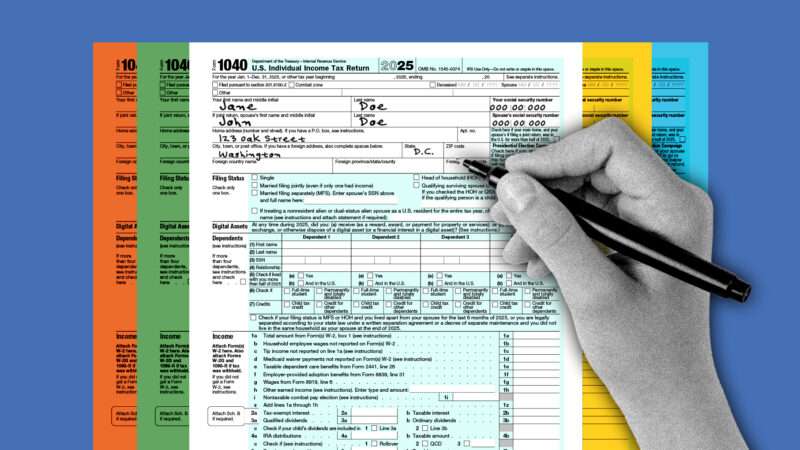
Happy Tax Day, if such a thing can exist. Today marks the last day that most Americans can file their taxes with Uncle Sam or else face financial consequences.
For most people, tax filing is stressful and messy. And even though average refunds are expected to significantly jump thanks to the GOP’s sprawling tax bill from last year, nearly 60 percent of Americans say taxes are still too high, according to a new Gallup poll. But the burden of paying taxes is more than monetary. Here are four other reasons to loathe tax season.
1. Filing Taxes Can Cost Significant Resources
In addition to spending about $290 on out-of-pocket costs, the average American dedicates 13 hours of their time filing an individual tax return, according to the National Taxpayers Union Foundation. Americans can thank their government for this. As Reason’s Joe Lancaster noted in 2024, “The amount of effort and expense required is due to the tax code’s complexity.” Since 1955, the length of the documents detailing the federal tax code and regulations has increased by about 144,500 words a year, according to estimates by the Tax Foundation.
2. What Counts as ‘Income’ May Surprise You
The government’s desire for your money knows no bounds. If you did your civic duty by reporting for jury duty, you have to pay taxes on the jury duty income and report it on the “other” income section of your 1040 form. If you sell stamps and make a profit from your philatelic activities, you need to report those capital gains to the IRS. Even working with a travel agency can cost you: If you organize a tour for a big group through an agency, and the agency throws in a complimentary tour, it’s not free. You have to report the value of the tour as income. Reward money earned from giving the police a hot tip must be counted as income and taxed by the government. If you profited from illegal activities or stole something, Uncle Sam wants to know about it. There is, however, a notable exception to reporting illegal goods. If you return a stolen item within a year, you do not have to report its value as income.
3. Taxes Are Wielded as Tools of Social Engineering
As Reason Contributing Editor Veronique de Rugy notes, “The tax code is neither fair nor neutral. It punishes and rewards all sorts of behaviors based on what government officials decide is good or bad.” Depending on a couple’s income levels, getting married could increase or decrease a couple’s tax bill. Child tax credits, which have now increased to $2,200 per child under the One Big Beautiful Bill Act, favor parents over childless adults by design. The tax code has not only attempted to impact family planning, but major purchases, too. During the Biden administration, taxpayers were incentivized to buy electric cars with generous tax credits that could reduce a filer’s tax liability come tax season. The credits have since expired.
4. The System Hides Government Spending
Under the withholding system, employers withhold income taxes from paychecks and send them to the government to finance spending initiatives. While this might reduce someone’s liability, it also insulates taxpayers from understanding the full breadth of the federal government’s spending. Before the withholding system, Americans paid their income taxes in a lump sum, which forced taxpayers to reckon with the crushing cost of government (although income taxes were much lower back then). Then, during World War II, a group of Treasury Department economists, including Milton Friedman, created the withholding system to raise taxes during wartime. Friedman later told Reason that it was a “great mistake” to keep the withholding system during peacetime, and he wished he could have abolished it after the war.
The post 60% of Americans Agree Taxes Are Too High. Here Are 4 Other Reasons To Hate the Tax System. appeared first on Reason.com.
from Latest – Reason.com https://ift.tt/qTcFB2h
via IFTTT