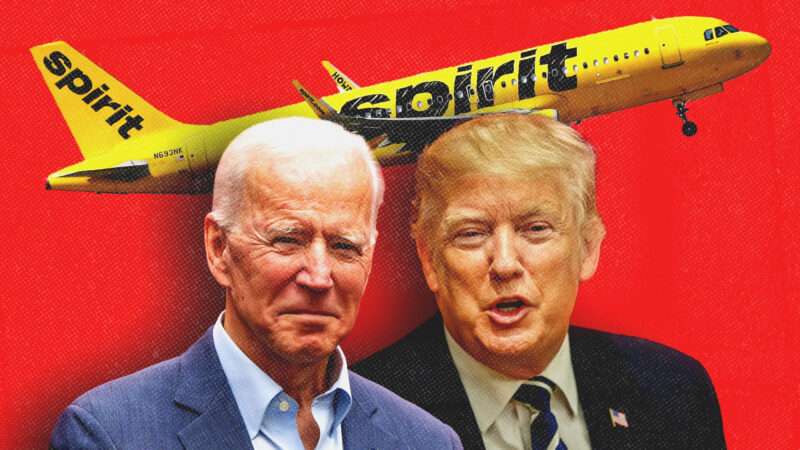
President Donald Trump is reportedly set to add an airline to the stable of private companies he’s demanded the government take a piece of.
“The Trump administration is in advanced discussions with budget carrier Spirit Airlines about a bailout,” CBS News reports. “The financing package could include a loan of up to $500 million, in exchange for warrants that would allow the federal government to take a potentially substantial ownership stake in the beleaguered airline.” A source told NBC News the government could end up owning as much as 90 percent of the company.
Americans should oppose any bailout of a private company with public funds—not to mention the government taking an ownership stake. But this one is especially galling, because Spirit had a lifeline: Competing airline JetBlue agreed to buy the struggling company. But Trump’s predecessor, Joe Biden, killed the deal in court.
Now, as both companies struggle, Trump is expending further taxpayer funds to bail out a private company that could have been saved before.
In July 2022, the companies announced that JetBlue would acquire Spirit, famous for its low fares and few frills. The acquisition would cost about $3.8 billion, plus another $3.8 billion to cover Spirit’s debts.
The deal, Spirit then-CEO Ted Christie said at the time, would “create the most compelling national low-fare challenger to the dominant U.S. carriers.”
In the 12 months ending January 2026, the four largest airlines—Delta, American, Southwest, and United—collectively accounted for more than two-thirds of all domestic air travel, according to the Bureau of Transportation Statistics.
JetBlue, on the other hand, accounted for 4.6 percent, with Spirit trailing at 3.4 percent. Even the companies’ combined traffic would account for just over half of one of the four larger airlines’ shares.
That, apparently, was too much for the Biden administration. In March 2023, the Department of Justice (DOJ) sued to stop the merger. “JetBlue’s acquisition of Spirit would eliminate the ‘Spirit Effect,’ where Spirit’s presence in a market forces other air carriers, including JetBlue, to lower their fares,” per a DOJ press release. “This will lead to higher fares and fewer seats, harming millions of consumers on hundreds of routes.”
As The Washington Post noted, it was “the first time a challenge to an airline merger has gone to court.”
“This is not Pepsi buying Coke,” JetBlue then-CEO Robin Hayes said ahead of the trial. “Together, we are going to be 8-9% of the market…a distant fifth-largest airline.”
Besides, there were more reasons for the merger than just consolidation: Spirit was struggling. The company lost more than $300 million in the second half of 2022. A merger could have saved the company or at least kept it afloat.
Ultimately, the court sided with the government and blocked the deal. “A post-merger, combined firm of JetBlue and Spirit would likely place stronger competitive pressure on the larger airlines in the country,” U.S. District Judge William G. Young wrote in the decision. “At the same time, however, the consumers that rely on Spirit’s unique, low-price model would likely be harmed.”
Young felt that since JetBlue and Spirit currently compete in many of the same markets, a merger would deprive consumers in those markets of choice and competition. As such, he determined the merger would violate the Clayton Antitrust Act of 1914, which prohibits anti-competitive mergers.
“Spirit is a small airline,” Young concluded. “But there are those who love it. To those dedicated customers of Spirit, this one’s for you. Why? Because the Clayton Act, a 109-year-old statute requires this result—a statute that continues to deliver for the American people.”
Then-U.S. Attorney General Merrick Garland called the merger’s failure “yet another victory for the Justice Department’s work on behalf of American consumers.” Assistant Attorney General Jonathan Kanter of the Department of Justice Antitrust Division added that it was “a victory for U.S. travelers who deserve lower prices and better choices.”
Of course, it wasn’t a victory for everybody: Within two days of Young’s decision, Spirit’s stock price fell by more than two-thirds. Over the next few months, it filed for bankruptcy—twice—while laying off hundreds of employees and ending flights to 11 cities.
JetBlue isn’t thriving, either. Amid rising debt and higher fuel costs, JetBlue founder David Neelman said privately that the company was “in a really tough spot,” and if it faced bankruptcy and needed to find a buyer, it would have “very few options.” (Then again, maybe he has nothing to worry about: If it fails while Trump is still in office, maybe the federal government will buy JetBlue, too.)
That’s where Spirit found itself this week, when Trump told CNBC, “Spirit’s in trouble….Maybe the federal government should help that one out.″ Trump also said, “I don’t mind mergers. I think I’d love somebody to buy Spirit,” which Cato Institute policy analyst Tad DeHaven notes “is painfully ironic given that the Biden administration prevented precisely that from happening.”
DeHaven added that the JetBlue–Spirit merger provides a perfect example “of policy uncertainty from one administration to the next.” But in another way, it’s perfectly consistent: In this scenario, the Biden and Trump administrations both chose central planning over free markets.
The post Biden Killed the Spirit Airlines Merger. Now Trump Wants Taxpayers To Save It. appeared first on Reason.com.
from Latest – Reason.com https://ift.tt/G6duaLV
via IFTTT