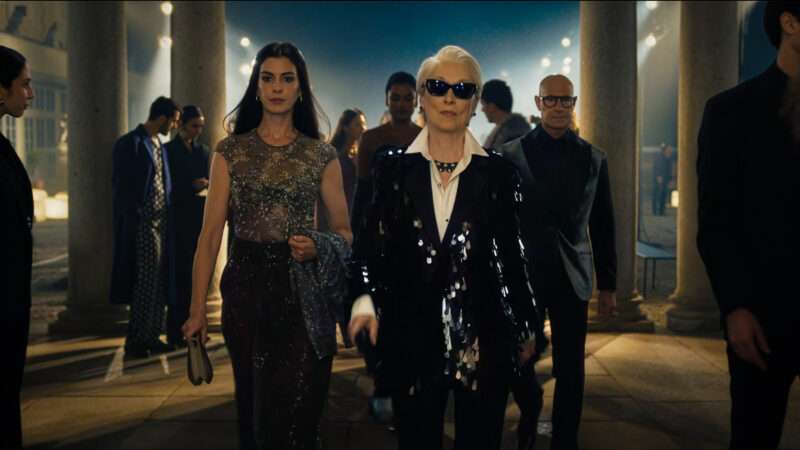
Normally, I am against content labels for media, but I might have to make an exception for The Devil Wears Prada 2. This movie should come with a trigger warning, at least for millennial journalists. The fizzy, frothy comedy is also a jewel-box encapsulation of a generation’s broken dreams, told through the decline of magazine journalism.
The film opens at a journalistic awards ceremony, one of those rubber chicken dinners where journalists give each other plastic trophies to honor worthy (but often little-read) work. Just as our heroine, Andy Sachs (a perky, perfectly neurotic Anne Hathaway), accepts the top honor, she receives a text. Everyone at her table has been fired as part of a corporate cost-cutting deal. Andy makes tearful remarks and goes off to mourn her job and the industry.
At the same time, Andy’s old nemesis, the fearsome Miranda Priestly—the formidable editor of the (former) fashion powerhouse Runway—is facing a scandal for running a puff piece about a dicey fast fashion company. Runway‘s owner sees Andy’s speech, which has gone viral, and offers her a job as the magazine’s features editor in an attempt to revitalize the publication’s journalistic credibility.
The setup is somewhat strained, but the important thing is that it quickly brings Andy back into Miranda’s orbit, renewing the cat-and-mouse dynamic that drove its hit predecessor.
The Devil Wears Prada was released in 2006, before smartphones, before the publishing industry crashed, before everything went online. Watching it now is like finding a buried time capsule, every detail a precise signifier: Andy’s fling is not just a successful magazine journalist, but a freelancer. Her friends drink wine and Cosmopolitans. Andy even wears a toe ring.
Much of that movie’s tension was about journalistic values: She wanted to be a serious reporter, but by working at Runway, she learned that fashion has value too.
This late-breaking sequel inverts that idea. The question it poses is whether either journalism or fashion matters anymore.
Yes, is the movie’s emphatic answer. But the film is also honest enough to acknowledge that neither journalism nor fashion have the cultural cache they used to. The first film was a breezy coming-of-age fantasy about a young woman making her way in the hustle and bustle of the world’s greatest metropolis. The sequel is about what happens when the world has changed, and those hopes seem dashed.
And it’s not just Andy who has lost something. Miranda, once again played by Meryl Streep, used to be the queen of her domain, which was everything everyone wore. But she’s been reduced to something smaller: hanging her own coat, trying to avoid H.R. complaints about political correctness, and begging advertisers for forgiveness while refusing to put up a fight against the tasteless tech-and-money men who control her fate. Streep made Miranda an exquisite terror in the first film, but there’s a kind of powerlessness to her now, a sense of fading glory in a world that has passed her by.
The Devil Wears Prada 2 is never maudlin, but it’s quite sentimental. It doesn’t have much sympathy for economic dynamism or technological change. Nor does it acknowledge the actually good fortunes that American millennials have experienced; we are far richer than our parents were at this stage of life, and far more materially comfortable in nearly every way.
I’m normally annoyed with such static, pessimistic, nostalgia-tinged worldviews, but as a mid-40s journalist who moved to a city to write for magazines at almost the exact same time that the fictional Andy did, I can’t view this one from a distance. I’m way too close to the story.
And if you look closely, the movie isn’t simply arguing for nostalgia to rule. A key scene comes when Andy meets a new love interest, a handsome contractor who modernizes old urban buildings that were going to be torn down. She argues that he’s destroying history; he makes a convincing rebuttal that he’s actually preserving it by making it new. She ends up falling for him—and moving into one of his apartments. Is this an act of betrayal? Or is Andy just making peace with a world in constant flux?
The movie suggests that beautiful, human things like clothing and stories and buildings still matter and will always matter—and that it’s up to those who care, and have the means, to support them. I don’t want to spoil things, but the billionaire class comes through in the end.
The Devil Wears Prada 2 may not quite be the great millennial journalism movie, but it comes surprisingly close. Consider yourself warned.
The post Is <i>The Devil Wears Prada 2</i> the Great Millennial Journalism Movie? appeared first on Reason.com.
from Latest – Reason.com https://ift.tt/a6BkrUc
via IFTTT