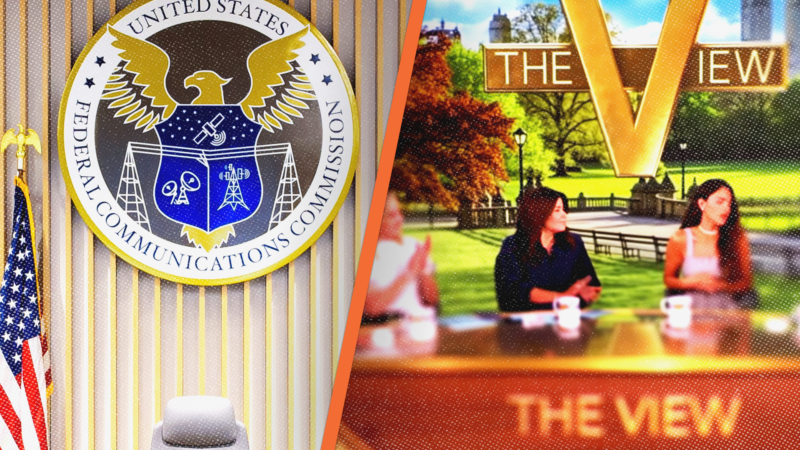
President Donald Trump is not a fan of The View, an ABC talk show whose panelists frequently criticize him. Neither is Brendan Carr, the Trump-appointed chairman of the Federal Communications Commission (FCC), who has suggested that the show could face regulatory consequences because of its political bias. Specifically, Carr is threatening to revoke The View‘s exemption from the “equal time” rule, which in practice would amount to a ban on interviews with candidates for public office.
That threat, ABC argues in an FCC petition filed on Friday, is blatantly inconsistent with the First Amendment, which protects the editorial discretion of news and opinion outlets. Notably, ABC is represented by Paul Clement, a veteran Supreme Court litigator who served as solicitor general during the George W. Bush administration. Clement says the “equal time” rule itself “raises profound First Amendment concerns,” a problem that will be aggravated if the FCC reverses its longstanding policy of exempting talk shows like The View.
Under 47 USC 315, a TV or radio station that gives airtime to “a legally qualified candidate for any public office” must “afford equal opportunities” to all other candidates for that office. Universal application of that requirement would have a crippling impact on news coverage. If a station aired an interview with one of the leading candidates for California governor, for example, it would also have to accommodate the 60 other candidates on the ballot.
Congress recognized the chilling impact of that situation in 1959, when it added a “bona fide news exemption” to Section 315. Under current law, the “equal time” rule does not apply to a “bona fide newscast,” a “bona fide news interview,” a “bona fide news documentary” (provided the candidate’s appearance is “incidental” to coverage of other subjects), or “on-the-spot coverage of bona fide news events” such as political conventions.
Since 1984, when the FCC granted a “bona fide news interview” exemption to Phil Donahue’s daytime talk show, it has given similar leeway to a wide range of programs, including Geraldo, Sally Jessy Raphael, Later With Bob Costas, The Jerry Springer Show, The Howard Stern Show, and The Tonight Show. In 2002, the FCC added The View to that list based on the three-part test it has been applying for decades, which allows an exemption for any “regularly scheduled” show when its content is controlled by its producers and their decisions are based on judgments of newsworthiness.
Carr wants to change that test. “For years,” he complained on X in January, “legacy TV networks assumed that their late night & daytime talk shows qualify as ‘bona fide news’ programs—even when motivated by purely partisan political purposes. Today, the FCC reminded them of their obligation to provide all candidates with equal opportunities.”
That “reminder” was a public notice that claimed to provide “guidance on the application of the statutory equal opportunities requirement and the bona fide news exemptions to broadcast television stations, including their airing of late night and daytime talk shows.” Although “a wide variety of shows can be eligible” for the “bona fide news interview” exemption, the commission’s Media Bureau said, “the FCC has not been presented with any evidence that the interview portion of any late night or daytime television talk show program on air presently would qualify.”
A program “motivated by partisan purposes,” the FCC warned, “would not be entitled to an exemption.” Or as Carr put it at a press conference in January, “If you’re fake news, you’re not going to qualify [for] the bona fide news exception.” And as Carr sees it, a program is “fake news” when it is biased against his boss.
The FCC’s notice said “any program or station that wishes to obtain formal assurance that the equal opportunities requirement does not apply (in whole or in part) is encouraged to promptly file a petition for declaratory ruling that satisfies the statutory requirements for a bona fide news exemption.” At the end of March, the FCC went beyond encouragement, ordering KTRK, the ABC-owned station in Houston, to file such a petition regarding The View.
The ostensible impetus for that order was the show’s February 2 interview with James Talarico, a Texas state legislator who would later win the Democratic nomination in that state’s U.S. Senate race. The FCC’s Media Bureau instructed KTRK to submit “a petition for declaratory ruling regarding The View that satisfies the statutory requirements for a bona fide news exemption.”
The Media Bureau “lacks the authority to issue an order mandating a licensee to file a petition for declaratory ruling,” Clement argues. But that is by no means his only objection.
The FCC’s actions “threaten to upend decades of settled law and practice and chill critical protected speech, both with respect to The View and more broadly,” Clement says. “The View has been broadcasting under a bona fide news exemption granted to it more than twenty years ago, consistent with longstanding Commission interpretations designed to minimize the serious First Amendment problems inherent in the equal time regime. The View‘s exemption remains valid and the constitutional infirmities in the equal time doctrine are even more pronounced today, when the broadcast airwaves account for a slice of the numerous media options through which Americans get their political information.”
Clement is referring to the dramatic changes in the U.S. media landscape since the Supreme Court’s 1969 ruling in Red Lion Broadcasting v. FCC, which upheld the “personal attack” prong of the Fairness Doctrine. “Although broadcasting is clearly a medium affected by a First Amendment interest, differences in the characteristics of new media justify differences in the First Amendment standards applied to them,” Justice Byron White wrote for the unanimous Court. “Because of the scarcity of radio frequencies, the Government is permitted to put restraints on licensees in favor of others whose views should be expressed on this unique medium.”
That “scarcity” rationale for FCC regulation of broadcast content never made much sense, and it has not aged well. “The marketplace of ideas has never been more robust,” Clement notes. “People can hear virtually any brand of political commentary by listening to a podcast, watching cable, scrolling social media, or streaming on a phone, computer or connected TV. The free flow of ideas flourishes on these non-broadcast platforms even though the equal opportunities rule does not apply there.”
The Supreme Court’s rationale for upholding the Fairness Doctrine was “dubious then” and is “unsupportable now in an age of information ubiquity,” Clement says. “At a minimum, the equal opportunities rule could not survive constitutional scrutiny
without the kind of robust bona fide news exemption that the Commission has applied for decades.”
By 1985, the FCC was arguing that the proliferation of media outlets had cast doubt on the Supreme Court’s reasoning in Red Lion. Two years later, the FCC formally abandoned the Fairness Doctrine, which required that broadcasters cover public issues in an evenhanded and balanced manner. Far from promoting free and open debate, the FCC concluded, that policy had discouraged it by “inhibit[ing] the presentation of controversial issues.” The agency also noted that the Fairness Doctrine “unnecessarily restricts the journalistic freedom of broadcasters” and “creates the opportunity for intimidation of broadcasters by government officials.”
As Carr seems determined to prove, other FCC policies pose the same risk. Because broadcasters are supposed to operate in the “public interest,” Carr thinks, he has the authority to intervene whenever he believes they are falling short of that amorphous standard. In pursuit of that mission, Carr has treated editorial decisions he does not like as potential violations of the FCC’s rule against “broadcast news distortion,” demanded changes to a TV network’s journalistic practices as a condition of approving a merger, and threatened broadcasters with fines and license revocation if they failed to punish an anti-Trump comedian by suspending his show. Carr’s use of the “equal time” rule to retaliate against shows that irk him is part of that broader pattern.
Even as Carr deploys that rule against left-leaning TV shows that offend him, Clement notes, he has not shown any interest in demanding “equal opportunities” for political candidates from stations that air conservative radio shows. On February 16, for example, Mark Levin interviewed Dan Patrick, who is running for reelection as lieutenant governor of Texas. Two days later, Glenn Beck interviewed Rep. Chip Roy (R–Texas), a candidate for attorney general of Texas. Roy also appeared on the Guy Benson Show around the same time. As far as we know, none of those incidents triggered FCC inquiries.
“While The Mark Levin Show, The Glenn Beck Program, and the Guy Benson Show are all popular, long running radio talk shows, there is no indication that any of them has ever received a Declaratory Ruling that it is a bona fide news interview program,” Clement notes. Yet the FCC “has not made any public announcements that it is investigating” those shows or the stations that carry them. “Such a clear disparity in the treatment of broadcasters that ought to be subject to the same treatment under law raises serious concerns about viewpoint discrimination and retaliatory targeting,” Clement says.
Robert Corn-Revere, chief counsel at the Foundation for Individual Rights and Expression, is more blunt. “Brendan Carr’s FCC is continuing its streak of naked partisanship by wielding the agency’s power in new and laughable ways,” Corn-Revere complained in February after CBS nixed a Late Show interview with Talarico based on concerns about the FCC’s new “equal time” policy.
That policy did not extend to talk radio, Carr had said, because “there wasn’t a relevant precedent that we saw that was being misconstrued on the radio side.” Corn-Revere did not buy it: “By putting pressure on late night talk shows critical of the Trump administration while openly admitting that conservative talk radio is immune from the FCC’s ire, he’s making himself the poster boy for big government putting its thumb on the scale of political debate.”
Such meddling is plainly unconstitutional, Clement argues. “Some may dislike certain—or even most—of the viewpoints expressed on The View or similar shows,” he writes. “Such dislike, however, cannot justify using regulatory processes to restrict those views.” He warns that “uncertainty as to the scope of broadcast licensees’ editorial discretion threatens to limit news coverage of political candidates and chill core First Amendment-protected speech for years and potentially decades to come.”
Although Republicans might be inclined to cheer on Carr as he attacks TV programming they loathe, that attitude would be shortsighted as well as unprincipled. Although “it might feel good right now to threaten Jimmy Kimmel,” Sen. Ted Cruz (R–Texas) said after Carr publicly threatened TV stations that aired Kimmel’s show, “we will regret it” when similar tactics are “used to silence every conservative in America.” When the Democrats retake the White House, “they will use this power, and they will use it ruthlessly,” Cruz warned. “It is unbelievably dangerous for government to put itself in the position of saying, ‘We’re going to decide what speech we like and what we don’t, and we’re going to threaten to take you off air if we don’t like what you’re saying.'”
The same analysis applies to Carr’s “equal time” threats. “If the government is allowed to discriminate on the basis of viewpoint in a Republican administration,” Clement warns, “there is little preventing it from doing so when the Democrats are in charge.”
The post Brendan Carr's 'Equal Time' Threat Against <i>The View</i> Is Blatantly Unconstitutional, ABC Says appeared first on Reason.com.
from Latest – Reason.com https://ift.tt/E6iKOND
via IFTTT