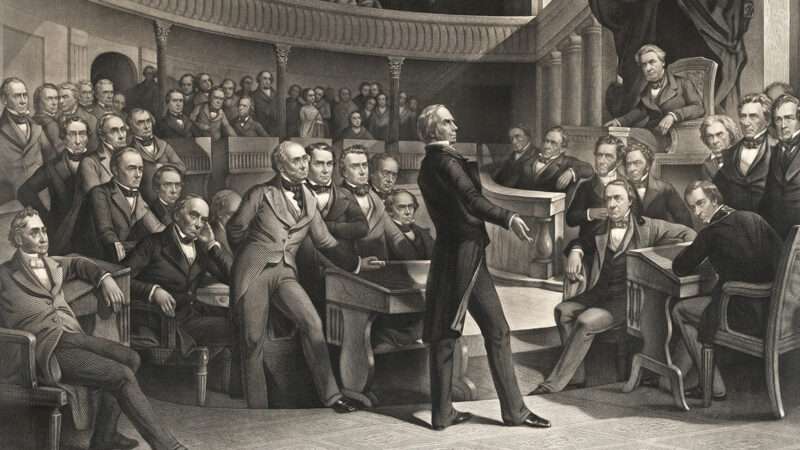
It was a Tuesday, January 29, 1850, and Sen. Henry Clay had set himself the none-too-modest goal of solving the seemingly intractable problem of American slavery once and for all.
By the Kentucky Whig’s own none-too-modest reckoning, he had nearly done that very thing once before. Thirty years earlier, while serving as speaker of the House of Representatives, Clay had been the driving force behind the landmark legislation that came to be known as the Missouri Compromise. That storied law had admitted Missouri to the Union as a slave state while simultaneously admitting Maine to the Union as a free state; it also bisected the young nation, slashing a line across the map that prohibited slavery “north of thirty-six degrees and thirty minutes north latitude” in the remaining federal territory acquired from France in the Louisiana Purchase. Clay’s legislative maneuverings had thus preserved the tenuous sectional balance between slave states and free states. The Union remained intact.
But that was then. The United States had kept on expanding in the years since, its territorial growth aided in no small part by an 1848 military triumph over Mexico. That war’s end had brought with it vast new lands that were now readying to become new states, such as California. Before such states might take their respective places in the Union, however, Congress had to confront, again, the vexing question of slavery and sectional balance.
This was no mere academic query. The nation then stood starkly divided between slave states and free states. If Congress flatly outlawed slavery in the new federal territories—as a growing number of lawmakers wanted to do—that meant Congress could prevent new slave states from forming and entering the Union. The number of free states would grow while the number of slave states would remain the same. The slaveholders and their political allies did the math and shuddered at the results.
Enter the senator from Kentucky. “I consider our country in danger,” Clay was heard to say, “and if I can be the means in any measure of averting that danger, my health and life is of little consequence.” Clay’s overriding idea, soon to be known as the Compromise of 1850, was to appease both sides by getting each to give up something to get something. “I hold in my hand a series of resolutions,” Clay announced to the Senate, which, “taken together, in combination…propose an amicable arrangement of all questions in controversy between the free and slave States, growing out of the subject of slavery.”
The most pressing of those questions was the territorial one. Would the number of future slave states keep pace with the number of future free states as the new territories formed their protostate governments? Clay’s answer harkened back to the grand political bargain he had struck in 1820. Admit California to the Union as a free state, he now urged his fellow senators, while admitting the rest of the Mexican cession “without the adoption of any restriction or condition on the subject of slavery.” It was to be a sort of Missouri Compromise redux.
Another controversial question centered on the future of slavery in Washington, D.C. Under the terms of the U.S. Constitution, Congress possessed the power to “exercise exclusive Legislation in all Cases whatsoever, over…the Seat of the Government of the United States.” Antislavery activists had long urged Congress to wield that power on behalf of human freedom by abolishing slavery in the capital city. If Congress “can pass laws ‘to prevent horses from being cruelly abused,'” the abolitionist Theodore Dwight Weld argued in 1836, then Congress “can pass laws to prevent men from being cruelly abused, and if it can prevent cruel abuse, it can define what it is. It can declare that to make men work without pay is cruel abuse, and can prohibit it.”
Weld also turned the slaveholders’ legal defense of human property on its head. According to the Fifth Amendment to the Constitution, he noted, “no person shall…be deprived of life, liberty, or property, without due process of law.” Yet who could possibly believe that an enslaved person in D.C. (or anywhere else) had received anything even approximating due process of law before being deprived of liberty? Therefore, “the slaves were deprived of liberty unconstitutionally.” And “in that case,” Weld wrote, “the constitution emancipates them.”
For the sake of argument, Weld continued, assume that the enslavers were correct about their slaves qualifying as lawful private property. In that case, he observed, Congress undoubtedly had the power to free the slaves under its additional Fifth Amendment authority to take private property “for public use” so long as “just compensation” was paid to the owners. In other words, Congress may emancipate slaves in the District of Columbia, “provided it will do something else, that is, pay for them.”
Either way, Weld maintained, the federal government’s power to abolish slavery in Washington, D.C, clearly passed constitutional muster and should be exercised immediately. Thus argued the radical abolitionist.
Clay was unwilling to go that far. “It is inexpedient to abolish slavery in the District of Columbia,” his resolution stated, “whilst that institution continues to exist in the State of Maryland, without the consent of that State, without the consent of the people of the District, and without just compensation to the owners of slaves within the District.”
Clay’s next resolution, however, would offer something desirable to the antislavery side. “It is expedient,” it held, “to prohibit within the District the slave-trade.” The public auctioning of human property within the confines of the national capital not only outraged the abolitionists; it also embarrassed the moderate factions and even discomfited some of the slaveholders then working in Congress. “In view from the windows of the Capital,” one witness later recalled, there stood a horrific sight, “a sort of negro livery-stable, where droves of negroes were collected, temporarily kept, and finally taken to Southern markets, precisely like droves of horses.” On this specific issue, Clay thought, he might have found a genuine point of agreement between the two opposing sides.
The Constitution granted other powers to Congress that antislavery activists hoped to deploy against human bondage. Among them was the power “to regulate Commerce…among the several States,” a handy authority to cite in support of a national ban on the interstate slave trade. But Clay was absolutely opposed to that. “Congress has no power,” another one of his resolutions declared, “to prohibit or obstruct the trade in slaves between the slaveholding States.” It is notable that Clay, who was known to go into great detail on other legalistic matters, did not overly trouble himself with the pesky constitutional language that seemed to fatally undermine that particular resolution.
Another big controversy around slavery that Clay’s compromise sought to settle involved “persons bound to service or labor in any State, who may escape to any other State or Territory in the Union.” This provision was intended to be an unqualified boon to the proslavery side. In its final form, the Fugitive Slave Act of 1850 stripped suspected runaways of virtually all legal protections, including their right to offer evidence in their own defense and their right to petition the courts for a writ of habeas corpus. The law thereby made it far easier for slavecatchers to seize and “return” to bondage not only actual runaways but free black persons as well. To make matters worse, when a suspected fugitive slave was brought before a government commissioner under the 1850 law, that commissioner was paid $10 for every suspect delivered to slavery yet just $5 for every suspect set free. As the abolitionist leader Frederick Douglass scornfully observed, this was “an open and palpable bribe” in favor of the slave system.
Before concluding his business before the Senate that day, Clay permitted himself a final dramatic flourish. A few days earlier, he told his audience, a stranger had visited his rooms in Washington bearing a “precious relic.” That object was none other than “a fragment of the coffin” of George Washington. Yet it was also much more than that, Clay said. It was “a warning voice,” he intoned, “coming from the grave to the Congress now in session.” It was as if the spirit of Washington himself was suddenly floating around the legislative chamber, a ghostly presence beckoning the Senate to vote in favor of Clay’s omnibus bill. To vote otherwise, Clay offered—now fully milking his final moments in the spotlight—would be to risk destroying “that Union which was cemented by [Washington’s] exertions and examples.”
Unfortunately for Clay, his spooky story did not frighten away the opposition. The “dangerous doctrines” proposed by Clay, thundered Sen. Jefferson Davis (D–Miss.), directly threatened “the local and peculiar interests which I particularly represent.” Davis was referring, of course, to the interests of slaveholders, such as himself. He demanded, “Where is the concession to the South” in Clay’s proposal? “Is it in the admission, as a state, of California, from which we have been excluded by Congressional agitation?” Or “is it by declaring that it is inexpedient to abolish slavery in the District of Columbia, unless this Federal Government make compensation to the owners of slaves—a class of property,” Davis hastened to add, “with which this Government has nothing…to do with?” In effect, Davis accused Clay of selling out the South.
Meanwhile, Sen. Salmon P. Chase (Free Soil–Ohio) accused Clay of selling out the North. “All legislation adopted or enacted by Congress for enforcing” slavery, Chase declared, “ought to be repealed, whether in this District [of Columbia] or elsewhere.” As far as Chase was concerned, the federal government should use every constitutional weapon at its disposal in the fight against slavery, from banning the interstate slave trade to outlawing slavery throughout the federal territories. Just as Davis would not bend before the antislavery provisions in Clay’s bundle of compromises, Chase would not bend before the proslavery provisions. The two senators could agree only that the omnibus deserved to fail.
On that narrow point at least, both got their wish. In its final form, the Compromise of 1850 was really no compromise at all. Clay’s resolutions were not “taken together, in combination,” as he had first proposed. The bundle was ripped apart, the various resolutions emerging as separate bills enacted by separate votes. Lawmakers like Davis could join winning coalitions in support of the proslavery resolutions, while lawmakers like Chase could join winning coalitions in support of the antislavery resolutions. Neither side backed down. In fact, the divisions and animosities only got worse. The uproar over the Compromise of 1850 would be an unpleasant taste of the bitter, raging conflict to come.
The opposing views of Jefferson Davis and Salmon P. Chase perfectly encapsulated what that raging conflict was all about. Each one claimed the U.S. Constitution as his own, yet their respective interpretations of the document were wildly antagonistic. Davis saw an inherently proslavery instrument, a compact designed from the outset to protect the interests of slaveholders on every inch of American soil. Chase saw a document brimming with liberty-minded principles and provisions, making it the natural ally of the antislavery movement. It was this unyielding intellectual duel over the meaning of the Constitution—fought by both acclaimed lawmakers and average Americans whose names have been lost to history—that pushed the political conflict over slavery past the point of no return. In the end, only the text of an antislavery constitutional amendment, backed by the force of arms, would settle the debate for good.
This article is adapted from Emancipation War: The Fall of Slavery and the Coming of the Thirteenth Amendment by Damon Root, by permission of the University of Nebraska Press. ©2026 by Damon Root.
The post Henry Clay's Deal That Was No Deal: How the Compromise of 1850 Deepened the Slavery Crisis appeared first on Reason.com.
from Latest – Reason.com https://ift.tt/OfjkhIN
via IFTTT