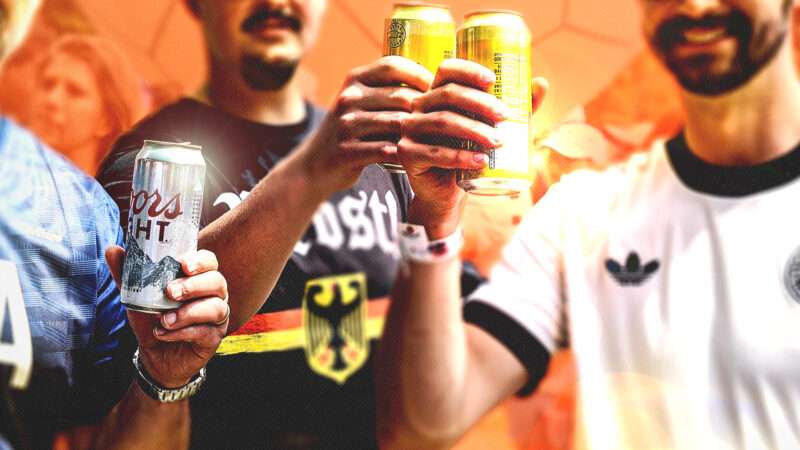
The World Cup is thus far proving to be not only a smashing success for the U.S. men’s national team, but also one for consumers in American host cities like Boston.
As is the case in most of America, the public consumption of alcohol in Boston is illegal. The city’s municipal code states that “no person shall drink any alcoholic beverage” or “possess an open container” of alcohol “while on, in or upon any public way,” in any place where the public has access, in any “park or playground, conservation area or recreation area,” with violations punishable by a fine of up to $200.
In the lead-up to the tournament, lawmakers in Massachusetts, which will host seven games throughout the World Cup at Boston Stadium (about 22 miles outside of the capital city), passed legislation temporarily extending operating hours for bars and allowing the public consumption of alcohol in designated areas. In Boston, outdoor drinking will be allowed within the social district of Union and Marshall Streets through the end of July.
“As Boston welcomes people from around the world to gather and enjoy our city this summer, these new social districts will create even more opportunities to build community and have fun responsibly. These districts help us open our streets in a safe environment for residents and visitors to enjoy themselves, ‘sip and stroll,’ and make lasting memories in our beautiful city,” Boston Mayor Michelle Wu said in a statement.
In addition to this announcement, businesses currently licensed to sell alcohol until 2 a.m. will be temporarily given permission to stay open until 3 a.m. Though the measure was supported by the city’s travel and hospitality sector, it is only temporary, and there are still an enormous number of onerous regulations Boston businesses must abide by. To participate, businesses must file a one-day amendment application with the Boston Licensing Board. Drinks must be in clear plastic cups with a label, and customers are limited to one 16-ounce alcoholic beverage. Still, the measures appear to be working well for the city’s bars that are servicing a rather thirsty Scottish fanbase.
Boston is not the only American city relaxing open-container laws for the World Cup. According to Newsweek, nine states have changed alcohol laws, including New York, Kansas, Massachusetts, Missouri, Pennsylvania, Rhode Island, Washington, Georgia, and New Jersey. Some changes extend last call—New York, for example, is allowing bars and restaurants to serve alcohol until 4 a.m.—while others open up public spaces for drinking.
While these moves are worth celebrating, it is unclear why this temporary relaxation in rules cannot be made permanent. Adults who can be trusted to drink in a bar, at a private party, or inside a stadium do not suddenly become incapable of responsible behavior the moment they step onto the street. If Boston can allow residents and visitors to “sip and stroll” safely for a few weeks, it should be able to do so permanently. Equally, if bars can serve alcohol until 3 a.m. during one busy summer, they surely ought to be able to decide their own hours year-round.
Indeed, while in Europe there are copious amounts of red tape businesses are restrained by, the public consumption of alcohol is usually not one of them. There are restrictions on disorderly behavior in public, but drinking a pint outside is perfectly legal in England, Wales, Germany, France, Austria, Belgium, Portugal, and a whole host of other countries with minimal impacts on public safety. According to one study of the U.K., New Zealand, and Australia, “there is no evidence that street drinking bans reduce alcohol-related harm or benefit the community in other ways.”
America’s strict alcohol rules are political choices. When officials want to accommodate tourists, boost business, and create a festive atmosphere, they suddenly discover that adults can be trusted with freedoms that are normally treated as a public health danger. The question is why those freedoms should vanish once the tournament ends.
The post Boston Is Temporarily Legalizing Outdoor Drinking for the World Cup. Why Not Make It Permanent? appeared first on Reason.com.
from Latest – Reason.com https://ift.tt/H8SQn2G
via IFTTT