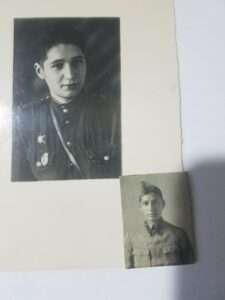
Today is the 85th anniversary of Operation Barbarossa, the German attack on the Soviet Union, in 1941. Virtually all my then-living relatives were caught up in the war in one way or another. But none more immediately than my grandfather Nathan Firun, who was 17 at the time. This is a shortened version of his story of that time, which he recounted to me in 2011. He hated talking about his experiences in World War II, and only after much effort did I persuade him to tell this story:
Nathan was a graduate of a special military high school in Leningrad, trained as an artillerist. Soon after the fighting began, he enlisted in a “militia” unit of (mostly) untrained civilians. The men were issued Canadian-made rifles left over from World War I, with only five bullets per rifle. When they asked to use one bullet each to test-fire the rifles to make sure they worked, permission was denied, because there were too few bullets to go around. The unit was employed digging trenches behind the lines.
Sometime later, they were required to turn in their weapons, so they could be sent to a unit at the front, where there were men with no weapons at all. Nathan said this was the first moment when he realized the war must be going badly for the Soviet side.
In late August, they were informed their position had been flanked by the Germans, and the men were required to disperse and make their way back to Soviet lines in small groups. After some harrowing adventures, Nathan did indeed evade the Germans and found a Soviet unit. The other soldier with him was not so lucky. He entered a village they passed on their way, and was never seen again. Nathan never knew what happened to him. Perhaps he got killed or was captured by the Germans.
When he returned to Soviet lines, Nathan was detained by the NKVD (the secret police agency later known as the KGB) for the “crime” of “betraying” the USSR by being caught behind enemy lines. He and a large group of other soldiers in similar straits were herded into a barbed-wire enclosure, and would very likely have ended up in a special punishment battalion (or, worse, a Gulag).
Fortunately, an NKVD lieutenant noticed that Nathan had a shoulder patch indicating that he was an artillerist. He came up to Nathan and asked if he really was one and knew how to operate artillery. Nathan said “yes.” The NKVD officer then said that they had two antitank guns that had just been brought up and needed to be set up and used to counter an imminent German attack. He told Nathan to gather ten other men from among the “traitors” and undertake the task.
“Where are the shells for the guns?” Nathan asked.
“You’re asking me where the shells are?”, said the NKVD man, “Go find some yourself!”
Nathan did as he was told, and set up and operated the guns (with the help of several other men released from detention for that task). After some effort, they did indeed find the necessary shells.
In the ensuing engagement, the Germans were repelled, and Nathan was wounded. He ended up in a hospital back in Leningrad, even as the city came under siege. At that point, it became clear that one else in the city knew he had been detained by the NKVD for being caught behind enemy lines. In the chaos of those days, Soviet record-keeping was even more shoddy than usual, and apparently no one had bothered to make any official record of my Nathan’s ‘crime’. Nathan’s father (my great-grandfather), Boris Firun, told him he should keep this story secret, and never tell anyone.
Boris had been detained by the NKVD himself several times in the 1930s, and knew whereof he spoke. One time, he had been arrested for attending a speech by Stalin’s rival Leon Trotsky. Even though, at the time, Trotsky was still a high-ranking Communist Party leader in good standing, the NKVD later pursued anyone who had gone to hear him. Boris managed to persuade them he had not actually gone to the event (though in fact he had).
My grandfather did indeed keep the story secret through almost four years of additional fighting. He eventually commanded an antitank gun battery and won numerous decorations. He did not reveal these events to anyone until he told me the story 70 years later.
Nathan Firun passed away in 2021, at the age of 97. We miss him greatly.
The post My Grandfather's Account of the Early Days of Germany's Attack on the Soviet Union in World War II appeared first on Reason.com.
from Latest – Reason.com https://ift.tt/VLICjJk
via IFTTT