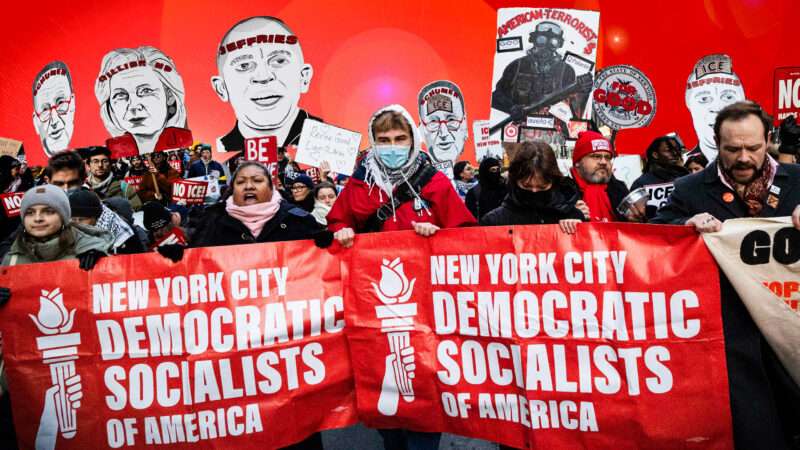
Of the trio of candidates who swept to victory in New York this week with the backing of Mayor Zohran Mamdani—all of whom are or have been associated with the Democratic Socialists of America (DSA)—none has generated more attention than Darializa Avila Chevalier.
Chevalier, who has never held office before, is a 32-year-old community organizer who this week won a Democratic primary in New York against incumbent Adriano Espaillat. Like many DSA-affiliated up-and-comers, Chevalier has a long history of incendiary social media posts. As Reason‘s Liz Wolfe noted yesterday, she’s called former President Joe Biden a “rapist” and a “war criminal.” She once posted “fuck Kamala Harris.” Remember, she just won a Democratic primary.
She also described the United States as a “fucking disgrace,” though it’s apparently not quite so disgraceful that she doesn’t want to take the title and salary of U.S. congressional representative. As center-left writer Jeff Maurer wrote, it will be extraordinarily easy for Republicans to portray her as a radical, anti-America lunatic “because she is a radical, anti-America lunatic.”
But Chevalier is not just an unusually unhinged, radically anti-American social media leftist; she’s also a committed economic socialist who supports creating a four-day, 32-hour work week with no pay reduction, free government-sponsored childcare, free pre-kindergarten, Medicare for All, and a federal rent control system, presumably because rent regulations have worked so well in New York. Somewhat confusingly, she also supports both a universal basic income and a federal jobs guarantee, which raises the question: Why would you need a federally guaranteed job if you have a federally guaranteed income?
In any case, after reading several academic studies, conversing with some economists and pollsters, and trying to assess her policy agenda neutrally, I have concluded that she is, in technical terms, cuckoo bananas.
OK, OK, you got me. I didn’t actually do all that. But her policy agenda is so wildly fanciful, so disconnected with economic reality, and so out of touch with American politics that I hardly needed to. It’s self-evidently absurd. The same is true of many of the ideas of her fellow DSA-linked, Mamdani-backed candidates, like Claire Valdez, another one of this week’s winners, who somehow still supports the Green New Deal and also wants the federal government to freeze electricity bills.
Medicare for All is so expensive and so unwieldy that it failed, even in a small scale, in Sen. Bernie Sanders’ (I–Vt.) home state of Vermont. The idea that it would pass at the national level is utterly fanciful. One estimate of the Green New Deal, a sort of everything bagel bundle of environmental-labor-big-government-quasi-socialism, put the cost at over $90 trillion, or about three times the country’s total annual gross domestic product. Making the federal government America’s electrical utility company would probably work about as well as making the federal government America’s landlord did during COVID-19.
And speaking of landlords, has anyone in the orbit of the DSA ever looked at one single solitary study of rent-control in New York? Or even just…the actual rent in New York, which is ground zero for American rent control? Rent control doesn’t need studies to show it doesn’t work. Every time someone rents an apartment in the Big Apple, it makes the case against itself.
One might argue that Chevalier and the rest of the Mamdani-backed, DSA-friendly slate of candidates are extreme and not representative of the rest of the party. And that’s true to some extent. But mainstream Democrats have been embracing fantasy economics for years, even and perhaps especially under a nominally moderate figure like Joe Biden.
Biden wasn’t a socialist. But he was a big-government Democrat who backed obviously ruinous spending policies from the day he entered office. His first major act as president was to pass the American Rescue Plan, a $2 trillion stimulus and spending bill billed as a COVID response, despite the fact that only a tiny percentage of the spending was actually dedicated to responding to the pandemic. Instead, the bill was a bloated package of handouts to Democratic interest groups and unnecessary checks to American voters. Critics warned that the package was too large and would cause inflation. In return, Biden said the bigger risk was going too small. But two years later, the economy suffered the worst inflation shock in 40 years.
Meanwhile, Biden appointed a group of Sen. Elizabeth Warren (D–Mass.) devotees to key regulatory posts. Often called neo-Brandeisians—or more colloquially, antitrust hipsters—they often gesture toward the technical and historical aspects of antitrust legislation. But in the main, their worldview is, as with most hipsters, aesthetic rather than technical. It can be summarized as: Big corporations are inherently suspect, and any merger or deal that makes them larger should require approval from the federal government, even if there is no obvious consumer harm. Indeed, this intellectual cohort sometimes explicitly argued that higher prices for consumers were an affirmative good that should be pursued by policymakers. You think an f-bomb directed at Kamala Harris is radical? Try telling American voters that the job of government is to make prices higher.
And this is just the stuff that Biden, with Harris and the rest of the Democratic Party along for the ride, actually did. From spending to business regulation to labor issues, much of the Democratic Party, even beyond the fringes of Mamdani’s Commie Corridor, has also gone cuckoo bananas, especially in bastions of blue governance like California and New York.
Harris once championed Sanders’ national single-payer health care plan. She backed off, but continued to push a large government expansion of health care that, while less expansive, was still substantial—and mostly just didn’t make any sense. Democrats in both California and New York have proposed their own, state-based single-payer health care plans, both of which would have required politically implausible tax hikes and both of which were, to put it kindly, ludicrously expensive.
Rep. Alexandria Ocasio-Cortez (D–N.Y.), who looks to be readying a 2028 presidential run, proposed a Green New Deal for Public Housing Act that, while less expensive than national single-payer health care, would still have cost hundreds of billions a decade and would have substantially increased federal control of the nation’s public housing stock. The city of Boston, meanwhile, pushed various forms of rent regulation, and the state of New York trumpeted eviction restrictions that, in some cases, allowed tenants to squat in apartments for years without paying rent.
In New York City, the DSA’s patron, Mamdani, has spent political capital pushing a series of utterly pointless, woefully expensive city-run grocery store boondoggles. Kamala Harris proposed a price-gouging law that was derided by Democratic-Party-friendly economists. Harris’ proposal had some commonalities with a price gouging law proposed by Warren, Sanders, and Democratic lawmakers from Wisconsin, Pennsylvania, and Illinois that might have given the federal government the ability to set grocery prices.
Part of the problem is that many of the party’s leading lights are not especially sharp when it comes to economics and policymaking. Another problem is that many simply don’t care about the realities and practicalities of their proposals. But while that explains some of the party’s economic nuttiness, that’s not exactly an excuse. Careless, uninformed radicalism is still radicalism, and it’s been gnawing its way closer to the party’s center for years. Chevalier and the DSA-adjacent, Mamdani-backed cohort are just the most bananas of them all, the bleeding edge of creeping cuckoo-bananaism.
I don’t mean to say the Republican Party is much better. Over the last decade, the party has become a personality cult, and the personality it has organized around understands the economy through a simple-minded mercantilist worldview, in which America is essentially a business that needs to collect revenue through tariffs, like licensing fees for Trump-branded golf courses. Much of the party has sat idly by, or even cheered, as President Donald Trump unilaterally passed sweeping, constitutionally dubious tariffs that have cost jobs, raised prices, and generally failed to deliver on their own stated goals, like reducing the national debt and deficit.
Speaking of which: Have you looked at the national debt recently? Our nation’s political class certainly hasn’t. All of these expansive spending proposals, from Medicare for All to the Green New Deal, are being talked about in an environment with dramatically less space for fiscal maneuvering. A major budget crunch is coming, yet the Democratic Party has largely decided to ignore the books and push for spending more, and more, and more.
The all-around radicalism of the GOP during the Trump years has papered over and excused the radicalism of the Democratic Party, and even helped egg it on. After this week’s radical sweep, youthful party strategist David Hogg posted, “If this isn’t the Dem tea party I don’t know what is.”
Whether or not this is the Democrats’ Tea Party, it’s certainly a revolution. But like all revolutions, it didn’t happen overnight. Democrats have been retreating into economic fantasyland for years, and this week’s radical upsets are just the latest sign that the fantasy is taking over.
The post The DSA and the Democrats' Retreat Into Economic Fantasyland appeared first on Reason.com.
from Latest – Reason.com https://ift.tt/cImg7rM
via IFTTT