In May 1995, a supporters group associated with the English football club Stoke City FC launched a campaign demanding wholesale changes to their beloved team. At the time, Stoke City played in Division One, the competition just below the top tier, three-year-old English Premier League (EPL). At the conclusion of every season the best clubs in the First Division get bumped up to the EPL to compete against heavyweights like Manchester United and Liverpool. But Stoke City was languishing, and hope that it would get promoted any time soon was fading. In an advertisement published in a local newspaper, the group asked, “Does the club’s present level of investment in players provide for a real promotion challenge in the future?” Much of the ire was directed toward Stoke City chairman and majority shareholder Peter Coates. Owner of a catering business and a collection of betting shops, Coates had been in charge of Stoke for close to a decade. “Whenever a club is seen not to be doing well there always has to be someone to blame,” he said a few days after the group’s ad. The problem, Coates explained, was a lack of resources. The money being poured into clubs like Blackburn, winners of the English Premier League title, is “the exception to the rule. Generally this does not happen and we would love such a sugar daddy at Stoke. But I don’t think we are going to get one.” He was right. No man was going to save Stoke City. But a woman would.
On January 10, 1998, Stoke City suffered its worst home defeat in history, a 7–0 drubbing by Birmingham City. No longer content with strongly worded missives, angry supporters stormed the field: “They came through the door like a herd of buffaloes,” a former Stoke City player told a reporter. A few days later, Coates resigned as chairman. A few months later, Stoke City was relegated to the Second Division. Almost two years later, Stoke City was sold to a consortium of investors from Iceland.
No longer in charge of a football club, Peter Coates returned to the corporate world to find that his daughter had big plans for the family business. Denise, an econometrics graduate from the University of Sheffield, had doubled the number of betting shops and grown revenue. But her real ambition was to shed the brick-and-mortar model to focus on the internet. Cognizant of the startup costs needed to compete with the offshore operators, Denise mortgaged the buildings and took out a loan. She purchased the domain name bet365.com for $25,000 and in March 2001 launched the company’s website. Four years later, all the shops had been sold and resources were being poured into the online business.
Her bet on the future of the internet paid off (maybe as well as any bet has ever paid off). With Coates’ focus on technology, customer service, and marketing, bet365 became one of the most popular online gambling websites in the world, generating far more revenue than the retail shops ever had. Suddenly the Coates family was flush with cash. In 2006, they bought Stoke City FC back from the Iceland group and Peter Coates resumed his role as chairman. With its newfound wealth, the family could now provide the resources needed to elevate the club’s fortunes. Two years later, much to the delight of its rabid fans, Stoke City finished in second place and was promoted to the English Premier League. Just a decade after her father’s acrimonious exit, Denise Coates had used gambling money to give her community what they had always wanted: a world-class football club.
Meanwhile, bet365 continued to grow. With gambling companies now allowed to advertise on television, it became nearly impossible to watch a British sporting event without seeing a bet365 commercial. The marketing tsunami, combined with the emergence of the smartphone and the company’s first-mover advantage, proved to be a potent combination. Add to the mix some exposure in the world’s most popular sports league—in 2012, bet365 became Stoke City’s primary jersey sponsor—and the result was the biggest gambling website on the planet. By 2014, the company was taking in $25 billion worth of bets from 7 million customers across 200 countries. Three years later, Denise Coates took home a compensation package worth somewhere in the neighborhood of $250 million. According to The Guardian, her pay was “more than 1,300 times that of the prime minister” and more than double the collective salaries of the entire Stoke City roster.
While Denise Coates became one of the wealthiest women in the world, her company became an influential part of the Stoke community and British society. Much of this influence was positive. As reported by The Guardian‘s Rob Davies, bet365 became the largest employer in Stoke and provided jobs to over 10,000 people worldwide. The company also became one of the country’s biggest taxpayers with annual bills in the hundreds of millions. Denise Coates herself became a dedicated philanthropist, pouring over $1 billion into causes such as medical research, disaster relief, and college scholarships.
And yet there was negative influence as well. For example, bet365 was often cited as one of the reasons for the increase in British “problem gamblers.” The site’s innovative “in-play” betting, where users could bet on dozens of outcomes while watching an actual event, was seen by some as a gateway to addiction. So were marketing tactics that involved handing out bonuses to bettors who had recently suffered big losses. One member of Parliament put it this way: “bet365 appear to be deliberately preying on vulnerable people and encouraging customers to rack up huge losses to boost their own profits.”
The moral duality of the company wasn’t lost on at least one employee, who in an anonymous letter to The Guardian asked, “The success [of bet365] presents an ethical quandary: do the taxes, the charity, the healthy salaries, and employee benefits balance out the massive harm that gambling causes, nationally and specifically in deprived areas such as Stoke-on-Trent?” In other words, do the positives of legalized gambling—which in the case of bet365 included not only thousands of jobs and a billion dollars to charity but also the salvation of the community’s favorite football club—outweigh the negatives?
States Decide Between Uncle Mick and Sports Betting Legalization
This quandary can be extrapolated outward, past Stoke City and far beyond the United Kingdom. After the fall of the Professional and Amateur Sports Protection Act (PASPA), for instance, each American state faced this very dilemma. But because there’s no single way to parse an ethical quandary, they all arrived at their answers at different times and through different means.
Take Illinois as an example. Six months after the Supreme Court handed down its decision, Democrat J.B. Pritzker was elected as the state’s new governor. He took one look at the $3.2 billion budget deficit, issued a public document detailing how the previous administration’s “ideological warfare” had put the state in a “financial ditch,” and started talking about how legalized sports betting could be part of the solution. Forget ethics, this was economics. “Every day we argue about who’s in and who’s out is money that goes to other states and to the black market,” Pritzker said.
There was no official referendum but most Illinoisans seemed to be on board. “It’s an idea whose time has come,” announced the Chicago Tribune in an editorial immediately after the Supreme Court decision. Then came the hard part: figuring out who was going to get a cut of the action. For one, the state had to balance bringing in as much money as possible while also making it worthwhile for companies to operate. Then there were the already established casinos and horse tracks who wanted to make sure that sports betting didn’t take away from their own businesses. The daily fantasy operators such as DraftKings and FanDuel, armed with millions of dollars to throw at lobbyists, were desperate to make sure they were well-positioned to compete. And the NBA and MLB were on a national tour reminding politicians that they created the product on which all these wagers were placed. They deserved a cut, too.
The end result of all this politicking was a bill passed by Illinois legislators in June 2019, signed by Pritzker shortly after, and which went into effect the following year. The state’s casinos and tracks were given priority to purchase a sports betting license, protecting their share of the gambling market. If DraftKings and FanDuel wanted to enter the Illinois market (which of course they did), they could partner with one of these entities to create a co-branded betting partnership. While the leagues never got their integrity fee, they’d turn out just fine with millions in sponsorship dollars and with betting allowed at some of the state’s most popular sports venues such as Wrigley Field, home of the Chicago Cubs, and the United Center, home of the Chicago Bulls. And all the sportsbooks would be taxed at 15 percent, not the highest in the country but also not the lowest and enough to satisfy Pritzker as he vowed to reduce the state’s debt.
So the positive side of the quandary, the huge pile of money and all its potential benefits, had been properly discussed. What about the other side? Given a once-in-a-lifetime opportunity to prepare for the expected rise in gambling addiction, especially among the state’s youth—a supposed inevitable consequence of legalized sports betting that politicians all over the country had been screaming about for years—Illinois’ legislators didn’t do much. Unlike in some other states, there was no agreed-upon percentage of revenue set aside for gambling addiction treatment and no rollout of education programs for schools and colleges. One of the few initiatives that Illinois politicians decided on was to require gambling ads to include a phone number customers could call if they wanted to talk about their or somebody else’s “gambling problem.” Besides that, it seemed as if the state was employing a reactive strategy that one industry executive described as “Legalize, Launch, Learn.” Get everyone betting, see what problems pop up, and then address those problems.
And then, just two weeks before launch, Illinois was gifted the perfect public relations campaign. In February 2020, federal charges were announced against 10 people accused of running “an offshore sports gambling ring that raked in millions of dollars from hundreds of Chicago-area gamblers.” Among those charged was Vincent Del Giudice, who went by the nickname “Uncle Mick”; Nicholas Stella, a Chicago police officer for nearly two decades; and Casey Urlacher, mayor of a small Illinois town and brother of Chicago Bears legend Brian Urlacher. Using a Costa Rica–based sportsbook to operate its website UncleMickSports.com, the group allegedly served over a thousand gamblers, pulled in millions of dollars, and had links to a separate bookie “with longstanding ties to the Chicago mob.”
It’s as if those most skeptical of the upcoming launch had been shown the alternative. Sure, legalized sports betting brought some negatives but did the great people of Illinois really want the industry to be controlled by the mob and guys named Uncle Mick?
Of course they didn’t. And so Uncle Mick went to jail and sports betting officially became legal in Illinois. Over the next few years, it also became legal in New York and Virginia and Iowa and dozens of other states. In the process, similar to what had happened in the United Kingdom and with daily fantasy, American sports became a promotional battleground. Betting ads appeared everywhere, on television and in podcasts and on billboards, with hundreds of millions of sponsorship dollars filtering down to teams, leagues, and media companies. With little product differentiation among competitors, companies started giving away deposit bonuses to anybody who simply opened an account, a tactic—”free money!”—designed to attract the average sports fan.
It worked. Seven years after the fall of PASPA, nearly a quarter of all Americans had an active sports betting account. FanDuel and DraftKings, two companies that had a significant head start with their daily fantasy offerings, became the market leaders. BetMGM, Caesars, and a few others managed to carve out their own share of the industry. But despite an early foray into New Jersey, bet365 mostly sat back and watched, content to let others figure out this new potentially very lucrative but also quite complex state-by-state market. Denise Coates, after all, didn’t have any shareholders to appease. And she certainly didn’t need the money herself.
So back to the quandary as it relates to the United States: Do the positives of sports betting outweigh the negatives? It depends on who you ask. Proponents of legalized sports betting point to the ubiquity of the activity before PASPA fell, the leagues’ improved ability to monitor irregular betting and spot potential fixes, and the billions of dollars of tax revenue that now filter down to a variety of programs and initiatives. From the other side, critics of sports betting say that more athletes are getting caught fixing outcomes not because the monitoring has improved but because there is simply more gambling and therefore more corruption. These critics also contend that no amount of tax revenue can offset the rise in gambling addiction brought on by increased accessibility and predatory marketing practices that encourage Americans to keep wagering even when they can’t afford it. And so the discussion endures, with no resolution or conclusion in sight. A classic ethical quandary.
Where does American sports betting go from here? To answer that question, we head to the city that played host to the most famous gambling scandal in American history. And boy, how times have changed.
From Calling Betting ‘Evil’ to the DraftKings Sportsbook at Wrigley Field
The speed at which legalized betting immersed itself within American sports is best illustrated by its relationship with Major League Baseball and one of the league’s oldest franchises, the Chicago Cubs.
During a 2012 deposition for New Jersey’s lawsuit seeking to overturn the federal ban on most forms of sports betting, MLB Commissioner Bud Selig called gambling “evil,” the “deadliest of all things that can happen,” and an activity that “destroys your sport.” There was no ethical quandary here: Bud hated gambling and wanted nothing to do with it. But three years later, Selig retired. And into the office stepped Rob Manfred. Similar to new NBA Commissioner Adam Silver, Manfred wanted to keep his options open. In 2017, he announced that the league was “rethinking” its stance on sports betting. That was very fortuitous—or more likely very strategic—timing as PASPA was struck down just a year later.
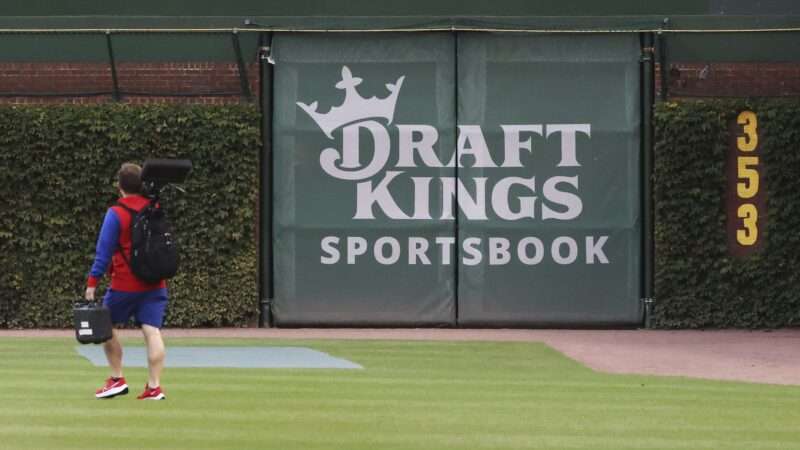
Over the next few years, sports betting was legalized in dozens of states including Illinois. In 2020, the Chicago Cubs announced an agreement with DraftKings to open an in-person sportsbook directly adjacent to its home ballpark, Wrigley Field. And in 2023, just over a decade after the head of professional baseball called gambling the “deadliest of all things that can happen,” there it was: a two-story sportsbook wedged into a corner lot at baseball’s most famous address.
The DraftKings Sportsbook at Wrigley Field is described as the “premier destination for entertainment” and a “unique one of a kind experience” perfect for any occasion from birthday parties to corporate gatherings. The food is good too, a place where “American cuisine meets modern innovation.” And wow is it big and shiny. Seventeen thousand square feet of space. Two thousand square feet of video screens. Room for nearly 700 people. Upon its grand opening, DraftKings’ Director of Communications Stephen Miraglia told a reporter how he couldn’t “imagine a better place to come and watch the game.”
It was quite the comment, especially since the venue literally shares a wall with one of the most iconic stadiums in the world. Besides, what’s the point of an in-person sportsbook, a place where somebody sits behind a window and accepts wagers, in a state where fans can simply bet on their phones?
When Las Vegas casinos started building sportsbooks in the 1970s, the world had not yet been introduced to smartphones, much less big-screen televisions or NFL Sunday Ticket, a television package that allows you to watch any professional football game you want from your living room. But 50 years later? We had all these things. And what would prevent somebody from coming to the DraftKings Sportsbook at Wrigley Field and using their phone to bet with a different online sportsbook such as FanDuel or BetMGM? Nothing. So why does this place exist?
Betting Together or Betting Alone?
The history of American sports betting provides some clues. First, it’s important to understand the traditional role of the in-person sportsbook, the kind buried in giant Vegas casinos with walls of televisions and buffalo wings and people sitting around getting drunk in their favorite team jerseys. While these establishments could occasionally generate a decent profit, especially with a savvy bookmaker in charge and a few fortuitous bounces, they’ve always been best understood as complements to high-margin games like blackjack and roulette. Sportsbooks were a way to get people in the casino door and keep them there after they’ve lost most of their money.
That’s because sportsbooks are fun. “With the decline in popularity of craps, the last of the interactive table games, gambling…increasingly has become an individual experience,” legendary Vegas oddsmaker Michael “Roxy” Roxborough wrote back in 1998. “A sportsbook then, is a casino’s last excitement center, the only area of the hotel where players consistently root and cheer for a common result.”
But Wrigley Field isn’t a casino. So what’s the DraftKings Sportsbook complementing? Another increasingly individualized experience: sports betting itself.
Similar to casino gambling, sports betting used to be more of a communal activity—think Calcutta pools the night before big golf tournaments or the regulars at Omaha’s Baseball Headquarters or the crowds congregating in the Madison Square Garden lobby. Despite the ubiquity, there’s an inescapable solitude to modern-day sports betting, the kind of seclusion that has crept over many activities as we go through our day head down, eyes on our phone. So maybe the DraftKings Sportsbook at Wrigley Field is an attempt to reverse this trend, to provide fans with a place to gather and talk about their lives, their favorite teams, and, of course, their wagers. Perhaps it’s the physical extension to a very digital experience, an in-person destination where gambling isn’t just tolerated or accepted, as in a normal sports bar, but actively encouraged.
But even if Americans learn to reembrace the more communal aspects of sports betting, there’s no reversing the increased individualization of the actual wagering. Forced to compete in a media landscape dominated by algorithmically chosen videos and highly curated music playlists, today’s sports betting platforms must cater to the whims of individual bettors to succeed. Nothing demonstrates this individualization more than the parlay, a bespoke wager tailor-made for the modern-day sports fan.
Parlays involve combining multiple outcomes to increase a wager’s potential payout. Parlays can take place over the course of a week, a day, or even a single game. These wagers are akin to lottery tickets: put in $5 for a chance to win, say, $300. If you lose, no big deal. It’s only $5. But if you win? Your whole week just got better. And you have a great screenshot to post on social media.
Americans love parlays. By 2024, these kinds of wagers made up over two-thirds of all NBA and NFL bets placed on FanDuel. Other companies have reported similar percentages. In 2025, DraftKings actually introduced a subscription service for users to boost their parlay odds.
Of course, none of this is new: Americans have always loved parlays. In the early 20th century, the United States was captivated by football pools. And aren’t March Madness bracket tournaments, by far the country’s most popular wagering activity, little more than giant parlay-like competitions in which the person who gets the most games correct wins?
The difference is that the data have finally caught up to the demand. Today, sites like FanDuel and DraftKings have so much information at their disposal that parlays can be offered on nearly any combination of bets. That simply wasn’t the case for old-school bookmakers who did their own calculations and were always hesitant to offer too many parlays for fear that they’d make a mistake and go broke. But that’s hardly an issue for the publicly held corporate giants that now control the vast majority of legalized sports betting. With detailed data on each individual bettor, promotions can be sculpted to specific tastes. You want a 10-leg parlay involving the Baltimore Orioles and Wimbledon? You got it! And here’s a 10 percent profit boost. Go ahead and put it in (because you’re probably going to lose).
In the years following legalization, many Vegas veterans were surprised at how the industry had evolved. “It turns out that the overwhelming market for sports betting is probably just small bets, microbets, as entertainment,” Roxborough said in 2020. Despite being someone who knew as much about sportsbook management as anybody in the world—he literally wrote a textbook on the topic—Roxy still wasn’t sure how it all worked from the accounting side. “Probably DraftKings and FanDuel have it right, but I’m not sure how they ever cash out on that business.”
The books are actually still trying to figure that out. Making money through bookmaking has never been easy. It’s even harder when customers have nearly a dozen options available on their phone all offering similar products and promising free money to anyone who signs up for an account. While most startups often operate in the red for the first few years, the amount of money lost by American sportsbooks immediately following the PASPA repeal is still staggering. From 2019 to 2024, DraftKings gained control of about a third of the (legal) American sports betting market. And during that time the company reported a cumulative net loss of over $5 billion.
So what’s the plan going forward? First, get rid of the good players. Most online sportsbooks have begun to aggressively limit the so-called “professionals” or “sharps,” the kind of bettors with long-term strategies, refined techniques, and big bankrolls. They’re a special breed, patient and deliberate, and have no problem betting five or six (or more) figures on individual games. For the most part, they’re no longer welcome on sites like DraftKings and FanDuel. “This is an entertainment activity,” DraftKings CEO Jason Robins famously said in 2021. “People who are doing this for profit are not the players we want.”
Once those players are gone, the next step is to get more amateurs, the kind who love parlays. Because they’re less likely to cash out, parlays allow betting companies to retain a higher share of the total money wagered, a figure known in the industry as “the hold.” But because the people who play parlays come from the “betting as entertainment” crowd, the total amount wagered is generally smaller. So a business built on parlays requires scale, meaning these sportsbooks need as many people as they can to start supplementing their sports experience with an occasional wager (specifically one that’s likely to lose). It’s almost like running a subscription service, where fans are expected to lose $20 or $50 or $100 every month but they don’t really care because it’s fun. And every so often the service pays them, which is even more fun.
The best way to build scale is through promotion, to stubbornly force betting back into the day-to-day American sports experience. The onslaught is well underway. Nightly broadcasts are peppered with betting information. Studio show and podcast hosts give out parlay tips and then tell viewers or listeners where they can bet those parlays. Then there’s the DraftKings Sportsbook at Wrigley Field, a literal extension of one of the country’s oldest sports venues. It’s also the perfect visible metaphor, as if DraftKings is saying, “Oh, us? We’re with them” as it snuggles up against iconic Wrigley Field. Painted green to blend in with the stadium’s legendary façade, it’s almost as if it’s been there the entire time. (As of June 2026, the building is still a DraftKings-branded bar, but no longer accepting in-person bets.)
And if you buy the argument that betting was an important catalyst for the growth of nearly every American sport, a symbiotic relationship that’s been manipulated and suppressed for nearly 200 years, then maybe that’s exactly where it belongs.
How will legalized sports betting change American sports? Perhaps parlays can provide some perspective. Consider this scenario. A lifelong Cubs fan arrives early to a weekday ballgame and stops for dinner and drinks at the state’s “premier destination for entertainment,” the DraftKings Sportsbook at Wrigley Field. While there, he notices a promotion on one of the screens that promises a “profit boost” for a “10-leg, same-game parlay.” Never one to turn down a boosted profit, our fan pulls out his phone, brings up the DraftKings app, and strings 10 separate bets into a single wager. It ends up costing $10, less than the cost of his beer. He then pays his bill and heads into the stadium. The game begins and neither team scores a run in the first inning.
That was one leg of the parlay. Then the Cubs third baseman gets a hit. Second leg unlocked. So far, so good. Over the next eight innings, nine of the 10 legs of the parlay hit. There’s only one scenario left: The Cubs catcher can’t get more than one hit in the game. And now this player is up in the ninth inning having already hit a double. Also the bases are loaded, the Cubs are down by one, and the team’s speedy center fielder is on second base. If the catcher gets a hit, the game is probably over and the Cubs win. But if he gets out, the Cubs lose and our fan wins $1,000.
So what’s our fan going to do? He’s going to root for the money, right? It’s a single regular-season game for a team that probably won’t make the playoffs anyway. But what if the payout was only $500? Or $50? How about $15? How much is a win worth to our fan? How much are any wins worth to any fans?
The entire country is about to find out.
This article is adapted from Over/Under: An Unexpected History of Sports Betting by permission of Pegasus Books.
The post The Mob Used To Run Sports Betting. Now DraftKings and FanDuel Do. appeared first on Reason.com.
from Latest – Reason.com https://ift.tt/yzIfAE5
via IFTTT