From Friday’s decision in Del Biaggio v. Bansen, written by California Court of Appeal Justice Jeremy Goldman, joined by Justice Tracie Brown and Marin County Superior Court Judge Andrew Sweet:
Del Biaggio’s opening brief does contain fictitious quotations, and not on tangential points…. In a declaration in support of his opposition to the motion, Floyd [Del Biaggio’s lawyer] states that his office “uses generative AI” in a manner “consistent with State Bar guidance,” with “protocols requiring human verification of all outputs using primary sources.” He attributes the failures here to a “communication error,” explaining that he added the quotations at issue during trial recesses in another case, and asked his paralegal to verify them but she understood he had already done so. He writes that he “deeply regret[s] any errors and affirm[s] they were not willful or AI-driven without review.” The paralegal writes in her declaration that she verified all sources in a previous draft, but “based on a brief exchange” believed that Floyd had already verified his later additions to the draft.
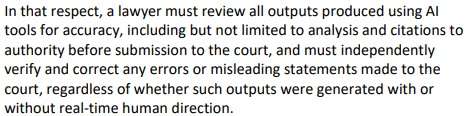
First, even if the communication error had not occurred, Floyd’s protocol would not comply with the State Bar guidance to which he refers. It provides that “a lawyer must review all outputs produced using AI tools for accuracy, including but not limited to analysis and citations to authority before submission to the court.” (State Bar of California, Standing Committee on Professional Responsibility and Conduct, “Practical Guidance for the Use of Generative Artificial Intelligence in the Practice of Law” (Practical Guidance), p. 9, italics added.)
We glean from Floyd’s declaration that he used generative AI to make additions to the opening brief during trial recesses in another case without ever planning to review personally—or even to have any other lawyer review—the case law he added. Rather, he intended to have his paralegal simply check the citations before filing the brief. This plan would have been inappropriate even if it had not gone awry. (See Noland v. Land of the Free, L.P. (Cal. App. 2025) [“it is a fundamental duty of attorneys to read the legal authorities they cite in appellate briefs or any other court filings to determine that the authorities stand for the propositions for which they are cited”].)
Second, while we accept Floyd’s representation that there was no intent to mislead, we find the declarations vague about how precisely the “communication error” arose. Floyd emphasizes that, because he was in trial, he had “limited time for review.” But his general unavailability to supervise the brief’s finalization made it even less appropriate for him to expect his paralegal to assume responsibility for verifying what he wrote about cases he apparently had not laid eyes on himself.
Moreover, it should have been a red flag to him that the AI-supplied quotations, which articulated the exact proposition he sought to advance (including purportedly from the California Supreme Court 26 years ago), had eluded him when he researched the same issue in the trial court. We reiterate here that “our warning to litigants is not merely an admonition to double-check citations and otherwise fastidiously comply with the Rules [of Court]; it is to be at all times truthful and to be responsible in crafting any written arguments presented in this court.”
Third, the State Bar guidance to which Floyd refers also explains that the lawyer’s duty of candor requires counsel to “correct any errors or misleading statements made to the court, regardless of whether such outputs were generated with or without real-time human direction.” Ultimately Floyd did file a letter identifying and withdrawing the misstatements, but it came only a few days before oral argument and more than three months after he realized, based on the Bansens’ motion for sanctions, that the opening brief had been filed without proper verification of the quotations and citations. In his opposition to the sanctions motion, Floyd wrote only that he deeply regretted “any errors.” We reject Floyd’s contention that these long-uncorrected errors caused no prejudice. Misrepresentations of the case law, however they come about, waste the time of both opposing counsel and the court, imposing on them the burden of correcting them….
We acknowledge that Floyd admitted the unverified use of AI, offered some explanation for how it occurred, and eventually sent a letter identifying and withdrawing the misstatements. But the protocol he described was insufficient not only to prevent the errors but also to satisfy his obligation to review personally the principal legal authority on which his argument relied. Waiting until shortly before oral argument to correct the misstatements was also far from ideal. We find it appropriate under the circumstances to order Floyd to pay a sanction of $1,500 to the court.
While we order Floyd to pay sanctions to the court, we decline to award sanctions to the Bansens. It is true that they first raised the issue by identifying some of the misstatements of authority in the opening brief. But their motion significantly overreaches by characterizing the appeal as frivolous. We borrow a caution previously expressed by the Ninth Circuit: “Allegations of frivolous appeal are not taken lightly by this court.” The label is inappropriate here.
As discussed above, Del Biaggio’s motion for reconsideration in the trial court was procedurally authorized because the court decided sua sponte that paralegal fees could not be recovered under the Agreement, without giving the parties an opportunity to be heard. His argument in the trial court, which did not include the fictitious quotations that appear in his opening brief on appeal, came after the Bansens themselves had failed to dispute that paralegal fees were within the scope of the Agreement’s fee-shifting provision. His argument on appeal is not limited to the false quotations, and we have found it otherwise meritorious. Under these circumstances, we will not order Del Biaggio or Floyd to pay sanctions to the Bansens….
The post AI-Generated Briefing Must Be Cite-Checked by Lawyer, Not Just a Paralegal appeared first on Reason.com.
from Latest – Reason.com https://ift.tt/aBM1nd4
via IFTTT