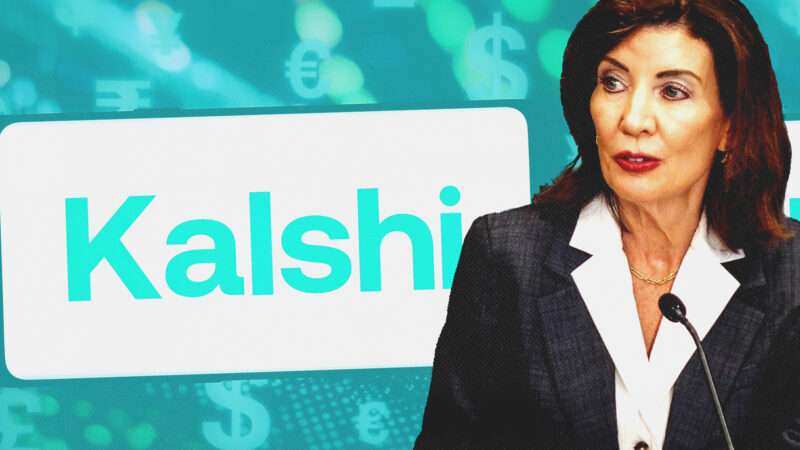
New York is attempting to squeeze $36 billion from the prediction market Kalshi for operating in the state without cutting in state regulators.
In a move that would make Tony Soprano proud, New York Democratic Gov. Kathy Hochul and Attorney General Letitia James announced on Friday that the state was suing Kalshi for “running an illegal gambling operation” despite the company being a federally regulated exchange. As restitution for violating New York’s gambling laws, James wants the state Supreme Court to permanently ban Kalshi from operating within its borders until it obtains “all the required licenses” from the state’s Gaming Commission.
James wants Kalshi to identify “each of its customers,” along with an accounting of their itemized bets, the amount of money they’ve lost, and the amount of revenue earned by Kalshi during its operations in New York. Should the state prevail in its case, James has asked for Kalshi to “make full restitution” to anyone in the state who used the platform, as well as a “penalty of three times the amount” of revenue generated by Kalshi in New York.
James is also seeking a penalty of $100,000 for “each offering” or “attempt to offer” sports gambling in New York by Kalshi, which comes to a total of at least $36 billion, according to a court filing from her office.
Gambling is tightly restricted in New York. The state constitution bans all forms of gambling except for specifically named exceptions, including the state lottery, horse racing, casino games, bingo, and lottery games run by nonprofits. Operating as a contract market, not a sportsbook, has allowed Kalshi and its users to skirt related New York taxes.
The state has not been pleased with that workaround. Since 2025, New York lawmakers have waged a minicampaign to ban prediction markets.
Last October, the state’s Gaming Commission sent Kalshi a cease-and-desist letter accusing the company of operating an “unlicensed mobile sports wagering platform.” James has also used her position as the state’s highest legal official to issue consumer alerts arguing prediction markets are “unregulated” gambling platforms that pose “significant financial risk.” In April, James sued Coinbase and Gemini Titan, alleging that, like Kalshi, their prediction platforms violated state gambling laws. A day later, Hochul signed an executive order banning state employees from engaging in insider trading on prediction markets, even though federal law and the platforms’ own rules already outlaw this practice.
There’s a chance New York will lose this fight, since federal law gives the U.S. Commodity Futures Trading Commission (CFTC) exclusive jurisdiction to regulate prediction markets.
CFTC Chairman Mike Selig says New York’s lawsuit seeks to force an “unprecedented sudden shutdown of prediction markets nationwide.” The CFTC already sued New York in April to stop the state from applying its gambling laws to prediction markets. On Thursday, the CFTC filed a motion for an emergency temporary restraining order against New York to block the state from pursuing criminal or civil enforcement actions against prediction markets.
So far, two federal courts have agreed with the CFTC’s interpretation of this law.
In April, the 3rd Circuit Court of Appeals granted Kalshi an injunction against New Jersey regulators, barring the state from enforcing its law prohibiting wagers on collegiate sports. This week, a federal court in Minnesota used similar reasoning when it ruled in Kalshi’s favor, issuing an injunction that prevents the state from enforcing its ban on prediction markets.
In both cases, the courts found that federal law expressly preempts statewide bans against prediction markets. However, the ruling in Minnesota left the door open for states to regulate event contracts that fall outside of the federal definition of a swap, such as futures contracts that hedge investments made in energy or agricultural markets.
James says that “no matter what they call themselves, prediction markets like Kalshi are gambling platforms, plain and simple.” Minnesota Attorney General Keith Ellison made similar statements to Reason after a district court struck down the state’s ban on prediction markets.
Still, despite the recent wins in other states for prediction markets, there is reason for James to feel optimistic, as New York has already found success with the courts on this issue. In July, Kalshi failed twice to get a preliminary injunction against New York’s enforcement actions. In denying Kalshi’s appeal for an emergency injunction on Monday, the New York district court found the state was “likely to succeed on the merits” of its case that Kalshi’s sports contracts were akin to sports gambling.
Kalshi is seeking to move the suit to a “potentially friendlier” Manhattan federal court, according to The Wall Street Journal.
In the press release announcing the suit, Hochul framed this legal action against Kalshi as necessary to “protect consumers, prevent problematic gambling, deliver funding for critical public services, and ensure that every company plays by the same rules.” But the real justification seems pretty clear: Casting Kalshi and other prediction markets as reckless, out-of-control gambling hotbeds makes it easier for New York lawmakers to extract the tax revenue they’re really after.
The state is fully willing to allow gambling, provided businesses and users pay a premium in corporate and income taxes.
The post New York Wants a $36 Billion Cut From Kalshi, Calling It an 'Illegal Gambling Operation' appeared first on Reason.com.
from Latest – Reason.com https://ift.tt/3MTuSvF
via IFTTT