The post Open Thread appeared first on Reason.com.
from Latest – Reason.com https://ift.tt/QroFWl3
via IFTTT
another site
The post Open Thread appeared first on Reason.com.
from Latest – Reason.com https://ift.tt/QroFWl3
via IFTTT
The post Open Thread appeared first on Reason.com.
from Latest – Reason.com https://ift.tt/QroFWl3
via IFTTT
The Fifth Edition of the Barnett/Blackman casebook will be published circa December 2026 for adoption in the Spring 2027 semester. We worked out an arrangement with our publisher to finalize several chapters immediately after the term ends.
First, we are incorporating Hemani and Wolford into the Second Amendment chapter. We already shortened Heller, and the excerpt from Bruen will likely shrink. It is regrettable the Court will not decide the AR-15 case until our book is in print.
The chapter on sex discrimination was waiting for B.P.J. v. West Virginia. That case follows neatly from Skrmetti and Mahmoud. Indeed, Frontiero and Craig v. Boren seem quaint and a bit outdated.
We are still figuring out exactly how to use the birthright citizenship case. It doesn’t neatly fit in any existing chapter. Maybe we just add it to the end of the chapter on the Reconstruction Amendments?
Finally, Trump v. Slaughter will drastically change the separation of powers chapter. We did not include Meyers or Humphrey’s Executor. I don’t see much reason to add either case now. Our excerpt of Seila Law probably drops altogether. It was just a pit stop on the Chief’s “long game.” Our excerpt of Morrison v. Olson will shrink, with most of the cuts coming from Rehnquist’s majority opinion. The Scalia dissent will remain.
For those interested, I’ve finished editing Slaughter. You can download the file here. The 108 page opinion is reduced to about 31 pages. These sorts of cuts are always tough, and your mileage may vary. Next up, B.P.J., and then Barbara.
The post Edited Version of <i>Trump v. Slaughter</i> appeared first on Reason.com.
from Latest – Reason.com https://ift.tt/xD0egcp
via IFTTT
Chief Justice John Roberts wrote the most consequential and important majority opinion of his tenure as Chief Justice today in Trump v. Slaughter. In a 6 to 3 decision, the Supreme Court correctly overruled its 91-year-old precedent in Humphrey’s Executor v. United States (1935), consigning that erroneous nine-page opinion to the ashbin of history. I had argued for this outcome in an amicus brief co-signed with Attorneys General Ed Meese and Michael Mukasey that sets out our thoughts on the case in far more detail than I am going to discuss in this blog post.
The highlights of Chief Justice Roberts’ opinion:
(Roberts’ opinion also began nicely with citations to the legendary historian Gordon S. Wood, who tragically died in a traffic accident on June 5, 2026, at the age of 92, and who did so much to shed light on the original understanding of the Framers of the Constitution.)
To better understand this analysis, and the rest of the post, let’s recall the definitions of a few key terms:
Chief Justice Roberts’ opinion in Trump v. Slaughter could have made other arguments for presidential removal power over principal and superior officers: The Chief Justice could have, for instance, told the stories of the rise and fall of the Tenure of Office Act (1867-1887) or of the rise and fall of the independent counsels appointed under the Ethics in Government Act (1978-1999) as cautionary tales about the evils that can happen when presidential removal power at will is curtailed. But there was no real need for him to do so.
Chief Justice Roberts could also have discussed the 219 years of American history from 1789 to 2008 during which every single president from George Washington up through George W. Bush resisted congressional efforts to nurture the headless fourth branch of government, which Humphrey’s Executor (1935) had created, see Steven G. Calabresi & Christopher S. Yoo, The Unitary Executive: Presidential Power from Washington to Bush (2008). But again, with text and original public meaning on his side, there was no real need to delve into the 219 years of presidential resistance to congressional efforts to limit the President’s removal power.
Finally, Chief Justice Roberts could have addressed policy arguments for presidential removal power such as those made in Steven G. Calabresi, Some Normative Arguments for the Unitary Executive, 48 Arkansas L. Rev. 23 (1985), or in Steven G. Calabresi & Nicholas Terrell, The Fatally Flawed Theory of the Unbundled Executive, 93 Minnesota L. Rev. 1696 (2009). But, policy arguments, like arguments about 219 years of presidential past practice, should play no role at all in constitutional interpretation when the original public meaning of the constitutional text is clear, as it is here. Steven G. Calabresi & Saikrishna Bangalore Prakash, The President’s Power to Execute the Law, 104 Yale L.J. 541 (1994). I said in 1994 that text and original public meaning were all that was required to resolve the question of the constitutionality of the headless fourth branch, and I still think that was right. I am pleased that Chief Justice Roberts agrees.
Like Chief Justice Roberts and Justice Kavanaugh, I think the two areas where unlimited presidential removal power becomes problematic are (1) with respect to non-Article III judges such as Administrative Law Judges and those on the Claims Court and (2) with respect to officers who control the money supply.
As to the former, I think the Supreme Court should require that legislative court judges who decide cases where rights to life, liberty, or property are at stake must be given tenure during “good behaviour” as Article III commands. As to legislative court judges who decide public benefits cases like social security disability benefit entitlements, I think there is no constitutional problem with such judges being removable at will by the President.
As to officers who control the money supply, records from countries all over the world make it clear that such officers must be independent from political interference, subject to the caveat that there really are rare moments in history like the Great Depression of 1932 or the Great Recession of 2008 when it is essential that interest rates be dropped to zero and that an inflationary monetary policy must be followed. We thus today applaud the fact that President Franklin D. Roosevelt responded to Herbert Hoover’s deflationary monetary policy by enacting Executive Order 6102, on April 5, 1933, forbidding “the hoarding of gold coin, gold bullion, and gold certificates within the United States.” This necessary inflationary measure, supplemented by the Gold Reserve Act of 1934, which devalued the dollar by reducing the amount of gold required to back U.S. currency, was essential in pulling the U.S. out of the devastating deflation that former President Herbert Hoover’s excessively tight monetary policy had inflicted on the nation, as even free market economists like Milton Friedman have long recognized.
The same thing happened again with the deflation caused by the Great Recession of 2008, which President Obama and Federal Reserve Board Chairman, Ben Bernanke—a student of the Great Depression—faced at the start of President Obama’s presidency. Fortunately, Ben Bernanke, a George W. Bush holdover, had written his Ph.D. dissertation on the deflationary policies that had led to the Great Depression of the 1930’s. Bernanke thus agreed with President Obama to drop interest rates to almost zero in January 2009 and to inflate the currency. As a result, the U.S. government pulled the country out of the Great Recession of 2008 much faster and more completely than did the European and Japanese governments.
This suggests to me that staggered terms on the Federal Reserve Board with each president making some, but not all appointments, is the best way to structure the Federal Reserve Board by allowing some political inputs while preventing reckless presidents from inflating the money supply to win elections. Staggered terms on an independent Federal Reserve Board with officials being removable only for cause is “necessary and proper for carrying into execution Congress’s power of the purse.” One should note here for centuries in England the King was said to have the Power of the Sword while Parliament held the Power of the Purse. Control over the money supply is really a congressional and not an executive prerogative and that has always been the case.
An exception to unlimited presidential removal power makes sense with respect only to the Federal Reserve Board’s role in controlling the money supply. The modern Federal Reserve Board does a lot of things like regulation of banking as to which at-will presidential removal power makes constitutional sense. It will thus be necessary in evaluating the constitutionality of removal limits as to the Federal Reserve Board to unpack the many things that institution does, which I do not claim to be an expert on.
This brings me to Trump v. Cook (2026)—the companion removal power, unitary executive case which Chief Justice Roberts decided in addition to Trump v. Slaughter on June 29, 2026. Members of the Federal Reserve board can only be removed for cause. Federal Reserve Board Member, Lisa Cook, an appointee of former President Biden was removed for cause by President Trump based on his conclusion that she swore under penalty of perjury on a mortgage application that she would use a home she was buying in Michigan as her principal residence and then three weeks later swore that a home that she was buying in another state would be her principal place of residence.
Fraud would certainly be cause for presidential removal of a Federal Reserve Board Commissioner, if it actually occurred, which Cook disputed. No factual hearing has yet been held on this matter. The lower federal courts ordered that Cook be reinstated, and the Trump Administration appealed to the Supreme Court for a stay on the order of reinstatement. The Trump Administration specified in its pleadings in Cook’s removal case that it was not challenging the constitutionality of the for-cause limit on the President’s power to remove Cook from her position as a Governor on the Federal Reserve Board.
Surprisingly, Chief Justice Roberts and Justice Kavanaugh joined the three Democrats on the Supreme Court in denying President Trump’s request for a stay on reinstating Cook. Justices Thomas, Alito, Gorsuch, and Barrett all wrote compelling dissents. No federal court has ever in 237 years of American history ordered that a federal officer who had been fired be reinstated. In Humphrey’s Executor and in Wiener v. United States (1958), the Supreme Court argued that officers of the headless fourth branch of the government be given backpay when they were removed before their terms ran out. Humphrey was dead so reinstatement was impossible, and Wiener did not seek reinstatement either. The Due Process Clause of the Fifth Amendment protected Humphrey’s and Wiener’s right to backpay but not their right to hold an office. Moreover, mortgage fraud is a permissible for-cause reason for President Trump’s removal of Cook, so long Cook is able to collect backpay if the Claims Court rules that she was improperly removed.
As Justice Thomas pointed out, the statute setting up the Federal Reserve Board creates no cause of action for a fired employee to bring a lawsuit, and the Supreme Court has over the last 40 years cut way back on the implying of causes of action to sue. In addition, the Administrative Procedure Act did not provide a cause of action to sue here. Chief Justice Roberts and Justice Kavanaugh wrote opinions implying that President Trump was trying to indirectly challenge the constitutionality of the for-cause removal limit, which Congress has put in place to protect members of the Federal Reserve Board. But the government in its pleadings had explicitly waived that issue and was arguing only that Lisa Cook should not be reinstated prior to some factfinding that she was innocent of the accusation that she had committed mortgage fraud.
The Court should have remanded Lisa Cook’s case to the trial court so that she could pursue whatever legal relief was available to her. At a minimum, I would assume that Lisa Cook would have had standing to sue for her salary in the Claims Court with a statutory right of appeal to the Federal Circuit and from there back to the Supreme Court. The Claims Court could then have held a full factual hearing and come to some conclusion as to whether Lisa Cook had or had not committed mortgage fraud. The one outcome that does not make sense is for five unelected, life-tenured Supreme Court justices to put Lisa Cook back in control (to some limited degree) of the nation’s money supply when the elected President of the United States has concluded that she was guilty of mortgage fraud.
So why did Chief Justice Roberts and Justice Kavanaugh join the Court’s three Democrat-appointed Justices in reinstating Lisa Cook? My conjecture is that they wanted to look “evenhanded” in their treatment of President Trump. President Trump, they had held, had acted constitutionally in firing Slaughter as a Federal Trade Commissioner. Roberts and Kavanaugh wanted to even things out by holding that Trump had acted illegally in removing Cook even though that was not true.
But in doing so, they violated the rule of law. Splitting the baby and not following the law to make the Court look good only sullies the reputation of those who engage in it. And it’s a shame that Roberts has this particular character flaw—because when he is at his best, as in Trump v. Slaughter, he can be as good as John Marshall.
The post Two Cheers for Chief Justice Roberts on the Unitary Executive appeared first on Reason.com.
from Latest – Reason.com https://ift.tt/suivNQ8
via IFTTT
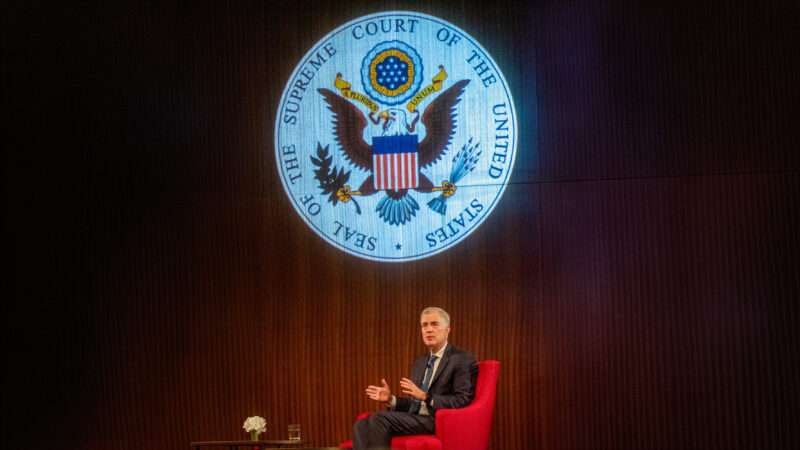
Two weeks ago, the Supreme Court ruled that “an agreement not to appeal a sentence is unenforceable when it would result in a miscarriage of justice.” This week, the Court held that a government-ordered analysis of cellphone location data qualifies as a “search” under the Fourth Amendment.
In both cases, Justice Neil Gorsuch agreed with the result but wrote separately to highlight deeper issues that the majority did not address: the Supreme Court’s endorsement of coercive plea bargaining and its embrace of two dubious Fourth Amendment doctrines. Gorsuch’s opinions, which criticize precedents that have undermined civil liberties, illustrate his talent for identifying wrong turns that his colleagues are not yet ready to acknowledge.
The first case involved Munson P. Hunter III, who was sentenced to four years in federal prison after pleading guilty to one count of aiding and abetting wire fraud. His sentence also included a requirement that he undergo psychiatric treatment after his release and “take all mental health medications” prescribed for him.
Hunter objected to the latter condition, saying it violated his “constitutionally protected liberty interest in avoiding the unwanted administration of antipsychotic drugs.” But the U.S. Court of Appeals for the 5th Circuit said he was not allowed to raise that issue because he had given up his right to contest any aspect of his sentence, as federal defendants usually do when they plead guilty.
The Supreme Court disagreed, saying Hunter should be allowed to argue that forced medication qualifies as a “miscarriage of justice” because it is unconstitutional. Gorsuch concurred, noting that an appeal waiver can hardly be considered “knowing and voluntary” when the defendant does not yet know the details of his sentence.
Gorsuch went further, emphasizing that the appeal-waiver issue is just one facet of a broader problem. “In our times, the jury trial has given way to a conveyor belt of plea bargains,” he wrote, noting that about 95 percent of felony convictions in the U.S. are based on guilty pleas, typically obtained under the threat of additional punishment for defendants who insist on exercising their Sixth Amendment rights.
That situation would have dismayed the Founders, who viewed trial by jury as an essential safeguard against tyranny. Yet “when confronted with coercive prosecutorial tactics designed to induce defendants to take plea deals,” Gorsuch noted, “the Court has often condoned those practices or let them pass in silence.”
The second case involved a Virginia bank robbery investigation in which police used a “geofence” warrant to identify the perpetrator by requiring Google to search customer data collected by its Location History feature, which tracks the whereabouts of cellphone users. Such records, Gorsuch argued, qualify as “effects” protected by the Fourth Amendment.
Instead of taking that property rights approach, the majority asked whether cellphone users have a “reasonable expectation of privacy” in their location histories. That Fourth Amendment test, which the Court invented in 1967, “has no basis in the Constitution’s text or history,” Gorsuch complained, and it has never been clear how courts should determine when an “expectation of privacy” is “reasonable.”
The Court compounded the uncertainty in 1976, when it announced that Americans do not have a reasonable expectation of privacy when they voluntarily share information with third parties. Although that doctrine would seem to exclude records stored by tech companies like Google from the Fourth Amendment’s protection, the majority in the geofence case rebelled at that implication.
Given the huge amount of sensitive information that Americans routinely store on third-party servers, that reaction is understandable. But like a similar 2018 decision dealing with location data collected by cell sites, this one seems inconsistent with the Court’s precedents.
Gorsuch thinks the Court should ditch those precedents, which he says are indefensible in theory and unworkable in practice. He also thinks the Court should reconsider its blasé attitude toward coercive plea bargaining.
When the justices make mistakes, correcting them is a slow, uncertain process. But it begins with opinions like these.
© Copyright 2026 by Creators Syndicate Inc.
The post Neil Gorsuch Urges Supreme Court To Correct 2 Wrong Turns That Undermined Civil Liberties appeared first on Reason.com.
from Latest – Reason.com https://ift.tt/ZQUcrva
via IFTTT
One of the perks of seniority the power to assign opinions. But with Chief Justice Roberts being in the majority more than 90% of the time, there are few opinions assigned by Justice Thomas or anyone else. Justice Sotomayor, who is number four in terms of seniority, has only assigned a handful of majority opinions. Since Justice Breyer’s retirement, Justice Sotomayor now has the power to assign the dissents in cases that split 6-3. This term, Sotomayor made a number of such authorships. Who did she pick?
Justice Sotomayor kept the dissents for herself in West Virginia v. B.P.J., Trump v. Slaughter, and Allen v. Milligan.
Justice Sotomayor assigned the dissents to Justice Kagan in Mullin v. Doe, NRSC v. FEC, Wolford v. Lopez, Exxon Mobile v. Climex, and Louisiana v. Callais.
Justice Sotomayor assigned the dissent to Justice Jackson in Mullin v. Al Otro Lado, Landor v. Louisiana Department of Corrections, and Blanch v. Lau.
(Let me know if I missed any.)
It strikes me as odd that Justice Kagan did not write the Slaughter dissent. Justice Kagan’s dissent in Seila Law is probably her most important opinion of all time. Sotomayor’s Slaughter dissent repeatedly calls back to Seila Law.Slaughter and NRSC were both argued in December. Sotomayor made the choice to keep Slaughter for herself and giving Kagan NRSC.
I would have loved to read a Kagan dissent in Slaughter. Sotomayor’s dissent was, well, lacking in punch. I often write about the best writers on the Court, but I usually don’t rank the bottom of the pack. Breezing through a witty Kagan dissent is a joy. Slogging through a dense Sotomayor dissent feels like a chore.
The post How Did Justice Sotomayor Assign Dissents in 6-3 Cases This Term? appeared first on Reason.com.
from Latest – Reason.com https://ift.tt/ZFYWPUs
via IFTTT
The Fifth Edition of the Barnett/Blackman casebook will be published circa December 2026 for adoption in the Spring 2027 semester. We worked out an arrangement with our publisher to finalize several chapters immediately after the term ends.
First, we are incorporating Hemani and Wolford into the Second Amendment chapter. We already shortened Heller, and the excerpt from Bruen will likely shrink. It is regrettable the Court will not decide the AR-15 case until our book is in print.
The chapter on sex discrimination was waiting for B.P.J. v. West Virginia. That case follows neatly from Skrmetti and Mahmoud. Indeed, Frontiero and Craig v. Boren seem quaint and a bit outdated.
We are still figuring out exactly how to use the birthright citizenship case. It doesn’t neatly fit in any existing chapter. Maybe we just add it to the end of the chapter on the Reconstruction Amendments?
Finally, Trump v. Slaughter will drastically change the separation of powers chapter. We did not include Meyers or Humphrey’s Executor. I don’t see much reason to add either case now. Our excerpt of Seila Law probably drops altogether. It was just a pit stop on the Chief’s “long game.” Our excerpt of Morrison v. Olson will shrink, with most of the cuts coming from Rehnquist’s majority opinion. The Scalia dissent will remain.
For those interested, I’ve finished editing Slaughter. You can download the file here. The 108 page opinion is reduced to about 31 pages. These sorts of cuts are always tough, and your mileage may vary. Next up, B.P.J., and then Barbara.
The post Edited Version of <i>Trump v. Slaughter</i> appeared first on Reason.com.
from Latest – Reason.com https://ift.tt/xD0egcp
via IFTTT
Chief Justice John Roberts wrote the most consequential and important majority opinion of his tenure as Chief Justice today in Trump v. Slaughter. In a 6 to 3 decision, the Supreme Court correctly overruled its 91-year-old precedent in Humphrey’s Executor v. United States (1935), consigning that erroneous nine-page opinion to the ashbin of history. I had argued for this outcome in an amicus brief co-signed with Attorneys General Ed Meese and Michael Mukasey that sets out our thoughts on the case in far more detail than I am going to discuss in this blog post.
The highlights of Chief Justice Roberts’ opinion:
(Roberts’ opinion also began nicely with citations to the legendary historian Gordon S. Wood, who tragically died in a traffic accident on June 5, 2026, at the age of 92, and who did so much to shed light on the original understanding of the Framers of the Constitution.)
To better understand this analysis, and the rest of the post, let’s recall the definitions of a few key terms:
Chief Justice Roberts’ opinion in Trump v. Slaughter could have made other arguments for presidential removal power over principal and superior officers: The Chief Justice could have, for instance, told the stories of the rise and fall of the Tenure of Office Act (1867-1887) or of the rise and fall of the independent counsels appointed under the Ethics in Government Act (1978-1999) as cautionary tales about the evils that can happen when presidential removal power at will is curtailed. But there was no real need for him to do so.
Chief Justice Roberts could also have discussed the 219 years of American history from 1789 to 2008 during which every single president from George Washington up through George W. Bush resisted congressional efforts to nurture the headless fourth branch of government, which Humphrey’s Executor (1935) had created, see Steven G. Calabresi & Christopher S. Yoo, The Unitary Executive: Presidential Power from Washington to Bush (2008). But again, with text and original public meaning on his side, there was no real need to delve into the 219 years of presidential resistance to congressional efforts to limit the President’s removal power.
Finally, Chief Justice Roberts could have addressed policy arguments for presidential removal power such as those made in Steven G. Calabresi, Some Normative Arguments for the Unitary Executive, 48 Arkansas L. Rev. 23 (1985), or in Steven G. Calabresi & Nicholas Terrell, The Fatally Flawed Theory of the Unbundled Executive, 93 Minnesota L. Rev. 1696 (2009). But, policy arguments, like arguments about 219 years of presidential past practice, should play no role at all in constitutional interpretation when the original public meaning of the constitutional text is clear, as it is here. Steven G. Calabresi & Saikrishna Bangalore Prakash, The President’s Power to Execute the Law, 104 Yale L.J. 541 (1994). I said in 1994 that text and original public meaning were all that was required to resolve the question of the constitutionality of the headless fourth branch, and I still think that was right. I am pleased that Chief Justice Roberts agrees.
Like Chief Justice Roberts and Justice Kavanaugh, I think the two areas where unlimited presidential removal power becomes problematic are (1) with respect to non-Article III judges such as Administrative Law Judges and those on the Claims Court and (2) with respect to officers who control the money supply.
As to the former, I think the Supreme Court should require that legislative court judges who decide cases where rights to life, liberty, or property are at stake must be given tenure during “good behaviour” as Article III commands. As to legislative court judges who decide public benefits cases like social security disability benefit entitlements, I think there is no constitutional problem with such judges being removable at will by the President.
As to officers who control the money supply, records from countries all over the world make it clear that such officers must be independent from political interference, subject to the caveat that there really are rare moments in history like the Great Depression of 1932 or the Great Recession of 2008 when it is essential that interest rates be dropped to zero and that an inflationary monetary policy must be followed. We thus today applaud the fact that President Franklin D. Roosevelt responded to Herbert Hoover’s deflationary monetary policy by enacting Executive Order 6102, on April 5, 1933, forbidding “the hoarding of gold coin, gold bullion, and gold certificates within the United States.” This necessary inflationary measure, supplemented by the Gold Reserve Act of 1934, which devalued the dollar by reducing the amount of gold required to back U.S. currency, was essential in pulling the U.S. out of the devastating deflation that former President Herbert Hoover’s excessively tight monetary policy had inflicted on the nation, as even free market economists like Milton Friedman have long recognized.
The same thing happened again with the deflation caused by the Great Recession of 2008, which President Obama and Federal Reserve Board Chairman, Ben Bernanke—a student of the Great Depression—faced at the start of President Obama’s presidency. Fortunately, Ben Bernanke, a George W. Bush holdover, had written his Ph.D. dissertation on the deflationary policies that had led to the Great Depression of the 1930’s. Bernanke thus agreed with President Obama to drop interest rates to almost zero in January 2009 and to inflate the currency. As a result, the U.S. government pulled the country out of the Great Recession of 2008 much faster and more completely than did the European and Japanese governments.
This suggests to me that staggered terms on the Federal Reserve Board with each president making some, but not all appointments, is the best way to structure the Federal Reserve Board by allowing some political inputs while preventing reckless presidents from inflating the money supply to win elections. Staggered terms on an independent Federal Reserve Board with officials being removable only for cause is “necessary and proper for carrying into execution Congress’s power of the purse.” One should note here for centuries in England the King was said to have the Power of the Sword while Parliament held the Power of the Purse. Control over the money supply is really a congressional and not an executive prerogative and that has always been the case.
An exception to unlimited presidential removal power makes sense with respect only to the Federal Reserve Board’s role in controlling the money supply. The modern Federal Reserve Board does a lot of things like regulation of banking as to which at-will presidential removal power makes constitutional sense. It will thus be necessary in evaluating the constitutionality of removal limits as to the Federal Reserve Board to unpack the many things that institution does, which I do not claim to be an expert on.
This brings me to Trump v. Cook (2026)—the companion removal power, unitary executive case which Chief Justice Roberts decided in addition to Trump v. Slaughter on June 29, 2026. Members of the Federal Reserve board can only be removed for cause. Federal Reserve Board Member, Lisa Cook, an appointee of former President Biden was removed for cause by President Trump based on his conclusion that she swore under penalty of perjury on a mortgage application that she would use a home she was buying in Michigan as her principal residence and then three weeks later swore that a home that she was buying in another state would be her principal place of residence.
Fraud would certainly be cause for presidential removal of a Federal Reserve Board Commissioner, if it actually occurred, which Cook disputed. No factual hearing has yet been held on this matter. The lower federal courts ordered that Cook be reinstated, and the Trump Administration appealed to the Supreme Court for a stay on the order of reinstatement. The Trump Administration specified in its pleadings in Cook’s removal case that it was not challenging the constitutionality of the for-cause limit on the President’s power to remove Cook from her position as a Governor on the Federal Reserve Board.
Surprisingly, Chief Justice Roberts and Justice Kavanaugh joined the three Democrats on the Supreme Court in denying President Trump’s request for a stay on reinstating Cook. Justices Thomas, Alito, Gorsuch, and Barrett all wrote compelling dissents. No federal court has ever in 237 years of American history ordered that a federal officer who had been fired be reinstated. In Humphrey’s Executor and in Wiener v. United States (1958), the Supreme Court argued that officers of the headless fourth branch of the government be given backpay when they were removed before their terms ran out. Humphrey was dead so reinstatement was impossible, and Wiener did not seek reinstatement either. The Due Process Clause of the Fifth Amendment protected Humphrey’s and Wiener’s right to backpay but not their right to hold an office. Moreover, mortgage fraud is a permissible for-cause reason for President Trump’s removal of Cook, so long Cook is able to collect backpay if the Claims Court rules that she was improperly removed.
As Justice Thomas pointed out, the statute setting up the Federal Reserve Board creates no cause of action for a fired employee to bring a lawsuit, and the Supreme Court has over the last 40 years cut way back on the implying of causes of action to sue. In addition, the Administrative Procedure Act did not provide a cause of action to sue here. Chief Justice Roberts and Justice Kavanaugh wrote opinions implying that President Trump was trying to indirectly challenge the constitutionality of the for-cause removal limit, which Congress has put in place to protect members of the Federal Reserve Board. But the government in its pleadings had explicitly waived that issue and was arguing only that Lisa Cook should not be reinstated prior to some factfinding that she was innocent of the accusation that she had committed mortgage fraud.
The Court should have remanded Lisa Cook’s case to the trial court so that she could pursue whatever legal relief was available to her. At a minimum, I would assume that Lisa Cook would have had standing to sue for her salary in the Claims Court with a statutory right of appeal to the Federal Circuit and from there back to the Supreme Court. The Claims Court could then have held a full factual hearing and come to some conclusion as to whether Lisa Cook had or had not committed mortgage fraud. The one outcome that does not make sense is for five unelected, life-tenured Supreme Court justices to put Lisa Cook back in control (to some limited degree) of the nation’s money supply when the elected President of the United States has concluded that she was guilty of mortgage fraud.
So why did Chief Justice Roberts and Justice Kavanaugh join the Court’s three Democrat-appointed Justices in reinstating Lisa Cook? My conjecture is that they wanted to look “evenhanded” in their treatment of President Trump. President Trump, they had held, had acted constitutionally in firing Slaughter as a Federal Trade Commissioner. Roberts and Kavanaugh wanted to even things out by holding that Trump had acted illegally in removing Cook even though that was not true.
But in doing so, they violated the rule of law. Splitting the baby and not following the law to make the Court look good only sullies the reputation of those who engage in it. And it’s a shame that Roberts has this particular character flaw—because when he is at his best, as in Trump v. Slaughter, he can be as good as John Marshall.
The post Two Cheers for Chief Justice Roberts on the Unitary Executive appeared first on Reason.com.
from Latest – Reason.com https://ift.tt/suivNQ8
via IFTTT
Two weeks ago, the Supreme Court ruled that “an agreement not to appeal a sentence is unenforceable when it would result in a miscarriage of justice.” This week, the Court held that a government-ordered analysis of cellphone location data qualifies as a “search” under the Fourth Amendment.
In both cases, Justice Neil Gorsuch agreed with the result but wrote separately to highlight deeper issues that the majority did not address: the Supreme Court’s endorsement of coercive plea bargaining and its embrace of two dubious Fourth Amendment doctrines. Gorsuch’s opinions, which criticize precedents that have undermined civil liberties, illustrate his talent for identifying wrong turns that his colleagues are not yet ready to acknowledge.
The first case involved Munson P. Hunter III, who was sentenced to four years in federal prison after pleading guilty to one count of aiding and abetting wire fraud. His sentence also included a requirement that he undergo psychiatric treatment after his release and “take all mental health medications” prescribed for him.
Hunter objected to the latter condition, saying it violated his “constitutionally protected liberty interest in avoiding the unwanted administration of antipsychotic drugs.” But the U.S. Court of Appeals for the 5th Circuit said he was not allowed to raise that issue because he had given up his right to contest any aspect of his sentence, as federal defendants usually do when they plead guilty.
The Supreme Court disagreed, saying Hunter should be allowed to argue that forced medication qualifies as a “miscarriage of justice” because it is unconstitutional. Gorsuch concurred, noting that an appeal waiver can hardly be considered “knowing and voluntary” when the defendant does not yet know the details of his sentence.
Gorsuch went further, emphasizing that the appeal-waiver issue is just one facet of a broader problem. “In our times, the jury trial has given way to a conveyor belt of plea bargains,” he wrote, noting that about 95 percent of felony convictions in the U.S. are based on guilty pleas, typically obtained under the threat of additional punishment for defendants who insist on exercising their Sixth Amendment rights.
That situation would have dismayed the Founders, who viewed trial by jury as an essential safeguard against tyranny. Yet “when confronted with coercive prosecutorial tactics designed to induce defendants to take plea deals,” Gorsuch noted, “the Court has often condoned those practices or let them pass in silence.”
The second case involved a Virginia bank robbery investigation in which police used a “geofence” warrant to identify the perpetrator by requiring Google to search customer data collected by its Location History feature, which tracks the whereabouts of cellphone users. Such records, Gorsuch argued, qualify as “effects” protected by the Fourth Amendment.
Instead of taking that property rights approach, the majority asked whether cellphone users have a “reasonable expectation of privacy” in their location histories. That Fourth Amendment test, which the Court invented in 1967, “has no basis in the Constitution’s text or history,” Gorsuch complained, and it has never been clear how courts should determine when an “expectation of privacy” is “reasonable.”
The Court compounded the uncertainty in 1976, when it announced that Americans do not have a reasonable expectation of privacy when they voluntarily share information with third parties. Although that doctrine would seem to exclude records stored by tech companies like Google from the Fourth Amendment’s protection, the majority in the geofence case rebelled at that implication.
Given the huge amount of sensitive information that Americans routinely store on third-party servers, that reaction is understandable. But like a similar 2018 decision dealing with location data collected by cell sites, this one seems inconsistent with the Court’s precedents.
Gorsuch thinks the Court should ditch those precedents, which he says are indefensible in theory and unworkable in practice. He also thinks the Court should reconsider its blasé attitude toward coercive plea bargaining.
When the justices make mistakes, correcting them is a slow, uncertain process. But it begins with opinions like these.
© Copyright 2026 by Creators Syndicate Inc.
The post Neil Gorsuch Urges Supreme Court To Correct 2 Wrong Turns That Undermined Civil Liberties appeared first on Reason.com.
from Latest – Reason.com https://ift.tt/ZQUcrva
via IFTTT
One of the perks of seniority the power to assign opinions. But with Chief Justice Roberts being in the majority more than 90% of the time, there are few opinions assigned by Justice Thomas or anyone else. Justice Sotomayor, who is number four in terms of seniority, has only assigned a handful of majority opinions. Since Justice Breyer’s retirement, Justice Sotomayor now has the power to assign the dissents in cases that split 6-3. This term, Sotomayor made a number of such authorships. Who did she pick?
Justice Sotomayor kept the dissents for herself in West Virginia v. B.P.J., Trump v. Slaughter, and Allen v. Milligan.
Justice Sotomayor assigned the dissents to Justice Kagan in Mullin v. Doe, NRSC v. FEC, Wolford v. Lopez, Exxon Mobile v. Climex, and Louisiana v. Callais.
Justice Sotomayor assigned the dissent to Justice Jackson in Mullin v. Al Otro Lado, Landor v. Louisiana Department of Corrections, and Blanch v. Lau.
(Let me know if I missed any.)
It strikes me as odd that Justice Kagan did not write the Slaughter dissent. Justice Kagan’s dissent in Seila Law is probably her most important opinion of all time. Sotomayor’s Slaughter dissent repeatedly calls back to Seila Law.Slaughter and NRSC were both argued in December. Sotomayor made the choice to keep Slaughter for herself and giving Kagan NRSC.
I would have loved to read a Kagan dissent in Slaughter. Sotomayor’s dissent was, well, lacking in punch. I often write about the best writers on the Court, but I usually don’t rank the bottom of the pack. Breezing through a witty Kagan dissent is a joy. Slogging through a dense Sotomayor dissent feels like a chore.
The post How Did Justice Sotomayor Assign Dissents in 6-3 Cases This Term? appeared first on Reason.com.
from Latest – Reason.com https://ift.tt/ZFYWPUs
via IFTTT