Nina Totenberg Sincerely Apologizes For An Inexplicable Error

Nina Totenberg, to her credit, took all the blame for the Alito retirement story. She also offered a sincere apology, which I respect. Still, her error is inexplicable. Here is how the NPR Public Editor described the incident:

Totenberg was reporting on the final day of the Supreme Court session on Tuesday. As she was leaving the court, Chief Justice John Roberts was announcing upcoming retirements. Totenberg wondered why everyone else wasn’t leaving and asked someone outside the court. According to her interview that same day on All Things Considered, Totenberg asked a bystander what was going on, and the person replied “retirement announcements.” But Totenberg heard the reply in the singular, “announcement, ” and assumed it was the notice that Alito was retiring.

Let me set the stage a bit. On the last day of each term, after all the opinions are announced, the Chief Justice announces retirements of Court employees. But it is not the practice for a Justice to announce his or retirement on the last day. I think the last person to do that was Justice Thurgood Marshall, as Totenberg reported in 1991.

There was no conceivable way that Justice Alito would let the Chief Justice make that announcement from the bench, with no advance warning, with all the public present. Alito is extremely introverted. If he retired, it would be done quietly, outside the gaze of Totenberg and her colleagues. Yet Totenberg thought that a court employee meant to signal there was one singular retirement as a way of saying Alito was stepping down? As if Totenberg was getting a secret signal? That story does not plausibly pass the smell test.

NPR Executive Editor Krishnadev Calamur believed Nina because of her legendary status:

“She’s the preeminent Supreme Court reporter in the courtroom,” Calamur said. “So I’m assuming that’s what she heard. … She’s in the room. It’s like when we report opinions. I’m not waiting to see what the Times is reporting. It’s when Nina says, here’s what happened, and we do it. That’s the trust you build up.”

But does Totenberg deserve that trust? The Alito incident is just the latest in a string of questionable judgments Totenberg has made in recent years.

I’ll start with an incident that I partially reported on, indirectly. By chance, I was in the Court for Justice Kennedy’s final day on the Court in 2018. I wrote about that experience in National Review. I noted that one of the first clues was when Kennedy’s family walked into the Court.

But then everything changed. Mary Kennedy, Justice Kennedy’s wife walked into the room. Justice Kennedy was not expected to issue any more opinions, so her presence was a mystery. She was followed by (what looked like) her children and grandchildren, who took their seats in the reserved seat section. At that point, it became obvious that the entire Kennedy clan was in attendance. One of the members of the press section released an excited utterance: “Oh, f***!” The other reporters tried to figure out whether the guests were in fact Kennedy’s family members. No one quite knew for sure. But there was no more time to think about it.

The reporter who said “Oh, fuck!” was none other than Nina Totenberg. I was sitting on the left side of the bar section, which was adjacent to the press box. I didn’t feel the need to name Totenberg at the time, but I think it is now appropriate. I also didn’t publish her follow-up comment, which was something to the effect of “How could he do this to us?” The message was clear–how could Kennedy let Trump replace him. There was never any doubt about which team Totenberg was on. She was exhibiting public disappointment in Kennedy’s retirement.  Reporters are supposed to maintain some sense of neutrality in public, but Totenberg didn’t even try. Totenberg is known to make other inappropriate comments while sitting in the press box, including about me. When the bar section is filled to capacity, there are many lawyers in earshot of the press box.

In any event, this incident from 2018 reveals that Totenberg knows the usual routine of how Justice retirements are announced, which makes her story even more inexplicable.

There’s more. Totenberg kept her decades-long friendship with Justice Ginsburg secret, even though she interviewed and wrote about RBG often. Totenberg reported that Justice Sotomayor asked Justice Gorsuch to wear a mask, and he refused. The Chief Justice, and Justices Gorsuch and Sotomayor, put out a statements saying the reporting was “false,” but Totenberg stood by her story. On the day Justice Gorsuch’s confirmation hearing began, Totenberg released what was supposed to be a bombshell story about students in Gorsuch’s class. Within a few hours, the story fell apart, as Gorsuch disputed teh allegations, and another “Editor’s Note” was added. I could go on.

Has any Supreme Court reporter made so many major errors in reporting that required corrections or “clarifications”? Has any member of the Supreme Court press corp made a single error of this magnitude and kept their job?

At some point, this long string of questionable judgments adds up to a conclusion: with Totenberg, trust but verify.

The post Nina Totenberg Sincerely Apologizes For An Inexplicable Error appeared first on Reason.com.

from Latest – Reason.com https://ift.tt/ZEmBbR5
via IFTTT

Nina Totenberg Sincerely Apologizes For An Inexplicable Error

Nina Totenberg, to her credit, took all the blame for the Alito retirement story. She also offered a sincere apology, which I respect. Still, her error is inexplicable. Here is how the NPR Public Editor described the incident:

Totenberg was reporting on the final day of the Supreme Court session on Tuesday. As she was leaving the court, Chief Justice John Roberts was announcing upcoming retirements. Totenberg wondered why everyone else wasn’t leaving and asked someone outside the court. According to her interview that same day on All Things Considered, Totenberg asked a bystander what was going on, and the person replied “retirement announcements.” But Totenberg heard the reply in the singular, “announcement, ” and assumed it was the notice that Alito was retiring.

Let me set the stage a bit. On the last day of each term, after all the opinions are announced, the Chief Justice announces retirements of Court employees. But it is not the practice for a Justice to announce his or retirement on the last day. I think the last person to do that was Justice Thurgood Marshall, as Totenberg reported in 1991.

There was no conceivable way that Justice Alito would let the Chief Justice make that announcement from the bench, with no advance warning, with all the public present. Alito is extremely introverted. If he retired, it would be done quietly, outside the gaze of Totenberg and her colleagues. Yet Totenberg thought that a court employee meant to signal there was one singular retirement as a way of saying Alito was stepping down? As if Totenberg was getting a secret signal? That story does not plausibly pass the smell test.

NPR Executive Editor Krishnadev Calamur believed Nina because of her legendary status:

“She’s the preeminent Supreme Court reporter in the courtroom,” Calamur said. “So I’m assuming that’s what she heard. … She’s in the room. It’s like when we report opinions. I’m not waiting to see what the Times is reporting. It’s when Nina says, here’s what happened, and we do it. That’s the trust you build up.”

But does Totenberg deserve that trust? The Alito incident is just the latest in a string of questionable judgments Totenberg has made in recent years.

I’ll start with an incident that I partially reported on, indirectly. By chance, I was in the Court for Justice Kennedy’s final day on the Court in 2018. I wrote about that experience in National Review. I noted that one of the first clues was when Kennedy’s family walked into the Court.

But then everything changed. Mary Kennedy, Justice Kennedy’s wife walked into the room. Justice Kennedy was not expected to issue any more opinions, so her presence was a mystery. She was followed by (what looked like) her children and grandchildren, who took their seats in the reserved seat section. At that point, it became obvious that the entire Kennedy clan was in attendance. One of the members of the press section released an excited utterance: “Oh, f***!” The other reporters tried to figure out whether the guests were in fact Kennedy’s family members. No one quite knew for sure. But there was no more time to think about it.

The reporter who said “Oh, fuck!” was none other than Nina Totenberg. I was sitting on the left side of the bar section, which was adjacent to the press box. I didn’t feel the need to name Totenberg at the time, but I think it is now appropriate. I also didn’t publish her follow-up comment, which was something to the effect of “How could he do this to us?” The message was clear–how could Kennedy let Trump replace him. There was never any doubt about which team Totenberg was on. She was exhibiting public disappointment in Kennedy’s retirement.  Reporters are supposed to maintain some sense of neutrality in public, but Totenberg didn’t even try. Totenberg is known to make other inappropriate comments while sitting in the press box, including about me. When the bar section is filled to capacity, there are many lawyers in earshot of the press box.

In any event, this incident from 2018 reveals that Totenberg knows the usual routine of how Justice retirements are announced, which makes her story even more inexplicable.

There’s more. Totenberg kept her decades-long friendship with Justice Ginsburg secret, even though she interviewed and wrote about RBG often. Totenberg reported that Justice Sotomayor asked Justice Gorsuch to wear a mask, and he refused. The Chief Justice, and Justices Gorsuch and Sotomayor, put out a statements saying the reporting was “false,” but Totenberg stood by her story. On the day Justice Gorsuch’s confirmation hearing began, Totenberg released what was supposed to be a bombshell story about students in Gorsuch’s class. Within a few hours, the story fell apart, as Gorsuch disputed teh allegations, and another “Editor’s Note” was added. I could go on.

Has any Supreme Court reporter made so many major errors in reporting that required corrections or “clarifications”? Has any member of the Supreme Court press corp made a single error of this magnitude and kept their job?

At some point, this long string of questionable judgments adds up to a conclusion: with Totenberg, trust but verify.

The post Nina Totenberg Sincerely Apologizes For An Inexplicable Error appeared first on Reason.com.

from Latest – Reason.com https://ift.tt/ZEmBbR5
via IFTTT

On The Other Side Of The Looking Glass With B.P.J. v. West Virginia

This morning, I received an invitation to go on AirTalk, a Los Angeles NPR show, to discuss B.P.J. v. West Virginia. I was somewhat hesitant, as I knew this would not be a friendly forum. Still, I agred. I’ve gone on Larry Mantle’s show many times over the years, and have always found him to be a fair host. The other guest would be Jennifer C. Pizer, Chief Legal Officer and Eden/Rushing Chair for Lambda Legal. Pizer was counsel in B.P.J.

The interview was surreal. I felt like I was on the other side the looking glass. Much of the discussion turned on my use of the term “biological male.” I encourage you to listen to the entire exchange, though for those who prefer to read, I’ve included excerpts from the transcript below. I add some brief comments at the end.

Jennifer Pizer:  I think there were some real mistakes in the way the analysis was done in this case, but the bottom line is that the, the equal protection test, when it comes to sex discrimination, the court has used what’s called intermediate scrutiny, so the government can justify different treatment of women and men as groups, if the government can identify an important objective that it is trying to further with this distinction, and if the classification it’s using is closely enough related to that goal, and in this instance, Justice Kavanaugh said that, well, they’re interested interests in competitive fairness, as well as physical safety, those are important, and that this, this distinction based on biology, as he defines it, as he seems to understand it, that it’s closely enough related, and the fact that that the two transgender girls, or young woman, in the case of the Hecox case, the fact that that they are excluded without a careful look at who they actually are and whether they, whether they have any, any physical advantages based on having whatever the sex was designated at birth, that’s not to be considered, which we think is, which we think is an error, but that was the main basis of of the majority decision.

Larry Mantle: Jenny does, does, and maybe I’m missing the mark here, but does much of this come down to the lens of anatomy versus gender identity? Or are these legal issues that you’re talking about, do those take precedence over this sort of issue of, of someone’s, you know, anatomically what they look like versus how they identify.

Jennifer Pizer: That’s the core question for sure. I think the what the majority is doing is using a very simplified, simplified to the point of being being inaccurate understanding of the term that it keeps being used is is biological sex, somebody’s biologically male or biologically female, but but sex is actually, and the way our bodies develop is made up of lots of different things, so the the classification that these state laws are using is what was the sex designated at birth and written on your birth certificate. Well, that’s based on some observation of the infant’s anatomy, but then we develop based on what are our chromosomes. How does, how does our body react to hormones? What kind of puberty do we go through? So, for most girls and most boys, when they go through puberty, bodies develop in different ways based on hormones. For these transgender girls, they didn’t go through a male puberty and develop the way boys generally develop, and so to the classification is supposed to be about safety in school sports based on the anatomy that the student has at that age. These particular transgender girls didn’t go through the development that’s generally relevant to whether there is a competitive advantage or disadvantage, and one of the, one of the errors that we think the majority makes here in the equal protection analysis is to to decide that the equal protection claim fails without looking at the detailed facts, actually testing them in the district court. The district court made a decision based on the papers. Usually, if the, if an appellate court says, “Well, there’s, there’s disputed facts here, we can’t tell what facts are right and wrong. Usually, you send it back down for the trial court to consider those facts, and in this instance the Supreme Court did not do that.

Larry Mantle:
We’re talking with Jennifer Pizer, Chief Legal Officer and Chair for Lambda Legal, also with us, Professor Josh Blackman, Constitutional Scholar at South Texas College of Law, Houston. Josh, thank you for being with us again. Your reading of this, and what, if anything, it tees up for future Supreme Court review when it comes to transgender athletes.

Josh Blackman:
Sure, both of these cases today came from red states, Idaho and West Virginia, that tried to exclude biologically male athletes from female sports, the sort of next shoe or perhaps cleat to drop is in blue states like California, where they allow these transgender athletes to compete. I can see the Trump administration taking action against California, New Jersey, Maryland, and so on, arguing that permitting these biologically male athletes compete violates both Title Nine, not quite the Constitution, but it at least violates Title Nine under the understanding of sex that the court adopted today.

Larry Mantle:
All right, and Jenny, just want to clarify, when we talk about biologically male, I know that that is, that’s a nuanced term. How would you interpret that term,

Jennifer Pizer:
The way it’s being used here is, how was an infant designated at birth? What we know in terms of biology and medical science is that the way our sex develops and the way we understand our gender is a function of lots of things, including, you know, chromosomes and hormones. How do they interact? So, the one of the core problems I think with these decisions is that it doesn’t grapple with who trans, who transgender people are, and so for these girls, who did not go through a male puberty and did not develop as cisgender as most boys do, they don’t have the physical advantage that is the core of what the court seems to be concerned about.

Larry Mantle:
So, would they be considered, then, Jennifer, in the way you’re putting it, as biologically female? Well,

Jennifer Pizer
I think they, they, they should be, or more so the term biological male and biological female just seems so simplified to not be helpful here. Okay,

Larry Mantle:
Okay. Let me go back to Josh Blackman. So, Josh, what do you think would be the Supreme Court’s receptivity to take up a case if the Trump administration were to challenge a state like California, which allows transgender girls and women to participate in girls’ and women’s sports.

Josh Blackman:
Well, I think the dynamics are somewhat flipped, and I take my friend’s point about the term biological male and female. What the court said today is these are issues in which people disagree, and under the relevant constitutional standard, the state gets some deference in how they sort of define these issues, right? If West Virginia and Idaho want to look at the child’s sex, and they base it based on what was seen at birth in genitalia, they don’t consider how they went through puberty, and so on. That’s a determination they can make. On the flip side, California has adopted this sort of varied approach, where each person is reviewed based on a host of different factors. I don’t know if the court will then defer to how California does it, or see that the definition of biological sex in Title IX, which is not based on sort of the California vision of everything happened, but genitalia, and even if a classification affects 99 or 98% of people, whatever the percentage is, that that might be good enough for government work, and that might exclude transgender athletes from the ability to participate in female sports,

Larry Mantle:
And so for those states where transgender athletes are not allowed to compete in women’s sports, do they have any alternative? Josh, do you know for those women and girls to be able to compete? I mean, would they have to compete on a men’s team, or do you know how they deal with that.

Josh Blackman:
I mean, presumably, for again, I know my friends don’t like the phrase, but for biological males, they can compete on the male sports teams as they’ve done before. I don’t think they’d be creating a separate league. I think that would create even more, more objections and more concerns, but I think this is an area where the court’s ruling does make a difference, you can imagine with a very different court that could be shooting rulings as well. You know, maybe the state should follow the practice of the International Olympics Committee, where if there’s a certain hormone level or a certain type of puberty changes, and so on, that person can be considered biologically male or female. The Kavanaugh opinion is pretty, pretty clear on this, and I’m not sure if there’s much wiggle room, we can always amend Title Nine and amend the statute. States have created various protections under their own laws, but unless the laws change, I just don’t see many, many paths, and perhaps there’s something we’re aware of here.

Larry Mantle:
All right, Jenny, just a final thought on this. I mean, the CIF [California Interscholastic Federation] in California, for example, when you’re talking about individual athlete sports, if a transgender athlete competing with girls or women is victorious, then there will be the whoever was the runner up who’s not transgender will also go up and receive the honor, that’s kind of the way that they’ve threaded the needle in this. Are there other alternatives that you see to that approach CIF takes?

Jennifer Pizer
Oh, I mean, I think for our client in West Virginia, she, you know, really, she just doesn’t get to participate, you know, as a practical matter, I mean, she, she’s a girl, she lives her life as a girl. Among the things that just seems disappointing about this analysis is that under Title Nine, and, and also, as, as was mentioned, as the Olympics are doing, different sports are different, and there’s and they title nine did contemplate setting up different rules for different sports by people who know something about the particular sports, Justice Kavanaugh writes, well, judges aren’t the right people to figure this out, and I would say yes, that’s right, it isn’t about judges to figure this out, where there’s where there’s different treatment based on sex, which they acknowledge is happening here. Then the state should be showing why the exclusion furthers the interest that the state has. Why does excluding our client serve the interests of fairness, if her body has developed like other girls, I mean, she’s not running track with her, with her genitals, right? It sort of doesn’t matter what’s in her pants, what matters is how her body has developed, which is based on the medical course of treatment she’s under. So, I just think it misses the mark, but as, as, as my colleague here has pointed out states are developing different approaches, and a lot more education is happening, so people can understand more, and I think the majority does not see transgender people for who they are, as Justice Sotomayor’s dissent explains, and it’s not consistent with the sex discrimination doctrine we’ve had under the equal protection clause in the past, so I think there’s a lot more work to be done as the bottom line.

Larry Mantle:
Jenny Pizer, thank you, as always. Appreciate you being with us. Thank you, Jenny Peiser, Chief Legal Officer, Chair for Lambda Legal, and our thanks to Professor Josh Blackman. He’s a constitutional law specialist at the South Texas College of Law in Houston.

Throughout this entire interview, I felt like I was on the other side of the looking glass. My fellow guest and the host were using language and words that were at odds with reality. I did my best to keep my composure and be respectful. But all I could think about was Justice Thomas’s concurrence:

Second, as the Court recognizes, this case concerns “biological men” and “boys who identify as girls.” Ante, at 10, 27. Men and boys with gender dysphoria are not women or girls, even if they believe that they are. Sex is an immutable “biological” characteristic, see ante, at 10; it is binary; and “man” and “woman,” “boy” and “girl,” are the terms that correspond to adults and children of each sex. See A. Byrne, Are Women Adult Human Females? 177 Philosophical Studies 3783, 3786–3787 (2020). To use language to obscure reality—to show “indifference regarding the truth”—is to lie to the public and cease to treat our fellow citizens”as equal[s].” J. Pieper, Abuse of Language—Abuse of Power 17, 21 (1992).

We have a duty, above all else, to the truth.

I note that the majority did not use the neologisms “cisgender” or “transgender girls.” I’ll have more to say about this topic in a future writing.

The post On The Other Side Of The Looking Glass With <i>B.P.J. v. West Virginia</i> appeared first on Reason.com.

from Latest – Reason.com https://ift.tt/ohveuOk
via IFTTT

Second Amendment Roundup: Cert Granted on Semiautomatic Rifle Bans

On June 30, the Supreme Court granted cert in two cases involving prohibitions on semiautomatic rifles.  In Viramontes v. Cook County, arising out of the 7th Circuit, the petition posed the issue as: “Whether the Second and Fourteenth Amendments guarantee the right to possess AR-15 platform and similar semiautomatic rifles.”  That was consolidated with Grant v. Rovella, which concerns Connecticut’s ban upheld by the 2nd Circuit.  The statement of the question in Viramontes will apply to both cases.

The Viramontes petition begins with the following statement:

Last term, this Court denied certiorari in Snope v. Brown, a case raising the constitutionality of Maryland’s ban on the AR-15 platform rifle. 145 S. Ct. 1534 (2025) (Mem.) In his statement respecting denial, Justice Kavanaugh pointed out that there is a “strong argument that AR-15s are in ‘common use’ by law-abiding citizens and therefore are protected by the Second Amendment” and that it is “analytically difficult to distinguish the AR-15[] … from the handguns at issue in Heller.” Id. at 1534 (Kavanaugh, J., statement respecting denial). Justice Kavanaugh noted that there were several other cases pending in the Courts of Appeals raising the same issue, including this one, and stated that “this Court should and presumably will address the AR-15 issue soon, in the next Term or two.” Id.

So now the Court will deliver on Justice Kavanaugh’s prediction.  Recent statements by the Court suggest a favorable atmosphere to have the issue revolved.  As Justice Kagan wrote for a unanimous Court in Smith & Wesson v. Mexico, semiautomatic rifles “are both widely legal and bought by many ordinary consumers. (The AR–15 is the most popular rifle in the country….)”  And don’t forget Justice Sotomayor stating in Garland v. Cargill that AR-15s are “commonly available, semiautomatic rifles.”  Such statements buttress the validity of the title of my latest book, America’s Rifle: The Case for the AR-15.

Without belaboring the point, for much ink will now be spilled in this issue before the Court, since it was first announced in 2008, lower courts have been resisting the Heller test that the Second Amendment protects “arms in common use at the time for lawful purposes like self-defense.”  In Viramontes, the 7th Circuit summarily rejected the appeal based on its previous 2023 Bevis opinion, which stated that “‘common use’ is a slippery concept” and changed the subject to machine guns.  In Grant, the 2nd Circuit wrote, “The cases do not hold that the Second Amendment necessarily protects all weapons in common use,” for what if “the W54 nuclear warhead” became in common use before it could be banned?

Such comments belittle the Supreme Court’s continuing references to the common use test.  In resolving Viramontes and Grant, it’s unlikely the Court will appreciate absurd examples that detract from its precedents.

The post Second Amendment Roundup: Cert Granted on Semiautomatic Rifle Bans appeared first on Reason.com.

from Latest – Reason.com https://ift.tt/DYS1F86
via IFTTT

On The Other Side Of The Looking Glass With B.P.J. v. West Virginia

This morning, I received an invitation to go on AirTalk, a Los Angeles NPR show, to discuss B.P.J. v. West Virginia. I was somewhat hesitant, as I knew this would not be a friendly forum. Still, I agred. I’ve gone on Larry Mantle’s show many times over the years, and have always found him to be a fair host. The other guest would be Jennifer C. Pizer, Chief Legal Officer and Eden/Rushing Chair for Lambda Legal. Pizer was counsel in B.P.J.

The interview was surreal. I felt like I was on the other side the looking glass. Much of the discussion turned on my use of the term “biological male.” I encourage you to listen to the entire exchange, though for those who prefer to read, I’ve included excerpts from the transcript below. I add some brief comments at the end.

Jennifer Pizer:  I think there were some real mistakes in the way the analysis was done in this case, but the bottom line is that the, the equal protection test, when it comes to sex discrimination, the court has used what’s called intermediate scrutiny, so the government can justify different treatment of women and men as groups, if the government can identify an important objective that it is trying to further with this distinction, and if the classification it’s using is closely enough related to that goal, and in this instance, Justice Kavanaugh said that, well, they’re interested interests in competitive fairness, as well as physical safety, those are important, and that this, this distinction based on biology, as he defines it, as he seems to understand it, that it’s closely enough related, and the fact that that the two transgender girls, or young woman, in the case of the Hecox case, the fact that that they are excluded without a careful look at who they actually are and whether they, whether they have any, any physical advantages based on having whatever the sex was designated at birth, that’s not to be considered, which we think is, which we think is an error, but that was the main basis of of the majority decision.

Larry Mantle: Jenny does, does, and maybe I’m missing the mark here, but does much of this come down to the lens of anatomy versus gender identity? Or are these legal issues that you’re talking about, do those take precedence over this sort of issue of, of someone’s, you know, anatomically what they look like versus how they identify.

Jennifer Pizer: That’s the core question for sure. I think the what the majority is doing is using a very simplified, simplified to the point of being being inaccurate understanding of the term that it keeps being used is is biological sex, somebody’s biologically male or biologically female, but but sex is actually, and the way our bodies develop is made up of lots of different things, so the the classification that these state laws are using is what was the sex designated at birth and written on your birth certificate. Well, that’s based on some observation of the infant’s anatomy, but then we develop based on what are our chromosomes. How does, how does our body react to hormones? What kind of puberty do we go through? So, for most girls and most boys, when they go through puberty, bodies develop in different ways based on hormones. For these transgender girls, they didn’t go through a male puberty and develop the way boys generally develop, and so to the classification is supposed to be about safety in school sports based on the anatomy that the student has at that age. These particular transgender girls didn’t go through the development that’s generally relevant to whether there is a competitive advantage or disadvantage, and one of the, one of the errors that we think the majority makes here in the equal protection analysis is to to decide that the equal protection claim fails without looking at the detailed facts, actually testing them in the district court. The district court made a decision based on the papers. Usually, if the, if an appellate court says, “Well, there’s, there’s disputed facts here, we can’t tell what facts are right and wrong. Usually, you send it back down for the trial court to consider those facts, and in this instance the Supreme Court did not do that.

Larry Mantle:
We’re talking with Jennifer Pizer, Chief Legal Officer and Chair for Lambda Legal, also with us, Professor Josh Blackman, Constitutional Scholar at South Texas College of Law, Houston. Josh, thank you for being with us again. Your reading of this, and what, if anything, it tees up for future Supreme Court review when it comes to transgender athletes.

Josh Blackman:
Sure, both of these cases today came from red states, Idaho and West Virginia, that tried to exclude biologically male athletes from female sports, the sort of next shoe or perhaps cleat to drop is in blue states like California, where they allow these transgender athletes to compete. I can see the Trump administration taking action against California, New Jersey, Maryland, and so on, arguing that permitting these biologically male athletes compete violates both Title Nine, not quite the Constitution, but it at least violates Title Nine under the understanding of sex that the court adopted today.

Larry Mantle:
All right, and Jenny, just want to clarify, when we talk about biologically male, I know that that is, that’s a nuanced term. How would you interpret that term,

Jennifer Pizer:
The way it’s being used here is, how was an infant designated at birth? What we know in terms of biology and medical science is that the way our sex develops and the way we understand our gender is a function of lots of things, including, you know, chromosomes and hormones. How do they interact? So, the one of the core problems I think with these decisions is that it doesn’t grapple with who trans, who transgender people are, and so for these girls, who did not go through a male puberty and did not develop as cisgender as most boys do, they don’t have the physical advantage that is the core of what the court seems to be concerned about.

Larry Mantle:
So, would they be considered, then, Jennifer, in the way you’re putting it, as biologically female? Well,

Jennifer Pizer
I think they, they, they should be, or more so the term biological male and biological female just seems so simplified to not be helpful here. Okay,

Larry Mantle:
Okay. Let me go back to Josh Blackman. So, Josh, what do you think would be the Supreme Court’s receptivity to take up a case if the Trump administration were to challenge a state like California, which allows transgender girls and women to participate in girls’ and women’s sports.

Josh Blackman:
Well, I think the dynamics are somewhat flipped, and I take my friend’s point about the term biological male and female. What the court said today is these are issues in which people disagree, and under the relevant constitutional standard, the state gets some deference in how they sort of define these issues, right? If West Virginia and Idaho want to look at the child’s sex, and they base it based on what was seen at birth in genitalia, they don’t consider how they went through puberty, and so on. That’s a determination they can make. On the flip side, California has adopted this sort of varied approach, where each person is reviewed based on a host of different factors. I don’t know if the court will then defer to how California does it, or see that the definition of biological sex in Title IX, which is not based on sort of the California vision of everything happened, but genitalia, and even if a classification affects 99 or 98% of people, whatever the percentage is, that that might be good enough for government work, and that might exclude transgender athletes from the ability to participate in female sports,

Larry Mantle:
And so for those states where transgender athletes are not allowed to compete in women’s sports, do they have any alternative? Josh, do you know for those women and girls to be able to compete? I mean, would they have to compete on a men’s team, or do you know how they deal with that.

Josh Blackman:
I mean, presumably, for again, I know my friends don’t like the phrase, but for biological males, they can compete on the male sports teams as they’ve done before. I don’t think they’d be creating a separate league. I think that would create even more, more objections and more concerns, but I think this is an area where the court’s ruling does make a difference, you can imagine with a very different court that could be shooting rulings as well. You know, maybe the state should follow the practice of the International Olympics Committee, where if there’s a certain hormone level or a certain type of puberty changes, and so on, that person can be considered biologically male or female. The Kavanaugh opinion is pretty, pretty clear on this, and I’m not sure if there’s much wiggle room, we can always amend Title Nine and amend the statute. States have created various protections under their own laws, but unless the laws change, I just don’t see many, many paths, and perhaps there’s something we’re aware of here.

Larry Mantle:
All right, Jenny, just a final thought on this. I mean, the CIF [California Interscholastic Federation] in California, for example, when you’re talking about individual athlete sports, if a transgender athlete competing with girls or women is victorious, then there will be the whoever was the runner up who’s not transgender will also go up and receive the honor, that’s kind of the way that they’ve threaded the needle in this. Are there other alternatives that you see to that approach CIF takes?

Jennifer Pizer
Oh, I mean, I think for our client in West Virginia, she, you know, really, she just doesn’t get to participate, you know, as a practical matter, I mean, she, she’s a girl, she lives her life as a girl. Among the things that just seems disappointing about this analysis is that under Title Nine, and, and also, as, as was mentioned, as the Olympics are doing, different sports are different, and there’s and they title nine did contemplate setting up different rules for different sports by people who know something about the particular sports, Justice Kavanaugh writes, well, judges aren’t the right people to figure this out, and I would say yes, that’s right, it isn’t about judges to figure this out, where there’s where there’s different treatment based on sex, which they acknowledge is happening here. Then the state should be showing why the exclusion furthers the interest that the state has. Why does excluding our client serve the interests of fairness, if her body has developed like other girls, I mean, she’s not running track with her, with her genitals, right? It sort of doesn’t matter what’s in her pants, what matters is how her body has developed, which is based on the medical course of treatment she’s under. So, I just think it misses the mark, but as, as, as my colleague here has pointed out states are developing different approaches, and a lot more education is happening, so people can understand more, and I think the majority does not see transgender people for who they are, as Justice Sotomayor’s dissent explains, and it’s not consistent with the sex discrimination doctrine we’ve had under the equal protection clause in the past, so I think there’s a lot more work to be done as the bottom line.

Larry Mantle:
Jenny Pizer, thank you, as always. Appreciate you being with us. Thank you, Jenny Peiser, Chief Legal Officer, Chair for Lambda Legal, and our thanks to Professor Josh Blackman. He’s a constitutional law specialist at the South Texas College of Law in Houston.

Throughout this entire interview, I felt like I was on the other side of the looking glass. My fellow guest and the host were using language and words that were at odds with reality. I did my best to keep my composure and be respectful. But all I could think about was Justice Thomas’s concurrence:

Second, as the Court recognizes, this case concerns “biological men” and “boys who identify as girls.” Ante, at 10, 27. Men and boys with gender dysphoria are not women or girls, even if they believe that they are. Sex is an immutable “biological” characteristic, see ante, at 10; it is binary; and “man” and “woman,” “boy” and “girl,” are the terms that correspond to adults and children of each sex. See A. Byrne, Are Women Adult Human Females? 177 Philosophical Studies 3783, 3786–3787 (2020). To use language to obscure reality—to show “indifference regarding the truth”—is to lie to the public and cease to treat our fellow citizens”as equal[s].” J. Pieper, Abuse of Language—Abuse of Power 17, 21 (1992).

We have a duty, above all else, to the truth.

I note that the majority did not use the neologisms “cisgender” or “transgender girls.” I’ll have more to say about this topic in a future writing.

The post On The Other Side Of The Looking Glass With <i>B.P.J. v. West Virginia</i> appeared first on Reason.com.

from Latest – Reason.com https://ift.tt/ohveuOk
via IFTTT

Second Amendment Roundup: Cert Granted on Semiautomatic Rifle Bans

On June 30, the Supreme Court granted cert in two cases involving prohibitions on semiautomatic rifles.  In Viramontes v. Cook County, arising out of the 7th Circuit, the petition posed the issue as: “Whether the Second and Fourteenth Amendments guarantee the right to possess AR-15 platform and similar semiautomatic rifles.”  That was consolidated with Grant v. Rovella, which concerns Connecticut’s ban upheld by the 2nd Circuit.  The statement of the question in Viramontes will apply to both cases.

The Viramontes petition begins with the following statement:

Last term, this Court denied certiorari in Snope v. Brown, a case raising the constitutionality of Maryland’s ban on the AR-15 platform rifle. 145 S. Ct. 1534 (2025) (Mem.) In his statement respecting denial, Justice Kavanaugh pointed out that there is a “strong argument that AR-15s are in ‘common use’ by law-abiding citizens and therefore are protected by the Second Amendment” and that it is “analytically difficult to distinguish the AR-15[] … from the handguns at issue in Heller.” Id. at 1534 (Kavanaugh, J., statement respecting denial). Justice Kavanaugh noted that there were several other cases pending in the Courts of Appeals raising the same issue, including this one, and stated that “this Court should and presumably will address the AR-15 issue soon, in the next Term or two.” Id.

So now the Court will deliver on Justice Kavanaugh’s prediction.  Recent statements by the Court suggest a favorable atmosphere to have the issue revolved.  As Justice Kagan wrote for a unanimous Court in Smith & Wesson v. Mexico, semiautomatic rifles “are both widely legal and bought by many ordinary consumers. (The AR–15 is the most popular rifle in the country….)”  And don’t forget Justice Sotomayor stating in Garland v. Cargill that AR-15s are “commonly available, semiautomatic rifles.”  Such statements buttress the validity of the title of my latest book, America’s Rifle: The Case for the AR-15.

Without belaboring the point, for much ink will now be spilled in this issue before the Court, since it was first announced in 2008, lower courts have been resisting the Heller test that the Second Amendment protects “arms in common use at the time for lawful purposes like self-defense.”  In Viramontes, the 7th Circuit summarily rejected the appeal based on its previous 2023 Bevis opinion, which stated that “‘common use’ is a slippery concept” and changed the subject to machine guns.  In Grant, the 2nd Circuit wrote, “The cases do not hold that the Second Amendment necessarily protects all weapons in common use,” for what if “the W54 nuclear warhead” became in common use before it could be banned?

Such comments belittle the Supreme Court’s continuing references to the common use test.  In resolving Viramontes and Grant, it’s unlikely the Court will appreciate absurd examples that detract from its precedents.

The post Second Amendment Roundup: Cert Granted on Semiautomatic Rifle Bans appeared first on Reason.com.

from Latest – Reason.com https://ift.tt/DYS1F86
via IFTTT

xAI Rolls Out Data Center Dividend For Residents Around Memphis Colossus

xAI Rolls Out Data Center Dividend For Residents Around Memphis Colossus

xAI Memphis, Elon Musk’s supercomputing and data center complex in the Memphis metro area – better known as Colossus – appears to be testing a version of the “data center dividend” for residents in the surrounding community.

The offer of Starlink service with no upfront hardware costs and a substantial monthly discount appears to be an attempt by xAI to turn local goodwill into political insulation, as AI data centers face growing scrutiny over soaring power demand, grid strain, and other neighborhood-level impacts.

“As SpaceX continues to invest in the area, SpaceX is offering our neighbors in the Memphis area no upfront hardware costs on Residential @Starlink kits for new customers and a discount on home internet service plans for both new and existing customers,” Starlink wrote on X.

Starlink wrote on its website, “The discount is half the standard monthly price and is applied automatically.” 

xAI describes Colossus as its AI training supercomputer, built in Memphis and pitched by Musk as one of the world’s most powerful AI superclusters.

The project has become a major flashpoint because of its massive electricity demand. xAI has expanded from Colossus 1 in Memphis to Colossus 2 in Southaven, Mississippi, just across the state line, and has used natural gas turbines to supply power.

Left-wing environmental NGOs and the NAACP have sued xAI and its subsidiary, MZX Tech, alleging that some natural gas turbines were operated without proper air permits and could worsen pollution in nearby communities.

xAI’s data center dividend to the local community around Colossus may only suggest that other forms of dividends offered to local communities could one day include monthly utility bill credits, grid upgrades, and infrastructure improvements.

Perhaps other data center operators should take note of what xAI is doing, given that half of U.S. data centers scheduled for construction this year could be canceled or delayed as local resistance mounts.

Tyler Durden
Tue, 06/30/2026 – 21:20

via ZeroHedge News https://ift.tt/bUuV9vB Tyler Durden

San Francisco Archdiocese Agrees To $395 Million Abuse Settlement

San Francisco Archdiocese Agrees To $395 Million Abuse Settlement

Authored by Owen Evans via The Epoch Times,

The Archdiocese of San Francisco has agreed to pay $395 million to settle more than 500 lawsuits alleging child sexual abuse by church officials, in what the plaintiffs’ lawyers described as the largest per-survivor settlement.

The plaintiffs’ attorneys said on June 29 that San Francisco Archbishop Salvatore Cordileone will have to write an apology letter to each survivor as part of the settlement.

The settlement also requires the archdiocese to implement a series of child protection and transparency reforms.

The settlement comes three years after the archdiocese filed for bankruptcy and will cover approximately 530 survivors of child sexual abuse.

It is the latest agreement over clergy sexual abuse claims. In 2024, the Archdiocese of Los Angeles agreed to a record $880 million settlement.

This settlement follows years of back-and-forth mediation between the Archdiocese and the Survivors’ Creditors Committee.

The law firm representing the survivors said the $395 million “stands as the largest per survivor settlement in any clerical bankruptcy.”

“As a part of the settlement, the Archdiocese is turning over (assigning) its rights under the insurance policies for the survivors to recover additional damages against all the insurance companies who refused to abide by their contractual responsibilities to the Archdiocese and the survivors,” it said.

“I’ve been working with survivors for decades, and I’ve never heard of anything quite as significant, as rigorous, as robust as what is being required of the Archdiocese of San Francisco,” said Jeff Anderson, an attorney representing dozens of child sexual abuse victims.

The proposed 14-point settlement plan calls for appointing an independent child protection consultant with full access to archdiocesan records, publishing findings and a more complete list of credibly accused offenders, creating a survivor-sensitive public archive, and strengthening protections for whistleblowers and reporters.

It also calls for banning mandatory nondisclosure agreements (NDAs) in abuse settlements and prohibiting private digital communications between adults and children.

Margie O’Driscoll sued the archdiocese, alleging she was sexually abused almost 50 years ago by a priest while she was a student at Marin Catholic High School in Kentfield, a community north of the Golden Gate Bridge.

“I, like every survivor, have carried this pain and shame along like a ball and chain for a very, very long time,” O’Driscoll said during a news conference.

“Ashamed and confused about what happened, scorned by the archdiocese, and sometimes not even believed by family and friends, and I think today shame is gonna change sides.”

“We believe this proposal provides a path toward fair compensation for survivors who have borne the weight of this abuse for a lifetime,” Rev. Salvatore J. Cordileone, archbishop of San Francisco, said in a June 29 statement.

The Archdiocese of San Francisco, led by Cordileone, serves more than 400,000 Catholics in San Francisco, San Mateo, and Marin Counties.

“The entire Catholic family is called to unite and share in the work of making amends through this proposed settlement. We have a moral obligation to bring some level of healing and reconciliation to those who deserve our unwavering respect, attention, and prayers,” he said.

“With stringent preventative measures and trainings now in place for decades, the hope is that this proposal will allow us collectively to move forward by continuing the important ministries to the faithful and community members that rely on our services and charity.

“While the vast majority of sexual abuse allegations associated with this bankruptcy were from many decades ago, we accept full responsibility for what happened, and I sincerely apologize to all those who have been harmed.”

Tyler Durden
Tue, 06/30/2026 – 20:55

via ZeroHedge News https://ift.tt/gDT4Fmc Tyler Durden

El Nino Heat Wave Fuels HVAC Boom: Goldman Maps The Trade

El Nino Heat Wave Fuels HVAC Boom: Goldman Maps The Trade

We have already provided readers with plenty of color on El Niño (see here and here), a weather phenomenon that could pressure harvest yields and potentially reignite food inflation later this year. El Niño tends to raise temperatures and intensify weather extremes, worsening drought in some regions while amplifying heavy rainfall in others.

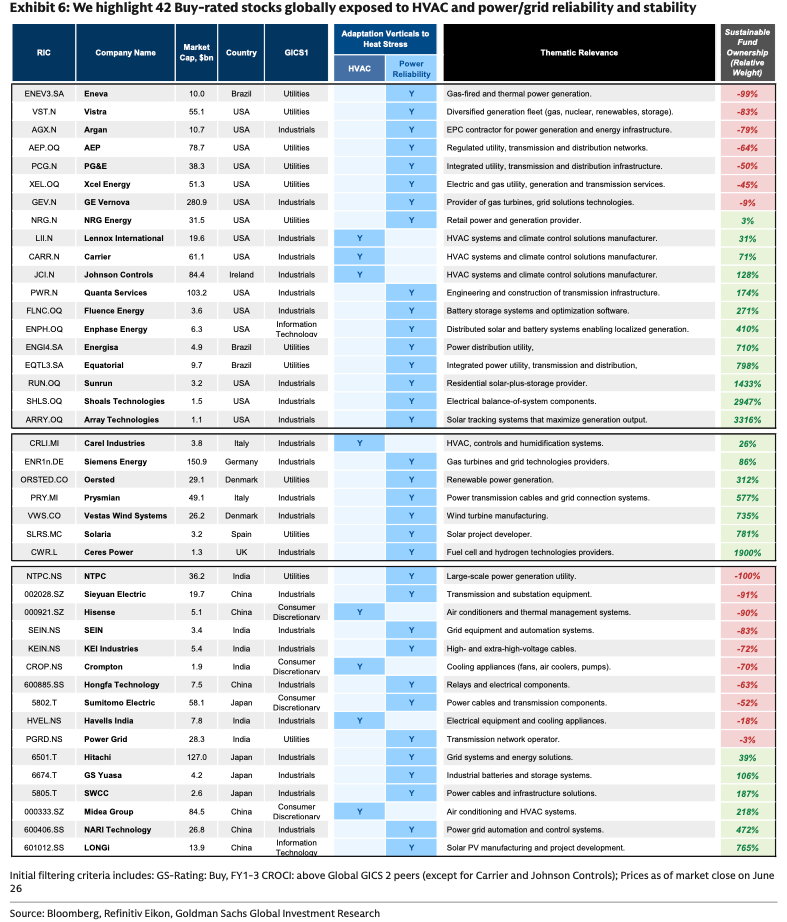
Now comes the question of how to profit beyond the agri markets. Goldman analysts led by Brian Singer penned a note for clients titled “Heat Waves Could Further Amplify HVAC Demand,” in which they laid out dozens of stocks tied to HVAC and power-reliability verticals that stand to benefit as heat waves drive surging cooling demand worldwide.

We highlight 42 global Buy-rated stocks exposed to HVAC and power reliability verticals that are positioned to benefit from rising cooling demand. We highlight analysis on El Niño and US drought conditions from our Commodities Research and Data Works/Retail teams,” Singer said.

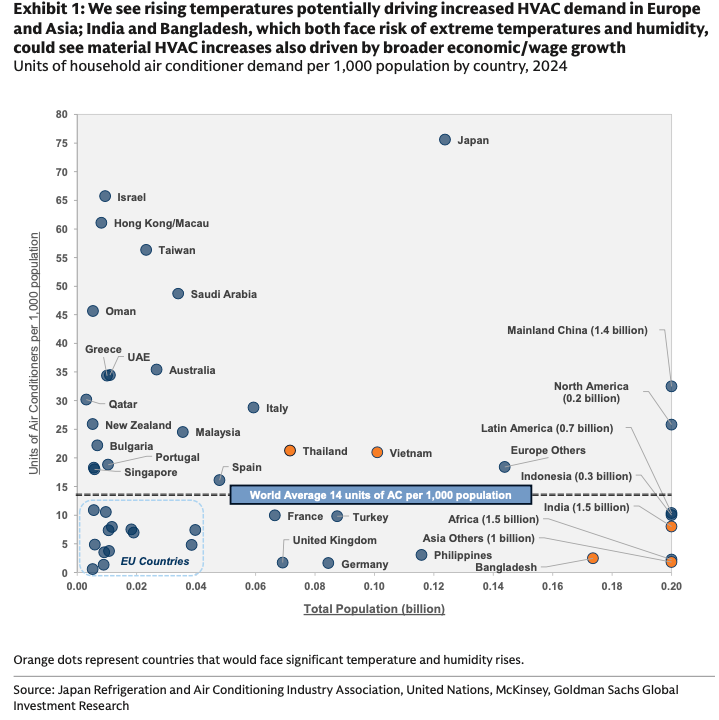
Singer noted that HVAC demand rose to 114 million units in 2024, up 7% from a year earlier, while global HVAC demand per capita increased by 6% to 13.9 units per 1,000 people.

Asia remains the largest residential HVAC market, accounting for about 60% of global demand, with Japan, Hong Kong/Macau, and Taiwan leading in market penetration.

Asia, Europe, India, and Bangladesh are set to be among the top markets driving global HVAC demand, given the hot, humid weather backdrop this year.

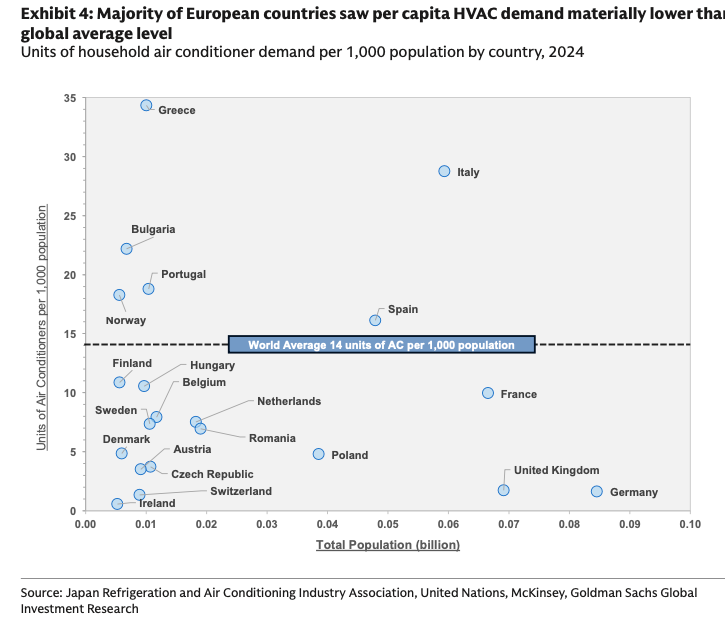
Singer explained that Europe has become a notable pool of HVAC demand because, even before the heat waves, Germany, the UK, and France were still well below the global average for AC adoption.

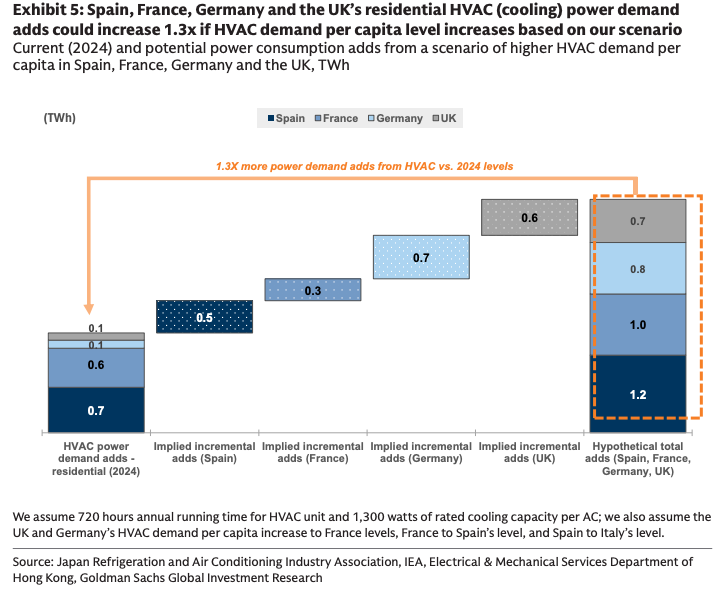
Power demand in Spain, France, Germany, and the UK set to rise if HVAC adoption increases. 

Last week, Rory Green, TS Lombard’s chief China economist, briefed clients on a weather note titled Super El Niño: Famine Follows War?”

Green wrote in the note, “In general, El Niño raises temperatures and significantly exacerbates both drought and heavy rainfall. For global macro, it is an inflationary shock via the food price channel – a shock that will likely be compounded by existing war-related high fertilizer costs.”

He said within his coverage, “India is the most exposed to both growth and inflation risks, supporting our underweight Indian assets. Brazil and Mexico, too, will receive an inflation impulse.”

El Niño Impact Watch:

Singer provided clients with 42 Buy-rated global stocks exposed to HVAC and power reliability, including Carrier, Johnson Controls, Lennox, GE Vernova, Vistra, Quanta Services, Prysmian, Siemens Energy, Midea, Hitachi and Power Grid.

Professional subscribers can read more on El Niño here at our new Marketdesk.ai portal. 

Tyler Durden
Tue, 06/30/2026 – 20:30

via ZeroHedge News https://ift.tt/DxTuY1H Tyler Durden

It’s Time To Stop Pretending That Migrants Are Entitled To Equal Citizenship

It’s Time To Stop Pretending That Migrants Are Entitled To Equal Citizenship

Authored by Brandon Smith via Alt-Market.us

Yet another civil conflict is brewing this week as the Supreme Court tackles a number of foreign citizenship debates, including Temporary Protection Status (TPS) and Birthright Citizenship. The court has ruled that hundreds of thousands of Haitian and Syrian migrants residing in the US under TPS are no longer safe from mass deportations (a win). But, they have also ruled in favor of migrant anchor babies (a big loss).

Both issues deal with changing American perceptions on what is “constitutional” when it comes to foreign access to citizenship. The Supreme Court’s decisions aside, I find it mind boggling that this debate has been ongoing for so many decades. Frankly, foreigners should not have any citizenship rights under the constitution until they have demonstrated assimilation. Until that time, there should be a separate set of rules handling newcomers (and invaders).

When it comes to TPS and the Haitians, the leftists are raging. Despite this status supposedly being “temporary” (the Obama Administration originally claimed these people would only be in the US for 18 months), many of these foreign transplants have been enjoying the benefits of unearned American citizenship for 16 years or more.  Yet, when Haitians protest the TPS decision, what flag do you see them flying?  That’s right – They fly the Haitian flag, not the American flag.  This tells us everything we need to know.

The liberal position on this issue is crystal clear: They believe that the constitution protects foreign migrants and their cultures from overt scrutiny. Meaning, foreigners don’t have to prove themselves worthy of citizenship, they get access regardless. Liberals also believe that it should be extremely difficult to remove migrants once they enter the country.

Keep in mind, this is the LIBERAL position. The woke position is much worse.

The radical left argues that western borders should not exist at all. For other countries, borders are fine. For the US and Europe, borders must be erased. Furthermore, they assert that the American economy must be treated as an open marketplace rather than a closed system. In other words, foreigners should be allowed to feed on the system whenever they please, transfer that wealth back to their third world hovels, and then come back for more.

The “empathetic” liberal position creates the foundation for the militant woke position. It’s rooted in a propaganda narrative created in the early 20th century: The claim that America’s entire identity is a “melting pot” of cultures and nationalities and that there is no original source identity. This false origin story was produced by New York socialists and it’s been spread by Hollywood for decades.

The famous poem called “The Colossus” imprinted on the Statue of Liberty is often used to elevate the melting pot myth. It was added in 1903, over 20 years after the statue was built. It’s author, Emma Lazarus, was a Zionist feminist with ties to numerous socialist movements. The fantasy of the melting pot of “huddled masses yearning to breathe free” was then popularized heavily in the 1960s and 1970s by far-left activist groups and the establishment media.

The melting pot is not our identity and never was. Historically speaking, America has always had a guarded relationship to immigration and we operated on “origin-based rules”. Meaning, Europeans from the north and west were welcomed, everyone else was limited. There was nothing wrong with this model.

America’s source identity is western civilization and European influence. There is no cultural melting pot.

The notion that the US is somehow legally required to accept everyone from everywhere regardless of their beliefs or background was not a thing until after the liberal era of the 1960s – 1990s. Until this time period, America had numerous regulations on who was allowed in. After the 1990s, the melting pot ideal became sacrosanct, as if it had always been a part of our constitutional legacy.

George Washington instituted the Naturalization Act of 1790 which restricted immigration to people mostly from European nations. John Adams instituted the Alien Friends Act 1798 which allowed the quick deportation of migrants found to be initiating civil disruption and sedition. He also enforced an extended probation period of 14 years before any migrant gained citizenship rights (instead of the original five year period).

Even Thomas Jefferson, who opposed the Alien Friends Act and had a highly liberal (and I would argue naive) ideal of America as an “open asylum for the oppressed”, supported some restrictions and regulations to immigration. It was a different time, but the rules still make sense today.

Teddy Roosevelt enforced the Immigrant Act of 1907, which banned the citizenship of any foreigners from cultures that practiced polygamy (which included Muslims) and focused on migration among groups that could easily assimilate into American society. Once again, this is perfectly acceptable and rational. There’s nothing wrong with enforcing logical standards.

Now, more than ever, we need such rules in place. Just because they were overturned once does not mean they can’t be brought back again as the conditions demand.

As far as the 1st Amendment is concerned, we’ve had exceptions to these protections when it comes to dangerous ideologies. For example, the US banned communist organization for decades, right up until the 1990s.

Why? Because the proliferation of communism will inevitably lead to the destruction of the same 1st Amendment rights that liberals claim to be protecting. Even in a republic, there are certain groups who cannot be allowed to exist because they represent a clear and present danger to the very framework that our country is built on. They are at war with our culture. To give citizenship to the barbarians at the gate is suicide.

By extension, one could argue that Muslim ideology is much like communism in that Muslims have a tendency to seek dominance and authoritarianism rather than integration. Their presence in the US is an obvious threat to the Bill of Rights. Therefore, we may have to make exceptions for them, just as we made exceptions for communism (globalism is also another important target for removal).

We can argue over the bureaucratic labyrinth that has been created to make expulsion of these groups difficult, but it doesn’t matter. Again, regardless of what the courts say, these people are not entitled to the same rights as natural born citizens, and we need to stop pretending as if they are owed something.

It is true that under current liberal precedents the constitution restricts the Federal Government from taking action to remove people based on identity, but this does not apply to the American public. If the government isn’t allowed to remove these threats, then make no mistake, the American people will eventually do it themselves. The film “Citizen Vigilante” is not fiction, it’s a warning. It’s wildly popular for a reason.

At the very least, the TPS decision shows that the Supreme Court is beginning to realize that it’s better to allow managed deportations than it is to drive the population to adopt vigilantism.

America has NEVER been a country of equal treatment for everyone all the time, and that’s because this is a foolish concept. The closer the Overton Window moves us towards multicultural equality the worse things get for everyone. As we’ve witnessed over the past decade, some groups tend to sabotage everything they touch. They don’t view American life as a privilege, they see it as something that can be pillaged, and liberal movements are enabling this behavior.

There are two key pillars to the liberal argument that need to be abandoned before it’s too late:

First, that immigration is some kind of sacred duty of the American people. It is our “historical identity” and a tradition that must not be forsaken. They suggest that migrants, as if by magic, become Americans as soon as they cross the border or drop a newborn child on the soil, and thus they must be given all the opportunities and legal protections afforded to true citizens.

Second, the constitutional laws in place are liberal in the application of rights, even for foreigners fresh off the boat. In other words, we’re violating the constitution by making exceptions.

This is simply not so. History shows us that logical exceptions have always been made. Why, for example, is a migrant allowed to slip across our border illegally, squeeze out a kid on this side of the line and by default that kid becomes a citizen? It makes no sense and almost no other country in the world allows it.

The absolutist vision of the constitutional shield might be sacred for people who are born and raised in America under American ideals and by American parents. This does not, however, apply to foreign invaders with intentions of exploiting loopholes and ransacking the nation while maintaining loyalties to their home countries.

Hell, I would even argue that exceptions can and should be made for radical communists. We had it right in the 1950s. And the answer is simple: Deport them all.

Is a group of people seeking to sabotage western civilization? Deport them. Are they acting like parasites feeding off subsidies while giving nothing in return? Deport them. Does a group have a religion or ideology that is clearly antithetical to western values? Deport them.

And what about the argument that we must accommodate refugees from war-torn regions; that we must provide safe haven? No, we don’t.

Since when are we not allowed to be selective in who we help? No other country in the world is treated with the same expectations as the US when it comes to immigration. When did it become our responsibility to fix every problem in the world? This is a role that was foisted on us by a century of progressive propaganda.

Maybe Haitian refugees need to be sent back home to fix their own problems in their own country? Maybe the only way these places will ever be reformed is if the US stops acting as a steam valve for the discontented? Maybe anchor babies need to be shipped off with their illegal migrant parents, instead of letting them all stay in the country on a technicality?

Is it a slippery slope? Could these same rules be turned back on American conservatives and patriots? No, because who would be left to use them against us? This is not a call for an end to constitutional rights. Nor is it a call for an end to all immigration. Rather, it is plea for nuance, sanity and selectivity.

We used to have more practical rules for these problems, and I guarantee, the Founding Fathers would be FAR more aggressive in enforcing those rules than we are today. Some people do not deserve the same rights as US citizens and some people do not deserve the same access as US citizens.

It’s okay to admit it. This is a fact that we need to accept as a society. We need to stop the benevolent liberal charade which is designed to make us feel obliged to the rest of the world.

Views expressed in this article are opinions of the author and do not necessarily reflect the views of ZeroHedge.

Tyler Durden
Tue, 06/30/2026 – 20:05

via ZeroHedge News https://ift.tt/cHzTomk Tyler Durden