Former Florida police officer Zachary Krug has been charged after investigators say he drove 104 mph in a 50 mph zone and crashed into an SUV, killing a 6-year-old girl. Prosecutors say Krug was late for work with the Temple Terrace Police. He activated the emergency lights on his unmarked car to get through a red light, then accelerated to more than twice the speed limit before crashing into an SUV containing Samantha Sakowski and her three children. Sakowski received broken ribs and two black eyes, one child sustained a concussion, and another had a broken spine and pelvis and needed to be placed into a medically induced coma. Six-year-old Leila died from her injuries. His attorney claimed Krug was following a speeding driver, but the county prosecutor says there was no such driver. Krug was fired and now faces charges of vehicular homicide and reckless driving.
Let’s consider the arguments of those who advocate global governance, the people whom Hrvoje Morić identifies as the Multipolaristas. They are often engaged in China-maxxing and are, whether they know it or not, essentially serving as propagandists for the global oligarchy.
Research conducted by analysts working for the South China Morning Post (SCMP)—an English-speaking, Western-aligned Chinese news outlet—suggests that, between 2015 and 2025, a notable shift occurred in the way China and its government were portrayed by the leading Western media organisations.
Chief analyst Jianlu Bi, who is a senior fellow at the Washington Institute for Policy Studies and a research fellow at the Charhar Institute in Beijing, wrote:
[N]early 70 per cent of stories covering China’s economy, technology or environment in 2019 had a negative tone [but] by 2025, the share of negative stories dropped to around 40 per cent, along with an increase in neutral coverage across all categories and positive coverage of the [Chinese] economy.
This notable Western media narrative shift is part of a wider trend that can be described as “China-maxxing.” With outlets like The Economist, the Financial Times, and The New York Times—all previously known for their staunch anti-China propaganda—now quite regularly extolling the virtues of China and, most notably, its economy, “China-maxxing” is an identifiable phenomenon.
The Western mainstream media is gradually shifting to sell the Chinese government to us as the “good guys.”
Recently, Elon Musk has engaged in some China-maxxing of his own. Musk is part of the gaggle of oligarchs eager to roll out AI data centers wherever they can. Musk was keen to point out that the only national government that has, in his view, adopted the right approach is China’s:
The availability of energy is the issue. If you look at electrical output outside of China, it’s more or less flat. Very slight increase, but pretty much flat. [. . .] If you’re putting data centers anywhere except China, where are you going to get your electricity? Especially as you scale, how are you going to turn the chips on? Magical power sources? Magical electricity fairies?
The previous blanket Western media vilification of China was always absurd state propaganda. China has been framed as the comic-book villain to encourage Western populations to accept further suppressions of their rights by their own governments and to claim justification for increased public spending on the Western military-intelligence complex.
Meanwhile, the multinational corporations that benefit from the government contracts, supposedly awarded to protect Western populations from the fabricated Chinese threat, such as Musk’s SpaceX, are led by oligarchs who genuinely pose a threat to everyone.
Though he didn’t use the term himself, in trying to explain China-maxxing, Mr. Jianlu offered a list of potential reasons for it. These included the Western media’s recognition of China’s technological and economic progress, the Chinese government’s apparent commitment to tackling climate change, its drive for efficiency, and so on. Jianlu argued that all of this has combined to force Western media outlets to reevaluate how they cover China and China-related matters.
Nation-states and national governments are set to be replaced by a global Technocracy. At some point, therefore, the conversation about moving away from the extant governance system to which people are accustomed to the new one has to commence.
Returning to Jianlu’s analysis, he is a leading Western policy think tank representative, and the media outlets he discussed primarily serve as propagandists for Western policy. Buried in the analysis, there is a brief statement that indicates what the real purpose of China-maxxing is:
Unlike the US, where policy shifts can abruptly occur due to political changes and short-term economic pressures, [. . .] China’s long-term strategic planning and consistent policy implementation have yielded results.
Dark Enlightenment-enthused oligarchs like Peter Thiel want to “escape from politics in all its forms,” and beyond dictatorship, there is no political mechanism of any kind in the Technocracy advocated by oligarchs like Elon Musk.
The oligarchy intends to make itself the feudal lords (founders) of private smart city-states similar to those currently being developed in China. The UN desires the same transformation. China-maxxing suits their shared agenda perfectly.
China-maxxing is yet more Western media propaganda, this time intended to convince Westerners that the model of government they are accustomed to no longer works. The Chinese development of Technocracy is better because it “yields[s] results.” Irrespective of the fact that no Westphalian-model Western government has ever operated as a democracy, China-maxxing has arrived to persuade Westerners that the so-called “representative democracies” that they have been misled to believe are democracies are now surplus to requirements.
Multipolaristas, specifically those working in the independent media, perhaps unwittingly argue that the dictatorial state control of human beings’ access to resources is acceptable because the accompanying surveillance state seemingly “yields[s] results.” Some say it reduces crime or that the gleaming towers of the new city-states are so beautifully clean and convenient. Others that China’s infrastructure investment strategy shows the world a clear alternative to austerity.
China is nation-building while Western nations decline and collapse. Chinese Technocracy “yields[s] results” that failing Western nations cannot match. Unless, logically, they too adopt Technocracy.
To an extent, the Multipolaristas make reasonable points. Who wouldn’t want to live in safe, clean cities? Who wants austerity when the state could invest in much-needed infrastructure instead? Who wouldn’t want the employment opportunities and the economic benefits that result? But all of the Multipolarista’s ostensibly reasonable observations and commentaries are based upon fatal omissions that result in them essentially spreading Western propaganda, intentionally or otherwise.
No state needs to impose a centralised technological population surveillance system in order to improve public safety, clean the environment or the streets, or invest in public infrastructure and its own economy. By effectively promoting global governance and Technocracy, the Multipolaristas’ foolhardy suggestion is that functional oligarchies are benevolent and that we should trust them.
There are no historical examples of a state ever successfully imposing the full gamut of despotic behavioural control systems on a large population. But with its Greater Bay Area initiative, linking China’s numerous smart city projects together, China is reaching that point. Now Western mainstream and independent media outlets are showcasing China’s development to sell all the alleged benefits of Technocracy to Western populations.
Neither fascism nor communism even comes close to the behavioural dictatorship Technocracy is designed to inflict. Ignoring this aspect of China’s undoubtedly impressive modernisation is an epistemological error so profound it renders the rest of the Multipolaristas’ arguments practically irrelevant.
If the objective was not to enslave us, no state and no oligarch would construct Technates. The sole purpose of Technocracy is systematic human bondage.
From humanity’s perspective, there is nothing good about living in a Technocracy. No matter what incentives we are given, irrespective of the claimed benefits offered to entice us, giving our consent to those who wish to foist Technocracy upon us is an act of generational suicide.
There is, of course, no reason why we should agree to any of it.
Views expressed in this article are opinions of the author and do not necessarily reflect the views of ZeroHedge.
We’ve all heard the argument for most of our lives: “White culture doesn’t exist.” It’s perhaps the most common racial refrain because it’s the most socially acceptable to repeat. If someone said “Black culture doesn’t exist because black people all herald from different tribes…” that person would be browbeaten as a bigot by the woke mob. When it comes to white culture, such claims are applauded.
The question is, why is it okay to diminish or denigrate white culture while worshiping every other culture? Furthermore, if white culture doesn’t exist, why are woke minority groups constantly trying to hijack white history and accomplishments?
I want to explore this issue a little more deeply, mostly because of the endless targeting of western civilization through the leftist deconstruction of our most popular figures and mythologies. This time, the Hollywood elites have chosen Homer’s The Odyssey, an ancient Greek classic deeply rooted in western history (white history), as their victim.
Hollywood has pulled out ALL the stops for this movie and I suspect it’s because they are desperate. They are desperate for a woke win. They’ve had hundreds of failures both in film and television in the past few years and it’s starting to look like “Get Woke, Go Broke” is becoming the dominant force in popular discourse. The leftists can’t stand it.
In response, Hollywood has stacked the deck – They brought in Christopher Nolan, one of the only directors left in the industry who still has a built-in audience of simps who will go see his movies regardless of their quality. The distributors have focused on IMAX ticket sales for a wealthier clientele, artificially inflating the overall box office take.
The media has been running non-stop interference, promoting the movie heavily months in advance. Evidence also suggests that Rotten Tomatoes is once again rigging the audience score for this film by rejecting most negative reviews (they have done this with multiple woke tent pole movies over the years).
Hilariously, journalists are already declaring The Odyssey “proof” that “Get Woke, Go Broke” is a fallacy. As I write this, the movie hasn’t made a dime in profit yet. What I find most interesting, however, is that these activist journalists are actually using the phrase “Get Woke, Go Broke” in their vernacular. It’s an indirect admission of their agenda.
They are specifically citing our movement as their enemy and declaring us “defeated” because The Odyssey is projected to make money. By default, they are admitting that we are a threat to them, and that The Odyssey is a woke project designed to “silence us.” But why does this matter?
It’s important to understand that leftists think like children. They believe that having a “majority” is the same as being right; having a majority to them is the same as having power. If the Odyssey is a box office success, they think this proves that they are the dominant political movement.
They don’t care if their supposed majority is actually astroturf; if they can fool the public into thinking the political left has a social mandate, this will win them control over the culture. In other words, they’re trying to manufacture a consensus.
The Odyssey film is a clear salvo aimed directly at conservatives and western history. It is a multicultural travesty, a joke of a movie filled with historical inaccuracies and based on a deconstructionist translation written by a feminist academic from Oxford (Emily Wilson). The movie explicitly undermines the heroism of the story and makes Odysseus a broken man, suffering from “trauma” and PTSD over his regrets of the war and his “colonist” behavior.
But the spurious additions to the mythology are less interesting to me than the reasons they were included.
The deconstruction of Odysseus reminds me of what Kathleen Kennedy and friends at Disney did to Luke Skywalker in “The Last Jedi”. They took a brilliant, courageous and moral man and turned him into a shattered, crusty and nihilistic little bitch – completely the opposite of his original character. This was not a mistake, this was quite deliberate.
White people are not allowed to have bold, wise and confident heroes. We’re supposed to regret our history and our accomplishments. We’re not supposed to celebrate such things, because that might inspire us to be bold, wise and confident today.
The race swapped cast of The Odyssey featuring black actors, Hispanics, Asians, and other people (including a transgender Ellen Page playing a male Greek warrior) who would never have populated Homer’s era is the common angle of attack for woke Hollywood, but it’s not the only attack. If a main protagonist is white, as is the case in Nolan’s film, he must be torn down and made weak. He must be portrayed as shamed and desperate for redemption, which, of course, he will only receive by embracing progressive ideals.
The last thing Hollywood wants is to portray a white hero who is unapologetic for his actions and values.
This is the underlying woke messaging that really poisons the well when it comes to The Odyssey. The minority actors are primarily a shield from criticism. If anyone complains about African or Hispanic or Asian actors in a Greek epic, the media can pull the “racism” card and dismiss the issue outright. They assert that we merely hate seeing minorities in movies.
But it’s not minorities in movies that we have a problem with; it’s the injection of woke propaganda. This is the real crime. If Christopher Nolan made a film based on the African “Epic of Liyongo” from the 9th Century and he replaced the Swahili characters with white actors in a bid to hijack African history, the left wing would lose their collective minds and scream “cultural appropriation.” The double standard is obvious.
Will Odyssey make a profit? Possibly. The movie had a big first weekend, but adjusted for inflation it didn’t even crack the top fifty on the list of opening weekend box office winners. The film has to make around $700 million in order to break even, not counting the 20% of the gross receipts that go to Christopher Nolan according to his contract.
I am doubtful that the studio will make much money on this flick, but Hollywood will declare it a victory all the same. Firstly, because no woke movie has had similar momentum in years. And secondly, because the political left is dying and they need a very public win in order to justify their habit of doubling down on failure.
Any sane and intelligent person would point out that one “successful” movie does not make up for the cemetery filled with woke box office disasters. This doesn’t matter to the activist mob. They think that one win will erase all their previous losses.
Furthermore, The Odyssey is intended to act as a continuation of the long Marxist march towards a multicultural west and the end of white history as we know it.
Homer’s epic poem was composed around 2800 years ago and is one of the oldest surviving works of literature in human history. It stands as a testament to the incredible accomplishments of the western world; part of the wellspring from which the modern west poured forth.
At the time The Odyssey was created, the Mediterranean was overwhelmingly Caucasian according to genetic records. This includes North Africa, which was majority Caucasian and largely “white” by modern standards. It should be noted that Sub-Saharan Africans did not exist in any notable quantity in North Africa or the Mediterranean until many centuries later because travel across the deserts of central Africa prevented their migration north for thousands of years.
Arabs were also limited and did not occupy the region in great numbers until the invasion of the Muslim hordes long after Homer lived.
Numerous images from the ancient Greeks and Macedonians, including pottery, murals and other surviving art, depict people of fair skin, often with blue eyes, and in some cases blonde hair, etc. In other words, they were white – Varying shades of white, but still white.
Simply pointing out this historical and scientific fact will immediately trigger the woke mob and their academic allies. You will be inundated with a flurry of exceptions and some tiresome mental gymnastics about why the people of these early civilizations were not really “white”. Remember, “white culture doesn’t exist”, only other cultures exist.
Far too many critics and historical conspiracy nuts actually think the demographics of North Africa and the Mediterranean in the time of Homer were the same as the demographics of North Africa and the Mediterranean today. They don’t know anything about the great migration shifts of the Middle Ages or the invasion of the Muslims. No meaningful discussion can be had with these people because their point of reference is built on pure ignorance.
Beyond that, there is another subset of dishonest people (woke leftists) who see it as their duty to undermine white history and rewrite as if it never existed. They often cater to the inferiority complexes of minority groups by asserting that white history is actually THEIR history. White people just “stole” accomplishments from other civilizations and replaced them over time.
This is part of the narrative that motivates the discourse over Christopher Nolan’s dismal film version of The Odyssey. It is a woke treatise, a magic talisman designed to brown-wash and feminize yet another piece of western heritage. It’s part of a greater agenda to make white people forget who we are, or at the very least, make us ashamed of who we are.
The end game? Like I said, it’s about the multicultural takeover of the western world. Everything stems from this scheme. Hollywood’s woke reboots are rooted in it. The mass immigration policies of leftist governments drive the agenda forward. The deconstruction of our history in public schools and colleges is designed to indoctrinate children so they never learn the truth.
Until one day, we look around, and everything that makes us who we are is gone, from meritocracy to republicanism, from Christianity to critical thinking, from innovation to entrepreneurship, from individual liberty to free markets, from property to responsibility, and yes, colonialism (the act of improving third world hellholes where people are incapable of improving their own surroundings so they don’t turn into pillagers trying to invade our countries).
All of it replaced with a socialist purgatory in which everyone is equally pathetic, hopeless and useless.
The whole conspiracy has become quite transparent and grimly boring. Luckily, one garbage movie isn’t going to change the overwhelming trend, which is the slow but steady decline of left-wing insanity. Nothing they are doing is hidden from us. We see it all, and in the long run, they’re going to lose. It’s inevitable.
China Plans Planetary Defense Test By Slamming Mach 26 Spacecraft Into Asteroid
A new paper under peer review by the Chinese-language Journal of Deep Space Exploration lays out an ambitious plan to crash a spacecraft at Mach 26, or 20,000 mph, into a near-Earth asteroid to test new planetary defenses.
The South China Morning Post reports that a team led by Li Mingtao, chief scientist for planetary defense at the China National Space Administration, is planning a mission even more ambitious than NASA’s Double Asteroid Redirection Test (DART).
That mission would slam a spacecraft into 2015 XF261, an asteroid estimated to be about 30 meters wide, in either 2029 or 2030.
“Dart was the first to demonstrate asteroid deflection by kinetic impact in space, but it did not directly change an asteroid’s orbit around the sun relative to Earth, making it different from a real planetary-defense scenario,” the researchers wrote in the report.
The planned impact would be nearly 50% faster than NASA’s 2022 DART, which hit the asteroid Dimorphos at 6.1 kilometers per second, or about Mach 18.
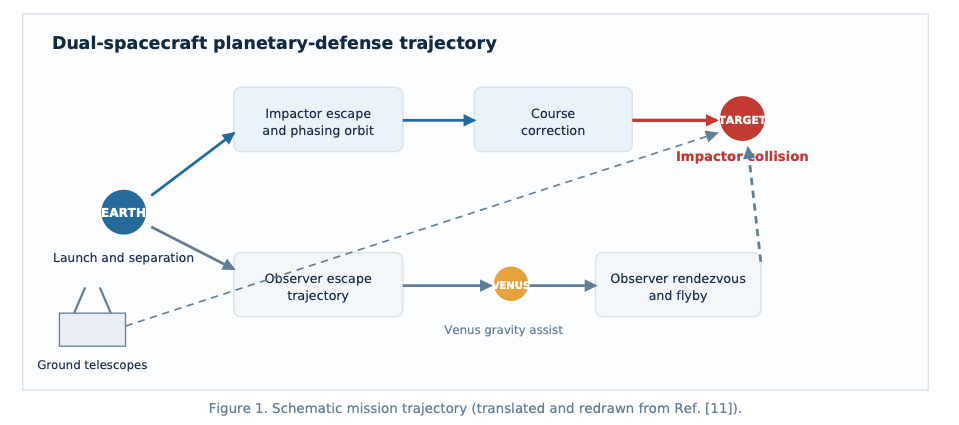
According to the paper, the mission calls for two spacecraft: one interceptor and one observation spacecraft, which would use a Venus gravity assist before rendezvousing with the target. It would deploy a small probe to monitor the collision and measure changes to the asteroid’s orbit, shape, surface, and internal structure.
“Focusing on China’s first asteroid-defense demonstration and verification mission, planned for implementation before 2030, this paper systematically reviews the frontier scientific questions in kinetic-impact asteroid defense to support mission design, implementation, and preliminary scientific research,” the researchers said.
If successful, the test would become China’s first end-to-end demonstration of an operational planetary-defense system. It will help scientists better understand how – and when – a kinetic impactor spacecraft could be used to deflect an Earth-bound asteroid.
Meanwhile, SpaceX will launch the NEO Surveyor asteroid-detection telescope no earlier than September 2027, which will discover and monitor most of the potentially hazardous asteroids and comets that come within 30 million miles of Earth’s orbit.
Ohioan John Ream is an accomplished aerospace engineer and brewery owner. He would like to try his hand at making Bourbon. However, federal law prohibits distilling spirited beverages at home. On Monday, he filed a petition in the Supreme Court of the United States asking it to hear his case, which raises important questions about the limits of federal power.
Home distilling is, of course, as American as apple pie, and certainly a lot older. George Washington’s Mount Vernon estate featured a distillery that, by 1799, was producing more than 10,000 gallons of whiskey per year. Nonetheless, Congress barred distilling inside any “dwelling house” or “shed, yard, or inclosure connected with a dwelling house” in what was, by all indications, a sop to the temperance movement. Later, Prohibition killed off what remained of craft spirits production.
The home-distilling ban ultimately survived both Prohibition and repeal, along with the distilled-spirits tax. Under the law, distilling, or even owning a set-up still, in a prohibited location like a home is punishable by fines, property forfeiture, and imprisonment. Given the draconian penalties, it’s little surprise that hobby distilling has floundered while craft brewing and small-batch winemaking, both of which the law allows, have flourished.
Mr. Ream filed a lawsuit in federal court challenging whether that disparity has any lawful basis. The federal government, after all, possesses only the limited powers specified in the constitutional text. States, meanwhile, retain broad authority to legislate for the public good. This vertical separation of powers between the federal government and the states promotes accountability, responsiveness, and ultimately individual freedom.
Or it would, if the Court hadn’t refashioned the Constitution’s Commerce Clause, which authorizes Congress to “regulate Commerce…among the several States,” and had long been understood to reach only interstate trade and the channels of such trade. But in the 1942 Wickard v. Filburn ruling, the Supreme Court eviscerated such limitations. At issue was a Soviet-inspired law capping wheat production to “rationalize” the agricultural sector and, by limiting its volume, drive up prices. Roscoe Filburn was an Ohio farmer who exceeded the imposed cap and grew enough wheat to feed both his family and the animals on his farm. The Court held that Congress may regulate any activity that, in aggregate, has a substantial effect on interstate commerce. Because widespread home-production of wheat would prevent Congress from regulating interstate prices, Congress could therefore restrict home production as part of its price-regulation scheme.
For the six decades following Wickard, the Court demurred in enforcing the Commerce Clause’s limits. But by the mid-1990s, the Court appeared ready to chart a new course. First, it struck down the Gun-Free School Zones Act in a 1995 decision, United States v. Lopez, reasoning that merely carrying a gun near a school was too attenuated from interstate commerce to substantially affect it. Then the Court doubled down in United States v. Morrison (2000), which held unconstitutional a federal statute authorizing lawsuits by victims of gender-motivated violence. Morrison pared back Wickard‘s aggregation principle, suggesting that it applies only to inherently economic activities, and refused to defer to Congress’s view on whether local activities substantially affect interstate commerce. Legal observers proclaimed a nascent “federalism revolution.”
It didn’t last. The promise of Lopez and Morrison was cut short by a 2005 decision, Gonzales v. Raich, upholding the Controlled Substances Act’s prohibition on the home cultivation and consumption of marijuana subject to state regulation. Going well beyond Wickard, Raich applied its aggregation principle to noncommercial activity and adopted the maximally deferential “rational basis” standard for assessing Congress’s need to regulate non-interstate activities. Taken on its own terms, Raich all but declares that anything goes with regard to regulation under the Commerce Clause.
One doubts that is the view of the current Court. Justice Thomas is the sole holdover from Raich, from which he dissented. His opinion explained how, if the Raich majority were right, then “the Federal Government is no longer one of limited and enumerated powers.” Chief Justice Roberts wielded that same logic in his opinion holding that Obamacare’s “individual mandate” to purchase health insurance was not authorized by the Commerce Clause, and the dissent joined by Justices Thomas and Samuel Alito reasoned similarly. Although the justices appointed by President Trump have not been afforded the occasion to opine on the Commerce Clause’s limits, all three take seriously the Constitution’s original meaning, its structural features, and the enumeration of powers as a constraint on federal power. Expect them to be more skeptical of assertions of federal authority than was the Raich majority.
John Ream’s current challenge to the home-distilling ban takes aim at the excesses of Raich, and would be a meaningful first step toward rekindling the federalism revolution.
The U.S. Court of Appeals for the Sixth Circuit upheld the home-distilling prohibition, ruling that the ban, while not a tax, “is a necessary and proper means of collecting the federal excise tax on spirits,” because stills could be hidden within homes in order to evade taxation.
The more defensible view on this same matter was expressed in a U.S. Court of Appeals for the Fifth Circuit decision by Judge Edith Jones issued eleven days earlier. Far from furthering collection of the tax, the ban serves to “reduce revenue by preventing individuals from making distilled spirits” otherwise subject to taxation. It would be improper to allow Congress to “criminalize nearly any at-home conduct only because it has the possibility of concealing taxable activity.”
The split between the Fifth and Sixth Circuits on the home-distilling ban’s constitutionality is reason enough for the Supreme Court to take Ream’s case, resolve this conflict, and provide national uniformity in the law. But there’s also a need for further clarity on the Commerce Clause and Raich‘s continued viability. Given the massive growth of the federal government and its intrusion into every facet of modern life, there are few issues more important or pressing for the Court’s consideration.
Andrew M. Grossman and Robert Alt represent John Ream in his litigation and also the plaintiffs who prevailed before the Fifth Circuit. Mr. Alt is President and CEO of The Buckeye Institute, where Mr. Grossman is a Senior Legal Fellow.
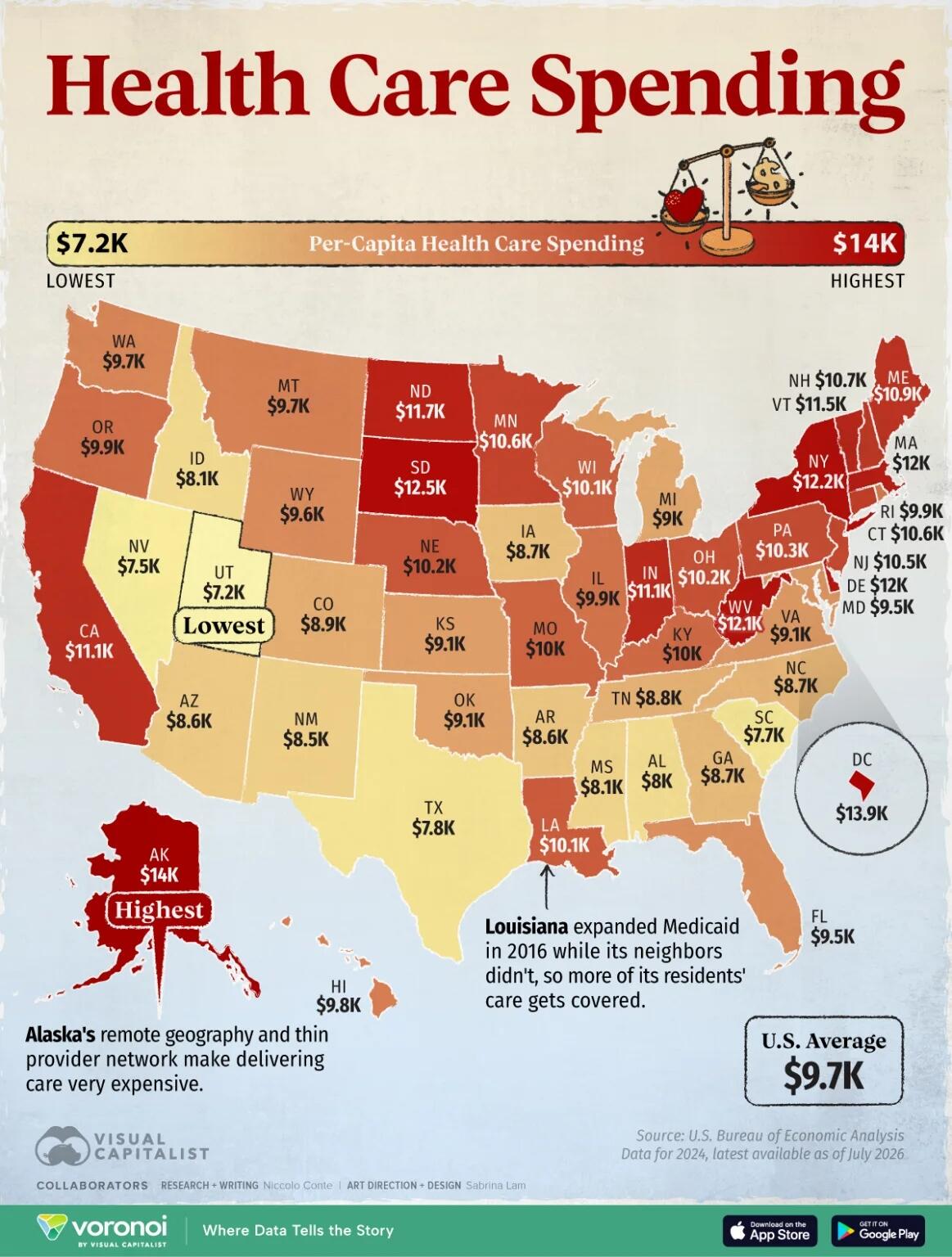
Below is a ranking of states based on per-person health care spending:
Rank
State
Per-Capita Health Care Spending
1
Alaska
$14,044
2
District of Columbia
$13,865
3
South Dakota
$12,451
4
New York
$12,221
5
West Virginia
$12,055
6
Delaware
$11,987
7
Massachusetts
$11,985
8
North Dakota
$11,667
9
Vermont
$11,493
10
Indiana
$11,071
11
California
$11,054
12
Maine
$10,913
13
New Hampshire
$10,682
14
Connecticut
$10,639
15
Minnesota
$10,567
16
New Jersey
$10,468
17
Pennsylvania
$10,262
18
Ohio
$10,202
19
Nebraska
$10,192
20
Louisiana
$10,148
21
Wisconsin
$10,079
22
Missouri
$10,036
23
Kentucky
$9,964
24
Oregon
$9,931
25
Illinois
$9,895
26
Rhode Island
$9,864
27
Hawaii
$9,808
28
Montana
$9,747
29
Washington
$9,693
30
Wyoming
$9,640
31
Florida
$9,545
32
Maryland
$9,456
33
Virginia
$9,123
34
Kansas
$9,066
35
Oklahoma
$9,052
36
Michigan
$9,023
37
Colorado
$8,871
38
Tennessee
$8,761
39
North Carolina
$8,744
40
Georgia
$8,680
41
Iowa
$8,660
42
Arkansas
$8,562
43
Arizona
$8,556
44
New Mexico
$8,469
45
Mississippi
$8,135
46
Idaho
$8,078
47
Alabama
$7,980
48
Texas
$7,807
49
South Carolina
$7,741
50
Nevada
$7,536
51
Utah
$7,233
Alaska spent nearly twice as much per resident on health care as Utah in 2024.
Several Northeastern states, along with South Dakota and Washington, D.C., also ranked near the top. Meanwhile, much of the Mountain West and South recorded below-average spending.
Why Do Some States Spend More Than Others?
Higher spending does not necessarily mean residents receive more medical care.
Numerous studies have found that differences in prices, especially for hospital and physician services, explain much more of the variation in U.S. health spending than differences in how often people use care. Administrative costs, provider wages, and regional labor markets also play major roles.
State-specific factors matter as well. Alaska’s remote geography and limited provider network make delivering care significantly more expensive, while states with older populations often spend more because seniors tend to use more medical services.
Broader insurance coverage can also increase the share of care captured in personal consumption expenditures.
Health Care Spending Continues to Climb
Nationally, health care expenditures continue to rise.
CMS projects U.S. health spending will approach $9 trillion annually by 2034, driven by increased enrollment in Medicare and Medicaid, along with continued growth in health care prices. Despite already spending more per person than any comparable high-income country, the U.S. is expected to devote an even larger share of its economy to health care over the next decade.
International comparisons show the U.S. spends substantially more on health care than other high-income countries, largely because medical services cost more rather than because Americans use dramatically more care.
As national spending continues to rise, the nearly twofold gap between states highlights how geography remains a major factor in what Americans ultimately spend on health care.
Topline:Since 2019, school districts across 24 states and Puerto Rico have lost $225 million to fraud confirmed by the U.S. Department of Education inspector general’s semiannual report to Congress. No more than $67 million has been recovered.
Key facts: Open the Books and the State Financial Officers Foundation documented74 instances of confirmed school fraud, averaging over $3 million each. There are far more that have gone unprosecuted or undetected.
Florida and Illinois schools each had the most instances of fraud with 11.
Indiana lost the most money – $44 million – due to inflated attendance numbers that increased state funding to two schools. The schools’ founder then allegedly sent the money to companies he owned. The schools closed in 2019, and four alleged conspirators were charged in 2024.
At Broward County Public Schools in Florida, information officer Anthony Hunter allegedly used district funds to buy $17 million worth of school supplies from a friend’s business, ignoring the competitive bidding process. In return, the friend hired Hunter and his son to work a security job and sold Hunter a house for $150,000 below market value, state prosecutors claim
Chicago Public Schools received $1 million of federal grants meant for Native American students, using an application that included more than 1,000 students of South Asian descent. The district was unable to verify how many students were actually in the program, and agreed to repay the money.
Fraud arguably hits small school districts the hardest because they have fewer budgetary resources to begin with. When Janis Bucknor, former head of Community Preparatory Academy in California, admitted to stealing $3 million from the school over five years, it amounted to one-third of all the school’s state and federal funding.
Bucknor spent $220,600 of the money on Disney vacations and also funded her internet shopping and private school tuition for her kids. She was sentenced to three years of home detention and ordered to repay the money.
Summary: The government loses hundreds of billions of dollars to fraud annually, but redirecting money away from children’s education is especially egregious.
The #WasteOfTheDay is brought to you by the forensic auditors at OpenTheBooks.com
India expects to build domestically five small modular reactors (SMRs) by 2033, India’s Atomic Energy Minister, Jitendra Singh, said. The five SMRs would be part of India’s push to accelerate nuclear power capacity installations over the next two decades, the minister told lawmakers in a written reply to questions as carried by local media.
The Bhabha Atomic Research Centre (BARC), India’s premier nuclear research facility under the Department of Atomic Energy, is currently developing a 220-MW Bharat Small Modular Reactor, a 55-MW reactor, and a high-temperature gas-cooled reactor designed to produce hydrogen, Singh said quoted by OilPrice.com.
As per India’s nuclear energy roadmap, the country aims to boost its installed nuclear power capacity from 8.78 gigawatts (GW) now to about 22 GW by the 2031-32 fiscal year, the minister said.
India goal is to boost its installed nuclear power capacity to 100 GW by 2047, up from just 8.8 GW now. This would require as much as 19.28 trillion Indian rupees, or $200 billion at current exchange rates, of cumulative capital, a panel set up by India’s power ministry said in the ‘roadmap to 100 GW’ report last year.
At the end of 2025, India’s government approved the landmark Atomic Energy Bill, which allows private companies to invest in its nuclear energy industry for the first time, as the country looks to boost nuclear power capacity tenfold within two decades.
The so-called SHANTI (Sustainable Harnessing of Advancement of Nuclear Energy for Transforming India) Act could drive huge investments from private companies in India’s nuclear energy sector.
Yet, Indian state-owned NTPC Ltd, the biggest utility in the country, is expected to account for 30% of the new nuclear power capacity installations by 2047.
NTPC, currently the only nuclear power generator in India, is now looking to acquire stakes in uranium assets globally to secure fuel for the expected massive expansion of India’s nuclear power capacity.
Through what he envisions as a federal declaration, consenting adults would be allowed to buy and sell homemade and farmstead food directly, without the costly commercial infrastructure and cumbersome government regulation currently in place.
Salatin’s mission reflects a push among homesteaders and independent farmers to cultivate local food networks, where food is grown and raised without chemicals and consumers can gain a more transparent connection to how food is produced.
The Next 15 Years
At its core, food emancipation and local food networks are about neighbors feeding neighbors, sidestepping a system many no longer trust.
Salatin told The Epoch Times that the American food system is at a historic inflection point. He points to an aging farm class; the average American farmer is now around 60 years old.
Around half of U.S. agricultural equity is expected to change hands in the next 15 years, he said.
“That’s the most unprecedented peaceful transfer in modern history,” he said.
In 2025, Americans spent 56.3 percent of their food dollars on items prepared outside the home, at restaurants, at fast-food chains, and through takeout delivery services. Overall, out-of-home food spending reached a record $1.41 trillion out of a total $2.51 trillion in national food spending, according to the U.S. Department of Agriculture (USDA).
Meanwhile, the farmer’s share of the retail food dollar after production expenses has plummeted to roughly 5.8 cents today, according to the USDA. That figure was 40 cents in the mid-20th century.
The idea of food emancipation is simple: Let small producers legally and freely sell directly to the people who want their food.
Salatin notes that the real barrier to young people entering farming is not access to land alone, but the inability to profit from small-scale, value-added food production under existing rules.
He illustrates the gap with a simple calculation.
On a couple of acres, a farmer might raise 1,200 pastured chickens, selling them as whole birds or cut-up parts at an average of about $30 per bird, yielding $36,000 in gross income, he said.
If that same farmer could legally turn those birds into homemade chicken pot pies – free of dyes, seed oils, and industrial additives – and market them as high-quality convenience food, the average value per bird could jump to around $200, he explained, turning the same flock into $240,000 in revenue on the same land.
Once a farmer moves from raw ingredients to prepared foods, the regulatory threshold explodes, going from a home kitchen with existing equipment to what he described as “a half-million-dollar requirement to sell one chicken pot pie.”
Saving The Family Farm
Pennsylvania dairy farmer Edwin Shank told The Epoch Times that his family nearly lost a four-generation farm after expanding from 40 to 300 cows under university-driven advice that prioritized volume above all else.
Despite filling a tractor-trailer with milk every two days, the Shanks were going bankrupt.
Milk checks came once a month – whatever the processor felt like paying. His banker warned that if nothing changed in three to four months, the farm would be gone.
A family portrait from that period, he said, looks idyllic – flowers, six children, a tidy yard – but behind the smiles they “were losing the farm.”
“Inside the fence, hope is outside the fence,” he said, quoting a conventional dairyman who described it as “a hard time to be a farmer these days.”
The Shanks’ response was to step outside the fence.
They converted their operation to certified organic; then, with borrowed money and little capital, they began selling raw milk directly from the farm under Pennsylvania’s permit system. They couldn’t afford a modern facility, so they bought used refrigerated semi-trailers – or reefers – for a few thousand dollars each and bolted them together into a makeshift cold-storage complex.
Business started to flourish after a phone call from New Jersey. A mother in Trenton asked if Shank could deliver raw milk across the state line. Legally, he could not, but he took a cue from Salatin.
“I told her, ‘I can’t deliver to you alone, but if you have enough friends, I can meet you at the state line,'” Shank recalled. The customer organized five families. That was enough for Shank to load his minivan and make the three-hour trip.
He drove down I-95 and reached the exit ramp to New Hope.
“Right there, it went through me,” he said. “God, are you telling me something?”
That first drop point grew into a network of 55 delivery locations. Shank’s business, The Family Cow, ships raw dairy, grass-fed beef, pastured pork and poultry, and other regenerative products five days a week to thousands of households.
‘Survival Of The Collaborators’
Around 90 percent of the business is now online, Shank said, with about 10 percent sold through a new on-farm retail store and cafe that offers sourdough-based sandwiches piled high with organic, grass-fed meats and slathered in real butter.
Shank abandoned the idea that his farm had to produce everything it sold. He opted to develop what he calls “survival of the collaborators.”
Multiple family farms share production.
Two dairies supply raw milk, seven families produce pastured eggs, and 11 families raise grass-fed beef. Other families specialize in pastured pork, turkeys, and piglets.
The Family Cow brought aboard three young families to raise pastured poultry. The farm provided the market, butchering, and marketing know-how, while the families provided the labor and land. In their first year, the group produced 10,000 chickens.
Shank is open to suggestions from entrepreneurs. A mother and daughter approached him, offering water kefir priced at $5 per jar. Initially, Shank acknowledged that he doubted customers would pay.
Within six months, they sold 10,000 jars through The Family Cow network, Shank said.
Getting Healthy
Max Kane, a raw milk activist and farmer in Wisconsin, reversed a life-threatening illness by changing his diet and has emerged as a leading voice in the fight for food sovereignty, raw milk access, and local farm-based economies.
Diagnosed with degenerative Crohn’s disease at 11, he spent more than a decade cycling through surgeries, supplements, and medications with little improvement. The Chicago native rejected the conventional medical path and switched to an all-unprocessed, farm-direct diet from local producers. That restored his health and allowed him to leave federal disability assistance and become what he calls “a functional, contributing member of society” in his mid-20s.
Today, Kane operates a 211-acre farm in southwest Wisconsin and a raw milk buying club that has served Chicago-area families for around two decades.
In 2009, he said, the USDA, Food and Drug Administration, and state authorities tried to put him in jail for 18 months over his raw milk deliveries to Chicago. The experience spurred his advocacy for legalizing raw milk and reinforced his view that Americans must have the freedom to opt out of the industrial food system and to form private food networks between farmers and consumers.
He created Farm Match, an online marketplace he described as “Etsy for local food.” The platform connects consumers directly with vetted farms and buying clubs.
Homesteading at any level – whether it involves full rural homesteads, balcony gardens in urban high-rises, or suburban backyard gardens – is on the rise because of the failures of the current industrial food system, defined by ultra-processed foods and unpredictable supply chains, Kane told The Epoch Times.
Industrial supply chains lack true transparency and traceability, which allows ingredients to be legally hidden from labels and makes it difficult for consumers to understand what they are eating or to track the source of contamination when something goes wrong, Kane noted.
Economically, this “takes the money out of the local economy and sends it far away, undermining rural communities and small producers,” he said.
“Simply put, the food people eat is the single biggest determinant of their ability to perform their life, no matter what they do for a living,” Kane said. “If citizens cannot legally build private food systems that nourish their bodies and minds, they risk becoming permanently dependent on an infrastructure that leaves them sick, disempowered, and economically sidelined.”
Sally Fallon Morell agrees. The founding president of the Weston A. Price Foundation – a nonprofit that promotes traditional diets, whole foods, and the consumption of animal fats – shared a simple grassroots strategy that bypasses corporate supply chains and empowers small, pasture-based producers during her discussion with The Epoch Times.
“If we asked people to spend half their food dollars on direct purchases from farms, it would change everything, and we’d get back to the kind of farming that we want to promote,” Fallon Morell said.
Her vision includes buying raw milk, eggs, and meat directly from regenerative farmers, and supporting local artisans and small-scale producers of sourdough bread, sauerkraut, and other traditionally prepared foods.
This encourages interdependence and local networks, she added.
“The goal is a resilient local web of producers and eaters, not a homestead cut off from the broader world,” she said.