Jefferies Responds To Goldman Junior Banker Crisis By Gifting Analysts Free Pelotons, iPads
The very same social media account that was instrumental in helping leak out the Goldman Sachs slides that junior bankers made to complain about recent working conditions has now posted that investment bank Jefferies may be trying to avoid a similar PR disaster.
Jefferies may be trying to get ahead of having the same crisis as Goldman Sachs by “gifting analysts & associates a choice of Peloton, Mirror, or an Apple package,” Twitter user @litcapital wrote late Thursday.
They attached what appeared to be a Tweet from Jefferies, to analysts, claiming that the bank was “incredibly grateful for all of the Analysts and Associates across Jefferies around the world who support so much of what we do every day.”
“We have tried to express this through our continuing efforts to support your training, learning and work/life balance,” it continues. “Today, we want to go one step further in expressing our appreciation for all you are doing by asking you to click here now to select for yourself one of three gifts below from Jefferies.”
Jefferies responding to the GS presentation by gifting analysts & associates a choice of Peloton, Mirror, or an Apple package 💀 pic.twitter.com/PYJQ06HcNH
The e-mail lists the three gifts as a “Peloton bike with a one year subscription”, “MIRROR Home Workout System with a one year subscription” or an “Apple Package” which includes an Apple Watch, an iPad Air Plus and Airpods.
“You have given us your all these past 12 months,” the email says. “…these gifts are a sign of our deep appreciation for your dedication, sacrifice and contribution to our success…”
Yeah, and are our tools for helping avoid the same amount of money we would have spent dealing with a PR crisis. Meanwhile, the last time we saw a promotional email telling workers they had to click through to get a bonus, it was an internal campaign to protect against email phishing. We’re guessing that’s not the case here.
Recall, we noted on Thursday that 13 first year analysts at Goldman Sachs had expressed their “burnout” from working 100 hour work weeks due to the SPAC boom in a presentation that was making its way through social media. The slides had been authenticated by people close to the source, according to a CNBC writeup.
One Goldman analyst commented:
“The sleep deprivation, the treatment by senior bankers, the mental and physical stress … I’ve been through foster care and this is arguably worse.” A second analyst commented: “My body physically hurts all the time and mentally I’m in a really dark place.”
The slides making their rounds online looked like this:
In traditional Goldman-slide format, they include color coded charts and have been formatted to look just like a normal investment banking deck.
“Junior bankers should not be expected to do any work after 9 p.m. Friday or all day Saturday without a pre-approved exception, as that is the only safe-guarded personal time that we get,” one slide says. Another suggests limiting a work week to 80 hours maximum.
The deck was created by “disgruntled analysts,” the report notes.
Goldman has reportedly commented that it is taking the concerns “seriously” and that executives had met with the employees last month an assured them they would be adding junior bankers to help tackle the massive workload. A Goldman spokeswoman said: “We recognize that our people are very busy, because business is strong and volumes are at historic levels. A year into COVID, people are understandably stretched pretty thin, and that’s why we are listening to their concerns and taking multiple steps to address them.”
Athleisure has been popular in the clothing space well before the pandemic hit, with brands such as Lululemon, Nike, Adidas and Under Armour dominating the space.
As people continue to seek clothing that can be worn in the gym or around the house just as easily as it could be worn out to a restaurant, companies have rushed to grab a piece of the athleisure pie.
Target’s activewear and sporting goods brand, All in Motion, just surpassed $1 billion in sales in its first year after the company says its in-house design team used intel from thousands of guests from the beginning to get the product right.
The line includes popular athleisure items such as commuter pants, joggers, shorts, tees, hooded sweatshirts and quarter-zips. VRST items will be priced from $30 to $120 and be available in multiple sizing options outside of standard sizes S-XXL.
“With the continued intersection of casual wear and athletic apparel, we saw a white space opportunity for a men’s line,” Dick’s Senior Vice President of Product Development Nina Barjesteh said. “The VRST line leverages our expertise in athletic apparel, technology and the in-house design capabilities we have been building over several years. VRST not only offers sophisticated performance apparel for running and training, but also comfortable, stylish pieces with premium fabrication that can be worn around town, out with friends or while working or working out at home.”
The launch of VRST follows the success of its CALIA brand, which is a women’s fitness and lifestyle brand launched more than five years ago through a partnership with Carrie Underwood. Dick’s says CALIA has become one of the its top-selling women’s brands.
VRST will become just the second brand—after CALIA, sold exclusively at Dick’s to have its own eCommerce and digital platforms. Dick’s says it will share additional news on brand ambassador and marketing initiatives in the coming weeks.
With the athleisure style of clothing seemingly a trend that will be around for a while, Dick’s is the latest company to enter the market with its own brand.
Tesla On Autopilot Slams Michigan State Trooper’s Car, Prompting Second NHTSA Probe This Month
A Tesla slammed into a police car early on Wednesday morning of this week, prompting Federal vehicle safety regulators to open an investigation into the incident. The Model Y involved in the incident was reportedly on Autopilot at the time of the crash, according to CNBC.
The Model Y struck a police officer’s blue Dodge Charger while troopers were in the midst of investigating another driving colliding with a deer at about 1AM. The police car was parked and sitting in the right line of the highway with its emergency lights on at the time of the incident.
There were no injuries sustained by the officers or the Tesla “driver”, who was subsequently issued citations for both failure to move over and driving with a suspended license. He admitted to officers that the vehicle was operating in Autopilot mode.
Meanwhile, the National Highway Transportation Safety Administration was already in the midst of investigating another Tesla collision that occurred about 100 miles Southeast, in Detroit, just days prior. That incident was described as a “violent” crash between a Tesla and a tractor trailer.
The NHTSA said in a statement: “Consistent with NHTSA’s vigilant oversight and robust authority over the safety of all motor vehicles and equipment, including automated technologies, we have launched a Special Crash Investigation team to investigate the crash.”
And while CNBC notes that the “NHTSA has previously opened probes into more than a dozen crashes that were thought to involve Tesla’s advanced driver assist systems, including Autopilot,” so far Musk’s nationwide beta test looks at though it shows no signs of stopping.
The NHTSA has urged Tesla before to “improve Autopilot technology.” Robert L. Sumwalt, the board’s chairman, recently said: “It’s time to stop enabling drivers in any partially automated vehicle to pretend that they have driverless cars.”
Here’s our coverage of some of the latest Tesla crashes:
No injuries to troopers or anyone involved. Driver of the Tesla, a 22 year old man from Lansing was issued citations for failure to move over and DWLS. pic.twitter.com/zTSJOhuJMP
From F.F. v. State, decided yesterday by New York’s intermediate appellate court (third department), in an opinion by Justice Stan Pritzker:
Public Health Law § 2164 requires children from the ages of two months to 18 years to be immunized from certain diseases, including measles, in order to attend any public or private school or child care facility. Initially, the school vaccination law contained two exemptions to this requirement: a medical exemption requiring a physician’s certification that a certain vaccination may be detrimental to a child’s health (hereinafter the medical exemption) and a non-medical exemption that required a statement by the parent or guardian indicating that he or she objected to vaccination on religious grounds ….
In 2000, public health officials declared that measles had been eliminated from the United States. However, after seven cases of measles were reported in Rockland County in the fall of 2018, a nationwide measles outbreak occurred that was largely concentrated in communities in Brooklyn and Rockland County with “precipitously low immunization rates.”
That October, following state regulations, both the State and County Commissioners of Health advised certain schools with reported cases of measles to exclude children who had not been vaccinated pursuant to the religious exemption. In January 2019, companion bills were introduced in the Senate and Assembly that proposed to repeal the religious exemption. On June 13, 2019, the Legislature voted to adopt the bills (hereinafter the repeal), which went into effect immediately ….
Plaintiffs raise a number of constitutional challenges, but primarily contend that the complaint alleged a viable cause of action that the repeal was motivated by active hostility towards religion and thus violated the Free Exercise Clause…. [P]laintiffs allege three reasons in their complaint why the repeal was not a [constitutionally valid] neutral law: first, that the Legislature failed to act during the height of the measles outbreak, asserting that the timing of the legislation undermines the public health concerns it relied upon in adopting the repeal; second, that, despite multiple requests from plaintiffs and others in the six months between the proposal of the bills and their adoption, no public hearings were held on the matter; and third, that the alleged religious animus is reflected in certain statements made by some of the legislators.
First, we do not find that the timing of the repeal reveals political or ideological motivation; rather, the record reflects that the repeal simply worked its way through the basic legislative process and was motivated by a prescient public health concern…. [B]ills, even exigent ones, take time to pass.
Second, we find plaintiffs’ claims regarding the Legislature’s failure to hold hearings to be equally unavailing, given the Legislature’s reliance upon data from the Centers for Disease Control and Prevention and other public health officials, including the amici, which represent various medical experts in the state and have confirmed that the data contemplated by the Legislature was scientifically accurate. Further, the legislative history reveals a spirited floor debate among the legislators, particularly in the Assembly, where many representatives professed both their personal concerns as well as concerns of their constituents regarding the repeal’s impact on religion. The ultimate floor vote reflected the many different views among the lawmakers. Finally, the extensive bill jacket reveals that several hundred letters were received, mostly in opposition to the repeal, which address religious issues.
Third, we reject plaintiffs’ claims that, based upon statements by some of the legislators, the repeal was motivated by religious animus. Significantly, the 11 statements alleged to suggest religious hostility were attributed to only five of the over 200 legislators in office at any given time. Although a suggestion of animosity towards religion is sufficient to state a cause of action under the Free Exercise Clause, that the comments here were made by less than three percent of the Legislature does not, under these circumstances, taint the actions of the whole.
More importantly, many of the statements do not demonstrate religious animus, as plaintiffs suggest, but instead display a concern that there were individuals who abused the religious exemption to evade the vaccination requirement based upon non-religious beliefs. Indeed, some legislators were concerned that parents may be hiring consultants to evade the vaccination requirement—suggesting that parents attempted to falsify religious beliefs to receive exempt status. The repeal relieves public school officials from the challenge of distinguishing sincere expressions of religious beliefs from those that may be fabricated.
In fact, one of the quotes cited by plaintiffs refers to so-called “anti-vaxxers,” implying a secular, rather than religious, movement resistant to vaccination. Another comment refers not to religion at all, but to “ideological beliefs.” One of the comments goes so far as to explicitly state that “[r]eligion cannot be involved here,” explaining that the priority must be to “govern by science,” not only with the goal of promoting public health, but also to “lower the stigma that happens” against religious communities in the aftermath of viral outbreaks.
To be sure, there were certain insensitive comments that could be construed as demonstrating religious animus. However, by and large, these comments highlight the tension between public health and socio-religious beliefs—a unique intersection of compelling personal liberties that was to be balanced against the backdrop of a measles outbreak that could be repeated….
Although, at first blush, the repeal of a religious exemption naturally seems to target the First Amendment, such is not the case here. In Roman Catholic Diocese of Brooklyn v Cuomo (2020), the Supreme Court of the United States determined that an executive order that imposed restrictions on attendance at religious services in certain areas in response to the COVID-19 pandemic would likely not be considered neutral and of general applicability and thus must satisfy strict scrutiny. As noted by Justice Kavanaugh in a concurring opinion, the regulation created a favored class of businesses and it thus needed to justify why houses of worship were excluded from that favored class.
By contrast, here, the religious exemption previously created a benefit to the covered class, and now the elimination of the exemption subjects those in the previously covered class to vaccine rules that are generally applicable to the public. In fact, the sole purpose of the repeal is to make the vaccine requirement generally applicable to the public at large in order to achieve herd immunity….
The New York Constitution has been read by New York’s high court as sometimes requiring exemptions even from religion-neutral laws; but rather than requiring “strict scrutiny” of laws that incidentally burden religion, as many states do, the New York constitution only offers a balancing test:
“[W]hen the [s]tate imposes ‘an incidental burden on the right to free exercise of religion’ [a court] must consider the interest advanced by the legislation that imposes the burden, and that ‘the respective interests must be balanced to determine whether the incidental burdening is justified.'” “[S]ubstantial deference is due the Legislature, and … the party claiming an exemption bears the burden of showing that the challenged legislation, as applied to that party, is an unreasonable interference with religious freedom.” Given the Legislature’s substantial interest in protecting the public health, plaintiffs fall short of establishing such a claim.
After police in Aurora, Colorado, mistook a blue SUV with Colorado plates for a stolen yellow motorcycle with Montana plates, they pulled up behind the parked car, ordered the driver and the passengers out at gunpoint, and forced them to lie facedown on the pavement. Neither the driver, Brittney Gilliam, nor her passengers—four girls ranging in age from 6 to 17—had done anything wrong. But the terrified, wailing girls were still detained for about 10 minutes, with two of them in handcuffs, until after the cops realized their mistake.
The 2020 incident, much of which was recorded by a bystander, provoked international outrage at the gratuitous trauma inflicted on Gilliam and the girls. But newly released internal reports and body camera videos suggest that the cops at the scene were more upset by Gilliam’s anger and onlookers’ criticism. The evidence, which Chicago defense attorney Mike Buresh obtained under Colorado’s Criminal Justice Records Act, reveals a chasm between ordinary people who are appalled by police abuse and cops who think they are simply doing their jobs.
‘This Is a Stolen Vehicle’
On a Sunday morning last August, Gilliam, a 29-year-old food service worker at the Denver County Jail, drove her sister’s 2009 Dodge Journey to a nail salon. She was accompanied by her 6-year-old daughter, Gilliam’s 17-year-old sister, and two nieces, ages 12 and 14. They planned to have their nails done and get ice cream afterward. But when they arrived at the nail salon, they found it was closed. Gilliam and the girls were sitting in the parked SUV as she used her smartphone to find an open salon when a police car pulled up behind them and two officers, Darian Dasko and Madisen Moen, got out with their guns drawn.
The officers ordered Gilliam and the girls to put their hands out the windows, which they did. Dasko told Gilliam to put her keys on the roof of the car. Dasko’s body camera, which began recording at 10:54 a.m., captured this exchange while Gilliam was still sitting in the driver’s seat:
Gilliam: What’s the reason for this stop?
Dasko: This is a stolen vehicle.
Gilliam: This is a stolen vehicle?
Dasko: Yes.
Gilliam: My sister’s car is a stolen vehicle?
Dasko: It’s a stolen vehicle.
Gilliam: I’m going to prove your ass wrong. This was a stolen vehicle a long time ago…
Dasko: It’s a stolen vehicle.
Contrary to Dasko’s mantra, it was not a stolen vehicle. As he later acknowledged, police records indicated that the SUV was reported stolen on February 2, 2020, and recovered three days later. Yet a license plate reader had erroneously flagged the car as stolen, and the record Dasko initially received included a photo matching the car Gilliam was driving. Dasko said he checked with a dispatcher to confirm that the car was stolen, and he was told it was.
It turned out that hit was actually for a stolen motorcycle registered in Montana. If Dasko had run the plate number through the National Crime Information Center’s database, he would have discovered the error, and this whole encounter could have been avoided. But he did not do that.
Dasko nevertheless was immediately on notice that something was amiss with his information. He disregarded Gilliam when she repeatedly told him the car was her sister’s, even when she offered to prove it by showing him the registration. Instead, Dasko and Moen, a trainee he was supervising, proceeded to treat Gilliam and the girls like dangerous criminals.
‘We Never Put Any Underaged Children in Handcuffs’
According to a state lawsuit that Gilliam filed in January, the cops patted down everyone, including the 6-year-old. With guns drawn, they made everyone lie on the pavement. They handcuffed Gilliam, the 12-year-old, and the 17-year-old. The complaint says “Defendant Officer 4 tried to handcuff six-year-old L.T. [Gilliam’s daughter], but the handcuffs were too big to fit around her wrists.”
Exactly who was handcuffed, and how those individuals should be described, became a point of contention. “They put handcuffs on the babies,” a male bystander can be heard saying in Dasko’s video. “That’s not true,” an angry female officer replies. “That’s a lie. No handcuffs went on that child…There were no handcuffs on the small child.” That much is true, but it elides the question of whether the cops tried to cuff her, as the lawsuit alleges.
Although Moen’s body camera video should cast light on that issue, 10 crucial minutes are missing from the version released by the district attorney’s office. Buresh has asked the office to explain the legal justification for that redaction but has not heard back yet.
In his video, Dasko tells a sergeant: “No little, underaged kids were put in handcuffs. There was a little tyke…and she just sat there with her sister [actually, her cousin]. We never put any underaged children in handcuffs. All were proned out here, besides the driver, [who] was over here because she was uncooperative.” Dasko seems unfazed by the impact that being “proned out,” with or without handcuffs, might have on a little girl. Furthermore, the bystander video confirms that the 12-year-old and the 17-year-old were handcuffed. Dasko’s definition of “underaged children” evidently excludes anyone past puberty.
According to a report from Officer Travis Hanson, the 14-year-old, whom he describes as “the third woman with the small child,” would have been handcuffed too, but he decided that was unwise, because “a large crowd [had] developed, was extremely agitated, and [was] encroaching on our position.” In other words, the problem with handcuffing an innocent 14-year-old girl was not that it was patently wrong but that witnesses might perceive it that way.
Dasko likewise tries to minimize the threat of deadly force against the girls. “At no time did any Officer on scene run up to the juvenile female or child and point their duty weapon in their face,” he writes. Yes, the officers pulled out their guns and forced a 6-year-old to lie on the ground. But they did not point their guns in her face, which to Dasko’s mind apparently makes it OK.
‘Gilliam Began Screaming and Yelling’
Unsurprisingly, the girls were terrified by this sudden and inexplicable use of force. They can be heard crying and whimpering in the bystander video. “I want my mother!” the 6-year-old says. “Can I have my sister next to me?” one of her cousins asks. “Can I help my sister?”
Dasko and Moen blame Gilliam for upsetting the children. “Gilliam began screaming and yelling more,” Dasko says in his report, “which made the younger child cry.” Moen concurs that the girls’ emotional state was Gilliam’s fault. Gilliam “began to scream and yell to the occupants on the passenger side making them visually upset,” she writes. “The passengers began to scream and cry.”
Although Dasko describes Gilliam as “uncooperative,” which he says was the reason he separated her from the girls and placed her in the back of his patrol car, she actually followed all of his instructions. But she also repeatedly and profanely objected to the way Dasko was treating her, which seems to be what bothered him.
Gilliam “was verbally aggressive yelling and cussing,” Dasko complains. And even when he finally took off her handcuffs—which he did not do until six minutes after he learned that the car was not stolen—she was not properly grateful. “As I was releasing Gilliam from hand-cuffs, I tried to explain our mistake,” he says. “Gilliam was very hostile towards Officers and stated she wanted to check on her kids.”
Other officers were likewise irked by Gilliam’s attitude. “Brittney kept yelling and scream[ing] at us,” Officer Devin Drexel writes. “When she would ask a question for us to answer, she would shout over us when we attempted to speak to her.”
When Sgt. Edward Lopez approached Gilliam to explain what had happened, Sgt. David Wells says, “Gilliam would yell and talk over SGT Lopez and would not allow him to speak.”
Lopez himself was annoyed. “As I approached her,” he writes, “she looked at me and stated ‘you’re a Sergeant,’ and began shouting at me, informing me that the officers pointed guns at her and her children, saying she was in a stolen car. I attempted to explain the circumstances to her several times however she continued to interrupt me, not allowing me to give her an explanation.”
These officers seemed to think the problem was Gilliam’s rudeness rather than the shocking incident that provoked it. Lt. John Tollakson took a different view. “She was upset that police pointed guns at them and specifically the children and that they were handcuffed,” he notes. Tollakson “agreed with her being upset about this instance (I would have been upset too) and apologized to her for this incident/inconvenience.”
Tollakson’s impression of Gilliam was different from his colleagues’, possibly because more time had elapsed or because he treated her more respectfully. “We shook hands at the conclusion of our time together,” he writes. “I would also note that while she was visibly upset, she and I spoke with each other civilly and in conversational tones.”
Yet even Tollakson implies that the officers’ handling of the encounter was justified in the circumstances. After all, they did what they were trained to do during a “high-risk vehicle stop,” a label that automatically applied in this case, since they mistakenly thought the car was stolen. “It is not uncommon for persons in stolen cars to be armed,” Tollakson says, “and it was also not uncommon for suspects to be teenagers to include females.”
‘They Had Guns on Kids!’
The bystanders who witnessed the encounter or its aftermath saw things differently. “They had guns on kids!” Jennifer Wurtz says in the video she recorded. “That little girl did not need to have her face in the concrete.” Another woman agrees that “you shouldn’t do that to a baby.” A man declares, “This is some bullshit.” Another bystander notes that “the car’s not even stolen.” A woman says “these babies are traumatized” and wonders, “How can they trust police officers?”
Although those seem like pretty cogent points, the cops were upset by the criticism. “A group of irrational people began yelling at us and recording,” Officer Kristi Mason complains in her report. “I had to tell one irrational white female several times to step back and record from a distance.”
If Mason is referring to Wurtz, that characterization is inconsistent with Wurtz’s recording. Wurtz repeatedly expresses her concerns about the incident, insists on her right to record it, and offers to talk to the children because “they’re obviously scared.” But she remains calm throughout. “At some point,” she says to one of the cops, “when you see little kids screaming and crying with their faces in the concrete, your partner has to go, ‘OK, let’s get ’em up.’ It took far too long.”
From Hanson’s perspective, however, Wurtz was “interfering with our investigation.” While “you have every right to record,” he says, “I’m going to give you a lawful order to step away at least 25 feet.”
The cops were clearly unnerved by the fact that they were being recorded. “Just be advised,” someone says over the radio in Dasko’s video. “We have a lot of people out here recording.” Talking on his cellphone with a sergeant, Dasko says, “Oh, it’s a disaster. We’ve got people recording, people yelling here.” Just to be clear: The “disaster” was not the erroneous detention of an innocent family; it was the people “recording” it and “yelling” about it. In their written reports, Dasko, Mason, Wells, Drexel, Tollakson, Officer Steven Garcia, Officer Michael Enriquez, and Officer Jonathan Kwon likewise note that bystanders were using their cellphones to record what was happening.
All that attention explains why so many officers ultimately converged on the scene. By one bystander’s count, there were eventually nine patrol cars in the parking lot. “Due to a hostile crowd closing in recording Officers screaming and yelling obscenities a request for more Officers was made and supervisors to respond,” writes Dasko, who says “there were police agitators on scene.”
Wells also was disturbed by the onlookers. “I observed numerous parties near the scene, yelling at officers and stating they were recording on Facebook Live,” he says. “The parties were making anti-police statements and yelling about ‘babies being handcuffed and guns pointed at them.'” Lopez likewise “observed several parties shouting at the officers already on scene and pointing their cell phones at the officers.” Enriquez “observed several citizens recording Officers on scene” and “making it known they dislike Aurora PD.” Drexel says “the bystanders made it known they dislike the Aurora PD by making anti-police statements.” Garcia says “there were 15-20 people on scene antagonizing officers.”
The reports leave the impression that the police were facing an incipient riot, requiring a large number of officers to “keep the peace.” The body camera videos paint a less alarming picture. Yes, some bystanders raised their voices, and some of them cursed. But I did not hear any blanket condemnations of the police, let alone any threats of violence. The cops’ fixation on disapproving bystanders armed with nothing but cellphones is of a piece with their emphasis on Gilliam’s ire. In both cases, they are deflecting attention from what police did by focusing on the disagreeable response it provoked.
‘This Was a Horrible Mistake’
Aurora Police Chief Vanessa Wilson (Twitter)
A few days after the incident, Aurora Police Chief Vanessa Wilson apologized to Gilliam and her family, offering to pay for the girls’ psychotherapy bills. “This was a horrible mistake and one that I hope we can at least correct for the kids,” she said. “We must allow our officers to have discretion and to deviate from this process when different scenarios present themselves. I have already directed my team to look at new practices and training.” Yet five months later, the Aurora Sentinelreported that “a spokesperson for Aurora police said there have not been any specific changes to the department’s high-risk stop policies in recent months.”
Gilliam, who argues that the Aurora Police Department (APD) has a history of racially biased law enforcement, was not impressed by Wilson’s apology. “If it was a white family,” she toldThe Denver Post, “it never would have happened.”
A few weeks before Gilliam filed her lawsuit, Chief Deputy District Attorney Clinton McKinzie announced that his office would not be filing criminal charges against Dasko or Moen. “Despite the disturbing fact that terrified children were ordered out of a vehicle at gunpoint and placed face-down on the ground, our conclusion is that there is not evidence beyond a reasonable doubt that the APD officers involved unlawfully, intentionally, knowingly, or negligently violated any Colorado criminal law,” McKinzie said in a January 8 letter to Wilson. “What happened to the innocent occupants is unacceptable and preventable, but that alone is an insufficient basis to affix criminal culpability to the two officers involved in the initial contact.”
In reaching that conclusion, the district attorney’s office consulted with Paul Taylor, a former police officer and an assistant professor of criminal justice at the University of Colorado Denver. “Given the information they were relying on and the training they had received, the officers involved in this incident were reasonable, prudent and safe in their choice and use of tactics, weapons and restraints,” Taylor said. “All of the officers involved in the incident acted in a professional, safe and respectful manner in all their interactions with the driver and the other occupants of the vehicle during the encounter.”
It is true that Dasko was generally calm during his encounter with Gilliam. Whether his treatment of her was “respectful” is another matter. He ignored her truthful assurances that the car was not stolen, refused to look at evidence to that effect, and stubbornly insisted that she was lying, all because of a stupid and easily avoidable mistake. He threatened her with a gun, barked orders at her, forced her to kneel and then lie on the pavement, frisked her, clapped her in handcuffs, and imprisoned her in the back of his patrol car. Meanwhile, his colleagues were subjecting her daughter, sister, and nieces to similar treatment—all for no legitimate reason.
‘Don’t Tell Me OK!’
In contrast with Dasko, Gilliam was loud, profane, and angry, much to the dismay of the officers who were victimizing her and her family:
Gilliam: You’ve got my fucking kids on the fucking floor! Kids!
Dasko: OK. We’ll deal with that.
Gilliam: Don’t tell me “OK”! Who the fuck are you? Kids! Do you see how you’re scaring kids?
Dasko: OK. We’ll deal with it…because we don’t know what’s inside the vehicle and what’s going on. We’ll find out. OK? We’ll find out.
As Dasko says that, he is clapping the cuffs on Gilliam, figuring he would arrest her first and “find out” whether she was actually guilty of anything later. Of course Gilliam was mad, because this was a maddening situation, made all the more maddening by Dasko’s blithe manner.
In the body camera videos, Dasko repeatedly explains what happened to sympathetic colleagues, blaming the dispatcher for his blunder. He also complains that he tried to apologize to Gilliam, but “she doesn’t want to talk to us.”
After Ronald Gilliam, Brittney’s father, arrives, Dasko finds him calmer and more receptive. “I’d like to apologize,” Dasko says. “It was a mistake on our end.” Gilliam tries to explain the gravity of the situation: “These are young kids…You know what’s going on now. Everything police do is going to get scrutinized.” And when that happens, cops are sure to complain about the scrutiny rather than wonder whether the problem might be their own attitudes and practices.
from Latest – Reason.com https://ift.tt/3s362BZ
via IFTTT
From F.F. v. State, decided yesterday by New York’s intermediate appellate court (third department), in an opinion by Justice Stan Pritzker:
Public Health Law § 2164 requires children from the ages of two months to 18 years to be immunized from certain diseases, including measles, in order to attend any public or private school or child care facility. Initially, the school vaccination law contained two exemptions to this requirement: a medical exemption requiring a physician’s certification that a certain vaccination may be detrimental to a child’s health (hereinafter the medical exemption) and a non-medical exemption that required a statement by the parent or guardian indicating that he or she objected to vaccination on religious grounds ….
In 2000, public health officials declared that measles had been eliminated from the United States. However, after seven cases of measles were reported in Rockland County in the fall of 2018, a nationwide measles outbreak occurred that was largely concentrated in communities in Brooklyn and Rockland County with “precipitously low immunization rates.”
That October, following state regulations, both the State and County Commissioners of Health advised certain schools with reported cases of measles to exclude children who had not been vaccinated pursuant to the religious exemption. In January 2019, companion bills were introduced in the Senate and Assembly that proposed to repeal the religious exemption. On June 13, 2019, the Legislature voted to adopt the bills (hereinafter the repeal), which went into effect immediately ….
Plaintiffs raise a number of constitutional challenges, but primarily contend that the complaint alleged a viable cause of action that the repeal was motivated by active hostility towards religion and thus violated the Free Exercise Clause…. [P]laintiffs allege three reasons in their complaint why the repeal was not a [constitutionally valid] neutral law: first, that the Legislature failed to act during the height of the measles outbreak, asserting that the timing of the legislation undermines the public health concerns it relied upon in adopting the repeal; second, that, despite multiple requests from plaintiffs and others in the six months between the proposal of the bills and their adoption, no public hearings were held on the matter; and third, that the alleged religious animus is reflected in certain statements made by some of the legislators.
First, we do not find that the timing of the repeal reveals political or ideological motivation; rather, the record reflects that the repeal simply worked its way through the basic legislative process and was motivated by a prescient public health concern…. [B]ills, even exigent ones, take time to pass.
Second, we find plaintiffs’ claims regarding the Legislature’s failure to hold hearings to be equally unavailing, given the Legislature’s reliance upon data from the Centers for Disease Control and Prevention and other public health officials, including the amici, which represent various medical experts in the state and have confirmed that the data contemplated by the Legislature was scientifically accurate. Further, the legislative history reveals a spirited floor debate among the legislators, particularly in the Assembly, where many representatives professed both their personal concerns as well as concerns of their constituents regarding the repeal’s impact on religion. The ultimate floor vote reflected the many different views among the lawmakers. Finally, the extensive bill jacket reveals that several hundred letters were received, mostly in opposition to the repeal, which address religious issues.
Third, we reject plaintiffs’ claims that, based upon statements by some of the legislators, the repeal was motivated by religious animus. Significantly, the 11 statements alleged to suggest religious hostility were attributed to only five of the over 200 legislators in office at any given time. Although a suggestion of animosity towards religion is sufficient to state a cause of action under the Free Exercise Clause, that the comments here were made by less than three percent of the Legislature does not, under these circumstances, taint the actions of the whole.
More importantly, many of the statements do not demonstrate religious animus, as plaintiffs suggest, but instead display a concern that there were individuals who abused the religious exemption to evade the vaccination requirement based upon non-religious beliefs. Indeed, some legislators were concerned that parents may be hiring consultants to evade the vaccination requirement—suggesting that parents attempted to falsify religious beliefs to receive exempt status. The repeal relieves public school officials from the challenge of distinguishing sincere expressions of religious beliefs from those that may be fabricated.
In fact, one of the quotes cited by plaintiffs refers to so-called “anti-vaxxers,” implying a secular, rather than religious, movement resistant to vaccination. Another comment refers not to religion at all, but to “ideological beliefs.” One of the comments goes so far as to explicitly state that “[r]eligion cannot be involved here,” explaining that the priority must be to “govern by science,” not only with the goal of promoting public health, but also to “lower the stigma that happens” against religious communities in the aftermath of viral outbreaks.
To be sure, there were certain insensitive comments that could be construed as demonstrating religious animus. However, by and large, these comments highlight the tension between public health and socio-religious beliefs—a unique intersection of compelling personal liberties that was to be balanced against the backdrop of a measles outbreak that could be repeated….
Although, at first blush, the repeal of a religious exemption naturally seems to target the First Amendment, such is not the case here. In Roman Catholic Diocese of Brooklyn v Cuomo (2020), the Supreme Court of the United States determined that an executive order that imposed restrictions on attendance at religious services in certain areas in response to the COVID-19 pandemic would likely not be considered neutral and of general applicability and thus must satisfy strict scrutiny. As noted by Justice Kavanaugh in a concurring opinion, the regulation created a favored class of businesses and it thus needed to justify why houses of worship were excluded from that favored class.
By contrast, here, the religious exemption previously created a benefit to the covered class, and now the elimination of the exemption subjects those in the previously covered class to vaccine rules that are generally applicable to the public. In fact, the sole purpose of the repeal is to make the vaccine requirement generally applicable to the public at large in order to achieve herd immunity….
The New York Constitution has been read by New York’s high court as sometimes requiring exemptions even from religion-neutral laws; but rather than requiring “strict scrutiny” of laws that incidentally burden religion, as many states do, the New York constitution only offers a balancing test:
“[W]hen the [s]tate imposes ‘an incidental burden on the right to free exercise of religion’ [a court] must consider the interest advanced by the legislation that imposes the burden, and that ‘the respective interests must be balanced to determine whether the incidental burdening is justified.'” “[S]ubstantial deference is due the Legislature, and … the party claiming an exemption bears the burden of showing that the challenged legislation, as applied to that party, is an unreasonable interference with religious freedom.” Given the Legislature’s substantial interest in protecting the public health, plaintiffs fall short of establishing such a claim.
After police in Aurora, Colorado, mistook a blue SUV with Colorado plates for a stolen yellow motorcycle with Montana plates, they pulled up behind the parked car, ordered the driver and the passengers out at gunpoint, and forced them to lie facedown on the pavement. Neither the driver, Brittney Gilliam, nor her passengers—four girls ranging in age from 6 to 17—had done anything wrong. But the terrified, wailing girls were still detained for about 10 minutes, with two of them in handcuffs, until after the cops realized their mistake.
The 2020 incident, much of which was recorded by a bystander, provoked international outrage at the gratuitous trauma inflicted on Gilliam and the girls. But newly released internal reports and body camera videos suggest that the cops at the scene were more upset by Gilliam’s anger and onlookers’ criticism. The evidence, which Chicago defense attorney Mike Buresh obtained under Colorado’s Criminal Justice Records Act, reveals a chasm between ordinary people who are appalled by police abuse and cops who think they are simply doing their jobs.
‘This Is a Stolen Vehicle’
On a Sunday morning last August, Gilliam, a 29-year-old food service worker at the Denver County Jail, drove her sister’s 2009 Dodge Journey to a nail salon. She was accompanied by her 6-year-old daughter, Gilliam’s 17-year-old sister, and two nieces, ages 12 and 14. They planned to have their nails done and get ice cream afterward. But when they arrived at the nail salon, they found it was closed. Gilliam and the girls were sitting in the parked SUV as she used her smartphone to find an open salon when a police car pulled up behind them and two officers, Darian Dasko and Madisen Moen, got out with their guns drawn.
The officers ordered Gilliam and the girls to put their hands out the windows, which they did. Dasko told Gilliam to put her keys on the roof of the car. Dasko’s body camera, which began recording at 10:54 a.m., captured this exchange while Gilliam was still sitting in the driver’s seat:
Gilliam: What’s the reason for this stop?
Dasko: This is a stolen vehicle.
Gilliam: This is a stolen vehicle?
Dasko: Yes.
Gilliam: My sister’s car is a stolen vehicle?
Dasko: It’s a stolen vehicle.
Gilliam: I’m going to prove your ass wrong. This was a stolen vehicle a long time ago…
Dasko: It’s a stolen vehicle.
Contrary to Dasko’s mantra, it was not a stolen vehicle. As he later acknowledged, police records indicated that the SUV was reported stolen on February 2, 2020, and recovered three days later. Yet a license plate reader had erroneously flagged the car as stolen, and the record Dasko initially received included a photo matching the car Gilliam was driving. Dasko said he checked with a dispatcher to confirm that the car was stolen, and he was told it was.
It turned out that hit was actually for a stolen motorcycle registered in Montana. If Dasko had run the plate number through the National Crime Information Center’s database, he would have discovered the error, and this whole encounter could have been avoided. But he did not do that.
Dasko nevertheless was immediately on notice that something was amiss with his information. He disregarded Gilliam when she repeatedly told him the car was her sister’s, even when she offered to prove it by showing him the registration. Instead, Dasko and Moen, a trainee he was supervising, proceeded to treat Gilliam and the girls like dangerous criminals.
‘We Never Put Any Underaged Children in Handcuffs’
According to a state lawsuit that Gilliam filed in January, the cops patted down everyone, including the 6-year-old. With guns drawn, they made everyone lie on the pavement. They handcuffed Gilliam, the 12-year-old, and the 17-year-old. The complaint says “Defendant Officer 4 tried to handcuff six-year-old L.T. [Gilliam’s daughter], but the handcuffs were too big to fit around her wrists.”
Exactly who was handcuffed, and how those individuals should be described, became a point of contention. “They put handcuffs on the babies,” a male bystander can be heard saying in Dasko’s video. “That’s not true,” an angry female officer replies. “That’s a lie. No handcuffs went on that child…There were no handcuffs on the small child.” That much is true, but it elides the question of whether the cops tried to cuff her, as the lawsuit alleges.
Although Moen’s body camera video should cast light on that issue, 10 crucial minutes are missing from the version released by the district attorney’s office. Buresh has asked the office to explain the legal justification for that redaction but has not heard back yet.
In his video, Dasko tells a sergeant: “No little, underaged kids were put in handcuffs. There was a little tyke…and she just sat there with her sister [actually, her cousin]. We never put any underaged children in handcuffs. All were proned out here, besides the driver, [who] was over here because she was uncooperative.” Dasko seems unfazed by the impact that being “proned out,” with or without handcuffs, might have on a little girl. Furthermore, the bystander video confirms that the 12-year-old and the 17-year-old were handcuffed. Dasko’s definition of “underaged children” evidently excludes anyone past puberty.
According to a report from Officer Travis Hanson, the 14-year-old, whom he describes as “the third woman with the small child,” would have been handcuffed too, but he decided that was unwise, because “a large crowd [had] developed, was extremely agitated, and [was] encroaching on our position.” In other words, the problem with handcuffing an innocent 14-year-old girl was not that it was patently wrong but that witnesses might perceive it that way.
Dasko likewise tries to minimize the threat of deadly force against the girls. “At no time did any Officer on scene run up to the juvenile female or child and point their duty weapon in their face,” he writes. Yes, the officers pulled out their guns and forced a 6-year-old to lie on the ground. But they did not point their guns in her face, which to Dasko’s mind apparently makes it OK.
‘Gilliam Began Screaming and Yelling’
Unsurprisingly, the girls were terrified by this sudden and inexplicable use of force. They can be heard crying and whimpering in the bystander video. “I want my mother!” the 6-year-old says. “Can I have my sister next to me?” one of her cousins asks. “Can I help my sister?”
Dasko and Moen blame Gilliam for upsetting the children. “Gilliam began screaming and yelling more,” Dasko says in his report, “which made the younger child cry.” Moen concurs that the girls’ emotional state was Gilliam’s fault. Gilliam “began to scream and yell to the occupants on the passenger side making them visually upset,” she writes. “The passengers began to scream and cry.”
Although Dasko describes Gilliam as “uncooperative,” which he says was the reason he separated her from the girls and placed her in the back of his patrol car, she actually followed all of his instructions. But she also repeatedly and profanely objected to the way Dasko was treating her, which seems to be what bothered him.
Gilliam “was verbally aggressive yelling and cussing,” Dasko complains. And even when he finally took off her handcuffs—which he did not do until six minutes after he learned that the car was not stolen—she was not properly grateful. “As I was releasing Gilliam from hand-cuffs, I tried to explain our mistake,” he says. “Gilliam was very hostile towards Officers and stated she wanted to check on her kids.”
Other officers were likewise irked by Gilliam’s attitude. “Brittney kept yelling and scream[ing] at us,” Officer Devin Drexel writes. “When she would ask a question for us to answer, she would shout over us when we attempted to speak to her.”
When Sgt. Edward Lopez approached Gilliam to explain what had happened, Sgt. David Wells says, “Gilliam would yell and talk over SGT Lopez and would not allow him to speak.”
Lopez himself was annoyed. “As I approached her,” he writes, “she looked at me and stated ‘you’re a Sergeant,’ and began shouting at me, informing me that the officers pointed guns at her and her children, saying she was in a stolen car. I attempted to explain the circumstances to her several times however she continued to interrupt me, not allowing me to give her an explanation.”
These officers seemed to think the problem was Gilliam’s rudeness rather than the shocking incident that provoked it. Lt. John Tollakson took a different view. “She was upset that police pointed guns at them and specifically the children and that they were handcuffed,” he notes. Tollakson “agreed with her being upset about this instance (I would have been upset too) and apologized to her for this incident/inconvenience.”
Tollakson’s impression of Gilliam was different from his colleagues’, possibly because more time had elapsed or because he treated her more respectfully. “We shook hands at the conclusion of our time together,” he writes. “I would also note that while she was visibly upset, she and I spoke with each other civilly and in conversational tones.”
Yet even Tollakson implies that the officers’ handling of the encounter was justified in the circumstances. After all, they did what they were trained to do during a “high-risk vehicle stop,” a label that automatically applied in this case, since they mistakenly thought the car was stolen. “It is not uncommon for persons in stolen cars to be armed,” Tollakson says, “and it was also not uncommon for suspects to be teenagers to include females.”
‘They Had Guns on Kids!’
The bystanders who witnessed the encounter or its aftermath saw things differently. “They had guns on kids!” Jennifer Wurtz says in the video she recorded. “That little girl did not need to have her face in the concrete.” Another woman agrees that “you shouldn’t do that to a baby.” A man declares, “This is some bullshit.” Another bystander notes that “the car’s not even stolen.” A woman says “these babies are traumatized” and wonders, “How can they trust police officers?”
Although those seem like pretty cogent points, the cops were upset by the criticism. “A group of irrational people began yelling at us and recording,” Officer Kristi Mason complains in her report. “I had to tell one irrational white female several times to step back and record from a distance.”
If Mason is referring to Wurtz, that characterization is inconsistent with Wurtz’s recording. Wurtz repeatedly expresses her concerns about the incident, insists on her right to record it, and offers to talk to the children because “they’re obviously scared.” But she remains calm throughout. “At some point,” she says to one of the cops, “when you see little kids screaming and crying with their faces in the concrete, your partner has to go, ‘OK, let’s get ’em up.’ It took far too long.”
From Hanson’s perspective, however, Wurtz was “interfering with our investigation.” While “you have every right to record,” he says, “I’m going to give you a lawful order to step away at least 25 feet.”
The cops were clearly unnerved by the fact that they were being recorded. “Just be advised,” someone says over the radio in Dasko’s video. “We have a lot of people out here recording.” Talking on his cellphone with a sergeant, Dasko says, “Oh, it’s a disaster. We’ve got people recording, people yelling here.” Just to be clear: The “disaster” was not the erroneous detention of an innocent family; it was the people “recording” it and “yelling” about it. In their written reports, Dasko, Mason, Wells, Drexel, Tollakson, Officer Steven Garcia, Officer Michael Enriquez, and Officer Jonathan Kwon likewise note that bystanders were using their cellphones to record what was happening.
All that attention explains why so many officers ultimately converged on the scene. By one bystander’s count, there were eventually nine patrol cars in the parking lot. “Due to a hostile crowd closing in recording Officers screaming and yelling obscenities a request for more Officers was made and supervisors to respond,” writes Dasko, who says “there were police agitators on scene.”
Wells also was disturbed by the onlookers. “I observed numerous parties near the scene, yelling at officers and stating they were recording on Facebook Live,” he says. “The parties were making anti-police statements and yelling about ‘babies being handcuffed and guns pointed at them.'” Lopez likewise “observed several parties shouting at the officers already on scene and pointing their cell phones at the officers.” Enriquez “observed several citizens recording Officers on scene” and “making it known they dislike Aurora PD.” Drexel says “the bystanders made it known they dislike the Aurora PD by making anti-police statements.” Garcia says “there were 15-20 people on scene antagonizing officers.”
The reports leave the impression that the police were facing an incipient riot, requiring a large number of officers to “keep the peace.” The body camera videos paint a less alarming picture. Yes, some bystanders raised their voices, and some of them cursed. But I did not hear any blanket condemnations of the police, let alone any threats of violence. The cops’ fixation on disapproving bystanders armed with nothing but cellphones is of a piece with their emphasis on Gilliam’s ire. In both cases, they are deflecting attention from what police did by focusing on the disagreeable response it provoked.
‘This Was a Horrible Mistake’
Aurora Police Chief Vanessa Wilson (Twitter)
A few days after the incident, Aurora Police Chief Vanessa Wilson apologized to Gilliam and her family, offering to pay for the girls’ psychotherapy bills. “This was a horrible mistake and one that I hope we can at least correct for the kids,” she said. “We must allow our officers to have discretion and to deviate from this process when different scenarios present themselves. I have already directed my team to look at new practices and training.” Yet five months later, the Aurora Sentinelreported that “a spokesperson for Aurora police said there have not been any specific changes to the department’s high-risk stop policies in recent months.”
Gilliam, who argues that the Aurora Police Department (APD) has a history of racially biased law enforcement, was not impressed by Wilson’s apology. “If it was a white family,” she toldThe Denver Post, “it never would have happened.”
A few weeks before Gilliam filed her lawsuit, Chief Deputy District Attorney Clinton McKinzie announced that his office would not be filing criminal charges against Dasko or Moen. “Despite the disturbing fact that terrified children were ordered out of a vehicle at gunpoint and placed face-down on the ground, our conclusion is that there is not evidence beyond a reasonable doubt that the APD officers involved unlawfully, intentionally, knowingly, or negligently violated any Colorado criminal law,” McKinzie said in a January 8 letter to Wilson. “What happened to the innocent occupants is unacceptable and preventable, but that alone is an insufficient basis to affix criminal culpability to the two officers involved in the initial contact.”
In reaching that conclusion, the district attorney’s office consulted with Paul Taylor, a former police officer and an assistant professor of criminal justice at the University of Colorado Denver. “Given the information they were relying on and the training they had received, the officers involved in this incident were reasonable, prudent and safe in their choice and use of tactics, weapons and restraints,” Taylor said. “All of the officers involved in the incident acted in a professional, safe and respectful manner in all their interactions with the driver and the other occupants of the vehicle during the encounter.”
It is true that Dasko was generally calm during his encounter with Gilliam. Whether his treatment of her was “respectful” is another matter. He ignored her truthful assurances that the car was not stolen, refused to look at evidence to that effect, and stubbornly insisted that she was lying, all because of a stupid and easily avoidable mistake. He threatened her with a gun, barked orders at her, forced her to kneel and then lie on the pavement, frisked her, clapped her in handcuffs, and imprisoned her in the back of his patrol car. Meanwhile, his colleagues were subjecting her daughter, sister, and nieces to similar treatment—all for no legitimate reason.
‘Don’t Tell Me OK!’
In contrast with Dasko, Gilliam was loud, profane, and angry, much to the dismay of the officers who were victimizing her and her family:
Gilliam: You’ve got my fucking kids on the fucking floor! Kids!
Dasko: OK. We’ll deal with that.
Gilliam: Don’t tell me “OK”! Who the fuck are you? Kids! Do you see how you’re scaring kids?
Dasko: OK. We’ll deal with it…because we don’t know what’s inside the vehicle and what’s going on. We’ll find out. OK? We’ll find out.
As Dasko says that, he is clapping the cuffs on Gilliam, figuring he would arrest her first and “find out” whether she was actually guilty of anything later. Of course Gilliam was mad, because this was a maddening situation, made all the more maddening by Dasko’s blithe manner.
In the body camera videos, Dasko repeatedly explains what happened to sympathetic colleagues, blaming the dispatcher for his blunder. He also complains that he tried to apologize to Gilliam, but “she doesn’t want to talk to us.”
After Ronald Gilliam, Brittney’s father, arrives, Dasko finds him calmer and more receptive. “I’d like to apologize,” Dasko says. “It was a mistake on our end.” Gilliam tries to explain the gravity of the situation: “These are young kids…You know what’s going on now. Everything police do is going to get scrutinized.” And when that happens, cops are sure to complain about the scrutiny rather than wonder whether the problem might be their own attitudes and practices.
from Latest – Reason.com https://ift.tt/3s362BZ
via IFTTT
(A comment on the Incomplete Reports of Legal Proceedings as Libel thread leads me to repost this item from two years ago; there has been a lot of talk of libel since then, so I thought reposting it might yield an interesting conversation.)
Say that Don writes, “Teresa alleges Paul committed armed robbery.” Don’s statement is literally true: Teresa did allege that. But the statement Don is reporting on (Teresa’s statement) is false. Can Paul sue Don for defamation and win?
[1.] The republication rule: Often, yes. American defamation law has long adopted the “republication rule,” under which Don is potentially liable for defamation—if Teresa’s allegation actually proves to be false—even if he expressly attributes the statement to Teresa. See Restatement (Second) of Torts § 578. (You could tell that Don was destined to be a defendant just from the first letter of his name.)
The principle is that “Tale bearers are as bad as the tale makers.” And this is true even if Don distances himself from the allegation, for instance by saying that Paul has denied the statement, or that Teresa has reason to lie. A stark example: Martin v. Wilson Pub. Co.(R.I. 1985), which held that reporting a rumor that a local developer had been guilty of arson could be defamatory even though the newspaper expressly said that “[s]ome residents stretch available facts when they imagine Mr. Martin is connected with [the fires],” and that “[l]ocal fire officials feel that certain local kids did it for kicks.”
[2.] The “absence of malice” / absence of negligence defense: Of course, Don (like Teresa) would still have the benefit of the First Amendment defamation defenses that the Supreme Court has crafted. For instance, if Paul is a public official or a public figure, Don is immune from liability unless he spoke knowing that the statement was false, or at least having “serious doubts as to the truth of” the allegation. That’s the famous “actual malice” standard, though that term is confusing, because it doesn’t actually mean “malice.”
If Paul is a private figure, Don would generally be immune from liability if he reasonably (i.e., nonnegligently) believed the allegations. (In a few states, if Paul is a private figure and the accusation is seen as a matter of purely private concern, e.g., an accusation of adultery rather than a serious crime, Don might be “strict liable,” even if he reasonably investigated the matter; but most states require at least negligence in all cases.)
But often enough, a jury could determine that Don was negligent, or even that he was aware that the statement might well be false and thus entertained serious doubt as to its truth. Does that mean that Don is liable?
Well, it often means that, but it can’t always mean that, right? The theory behind the First Amendment exception for defamation is that “there is no constitutional value in false statements of fact,” because such statements do not “materially advance[] society’s interest in ‘uninhibited, robust, and wide-open’ debate on public issues.” But sometimes the very existence of an allegation or a rumor is indeed of importance to public issues.
Thus, consider the following two exceptions.
[3.] The fair report (of government proceedings) privilege: Say a reporter is covering a trial, in which witnesses are making assertions that the reporter knows are false, or knows are likely false; or say a reporter is reporting on some official government report. The law has long recognized that such coverage must be immune from liability, under the so-called “fair report privilege,” at least when the coverage is substantially accurate and evenhandedly summarizes the testimony. In many states, this is an absolute privilege, applicable even when the reporter knows that the statements within those proceedings are likely to be false.
The fair report privilege also generally extends beyond reports of court proceedings, to include reports of public meetings of government bodies, including legislative and executive bodies. In all of these cases, the very fact that something has been said—even if there’s reason to believe it’s false—is important for the public to understand what the government body is doing.
[4.] The possible neutral reportage privilege: But what if the statement is outside a government proceeding? Consider this incident, from Norton v. Glenn, a 2004 Pennsylvania Supreme Court case:
William T. Glenn Sr., a city councilman, claimed that council president James B. Norton III and mayor Don M. Wolfe were gay, implied that they were child molesters, and claimed “that Norton had made homosexual advances toward Glenn which escalated to Norton grabbing Glenn’s penis.”
A newspaper published an article accurately describing the charges and quoting Norton’s unequivocal denial; the newspaper didn’t endorse Glenn’s statements.
Norton and Wolfe sued both the newspaper and Glenn, and the jury found that the statements were false.
Some courts would hold that the newspaper would be protected in such a case under a First Amendment “neutral reportage” privilege—
when a responsible, prominent organization … makes serious charges against a public figure, the First Amendment protects the accurate and disinterested reporting of those charges,
even when the reporter has serious doubts about the accuracy of the charges. (That’s from Edwards v. National Audubon Society(2d Cir. 1977).) And some other courts have extended this to certain charges on matters of public concern against private figures, and to statements made not just by responsible, prominent organizations but by any public figure, or even by any non-anonymous source.
There’s much to be said, I think, for the neutral reportage privilege. Sometimes, charges themselves can be newsworthy even if they are false: Among other things, for instance, Glenn’s charges against Norton and Wolfe could be important to the public because they reflected on Glenn’s fitness for office. And it seems bad in a democracy when elite insiders know what rumors are swirling around, but ordinary voters are denied access to those rumors
Nonetheless, a majority (though not an overwhelming majority) of courts that have considered the matter have rejected the neutral reportage privilege, because of the harm that false allegations—including ones passed along, rather than created in the first place, by the defendant—can cause to people’s reputations. In Norton v. Glenn, for instance, the Pennsylvania Supreme Court held that Norton’s and Wolfe’s lawsuit against the paper could go forward, and the paper could be held liable if it published Glenn’s statements knowing that they were likely false; the case eventually settled for an undisclosed amount. The New York high court has also rejected the neutral reportage privilege, as have several others.
And there are other exceptions as well.
[5.] The privilege for private communications of rumors, described as such: Defamation law applies not just to newspapers, broadcasters, bloggers, and the like, but also to people who speak to only a few listeners—an employer talking to its employees (or vice versa), a person talking to a friend, and the like. In such situations, courts have developed the following test, summarized in § 602 of the Restatement (Second) of Torts: When “the relation of the parties, the importance of the interests affected and the harm likely to be done make the publication reasonable,” it’s generally not defamation to “publish[] a defamatory rumor or suspicion concerning another,” even if you “know[] or believe[] the rumor or suspicion to be false,” if you “state[] the defamatory matter as rumor or suspicion and not as fact.” The Restatement offers two illustrations:
“A informs his friend B that there is a rumor he has heard concerning the honesty of C, B’s servant [here, likely meaning any employee -EV]. The fact that A knows nothing of C, and therefore neither believes the rumor nor has knowledge of facts that would lead a reasonable man to the belief, does not constitute an abuse of the privilege.”
“A informs his daughter B that there is a rumor that C, B’s fiance, is an embezzler. The fact that A believes the rumor to be false does not constitute an abuse of the privilege.”
The parties have a relationship (friends, family members, potentially coworkers) that makes it reasonable—even perhaps ethically obligatory—for them to pass along such rumors. This creates a so-called “conditional privilege” that will generally defeat a defamation claim even if the rumor proves false, so long as it’s just passed along as a rumor.
[6.] 47 U.S.C. § 230: But online speakers could have another source of immunity here—the federal 47 U.S.C. § 230 statute. That statute (enacted in 1996 as part of the Communications Decency Act) is famous for protecting online publications from being held liable for user comments. If you write unsubstantiated rumors in the comments to this post (and please don’t!), Reason and I aren’t going to be liable; Congress chose to provide such protection because it worried that otherwise online-service providers—such as America Online, back in the day—would simply refuse to host user posts or user comments.
But the statute has generally been read quite broadly, including to online publishers’ deliberate decisions to forward particular materials. Thus, in Batzel v. Smith (9th Cir. 2003), Ton Cremers ran an email newsletter about allegedly stolen art; Robert Smith submitted an item that alleged that Ellen Batzel possessed a painting that had been stolen by the Nazis from its rightful owner; and Cremers deliberately chose to include the item in his newsletter and on his site.
A federal appellate court held that this too was protected by § 230, because that statute broadly provides that “no provider or user of an interactive computer service shall be treated as the publisher or speaker of any information provided by another information content provider.” Cremers was a “user of an interactive computer service”; Smith was an “information content provider”; Cremers was therefore immune from liability for distributing Smith’s email.
Likewise, in Barrett v. Rosenthal(Cal. 2006), Ilena Rosenthal forwarded an email that she received from someone else; that email contained charges against Stephen Barrett. Barrett sued Rosenthal as well as the original sender, but the California Supreme Court held that Rosenthal was immune under § 230. The court acknowledged that this immunity was very broad (paragraph break added):
We share the concerns of those who have expressed reservations about … [such a] broad interpretation of section 230 immunity. The prospect of blanket immunity for those who intentionally redistribute defamatory statements on the Internet has disturbing implications.
Nevertheless, by its terms section 230 exempts Internet intermediaries from defamation liability for republication. The statutory immunity serves to protect online freedom of expression and to encourage self-regulation, as Congress intended. Section 230 has been interpreted literally. It does not permit Internet service providers or users to be sued as “distributors,” nor does it expose “active users” to liability.
So if Teresa e-mailed Don the claims about Paul, and Don posted them on-line (which is what happened with Cremers and Rosenthal), Don might well be protected by § 230. If he decided to print the material offline, or even repeat it orally, it wouldn’t get such immunity, since § 230 only covers online publications. But online sites get this extra statutory protection.
On the other hand, many courts might find this result quite unappealing: Not only does it completely gut the republication rule for online publications, but it gives online media outlets a huge advantage over offline media outlets, within the core of the media’s traditional function—what a publication chooses to distribute to its readers—and not just as to comments. A court might thus refuse to accept Batzel or Barrett (which are binding precedent only in Ninth Circuit federal courts and in California state courts).
[7.] The bottom line: I told you it was complicated! That just shows how ridiculously over-complicated our legal system has become, some might say. No, others might say, it just reflects the crooked timber of humanity and the inherent complexity needed in rules that deal with a complex world.
In any case, I don’t make the law, I just report on it. And the short version of the law is that you can neither accurately say
Accurately repeating a false and defamatory allegation is categorically protected against liability, because the statement ‘Teresa accused Don of …’ is true.
nor accurately say
Accurately repeating a false and defamatory allegation is categorically subject to liability, because the accusation being reported is false and defamatory.
from Latest – Reason.com https://ift.tt/3lx75aF
via IFTTT
More than 3,000 years ago in the early 12th century BC, Greco-Roman legend tells us of a mythical pair of monsters located in the Strait of Messina in southern Italy.
The monsters were named Scylla and Charybdis. And both Homer’s Odyssey and Virgil’s Aeneid describe the terror of sailors who came into contact with them.
Scylla was on one side of the Strait, and Charybdis on the other. But because the Strait is so narrow, it was impossible for sailors to avoid both of the monsters, essentially forcing the captain to choose between the lesser of two evils.
In Homer’s narrative, for example, Odysseus is advised that the whirlpools of Charybis could sink his entire ship, while Scylla might only kill a handful of his sailors.
So Odysseus chooses to sail past Scylla: “Better by far to lose six men and keep your ship than lose your entire crew.”
The story is a myth. But the idea of having to choose between two terrible options is very real.
It appears that the Federal Reserve has landed itself in this position.
In its efforts to boost the economy during the pandemic, the Fed slashed interest rates so much that the average 30-year mortgage rate for homebuyers reached an all-time low of 2.65% earlier this year.
Similarly, AAA-rated corporate bond yields reached record low 2.14% last summer.
The US government 10-year Treasury Note dropped to a record low 0.52%.
And the 28-day US government Treasury Bill rate actually turned negative for a brief period– something that has never happened before.
The effects of such cheap rates are obvious.
With corporate borrowing rates so low, the stock market has boomed. With consumers able to borrow money so cheaply, home prices have surged to an all-time high.
Yet in slashing interest rates to record lows, the Fed has essentially sailed right into the Strait of Messina. And they’re about to find themselves stuck between two monsters.
On one side of the Strait is the Inflation Monster, which grows stronger and more menacing with ever dollar the Fed conjures into existence.
Last year the Fed increased the supply of US dollars in the financial system (M2) by 26%– the single largest annual increase since 1943.
The Fed has nearly doubled the size of its balance sheet in the last 12 months alone, and nearly 10x’d its balance sheet since the financial crisis of 2008.
In simple terms, the Fed ‘prints’ money (albeit electronically) and sprinkles it around the financial system.
This is a form of debasement, not much different than how ancient Roman emperors cut corners by reducing the purity of their gold and silver coins.
Historically speaking, debasing the currency eventually causes inflation.
There are famous historical episodes, like Zimbabwe, Venezuela, or the Weimar Republic, where the government’s endless money printing caused hyperinflation.
But there are countless ‘quieter’ examples of inflation– like in Brazil, where inflation is now over 5%, or Turkey, where the annualized inflation rate is about 15%.
15% isn’t exactly hyperinflation. But it does make life pretty uncomfortable, especially when wage growth fails to keep pace. Every year people find themselves poorer and worse off.
Yet the Federal Reserve ignores these countless historic examples, recently claiming to Congress that relentless money printing will not cause inflation.
The Fed’s reasoning is that, because their money printing hasn’t caused inflation yet, it never will. This is pretty dangerous logic, given that rule #1 in finance is ‘past performance is no guarantee of future results.’
But I’ll come back to that in a moment, because on the other side of the Strait is the Market Monster.
Like the Inflation Monster, the Market Monster grows larger with ever dollar the Fed creates. It FEEDS on cheap interest rates.
Look at the US stock market: prior to the pandemic, the Dow Jones Industrial Average reached a record high of just over 29,000 points. Today, the market is more than 10% higher.
And yet–
1. Corporate earnings are DOWN. The average Earnings per Share in the S&P 500 is 30.47% LOWER than prior to the pandemic.
2. Corporate revenue is also down. Yet corporate DEBT is substantially higher.
3. The US economy as measured by GDP is weaker. Consumer spending is still lower than before the pandemic. Unemployment is higher.
4. Government debt is hilariously out of control, and the new ruling party just announced that they want to raise taxes.
Lower profit, lower revenue, higher debt, higher taxes– NONE of these trends should be favorable for stocks. Yet the market is UP, with the average Price/Earnings ratio in the S&P 500 now an incredible 40x.
The Fed knows that the strength of the stock market… along with the real estate and bond markets… is based on cheap interest rates.
They also know that if they raise rates, these markets could suffer a dramatic downturn.
So the Fed has two options to choose from, and neither is good: raise rates and cause markets to crash. Or, don’t raise rates, and risk inflation.
They’ve pretty much already told us they’re choosing inflation.
I’m not suggesting that the US is going to turn into Zimbabwe and suffer terrible hyperinflation.
But inflation levels similar to Brazil or Turkey are definitely possible. It happened before in the 1970s when inflation hit double digits– and stayed that way for years.
And given the Fed’s refusal to acknowledge the slightest chance of inflation (heresy!), it makes sense to consider preparing for the possibility.
I would point out again that gold has a 5,000 year track record of performing well during times of inflation.
It’s also among the few major asset classes that’s NOT currently at a record high.
Unlike the stock market, which has reached an all-time high despite lower earnings and higher debt, gold is down 16% from its peak even though inflation expectations are the highest they’ve been in years.
Oh and just one more thing. Remember when Biden mocked Trump’s ramp walk at West Point…
FLASHBACK -> Biden mocks Trump’s ramp walk at West Point and claims he’s stronger: “Look at how he steps and look at how I step. Watch how I run up ramps and he stumbles down ramps. Come on.” pic.twitter.com/U7CL0dBSQA
We’ll give the final word to Don Jr who, as usual, sums up the farce perfectly: “I remember the press bashing Trump for touching the rail once. Biden falls repeatedly but I’m sure he’s the picture of health. No wonder all our enemies are pouncing simultaneously and mocking him publicly. “
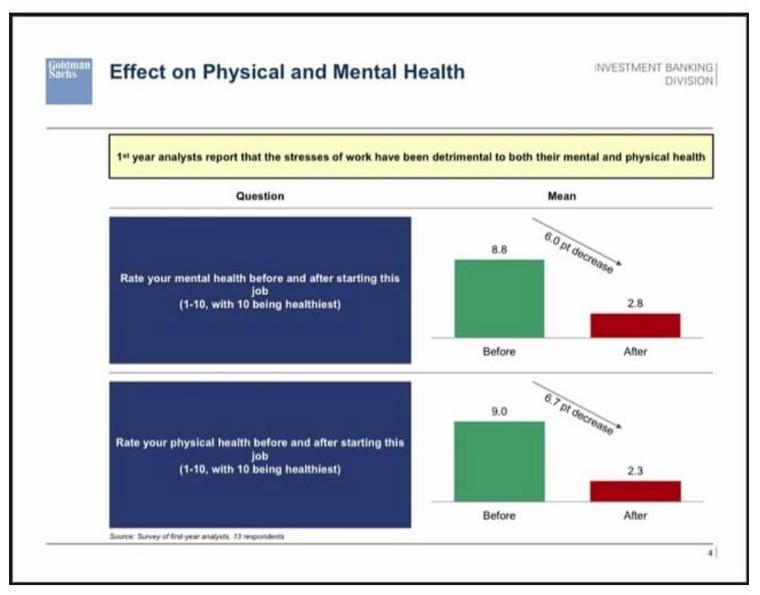

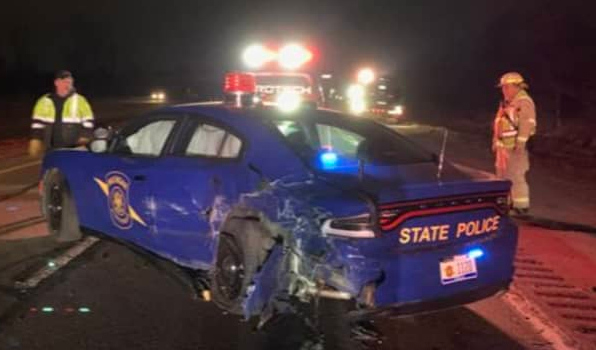

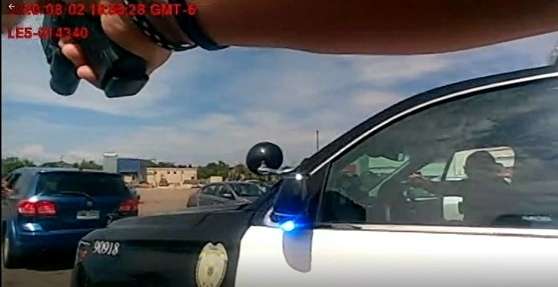
 In his video, Dasko tells a sergeant: “No little, underaged kids were put in handcuffs. There was a little tyke…and she just sat there with her sister [actually, her cousin]. We never put any underaged children in handcuffs. All were proned out here, besides the driver, [who] was over here because she was uncooperative.” Dasko seems unfazed by the impact that being “proned out,” with or without handcuffs, might have on a little girl. Furthermore, the bystander video confirms that the 12-year-old and the 17-year-old were handcuffed. Dasko’s definition of “underaged children” evidently excludes anyone past puberty.
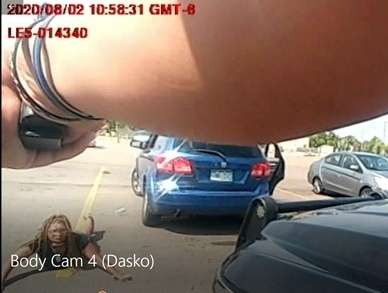 Although Dasko describes Gilliam as “uncooperative,” which he says was the reason he separated her from the girls and placed her in the back of his patrol car, she actually followed all of his instructions. But she also repeatedly and profanely objected to the way Dasko was treating her, which seems to be what bothered him.
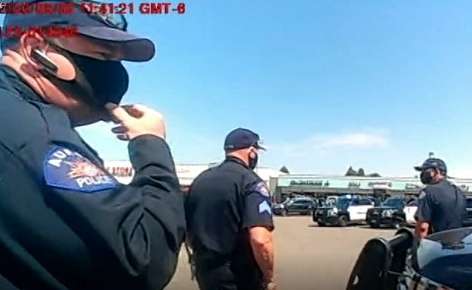 All that attention explains why so many officers ultimately converged on the scene. By one bystander’s count, there were eventually nine patrol cars in the parking lot. “Due to a hostile crowd closing in recording Officers screaming and yelling obscenities a request for more Officers was made and supervisors to respond,” writes Dasko, who says “there were police agitators on scene.”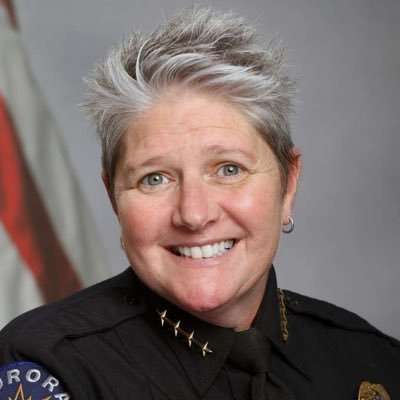
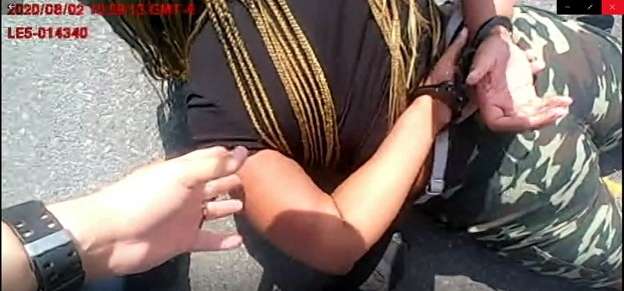 In contrast with Dasko, Gilliam was loud, profane, and angry, much to the dismay of the officers who were victimizing her and her family: