Kind Stranger Places Roses on Car Windshields, Cops Assume It’s a Sex Trafficking Thing

dreamstime_xxl_48496885

If it walks like a duck and talks like a duck, it probably is a duck. But if it looks like a rose and smells like a rose, maybe it’s sex trafficking?

That was the conclusion reached by police officers contacted by a manager at the Walmart in Coshocton, Ohio, who saw some people putting roses on the windshields of cars in the store’s parking lot. The manager called the cops and soon an investigation was underway, according to local news.

“Was this something heinous or was it something of a lesser nature, was it completely harmless?” Deputy Chris Johnson asked.

A bunch of Walmart shoppers thought heinous. Soon so many calls were flooding in that Johnson took the bull by the long-stems and issued a warning:

On 2/15/2021 the Sheriff’s Office received a call from the Walmart Security Department in regards to suspicious activity in their parking lot involving a vehicle and two, what appear to be, males looking into vehicles and placing a single red rose under the windshield wipers of those vehicles. While reviewing the Walmart Surveillance Cameras, the two unknown males are seen exiting from, what appears to be, a newer style dark gray Ford Explorer…and placing a single red rose on it. This same sequence occurs multiple times on several vehicles…

As if that wasn’t scary enough, Johnson raised the terrifying prospect of human sex trafficking:

Although there have been several Facebook posts of similar instances that have happened in Ohio regarding Human Trafficking related techniques, it is unclear at this time if this incident is related to such type of crime.

Ah yes, the reliability of “several Facebook posts.”

Word of the thorn thugs spread so far so fast that a woman named Brittaney Strupe read about the panic in her newsfeed—and picked up the phone.

Note, please, the day of the scary incident: February 15. Hmm. Roses… February 15… Could there possibly be some connection?

Strupe told the police that on Valentine’s Day, a holiday in some parts, her fiancé had given her $300 worth of roses. The next day, as they started to wilt, she didn’t want to throw them out. So she decided to give them away instead.

Strupe and her sister and daughter headed over to where they knew they’d find a lot of cars and put one rose on each windshield.

When Johnson heard the explanation, “It was a relief, and it was nice to put out that update letting the community know that it had been solved.”

In that post to the pollen-petrified people of Coshocton, he explained the guerilla gifters, “never meant to alarm anyone or cause panic in our community.”

And then, as if to undermine the idea that sometimes even sex traffickers take a day off, he added that it is still very important for everyone to be vigilant and aware of their surroundings and follow their gut if they ever see anything suspicious.

Like a random act of kindness.

from Latest – Reason.com https://ift.tt/3kwgwqB
via IFTTT

Policy Risks Are Rising… Hope Is Never A Good Strategy

Policy Risks Are Rising… Hope Is Never A Good Strategy

Authored by Bill Blain via MorningPorridge.com,

“Let’s go to the other side. The view will be better over there…”

No surprises from Fed-Head Jay Powell yesterday – no matter how much we fear inflation or recovery pushing rates higher, he reassured us by saying what the market wanted to hear: the US economy remains “a long way from our employment and inflation goals, it is likely to take some time for substantial progress to be achieved.” Low rates will continue long-term, “inflation dynamics” won’t “change on a dime” – and even if they did the Fed is ready with the necessary tools to address it. Until then, the Fed will keep buying bonds, controlling the yield curve, and will stay well away from any comments on fiscal policy. 

The telling moment yesterday was Powell’s ongoing refusal to comment on fiscal policy – as a senator tellingly asked: what do you think of Biden’s $1.9 trillion stimulus package? Powell made clear he won’t say anything. If he did he’d be making a political comment. 

Let me make a cryptic observation: the right hand might well know what the left hand is doing – but they aren’t necessarily working together to rebuild the global economy.  

The left and right hand tools I’m talking about are monetary policy wielded by “independent” central banks, and fiscal policy determined by national governments. Both seek to achieve the same end – stronger economic growth. Both are very effective levers to be used to heat or cool economies. Both are critical. Any market player will be aware the biggest risks for any economy are policy mistakes in fiscal or monetary policy can result in magnified financial crisis – such as austerity in the early 2010s or the taper tantrum a few years back.

If you are placing your trust in markets on the ability of central banks and governments to invisibly/independently coordinate these powerful twin levels of fiscal and monetary policy – well that’s a big ask. Can the global economy really recover without fiscal and monetary policies being played harmoniously together? Can the global economy be redirected to address all the multiple challenges like climate change, income and social inequality, and the rest unless monetary and fiscal policy are used effectively by grown ups to lever economies? 

I’m asking a rhetorical question – you know it’s happening, but you don’t know how effectively. That depends on the quality of government, and the quality of central bankers. Worries me. It should probably worry you.

Policy uncertainty is a key risk for markets. The big concerns come from the various factions of the market who perceive multiple potential policy mistakes – like runaway debt to pay for fiscal stimulus driven by “god-damn socialist” spending and tax programmes, or the debasement of currency though overly easy monetary stimulus.  Much of that noise is politically driven – but if often rooted in common sense.

We got a clear illustration of the power of monetary policy yesterday: after stumbling for a couple of days, markets went back into rally mode after the Fed confirmed its easy money fire-sale will continue for the long-term. If the $1.9 trillion Biden stimulus package is passed, it will have a similar effect – but also consequences in terms of how it benefits particular sectors.

Analysts can argue about fundamental vs growth stocks, or the coming transition from tech into dividend stocks (or is it the other way round?), but the bottom line today is its supportive policy that is driving markets. Jay Powell won’t ever admit it, but it’s cheap (effectively free) money, artificially low interest rates and QE infinity around the globe that has been driving the remorseless rally across financial assets. The prices of real assets (everything from property, fast cars, art and fine malt whisky) are all being dragged higher in the wake of relative value to financial assets.

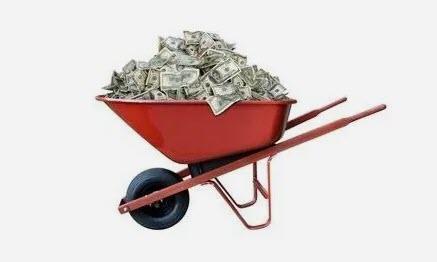
Really smart investors are increasingly hedging their wealth created from financial assets (stocks and shares) by putting much of their allocations into Alternatives: outright real assets or cash flow driven assets, assets that are likely to retain value while still paying attractive returns. (The cost is lower liquidity). The idea is that if crisis ever comes, then owning the wheelbarrow might be better than owning the mountains of worthless cash it’s carrying (to cite the classic example of inflationary danger from Weimar Germany…)

The problem is worse in Europe. ECB head Christine Lagarde can say whatever she likes about doing whatever is needed, and keeping rates low, but Europe is limited to reliance primarily on monetary policy only. 

While the US Congress or the UK Parliament can approve how much government spends to reflate their respective economies via fiscal policies, the rules of the Euro mean countries can only borrow if they are within the rules. Hence the curious construct of the ECB’s €750 bln Recovery Bond programme – which is likely to prove a Euro late and short by the time it actually filters down as grants and loans to Euro members. 

Because fiscal policy is constrained at the level of the national states by the Euro’s rules, and the ECB can’t be seen to be acting as a political fiscal decision maker (even if its connived at such control via the EU through the recovery bonds), all the ECB can do is keep trying to keep rates as low as possibly via QE and yield curve control and HOPE it might drive a Euro wide recovery. 

Hope is never a good strategy. 

The last 10-years has shown you can’t drive an economy into recovery through monetary stimulus on it own – that’s absolutely clear across Spain, Italy, Greece and the rest. These nations need to deliver fiscal stimulus; via regional policy, education and technical training, youth employment programmes, and a host of other programmes. But the only instrument available is the ECB’s zero rate policy and hoping the €1.85 trillion QE programme will drive growth. 

Again. Hope is not a good strategy. If it hasn’t worked for 10-years – why should it now. It’s the equivalent of pushing a heavy boulder uphill with a length of damp string. 

Meanwhile… 

A couple of comments from readers yesterday asking about Cathie Wood (investment superstar of the day) and ARK – noting its exposures to Tesla, Bitcoin and Biotech. I would simply suggest you read something I put out weeks ago: ARK: Tech, Luck and Megatrends.

Tyler Durden
Wed, 02/24/2021 – 10:45

via ZeroHedge News https://ift.tt/3r3er7C Tyler Durden

WTI Surges Above $63 Despite Surprise Crude Build, Plunge In Gasoline Demand

WTI Surges Above $63 Despite Surprise Crude Build, Plunge In Gasoline Demand

Oil prices have rebounded higher overnight after dropping on a surprise crude build reported by API, as stockpiles at a key European storage hub are at their lowest level since September, according to Genscape. Additionally, the structure of the futures curve continues to indicate tighter supply.

“Yesterday’s choppy performance in the oil and equity markets has fueled speculation over how much further the rally in risk assets has to go,” said Stephen Brennock, analyst at PVM Oil Associates.

“Oil prices are treading water ahead of what is sure to be a weather-affected EIA update concerning U.S. oil stockpiles.”

Pent up demand as the global economy recovers has even got some traders talking about the prospect of returning to $100 crude over the next year or two.

API

  • Crude +1.026mm (-5.372mm exp)

  • Cushing +2.738mm (-3.034mm exp)

  • Gasoline +66k (-3.472mm exp)

  • Distillates -4.489mm (-3.905mm exp)

DOE

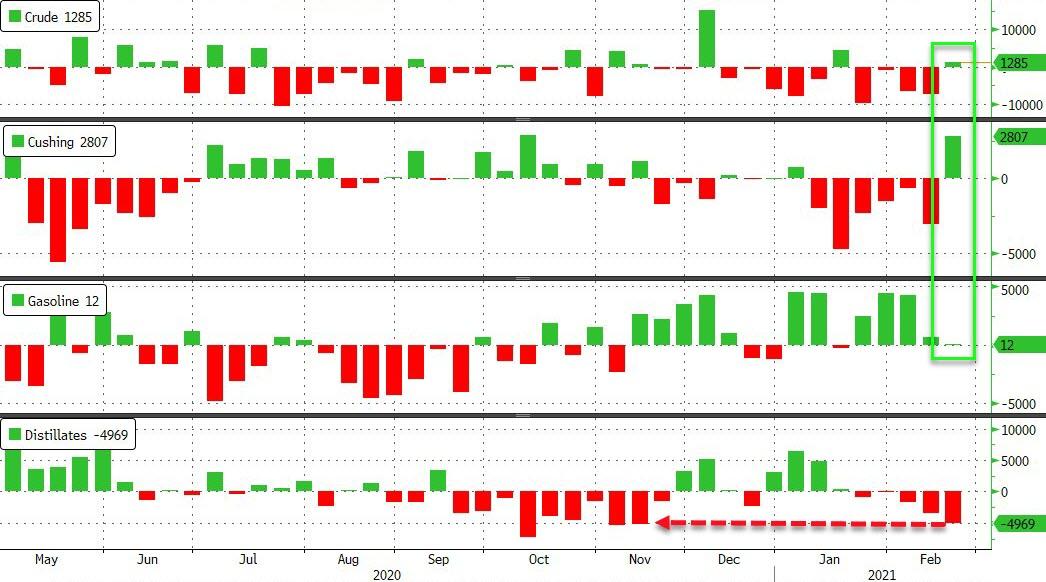
  • Crude +1.29mm (-5.372mm exp)

  • Cushing +2.807mm (-3.034mm exp)

  • Gasoline +12k (-3.472mm exp)

  • Distillates -4.969mm (-3.905mm exp)

DOE confirmed API’s reports of a modest crude and gasoline build (and large distillates draw)…

Source: Bloomberg

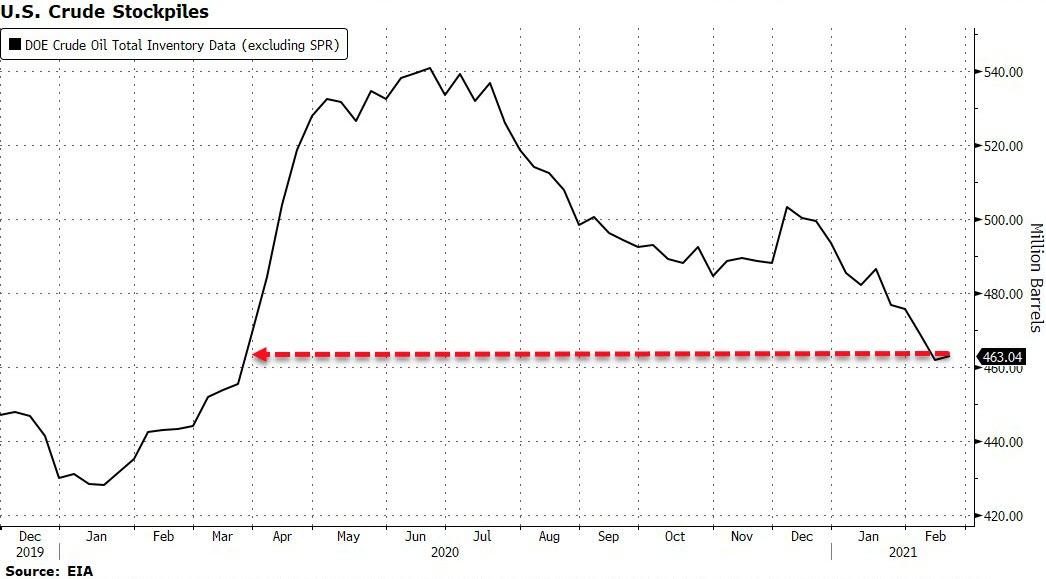
Overall crude stocks remain near 13 month lows…

Source: Bloomberg

Gasoline Demand plunged last week – driven we would assume by Texas chaos…

Source: Bloomberg

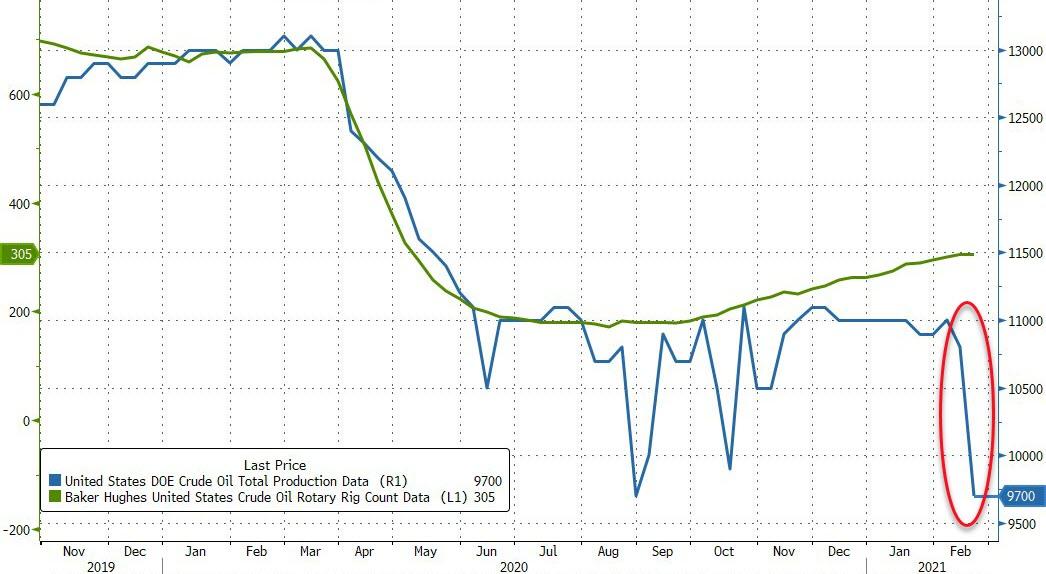
US crude production collapsed (as expected given the Permian freeze) by 1.1 million barrels a day on average last week compared with the prior period. That was the same as the drop recorded in August when Hurricane Laura hit the Gulf of Mexico and a lot smaller than the headline 4 million barrels figure cited as the loss at the storm’s height. Most of that supply is expected to come back on line during this week.

Source: Bloomberg

The Permian Basin in Texas is now producing about 2.9 million barrels a day after output was restored following the cold snap, according to data analytics firm OilX. The region typically pumps around 3.5 million barrels a day.

WTI pushed up towards $63 this morning ahead of the DOE data after tumbling to a $60 handle after API’s crude build, and after DOE confirmed the same story, the oil algos decided to lift WTI above $63

Notably, California is beginning to feel the ripples of oil refinery shutdowns in Texas, with gasoline prices rising faster in the Golden State since a deep freeze crippled fuel-making plants on the Gulf Coast.

Bloomberg Intelligence Energy Analyst Fernando Valle notes that “there’s likely some noise in the inventory numbers this week after an unexpected increase in crude and gasoline supply, despite major outages in Texas production. Refinery throughput fell more than twice as sharply as anticipated. A longer restart time for these plants could push more shale crude to export markets, widening discounts for WTI to Brent.

Tyler Durden
Wed, 02/24/2021 – 10:37

via ZeroHedge News https://ift.tt/2NW2ylo Tyler Durden

Watch Live: Powell Answers Questions From House Lawmakers

Watch Live: Powell Answers Questions From House Lawmakers

Fed Chairman Powell is sitting for a second Q&A session on Wednesday morning…watch it live below:

Yesterday, Powelll sat for questions before the Senate Banking Committee in a similarly virtual session. Every six months, the head of the central bank testifies about the state of the US economy before committees of the Senate and the House.

The House Financial Services Committee also shared the Fed’s latest monetary policy report.

hhrg-117-ba00-20210224-sd003 by Joseph Adinolfi Jr. on Scribd

Tyler Durden
Wed, 02/24/2021 – 10:34

via ZeroHedge News https://ift.tt/3dEZ2qs Tyler Durden

JNJ COVID Jab Is 72% Effective, On Track For Emergency Approval Saturday

JNJ COVID Jab Is 72% Effective, On Track For Emergency Approval Saturday

Following a wave of trial results alternatively teasing, and questioning, the efficacy of the company’s vaccine – including the possibility that it might not be effective as a single-shot jab – new data from Johnson & Johnson purports to show the shot is surprisingly effective at preventing severe illness and reducing transmission in its current (single-dose) form.

An analysis of the company’s trial data by the FDA was released on Wednesday, two days before an FDA committee is expected to meet to discuss the safety and efficacy of the JNJ vaccine. According to the NYT, the jab could be approved for emergency use as early as Saturday morning (following the committee’s meeting and a possible vote on Friday).

The vaccine had a 72% overall efficacy rate in the US and 64% in South Africa, where a highly contagious variant emerged in the fall and is now driving most cases. Notably, the analysis showed the JNJ vaccine was seven percentage points more effective against the SA mutation than a prior dataset had suggested. The vaccine was also 86% effective against severe forms of COVID-19 in the US, and 82% against severe disease in South Africa. According to JNJ and the FDA, this means that a vaccinated person has a far lower risk of being hospitalized or dying from the virus.

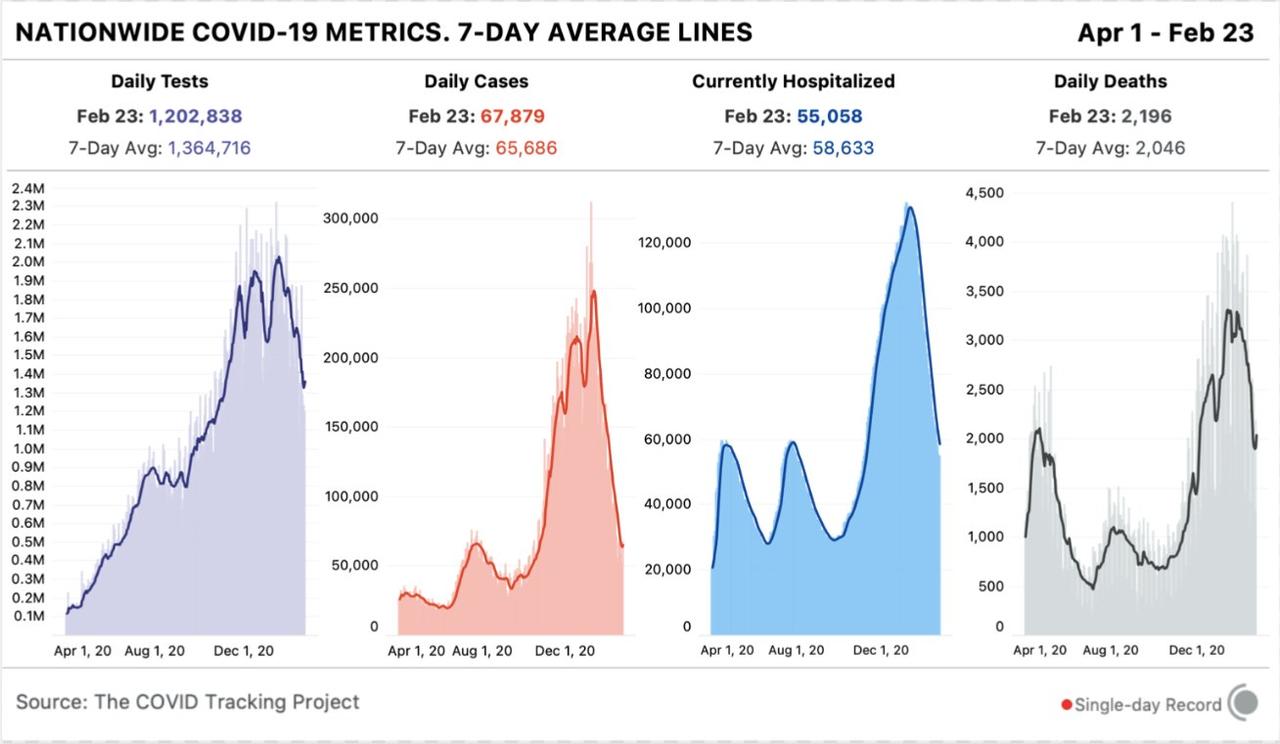
The news essentially confirms that Americans will be the first to benefit from a third COVID vaccine as the pace of new cases, hospitalizations and deaths continues to decline.

What’s more, JNJ’s vaccine can be stored at normal refrigeration temperatures for at least three months, making its distribution considerably easier than the authorized vaccines made by Moderna and Pfizer-BioNTech, which require two doses and must be stored at frigid temperatures.

“With a J&J vaccine, we’ll be able to accelerate the vaccine rollout for our country and for the world,” said Dan Barouch, a virologist at Beth Israel Deaconess Medical Center in Boston. He reportedly led much of the early research on the vaccine last year.

Although JNJ’s jab is less effective than the Moderna and Pfizer shots, when it comes to the South African variant, JNJ is the clear winner.

Another rival, the AstraZeneca-Oxford jab, was found that the jab didn’t offer much protection at all. The negative results led the South African government to abandon its plan of giving a million doses of AstraZeneca vaccines to health care workers.

Circling back to the JNJ jab, the newly released documents, which include the FDA’s first technical analysis of the company’s 45K-person clinical trial, included evidence that the vaccine was safe, with noticeably milder side effects than the Pfizer and Moderna vaccines and without any reports of severe allergic reactions like anaphylaxis.

The vaccine’s protection was consistent across Black, Hispanic and white participants, and also across various age groups. The trial indicated a lower efficacy, of 42.3 percent, for people over 60 who had risk factors like heart disease or diabetes. Johnson & Johnson looked for asymptomatic infections by checking for coronavirus antibodies 71 days after volunteers got a vaccine or a placebo. The new analyses estimate that the vaccine has an efficacy rate of 74 percent against asymptomatic infections.

JNJ execs have promised to get their shot into the arms of at least 20M Americans by the end of next month. The New Jersey-based company has promised to deliver more than 100M doses by the end of June.

Tyler Durden
Wed, 02/24/2021 – 10:30

via ZeroHedge News https://ift.tt/3qVzVDy Tyler Durden

Tiger Woods Recovering From “Long” Surgery For Multiple Open Leg Fractures

Tiger Woods Recovering From “Long” Surgery For Multiple Open Leg Fractures

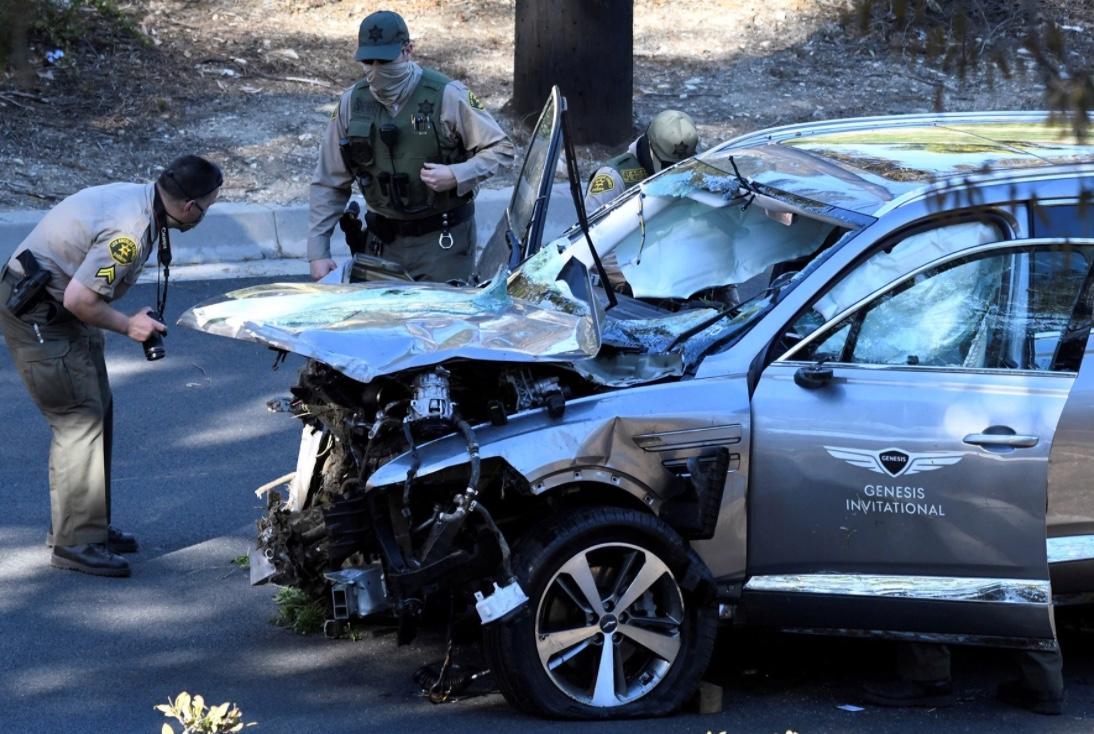
Tiger Woods, the greatest golfer of his generation, is recovering from a lengthy surgery after he sustained multiple open fractures to his leg and ankle during a single-car accident Tuesday morning. Woods’ car reportedly rolled over several times, and required a rescue team equipped with special tools to rescue the trapped and badly injured athlete.

While Woods’ injuries are said to be non-life-threatening, at the time of the accident, he was recovering from back surgery which he had just the week before. With Woods’ career in jeopardy, the chief medical officer and interim chief executive at Harbor-UCLA Medical Center detailed the extent of the injuries, saying that a rod, pins and screws were needed to stabilize Woods’s injuries.

“Comminuted open fractures affecting both the upper and lower portions of the tibia and fibula bones were stabilized by inserting a rod into the tibia,” Anish Mahajan said in a statement released early Wednesday by Woods’s representatives.

“Additional injuries to the bones of the foot and ankle were stabilized with a combination of screws and pins. Trauma to the muscle and soft-tissue of the leg required surgical release of the covering of the muscles to relieve pressure due to swelling.”

For those who aren’t up on their medical terminology, a comminuted open fracture is one in which a bone breaks in more than one place and breaks through the skin.

Woods’s team added that the golfer is “awake, responsive and recovering in his hospital room” after what was described as a “long” surgery, and thanked everyone for their “overwhelming support and messages during this tough time.”

Woods, who was rehabbing from his fifth back surgery, had been in the Los Angeles area for the Genesis Open, a golf tournament his foundation sponsors. He remained to shoot videos, joining Dwyane Wade and David Spade on Monday and scheduling more with quarterbacks Justin Herbert of the Los Angeles Chargers and Drew Brees of the New Orleans Saints.

Woods had stayed at a resort in Rancho Palos Verdes, south of downtown Los Angeles, and was en route to Rolling Hills Country Club when he crashed while driving through a residential area. His car crossed a median on a hilly, curvy road at a place where a number of accidents had happened and rolled several hundred feet before settling on the driver’s side of the 2021 Genesis SUV. Fortunately, deputies said Woods was wearing his seatbelt, which probably saved his life.

One of the first people to arrive on the scene said he opted not to remove Woods from the car right away so they could wait for the fire department with its specialized tools, which were used to carefully extract Woods from the vehicle.

“He didn’t seem like he was in distress, and he was able to kind of talk to me a little bit … I did consider pulling him out myself, but I decided that it would be better to wait for the fire department, since they have the specialized tools and training to remove people safely from vehicles like that.”

Meanwhile, as far as what might have caused the crash, one TV director reportedly told coworkers that he nearly crashed into an “agitated and impatient” Woods hours before the accident. The director of the TV show “Grown-ish” recounted the near-miss to his crew even before news of the golfing legend’s horrifying crash first broke. Woods crashed in a residential area in a spot where many accidents have occurred, and video obtained by TMZ shows Woods driving his Genesis GV80 SUV just moments before the crash.

The clip was filmed at 0705PT. on Hawthorne Boulevard, the same road that the legendary golfer crashed on seven minutes and five miles later.

Tyler Durden
Wed, 02/24/2021 – 10:15

via ZeroHedge News https://ift.tt/2NywO5W Tyler Durden

New Home Sales Surge In January As Mortgage Apps Crash To 9-Month Lows

New Home Sales Surge In January As Mortgage Apps Crash To 9-Month Lows

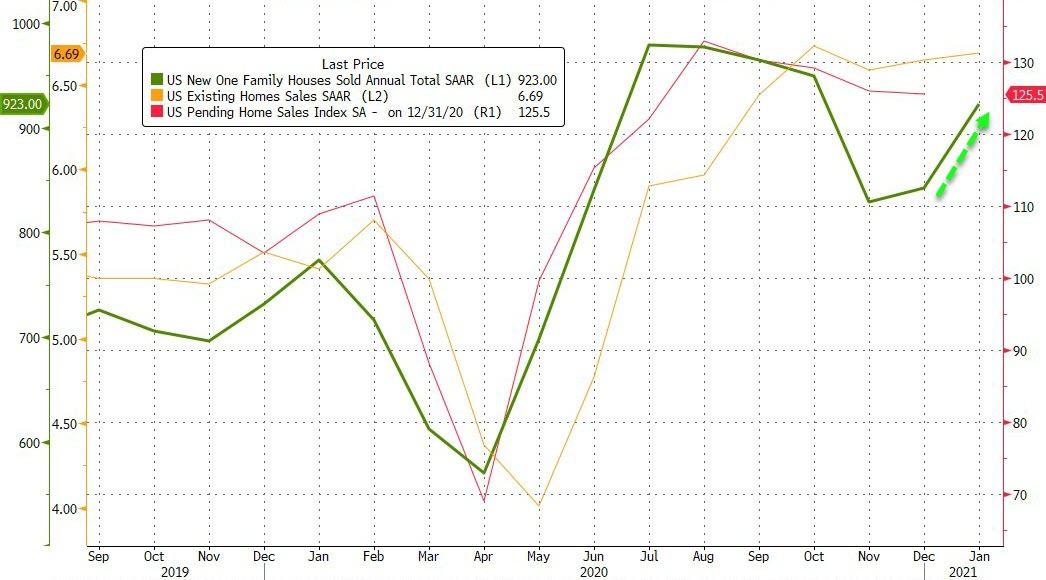
After the surprise rise in existing home sales, analysts also expected a modest 1.7% MoM rise in new home sales in January (after plunging in November and rebounding very modestly in December). But, in the face of collapsing mortgage apps, new home sales surprised with a 4.3% MoM surge…

Source: Bloomberg

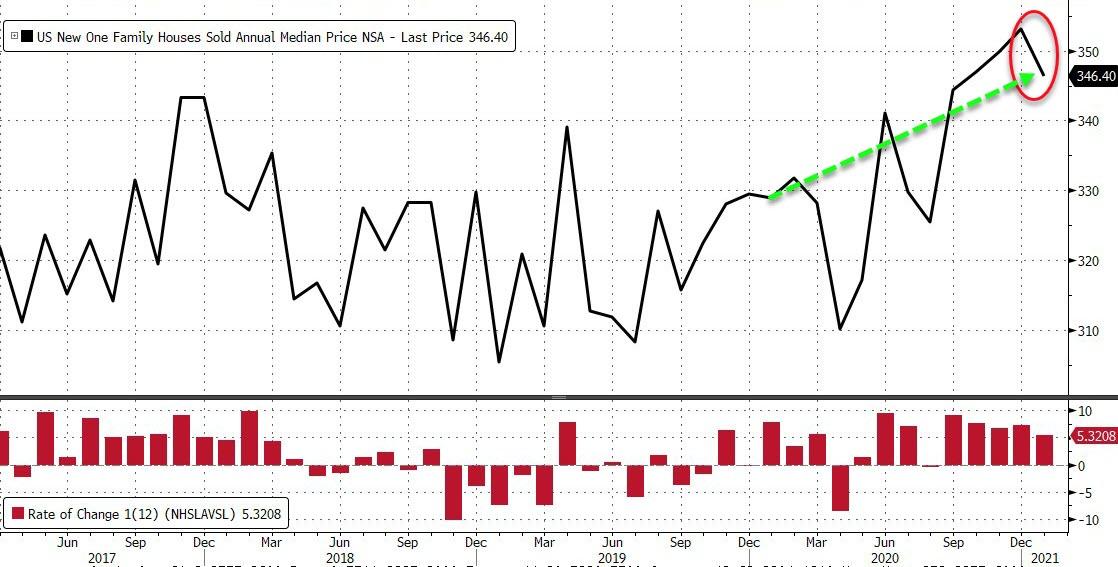
Median new home price rose 5.3% YoY to $346,400 (average selling price at $408,800) but did drop around 2% MoM…

Source: Bloomberg

21% of new homes sold in Jan. cost more than $500,000, up from 16% prior month.

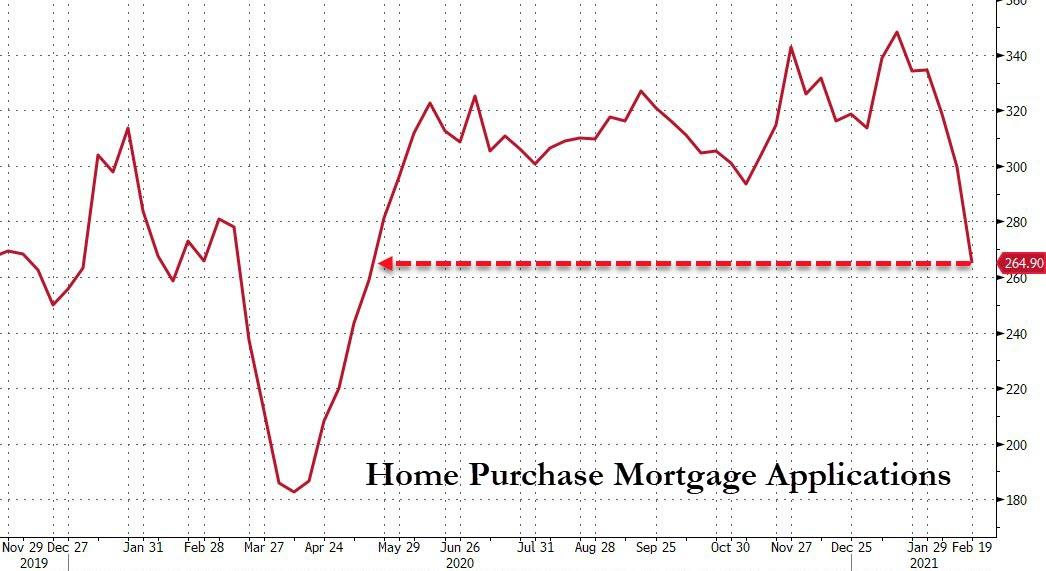
However, the surge in new home sales comes as mortgage applications crashed by most since April (dropping for 5 of the last 6 weeks)…

Source: Bloomberg

With home purchase applications (as opposed to refis) collapsing to the lowest in 9 months

Source: Bloomberg

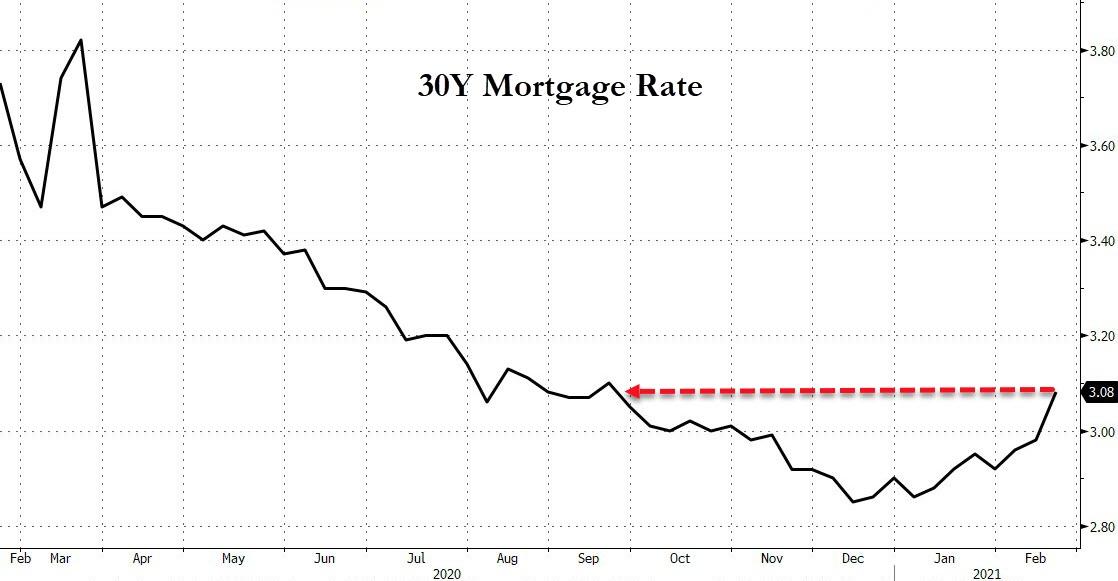
As 30Y mortgage rates rise to their highest since September

Source: Bloomberg

Get back to work Mr.Powell!

Tyler Durden
Wed, 02/24/2021 – 10:03

via ZeroHedge News https://ift.tt/2NRRshk Tyler Durden

Biden To Sign Executive Order On Alarming Computer Chip Shortage That’s Thrashed Carmakers

Biden To Sign Executive Order On Alarming Computer Chip Shortage That’s Thrashed Carmakers

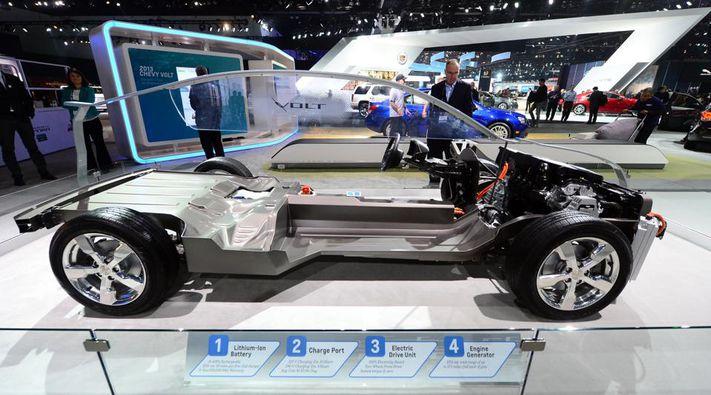
Among US-manufactured items seen as vital across multiple industries which increasingly came up in short supply as demand increased faster than expected amid the coronavirus pandemic have been semiconductor chips and large-capacity batteries for electric vehicles.

The chip shortage has most immediately and severely hit US automakers to the point of having to in many cases halt production and furlough workers amid the supply bottleneck. “The supply disruptions threaten to harm U.S. economic growth and could lead to layoffs, prompting concern from the White House as Biden seeks to rebuild an economy battered by the coronavirus,” Bloomberg writes.

AFP/Getty Images

On Wednesday President Biden will sign an executive order which seeks to address the global semiconductor chip shortage after a session with a bipartisan group of lawmakers to discuss the growing crisis. “Make no mistake, we’re not simply planning to order up reports. We are planning to take actions to close gaps as we identify them,” an administration official said.

Reuters cites alarming numbers out of Ford Motor Co which said recently that “a lack of chips could cut the company’s production by up to 20% in the first quarter while General Motors said it was forced to cut output at factories in the United States, Canada and Mexico and would reassess its production plans in mid-March.”

The crisis at home also comes as China is chasing its own semiconductor self-sufficiency and as Republicans pressure the Biden White House to act to protect pandemic-slowed American supply chains. The slowed supply in the US is also hurting smartphone companies.

“U.S. semiconductor firms account for 47% of global chip sales but only 12% of production, because they have outsourced much of the manufacturing overseas, according to the Semiconductor Industry Association,” Reuters underscores. “In 1990, the U.S. accounted for 37% of global semiconductor production.”

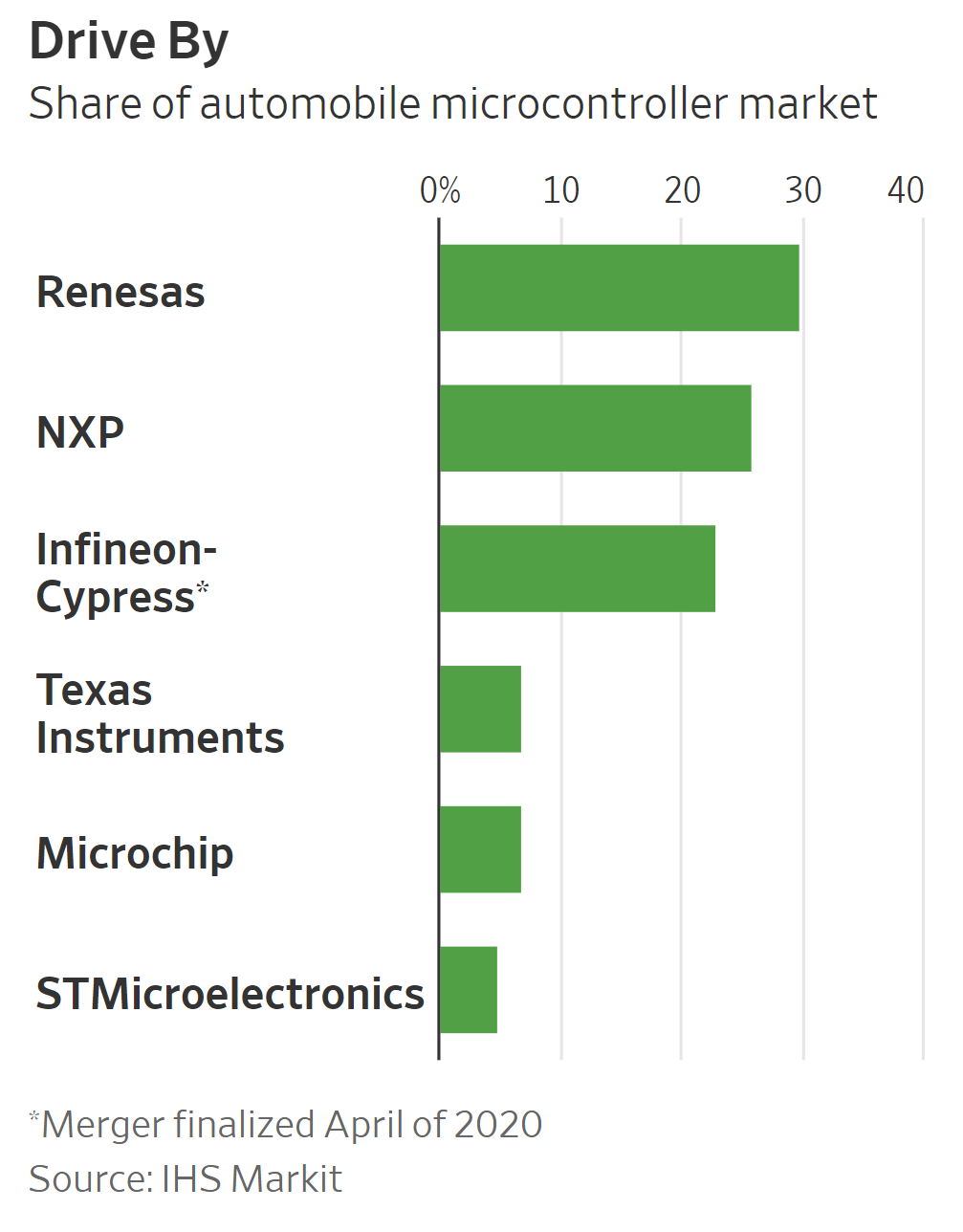
Via The Wall Street Journal/IHS Market

Part of the problem, as WSJ recently reviewed, is the immense cost, space and construction it takes to set up a chip fabrication plant which usually “take more than two years to set up and the soaring cost of building and equipping them has led more semiconductor companies to outsource more of their production needs. As examples, WSJ notes that “Renesas, NXP and Infineon -Cypress, which together account for nearly 80% of the automotive chip market, all use TSMC for some of their manufacturing. The Taiwanese firm now produces about 70% of the microcontroller units used in the world’s automobiles, estimates Phil Amsrud of IHS Markit.”

The new executive order, expected to be signed late in the afternoon, will initiate an immediate 100-day review of supply chains for the following products deemed vital to US industrial development and the defense sector: semiconductor chips, large-capacity batteries for electric vehicles, rare earth minerals and pharmaceuticals.

Tyler Durden
Wed, 02/24/2021 – 09:50

via ZeroHedge News https://ift.tt/3uqJtbL Tyler Durden

Hong Kong Market Tumbles After “Shock” Transaction Tax Hike To Pay For Government Handouts

Hong Kong Market Tumbles After “Shock” Transaction Tax Hike To Pay For Government Handouts

Is Hong Kong a harbinger of what is coming to the US?

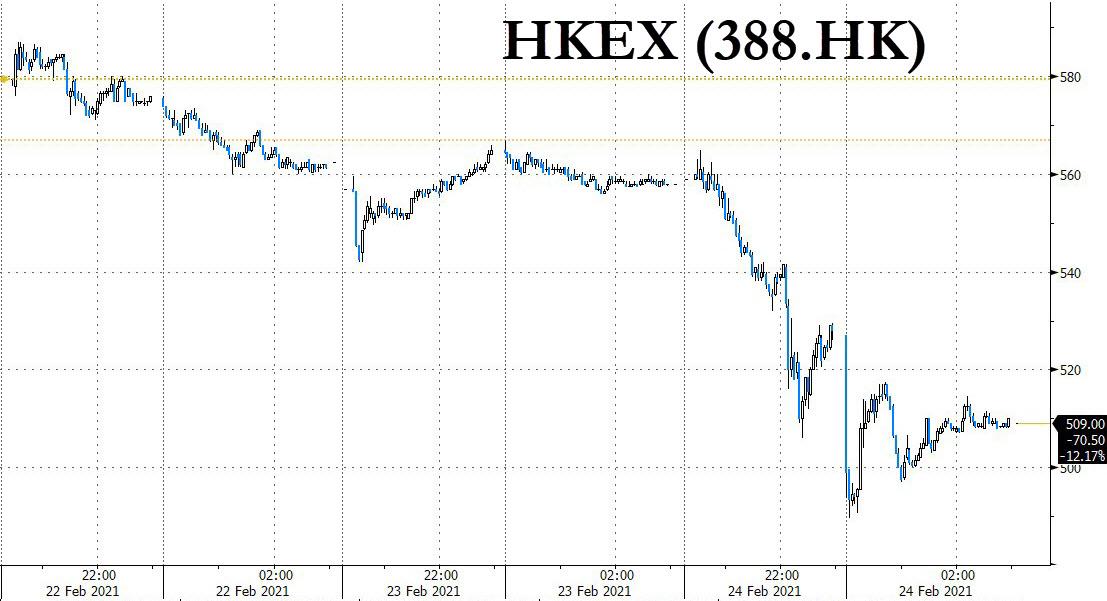
With speculation growing in the US that in the aftermath of the Robinhood scandal, the Biden administration may pass a transaction, or “Tobin Tax” demanded by progressive democrats (according to a 2018 CBO estimate, a 0.1% tax on stock, bond and derivative transactions could raise $777 billion over a decade) and targeting HFTs and other “market makers”, overnight Hong Kong showed how it’s done when in a shock announcement, Hong Kong unveiled its first stamp-duty increase on stock trades since 1993, sparking a furious selloff in the $7.6 trillion market and sending shares of the city’s exchange to their biggest plunge in more than five years.

As Bloomberg reports, the plan for a trading-tax hike to 0.13% from 0.10% is part of a raft of new measures announced in Hong Kong’s budget on Wednesday that included increased spending and cash handouts (in the form of coupons) to help residents weather the pandemic. Even as the city’s economy has plunged over the past year, stock prices and trading have surged amid a global market boom.

The news sent local stocks tumbling, with Hong Kong’s Hang Seng Index closing 3% lower, led by a 8.8% tumble in Hong Kong Exchanges & Clearing.

The plunge was especially awkward as it came after the bourse operator reported record annual earnings on Wednesday. Mainland-based funds sold a record $2.6 billion worth of Hong Kong stocks through exchange links with Shenzhen and Shanghai. That comes after 38 days of net purchases from north of the border.

The news was as shocking to the exchange as it was to everyone else. Calvin Tai, HKEX interim CEO said in an earnings call that the he wasn’t consulted by the government on its decision to hike the stamp duty.

“The impact will be significant,” said Kingston Lin, managing director of the asset management department at Canfield Securities in Hong Kong, ahead of the announcement by the city. “The market is doing very well and, of course, it will bring more revenue to the government. But higher transaction costs will be a concern for the exchange.”

And in a true Robinhood twist, an exchange spokesperson said that “whilst we are disappointed about the government’s decision to raise stamp duty for stock transactions, we recognize that such a levy is an important source of government revenue,” adding that “HKEX looks forward to continue working closely with all its stakeholders to drive the continued success, resiliency, vibrancy and attractiveness of Hong Kong’s capital markets.”

According to local media including Apple Daily and NowTV, the trading tax hike will be launched on Aug. 1 and the government expects it to generate an extra HK$12 billion a year. In the 2019/2020 fiscal year, the duty contributed HK$33.2 billion in revenue.

That said, the move risks damping a trading boom that has gripped the city and propelled earnings at the exchange. The bourse on Wednesday reported that profit rose 23% to a record HK$11.5 billion in 2020, helped by a 60% jump in stock trading. Its shares have surged about 150% from a low last year, making it the world’s biggest by market value.

Analysts at Citigroup Inc. estimated that the increased stamp duty will raise trading costs by 6% to 15%, pressing down trading volumes and crimping the exchange’s earnings per share by 3% to 7%.

Separately, the government announced spending measures of more than HK$120 billion ($15.5 billion) to alleviate economic hardship for city residents struggling after a two-year economic recession.

While Hong Kong has been an outlier when it comes to taxing stock transactions, with major markets such as the U.S. and regional rival Singapore refraining, HK’s action may prompt more politicians into acting to transfer some capital from the financial sector to the people. Indeed, talk of implementing a tax on financial transactions has recently been rekindled by some Democrats in the U.S. after the recent trading frenzy in GameStop Corp. shares.

Tyler Durden
Wed, 02/24/2021 – 09:35

via ZeroHedge News https://ift.tt/3kltIOB Tyler Durden

Rabo: The Greenspan Put Will Become The Greenspan Putsch Due To Soaring Food Prices

Rabo: The Greenspan Put Will Become The Greenspan Putsch Due To Soaring Food Prices

By Michael Every of Rabobank

The Greenspan Putsch

Markets were soothed yesterday, and the Hoolis of the world most so, by Fed Chair Powell saying there was “hope for return to more normal conditions”. Yet this can’t have been a reaction to any reference to the Covid pandemic: a total recovery has been more than priced in for a long time now. Neither can this market move have been a response to a hypothetical Fed Funds sitting at 4 or 5%, or even 2.5%, as it once did when things were normal.

Rather, the “hope” as well as the “normal conditions” were interpreted by the markets as Powell reiterating that the ‘Greenspan Put’ is still in full effect by any other name, and now justified for different reasons. As such, the Fed’s ‘normal’ policy of making very rich people vastly richer in order to try to make some poor people slightly less poor is going to continue.

The junkiest of bond yields can be at record lows – and it’s all good, because rates are never going to rise; steaming piles of profitless equity rubbish can be valued like gold – and it’s all good, because rates are never going to rise; and gold and crypto can send whatever signals they want – and may try to because rates are never going to rise. As regularly noted here, even the troublesome long end of the government bond yield curve, which has had the temerity to try to show independent thought, can be flattened by central-bank war-war if the jaw-jaw fails to do the trick – and hence rates are never going to rise.

This was never the cleverest of plans when you strip it down to its bare bones, unless you are beneficiary of said Fed largesse, in which case it’s genius. Yet the real problem is that this ‘Greenspan Put’ has serious side-effects immediately.

Not just that the Fed Chair gave semi-annual testimony at the time of what is widely seen as one of the biggest bubbles in financial history, and yet didn’t even give it a semi-serious reference – which will only see said bubble get bigger, and the damage larger when it bursts. Rather, because there are more financial headlines underlining the same Wall Street funds who enthusiastically pile into ‘Hoolis’ are now swallowing up commodities left, right, and center. That is going to make everything needed to make everything, and everything needed to make everything that people eat, much more expensive in particular. Such a trend always risks an explosive outcome, which one might have thought the Fed Chair could have considered more deeply (if one didn’t know the Fed).

With the Fed saying “Let them eat stocks”, or at least “let them buy stocks in order to eat”, there will be global consequences: the Greenspan Put could become the Greenspan Putsch in places with serious food insecurity problems.

But don’t worry, markets! “Hope for return to more normal conditions” obviously covers all of these kinds of eventualities; indeed, this will be called totally-unforeseeable, completely-exogenous “geopolitical risks” – which will subsequently require low Fed rates for even longer. I am sure markets will remain bullish if we just give them a putsch.

Meanwhile, on hopes for “more normal conditions” in the global sphere, China has laid down the conditions for the US to meet in order to reset bilateral relations: remove all tariffs; all sanctions; and all controls on Chinese tech and access to US education; and stop interfering in domestic affairs, such as Taiwan, Xinjiang, Tibet, and Hong Kong – and the South China Sea. “A good-mannered gentleman never thrusts his knife and fork into the food on someone else’s plate,” was the message, which seems apt at a time when food on plates is becoming a major geopolitical issue again.

The US response is that Treasury Secretary Yellen has reiterated Trump tariffs on China are to stay for now; the ranking member on the Homeland Security Committee has urged President Biden to boycott the 2022 Winter Olympics in Beijing; and within weeks the Senate will take up a bipartisan bill, The Endless Frontiers Act, aimed at boosting its economic competitiveness vs. China. This would rename the National Science Foundation and charge it with “finding ways to advance US efforts in certain high tech areas, including artificial intelligence, high performance computing and advanced manufacturing.” Knives and forks out, it seems.

Likewise, the Canadian parliament just voted 266-0, in an non-binding motion, to recognise Chinese actions in Xinjiang as genocide. Even with PM Trudeau and his cabinet abstaining, one would imagine that further trade damage may be done. Let’s see if China continues to buy canola from Canada or not, eh?

If Canadian canola sales continue anyway (and some Aussie agri exports continue to sneak in too) it could suggest the US Fed may have –totally inadvertently– stumbled onto a geopolitical weapon in its ‘Putting’. Previously we saw concerns over a deliberate shortage of US dollars being used to squeeze China, and this remains a potential threat; yet a flood of US dollars forcing up global food prices for a China that cannot feed itself and must buy all commodities in said dollars could ironically also be a pressure point – as any bifurcation in real trade-flows vs. diplomatic rhetoric would suggest. That’s the power of the global reserve currency, even if a Greenspan Putsch is *not* applicable there.

And on rhetoric, trade, bifurcation, and pressure points, following the release of the European Commission’s strategy to make EU trade more “strategic” –read ‘as mercantilist/pugilist as everyone else’ (see here)– the EU is not only interested in building its own Hoolis, but its own semiconductor production to work around bottlenecks in that manufactured commodity. Yet quoting the article linked above: [The] idea of an [EU] foundry that manufactures the most sophisticated generations of chips “is a bridge too far,” said one industry official…. “The gap is pretty wide between what [the EU] has in mind and what the industry can deliver without committing financial suicide…The European ambition gets bigger and bigger by the quarter. It started as the project of the decade, now it’s become the project of the century and soon it’ll be the project of the millennium,” the official said. “Meanwhile, we are forgetting to take the first step.” Well, at least we have central banks to make financial suicide perfectly viable as a strategy, right?

For those not joining the dot plots here, this is yet another example of the long-predicted conjoined trends of massive monetary (and then fiscal) stimulus and rising global protectionism and the desire for “strategic autonomy”, in order to reflate on one’s own terms. It’s all very 19th century, just now with semiconductors as the new ‘steel’ – but gunboats are the same gunboats, and food still the same old food.

Never mind. Just focus on the “Hope for return to more normal conditions.”

Tyler Durden
Wed, 02/24/2021 – 09:20

via ZeroHedge News https://ift.tt/3klgcL5 Tyler Durden