Senate Renews FBI Surveillance Powers With Modest Reforms

An attempt by Sen. Rand Paul (R–Ky.) to completely end the Foreign Intelligence Surveillance Act (FISA) court’s authority to approve warrantless surveillance of Americans went down in flames this afternoon in a blowout 11–85 vote. The Senate subsequently passed a bill that renewed some of these powers with more modest reforms.

Paul’s legislation was essentially a Hail Mary pass: It would have forbidden the feds from targeting American citizens with any of the surveillance, wiretapping, and data collection tools authorized by the FISA court. The National Security Agency and the FBI would instead have to go through traditional federal courts and get a warrant. (The court could still allow surveillance of foreign targets.)

Prior to the vote, Paul took to the Senate floor to argue that the law has been woefully abused and twisted to target Americans, taking note that the FISA court had been specifically designed to make sure the FBI was not secretly surveilling Americans for engaging in protected or political speech. He said that the investigation of former Donald Trump aide Carter Page demonstrated that the FISA court “was manipulated and lied to” to get permission to wiretap Page.

“We should all be appalled at this abuse of power,” Paul said. He argued that the FISA court denies Americans their Fourth Amendment protections, noting that surveillance targets aren’t informed of the warrant submission and aren’t allowed legal representation at a hearing. He added that the court’s decisions are not based on “probable cause,” as the Fourth Amendment requires, but on a lesser threshold showing that the requested surveillance is “relevant” to an investigation.

“That’s not constitutional and we can’t make it constitutional,” Paul said.

The most recent transparency report from the Office of the Director of National Intelligence shows that despite reforms to the system, FBI officials secretly query records for information about U.S. citizens thousands of times a year. The report also says that the federal government has not opened any investigations of “a U.S. person who is not considered a threat to national security” based on this acquired information since the office started tracking this info in 2017. Last year, the government entered evidence gathered from FISA surveillance in seven criminal proceedings.

The failure of Paul’s bill should hardly come as a surprise after another surveillance vote yesterday. Lawmakers weren’t even able to push through a measure telling the FBI it can’t collect our browser and search data without getting a warrant. There was no chance the Senate was going to vote to stop all targeting of Americans via the FISA court. Still, 11–85 is a pretty sound defeat.

After Paul’s proposal failed, the Senate voted on H.R. 6172, a compromise bill to restore some USA Freedom Act surveillance powers (which expired in March) with some reforms. The bill easily passed, 80–16. The authority to engage in mass collection of Americans’ online and phone metadata is now officially gone. The bill specifies that the FBI can’t treat cell phone location and global positioning system data as part of a “business record” (meaning it’s harder for the feds to secretly collect that data from your phone service provider). The bill also bolsters the FISA court’s ability to bring in independent “amicus curiae” advisers to consult and defend the constitutional rights of any Americans who are being targeted for FISA warrants. (This process was bolstered further on Wednesday, when the Senate passed an amendment attempting to ensure that Americans aren’t targeted for political purposes.)

Because the Senate amended H.R. 6172 yesterday, the bill will have to return to the House for another vote. It will likely pass.

The renewal comes with another sunset in December 2023, so we’re not necessarily stuck with this system forever. But as today’s votes show, it’s a long road to convince senators to treat Americans’ Fourth Amendment protections seriously.

from Latest – Reason.com https://ift.tt/2T1XQSQ
via IFTTT

Quartz Fires Nearly Half Of Its Journalists, Blames COVID For Failure Of Subscription Strategy

Quartz Fires Nearly Half Of Its Journalists, Blames COVID For Failure Of Subscription Strategy

Tyler Durden

Thu, 05/14/2020 – 15:00

Quartz, once a pioneering and extremely trendy source for business and economic news that produced several journalist blue-check super-stars who have mostly since moved on to different outlets as the company became increasingly irrelevant after adopting a paywall, is planning to lay off 80 employees in the latest round of journalism job cuts.

The news, which comes after Buzzfeed furloughed dozens of employees and cut pay, while Wired also laid off a bunch of staff, is the latest blow to the digital news model that cropped up around the time of the last crisis, where a new wave of VC-backed “digitally native” sites like Buzzfeed and Quartz, which mixed news, opinion and “analysis” to produce a cheaply made product that failed to inspire enough readers to pay up for a premium edition.

The New York Times reported that the cuts are equivalent to 40% the company’s staff. It also noted that Quartz has offices “all around the world.” According to the report, Quartz, which has struggled to switch over to a subscription-based model from an advertising-based model, has fewer than 18,000 paying subscribers, meaning the company is probably only pulling in a few million dollars a year in revenue from subscriptions, hardly enough to sustain a newsroom.

Quartz’s owner, the Japanese financial intelligence firm Uzabase, announced the layoffs in a public filing Thursday. The company said that approximately 40 percent of Quartz staff members would lose their jobs, with the cuts focused on the advertising department. Quartz had 188 employees at the end of last year, Uzabase said.

The site’s EIC, who hasn’t tweeted since Tuesday, told the NYT that the layoffs were part of a plan to pivot, and also blamed them on the coronavirus, which he said dramatically cut into the company’s advertising take.

Zach Seward, the chief executive, said in a note to the staff that approximately 80 roles would be eliminated. A spokesman for the NewsGuild, which represents 43 journalists working at Quartz, said on Thursday that about half its members would lose their jobs.

Quartz is also trying to cut costs by closing physical offices in London, San Francisco, Hong Kong and Washington and by reducing executive salaries by 25 to 50 percent, according to the note.

Mr. Seward said the cuts were part of a strategy to make Quartz profitable by emphasizing subscriptions over advertising.

The site started charging readers for articles in 2018, shortly after Uzabase bought it from Atlantic Media, which founded Quartz in 2012. Many news sites have installed pay walls in recent years as the game plan of offering free content supported by advertising has begun to seem less tenable.

“Our strategy is to focus on what Quartz does best, which is analysis of global business and economics for our audience of young, ambitious professionals,” Mr. Seward said in his note to the staff. “The business model will still be a mix of subscription and advertising revenue, but as a smaller and more focused company, we’ll only do those things that serve Quartz’s core.”

The number of paid subscribers rose to 17,680 at the end of April, Mr. Seward added.

While the coronavirus has hammered many companies and many industries, several media companies have now blamed the virus as an excuse for cutting back staff or making other cuts in operational spending – but we suspect that’s not the full story.

As the company has previously claimed, it’s transition away from advertising started years ago. By now, if the owners at Uzabase who decided to buy Quartz away from the Atlantic had succeeded in their transition plan, Quartz wouldn’t be so reliant on advertising revenue growth to sustain its business. And the article – notably – says nothing about cancelled subscriptions, or a slowing in subscription growth.

Plus, data on ad spending by industry suggests that many of the biggest companies to say they’re cutting ad spending either haven’t yet, or no longer plan to.

It’s just the latest sign that sites like Quartz, which cater to young, urban professionals, just aren’t appealing to a broad enough range of readers. We wonder why that is…

Apparently, the Quartz union was powerless to stop the savage cutbacks – just the latest example of how little the ‘newsroom unionization movement’ has actually accomplished.

Maybe all the laid-off blue checks from Quartz, Buzzfeed, Deadspin and all the other digital news sites that are hemorrhaging ‘content writers’ with no real reporting or writing chops but like 8k+ twitter followers.

Adding insult to injury, the Atlantic signed up some 36,000 new subscribers in March alone, and has been building its subscriber base at a rapid clip. Maybe some of these laid off Quartz writers can ring up some of their old colleagues.

via ZeroHedge News https://ift.tt/3czIdd3 Tyler Durden

Fed Chair Powell’s ‘Solution’ Is The Root Of The Problem

Fed Chair Powell’s ‘Solution’ Is The Root Of The Problem

Tyler Durden

Thu, 05/14/2020 – 14:45

Authored by Michael Maharrey via SchiffGold.com,

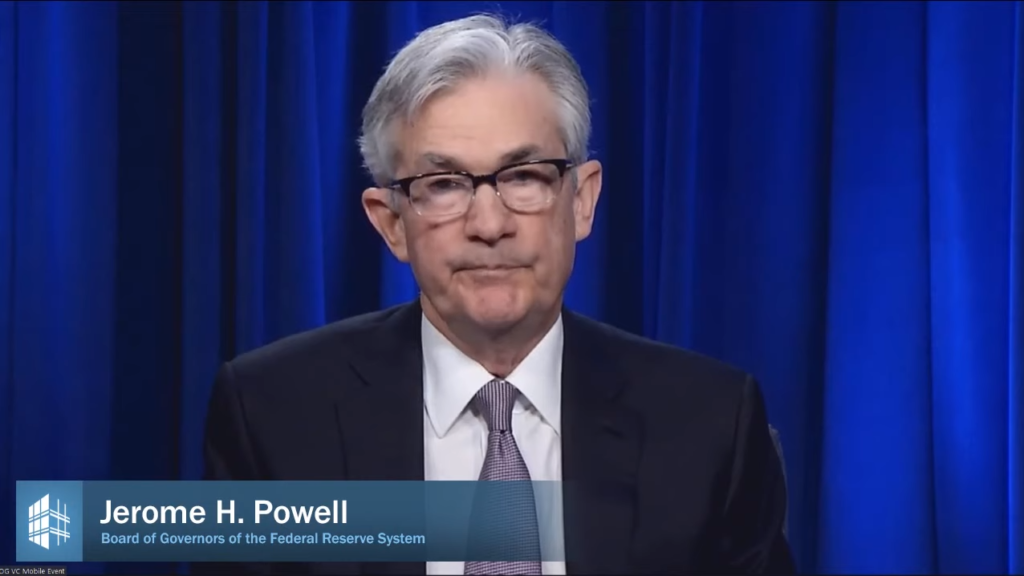
Federal Reserve Chairman Jerome Powell went negative in a webcast speech on Wednesday, May 13.

I’m not talking about negative interest rates, although that could be coming down the pike as well. Powell went negative on the prospects of a quick economic recovery.

He’s right about the prospects for the economy, but he’s wrong about the solution. That’s because he doesn’t even realize it’s Fed policy at the root of the problem to begin with.

A lot of pundits and politicians have assumed that the economy will just snap back to normal once governments open things back up. Powell dumped cold water on that notion warning that the US could face a “deep, prolonged” recession. He said, “The scope and speed of this downturn are without modern precedent, significantly worse than any recession since World War II.”

We are seeing a severe decline in economic activity and in employment, and already the job gains of the past decade have been erased. Since the pandemic arrived in force just two months ago, more than 20 million people have lost their jobs. A Fed survey being released tomorrow reflects findings similar to many others: Among people who were working in February, almost 40 percent of those in households making less than $40,000 a year had lost a job in March. This reversal of economic fortune has caused a level of pain that is hard to capture in words, as lives are upended amid great uncertainty about the future.”

Powell warned, that “the path ahead is both highly uncertain and subject to significant downside risks.” He added that “A prolonged recession and weak recovery could also discourage business investment and expansion, further limiting the resurgence of jobs as well as the growth of capital stock and the pace of technological advancement. The result could be an extended period of low productivity growth and stagnant incomes.”

He’s right about all that. But he got just about everything else in his speech wrong.

After painting a gloomy picture, Powell called for more government spending and more extreme monetary policy.

We ought to do what we can to avoid these outcomes, and that may require additional policy measures.”

Powell promised that the Fed will “continue to use our tools to their fullest until the crisis has passed and the economic recovery is well underway,” but emphasized there is only so much the central bank can do. He practically begged Congress to borrow and spend more money.

Additional fiscal support could be costly, but worth it if it helps avoid long-term economic damage and leaves us with a stronger recovery. This tradeoff is one for our elected representatives, who wield powers of taxation and spending.”

Costly seems like a bit of an understatement. The US government has already committed to spending trillions of dollars and Democrats in the House just proposed a spending bill with $3 trillion more. The budget deficit in April was a staggering $738 billion — and that’s just the tip of the iceberg. The Treasury Department already announced plans to borrow $2.99 trillion in the second quarter.

Powell said we can worry about the debt in the good times, but where was he when the Trump administration was running a trillion-dollar deficit before the pandemic? Powell was telling us the economy was great then – even as he cut interest rates and launched QE.

Therein lies the ugly truth: Powell’s prescription for low interest rates into perpetuity, quantitative easing, money-printing, and government borrowing and spending, are the very same medicines that already had the economy teetering on the brink of a meltdown before the coronavirus pandemic.

Keep in mind, everything Powell talked about was already happening before COVID-19. The economy was riddled with debt and was already being propped up by extraordinary Federal Reserve monetary policy. We had three rate cuts in 2019. The Fed was running repo operations to stabilizing the financial markets and the central bank had already launched quantitative easing, even though Jerome Powell and Company refused to call it that. The US government was on track for a $1 trillion deficit in FY2020 even before the government passed trillions in stimulus spending. The coronavirus just put everything into hyperdrive.

And now Powell wants to go into triple-warp speed.

It should come as no surprise that Powell is clueless about how we should move forward because he’s clueless about how we got here. The man displays no self-awareness whatsoever.

During his speech, he noted that past crashes happened after asset prices “reached unsupportable levels” or after “important sectors of the economy, such as housing, that boomed unsustainably.” Not this time, though.

There was no economy-threatening bubble to pop and no unsustainable boom to bust. The virus is the cause, not the usual suspects—something worth keeping in mind as we respond.”

Come on, Jerome! The air was coming out of your unsustainable stock market bubble before coronavirus. That’s why you were cutting rates last year and launching your little QE programs.

Yes, the coronavirus government shutdowns have created unprecedented disruptions in the economy. That’s not debatable. But that economy was rotten to the core before the pandemic due to the very policies you now want to ramp up in order to save the economy. It was a great, big, fat, ugle bubble blown up by debt. Powell’s prescription is not going to save the economy. At best, it will save the bubble – for a little while longer.

Maybe.

Peter Schiff hit the nail on the head in a recent podcast.

Nobody really cares at this point about the data or how weak it is because they simply attribute it all to the coronavirus. It’s a self-inflicted wound. Forgetting about the fact that we were actually wounded anyway. People don’t appreciate the problems that the US economy had – the very deep-seated structural problems that lay beneath that bubble that people still haven’t come to terms with. They’re still focusing on the effects of the coronavirus and not realizing that the economy was very sick long before we got infected with the coronavirus.”

And it was Powell’s policies – the ones he wants to triple down on today – that wounded the economy to begin with.

There is no easy path forward. The bubbles need to deflate. The distortions and misallocations in the economy need to reset. But that would create a great deal of pain that the political class isn’t willing to face. Instead, they will kick the can down the road by repeating the same mistakes of the past on a larger scale.

Peter said as somber as Powell was, he’s still too optimistic, and “his advice that the Federal government spend massively financed by deficits monetized by the Fed, guarantees the worst possible outcome.”

via ZeroHedge News https://ift.tt/2T57J1Y Tyler Durden

Traders Mock Powell As Negative Rate Bets Surge

Traders Mock Powell As Negative Rate Bets Surge

Tyler Durden

Thu, 05/14/2020 – 14:30

If Jerome Powell hoped that he had put to rest the topic – and debate- of negative interest rates in the US (if only for a few weeks) he failed.

One day after Powell’s ad hoc appearance in a Peterson Institute video chat in which Powell was very clear: the Fed doesn’t support negative rates even with downside economic risks – the question of when, not if, rates will turn negative continues to dominate.

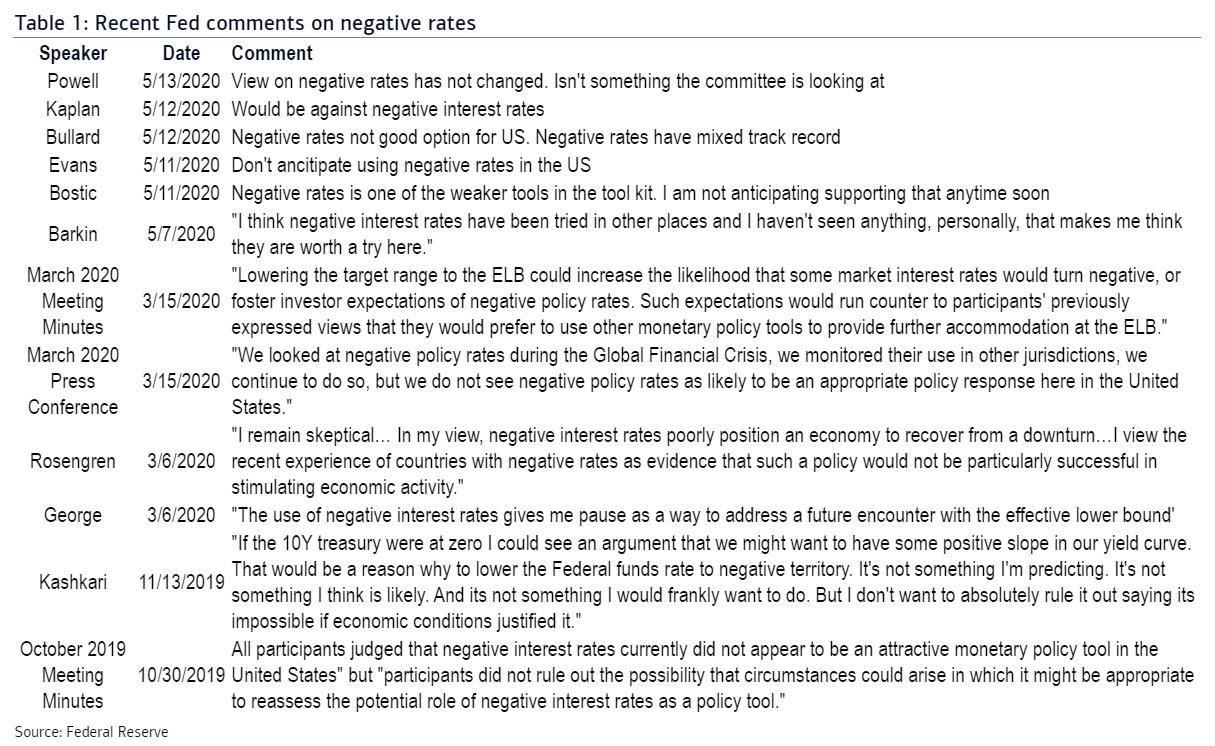
In an attempt to amplify Powell’s message, BofA’s rates strategist and former NY Fed staffer Mark Cabana writes today that the Fed is rarely this unified in any view: “US negative rates are not an attractive monetary policy tool”, adding that Chair Powell was very clear in this view yesterday. It’s not just Powell of course, and below the strategist has assembled a summary “of the uniform and widespread opposition to negative rates from a range of Fed officials.” The most striking rebuke of negative rates came from the October 2019 FOMC meeting minutes when “all participants judged that negative interest rates currently did not appear to be an attractive monetary policy tool in the United States”. It is very unusual to see this type of broad based agreement on any potential policy stance, according to Cabana who adds that in order to see a material change in thinking on negative rates “it would likely require a leadership change and large scale Fed turnover. Neither of these is likely in the near term.”

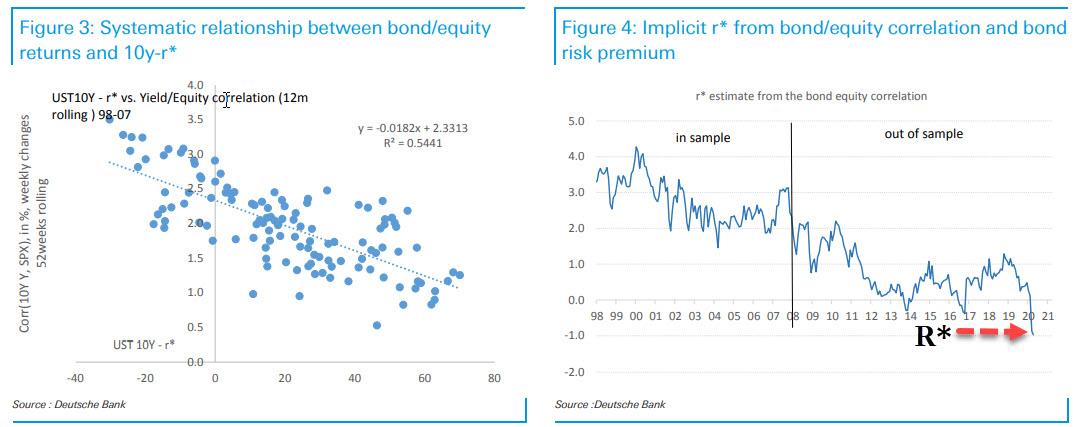
As an alternative to negative rates, Powell has indicated the Fed can ease through forward guidance, UST & agency MBS asset purchases, or “13-3” extraordinary market programs. Indeed, just yesterday we noted that – using Deutsche Bank calculations – to catch down to where the current neutral rate of interest, or r*, is which is at roughly -1%, the Fed would need to conduct roughly $3.3 trillion in QE on top of what the market is currently pricing in.

Cabana expects that, in further distancing itself from NIRP, Fed official will “overweight these tools in support of expansive fiscal policies but not shift their thinking on negative interest rates in the near term.”

But far more importantly, Cabana writes that he does not think “the market can “bully” the Fed into adopting negative interest rates.” As he explains, while the market can push the Fed to adopt a number of policies, “the case for negative rates is fundamentally different. Negative rates have meaningful implications for the financial system and financial intermediation. If market participants want to position for a Fed that will ease further we would suggest better risk/reward tradeoffs are in lower longer-dated real rates or higher breakevens.

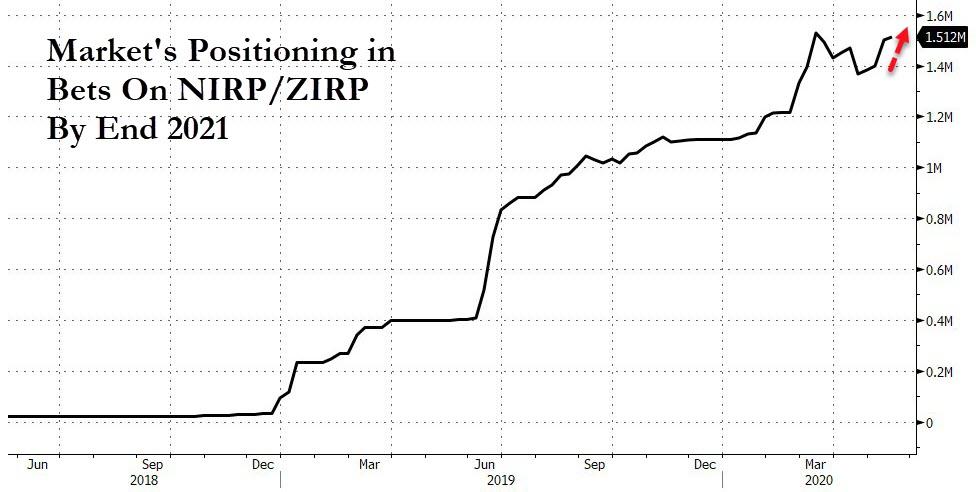
Cabana then makes an extensive list laying out all the various reasons – ranging from legal, to structural, to behavioral – why negative rates are virtually impossible (we will highlight these in a subsequent post) yet what we find fascinating is that despite Powell’s solemn admonition and the bevy of reasons why NIRP is likely not on the agenda, the market simply refuses to care, and as Bloomberg notes in an article explaining why negative rates “are the Only Game in Town” for eurodollar option traders, bets that negative rates are coming have soared, as calls that pay off if the Fed sets the low end of the fed funds target range below 0% between September 2020 and June 2021 “have been in steady demand over the past two weeks.

According to Bloomberg’s Edward Bolingbroke, the most popular trade expects a rate cut of 10 to 15 basis points by September. That’s just the beginning however, because in a clear mockery of Powell’s video address, this week demand has picked up for options that offer protection against a policy rate as low as -0.50% by the middle of next year.

At the same time, overnight index swaps are pricing in a rate cut as the Fed’s next move, with no rate increases for at least five years. Per Bloomberg calculations, the April 2021 OIS contract tied to the traded at about -1 basis point Thursday, 6 basis points lower than the effective fed funds rate, “pricing in more than 50% odds of a 10 basis point rate cut.”

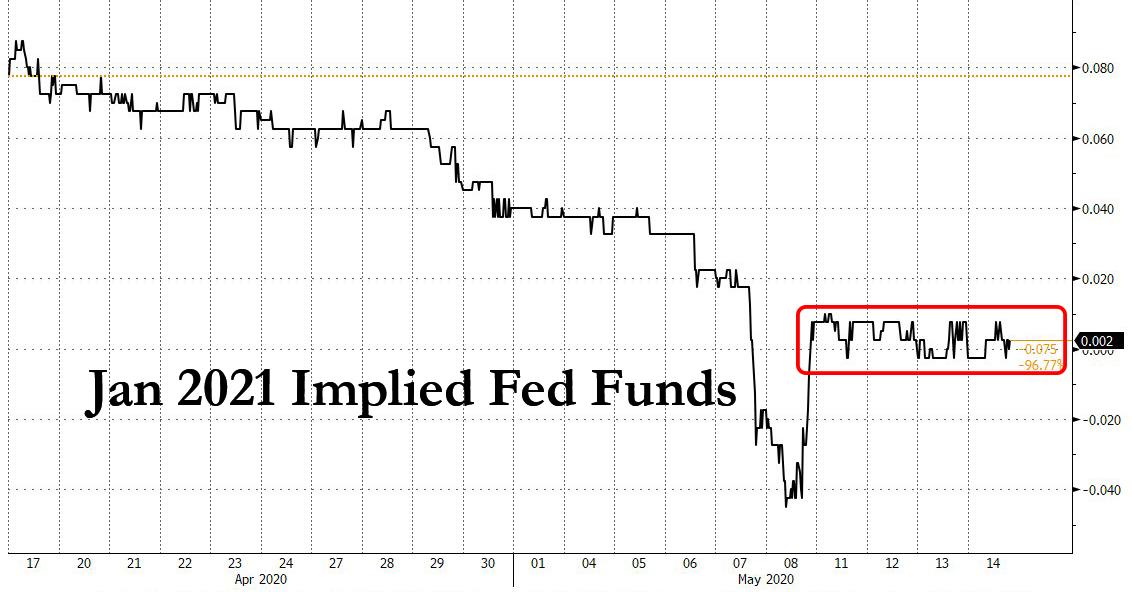
Meanwhile, the implied January 2021 fed fund rate has continued to dip below 0% even after Powell’s speech, although it is well above its Friday crash low, where a -0.4% rate was expected.

The bottom line: far from not “bullying” Powell, the market is just waiting for the next opportunity to pounce on what now seems to be a monetary inevitability: negative rates in the US.

And why not: with the US becoming Japanified with each passing day, it’s only a matter of time before Powell imitates every wrong move in the Kuroda playbook, starting with negative rates and concluding with buying equities. All he needs is a catalyst for the next move, a catalyst… like for example the next sharp drop in equities.

via ZeroHedge News https://ift.tt/2TlObXF Tyler Durden

Arsenault: Beware The “Lazy W” ‘Recovery’

Arsenault: Beware The “Lazy W” ‘Recovery’

Tyler Durden

Thu, 05/14/2020 – 14:15

Authored by John Rubino via DollarCollapse.com,

Real estate investor Marcel Arsenault has racked up Warren Buffett-scale profits over the past few credit cycles by loading up on “empty buildings” at the bottom, filling them with paying tenants, and then selling at the top. In a recent message to investors, he warns that the current market is especially tricky.

Here’s an excerpt:

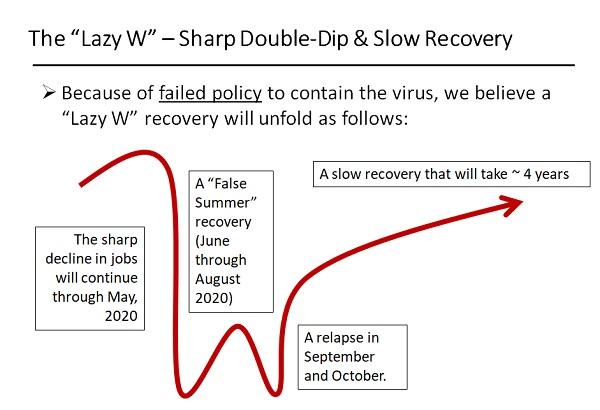
Our Rationale for a Highly Dangerous “Lazy W”

  • The U.S. is already experiencing extremely sharp job losses.

  • We project 26.9 million jobs lost between March and May, 2020.

  • This implies an unemployment rate of 21.4% by May, 2020 – the highest since the 1930s.

  • Because of the immense economic damage, RCS believes there will be intense political and economic pressure to reopen the economy (while unprepared);

  • Businesses rehire, hoping to rebuild lost sales.

  • RCS estimates nearly 10.0 million jobs will be regained, lowering the unemployment rate to 15.1% by August, 2020.

  • This premature “relapse” also happened in the 1918 Flu Pandemic.

  • Re-opening of the economy without the right programs in place causes a “second wave” of new Covid-19 cases in the Fall.

  • States reimplement Shelter-in-Place orders.

  • The weakened economy refreezes.

  • Weakened businesses capitulate and close permanently.

  • By October, 6.9 million jobs will be lost from the premature opening.

  • Many of these job losses will become persistent.

Conclusions and Implications of Our “Lazy W”

  • The Covid-19 Pandemic is setting the economy back several years.

  • By YE 2021, considerable demand for nearly every sector of the economy will have been permanently destroyed.

  • Employment levels by YE 2021 will be roughly the same as YE 2015.

  • It will take until mid-2024 for jobs to recover lost ground.

  • Interest rates will stay at historic lows into 2024.

  • With high unemployment, the Fed will have no incentive to raise rates.

  • Near-term, unemployment peaks at over 20%.

  • By YE 2024, the unemployment rate will still be at 6.4%.

  • Asset values that were at peak will decline precipitously.

  • Equities and commercial real estate will not hit bottom until late 2021.

  • Home values will hold up comparatively well.

Real Capital Solutions (RCS) believes it is crucial for market participants to keep an open mind to all scenarios and plan defensively.

This scenario is as reasonable as it is scary, especially for the retail investors who have, for some reason, been pouring into stocks lately. Consider:

Young investors pile into stocks, seeing ‘generational-buying moment’ instead of risk

The coronavirus market downturn spurred young people — in some cases, for the first time in their lives — to get started with investing.

A spike in new accounts at online brokers show that young and inexperienced investors saw the coronavirus downturn as an entry point into the world of investing and not a time to hunker down.

“New investors who sense a generational-buying moment but do not have much background in the equity space,” Citi chief U.S. equity strategist Tobias Levkovich said in a note to clients.

“We have heard anecdotally about younger individuals with less market experience viewing the March plunge as a unique time to start portfolios and often crowding into the tech arena, purchasing the stocks whose services or products they know and use.”

The major online brokers – Charles Schwab, TD Ameritrade, Etrade and Robinhood – saw new accounts grow as much as 170% in the first quarter, when stocks experienced the fastest bear market and the worst first quarter in history.

But young people apparently saw it as an opportunity and began buying familiar technology stocks.

So who are you going to follow? Millennial Mike and his momentum-chasing muppetry or someone who has actually been through a period when BTFD was not the only strategy and The Fed was not the only game in town.

via ZeroHedge News https://ift.tt/3buealH Tyler Durden

Bank Of Mexico Cuts Rates By 50bps To 5.50% As Expected

Bank Of Mexico Cuts Rates By 50bps To 5.50% As Expected

Tyler Durden

Thu, 05/14/2020 – 14:15

Heading into today’s rate cut decision by the Mexican Central Bank, analysts were nearly unanimous, with 20 out of the 22 analysts expecting a 50bpcut, 1 a 75bp cut, and the remaining one 100bp. The majority was right, with the Bank of Mexico – seeking to stimulate the Mexican economy from its worst recession in recent history – cutting rates  again to 5.50% from 6.0% in a unanimous decision, even though Goldman had assessed “a 40% probability of a larger 75bp-100bp cut given the sharp deterioration of the growth outlook, worsening business confidence and PMIs, decelerating consumer credit and formal job creation, and below-target headline, services and non-food core-goods inflation.”

And with that, the highest yielding currency in LatAm (aside for the occasional banana republic) just became even a little bit less attractive for carry traders.

Explaining the rate cut, the central bank said that it took “into  account  the referred  risks  for  inflation,  economic  activity  and  financial  markets,  majorchallenges  arise  for  monetary policy and for the economy in general. Considering the room  for maneuvering that on balance monetary policy has as a result of these implications, and with the presence of all its members, Banco de México’s Governing Board decided unanimously to lower the target for the overnight interbank interest rate by 50 basis points to a level of 5.5%.”

Commenting on the decision, Banxico said that “the challenges for monetary policy posed by the pandemic include both the unprecedented impact on economic activity as well as those associated with the financial shock that we are currently facing. As for the  risks  to  the  foreseen  trajectory  of  inflation,  the  most  important  to  the  downside  are  a  significant  widening of the negative output gap and the effects of the fall in energy prices. To the upside, a greater or  more  persistent  depreciation  of  the  peso  and  possible disruptions to  chains  of  production  and  distribution  of  certain  goods  and  services.  In  this  context,  the  balance  of  risks  for  inflation  remains  uncertain.”

The central bank also said that “available information shows that  economic  activity  in  Mexico  contracted  significantly  during  the  first  quarter of the year, incorporating the effects associated with the pandemic in March, which affected the production of goods and services considerably. Although the magnitude and duration of the effects of the pandemic are still unknown, these are expected to intensify during the second quarter, and to  result in a significant contraction of employment. Slack conditions thus continue to widen considerably, in a context in which the balance of risks for growth is significantly biased to the downside.”

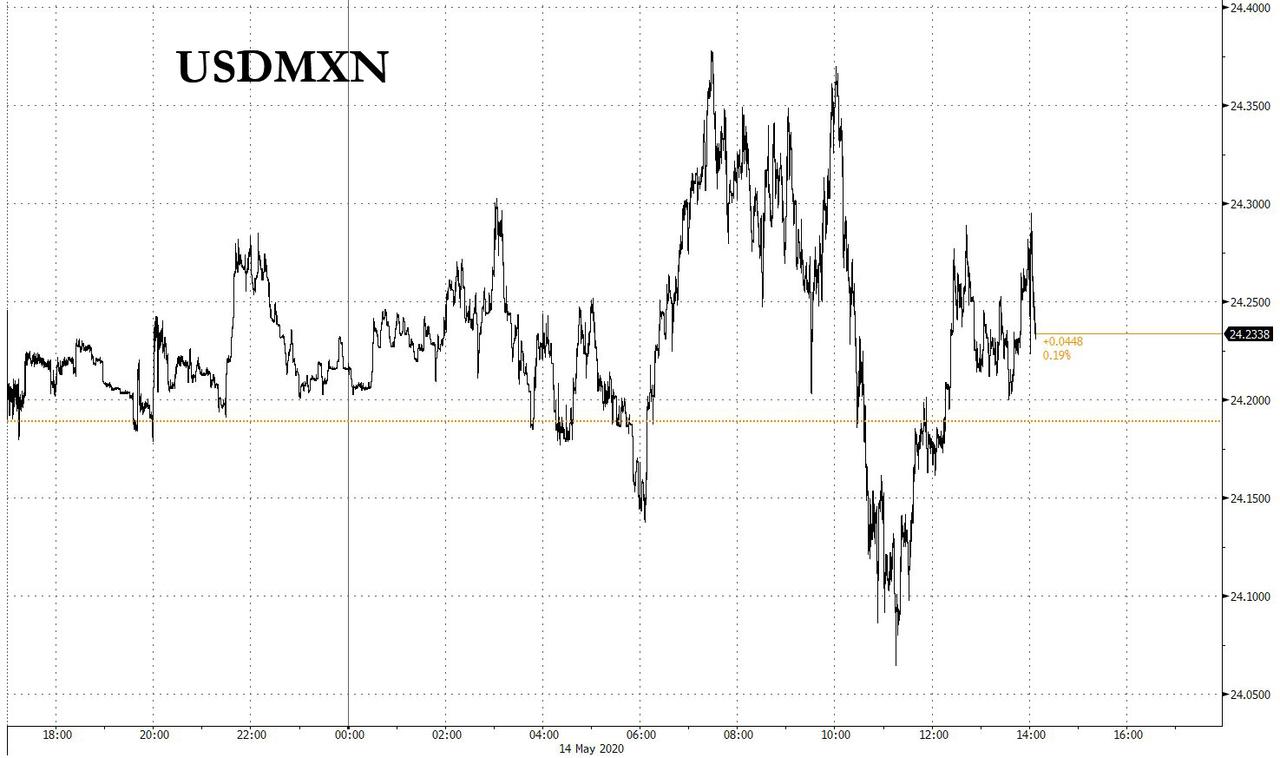
Since the decision was widely as expected, the MXN was virtually unchanged trading at around 24.25 after the announcement.

Goldman justified the 50bp rate cut with the following recent developments:

  • The deep recession and declining commodity prices are starting to bend the inflation curve down, as seen by the impact on tourism-related services, airfares and gasoline prices. The expectation of a very deep recession in 2020 should reduce pricing power and limit the pass-through from a weaker MXN to higher final consumer prices. Finally, lower Dollar commodity prices should also contribute to keep inflation in check.
  • Annual headline inflation moderated to a well below inflation target band 2.15% in April (close to the 2% lower limit of the target range), and core inflation eased to 3.50% (from 3.60% in Mar), with core-services inflation declining to a low 2.84% (down from 3.35% in Mar) and the first sub-3% print in 40 months). However, on a less benign note, core-goods food/tobacco/beverages inflation accelerated to a high 5.78% yoy in April, but core-goods ex-food/tobacco/beverages (component mostly correlated with the real business cycle) declined by 20bp to a further below-target 2.34%.
  • The performance of the economy continues to disappoint and the output gap to widen. Sequentially, real GDP recorded no growth in 4Q19, and average sequential quarterly growth during the last seven quarters has also been zero. GDP growth.
  • According to the 1Q2020 flash estimate, real GDP declined by a larger than expected 1.6% qoq sa (-2.4% yoy sa) reflecting the early impact of the Covid pandemic on both domestic and external demand.
  • Leading indicators point to a very large drop in activity in 2Q: ANTAD reported that sales declined by 24.5% yoy in April, auto production declined 98.8% yoy and auto sales retrenched 64.5% yoy.
  • Sentiment continues to deteriorate. Business confidence declined sharply in April (-6.2pt; the seventh consecutive monthly decline) with the index now sitting deep within pessimist territory (37.4). The Manufacturing and Services PMIs also fell sharply in April, and are now at the lowest levels on record.
  • Consumer credit growth decelerated further: to 0.0% yoy in real terms, down from 1.1% yoy in Feb and 2.4% yoy in Dec. However, corporate credit growth accelerated to 10.0% yoy in March, from a minor 0.4% yoy in Feb and 9.1% yoy a year ago), likely a reflection of increasing credit demand by corporates given the covid-related hit to cash-flows and, on the supply of credit side, the effect of the recent central bank measures to boost liquidity and support credit origination, particularly to SMEs.
  • Expectations for 2020-21 headline inflation improved and the outlook for the economy worsened further. According to the April central bank survey, the median expectation for headline inflation in 2020 declined to 2.90%, from 3.64% and for 2021 declined by a minor 1bp, to 3.50%. The median expectation for core inflation in 2020 declined by 16bp, to 3.34%, and for 2021 by 45p, to 3.44%. The median expectation for real GDP growth in 2020 declined to -7.1% (from 3.5%) and for 2021 rose slightly to 2.20% (from 1.70%).
  • The median market expectation for the policy rate at end-2020 declined to 5.00% (from 5.50%), and for end-2021 declined to also 5.00% (from also 5.50%). n The MXN/USD has been trading well: broadly at the same 23.4 level ahead of the April 21 inter-meeting 50bp rate cut.
  • Formal job creation continues to decelerate: according to the social security ministry database (IMSS), formal employment growth decelerated to an all-time low -2.21% yoy in April, from +0.66% in March and 1.54% yoy in Feb. Formal employment declined by 555 thousand from March and 451 thousand from a year ago. On a quarterly basis, formal job creation decelerated to 0% in the 3-months ending in April, from 1.26% yoy in 1Q2020, down from 1.74% yoy in 4Q19.

via ZeroHedge News https://ift.tt/2yNdOtm Tyler Durden

Wall Street Bonuses Set To Drop By Up To 30%

Wall Street Bonuses Set To Drop By Up To 30%

Tyler Durden

Thu, 05/14/2020 – 14:00

A chaotic year for finance professionals, which has seen their routine upended with many forced to work from home and unable to frequent their favorite watering holes and strip clubs with buddies after work, is about to get even worse. According to a report published Wednesday by compensation consulting firm Johnson Associates, Wall Street bonuses for 2020 could fall by as much as 25%-30% due to the deep cuts to revenues recorded by banks and hedge funds earlier this year as a result of the novel coronavirus.

While most compensation is expected to be down, 2020 is likely to be a year with “wide, wide variations in incentive outcomes between stronger and weaker competitors,” according to the report whose predictions are closely watched by financial professionals and HR departments, which set compensation benchmarks across the industry.

Commercial and retail bankers of many large banks could see the largest year-over-year declines in their incentive pay of up to 30%, as those banks have had to set aside billions for loans that could potentially go bad in this economy. Investment bankers in advisory roles could receive 20%-25% cuts to incentive pay, while their investment bank colleagues who work in underwriting would see smaller declines of 10%-15%, thanks to a record surge in bond underwriting.

Johnson writes that this is because investment banking advisory revenues were down in the first quarter of the year, with most deals stalled, while debt underwriting has soared as corporations sought to build up their cash, and the Fed backstopped investment grade corporate bonds.

The report also finds that asset managers could receive 20%-25% reductions in bonuses, while hedge fund workers could see 15%-20% declines.

It’s not all gloom, however, as bonuses for equity and fixed-income traders could jump as much as 20% this year:

“This is their heyday” after several years of virtually no change in compensation, Johnson told Bloomberg in an interview. “Sales and trading now is mainly a customer business, so you’re benefiting from the flows.”

Wall Street trading desks posted their best quarter in eight years in the first three months of 2020 on surging demand from customers responding to the most volatile market on record. That helped the industry’s largest firms remain profitable even as the coronavirus pandemic forced them to set aside more for bad loans in three months than they did in all of last year.

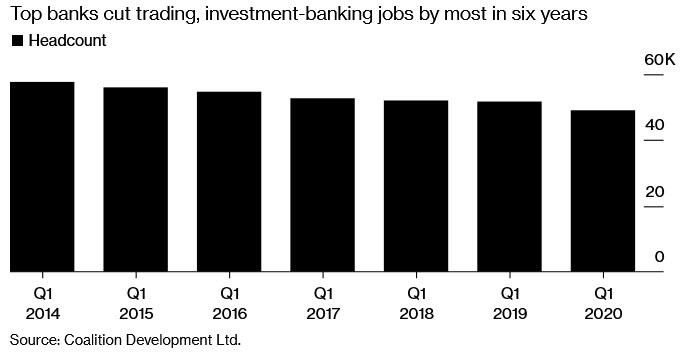
This is good news… for those traders who are still employed. The world’s biggest banks cut trading and investment-banking jobs by 5% in the first quarter, the most in six years, according to Coalition Development Ltd.

“The reliance on big headcount has gone down,” particularly in equities, said Amrit Shahani, research director at Coalition in London. “That is a theme across banks.”

The reduction in front-office revenue producers came even as investment-bank revenue surged 12% to a five-year high, Coalition said in a report Wednesday. Stock-trading divisions reduced headcount 10%, particularly in institutional cash equities, while bond-trading divisions shrank 6%, letting go of employees in Group-of-10 rates and commodities.

The result is that those workers who are still employed have a relatively larger pot to split, or at least that’s the theory. As Bloomberg adds, some think the revenue gains won’t translate into higher pay because fallout from the pandemic has been too severe. New York’s bankers and traders are likely to see bonus payments “fall sharply” this year as the economic slump crimps earnings in the finance industry, the state’s comptroller said in March.

The decline in staffing contrasts with rising revenue, according to data from the 12 largest global investment banks tracked by Coalition. In fixed income, currencies and commodities, revenue jumped 20%, driven by macro products. Investment-banking revenue increased 7%, helped by equity and debt capital markets.

At the end of the day, it all depends on whether there is a second wave or if the reopening does not work out as expected.

“If this opening up turns out to be a real problem, and then we have further shutdowns,” Johnson said, “then things could get a lot worse.”

via ZeroHedge News https://ift.tt/2TlH819 Tyler Durden

The Real Killer Is COVID-Lockdown-Driven Unemployment

The Real Killer Is COVID-Lockdown-Driven Unemployment

Tyler Durden

Thu, 05/14/2020 – 13:45

Authored by Christopher Dembik, head of Macro Analysis at Saxo,

Summary 

Today, the U.S. Federal Reserve will release a survey confirming the economy is doomed for a long and painful downturn. Chairman Powell said in a webinar at the Peterson Institute for International Economics yesterday that one of the main findings, which is similar to that of many other surveys, is that lower-income Americans have been the most affected by the consequences of the virus. According to Powell: “Among people who were working in February, almost 40% of those in households making less than 40,000 USD a year had lost a job in March”.

The coronavirus is a pure negative externality. It initially caused a negative supply shock that was rapidly offset by a negative global aggregate demand shock. The fact that global commodity prices are plunging also speaks to the fact that we are dealing with a demand shock.

The only short-term solution to limit the spread of the virus was to favor social distancing and to implement strict lockdown where it was needed, which contributed to depress aggregate demand. Households were called upon to stay at home and avoid social interactions, which forced them to spend less. If consumers buy less, companies are inclined to produce less. In other words, if some companies can continue to produce despite these unusual circumstances, they do not necessarily have the incentive to do so. This will also have a negative impact on production and will cause massive layoffs. This is the phase in which we currently are.

Phase 1: Temporary massive layoffs

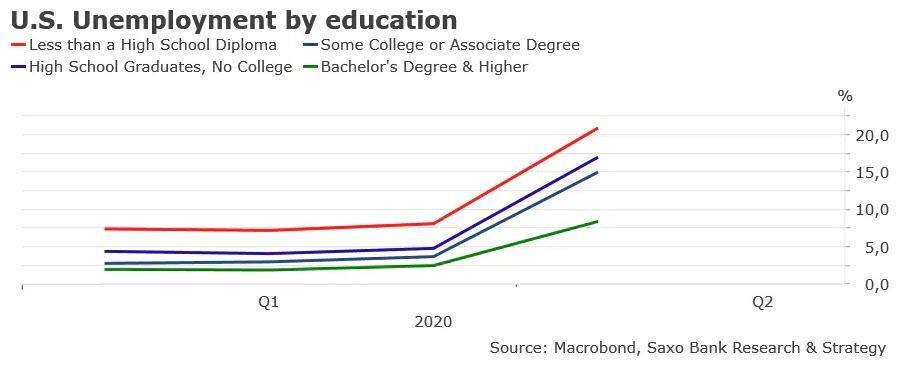
In the United States, the economy destroyed more than 20 million jobs in April due to the lockdown, which pushed the unemployment rate to 14.7% from 4.4% a month earlier. According to several members of the Federal Reserve, the unemployment rate might quickly climb to 20%, eventually reaching a peak close to 30%. But a better indicator of what is actually happening is probably the ratio unemployment as share of population (16 years and over) which dropped to 51.3%. Said differently, only half of the population has a job. The service sector has been the most affected by the coronavirus: more than 7 million jobs have been lost in leisure and hotels, almost 2.5 million in education and health and another 2 million in retail trade. The below charts shows the impact on unemployment rate by education level.

We see that every unemployment rate quadrupled so far during the lockdown period but, as it is the case with every “normal” recession, the size of the shock is much greater for lower education level than for higher ones. The only major difference is the amplitude of the shock in such a short period of time.

Phase 2: Hysteresis effect and solvency issues

A large chunks of layoffs are considered as temporary (up to 70% in the United States according to the April nonfarm payrolls report). When the lockdown measures will be lifted, the economy will restart as normal and companies will hire back those who were laid off during the crisis. I disagree with this assumption.

If China leads the rest of the world in the ongoing process, then there is no V-shape recovery in perspective.

In China, it took one month to one month and half for productive capacities to get back to 100%, but consumption remains sluggish.

Retail sales fell 15.8% year-on-year in March and restaurant spending plunged nearly 50% over the same period.

Many shops are still desperately empty, even in Beijing.

This phenomenon is called the hysteresis effect. Although the pandemic has disappeared, it continues to have a noticeable effect on consumption and savings behavior. Due to the uncertain economic outlook and fears of rising unemployment, consumers are strongly inclined to save, which is a huge negative for aggregate demand, and will amplify the economic downturn. As a result, companies are facing increasing solvency issues topping sometimes preexisting decrease in industrial profit (as it is the case in China where industrial profit was down minus 37% in Q1 2020) and will have no other choice but to focus on restoring cash flows and to cut costs, including jobs. The vicious circle of sluggish aggregate demand and solvency issues is just about to start and will lead to a strong and lasting jump in unemployment which will be more important in countries with insufficient automatic stabilizers.

Winners and losers in the post-COVID world

Coronavirus scars will weaken the economy for years to come. Policymakers, with a massive inflow of liquidity into the economy, have delayed and postponed a lot of pain but they have not eliminated it. The second economic wave is coming and will be characterized by weak demand, an unprecedented number of bankruptcies and much higher unemployment. Before the outbreak, the global economy was already in a very weak position, with a high level of public and private debt, elevated market valuation and low growth momentum. Historical precedent tend to indicate that, contrary to wars, there is no strong recovery after pandemics and depressive effects, such as depressed investment opportunities and increase in precautionary saving, can persist up to 40 years (see for further details this excellent paper published on the website of the NBER).

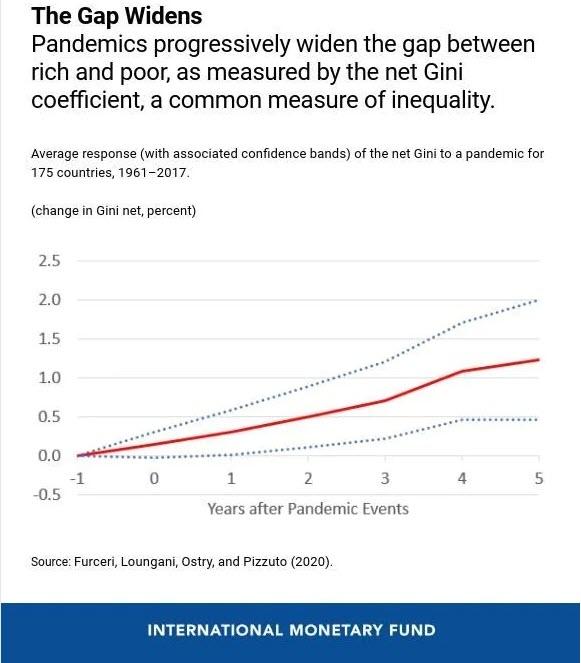
Another characteristic of pandemics is that they leave the poor even farther behind. One of the latest IMF blogposts (see here) using the net Gini coefficient concludes that pandemics progressively widen gap between rich and poor and hurt employment prospects of those with only a basic education while scarcely affecting employment of people with advanced degrees. The most striking finding is certainly that inequality tends to increase in the long run (the net Gini increased by nearly 1.5% after five years), confirming that pandemics scars have a very long-term impact on the broad economy.

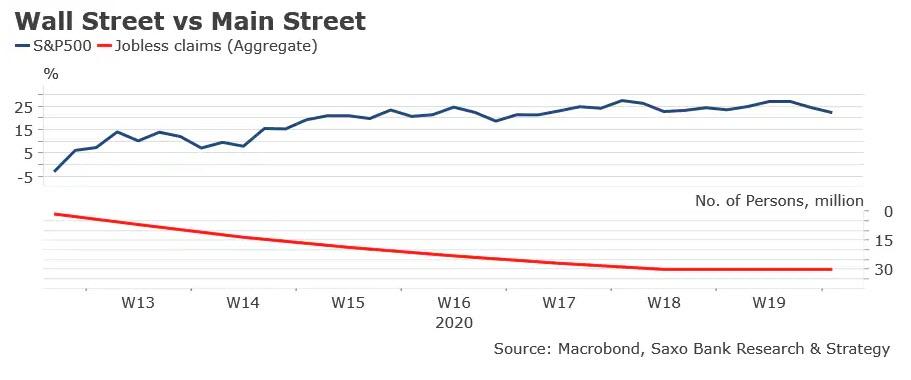
The risk is that the gap between rich and poor, symbolized in the above chart by the evolution of the S&P 500 since its low point of March 23 and the aggregate increase in U.S. jobless claims over the same period, will widen further. There have been plenty of research from the IMF and the Bank of England over the past years demonstrating that quantitative easing induces a lasting jump in wealth inequalities due to the increase in the price of financial assets (see herehere and here). Given the amount of liquidity injected by central banks all around the world and the initial effect on the stock market, the winners of the ongoing crisis might likely be the 1%. On the contrary, the losers will be the rest of the population, especially the less educated, that will need to cope with higher unemployment and lower purchasing power. Coronavirus unemployment is putting at risk the social contract made between citizens and the state and may pave the way to populism. Governments will certainly try to address the issues of unemployment and inequality by implementing more redistributive policy and letting the fiscal deficit widen. Will it be enough? I don’t have the answer yet, but I know that policymakers cannot let down the 99% one more time.

via ZeroHedge News https://ift.tt/2Z4vWJW Tyler Durden

What Real-Time Indicators Say About The True State Of The US And Global Economy

What Real-Time Indicators Say About The True State Of The US And Global Economy

Tyler Durden

Thu, 05/14/2020 – 13:30

With the official GDP update on the current state of the US economy not due for months, we take a look at the latest real-time indicators compiled by some of the largest banks.

We start with Goldman’s global activity tracker, which showed some more good news, ticking up to -15% yoy for the week of May 3-9, while US Industrial Activity ticked up to -15%.

Away from the manufacturing economy, the picture in the US remains dismal: Goldman’s US Consumer Activity Tracker—which tracks spending in categories of consumption that are likely to be disproportionately affected by the virus—edged down to -73% yoy, as China also appears to be suffering a setback in recent days.

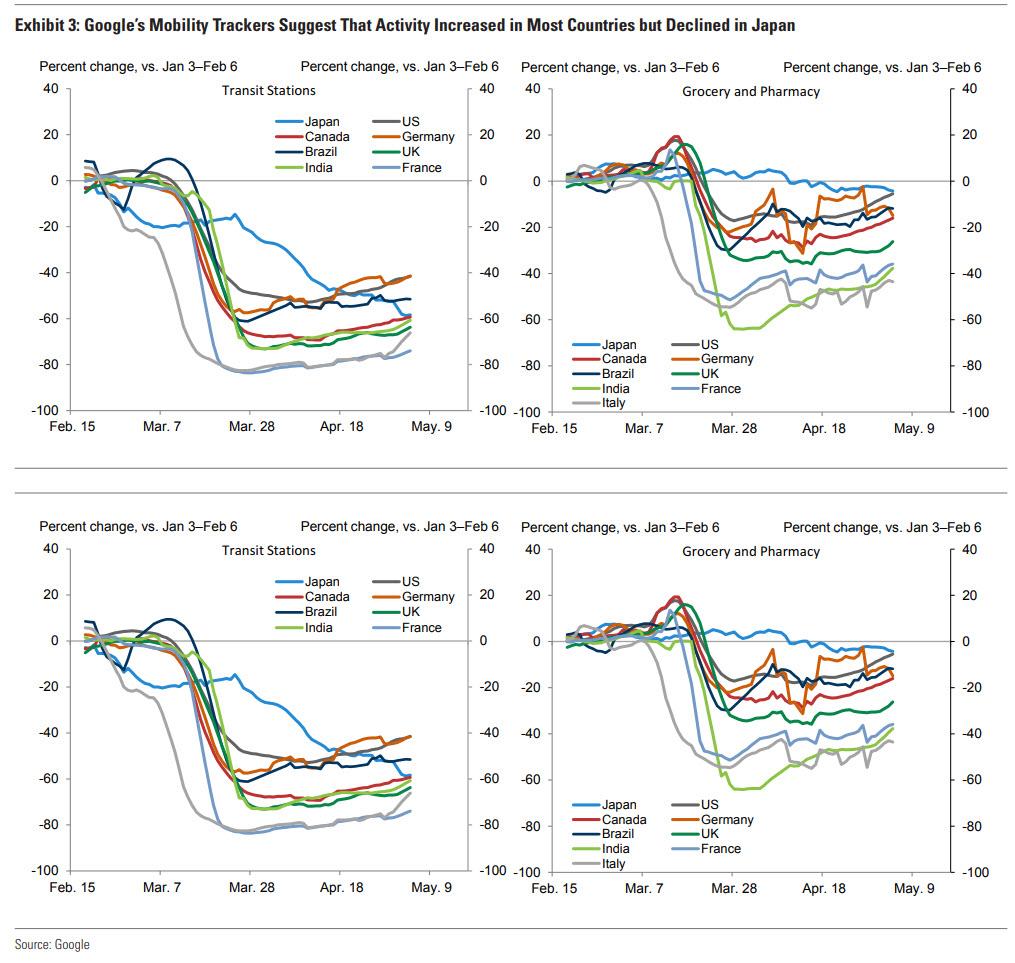
Google’s mobility trackers suggest that activity increased in most countries, but declined in Japan.

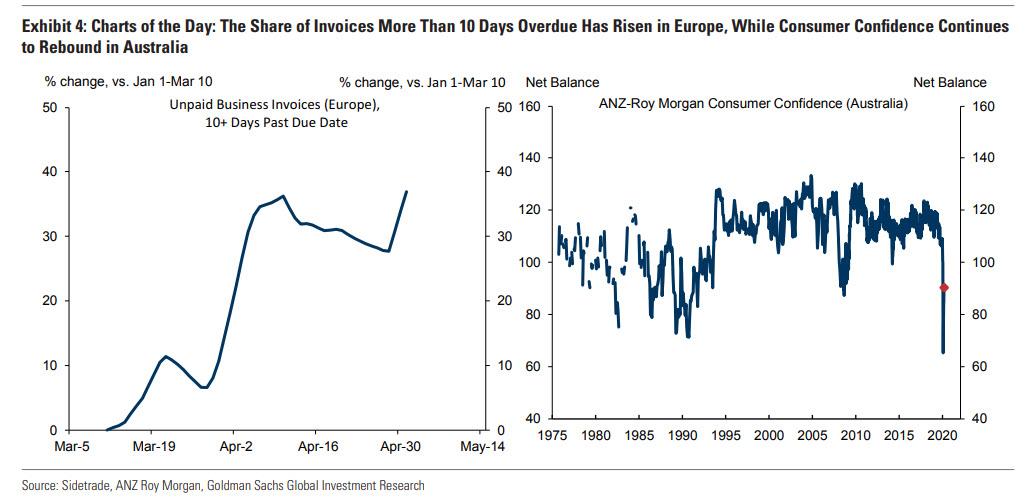
One especially ominous chart comes from Europe, where the percentage of invoices unpaid for more than 10 days has risen to an all time high of 37% relative to its pre-virus level in Europe; on the flipside, consumer confidence continues to rebound in Australia.

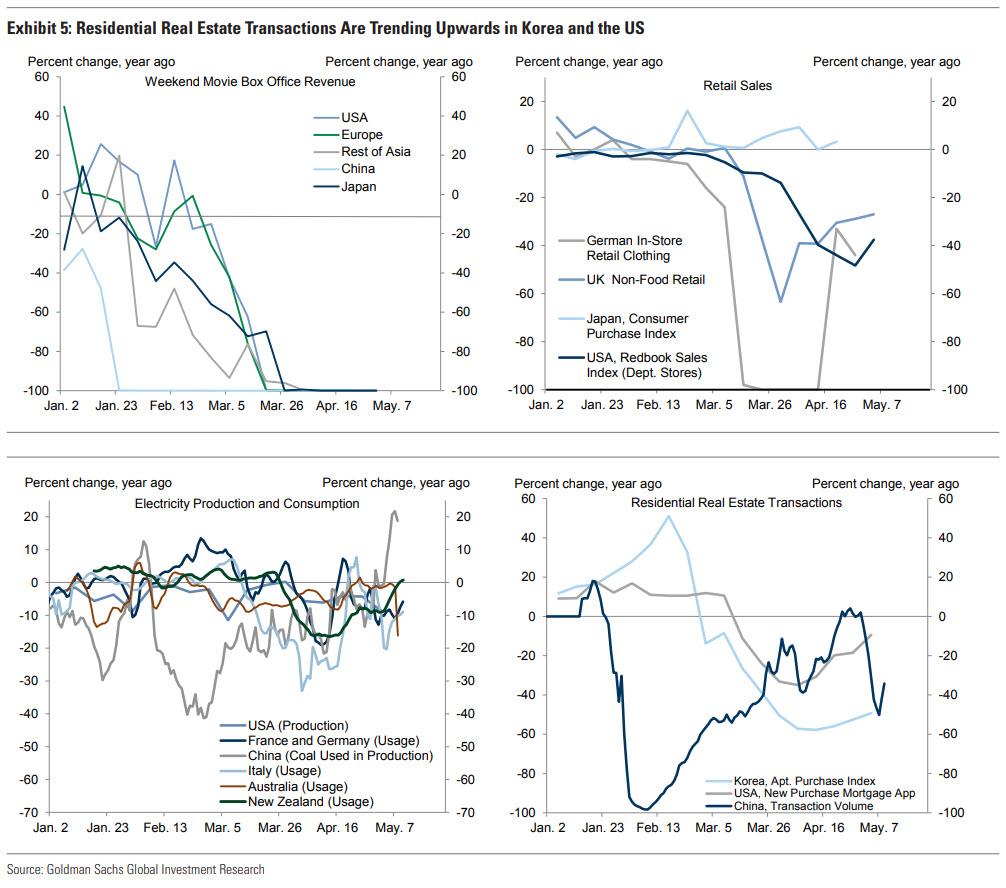
Cinemas remain dead around the globe, retail sales have managed a modest recovery in Germany if not in the US, while there was more good news in the real estate sector where transactions are trending upward in Korea and the US.

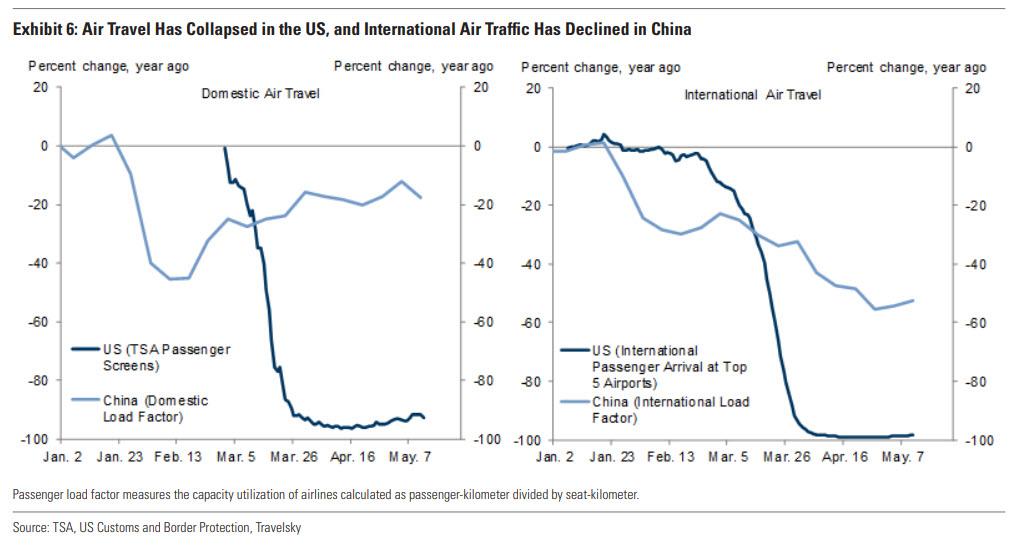
There is no recovery in US air travel, however, and while domestic load factors in China have rebounded, international travel continues to decline.

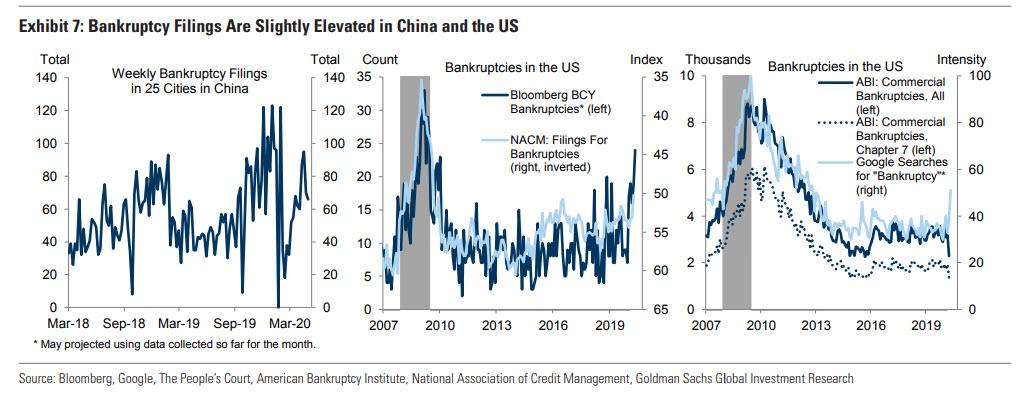
Another silver lining is that while bankruptcy filings are slightly elevated in China and the US, the full avalanche has yet to start even though google searches for “bankruptcy” are on the rise.

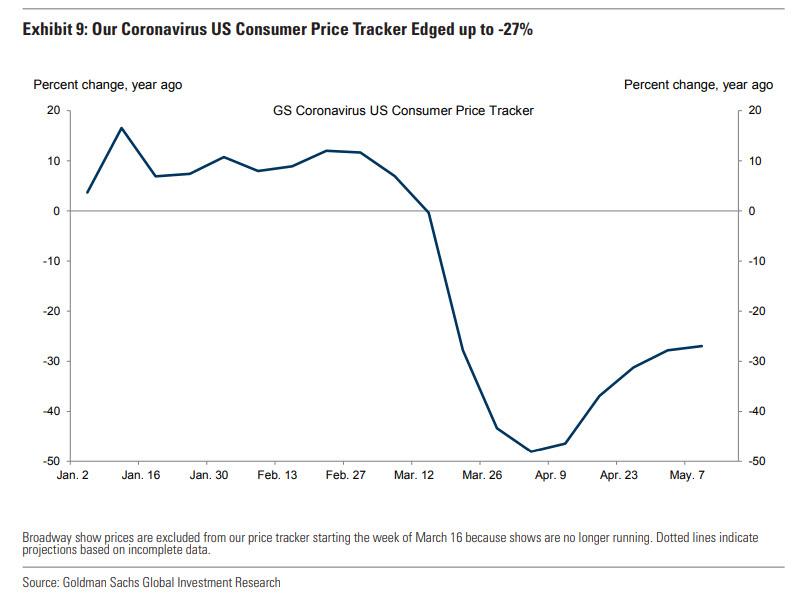
One place where there are clear signs of a recovery in the US, is consumer prices which after troughing in early April have managed to cut losses in half.

Next, we look at Bank of America’s indicators, which focus on restaurant dining (tiny rebound from all time lows), general mobility, subway ridership in San Fran and New York…

… as well as overall traffic in NYC, news and economic sentiment, business impact, and gasoline usage.

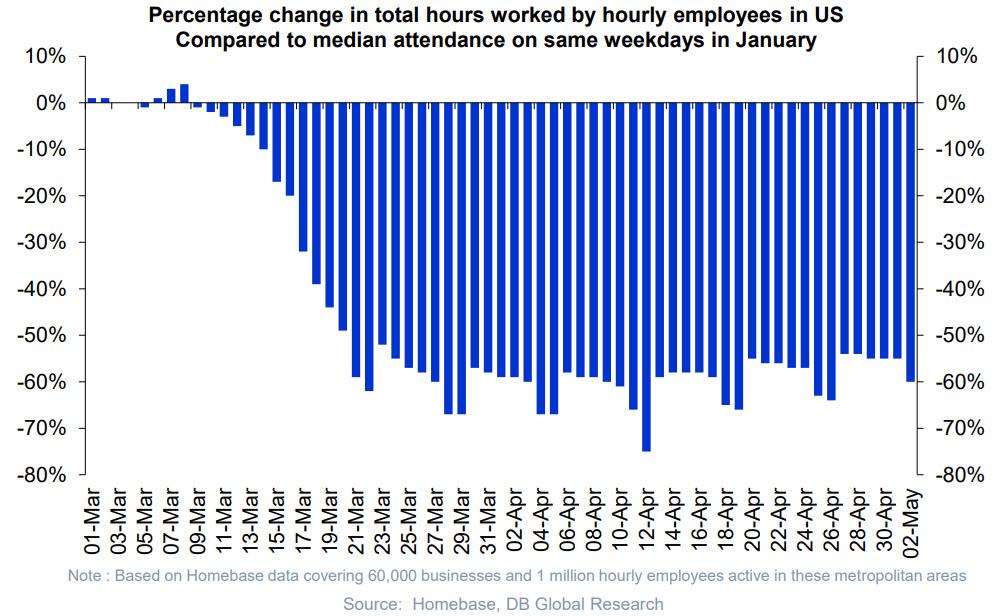
Finally, we shift to Deutsche Bank which finds signs of stabilization among small businesses, specifically in the Percentage change in total hours worked by hourly employees in US Compared to median attendance on same weekdays in January…

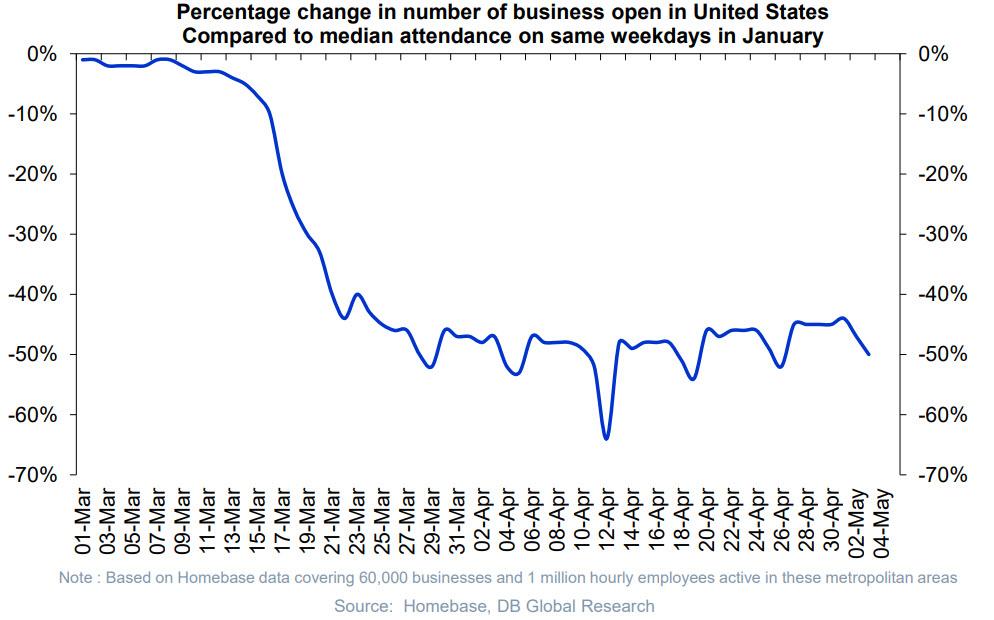
… and the percentage change in number of business open in United States Compared to median attendance on same weekdays in January.

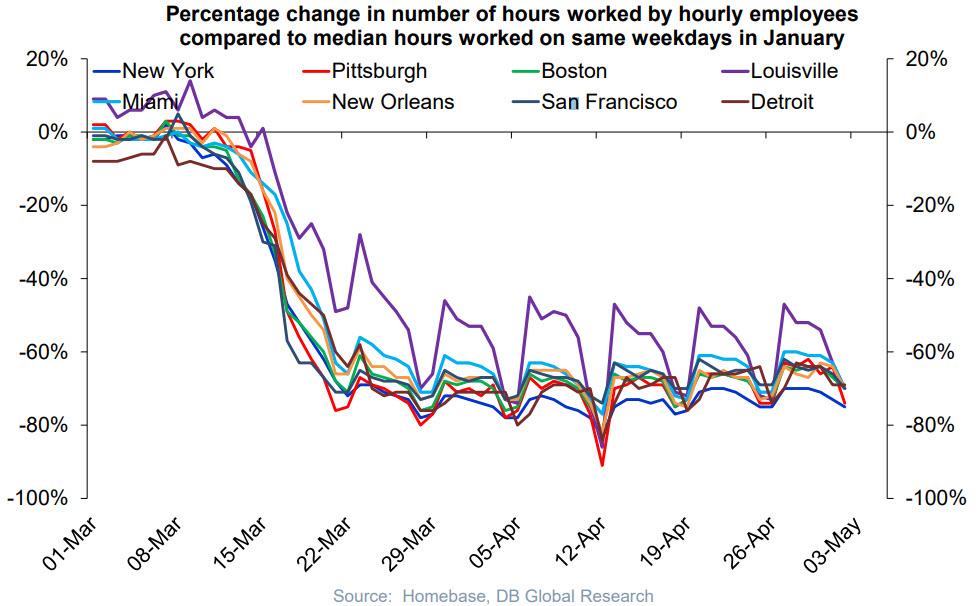
Of course, stabilization does not mean recovery, as the flatlining in the percentage change in number of hours worked by hourly employees compared to median shows.

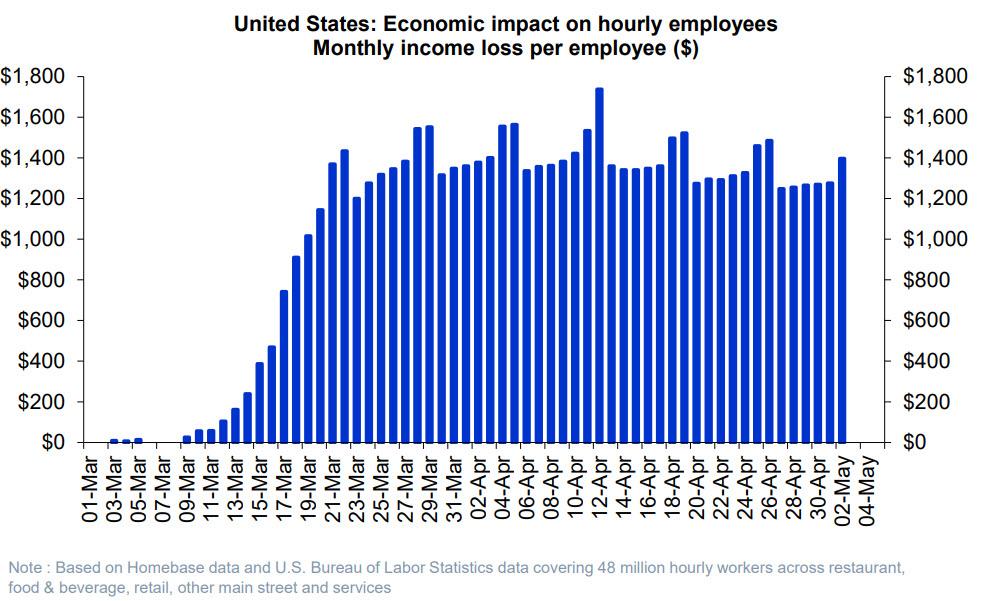
Meanwhile, hourly employees continue to lose over $1,2000 on average as a result of the shutdown.

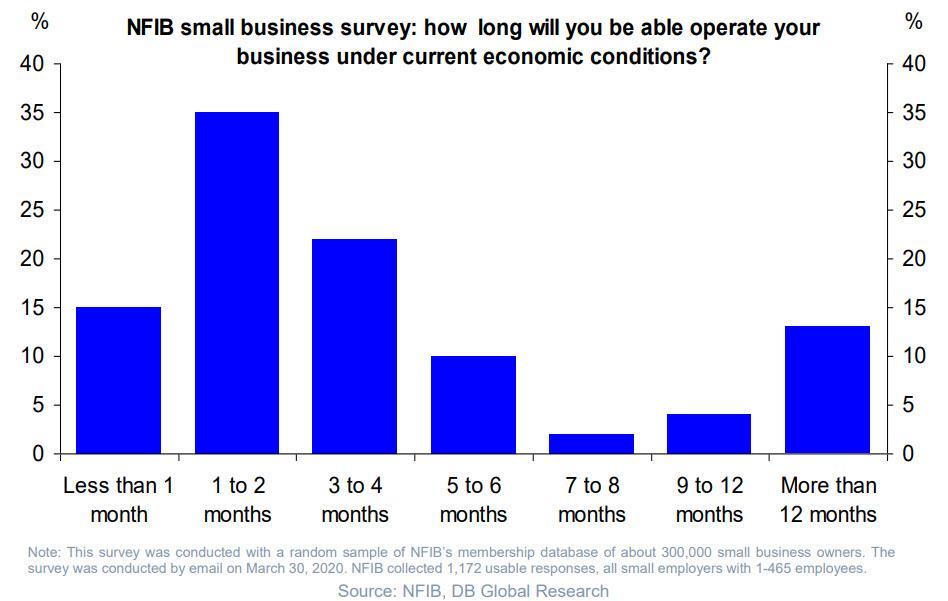
And, as always, we go back to the big question: how much longer will the shutdown continue, because as the NFIB has found, most business in the US can only operate for 1-2 months under current economic conditions. It is now almost 2 months since the shutdown, so once the government bailout support starts drying out and is not replenished, we will likely see the next big hit to the US economy.

via ZeroHedge News https://ift.tt/2Lrotwa Tyler Durden

US-Backed Forces Seize Syrian Commercial Bank In Oil-Rich Northeast Province

US-Backed Forces Seize Syrian Commercial Bank In Oil-Rich Northeast Province

Tyler Durden

Thu, 05/14/2020 – 13:15

Via AlMasdarNews.com,

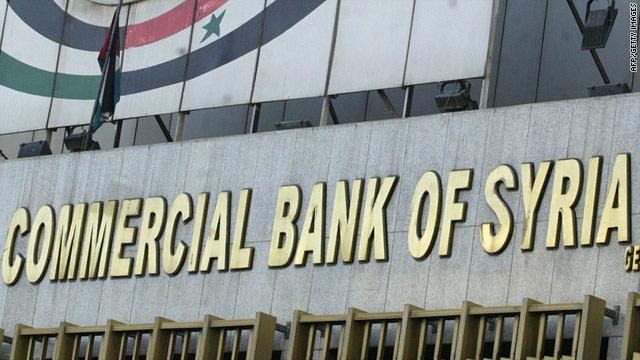
U.S.-backed forces have seized a Syrian Commercial Bank branch in the Al-Hasakah Governorate, as they expelled all the employees inside the building and established full control over the site. The Syrian Commercial Bank is the largest commercial bank in Syria and is state-owned, headquartered in Damascus. Since 2011 it’s been under US and EU sanctions.

According to a field report, the Syrian Democratic Forces (SDF), alongside the U.S. Coalition, attacked the main building of the Syrian Commercial Bank branch of the government located within the gathering of  official departments in the southern section of Ghuweiran District, at the entrance of Al-Zohour neighborhood in Hasakah city.

File image via AFP/CNN

“The building that was controlled by the SDF is located near the Industrial Prison, the Industrial Secondary School, and the Industrial Institute,” a source told Sputnik Arabic.

The southern section of the Al-Ghuweiran District is where the Industrial Prison is located; this is the same jail that the Islamic State (ISIS/ISIL/IS/Daesh) broke out of earlier this month.

The U.S. Coalition and SDF reportedly expelled government officials and students from the Tourism Directorate building, which also includes the hotel’s tourist high school and the Technical Institute for Tourist and Hotel Sciences in the Al-Zuhour neighborhood of Al-Hasakah.

The Commercial Bank building and the Tourism Directorate building were captured by the SDF troops in August of 2016 after attacking the sites of the Syrian Arab Army (SAA).

US troops with Bradley Fighting Vehicle at a base in Syria’s Hasakah province. Image source: NPR

However, following the implementation of the Hmeimim Agreement last year, the building was returned to the Syrian government, which allowed the bank to resume its work.

These developments come amid the arrival of military and logistical reinforcements for the U.S. military to its bases in the governorates of Al-Hasakah and Deir Ezzor.

Meanwhile University of Oklahoma professor and expert on the region Joshua Landis highlighted the words of US special envoy to Syria James Jeffrey this week as follows“He pledged that the United States will continue to deny Syria – international funding, reconstruction, oil, banking, agriculture & recognition of government.”

via ZeroHedge News https://ift.tt/2Lwx1Ss Tyler Durden