The Federal Government’s “Police Power” and the Takings Clause: Part III

Part I in this series explained that Congress does not have a general police power. Part II added that Congress can seize property pursuant to its Commerce and Necessary and Proper Clause Powers. But the federal government cannot seize property if the requisite statutory authority exceeds Congress’s enumerated powers. Part III will extend this analysis to the Trump Administration’s ban on bump stocks.

In 2018, the Trump Administration announced that federal gun control laws would now be read to prohibit bump stocks. Previously, the Obama Administration determined that the National Firearms Act and the Gun Control Act did not prohibit bump stocks. The final rule was challenged in several courts. (I filed an amicus brief on behalf of the Cato Institute in Guedes v. Bureau of Alcohol, Tobacco).

The Bureau of Alcohol, Tobacco relies on 18 U.S.C. 922(o) for the requisite statutory authority. This statute prohibits the possession of a machine gun.  ATF determined that bumpstocks were “machine guns” within the meaning of 18 U.SC. 922(o).

The final rule explained:

As 18 U.S.C. 922(o), with limited exceptions, prohibits the possession of machineguns that were not lawfully possessed before the effective date of the statute, current possessors of bump-stock-type devices will be obligated to cease possessing these devices. . . .

The NFA does not “usurp[ ] police power reserved to the States.” United States v. Miller, 307 U.S. 174, 176 (1939). Further, “[b]ecause § 922(o) was a proper exercise of Congress’s enumerated authority under the Commerce Clause, and because it does not compel, let alone commandeer, the states to do anything, the statute does not violate the Tenth Amendment.” United States v. Kenney, 91 F.3d 884, 891 (7th Cir. 1996).

All bump stocks must be destroyed or surrendered prior to the effective date of the regulation (March 26, 2019).

After implementation of this final rule, bump-stock-type devices that meet the definition of “machinegun” under the NFA and GCA cannot be lawfully possessed because the pertinent provision of the GCA, 18 U.S.C. 922(o), prohibits persons from possessing a machinegun unless it was lawfully possessed before the effective date of section 922(o). Bump-stock-type devices currently possessed by individuals will have to be destroyed or abandoned prior to the effective date of this regulation.

The Bureau also cites 18 U.S.C. 922(o) as a defense to any takings claims:

The Department disagrees that lawabiding citizens would instantly become felons under this rule. This final rule provides specific information about acceptable methods of disposal, as well as the timeframe under which disposal must be accomplished to avoid violating 18 U.S.C. 922(o). Current possessors of bump-stock-type devices who properly destroy or abandon their devices will avoid criminal liability. As described in Part IV.D.1.b, this is not a compensable “taking” of property under the Constitution. . .

The Court of Federal Claims accepted this argument in McCutchen v. United States, 145 Fed. Cl. 42, 50-53 (Ct. Fed. Cl. 2019).

In this case, Plaintiffs’ bump-stock devices were not “taken for a public use,” within the meaning of the Takings Clause. Instead, because the devices have been designated as machineguns under ATF’s regulatory authority, they are subject to 18 U.S.C. § 922(o), which makes their possession a criminal offense. ATF, in the exercise of its police power, directed that owners of the devices must either destroy or abandon them at an ATF office, to avoid prosecution. Because the prohibition on possession involved an exercise of the government’s police power, there was no taking within the meaning of the Fifth Amendment.

The terminology in this case is imprecise. The federal government lacks a general police power. ATF’s authority to require destruction of bump stocks must rise and fall on 18 U.S.C. 922(o).

If 18 U.S.C. 922(o) is within Congress’s enumerated powers, as applied to the bump stock ban, then compensation would not need to be provided for those who abandon their devices. If 18 U.S.C. 922(o) is beyond Congress’s enumerated powers, as applied to the bump stock ban, then just compensation must be provided.

Part IV in this series will consider the constitutionality of 18 U.S.C. 922(o) as applied to bump stocks.

(Thanks to Caleb Kruckenberg of the New Civil Liberties Alliance for his help with this post.)

from Latest – Reason.com https://ift.tt/3aP2Cdg
via IFTTT

Eurogroup Fails To Agree On Coronavirus Stimulus After Feud Erupts Between Italy And Netherlands

Eurogroup Fails To Agree On Coronavirus Stimulus After Feud Erupts Between Italy And Netherlands

Three things are guaranteed in life: death, taxes and the Eurogroup failing to reach an agreement.

At exactly 2am ET, the EURUSD tumbled in a flashback to the dark eurozone sovereign debt crisis days of 2010-2015, when news broke that European Union finance ministers had failed to agree in all-night talks on more support for their coronavirus-hit economies.

Shortly after Eurogroup president Mario Centeno tweeted that he was suspending the discussions until Thursday: “after 16 hours of discussions, we came close to a deal but we are not there yet. I suspended the Eurogroup and continue tomorrow, Thursday. My goal remains: A strong EU safety net against fallout of COVID-19 to shield workers, firms and countries & commit to a sizeable recovery plan.”

According to Reuters, diplomatic sources and officials said a feud between Italy and the Netherlands over what conditions should be attached to euro zone credit for governments fighting the pandemic was blocking progress on half a trillion euros worth of aid.

The finance ministers, who started talks at 1430 GMT on Tuesday and lasted all night with numerous breaks to allow for bilateral negotiations, are trying to agree a package of measures to help governments, companies and individuals.  They had hoped to agree on a half-trillion-euro program to cushion the economic slump and finance recovery from the pandemic, and turn a page on divisions that have marred relations as the bloc struggles with the outbreak.

But feuds emerged prominently again, one diplomatic source said: “The Italians want a reference to debt mutualisation as a possible recovery instrument to be analysed more in the future. The Dutch say ‘no’.”

In other words, Italy was hoping to use the coronacrisis to finally get its long-sought goal of federalized, mutualized debt, and yet the Dutch (and somewhere not as loud behind them the Germans) said “nee.”

An official who participated in the talks said at around 0400 GMT on Wednesday The Hague was the only one refusing to endorse a text that the ministers were expected to agree on to get endorsement for a new set of economic measures from the bloc’s 27 national leaders.

German Finance Minister Olaf Scholz said on Twitter: “In this difficult hour Europe must stand together closely. Together with (French finance minister) Bruno Le Maire, I therefore call on all euro countries not to refuse to resolve these difficult financial issues and to facilitate a good compromise – for all citizens.”

Hardly a new topic of contention, issuing joint debt has been a battle line between economically ailing southern countries like Spain and Italy and the fiscally frugal north, led by Germany and the Netherlands, since the financial and euro zone crises began over a decade ago.

To support economies burdened by coronavirus lockdowns, the EU has already suspended state aid limits and allowed member states to inflate their debt to spend more. But Spain, France and Italy say that is not enough and have cast the discussion about more support as an existential test of solidarity that could make or break the EU.

Further proposals under discussions include credit lines from the euro zone bailout fund that would be worth up to 2% of a country’s economic output, or 240 billion euros in total. The conditions for gaining access to this money remain a sticking point. Granting the European Investment Bank 25 billion euros of extra guarantees so it can step up lending to companies by a further 200 billion euros is another option.

The third is support for the EU executive’s plan to raise 100 billion euros on the market against 25 billion euros of guarantees from all governments in the bloc to subsidise wages so that firms can cut working hours rather than sack people.

Creating an emergency support fund issuing grants for medical supplies and health care is another idea, as is a French proposal to create a joint EU solidarity fund to finance long-term recovery.

* * *

That said, if Europe does eventually agree, the combined pan-EU and national government responses could add up to the biggest fiscal support programme in the world, surpassing that of the United States, Reuters calculations showed. Below is a summary of what is eventually expected to be unveiled:

  • Unemployment scheme: The EU Commission plan to set up an instrument for temporary Support to mitigate Unemployment Risks in an Emergency (SURE) where loans up to EUR100bn can be granted to member states (which helps to contain job losses in the Eurozone vs the US).
  • Corporate support: The EIB announcement to set up a pan-European guarantee fund (EUR25bn proposal on top of 40bn support package announced last month). Question is how generous this will be.
  • No coronabonds. Commonly issued debt to exclusively fund COVID-19 measures is unlikely to be agreed on. While advocated by Spain, Italy and France, there is staunch opposition from other parts of the Eurogroup.
  • Open question on ESM credit lines: Loans from the European Stability Mechanism with loose conditionality attached are possible. Citi Rates Strategy notes that the ESM currently has unused lending capacities of EUR410bn but that a compromise is unlikely today. Southern European countries have generally opposed this, particularly the stigma attached and the conditionality.

While the EU is no stranger to protracted horse-trading, the discussion exposes rifts in the bloc and further strains its unity, already damaged by the euro zone crisis and the 2015-16 migration crisis, which partly contributed to Brexit.

So far the ministers, discussing via videoconference through the night with some of them dozing off at times, according to officials present, have been left frustrated. Le Maire was quoted as saying at one point during the night, according to one official who participated: “Shame on you, shame on Europe. Stop this clownesque show.”


Tyler Durden

Wed, 04/08/2020 – 07:51

via ZeroHedge News https://ift.tt/2RogkfD Tyler Durden

Coronavirus Cases Pass 1.4 Million As Scientists Discover Reinfection Risk For Patients Much Higher Than Expected: Live Updates

Coronavirus Cases Pass 1.4 Million As Scientists Discover Reinfection Risk For Patients Much Higher Than Expected: Live Updates

Though the coronavirus outbreak figures reported out of Europe yesterday were probably more mixed than health officials would have liked, there was, apparently, enough to keep the resurgence of optimism that has fueled market gains in recent days alive. While China blithely prepares to unleash its second wave on itself and the world in what seems like an almost deliberate act, the Washington Post reported overnight that the main epidemiological model being followed by the federal government has just revised down the need for ventilators, beds and other equipment as the world seems to have convinced itself that a lull is underway.

Across the US, chatter on social media about the need to get at least some of the shut-down economy back online has intensified in recent days, as political commentary as inspired heated discussions as opponents accuse Republicans and many regular Americans of callously placing the economy and their own self-interest above protecting society’s most vulnerable. Meanwhile, the global case total has surpassed 1.4 million, with 83k+ deaths.

But as JPM projected, and as was the case during SARS and other prior pandemics, even if the novel coronavirus does begin to recede heading into the summer, remember: this is only part one.

At this point, it’s not like anybody is going to snap their fingers and suddenly turn the clock back to Dec. 31, 2019. Many Americans – especially those at high risk – will likely cut down on leisure air travel, as pundits are already talking about the death of the “one-flight meeting”.

But as we begin to weigh the pros and cons, and the Trump Administration reportedly weighs a plan to reactivate parts of the economy and allowing some people to get back to work if they can demonstrate that they’re healthy, the SCMP late last night highlighted some new scientific evidence that is extremely disturbing.

As we explained above, by lifting restrictions on Wuhan, China is potentially unleashing hundreds, maybe even thousands, of asymptomatic carriers on the rest of the country. But scientists believe the ‘herd immunity’ that has supposedly been built up during the first wave should blunt the impact of ensuing waves somewhat. Well, unfortunately, it looks like that thesis needs to be reexamined.

Since the early days of the outbreak, we’ve seen reports about people being reinfected with the virus (though in some cases there were doubts about whether the virus ever really left). Well, now, a team of researchers at Fudan University in Shanghai has discovered that an alarmingly high number of recovered patients whom they’ve tested show low, or no, levels of the virus antibodies in their blood. That means a sizable chunk of those who are infected will be vulnerable to reinfection.

In other words, if these findings are confirmed, the hoped-for “herd immunity” that is supposed to help us get things back to normal in the time between now and however long it takes researchers to mass produce a vaccine simply isn’t going to materialize: Instead of diluting the density and acting as blockers for spread, many will be reinfected, and go on to spread the virus to others, all over again. It’s just the latest reason to worry that the second wave of the virus could be larger than the first.

Some countries are already seeing the first stirrings of a second wave: On Wednesday, Tokyo reported a record 144 new cases on Wednesday as PM Shinzo Abe’s lockdown (which is legally toothless but has inspired most businesses to close nonetheless) took effect.

As the virus continues its woefully underreported spread across Africa – or so public health experts fear – Ethiopia announced on Wednesday that it’s joining a growing list of African nations – already including Botswana, Congo, Ivory Coast, Senegal, South Africa and others – by declaring a state of emergency over the virus. The country’s 110 million people have been relatively unscathed, reporting just 52 cases so far, though some fear that the country’s close ties to Beijing and commerce between the two nations means many more cases have gone unreported.

Iraq also extended the closure of its main border crossing with Iran as the ‘official’ death toll in that country passes 10k. Much to Trump’s delight, the decision will put added economic pressure on Tehran, as it will disrupt trade between the two nations, something upon which Iran’s sanctions-starved government greatly relies.

Certain progressive media outlets in the US will likely never forget that certain conservative pundits and even – to a much lesser degree – President Trump, Mitch McConnell and other Republican leaders played down the coronavirus as the first cases were confirmed in the US. While President Trump likes to brag about his decision to shut down travel from China, in reality, that was a half-measure (he should have shut down travel from Europe, as certain senior advisors reportedly urged). And while they’re not wrong, they’re only telling part of the story. A lot of people in positions of power – including, as the Intercept notes, NYC’s Democratic mayor – either underestimated the outbreak, or have changed views on subjects like drugs, whether shutting down schools makes sense, whether a partial shutdown that preserves more of the economy might be a more appropriate response – the list goes on and on.

Going through this list, it appears to us that nobody is more guilty than the WHO, which is partly why President Trump is insisting that the US reexamine the WHO’s funding, and has mocked the WHO for ‘totally blowing it’.

Of course, anybody who has only just started paying attention in the past few weeks (ie most of America) probably doesn’t remember the WHO dragging its feet on the global threat and pandemic designations (those were two separate declarations), while also insisting that travel restrictions and border closures weren’t appropriate at a time when those decisions could have gone a long way toward suppressing the spread.

Because as the White House reportedly prepares a plan to get some healthy people back to work in the not too distant future, the WHO is now urging that countries considering a lifting of their lockdowns should probably reconsider (even as China prepares to send legions of infected Wuhan residents across its own country, and the world).

The WHO said Wednesday that “we have a long way to go” to defeat the pandemic, said Dr Hans Kluge, the WHO regional director for Europe, adding that now is “not the time to relax [lockdown] measures,” and all countries must “double and triple our collective efforts”. “We still have a long way to go,” he said. “The progress we have made so far in fighting the virus is extremely fragile.” Any relaxation of social distancing measures requires “very careful consideration,” he added. “We need to remain committed.”

His remarks were clearly directed at the West (after all, he was speaking in English), but would the WHO, which has come under fire for refusing to criticize Beijing, say the same about Wuhan?

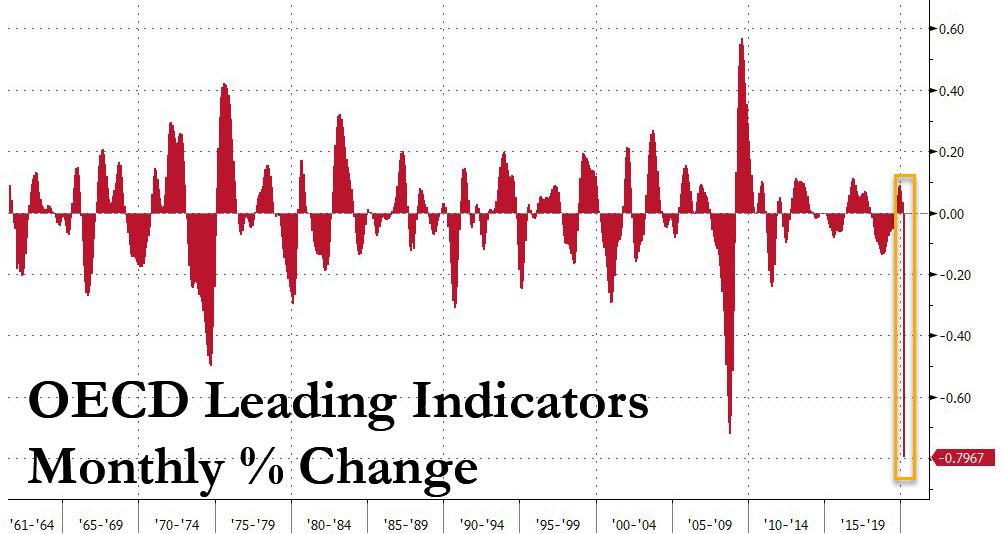
If you, dear reader, happen to be a billionaire like Microsoft founder Bill Gates, or at least wealthy enough to perhaps be insulated from the vicissitudes of the combined economic and public health crises which have caused the economy to literally grind to a halt, then perhaps you don’t understand how bad things really are out there (after all, the stock market has really bounced back over these last few days). For those who still believe most Americans could survive a ten week total economic shutdown, the OECD would just like you to know: Most of the world is already officially in a deep recession. A leading indicator published by the Paris-based NGO showed its biggest drop on record.

Just in case you weren’t aware, the global economy is a giant dumpster fire right now. And while people with comfortable white collar jobs are shouting at everybody to “stay indoors!!!!”, there are millions of people are this country who are still waking up every day trying to figure out how they’re going to eat, or take care of other essential needs, in the middle of a lockdown. That doesn’t mean people should just flout the lockdown when they feel like it, it’s just a reminder that everybody deserves the benefit of the doubt.


Tyler Durden

Wed, 04/08/2020 – 07:31

via ZeroHedge News https://ift.tt/3e7L26a Tyler Durden

Lacalle: Is Now The Time To Buy Gold?

Lacalle: Is Now The Time To Buy Gold?

In this interview Daniel Lacalle explains why the fundamentals for gold are stronger each day, and why silver and palladium should not be ignored in the current crisis.

Central banks keep buying more gold and will need even more as massive liquidity measures drive their balance sheets higher.

Supply challenges remain with some mines being shut down and new supply coming well below demand (as evidenced by the decoupling – once again – between spot and futs)…

Massive monetary imbalances globally will drive demand from investors looking for a hedge to currency debasement (and that systemic risk is soaring, with sovereign credit markets starting to leak information)…

*  *  *

Finally, we give the last word to Raoul Pal and his most recent thoughts (excerpted) on “A Dollar Standard Crisis” (referring to his institutional market research at Global Macro Investor)…

….

Don’t forget – the $13tn short dollar positions (foreign dollar debt held mainly by foreign corporation and investment vehicles) is the largest position ever taken in the history of global financial markets.

It can only mean a massive, uncontrolled dollar rally.

QE will not fix this. Swap lines will not fix this. A debt jubilee would fix this or multiple trillions of dollars in write-downs and defaults.

It is the dollar strength that brings to world to its nadir (just like the 1930s). It is the dollar system that is the really big problem.

The dollar has eaten all of its competitors and now it is going to eat itself.

This eventually breaks the dollar after a super-spike as global central banks are forced to find alternatives.

Remember, nothing lasts forever…


Tyler Durden

Wed, 04/08/2020 – 06:30

via ZeroHedge News https://ift.tt/3bYGHAz Tyler Durden

Is Passover the Most Libertarian Holiday?

Short of opening a libertarian theme park (“Ride the Rockin’ Road to Serfdom!”), it can be difficult to make the love of liberty a “lived experience,” especially for kids. What we need is something hands-on—an emotional, immersive experience that gets children and their parents totally involved.

Fortunately, this multimedia memory-maker already exists. It’s called Passover.

Passover is the Jewish festival of freedom. It’s an annual retelling of the Exodus story, complete with jingles, novelty foods, and cash prizes. Moses went down to Egyptland more than 3,000 years ago, yet the story miraculously manages—like last year’s matzo—to stay fresh as ever.

Matzo

Not for nothing do some Jews jokingly call this holiday the “festival of constipation.” Matzo is the corrugated cardboard–like bread substitute we are commanded to eat all eight days of Passover. The story says that when Pharaoh finally let the Jews go, they feared he might change his mind, so they fled without even waiting for their dough to rise. To this day, we eat the same thing they did: unleavened bread. The fact that it wreaks havoc on many a digestive system is actually quite clever: Our suffering reminds us of our forebears’ suffering. In fact, on Passover, we can’t even say they, as in “They left Egypt.” We have to say me or we, as in “This is to remember when God took me out of Egypt.” Because, as the haggadah points out, if “they” hadn’t been taken out, “we” would still be there. Touché!

The Haggadah

This is the Passover playbook filled with stories, songs, and stage directions such as “lift the matzo and show it to everyone.” What other holiday comes with its own instruction book? And since it’s all right there, this is a holiday Jews basically celebrate in the same way from Texas to Tel Aviv. We eat an apple and nut mixture that reminds us of the mortar they…er, we…used to build Pharaoh’s temples. We eat bitter herbs to feel, well, bitter. We point to a lamb shank bone to remember how they (we!) painted lamb’s blood on our doorframes so God would pass over us (yes, that’s where the word comes from) when he got to Plague No. 10, the killing of the firstborn sons. We even spill some wine as a small sacrifice in honor of the suffering of the Egyptians themselves. Every bit of the service points back to how terrible it was to be enslaved, reminding us that our duty is to be grateful for—and to work to spread—freedom.

‘Dayenu’

One particular song dominates this holiday: “Dayenu.” In Hebrew, the word means “it would have been enough.” As in: If God had just taken us out of Egypt, it would have been enough—but He did so much more, which the song then goes on to list. The key here is the killer chorus, in which dayenu is repeated endlessly. It’s so simple that a toddler can sing it. Jews with Alzheimer’s can sing it too—even after they’ve forgotten almost everything else. (I’ve witnessed this myself.) That is a great jingle.

The Four Questions

The freedom theme is front and center again when the youngest child at the Passover dinner is expected to ask the famous “four questions,” beginning with: “Why is this night different from all other nights?” Why? Because this is the night we really try to feel what it was like to be a slave set free. Each of the four questions gets back to that point: Oppression bad. Liberty amazing! Assigning question duty to the youngest kid guarantees that every child will do it at some point, assuring a lot of buy-in. And since it’s the kid’s first big moment in the family spotlight, not to mention the great river of Jewish tradition, it’s memorable for everyone at the table.

The Afikomen

At the end of the meal, kids go hunting for a little piece of—you guessed it—matzo, known as the afikomen. The winner gets a prize, often cash that he or she has to haggle for. Just like trade show organizers promising the grand prize drawing at the end, this scavenger hunt keeps people from leaving early. It also gets the kids running around, bonding (and fighting) with their cousins, assuring even more memories are made.

If the holiday just featured a special game, dayenu. If it featured a special game and a special food, dayenu. But Passover works on every level, hammering home the message: Thank God (literally!) for freedom.

from Latest – Reason.com https://ift.tt/2VcSdl1
via IFTTT

More People Died Of Suicide Last Week In Tennessee Than COVID-19

More People Died Of Suicide Last Week In Tennessee Than COVID-19

Authored by Mac Slavo via SHTFplan.com,

As we previously warned, this pandemic will bankrupt and kill more people from suicide than the virus will. When you sacrifice people’s livelihoods, you create a difficult situation of desperation for many who will see no other way out.

We are about to have a mental health crisis during an economic depression that will be tough to live through.  The virus is no longer the problem.  The government’s reaction has been the problem and even some politicians have figured it out. Knox County Mayor Glenn Jacobs revealed in a weekly update that our solution to this pandemic has not been a good one. 

“Thus far, our reaction to COVID-19 has been to sacrifice the global economy,” said Jacobs.

“The truth is: a sick economy produces sick people.”

Most people don’t want to hear the truth, unfortunately, and the longer state governments insist on businesses being closed and an economy shut down to combat what’s looking like a fairly insignificant virus for most of the population, the aftermath will worsen.  Each day that drags on will make the next few years more difficult.

“Last year, our medical examiner performed autopsies for 199 confirmed or suspected suicides from across the region, with 83 of those coming from Knox County. Over the past 48 hours, that office has now examined nine suspected suicides, eight of which are from Knox County alone. For Knox County, that’s almost ten percent of last year’s total number in the past two days alone,” Jacobs added.

We’ve said it before and it needs to be said again, we should no longer be preparing for a pandemic, but social unrest, violence, and economic depression. The longer the economy is shut down, the more horrific the future social unrest will be. Jacobs is questioning the tyrannical measures and authoritarian power grabs by politicians.

Jacobs called the suicide numbers “utterly shocking” and said he is questioning if the government is taking the right approach in responding to COVID-19. “Is what we are doing now really the best approach? How can we respond to COVID-19 in a way that keeps our economy intact, keeps people employed, and empowers our people with a feeling of hope and optimism, not desperation and despair?” he said.

“That’s startling and disturbing and really, really challenging to think about how some of the things we have to do as a community right now could be contributing to these things,” she said. 

“The more important message today that I want to deliver is that now more than ever we need to be kinder and gentler with ourselves and with each other. If there’s anybody out there who’s struggling, I encourage you to reach out.”

We want to thank Jacobs for standing up against all the other tyrants out there using this virus as an excuse to commit economic suicide and impoverish millions of people. Now let’s face reality: it’s time to reopen the economy and salvage what’s left if we can.  The longer this drags on, the direr our situation becomes.

*  *  *

GOOGLE Is Doing Whatever It Can To De-Monetize SHTFplan And Shadow-Ban us. During these TOUGH financial times, we ASPIRE to stay completely independent and pay our full staff, so we can continue to deliver VALUE to you. It is possible for you to HELP us, by supporting our COVID-19 expert survival report HERE!  Thank You, ShtfPlan.com Staff


Tyler Durden

Wed, 04/08/2020 – 06:00

via ZeroHedge News https://ift.tt/3e3z3qv Tyler Durden

US Army Officer Reportedly Killed In Deir Ezzor Ambush: Syrian Media

US Army Officer Reportedly Killed In Deir Ezzor Ambush: Syrian Media

Syrian state media is reporting that a US Army officer was killed during an ambush of a convoy of military vehicles the eastern part of the country Monday.

The reported attack took place in the town of Al-Sour, in the northeast of Deir Ezzor, reported SANA News Agency. Two members of the Kurdish-led Syrian Democratic Forces (SDF) were also said killed in the attack by unknown gunmen.

Middle East Monitor and others said the attackers were part of an ISIS terror cell. Lebanon’s Al-Mayadeen TV was the first to report the news, subsequently picked up in other foreign media; however, neither the US State Department nor Pentagon have yet to confirm or deny the reports.

US Marines in operations in the Middle Euphrates River Valley’s Deir Ezzor province, Syria. File image: US Army

“An American officer and several SDF soldiers were killed in an ambush targeting a patrol in Wasiy’ah in the northern countryside of Deir Ezzor,” Al-Mayadeen reported Monday.

And China’s official state-run Xinhua filled in more alleged details as follows:

The ambush, carried out by an unknown group, targeted vehicles of the U.S.-led coalition and fighters of the Kurdish-led Syrian Democratic Forces in the village of Sur in Deir al-Zour’s countryside.

The slain U.S. officer was transported to the Shaddadi base, which is run by the U.S. forces, in the southern countryside of the northeastern province of Hasakah, SANA said, providing no further details.

American forces and their proxies in the SDF still control several oil and gas fields in eastern Syria, which both Damascus and Russia have long demanded be returned to the Syrian state.

Despite Syria as well as the still festering Idlib situation and standoff between the Syrian Army and Turkish forces being out of the headlines for months, the death of a US officer, if confirmed, would mark a huge development.


Tyler Durden

Wed, 04/08/2020 – 05:30

via ZeroHedge News https://ift.tt/39M6nio Tyler Durden

Is Passover the Most Libertarian Holiday?

Short of opening a libertarian theme park (“Ride the Rockin’ Road to Serfdom!”), it can be difficult to make the love of liberty a “lived experience,” especially for kids. What we need is something hands-on—an emotional, immersive experience that gets children and their parents totally involved.

Fortunately, this multimedia memory-maker already exists. It’s called Passover.

Passover is the Jewish festival of freedom. It’s an annual retelling of the Exodus story, complete with jingles, novelty foods, and cash prizes. Moses went down to Egyptland more than 3,000 years ago, yet the story miraculously manages—like last year’s matzo—to stay fresh as ever.

Matzo

Not for nothing do some Jews jokingly call this holiday the “festival of constipation.” Matzo is the corrugated cardboard–like bread substitute we are commanded to eat all eight days of Passover. The story says that when Pharaoh finally let the Jews go, they feared he might change his mind, so they fled without even waiting for their dough to rise. To this day, we eat the same thing they did: unleavened bread. The fact that it wreaks havoc on many a digestive system is actually quite clever: Our suffering reminds us of our forebears’ suffering. In fact, on Passover, we can’t even say they, as in “They left Egypt.” We have to say me or we, as in “This is to remember when God took me out of Egypt.” Because, as the haggadah points out, if “they” hadn’t been taken out, “we” would still be there. Touché!

The Haggadah

This is the Passover playbook filled with stories, songs, and stage directions such as “lift the matzo and show it to everyone.” What other holiday comes with its own instruction book? And since it’s all right there, this is a holiday Jews basically celebrate in the same way from Texas to Tel Aviv. We eat an apple and nut mixture that reminds us of the mortar they…er, we…used to build Pharaoh’s temples. We eat bitter herbs to feel, well, bitter. We point to a lamb shank bone to remember how they (we!) painted lamb’s blood on our doorframes so God would pass over us (yes, that’s where the word comes from) when he got to Plague No. 10, the killing of the firstborn sons. We even spill some wine as a small sacrifice in honor of the suffering of the Egyptians themselves. Every bit of the service points back to how terrible it was to be enslaved, reminding us that our duty is to be grateful for—and to work to spread—freedom.

‘Dayenu’

One particular song dominates this holiday: “Dayenu.” In Hebrew, the word means “it would have been enough.” As in: If God had just taken us out of Egypt, it would have been enough—but He did so much more, which the song then goes on to list. The key here is the killer chorus, in which dayenu is repeated endlessly. It’s so simple that a toddler can sing it. Jews with Alzheimer’s can sing it too—even after they’ve forgotten almost everything else. (I’ve witnessed this myself.) That is a great jingle.

The Four Questions

The freedom theme is front and center again when the youngest child at the Passover dinner is expected to ask the famous “four questions,” beginning with: “Why is this night different from all other nights?” Why? Because this is the night we really try to feel what it was like to be a slave set free. Each of the four questions gets back to that point: Oppression bad. Liberty amazing! Assigning question duty to the youngest kid guarantees that every child will do it at some point, assuring a lot of buy-in. And since it’s the kid’s first big moment in the family spotlight, not to mention the great river of Jewish tradition, it’s memorable for everyone at the table.

The Afikomen

At the end of the meal, kids go hunting for a little piece of—you guessed it—matzo, known as the afikomen. The winner gets a prize, often cash that he or she has to haggle for. Just like trade show organizers promising the grand prize drawing at the end, this scavenger hunt keeps people from leaving early. It also gets the kids running around, bonding (and fighting) with their cousins, assuring even more memories are made.

If the holiday just featured a special game, dayenu. If it featured a special game and a special food, dayenu. But Passover works on every level, hammering home the message: Thank God (literally!) for freedom.

from Latest – Reason.com https://ift.tt/2VcSdl1
via IFTTT