Don’t Forget the One-Fifth Clause

This column at Politico (by Republican political consultant Juleanna Glover) argues:

By most everyone’s judgment, the Senate will not vote to remove President Donald Trump from office if the House impeaches him. But what if senators could vote on impeachment by secret ballot? If they didn’t have to face backlash from constituents or the media or the president himself, who knows how many Republican senators would vote to remove?

A secret impeachment ballot might sound crazy, but it’s actually quite possible. In fact, it would take only three senators [Republicans who would cross over to form a majority with the Democrats] to allow for that possibility.

But I don’t think that’s right; article I, section 5 of the Constitution provides (emphasis added),

Each House shall be the Judge of the Elections, Returns and Qualifications of its own Members, and a Majority of each shall constitute a Quorum to do Business; but a smaller Number may adjourn from day to day, and may be authorized to compel the Attendance of absent Members, in such Manner, and under such Penalties as each House may provide.

Each House may determine the Rules of its Proceedings, punish its Members for disorderly Behaviour, and, with the Concurrence of two thirds, expel a Member.

Each House shall keep a Journal of its Proceedings, and from time to time publish the same, excepting such Parts as may in their Judgment require Secrecy; and the Yeas and Nays of the Members of either House on any question shall, at the Desire of one fifth of those Present, be entered on the Journal….

That seems to provide a clear rule governing the matter: If 1/5 of the Senators oppose a secret ballot, the yea and nay votes “shall … be” made public. You’d need 81 senators for secrecy, not 51. Whatever one might say as a policy matter about the advantages and disadvantages of secret ballots, the Constitution’s text has taken a very specific stand on this subject. (Prof. Josh Chafetz (Cornell) has argued the same, and I’m sure others have as well.)

The column has an UPDATE, reading,

Some constitutional scholars have pointed out that Article 1, Section 5, of the Constitution designates that 20 senators can oppose a secret ballot on “any questions,” but “questions” are defined as “Any matter on which the Senate is to vote, such as passage of a bill, adoption of an amendment, agreement to a motion, or an appeal.” No mention of impeachment proceedings is made. And, as others have pointed out, preceding this one-fifth requirement is crucial language: “Each House shall keep a Journal of its Proceedings, and from time to time publish the same, excepting such Parts as may in their Judgment require Secrecy.” Precedents are so thin here, but it is clear the Senate has the power to make its own rules over the trial proceedings. Those rules have historically required a simple majority of support.

That, though, seems wrong to me. First, the Constitution doesn’t limit “any questions” to bills, amendments, motions, or appeals (which would mean appeals from procedural rulings). That quote comes from the Senate’s web site, which doesn’t seem particularly authoritative on this score—and in any event, gives bills, amendments, and the like as such examples (“such as”) of “questions.” Whether to remove a President from office strikes me as well within the term “any question,” and for that matter within the Senate site’s phrase “Any matter on which the Senate is to vote.”

Second, that “excepting such Parts as may in their Judgment require Secrecy” precedes the one-fifth requirement simply makes clear that (1) secrecy is sometimes allowed, but (2) can be overcome by a one-fifth vote, not by a half-plus-1 vote or any other mechanism.

Third, while article I, section 5 does leave each house with the power to “determine the Rules of its Proceedings,” that general power is limited by the specific constraints in the same section:

Each House may determine the Rules of its Proceedings, punish its Members for disorderly Behaviour, and, with the Concurrence of two thirds, expel a Member.

Each House shall keep a Journal of its Proceedings, and from time to time publish the same, excepting such Parts as may in their Judgment require Secrecy; and the Yeas and Nays of the Members of either House on any question shall, at the Desire of one fifth of those Present, be entered on the Journal….

I take it that we wouldn’t think that the Senate could expel a Senator by a 51-49 vote, simply by creating a “Rule[] of its Proceedings” that authorizes that; the “Concurrence of two thirds” needed to “expel a Member” is an express limitation on the Senate’s powers, including its powers to make rules for expulsion. Likewise, the One-Fifth Clause is an express limitation on the Senate’s powers, including its powers to make rules for operating in secret.

from Latest – Reason.com https://ift.tt/2QcFoGD
via IFTTT
What Blackout Period: BofA Just Had Its 6th Busiest Week Ever For Stock Buybacks

What Blackout Period: BofA Just Had Its 6th Busiest Week Ever For Stock Buybacks

It’s time to finally put the entire “buyback blackout” myth to pasture.

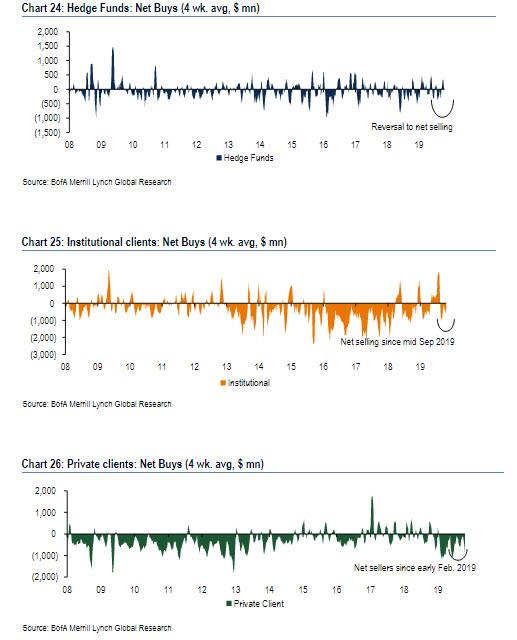
Commenting on its client flows during the past week in which the S&P 500 closed up 0.9%, Bank of America clients were net buyers of US equities after a week of net selling. Both single stocks and ETFs saw inflows, marking the ninth straight week of ETF inflows.

Looking at the breakdown of client activity that crossed its trading desk, BofA writes that hedge funds were net sellers after buying for six weeks, while in a mirror image of activity, institutional clients bought for the first time after selling for six weeks. Meanwhile, retail clients remained net sellers for the sixth consecutive week.

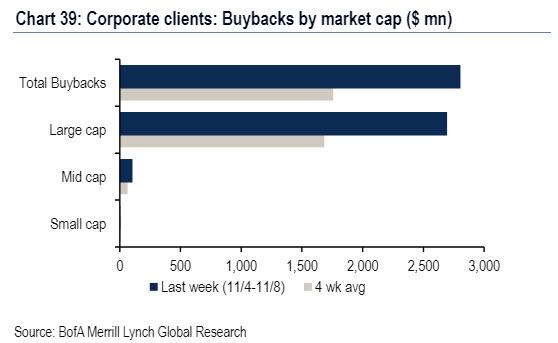
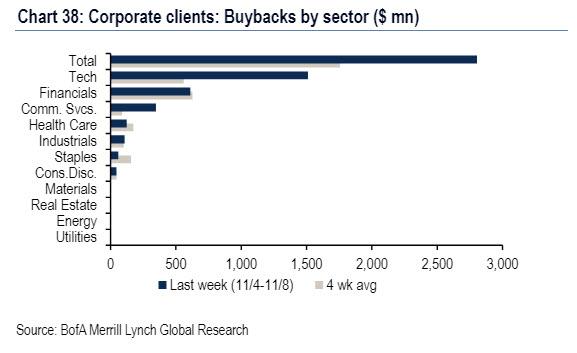
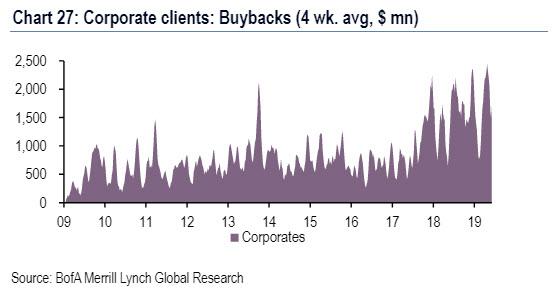
But what may come as a big surprise to those that still believe buybacks are mostly barred during earnings season is BofA’s disclosure that corporate buybacks surged last week (last major week of reporting season) to their sixth-highest weekly level in BofA history. YTD, buybacks are +26% from the comparable period last year.

The bulk of buybacks in the past week was focused on large cap companies, with nearly $3 billion in large cap buybacks executed by BofA’s desk.

As for the industry that once again led the surge in buybacks, no surprise there: as has been the case for much of 2019, it was almost all tech, which engaged in the fourth-largest ever weekly stock repurchase on record, with a few banks thrown in for good measure.

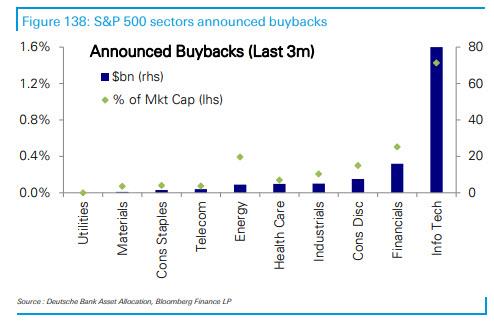
Last week’s repurchase activity is merely a continuation of the buybacks announced over the past three months, which were also led by infotech and financial companies.

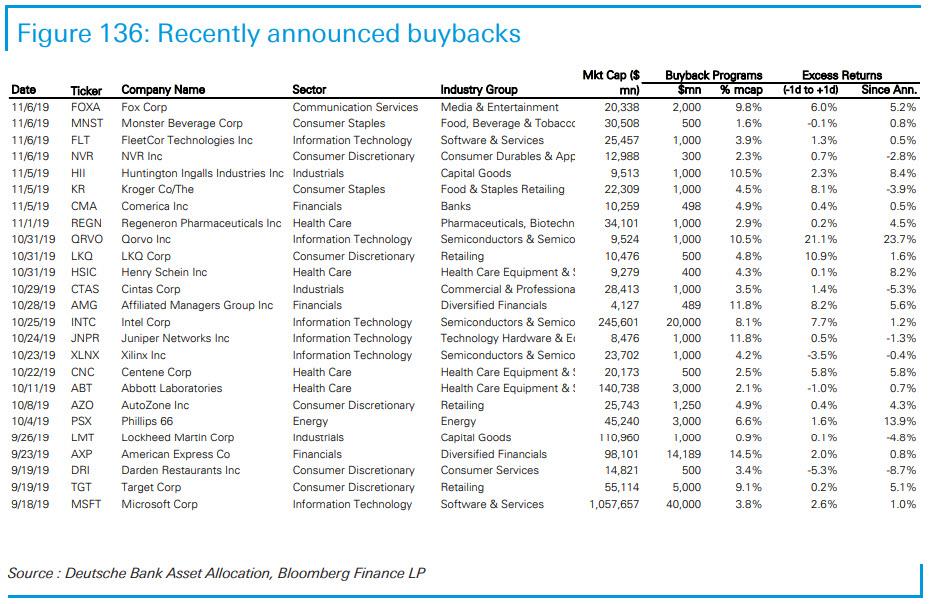
Yet as executed buybacks soared, buybacks announcements (which can take place at any time in the near future) dipped, although there was still a plethora of companies announcing they will buy back their shares.

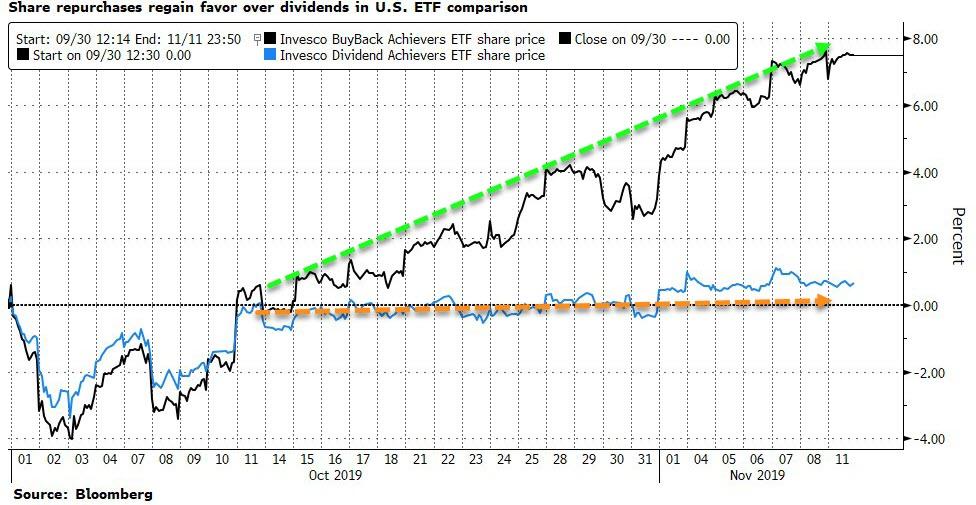
More importantly, while it is now clear that companies deploy buybacks even more aggressively during “blackout” period, the recent surge in stock repurchases probably explains why buyback-linked ETFs have been trouncing dividend ETFs.

In fact the surge in stock repurchases may explain not just the impressive outperformance of buyback-linked ETFs, but why the market has continued to levitate despite the latest bout of violent momentum/value reversal, which any other time would have been sufficient to know the S&P500 several percent lower, but not this time.


Tyler Durden

Tue, 11/12/2019 – 18:05

via ZeroHedge News https://ift.tt/2KfULdn Tyler Durden

Don’t Forget the One-Fifth Clause

This column at Politico (by Republican political consultant Juleanna Glover) argues:

By most everyone’s judgment, the Senate will not vote to remove President Donald Trump from office if the House impeaches him. But what if senators could vote on impeachment by secret ballot? If they didn’t have to face backlash from constituents or the media or the president himself, who knows how many Republican senators would vote to remove?

A secret impeachment ballot might sound crazy, but it’s actually quite possible. In fact, it would take only three senators [Republicans who would cross over to form a majority with the Democrats] to allow for that possibility.

But I don’t think that’s right; article I, section 5 of the Constitution provides (emphasis added),

Each House shall be the Judge of the Elections, Returns and Qualifications of its own Members, and a Majority of each shall constitute a Quorum to do Business; but a smaller Number may adjourn from day to day, and may be authorized to compel the Attendance of absent Members, in such Manner, and under such Penalties as each House may provide.

Each House may determine the Rules of its Proceedings, punish its Members for disorderly Behaviour, and, with the Concurrence of two thirds, expel a Member.

Each House shall keep a Journal of its Proceedings, and from time to time publish the same, excepting such Parts as may in their Judgment require Secrecy; and the Yeas and Nays of the Members of either House on any question shall, at the Desire of one fifth of those Present, be entered on the Journal….

That seems to provide a clear rule governing the matter: If 1/5 of the Senators oppose a secret ballot, the yea and nay votes “shall … be” made public. You’d need 81 senators for secrecy, not 51. Whatever one might say as a policy matter about the advantages and disadvantages of secret ballots, the Constitution’s text has taken a very specific stand on this subject. (Prof. Josh Chafetz (Cornell) has argued the same, and I’m sure others have as well.)

The column has an UPDATE, reading,

Some constitutional scholars have pointed out that Article 1, Section 5, of the Constitution designates that 20 senators can oppose a secret ballot on “any questions,” but “questions” are defined as “Any matter on which the Senate is to vote, such as passage of a bill, adoption of an amendment, agreement to a motion, or an appeal.” No mention of impeachment proceedings is made. And, as others have pointed out, preceding this one-fifth requirement is crucial language: “Each House shall keep a Journal of its Proceedings, and from time to time publish the same, excepting such Parts as may in their Judgment require Secrecy.” Precedents are so thin here, but it is clear the Senate has the power to make its own rules over the trial proceedings. Those rules have historically required a simple majority of support.

That, though, seems wrong to me. First, the Constitution doesn’t limit “any questions” to bills, amendments, motions, or appeals (which would mean appeals from procedural rulings). That quote comes from the Senate’s web site, which doesn’t seem particularly authoritative on this score—and in any event, gives bills, amendments, and the like as such examples (“such as”) of “questions.” Whether to remove a President from office strikes me as well within the term “any question,” and for that matter within the Senate site’s phrase “Any matter on which the Senate is to vote.”

Second, that “excepting such Parts as may in their Judgment require Secrecy” precedes the one-fifth requirement simply makes clear that (1) secrecy is sometimes allowed, but (2) can be overcome by a one-fifth vote, not by a half-plus-1 vote or any other mechanism.

Third, while article I, section 5 does leave each house with the power to “determine the Rules of its Proceedings,” that general power is limited by the specific constraints in the same section:

Each House may determine the Rules of its Proceedings, punish its Members for disorderly Behaviour, and, with the Concurrence of two thirds, expel a Member.

Each House shall keep a Journal of its Proceedings, and from time to time publish the same, excepting such Parts as may in their Judgment require Secrecy; and the Yeas and Nays of the Members of either House on any question shall, at the Desire of one fifth of those Present, be entered on the Journal….

I take it that we wouldn’t think that the Senate could expel a Senator by a 51-49 vote, simply by creating a “Rule[] of its Proceedings” that authorizes that; the “Concurrence of two thirds” needed to “expel a Member” is an express limitation on the Senate’s powers, including its powers to make rules for expulsion. Likewise, the One-Fifth Clause is an express limitation on the Senate’s powers, including its powers to make rules for operating in secret.

from Latest – Reason.com https://ift.tt/2QcFoGD
via IFTTT
In Search Of A Traitor

In Search Of A Traitor

Submitted by Chris Andrew at Clarmond

With the calm of the Hudson river to my left and the last of the changing Fall colours to my right, I am making my way through the small towns of Hastings on Hudson, Irvington and Dobbs Ferry. My final destination is the Lyndhurst Mansion at Tarrytown. This gothic revival mansion has a limestone exterior, a 100 meter long greenhouse and a bowling alley by the river.

Lyndhurst  Mansion

Lyndhurst was the home of Jay Gould, an icon of the Gilded Age described as the “Mephistopheles of Wall Street – an unstoppable force.” His self-made fortune came from railroads and the telegraph, the leading technologies of the day. His skill set was leverage, capital structuring, bribery and market manipulation. The value of Jay Gould’s fortune, in modern money, would be around $120b, however, his plaintive comment was that he was going to leave his children “everything but a good name”. In that golden age massive technology-driven wealth co-existed alongside great inequality; this has much resonance for us today.  

Perhaps it was what followed Jay Gould’s death in 1892 that is of greater interest. The next decades were a back and forth between ‘populists, plungers, and progressives.’ Populist champions wanted easy money for rural Americans; plungers were Wall Street investors who wanted the markets to be left alone; and progressives wanted an end to businessmen and politicians carving up the system.

All these three set of beliefs have modern day adherents in the US political parties that are currently battling for pole position. On offer are ideas on cheap credit, deregulation and an end to corrupt elites. What is clear from the past is that anyone advocating a return to the status quo are the losers. It is new untested ideas that are demanded and maybe, given the pace to technological change, that makes sense. First up was a junior Senator from Illinois, but he turned out to be a status quo leader; currently, it is a loud septuagenarian real estate showman…

Candidates advocating radical change are going to be placed in power, or, at the very least, their ideas are. In the past progressive democratic policies were ultimately accepted, but it took a war and a couple of ‘boom-busts’ for this to happen.

The leader of the Progressives, FDR, was labeled “a Traitor to his Class” – he also owned a mansion further up the Hudson at Hyde Park.

FDR’s Hyde Park home

It seems like the country is in search of another similar traitor. If I mistakenly turn on the news all I hear is a never-ending ‘impeachment loop’ which ignores the fact that there is an election in 365 days and also that the country needs someone to win rather than someone to lose.

Next time I hope to visit the Old Traitor’s mansion at Hyde Park by which time we shall have choice between a populist and a progressive, unless a plunger jumps into the race.


Tyler Durden

Tue, 11/12/2019 – 17:45

via ZeroHedge News https://ift.tt/2X7zeJe Tyler Durden

Hillary Clinton’s ‘Russian Asset’ Comment About Tulsi Gabbard Was Dumb, Not Defamatory

Rep. Tulsi Gabbard (D–Hawaii) has made quite the impression as she attempts to secure the Democratic presidential nomination. Her efforts were unwittingly elevated by former Secretary of State Hillary Clinton, who recently appeared to liken Gabbard to a “Russian asset.” The congresswoman is now threatening Clinton with a defamation lawsuit over that statement.

“Your statement is defamatory, and we demand that you retract it immediately,” Gabbard’s attorney said in a letter to Clinton, urging that the 2016 Democratic candidate post the retraction to Twitter and disseminate it to CNN, Fox News, MSNBC, The New York Times, The Wall Street Journal, and The Washington Post.

“In making the statement, you knew it was false. Congresswoman Gabbard is not a Russian asset and is not being groomed by Russia,” the letter said. “Besides your statement, no law enforcement or intelligence agencies have claimed, much less presented any evidence, that Congresswoman Gabbard is a Russian asset. This fabricated story is so facially improbable that it is actionable as defamation.”

While Clinton’s allegations were certainly odd, they are nowhere near the threshold for illegal slander, making this nothing more than political grandstanding. That’s particularly apparent in that, while Clinton did speculate that a third-party run was imminent for Gabbard, it would come at the behest of Republicansnot the Russians. And while Clinton did drop a name, it wasn’t Gabbard’s.

“They are going to do third party again,” said Clinton in a conversation about GOP strategy in the 2020 election with David Louffe, a former campaign manager for Barack Obama. “I’m not making any predictions, but I think they’ve got their eye on someone who is currently in the Democratic primary and are grooming her to be the third-party candidate. She’s a favorite of the Russians and they have a bunch of sites and bots and other ways of supporting her so far. That’s assuming Jill Stein will give it up, which she might not because she’s also a Russian asset.”

When a CNN reporter sought to confirm that Clinton was referring to Gabbard, Clinton spokesperson Nick Merrill responded, “if the nesting doll fits.” But Merrill also clarified that Clinton said it is the GOP that is “grooming her.” That makes far more sense in the larger context of the conversation between Clinton and Louffe. It also lines up with a certain public perception of Gabbard, who has been maligned by the left for her regular appearances on right-leaning Fox News programs.

In any case, how could such comments by Clinton possibly amount to defamation, which requires someone to circulate a “false statement of fact” with malice or negligence for the sake of harming another’s reputation? In my view, Clinton’s comments amount to nothing more than silly, unfounded speculation. Clinton never directly claimed that Gabbard is a pro-Russian traitor.

It’s understandable why Gabbard would take issue with Clinton’s comments, which were presented without concrete evidence. But ill-founded criticism is not the same thing as illegal speech.

Regrettably, Gabbard’s understanding of how the First Amendment works seems equally shaky across the board. In July, for example, she sued Google for violating her First Amendment rights after it suspended her advertising account for a few hours following June’s initial Democratic debate. The company alleges that her wave of support temporarily triggered an anti-fraud freeze; she accuses the company of bias and of trampling her free speech rights. Perhaps she has good reason to be upset, but the First Amendment protects her against government censorship, not from the business decisions made by private companies.

In this case, if Gabbard had her way, all sorts of overheated political rhetoric could become subject to costly defamation suits. I fundamentally oppose Clinton’s unsupported political finger-pointing, including her blurb about Gabbard. But the irony surrounding Gabbard’s counterclaim is difficult to ignore: It sounds less compatible with American society, and perhaps more suited to that of Russia.

from Latest – Reason.com https://ift.tt/2Oa9xDG
via IFTTT

Hillary Clinton’s ‘Russian Asset’ Comment About Tulsi Gabbard Was Dumb, Not Defamatory

Rep. Tulsi Gabbard (D–Hawaii) has made quite the impression as she attempts to secure the Democratic presidential nomination. Her efforts were unwittingly elevated by former Secretary of State Hillary Clinton, who recently appeared to liken Gabbard to a “Russian asset.” The congresswoman is now threatening Clinton with a defamation lawsuit over that statement.

“Your statement is defamatory, and we demand that you retract it immediately,” Gabbard’s attorney said in a letter to Clinton, urging that the 2016 Democratic candidate post the retraction to Twitter and disseminate it to CNN, Fox News, MSNBC, The New York Times, The Wall Street Journal, and The Washington Post.

“In making the statement, you knew it was false. Congresswoman Gabbard is not a Russian asset and is not being groomed by Russia,” the letter said. “Besides your statement, no law enforcement or intelligence agencies have claimed, much less presented any evidence, that Congresswoman Gabbard is a Russian asset. This fabricated story is so facially improbable that it is actionable as defamation.”

While Clinton’s allegations were certainly odd, they are nowhere near the threshold for illegal slander, making this nothing more than political grandstanding. That’s particularly apparent in that, while Clinton did speculate that a third-party run was imminent for Gabbard, it would come at the behest of Republicansnot the Russians. And while Clinton did drop a name, it wasn’t Gabbard’s.

“They are going to do third party again,” said Clinton in a conversation about GOP strategy in the 2020 election with David Louffe, a former campaign manager for Barack Obama. “I’m not making any predictions, but I think they’ve got their eye on someone who is currently in the Democratic primary and are grooming her to be the third-party candidate. She’s a favorite of the Russians and they have a bunch of sites and bots and other ways of supporting her so far. That’s assuming Jill Stein will give it up, which she might not because she’s also a Russian asset.”

When a CNN reporter sought to confirm that Clinton was referring to Gabbard, Clinton spokesperson Nick Merrill responded, “if the nesting doll fits.” But Merrill also clarified that Clinton said it is the GOP that is “grooming her.” That makes far more sense in the larger context of the conversation between Clinton and Louffe. It also lines up with a certain public perception of Gabbard, who has been maligned by the left for her regular appearances on right-leaning Fox News programs.

In any case, how could such comments by Clinton possibly amount to defamation, which requires someone to circulate a “false statement of fact” with malice or negligence for the sake of harming another’s reputation? In my view, Clinton’s comments amount to nothing more than silly, unfounded speculation. Clinton never directly claimed that Gabbard is a pro-Russian traitor.

It’s understandable why Gabbard would take issue with Clinton’s comments, which were presented without concrete evidence. But ill-founded criticism is not the same thing as illegal speech.

Regrettably, Gabbard’s understanding of how the First Amendment works seems equally shaky across the board. In July, for example, she sued Google for violating her First Amendment rights after it suspended her advertising account for a few hours following June’s initial Democratic debate. The company alleges that her wave of support temporarily triggered an anti-fraud freeze; she accuses the company of bias and of trampling her free speech rights. Perhaps she has good reason to be upset, but the First Amendment protects her against government censorship, not from the business decisions made by private companies.

In this case, if Gabbard had her way, all sorts of overheated political rhetoric could become subject to costly defamation suits. I fundamentally oppose Clinton’s unsupported political finger-pointing, including her blurb about Gabbard. But the irony surrounding Gabbard’s counterclaim is difficult to ignore: It sounds less compatible with American society, and perhaps more suited to that of Russia.

from Latest – Reason.com https://ift.tt/2Oa9xDG
via IFTTT

Bolton Trashes Trump During Private Speech; Says Real-Estate Tactics Hurting Foreign Policy

Bolton Trashes Trump During Private Speech; Says Real-Estate Tactics Hurting Foreign Policy

Former national security adviser and noted war hawk John Bolton told a private gathering of Morgan Stanley’s largest hedge fund clients that President Trump’s approach is not in alignment with any of his key advisers, according to NBC News, citing six attendees.

Bolton, who is currently working on a book, suggested that Trump’s “win-or-lose” negotiation style that works in real estate is bad for foreign policy, and that the president doesn’t understand the interconnected nature of geopolitical relationships.

Where Bolton does agree with Trump is their mutual stance against China on trade, according to the report, however the two have had far more disagreements over Iran, North Korea, Syria and Ukraine.

Bolton told the gathering of Morgan Stanley’s largest hedge fund clients that he was most frustrated with Trump over his handling of Turkey, people who were present said. Noting the broad bipartisan support in Congress to sanction Turkey after President Recep Tayyip Erdogan purchased a Russian missile defense system, Bolton said Trump’s resistance to the move was unreasonable, four people present for his speech said. –NBC News

Trump notably sent Erdogan a letter in October warning him against “slaughtering thousands of people” after US forces pulled out of Northern Syria, and told the Turkish leader “Don’t be a tough guy! Don’t be a fool!” In response, Erdogan said that when the time comes “we will take the necessary steps” to respond to Trump’s insulting note.

During an Oct. 6 phone call with Erdogan, Trump agreed to pull back U.S. troops from northeast Syria so Turkish forces could launch an attack against America’s Kurdish allies in the area. The presence of U.S. forces had deterred Erdogan from invading Syria, which he had threatened to do for years. Trump’s decision, followed by an order for all U.S. troops to exit Syria, was widely criticized even among the president’s Republican allies and was seen by many as a gift to the Turkish leader. –NBC News

Bolton also says he thinks there is a personal or business relationship underlying his position on Turkey because none of his key advisers are in agreement, according to the attendees.

NBC News notes that the Trump organization has lent Trump’s name to a property in Istanbul. In 2012, Erdogan attended its grand opening with Ivanka Trump.

When asked what he thinks will happen in January 2021 if Trump is re-elected, Bolton reportedly took a swipe at Ivanka and her husband, Jared Kushner, along with Senator Rand Paul (R-KY).

Bolton said Trump could go full isolationist — with the faction of the Republican Party that aligns with Paul’s foreign policy views taking over the GOP — and could withdraw the U.S. from NATO and other international alliances, three people present for his remarks said.

He also suggested that Kushner and Ivanka Trump could convince the president to rewrite his legacy and nominate a liberal like Lawrence Tribe — a Harvard Law professor who has questioned Trump’s fitness for office and was a legal adviser to Barack Obama’s 2008 campaign — to the Supreme Court, the people present for Bolton’s speech said.

Bolton said, with an eye roll that suggested he doesn’t take them seriously, that Kushner and Ivanka Trump could do so in an attempt to prove they had real influence and were in the White House representing the people they want to be in social circles with at home in New York City, the people present for his remarks said. –NBC News

Bolton promised the hedge fund investors that we can learn more in his upcoming book, after having reached a deal with Simon & Schuster.


Tyler Durden

Tue, 11/12/2019 – 17:25

Tags

via ZeroHedge News https://ift.tt/2O2RqQ6 Tyler Durden

This Groundbreaking FDA-Approved Study Will Use Marijuana Produced by a U.S. Company

CTPharma, a Connecticut company that supplies cannabis products to dispensaries under that state’s medical marijuana program, recently announced that it is collaborating with researchers at Yale University on a federally approved study of CBD and THC as treatments for pain and stress. This appears to be the first time that the Food and Drug Administration (FDA) has signed off on a medical study involving U.S.-grown cannabis from a source other than the National Institute on Drug Abuse (NIDA), heretofore the only legal supplier of marijuana for research in this country.

Researchers have long complained about the quality and variety of Uncle Sam’s cannabis, which is grown at the University of Mississippi under an exclusive contract with NIDA. They have also noted that NIDA marijuana cannot be used for commercial purposes, which means it cannot be used in Phase III clinical trials, the last step before FDA approval of a new medicine. The drug that subjects take at that stage has to be the same as the drug that will be sold to patients once the medication is approved.

The Drug Enforcement Administration (DEA), which for years refused to license additional suppliers of marijuana, changed its mind in 2016, the last year of the Obama administration, when it announced that it would start accepting applications from would-be growers. But under the Trump administration, the DEA has dragged its feet in fulfilling that promise. As of August, Mike Riggs noted, the DEA had received 33 applications, but so far it has not granted any licenses.

CTPharma is not licensed by the DEA to produce marijuana. In fact, its entire operation, like those of every other state-licensed marijuana supplier, remains illegal under the federal Controlled Substances Act. It is therefore rather surprising that Yale researchers were allowed to use its products—specifically, tablets containing plant-derived CBD and THC—in an FDA-approved Phase I clinical trial. “All the formulations are in tablet,” says CTPharma COO Rino Farrarese. “The FDA wanted very specific formulations.”

The study will be conducted at the Yale Stress Center, which is part of the university’s medical school. Farrarese says the DEA would not let a pharmacist at Yale dispense the tablets but withdrew its objections after the researchers proposed a different plan: The subjects will pick up their tablets at Affinity Health & Wellness, a dispensary in New Haven, and bring them to Yale for the study.

The first stage of the study involves recreational cannabis consumers who will be randomly assigned to receive either placebos or various doses of CBD, sometimes in combination with THC, over a six-week period. The second stage involves people with chronic pain. The researchers will record subjective drug effects, stress and pain ratings, heart rate, blood pressure, and blood levels of CBD, THC, and their metabolites.

Depending on what they find, the researchers may decide to include subjects with other conditions, such as post-traumatic stress disorder. “With increasing levels of use of medical marijuana products in the U.S. today,” lead researcher Rajita Sinha, a Yale professor of psychiatry and neurobiology, said in a press release, “it is imperative that we understand the science of how these products are working to alleviate patient symptoms.”

Farrarese noted that “an English company has the only FDA-approved plant-based medical marijuana product in our market”: Epidiolex, an oral CBD solution made by GW Pharmaceuticals from cannabis the company grows in the U.K. Last year the FDA approved Epidiolex as a treatment for two rare forms of epilepsy. CTPharma hopes to follow in the British company’s footsteps, although the process may take three to seven years.

Meanwhile, CTPharma seems to have accomplished a first of its own. Farrarese says he is not aware of any other FDA-approved study using marijuana produced in the United States that does not come from NIDA. “I’m pretty sure it’s the first one,” he says.

from Latest – Reason.com https://ift.tt/2QcwmJz
via IFTTT

This Groundbreaking FDA-Approved Study Will Use Marijuana Produced by a U.S. Company

CTPharma, a Connecticut company that supplies cannabis products to dispensaries under that state’s medical marijuana program, recently announced that it is collaborating with researchers at Yale University on a federally approved study of CBD and THC as treatments for pain and stress. This appears to be the first time that the Food and Drug Administration (FDA) has signed off on a medical study involving U.S.-grown cannabis from a source other than the National Institute on Drug Abuse (NIDA), heretofore the only legal supplier of marijuana for research in this country.

Researchers have long complained about the quality and variety of Uncle Sam’s cannabis, which is grown at the University of Mississippi under an exclusive contract with NIDA. They have also noted that NIDA marijuana cannot be used for commercial purposes, which means it cannot be used in Phase III clinical trials, the last step before FDA approval of a new medicine. The drug that subjects take at that stage has to be the same as the drug that will be sold to patients once the medication is approved.

The Drug Enforcement Administration (DEA), which for years refused to license additional suppliers of marijuana, changed its mind in 2016, the last year of the Obama administration, when it announced that it would start accepting applications from would-be growers. But under the Trump administration, the DEA has dragged its feet in fulfilling that promise. As of August, Mike Riggs noted, the DEA had received 33 applications, but so far it has not granted any licenses.

CTPharma is not licensed by the DEA to produce marijuana. In fact, its entire operation, like those of every other state-licensed marijuana supplier, remains illegal under the federal Controlled Substances Act. It is therefore rather surprising that Yale researchers were allowed to use its products—specifically, tablets containing plant-derived CBD and THC—in an FDA-approved Phase I clinical trial. “All the formulations are in tablet,” says CTPharma COO Rino Farrarese. “The FDA wanted very specific formulations.”

The study will be conducted at the Yale Stress Center, which is part of the university’s medical school. Farrarese says the DEA would not let a pharmacist at Yale dispense the tablets but withdrew its objections after the researchers proposed a different plan: The subjects will pick up their tablets at Affinity Health & Wellness, a dispensary in New Haven, and bring them to Yale for the study.

The first stage of the study involves recreational cannabis consumers who will be randomly assigned to receive either placebos or various doses of CBD, sometimes in combination with THC, over a six-week period. The second stage involves people with chronic pain. The researchers will record subjective drug effects, stress and pain ratings, heart rate, blood pressure, and blood levels of CBD, THC, and their metabolites.

Depending on what they find, the researchers may decide to include subjects with other conditions, such as post-traumatic stress disorder. “With increasing levels of use of medical marijuana products in the U.S. today,” lead researcher Rajita Sinha, a Yale professor of psychiatry and neurobiology, said in a press release, “it is imperative that we understand the science of how these products are working to alleviate patient symptoms.”

Farrarese noted that “an English company has the only FDA-approved plant-based medical marijuana product in our market”: Epidiolex, an oral CBD solution made by GW Pharmaceuticals from cannabis the company grows in the U.K. Last year the FDA approved Epidiolex as a treatment for two rare forms of epilepsy. CTPharma hopes to follow in the British company’s footsteps, although the process may take three to seven years.

Meanwhile, CTPharma seems to have accomplished a first of its own. Farrarese says he is not aware of any other FDA-approved study using marijuana produced in the United States that does not come from NIDA. “I’m pretty sure it’s the first one,” he says.

from Latest – Reason.com https://ift.tt/2QcwmJz
via IFTTT

Wisconsin’s Dairy Crisis: “We’re Losing Two Farms A Day!”

Wisconsin’s Dairy Crisis: “We’re Losing Two Farms A Day!”

Authored by Mac Slavo via SHTFplan.com,

Wisconsin’s dairy crisis has only just begun as the state is losing two farms each day, according to Patty Edelburg, vice president of the National Farmers Union. 

As farm bankruptcies soar, it is possible that nearly 10% of Wisconsin dairy farmers may go out of business in 2019.

“You look at the weather, you look at the crops you can’t get off the field, you look at the bills you can’t pay,” Edelburg, told Yahoo Finance. 

“Bankruptcies are up. Wisconsin is attributed as the number one bankruptcy in the nation right now when it comes to dairy farmers. That number is up, I think, 24% from last year already. We’re losing two farms a day.”  

Between 2016 and 2018, Wisconsin lost almost 1,200 dairy farms. The USDA saw a 6.8% decrease in farms across the entire country in 2018.

Wisconsin’s suicide rates have spiked over the last few years and according to the Wisconsin State Journal, experts are attributing many of those deaths to farmers facing economic challenges.

“Farming is such a stressful occupation by itself,” Edelburg said.

“When you start adding financial stress on top of it, it’s just going to add more stress. Farmers can’t pay their bills, they have no extra money, they have people honing down their neck looking to pay bills. They’re going to banks and they can’t get loans. They’re literally being denied loans.”

She explained that the USDA farm agency trains its farm loan officers on how to look for warning signs as part of suicide prevention.

“The bankers are the first and the forefront to see a lot of these things,” Edelburg said.

“They’re delivering the bad news, and these farmers are dealing with it on that level.”

It isn’t just farmers who are committing suicide either.  The political structure in place, which is designed to steal from the producer and redistribute wealth to the government is widening the wealth gap, creating more poverty, and generally destroying the mental well being of so many Americans.


Tyler Durden

Tue, 11/12/2019 – 17:05

via ZeroHedge News https://ift.tt/36YrYnA Tyler Durden