Federal Court Rules Trump Cannot Use “Emergency” Declaration to Divert Funds to Build his Border Wall

Earlier today, federal district judge Judge David Briones issued a decision holding that it is illegal for President Trump to use his declaration of a “national emergency” to divert funds to build his border wall. This is the first judicial ruling directly addressing the issue of whether it is legal to use the emergency declaration for that purpose. Previous wall decisions dealt with the administration’s attempts to divert other funds to build the wall, from sources that did not depend on the use of the emergency declaration. Judge Briones’ ruling comes in a case filed by El Paso County and the Border Network for Human Rights.

In February, the president issued a declaration announcing that the situation at the border qualifies as a “national emergency.” That, in turn, allowed him to make use of a wide range of powers triggered by an emergency declaration. Among them was authority to use 10 U.S.C. Section 2808, which states that, during a “national emergency” that “requires the use of the armed forces,” the president can reallocate defense funds to “undertake military construction projects … that are necessary to support such use of the armed forces.” The administration contends that Section 2808 gives it the authority to transfer some $3.6 billion in defense funds towards the border wall. The decision also addresses efforts to  rely on 10 USC Section 284, which allows the use of Department of Defense “counternarcotics” funds to provide support for “counterdrug activities” by other agencies.

Judge Briones’ ruling concludes that such a diversion is illegal. He reaches that conclusion for two reasons. First, it violates the Consolidated Appropriations Act of 2019, which ended the government shutdown caused by Trump’s fight with Congress over border-wall funding:

To resolve this case, the Court turns to one of the three golden rules of statutory
construction “established from time immemorial” that “a more specific statute will be given precedence over a more general one.” Nevada v. Dep ‘t of Energy, 400 F.3d 9, 16 (D.C. Cir. 2005) (quoting 1 Comp. Dec. 126, 127 (1894) and Busic v. United States, 446 U.S. 398, 406(1980)). This rule “appli[es] to appropriations bills.” See id. Thus, “[a]n appropriation for a specific purpose is exclusive of other appropriations in general terms which might be applicable in the absence of the specific appropriation.” Id…..

[T]he CAA specifically appropriates $1.3 75 billion for border-wall expenditures and requires those expenditures to be made on “construction. . . in the Rio Grande Valley Sector” alone. CAA § § 230, 231. Defendants’ funding plan, by contrast, will transfer $6.1 billion of funds appropriated for other more general purposes f military construction, under § 2808, and counterdrug activities, under § 284. Their plan therefore flouts the cardinal principle that a specific statute controls a general one and violates the CAA….

The court also ruled that the funding diversion violates Section 739 of the CAA, which mandates that “None of the funds made available in this or any other appropriations Act may be used to increase. . . funding for a program, project, or activity as proposed in the President’s budget request for a fiscal year until such proposed change is subsequently enacted in an appropriation Act, or unless such change is made pursuant to the
reprogramming or transfer provisions of this or any other appropriations Act”:

§ 739 creates a general rule and an exception. The general rule is that “[n]one of
the funds made available” in an “appropriations Act” (including the CAA) “may be used to increase funding for a program, project, or activity” that was “proposed in the President’s budget request for a fiscal year.” CAA § 739. The exception is that appropriations may be used to increase such funding if that use is authorized by “the reprogramming or transfer provisions” of an “appropriations Act.” § 739 prohibits Defendants’ plan to fund the border wall because the plan is barred by that provision’s general rule and the plan does not fall within its exception.

Defendants’ plan is barred by § 73 9’s general rule, because it (1) seeks to use funds “made available in” an “appropriations Act”; (2) “to increase funding for a program, project, or activity”; (3) that was “proposed in the President’s budget request for a fiscal year.” First, Defendants’ plan seeks to use funds “made available in” an “appropriations Act.” CAA § 739. It taps appropriated military construction funds under § 2808 and counterdrug support funds under § 284. As the White House has acknowledged, all funds have been “appropriated by Congress…..”

Second, Defendants’ plan also seeks to use these appropriations to “increase
funding for a program, project, or activity.” CAA § 739. Construction of a wall along the southern border is a singular “project” under that word’s ordinary meaning. See Merriam Webster’s Dictionary 932 (11th ed. 2003) (defining “project” as “a specific plan or design”) Indeed, the Executive Branch has consistently referred to the wall in this manner….

Defendants’ funding plan is not saved by § 739’s exception: the funding increases it proposes are not “change[s] . . . made pursuant to the reprogramming or transfer provisions of this or any other appropriations Act.” Under federal law, an “appropriations Act” is an Act whose title begins: “An Act making appropriations.” 2 U.S.C. § 622(5); 1 U.S.C. § 105. Neither § 2808 nor § 284 begins with this language. § 2808 is a provision of the Military Construction Codification Act, Pub. L. No. 97-124, 96 Stat. 153 (1982), which says nothing about appropriations in its title, nor makes any appropriations in its body. And § 284 is a provision of the National Defense Authorization Act, Pub. L. No. 114-328, 130 Stat. 2000, 2381, 2497 (2016), which by title and substance is not an “appropriations Act.” Cf Pub. L. No. 115- 31, 131 Stat. 135, 229 (2017) (separate statute appropriating DOD funds). The Proclamation violates § 739 of the CAA.

I  am not sure what to think about the court’s “specific trumps general” argument. It raises some difficult statutory interpretation questions that I will leave to those with greater relevant expertise. But the Section 739 point strikes me as compelling, for exactly the reasons explained by Judge Briones.

Resolving the national emergency question in this way allows the court to avoid virtually all of the big picture issues surrounding the emergency declaration, such as whether the situation at the border qualifies as “national emergency” under the National Emergencies Act of 1976, whether the relevant provision of the National Emergencies Act (if interpreted in the broad way the administration advocates) is unconstitutional, and even whether the text of Section 2808 actually allows the use of funds for border wall construction (in my view, the answer is an emphatic “no”). It also does not consider whether the president has the authority to use eminent domain to seize property for border wall construction not specifically authorized by Congress.

The narrowness of the ruling might prove attractive to appellate judges (including perhaps some Supreme Court justices) who want to find a relatively simple way to dispose of the national emergency issue, without having to set any broad precedent. But the broader questions could, nonetheless,  come back into play when the administration appeals the decision.

The ruling is also notable for the fact that it comes in a case where the plaintiffs have clear “economic” interests at stake. El Paso County controls land in the area where the wall would be built. Some previous rulings in border wall cases have been decided on procedural grounds, because the plaintiffs in question lacked sufficient strong interests to qualify for standing. In a recent Ninth Circuit decision holding that Trump lacked authority to divert other military funds for border wall construction, a dissenting judge argued that the plaintiffs were not legally entitled to bring the suit, because their lack of an “economic” interest placed them outside of the “zone of interests” protected by the relevant federal statutes. The Supreme Court eventually stayed the Ninth Circuit decision, possibly based on such procedural concerns.

In the El Paso case, the plaintiffs’ economic interests are undeniable. It is hard to have a clearer economic interest than having the government build a wall through your land, or through property near it. In addition, some $20 million of the money diverted would come from a military construction project in the County, in which the local government has an obvious economic interest, as well. Thus, it will be hard for the administration to get this case dismissed on procedural grounds. Courts will likely have to continue to address it on the merits.

Given the virtual inevitability of an appeal, this case is far from over. And there are many other wall-building cases still making their way through the system.

It is also worth noting that Judge Briones is a Democratic appointee. So far, all of the Democratic-appointed judges who have issued decisions in wall cases have ruled for the plaintiffs, while all but one Republican appointee (Judge Clifton of the Ninth Circuit) have voted against them. It is, possible, therefore, that the wall litigation will continue to split judges largely along partisan lines. On the other hand, all the Republican judges who have voted against the plaintiffs, so far, have done so on procedural grounds. Judge Clifton is the only one who has reached the merits, and he voted for the plaintiffs. At least some other GOP-appointed judges might take similar positions when and if they get the chance to rule on the merits, as well.

Today’s ruling is a notable victory for opponents of the wall. But the outcome of both this case and that of the broader legal struggle over the wall remain uncertain. Stay tuned!


from Latest – Reason.com https://ift.tt/35sgzeT
via IFTTT
The legal-historical amnesia of using tax exemptions to punish political beliefs

In a televised Democratic presidential forum on LGBT issues last night in Los Angeles, CNN’s Don Lemmon asked Beto O’Rourke, “Do you think religious institutions like colleges, churches, charities – should they lose their tax-exempt status if they oppose same-sex marriage?”

“Yes,” O’Rourke responded. “There can be no reward, no benefit, no tax break for anyone, or any institution, any organization in America that denies the full human rights and the full civil rights of every single one of us.”

Eugene explained well in this 2016 post why the IRS cannot deny tax exemptions solely on the basis of viewpoint, even if you conceive of a tax exemption as a form of subsidy (a “reward”) that the government does not have not to give anyone at all, and even if you think the group propounds a hateful or deeply immoral message. The IRS

can’t deny exemptions to groups that engage in “hate speech” against blacks, gays, evangelical Christians or Donald Trump supporters, while allowing exemptions to groups that praise blacks, gays, evangelical Christians or Donald Trump supporters. Indeed, the Supreme Court has made this clear: The government may not discriminate against groups based on the viewpoint of their speech. See Rosenberger v. Rector (1994) (discussing Regan v. Taxation With Representation (1983)). As the D.C. Circuit put it in Z Street v. Koskinen (2015) (itself a 501(c)(3) tax exemption case), “in administering the tax code, the IRS may not discriminate on the basis of viewpoint.”

Walter Olson expands on why O’Rourke’s answer was so objectionable, calling it “illiberal, anti-pluralist, and inflammatory.” Scott Shackford piles on, noting the political damage that could be done: “If you care about LGBT rights, you should be glad O’Rourke doesn’t have a shot: The backlash against him as a nominee would be massive.”

All of these points are well taken. Perhaps most striking to me about the exchange between Lemmon and O’Rourke was not that a candidate would tell an audience what it thought they wanted to hear, but that the audience was so wildly enthusiastic about it.  The reaction was explicable on one level because organized religion has been an extraordinary source of pain to LGBT people. (And of course, it has also been a source of extraordinary comfort to many LGBT people. It giveth and taketh away.)

But on another level, it’s an act of forgetfulness. As William Eskridge has written, “the modern regulatory state cut its teeth on gay people.” First Amendment rights, especially the cardinal directive that government may not discriminate on the basis of viewpoint, has served both individual LGBT people and the organized LGBT-rights movement very well.  When the government, including the administrative state and courts, failed to live up to those principles, the whole movement was imperiled.

One of the innumerable ways in which the state attempted to discourage gay-rights advocacy in its infancy was through the device of denying corporate charters, school recognition, and all other manner of what O’Rourke might call a “reward, benefit, or tax break . . for anyone, or any institution, or any organization” that violated right and good state-sanctioned principles.

Among these devices was specifically the selective denial of charitable tax exemptions for gay organizations in the 1970s. As Eskridge summarized some of the cases in a 1997 Yale Law Journal article:

Educational and charitable organizations are entitled to exemption from federal income tax, and their contributors are entitled to tax deductions. The IRS had granted tax-exempt status to organizations not having “gay” in their names, most prominently the University Fellowship of Metropolitan Community Churches, and had been willing to give “gay” groups exemptions if they stipulated that they did not “promote” homosexuality or if they accepted homosexuality as a “diseased pathology.” Accordingly, the IRS denied tax exempt status to the Gay Community Services Center of Los Angeles in January 1973. In an important turnabout and after a series of meetings with gay representatives, the IRS reversed itself in August of that year, giving exempt status for the first time to an organization with “gay” in its name. Lambda Legal Defense got surprisingly quick approval the next year.

In other words, the IRS made speech restriction (no “gay”) or even compelled speech (accepting homosexuality as a mental illness) a condition of receiving a tax benefit.

The IRS also initially denied exempt status to the Pride Foundation, a progay educational and legal organization.

The IRS found that the Pride Foundation’s “efforts ‘toward the elimination of unjustified and improper discrimination or treatment, or toward violations of the privacy of adult individuals, are insignificant when compared to the possible detriment to society,”‘ specifically, “‘advancing the unqualified and unrestricted promotion of the alleged normalcy of homosexuality”‘ which the IRS feared would have the effect “‘in the general prevalence of what is still generally regarded as deviant sexual behavior.”‘ As legal authority for its position, the agency cited the Supreme Court’s disapproval of “perverted” sexuality in its obscenity opinions and state sodomy laws against homosexual conduct.

Here the federal government doled out exempt status purely on the basis of the viewpoint of the gay-advocacy group: it could not “promote” the idea that homosexuality was normal. Doing so might have socially harmful (and indeed illegal) behavioral consequences. Eskridge recounts how gay-rights attorneys were able to turn the IRS around:

Once such a justification was out in the open, gaylegal representatives were able to ply the IRS with arguments and information undermining its premises. Lawyers for the Fund for Human Dignity in New York worked with the IRS for two years and persuaded the agency to grant exempt status to gay educational groups, without any disclaimer, in a September 1977 ruling.

O’Rourke’s rationale for denying exempt status to churches and other groups that oppose same-sex marriage is identical in form to the rationale for denying exempt status to the Pride Foundation in the 1970s. A federal benefit (exempt status) can be denied selectively on the basis of a viewpoint (“promoting” homosexuality then, opposing same-sex marriage now) in the interest of avoiding social harm (“sexual deviancy” then, denial of “full human and civil rights” now).

There’s a lot of forgotten or unrecognized history in the LGBT-rights movement.  The movement has been trying rather self-consciously to unearth that history. It’s also worth recalling that the government, with its long and ready list of good causes, has not always been a friend.

from Latest – Reason.com https://ift.tt/2MwrknO
via IFTTT

Federal Court Rules Trump Cannot Use “Emergency” Declaration to Divert Funds to Build his Border Wall

Earlier today, federal district judge Judge David Briones issued a decision holding that it is illegal for President Trump to use his declaration of a “national emergency” to divert funds to build his border wall. This is the first judicial ruling directly addressing the issue of whether it is legal to use the emergency declaration for that purpose. Previous wall decisions dealt with the administration’s attempts to divert other funds to build the wall, from sources that did not depend on the use of the emergency declaration. Judge Briones’ ruling comes in a case filed by El Paso County and the Border Network for Human Rights.

In February, the president issued a declaration announcing that the situation at the border qualifies as a “national emergency.” That, in turn, allowed him to make use of a wide range of powers triggered by an emergency declaration. Among them was authority to use 10 U.S.C. Section 2808, which states that, during a “national emergency” that “requires the use of the armed forces,” the president can reallocate defense funds to “undertake military construction projects … that are necessary to support such use of the armed forces.” The administration contends that Section 2808 gives it the authority to transfer some $3.6 billion in defense funds towards the border wall. The decision also addresses efforts to  rely on 10 USC Section 284, which allows the use of Department of Defense “counternarcotics” funds to provide support for “counterdrug activities” by other agencies.

Judge Briones’ ruling concludes that such a diversion is illegal. He reaches that conclusion for two reasons. First, it violates the Consolidated Appropriations Act of 2019, which ended the government shutdown caused by Trump’s fight with Congress over border-wall funding:

To resolve this case, the Court turns to one of the three golden rules of statutory
construction “established from time immemorial” that “a more specific statute will be given precedence over a more general one.” Nevada v. Dep ‘t of Energy, 400 F.3d 9, 16 (D.C. Cir. 2005) (quoting 1 Comp. Dec. 126, 127 (1894) and Busic v. United States, 446 U.S. 398, 406(1980)). This rule “appli[es] to appropriations bills.” See id. Thus, “[a]n appropriation for a specific purpose is exclusive of other appropriations in general terms which might be applicable in the absence of the specific appropriation.” Id…..

[T]he CAA specifically appropriates $1.3 75 billion for border-wall expenditures and requires those expenditures to be made on “construction. . . in the Rio Grande Valley Sector” alone. CAA § § 230, 231. Defendants’ funding plan, by contrast, will transfer $6.1 billion of funds appropriated for other more general purposes f military construction, under § 2808, and counterdrug activities, under § 284. Their plan therefore flouts the cardinal principle that a specific statute controls a general one and violates the CAA….

The court also ruled that the funding diversion violates Section 739 of the CAA, which mandates that “None of the funds made available in this or any other appropriations Act may be used to increase. . . funding for a program, project, or activity as proposed in the President’s budget request for a fiscal year until such proposed change is subsequently enacted in an appropriation Act, or unless such change is made pursuant to the
reprogramming or transfer provisions of this or any other appropriations Act”:

§ 739 creates a general rule and an exception. The general rule is that “[n]one of
the funds made available” in an “appropriations Act” (including the CAA) “may be used to increase funding for a program, project, or activity” that was “proposed in the President’s budget request for a fiscal year.” CAA § 739. The exception is that appropriations may be used to increase such funding if that use is authorized by “the reprogramming or transfer provisions” of an “appropriations Act.” § 739 prohibits Defendants’ plan to fund the border wall because the plan is barred by that provision’s general rule and the plan does not fall within its exception.

Defendants’ plan is barred by § 73 9’s general rule, because it (1) seeks to use funds “made available in” an “appropriations Act”; (2) “to increase funding for a program, project, or activity”; (3) that was “proposed in the President’s budget request for a fiscal year.” First, Defendants’ plan seeks to use funds “made available in” an “appropriations Act.” CAA § 739. It taps appropriated military construction funds under § 2808 and counterdrug support funds under § 284. As the White House has acknowledged, all funds have been “appropriated by Congress…..”

Second, Defendants’ plan also seeks to use these appropriations to “increase
funding for a program, project, or activity.” CAA § 739. Construction of a wall along the southern border is a singular “project” under that word’s ordinary meaning. See Merriam Webster’s Dictionary 932 (11th ed. 2003) (defining “project” as “a specific plan or design”) Indeed, the Executive Branch has consistently referred to the wall in this manner….

Defendants’ funding plan is not saved by § 739’s exception: the funding increases it proposes are not “change[s] . . . made pursuant to the reprogramming or transfer provisions of this or any other appropriations Act.” Under federal law, an “appropriations Act” is an Act whose title begins: “An Act making appropriations.” 2 U.S.C. § 622(5); 1 U.S.C. § 105. Neither § 2808 nor § 284 begins with this language. § 2808 is a provision of the Military Construction Codification Act, Pub. L. No. 97-124, 96 Stat. 153 (1982), which says nothing about appropriations in its title, nor makes any appropriations in its body. And § 284 is a provision of the National Defense Authorization Act, Pub. L. No. 114-328, 130 Stat. 2000, 2381, 2497 (2016), which by title and substance is not an “appropriations Act.” Cf Pub. L. No. 115- 31, 131 Stat. 135, 229 (2017) (separate statute appropriating DOD funds). The Proclamation violates § 739 of the CAA.

I  am not sure what to think about the court’s “specific trumps general” argument. It raises some difficult statutory interpretation questions that I will leave to those with greater relevant expertise. But the Section 739 point strikes me as compelling, for exactly the reasons explained by Judge Briones.

Resolving the national emergency question in this way allows the court to avoid virtually all of the big picture issues surrounding the emergency declaration, such as whether the situation at the border qualifies as “national emergency” under the National Emergencies Act of 1976, whether the relevant provision of the National Emergencies Act (if interpreted in the broad way the administration advocates) is unconstitutional, and even whether the text of Section 2808 actually allows the use of funds for border wall construction (in my view, the answer is an emphatic “no”). It also does not consider whether the president has the authority to use eminent domain to seize property for border wall construction not specifically authorized by Congress.

The narrowness of the ruling might prove attractive to appellate judges (including perhaps some Supreme Court justices) who want to find a relatively simple way to dispose of the national emergency issue, without having to set any broad precedent. But the broader questions could, nonetheless,  come back into play when the administration appeals the decision.

The ruling is also notable for the fact that it comes in a case where the plaintiffs have clear “economic” interests at stake. El Paso County controls land in the area where the wall would be built. Some previous rulings in border wall cases have been decided on procedural grounds, because the plaintiffs in question lacked sufficient strong interests to qualify for standing. In a recent Ninth Circuit decision holding that Trump lacked authority to divert other military funds for border wall construction, a dissenting judge argued that the plaintiffs were not legally entitled to bring the suit, because their lack of an “economic” interest placed them outside of the “zone of interests” protected by the relevant federal statutes. The Supreme Court eventually stayed the Ninth Circuit decision, possibly based on such procedural concerns.

In the El Paso case, the plaintiffs’ economic interests are undeniable. It is hard to have a clearer economic interest than having the government build a wall through your land, or through property near it. In addition, some $20 million of the money diverted would come from a military construction project in the County, in which the local government has an obvious economic interest, as well. Thus, it will be hard for the administration to get this case dismissed on procedural grounds. Courts will likely have to continue to address it on the merits.

Given the virtual inevitability of an appeal, this case is far from over. And there are many other wall-building cases still making their way through the system.

It is also worth noting that Judge Briones is a Democratic appointee. So far, all of the Democratic-appointed judges who have issued decisions in wall cases have ruled for the plaintiffs, while all but one Republican appointee (Judge Clifton of the Ninth Circuit) have voted against them. It is, possible, therefore, that the wall litigation will continue to split judges largely along partisan lines. On the other hand, all the Republican judges who have voted against the plaintiffs, so far, have done so on procedural grounds. Judge Clifton is the only one who has reached the merits, and he voted for the plaintiffs. At least some other GOP-appointed judges might take similar positions when and if they get the chance to rule on the merits, as well.

Today’s ruling is a notable victory for opponents of the wall. But the outcome of both this case and that of the broader legal struggle over the wall remain uncertain. Stay tuned!


from Latest – Reason.com https://ift.tt/35sgzeT
via IFTTT
Housing Market Points To Recession By Election Day

Housing Market Points To Recession By Election Day

Authored by Benn Steil and Benjamin Della Rocca via The Council on Foreign Relations,

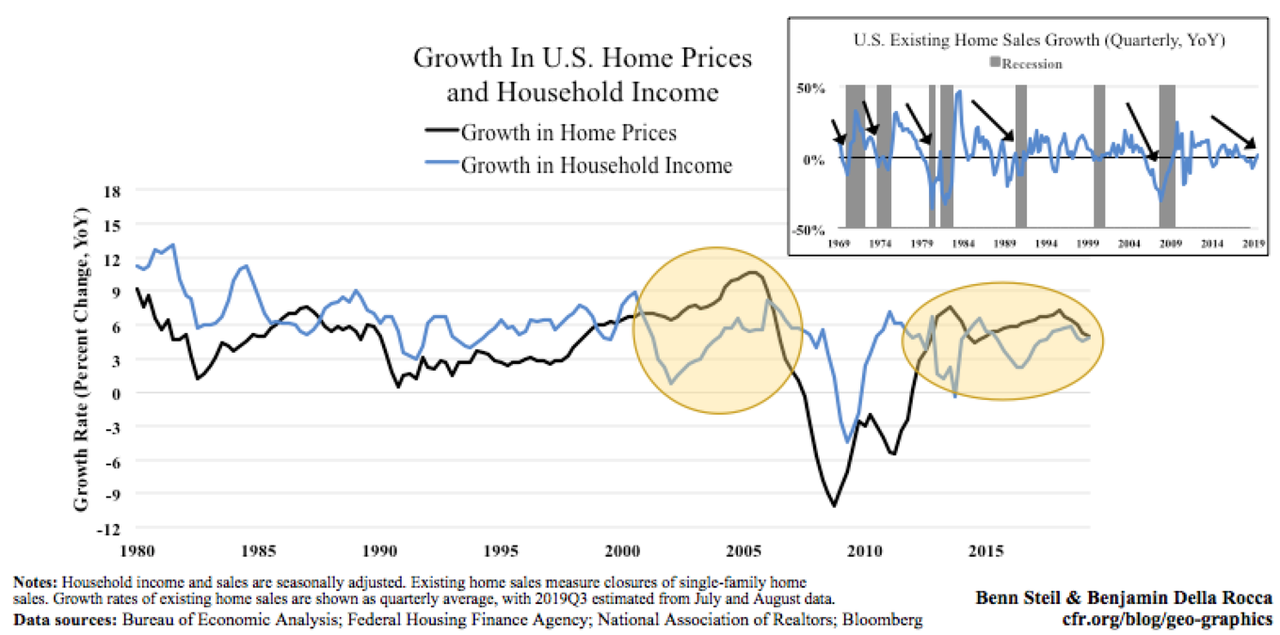
Looking back at the years preceding the 2008 financial crisis, a critical warning sign was the surging gap between the growth in home prices and household income – as can be seen in the main graphic below.

When income fails to keep pace with home prices, the latter must fall back. Falling home prices, in turn, drive down household spending by way of the so-called wealth effect—that is, consumers cut spending when their assets fall in value. As one Federal Reserve study shows, consumption falls by $2.50-5.00 for every $100 decrease in housing-market net worth.

Today, a parallel dynamic is playing out – as can readily be seen in the graphic. A similar housing-income gap began opening in 2015. In 2018, as in 2005, housing-price growth began falling rapidly, with significant price drops occurring in several major markets. As the inset figure shows, the trend-line in existing-home sales growth has also been down since 2015, tipping into negative territory at the start of last year. Similar drops have preceded nearly every recession since 1970.

If these trends continue, we should expect broad falls in home prices beginning by mid-2020, which will in turn drag down household spending against a darkening economic backdrop. Growth has been slowing, with Trump’s tariff war hitting exports. Manufacturing is contracting. Retail sales, excluding autos, have stalled. Consumer confidence is falling.

What are the best hopes for avoiding recession, then? Well, we could see a U.S.-China trade deal, which would buoy business confidence. But all signs are that this is unlikely, given Chinese insistence that structural reforms are now off the table. A so-called narrow deal, with punitive tariffs eliminated in return for greater Chinese purchases of soybeans and LNG, would amount to a total victory for Beijing, given the country’s naturally rising demand for both. So our base-case is that the trade war continues.

The Fed? Well, if we are really on the cusp of a recession it will likely take more than 175 basis points of easing to prevent it—and that is all the central bank has to play with before we’re back to the zero lower bound. At that point, applying monetary stimulus becomes considerably more challenging.

In short, then, we think Trump will be entering the election homestretch with some strong economic headwinds against him.  Most notable among them will be a declining housing market.


Tyler Durden

Fri, 10/11/2019 – 20:20

via ZeroHedge News https://ift.tt/2OFR8kf Tyler Durden

17 Former Watergate Special Prosecutors Pen Op-Ed On Why Trump Should Be Impeached

17 Former Watergate Special Prosecutors Pen Op-Ed On Why Trump Should Be Impeached

Seventeen Watergate special prosecutors have together for one purpose; to tell the American people why President Trump should be impeached. 

The authors are mostly Democrats, and include a CNN Legal Analyst, former officials in the Clinton and Carter administrations (one of whom got the Illinois Attorney General to assign a special prosecutor to investigate her veterinarian after her Dalmatian died), a DNC donor, a Dianne Feinstein donor, a Mitt Romney donor who had lots of misguided thoughts on the Mueller investigation, and others whose politics are quite clear.

Their argument? 

Trump has “demonstrated serious and persistent abuses of power that, in our view, satisfy the constitutional standard of “high crimes and misdemeanors.””

In largely unsupported broad brush strokes, they offer a polished version of several Democrat talking points – many of which are incorrect or have been debunked by a simple reading of the underlying evidence.

For example, the authors write that Trump “appears to have demanded that Ukraine investigate a potential 2020 political opponent and pursue the conspiracy theory that Ukraine had interfered in the 2016 presidential election, despite the unanimous conclusion of the U.S. intelligence community that it was Russia that had interfered.” 

Apparently they didn’t read the Trump-Zelensky transcript which makes crystal clear nothing was “demanded.” Zelensky himself has said as much multiple times, including a Thursday statement that there  was “no blackmail” which occurred during the call with Trump. Moreover, Zelensky says he had no idea the United States withheld nearly $400 million in military aid while the Trump administration investigated Ukrainian corruption. The authors, all 17 of them, fail to mention this. 

They then repeat the notion that a well-documented effort by a Clinton/DNC operative to harm the Trump campaign with the assistance of a Ukrainian official and US journalist Michael Isikoff, which was deemed illegal by a Ukrainian court, is a “conspiracy theory.” 

And in a serious case of misdirection, the authors imply that only one country can meddle in an election at the same time. 

The authors then point to ‘evidence laid out in the Mueller report’ that Trump engaged in multiple acts of obstruction of justice – and committed further obstruction by ‘systematically withholding evidence and directing government agencies and employees to refuse to cooperate‘ with what the authors deem “legitimate oversight by Congress” (led by Rep. Adam Schiff, whose office worked with a CIA officer ‘whistleblower’ that worked with Joe Biden and flipped out when they learned that Trump wanted Biden investigated for corruption). 

Oh, and the whistleblower was assisted by a former staffer to Obama’s Director of National Intelligence, James Clapper. 

Read their arguments below: 

● Trump conditioned protection of the military security of the United States and of an ally (Ukraine) on actions for his personal political benefit.

● Trump subordinated the integrity of our national electoral process to his own personal political interest by soliciting and encouraging foreign government interference in our electoral process, including by Russia and China. He also appears to have demanded that Ukraine investigate a potential 2020 political opponent and pursue the conspiracy theory that Ukraine had interfered in the 2016 presidential election, despite the unanimous conclusion of the U.S. intelligence community that it was Russia that had interfered.

● According to the evidence laid out in the Mueller report, Trump engaged in multiple acts of obstruction of justice in violation of federal criminal statutes and of his oath of office to “take care that the laws be faithfully executed.” Because Mueller viewed Justice Department policy as precluding him from filing criminal charges against the president, the special counsel appropriately stated that these abuses are for Congress to address.

● Trump obstructed lawful congressional investigations by systematically withholding evidence and by directing government agencies and employees to refuse to cooperate with legitimate oversight by Congress. Most significantly, the president’s blanket refusal to honor requests for relevant information sought by House members conducting an impeachment inquiry constitutes impeachable contempt and obstruction. The public is entitled to know the facts, and Congress is the body our democracy has entrusted with uncovering them. –Washington Post

Perhaps they can opine on why Nancy Pelosi hasn’t called a formal impeachment inquiry vote, if the evidence is so overwhelming.


Tyler Durden

Fri, 10/11/2019 – 20:00

via ZeroHedge News https://ift.tt/2IHdZbl Tyler Durden

Trump Needs To Fix America’s Dependency On Foreign Uranium

Trump Needs To Fix America’s Dependency On Foreign Uranium

Authored by Thomas Del Beccaro via The Epoch Times,

One of the biggest scandals of the Obama administration is seriously endangering U.S. national security. The federal government’s approval of the sale of the Uranium One mining company to the Russian state-owned nuclear company leaves our country vulnerable to the Russians. Only President Donald Trump can restore our national security, and the time to do that is now.

Not surprisingly, the Uranium One scandal received little attention in the mainstream media. That was likely due to the involvement of then-Secretary of State Hillary Clinton who would soon become the Democratic nominee for president.

Some in the media have scoffed at the notion of Clinton’s role. The fact remains, however, that the Uranium One sale was subject to approval by a cabinet-level Committee on Foreign Investment in the United States (CFIUS). Neither Clinton nor then-Vice President Joe Biden did anything at the time to stop the transaction of U.S. uranium mines critical to America’s national and energy security to the Russians. Worse yet, after the sale, the Clinton Foundation received a sizable donation from a former Uranium One chairman.

Now, Trump has an opportunity to undo another bad Biden–Clinton deal. While Trump passed on his Commerce Department’s recommendation to implement a “Buy America” quota for U.S. uranium, he did direct an administration working group to report by Oct. 15 with recommendations to revitalize this industry critical to U.S. national and energy security.

Trump’s uranium working group needs to take bold and urgent actions. Here’s why.

The once-vibrant U.S. uranium mining sector is nearly extinct thanks to cheap foreign uranium supplies that have flooded the U.S. market. Whereas the United States once produced all the uranium needed for our civil and defense needs, it is now nearly totally dependent on imports of foreign uranium, which account for 98 percent of the uranium used in U.S. nuclear reactors.

Russia, Kazakhstan, and Uzbekistan account together for a combined 40 percent of all uranium imported into the United States. Yes, Russia—the country Democrats claim to fear so very much over election tampering.

The now Russian-owned Uranium One isn’t selling uranium from its U.S. mines, but instead stopped production in the United States and is now selling uranium from its Russian and Kazakhstan mines to U.S. nuclear utilities.

Moreover, The Wall Street Journal reported in 2018 that the Department of Homeland Security and other intelligence agencies disclosed that Russian entities have tried to hack into the U.S. electric grid and into the control rooms of the U.S. utilities, the same customers buying Russia’s uranium.

The U.S. Defense Department is required to use U.S.-origin uranium for its nuclear submarines, aircraft carriers, and other defense purposes. But with so little U.S. uranium being mined today, the Pentagon is now drawing from its dwindling uranium stockpiles.

From the beginning, Trump has been an outspoken critic of the Uranium One deal and its threat to our national security. He also has a much clearer understanding of the threat posed to the U.S. nuclear power sector if it remains dependent on imports to cover 98 percent of the uranium used in its plants.

According to news reports, Trump’s uranium working group is considering several executive actions that will result in long-term uranium purchase contracts with U.S. mining companies at price levels that will sustain U.S. production and thus our national security. But I would urge Trump to also reconsider the “Buy America” quota for U.S. uranium that was recommended by his Commerce Department.

Because of Trump’s policy of “energy dominance,” the U.S. people can be confident that his administration will take the bold and urgent action that is necessary to not only reduce the United States’ dependence on foreign uranium imports but also help put miners in the U.S. uranium industry back to work.

Former Trump economic advisor Stephen Moore and the Committee to Unleash Prosperity recently released a report called “Solving America’s Uranium Crisis.” The report correctly states that “mining domestic uranium is vital to U.S. national and economic security.”

Trump has demonstrated that these are two issues he takes seriously by establishing the new U.S. policy of “energy dominance” and by rebuilding the United States’ military. He surely understands that the United States cannot have energy dominance or strategic supplies of uranium for defense purposes if it is at the mercy of Russian and other foreign imports of uranium, as is the case today.

Under Trump’s policies, the United States is safer and more secure than ever. But there is more to do. With the stroke of his pen, Trump can strengthen the United States’ energy and national security, put U.S. mines back to work, and send a powerful signal to Russia and other foreign actors that the days of cozy deals like the Biden–Clinton Uranium One transaction are over.


Tyler Durden

Fri, 10/11/2019 – 19:40

via ZeroHedge News https://ift.tt/329TyeP Tyler Durden

“Never Seen This Before” – Protester Spits In Face Of Trump Supporter During VICE Interview

“Never Seen This Before” – Protester Spits In Face Of Trump Supporter During VICE Interview

I interview a lot of the President’s supporters at rallies & have never seen this before. (My reaction gives that away quickly),”  exclaimed VICE’s Elizabeth Landers after the following disgusting incident happened.

Minnesota nice turned into Minnesota nasty quickly Thursday during a VICE News interview outside of President Trump’s rally in Minneapolis, Minnesota.

As Dave Carlson, a salesman in Minnesota, calmly shared why he donates to President Trump’s campaign, a protestor spat in the MAGA-hat-wearing Trump supporter’s face and kept walking by.

“Oh, nice,” Carlson commented, while keeping his cool and wiping off his face, saying, “I’m fine, I’m fine.”

While, two other protestors apologized to Carlson, another decided to ‘help’ by explaining that Carlson deserved it, because of his hat, saying “that shit is disrespectful.”

Maxine Waters would be proud.


Tyler Durden

Fri, 10/11/2019 – 19:20

Tags

via ZeroHedge News https://ift.tt/2phKu8R Tyler Durden

The legal-historical amnesia of using tax exemptions to punish political beliefs

In a televised Democratic presidential forum on LGBT issues last night in Los Angeles, CNN’s Don Lemmon asked Beto O’Rourke, “Do you think religious institutions like colleges, churches, charities – should they lose their tax-exempt status if they oppose same-sex marriage?”

“Yes,” O’Rourke responded. “There can be no reward, no benefit, no tax break for anyone, or any institution, any organization in America that denies the full human rights and the full civil rights of every single one of us.”

Eugene explained well in this 2016 post why the IRS cannot deny tax exemptions solely on the basis of viewpoint, even if you conceive of a tax exemption as a form of subsidy (a “reward”) that the government does not have not to give anyone at all, and even if you think the group propounds a hateful or deeply immoral message. The IRS

can’t deny exemptions to groups that engage in “hate speech” against blacks, gays, evangelical Christians or Donald Trump supporters, while allowing exemptions to groups that praise blacks, gays, evangelical Christians or Donald Trump supporters. Indeed, the Supreme Court has made this clear: The government may not discriminate against groups based on the viewpoint of their speech. See Rosenberger v. Rector (1994) (discussing Regan v. Taxation With Representation (1983)). As the D.C. Circuit put it in Z Street v. Koskinen (2015) (itself a 501(c)(3) tax exemption case), “in administering the tax code, the IRS may not discriminate on the basis of viewpoint.”

Walter Olson expands on why O’Rourke’s answer was so objectionable, calling it “illiberal, anti-pluralist, and inflammatory.” Scott Shackford piles on, noting the political damage that could be done: “If you care about LGBT rights, you should be glad O’Rourke doesn’t have a shot: The backlash against him as a nominee would be massive.”

All of these points are well taken. Perhaps most striking to me about the exchange between Lemmon and O’Rourke was not that a candidate would tell an audience what it thought they wanted to hear, but that the audience was so wildly enthusiastic about it.  The reaction was explicable on one level because organized religion has been an extraordinary source of pain to LGBT people. (And of course, it has also been a source of extraordinary comfort to many LGBT people. It giveth and taketh away.)

But on another level, it’s an act of forgetfulness. As William Eskridge has written, “the modern regulatory state cut its teeth on gay people.” First Amendment rights, especially the cardinal directive that government may not discriminate on the basis of viewpoint, has served both individual LGBT people and the organized LGBT-rights movement very well.  When the government, including the administrative state and courts, failed to live up to those principles, the whole movement was imperiled.

One of the innumerable ways in which the state attempted to discourage gay-rights advocacy in its infancy was through the device of denying corporate charters, school recognition, and all other manner of what O’Rourke might call a “reward, benefit, or tax break . . for anyone, or any institution, or any organization” that violated right and good state-sanctioned principles.

Among these devices was specifically the selective denial of charitable tax exemptions for gay organizations in the 1970s. As Eskridge summarized some of the cases in a 1997 Yale Law Journal article:

Educational and charitable organizations are entitled to exemption from federal income tax, and their contributors are entitled to tax deductions. The IRS had granted tax-exempt status to organizations not having “gay” in their names, most prominently the University Fellowship of Metropolitan Community Churches, and had been willing to give “gay” groups exemptions if they stipulated that they did not “promote” homosexuality or if they accepted homosexuality as a “diseased pathology.” Accordingly, the IRS denied tax exempt status to the Gay Community Services Center of Los Angeles in January 1973. In an important turnabout and after a series of meetings with gay representatives, the IRS reversed itself in August of that year, giving exempt status for the first time to an organization with “gay” in its name. Lambda Legal Defense got surprisingly quick approval the next year.

In other words, the IRS made speech restriction (no “gay”) or even compelled speech (accepting homosexuality as a mental illness) a condition of receiving a tax benefit.

The IRS also initially denied exempt status to the Pride Foundation, a progay educational and legal organization.

The IRS found that the Pride Foundation’s “efforts ‘toward the elimination of unjustified and improper discrimination or treatment, or toward violations of the privacy of adult individuals, are insignificant when compared to the possible detriment to society,”‘ specifically, “‘advancing the unqualified and unrestricted promotion of the alleged normalcy of homosexuality”‘ which the IRS feared would have the effect “‘in the general prevalence of what is still generally regarded as deviant sexual behavior.”‘ As legal authority for its position, the agency cited the Supreme Court’s disapproval of “perverted” sexuality in its obscenity opinions and state sodomy laws against homosexual conduct.

Here the federal government doled out exempt status purely on the basis of the viewpoint of the gay-advocacy group: it could not “promote” the idea that homosexuality was normal. Doing so might have socially harmful (and indeed illegal) behavioral consequences. Eskridge recounts how gay-rights attorneys were able to turn the IRS around:

Once such a justification was out in the open, gaylegal representatives were able to ply the IRS with arguments and information undermining its premises. Lawyers for the Fund for Human Dignity in New York worked with the IRS for two years and persuaded the agency to grant exempt status to gay educational groups, without any disclaimer, in a September 1977 ruling.

O’Rourke’s rationale for denying exempt status to churches and other groups that oppose same-sex marriage is identical in form to the rationale for denying exempt status to the Pride Foundation in the 1970s. A federal benefit (exempt status) can be denied selectively on the basis of a viewpoint (“promoting” homosexuality then, opposing same-sex marriage now) in the interest of avoiding social harm (“sexual deviancy” then, denial of “full human and civil rights” now).

There’s a lot of forgotten or unrecognized history in the LGBT-rights movement.  The movement has been trying rather self-consciously to unearth that history. It’s also worth recalling that the government, with its long and ready list of good causes, has not always been a friend.

from Latest – Reason.com https://ift.tt/2MwrknO
via IFTTT

Non-Seizability Of Bitcoin Very Attractive For Hong Kong: Pompliano

Non-Seizability Of Bitcoin Very Attractive For Hong Kong: Pompliano

Authored by William Suberg via CoinTelegraph.com,

Bitcoin’s use as a protector of wealth is coming to the fore in Hong Kong as trading volumes spike and businesses iron out problems with acceptance.

image courtesy of CoinTelegraph

Trading record underscores Bitcoin’s “non-seizability”

As multiple commentators including Morgan Creek Digital co-founder Anthony Pompliano noted this week, Bitcoin is a genuine solution for Hong Kong residents worried about monetary sovereignty.

“When you’re worried about your assets being seized or becoming inaccessible to you, Bitcoin’s non-seizability becomes very attractive. This aspect of Bitcoin just became important for 1+ billion people in India & Hong Kong,” he tweeted on Oct. 6. 

Pompliano was writing days after China’s 70th state anniversary protests, as big as any in the democracy movement’s 18-week history, were met with a forceful reaction from the government. 

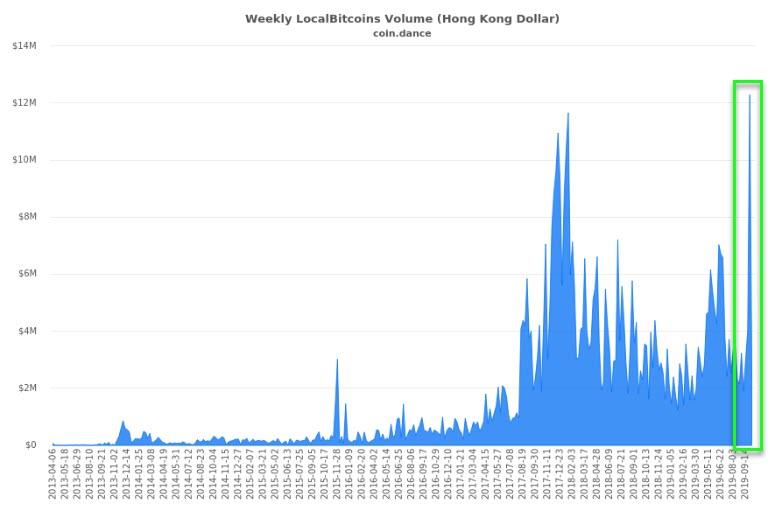
Hong Kong Localbitcoins weekly trading volume. Source: Coin Dance

In the face of a crackdown on civil liberties via emergency powers, monetary freedom also took a hit, with worried residents forming queues at ATMs. Hong Kong saw a giant spike in trading on P2P Bitcoin exchange Localbitcoins, seeing 12.3 million HKD ($1.57 million) change hands in the week ending Sept. 28.

Hong Kong Free Press Escapes ‘Clutches of BitPay’ — Switches to BTCPay

Local entities eyeing possibilities for escaping the grip of authorities had already considered Bitcoin, but it was the teething problems that hit the headlines.

As Cointelegraph reported, the Hong Kong Free Press (HKFP) had complained about payment processor BitPay failing to pass on donations to its cause. 

BitPay blamed the banking system, sparking a debate about the irony of relying on fiat via third parties in order to use Bitcoin.

As of Oct. 10, however, the HKFP had resolved the issue, founder Tom Grundy revealed — by switching to open-source alternative BTCPay.

“HKFP has escaped the clutches of BitPay and… now accepts Bitcoin again via BTCPay,” he confirmed.


Tyler Durden

Fri, 10/11/2019 – 19:00

via ZeroHedge News https://ift.tt/2oBmn55 Tyler Durden

Russia Sentences Israeli-American Traveler to 7.5 Years in Prison for 9 Grams of Pot

Today an Israeli woman caught with nine grams of marijuana (less than a third of an ounce) while catching a connecting flight in Moscow was sentenced to seven-and-a-half years in prison for drug smuggling. That’s 10 months for each gram.

Naama Issachar, a 26-year-old who is also a U.S. citizen, was arrested in April while returning to Israel after spending three months in India. A drug-sniffing dog at the Moscow airport alerted to her backpack, where security agents found her stash wrapped in plastic inside a toiletry bag.

Under Russian law, possessing less than six grams of marijuana is an administrative offense punishable by up to 15 days of detention and a 1,000-ruble fine. Acquiring six grams or more of marijuana without the intent to sell it is subject to criminal penalties, including up to three years in prison. But Issachar was charged with smuggling marijuana into Russia, which is punishable by up to 10 years in prison.

“This is a substantial and disproportionate punishment for a young Israeli with no criminal record, who arrived in Moscow with the intention of catching a connecting flight on her way home to Israel,” the Israeli Foreign Ministry said in a press release. “Unfortunately, Russian authorities have not as yet heeded our requests to conduct the case appropriately in accordance to the circumstances of her arrest.​”

Israeli Prime Minister Benjamin Netanyahu “requested a commuting of the sentence and an easing of the terms of Naama’s detention,” according to a statement from his office. “To our regret, the Russian prosecution has not yet accepted to these requests.” The office added that Issachar’s sentence “is disproportionate and does not fit the nature of the offense being attributed” to her.

The Times of Israel reports that “a senior Israeli official told Hebrew media that Russia offered several times in recent months to free Issachar if Israel agrees to release Aleksey Burkov, a Russian IT specialist who was arrested in Israel in 2016 at the request of Interpol.” Burkov “is wanted on embezzlement charges in the United States for a massive credit card scheme that saw him allegedly steal millions of dollars from American consumers.”

Issachar’s family told Channel 13 news she is being used as a “hostage” to secure Burkov’s release. “Until now we’ve been dealing with trying to prove there was not attempted drug smuggling,” they said, “but now we understand that this is a larger matter. Naama is being held as a hostage.”

from Latest – Reason.com https://ift.tt/33nkx6M
via IFTTT