When Will Ellen DeGeneres Visit Julian Assange?

When Will Ellen DeGeneres Visit Julian Assange?

Authored by Michael Krieger via Liberty Blitzkrieg blog,

A Road To Hell Paved With Bad Intentions
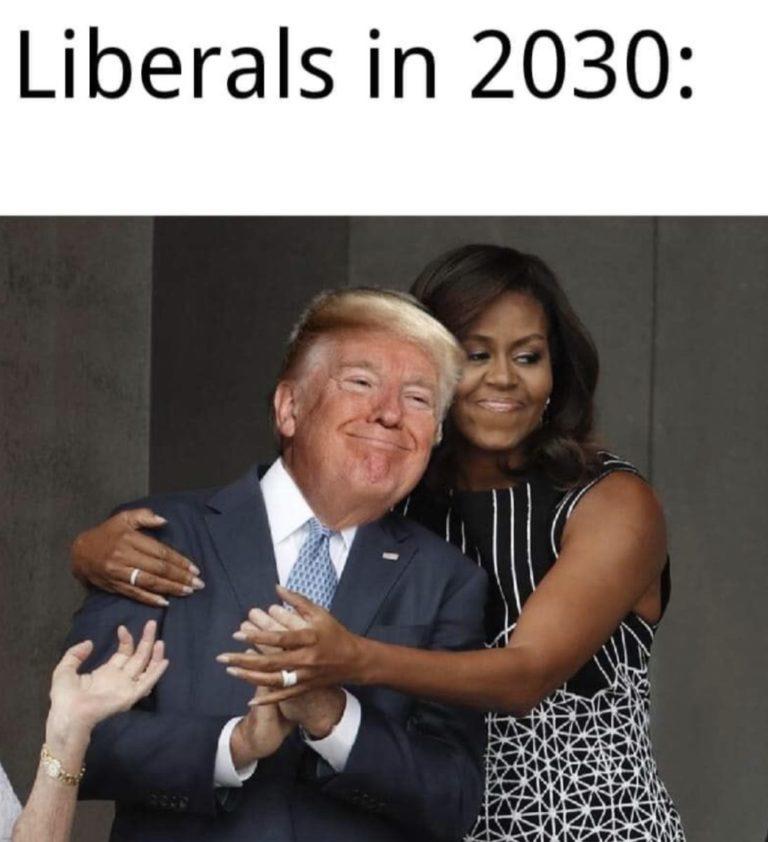
When someone shows you who they are, believe them the first time.
– Maya Angelou

If nothing else, one silver lining to Donald Trump’s election is the exposure of establishment types, whether Democratic or Republican, for what they really are. We now recognize that there’s very little daylight between a neocon and a neoliberal, and that the back and forth fighting over power between these two camps — which defined American politics for decades — was nothing more than a manipulative pro-wrestling circus.

Trump’s election has forced many establishment Democrats out of the closet as the intelligence agency, surveillance state, empire-worshipping, centralized power bootlickers they always were. Since neocons were historically more in your face shameless about their support for endless war, oligarch-coddling, and authoritarianism, establishment Democrats could pretend to represent an ethical opposition to such things. Alas, it was all an act and if the Obama administration didn’t already prove that to you, the embarrassingly clownish neoliberal “resistance” movement should.

There are endless ways for those who dislike Donald Trump to push back against him and his administration in an ethical and productive manner, but establishment Democrats always choose the most damaging and destructive route. This is no accident. The manner in which they respond to Trump is them showing you who they really are.

There are countless examples of this sort of behavior, but one of the most disturbing has been the intentional and completely maniacal rehabilitation of war criminal, torturer-in-chief and surveillance state architect George W. Bush and his catastrophic administration. Whether you feel love, hatred or indifference toward Donald Trump, there’s no comparing his administration thus far to that of the younger Bush. Bush’s policies directly killed more people all over the world and did far more to erode American civil liberties and the Constitution than Trump. There’s absolutely no reason for anyone ethically opposed to Trump to voluntarily embrace George W. Bush, yet that’s exactly what “resistance” celebrities have been doing and continue to do.

A couple of days ago, Ellen DeGeneres called George W. Bush a friend as she defended herself hanging out and watching a football game with the mass murderer.

Just a day before that, we saw this deranged and mindless tweet from Rosie O’Donnell.

Of course, how could we forget this…

Instead of propping up and advocating for some improved vision of the future, establishment Democrats have chosen quite consciously to embrace George W. Bush, intelligence agencies and war. When someone shows you who they are, believe them the first time.

These people aren’t offering you anything other than a whitewashing of the George W. Bush administration and an impeachment fantasy that ends with President Mike Pence. In other words, a road to hell paved with bad intentions.
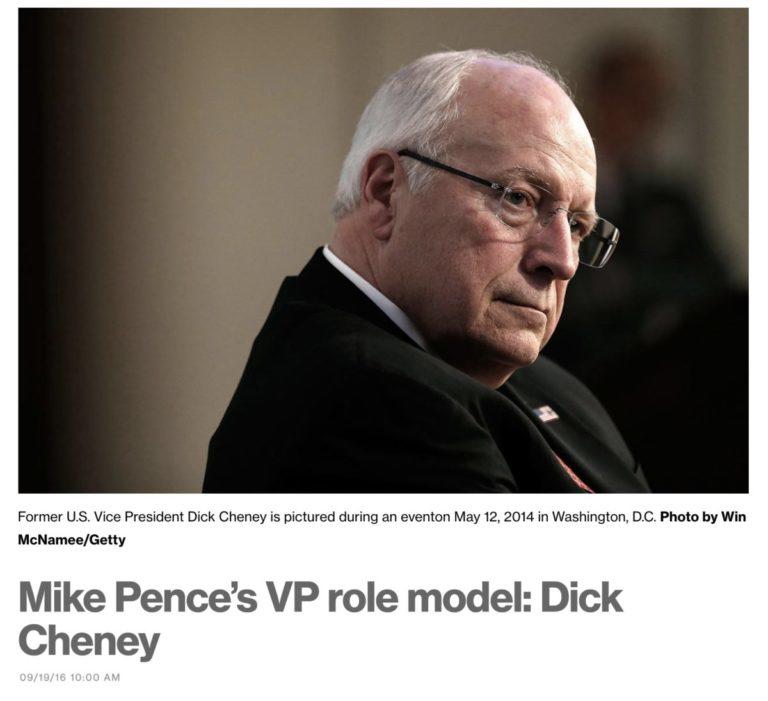
It’s as if establishment types consider it their job to ensure the American public is forced to choose between two kinds of crazy, but the good news is you don’t have to play this game. It is always in your power to rise above the circus of noise and manipulation and safeguard your humanity. If you take the period of time we’re living in seriously, you’ll be laser focused on your own consciousness in the midst of all the madness. This doesn’t mean apathy, it means focus should be on your own mindset and a dedication to not lose yourself to the encroaching insanity. When somebody offers you a choice between two evils you simply say no thank you. Becoming what you’re fighting against is the worst possible thing you can do.

Finally, I’m curious. When will Ellen DeGeneres be visiting Julian Assange in prison? I wonder how her relationship with the world’s most well-known political prisoner is going, or perhaps Ellen’s kindness is limited to ruling class war criminals. It’s much more profitable that way.

*  *  *

Liberty Blitzkrieg is now 100% ad free. To make this a successful, sustainable thing consider the following options. You can become a Patron. You can visit the Support Page to donate via PayPal, Bitcoin or send cash/check in the mail.


Tyler Durden

Wed, 10/09/2019 – 16:26

Tags

via ZeroHedge News https://ift.tt/30YwC0r Tyler Durden
Why the Failure of Vermont’s Single-Payer Plan Is the Best Argument Against Medicare for All

In today’s New York Times, I look at the failure of Vermont’s single-payer health care plan, which collapsed due to low public support and estimates projecting high costs and large tax increases.

The Vermont experiment presages many of the political and policy challenges that would arise under any attempt to pass Medicare for All, the single-payer plan proposed by Sen. Bernie Sanders (I–Vt.) and backed by Sen. Elizabeth Warren (D–Mass.). As I note at the end of the piece, the national political environment for Medicare for All would, if anything, be even less favorable than the political and economic environment for single-payer was in Vermont:

The Vermont plan was done in by high taxes, distrust of government and lack of political support. Any effort by a Sanders administration to enact a single-payer system at a national level would probably be doomed by similar problems.

Like [former Vermont Governor Peter] Shumlin, Mr. Sanders is a devout single-payer supporter who has campaigned aggressively on the idea. And like Mr. Shumlin, Mr. Sanders has so far declined to lay out a plan for fully financing his Medicare for All system.

But while some polls show majority public support for single-payer, that support declines substantially when faced with trade-offs like the elimination of most private coverage or higher taxes—two components of Mr. Sanders’s plan.

Similarly, Medicare for All supporters argue that single-payer would reduce the nation’s overall health spending. But savings are heavily predicated on the assumption that the new government-run system could pay Medicare rates, which are typically lower than those of private insurance, to providers across the board.

Legislators in Washington State started with the same assumption when they attempted to design a state-managed insurance plan, and it proved wrong. The plan passed only once rates were increased. Yet even a plan with lower rates would still represent an enormous increase in total government spending.

Backers of Medicare for All, including Sanders himself, often argue that the U.S., which spends a greater percentage of its economy on health care than other countries, should be able to finance a universal system. If other countries can do it, why not America?

One problem with this argument is that the plan Sanders has proposed is far more generous than the systems in other countries, eliminating co-pays and most out of pocket spending while covering a broader array of services than you find in other developed nations. It’s also more generous than most employer-sponsored plans, and even more generous than our current seniors-only Medicare system, a big component of which is heading for insolvency in less than eight years.

In short, passing and implementing a functional Medicare for All plan along the lines that Sanders envisions would be extremely difficult under any imaginable circumstance. And if it couldn’t work in a relatively politically hospitable environment like Vermont, it’s hard to see how it could work at a much larger scale.

from Latest – Reason.com https://ift.tt/2Ms6bLv
via IFTTT

Privacy for Rights Isn’t a Trade Americans Should Be Forced To Make

While some voters proudly display campaign yard signs or bumper stickers, many others keep their electoral choices to themselves.

Why? That’s none of your business. Nor is it the business of the federal government.

Sure, many elected officials would love to know the names of everyone who voted for their opponents. But does that justify eliminating the secret ballot? Should voters have their names, addresses, occupations, and employers published online alongside every vote they’ve ever cast? Should the right to vote be contingent on a voter’s identity being made public? 

Of course not. 

But federal law requires precisely such a tradeoff when it comes to the exercise of a related constitutional right: the First Amendment right to donate to a political campaign.  

Under current law, a person who gives more than $200 to a candidate has her name, address, occupation, employer, and the precise amount she gave made publicly available on the internet. Anyone can track her and her politics. The potential for this information to be misused to target private citizens is very real, and the chilling effect caused by the reasonable fear of such misuse is well-acknowledged by the courts. 

Candidates at the federal level raise millions of dollars from thousands of supporters. Does the fact that Jane Doe, the high school teacher who lives on 123 North Street in a heavily pro-Trump school district, gave $300 to a Democratic presidential candidate really need to be public information? Or does that information serve only to perpetuate abuse from her political opponents?

The $200 threshold hasn’t been adjusted, even for inflation, in over 40 years. It is well past time to raise it significantly. 

Recent news highlights how disclosure of campaign contributions can be abused to target private citizens. Rep. Joaquin Castro (D–Texas) tweeted the names of constituents who donated to President Trump’s campaign. Predictably, some of those people were harassed and boycotted. The actor Eric McCormack requested on Twitter that someone print a list of those attending a Trump campaign fundraiser in Beverly Hills “so the rest of us can be clear about who we don’t wanna work with.” McCormack’s actions drew comparisons to the Hollywood blacklist of alleged Communists. 

Equally alarming are calls to mandate disclosure for nonprofit organizations engaged in issue advocacy.  

In many cases, calls for nonprofit donor disclosure come from sitting lawmakers who want to know who is funding advocacy that they disagree with. In New Jersey, for example, several powerful lawmakers proposed a disclosure mandate for certain nonprofits. Why? The Senate President, a political enemy of Governor Phil Murphy, was angry with a group that supported the Governor’s budget, and that group did not voluntarily expose its supporters. So the Legislature decided to force many nonprofits to disclose. Groups across the ideological spectrum warned that the state’s retaliatory bill would chill advocacy, but it still became law. Now, the American Civil Liberties Union and Americans for Prosperity are suing. 

In San Francisco, the Board of Supervisors recently declared the National Rifle Association a “terrorist organization.” A former Republican congressman countered by suggesting that left-leaning groups are the real terrorists. In this climate, should politicians be telling supporters of such groups that they have no right to privacy?

At the federal level, sponsors of nonprofit donor disclosure bills rail against groups they oppose when touting their proposals. As Senate Minority Leader Chuck Schumer (D–N.Y.) put it years ago, “the deterrent effect” of forcing your political opponents to expose their supporters, “should not be underestimated.”

Some advocates of nonprofit disclosure believe that “transparency” in any context is an unalloyed good. To be sure, government transparency does benefit democracy. But nonprofit organizations are not the government, and nonprofit supporters should not be forced to sacrifice their privacy rights.

The United States boasts one of the most robust civil societies in the world. Don’t put that at risk in order to serve the shortsighted interests of politicians.

from Latest – Reason.com https://ift.tt/2M4hTx7
via IFTTT

Privacy for Rights Isn’t a Trade Americans Should Be Forced To Make

While some voters proudly display campaign yard signs or bumper stickers, many others keep their electoral choices to themselves.

Why? That’s none of your business. Nor is it the business of the federal government.

Sure, many elected officials would love to know the names of everyone who voted for their opponents. But does that justify eliminating the secret ballot? Should voters have their names, addresses, occupations, and employers published online alongside every vote they’ve ever cast? Should the right to vote be contingent on a voter’s identity being made public? 

Of course not. 

But federal law requires precisely such a tradeoff when it comes to the exercise of a related constitutional right: the First Amendment right to donate to a political campaign.  

Under current law, a person who gives more than $200 to a candidate has her name, address, occupation, employer, and the precise amount she gave made publicly available on the internet. Anyone can track her and her politics. The potential for this information to be misused to target private citizens is very real, and the chilling effect caused by the reasonable fear of such misuse is well-acknowledged by the courts. 

Candidates at the federal level raise millions of dollars from thousands of supporters. Does the fact that Jane Doe, the high school teacher who lives on 123 North Street in a heavily pro-Trump school district, gave $300 to a Democratic presidential candidate really need to be public information? Or does that information serve only to perpetuate abuse from her political opponents?

The $200 threshold hasn’t been adjusted, even for inflation, in over 40 years. It is well past time to raise it significantly. 

Recent news highlights how disclosure of campaign contributions can be abused to target private citizens. Rep. Joaquin Castro (D–Texas) tweeted the names of constituents who donated to President Trump’s campaign. Predictably, some of those people were harassed and boycotted. The actor Eric McCormack requested on Twitter that someone print a list of those attending a Trump campaign fundraiser in Beverly Hills “so the rest of us can be clear about who we don’t wanna work with.” McCormack’s actions drew comparisons to the Hollywood blacklist of alleged Communists. 

Equally alarming are calls to mandate disclosure for nonprofit organizations engaged in issue advocacy.  

In many cases, calls for nonprofit donor disclosure come from sitting lawmakers who want to know who is funding advocacy that they disagree with. In New Jersey, for example, several powerful lawmakers proposed a disclosure mandate for certain nonprofits. Why? The Senate President, a political enemy of Governor Phil Murphy, was angry with a group that supported the Governor’s budget, and that group did not voluntarily expose its supporters. So the Legislature decided to force many nonprofits to disclose. Groups across the ideological spectrum warned that the state’s retaliatory bill would chill advocacy, but it still became law. Now, the American Civil Liberties Union and Americans for Prosperity are suing. 

In San Francisco, the Board of Supervisors recently declared the National Rifle Association a “terrorist organization.” A former Republican congressman countered by suggesting that left-leaning groups are the real terrorists. In this climate, should politicians be telling supporters of such groups that they have no right to privacy?

At the federal level, sponsors of nonprofit donor disclosure bills rail against groups they oppose when touting their proposals. As Senate Minority Leader Chuck Schumer (D–N.Y.) put it years ago, “the deterrent effect” of forcing your political opponents to expose their supporters, “should not be underestimated.”

Some advocates of nonprofit disclosure believe that “transparency” in any context is an unalloyed good. To be sure, government transparency does benefit democracy. But nonprofit organizations are not the government, and nonprofit supporters should not be forced to sacrifice their privacy rights.

The United States boasts one of the most robust civil societies in the world. Don’t put that at risk in order to serve the shortsighted interests of politicians.

from Latest – Reason.com https://ift.tt/2M4hTx7
via IFTTT

Late-Day China Trade Headline Spoils Low-Volume Stock Market Party

Late-Day China Trade Headline Spoils Low-Volume Stock Market Party

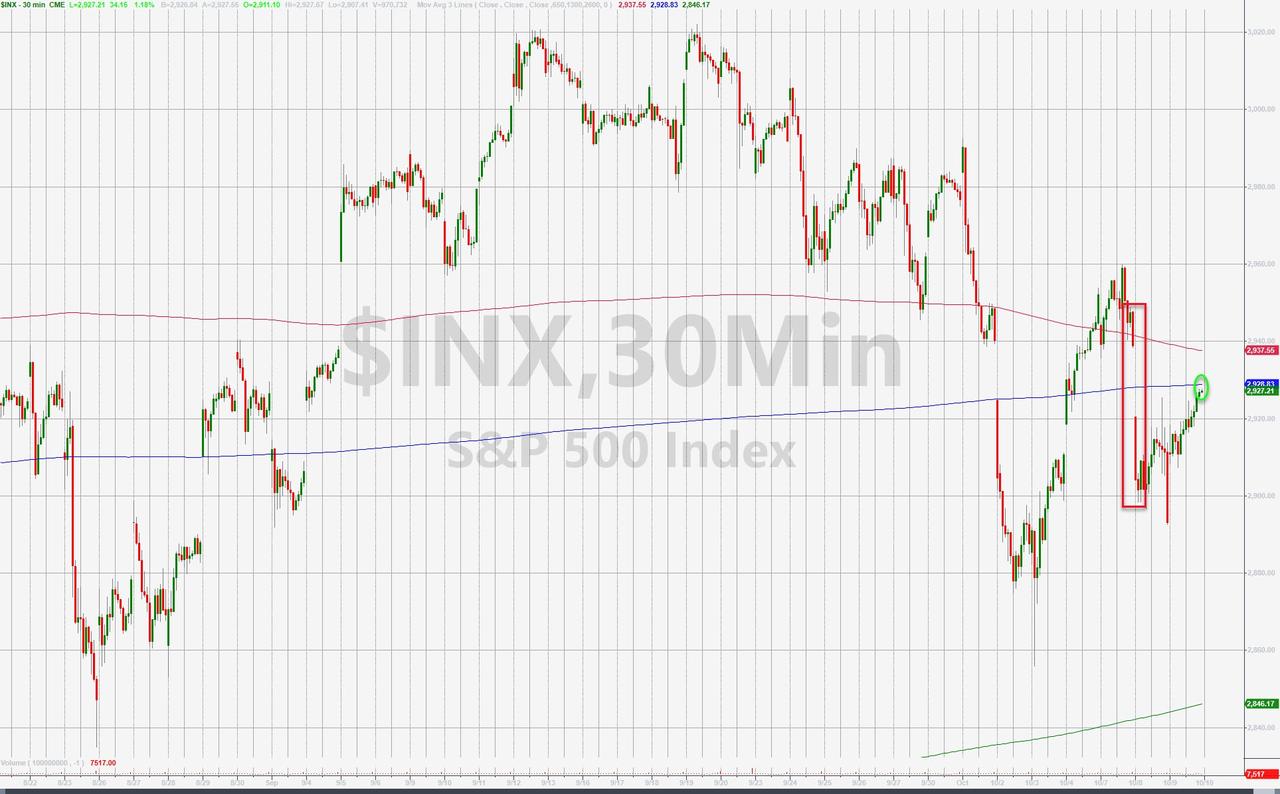
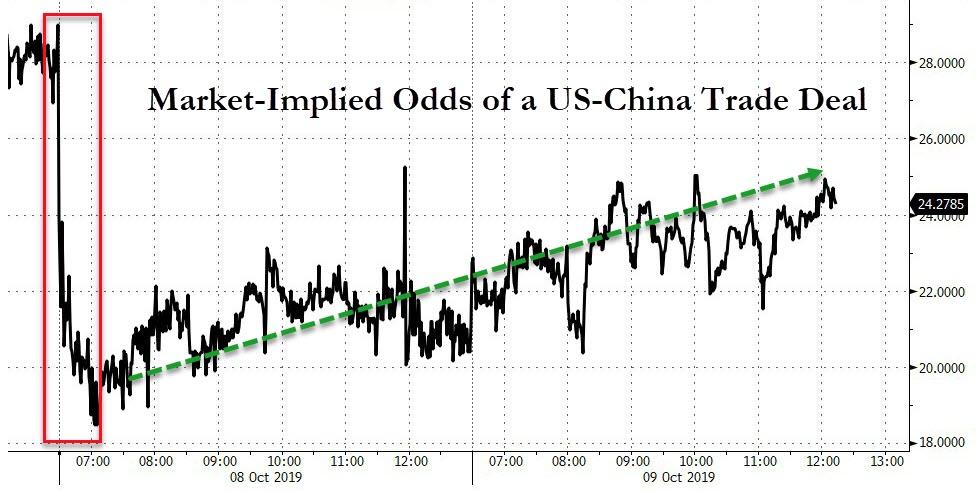
Today’s liftathon in stocks bought to you by the word “partial” (as in “China is amenable to a partial trade deal” which is entirely not news at all) and the number 2829 (the S&P 500 100-day moving average) because that means “all is well”

Trade deal odds had lifted…

Source: Bloomberg

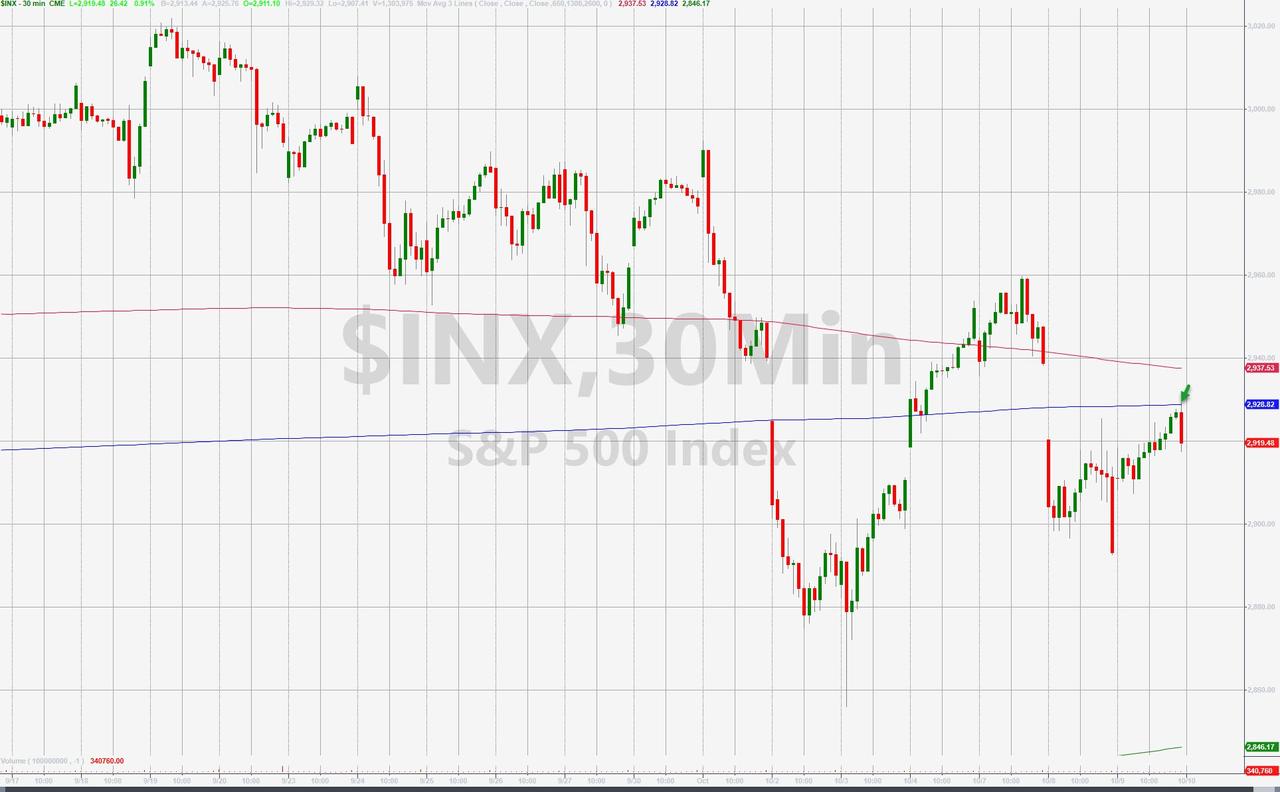
And the S&P 500 levitated back to its 100DMA…

But a late-day headline that Beijing has lower expectations of progress – due to the goodwill damage from US blacklisting 28 tech firms:

1544ET GOODWILL DAMAGED BY THE U.S. DEPARTMENT OF COMMERCE’S BLACKLISTING OF 28 CHINESE COMPANIES THIS WEEK-CHINESE OFFICIALS

1545ET BEIJING HAS LOWERED EXPECTATIONS FOR PROGRESS FROM U.S. TRADE NEGOTIATIONS THIS WEEK-CHINESE OFFICIALS BRIEFED ON TALKS

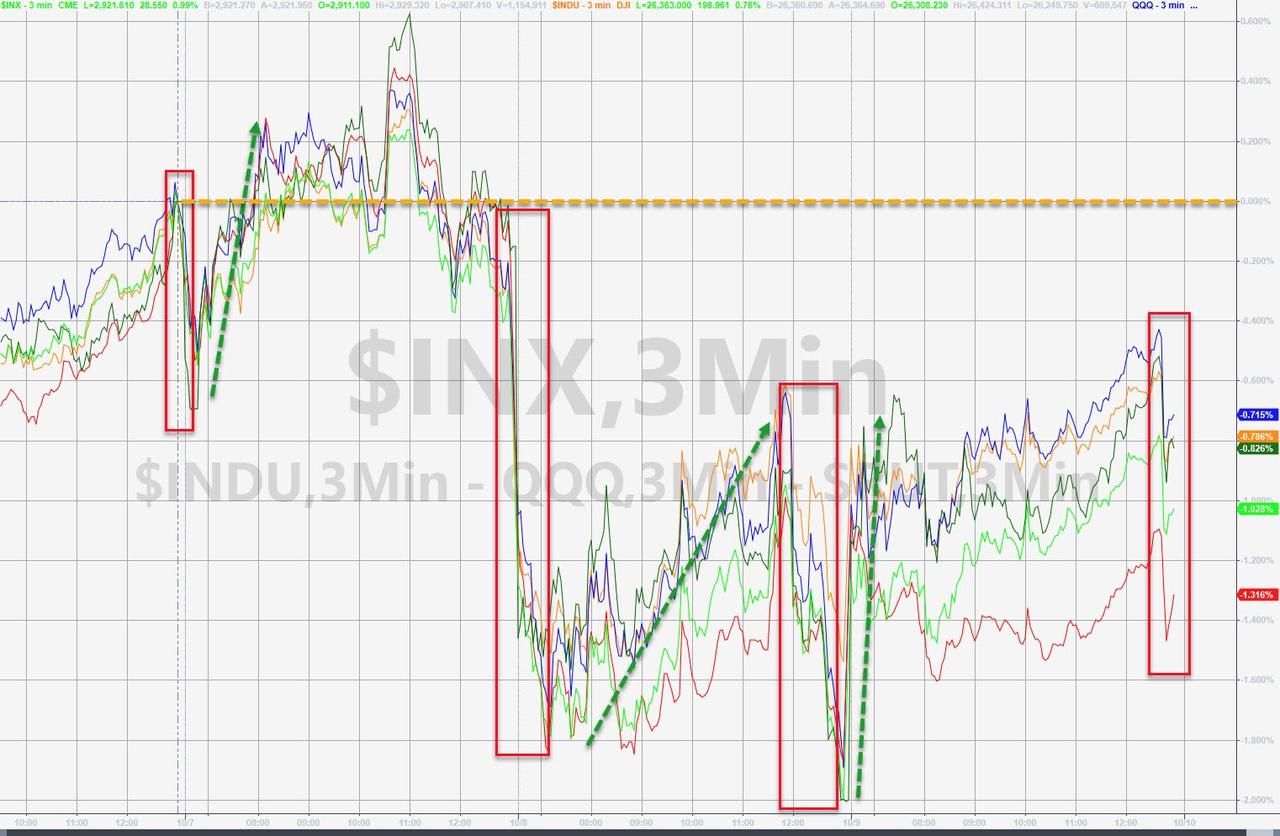
Sparked a dump in stocks…

NOTE – the headline timing was extremely odd as it hit right as the S&P hit its 100DMA…


But, despite gains today, US majors remain red on the week…

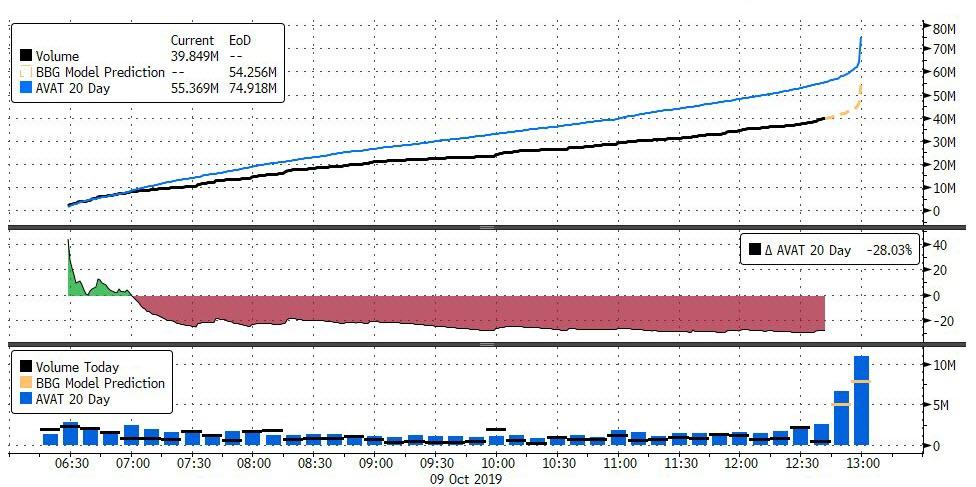
Volume overall was notably weak – around 30% below average…

Source: Bloomberg

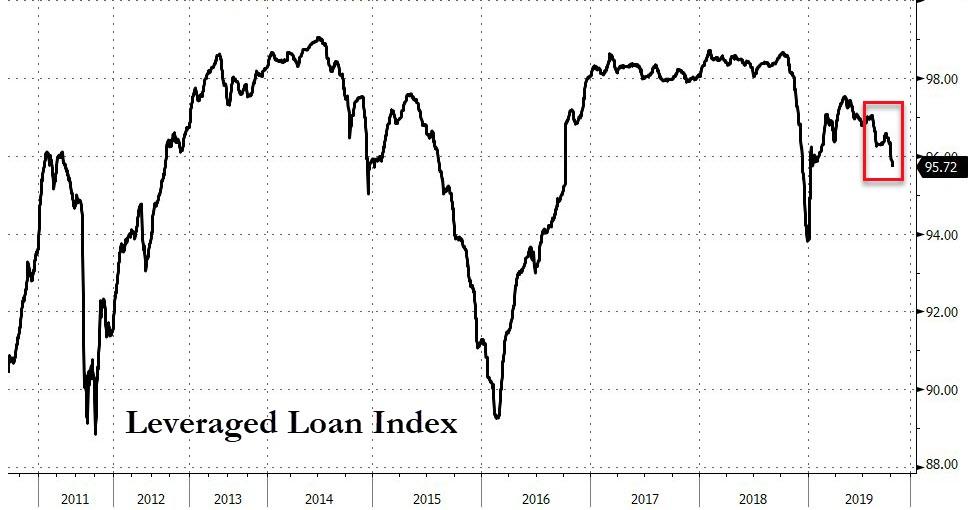
While credit markets are not in panic mode yet, leveraged loan markets are starting to crack…

Source: Bloomberg

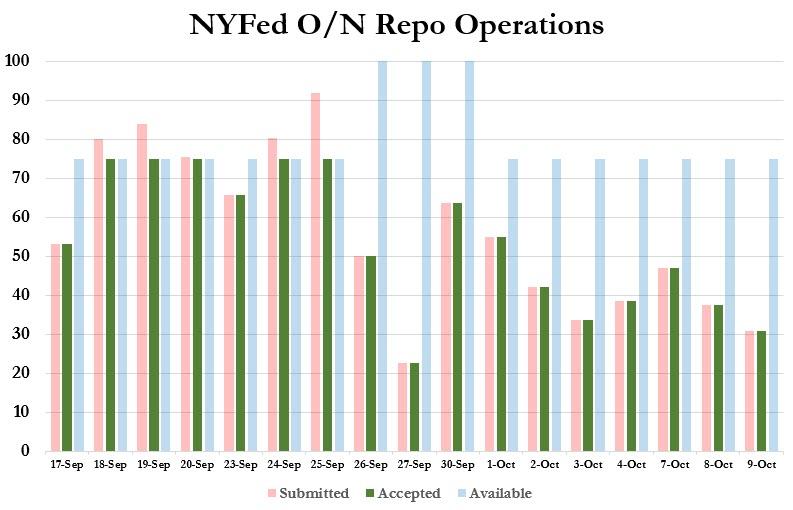
Another day, another $30bn of liquidity rolled with The Fed…

Source: Bloomberg

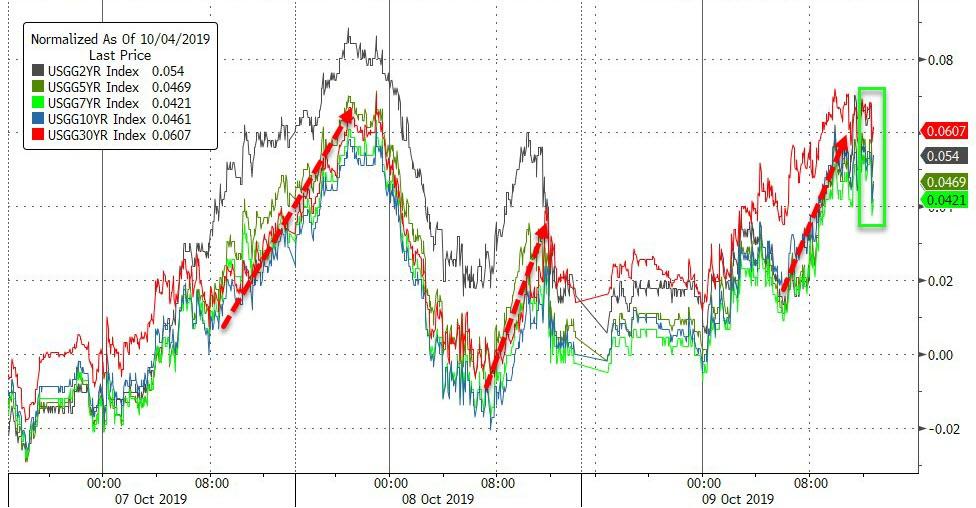
Treasury yields were all higher across the curve (parallel rise of around 5bps) before the late-day headline (note the selling every day that hits around the EU close)

Source: Bloomberg

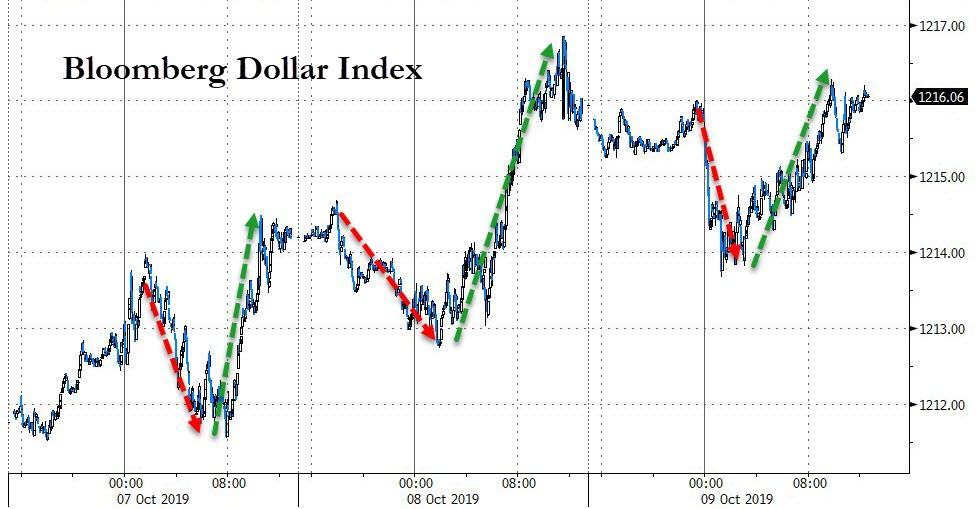
The Dollar managed gains on the day, following the same overnight weakness, European/US strength pattern…

Source: Bloomberg

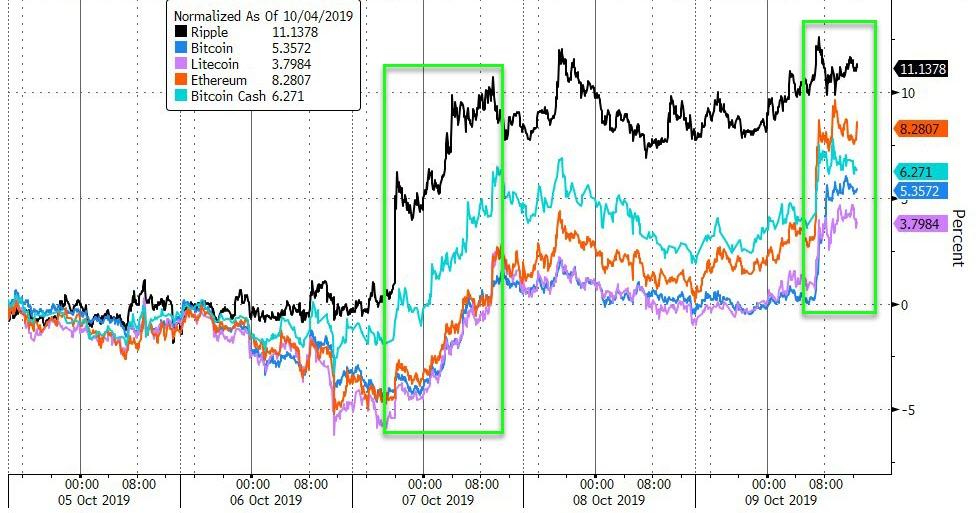
Cryptos rallied on the day with ETH leading today and XRP up most on the week…

Source: Bloomberg

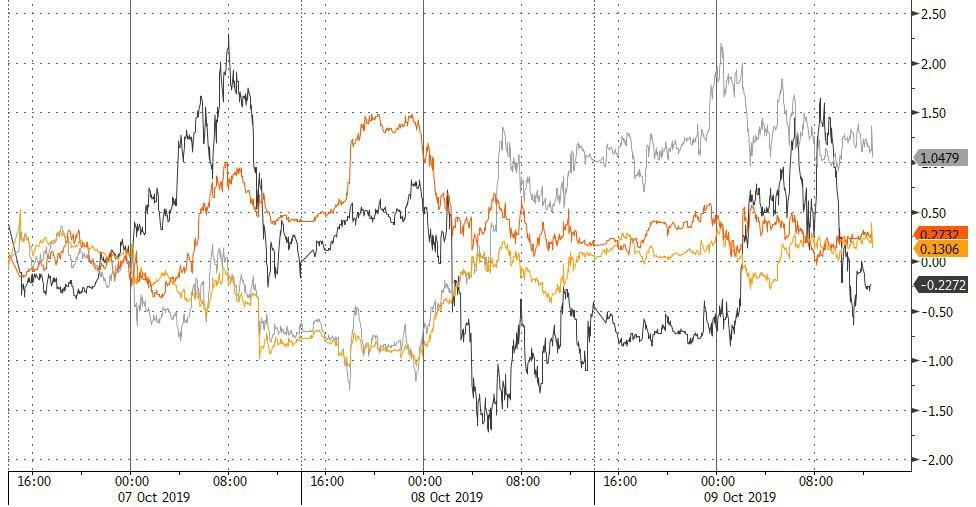
Commodities were unusually quiet today (apart from oil)…

Source: Bloomberg

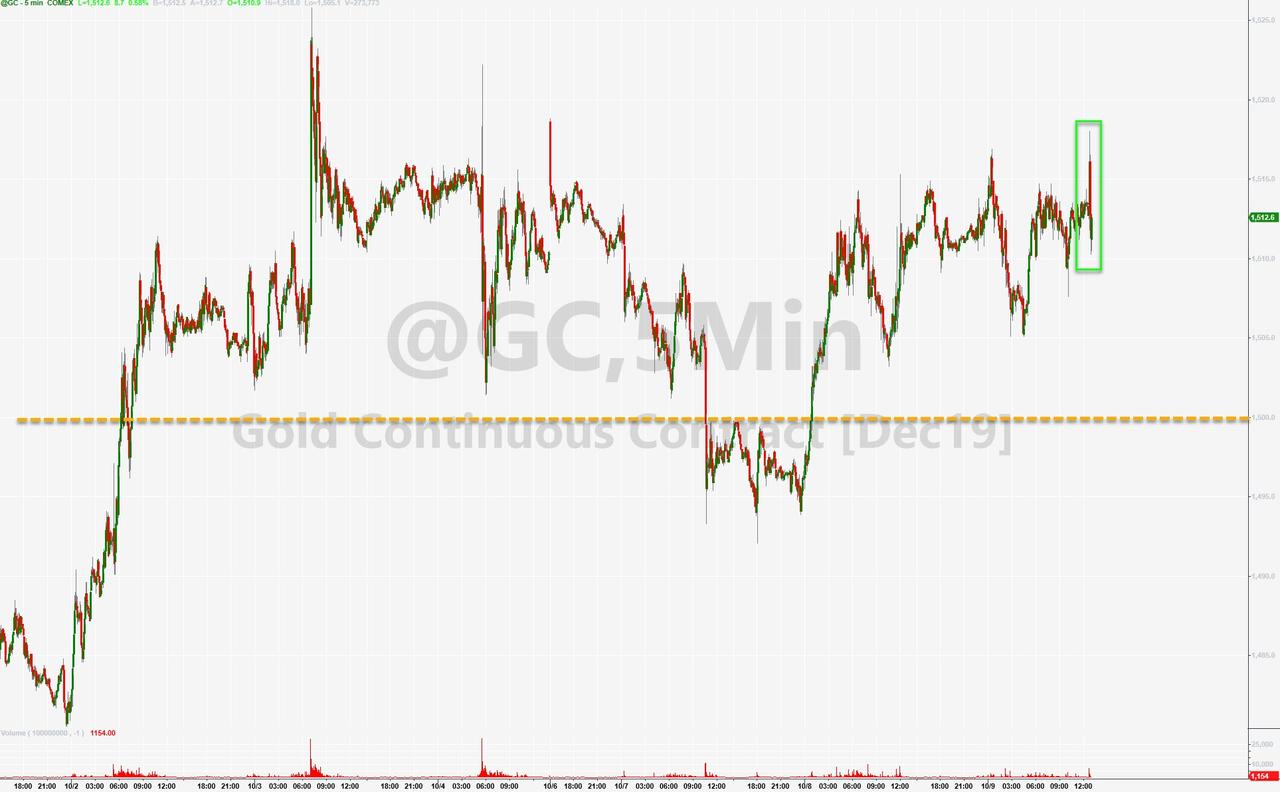
Gold spiked to $1518 on the Minutes…

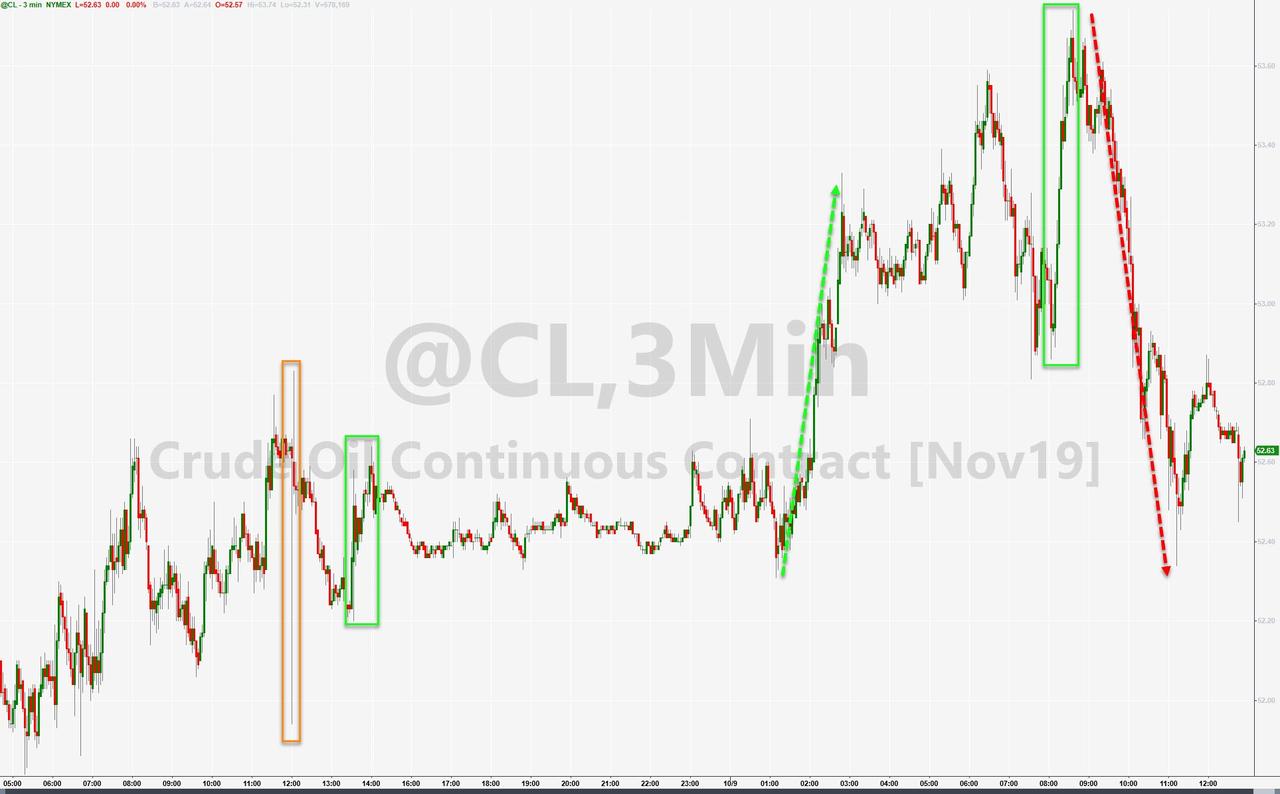
Oil spiked overnight on trade hopes and again on inventories, only to be dumped


Finally, the median stock is trading at a key trendline level…

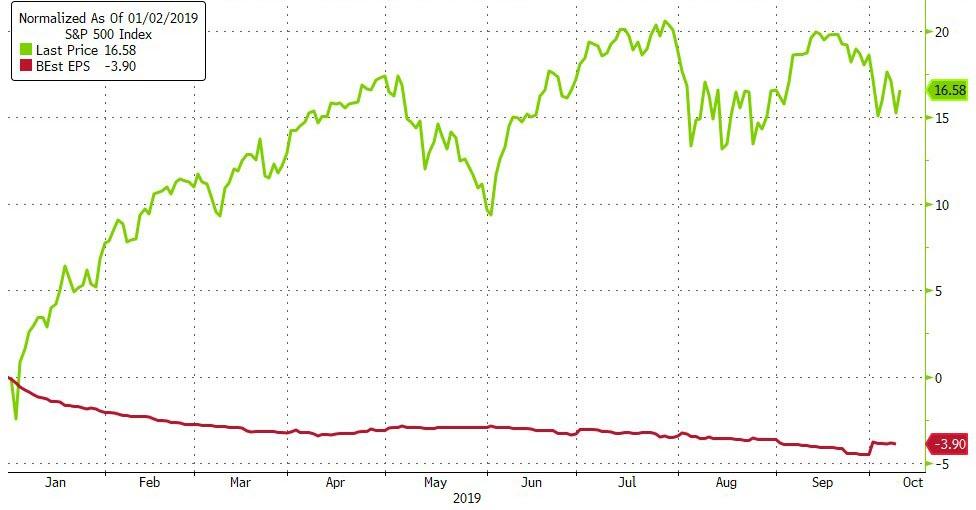
And don’t forget, it’s all about fun-durr-mentals…

Source: Bloomberg

Is it time for another quant-quake?

Source: Bloomberg


Tyler Durden

Wed, 10/09/2019 – 16:02

via ZeroHedge News https://ift.tt/35nTtpB Tyler Durden

No, The Poor Don’t Pay Higher Taxes Than The Rich

No, The Poor Don’t Pay Higher Taxes Than The Rich

Authored by Phillip Magness via The American Institute for Economic Research,

Are the poor actually paying a larger share of their earnings in taxes than the ultra-wealthy? That’s the claim at the center of a new New York Times article purporting to trace the effects of the previous year’s tax cut package.

While supporters of wealth taxation quickly claimed vindication for their cause in these findings, a closer examination provides several clear signs that something fishy is going on with the underlying numbers.

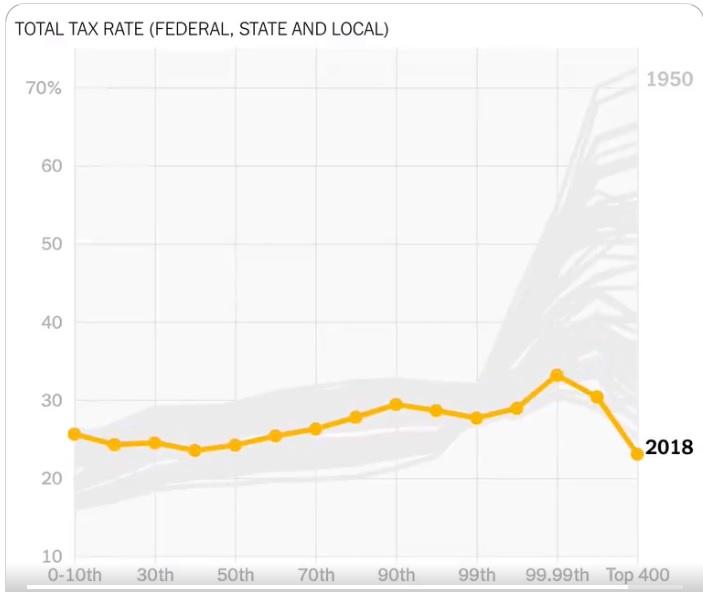
The Times’ report draws upon the work of Emmanuel Saez and Gabriel Zucman, two UC-Berkeley economists who are also currently advising the Elizabeth Warren campaign for president. In their newest study, they purport to show that the overall tax burden (federal, state, and local) on the ultrarich, defined as the top 400 earners, has now fallen below the rate paid by even the poorest decile. As the chart below implies, these findings also represent a long-term regressive shift in taxation over the past 70 years.

Source: Screencap of Saez & Zucman, as relayed to the New York Times, October 7, 2019

Be skeptical of these findings though, as they are at odds with the established literature on tax progressivity in the United States.

To understand how, we may begin with the Congressional Budget Office (CBO). For the past 40 years the CBO has maintained and published annual estimates of the average federal tax rate paid by each quintile of the U.S. income distribution. The CBO series only includes federal taxes (personal income, payroll, corporate, and excise), but federal taxation is the lion’s share of the overall tax burden in the United States.

The CBO’s figures diverge sharply from the findings in the New York Times report. Whereas Saez and Zucman place the top 1 percent’s total tax burden (federal, state, and local) at around 30 percent of its income in 2016 (the latest year available for comparison in both series), the CBO’s estimate for federal taxes alone is actually higher at 33.3 percent.

A similar inconsistency may be seen at the bottom of the distribution. According to the CBO, the bottom quintile (20 percent) of earners paid just 1.7 percent of their income on federal taxes. Saez and Zucman’s numbers also include state and local taxation, but their estimates for the poorest segment’s overall tax burden leap to nearly 25 percent. While state and local tax burdens do skew somewhat in a regressive direction, other data suggest this spike is entirely implausible.

The Institute on Taxation and Economic Policy (ITEP) maintains a separate estimate of the average state and local tax burden across the income quintiles found in the CBO series. According to ITEP’s most recent numbers, the top 1 percent currently pays an effective state and local tax rate of about 7.4 percent. The bottom quintile pays about 11.4 percent. These numbers confirm the moderate regressivity of state and local taxation, but they are also far short of being able to reverse the more pronounced progressivity of federal taxation.

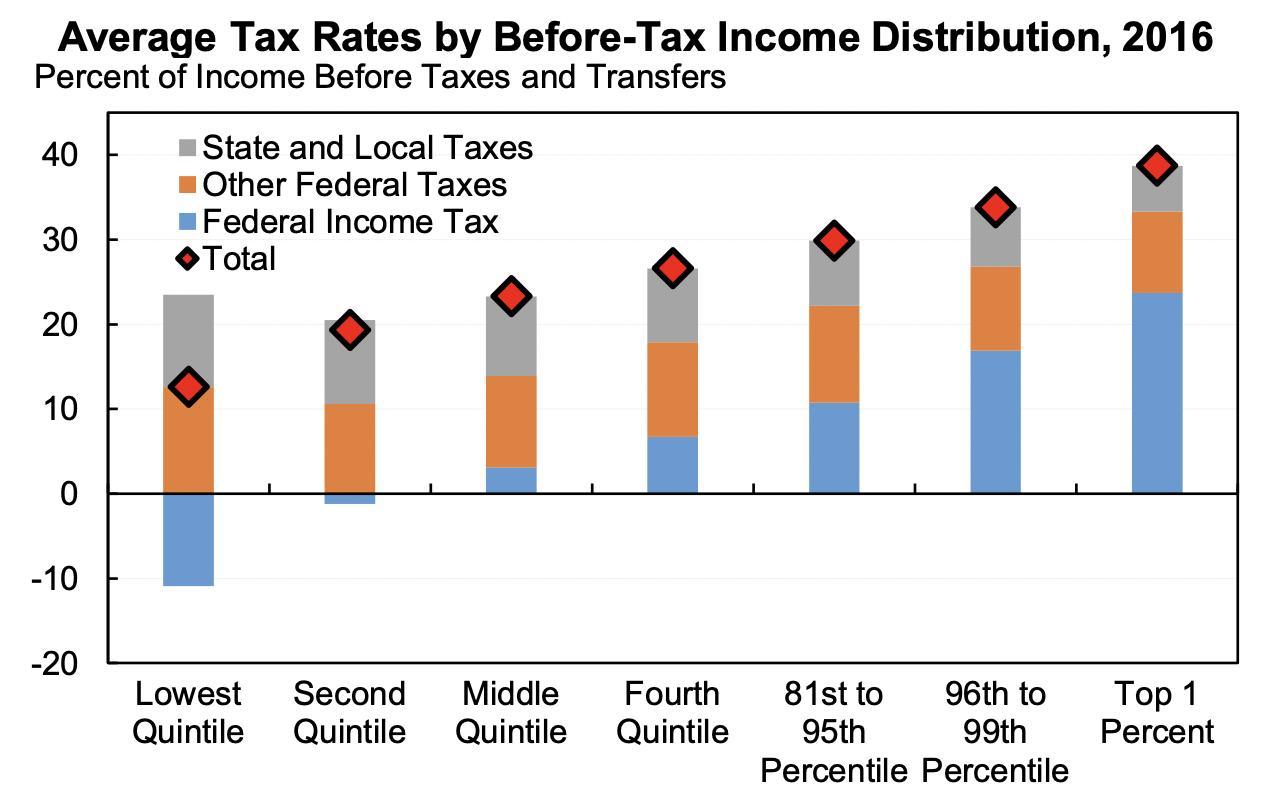
Jason Furman, former chairman of the Council of Economic Advisers under President Obama, combined the CBO and ITEP estimates in response to the New York Times report. His main figure appears below, and it confirms that the overall tax distribution for the most recent available year in both series (2016) is clearly progressive. Even though state and local taxes do increase the burden on the poor, the wealthiest earners still pay a much higher tax share. 

Source: Jason Furman, combining estimates from the CBO (federal) and ITEP (state and local)

So why is there such a pronounced difference between these conventional sources and the new Saez-Zucman estimate?

Bear in mind that Saez and Zucman have not yet officially released their figures or their underlying methodology. They simply gave their findings to the New York Times, which credulously reprinted them as if they were already established fact. Saez and Zucman are familiar faces in the ongoing debate over inequality, where they have produced estimates that consistently report much higher levels of income and wealth concentration than almost all other alternative measures of the same. Based on the pair’s previous track record and clear partisan connections to the Warren campaign, the Times should have exercised greater diligence before presenting their numbers as conclusive.

While we await Saez and Zucman’s full estimates, several clues have emerged that explain why their numbers are so far off from the better-established CBO and ITEP series.

First, as Zucman recently admitted on Twitter, their series removes the refundable portion of the earned income tax credit (EITC) from the bottom quintile’s federal tax burden. He claims this was done to separate the alleged “muddle” of transfer payments from the mix when looking at tax data, yet this produces highly misleading results.

The EITC is an intentional feature of the federal tax system designed to reduce its burden on the poor and provide eligible filers with an offsetting payment, thereby increasing the income tax’s overall progressivity. It is administered directly through annual tax return filings to the IRS and functions as an income-chained poverty-alleviation measure. For these reasons, the CBO incorporates the refundable EITC payment into its federal tax-distribution figures and has consistently done so over the past 40 years.

The effect of removing the EITC is not only a break from established statistical practices, it is also arguably deceptive. By excluding a key policy that enhances the progressivity of the federal tax system, Saez and Zucman end up with a distorted picture of the federal tax burdens and accompanying benefit payments to the poorest earners. This gives a false impression that the federal tax system falls more heavily on the poor than earners in the lowest quintile actually experience.

The second problem arises from Saez and Zucman’s treatment of data in the last two years. As noted, the most recent CBO release is from 2016. Yet Saez and Zucman purport to present more recent estimates, including last year.

There’s a reason why the CBO series lags in date. The IRS has yet to release its official income tax statistics for 2018, which raises the question of how Saez and Zucman are able to present estimates for a year in which we have extremely incomplete data.

As of this writing, neither economist has offered a clear answer save to note that their methods will be included in their forthcoming book release on the subject. Zucman has hinted in his comments since the Times article that their 2018 estimates work around the IRS release by using available totals of corporate tax revenue, and distributing it across the top 400 earners to get their results.

Since they didn’t provide additional details of the exact assumptions that went into the 2018 estimate, their approach seems both premature and empirically dodgy. It would likely constitute a break in their series from earlier years where better income data are available — and, conveniently enough, at the exact moment their series purports to show a regressive shift that substantially reduces the tax burden on the top 400. Furthermore, the provisions of the 2017 tax cut bill affected both the corporate and personal income tax rates, which almost certainly means some income shifting occurred between the two due to tax planning in the highest brackets. Without also knowing the as-yet-unreleased IRS income tax numbers, accounting for income shifting is likely a challenge. In short, the Saez-Zucman numbers for 2018 are almost certainly premature.

These issues leave us with a highly unconventional approach to presenting and vetting new economic data. In preparing their new numbers for the Times, Saez and Zucman appear to have eschewed best practices for estimating the distribution of tax burdens over the population as found with the CBO, which has employed the same underlying methodology since 1979. They also sidestepped the normal scholarly vetting process for new data, such as posting a working paper that details their methods and data sources.

Instead, Saez and Zucman released their new findings by providing privileged access to a friendly newspaper’s editorial page. Rather than shedding light upon important questions of scholarly inquiry, the result is a splashy story designed to capitalize on the news cycle and lend support to partisan electoral politicking. More sober analysis, rooted in established methods and publicly available sources such as the CBO and ITEP, show that story is also likely wrong.


Tyler Durden

Wed, 10/09/2019 – 15:55

via ZeroHedge News https://ift.tt/35opQob Tyler Durden

Stocks Suddenly Slide On Report Chinese Say “Goodwill Damaged” And “Expectations For Progress Lowered”

Stocks Suddenly Slide On Report Chinese Say “Goodwill Damaged” And “Expectations For Progress Lowered”

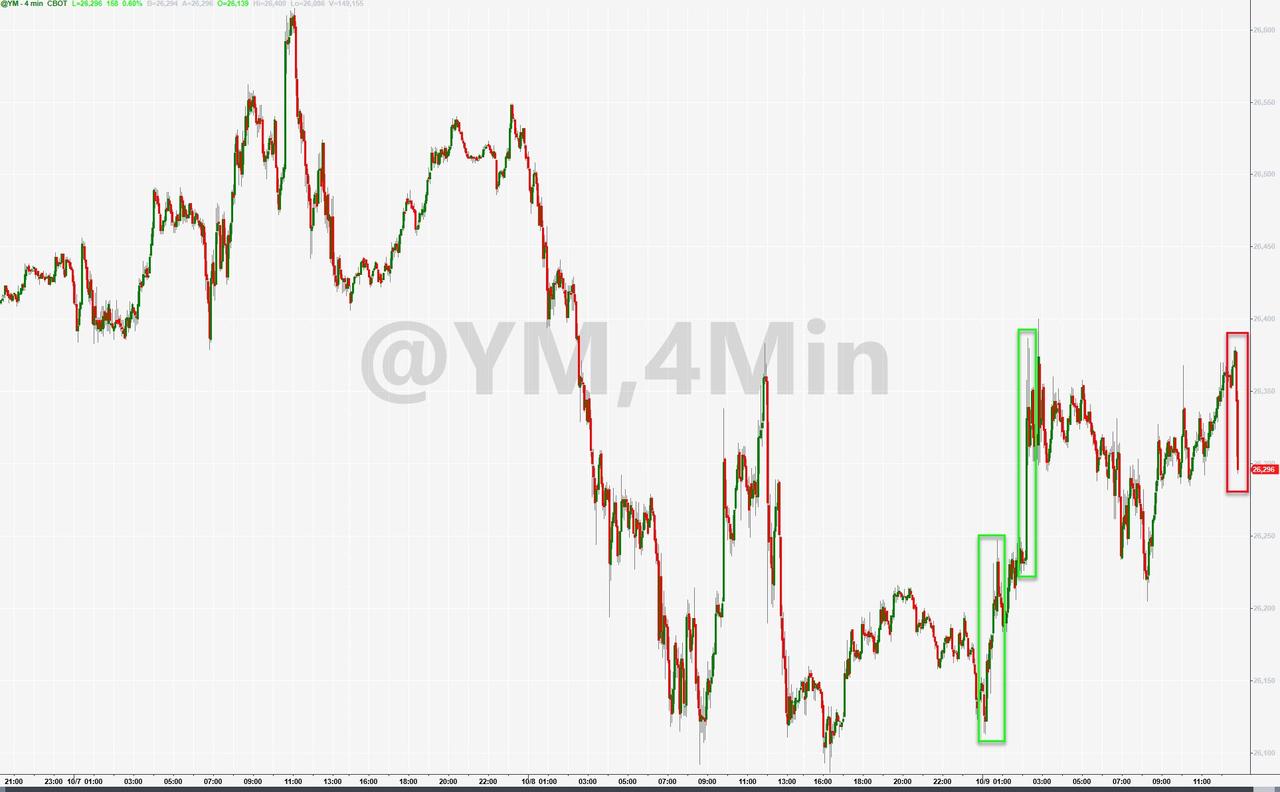
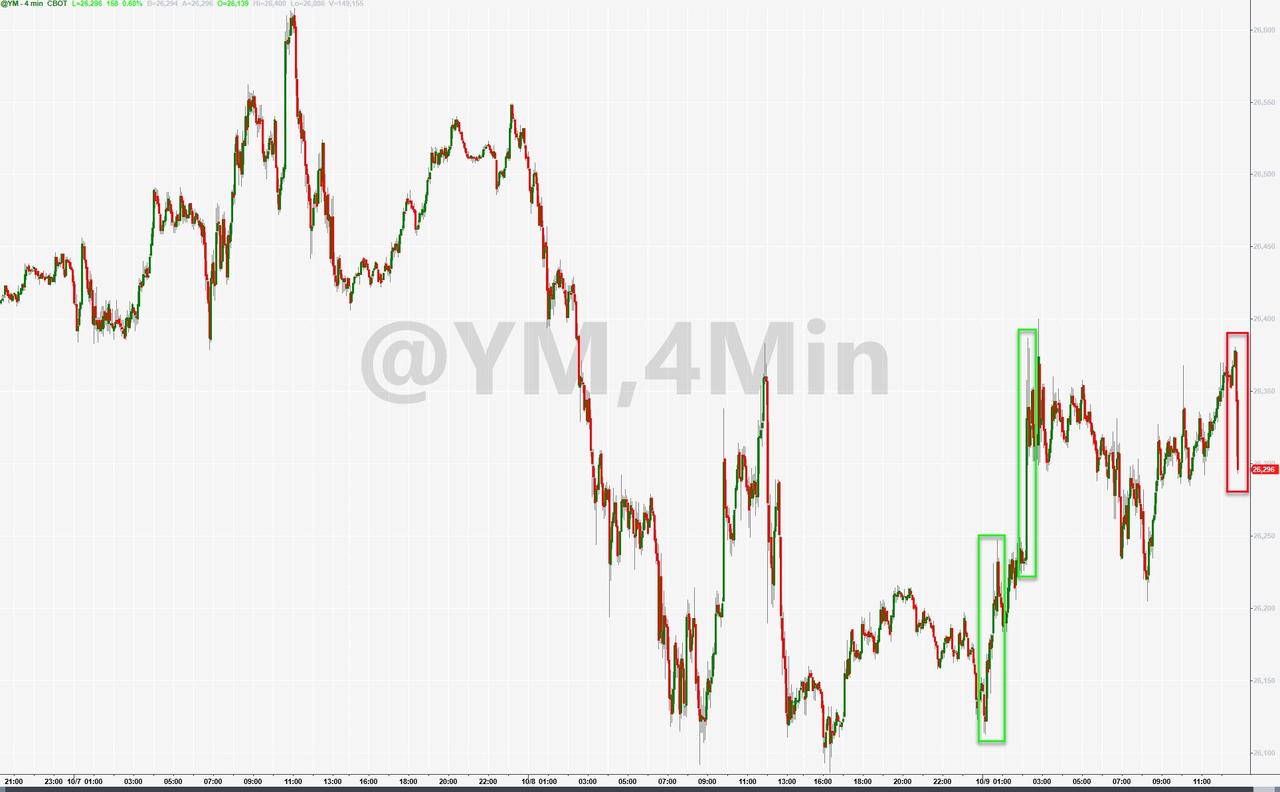
With stocks trading all day as if some sort of trade deal between the US and China was imminent, 15 minutes before the close risk suddenly hit an air pocket and US equity indices suddenly slumped sharply lower after a Reuters report that Chinese officials had said the the US blacklisting of 28 Chinese companies had “damaged goodwill” and that as a result, “Beijing has lowered its expectations from the progress of trade negotiations.”

  • GOODWILL DAMAGED BY THE U.S. DEPARTMENT OF COMMERCE’S BLACKLISTING OF 28 CHINESE COMPANIES THIS WEEK-CHINESE OFFICIALS
  • BEIJING HAS LOWERED EXPECTATIONS FOR PROGRESS FROM U.S. TRADE NEGOTIATIONS THIS WEEK-CHINESE OFFICIALS BRIEFED ON TALKS

The report instantly cut over 80 points of gains from the Dow and the S&P was trading roughly where it opened, just around 2,920 as suddenly the market’s conviction of an “optimistic outcome” from tomorrow’s meeting was shaken to the core.


Tyler Durden

Wed, 10/09/2019 – 15:52

via ZeroHedge News https://ift.tt/311CoP4 Tyler Durden

Elizabeth Warren Whips Out “Environmental Justice” Plan For Poor Communities

Elizabeth Warren Whips Out “Environmental Justice” Plan For Poor Communities

2020 Democratic candidate Elizabeth Warren announced a plan on Wednesday that would steer taxpayer dollars to fight ‘environmental injustice’ by helping poor communities grapple with the effects of climate change and pollution, according to Bloomberg

By injecting racism into the climate debate, Warren’s plan goes far beyond the Green New Deal championed by Bernie Sanders by allocating resources to bolster environmental plans at the federal and local levels, as well as “improving existing data to better prepare at-risk areas and punishing polluters,” whatever that means. 

From predominantly black neighborhoods in Detroit to Navajo communities in the southwest to Louisiana’s Cancer Alley,” reads a campaign announcement (note the shout-out to the Navajos after the Cherokee Nation slammed Warren for lying about being a Native American in order to advance her career). 

According to the statement, “industrial pollution has been concentrated in low-income communities for decades — communities that the federal government has tacitly written off as so-called ‘sacrifice zones.’”

Warren is virtually tied with former Vice President Joe Biden for first place among Democratic 2020 candidates, with around 26% support. Sanders, who just had a heart attack, is in a distant third at 14.6% according to Bloomberg

Warren’s plan calls for creating a Council on Climate Action with a mandate to pursue the goal of environmental justice.

It would strengthen programs and restore funding to the Environmental Protection Agency that was cut by President Donald Trump’s administration. The EPA’s National Environmental Justice Advisory Council would be elevated and report directly to the White House, and all federal agencies would be required to consider climate when making decisions. –Bloomberg

“Climate action needs to be mainstreamed in everything the federal government does,” according to the Warren plan, which also proposes EPA mapping of said ‘endangered’ areas, while better using that data to better gauge how climate change is supposedly affecting said areas. 

Warren’s previous climate plans have proposed transitioning to “Green Manufacturing,” as well as a “100% Clean Energy Plan,” which would involve $400 billion in energy R&D. She has vowed to provide job training (i.e. learn to code), wage, and benefit guarantees to workers in fossil fuel industries who would be displaced by the transition to clean energy. Warren has also called for harsh punishments for polluters – previously proposing hefty fines for corporations that pollute as defined in her Climate Risk Disclosure Act. 

The new plan also plan reiterates her proposal to “hold the finance industry accountable for its role in climate change” by requiring banks and other companies to “disclose their greenhouse gas emissions and price their exposure to climate risk into their valuations.” –Bloomberg

Meanwhile, Kamala Harris, who appears to have little chance of winning the Democratic nomination, has proposed legislation with Rep. Alexandria Ocasio-Cortez (D-NY) which would expand on the Green New Deal’s framework to steer federal resources to fighting climate change in low-income communities.  


Tyler Durden

Wed, 10/09/2019 – 15:40

via ZeroHedge News https://ift.tt/311q2GP Tyler Durden

First Rule Of QE Club, Don’t Call It QE

First Rule Of QE Club, Don’t Call It QE

Submitted by Mark Orsley, head of macro strategy at PrismFP 

  • Fed makes the full dovish pivot – deeper rate cuts and asset purchases coming – cycle end in sight
  • Emboldens long duration and tactical curve steepener calls – 2s10s can now steepen
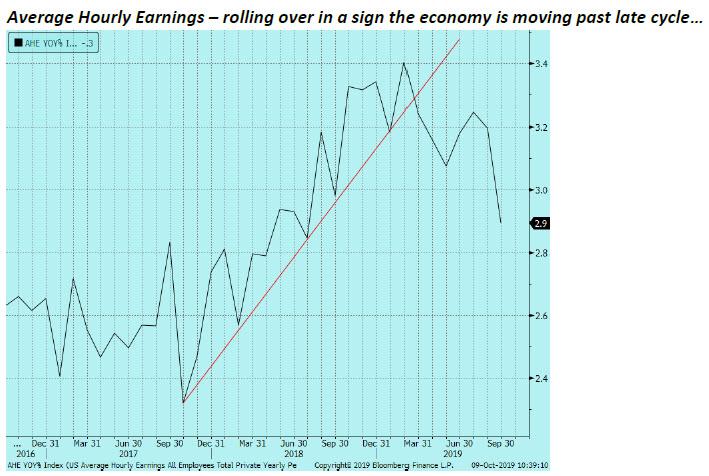
  • UER hits cycle lows but AHE reversal is more troublesome – initial signs of layoffs

It’s safe to say the Fed has capitulated. After a (super) brief stint in “neutral” that put the uptrend in Eurodollars at risk just a week or two ago Fed officials have fully pivoted back to dovish after the dreadful ISM data last week.

With regards to rate cuts, first was the Evans flip flop we discussed last week and then the mother of all hawks, Rosengren, even flipped on Friday:

Evans – now indicating rate cuts once again:

THEN -> Sept 30th: “After rate cuts, the Fed should leave policy on hold for some time”
NOW -> Oct 3rd: “ISM was a confirmation of FOMC view and I am concerned; open minded about the October meeting”
Oct 8th: “Could well be reasons for another 25bps cut; wouldn’t mind another cut”

Rosengren – downgrading growth and turning open minded (monumental shift):

THEN -> Sept. 20th: “additional accommodation is not needed”
NOW -> Oct 4th: “open minded on monetary policy; data is coming out weaker than expected; I thought growth would be 2% but I’d now say it looks closer to 1.7%”

With regards to the balance sheet, we then had Clarida give us the first indication that “don’t call it QE” was coming back:

Clarida:

Oct 3rd: “we will discuss balance expansion in October”

Then Powell put any and all question to bed where the Fed is taking monetary policy:

Powell:

Oct 8th: “As we indicated in our March statement on balance sheet normalization, at some point, we will begin increasing our securities holdings to maintain an appropriate level of reserves. That time is now upon us.”

Note, Powell specifically references the growth of “currency in circulation” as the reason for “don’t call it QE.” CiC (currency in circulation) would equate to a meager $8-9b/month of purchases. Not very meaningful, but the signaling back to “don’t call it QE” is significant. Let’s see what the actual purchases amount will be at the Oct meeting. If it’s more than $9b/month, then the Fed is clearly adding additional liquidity due to the economic slowdown.

In the Q&A, Powell took it to the next level, BOJ style.

Powell:

Oct 8th: “Short-term yield curve control is something worth looking at when the time comes”

The YCC comment should not shock us. Brainard warned us this was on the Fed’s radar back in May:

Brainard:

May 8th: “Another idea I would like to hear more about involves targeting the yield on specific securities so that once the short-term interest rates we traditionally target hit zero, we might turn to targeting slightly longer-term interest rates”

Lastly on the Fed, the largest question in my mind has been how the Fed will respond to rising inflation pressures (stemming from the supply side – ie: the wrong type of inflation) in the face of slowing growth (stagflation). Powell tidied this up nicely yesterday:

Powell:

Oct 8th: “tariffs are a one-time increase in prices and is different from inflation”

That means they will write off any inflationary pressure as “tariff transitory” which is important in front of the CPI report tomorrow. Therefore, don’t short the fixed income market or put on downside if we get CPI beats this quarter. The Fed will still cut as adding supply side inflation to the end of a cycle where wages were already compressing profit margins is economically damaging.

All the above Fed commentary leads us to a few very important points:

  • This is not a mid-cycle adjustment – the Fed has tried to spin it that way since July but all the rhetoric above speaks of a deeper cutting cycle (as well as the forward looking data, more on that below)
  • The Fed essentially just ended the cycle – this is the start of the eventual move to sub 1% rates “for long” and asset purchases.
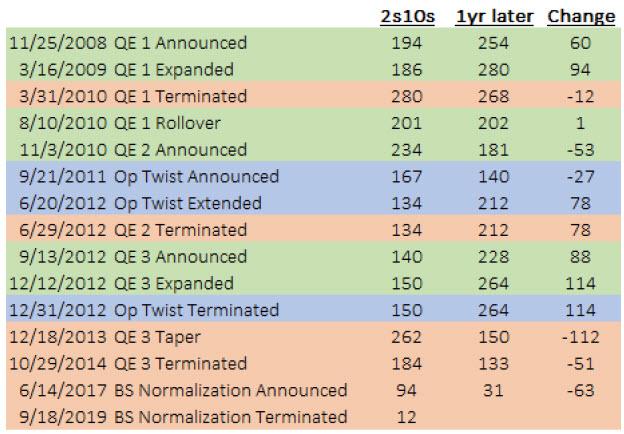
  • End of cycle means steeper curves – in this case, the curve steepener gets further emboldened with “reserve management” QE which is really a precursor to eventual LSAP (and who knows maybe even ultra issuance?). As you can see here, every time a QE program gets announced, rolled over, or expanded; one year later the curve is steeper…

  • 2s10s steepener is now in play – we have discussed 5s30s recently as a way to avoid the massive coming bill supply but the Fed just said its going to focus purchases on bills which will finally allow short end spreads like 2s5s, 2s10s to steepen
  • Although the curve can steepen initially, it won’t steepen out as far as past cycles – temper you expectations as we are starting from an absolute lower level of rates and more importantly; the Fed is now thinking YCC. So this will be a two speed trade where you play the steepener now and the flattener later. Therefore, you can think about buying Eurodollar flies like EDM2/EDM3/EDM4 (which is an EDM2/EDM3 steepener + EDM3/EDM4 flattener). This has a positive 1.7bps of 3m carry.

Back to our regularly scheduled data deterioration theme.

The labor report on Friday gave the market a collective sigh of relief after the disastrous ISM reports. While not robust, it was good enough to stave off a panicky fixed income rally.

The positive in the report was the UER (the most lagging indicator) ticked to a new a cycle low. This is what happens at the end of the cycle:

Labor market gets tight (in this case some labor shortages) -> inability to hire causes productivity to decline -> firms eventually have to go the other way and layoff.

On the layoff front, I am starting a running list as of the last week. If economic theory holds, this list should start to grow substantially:

  • Kroger Is Eliminating Hundreds of Store Employees
  • Lazard axes 7% of jobs from asset management unit
  • Sports Illustrated’s New Operator to Lay Off More Than 40 Employees
  • Domtar To Cut 100 Jobs In Arkansas, Michigan As Its Shuts 2 Paper Machines
  • WeWork leaders tell staff that job cuts are coming this month
  • HP Inc. to Cut as Much as 16% of Workforce Amid Print Unit Woes
  • Bonobos to Cut Several Dozen Jobs; Employs About 600 People
  • HSBC to Cut Up to 10,000 Jobs in Cost-Cutting Drive: FT
  • Lay-offs at GM edge close to 60,000 after talks with car workers break down
  • Schwab said it was cutting 3% of its workforce

The most troublesome part of the labor report Friday was the rollover in Average Hourly Earnings. Again, at the end of the cycle, wages are supposed to be rising: labor market gets tight -> employers are forced to pay up.

Therefore, the fact that wages are now reversing is a sign the economy is going past late cycle.

Bottom line: the Fed rhetoric that implies end of cycle is being confirmed by the continued data deterioration. The Fed got behind the curve, and now they are now attempting to catch up.

Long the front end, curve steepeners, long equities, and long gold (real yields will go negative) are the ways to position for this stage of the cycle. At a later date, the flattener and short equities will be the position, but not yet.


Tyler Durden

Wed, 10/09/2019 – 15:25

via ZeroHedge News https://ift.tt/33eLWHZ Tyler Durden

Why Hong Kong Protesters Are Channeling Bruce Lee

Few stories are generating as much as heat and interest as the ongoing protests in Hong Kong, where mostly young demonstrators are taking to the streets to call for democracy, autonomy, and privacy from authoritarian leaders in Beijing. In just the past week, the general manager of the Houston Rockets basketball team caused an international incident when he tweeted support for the protesters. This was a big deal because the NBA is huge in China—in fact, there are more NBA fans in China than there are people in the United States! The Rockets’ team owner and NBA leadership quickly apologized but not before the network carrying basketball in China announced it would not show any Rockets games this season.

The creators of South Park took a different tack: When an episode of their show mocking government censorship was shut down by the regime, Matt Stone and Trey Parker issued a caustic fake apology that read in part, “Like the NBA, we welcome the Chinese censors into our homes and into our hearts….We too love money more than freedom and democracy.”

A month ago, Reason TV producer Zach Weissmueller traveled to Hong Kong to document exactly what’s happening in the streets of a place long known for nearly unbridled capitalism (watch his videos at Reason.com or YouTube). In today’s Reason Interview, Zach tells how the protesters are using both high-tech and low-tech means to get their message out, why they’re inspired by the old Bruce Lee saying “be like water,” and whether they’re likely to achieve their goals of securing democratic, representative rule and privacy from the government that is perfecting the surveillance state in the 21st century.

Audio production by Ian Keyser and Regan Taylor.

from Latest – Reason.com https://ift.tt/33rnMKD
via IFTTT