Which Countries Support Marijuana Legalization?

Which Countries Support Marijuana Legalization?

Earlier this week, Canberra – or the Australian Capital Territory, which functions as a state – legalized the recreational use of marijuana for inhabitants 18 years and older. The new law is supposed to come into effect at the end of January. Adult Canberrans will be able to possess 50 grams of cannabis and will be allowed to grow two marijuana plants for personal consumption.

Much like in the U.S., Statista’s Katharina Buchholz notes, the possession of cannabis and cannabis plants will remain a federal offense, but that is not expected to make a difference “in practice”, according to ACT attorney-general Gordon Ramsay. ACT shadow attorney-general Jeremy Hanson from the Liberals said the bill would lead to “perverse outcomes”.

Looking at an international survey comparing attitudes towards marijuana legalization in different countries, Australia ranks quite high.

Infographic: Which Countries Support Marijuana Legalization? | Statista

You will find more infographics at Statista

In the U.S. and Canada, where marijuana was legal at least in part of the countries when the survey was carried out in late 2018, 80 percent of the population were in favor of some type of legalization (medical or recreational). In Australia, this number was at approximately 70 percent even though a larger proportion of respondents favored medical marijuana legislation over legalization for recreational use.


Tyler Durden

Sun, 09/29/2019 – 22:30

via ZeroHedge News https://ift.tt/2mM53K2 Tyler Durden

Limbaugh: We’re In The Middle Of “A Cold Civil War”

Limbaugh: We’re In The Middle Of “A Cold Civil War”

Via SaraACarter.com,

The Democrats have declared war against President Trump and those who support him. Instead of bullets, they use lies.

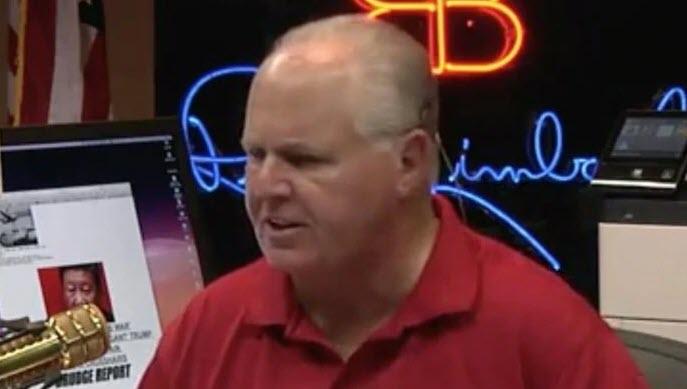
The media is not media. It’s just Democrats who work in the media, and the whole group of ’em is aligned. And what we are in the middle of now, folks, is a Cold Civil War,” Rush Limbaugh said said on his radio show.

Limbaugh put forth that the “Cold Civil War” encompasses overturning “the election results of 2016” and “protecting and defending” the Washington establishment.”

Their careers, their fortunes, their corruption. There are terribly big stakes involved here for these people. And Trump is on the cusp of overturning it and exposing it,” Limbaugh said.

Limbaugh called the latest developments involving Ukraine “nothing more than the Steele dossier 2.0,” alluding that it is an extension of the Russia investigation.

“It’s the same people, it’s the same scam, it’s the same objective,” Limbaugh said.

The whistleblower complaint is the latest stage of this war. Limbaugh correctly notes that the report is manufactured political opposition research, just as Christopher Steele’s dossier was. And the entire Democratic Party, including the media, is acting as if it’s real.


Tyler Durden

Sun, 09/29/2019 – 22:00

via ZeroHedge News https://ift.tt/2nHomUU Tyler Durden

Visualizing The Megaregions Driving The Global Economy

Visualizing The Megaregions Driving The Global Economy

If you’ve ever flown cross-country in a window seat, chances are, the bright lights at night have caught your eye. From above, the world tells its own story – as concentrated pockets of bright light keep the world’s economy thriving.

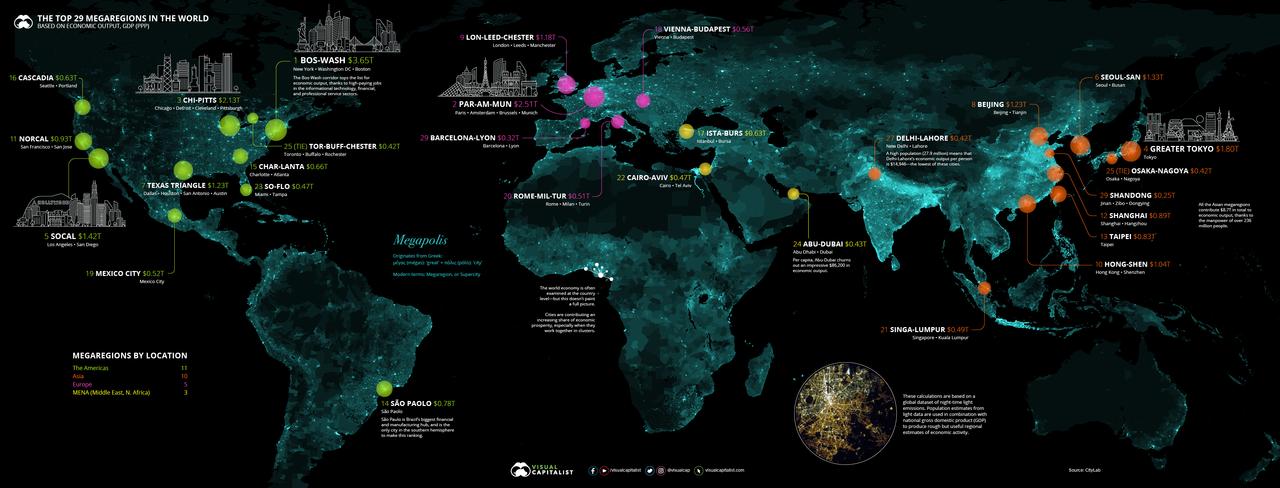
Today’s visualization relies on data compiled by CityLab researchers to identify the world’s largest megaregions. The team defines megaregions as:

  • Areas of continuous light, based on the latest night satellite imagery

  • Capturing metro areas or networks of metro areas, with a combined population of 5 million or higher

  • Generating economic output (GDP) of over $300 billion, on a PPP basis

The satellite imagery comes from the NOAA, while the base data for economic output is calculated from Oxford Economics via Brookings’ Global Metro Monitor 2018.

As Visual Capitalist’s Iman Ghosh details below, each megaregion may not be connected by specific trade relationships. Rather, satellite data highlights the proximity between these rough but useful regional estimates contributing to the global economy – and supercities are at the heart of it.

(click image for huge legible version)

From Megalopolis to Megaregion

Throughout history, academics have described vast, interlinked urban regions as a ‘megalopolis’, or ‘megapolis’. Economic geographer Jean Gottman popularized the Greek term, referring to the booming and unprecedented urbanization in Bos-Wash—the northeast stretch from Boston and New York down to Washington, D.C.:

This region has indeed a “personality” of its own […] Every city in this region spreads out far and wide around its original nucleus.

Gottmann, Megalopolis (1961)

By looking at adjacent metropolitan areas rather than country-level data, it can help provide an entirely new perspective on the global distribution of economic activity.

Where in the world are the most powerful urban economic clusters today?

The Largest Megaregions Today

The world’s economy is a sum of its parts. Each megaregion contributes significantly to the global growth engine, but arguably, certain areas pull more weight than others.

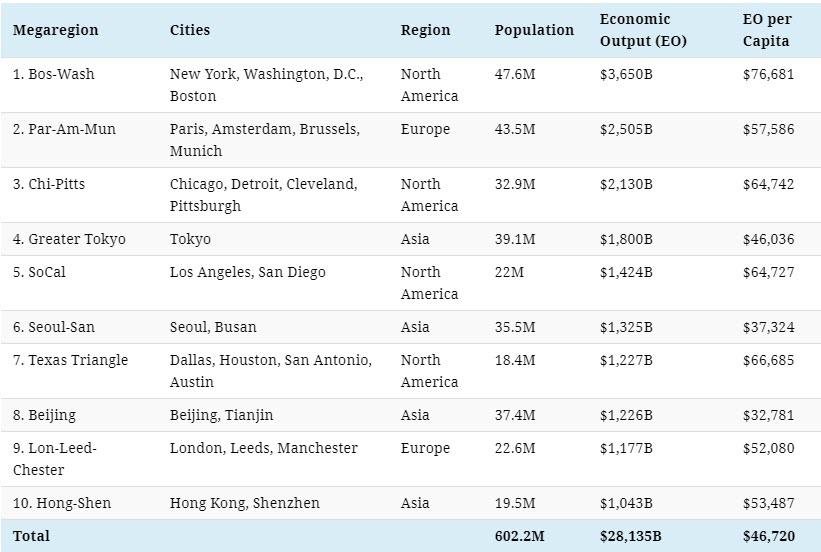
Altogether, these powerhouses bring in over $28 trillion in economic output.

Unsurprisingly, Bos-Wash reigns supreme even today, with $3.6 trillion in economic output, over 13% of the total. The corridor hosts some of the highest-paying sectors: information technology, finance, and professional services.

The largest city in Brazil, São Paulo, is the only city in the Southern Hemisphere to make the list. The city was once heavily reliant on manufacturing and trade, but the $780 billion city economy is now embracing its role as a nascent financial hub.

On the other side of the world, the cluster of Asian megaregions combines for $8.7 trillion in total economic output. Of these, Greater Tokyo in Japan is the largest, while Shandong might be a name that fewer people are familiar with. Sandwiched between Beijing and Shanghai, the coastal province houses multiple high-tech industrial and export processing zones.

The data is even more interesting when broken down into economic output per capita—Abu-Dubai churns out an impressive $86,200 per person. Meanwhile, Delhi-Lahore is lowest on the per-capita list, at $14,946 per person across nearly 28 million people.

Where To Next?

This trend shows no sign of slowing down, as megacities are on the rise in the coming decade. Eventually, more Indian and African megaregions will make its way onto this list, led by cities like Lagos and Chennai.


Tyler Durden

Sun, 09/29/2019 – 21:30

via ZeroHedge News https://ift.tt/2otqTCB Tyler Durden

Marc Cohodes On Joe Nocera And MiMedx: “An Unholy Alliance”

Marc Cohodes On Joe Nocera And MiMedx: “An Unholy Alliance”

Submitted by Marc Cohodes

I’ve been a short seller for over 30 years.  Mostly, I identify companies that are engaged in fraud, illegal conduct, or questionable accounting, I investigate, and I go public with what I’ve learned.  I put my money where my mouth is:  I sell the shares short knowing that I will lose money if I’m wrong, but also knowing I’ll make money if I’m right.  I’ve got a very good track record at uncovering frauds.  You don’t have to take my word for  it – you can read about me in Bloomberg and elsewhere.

MiMedx is a company that sells wound care treatments made from placentas to patients, many of whom are at veterans hospitals.  In 2017, I learned MiMedx was forcing products on its distributors in phony sales (“channel stuffing”), manipulating revenue, selling products that were unsafe or ineffective, coaching doctors on how to charge Medicare for its unnecessary treatments, improperly paying doctors to promote its products, discriminating against employees, and bullying, intimidating, and retaliating against employees who came forward to demand that illegal behavior stop.  After I challenged the CEO Pete Petit, management, and the board with the information I had gathered, they responded with more false statements and personal attacks on me. 

When you expose people who are doing bad things, they often lash out.  MiMedx, Petit, company management, and their backers were no exception, and they weren’t the first, either.  I expect that and it’s part of the job.  But I admit I was surprised to see Joe Nocera and Bloomberg pick up the MiMedx flag on behalf of people trying to make money off of unsuspecting investors, and by doing so, they have neutralized the previous Bloomberg news articles documenting the illegal and unscrupulous conduct at MiMedx. 

On August 19 and August 22, Nocera wrote a couple of articles about me and MiMedx.  The first article claimed that I was basically wrong about MiMedx, the company wasn’t so bad, and I went too far.  The second claimed that the company has now cleaned up its act, but that I am still conducting a “smear campaign” to destroy the company unfairly. 

Nocera’s two articles were sloppy, shallow, and consistently wrong.  I sent detailed letters pointing out the factual errors, but Bloomberg refused to correct the articles and even refused to publish this Op-Ed piece. 

I’m not going to try to correct every mistake Nocera made.  There are length limits for Op-Ed pieces, and we are talking about a reporter so careless that he once wrote an entire Bloomberg article headlined “Correction:  A Column Based on the Wrong Memo,” and who was reprimanded by The New York Times’s Public Editor for a serious ethical lapse in failing to disclose a conflict of interest.  But I’ll point out some of the big mistakes.

For starters, I was right about MiMedx all along.  MiMedx has admitted that six years of financial statements could not be relied on, three VA employees were indicted for taking bribes from MiMedx, the company’s CEO Petit, CFO Senken, COO Taylor, and Controller Cranston all were fired (and the Board is suing them to return their bonuses), MiMedx’s auditors at E&Y abruptly resigned, the stock was de-listed, the Wall Street Journal and Bloomberg reported that MiMedx had lied to the FDA about correcting thirteen health and safety violations; and the VA announced it would stop buying certain MiMedx products because they do not appear to be effective. 

On top of all that, in May 2019 the company filed a summary of an independent investigation, which confirmed senior management knowingly deviated from its distributor contracts in ways that caused the company to inflate revenue; the company knowingly manipulated revenue to meet guidance; Petit, Senken, Taylor, and Cranston all made material false statements to the SEC and auditors about the company’s revenue recognition practices; and the company engaged in a pervasive course of retaliation against employees who raised concerns about those unlawful practices.

That’s a lot of evidence you don’t see in Nocera’s articles, yet he opines that I overstated things and it wasn’t so bad at MiMedx.  According to him, the company’s investigation “strongly implied” some channel stuffing, but there was “no proof that MiMedx officials had bribed doctors, as Cohodes had alleged. Nor was there any evidence of Medicare fraud.”  Likewise, Nocera relies on someone named Eiad Asbahi, who told Nocera “the company’s critics had ‘failed to produce any smoking guns to support their claims of massive fraud.’”  (More on the undisclosed relationship between Asbahi and Nocera below.)

Nocera would know better if he read the public summary of the company’s own investigation.  That report – in addition to all the really bad stuff I described above – says MiMedx’s lawyers are still investigating allegations that the company violated the Anti-Kickback (a form of bribery) statute, the lawyers have already identified “certain customer accounts that present potential compliance risks and warrant additional review,” the lawyers are still evaluating the company’s “legal risk,” and the company “expects there to be additional departures in connection with the Investigation.” 

Nocera would also know better if he read, well, Bloomberg, which reported last year that, “MiMedx Group Inc. paid bribes to three Veterans Affairs Department health-care workers to promote the biotech firm’s products” according to the federal indictment.  Nocera also could have read that indictment, which charged the VA employees under the federal bribery statute.  Or Nocera could have read the company’s prospectus from May, which discloses that there are still ongoing federal investigations by the SEC, the US Attorney’s Office in the Southern District of New York, the VA Office of the Inspector General, the US Attorney’s Office in the Southern District of Georgia, as well as two separate pending False Claims Act lawsuits, brought by former employees.  And then there’s the Bloomberg and WSJ reports that the company lied to the FDA about the safety and efficacy of its products, and the VA’s decision to stop buying them.  So yeah, it was really bad at MiMedx, and it’s still really bad. 

So, did I go too far, like Nocera says?  No.  I accused people at MiMedx of doing very bad things, and while the original bad actors are gone, there are still bad actors at the company – and there are still whistleblowers working at the company who say so.  Originally, Petit and his cohorts tried to intimidate the brave employees who spoke out, as well as the professional skeptics like me.  For example, Petit sued analysts who reported the facts that the company itself has now admitted.  Petit boasts about his political connections, and especially to his local Senator Jonny Isakson, and then convinced Isakson to convince the FBI to send agents to my home to try to intimidate me. Actual Bloomberg reporters wrote about Petit’s intimidation attempt and how extraordinary it was.  A real journalist would take a dim view of that sort of thing, but Nocera leaves out the details and tells the story like Petit was a victim of a mugging, scared for his own safety  (Nocera also never mentions Petit’s secret video surveillance system designed to retaliate against whistleblowers.) 

Did I scare off MiMedx’s auditors at Ernst & Young, like Nocera says?  Seriously?  It’s silly to suggest that an auditor as large and experienced as E&Y would be scared off by a letter I wrote, or that it wouldn’t do its own investigation.  But more importantly, the company and E&Y explained why E&Y resigned in an 8-K.  E&Y had a disagreement with MiMedx’s (by then fired) senior management.  E&Y could not rely on statements by those discredited executives or even statements by their successors, because the new executive team “would have needed to rely on representations from certain legacy management personnel still in positions that could affect what is reflected in the Company’s books and records.”  E&Y was out because it realized it couldn’t trust MiMedx, not because I told them – correctly – that MiMedx couldn’t be trusted.

So, is everything fine at MiMedx now?  According to Nocera and Asbahi, it is.  And who is Asbahi, anyway?  Asbahi controls a groups of companies (Prescience Point) that together now own about 7% of MiMedx. Bloomberg readers would want to know there is a relationship between Nocera and Prescience Point.  Zach Kouwe is Prescience Point’s public relations agent in matters related to MiMedx.  Kouwe previously worked as Nocera’s researcher on a book and co-wrote articles with Nocera at The New York Times (prior to Kouwe’s abrupt resignation in a plagiarism scandal)Journalists are expected to disclose these kinds of relationships, as Nocera knows, since he was criticized for violating them when he was at the Times.  Nocera didn’t mention his relationship with Prescience Point’s PR agent, probably because he figured it would interfere with his anti-Marc Cohodes thesis. 

So, Asbahi has his own bias, and Nocera has a connection to Asbahi’s firm, but is Asbahi wrong?  Yes.  Nocera talks about a “research report” Asbahi published in January 2019 that supposedly found that “MiMedx products were ‘legitimate and sustainable’; that it had positive cash flow; and that, while ‘channel stuffing’ to improperly boost revenue at the end of the quarter had taken place, the company’s critics had ‘failed to produce any smoking guns to support their claims of massive fraud.’”  Before he wrote his articles, I told Nocera there were many reasons why the Asbahi report was wrong, and I could explain it to him.  He wasn’t interested.  Here’s what I would have told him. 

There are at least four big problems with Nocera’s reliance on the Asbahi report. 

One, when Asbahi published it in January, there were no MiMedx financial statements that anyone could rely on.  Even in May 2019, E&Y resigned saying it could not rely on the successor CEO and CFO because they were still dependent on unreliable statements by “legacy management personnel.” 

Two, at the same time that Asbahi said the company’s products were “legitimate and sustainable” (and it is never a good sign that people feel the need to say that), the company’s regulatory consultant, Lachman Consultants, found that MiMedx had failed to correct thirteen health and safety violations for which the FDA had cited it. Lachman recommended that MiMedx admit its failure to address violations identified by the FDA, but MiMedx refused to do so, and continued to market and sell noncompliant products.  The company has now admitted that it falsely told the FDA that it had resolved those defects. 

Three, it was premature at best to say there was “no smoking gun” four months before MiMedx’s audit committee released its damning report; but to repeat that  statement, three months after the report, is false and misleading to investors.  When the company admits that its C-Suite lied to the SEC, it will have to restate six years of financials, its auditor has abruptly resigned, it had a secret surveillance program to punish whistleblowers, it has identified accounts that pose risk for violations of the Anti-Kickback law, and it expects additional terminations as a result of its ongoing internal investigations; and the company’s own consultants find (and the company admits) the company lied to the FDA about correcting safety violations; and there are multiple federal agencies with active ongoing investigations; and there are multiple False Claims Act lawsuits pending; and the VA has stopped buying MiMedx products because there is insufficient evidence they are effective – I’d say the gun is smoking. 

Four, Nocera ignored the suspicious timing of Asbahi’s January 2019 report.  Prescience Point purchased millions of shares of MiMedx between August and December 2018, drove the price up with a large block purchase late in the day on December 31, 2018, and then, when the stock had been delisted, published a glowing report saying the stock could exceed $18 per share.  Then Prescience Point sold about 2.25 million MiMedx shares in January 2019.  When somebody publishes a report that says everything is rosy despite the company’s own disavowal of its prior financial statements, that contradicts what the company’s own consultants were saying about the products’ safety and efficacy, and that contradicts the findings by the company’s own lawyers of widespread unlawful conduct – right before dumping millions of shares – that’s reason alone to be skeptical. 

And that brings me to my last point.  I’ve been critical of Asbahi and his report, and I have accused Prescience Point of engaging in a “pump and dump” scheme.  On behalf of his old colleague’s client, Nocera says that’s “ludicrous.” 

So, is it ludicrous?  Nope.  Nocera ignores the main reasons I actually gave him for concluding this was a pump and dump (like the implausibility of the report, and the timing of Prescience Point’s trades). Instead, he tried to prove that I was way off when I said I understood Prescience Point bought stock at $6-10 per share prior to January 2019. I was right; Nocera was wrong (again).  Nocera claims that Prescience Point’s current cost basis for its MiMedx common stock holdings is about $2.60 based on a 13D from May 6, 2019.  That may be true, but it’s irrelevant because my point was that in 2018, Prescience Point purchased millions of dollars’ worth of shares on days that the stock traded at prices above $6.  (You can see that in the Schedule 14A Prescience Point filed May 29, 2019.)  By pumping up the stock in late December 2018 and in January 2019, Prescience Point reduced its losses somewhat when it sold about 2.25 million shares at about $2.50.  Then it bought back in at the lower prices reflected in the 13D that Nocera reviewed with his blinders on.  As a result, Prescience Point’s current cost basis is lower than what it was in January 2019, but the MiMedx share price has to rise significantly above that cost basis for Prescience Point to realize any gain from its total MiMedx common stock purchases.  That’s why it looks to me that Asbahi was engaged in a pump and dump scheme in January, and that’s why I suspect Nocera’s sloppy, poorly researched articles only help Asbahi’s manipulation.

All of this winds up with an accusation by Asbahi, adopted by Nocera, that I am engaged in a “smear campaign” to destroy MiMedx.  That’s false.  I’m engaged in a campaign to get at the truth about MiMedx, and I’m winning.  This company’s troubles are far from over, and with defenders like Nocera and Asbahi, they can only get worse fast. 

Marc Cohodes
Penngrove, CA
September 26, 2019


Tyler Durden

Sun, 09/29/2019 – 21:00

via ZeroHedge News https://ift.tt/2mW7gSX Tyler Durden

Brazil Is Selling Its Only Aircraft Carrier For Just $1.2 Million

Brazil Is Selling Its Only Aircraft Carrier For Just $1.2 Million

After just seven years of service in the Brazilian Navy where it was wracked with maintenance and structural problems, given that by the time it was purchased from the French it was already four decades old, Brazil’s only aircraft carrier is now up for sale. 

Officially decommissioned in 2017, the São Paulo never actually saw more than three months of successful continual operation without the need for repairs and maintenance.

According to The Drive, it’s now up for auction with bids starting at $1.275 million, or “roughly a tenth of what the country paid to buy the ship from France”

The São Paulo Clemenceau-class aircraft carrier, via Ship Spotting.

Though discussions are underway to replace the carrier amid a broader fleet modernization program, this leaves Brazil’s navy with merely one aviation vessel, a helicopter carrier with the name Atlantico.

Robert Beckhusen, an analyst and editor for War is Boring, previously described of the Sao Paulo’s storied career at sea: “During her 40 years in service with the French navy, Foch’s air wings dodged Yemeni MiGs, intervened in the Lebanese civil war and bombed Serbia during the Kosovo conflict.” 

But by the time of Brazil’s acquisition it became a floating money-pit, wrote Beckhusen:

France sold Foch to Brazil in 2000, and the renamed Sao Paulo carried out exercises and launched Brazil’s AF-1 Skyhawk attack planes from her flat, catapult-launch deck — similar to U.S. carriers and the Charles de Gaulle, France’s sole remaining fleet carrier. …

Brazil paid France $12 million for the carrier but sank $100 million more keeping her seaworthy Fires broke out aboard the vessel at least twice, once in 2004 — killing several sailors — and again 2012. The accidents forced costly repairs and kept the carrier in port for long periods of time.

By 2016, after many costly repairs, there were fears that it could take another decade to get the ship up to its full operational capacity

The São Paulo carrier, previously France’s ‘Foch’ via Wiki Commons.

“By the time the Brazilian navy finally decided to just retire the ship in 2017, it was the world’s oldest commissioned aircraft carrier,” The Drive noted. “In the better part of two decades that the flattop had flown the Brazilian flag, she had spent just 206 days at sea.”

Of course, it doesn’t appear Latin America’s largest country is really in need of a full blown aircraft carrier, given its greatest defense threat comes by land along the borders it shares with a total of ten countries, and given the relative instability of regional politics. 

Currently, there’s a movement to attempt to turn the Sao Paulo into a museum. A previous and brief unsuccessful attempt to put the carrier up for auction had resulted in a top bid of $8.9 million until the process was halted.


Tyler Durden

Sun, 09/29/2019 – 20:30

via ZeroHedge News https://ift.tt/2mTHWNx Tyler Durden

Hedge Fund CIO: You Should Be Buying Vol – MMT Is Coming Next And It Will Be Preceded By An Explosion In Volatility

Hedge Fund CIO: You Should Be Buying Vol – MMT Is Coming Next And It Will Be Preceded By An Explosion In Volatility

Submitted by Eric Peters, CIO of One River Asset Management

We’re approaching a redistribution,” said the macro CIO, swinging through NY. We were discussing trades, themes, the big picture. “What lies behind us were all good things for asset owners, and what lies ahead is in many respects the opposite.” We were eating at some Greek place. “Investors rode a trend based on stock buybacks, high profit margins (which are the inverse of low wages), low taxes, and loose regulation of technology,” he said, holding up four fingers. “Now think about what lies ahead.” And he lowered each finger into a closed fist.

We hit peak inequality and it sparked a political response across the globe, I said. And it occurred at a time when monetary policy has largely hit its limit – those two things are obviously related. So now markets bump along with investors scrambling for sources of scarce yield, accepting more risk for less return, until something goes wrong – then the profound changes that are happening beneath the surface become clear. That’s when we see an enormous fiscal response, whether we call it MMT or not won’t matter. That’s what’s coming next.
 
“I spend a lot of time in Tokyo,” said the same CIO, dropping heavy names from his recent visit. “I’ve been pressing them for years to get seriously aggressive. When the government can borrow for 20-years at -0.20% in a nation filled with so many smart scientists, how can you not issue bonds and invest massively in primary science? Surely you’ll earn a positive return on that kind of investment – that’s not building bridges to nowhere,” he said. “But my contacts there can’t seem to wrap their heads around anything that challenges their orthodoxy.”

Established economic and political interests created myths about how economies work, I said in response. Entrenched interests fear change and will do everything possible to maintain the status quo. They created what we now call economic orthodoxy. But according to it, all this QE would have sparked massive inflation. Japan’s 250% Debt/GDP would have provoked economic collapse. But these things haven’t happened, because the myths are not truths. And as the faith in orthodoxy melts, established interests will fall, real change will come.

“When will the redistribution process really begins to manifest in markets? That’s the question,” said the CIO. “When it begins, there will be big trends to ride and leverage. That’s what happens in phase shifts. Until then there’s probably a tradeable move in bunds when yields jump on fiscal stimulus. That’ll be short lived, then rates will grind more and more negative until we hit the crisis,” he said. “Until then, it’s a hard trade, because all the pieces are in place but they haven’t come together in a way that forces investors to materially change their portfolios.”

You need to be buying volatility, I said. People are focused on interest rate vol, but central bankers are terrified of rates rising. They’ll try to engineer negative real rates for a decade or more to get us all out from beneath this debt pile. That means the volatility will surface elsewhere. FX implied volatility is near all-time lows and in a world where central banks are scared to hike to defend their exchange rates, currencies are where the volatility should first appear, and then the vol in equities will explode. That’s where the biggest structural shorts are.

Anecdote:

“I’m not yet sure how to think about the conflict,” said the same macro CIO. “I can imagine a world where East and West coexist peacefully, but I know some powerful people here who think the window is closing on America’s ability to contain China and maintain military superiority,” he said.

“That’s the kind of worldview that leads to kinetic conflict. But the US misunderstands China. Ironically, it is strong now but will grow brittle as time passes,” he said. “Their surveillance state is now firmly established and will only get stronger, more sophisticated. But there will be costs to that – to the dynamism of their society, economy. They may be able to anticipate dissent and crush it, but they’ll expose themselves to cracks and divisions from within,” he said.

“The deal was always that guys like Jack Ma could make billions, but the state would take most of it. When he started buying property overseas, you knew the process had started – this is an example of something that will undermine their economic strength,” he said. The real window that I see closing is different, I explained. Advances in processing speeds, artificial intelligence, weaponry and proliferation mean we’re approaching a point where there will be so little time to respond to an overwhelming military attack that we’ll need to turn our defensive systems over to machines. As we approach that moment, it’s conceivable that some nation will conclude that its most rational course of action is to strike preemptively.

So ironically, technology is closing the window on our ability to coexist peacefully. We need a radical rethink in terms of how we interact with one another to avoid catastrophe. And I often wonder if the reason we’ve not discovered signs of life in the universe is because the features that allow intelligent life to advance contain the seed of self-destruction.     


Tyler Durden

Sun, 09/29/2019 – 20:00

via ZeroHedge News https://ift.tt/2nEf63L Tyler Durden

Shareholders Challenging FHFA’s Constitutionality Want Supreme Court to Hear Their Case—Even Though They Won

Several shareholders of Fannie Mae and Freddie Mac were unhappy with actions taken by the Federal Housing Finance Agency (FHFA) that greatly diminished the value of their shares. The shareholders sued, alleging (among other things) that the FHFA is unconstitutional because its Director is insulated from Presidential control because the director may only be removed for “cause.”

Last summer, a divided panel of the U.S. Court of Appeals for the Fifth Circuit agreed with the shareholders’ claim. Earlier this month, the entire Fifth Circuit, sitting en banc, agreed (albeit in a highly splintered opinion), affirming the panel’s opinion that the limitations on the removal of the FHFA’s Director violates the separation of powers.

Despite their victory, the shareholders filed a petition for certiorari last week, asking the Supreme Court to review the Fifth Circuit’s decision. Why would a prevailing party do such a thing? In this case, because the shareholders are unsatisfied with the remedy provided by the Fifth Circuit’s decision.

A majority of the en banc court found that the FHFA Director’s for-cause removal protection infringes upon the President’s ability to supervise the agency and ensure that it faithfully executes its legal obligations. A different majority of the en banc court held that the only remedy to which the shareholders were entitled was the prospective remedy of voiding the for-cause removal action. This left the shareholders unsatisfied because such a remedy does nothing to redress the injury—the devaluation of their shares in Fannie Mae and Freddie Mac—that was the basis of their suit.

While the shareholders (and their attorneys) are no doubt happy that the Fifth Circuit found their constitutional analysis compelling, they are seeking certiorari so that the Supreme Court can clarify the law of severability and consider whether greater relief was warranted in this case. On the one hand, the Supreme Court has adopted quite limited remedies in its own removal power decisions (such as Free Enterprise Fund v. PCAOB). On the other hand, in a case such as this, the result is a remedy that fails to redress the plaintiffs’ injuries.

Supreme Court review of this case, Collins v. Mnuchin, seems quite likely because the Court nearly always grants certiorari when a circuit court decision invalidates a federal law. Were that not enough, the logic of the Fifth Circuit’s Collins decision conflicts with opinions of the U.S. Courts of Appeals for the Ninth Circuit and the D.C. Circuit that rejected constitutional challenges to the Consumer Financial Protection Bureau, the head of which is also insulated by a for-cause removal provision. What this petition for certiorari seeks to ensure is that the Court pays adequate attention to the remedial questions if it accepts the constitutional challenges to these unusual agency structures.


from Latest – Reason.com https://ift.tt/2mT7Z7y
via IFTTT

Shareholders Challenging FHFA’s Constitutionality Want Supreme Court to Hear Their Case—Even Though They Won

Several shareholders of Fannie Mae and Freddie Mac were unhappy with actions taken by the Federal Housing Finance Agency (FHFA) that greatly diminished the value of their shares. The shareholders sued, alleging (among other things) that the FHFA is unconstitutional because its Director is insulated from Presidential control because the director may only be removed for “cause.”

Last summer, a divided panel of the U.S. Court of Appeals for the Fifth Circuit agreed with the shareholders’ claim. Earlier this month, the entire Fifth Circuit, sitting en banc, agreed (albeit in a highly splintered opinion), affirming the panel’s opinion that the limitations on the removal of the FHFA’s Director violates the separation of powers.

Despite their victory, the shareholders filed a petition for certiorari last week, asking the Supreme Court to review the Fifth Circuit’s decision. Why would a prevailing party do such a thing? In this case, because the shareholders are unsatisfied with the remedy provided by the Fifth Circuit’s decision.

A majority of the en banc court found that the FHFA Director’s for-cause removal protection infringes upon the President’s ability to supervise the agency and ensure that it faithfully executes its legal obligations. A different majority of the en banc court held that the only remedy to which the shareholders were entitled was the prospective remedy of voiding the for-cause removal action. This left the shareholders unsatisfied because such a remedy does nothing to redress the injury—the devaluation of their shares in Fannie Mae and Freddie Mac—that was the basis of their suit.

While the shareholders (and their attorneys) are no doubt happy that the Fifth Circuit found their constitutional analysis compelling, they are seeking certiorari so that the Supreme Court can clarify the law of severability and consider whether greater relief was warranted in this case. On the one hand, the Supreme Court has adopted quite limited remedies in its own removal power decisions (such as Free Enterprise Fund v. PCAOB). On the other hand, in a case such as this, the result is a remedy that fails to redress the plaintiffs’ injuries.

Supreme Court review of this case, Collins v. Mnuchin, seems quite likely because the Court nearly always grants certiorari when a circuit court decision invalidates a federal law. Were that not enough, the logic of the Fifth Circuit’s Collins decision conflicts with opinions of the U.S. Courts of Appeals for the Ninth Circuit and the D.C. Circuit that rejected constitutional challenges to the Consumer Financial Protection Bureau, the head of which is also insulated by a for-cause removal provision. What this petition for certiorari seeks to ensure is that the Court pays adequate attention to the remedial questions if it accepts the constitutional challenges to these unusual agency structures.


from Latest – Reason.com https://ift.tt/2mT7Z7y
via IFTTT

For Dems, Ukraine Is Perfect Extension Of Russian Narrative

For Dems, Ukraine Is Perfect Extension Of Russian Narrative

Authored by Michael Tracey via RealClearPolitics.com,

If Donald Trump were on the phone with the president of Angola or Singapore appearing to solicit foreign assistance, it would barely register on the outrage meter. That his latest purported infraction involves Ukraine makes all the difference, because it provides narrative continuity with the broader “Russian interference” saga that has consumed American politics for three years.

Democrats who recently came out for impeachment in droves have been explicit in drawing this connection.

Explaining his newfound embrace of impeachment, freshman Rep. Antonio Delgado (D-N.Y.) expressed outrage that the Trump administration would “withhold military aid that Ukraine needed to fend off Russian aggression.”

Rep. Brendan Boyle (D-Pa.), also endorsing the march toward impeachment, declared that “what Trump has done is sacrifice America’s defense of Europe against Russia. It is deeply unpatriotic.”

Neither of these statements would be intelligible but for the way in which they relate back to Robert Mueller’s special counsel investigation, which was endlessly hyped as the smoking gun that would take down Trump’s presidency. It failed to deliver, but Democrats (including almost every presidential candidate and more than half of the House caucus) nonetheless latched onto aspects of the Mueller report to further their impeachment ambitions. Prior to the Ukraine fracas, House Judiciary Committee Chairman Jerrold Nadler (D-N.Y.) had already been undertaking what he’d termed an “impeachment investigation” that focused on Mueller’s findings. It was trudging along somewhat uneventfully, with hearings and lawsuits that failed to produce anything especially new or revelatory. Then came the news of Trump’s phone call with Ukrainian President Volodymyr Zelensky, which was exactly the “spark” that Democrats needed to breathe new life into their impeachment dream.

But it would be a mistake to view the Ukraine developments as somehow separate from all that preceded it by way of Mueller, as some Democrats now reportedly want to do as a matter of tactical maneuvering. (Speaker Nancy Pelosi reportedly favors “narrowing the focus” of the impeachment inquiry exclusively to the Ukraine issue.) For one thing, Nadler and others had long maintained that the alleged infractions contained in the Mueller report alone were sufficient for impeachment, and had spent months engaged in investigative efforts to that end. Suddenly discarding all that work would be a tacit admission that the pre-Ukraine case for impeachment was weaker than they had so ardently insisted.

Even if Democrats were to “narrow the focus” along the lines Pelosi suggests, the foundation provided by the Mueller report and the years-long Trump/Russia saga will inevitably provide the narrative underpinnings of their impeachment drive. The anonymous “whistleblower” complaint released Thursday alleges that Trump sought to “solicit interference from a foreign country” for political gain. That was the core animating theme of the Mueller report, and the current charges have to be viewed through the same prism.

The idea that Trump sought to “solicit interference” from Russia in 2016 was effectively debunked by Mueller, but that didn’t stop Democrats from continuing to depict Trump as hell-bent on “collusion” in some form. That the “collusion” theme had been so relentlessly trumpeted for years in the media was a necessary prerequisite for the current Ukraine allegations to have any narrative purchase. Sen. Kamala Harris confirmed this when she declared on MSNBC that Trump “confessed that he is attempting to collude with a foreign government to yet again manipulate the elections process of our country.” Embedded in that premise is that Trump once before attempted to collude with a foreign government to manipulate the U.S. electoral process. The premise is wrong, but it’s integral in contextualizing why the Ukraine issue spurred such rapid and dramatic movement by Democrats.

Whatever the party leadership might be saying now by way of tactics, the Trump/Russia saga — despite its embarrassing, anticlimactic failure to dredge up “collusive” wrongdoing by Trump — will necessarily play a central role in how impeachment is framed, whether in the media, Congress, the presidential campaign, or elsewhere. As it now gets repeated to the point of cliche, impeachment is a “political process” and therefore the political arguments that give the Ukraine developments such political weight are integral to assessing whether the “high crimes and misdemeanors” threshold has been reached. The long fixation on Trump/Russia and Mueller have already provided the contours of that argument. Democrats simply needed a new “hook.”

This latest development is best understood as a Mueller report aftershock, a continuation of the dominant theme of Trump’s presidency. “Ukrainegate” now provides Democrats an opportunity to revive and reframe the previous Russia-specific allegations, because they’re part of the same overarching narrative. Elizabeth Warren, now arguably the most influential Democrat in the country, continues to maintain that the Mueller report alone provided enough material to justify impeachment, and is only mentioning Ukraine as an afterthought. That’s because for the Democratic audience it’s already self-evident how this relates to all that preceded it vis-a-vis Mueller. If Trump withheld military aid to Ukraine, it can be depicted as having served the interests of Russia, even if Russia is no longer the ostensible focus. Democrats are furiously invoking “national security” and Trump’s lack of “patriotism” — also core tenets of the Russiagate melodrama. Trump even mentioned Robert Mueller himself in the phone call with Zelensky, ensuring that the special counsel’s shadow will continue to hang over all future proceedings.

None of this excuses or justifies Trump’s behavior, which (as usual) is stupid, self-defeating, and corrupt in a variety of respects. But any forthcoming impeachment will be inescapably tied to what came before it in the narrative timeline. The Ukraine phone call is not a singular event, whatever Democrats might now want to claim — it is the latest iteration of the “collusion” saga that brought such spectacular humiliation to the political and media class.


Tyler Durden

Sun, 09/29/2019 – 19:00

Tags

via ZeroHedge News https://ift.tt/2mccGZS Tyler Durden

Chipotle Now Installing Drive-Thru “Chipotlanes” For Customers Who Order Online

Chipotle Now Installing Drive-Thru “Chipotlanes” For Customers Who Order Online

Five Chipotle restaurants in the Dallas area are going to be adding drive-thrus, according to the Dallas News. It’s a rarity for the Mexican chain that’s better known for its long, slow moving lines inside

And like any idea somebody else has done a million times before, they are slightly changing it, repackaging it and calling it by their own gimmicky name: a “Chipotlane”

The drive-thru area is going to be specifically set up for customers who order their food online or on the app only, and won’t be like a traditional drive-thru where customers place orders at a menu board. 

As of now, there is only one “Chipotlane” in North Texas, with a second about to open this week. Three more are going to be installed this winter, with more in the Dallas-Fort Worth area potentially on the agenda. 

“Our region will continue to be a focus in 2020,” a Chipotle spokeswoman said.

The lanes come at a time when digital ordering is at all-time highs. Across the industry, third party delivery has never been bigger and delivery sales are soon expected to eclipse on-premise restaurant sales by 2023. Chipotle currently uses delivery services like DoorDash, Postmates and Tapingo. As of February, digital sales made up about 13% of the company’s total business.  

The new drive-thru lanes will be set up to benefit these delivery services. The company said in a statement: “…with Chipotlanes, our delivery partners will have a faster way to pick up orders and get them in the hands of hungry customers.”

Earlier this month, we wrote about how McDonald’s was replacing more humans by using drive-thru AI and, in July, we also talked about how drive-thrus would soon be using license plate recognition to help customize menu choices and track customers. 


Tyler Durden

Sun, 09/29/2019 – 18:30

via ZeroHedge News https://ift.tt/2mUKVoP Tyler Durden