An exclusive Yahoo News report revealed Friday that the FBI is monitoring groups protesting at the US Mexico border. The documents disseminated by the FBI field office in Phoenix obtained by the news site revealed that groups are “increasingly arming themselves and using lethal force to further their goals” and are emboldened by the “perceived mistreatment or targeting of immigrants.”
The document, published on May 30, attributes the violence to “anarchist extremists” who are “increasing risk of armed conflict.”
For example, one of the leftist groups cited in the report includes Antifa. According to the document, the protestors are targeting law enforcement officials and their offices along the border.
See below for the full document:
via ZeroHedge News https://ift.tt/2POY5By Tyler Durden
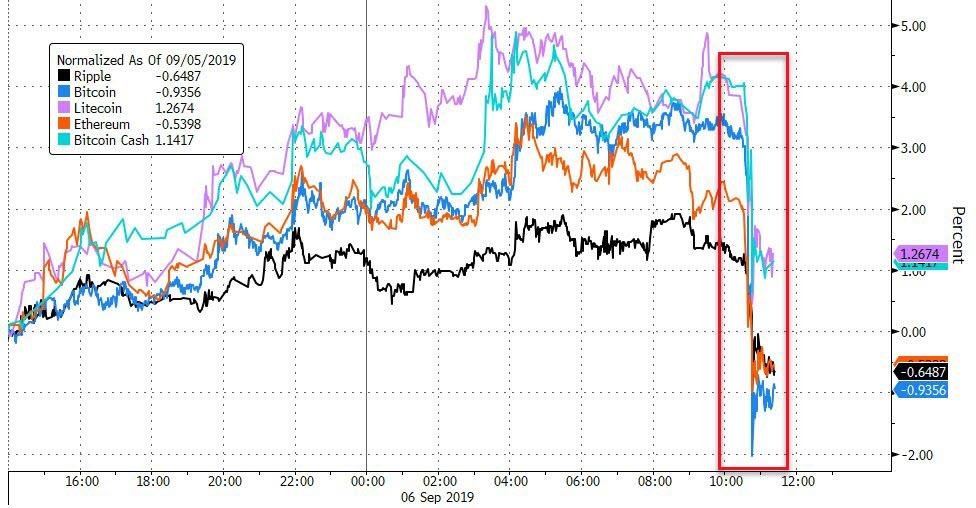
Echoing last Wednesday’s sudden collapse, cryptos all just got monkey-hammered lower in seconds after a positive week…
Bitcoin is leading the drop, but the whole space is suddenly down…
Source: Bloomberg
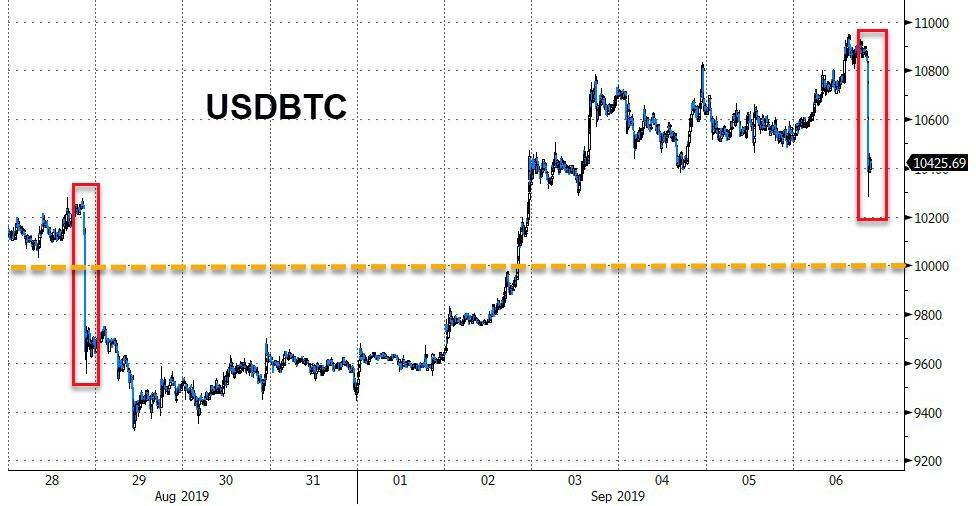
And Bitcoin is holding above $10k as it follows a similar path to last week’s slow pump and sudden dump…
Source: Bloomberg
The good news is that, as CoinTelegraph reports, Miss Finland is a big bitcoin fan and tries to explain why it is not more widely held.
In a Twitter discussion on Sept. 5, Miss Universe Finland 2015 winner, Rosa-Maria Ryyti, argued Bitcoin’s risk factor made it more appealing to men.
She was responding to a query by analyst and Cointelegraph contributor, Filb Filb, who asked followers why the Bitcoin community was overwhelmingly male.
“Women are more risk-conscious in general and often go for a ‘slow & steady’ investment strategy,” Ryyti wrote, adding:
“The current general perception of Bitcoin in the msm makes it even less probable for the average women (and men) to get involved.”
Is crypto shifting the gender balance?
Data currently available suggests around 90% of Bitcoin users are male. The phenomenon has frequently sparked debate, with dedicated structures set up in order to increase female involvement.
In June, Cointelegraph reported that 5% of Github commits involving cryptocurrency code came from women. Conversely, a report the following month suggested that out of all crypto holders in Europe, as many as 20% are female.
Ryyti herself rose to prominence more recently, participating in the Lightning Torch Bitcoin transaction relay earlier this year.
via ZeroHedge News https://ift.tt/2ZUxsLk Tyler Durden
The security service for the Canadian Senate has apologized to an energy industry executive who complained in an open letter about being forced to turn his T-shirt inside out during a tour of the building after a security official said it might offend some people.
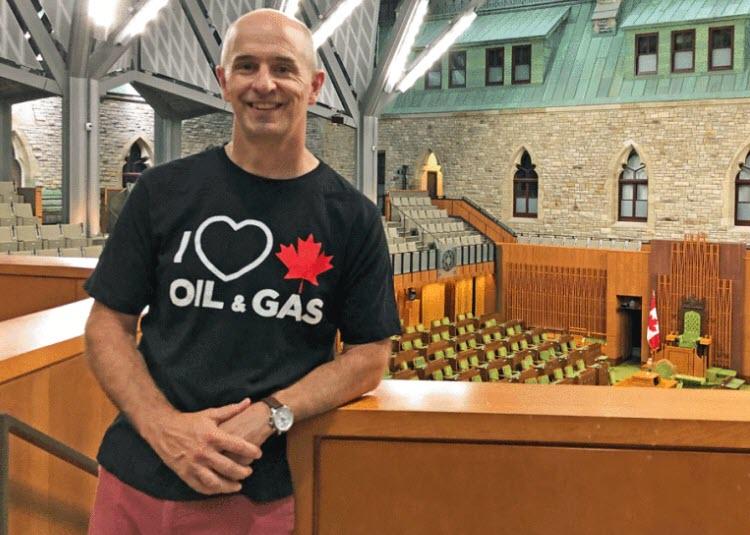
The Calgary Herald reports William Lacey, chief financial officer of Steelhead Petroleum, was on tour of the Senate with his family wearing a T-shirt that said “I love Canadian oil” on the front and “The world needs more Canadian energy” on the back.
According to Lacey, “The guard looked at me and he said, ‘Sir, I’m gonna have to ask you to remove your shirt because some people may be offended by the message,’” after which he invited Lacey to either turn the T-shirt inside out or leave the premises.
Lacey did turn his shirt inside out to continue the tour but once he got home, he wrote an open letter to express his frustration with the way the Senate security guard had treated him.
Under an image of the “offensive” shirt, Lacey wrote, “Nowhere does the shirt say anything negative, defamatory or insulting to others. Far from it – it advocates a responsible and ethical approach to resource development. Last I checked, freedom of expression is protected under Section 2 of the Canadian Charter of Rights and Freedoms. Moreover, there were other people on the tour who had graphics of things like a skull with a cross on the forehead, an anti-discrimination shirt (ironic) and one with a peace symbol on it.”
“The last time I checked there was nothing illegal about the Canadian energy sector,” Lacey wrote, “and yet I was made to feel as though I should be embarrassed for what I was wearing. The solution? I was told I could either leave or I could turn my shirt inside out and take part in the tour – I chose the latter option. The next stop on our tour was the House of Commons, where I was welcomed and there were absolutely no concerns expressed regarding my shirt. I went out of my way to talk with various members of security and not one of them raised an eyebrow at my shirt.”
Further on in his letter, the energy executive asked if it was the policy of the federal government to shame members of the Canadian energy industry.
The letter, according to the Calgary Herald, caught the attention of Conservative legislators who presented the case to a parliamentary committee and asked the security service for an explanation. The service admitted the guard had gone too far and offered Lacey apologies.
via ZeroHedge News https://ift.tt/2UEzaj4 Tyler Durden
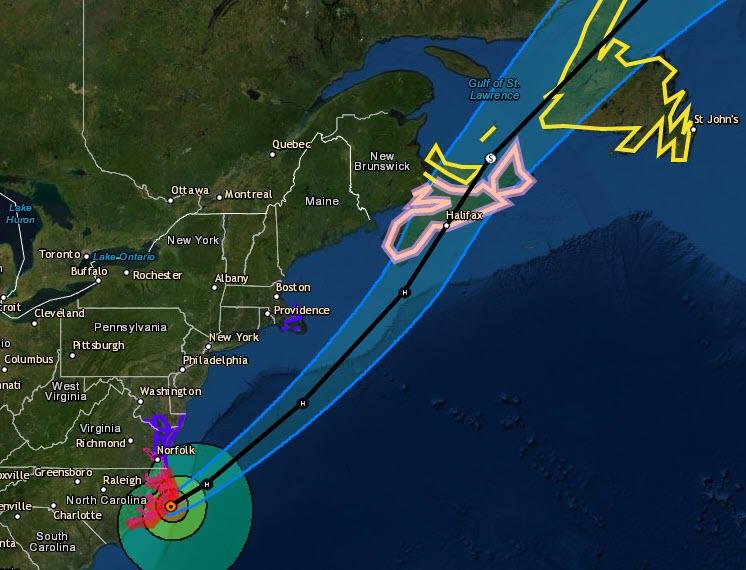
Despite being downgraded to Category 1, winds still reached up to 90mph as Hurricane Dorian blew ashore at Cape Hatteras, making its first landfall on the U.S. mainland, flooding homes in the low-lying ribbon of islands and throwing a scare into year-round residents who tried to tough it out.
“It’s bad,” Ann Warner, who owns Howard’s Pub on Ocracoke Island, said by telephone. “The water came up to the inside of our bottom floor, which has never had water.” She said a skylight blew out and whitecaps coursed through her front yard and underneath her elevated house.
“We’re safe,” Warner added. “But it’s certainly a mess.”
As of this morning, Dorian was moving northeast at 14 mph (22 kph). It is expected to remain a hurricane as it sweeps up the Eastern Seaboard on Friday and Saturday, far enough offshore that its hurricane-force winds are unlikely to reach land.
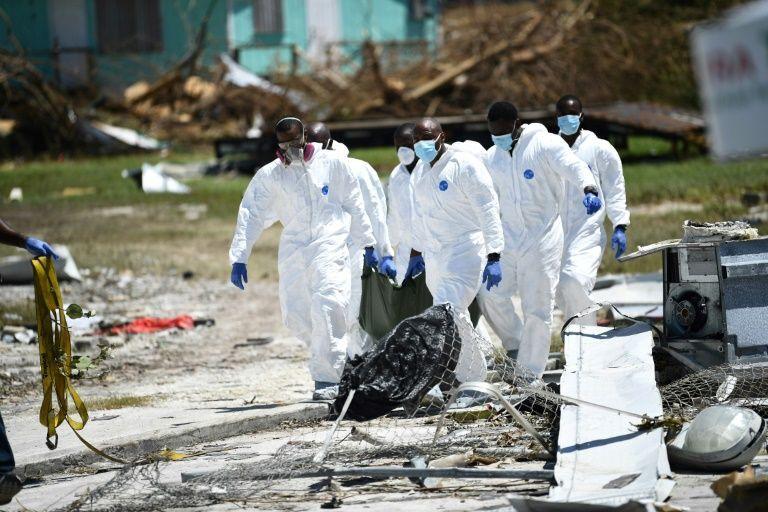
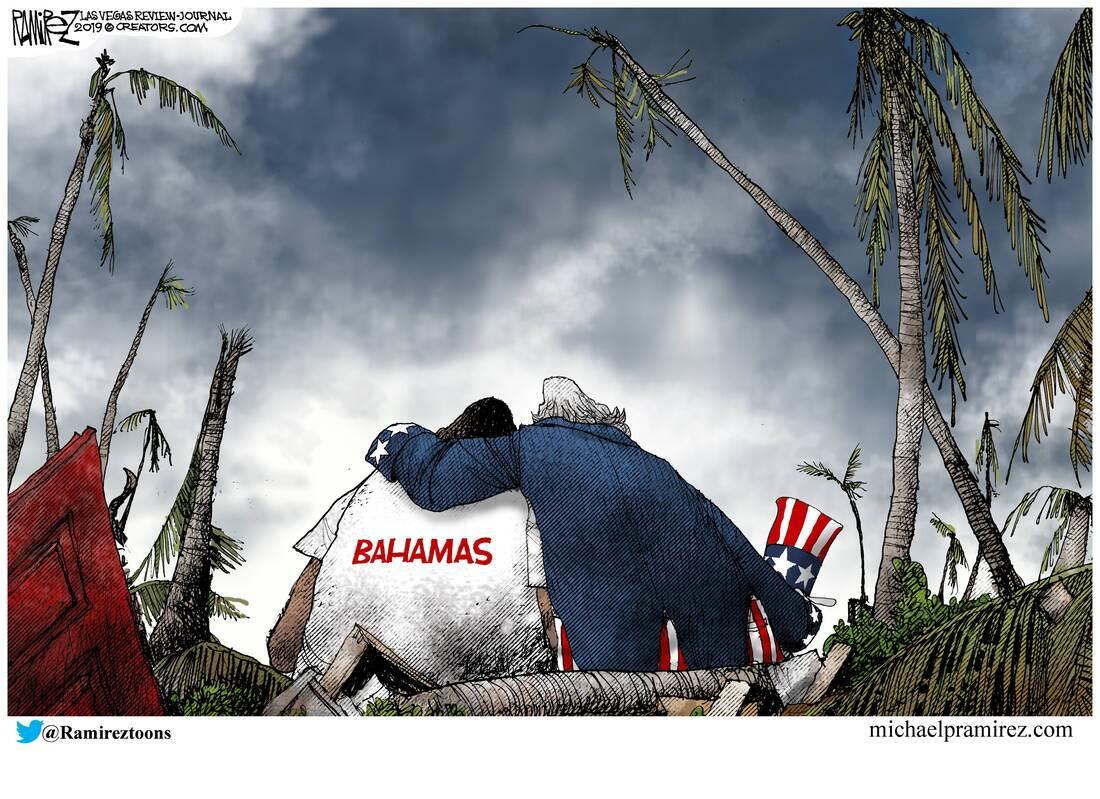
While the damage was far less than feared in many parts of the Carolinas, the ‘warzone’ left behind in the Bahamas is getting worse by the day.
“There’s just no way everyone’s going to get out,” says a woman fleeing Hurricane Dorian in the Bahamas, adding that people are trying to shoot each other for supplies.
“It’s just total devastation… there’s nothing left,” exclaims one woman as she tries to flee the islands. “People are starting to panic… pillaging, looting, trying to shoot people for food…”
As Yahoo reports, much of Great Abaco island remains inundated, making emergency access difficult. Hundreds of boats – smaller dinghies and large trawlers – lie on their sides or flipped like pancakes onto their decks, supine and abandoned to their fate by the receding ocean.
“We’re the lucky ones, but it’s hell everywhere,” says Brian Harvey, a Canadian trapped in the Bahamas by the hurricane and desperate for a place on a helicopter. “We need to get out of here, man.”
The death toll has risen to 30.
As AP reports, the United Nations announced the purchase of eight tons of ready-to-eat meals and said it will provide satellite communications equipment and airlift storage units, generators and prefab offices to set up logistics hubs. U.N. humanitarian chief Mark Lowcock said about 70,000 people “are in immediate need of life-saving assistance” on Grand Bahama and Abaco.
A British Royal Navy ship docked at Abaco and distributed supplies to hurricane survivors. On Grand Bahama, a Royal Caribbean cruise ship dropped off 10,000 meals, 10,000 bottles of water and more than 180 generators, as well as diapers and flashlights.
But the situation remains very far from hopeful for now…
“People will be out of jobs for months,” 67-year-old wood carver Gordon Higgs lamented. “They’ll be homeless, no food. Nothing.”
via ZeroHedge News https://ift.tt/2MWpqQd Tyler Durden
After leaving the Bahamas for dead, Hurricane Dorian barely grazed the US mainland en route to the Canadian shoals of oblivion, perhaps saving America’s insurance industry. But the steamy west coast of Africa is hurling out a cavalcade of replacements as the high season for Atlantic storms commences, so better keep the plywood sheets at hand.
Lots of things are looking stormy around the world just now: nations, markets, politics — everything really except all three divisions of the American League… yawn…
The world is in a nervous place these days.
The US is something like the world’s crazy old auntie, whom everyone else would like to lock in the attic. Except she happens to be cradling a bazooka, so they’ll go on trying to ignore her a while longer, hoping she doesn’t launch any rockets at the neighbors.
Britain courts chaos in its attempt to keep staving off the Brexit quandary, which itself seems to promise a hearty dose of chaos as thousands of unresolved trade issues threaten the country’s economic future walking out on Europe. The majority who voted Brexit feel that the EU is already crushing them under bureaucratic diktat and immigration quotas. New Prime Minister Bo-Jo has tried one ploy after another in his quest to reach the Halloween Brexit ramp. Everyone is ganging up on him, even his own brother, Jo Johnson, who has quit the cabinet and is ditching his seat in parliament. Bo-Jo wants to call an election because there is no one else to take his place, and many of those piling on him also detest the opposition Labor Party leader, Jeremy Corbyn. Events are outrunning anybody’s ability to see what happens next. Street violence is not out of the question.
What’s at stake behind all the pushing-and-shoving is the question of national sovereignty.Does it matter anymore? I suspect it will matter increasingly for everyone in many nations, and at a smaller and smaller scale of political divisions so that, for instance, Great Britain itself will be faced with surrendering its dominion over Scotland and Northern Ireland. This is churning in the zeitgeist now, actually has been for some time since the Soviet Union and Yugoslavia cracked up. Even the United States finds itself increasingly disunited and it’s not inconceivable that before the century ends some regions may go their own way. Texans have been talking it up for years, and California is already acting like she’s started divorce proceedings.
China, meanwhile, is whipping its quasi-vassal Hong Kong like a dog because Xi Jinping is not in a position to bust Donald Trump upside the head and Xi’s got to take it out on somebody. Everything was looking so rosy for China as it burst out of its medieval cocoon into industrial adulthood, and now Mr. Trump is ruining the global arrangements that turned the sclerotic old outfit into a global super-dragon. They’ve had a blast driving down the capitalist road — even if they’re actually ruled by communists — but a storm of bad debt is coming up on them from behind, and if it catches up, the joyride is over and some kind of dreadful crackup happens.
All the abiding normality of the past seventy years is slipping away into flux. Modernity is finally yielding – to what? Nobody knows. And nowhere is this more obvious than in the realm of money and economy. Beyond all the other quarrels of modern times — democracy versus communism, Islam versus the West, the wealthy north versus the poor south — one thing remained pretty steady: the flow of oil into the engines of economy. Turned out, the world didn’t have to run out of oil for that normality to fray badly; the oil just had to become marginally unaffordable, and voila! It’s hard for people to grok, especially here in the USA with oil production so far above the old 1970 prior peak that the proposition seems absurd.
But it is so. The companies chasing shale oil have done it on tons of borrowed money, and now having demonstrated that it’s not a profitable business, investors have soured on them and they can’t get new loans. A contagion of bankruptcies is underway among them and it’s going to get worse because the business model for shale oil is a joke.
But the business model for the nations of the world is also a joke: borrow as much as you can from your own future and pray for a happy ending. It is driving the whole world insane. It’s exactly why people in the USA think it’s a good idea for trannies with arrest records to read stories to six-year-olds.
These delusions and the financial head trips that spawn them will also get worse as the nations of the world go deeper into the alternative universe of zero-interest financing and Ponzi pretense. Without that cheap oil, growth is impossible, and without growth, crackup is inevitable.
via ZeroHedge News https://ift.tt/2HSddb3 Tyler Durden
“The widescale use of self-checkout machines in our state’s grocery stores is part of a deliberate corporate strategy that relies on automation to reduce labor costs and eliminate jobs,” Oregon AFL-CIO President Tom Chamberlin said in a statement. After the state attorney general drafts an official ballot title for its measure, petitioners will have to collect 112,000 signatures in order to qualify for the state ballot.
The text of the ballot initiative details a number of ills allegedly caused by self-checkout machines.
These include the loss of grocery store jobs, the enabling of underage alcohol purchases, and an increase in “social isolation and related negative health consequences.” The text also mentions difficulties the disabled or elderly sometimes have with operating the machines.
The state’s Bureau of Labor and Industry would be empowered to fine noncompliant stores the equivalent of one day’s salary and benefits for their highest-paid retail clerk. That’s for the first offense; further violations would result in increased fines.
The Willamatte Week reports that the initiative comes in the midst of tense salary negotiations between the grocery store chain Fred Meyer and the United Food and Commercial Workers (UFCW) Local 555, an AFL-CIO-affiliated union that represents grocery store workers in Oregon and Southwest Washington. In late August, the UFCW voted to authorize a strike should negotiations with Fred Meyer break down.
One could interpret this initiative as a way of applying pressure on Fred Meyer during these negotiations. It’s not hard to see why labor organizations would want to effectively require stores to hire more of their members.
That perhaps explains why the public-spirited arguments offered by the Oregon AFL-CIO for their measure are so weak.
For starters, grocery stores continue to maintain a hybrid of self-checkout machines and full-service checkout aisles. Folks who have difficulty operating self-checkout machines or who enjoy bantering with clerks can still opt to have an employee to scan their groceries for them.
And while a reduction in labor costs might be a bad thing for unions, it’s generally good for customers, who reap the benefits of lower prices. These same consumers can then spend the money they save on other products and services, creating more jobs that don’t need to be mandated into existence.
Indeed, the arguments advanced by the Oregon AFL-CIO’s ballot initiative could just have been deployed a century ago to prevent grocery stores from transitioning to modern, human-staffed checkout aisles the group is now trying to preserve. Back in the day, customers had to wait on grocery store staff to assemble their orders for them. The introduction of self-service grocery stores in the early 20th century allowed patrons to stroll the aisles themselves, picking out which goods they wanted. The change saved shoppers and stores time and money, creating the far more convenient stores we know today.
Few would argue that we’d be better off if lawmakers in the 1920s chose to ban self-service grocery stores in an effort to save jobs and prevent “social isolation.” Cracking down on self-checkout machines seems equally foolish.
from Latest – Reason.com https://ift.tt/2ZFlzgl
via IFTTT
“The widescale use of self-checkout machines in our state’s grocery stores is part of a deliberate corporate strategy that relies on automation to reduce labor costs and eliminate jobs,” Oregon AFL-CIO President Tom Chamberlin said in a statement. After the state attorney general drafts an official ballot title for its measure, petitioners will have to collect 112,000 signatures in order to qualify for the state ballot.
The text of the ballot initiative details a number of ills allegedly caused by self-checkout machines.
These include the loss of grocery store jobs, the enabling of underage alcohol purchases, and an increase in “social isolation and related negative health consequences.” The text also mentions difficulties the disabled or elderly sometimes have with operating the machines.
The state’s Bureau of Labor and Industry would be empowered to fine noncompliant stores the equivalent of one day’s salary and benefits for their highest-paid retail clerk. That’s for the first offense; further violations would result in increased fines.
The Willamatte Week reports that the initiative comes in the midst of tense salary negotiations between the grocery store chain Fred Meyer and the United Food and Commercial Workers (UFCW) Local 555, an AFL-CIO-affiliated union that represents grocery store workers in Oregon and Southwest Washington. In late August, the UFCW voted to authorize a strike should negotiations with Fred Meyer break down.
One could interpret this initiative as a way of applying pressure on Fred Meyer during these negotiations. It’s not hard to see why labor organizations would want to effectively require stores to hire more of their members.
That perhaps explains why the public-spirited arguments offered by the Oregon AFL-CIO for their measure are so weak.
For starters, grocery stores continue to maintain a hybrid of self-checkout machines and full-service checkout aisles. Folks who have difficulty operating self-checkout machines or who enjoy bantering with clerks can still opt to have an employee to scan their groceries for them.
And while a reduction in labor costs might be a bad thing for unions, it’s generally good for customers, who reap the benefits of lower prices. These same consumers can then spend the money they save on other products and services, creating more jobs that don’t need to be mandated into existence.
Indeed, the arguments advanced by the Oregon AFL-CIO’s ballot initiative could just have been deployed a century ago to prevent grocery stores from transitioning to modern, human-staffed checkout aisles the group is now trying to preserve. Back in the day, customers had to wait on grocery store staff to assemble their orders for them. The introduction of self-service grocery stores in the early 20th century allowed patrons to stroll the aisles themselves, picking out which goods they wanted. The change saved shoppers and stores time and money, creating the far more convenient stores we know today.
Few would argue that we’d be better off if lawmakers in the 1920s chose to ban self-service grocery stores in an effort to save jobs and prevent “social isolation.” Cracking down on self-checkout machines seems equally foolish.
from Latest – Reason.com https://ift.tt/2ZFlzgl
via IFTTT
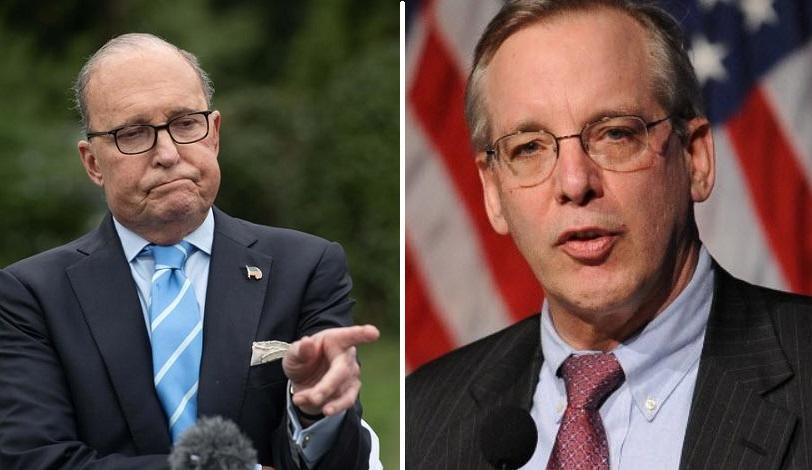
White House economic adviser and Director of the National Economic Council Larry Kudlow slammed former New York Fed president Bill “Deep State” Dudley, who wrote in a stunning Bloomberg op-ed that the central bank should avoid cutting interest rates in order to soften the economic impact of President Trump’s trade war with China.
“With respect to Bill Dudley, whom I have known for many years, Bill Dudley went over the cliff,” Kudlow told Bloomberg Television’s Jonathan Ferro on Friday, adding that Dudley was politicizing the independent Fed – while arguing that President Trump’s constant criticism of Fed chairman Jerome Powell don’t amount to the same interference.
“That is the most politicized statement I have ever heard,” Kudlow said.
Dudley sparked swift criticism after writing a Bloomberg Opinion column on Aug. 27 suggesting that the Fed reject interest-rate cuts that would help Trump’s prospects for re- election in 2020. Dudley argued the central bank would risk enabling further escalation by the president in the trade war with China and said that officials should state explicitly that they “won’t bail out an administration that keeps making bad choices on trade policy.” –Bloomberg
Dudley backpedaled in a September 4 follow-up, claiming that he doesn’t think the Fed should attempt to influence the 2020 US election through monetary policy, while insisting “There is no “deep state” or conspiracy that I am part of.”
He tried to explain that the combination of the trade war and the president’s attacks on the Fed “threatened to put the central bank in an untenable position”, one where Trump was shifting responsibility for the downside risks from his trade war onto the Fed. “I thought this was an important issue worth exploring,” he said.
Kudlow called Dudley’s op-ed and follow-up as “utter nonsense” and a “new low.”
“I’ve never seen anything like the Dudley statement,” he said, adding “There is no excuse or defense for it.”
Kudlow said his own conversations made clear that the Fed board was “horrified” by Dudley’s op-ed. Trump has regularly criticized the Fed, called for lower rates and lamented being stuck with Powell. Earlier Friday, Trump tweeted: “Where did I find this guy Jerome? Oh well, you can’t win them all!”
I agree with @jimcramer, the Fed should lower rates. They were WAY too early to raise, and Way too late to cut – and big dose quantitative tightening didn’t exactly help either. Where did I find this guy Jerome? Oh well, you can’t win them all!
“The market is telling us the Fed’s going to lower rates in September and October. I think that’s a good thing,” said Kudlow, adding “In any event, the Fed is professional, they are independent, they’re going to do what I think they need to do, and that’s going to help the economy.“
The next Fed meeting will be Sept. 17-18 in Washington.
via ZeroHedge News https://ift.tt/34toGYd Tyler Durden
A beef between Mississippi lawmakers and producers of meat substitutes may be ending with a satisfactory compromise.
Mississippi passed a law earlier this year that banned labeling plant-based meat substitutes (veggie burgers, etc.) as “meat” or a “meat food product.” This silly state-mandated censorship was an attempt to help protect entrenched agricultural interests from competition. Proponents claimed the law was intended to prevent “confusion,” which is utter nonsense. People are not generally tricked into buying meat substitutes based on food labels, and vegan and vegetarian foods clearly label themselves as such specifically to appeal to those who don’t eat real meat. There was really no pressing reason for the Mississippi lawmakers to get involved, except to satisfy producers of beef, chicken, and pork products at a time where the quality of meatless substitutes is improving and potentially reaching a greater number of customers.
The Institute for Justice, teaming up with the Plant Based Foods Association and a vegan food company called Upton’s Naturals, filed a federal suit in July to block the law, arguing that it violated of the First Amendment rights of businesses such as Upton’s. As institute attorney Justin Pearson noted back in July, “Under the First Amendment, businesses should be able to use almost any word they want, as long as consumers understand what they are saying. People know that vegan burgers do not come from cows. That is why they are called ‘vegan.'”
Today the Institute of Justice announced what appears to be a successful end to the fight. The Mississippi Department of Agriculture has withdrawn the regulations it proposed to enforce the law and introduced a new set of regulations. Under the new proposal, it’s still wrong for a plant-based food product to be labeled as “meat” or a “meat food product,” but there will be exceptions for products that include an appropriate qualifying term on the label, such as “plant-based,” “meatless,” “vegetarian,” or “vegan.”
So terms like “veggie burgers” or “meatless bacon” will be allowed on labels in Mississippi. Upton’s Naturals can still sell its seitan “Classic Burger“—seitan is a wheat gluten meat substitute—as long as the label also makes it clear it’s not beef.
“The new proposed regulation is a victory for the First Amendment and for common sense,” Pearson said in a statement today. “Mississippi has made the wise decision to change those regulations so that companies will be free to continue selling vegan and vegetarian burgers and other meat alternatives in the Magnolia State.”
If the proposed regulations are adopted (there’s a 25-day period for the Department of Agriculture to accept comments), the institute, Upton’s, and the Plant Based Foods Association will consider dropping their federal lawsuit.
And there’s more good news on the horizon for anyone who’s been looking to make the shift away from real meat but doesn’t want to miss the flavor: At the end of July, the Food and Drug Administration approved the sale of Impossible Burger meat directly to consumers at supermarkets. Starting later this fall, you will no longer have to go to restaurants to get them; you’ll be able to bring them home and craft your own recipes. I’ve had one myself, and yeah, beef producers should maybe be just a little bit worried.
from Latest – Reason.com https://ift.tt/2LoMhQU
via IFTTT
A beef between Mississippi lawmakers and producers of meat substitutes may be ending with a satisfactory compromise.
Mississippi passed a law earlier this year that banned labeling plant-based meat substitutes (veggie burgers, etc.) as “meat” or a “meat food product.” This silly state-mandated censorship was an attempt to help protect entrenched agricultural interests from competition. Proponents claimed the law was intended to prevent “confusion,” which is utter nonsense. People are not generally tricked into buying meat substitutes based on food labels, and vegan and vegetarian foods clearly label themselves as such specifically to appeal to those who don’t eat real meat. There was really no pressing reason for the Mississippi lawmakers to get involved, except to satisfy producers of beef, chicken, and pork products at a time where the quality of meatless substitutes is improving and potentially reaching a greater number of customers.
The Institute for Justice, teaming up with the Plant Based Foods Association and a vegan food company called Upton’s Naturals, filed a federal suit in July to block the law, arguing that it violated of the First Amendment rights of businesses such as Upton’s. As institute attorney Justin Pearson noted back in July, “Under the First Amendment, businesses should be able to use almost any word they want, as long as consumers understand what they are saying. People know that vegan burgers do not come from cows. That is why they are called ‘vegan.'”
Today the Institute of Justice announced what appears to be a successful end to the fight. The Mississippi Department of Agriculture has withdrawn the regulations it proposed to enforce the law and introduced a new set of regulations. Under the new proposal, it’s still wrong for a plant-based food product to be labeled as “meat” or a “meat food product,” but there will be exceptions for products that include an appropriate qualifying term on the label, such as “plant-based,” “meatless,” “vegetarian,” or “vegan.”
So terms like “veggie burgers” or “meatless bacon” will be allowed on labels in Mississippi. Upton’s Naturals can still sell its seitan “Classic Burger“—seitan is a wheat gluten meat substitute—as long as the label also makes it clear it’s not beef.
“The new proposed regulation is a victory for the First Amendment and for common sense,” Pearson said in a statement today. “Mississippi has made the wise decision to change those regulations so that companies will be free to continue selling vegan and vegetarian burgers and other meat alternatives in the Magnolia State.”
If the proposed regulations are adopted (there’s a 25-day period for the Department of Agriculture to accept comments), the institute, Upton’s, and the Plant Based Foods Association will consider dropping their federal lawsuit.
And there’s more good news on the horizon for anyone who’s been looking to make the shift away from real meat but doesn’t want to miss the flavor: At the end of July, the Food and Drug Administration approved the sale of Impossible Burger meat directly to consumers at supermarkets. Starting later this fall, you will no longer have to go to restaurants to get them; you’ll be able to bring them home and craft your own recipes. I’ve had one myself, and yeah, beef producers should maybe be just a little bit worried.
from Latest – Reason.com https://ift.tt/2LoMhQU
via IFTTT