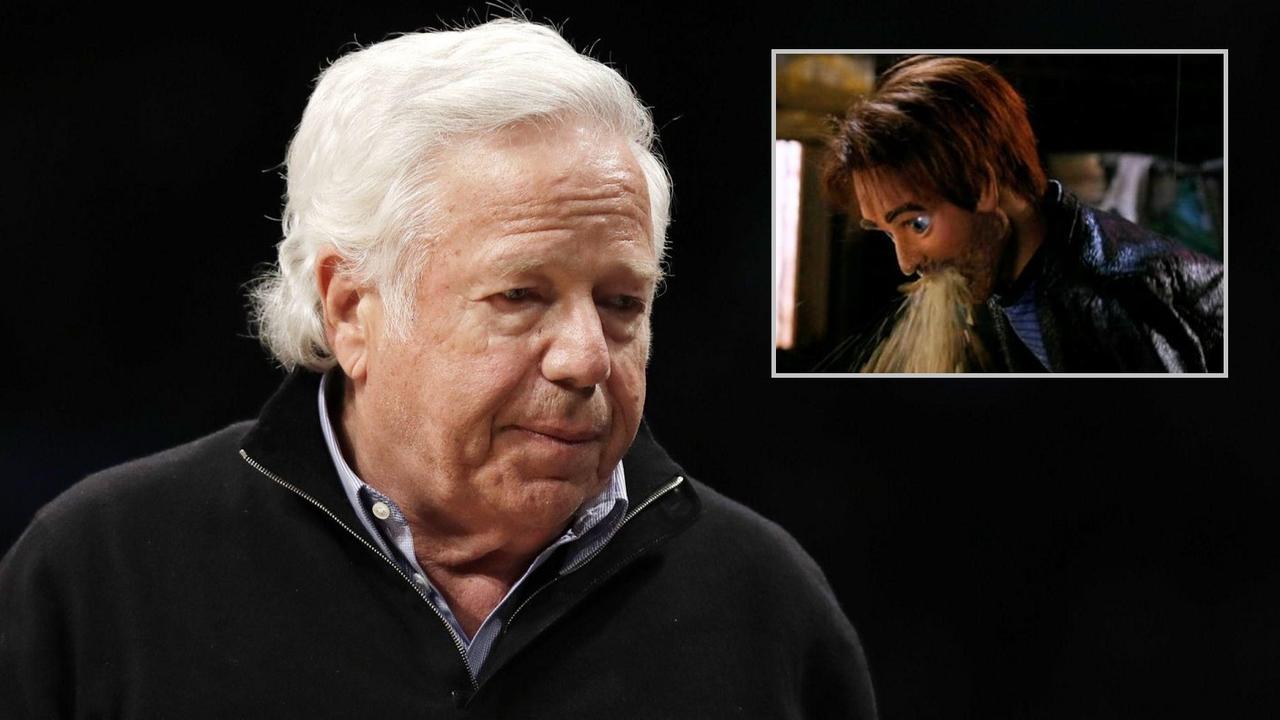
Despite desperate pleas from the madam’s legal team, a sex tape showing billionaire Patriots owner Robert Kraft getting a massage with a happy ending has leaked.
According to the Daily Mail, attorneys for the manager of the Orchids of Asia Day Spa, Lei Wang, appeared at an emergency court hearing on Wednesday to ask that the judge bar the Jupiter police from leaking the hidden camera footage showing two of its employees performing oral and manual sex acts on Kraft.
However, the tape was leaked anyway, and the attorneys are now requesting that the police be held in contempt of court.
via ZeroHedge News http://bit.ly/2PirHTW Tyler Durden
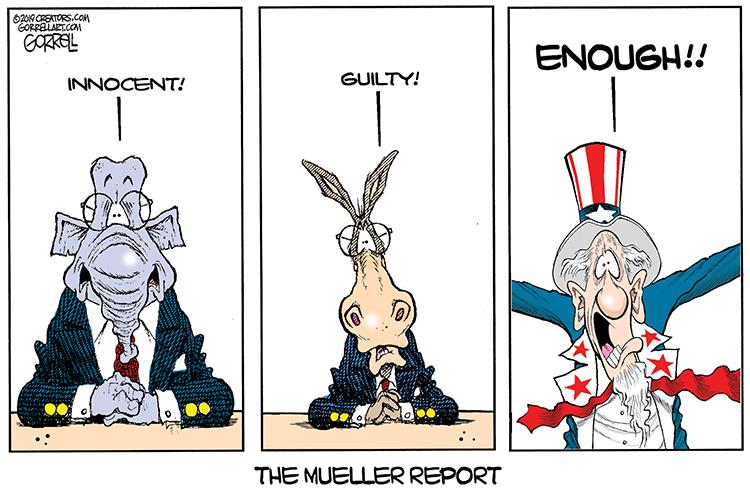
After two years of gaslighting the public while it blew smoke up America’s ass, the Jacobin news media enjoyed its final feeding frenzy with the release of the 400-page Mueller report. They expected 1000 pounds of raw filet mignon, but it turned out to be tofu fried in olestra. The ensuing fugue of hyperventilating hysteria was also duly expected and William Barr stoically endured their hebephrenic peevings at the release ceremony — a press conference which itself offended the media.
The threats and raving continued all the livelong day and far into the peeper-filled night with CNN’s Chris Cuomo blustering “It’s time to rumble,” and the lugubrious hack David Gergen muttering soulfully, “This was not fake news,” and The Times’ Maggie Haberman fuming that the White House had played the “Nazi anthem” Edelweiss — very fake news, it turned out, since the tune was written for Rodgers’ and Hammerstein’s 1959 Broadway show, The Sound of Music (and sung by the anti-Nazi hero Baron von Trapp). Meanwhile Rachel Maddow had the balls to confab in prime time with disgraced former FBI mandarin Andy McCabe, officially identified as a liar by his own colleagues at the agency. What a circus of perfidious freakery!
Understand that the Mueller Report itself was the mendacious conclusion to a deceitful investigation, the purpose of which was to conceal the criminal conduct of US government officials meddling in the 2016 election, in collusion with the Hillary Clinton campaign, to derail Mr. Trump’s campaign, and then disable him when he managed to win the election. Mr. Mueller was theoretically trying to save the FBI’s reputation, but he may have only succeeded in injuring it more gravely.
The whole wicked business began as a (failed) entrapment scheme using shadowy US Intel “assests” Stefan Halper and Joseph Mifsud to con small fish Papadopoulos and Carter Page into incriminating themselves (they declined to be conned) and moved on to ploys like the much-touted Trump Tower meeting to ensnare Trump Junior and then to several efforts (also failed) to flip Paul Manafort, and Michael Cohen — the final product of which was an epic failure to find one instance of real chargeable criminal collusion between anyone connected to Mr. Trump and Russia.
By the way, the Mueller Report failed to mention that the two Russians present in that August 2016 Trump Tower meeting, lawyer Natalia Veselnitskaya and lobbyist Rinat Akhmetshin, were on the payroll of Hillary Clinton’s oppo research contractor Fusion GPS, and met with that company’s principal, Glenn Simpson, both before and after the meeting — just one example among many of the Mueller Team’s shifty tactics, but a move that speaks volumes about Mr. Mueller’s actual intent, which was to keep his prosecutorial circus going as long as possible to interfere with Mr. Trump carrying out his own duties.
The Special Prosecutor’s main bit of mischief, of course, was his refusal to reach a conclusionon the obstruction of justice charge. What the media refuses to accept and make clear is that a prosecutor’s failure to reach a conclusion is exactly the same thing as an inability to make a case, and it was a breach of Mr. Mueller’s duty to dishonestly present that failure as anything but that in his report — and possibly an act of criminal prosecutorial misconduct.
Like any tantrum, the media’s frenzy will run out of steam (and credibility) and now they will be whipped like dogs for betraying their public trust.
There is a counter-narrative to the “Resistance” narrative, and it is a true crime story. That suppressed story is finally going to roll out in the implacable workings of actual (not fake) justice and it is going to crush a lot of people who concocted this epic political hoax, including some members of the press who knowingly and dishonestly abetted it.
Many criminal referrals have already been made on the likes of James Comey, Andrew McCabe, Peter Strzok, Lisa Page, and Bruce Ohr, and a big net has been cast to pull in the figures who have been hiding in the thickets lo these two-and-a-half-years of smoke and gaslight: Loretta Lynch, Sally Yates, William Brennan, James Clapper, Nellie Ohr, Samantha Power, Bill Priestap, Jim Rybicki, James Baker, Mike Kortan, John Carlin, Mary McCord, Josh Campbell and more. Some of these are going to jail and some have already flipped. The fetchings should reach the Obama White House. Mr. Mueller himself, even in his majestic granitic silence, will be liable for failing to inform his boss, the Attorney General, that the predicate document for his witch hunt was known to be a fraud back in 2016, and was used anyway to spy on a presidential candidate.
Let congress put on a carnival of its own now. It will be greeted like a TV commercial for a hemorrhoid remedy while the real national psychodrama plays out in grand juries and courtrooms, demonstrating what a grievous injury was done to this republic by its own vested authorities.
via ZeroHedge News http://bit.ly/2W3k32c Tyler Durden
I haven’t read the Mueller report and I don’t plan to any time soon. I don’t feel like I would gain much by sifting through what’s already been widely acknowledged to be 400-plus pages of Rorschach test. The main point of the “Russia probe” was to figure out whether there was any sort of hanky-panky going on between the former (future?) Soviets and the Trump campaign, and we now know that there was not.
But of course now the story shifts from dark worries about “collusion” to unrestrained outrage over the president’s ham-fisted attempts to “obstruct justice” by unduly influencing the investigation by lying in public and private, firing key players, leaning on witnesses, or otherwise gumming up the works. I trust my Reason colleagues (Scott Shackford, Peter Suderman, Jacob Sullum, and Eric Boehm), each of whom argues to varying degrees that if President Donald Trump isn’t technically guilty of obstruction, it’s not for lack of trying. It’s mostly because his subordinates either refused to follow his orders or screwed things up while trying to do his bidding.
But you know what? I don’t care that much that Trump was trying to obstruct justice in this instance. Certainly, if there is no underlying crime, you shouldn’t get in trouble for lying to the feds, even though it’s technically illegal. Section 1001 of Title 18 of the United States Code makes it a crime to
“knowingly and willfully … make[] any materially false, fictitious, or fraudulent statement or representation” in the course of “any matter within the jurisdiction of the executive, legislative, or judicial branch” of the federal government.
But should it be? We’ll come back to the White House in a moment, but the way this sort of usually plays out for the little people is that, as Jim Talent observed last year in National Review,
The FBI gathers information about a person, finds facts that the person might want to conceal — not because the facts prove a crime but because they are embarrassing for some other reason — then asks about those facts in an interview, on the expectation that the person will lie and thereby incriminate himself.
As Popehat blogger (and Reason contributor) Ken White has detailed extensively, FBI agents are trained to get you to lie, thereby being able to arrest you or squeeze you however they want. As White wrote for Reasona year ago,
In the old westerns, rather than take the trouble of hauling mustachioed miscreants to desultory trials, lawmen would often provoke them into drawing first, thus justifying shooting them down where they stood. A modern federal interview of a subject or target is like that. One purpose, arguably the primary purpose, is to provoke the foolish interviewee into lying, thus committing a new, fresh federal crime that is easily prosecuted, rendering the original investigation irrelevant. Title 18, United States Code, Section 1001, which makes it a felony to lie to the feds, is their shiny quick-draw sidearm. This result not an exception; it is the rule. It happens again and again.
Consider George Papadopoulos. The special counsel secured his guilty plea not for improper contact with the Russians but for lying about that contact to the FBI. Consider Michael Flynn. He too pled guilty not to unlawful contact with Russians but to lying to the FBI about that contact. Consider Scooter Libby, or Martha Stewart, or Dennis Hastert, or James Cartwright, all taken down by the feds not for their alleged original misconduct but for lying about it. Even when catching someone in a lie isn’t enough to force them to plead guilty, it can add charges to a case. Consider Paul Manafort and Richard Gates, charged not just with substantive crimes but with lying to the FBI about them.
There is arguably no person on the planet less sympathetic than Donald Trump. He is a reflexive liar, a blowhard, a bully, and the goddamned president of the United States. He should be a better person on all fronts and there’s no doubt that he should set a better example than he does. But when it comes to obstructing justice, at least when there was no underlying crime, he shouldn’t be in any trouble whatsoever.
Far more important, the rest of us shouldn’t be when we get set up to lie by the FBI or other law enforcement folks who have a tremendous amount of power. At The New York Times, David Brooks suggests that one of the great messages of the Mueller investigation is that it reveals
Trump doesn’t seem to have any notion of loyalty to an office. All power in his eye is personal power, and the government is there to serve his Sun God self. He’ll continue to trample the proper systems of government.
There’s much truth to that formulation, which has been echoed by many of the president’s critics. But there’s a bigger takeaway worth underscoring, one that is vastly more important than Donald Trump who, truth be told, is acting how most presidents have acted in the past and will act in the future.
The bigger takeaway is that the federal government exercises vast and nearly unchecked power over virtually every aspect of our lives. As civil libertarian and Three Felonies a Day author Harvey Silverglate has told Reason, there are literally hundreds of thousands of federal regulations under “each of the federal criminal statutes … [and] you’re just assumed to know [them] and you can be picked up and you can be charged and these are real criminal violations.” And if that doesn’t work, the feds can snag you simply by talking to you. Contempt for Donald Trump shouldn’t obscure that brutal reality, which will outlive the Mueller report and probably most of us, too.
from Latest – Reason.com http://bit.ly/2VTp1ih
via IFTTT
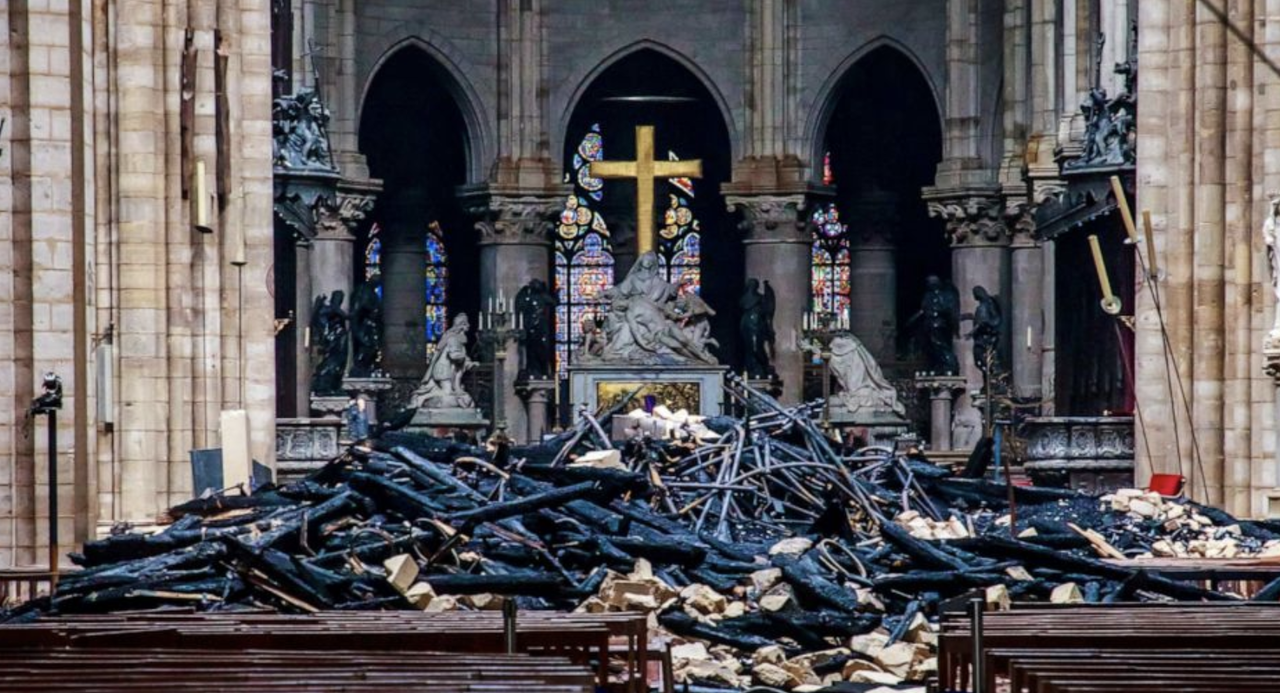
Speculation about the true cause of the fire at Notre Dame has ranged from an innocuous equipment malfunction to a menacing plot to frame gilet jaunes protesters. But according to the rector of the 850-year-old cathedral, the fire that tore through the cathedrals’ oaken beams might have been started by machine, not man.
The New York Post reports that a ‘computer glitch’ may have been responsible for the fire’s start, according to Notre Dame’s rector, Patrick Chauvet.
A “computer glitch” may have been behind the fast-spreading fire that ravaged Notre Dame, the cathedral’s rector said Friday, as architects and construction workers tried to figure out how to stabilize the damaged structure and protect it from the elements.
[…]
Speaking during a meeting of local business owners, rector Patrick Chauvet did not elaborate on the exact nature of the glitch, adding that “we may find out what happened in two or three months.”
Police are reportedly investigating whether a glitch was the cause, or whether the fire was started by the temporary elevators installed by the company handling the renovation work on the cathedral. An electrical short-circuit also may have been responsible for starting the fire.
Meanwhile, planning for the reconstruction efforts is in its early stages. President Macron has appointed a general, Jean-Louis Georgelin, a former chief of staff of the armed forces, to lead the reconstruction effort.
However, a suggestion from Macron to use modern materials to reconstruct the cathedral’s 150-year-old spire, which collapsed during the fire, has sparked a controversy, as France’s conservatives demand that the cathedral be rebuilt with the same oak and stone used in the original construction.
via ZeroHedge News http://bit.ly/2GuCqIe Tyler Durden
California can keep all its sanctuary cities and limit local both law enforcement cooperation and private employer cooperation with immigration officials, ruled a panel of federal circuit judges.
The Department of Justice has been challenging three immigration-focused laws passed by California in 2017. One (SB 54) essentially turned the entire state into an immigration “sanctuary,” significantly restricting the ability of law enforcement officers within the state from assisting the Department of Homeland Security in tracking down or detaining illegal immigrants unless they have been convicted of certain crimes. The second (AB 450) prohibits private businesses from voluntarily allowing federal immigration officials to enter non-public areas of their companies, as well as preventing them from accessing their records unless the feds have warrants. The third (AB 103) imposes inspection requirements on federal immigration detention facilities within California.
The Department of Justice argued that all of these laws are pre-empted by federal government immigration law and inappropriately attempted to impose burdens on the feds. Not so for two of those laws, said three judges with the U.S. District Court for the Eastern District of California. It’s federalism!
The judges’ reasoning for rejecting the feds should be familiar to anybody who paid attention to the conflicts as states started legalizing marijuana for medical use. It’s true that the federal government has the authority to round up people in the country illegally or anybody who has committed crimes that allow for deportation. But the federal government lacks the authority to demand state-level assistance in enforcing federal immigration guidelines, much like the federal government cannot force state or local police to arrest people for violating federal drug laws.
“SB 54 may well frustrate the federal government’s immigration enforcement efforts,” the panel ruled. “However, whatever the wisdom of the underlying policy adopted by California, that frustration is permissible, because California has the right, pursuant to the anti-commandeering rule, to refrain from assisting with federal efforts.”
For AB 450, the Justice Department argued that the bill intruded on the relationship between the feds and employers and attempted to impose requirements on federal inspections that weren’t authorized by Congress. Here the judges said that, actually, the imposition is on the relationship between employers and employees. It controls what employers must and must not do, not what the feds can do. The feds can certainly ask an employer to let them inspect a facility without a warrant. But it’s the employer that will get punished if he or she cooperates.
That may sound like a weird dodge, but it does raise the question of what would happen if a business owner challenged the law. By what authority does the state of California tell private citizens when they can cooperate with immigration officials? That’s significantly different from telling government employees when they can work with the feds.
The judges did determine that AB 103 does, unlike AB 450, burden the federal government with demands that are out of the scope of California’s authority in part and that a lower court erred when it concluded this burden was not significant.
So in the end, the court rejected the Department of Justice’s attempts to stop the first two laws from being implemented and sent the third one back down to a lower court for a second look. It’s another loss for the Trump administration, whose legal efforts against sanctuary city practices have been largely unsuccessful.
It’s hard to be pessimistic about marijuana legalization these days. Recreational cannabis is legal in 10 states and decriminalized in another 14. Virtually all presidential candidates, including Trump, favor letting states decide the legal status of marijuana. Polls show a majority of Republicans even support legalization. And six proposals to move marijuana laws in a more or less libertarian direction are now making their way through Congress.
What do these policy proposals look like? How are states navigating the conflicts between state and federal law? And are there any obstacles left on the path to nationwide legalization?
Reason’s Todd Krainin sat down with Erik Altieri, the executive director of NORML, the National Organization for the Reform of Marijuana Laws, to talk about the building momentum toward nationwide legal pot.
Music—”Reggae Life” by Goymamba.
Produced, hosted, and edited by Todd Krainin. Cameras by Austin Bragg and Meredith Bragg.
Broward County sheriff’s deputies were called to a popular teen meet-up area, a McDonald’s parking lot, Thursday afternoon. The police were there ostensibly to breakup a fight, not start one.
But according to video footage of the encounter, sheriff’s deputies pepper-sprayed at least one black teenager, tackled him, punched him in the head repeatedly, grabbed him by the back of the neck, and slammed his face into the pavement. The Sun Sentinel reported that the victim was a 14-year-old student at J.P. Taravella High School.
Okay c’mon #BlackTwitter , this needs to be seen period! These are MINORS, they going to school to get literally beat up by the police? Oh nah ????????♀️ #BlackTwitter Tag the right people so this could be seen cause this is truly SICK. I am disgusted. pic.twitter.com/dwVORGg74m
The victim left the scene in an ambulance, blood covering his face.
The Broward Sheriff’s Office is “investigating the incident to determine exactly what happened, how it started, how it escalated and they’re looking at the outcome of it,” a police spokesperson toldThe Miami New Times. But bashing a person’s head against hard concrete is never appropriate, regardless of which party escalated the encounter. The officers involved could have killed this young man, and they should face serious consequences.
from Latest – Reason.com http://bit.ly/2VVqDYK
via IFTTT
Just in time for 4/20, a CBS News poll shows that Americans increasingly support legalizing marijuana.
The April 9-14 poll of 1,010 adults, 65 percent of whom said they support legalization, is roughly in line with the results of similar surveys. It’s yet another sign that more and more Americans are tired of pot prohibition.
When CBS commissioned a similar poll in 1979, just 27 percent of respondents wanted legalization. That number rose to 45 percent in 2013, 59 percent in April 2018, and 65 percent, a record high, in the most recent polling.
Again, this latest number isn’t terribly surprising. An October 2018 Gallup poll showed that 66 percent of Americans supported legalization, up an astounding 44 percentage points from 12 percent in 1969. Moreover, 62 percent of respondents told the Pew Research Center they supported legalization in a survey released in October. The results of the University of Chicago’s General Social Survey, released last month, differed slightly, but not by much. A record-high 61 percent of Americans supported legalizing weed in that poll, up from just 16 percent in 1990. And Quinnipiac University’s national survey, the results of which were also published last month, showed 60 percent of Americans support legalization.
So which demographics favor legalization in CBS’s latest survey? Well, 72 percent of adults between the ages of 18 and 34 think weed should be legal, as well as 49 percent of adults ages 65 and over. This phenomenon was also seen in the Quinnipiac survey, where 85 percent of the former age group supported legalization, but just 44 percent of the latter demographic.
“The baby boomers say no to the drug that helped define an era, while the millennials say bring it on,” Tim Malloy, assistant director of the Quinnipiac University Poll, said at the time. “In between are enough voters to rubber stamp legalizing marijuana for recreation as well as medical reasons.” Sixty-three percent of voters between the ages of 35 and 49 supported legalization in the Quinnipiac survey, as well as 59 percent of respondents between the ages of 50 and 64. CBS News did not provide information on those demographics.
Legalization is relatively popular no matter your partisan persuasion, the CBS poll shows. Fifty-six percent of Republican respondents support legalization, as do 66 percent of independent voters and 72 percent of Democrats.
Overall, just 42 percent of respondents said a presidential candidate’s potential support for legalized marijuana would affect whether or not they vote for him or her. Twenty one percent—including 10 percent of Republicans and 25 percent of Democrats—said they’d be more likely to vote for that candidate. Another 21 percent—including 34 percent of Republicans and 12 percent of Democrats—said they’d be less likely to cast their ballot for that candidate.
(It’s worth noting, as Reason‘s Jacob Sullum and Nick Gillespie did on a recent podcast, that most of the 2020 presidential candidates, including Donald Trump, think legalization should be left up to individual states.)
Nearly two-thirds of Americans—66 percent—agree that marijuana is less dangerous than most other drugs. Twenty-seven percent believe it’s equally dangerous, and 5 percent think it’s more dangerous. For whatever it’s worth, it’s virtually impossible to die from a pot overdose: You’d need to consume 1,500 pounds of the stuff within 15 minutes to overdose, according to David Schmader, author of Weed: The User’s Guide, as I’ve previously explained.
Americans’ increasing acceptance of weed is reflected in changing laws around the country. Thirty-two states, as well as the District of Colombia, have legalized weed consumption in at least some cases. In 10 of those states, plus D.C., it’s legal for recreational use. States like New York and New Jersey are dragging their feet on legalization for recreational use, but they’re likely to get there sooner rather than later.
The next step, as Reason‘s Zuri Davis has pointed out, is for states that have legalized weed to address past marijuana convictions and bring the criminal justice system fully up to speed.
Bonus links: Saturday, coincidentally, happens to be 4/20, and Reason has got you covered with a wide array of Weed Week stories. (You should particularly check out my personal favorite, in which Liz Wolfe got high and did her taxes.)
from Latest – Reason.com http://bit.ly/2Iwra01
via IFTTT
An independent analysis of President Donald Trump’s ballyhooed rewrite of the North American Free Trade Agreement (NAFTA) projects that the new three-way trade deal would provide a boost to the U.S. economy but would result in the outsourcing of more automaking jobs.
Overall, though, the United States-Mexico-Canada Agreement (USMCA) is a modest, mild set of reforms—Trump has called NAFTA “one of the worst deals ever” but his proposed replacement is basically NAFTA 2.0, according to the estimates provided by the International Trade Commission (ITC) in a report released Thursday. The new report is unlikely to ease the USMCA’s passage through Congress, where factions on both sides of the aisle remain skeptical about the merits of replacing the 26-year-old NAFTA.
The ITC report projects the USMCA would hike U.S. gross domestic product by $68.2 billion (0.35 percent) and U.S. employment by 176,000 jobs (0.12 percent). The U.S. would see gains in both imports and exports if the deal is ratified, the ITC estimates.
“Since NAFTA removed almost all tariff barriers, the gains from USMCA are modest and largely come from reductions in the remaining non-tariff barriers,” writes Inu Manak a trade policy scholar for the libertarian Cato Institute.
Perhaps the most politically important part of the report focuses on how the new trade deal would affect automakers. The Trump administration pushed for the inclusion of stricter rules that make it more difficult for cars and car parts to cross national borders duty-free—something the administration believes would reverse the trend of automaking jobs moving to Mexico under NAFTA. Under the proposed new rules, 75 percent of the component parts of vehicles would have to be produced in North America, and 40 percent would have to be built by workers earning at least $16 an hour—effectively putting a minimum wage on Mexican manufacturing plants.
Instead of complying with the new regulations to trade duty-free, it’s likely that carmakers would simply pay the higher tariffs and pass those costs along to consumers. As a result, the ITC report says, consumer prices on cars in the U.S. would increase, resulting in an estimated 140,000 fewer vehicles sold. Auto manufacturing jobs would decline by about 1,500.
Matt Blunt, president of the American Automotive Policy Council, a trade group, called the ITC analysis “flawed” in a statement issued Thursday.
“The report underestimates the longer-term investments and increased U.S. auto parts sourcing that will be made in our sector as a result of the certainty and predictability the USMCA will deliver,” he said.
Previously, interest groups representing automakers and dealers had been skeptical about the NAFTA rewrite. Throwing support behind Trump’s USMCA may be a political calculation—essentially, a bet that getting the USMCA through Congress is the best way to get the president to back away from his threats to tear-up NAFTA without a replacement, an outcome that would be disastrous for automakers and the rest of the U.S. economy.
There’s something to be said for that promise of trade stability. Canada and Mexico are the two largest export markets for the United States, not to mention the second- and third-largest import markets.
It will now be up to Congress to weigh the modest gains and losses promised by the USMCA against the danger of not giving the president the win he seeks on trade. It’s now clear that the NAFTA replacement won’t dramatically alter the economic future of any of the three nations involved, but that doesn’t mean Congress will shrug its shoulders and simply pass it.
“Donald Trump’s NAFTA represents at best a minor update to NAFTA, which will offer only limited benefits to U.S. workers,” said Sen. Ron Wyden (D–Ore.), the ranking Democrat on the Senate Finance Committee, which handles trade issues, in a statement. “The administration shouldn’t squander the opportunity to lock in real, enforceable labor standards in Mexico.” Democrats appear poised to oppose the USMCA on the grounds that it does not do enough to prevent moving jobs to Mexico—Speaker of the House Nancy Pelosi (D–Calif.) has said she will not hold a vote on the new trade deal until Mexico makes changes to its own labor policies.
But the deal is already too protectionist for other members of Congress, including a faction of Senate Republicans who oppose the new rules of origin for cars. In a statement released Thursday, Senate Finance Committee chairman Chuck Grassley (R–Iowa) was noncommittal about the USMCA. “I’m glad to see the report recognized USMCA’s new economic benefits,” Grassley said, promising a “thorough and thoughtful review” of the trade deal and ITC analysis.
The report, says Manak, “is unlikely to sway anyone in Congress from changing their already strongly held opinions on the agreement.”
“If anything, the release of the ITC report clears the way for implementing legislation to come forward and the real battle for the passage of USMCA to begin.”
from Latest – Reason.com http://bit.ly/2PmwUKr
via IFTTT
With the rise of legal recreational marijuana across the country and an unwinding of the drug war on the horizon, more and more people are thinking about how best to shape America’s post-prohibition drug culture. What sorts of institutions, attitudes, and practices will help us figure out which chemicals we want to ingest to make ourselves happier, more productive, and more fulfilled? How do we best educate ourselves about the risks and rewards of better living through chemistry when everything from acid to Zoloft is legally in our home medicine cabinets?
Today’s guest is working to stage that conversation. Sarah Rose Siskind, who was the head writer on the Reason TV series Mostly Weekly, hosts a monthly show called Drug Test at New York’s Caveat theater. Each episode features a different drug—magic mushrooms, most recently—and scientists, researchers, and counselors discussing a particular substance’s chemistry, history, and associated rituals. There’s also footage of a “VIP” or “very intoxicated person” who performs a variety of mental and physical tests before and after ingesting the drug in question. The result is a frank, smart, and fun discussion of how we might all navigate the world after the drug war.