Advanced US Nuclear Battery Deal Targets 3000 MW Power With $22.5 Billion Pipeline

Advanced US Nuclear Battery Deal Targets 3000 MW Power With $22.5 Billion Pipeline

Authored by Aman Tripathi via Interesting Engineering,

Energy project facilitator GridMarket and nuclear technology developer Deployable Energy have formed a commercial agreement to deploy modular microreactors across the United States. The 40-year contract carries an estimated total value of $145 billion.

The collaboration follows a recent successful operational test by Deployable Energy.Deployable Energy 

The initiative intends to install more than 3 gigawatts (GW) of electrical capacity by 2035, focusing primarily on data centers, cloud infrastructure facilities, and industrial manufacturing plants.

“Demand for dependable, continuous power is growing faster than traditional infrastructure can support,” said Bobby Gallagher, Co-Founder and CEO at Deployable Energy.

The collaboration follows a successful operational test by Deployable Energy. The company recently achieved criticality with its prototype system, known as the Unity Nuclear Battery. This initial test reactor reached a self-sustaining nuclear reaction 150 days after the project began.

Speeding up domestic nuclear power deployment

The development occurred under the US Department of Energy’s Nuclear Energy Launch Pad program, which operates in accordance with a federal executive order designed to speed up domestic nuclear power deployment.

The rapid expansion of artificial intelligence applications and cloud computing infrastructure has created an unprecedented demand for baseload electrical power. Finding locations with sufficient grid capacity has become a primary obstacle for technology companies building new facility hubs.

Under the new agreement, GridMarket will use its database of evaluated commercial sites and current corporate clients to establish a pipeline for the new power systems.

The companies plan to install 500 megawatts (MW) of power capacity annually between 2030 and 2035. According to GridMarket executives, corporate clients are actively looking for alternatives to traditional electrical grid connections because standard power infrastructure cannot keep pace with the power requirements of modern computing facilities.

To shorten construction timelines

The Unity system differs from conventional utility infrastructure because it is manufactured in components at a factory rather than built entirely on-site. This modular design is intended to shorten construction timelines and allow installation directly at the site of demand, bypassing local electrical transmission bottlenecks. The microreactor operates as a combined utility system.

“Unlike the power and cooling systems running today’s data centers, the Unity Nuclear Battery delivers electricity, heat, and cooling in a single system – dramatically reducing the water intensity that has strained local communities hosting large-scale compute infrastructure,” said GridMarket in a press release.

The immediate priority for the two entities involves selecting a host location for a physical pilot installation. This initial project will serve to verify the technology under real-world operating conditions before beginning wider commercial production. Deployable Energy has committed to giving GridMarket’s client base priority scheduling for subsequent reactor deliveries.

Corporate leadership from Deployable Energy noted that current infrastructure cannot support the growth rate of digital data systems. The companies intend to publish specific details regarding the pilot site selection, regulatory approval tracking, and the initial group of commercial participants as the engineering program moves closer to the manufacturing phase.

We believe advanced nuclear technology can become an important part of the energy mix supporting the next generation of digital and energy infrastructure,” concluded Bobby Gallagher, Co-Founder and CEO at Deployable Energy.

Tyler Durden
Fri, 07/10/2026 – 18:55

via ZeroHedge News https://ift.tt/IDgszwL Tyler Durden

Trump Left Orders To Obliterate Iran If Assassinated: ‘Bomb Them At Levels Never Seen Before’

Trump Left Orders To Obliterate Iran If Assassinated: ‘Bomb Them At Levels Never Seen Before’

The Iran war saga has seen its fair share of bizarre and wild twists, and Friday has brought yet another – with the NY Post reporting that President Trump said he “left instructions” for a massive bombing campaign against Iran in the event he’s assassinated by Iranian operatives.

“I’ve been on their list for a long time. That’s what we’re dealing with,” he told New York Post. Then he followed with: “The only thing is, I’ve left instructions – if anything happens, to just literally bomb them at levels that they’ve never seen before.”

The provocative comment, which has unleashed a flurry of commentary and memes on social media, comes on the heels of Trump stating while at the NATO summit in Turkey this week that the Iranians were seeking to kill him.

He had quipped while in Turkey, “And so far, I guess I’ve been a little bit lucky, but that maybe doesn’t last very long.”

It seems Israel has been seizing on the opportunity for escalation of the crisis, given its leaders have made no secret of being deeply dissatisfied with the terms of the MoU.

Just as Tehran and Washington stand on the brink of returning once again to full-scale war, The Wall Street Journal reported the following late Thursday:

Israel shared new intelligence with the U.S. that it said indicated a fresh Iranian plan to kill President Trump, people familiar with the matter said, a finding that would mark an escalation in the war between Washington and Iran.

But then in the latest NY Post interview, Trump seemed to downplay if not outright deny the Israeli intelligence. He said instead, “No, no. Israel came up with nothing. No, no.” He then clarified that these are old and persisting, vague threats: “I’ve been No. 1 [on Iran’s kill list] for a long time, and it’s the way life is, you know,” he said, before adding, “I hope you’ll miss me.” From the NY Post in fuller context:

Asked about recent reports that Israel this week flagged intel of a plot to take out the US president, Trump indicated there was no fresh plan from Iran — but said Tehran has wanted him dead for years.

“No, no. Israel came up with nothing. No, no,” he said. “I’ve been No. 1 [on Iran’s kill list] for a long time, and it’s the way life is, you know.”

As for leaving “instructions” for the US government to bomb Iran “at levels that they’ve never seen before”… it seems that in Trump’s mind the Executive is some kind of hereditary office, as if a ‘last will and testament’ can be acted upon in the name of the United States merely because a prior president instructed that’s what he personally wants to see done.

The interview also highlights how far away we’ve come from the Constitutional principle of the presidency seeking Congressional approval – or even so much as notifying congressional members – of plans to start major wars.

But it remains that the media will eat it up, and web traffic and clicks will be generated, fearmongering over Iran will increase, and perhaps that’s what it’s all about. The threat has to always be inflated at peak levels, especially in the middle of a hot conflict in the Middle East.

Tyler Durden
Fri, 07/10/2026 – 18:30

via ZeroHedge News https://ift.tt/Q0bnNpF Tyler Durden

Russia’s New Bullets Disintegrate Into 3 Mid-Flight, Can Hit High-Speed Drones

Russia’s New Bullets Disintegrate Into 3 Mid-Flight, Can Hit High-Speed Drones

Authored by Prabhat Ranjan Mishra via Interesting Engineering,

A Russian company has developed a new type of rifle bullets that split into three mid-flight, according to reports. This can help increase hit probability against high-speed drones.

The development of specialized anti-drone ammunition reflects the changing nature of warfare. (Representational image) Jay_Rembert/stevepb

Developed by Russia’s Rostec, these multi-bullet “Mnogotochie” rounds can successfully hit drones. Reports have claimed that the first batches of these bullets have been delivered to Russian troops.

Effective option for combating drones

Vysokotochka, a subsidiary of Rostec, has developed “Mnogotochie”. These bullets reportedly offer high-density fire for combating drones.

Bekkhan Ozdoyev, industrial director of Rostec’s Armament Cluster, had earlier revealed that the Mnogotochie cartridges for rifled automatic weapons provide an effective option for combating drones. These are essentially standard 5.45x39mm and 7.62x39mm cartridges, but with a special bullet that splits into three parts upon exiting the barrel. This provides high-density fire. This means that shooting down a small drone with three bullets at once is much easier than with one.

Rostech previously also revealed that the 5.45x39mm caliber CT 226 and 7.62x54mm caliber CT 228 cartridges contain a three-element bullet that disintegrates in flight.

Standard cartridge case and standard propellant powder are used

The standard cartridge case and standard propellant powder are used, which simplifies serial production of the Mnogotochie at ammunition industry enterprises. Thanks to the design, all three elements are evenly separated upon exiting the barrel, improving firing accuracy and substantially increasing the probability of hitting small targets, reported TASS.

Earlier, Rostec also highlighted that small arms’ performance characteristics remain unchanged when using the Mnogotochie, eliminating the need for modifications or installation of attachments. The cartridge can also be fired with a silencer installed.

Footage released by the company shows the 5.45mm variant downing a drone hovering about 10 meters (33 feet) above the ground from a distance of 100 meters (328 feet) after four shots. Full-scale production is underway, with the first batch already delivered to the Russian military. The Mnogotochie’s three-piece nose separates after leaving the barrel, creating a controlled spread that allows a single shot to release three projectiles, reported NexGen Defense.

Reports indicate that the anti-drone round is effective at distances of up to 300 meters. While that range is relatively limited compared to dedicated air-defense systems, it is intended for situations where troops need to defend themselves against drones flying close to the battlefield.

Small commercial and military drones have become increasingly common in recent conflicts, performing reconnaissance, surveillance, and precision attack missions. Their relatively low cost and widespread availability have created new challenges for conventional military forces, driving demand for affordable countermeasures.

The development of specialized anti-drone ammunition reflects the changing nature of warfare, where inexpensive UAVs have become an important part of combat operations. Instead of relying solely on costly missile-based air-defense systems, militaries are exploring solutions that allow frontline troops to engage drones using standard firearms equipped with purpose-built ammunition.

If the new ammunition performs as intended in operational conditions, it could provide infantry units with an additional layer of defense against low-flying drones while complementing larger air-defense systems.

Tyler Durden
Fri, 07/10/2026 – 18:05

via ZeroHedge News https://ift.tt/V2olBHX Tyler Durden

Netflix’s Live TV Pivot Exposes Growing Engagement Crisis As Shares Falter

Netflix’s Live TV Pivot Exposes Growing Engagement Crisis As Shares Falter

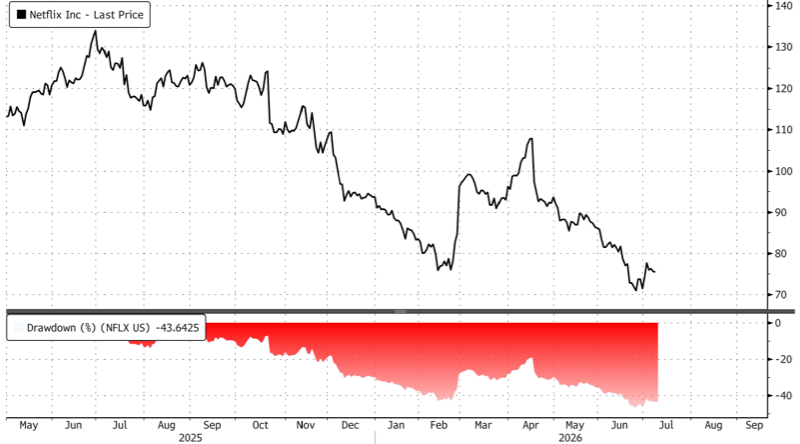
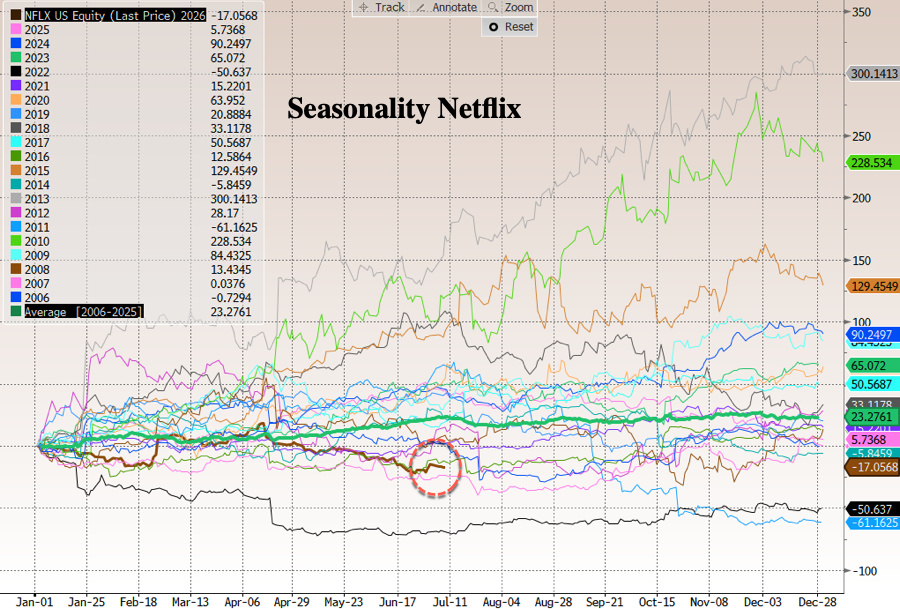
Netflix shares are teetering on the edge of a bear market after a brutal stretch of underperformance and one of the stock’s worst first-half starts in two decades. Subscriber engagement has become an increasing concern for the streaming giant, and a new report suggests management may be considering a risky pivot toward live television to revive viewing time and strengthen its advertising business.

According to The Wall Street Journal, Netflix management is weighing live channels, third-party streaming bundles, and additional sports rights as it seeks to reverse declining subscriber engagement.

Here’s more from the report:

To bolster engagement, executives at the company have recently discussed adding live channels that would continuously stream certain programs, or shows and films from a certain genre, according to people familiar with the matter. The company has also explored bundling other subscription-based streaming services, including NBCUniversal’s Peacock, into its offering. It would sell those subscriptions through its main app as rivals such as Amazon.com and Apple have long done, some of the people said.

Netflix’s discussions about adding TV channels and potentially streaming bundles, which would appear like tiles on the streamer’s home page, show how the company is willing to pivot from its roots.

The pivot comes as audience measurement firm Nielsen reports that Netflix’s share of TV viewership fell to 7.8% in April, its lowest level since May 2025.

Netflix’s share of streaming time has also declined, falling from 21% to 17% over the two-year period ending in March 2026 amid intense competition from rival platforms such as Disney+ and YouTube TV.

Here is what Wall Street desks are saying, courtesy of Bloomberg:

Bloomberg Intelligence analyst Geetha Ranganathan

  • The plans are “likely to reignite focus on engagement, a key driver of advertising and long-term revenue growth”
  • “The strategy makes sense given the launch of French broadcaster TF1’s linear channels, which lifted viewing by 16% in three weeks”

Citizens analyst Matthew Condon

  • If engagement slows and churn begins to rise, the core structural advantage begins to erode
  • “This is ultimately what is prompting Netflix to explore Live TV and subscription bundle partnerships”

Vital Knowledge

  • Netflix is facing a dip in subscriber engagement amid rising competition, which is a worrying trend

While Netflix remains the top streaming leader, its shares have nearly been halved since peaking in mid-2025.

Shares so far this year are teetering on the edge of a bear market, with first-half performance among the worst in two decades.

The underperformance in the stock comes not just from the subscriber engagement crisis but also from the company’s disappointing guidance for the second quarter, including lower year-over-year operating margins.

Tyler Durden
Fri, 07/10/2026 – 17:40

via ZeroHedge News https://ift.tt/knGs9xL Tyler Durden

The Token Revolt Goes Mainstream: Palo Alto CEO Demands 90% AI Price Drop

The Token Revolt Goes Mainstream: Palo Alto CEO Demands 90% AI Price Drop

Eight days ago it was Palantir’s Alex Karp going ballistic on live television about the “effing insane” economics of renting intelligence by the token. On Thursday it was Palo Alto Networks CEO Nikesh Arora’s turn, and while his delivery was calmer, his number was not: Arora told CNBC that AI token prices need to fall as much as 90% before enterprise adoption can actually scale.

So the chief executive of one of the largest cybersecurity companies in the world – that buys this stuff at industrial scale – telling the frontier labs, on their favorite network, that their pricing model is broken by roughly an order of magnitude.

90% Or Bust

Arora wants token costs at roughly one-fifth of current levels within the next 12 months, and down 90% by the year after that. Arora joins a growing list of executives – Karp most loudly among them – calling out runaway token costs, and that the bill shock is already pushing corporate buyers toward cheaper open-weight alternatives, including Chinese models that are rapidly closing the capability gap with the American labs. Regular readers will recognize that migration: we have documented Coinbase cutting its internal AI spend nearly in half by defaulting engineers to Chinese open-weight models, Microsoft weighing a hosted DeepSeek variant for its own agentic tools, and OpenRouter data showing Chinese models capturing – in some periods – north of 60% of global token consumption among top models.

Altman Blinks First

The timing was not accidental. Arora’s comments landed the same day OpenAI shipped its new GPT-5.6 family, with Sam Altman telling CNBC the latest model is 54% more token-efficient on agentic coding – a spec sheet line that doubles as a confession about what customers have been screaming at him for months. Asked about it, Arora offered the faintest of praise, calling the efficiency gain a good start before adding: “I think we probably need another turn at it.

Translation: nice 54%, now do it again. Twice.

None of this should surprise regular readers, who know OpenAI has been weighing drastic price cuts to claw enterprise customers back from Anthropic – the start of a classical deflationary race to the bottom – the opposite of what an industry burning tens of billions a year, and hoping to grow into trillion-dollar public valuations, actually needs. Altman himself conceded in June that cost had gone from a non-issue to a major one for customers. A month later, the “drastic cuts” are arriving dressed up as efficiency gains.

Meta Rising?

Also on Thursday, Meta launched Muse Spark 1.1, its first serious run at the agentic coding market that made Claude Code a phenomenon. Per Reuters figures cited by TechCrunch, Meta is charging $1.25 per million input tokens and $4.25 per million output tokens – parked right alongside the budget tiers of its rivals, Anthropic’s Claude Haiku 4.5 and OpenAI’s GPT-5.6 Luna. Meta AI chief Alexandr Wang described the pricing as “very aggressive and attractive,” and every new API account starts with $20 in free credits.

The launch was apparently important enough that Mark Zuckerberg posted on X for the first time in three years – his last post came in July 2023 – to pitch Spark as “a strong agentic and coding model at a very low price.” Read that again: the CEO of a company spending well north of $100 billion a year on AI infrastructure, a company Wall Street is openly pressing for evidence of AI returns, broke a three-year social media silence to advertise that his product is cheap.

Meta also shipped its Muse Image generation model Tuesday, SpaceXAI dropped a new Grok, and OpenAI’s GPT-5.6 family all landed inside the same 48 hours. 

The Math Has Not Changed

Arora’s admission is the latest wake-up call – from the tokenmaxxing fiasco and the $500 million mystery Claude bill, to Uber capping AI coding spend after torching its 2026 agentic budget in four months, to UBS checks finding token costs are now a live issue for roughly 60% of enterprise customers – including one that got its first AI invoice and heard leadership respond, flatly, “we don’t have the money for this.”

And we aren’t the only ones concerned about how this will go… As JPMorgan noted one month ago: falling prices do not automatically fix the customer’s problem, but they absolutely wreck the seller’s. Gartner’s own work suggests that even a 90% collapse in inference costs may not shrink enterprise AI bills, because agentic consumption grows faster than prices fall and providers do not pass the savings through. Meanwhile Apollo’s chief economist Torsten Slok has laid out the mirror-image problem: if token prices converge toward zero, there is not enough revenue to support the hyperscaler buildout even in a world where compute demand keeps surging. Arora’s 90% is the customer’s survival number. It may also be the vendor’s extinction number.

Meanwhile, the buildout is not slowing down to wait for the answer. Amazon raised $25 billion in debt this week to fund AI infrastructure, a month after SpaceX’s $25 billion bond sale – while this very morning, SK Hynix pulled off the largest US listing ever by a foreign company, a $26.5 billion raise that saw its ADRs open 14% above the offer price. The pattern could not be cleaner: the companies selling the shovels are booking record raises at record valuations, on the same tape where the companies selling the tokens are being told to cut prices 90%.

All of which lands at a delicate moment for the two firms the price war is actually about. OpenAI has already pushed its IPO into 2027, and Anthropic’s headline $47 billion ARR – a figure we treated with some skepticism when it was paraded ahead of the IPO filing – now faces its first print in a world where the customers have read their invoices and the competition includes Meta at $1.25 per million tokens.

Tyler Durden
Fri, 07/10/2026 – 16:50

via ZeroHedge News https://ift.tt/vyhVanA Tyler Durden

Apple Sues OpenAI Alleging Trade Secret Theft In Blockbuster AI Hardware Case

Apple Sues OpenAI Alleging Trade Secret Theft In Blockbuster AI Hardware Case

Apple has filed a major lawsuit in the U.S. District Court for the Northern District of California accusing OpenAI, io Products, and former Apple executives of misappropriating trade secrets to fast-track AI hardware development.

The complaint details a months-long scheme involving former Apple employees now at OpenAI. Key defendants include Tang Tan (OpenAI hardware lead and ex-Apple VP of product design) and Chang Liu (former Apple senior electrical engineer). Apple alleges they directed recruits to share confidential details on unreleased devices, components, manufacturing processes, and suppliers.

Specific claims, according to the WSJ, include Tan instructing interviewees to bring physical Apple hardware parts for review, retaining and distributing an internal Apple “Need to Know” departure security document, and using stolen supplier information to trick partners into using proprietary techniques. Liu is accused of downloading over a thousand pages of confidential files post-departure via a retained laptop and maintaining improper contacts at Apple for ongoing updates. (MacRumors)

“This case is about Apple’s former employees stealing Apple’s trade secrets for the benefit of OpenAI. Apple brings this suit to put a stop to it.”

Apple describes the conduct as “the tip of the iceberg” and states that OpenAI’s hardware efforts are “rotten to its core” due to reliance on misappropriated information. The company first contacted OpenAI in February with concerns but received no response. (9to5Mac)

In a response to inquiry by MacRumors, Apple said: 

“At Apple, our teams are constantly developing breakthrough technologies to create the best products and services in the world, and protecting their work and intellectual property is something we take very seriously. Recently, significant evidence has emerged suggesting individuals employed by OpenAI wrongfully took Apple’s secret and confidential information regarding our unreleased technologies, processes, and products. We will always defend our teams’ hard work and innovations, and we are taking all appropriate steps to do so.”

Apple seeks an injunction barring use or disclosure of the information, plus damages. The suit targets Tan and Liu for breach of contract but does not name Jony Ive or Sam Altman. It notes the Siri/ChatGPT partnership is not at issue and highlights that over 400 ex-Apple employees now work at OpenAI. 

This development occurs amid previously reported tensions, with OpenAI reportedly considering its own legal action against Apple over integration expectations. OpenAI is advancing hardware projects, including potential devices tied to its acquisition of Ive’s io startup. 

Tyler Durden
Fri, 07/10/2026 – 16:39

via ZeroHedge News https://ift.tt/hQ6ilEY Tyler Durden

Myth Busted: U.S. Much Safer Than Many Peer Nations

Myth Busted: U.S. Much Safer Than Many Peer Nations

Authored by John R. Lott Jr. via RealClearInvestigations,

Conventional wisdom holds that the United States is the most violent and dangerous nation in the developed world. This dark view is frequently invoked by conservatives to demand stronger penalties for crimes and by progressives to argue for stronger gun laws.

At the same time, other nations point to crime as an Achilles heel of the American system. These include two peer nations with some of the most restrictive gun laws in the world – Australia and Canada. In 2025, the Australian Broadcasting Corporation reported that “the U.S. generally sees higher violent crime rates than many other countries.” Last year, the Canadian Press similarly reported that “the number of police-reported violent crimes for every 100,000 people continue to be higher in the United States than in Canada.”

The data, however, undercuts this narrative. While the United States still leads in some categories, on the whole it has significantly less violent crime per capita than those two nations.

Regarding homicide, the most heinous crime of all, it’s true that in 2025, the U.S. murder rate was about four per 100,000 people – roughly twice Australia’s and Canada’s 2024 homicide rate. Yet it’s also true that homicides account for only a tiny fraction of violent crime. In 2024, homicides represented just 0.21% of violent crimes in the U.S., based on National Crime Victimization Survey (NCVS) estimates of rape/sexual assault, robbery, aggravated assault, and simple assault. Murder comprises an even smaller fraction of crimes in Australia and Canada.
Murders in the U.S. are usually highly concentrated geographically, often connected to street gang activity, and threaten only a tiny fraction of Americans. Just 2% of counties account for approximately 54% of all murders, and within those counties roughly two-thirds of killings occur within areas covering only about ten city blocks. By contrast, 53% of U.S. counties report no murders in a typical year, while another 16% report only one.

Moreover, when analyzing the incidence of a broader set of crimes, the U.S. is nowhere near the most dangerous developed country.

Ignoring Police

Because police statistics capture only a fraction of actual crime, the U.S., Canada, and Australia all conduct large-scale victimization surveys that estimate total crime, including incidents never reported to police. The Bureau of Justice Statistics has conducted the National Crime Victimization Survey (NCVS), which interviews roughly 240,000 Americans annually, for more than 50 years. Australia relies on a comparable survey conducted by the Australian Bureau of Statistics, while Statistics Canada conducts the General Social Survey (GSS) on Safety and Victimization.

“Anyone who wants to understand the seriousness of crime in Canada needs to recognize that victimization surveys paint a more complete picture than police-reported crime,” said Gary Mauser, who has extensively studied crime at Simon Fraser University in Canada.

The gap between police statistics and actual victimization is substantial. In Canada, the police-reported violent-crime rate is 885 per 100,000 people. The GSS reported a violent victimization rate almost 10 times that – 8,300 per 100,000.
Australia shows a similar pattern. Although the state of Victoria did not provide assault data to the ABS, only about 37% of robberies and sexual assaults were reported to police in 2024.

The U.S. data tell a very different story. Although the FBI does not collect national counts of simple assault, it recorded 1,203,808 violent crimes in 2019. During the same year, the NCVS estimated 2,013,220 felonious violent crimes – rape or sexual assault, robbery, and aggravated assault, excluding simple assault. Police reports therefore captured 59.8% of the NCVS estimate.

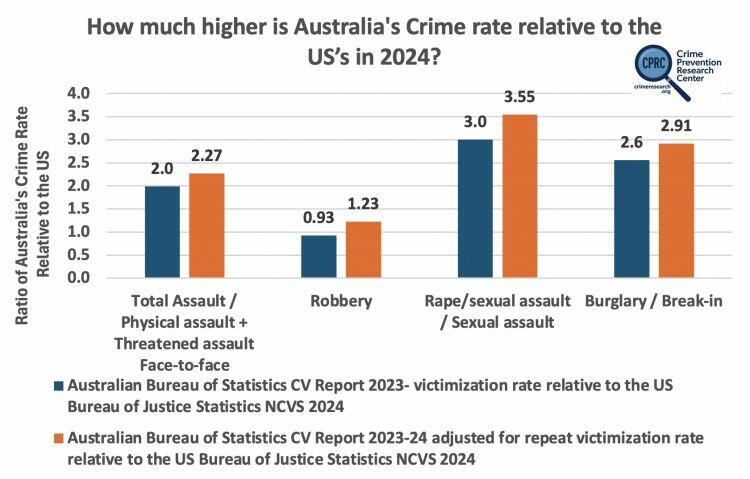
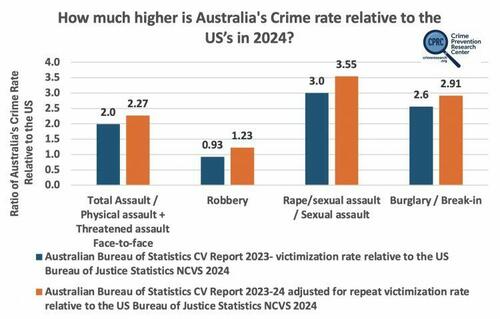
Using these broad estimates, Australia’s rape and sexual assault rate is roughly three times higher than that of the United States. Australia’s assault rate is about twice as high, and its burglary rate is about 2.5 times higher. Robbery is the only category where the two countries report similar rates.

But even this Australian data significantly understates the extent of violent crime because it counts victims rather than the number of crimes, unlike the U.S. data. If someone is robbed or sexually assaulted twice, the Australian survey records only one victimization, while the U.S. counts two separate crimes. As a result, Australia’s survey misses repeat victimizations and understates the total amount of violent crime. Even modest adjustments suggest that Australia’s violent crime rate is 15% higher than already discussed.

“For decades, researchers have documented that people report crimes more often when law enforcement is more likely to catch and punish the offenders,” said David Mustard, a professor and crime expert at the University of Georgia. “The extremely low reporting rates in Australia and Canada therefore raise serious doubts about public confidence in their criminal justice systems.”

Normalizing Rape

For example, in Canada in 2019, about 8.1% of total violent crimes resulted in the person being arrested and charged with the crime (210,000 arrested and charged out of 2.59 million victimizations), which is quite low even compared to the 20% rate in the U.S.

In Australia, there are numerous complaints that “Rape is effectively decriminalized.” In New South Wales, of the 9,138 sexual assaults reported to police in 2022, there were only 1,016 convictions – just an 11% conviction rate. Indeed, during a recent lecture that I gave to college students in New South Wales in February, several women said there was no reason to report rapes and sexual assaults to the police because they believed nothing would happen to the criminal and it was personally embarrassing to come forward publicly.

As a result, an analysis based solely on police statistics can be misleading when comparing countries. Victimization surveys tell a different story. Although direct comparisons require some caution because the Canadian GSS and the U.S. NCVS define certain crimes like sexual assault differently, those differences generally favor Canada and make the U.S. appear relatively more violent.

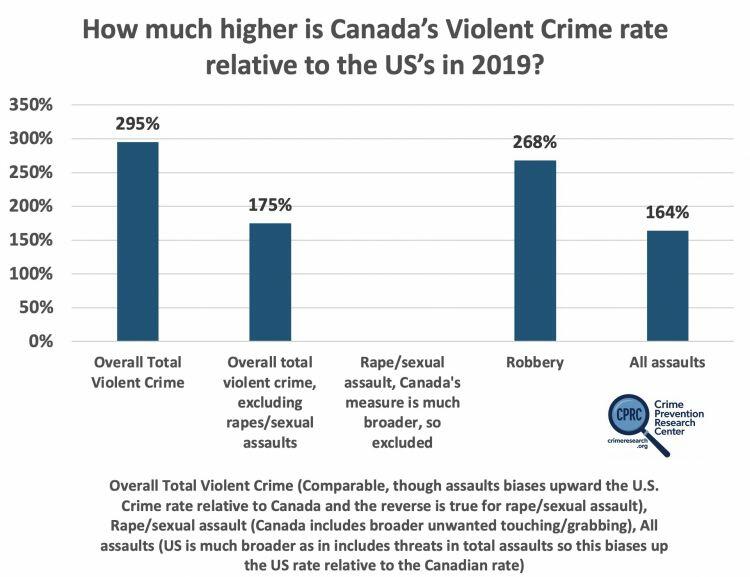
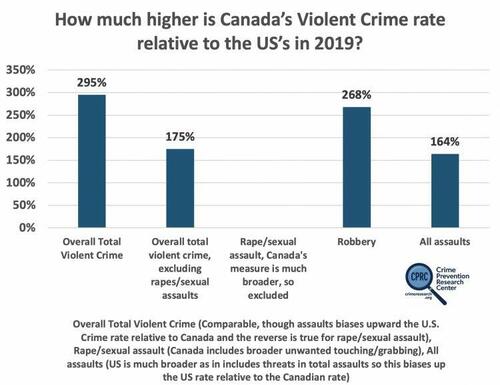
Still, the results remain striking. In 2019, Canada’s overall violent-crime victimization rate was at least 175% higher than the U.S. after adjusting for different methods. “Anyone who wants to understand just how serious crime is in Canada needs to recognize that crime rates are higher in Canada than in the U.S., according to victimization surveys,” Mauser said.

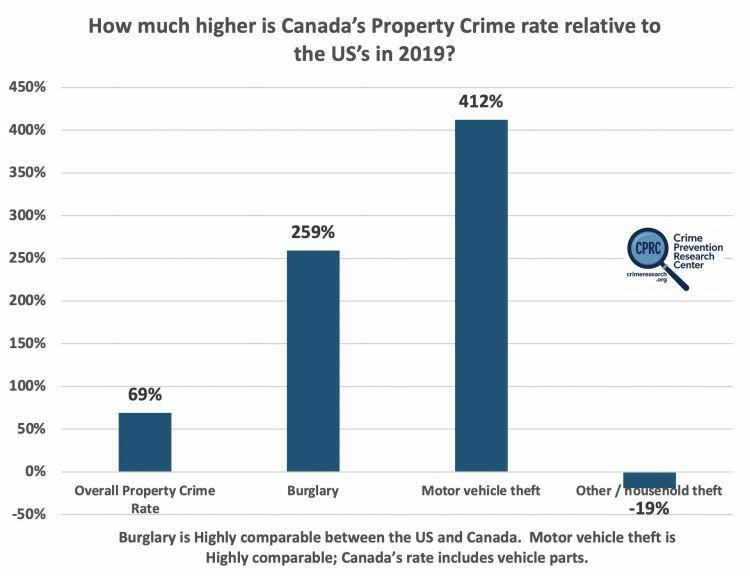
Robbery offers an especially useful comparison because both surveys define it similarly. Canada’s robbery victimization rate was 268% higher than the U.S. rate. Property crime follows a similar pattern. Canada’s burglary rate was 259% higher than the U.S. rate.
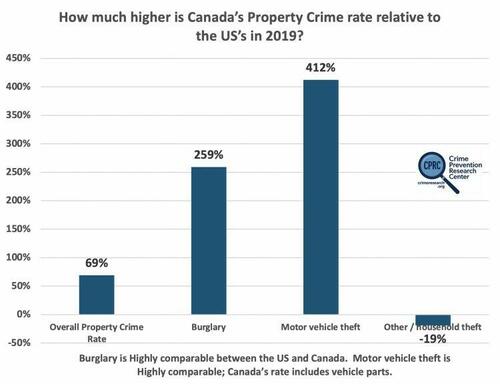
Nor is this pattern unique to recent years. The International Crime Victimization Survey (ICVS), which used identical questions and definitions across participating countries before the United Nations assumed responsibility for the survey and later discontinued it, reached similar conclusions. In 2000, Australia’s violent-crime victimization rate – including robbery, sexual incidents, assaults, and threats – was 104% higher than the U.S. rate. Robbery was 150% higher and sexual assaults 167.9% higher. The survey also found Canada’s violent-crime victimization rate to be 40% higher than the U.S.

Few countries conduct victimization surveys, but the historical evidence from older ICVS data paints a similar picture. The ICVS found that England and Wales and Scotland had violent crime rates about 40% higher than the United States, while Finland’s rate was about 20% higher. France, the Netherlands, and Sweden recorded rates roughly equal to the U.S., whereas Belgium and Poland experienced violent crime rates about 20% lower.

“The media’s emphasis on reported crime badly underestimates how bad the violent crime situation in Australia is compared to the U.S.,” Dr. Kesten C. Green, who has studied crime and is a researcher at the University of Adelaide Business School, tells RealClearInvestigations.

“Only victimization surveys capture both reported and unreported crimes, providing a far more complete picture


Tyler Durden
Fri, 07/10/2026 – 16:25

via ZeroHedge News https://ift.tt/bBcYISk Tyler Durden

Mali Govt Says Al-Qaeda Extremists In Region Receive Training, Drones From Ukraine

Mali Govt Says Al-Qaeda Extremists In Region Receive Training, Drones From Ukraine

Via The Cradle

The Malian government announced on Thursday that militant groups with links to Al-Qaeda carrying out terror attacks in the country were trained and armed by Ukrainian specialists.

Fousseynou Ouattara, Vice President of the Defense Commission of Mali’s Transitional Council, said authorities identified militants who received training in Ukraine to carry out operations using kamikaze drones produced by Kiev. “These young people are known, we have now added them to our lists, and we have their names,” Ouattara said.

Illustrative file image

The militants fighting the Malian government belong to a Tuareg-led separatist group, the Azawad Liberation Front (ALF), and Jamaat Nusrat al-Islam wal-Muslimeen (JNIM), an extremist group linked to Al-Qaeda.

He added that the militant groups are receiving fighters from Algeria, Mauritania, and Libya, as well as training from members of the French Foreign Legion and Ukrainian instructors.

France is allegedly supporting the ALF and JNIM following the Malian government’s removal of French troops in 2022. In their place, private military contractors from Russia’s Wagner Group were deployed.

After a May 2021 coup in Mali, the country’s military junta officially demanded that France withdraw its troops “without delay.” French troops had been present in Mali for nine years, allegedly to fight the Al-Qaeda-linked insurgency.

Mali was a French colony known as French Sudan before it gained independence as the Republic of Mali in 1960. However, France has sought to reassert its influence in Mali and in neighboring Burkina Faso and Niger, which are also former French colonies.

In September 2023, the military leaders of Mali, Niger, and Burkina Faso established the Alliance of Sahel States (AES), which established a partnership with Russia.

Fighting between the Malian army and the ALF and JNIM has escalated in recent weeks. On July 7, the Malian army released a statement saying that “more than 200 terrorists were neutralized during coordinated air and ground operations” conducted in the village of Anefis in the northern Kidal region. The army statement noted that the operation was conducted in response to attacks by armed groups on military positions.

On July 4, Mali’s Ministry of Defense and Veterans Affairs announced that militant groups attacked army positions in Aguelok, Anefis, Gao, Kenioroba, Konna, Sevare, and Somadougou.

Clashes with the militants reportedly continue near Anefis, where a major Malian military base is located. On Wednesday, Russian Foreign Minister Sergey Lavrov and his AES counterparts held a meeting in which they condemned destabilization campaigns supported by Ukraine and France.

Russia and the AES agreed to expand military cooperation, with Moscow pledging additional support to strengthen the operational capabilities of the armed forces of AES nations.

The foreign ministers of Russia, Mali, Niger, and Burkina Faso described the recent militant attacks on AES countries as “barbaric and ignoble” acts threatening regional stability.

“The two sides firmly condemned such destructive actions aimed at undermining the sovereignty of the AES and regional stability,” they said.

via Middle East Eye

The ministers also acknowledged the efforts of troops from AES member states in repelling “terrorist attacks,” as well as the contribution of Russia’s African Corps to counterterrorism operations in the Sahel.

The Russia-AES meeting took place as French President Emmanuelle Macron visited Syria to meet President Ahmad al-Sharaa, the former Al-Qaeda and ISIS commander. During the 14-year war to topple former Syrian president Bashar al-Assad, France joined the US and its allies in supporting Sharaa’s Nusra Front, which finally took power in Damascus in 2024.

Tyler Durden
Fri, 07/10/2026 – 15:45

via ZeroHedge News https://ift.tt/YkWpUAu Tyler Durden

Dispatch From COGE: A Bureaucratic Meeting About Cutting Bureaucratic Bloat


COGE meeting on the left, a sign pointing toward the COGE Public Hearing on the right | Meagan O'Rourke/Reason

Six weeks ago, New York City Mayor Zohran Mamdani announced the creation of COGE, the Commission on Government Efficiency. While the commission’s name might sound like Elon Musk’s now-dead federal DOGE and conjure up an image of a chainsaw-slashing, afuera-style attack on the city’s $125.8 billion budget, the commission has thus far been a typical governmental task force. 

Before proposing changes to the city’s charter, COGE is holding a series of 11 meetings to gather input from elected officials and the public about improving government efficiency. On Wednesday evening, I went to the penultimate COGE meeting in the auditorium of the historic Riverside Church in Morningside Heights to witness COGE in action. The meeting started about 20 minutes late. When the commissioners finally took their seats, a lone audience member began clapping, and the rest of the attendees tentatively joined him. 

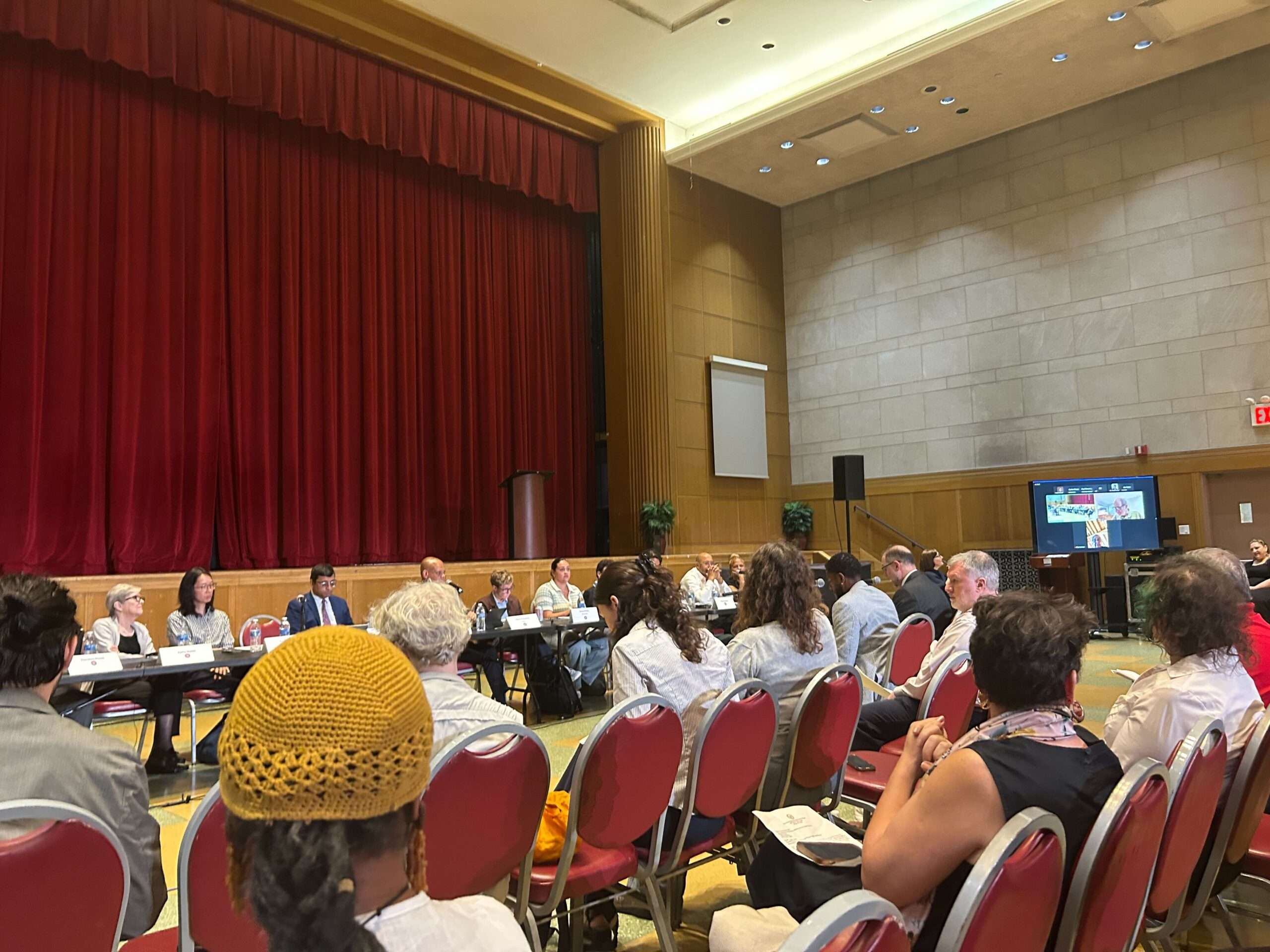
New Yorkers attended a COGE meeting on Wednesday night in Morningside Heights to discuss improving government efficiency. (Meagan O'Rourke/Reason)

The woman to my right said she was told she may not have time to testify during the meeting because city officials were giving presentations. The first hour of the meeting was, in fact, dedicated to lengthy presentations. Comptroller Mark Levine urged the commission to adopt clear rules for the city’s rainy day fund so emergency funds may be better protected and set aside for times of economic crisis. The public advocate, the city’s elected watchdog, then spoke about wanting easier access to city agency information. New York City Buildings Department Commissioner Ahmed Tigani, fresh off dealing with a building crisis in Midtown, discussed ways to accelerate safe construction projects. Tigani’s colleague then shared recommendations from the SPEED task force, which seeks to “expedite equitable development” (i.e., build affordable housing faster). 

The Commission on Government Efficiency listened to testimony from elected officials, experts, and the general public. (Meagan O'Rourke/Reason)

After the officials and experts testified for over an hour, members of the public were called to the front of the auditorium in pairs and were given three minutes to share their grievances and suggestions. The woman sitting next to me left before testifying. 

The theme of this meeting was streamlining permitting, but participants testified about a range of issues, from street safety complaints to teachers’ inability to gather supplies (despite the NYC Education Department’s $45 billion budget). Some participants shared testimony over Zoom, and participants were also able to submit written testimony online. One gentleman complained that the city was not ticketing cars on his street. In line with the COGE mission, nobody at the meeting demanded outright cuts to agencies, but they shared ideas for improving existing processes. 

Like at any public meeting, the attendees at the Riverside Church meeting were a self-selecting group. They were not local cranks like in Parks and Rec; they were mostly leaders of various civic groups and associations, including the Times Square Alliance. Those who attended appeared to be in good spirits, clapping after each testimony (although I did catch two people snoozing). It was heartening to see that these New Yorkers cared enough about efficiency to attend a three-hour-long governmental meeting on a summer evening. 

Perhaps improving government efficiency in New York City requires a long and tedious process like this. But let’s remember that several of those at the helm of COGE have had long careers in city—and, in some cases, federal—government. These commissioners appear to place great faith in the government’s ability to solve problems (if only it were more efficient), and they have little incentive to cut the programs they have spent their careers building. And while COGE may have good intentions, the commission’s approach does not attack inefficiency at its source: the expansive size and scope of government.

The post Dispatch From COGE: A Bureaucratic Meeting About Cutting Bureaucratic Bloat appeared first on Reason.com.

from Latest – Reason.com https://ift.tt/i7Hkqt6
via IFTTT

Dispatch From COGE: A Bureaucratic Meeting About Cutting Bureaucratic Bloat


COGE meeting on the left, a sign pointing toward the COGE Public Hearing on the right | Meagan O'Rourke/Reason

Six weeks ago, New York City Mayor Zohran Mamdani announced the creation of COGE, the Commission on Government Efficiency. While the commission’s name might sound like Elon Musk’s now-dead federal DOGE and conjure up an image of a chainsaw-slashing, afuera-style attack on the city’s $125.8 billion budget, the commission has thus far been a typical governmental task force. 

Before proposing changes to the city’s charter, COGE is holding a series of 11 meetings to gather input from elected officials and the public about improving government efficiency. On Wednesday evening, I went to the penultimate COGE meeting in the auditorium of the historic Riverside Church in Morningside Heights to witness COGE in action. The meeting started about 20 minutes late. When the commissioners finally took their seats, a lone audience member began clapping, and the rest of the attendees tentatively joined him. 

New Yorkers attended a COGE meeting on Wednesday night in Morningside Heights to discuss improving government efficiency. (Meagan O'Rourke/Reason)

The woman to my right said she was told she may not have time to testify during the meeting because city officials were giving presentations. The first hour of the meeting was, in fact, dedicated to lengthy presentations. Comptroller Mark Levine urged the commission to adopt clear rules for the city’s rainy day fund so emergency funds may be better protected and set aside for times of economic crisis. The public advocate, the city’s elected watchdog, then spoke about wanting easier access to city agency information. New York City Buildings Department Commissioner Ahmed Tigani, fresh off dealing with a building crisis in Midtown, discussed ways to accelerate safe construction projects. Tigani’s colleague then shared recommendations from the SPEED task force, which seeks to “expedite equitable development” (i.e., build affordable housing faster). 

The Commission on Government Efficiency listened to testimony from elected officials, experts, and the general public. (Meagan O'Rourke/Reason)

After the officials and experts testified for over an hour, members of the public were called to the front of the auditorium in pairs and were given three minutes to share their grievances and suggestions. The woman sitting next to me left before testifying. 

The theme of this meeting was streamlining permitting, but participants testified about a range of issues, from street safety complaints to teachers’ inability to gather supplies (despite the NYC Education Department’s $45 billion budget). Some participants shared testimony over Zoom, and participants were also able to submit written testimony online. One gentleman complained that the city was not ticketing cars on his street. In line with the COGE mission, nobody at the meeting demanded outright cuts to agencies, but they shared ideas for improving existing processes. 

Like at any public meeting, the attendees at the Riverside Church meeting were a self-selecting group. They were not local cranks like in Parks and Rec; they were mostly leaders of various civic groups and associations, including the Times Square Alliance. Those who attended appeared to be in good spirits, clapping after each testimony (although I did catch two people snoozing). It was heartening to see that these New Yorkers cared enough about efficiency to attend a three-hour-long governmental meeting on a summer evening. 

Perhaps improving government efficiency in New York City requires a long and tedious process like this. But let’s remember that several of those at the helm of COGE have had long careers in city—and, in some cases, federal—government. These commissioners appear to place great faith in the government’s ability to solve problems (if only it were more efficient), and they have little incentive to cut the programs they have spent their careers building. And while COGE may have good intentions, the commission’s approach does not attack inefficiency at its source: the expansive size and scope of government.

The post Dispatch From COGE: A Bureaucratic Meeting About Cutting Bureaucratic Bloat appeared first on Reason.com.

from Latest – Reason.com https://ift.tt/i7Hkqt6
via IFTTT