US Producer Price Inflation Unexpectedly Remains Near Record Highs In Jan

US Producer Price Inflation Unexpectedly Remains Near Record Highs In Jan

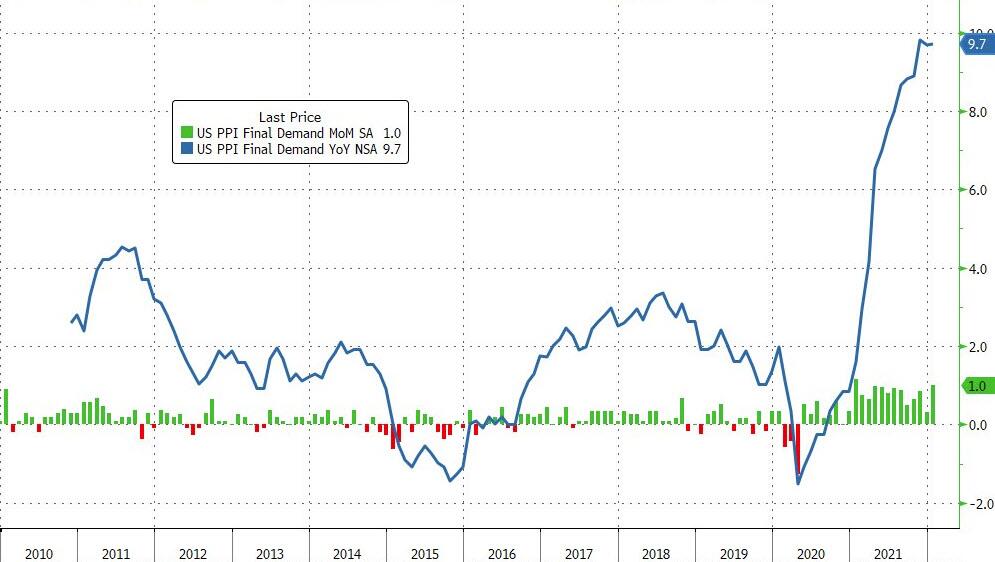
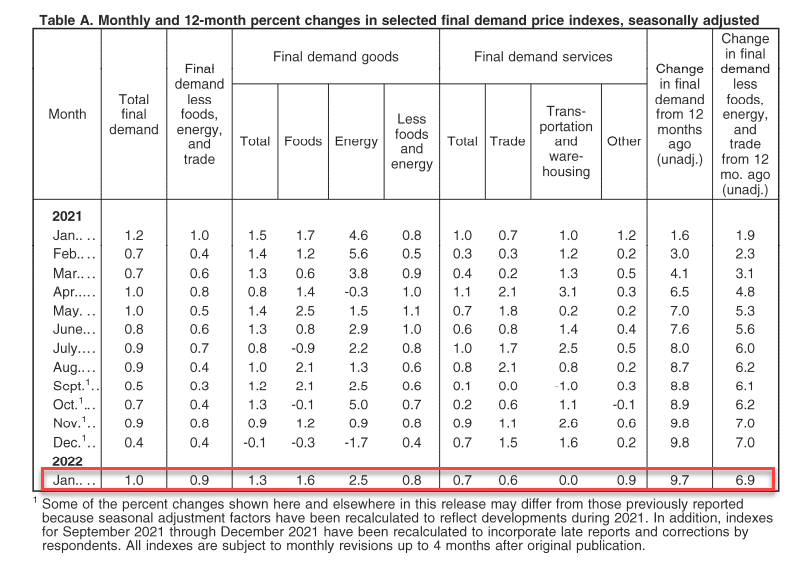
January saw US producer prices rise 1.0% MoM (twice the expected 0.5% jump) and is the 21st straight month of MoM rises. This sent prices up 9.7% YoY (record highs and well above the expected +9.1% YoY)…

Source: Bloomberg

Goods costs are accelerating faster than Services still with Energy and Food prices the biggest drivers…

Final demand services: Prices for final demand services advanced 0.7 percent in January, the same as in December. Three-fourths of the rise in January can be traced to a 0.9-percent increase in the index for final demand services less trade, transportation, and warehousing. Likewise, margins for final demand trade services moved up 0.6 percent. (Trade indexes measure changes in margins received by wholesalers and retailers.) Prices for final demand transportation and warehousing services were unchanged.

A major factor in the January increase in the index for final demand services was hospital outpatient care prices, which rose 1.6 percent. The indexes for machinery and vehicle wholesaling; apparel, jewelry, footwear, and accessories retailing; traveler accommodation services; portfolio management; and truck transportation of freight also moved higher. Conversely, margins for fuels and lubricants retailing fell 9.7 percent. The indexes for transportation of passengers (partial) and for physician care also decreased.

Final demand goods: Prices for final demand goods advanced 1.3 percent in January after declining 0.1 percent in December. Over 40 percent of the broad-based increase can be traced to a 0.8-percent rise in the index for final demand goods less foods and energy. Prices for final demand energy and for final demand foods also moved higher, 2.5 percent and 1.6 percent, respectively.

Within the final demand goods category in January, the index for motor vehicles and equipment rose 0.7 percent. Prices for diesel fuel, gasoline, beef and veal, dairy products, and jet fuel also increased. In contrast, the index for iron and steel scrap decreased 10.7 percent. Prices for unprocessed finfish and for natural gas also moved lower.

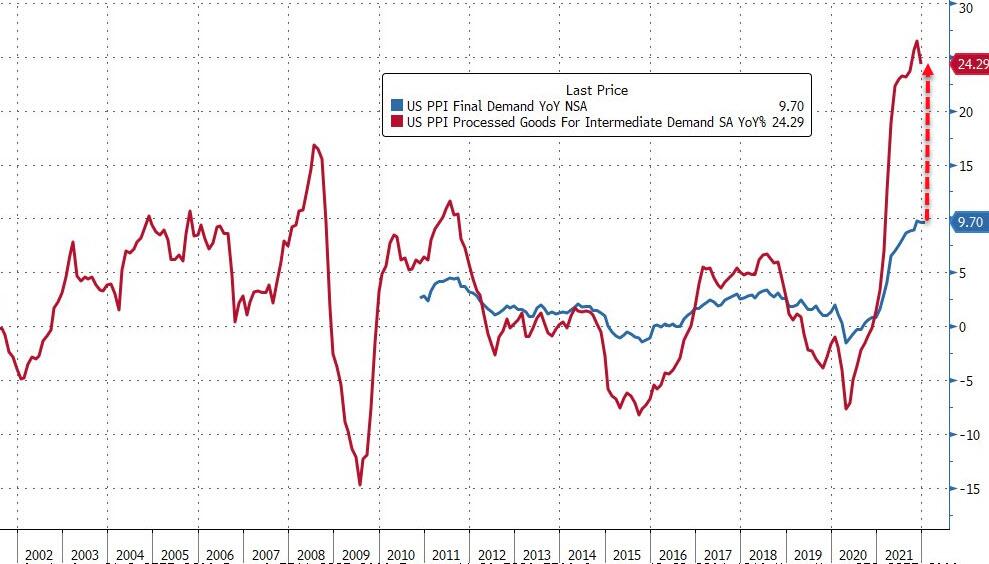
The pipeline for PPI continues to suggest more upside to come as Intermediate demand prices are soaring still…

Source: Bloomberg

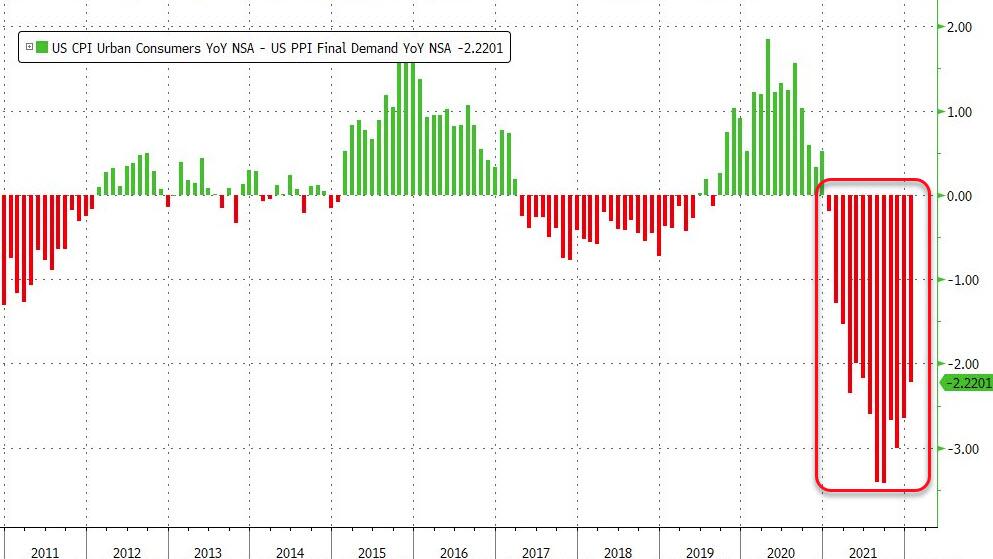
And finally that pipeline flows down hill to the consumer as we note that the CPI-PPI – US margin proxy – is negative for the 13th straight month, as for now, input costs are not all flowing through to output costs for consumers…

Source: Bloomberg

But it’s only a  matter of time.

Tyler Durden
Tue, 02/15/2022 – 08:39

via ZeroHedge News https://ift.tt/lait5eO Tyler Durden

Market Pullback Or Bear Market?

Market Pullback Or Bear Market?

Authored by Lance Roberts via RealInvestmentAdvice.com,

Market pullback or bear market? Such seems to be the question on everyone’s mind as of late, given the rough start to 2022 so far.

There are undoubtedly many issues confronting even the most optimistic of investors currently.

  • Geopolitical risk from Russia and the threat to the Ukraine

  • Rising interest rates

  • Surging inflationary pressures

  • Economic growth slowing

  • Profit margins under pressure

  • Reversal of monetary liqudity

  • Tighter monetary policy from the Federal Reserve

  • Surging oil prices

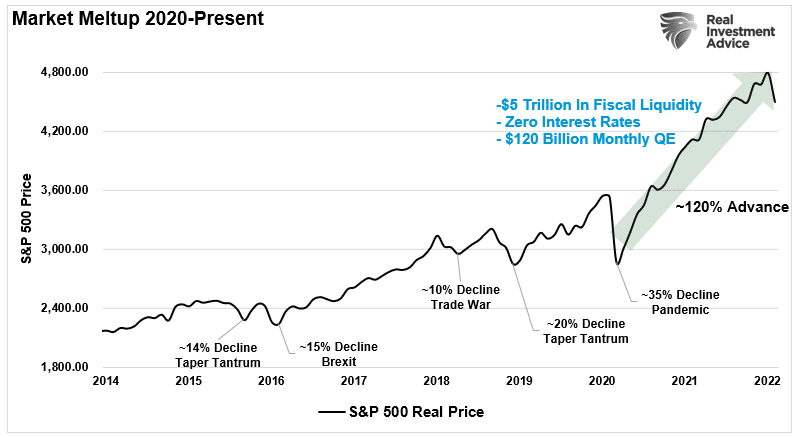
There are certainly others, but you get the idea. The many tailwinds that supported the rapid rise in the markets from 2020 to the present have started to reverse. As shown, the roughly 120% advance from the March lows should not be surprising given the massive liquidity surge from the Government.

Also, not surprisingly, is the subsequent surge in inflation. As Milton Friedman stated:

“Inflation is always and everywhere a monetary phenomenon. It is always and everywhere a result of too much money, of a more rapid increase of money, than of output.”

Friedman’s point is essential. Inflation is always a function of the Government printing too much money. In this case, the result of $5 trillion directly injected into the economy, inflation should be no surprise.

Now, the financial markets are starting to reflect the risk of a more aggressive Fed working to reverse that artificial surge in liquidity.

But, as discussed in “This Time Is Different,”therein lies the risk of a policy mistake.

Predictions Are Difficult

“Prediction is very difficult, especially about the future.” – Neils Bohr

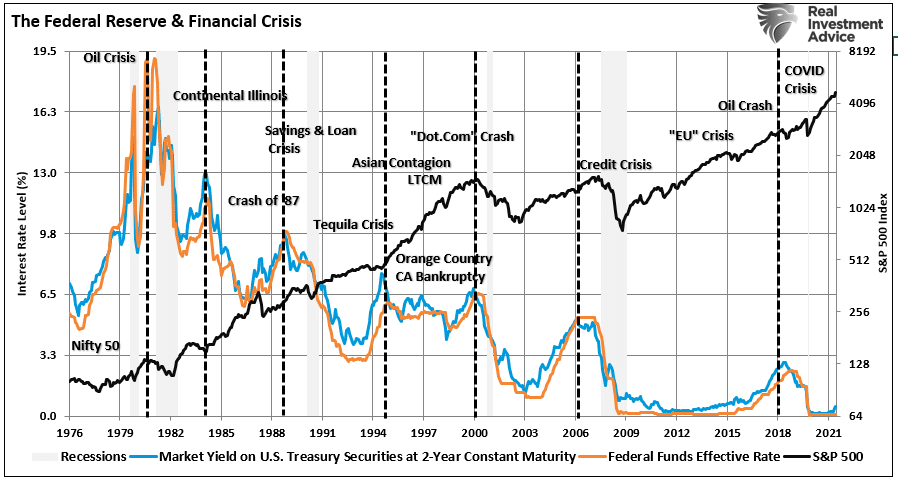
As discussed much recently, the hope is that the Fed can navigate tightening monetary policy and increasing interest rates without creating “financial instability.” Unfortunately, their track record remains unimpressive.

While the weight of evidence suggests that the bears are gaining control of the financial landscape, outcomes are not guaranteed. As investors, betting on “predictions” can often have unintended consequences as market dynamics change.

Therefore, we must be aware of the risks and navigate markets accordingly. As noted in this past weekend’s newsletter:

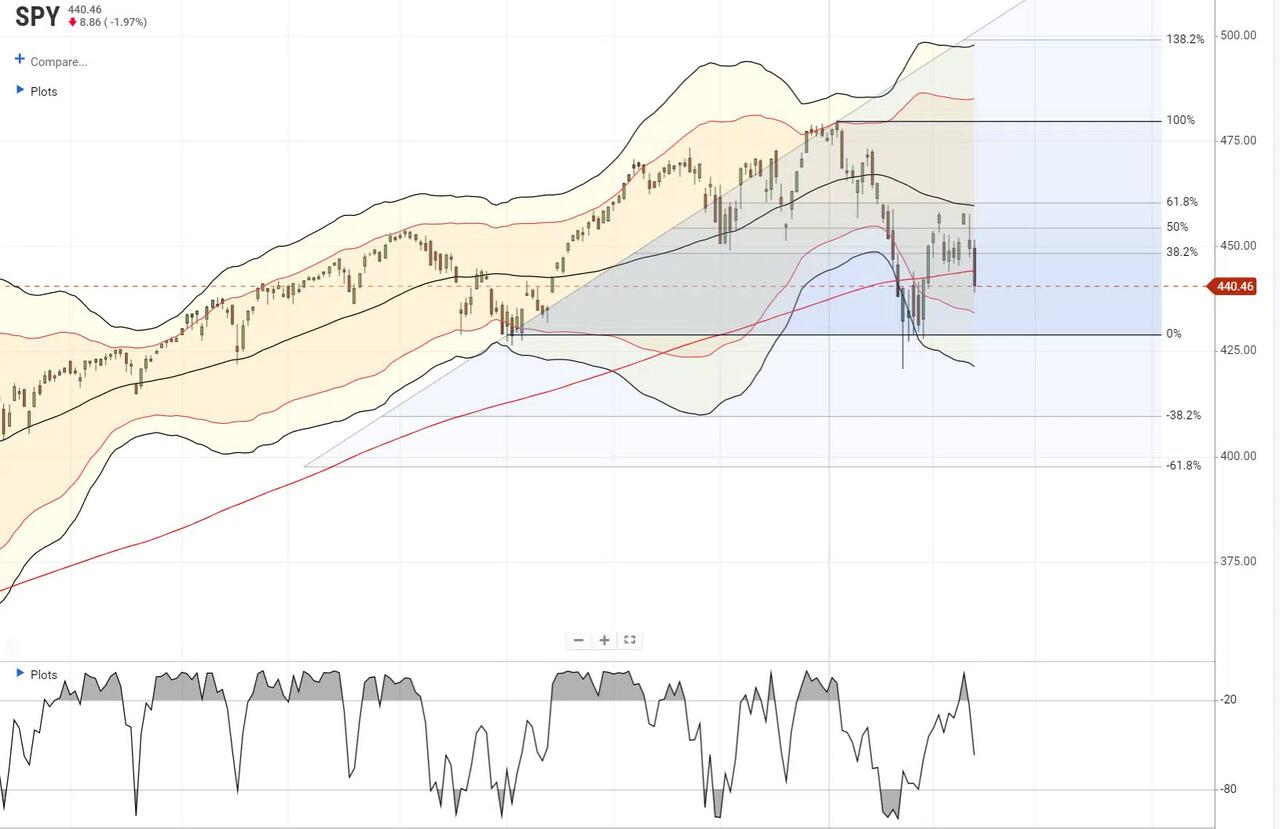
“Another nauseating week in the market as a hotter than expected inflation print and rumors of a Russian invasion of Ukraine sent stocks tumbling backward. The bad news is that support at the 200-dma failed.”

Chart courtesy of SimpleVisor.com

While the break of the 200-dma is notable, we also broke that level in January. Had you sold that break of support, you missed the reflexive rally back to the 50-dma. Such was the point we made in the “heat of the moment:”

“The ‘good news,’ if you want to call it that, and as noted by Zerohedge, is there is now a good bit of  ‘combustible fuel’ to create a counter-trend rally heading into the Fed meeting next week.

All this means is that investors are now all on ‘one side of the boat,’ which is a prime setup for a counter-trend bounce. However, it is likely a bounce you will want to use to ‘derisk’ your portfolio.

The message of “derisking on the rally” has been consistent for the last couple of weeks.

Notably, other than the decline from extreme overbought conditions, so far, the market has not violated important support or bullish trends.

In other words, so far, we are simply working through a market pullback.

Market Pullbacks Can Become Bear Markets

Such is a crucial point. We noted several times in 2021 that extremely “low volatility” would lead to “higher volatility.” To wit:

“A retest of the 200-dma should not be dismissed which is roughly 11% lower. While such a decline is well within the norms of a correction in any given market year, the low levels of volatility will make it ‘feel’ worse than it is.

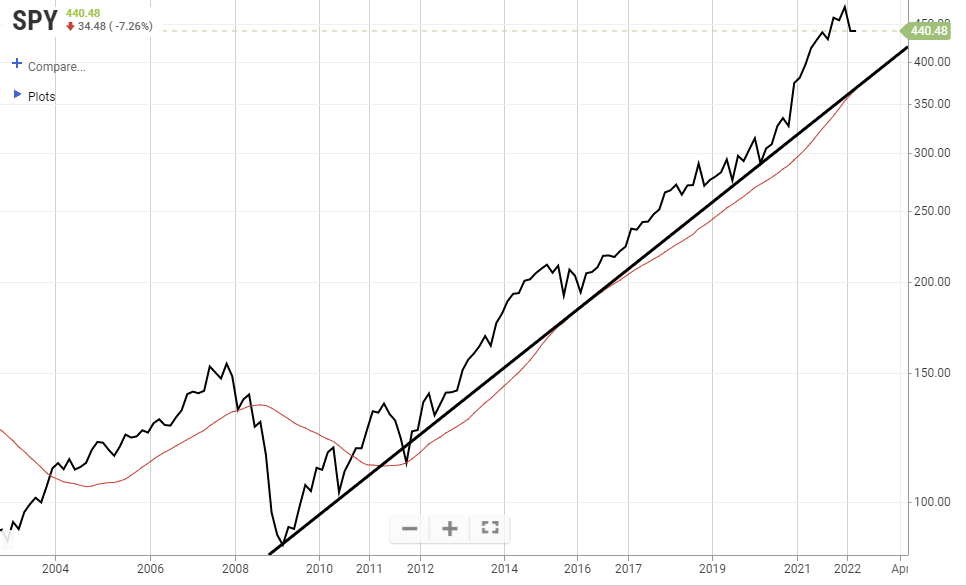
So far, that is what has happened. After a long period of only 5% drawdowns, the 10% market pullback in January “felt” like a crash. However, if we go back to 2009 and draw a trendline along the 24-week moving average, we see the recent correction has done little to violate that bullish trend.

Chart courtesy of SimpleVisor.com

It is worth noting the massive advance of the market from the 2009 lows was a function of more than $43 trillioninjected into the economy by the Government and Federal Reserve. With inflation now surging and the Fed trapped into a rate hiking cycle, there is a risk a market pullback could morph into a bear market.

All that is needed is a catalyst to change the bullish psychology.

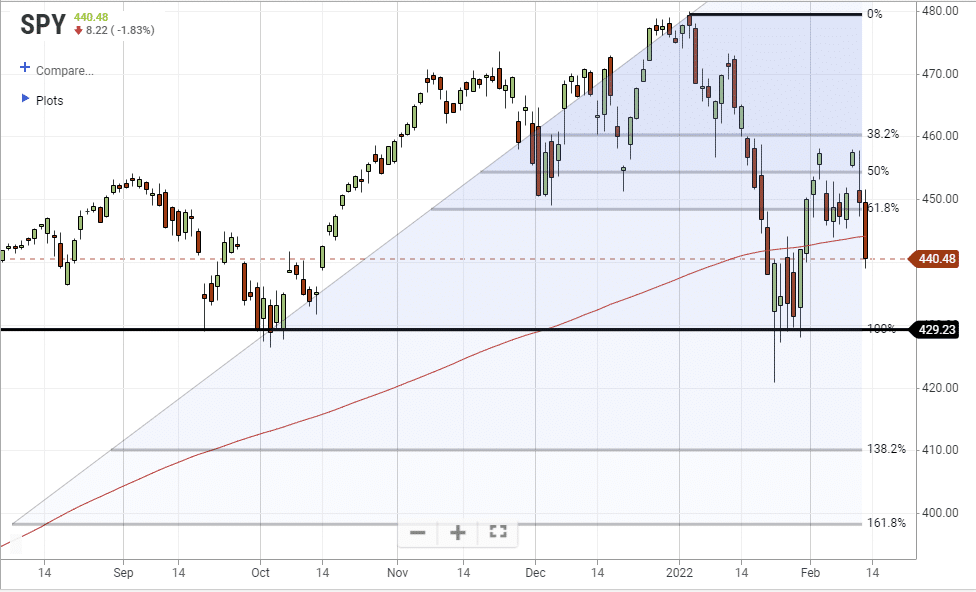
Currently, the risk to investors is a market pullback to October lows. A failure of that support would suggest a deeper correction to the 138.2% and 161.8% Fibonacci retracement levels. Such levels would approach a 20% decline.

Chart courtesy of SimpleVisor.com

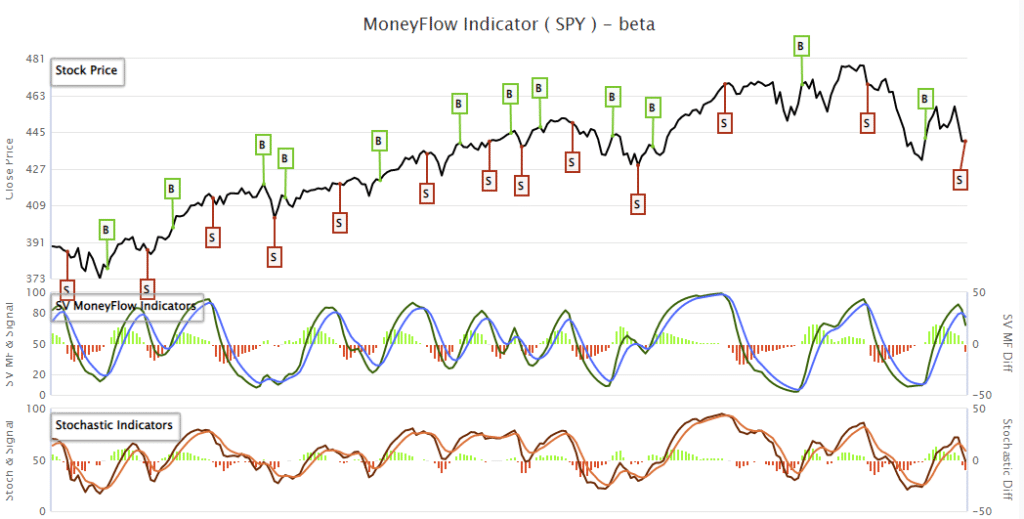
There is sufficient “fuel” for that deeper correction given the current overbought condition of the SimpleVisor money flow indicator, which has registered a sell signal.

Does this mean a “bear market” is inevitable? No.

Does it mean you should sell everything and go to cash? No.

It does mean you should at least be aware, and prepare for, the potential risk.

With that in mind, my job as a portfolio manager is to navigate market risks as we see them. Making a “one-sided” bet on a potential outcome harbors an outsized risk of being wrong. Such would potentially impact client capital and damage financial outcomes.

Therefore, we approach risk management in the market by choosing to hedge risk and reduce potential liabilities. As such, given the market’s current structure, we have three options currently:

  1. Do Nothing – if the markets correct, we lose destroy capital and time waiting for the portfolio to recover.

  2. Take Profits – This has been our choice on the recent reflexive rally. Taking profits, raising cash, and reducing equity exposure in advance of a correction mitigates the damage of a decline. However, if wrong, we can repurchase positions, add new ones, or resize portfolio holdings as needed.

  3. Hedge – We have also opted to hedge by adding a position to the portfolio that is the “inverse” of the market. Such allows us to keep existing positions intact. By “shorting against the portfolio,” we effectively reduce our equity risk (and related capital destruction) during a market correction.

As noted, we have opted to use a combination of both #2 and #3. Doing nothing leaves us too exposed to an unexpected “volatility shock” in the market or the reversal of bullish psychology.

While we are reducing capital risk opportunistically, we are very aware we could give up performance in the short term if the market rallies. For us, that is a choice we can live with if we potentially bypass the risk of a more significant correction.

In our view, we have a choice to either manage risk or ignore it.

The only problem with “ignoring risk” is that such has a long history of not working out well.

Investment Guidelines

When it comes to investing, we tend to repeat our mistakes by forgetting the past. Therefore, it is worth repeating investing guidelines to bring your focus back to what truly matters.

  • Investing is not a competition. There are no prizes for winning but severe penalties for losing.

  • Emotions have no place in investing.You are generally better off doing the opposite of what you “feel.”

  • The ONLY investments that you can “buy and hold” are those providing an income stream and return of principal.

  • Market valuations are very poor market timing devices.

  • Fundamentals and Economics drive long-term investment decisions – “Greed and Fear” drive short-term trading.

  • “Market timing” is impossible– managing exposure to risk is both logical and possible.

  • Investment is about discipline and patience. Lacking either one can be destructive to your investment goals.

  • There is no value in daily media commentary– turn off the television and save yourself the mental capital.

  • Investing is no different than gambling– both are “guesses” about future outcomes based on probabilities.  The winner is the one who knows when to “fold” and when to go “all in”.

  • No investment strategy works all the time. The trick is knowing the difference between a bad investment strategy and one that is temporarily out of favor.

“The investor’s chief problem – and even his worst enemy – is likely to be himself.” – Benjamin Graham.

Tyler Durden
Tue, 02/15/2022 – 08:20

via ZeroHedge News https://ift.tt/d87IXeg Tyler Durden

Speech-Based Expulsion from Private Club Doesn’t Violate Massachusetts Civil Rights Act

From yesterday’s Report and Recommendation by Magistrate Judge Donald Cabell (D. Mass.) in Koppel v. Moses:

[According to the Complaint,] Koppel and Moses at one point were friends and fellow MIT graduate students. Both belonged to a student-run computer science club called the Student Information Processing Board (“SIPB”), which Moses was the Chair of at all relevant times.

On February 10, 2020, a “keyholder” SIPB member stated during a meeting “that Koppel should not be made keyholder because he had made a political comment in a chatroom the preceding September, stating something that [this individual] disliked.” {A keyholder in SIPB is a member recognized for significant participation and contributions to SIPB. Keyholders are nominated and elected by existing keyholders. Keyholder status is desirable because it entitles one to be elected to the executive committee and to other positions of responsibility. Koppel had been working toward keyholder status since 2018.}  Consequently, on February 27, 2020, Moses told Koppel that he “was being expelled” from SIPB because his public political statements had made some SIPB members “uncomfortable.”

Moses sent an email the same day to a group of approximately 140 SIPB keyholders from at least the preceding twenty years and indicated in it that Koppel was being removed from SIPB for reasons of sexual harassment.  Then, on March 2, 2020, Moses sent another email to a larger distribution list of between 500 and 700 SIPB-affiliated persons, stating that Koppel had made many keyholders “deeply uncomfortable” and for that reason had been requested to no longer participate in SIPB activities.

Koppel sued for defamation and for violation of the Massachusetts Civil Rights Act, which reads (bullets added, and combining the two relevant provisions):

  • Whenever any person or persons, whether or not acting under color of law,
  • interfere [or attempt to interfere] by threats, intimidation or coercion, …
  • with the exercise or enjoyment by any other person or persons of rights secured by the constitution or laws of the United States [or Massachusetts], …
  • any person whose exercise or enjoyment of rights … has been interfered with, or attempted to be interfered with, …
  • may [sue] for injunctive [relief, and] … compensatory money damages … [and] the costs of the litigation and reasonable attorneys’ fees ….

Moses moved to dismiss the MCRA claim (the motion didn’t deal with the defamation claim), and the Magistrate Judge recommended that the District Court indeed dismiss it:

Koppel contends here that Moses defamed him and had him removed from SIPB “to punish and intimidate” him for his speech, and this conduct in turn interfered with Koppel’s right to engage in protected speech, because it caused him to exercise “near-total self-censorship” and “disrupt[ed] his freedom to speak and his ability to engage in associations for protected activity.” As apparent examples, Koppel alleges that he was hesitant to “like” a “slightly political statement by a friend on social media,” and “declined an invitation to appear on the Fox News show The Ingraham Angle to speak about a matter of public interest.” Koppel contends that Moses’ conduct could be viewed as either a threat or an act of intimidation or coercion….

[But] the complaint (as framed) fails to allege sufficient facts to show a threat, intimidation, or coercion within the meaning of the MCRA, and fails as well to allege facts showing that the natural effect of the defendant’s conduct was to interfere with the plaintiff’s right to thereafter engage in the referenced protected speech activities.

To begin, the Massachusetts Supreme Judicial Court (SJC) has defined the terms “threat,” “intimidation,” or “coercion” for purposes of the MCRA. A ‘threat’ “involves the intentional exertion of pressure to make another fearful or apprehensive of injury or harm;” ‘intimidation’ involves putting one “in fear for the purpose of compelling or deterring conduct;” and ‘coercion’ involves “the application to another of such force, either physical or moral, as to constrain him to do against his will something he would not otherwise have done.” Inherent in all three qualifying actions is that the conduct must compel the plaintiff to do something he is not lawfully required to do or to refrain from doing something he is entitled to do.

Applied here, the complaint fails to allege a threat because it contains no allegation that Moses exerted pressure on Koppel to make Koppel “fearful or apprehensive of injury or harm,” or that Koppel ever felt fearful of injury or harm. In this regard, the SJC has stressed that a MCRA claim based on a threat will almost always require proof of a potential physical confrontation. As the complaint makes no such allegations and, on the contrary, reflects that Moses did not ever use physical force in dealing with Koppel, it follows that it fails to adequately assert a threat under the statute.

With respect to intimidation, the complaint also falls short because it fails to allege facts suggesting that Moses sought to place Koppel in fear to deter Koppel from engaging in any conduct. Koppel does contend that Moses wished to “punish and intimidate” him, but he notably contends the punishment was for things Koppel had previously said, that is, for his past conduct. This matters because a putative MCRA plaintiff must show that a defendant acted to prevent the plaintiff from exercising protected speech rights in the future, not merely to retaliate against him for previous statements.

Finally, the complaint for similar reasons fails to allege that Moses coerced Koppel within the meaning of the MCRA. Koppel alleges that Moses smeared him and had him removed from SIPB in retaliation for his prior speech, but notably does not allege that Moses acted to deter Koppel from thereafter engaging in similar conduct with anyone or any entity within or outside the MIT campus. In sum, even crediting the complaint’s allegations as true, that is, even assuming that Moses “punished” Koppel for prior statements Koppel had made by making defamatory comments about Koppel and having him expelled from SIPB, that conduct fails to constitute a threat or act of intimidation or coercion within the meaning of the MCRA.

More, even assuming arguendo Moses’ conduct were deemed sufficient to constitute one of the three requisite acts, the complaint would still fail to state a valid MCRA claim because it fails to allege facts showing that the “natural effect” of Moses’ conduct was to interfere with Koppel’s ability to engage in certain protected speech as alleged. In this regard, the complaint simply goes too far.

It might be reasonable to believe that a person in Koppel’s position, after being criticized and expelled from a student organization for verbal harassment, might be somewhat reluctant for a period of time to engage in certain activities at MIT, but the complaint here alleges far more broadly that the effect of Moses’ conduct was to cause Koppel to exercise “near-total self-censorship” with respect to activities far beyond the university campus or community, to such a degree that he was hesitant to “like” a “slightly political” posting on social media or appear on a national television show. It is not self-evident to this court that Moses’ conduct might naturally cause Koppel to withdraw from social life outside of MIT to the far-reaching extent he claims it did, and the complaint asserts no additional or specific facts to plausibly permit one to see Koppel’s reaction as anything other than an overreaction. In the absence of additional facts that might help one see Koppel’s severe reaction as a natural consequence of his expulsion from SIPB, the MCRA claim, to this court, is too strained to go forward.

{In light of the court’s conclusion, it is not necessary to consider Moses’ additional argument that Koppel’s expulsion from SIPB was not serious enough to support a MCRA claim.}

The post Speech-Based Expulsion from Private Club Doesn't Violate Massachusetts Civil Rights Act appeared first on Reason.com.

from Latest https://ift.tt/iO7AKzs
via IFTTT

Amid Skepticism, Russia Publishes Video Of Tanks Leaving Ukrainian Border – Stoltenberg ‘Optimistic’

Amid Skepticism, Russia Publishes Video Of Tanks Leaving Ukrainian Border – Stoltenberg ‘Optimistic’

Global markets rallied Tuesday on the early morning announcement from Russia’s defense ministry that it had begun drawing down some military units from near the border with Ukraine. Further, Bloomberg wrote, “The ruble led developing currencies higher as reports Russia is returning some troops to their bases stoked appetite for riskier assets and dimmed the appeal of haven trades.”

However, Ukrainian officials remain skeptical that a significant troop reduction is in progress: “Russia constantly makes various statements,” Ukrainian Foreign Minister Dmytro Kuleba said. “That’s why we have the rule: We won’t believe when we hear, we’ll believe when we see. When we see troops pulling out, we’ll believe in de-escalation.” Perhaps anticipating such skepticism, Russia’s defense ministry has published a series of clips it says shows tanks and troop units returning to their permanent military bases.

Spokesman for the ministry, Major General Igor Konashenkov, made a televised formal announcement of the completion of key military exercises in the South, which were held near Ukraine and in Crimea.

“The units of the Southern Military District that have completed accomplishing their tasks as part of scheduled tactical exercises at combined arms practice ranges on the Crimean Peninsula have begun returning to their permanent bases,” he said according a translation in TASS. “The personnel of battalion tactical groups have conducted marches to the areas of railway stations where operations to load combat equipment on special platforms have been organized.”

The press statement underscored that tank units, heavy artillery, and other major hardware are now en route back to their permanent bases. “The troops are now fastening heavy tracked armor, such as tanks, infantry fighting vehicles and self-propelled artillery guns.

The statement continued, “The special trains will deliver the military hardware to the regions where the troops are permanently stationed, in particular, in Dagestan and North Ossetia. Upon arrival at their permanent bases, the troops will carry out maintenance of their equipment, the press office specified.”

Elsewhere in Russian state media, footage was featured purporting to show the continuing withdraw of tank units from near Ukraine’s border

After recent days wherein the United States issued unusually blunt predictions that Russia was poised to invade “any day” – and with reports featuring intelligence officials specifying Wednesday, February 16 as the exact day – this announced pullback from the Kremlin appears to be rapidly cooling tensions and even the ‘war-footing’ rhetoric coming from the West.

For example, on Tuesday NATO Secretary General said he currently has “cautious optimism” over Russia’s latest signals on Ukraine, but he didn’t quick acknowledge it as a sign of de-escalation just yet.

The AFP further cited sources on the ground to say: “There is no panic in society… You see how many people are walking around, they are all smiling, they are all happy,” in a report from the Ukrainian capital of Kiev. “On streets of the Ukrainian capital Kyiv, residents enjoying bright winter sunshine were warily optimistic, and grateful that Ukraine and its allies appeared to have held their nerve.”

Meanwhile in Moscow German Chancellor Olaf Scholz is wrapping up talks with Vladimir Putin, with a news conference expected later in the day. Scholz might provide some level of confirmation over the Russian troop draw down, or possibly some details over the size of the units returning to their basis.

Tyler Durden
Tue, 02/15/2022 – 08:04

via ZeroHedge News https://ift.tt/GStDwF3 Tyler Durden

Speech-Based Expulsion from Private Club Doesn’t Violate Massachusetts Civil Rights Act

From yesterday’s Report and Recommendation by Magistrate Judge Donald Cabell (D. Mass.) in Koppel v. Moses:

[According to the Complaint,] Koppel and Moses at one point were friends and fellow MIT graduate students. Both belonged to a student-run computer science club called the Student Information Processing Board (“SIPB”), which Moses was the Chair of at all relevant times.

On February 10, 2020, a “keyholder” SIPB member stated during a meeting “that Koppel should not be made keyholder because he had made a political comment in a chatroom the preceding September, stating something that [this individual] disliked.” {A keyholder in SIPB is a member recognized for significant participation and contributions to SIPB. Keyholders are nominated and elected by existing keyholders. Keyholder status is desirable because it entitles one to be elected to the executive committee and to other positions of responsibility. Koppel had been working toward keyholder status since 2018.}  Consequently, on February 27, 2020, Moses told Koppel that he “was being expelled” from SIPB because his public political statements had made some SIPB members “uncomfortable.”

Moses sent an email the same day to a group of approximately 140 SIPB keyholders from at least the preceding twenty years and indicated in it that Koppel was being removed from SIPB for reasons of sexual harassment.  Then, on March 2, 2020, Moses sent another email to a larger distribution list of between 500 and 700 SIPB-affiliated persons, stating that Koppel had made many keyholders “deeply uncomfortable” and for that reason had been requested to no longer participate in SIPB activities.

Koppel sued for defamation and for violation of the Massachusetts Civil Rights Act, which reads (bullets added, and combining the two relevant provisions):

  • Whenever any person or persons, whether or not acting under color of law,
  • interfere [or attempt to interfere] by threats, intimidation or coercion, …
  • with the exercise or enjoyment by any other person or persons of rights secured by the constitution or laws of the United States [or Massachusetts], …
  • any person whose exercise or enjoyment of rights … has been interfered with, or attempted to be interfered with, …
  • may [sue] for injunctive [relief, and] … compensatory money damages … [and] the costs of the litigation and reasonable attorneys’ fees ….

Moses moved to dismiss the MCRA claim (the motion didn’t deal with the defamation claim), and the Magistrate Judge recommended that the District Court indeed dismiss it:

Koppel contends here that Moses defamed him and had him removed from SIPB “to punish and intimidate” him for his speech, and this conduct in turn interfered with Koppel’s right to engage in protected speech, because it caused him to exercise “near-total self-censorship” and “disrupt[ed] his freedom to speak and his ability to engage in associations for protected activity.” As apparent examples, Koppel alleges that he was hesitant to “like” a “slightly political statement by a friend on social media,” and “declined an invitation to appear on the Fox News show The Ingraham Angle to speak about a matter of public interest.” Koppel contends that Moses’ conduct could be viewed as either a threat or an act of intimidation or coercion….

[But] the complaint (as framed) fails to allege sufficient facts to show a threat, intimidation, or coercion within the meaning of the MCRA, and fails as well to allege facts showing that the natural effect of the defendant’s conduct was to interfere with the plaintiff’s right to thereafter engage in the referenced protected speech activities.

To begin, the Massachusetts Supreme Judicial Court (SJC) has defined the terms “threat,” “intimidation,” or “coercion” for purposes of the MCRA. A ‘threat’ “involves the intentional exertion of pressure to make another fearful or apprehensive of injury or harm;” ‘intimidation’ involves putting one “in fear for the purpose of compelling or deterring conduct;” and ‘coercion’ involves “the application to another of such force, either physical or moral, as to constrain him to do against his will something he would not otherwise have done.” Inherent in all three qualifying actions is that the conduct must compel the plaintiff to do something he is not lawfully required to do or to refrain from doing something he is entitled to do.

Applied here, the complaint fails to allege a threat because it contains no allegation that Moses exerted pressure on Koppel to make Koppel “fearful or apprehensive of injury or harm,” or that Koppel ever felt fearful of injury or harm. In this regard, the SJC has stressed that a MCRA claim based on a threat will almost always require proof of a potential physical confrontation. As the complaint makes no such allegations and, on the contrary, reflects that Moses did not ever use physical force in dealing with Koppel, it follows that it fails to adequately assert a threat under the statute.

With respect to intimidation, the complaint also falls short because it fails to allege facts suggesting that Moses sought to place Koppel in fear to deter Koppel from engaging in any conduct. Koppel does contend that Moses wished to “punish and intimidate” him, but he notably contends the punishment was for things Koppel had previously said, that is, for his past conduct. This matters because a putative MCRA plaintiff must show that a defendant acted to prevent the plaintiff from exercising protected speech rights in the future, not merely to retaliate against him for previous statements.

Finally, the complaint for similar reasons fails to allege that Moses coerced Koppel within the meaning of the MCRA. Koppel alleges that Moses smeared him and had him removed from SIPB in retaliation for his prior speech, but notably does not allege that Moses acted to deter Koppel from thereafter engaging in similar conduct with anyone or any entity within or outside the MIT campus. In sum, even crediting the complaint’s allegations as true, that is, even assuming that Moses “punished” Koppel for prior statements Koppel had made by making defamatory comments about Koppel and having him expelled from SIPB, that conduct fails to constitute a threat or act of intimidation or coercion within the meaning of the MCRA.

More, even assuming arguendo Moses’ conduct were deemed sufficient to constitute one of the three requisite acts, the complaint would still fail to state a valid MCRA claim because it fails to allege facts showing that the “natural effect” of Moses’ conduct was to interfere with Koppel’s ability to engage in certain protected speech as alleged. In this regard, the complaint simply goes too far.

It might be reasonable to believe that a person in Koppel’s position, after being criticized and expelled from a student organization for verbal harassment, might be somewhat reluctant for a period of time to engage in certain activities at MIT, but the complaint here alleges far more broadly that the effect of Moses’ conduct was to cause Koppel to exercise “near-total self-censorship” with respect to activities far beyond the university campus or community, to such a degree that he was hesitant to “like” a “slightly political” posting on social media or appear on a national television show. It is not self-evident to this court that Moses’ conduct might naturally cause Koppel to withdraw from social life outside of MIT to the far-reaching extent he claims it did, and the complaint asserts no additional or specific facts to plausibly permit one to see Koppel’s reaction as anything other than an overreaction. In the absence of additional facts that might help one see Koppel’s severe reaction as a natural consequence of his expulsion from SIPB, the MCRA claim, to this court, is too strained to go forward.

{In light of the court’s conclusion, it is not necessary to consider Moses’ additional argument that Koppel’s expulsion from SIPB was not serious enough to support a MCRA claim.}

The post Speech-Based Expulsion from Private Club Doesn't Violate Massachusetts Civil Rights Act appeared first on Reason.com.

from Latest https://ift.tt/iO7AKzs
via IFTTT

Futures Soar, Safe Havens Tumble After Russia Announces Some Troops Returning To Base

Futures Soar, Safe Havens Tumble After Russia Announces Some Troops Returning To Base

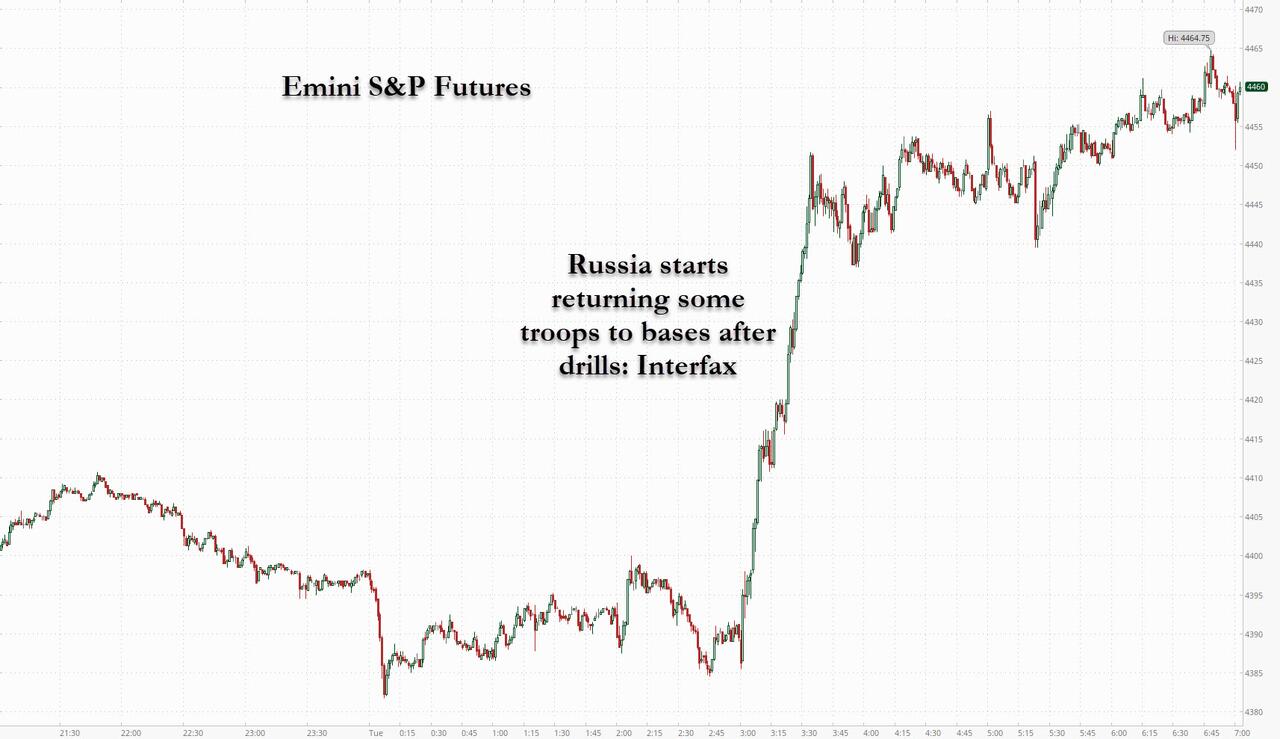
With less than 24 hours to go until the Feb 16 CNN and CIA-leaked Putin “invasion day” – because if you are Russia you always leak to the US intel agencies when you are going to invade a sovereign nation – this morning markets got a welcome surprise when just after 3am ET, Interfax reported and Russia’s Defense Ministry later confirmed that some troops are starting to return to their regular bases after completing drills. Markets welcomed the positive signals from Moscow, which included Russia’s top diplomat saying that diplomacy with the West could succeed, as US equity futures surged, bond yields were lifted and and oil, gold and other safe havens were slammed amid continued optimism that geopolitical tensions in Ukraine may be easing.

As of 715am, emini S&P futures were 1.6%, or 72 points higher, and trading at 4,464 while Nasdaq futures rose 2.2% and Dow futures were 1.2% higher. 10Y Treasury yields bounced above 2.02% after dropping as low as 1.90% yesterday after the US deep state sparked fresh groundless panic about an imminent invasion. The dollar, oil and gold tumbled while cryptos jumped. Meanwhile, iron ore tumbled as China ramped up a campaign to stop prices from overheating.
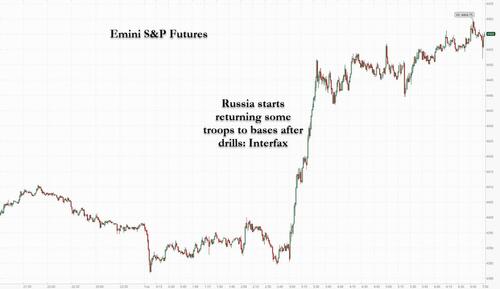
In premarket trading, Intel rose after agreeing to buy Israel’s Tower Semiconductor Ltd. for $5.4 billion. Big U.S. technology companies including Apple Inc., Tesla Inc. and Microsoft Corp. also rose, along with cryptocurrency-exposed stocks as Bitcoin extended its recent rebound back above the $44,000 level. Bigtech stocks also gained in premarket trading. Here are some other notable premarket movers:

  • Intel (INTC US) adds 1.4% in early trading after it agreed to acquire Tower Semiconductor for about $5.4 billion. Tower Semiconductor jumps 45%.
  • Resonant Inc. (RESN US) shares soar257% following its announced sale to Murata Electronics North America for $4.50 per share.
  • Advanced Micro Devices (AMD US) shares rise 3.5% in U.S. premarket; focus is shifting to solid long-term and multiple growth factors now that the semiconductor company completed Xilinx acquisition, writes Cowen (outperform).
  • Larimar Therapeutics (LRMR US) shares sink 58% in premarket trading after the company said the FDA is maintaining its clinical hold on Larimar’s CTI-1601 program.
  • Arista Networks (ANET US) shares jump 10% in premarket trading after the cloud-networking company gave a quarterly revenue forecast that exceeded analysts’ expectations.
  • Amkor Technology (AMKR US) shares gain 9% in early trading, after the semiconductor manufacturing company reported its fourth-quarter results and gave a forecast.
  • Car rental company Avis Budget (CAR US) reported fourth-quarter profit and revenue that beat the average analyst estimate. Shares fell 1.2% in postmarket trading Monday, with Morgan Stanley pointing out a weakness in pricing.

Also in knee jerk reaction, the Russian ruble strengthened the most in more than two weeks against the dollar, leading gains among emerging-market currencies after the Interfax news service reported some troops were returning to bases after drills in the Western and Southern military districts, fueling speculation tensions over Ukraine are abating. The yield on Russia’s ruble debt tumbled a quarter percentage point.

Still, significant uncertainty remains over the extent of Russia’s pullback, with NATO saying it has yet to see evidence of a pullback. And nerves are still raw after Monday, when stocks were spooked by President Volodymyr Zelenskiy’s sarcastic comment about the rest of the world predicting a date for an attack by Russia. The U.S. has said its intelligence indicates Russia may attack imminently, although officials in Moscow have repeatedly denied an invasion is planned and it now looks like they were correct again. Meanwhile, diplomatic efforts are continuing, with German Chancellor Olaf Scholz meeting Russian President Vladimir Putin.

Markets have been whipsawed this week as the Ukraine crisis added to existing concerns over high inflation and the withdrawal of stimulus by the Federal Reserve. Investor focus will turn to producer price inflation figures for cues on how aggressive the Fed is likely to be with reining in its monetary policy.

“What we are seeing is a Fed that is reacting to inflationary prints even though many of the pressures on inflation are factors that the Fed really can’t solve,” Kristina Hooper, chief global market strategist at Invesco, said on Bloomberg Television. “So that certainly increases the risks and reduces the clarity.”

In Europe, the Euro Stoxx 50 rose 1%, with FTSE MIB outperforms adding 1.1%, FTSE 100 lags adding 0.3%. Autos, industrials and chemicals are the strongest performing sectors.  Energy shares underperformed in Europe as oil retreated from the highest since 2014 and natural gas prices dropped on a possible cooling in the crisis. Delivery Hero SE led gains in Europe, while Glencore Plc jumped to a 10-year high.

Asian stocks, most of which closed before the Russian news hit the tape, extended losses for a third day, checked by the prospect of higher U.S. interest rates and concern Russia’s fallout with Ukraine will lead to conflict. The MSCI Asia Pacific Index fell as much as 0.8%. Financial and industrial sectors were the biggest drags while consumer staples and healthcare names provided support. Equities in mainland China bucked the trend, climbing after the central bank stepped up support for the slowing economy. The CSI 300 rose more than 1% after the People’s Bank of China injected a net 100 billion yuan ($15.7 billion) into the banking system with its medium-term lending facility, while leaving the borrowing rate unchanged. The key China stock gauge is still down nearly 7% this year, hurt by concerns over the economy. Investors will closely examine the Federal Reserve’s meeting minutes due this week for the next clues on monetary-policy tightening, said Mamoru Shimode, the chief strategist at Resona Asset Management. The market also remains on edge over geopolitical tensions, after Ukrainian President Volodymyr Zelenskiy spooked investors with confusing comments. “We’re in a very delicate situation for markets,” Shimode said. “The worst-case scenario is for this to drag on, leading to higher and higher oil and energy prices, which will leave no choice for the U.S. to tighten policy further and in turn, deteriorate economic growth.”

Japanese equities fell for a second day as the latest data on the local economy failed to cheer investors amid ongoing worry over Russia-Ukraine tensions and upcoming U.S. interest-rate hikes. Service providers and banks were the biggest drags on the Topix, which fell 0.8%. Recruit was the largest contributors to a 0.8% loss in the Nikkei 225, dropping 12% as analysts pointed to concerns about the post-pandemic outlook for HR-related business. The yen strengthened 0.2% against the dollar. Japan’s gross domestic product expanded at a slightly slower-than-expected annualized pace of 5.4% in the three months through December compared with the previous quarter, the Cabinet Office reported Tuesday. Economists had estimated growth of 6%. “Real GDP remained 0.2% below pre-pandemic 4Q 2019, highlighting Japan’s lagging recovery compared to the U.S. and Europe,” Shuji Tonouchi, an economist at Mitsubishi UFJ Morgan Stanley wrote in a note. “High import prices continue to spread to the investment deflator, which has weighed on housing and other investment.”

In FX, the Bloomberg Dollar Spot Index fell as much as 0.3% as risk assets rallied; Sweden’s krona was the top performer among G-10 peers while the yen and the Swiss franc were at the bottom, after giving up earlier gains. The euro erased yesterday’s loss versus the dollar to briefly top $1.1350. The pound advanced against the dollar but fell against the euro. U.K., real average wages fell at the fastest pace since 2014 in December, prompting concerns about a cost of living crisis. The Aussie recovered even as iron ore plummeted after Beijing ramped up a campaign to stop prices overheating. The ruble soared as much as 2.1% and currencies in the EU’s east extended gains against the dollar

In rates, Treasuries slid as haven-buying is unwound leading to modest bear steepening with 2s10s widening ~3bps, while bunds hovered, underperforming European peripheral bonds. Treasury losses were led by long-end of the curve, as stocks rally globally on signs that the Russia-Ukraine crisis may be easing. Yields are cheaper by 4bp-5bp across long-end of the curve, steepening 5s30s by ~2bp; front-end outperforms slightly with 2- year yields cheaper by less than 1bp and 2s10s steeper by nearly 4bp. In the 10-year sector bunds outperform U.S. by 2.7bp, gilts by 6.3bp.  Peripheral spreads tighten to Germany with 10y BTP/Bund narrowing ~1bp. Italian 10-year yield briefly touches 2%, now back to 1.965%.

In commodities, crude futures decline. WTI trades within Monday’s range, falling 2.7% to trade near $92.85. Spot gold falls roughly $15 to trade near $1,856/oz, while other precious metals follow suit. Most base metals trade in the green; LME lead rises 1%, outperforming peers. LME aluminum lags.

Bitcoin continues to pick up and back away from a potential test of the USD 40k mark to the downside following pressure emerging at the tail-end of last week/over the weekend

Looking at the day ahead, data releases from the US include January’s PPI and the February Empire State manufacturing survey. Meanwhile in Europe, there’s UK unemployment for December, the German ZEW survey for February, and the second estimate of the Euro Area’s Q4 GDP. Otherwise, central bank speakers include the ECB’s Villeroy, and earnings releases include Airbnb.
Market Snapshot

  • S&P 500 futures up 1.3% to 4,450.25
  • STOXX Europe 600 up 1.1% to 465.91
  • MXAP down 0.2% to 187.14
  • MXAPJ little changed at 616.00
  • Nikkei down 0.8% to 26,865.19
  • Topix down 0.8% to 1,914.70
  • Hang Seng Index down 0.8% to 24,355.71
  • Shanghai Composite up 0.5% to 3,446.09
  • Sensex up 3.0% to 58,096.29
  • Australia S&P/ASX 200 down 0.5% to 7,206.93
  • Kospi down 1.0% to 2,676.54
  • Brent Futures down 2.5% to $94.02/bbl
  • Gold spot down 0.9% to $1,854.13
  • U.S. Dollar Index down 0.31% to 96.07
  • German 10Y yield little changed at 0.29%
  • Euro up 0.3% to $1.1340
  • Brent Futures down 2.5% to $94.02/bbl

Top Overnight News from Bloomberg

  • Investor confidence in Germany’s economic recovery improved further as the country edges closer to loosening its coronavirus restrictions. The ZEW institute’s gauge of expectations rose to 54.3 in February from 51.7 the previous month. An index of current conditions also increased
  • Employment in the euro area exceeded its pre-pandemic level, shrugging off surging Covid-19 infections to highlight the economy’s increasing resilience to virus disruptions. The number of employed people rose 2.1% from a year ago in the final quarter of 2021, reaching 161.8 million, data released Tuesday showed
  • China’s central bank stepped up support for its slowing economy by pumping in cash via policy loans for a second straight month. The benchmark stock index advanced, outperforming regional equities.
  • Riksbank Deputy Governor Martin Floden says the recent krona weakening is partly related to the market perceiving the Riksbank’s latest decision as dovish, but even more to the tensions linked to Russia and Ukraine

A more detailed look at global markets courtesy of Newsquawk:

Asia-Pac stocks traded mostly lower following a similar handover from Wall Street. ASX 200 was subdued as the energy and mining names gave back some of yesterday’s gains, whilst the RBA minutes offered no fresh information. Nikkei 225 was pressured by its industrial sector and with a resilient Yen providing further headwinds. Hang Seng continued to be overpowered by the COVID situation in Hong Kong which prompted Chief Executive Lam to announce new measures to curb the spread. Shanghai Comp. bucked the trend and posted mild gains after the PBoC decided to inject CNY 300bln via 1yr MLF, albeit at a maintained rate of 2.85%

Top Asian News

  • China Warns Iron Ore Trading Cos Against Speculation, Hoarding
  • Hong Kong ‘Overwhelmed’ But Doesn’t Plan Lockdown: Virus Update
  • PBOC Offers 300b Yuan of MLF With Rate Unchanged at 2.85%
  • Japan Preliminary 4Q GDP Annualized Rises 5.4% Q/q; Est. +6%

European bourses are firmer in a pick-up from a relatively contained open amid developments on the geopolitical front. Updates that some Russia troops are returning to base lifted above Monday’s best levels.US futures In Europe, sectors are all in the green though is the relative underperformer amid additionalBasic Resources monitoring from China re. iron ore.

Top European News

  • U.K. Incomes See Biggest Squeeze Since 2014 as Inflation Bites
  • HSBC Said to Face ‘Disruptive’ Review of Credit Risk Reporting
  • Glencore Sets Aside $1.5 Billion as Graft Probes Near End
  • Engie Hikes Dividend 60% as Energy Price Surge Lifts Profits

In FX, the greenback slips as markets draw encouragement from Russia recalling troops after completing drills. Euro especially relieved by less perceived risk of imminent invasion of Ukraine. Pound perky as risk sentiment picks up and UK earnings exceed expectations. Kiwi and firm as NZ and China improve FTA terms.Yuan Rouble up as Russia’s Lavrov says dialogue with West to continue and results are achievable.

In commodities, crude benchmarks were hit on the reported withdrawal of some Russian troops, in an unwinding of geopolitical premia after a relatively uneventful APAC session. Pressure that sent below the USD 94.00/bbl mark, for instance. Brent Spot gold/silver also deteriorated on the above update, as havens across the board waned; albeit, the yellow metal retains USD 1850/oz. China’s NDRC and SAMR will reportedly be holding a meeting on iron ore in Qingdao on Feb 17th; Glencore (GLEN LN) and Trafigura are among those required to submit recent transaction data and port stockpiles, according to Chinese press. Iraq Federal Court deems Kurdish oil and gas law as unconstitutional, State News reports. Barclays raised its WTI and Brent price forecasts, both by USD 7/bbl, to USD 89/bbl and USD 92/bbl respectively, according to Reuters.

In fixed income, core bonds back off in tandem with some Russian forces returning from drills. Gilts hold up better after well received 2032 DMO issuance in contrast to a so-so German Bobl sale. US Treasuries bear-steepen awaiting Wednesday’s 20 year note supply.

In crypto, bitcoin continues to pick up and back away from a potential test of the USD 40k mark to the downside following pressure emerging at the tail-end of last week/over the weekend.

In geopolitics:

  • Kremlin spokesperson Peskov said Russian President Putin is “willing to negotiate”, has always demanded negotiations and diplomacy; adding the Ukraine crisis was only one part of Russia’s larger security concerns, via CNN.
  • US State Department advises US citizens to immediately depart Belarus, according to Bloomberg.
  • US is reportedly closing its embassy in Kyiv and relocating diplomatic operations to Western Ukraine. US State Department ordered destruction of computer equipment amid warnings of Russian invasion, according to WSJ.
  • Russia military says it is continuing set of drills involving almost all districts and navies, Interfax reports; some Western and Southern units are set to return to bases.
  • Russian Kremlin says that warnings from the US that Russia is going to launch a fresh attack on Ukraine on Wednesday is “baseless hysteria”, via Reuters.
  • Russian lawmakers vote in favour of sending a resolution on the recognition of two breakaway regions in Eastern Ukraine to President Putin, via Reuters.
  • EU’s Borrell says if there is a war between Ukraine and Russia, Nordstream 2 will not become operational, via Reuters.
  • Biden admin officials are reportedly running out of patience regarding talks on China’s shortfalls under the Phase One deal, but the White House plans to let the talks play out before considering the next steps, according to Bloomberg sources. This is in-fitting with reports from last Monday.
  • There are reports of Houthi militias firing a ballistic missile at Marib, Yemen, according to Al Arabiya

US Event Calendar

  • 8:30am: Jan. PPI Final Demand MoM, est. 0.5%, prior 0.2%, revised 0.3%; YoY, est. 9.1%, prior 9.7%
  • 8:30am: Jan. PPI Ex Food and Energy MoM, est. 0.5%, prior 0.5%; YoY, est. 7.8%, prior 8.3%
  • 8:30am: Feb. Empire Manufacturing, est. 12.0, prior -0.7
  • 4pm: Dec. Net Foreign Security Purchases, prior $137.4b

DB’s Jim Reid concludes the overnight wrap

Yesterday was a wild ride back and forth across what were relatively restrained ranges given all the newsflow. Headlines bounced about all over the place so it was hard to keep up. However in something I’ve never seen before, late quotes from the Ukrainian President that Russia would attack tomorrow, were soon rowed back by his office as “sarcasm”. I’m not sure if I’ve ever known a better use of the phrase “lost in translation”.

Starting in Europe, markets began the week catching up to the negative headlines that broke late on Friday. Optimistically, by the middle of the day, comments from Russian Foreign Minister Lavrov to President Putin that diplomacy should continue and there was still a chance of a deal helped to stabilise various assets. Focus then turned back to global monetary policy tightening, where comments from officials echoed what they said last week. St. Louis Fed President Bullard, much like last week, preferred a more aggressive path of policy, reiterating in a CNBC interview that he wanted 100bps of rate increases by July 1, saying that “our credibility is on the line here and we do have to react to data.”

This led to a big reversal in fixed income which peaked around the European close. Initially European sovereign yields sold off nearly 10bps in the morning but closed only marginally lower with 10yr bunds (-1.3bps) and OATs (-0.4bps) making a sharp about turn. Gilt yields actually rose across the curve, with the 10yr yield up +4.5bps to a 3-year high of 1.59% as overnight index swaps priced in a more aggressive series of rate moves this year. In keeping with the pattern of recent days, there was yet another widening in peripheral spreads, with the gap between Spanish and German 10yr yields moving above 100bps for the first time since June 2020, whilst the gap between Italian and German yields hit 169bps, the highest since July 2020.

The day was awash with headlines. Earlier U.S. officials reportedly had satellite images of Russian troops moving to attack positions which caused a wobble, but the big one was the headline from Ukraine’s President that was later put down to sarcasm.

Before the clarification, the headlines drove a discrete risk-off cross-asset price response, with 10yr yields falling around -7bps from their intraday highs, the S&P 500 dipping to session lows, and safe-haven currencies appreciating. Most assets stabilised for the remainder of the afternoon, however, as markets digested the misunderstanding. Next stop is German Chancellor Scholz’s planned trip to Moscow today. Expect plenty of headlines.

Treasury yields still wound up increasing across the curve after all was said and done, albeit below intraday highs, with 2yr yields (+7.5bps) outpacing 10yr yields (+5.0bps) on the continued hawkish tone from Fed officials combined with deteriorating risk sentiment. This drove the 2s10s curve to 41.0bps, the flattest level since August 2020. Fed funds futures are pricing 6.6 rate hikes by the end of 2022, the highest closing reading so far, and around +164bps of tightening, just below our US econ team’s updated call for +175bps of tightening this year.

For equities, the continued geopolitical tensions and the move to price in additional rate hikes led to further declines and the S&P 500 shed another -0.39%, well off the intra-day lows (-1.22%) but bringing its losses since January’s all-time high to -8.23% (-7.65% YTD). Growing volatility saw the VIX index rise a further +1.27pts, hitting 28.6pts, and Bloomberg’s index of US financial conditions fell to its least accommodative level in 3 weeks. US tech stocks outperformed, with the NASDAQ flat and the FANG+ up +0.57%. Over in Europe, where markets had been closed on Friday when the Ukraine headlines came through, the STOXX 600 lost a larger -1.83% (-2.99% at the day’s lows).

Looking at some of the most affected assets, oil prices took another leg higher after the geopolitical headlines, echoing Friday’s surge, with Brent Crude up +2.16%, whilst WTI saw a somewhat bigger gain of +2.53%. That marked the highest closing level for both since 2014. Furthermore, European gas prices remained elevated with a further +4.32% gain, but at €80.77/MWh it was still roughly in line with where they’d spent most of January. Growing appetite for haven assets was very good news for gold however, which advanced +0.6% in its 6th gain in the last 7 sessions, and 9 of the last 11, eclipsing its recent closing peak back in November.

Overnight in Asia, equity markets are mostly trading lower. In Japan, the Nikkei (-0.74%) has reversed its early morning gains after Japan’s economy expanded at an annualized rate of +5.4% q/q, less than the consensus estimate of +6.0%. For 2021, the nation’s economy grew +1.7%, recording its first expansion in three years after contracting -4.5% in 2020 and -0.2% in 2019. Meanwhile, the Kospi (-1.06%) and the Hang Seng (-1.14%) are both also trading lower. Elsewhere, the Shanghai Composite (+0.40%) and the CSI (+0.93%) are trading up after the People’s Bank of China (PBOC) injected cash via policy loans for a second consecutive month to counter the economic slowdown. The PBOC pumped in a net amount of 100 billion yuan ($15.7 billion) in the banking system via its medium-term lending facility (MLF). The MLF rate was kept unchanged at 2.85% after being cut from 2.95% last month.

Separately, oil prices are touch lower with Brent crude futures down -0.69% to $95.81/bbl while US crude futures -0.76% to $94.73/bbl. US treasury yields are 1-2bps across the curve.

Looking ahead, equity futures in the DM are relatively flat with contracts on the S&P 500 (+0.08%), Nasdaq (+0.20%) and DAX (+0.02%) waiting for fresh newsflow.

There wasn’t much on the data front yesterday, though we did get the New York Fed’s Survey of Consumer Expectations for January, which interestingly saw a decline in short and medium-term inflation expectations. In fact, short-term inflation expectations at the one-year horizon fell to 5.8%, the first decline since October 2020, whilst 3-year ahead expectations fell to 3.5% from 4.0% which was a bit surprising given all that we’ve seen and heard of late.

To the day ahead now, and data releases from the US include January’s PPI and the February Empire State manufacturing survey. Meanwhile in Europe, there’s UK unemployment for December, the German ZEW survey for February, and the second estimate of the Euro Area’s Q4 GDP. Otherwise, central bank speakers include the ECB’s Villeroy, and earnings releases include Airbnb.
Tyler Durden
Tue, 02/15/2022 – 07:48

via ZeroHedge News https://ift.tt/E9DNuOd Tyler Durden

Teacher Spying Is Instilling Surveillance Culture Into Students


cewitness100031

For the teachers, it began in October at the California Teachers Association’s 2021 LGBTQ+ Issues Conference. Lori Caldeira and Kelly Baraki explained how they identified potential new members of UBU, the school’s club of LGBTQ supporters. “When we were doing our virtual learning—we totally stalked what they were doing on Google, when they weren’t doing schoolwork,” Caldeira said. “One of them was Googling ‘Trans Day of Visibility.’ And we’re like, ‘Check.’ We’re going to invite that kid when we get back on campus.”

Whatever you think of LGBTQ issues, the fact that a teacher can remotely track what students do online should give you pause. This was not a case of a teacher reviewing the browser history on a classroom computer after school. As Caldeira said, albeit with her tongue in cheek, they were stalking the kids. (The title of Caldeira and Baraki’s presentation declared that it was about running such clubs “in conservative communities.” Needless to say, conservative teachers can snoop on kids’ online activities too.)

The Buena Vista Middle School in Salinas, California, where Caldeira is employed (and is currently on leave, following the uproar over the story), uses GoGuardian, a standard software tool for monitoring what students do during Zoom classes. GoGuardian, which promotes itself as powering “digital learning environments where every student can thrive,” is being used in about 30,000 schools.

Schools do, of course, have a vested interest in protecting students. Defenders of programs like GoGuardian point out that it could catch a student searching for, say, “how to commit suicide.” But as with law, extreme cases make bad policy. If “digital learning environment” tools also collect data related to non-life-threatening behavior, can we expect school authorities to hold a line on what to flag and when to interfere?

GoGuardian’s website features a testimonial from a district administrator. A student, new to the district, revealed in his journal he was struggling to fit in. Certain words tripped an alert, and the administrator was able to connect the student to support services. Perhaps that worked out for the best for this student, but most kids probably don’t want school administrators reading their journals. (GoGuardian was unable “to get any exec spokesperson availability” to respond to my inquiries.)

Justin Reich, a former teacher who spent 15 years as an education technology consultant and who now directs MIT’s Teaching Systems Lab, says, “Generally speaking, I think school policy gives quite wide leeway for schools and districts to have the capacity to view almost anything that happens on school devices, networks and services.” And that worries him. “We need to consider how schools help induct students into a surveillance culture,” he says.

Chris Gilliard of Macomb Community College pointed out on Reich’s podcast, TeachLab, that schools have long been “a place where people watch and are watched.” The difference today lies in which realm, the physical or the virtual, the watching takes place. Students are watched at school and then beyond campus via devices they access at home. What lines are schools drawing between necessary monitoring of student behavior, the requirements of mandatory reporting, and student privacy? Are these lines being codified in policies? Or are schools flying by the seat of their pants?

“Many of these tools were adopted in a rush at the start of the pandemic,” says Elana Zeide, an expert on student privacy and artificial intelligence at the University of Nebraska School of Law. “But after two years of remote learning, they should have gotten themselves together and ironed their policies out.”

It’s not even clear that the tools are working the way they are supposed to. For example, Zeide says, there is little evidence that “online proctoring reduced cheating.”

There is also the question of equity. School-issued devices are like work-issued ones, which are expected to be used strictly for work. Many students have access to a second device at home for personal use, and thus can evade the prying eyes of school surveillance tools. But this, Zeide points out, disadvantages lower-income students “who might have only the school-issued machine.”

And Zeide has a larger concern too. “Surveilling students has been shown to have a chilling effect on their speech and their curiosity, what might be called their intellectual privacy,” she says. If students feel they are being watched, they may be less likely to explore less “acceptable” ideas or to search the internet with questions they are embarrassed to ask in class.

If schools won’t abandone online surveillance altogether, are there smaller steps they can take? Zeide wants better teacher training, since how well these tools work depends in part on how they are used. Schools can also turn surveillance off after school hours. (GoGuardian offers such an option.) And then there’s transparency: Schools, Zeide says, should explain to parents what data is being collected, even if the data is not part of the student’s permanent educational record.

“It may be best practice, but how many schools are actually practicing it?” I ask.

“That’s a great question,” Zeide replies.

The post Teacher Spying Is Instilling Surveillance Culture Into Students appeared first on Reason.com.

from Latest https://ift.tt/ZXNygqr
via IFTTT

Russia Withdraws Troops From Ukraine Border After Media Said Invasion Was Imminent

Russia Withdraws Troops From Ukraine Border After Media Said Invasion Was Imminent

By Paul Joseph Watson of SummitNews.com

Shortly after media reports suggested a Russian invasion of Ukraine was imminent, Moscow announced that it was withdrawing all troops from the border and then claimed “western propaganda” had failed.

Goaded by the Biden administration, major news outlets like the Sun reported that the invasion was set for tomorrow, with a “massive missile blitz” planned, along with 200,000 troops at the ready.

But within hours, it appeared the media had jumped the gun.

Major General Igor Konashenkov announced that all Russian troops would begin to be withdrawn from the border region.

“As the forces complete their military exercises, they will, as always, complete a multimodal march back to their permanent bases,” Konashenkov stated. “The divisions of the South and West Military Districts have finished their tasks and have already begun loading the rail and automobile transport, and today will begin moving back to their military garrisons.”

Russia also released video clips showing armor being loaded onto railway carriages on its way back home.

Kremlin officials seized upon the troop withdrawal as proof of a propaganda victory against the United States and NATO.

Foreign Ministry spokeswoman Maria Zakharova said, “15 February 2022 will go down in history as the day Western war propaganda failed,” she wrote, adding that the west has been “shamed and destroyed without firing a single shot.”

The White House’s national security advisor Jake Sullivan had breathlessly told CNN on Sunday that intelligence suggested “major military action” could “begin any day now.”

Ukrainian President Volodymyr Zelensky had also declared that February 16th, the day the Biden administration claimed Russia was planning to invade, would be a national “day of unity.”

“On this day, we will fly our national flags, put on blue-and-yellow ribbons and show our unity to the entire world,” said Zelensky.


The comments were subsequently picked up by US media outlets and reported without an ounce of skepticism, prompting a stock market sell off and a rush on gold and crude oil.

Zelensky was then forced to back pedal and claim his comments were said “with irony.”

Tyler Durden
Tue, 02/15/2022 – 07:14

via ZeroHedge News https://ift.tt/KkxWTJY Tyler Durden

Teacher Spying Is Instilling Surveillance Culture Into Students


cewitness100031

For the teachers, it began in October at the California Teachers Association’s 2021 LGBTQ+ Issues Conference. Lori Caldeira and Kelly Baraki explained how they identified potential new members of UBU, the school’s club of LGBTQ supporters. “When we were doing our virtual learning—we totally stalked what they were doing on Google, when they weren’t doing schoolwork,” Caldeira said. “One of them was Googling ‘Trans Day of Visibility.’ And we’re like, ‘Check.’ We’re going to invite that kid when we get back on campus.”

Whatever you think of LGBTQ issues, the fact that a teacher can remotely track what students do online should give you pause. This was not a case of a teacher reviewing the browser history on a classroom computer after school. As Caldeira said, albeit with her tongue in cheek, they were stalking the kids. (The title of Caldeira and Baraki’s presentation declared that it was about running such clubs “in conservative communities.” Needless to say, conservative teachers can snoop on kids’ online activities too.)

The Buena Vista Middle School in Salinas, California, where Caldeira is employed (and is currently on leave, following the uproar over the story), uses GoGuardian, a standard software tool for monitoring what students do during Zoom classes. GoGuardian, which promotes itself as powering “digital learning environments where every student can thrive,” is being used in about 30,000 schools.

Schools do, of course, have a vested interest in protecting students. Defenders of programs like GoGuardian point out that it could catch a student searching for, say, “how to commit suicide.” But as with law, extreme cases make bad policy. If “digital learning environment” tools also collect data related to non-life-threatening behavior, can we expect school authorities to hold a line on what to flag and when to interfere?

GoGuardian’s website features a testimonial from a district administrator. A student, new to the district, revealed in his journal he was struggling to fit in. Certain words tripped an alert, and the administrator was able to connect the student to support services. Perhaps that worked out for the best for this student, but most kids probably don’t want school administrators reading their journals. (GoGuardian was unable “to get any exec spokesperson availability” to respond to my inquiries.)

Justin Reich, a former teacher who spent 15 years as an education technology consultant and who now directs MIT’s Teaching Systems Lab, says, “Generally speaking, I think school policy gives quite wide leeway for schools and districts to have the capacity to view almost anything that happens on school devices, networks and services.” And that worries him. “We need to consider how schools help induct students into a surveillance culture,” he says.

Chris Gilliard of Macomb Community College pointed out on Reich’s podcast, TeachLab, that schools have long been “a place where people watch and are watched.” The difference today lies in which realm, the physical or the virtual, the watching takes place. Students are watched at school and then beyond campus via devices they access at home. What lines are schools drawing between necessary monitoring of student behavior, the requirements of mandatory reporting, and student privacy? Are these lines being codified in policies? Or are schools flying by the seat of their pants?

“Many of these tools were adopted in a rush at the start of the pandemic,” says Elana Zeide, an expert on student privacy and artificial intelligence at the University of Nebraska School of Law. “But after two years of remote learning, they should have gotten themselves together and ironed their policies out.”

It’s not even clear that the tools are working the way they are supposed to. For example, Zeide says, there is little evidence that “online proctoring reduced cheating.”

There is also the question of equity. School-issued devices are like work-issued ones, which are expected to be used strictly for work. Many students have access to a second device at home for personal use, and thus can evade the prying eyes of school surveillance tools. But this, Zeide points out, disadvantages lower-income students “who might have only the school-issued machine.”

And Zeide has a larger concern too. “Surveilling students has been shown to have a chilling effect on their speech and their curiosity, what might be called their intellectual privacy,” she says. If students feel they are being watched, they may be less likely to explore less “acceptable” ideas or to search the internet with questions they are embarrassed to ask in class.

If schools won’t abandone online surveillance altogether, are there smaller steps they can take? Zeide wants better teacher training, since how well these tools work depends in part on how they are used. Schools can also turn surveillance off after school hours. (GoGuardian offers such an option.) And then there’s transparency: Schools, Zeide says, should explain to parents what data is being collected, even if the data is not part of the student’s permanent educational record.

“It may be best practice, but how many schools are actually practicing it?” I ask.

“That’s a great question,” Zeide replies.

The post Teacher Spying Is Instilling Surveillance Culture Into Students appeared first on Reason.com.

from Latest https://ift.tt/ZXNygqr
via IFTTT