Key Events This Week: Payrolls, PMIs, Earnings And Fed Speak

Key Events This Week: Payrolls, PMIs, Earnings And Fed Speak

Now that the big China data dump is out of the way (as we reported overnight, it missed on 3 of 4 metrics, with just retail sales beating, while GDP, industrial output and fixed investment all missed), we’ll have to wait until Friday for the main releases of the week, namely the global flash PMIs. Outside of that, DB’s Jim Reid notes that there’s plenty of Fedspeak as they approach the blackout period at the weekend ahead of their November 3rd meeting where they’re expected to announce the much discussed taper.

On top of this, earnings season will ramp up further, with 78 companies in the S&P 500 reporting. Early season positive earnings across the board have definitely helped sentiment over the last few days. 18 out of 19 that reported last week beat expectations across varying sectors. As examples, freight firm JB Hunt climbed around 9% after beating, Alcoa over 15% and Goldman Sachs nearly 4%. On the back of the decent earnings, the S&P 500 had its best week since July last week and is now only less than -1.5% off its record high from early September.

As DB further notes, given that earnings season has made a difference the 78 companies in the S&P 500 and 58 from the Stoxx 600 will be important for sentiment this week. In terms of the highlights, tomorrow we’ll get reports from Johnson & Johnson, Procter & Gamble, Netflix, Philip Morris International and BNY Mellon. Then on Wednesday, releases include Tesla, ASML, Verizon Communications, Abbott Laboratories, NextEra Energy and IBM. On Thursday, there’s Intel, Danaher, AT&T, Union Pacific and Barclays. Lastly on Friday, well hear from Honeywell and American Express.
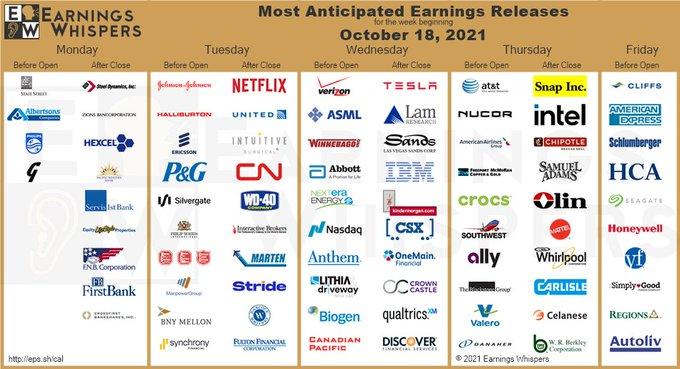
Source: Earnings Whispers

It’ll also be worth watching out for the latest inflation data, with CPI releases for September from the UK, Canada (both Wednesday) and Japan (Friday). The UK is by far and away the most interesting given the recent pressures and likely imminent rate hike. This month is likely to be a bit of calm before the future storm though as expectations are broadly similar to last month. Given the recent rise in energy prices, this won’t last though.

In terms of the main US data, today’s industrial production (consensus +0.2% vs. +0.4% previously) will be a window into supply-chain disruptions, particularly in the auto sector. Alas, the big miss of -1.3% confirms that the US economy is fading fast.

Outside of that, you’ll see in the day-by-day week ahead guide at the end that there’s a bit of US housing data to be unveiled (NAHB today, housing starts and permits tomorrow). Housing was actually the most interesting part of the US CPI last week as rental inflation came in very strong, with primary rents and owners’ equivalent rent growing at the fastest pace since 2001 and 2006, respectively. The strength was regionalized (mainly in the South) but this push from recent housing market buoyancy into CPI, via rents, has been a big theme of here in recent months. Rents and owners’ equivalent rent makes up around a third of US CPI. So will a third of US inflation be above 4% consistently next year before we even get to all the other things?
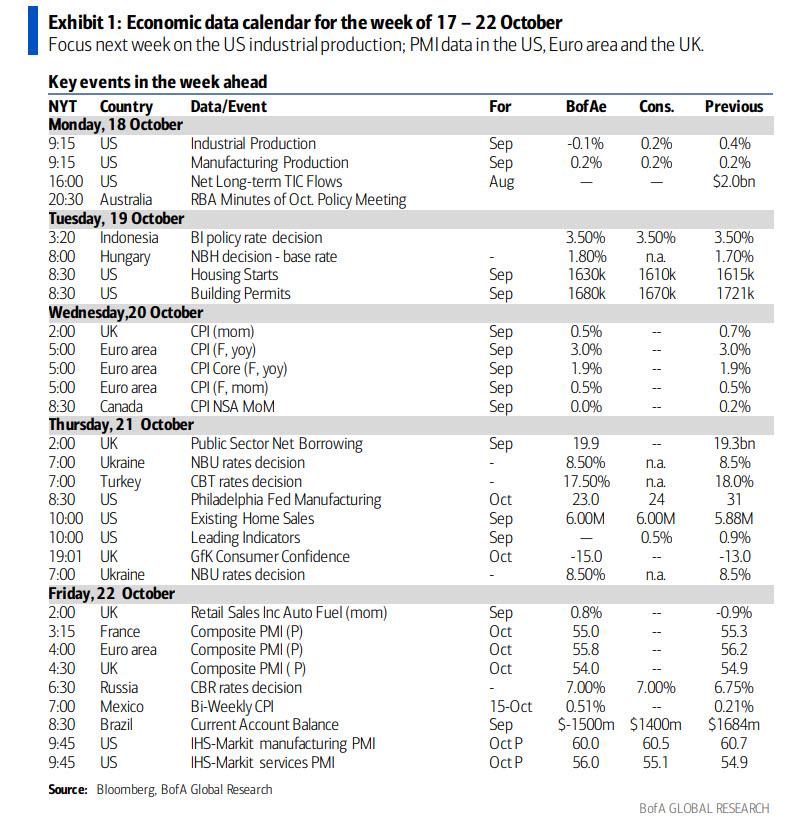
Moving to Germany, formal coalition negotiations are set to commence soon between the SPD, the Greens and the FDP. They reached an agreement on Friday with some preliminary policies that will form the basis for talks, including the maintenance of the constitutional debt brake, a pledge not to raise taxes or impose new ones, along with an increase in the minimum wage to €12 per hour. There are also a number of environmental measures, including a faster shift away from coal that will be complete by 2030. The Green Party voted in favor of entering the formal negotiations over the weekend, with the SPD agreeing on Friday, and the FDP is expected to approve the talks today.

Below is a day-by-day calendar of events, courtesy of Deutsche Bank

Monday October 18

  1. Data: China Q3 GDP, September retail sales, industrial production, US September industrial production, capacity utilisation, October NAHB housing market index
  2. Central Banks: Fed’s Quarles, Kashkari and BoE’s Cunliffe speak

Tuesday October 19

  • Data: US September housing starts, building permits
  • Central Banks: Bank Indonesia monetary policy decision, ECB’s Rehn, Panetta, Lane, Fed’s Daly, Bostic, Waller, and BoE’s Governor Bailey and Mann speak
  • Earnings: Johnson & Johnson, Procter & Gamble, Netflix, Philip Morris International, BNY Mellon

Wednesday October 20

  • Data: Japan September trade balance, UK September CPI, Canada September CPI
  • Central Banks: Federal Reserve releases Beige Book, ECB’s Villeroy, Elderson, Holzmann, Villeroy, Visco, Fed’s Bostic, Kashkari, Evans, Bullard and Quarles speak
  • Earnings: Tesla, ASML, Verizon Communications, Abbott Laboratories, NextEra Energy, IBM

Thursday October 21

  • Data: US weekly initial jobless claims, September leading index, existing home sales, Euro Area advance October consumer confidence
  • Central Banks: Central Bank of Turkey monetary policy decision, Fed’s Waller speaks
  • Earnings: Intel, Danaher, AT&T, Union Pacific, Barclays

Friday October 22

  • Data: October flash PMIs from Australia, Japan, France, Germany, Euro Area, UK and US, UK October GfK consumer confidence indicator, Japan September nationwide CPI
  • Central Banks: Central Bank of Russia monetary policy decision, Fed’s Daly speaks
  • Earnings: Honeywell, American Express

* * *

Finally, focusing just on the US, Goldman writes that the key economic data release this week is the Philadelphia Fed manufacturing index on Thursday. There are several scheduled speaking engagements from Fed officials this week, including a discussion with Chair Powell hosted by the South African Reserve Bank.

 Monday, October 18

  • 05:30 AM Fed Governor Quarles (FOMC voter) speaks; Fed Governor Randal Quarles will speak at a conference on financial stability hosted by the Bank of Spain in Madrid. Text and moderated Q&A are expected.
  • 09:15 AM Industrial production, September (GS -0.2%, consensus +0.2%, last +0.4%); Manufacturing production, September (GS flat, consensus +0.1%, last +0.2%): Capacity utilization, September (GS 76.2%, consensus 76.5%, last 76.4%): We estimate industrial production declined by 0.2% in September, reflecting weakness in motor vehicle, oil, and natural gas production. We estimate capacity utilization declined by 0.2pp to 76.2%.
  • 10:00 AM NAHB housing market index, October (consensus 75, last 76)
  • 02:15 PM Minneapolis Fed President Kashkari (FOMC non-voter) speaks: Minneapolis Fed President Neel Kashkari will discuss financial inclusion as part of a forum on minorities in banking hosted by the Kansas City Fed.

Tuesday, October 19

  • 08:30 AM Housing starts, September (GS +1.0%, consensus flat, last +3.9%); Building permits, September (consensus -2.4%, last +5.6%): We estimate housing starts increased by +1.0% in September, reflecting higher permits in August.
  • 11:00 AM San Francisco Fed President Daly (FOMC voter) and Fed Governor Bowman (FOMC voter) speak: San Francisco Fed President Mary Daly will deliver introductory remarks and Governor Michelle Bowman will give a speech at a forum hosted by the San Francisco Fed. Text is expected.
  • 02:50 PM Atlanta Fed President Bostic (FOMC voter) speaks: Atlanta Fed President Raphael Bostic will take part in a virtual interview with The Hill
  • 03:00 PM Fed Governor Waller (FOMC voter) speaks: Fed Governor Christopher Waller will give a speech on the economic outlook at an event hosted by the Stanford Institute for Economic Policy Research. Text and moderated Q&A are expected.

Wednesday, October 20

  • 12:00 PM Chicago Fed President Evans (FOMC voter), Atlanta Fed President Bostic (FOMC voter), St. Louis Fed President Bullard (FOMC non-voter), and Minneapolis Fed President Kashkari (FOMC non-voter) speak: Regional Fed presidents Charles Evans, Raphael Bostic, James Bullard and Neel Kashkari will take part in an event hosted by the Minneapolis Fed on racism and the economy.
  • 01:00 PM Fed Governor Quarles (FOMC voter) speaks: Fed Governor Randal Quarles will discuss the economic outlook at an event hosted by the Milken Institute in Los Angeles. Text and moderated Q&A are expected.
  • 02:00 PM Beige Book, November FOMC meeting period: The Fed’s Beige Book is a summary of regional economic anecdotes from the 12 Federal Reserve districts. In this Beige Book, we look for anecdotes related to growth, the labor market, wages, price inflation, and supply chain disruptions.

Thursday, October 21

  • 08:30 AM Initial jobless claims, week ended October 16 (GS 295k, consensus 300k, last 293k); Continuing jobless claims, week ended October 9 (consensus 2,550k, last 2,593k): We estimate initial jobless claims edged up to 295k in the week ended October 16.
  • 08:30 AM Philadelphia Fed manufacturing index, October (GS 27.0, consensus 25.0, last 30.7); We estimate that the Philadelphia Fed manufacturing index declined by 3.7pt to 27.0 in October, reflecting continued production constraints.
  • 09:00 AM Fed Governor Waller (FOMC voter) speaks: Fed Governor Christopher Waller will take part in a virtual event hosted by the Official Monetary and Financial Institutions Forum. Moderated Q&A is expected.
  • 10:00 AM Existing home sales, September (GS +3.5%, consensus +3.4%, last -2.0%): We estimate that existing home sales increased by 3.5% in September after declining by 2.0% in August. Existing home sales are an input into the brokers’ commissions component of residential investment in the GDP report.
  • 09:00 PM New York Fed President Williams (FOMC voter) speaks: New York Fed President John Williams will take part in a moderated discussion hosted by the China 40 Forum. Moderated Q&A is expected.

Friday, October 22

  • 09:45 AM Markit Flash US manufacturing PMI, October preliminary (consensus 60.5, last 60.7); Markit Flash US services PMI, October preliminary (consensus 55.2, last 54.9)
  • 10:00 AM San Francisco Fed President Daly (FOMC voter) speaks: San Francisco Fed President Mary Daly will discuss the Fed and climate change risk during a virtual event hosted by the American Enterprise Institute.

d


Tyler Durden
Mon, 10/18/2021 – 09:29

via ZeroHedge News https://ift.tt/3paIht1 Tyler Durden

What If the Supreme Court Corrected an Error and No One Noticed?

Supreme Court slip opinions sometimes contain typos. They are typically fixed quite quickly (and for most of the Court’s history, quite quietly as well). Even if the error concerns something substantive, so long as the official version of the opinion published in the U.S. Reports is accurate, it is no big deal.

But what if a typo in a slip opinion affects the substance of the Court’s reasoning or holding, and what if that typo is quoted in subsequent lower court opinions in legal briefs? As reported in the New York Times, that appears to have happened with Washington ex rel Seattle Title Trust Company v. Roberge, in which a potentially consequential typo lived on despite the Court’s correction.

From Adam Liptak’s story:

The mistake appeared in a slip opinion issued in 1928, soon after the court announced a decision in a zoning dispute. It contained what seemed like a sweeping statement about the constitutional stature of property rights: “The right of the trustee to devote its land to any legitimate use is property within the protection of the Constitution.”

But the author of the opinion, Justice Pierce Butler, had not meant to write “property.” He meant to say “properly.” . . .

The court eventually fixed the mistake, and this is what appears in the final version of the opinion published in book form in United States Reports: “The right of the trustee to devote its land to any legitimate use is properly within the protection of the Constitution.” . . .

The wrong version of the statement has appeared in at least 14 court decisions, the most recent of which was issued last year; in at least 11 appellate briefs; in a Supreme Court argument; and in books and articles.

It is hard to know whether the typo has affected the outcome in subsequent cases, the erroneous quote does appear to have affected arguments made in various cases, and may have encouraged courts to reach stronger conclusions about the scope of property rights than the 1928 decision really supports.

The NYT article draw heavily on a law review article by University of Florida law professor Michael Allan Wolf forthcoming in the Washington University Law Review, “A Reign of Error: Property Rights and Stare Decisis.”  Here is the abstract:

Mistakes matter in law, even the smallest ones. What would happen if a small but substantively meaningful typographical error appeared in the earliest published version of a U.S. Supreme Court opinion and remained uncorrected for several decades in versions of the decision published by the two leading commercial companies and in several online databases? And what would happen if judges, legal commentators, and practitioners wrote opinions, articles, and other legal materials that incorporated and built on that mistake? In answering these questions, this Article traces the widespread, exponential replication of an error (first appearing in 1928) in numerous subsequent cases and other law and law-related sources; explores why the phenomenon of reproducing mistakes matters in a legal system whose lifeblood is words and that heavily relies on the principle of stare decisis; and argues that one legacy of this cautionary tale of an unforced error can be a functional understanding of how the Due Process, Equal Protection, and Takings Clauses can and should protect private property rights in different yet related ways.

from Latest – Reason.com https://ift.tt/3n1q4vj
via IFTTT

Rutgers University Cancels Justice Joseph Bradley

Justice Joseph Bradley graduated from Rutgers University in 1836. In 1971, Rutger University named a building in Newark after Justice Bradley. No longer. The University has officially renamed the building. Tap Into Newark has this report:

The Rutgers University Board of Governors during a Wednesday meeting passed a resolution which approved the removal of Bradley’s name from the building at 110 Warren St. A main reason for the name change, Rutgers officials said, stemmed from a court opinion Bradley wrote in 1883 that overturned the Civil Rights Act of 1875. . . .

“The committee recommended removal of the name after intensive study of the judicial record of the late Associate Justice of the Supreme Court Joseph P. Bradley, for whom Bradley Hall was named,” said Peter Englot, a senior vice chancellor for public affairs and chief of staff at Rutgers–Newark. “The study revealed that he was more than just ‘a person of his time.’ Rather, at a time when the forces favoring and opposing Reconstruction were closely balanced following the Civil War, Bradley instead chose to use his position to tip that balance toward undoing Reconstruction, regressing on civil rights, and opening a new era of oppression and terror.”

The decision to remove the name, Englot said, came from recommendations submitted by a committee of Rutgers-Newark faculty, students, and staff appointed by Rutgers-Newark Chancellor Nancy Cantor as part of the school’s pursuit of its strategic plan that centers on strengthening inclusivity on campus.

The Civil Rights Cases is still good law. The Supreme Court reaffirmed the state-action doctrine in United States v. Morrison. Justice Bradley is also well known for his ignominious concurrence in Bradwell v. Illinois. He wrote:

The paramount destiny and mission of woman are to fulfill the noble and benign offices of wife and mother. This is the law of the Creator. And the rules of civil society must be adapted to the general constitution of things, and cannot be based upon exceptional cases.

I doubt any 19th century Justices is safe from cancellation. The 20th century Justices will be on the chopping block soon enough.

from Latest – Reason.com https://ift.tt/30DH3ME
via IFTTT

US Industrial Production Unexpectedly Plunges In September

US Industrial Production Unexpectedly Plunges In September

Despite hope-filled ‘soft’ survey data suggesting US manufacturing’s rebound, the ‘hard’ data shows anything but.

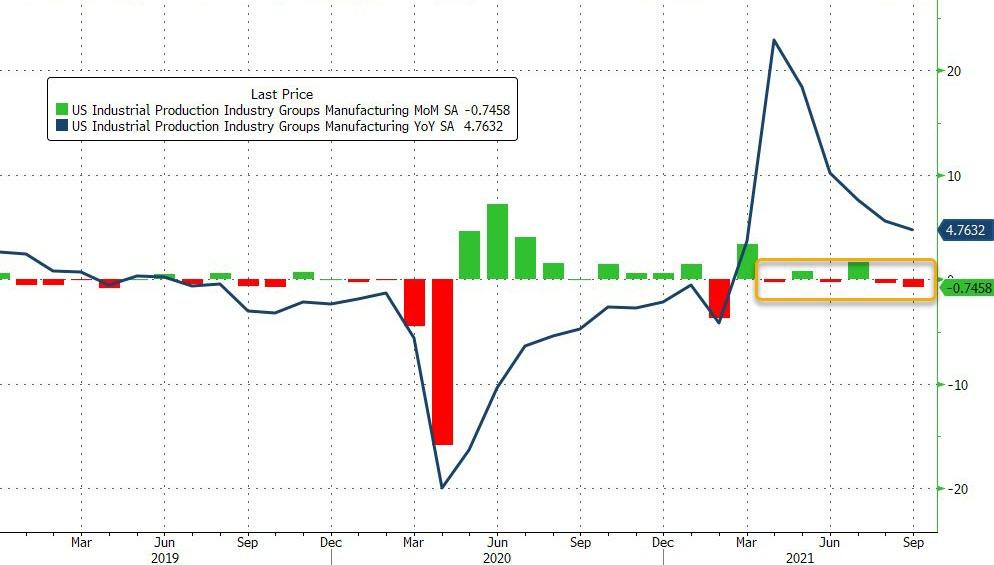
September saw a 1.3% MoM plunge in US Industrial Production (dramatically worse than the 0.1% MoM increase expected) and making matters worse, August was revised down from a 0.4% MoM rise to a 0.1% MoM drop…

Source: Bloomberg

US Manufacturing output tumbled 0.7% MoM (also worse than the +0.1% MoM expected)…

Source: Bloomberg

This is the sixth straight month of basically flatline US manufacturing production.

Tyler Durden
Mon, 10/18/2021 – 09:21

via ZeroHedge News https://ift.tt/3lOTHk4 Tyler Durden

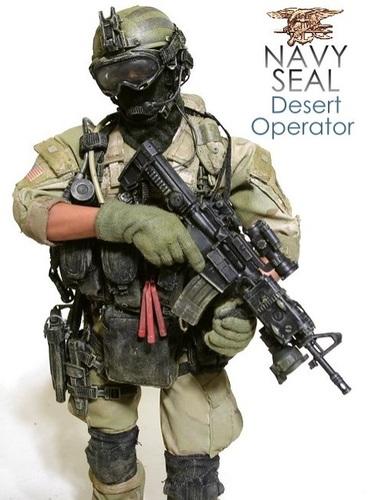
Biden Admin Threatens To Make Unvaxx’d Navy SEALs Repay Their Training Costs

Biden Admin Threatens To Make Unvaxx’d Navy SEALs Repay Their Training Costs

Authored by Thomas Lifson via AmericanThinker.com,

I can think of few better ways to ensure that fewer qualified people will apply to join the nation’s most elite fighting unit than the policy just announced by the U.S. Navy’s COVID Consolidated Disposition Authority.  It has  issued a directive that, as Hank Berrien reports, threatens “removing them from special warfare, reducing their salaries, and forcing them to repay training.”

7.a. and 7.b.: The Vice Chief of Naval Operations retains authority for non-judicial punishment and courts-martial. Involuntary extension of enlistments is not authorized on the basis of administrative or disciplinary action for vaccination refusal.  The CCDA may seek recoupment of applicable bonuses, special and incentive pays, and the cost of training and education for service members refusing the vaccine.

Since training a SEAL is very expensive, this amounts to financial ruin for the heroes who undergo incredibly harsh training and who offer their lives to protect us.

President Trump’s interior secretary, Ryan Zinke, a former SEAL, appropriately criticized the plan on Facebook:

Our Nation’s best don’t sign up to be a Navy SEAL to cash in on our training years later. We give a blood oath to fight for freedom and defend the Constitution against all enemies, both foreign and domestic. In doing so, we bear a burden of emotional, psychological, physical, and family stress of constant deployments and low pay because we love our Country. Shame Mr. President for not recognizing the service and sacrifice and further insulting SEALs by making this about money.

Put aside any consideration of the effectiveness of the vaccines or of the side-effects that may take years to become apparent.  This escalation of bullying of the bravest and most self-sacrificing among us threatens national security.

Trying to bully people like this?  Really?

Physically fit young adults like the SEALS face a negligible threat from COVID, so why sacrifice the effectiveness of the nation’s elite fighting units?

The price that is being inflicted on the nation far outweighs any benefit from the vaccines.

Tyler Durden
Mon, 10/18/2021 – 09:16

via ZeroHedge News https://ift.tt/3FTFUkl Tyler Durden

What If the Supreme Court Corrected an Error and No One Noticed?

Supreme Court slip opinions sometimes contain typos. They are typically fixed quite quickly (and for most of the Court’s history, quite quietly as well). Even if the error concerns something substantive, so long as the official version of the opinion published in the U.S. Reports is accurate, it is no big deal.

But what if a typo in a slip opinion affects the substance of the Court’s reasoning or holding, and what if that typo is quoted in subsequent lower court opinions in legal briefs? As reported in the New York Times, that appears to have happened with Washington ex rel Seattle Title Trust Company v. Roberge, in which a potentially consequential typo lived on despite the Court’s correction.

From Adam Liptak’s story:

The mistake appeared in a slip opinion issued in 1928, soon after the court announced a decision in a zoning dispute. It contained what seemed like a sweeping statement about the constitutional stature of property rights: “The right of the trustee to devote its land to any legitimate use is property within the protection of the Constitution.”

But the author of the opinion, Justice Pierce Butler, had not meant to write “property.” He meant to say “properly.” . . .

The court eventually fixed the mistake, and this is what appears in the final version of the opinion published in book form in United States Reports: “The right of the trustee to devote its land to any legitimate use is properly within the protection of the Constitution.” . . .

The wrong version of the statement has appeared in at least 14 court decisions, the most recent of which was issued last year; in at least 11 appellate briefs; in a Supreme Court argument; and in books and articles.

It is hard to know whether the typo has affected the outcome in subsequent cases, the erroneous quote does appear to have affected arguments made in various cases, and may have encouraged courts to reach stronger conclusions about the scope of property rights than the 1928 decision really supports.

The NYT article draw heavily on a law review article by University of Florida law professor Michael Allan Wolf forthcoming in the Washington University Law Review, “A Reign of Error: Property Rights and Stare Decisis.”  Here is the abstract:

Mistakes matter in law, even the smallest ones. What would happen if a small but substantively meaningful typographical error appeared in the earliest published version of a U.S. Supreme Court opinion and remained uncorrected for several decades in versions of the decision published by the two leading commercial companies and in several online databases? And what would happen if judges, legal commentators, and practitioners wrote opinions, articles, and other legal materials that incorporated and built on that mistake? In answering these questions, this Article traces the widespread, exponential replication of an error (first appearing in 1928) in numerous subsequent cases and other law and law-related sources; explores why the phenomenon of reproducing mistakes matters in a legal system whose lifeblood is words and that heavily relies on the principle of stare decisis; and argues that one legacy of this cautionary tale of an unforced error can be a functional understanding of how the Due Process, Equal Protection, and Takings Clauses can and should protect private property rights in different yet related ways.

from Latest – Reason.com https://ift.tt/3n1q4vj
via IFTTT

Rutgers University Cancels Justice Joseph Bradley

Justice Joseph Bradley graduated from Rutgers University in 1836. In 1971, Rutger University named a building in Newark after Justice Bradley. No longer. The University has officially renamed the building. Tap Into Newark has this report:

The Rutgers University Board of Governors during a Wednesday meeting passed a resolution which approved the removal of Bradley’s name from the building at 110 Warren St. A main reason for the name change, Rutgers officials said, stemmed from a court opinion Bradley wrote in 1883 that overturned the Civil Rights Act of 1875. . . .

“The committee recommended removal of the name after intensive study of the judicial record of the late Associate Justice of the Supreme Court Joseph P. Bradley, for whom Bradley Hall was named,” said Peter Englot, a senior vice chancellor for public affairs and chief of staff at Rutgers–Newark. “The study revealed that he was more than just ‘a person of his time.’ Rather, at a time when the forces favoring and opposing Reconstruction were closely balanced following the Civil War, Bradley instead chose to use his position to tip that balance toward undoing Reconstruction, regressing on civil rights, and opening a new era of oppression and terror.”

The decision to remove the name, Englot said, came from recommendations submitted by a committee of Rutgers-Newark faculty, students, and staff appointed by Rutgers-Newark Chancellor Nancy Cantor as part of the school’s pursuit of its strategic plan that centers on strengthening inclusivity on campus.

The Civil Rights Cases is still good law. The Supreme Court reaffirmed the state-action doctrine in United States v. Morrison. Justice Bradley is also well known for his ignominious concurrence in Bradwell v. Illinois. He wrote:

The paramount destiny and mission of woman are to fulfill the noble and benign offices of wife and mother. This is the law of the Creator. And the rules of civil society must be adapted to the general constitution of things, and cannot be based upon exceptional cases.

I doubt any 19th century Justices is safe from cancellation. The 20th century Justices will be on the chopping block soon enough.

from Latest – Reason.com https://ift.tt/30DH3ME
via IFTTT

Americans Want Racial Diversity More Than Ever Before


dreamstime_m_136184596

From protests inspired by the police murder of George Floyd, to the 1619 project at The New York Times, to battles over curricula inspired by controversial “anti-racism” ideology, the United States seems to be at a moment of reckoning over race relations. And yet, while there’s no question that racially charged conflicts have spread across the country, it’s not at all obvious that Americans are especially racist today. If you compare headlines with polling data, it looks like politicians, activists, and the media are ginning up racial disagreements even as people become increasingly accepting of those from different backgrounds.

“I think one of the sticking points that I’ve found is this sort of predominance of white people saying, ‘I’m not racist,’ and the predominance of people of color saying ‘I can’t be racist,’ and it creates this environment in which we have racism, but every individual is claiming that it’s not them,” Ibram X. Kendi, an author of books asserting widespread racism, told a recent Harvard University gathering

“An Alabama state school board member said protesters may be ‘terrorists’ at a Thursday meeting, amid ongoing controversy over topics of race and racism in education,” noted AL.com last week.

All is not well in race relations among Americans, according to news stories. And yet, when you ask people how they feel about neighbors from different backgrounds, you get a very different result.

“In many places – including Singapore, New Zealand, the United States, Canada, the United Kingdom, Australia and Taiwan – at least eight-in-ten describe where they live as benefiting from people of different ethnic groups, religions and races,” Pew Research finds in polling results published October 13. Specifically, 86 percent of Americans “say that having people of many ethnic groups, religions and races makes their society a better place to live.” That’s a bit less than the 92 percent of Singaporeans who say the same, identical to results from Canada, and far above the 45 percent of Greeks and 39 percent of Japanese who agree. Support for diversity across the countries surveyed averages 76 percent.

Can we be sure Americans aren’t just mouthing empty platitudes about tolerance? Other survey results suggest that our countrymen mean what they say.

“Ninety-four percent of U.S. adults now approve of marriages between Black people and White people, up from 87% in the prior reading from 2013,” Gallup found last month. “The current figure marks a new high in Gallup’s trend, which spans more than six decades. Just 4% approved when Gallup first asked the question in 1958.”

Intermarriage isn’t the be-all and end-all for assessing good will between groups, but it’s a pretty good proxy. Marriage is an intimate relationship that tends to push people’s hot buttons. And questions about intermarriage have been asked of Americans for more than 60 years, giving us a consistent measure of shifting attitudes. Importantly, approval of intermarriage is nearly identical (within the margin of error) for white and non-white adults, and above 90 percent across age groups and regions.

So, with all of this kumbaya, are Americans just blind to disagreements around them? No, people are all too aware of the headlines.

“When it comes to perceived political and ethnic conflicts, no public is more divided than Americans: 90% say there are conflicts between people who support different political parties and 71% say the same when it comes to ethnic and racial groups,” Pew adds.

Note, though, that being aware of battles doesn’t mean that people want to pick fights with their neighbors—it’s an indication that they follow the news. They’re acknowledging conflicts (which, in the cases of school curricula and the 1619 Project are about framing race relations rather than actual interactions), not cheering them on. Also, racial conflicts don’t lead the pack in polling results.

“In most societies racial and ethnic divisions are not seen as the most salient cleavage,” Pew observes. “In the U.S. and South Korea, 90% say there are at least strong conflicts between those who support different parties – including around half or more in each country who say these conflicts are very strong.”

Americans overwhelmingly approve of interracial marriage, but don’t feel the same about crossing partisan boundaries.

“According to the latest Economist/YouGov Poll, 38 percent of Democrats and 38 percent of Republicans said they would feel somewhat or very upset at the prospect of their child marrying someone from the opposite party,” according to a 2020 survey. Political divisions weigh far more heavily than race.

That doesn’t mean that America’s racial problems have been solved and we can just drop the issue. When members of a group take to the streets to voice common concerns about disparate treatment by police and the criminal justice system, we should listen. That was certainly the case with last year’s protests over George Floyd, Breonna Taylor, and other African-Americans on the receiving end of law enforcement’s often brutal conduct. A society’s institutions need to treat people equally—equally well, not poorly, we hope.

There also are still actual racists catering to old fears with garbage like “replacement theory” which holds that white Americans will be pushed aside by people from other backgrounds. It’s a hateful message that plays to lingering obsessions with group identities.

But we should acknowledge that Americans observing conflicts around them have the highest level of tolerance for one another on record. Participants in protests over racially charged curricula are themselves drawn from the least racist generation of Americans so far. There’s still progress to be made, but this country has come a very long way since the days when only 4 percent of the population approved of marriage between black people and white people and such relationships were illegal.

The racial conflicts grabbing headlines are largely about the behavior of government officials and activists, and coverage by the media. Protests over police conduct were about the state’s enforcement apparatus. Protests over public school curricula are about how government-employed educators teach about race relations. The 1619 Project and classroom battles are fueled by activists who are heavily invested in an ideology that emphasizes racial differences to a public losing interest in those divisions. The media, at least at the elite level, is strongly sympathetic to those activists. And politicians get mileage out of amplifying the country’s political conflicts with racial concerns.

Americans are less divided than ever before by race, but too many prominent people regret that progress.

from Latest – Reason.com https://ift.tt/3n1FPT2
via IFTTT

“This Looks Like An Absolute Disaster”: UK Short-Term Yields Blow Up Most Since 2010 As Frantic Traders Front-Run BOE Rate Hikes

“This Looks Like An Absolute Disaster”: UK Short-Term Yields Blow Up Most Since 2010 As Frantic Traders Front-Run BOE Rate Hikes

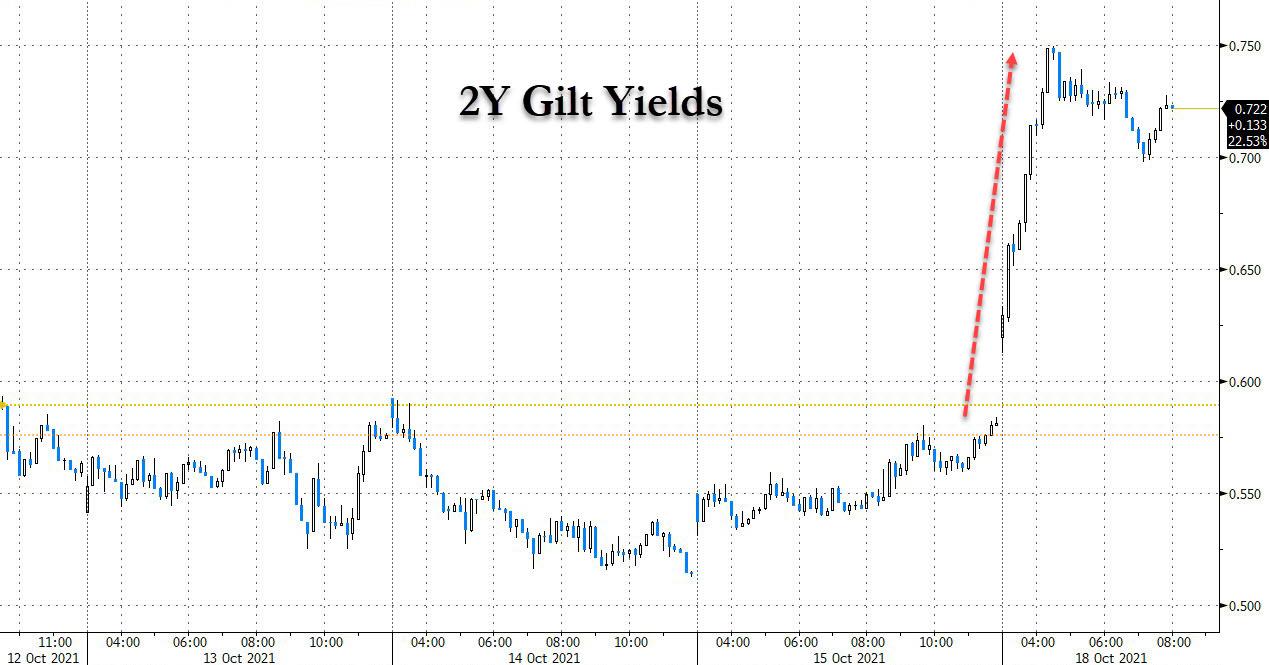
Frantic rates traders pulled forward rate-hike bets after BoE governor Bailey said over the weekend that the central bank “will have to act” on inflation. The move manifested in a huge spike in 2Y gilts, which rose as much as 17bps to 0.75%…

… the biggest one-day move since 2010, before easing a bit. Even more striking, 3-month sterling LIBOR soared by 7.9bps, the biggest one day surge since Lehman.

Besides the usual, and now daily, surge in commodities, a Friday report from Goldman predicted the BOE would likely raise rates in November.

“While we view it as a close call between a November and December lift-off, we think the November meeting is slightly more likely given it comes with a press conference and updated projections within the Monetary Policy Report,” Goldman Sachs economists wrote adding that they now expect 3 rate hikes at alternate MPC meetings, taking BOE’s benchmark rate to 0.75% by May, and 1% by the end of next year.

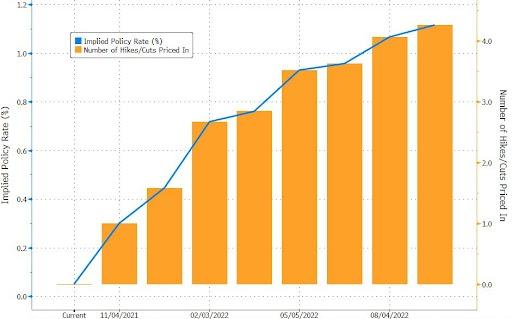
Not surprisingly, UK money markets reacted accordingly, and now see 36 basis points of BoE rate increases in December, while pricing 20 basis points of tightening next month. Traders are also now betting the BoE’s key rate will top 1% by August, an even more aggressive timeline than Goldman’s, from 0.1% currently.

Needless to say, not everyone is happy with this development perhaps first and foremost Former Bank of England policy maker Danny Blanchflower (who last weekend suggested that the US is already in a recession), who said that lifting U.K. interest rates anytime soon would be “a terrible error.”

“I think they may go and do that, but it would be a very foolish thing to do, especially with what the data is doing and the chancellor is doing, but also the possibility and this is a distinct possibility that the U.S. is going into recession,” Blanchflower said on BBC Radio 4’s “Today” program on Monday quoted by Bloomberg.

“These seem very early days to be thinking that. The economy is very hard to understand right now. It looks to me as with every interest rate rise since 2008 that they have all been in error” he said, adding that “there’s lots of things to think about. We’ve just had a big furlough scheme, which means the labor market is very difficult to understand. We’ve had a very little bit of inflation. It looks terribly temporary”

“Think of an island if a hurricane hits it. The price of plumbers and roofers is going to rise. Once the adjustment takes place those prices are going to fall. These paths, these changes in inflation look to be enormously temporary. And any response by the central bank to those changes look to be a big error. It looks increasingly like 2008.

His conclusion is probably not wrong: If the BOE raises rates now, “They’d probably have to reverse it quite quickly.” In fact, that may be just what central bankers are hoping for: to hike into a recession so they have justification to cut right after.

“This looks like an absolute disaster if the Bank of England did it. This looks like a terrible error.”

Maybe, but tell that to those who are about to spend a quarter of their paycheck on heating bills and gasoline.

Tyler Durden
Mon, 10/18/2021 – 08:45

via ZeroHedge News https://ift.tt/30wQ4a9 Tyler Durden

Americans Want Racial Diversity More Than Ever Before


dreamstime_m_136184596

From protests inspired by the police murder of George Floyd, to the 1619 project at The New York Times, to battles over curricula inspired by controversial “anti-racism” ideology, the United States seems to be at a moment of reckoning over race relations. And yet, while there’s no question that racially charged conflicts have spread across the country, it’s not at all obvious that Americans are especially racist today. If you compare headlines with polling data, it looks like politicians, activists, and the media are ginning up racial disagreements even as people become increasingly accepting of those from different backgrounds.

“I think one of the sticking points that I’ve found is this sort of predominance of white people saying, ‘I’m not racist,’ and the predominance of people of color saying ‘I can’t be racist,’ and it creates this environment in which we have racism, but every individual is claiming that it’s not them,” Ibram X. Kendi, an author of books asserting widespread racism, told a recent Harvard University gathering

“An Alabama state school board member said protesters may be ‘terrorists’ at a Thursday meeting, amid ongoing controversy over topics of race and racism in education,” noted AL.com last week.

All is not well in race relations among Americans, according to news stories. And yet, when you ask people how they feel about neighbors from different backgrounds, you get a very different result.

“In many places – including Singapore, New Zealand, the United States, Canada, the United Kingdom, Australia and Taiwan – at least eight-in-ten describe where they live as benefiting from people of different ethnic groups, religions and races,” Pew Research finds in polling results published October 13. Specifically, 86 percent of Americans “say that having people of many ethnic groups, religions and races makes their society a better place to live.” That’s a bit less than the 92 percent of Singaporeans who say the same, identical to results from Canada, and far above the 45 percent of Greeks and 39 percent of Japanese who agree. Support for diversity across the countries surveyed averages 76 percent.

Can we be sure Americans aren’t just mouthing empty platitudes about tolerance? Other survey results suggest that our countrymen mean what they say.

“Ninety-four percent of U.S. adults now approve of marriages between Black people and White people, up from 87% in the prior reading from 2013,” Gallup found last month. “The current figure marks a new high in Gallup’s trend, which spans more than six decades. Just 4% approved when Gallup first asked the question in 1958.”

Intermarriage isn’t the be-all and end-all for assessing good will between groups, but it’s a pretty good proxy. Marriage is an intimate relationship that tends to push people’s hot buttons. And questions about intermarriage have been asked of Americans for more than 60 years, giving us a consistent measure of shifting attitudes. Importantly, approval of intermarriage is nearly identical (within the margin of error) for white and non-white adults, and above 90 percent across age groups and regions.

So, with all of this kumbaya, are Americans just blind to disagreements around them? No, people are all too aware of the headlines.

“When it comes to perceived political and ethnic conflicts, no public is more divided than Americans: 90% say there are conflicts between people who support different political parties and 71% say the same when it comes to ethnic and racial groups,” Pew adds.

Note, though, that being aware of battles doesn’t mean that people want to pick fights with their neighbors—it’s an indication that they follow the news. They’re acknowledging conflicts (which, in the cases of school curricula and the 1619 Project are about framing race relations rather than actual interactions), not cheering them on. Also, racial conflicts don’t lead the pack in polling results.

“In most societies racial and ethnic divisions are not seen as the most salient cleavage,” Pew observes. “In the U.S. and South Korea, 90% say there are at least strong conflicts between those who support different parties – including around half or more in each country who say these conflicts are very strong.”

Americans overwhelmingly approve of interracial marriage, but don’t feel the same about crossing partisan boundaries.

“According to the latest Economist/YouGov Poll, 38 percent of Democrats and 38 percent of Republicans said they would feel somewhat or very upset at the prospect of their child marrying someone from the opposite party,” according to a 2020 survey. Political divisions weigh far more heavily than race.

That doesn’t mean that America’s racial problems have been solved and we can just drop the issue. When members of a group take to the streets to voice common concerns about disparate treatment by police and the criminal justice system, we should listen. That was certainly the case with last year’s protests over George Floyd, Breonna Taylor, and other African-Americans on the receiving end of law enforcement’s often brutal conduct. A society’s institutions need to treat people equally—equally well, not poorly, we hope.

There also are still actual racists catering to old fears with garbage like “replacement theory” which holds that white Americans will be pushed aside by people from other backgrounds. It’s a hateful message that plays to lingering obsessions with group identities.

But we should acknowledge that Americans observing conflicts around them have the highest level of tolerance for one another on record. Participants in protests over racially charged curricula are themselves drawn from the least racist generation of Americans so far. There’s still progress to be made, but this country has come a very long way since the days when only 4 percent of the population approved of marriage between black people and white people and such relationships were illegal.

The racial conflicts grabbing headlines are largely about the behavior of government officials and activists, and coverage by the media. Protests over police conduct were about the state’s enforcement apparatus. Protests over public school curricula are about how government-employed educators teach about race relations. The 1619 Project and classroom battles are fueled by activists who are heavily invested in an ideology that emphasizes racial differences to a public losing interest in those divisions. The media, at least at the elite level, is strongly sympathetic to those activists. And politicians get mileage out of amplifying the country’s political conflicts with racial concerns.

Americans are less divided than ever before by race, but too many prominent people regret that progress.

from Latest – Reason.com https://ift.tt/3n1FPT2
via IFTTT