Court Affirms Rejection of Allegedly Anti-Zionist Professors’ Claims That University Should Have Stopped Jewish Professors from Filing Religious Discrimination Complaints Against Them

From Lax v. CUNY, decided in 2024 by N.Y. trial court judge Gina Abadi, and just affirmed Wednesday in a short opinion by the N.Y. intermediate appellate court:

 Plaintiffs are observant Jewish professors at Kingsborough Community College (Kingsborough), which is part of CUNY [City University of New York]. Defendant Professional Staff Congress (the Union) is the labor union for the faculty. Defendant the New Caucus of the Professional Staff Congress (New Caucus) is a political party of the Union. [Defendants] Wetzel and Perea were professors at Kingsborough and members of the New Caucus.

On February 26, 2021, plaintiffs filed this action alleging … hostile work environment discrimination on the basis of religion[,] … retaliation [for making discrimination complaints], … [and] assault and false imprisonment.

Plaintiffs allege that they and other observant Jewish faculty and staff members at Kingsborough have faced pervasive, anti-religious discrimination from a particular segment of fellow faculty members who are the leaders of a faculty group called the Progressive Faculty Caucus of Kingsborough Community College (PFC) and are also members of the New Caucus. Plaintiffs claim that the New Caucus members collaborated with the PFC members to dominate campus elections and call for the removal of observant Jewish faculty members, administrators, department chairs, and others at Kingsborough. Plaintiffs allege that Wetzel and Perea actually participated in, and aided and abetted, the conduct giving rise to their discrimination and retaliation claims.

Plaintiffs assert, among numerous alleged acts of discriminatory conduct, that the PFC denied entry to every observant Jewish applicant, including Lax; that the PFC and the New Caucus members lobbied against Lax and other observant Jewish candidates running in campus elections; that the PFC members called for the removal of observant Jewish faculty members, including Lax; that the PFC and the New Caucus members wrote in a communist newspaper regarding their “struggle” against a “network of Zionists” among the faculty at Kingsborough, and made similar comments in a publicly distributed campus survey; that there were discussions between Wetzel and others that observant Jews were undesirable for PFC membership; that Perea engaged in a malicious and relentless campaign to get Goldstein fired because he was a Zionist; that an internal PFC email mentioned the need to “bring violence to the Zionists on campus”; that anti-Semitic flyers were distributed on the Kingsborough campus; that a portrait of Goldstein’s father was defaced; that nails were found in the tires of cars belonging to Lax and Goldstein; and that the PFC members called for plaintiffs’ removal from their jobs at Kingsborough.

[Defendants] Wetzel … and Perea[ cross-claimed, arguing, among other things,] that CUNY is a government entity directly subject to the First Amendment … and that, in addition, CUNY has promised to protect their academic freedom and freedom of speech in assertions made in its contract with them, in its faculty handbook, on its website, and elsewhere, on which they relied to their detriment. [Their cross-claim] further alleges that Wetzel and Perea have used their academic freedom and First Amendment rights to utter progressive political views and criticism of [plaintiff] Goldstein, which plaintiffs claimed were anti-Semitic. It also alleges that Wetzel and Perea’s political criticism of Israel is not anti-Semitic, and that the complaint’s specific assertions against them regarding their alleged actions of anti-Semitism are frivolous.

In addition, Wetzel and Perea’s second cross-claim alleges that plaintiffs have complained to CUNY about them using available processes and procedures, such as making administrative complaints of discrimination, asserting that they were a danger or security risk to plaintiffs and the CUNY community, and stating that they breached other CUNY codes and rules. It asserts that plaintiffs’ intentions that motivated all of their initiatives against Wetzel and Perea are to punish them and retaliate for their politically progressive views and criticism of Goldstein. It alleges that “CUNY has permitted and facilitated such retaliation by its failure to supervise [p]laintiffs and to protect [their] academic freedom.”

Wetzel and Perea, in this cross-claim, state that for example, when plaintiffs filed United States Equal Employment Opportunity Commission (EEOC) complaints implicating them in organizing an anti-discrimination event for a Friday night (the Friday Night Event), with the purpose of excluding Sabbath-observant Jewish members, CUNY failed to give them notice that these EEOC complaints had been filed. Wetzel and Perea state, upon information and belief, that CUNY also failed assertively to protect their interests and academic freedom at the EEOC. They allege that plaintiffs’ retaliatory measures were carried out with CUNY’s complicity and have succeeded in shutting down their free speech and academic freedom, since for example, the Friday Night Event was cancelled….

The court rejected the cross-claims, reasoning that, among other things:

Wetzel and Perea … assert that CUNY has permitted and facilitated retaliation by plaintiffs by its failure to supervise plaintiffs and to protect cross-claimants’ academic freedom. However, they do not specify how CUNY failed to supervise plaintiffs and how such alleged failure amounts to a violation of the First Amendment. This cross claim is also devoid of any factual allegations as to how Wetzel and Perea’s interests and academic freedom were not protected by CUNY. While Wetzel and Perea allege that CUNY did not give them notice that EEOC complaints had been filed against it, they fail to cite to any legal authority indicating that CUNY was under any legal obligation to provide them with such notice.

To the extent that Wetzel and Perea purport to assert that CUNY was obligated to discourage plaintiffs from “using available processes and procedures, such as the filing of administrative complaints of discrimination,” including filing EEOC complaints, any such conduct by CUNY could constitute a violation of federal, state, and local anti-discrimination law. See Vance v Ball State Univ. (2013) (in an action brought by a university employee against a university, the U.S. Supreme Court stated that evidence that an employer “effectively discouraged complaints from being filed” are relevant to employer liability for Title VII claims for hostile work environment and retaliation for an employee’s complaints about racial harassment).

That seems correct to me, though I think the judge may have erred in this aside about academic freedom:

Academic freedom generally “encompasses concepts like the University’s right to make its own rules concerning academic standards, … its prerogative to determine for itself on academic grounds who may teach, … its right to set its own criteria for promotion and then to evaluate a candidate’s fitness for promotion under them, … and so on.” Heim v Daniel, 81 F.4th 212, 231 (2d Cir. 2023) (internal quotation marks and citations omitted). While Wetzel and Perea are professors, and not a university, they, in any event, fail to allege how CUNY did not protect their academic speech or free exchange of ideas in the classroom.

The suggestion that, under Heim v. Daniel, only “a university” and not “professors” enjoy “academic freedom,” seems inconsistent with Heim’s acknowledging “the wealth of authority championing individual educators’ interest in academic freedom.”

 The court also rejected Wetzel’s and Perea’s contract claims, both on the grounds that the internal rules that were allegedly violated weren’t binding contracts, and on the grounds that “Wetzel and Perea … fail to allege what actions plaintiffs took in violation of [those rules] or how CUNY tolerated, accepted, or facilitated any of those actions”:

Wetzel and Perea rely upon the general policy statement preceding the Henderson Rules, which provides that academic freedom and the sanctuary of the university campus “cannot be invoked by those who would subordinate intellectual freedom to political ends, or who violate the norms of conduct established to protect that freedom.” They also rely upon Rule 1 and Rule 5 of the Henderson Rules.

Rule 1 of the Henderson Rules provides:

“A member of the academic community shall not intentionally obstruct and/or forcibly prevent others from the exercise of their rights. Nor shall he [or she] interfere with the institution’s educational processes or facilities, or the rights of those who wish to avail themselves of any of the institution’s instructional, personal, administrative, recreational, and community services.”

Rule 5 of the Henderson Rules provides:

“Each member of the academic community or an invited guest has the right to advocate his position without having to fear abuse, physical, verbal, or otherwise, from others supporting conflicting points of view. Members of the academic community and other persons on the college grounds shall not use language or take actions reasonably likely to provoke or encourage physical violence by demonstrators, those demonstrated against, or spectators.”

The Henderson Rules do not set forth any specific disciplinary action, procedure, or remedy that CUNY is required to follow in responding to an alleged violation of such rules. Instead, the Henderson Rules provide that the President of the CUNY Board holds “full discretionary power in carrying [the Henderson Rules] into effect.” The court also notes that in the “Additional Policies” section of the Henderson Rules, it sets forth that “[a]s a public university system. CUNY adheres to federal, state and city laws and regulations regarding non-discrimination.” Thus, assertions that CUNY should have enforced the Henderson Rules by stifling plaintiffs from complaining of religious discrimination against them would violate this policy….

The post Court Affirms Rejection of Allegedly Anti-Zionist Professors' Claims That University Should Have Stopped Jewish Professors from Filing Religious Discrimination Complaints Against Them appeared first on Reason.com.

from Latest – Reason.com https://ift.tt/5WQsjNX
via IFTTT

California’s Local Governments Want State Taxpayers To Pay More, More, More


Karen Bass | Illustration: Midjourney/Nikolai Sorokin/Dreamstime

California local governments of every size are crying poor as they struggle with budget shortfalls amid what many officials predictably call a “perfect storm” of troubling economic news, including the end of COVID-19 funds that had propped up their budgets for a few years. As ABC News reported, “From rising costs to slowing revenue, local governments are now being forced to make difficult financial decisions as they work to balance their budgets.”

The “difficult financial decisions” caused me to laugh out loud given that, well, local government officials’ idea of a tough decision always comes down to one or all of three easy, go-to choices: Raise taxes on their residents, cut public services (especially ones the public relies on the most), or lobby Sacramento for a bailout. If one traces the history of local government spending, one sees the same story playing every few years.

Back in 2019, before the feds sent $600 billion in pandemic relief funds to California’s state and local governments, our governments were likewise sounding the fiscal alarms. The California State Auditor that year explained that “more than half of California’s cities were listed as being at a moderate to high risk of experiencing fiscal distress,” per a summary from Reason. In 2013, commentators suggested that myriad California cities were facing a financial crisis due to some combination of apparently never-before imagined economic travails.

California has the nation’s highest tax burden, yet no matter how much taxpayers send to Sacramento or City Hall, it’s really never enough. But it doesn’t take much digging to get a handle on the real source of the problem. For instance, in May, the city of Los Angeles passed a $15 billion budget. In 2020-2021, the city’s budget was $10.65 billion. That’s more than a 40 percent boost. Have public services gotten that much better in a few years? See, now you’re laughing out loud.

It’s easy to mock big, incompetent cities. Their officials deserve all the scorn sent their way, of course. But smaller cities and placid suburbs aren’t really any better, even in supposedly conservative Orange County. Last July, financial consultants for the city of Orange warned that the city could be facing a municipal bankruptcy in a few years. Not surprisingly, the city is asking voters to increase taxes: a hotel tax and a “temporary” sales tax.

I don’t even know why local officials go through this temporary pretense, as we all know tax increases never go away. Santa Ana, for instance, will ask voters in November to make its temporary 1.5 percent sales tax permanent. “Elected leaders publicly said Tuesday it will be up to voters to decide if they want to continue to enjoy services and programs like graffiti removal, fixing parks, and keeping emergency response times at the same level by weighing in on the ballot measure,” according to the VoiceofOC.

That’s the classic shakedown: Either give us more money to provide the public services that you pay us to provide, or we won’t be able to provide those public services. Santa Ana, by the way, has the nasty habit of dramatically boosting spending at the behest of its public-employee unions even when it doesn’t have the money to do so. Then it threatens residents with cuts in public safety, and then residents reliably agree to higher taxes.

Where did those billions of dollars in COVID funds go? We’ve all read about many unnecessary and wasteful projects, and occasional corruption, but lots of cash funded law-enforcement budgets rather than for programs that were meant to help people navigate an economic shutdown. Police spending is naturally popular given concerns about crime, but policing is a nuts-and-bolts function that should be sustainably funded from normal revenues. This shell game provides a clue to the fundamental problem.

City officials are incapable of saying no to public-employee unions. Those unions, especially the police and firefighting variety, are typically the most politically powerful lobbies at the local level. All these other discussions—tax measures, cuts to arts and transportation programs, calls for additional monies from Sacramento and Washington, D.C.—obscure the central fact that cities are basically jobs and pension providers rather than public-service providers. Employee lobbies are so powerful that officials can never make one particularly hard choice.

After the 2025 Los Angeles wildfires, the media and elected officials focused on the need for stepped-up firefighting efforts and related budget constraints. Yet no one mentioned this tidbit: Of the top 10 best-paid Los Angeles city officials, seven of them worked in the fire department with total compensation packages ranging from $598,000 to $802,000, per the Transparent California database. Los Angeles isn’t that much of an outlier.

I don’t know, but could these numbers help explain why the city never has enough cash? Consider that simple question before you believe that local officials couldn’t see the latest budget crisis coming.

This column was first published in The Orange County Register.

The post California's Local Governments Want State Taxpayers To Pay More, More, More appeared first on Reason.com.

from Latest – Reason.com https://ift.tt/fQwb5od
via IFTTT

Europe Requires Cameras in Cars To Monitor Drivers


A man drives a car with a camera pointed at his face. | Illustration: Midjourney

Give the world’s control freaks credit where it’s due: No matter how creepy their proposals are, there’s always another nanny someplace eager to double down with an even more intrusive scheme. So, as Americans debate the wisdom of drunk-driver kill switch mandates for cars, their counterparts in Europe now require that new vehicles include in-car cameras that constantly monitor drivers. The result is an escalating race in government-dictated automobile surveillance that we’ll all have to pay for, even if we plan to bypass or sabotage it once we’re off the lot.

Your Car Will Watch and Prod You for ‘Distraction’

“Thanks to the EU’s General Safety Regulation, many safety systems have already been mandatory for all newly registered cars and vans since 2024,” the European Commission boasted earlier this month. “Starting on 7 July 2026, these vehicles will now be subject to even more advanced safety requirements.” Among the list of mandated technologies car companies must include at customers’ expense is an “advanced driver distraction warning system to keep drivers focused.”

The regulation specifies that “driver drowsiness and attention warning and advanced driver distraction warning systems shall be designed in such a way that those systems do not continuously record nor retain any data other than what is necessary in relation to the purposes for which they were collected or otherwise processed within the closed-loop system.” An explanatory memorandum adds that the “requirement does not forbid the ADDW system to use data from the camera(s) equipped in the vehicle, it forbids the identification of the person by the ADDW system.”

Despite assurances about not continuously recording or retaining data, this means that cars are expected to constantly monitor drivers and prod the ones who are allegedly drowsy or distracted. The ADDW system uses infrared cameras, mounted on or around the steering column, to monitor drivers’ heads and eyes for signs of inattention. It sounds an alert when it detects a supposed problem.

Who Will Have Access to Those Cameras and Recordings?

These mandated cameras are not supposed to store or share information about such interactions, but few people seem in a trusting mood after years of mounting surveillance. Writing for Forbes, Michael Harley cautions that “if all new automobiles are equipped with the physical hardware to monitor drivers via IR cameras, it’s only a matter of changing some software and adding a storage device to record driver behavior.”

In fact, the data could be stored using existing capabilities on car company or government servers, since most modern cars are tracking beacons with wheels. In 2024, Kashmir Hill reported for The New York Times about drivers receiving surprise insurance premium increases because their vehicles transmitted information about their driving habits to the mothership. “Car companies are collecting information directly from internet-connected vehicles for use by the insurance industry,” she wrote.

Even earlier, in 2020, NBC found that “automobiles—particularly newer models—can be treasure troves of digital evidence. Their onboard computers generate and store data that can be used to reconstruct where a vehicle has been and what its passengers were doing.”

Drivers Are Already Disabling In-Car Nannies

Many drivers already disable existing advanced-driver assistance systems which warn of lane position, encroaching cars, and nearby hazards because they find the warnings intrusive and annoying, and the systems that trigger them to be overly sensitive. Last year in the U.K., a “survey of over 1,500 drivers found that 54% had deactivated at least one of five key Advanced Driver-Assistance Systems (ADAS) features,” according to Tech Digest.

Now that monitoring with driver-facing cameras is mandatory for European drivers, resentment of such systems is bound to increase. That will be complicated by requirements that make it possible for drivers to disable ADDW only for each driving session; the system resets every time the car is turned back on. And, of course, the camera is always pointed at the driver, who must trust that it’s not recording.

This reminds me of when my father got pointers from a car salesman about disabling the seat belt interlocks that were briefly required in the 1970s. In similar form, decades later I opted out of sharing data with Toyota on my then-recently purchased 4Runner. For good measure, I also pulled the fuse for the Data Communication Module, which connects the car to the cellphone network.

The equivalent for cars with ADDW might be as simple as covering or removing driver-monitoring cameras. Inexpensive 3D printed “dust covers” are already on the market to obscure the driver-facing cameras in Chinese-made vehicles, many of which are equipped with ADDW systems. A piece of electrical tape is an even cheaper alternative.

The Threat to American Drivers

Americans are far from immune to creeping car surveillance mandates. As Reason‘s Meagan O’Rourke reported in April, Congress in 2021 passed legislation requiring “that ‘advanced drunk and impaired driving prevention technology’—which the bill defined as a system that can ‘passively monitor the performance of a driver of a motor vehicle to accurately identify whether that driver may be impaired’ and ‘prevent or limit motor vehicle operation if an impairment is detected’—be installed in new cars.”

Efforts to repeal the impaired driving kill switch have been unsuccessful. But in February, the National Highway Traffic Safety Administration revealed that “detection technology around the legal limit continues to have an error rate that would be unacceptably high” to explain why it has yet to issue implementation rules. Lawmakers’ nanny-state aspirations ran ahead of technology—for the moment.

Just as concerning, though, is that Europe’s car-snoop mandates could bleed into the U.S. market.

“With the IR camera hardware and software already tested and baked into vehicle architecture to satisfy EU regulations, the incremental cost of offering the same systems in U.S.-market vehicles drops significantly (car companies do not like building dramatically different electrical architectures for different regions),” Harley warns in Forbes. It would be easy for U.S. regulators to turn default surveillance technology included in cars into a requirement.

Undoubtedly, many car owners will quickly learn to disable new surveillance technologies that compromise in-car privacy, just as they unplug their cars from the internet now or disabled seat belt interlocks in the 1970s. But they’ll be forced to pay for technology they resent and promptly sabotage. And they may risk legal penalties or civil liability for yanking the plug on Big Brother.

Avoiding the nanny state’s constant hectoring and monitoring remains an ongoing battle.

The post Europe Requires Cameras in Cars To Monitor Drivers appeared first on Reason.com.

from Latest – Reason.com https://ift.tt/uphFl93
via IFTTT

Today in Supreme Court History: July 17, 1862

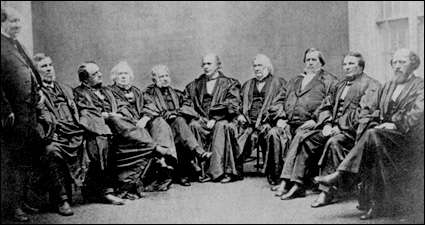
7/17/1862:  Congress enacts the Confiscation Act, which empowers the government to seize the property of the rebels. The Supreme Court considered the constitutionality of that law in The Confiscation Cases (1873).

The Chase Court (1873)

The post Today in Supreme Court History: July 17, 1862 appeared first on Reason.com.

from Latest – Reason.com https://ift.tt/yJSGdNv
via IFTTT

Review: Thomas Jefferson’s Monticello Is Celebrating America’s Semiquincentennial


minisexhibit | Monticello Exhibit, 1776: Road to the Declaration

At Monticello, the central Virginia home of Thomas Jefferson, the phrase Our Guy Wrote It is emblazoned on banners and T-shirts hailing the 250th anniversary of the Declaration of Independence. Jefferson’s estate is also the home to “1776: Road to the Declaration,” a compact new exhibition tracing the Declaration’s origins.

The exhibit greets visitors with a 1795 quotation from Jefferson: “This ball of liberty, I believe most piously, is now so well in motion that it will roll around the globe.” A highlight of the exhibition is the commemorative copy of the Declaration owned by Jefferson’s friend, the fourth president of the United States, James Madison. There is also a handy timeline intertwining significant events in Jefferson’s life with the history of America.

Since 1776, the Declaration’s bold claim that “all men are created equal” and endowed with “unalienable Rights” to “Life, Liberty, and the pursuit of Happiness” has inspired countless subsequent struggles for freedom. That ball launched two and a half centuries ago by Jefferson’s Declaration keeps battering tyrannies across the globe today.

The post Review: Thomas Jefferson's Monticello Is Celebrating America's Semiquincentennial appeared first on Reason.com.

from Latest – Reason.com https://ift.tt/fcgkAjU
via IFTTT

Court Affirms Rejection of Allegedly Anti-Zionist Professors’ Claims That University Should Have Stopped Jewish Professors from Filing Religious Discrimination Complaints Against Them

From Lax v. CUNY, decided in 2024 by N.Y. trial court judge Gina Abadi, and just affirmed Wednesday in a short opinion by the N.Y. intermediate appellate court:

 Plaintiffs are observant Jewish professors at Kingsborough Community College (Kingsborough), which is part of CUNY [City University of New York]. Defendant Professional Staff Congress (the Union) is the labor union for the faculty. Defendant the New Caucus of the Professional Staff Congress (New Caucus) is a political party of the Union. [Defendants] Wetzel and Perea were professors at Kingsborough and members of the New Caucus.

On February 26, 2021, plaintiffs filed this action alleging … hostile work environment discrimination on the basis of religion[,] … retaliation [for making discrimination complaints], … [and] assault and false imprisonment.

Plaintiffs allege that they and other observant Jewish faculty and staff members at Kingsborough have faced pervasive, anti-religious discrimination from a particular segment of fellow faculty members who are the leaders of a faculty group called the Progressive Faculty Caucus of Kingsborough Community College (PFC) and are also members of the New Caucus. Plaintiffs claim that the New Caucus members collaborated with the PFC members to dominate campus elections and call for the removal of observant Jewish faculty members, administrators, department chairs, and others at Kingsborough. Plaintiffs allege that Wetzel and Perea actually participated in, and aided and abetted, the conduct giving rise to their discrimination and retaliation claims.

Plaintiffs assert, among numerous alleged acts of discriminatory conduct, that the PFC denied entry to every observant Jewish applicant, including Lax; that the PFC and the New Caucus members lobbied against Lax and other observant Jewish candidates running in campus elections; that the PFC members called for the removal of observant Jewish faculty members, including Lax; that the PFC and the New Caucus members wrote in a communist newspaper regarding their “struggle” against a “network of Zionists” among the faculty at Kingsborough, and made similar comments in a publicly distributed campus survey; that there were discussions between Wetzel and others that observant Jews were undesirable for PFC membership; that Perea engaged in a malicious and relentless campaign to get Goldstein fired because he was a Zionist; that an internal PFC email mentioned the need to “bring violence to the Zionists on campus”; that anti-Semitic flyers were distributed on the Kingsborough campus; that a portrait of Goldstein’s father was defaced; that nails were found in the tires of cars belonging to Lax and Goldstein; and that the PFC members called for plaintiffs’ removal from their jobs at Kingsborough.

[Defendants] Wetzel … and Perea[ cross-claimed, arguing, among other things,] that CUNY is a government entity directly subject to the First Amendment … and that, in addition, CUNY has promised to protect their academic freedom and freedom of speech in assertions made in its contract with them, in its faculty handbook, on its website, and elsewhere, on which they relied to their detriment. [Their cross-claim] further alleges that Wetzel and Perea have used their academic freedom and First Amendment rights to utter progressive political views and criticism of [plaintiff] Goldstein, which plaintiffs claimed were anti-Semitic. It also alleges that Wetzel and Perea’s political criticism of Israel is not anti-Semitic, and that the complaint’s specific assertions against them regarding their alleged actions of anti-Semitism are frivolous.

In addition, Wetzel and Perea’s second cross-claim alleges that plaintiffs have complained to CUNY about them using available processes and procedures, such as making administrative complaints of discrimination, asserting that they were a danger or security risk to plaintiffs and the CUNY community, and stating that they breached other CUNY codes and rules. It asserts that plaintiffs’ intentions that motivated all of their initiatives against Wetzel and Perea are to punish them and retaliate for their politically progressive views and criticism of Goldstein. It alleges that “CUNY has permitted and facilitated such retaliation by its failure to supervise [p]laintiffs and to protect [their] academic freedom.”

Wetzel and Perea, in this cross-claim, state that for example, when plaintiffs filed United States Equal Employment Opportunity Commission (EEOC) complaints implicating them in organizing an anti-discrimination event for a Friday night (the Friday Night Event), with the purpose of excluding Sabbath-observant Jewish members, CUNY failed to give them notice that these EEOC complaints had been filed. Wetzel and Perea state, upon information and belief, that CUNY also failed assertively to protect their interests and academic freedom at the EEOC. They allege that plaintiffs’ retaliatory measures were carried out with CUNY’s complicity and have succeeded in shutting down their free speech and academic freedom, since for example, the Friday Night Event was cancelled….

The court rejected the cross-claims, reasoning that, among other things:

Wetzel and Perea … assert that CUNY has permitted and facilitated retaliation by plaintiffs by its failure to supervise plaintiffs and to protect cross-claimants’ academic freedom. However, they do not specify how CUNY failed to supervise plaintiffs and how such alleged failure amounts to a violation of the First Amendment. This cross claim is also devoid of any factual allegations as to how Wetzel and Perea’s interests and academic freedom were not protected by CUNY. While Wetzel and Perea allege that CUNY did not give them notice that EEOC complaints had been filed against it, they fail to cite to any legal authority indicating that CUNY was under any legal obligation to provide them with such notice.

To the extent that Wetzel and Perea purport to assert that CUNY was obligated to discourage plaintiffs from “using available processes and procedures, such as the filing of administrative complaints of discrimination,” including filing EEOC complaints, any such conduct by CUNY could constitute a violation of federal, state, and local anti-discrimination law. See Vance v Ball State Univ. (2013) (in an action brought by a university employee against a university, the U.S. Supreme Court stated that evidence that an employer “effectively discouraged complaints from being filed” are relevant to employer liability for Title VII claims for hostile work environment and retaliation for an employee’s complaints about racial harassment).

That seems correct to me, though I think the judge may have erred in this aside about academic freedom:

Academic freedom generally “encompasses concepts like the University’s right to make its own rules concerning academic standards, … its prerogative to determine for itself on academic grounds who may teach, … its right to set its own criteria for promotion and then to evaluate a candidate’s fitness for promotion under them, … and so on.” Heim v Daniel, 81 F.4th 212, 231 (2d Cir. 2023) (internal quotation marks and citations omitted). While Wetzel and Perea are professors, and not a university, they, in any event, fail to allege how CUNY did not protect their academic speech or free exchange of ideas in the classroom.

The suggestion that, under Heim v. Daniel, only “a university” and not “professors” enjoy “academic freedom,” seems inconsistent with Heim’s acknowledging “the wealth of authority championing individual educators’ interest in academic freedom.”

 The court also rejected Wetzel’s and Perea’s contract claims, both on the grounds that the internal rules that were allegedly violated weren’t binding contracts, and on the grounds that “Wetzel and Perea … fail to allege what actions plaintiffs took in violation of [those rules] or how CUNY tolerated, accepted, or facilitated any of those actions”:

Wetzel and Perea rely upon the general policy statement preceding the Henderson Rules, which provides that academic freedom and the sanctuary of the university campus “cannot be invoked by those who would subordinate intellectual freedom to political ends, or who violate the norms of conduct established to protect that freedom.” They also rely upon Rule 1 and Rule 5 of the Henderson Rules.

Rule 1 of the Henderson Rules provides:

“A member of the academic community shall not intentionally obstruct and/or forcibly prevent others from the exercise of their rights. Nor shall he [or she] interfere with the institution’s educational processes or facilities, or the rights of those who wish to avail themselves of any of the institution’s instructional, personal, administrative, recreational, and community services.”

Rule 5 of the Henderson Rules provides:

“Each member of the academic community or an invited guest has the right to advocate his position without having to fear abuse, physical, verbal, or otherwise, from others supporting conflicting points of view. Members of the academic community and other persons on the college grounds shall not use language or take actions reasonably likely to provoke or encourage physical violence by demonstrators, those demonstrated against, or spectators.”

The Henderson Rules do not set forth any specific disciplinary action, procedure, or remedy that CUNY is required to follow in responding to an alleged violation of such rules. Instead, the Henderson Rules provide that the President of the CUNY Board holds “full discretionary power in carrying [the Henderson Rules] into effect.” The court also notes that in the “Additional Policies” section of the Henderson Rules, it sets forth that “[a]s a public university system. CUNY adheres to federal, state and city laws and regulations regarding non-discrimination.” Thus, assertions that CUNY should have enforced the Henderson Rules by stifling plaintiffs from complaining of religious discrimination against them would violate this policy….

The post Court Affirms Rejection of Allegedly Anti-Zionist Professors' Claims That University Should Have Stopped Jewish Professors from Filing Religious Discrimination Complaints Against Them appeared first on Reason.com.

from Latest – Reason.com https://ift.tt/5WQsjNX
via IFTTT

California’s Local Governments Want State Taxpayers To Pay More, More, More


Karen Bass | Illustration: Midjourney/Nikolai Sorokin/Dreamstime

California local governments of every size are crying poor as they struggle with budget shortfalls amid what many officials predictably call a “perfect storm” of troubling economic news, including the end of COVID-19 funds that had propped up their budgets for a few years. As ABC News reported, “From rising costs to slowing revenue, local governments are now being forced to make difficult financial decisions as they work to balance their budgets.”

The “difficult financial decisions” caused me to laugh out loud given that, well, local government officials’ idea of a tough decision always comes down to one or all of three easy, go-to choices: Raise taxes on their residents, cut public services (especially ones the public relies on the most), or lobby Sacramento for a bailout. If one traces the history of local government spending, one sees the same story playing every few years.

Back in 2019, before the feds sent $600 billion in pandemic relief funds to California’s state and local governments, our governments were likewise sounding the fiscal alarms. The California State Auditor that year explained that “more than half of California’s cities were listed as being at a moderate to high risk of experiencing fiscal distress,” per a summary from Reason. In 2013, commentators suggested that myriad California cities were facing a financial crisis due to some combination of apparently never-before imagined economic travails.

California has the nation’s highest tax burden, yet no matter how much taxpayers send to Sacramento or City Hall, it’s really never enough. But it doesn’t take much digging to get a handle on the real source of the problem. For instance, in May, the city of Los Angeles passed a $15 billion budget. In 2020-2021, the city’s budget was $10.65 billion. That’s more than a 40 percent boost. Have public services gotten that much better in a few years? See, now you’re laughing out loud.

It’s easy to mock big, incompetent cities. Their officials deserve all the scorn sent their way, of course. But smaller cities and placid suburbs aren’t really any better, even in supposedly conservative Orange County. Last July, financial consultants for the city of Orange warned that the city could be facing a municipal bankruptcy in a few years. Not surprisingly, the city is asking voters to increase taxes: a hotel tax and a “temporary” sales tax.

I don’t even know why local officials go through this temporary pretense, as we all know tax increases never go away. Santa Ana, for instance, will ask voters in November to make its temporary 1.5 percent sales tax permanent. “Elected leaders publicly said Tuesday it will be up to voters to decide if they want to continue to enjoy services and programs like graffiti removal, fixing parks, and keeping emergency response times at the same level by weighing in on the ballot measure,” according to the VoiceofOC.

That’s the classic shakedown: Either give us more money to provide the public services that you pay us to provide, or we won’t be able to provide those public services. Santa Ana, by the way, has the nasty habit of dramatically boosting spending at the behest of its public-employee unions even when it doesn’t have the money to do so. Then it threatens residents with cuts in public safety, and then residents reliably agree to higher taxes.

Where did those billions of dollars in COVID funds go? We’ve all read about many unnecessary and wasteful projects, and occasional corruption, but lots of cash funded law-enforcement budgets rather than for programs that were meant to help people navigate an economic shutdown. Police spending is naturally popular given concerns about crime, but policing is a nuts-and-bolts function that should be sustainably funded from normal revenues. This shell game provides a clue to the fundamental problem.

City officials are incapable of saying no to public-employee unions. Those unions, especially the police and firefighting variety, are typically the most politically powerful lobbies at the local level. All these other discussions—tax measures, cuts to arts and transportation programs, calls for additional monies from Sacramento and Washington, D.C.—obscure the central fact that cities are basically jobs and pension providers rather than public-service providers. Employee lobbies are so powerful that officials can never make one particularly hard choice.

After the 2025 Los Angeles wildfires, the media and elected officials focused on the need for stepped-up firefighting efforts and related budget constraints. Yet no one mentioned this tidbit: Of the top 10 best-paid Los Angeles city officials, seven of them worked in the fire department with total compensation packages ranging from $598,000 to $802,000, per the Transparent California database. Los Angeles isn’t that much of an outlier.

I don’t know, but could these numbers help explain why the city never has enough cash? Consider that simple question before you believe that local officials couldn’t see the latest budget crisis coming.

This column was first published in The Orange County Register.

The post California's Local Governments Want State Taxpayers To Pay More, More, More appeared first on Reason.com.

from Latest – Reason.com https://ift.tt/fQwb5od
via IFTTT

Europe Requires Cameras in Cars To Monitor Drivers


A man drives a car with a camera pointed at his face. | Illustration: Midjourney

Give the world’s control freaks credit where it’s due: No matter how creepy their proposals are, there’s always another nanny someplace eager to double down with an even more intrusive scheme. So, as Americans debate the wisdom of drunk-driver kill switch mandates for cars, their counterparts in Europe now require that new vehicles include in-car cameras that constantly monitor drivers. The result is an escalating race in government-dictated automobile surveillance that we’ll all have to pay for, even if we plan to bypass or sabotage it once we’re off the lot.

Your Car Will Watch and Prod You for ‘Distraction’

“Thanks to the EU’s General Safety Regulation, many safety systems have already been mandatory for all newly registered cars and vans since 2024,” the European Commission boasted earlier this month. “Starting on 7 July 2026, these vehicles will now be subject to even more advanced safety requirements.” Among the list of mandated technologies car companies must include at customers’ expense is an “advanced driver distraction warning system to keep drivers focused.”

The regulation specifies that “driver drowsiness and attention warning and advanced driver distraction warning systems shall be designed in such a way that those systems do not continuously record nor retain any data other than what is necessary in relation to the purposes for which they were collected or otherwise processed within the closed-loop system.” An explanatory memorandum adds that the “requirement does not forbid the ADDW system to use data from the camera(s) equipped in the vehicle, it forbids the identification of the person by the ADDW system.”

Despite assurances about not continuously recording or retaining data, this means that cars are expected to constantly monitor drivers and prod the ones who are allegedly drowsy or distracted. The ADDW system uses infrared cameras, mounted on or around the steering column, to monitor drivers’ heads and eyes for signs of inattention. It sounds an alert when it detects a supposed problem.

Who Will Have Access to Those Cameras and Recordings?

These mandated cameras are not supposed to store or share information about such interactions, but few people seem in a trusting mood after years of mounting surveillance. Writing for Forbes, Michael Harley cautions that “if all new automobiles are equipped with the physical hardware to monitor drivers via IR cameras, it’s only a matter of changing some software and adding a storage device to record driver behavior.”

In fact, the data could be stored using existing capabilities on car company or government servers, since most modern cars are tracking beacons with wheels. In 2024, Kashmir Hill reported for The New York Times about drivers receiving surprise insurance premium increases because their vehicles transmitted information about their driving habits to the mothership. “Car companies are collecting information directly from internet-connected vehicles for use by the insurance industry,” she wrote.

Even earlier, in 2020, NBC found that “automobiles—particularly newer models—can be treasure troves of digital evidence. Their onboard computers generate and store data that can be used to reconstruct where a vehicle has been and what its passengers were doing.”

Drivers Are Already Disabling In-Car Nannies

Many drivers already disable existing advanced-driver assistance systems which warn of lane position, encroaching cars, and nearby hazards because they find the warnings intrusive and annoying, and the systems that trigger them to be overly sensitive. Last year in the U.K., a “survey of over 1,500 drivers found that 54% had deactivated at least one of five key Advanced Driver-Assistance Systems (ADAS) features,” according to Tech Digest.

Now that monitoring with driver-facing cameras is mandatory for European drivers, resentment of such systems is bound to increase. That will be complicated by requirements that make it possible for drivers to disable ADDW only for each driving session; the system resets every time the car is turned back on. And, of course, the camera is always pointed at the driver, who must trust that it’s not recording.

This reminds me of when my father got pointers from a car salesman about disabling the seat belt interlocks that were briefly required in the 1970s. In similar form, decades later I opted out of sharing data with Toyota on my then-recently purchased 4Runner. For good measure, I also pulled the fuse for the Data Communication Module, which connects the car to the cellphone network.

The equivalent for cars with ADDW might be as simple as covering or removing driver-monitoring cameras. Inexpensive 3D printed “dust covers” are already on the market to obscure the driver-facing cameras in Chinese-made vehicles, many of which are equipped with ADDW systems. A piece of electrical tape is an even cheaper alternative.

The Threat to American Drivers

Americans are far from immune to creeping car surveillance mandates. As Reason‘s Meagan O’Rourke reported in April, Congress in 2021 passed legislation requiring “that ‘advanced drunk and impaired driving prevention technology’—which the bill defined as a system that can ‘passively monitor the performance of a driver of a motor vehicle to accurately identify whether that driver may be impaired’ and ‘prevent or limit motor vehicle operation if an impairment is detected’—be installed in new cars.”

Efforts to repeal the impaired driving kill switch have been unsuccessful. But in February, the National Highway Traffic Safety Administration revealed that “detection technology around the legal limit continues to have an error rate that would be unacceptably high” to explain why it has yet to issue implementation rules. Lawmakers’ nanny-state aspirations ran ahead of technology—for the moment.

Just as concerning, though, is that Europe’s car-snoop mandates could bleed into the U.S. market.

“With the IR camera hardware and software already tested and baked into vehicle architecture to satisfy EU regulations, the incremental cost of offering the same systems in U.S.-market vehicles drops significantly (car companies do not like building dramatically different electrical architectures for different regions),” Harley warns in Forbes. It would be easy for U.S. regulators to turn default surveillance technology included in cars into a requirement.

Undoubtedly, many car owners will quickly learn to disable new surveillance technologies that compromise in-car privacy, just as they unplug their cars from the internet now or disabled seat belt interlocks in the 1970s. But they’ll be forced to pay for technology they resent and promptly sabotage. And they may risk legal penalties or civil liability for yanking the plug on Big Brother.

Avoiding the nanny state’s constant hectoring and monitoring remains an ongoing battle.

The post Europe Requires Cameras in Cars To Monitor Drivers appeared first on Reason.com.

from Latest – Reason.com https://ift.tt/uphFl93
via IFTTT

Today in Supreme Court History: July 17, 1862

7/17/1862:  Congress enacts the Confiscation Act, which empowers the government to seize the property of the rebels. The Supreme Court considered the constitutionality of that law in The Confiscation Cases (1873).

The Chase Court (1873)

The post Today in Supreme Court History: July 17, 1862 appeared first on Reason.com.

from Latest – Reason.com https://ift.tt/yJSGdNv
via IFTTT

Review: Thomas Jefferson’s Monticello Is Celebrating America’s Semiquincentennial


minisexhibit | Monticello Exhibit, 1776: Road to the Declaration

At Monticello, the central Virginia home of Thomas Jefferson, the phrase Our Guy Wrote It is emblazoned on banners and T-shirts hailing the 250th anniversary of the Declaration of Independence. Jefferson’s estate is also the home to “1776: Road to the Declaration,” a compact new exhibition tracing the Declaration’s origins.

The exhibit greets visitors with a 1795 quotation from Jefferson: “This ball of liberty, I believe most piously, is now so well in motion that it will roll around the globe.” A highlight of the exhibition is the commemorative copy of the Declaration owned by Jefferson’s friend, the fourth president of the United States, James Madison. There is also a handy timeline intertwining significant events in Jefferson’s life with the history of America.

Since 1776, the Declaration’s bold claim that “all men are created equal” and endowed with “unalienable Rights” to “Life, Liberty, and the pursuit of Happiness” has inspired countless subsequent struggles for freedom. That ball launched two and a half centuries ago by Jefferson’s Declaration keeps battering tyrannies across the globe today.

The post Review: Thomas Jefferson's Monticello Is Celebrating America's Semiquincentennial appeared first on Reason.com.

from Latest – Reason.com https://ift.tt/fcgkAjU
via IFTTT