Journal of Free Speech Law: “A Cure Worse than the Disease: Why the EU’s Proposal to Criminalize Hate Speech Violates Freedom of Expression—and Won’t Reduce Intolerance or Extremism,” by Jacob Mchangama & Natalie Alkiviadou

The article is here; the Introduction:

In Germany, an artist and activist was arrested multiple times, once for wearing a Palestinian flag and again for holding a sign that read “from the river to the sea, we demand equality.” In France, a mayor was held criminally liable, not for what he said, but for failing to remove Islamophobic comments posted by others beneath one of his Facebook posts. In Finland, a member of Parliament faced criminal charges for criticizing her church’s support for gay pride events, citing a Bible verse.

Such cases are not exceptional among European Union member states. In many places, they are standard practice.

Yet despite already possessing some of the democratic world’s most expansive and actively enforced hate‑speech laws, the European Commission has proposed adding hate speech to the EU’s list of “EU crimes” under Article 83(1) of the Treaty on the Functioning of the European Union. In 2020, the European Commission (Commission) President Ursula von der Leyen proposed making hate speech and hate crime European Union (EU)-level offenses. The proposal is framed as part of the Union’s broader efforts to promote equality, inclusion, and non-discrimination. Yet it also forms part of a wider trend within EU institutions and Member States, namely a growing belief that expansive restrictions on expression are necessary to protect democratic values, counter extremism, and address social harms.

Since 2021, the Commission has reaffirmed the initiative in formal communications and public statements, with strong support from the European Parliament and other EU bodies, although unanimity in the Council of the European Union has not yet been secured. In its 2026–2030 Anti-Racism Strategy, the Commission signaled that, given the lack of progress, it is considering a legislative initiative to harmonize definitions of online hate offences by drawing on existing areas of crime covered by Article 83(1) of the Treaty on the Functioning of the European Union (TFEU). The shift from treaty expansion to reliance on the existing legal authority of Article 83 reflects not a retreat from harmonization, but a change in legal technique. Where unanimity failed, pursuing similar objectives through digital or computer-crime competences warrants scrutiny as a potential competence-stretching bypassing Member State resistance.

At the time of this report, the proposal has stalled due to a lack of unanimity in the European Council. But the Commission has signaled a narrower, “online‑only” route: a legislative initiative under existing Article 83(1) crime categories (e.g., computer crime) to harmonize definitions of online hate offences. In practice, this would still embed criminal prohibitions more deeply into national criminal law and EU digital enforcement frameworks. It also raises questions about whether speech that might be considered legal when said online suddenly becomes subject to criminal penalties if posted online.

The Commission seeks to justify the new initiative by pointing to an increase in hate speech and hate crimes across the EU. It also highlights divergent national definitions and enforcement practices, arguing that fragmentation undermines victim protection, creates enforcement gaps, and sends “mixed messages” about the seriousness of hate speech. It thus frames the proposal not as a novel expansion but as the logical next step in building a coherent European response that would enable the EU to address serious forms of hate speech more effectively, particularly online.

While it may be unclear how a EU-wide criminalization of hate speech will ultimately take shape, the Commission’s proposal fails to meet the foundational requirements of legality, necessity, and proportionality under both European and international human rights law. It further finds that the empirical assumptions underpinning the initiative are unsubstantiated and, in some respects, contradicted by available evidence.

Legality: The principle of legality requires that criminal offenses be formulated with sufficient clarity and precision to enable individuals to regulate their conduct and to foresee, to a reasonable degree, the legal consequences of their actions. This requirement is especially stringent in the case of speech, because uncertainty itself chills expression.

The European Commission’s proposal offers no conceptualization of “hate speech.” Instead, it relies on broad, vague, and varying moral, identity-based, and sociological categories. The European Parliament has further encouraged the adoption of an open-ended list of protected characteristics, creating a system in which virtually any political, social, or ideological group could invoke criminal law to shield itself from alleged hate speech. If such definitional vagueness is adopted in any subsequent directive, then it will be incompatible with legal certainty, invite arbitrary enforcement, and risk chilling democratic debate on topics of public interest across all 27 Member States.

Necessity: Necessity requires showing that criminalization at the EU level is indispensable, and that less intrusive measures are insufficient to address the identified harm.

The Commission has not demonstrated that EU-level criminalization or harmonization of online hate offences is necessary. Member States already rely on extensive criminal and regulatory tools, including national speech offences, the 2008 Framework Decision on combating racism and xenophobia through criminal law, and the Digital Services Act.

Moreover, the political rationales underpinning the initiative have shifted over time, from the COVID-19 pandemic to post-October 7 tensions, suggesting a sense of urgency driven by the prevailing political climate rather than by a demonstrable legislative need. And empirical research provides little evidence that the criminalization of hate speech reduces hatred or violence. The empirical literature does not establish that broader criminalization reduces hatred or violence in stable democracies, and it identifies plausible counterproductive dynamics (polarization, grievance narratives, displacement). Conversely, stronger expressive freedoms are associated with higher tolerance and lower social conflict in democratic settings.

Proportionality: Proportionality requires that restrictions on expression pursue a legitimate aim using the least intrusive means available. Criminal sanctions represent the most severe form of state interference with speech and therefore demand especially compelling justification. Even under the European Court of Human Rights’ comparatively deferential approach to national hate speech laws, criminal sanctions must remain proportionate and narrowly tailored.

While the Commission’s Communications briefly acknowledge the importance of freedom of expression, they omit core safeguards required under International Human Rights Law, including intent, imminence, and likelihood of harm. The proposal thus falls short of the strict incitement standard set out in Article 20(2) of the International Covenant on Civil and Political Rights, which must conform with the strict requirements for restricting freedom of expression under Article 19. Article 20(2) mandates only the prohibition of any advocacy of national, racial, or religious hatred that constitutes incitement to discrimination, hostility, or violence, as interpreted by the Rabat Plan of Action.

As a result, the proposal risks criminalizing even “shocking, offensive, or disturbing” speech that is protected under Article 10 of the European Convention on Human Rights (the right to freedom of expression). In practice, this could expose journalists, academics, artists, politicians, activists, and others to criminal liability for expression that is currently lawful in many Member States. And because the Digital Services Act defines “illegal content” by reference to EU and national law, an EU-wide regime harmonizing hate speech or online hate offences would expand platform removal and risk mitigation duties at scale, strengthening incentives to over remove lawful but controversial speech—especially where automated systems struggle with context (satire, minority speech, political critique).

An online-only offence would also risk creating a two-tier criminal regime: Speech that is lawful when delivered offline could trigger criminal liability once posted online. Because many contemporary prosecutions concern online comments, Member States would face strong legal and political pressure to align their general criminal codes with the online definition, effectively achieving the criminal law harmonization that some States have resisted. If they do not, the result is unequal treatment and “digital disappearance.” For instance, a lecture could be lawful in a hall and reportable in the press yet be removed from social media (and even expose the speaker or person posting the lecture on social media to prosecution) when uploaded.

International Effects: The proposal also risks reshaping global norms. European approaches to online speech and hate-speech regulation already exert significant influence on countries with weak rule-of‑law protections. Laws in Russia, Turkey, Venezuela, and other jurisdictions have explicitly cited European models when criminalizing or suppressing dissent—even when the effect of implementing the European models in the political systems of those countries is much more speech-restrictive than it would be in Europe. Through the so‑called “Brussels Effect,” an EU‑level regime harmonizing online hate offences would further entrench this dynamic, irrespective of the European Union’s pro‑democratic intentions.

A More Effective and Rights-Compatible Alternative: Considering the broad range of legal tools already available to Member States to address harmful speech, the European Union should prioritize non-punitive interventions such as counterspeech. This method can foster social resilience without compromising the right to freedom of expression, which underpins democratic life and serves as a safeguard against government overreach, even when pursued with well-intentioned aims.

At a time of heightened political polarization and democratic backsliding, the European Union must reaffirm its commitment to open debate, pluralism, and restraint as a cornerstone of democratic society. The Commission’s proposal risks normalizing a model of speech governance that suppresses democratic debate rather than strengthening it. The European Union should regard freedom of expression as an essential safeguard of freedom and democracy—not a “risk” to be managed.

* * *

Rather than strengthening democratic resilience, EU-level criminalization of hate speech or harmonization of online hate offences risks entrenching overbroad enforcement, chilling lawful expression, and amplifying the very social tensions it purports to address. Accordingly, the EU should focus on strengthening rather than weakening freedom of expression and ensure that the criminalization of hate speech is used only as a last resort and in ways that complies strictly with the requirements of legality, necessity and proportionality. The EU should also refocus its crucial efforts to combat hatred and discrimination with an increased emphasis on using non-restrictive means such as counterspeech and education.

Our analysis proceeds from the basic premise that all member states of the EU criminalize certain forms of hate speech and that such criminalization, subject to balancing against the human right to freedom of expression, is both required and compatible with EU law and International Human Rights Law. Accordingly, we assume for our purposes that the repeal of European hate speech laws is both legally and politically unfeasible, even if there are compelling normative and empirical arguments in favor of such a maximalist position. Instead, we examine the proposal through the foundational principles governing restrictions on freedom of expression in European and International Human Rights Law (IHRL): legality, necessity, and proportionality. We assess whether EU-level criminalization is compatible with these standards, whether the need for such a proposal is supported by evidence, and the proposal’s implications for democratic debate, online expression, and Europe’s broader global influence.

In the following Parts, we situate the initiative’s institutional trajectory (Part I); assess its legality, necessity, and proportionality under European and international human rights standards (Part II); analyze Europe’s existing hate-speech landscape and escalation dynamics, including the DSA multiplier (Part III); test the proposal’s empirical premises (Part IV); examine external diffusion through the “Brussels Effect” (Part V); and develop rights-compatible alternatives (Part VI).

The post Journal of Free Speech Law: "A Cure Worse than the Disease: Why the EU's Proposal to Criminalize Hate Speech Violates Freedom of Expression—and Won't Reduce Intolerance or Extremism," by Jacob Mchangama & Natalie Alkiviadou appeared first on Reason.com.

from Latest – Reason.com https://ift.tt/Am8uXgt
via IFTTT
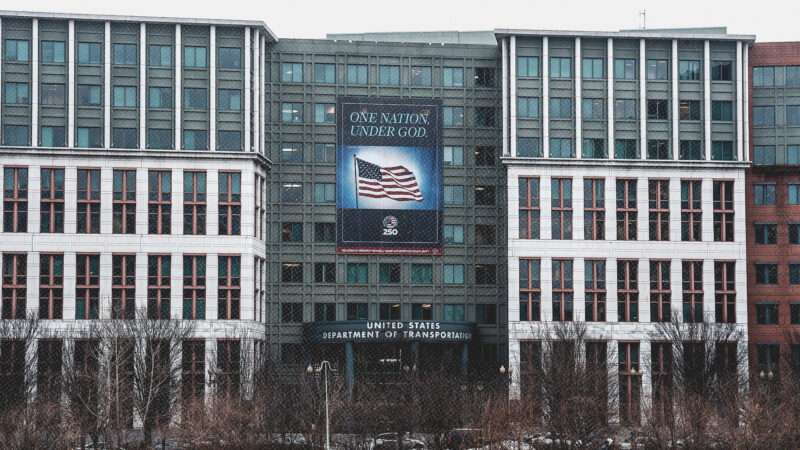
One Federal Agency’s Unused Office Space Costs ‘Hundreds of Millions of Dollars’ Per Year


The U.S. Department of Transportation headquarters building in Washington, D.C. | Andrew Leyden/ZUMAPRESS/Newscom

In one of his day-one acts, President Donald Trump ordered all executive branch agencies to “terminate remote work arrangements and require employees to return to work in-person at their respective duty stations on a full-time basis,” barring individual exemptions.

Despite that, a new report found that one department’s office spaces are “significantly underutilized,” and it’s costing taxpayers a fortune.

“The Department of Transportation (DOT) and its component agencies are
underutilizing their office space department-wide,” according to the Government Accountability Office (GAO).

The Utilizing Space Efficiently and Improving Technologies (USE IT) Act, passed in 2023, set a required minimum 60 percent occupancy rate for all federal agencies and empowered the government to “consolidate federal agency headquarters buildings in the National Capital region,” if necessary, to hit that benchmark.

According to the report, when GAO auditors checked DOT facilities between August 25 and September 19, 2025, they “found that 89 percent of DOT’s 189 office buildings, including the DOT and the Federal Aviation Administration (FAA) headquarters complexes, were underutilized,” based on that 60-percent threshold.

It turns out they were not just underused, but drastically so: “Our analysis found that average utilization rates among owned and leased buildings were similar, at 37 and 41 percent, respectively.”

The DOT and FAA headquarters buildings are by far the department’s largest and most expensive: Combined, they total 1.8 million square feet and have an estimated capacity of more than 12,000 employees, with over $100 million in annual rental costs and nearly $25 million in annual operations costs. And yet when surveyed, each building was only about one-third full on any given day.

The DOT’s third most expensive building is One Aviation Plaza in Queens, New York. Despite having an estimated capacity under 1,000 people, the building carries over $15 million in annual rental costs, and yet during the GAO’s survey period, it was only 13 percent occupied.

The report divided all DOT buildings into four categories based on size; of those, the only category that averaged more than 50 percent occupancy was the very smallest facilities, with an average capacity of just 16 people.

This is about more than just sparsely populated offices, though: As with most things that involve the federal government, it’s about huge wastes of taxpayer money.

“DOT’s underutilized office space costs hundreds of millions of dollars annually to lease, operate, and maintain,” the GAO found. “Of the 189 DOT buildings included in our analysis, we found 168 buildings were underutilized, totaling $370 million in annual rental, operations, and maintenance costs.”

Unfortunately, this issue is not new, nor is it confined to just the DOT. In 2023, the GAO surveyed the 24 agencies that use most of the federal government’s buildings, constituting about $2 billion in annual operating costs. It found average occupancy rates between 25 percent or less on the low end, and 49 percent on the high end.

At that time, the DOT was in the second-lowest quartile of agencies that used only around 16 percent of their available space, on average.

One thing the report notes is that the DOT has made no efforts to maximize its existing space, particularly at any of its secondary locations. For example, the DOT operates a number of inferior agencies, but none of them currently share office space with each other. In practice, this means a number of similar agencies in the same department occupy separate, half-empty offices.

The report also notes that certain DOT offices could adopt a desk-sharing system. Even though agencies are required to work in person, many employees in DOT field offices “conduct investigations or inspections at offsite locations, such as airports or airplane manufacturing facilities,” and as a result, they “spend roughly half of their time working offsite.” And yet, the department provides each of them with a dedicated desk that is empty half the time. The GAO notes that a desk reservation system, which the department has resisted, could free up space that currently sits empty.

Granted, the DOT has taken some steps to address the issue. Last year, the department announced plans to move FAA staff into the DOT headquarters and return the FAA’s building to the General Services Administration (GSA). Doing so, the GAO noted, “will allow DOT to avoid paying $56 million annually to GSA for rent, operations and maintenance,” plus “an estimated $131 million in deferred maintenance costs,” depending on what the GSA does with it next. (Ideally, it would sell the building, and many others, freeing up valuable commercial real estate for use in the private sector and saving taxpayers money in the process.)

But right now, those savings are theoretical: The GAO notes that not all FAA staff would move into the DOT building, leaving 950 FAA staffers whom the department hasn’t figured out where to put yet.

Considering the FAA employs more than 45,000 people in total, perhaps they could be relocated into the private sector too?

The post One Federal Agency's Unused Office Space Costs 'Hundreds of Millions of Dollars' Per Year appeared first on Reason.com.

from Latest – Reason.com https://ift.tt/0ejWfo1
via IFTTT

Are the Epstein Files a Moral Panic?

Journalist Michael Tracey and Pace University’s Marcella Szablewicz debate the resolution, “The Jeffrey Epstein scandal has become a case of moral panic.”

Taking the affirmative is Tracey, an independent journalist, political commentator, and media critic known for his skepticism of the Epstein narrative and what he calls the surrounding “mythology” and hysteria.

Taking the negative is Szablewicz, an associate professor of communication and media studies at Pace University’s Dyson College of Arts and Sciences. Her research focuses on digital media and media moral panics.

The debate is moderated by Soho Forum Director Gene Epstein.

The post Are the Epstein Files a Moral Panic? appeared first on Reason.com.

from Latest – Reason.com https://ift.tt/iIEbptX
via IFTTT

With The Odyssey, Christopher Nolan Earns His Place as Hollywood’s Great Liberal Humanist 


Matt Damon in Christopher Nolan's "The Odyssey" | Universal Pictures

For two and a half decades, Christopher Nolan has been Hollywood’s great liberal humanist, a defender of the secular, human ideal, and a mournful viewer of man’s tragic nature—and society’s. His Batman trilogy began with his hero defeating the threat of martial authoritarianism, moved on to a story about the destruction wrought by nihilistic chaos-mongers, and closed with a warning about the appeal of strongman populism. His Interstellar warned of decline through stagnation, as humanity forgot how to be bold in progress. His Tenet and Oppenheimer foretold man’s capacity for self-annihilation. We’ve been living in Nolan’s world. 

His latest, an adaptation of Homer’s The Odyssey, takes us even deeper into that world, via an ancient epic poem. Those familiar with the Greek epic will recognize much of what’s on screen, and Nolan has done justice, at least visually, to many of its most iconic moments, from the whirlpool to the encounter with the cyclops to the Trojan horse attack that left the story’s hero stranded and separated for years before his return home. 

But this adaptation is pure Nolan, not only in its glorious analog revanchism, but in its time-looping structure, its psychological fascinations, and its ultimate view of what holds civilization together: Like his Batman films, Nolan’s The Odyssey is a story about the restoration of the liberal order, or what passed for it in ancient times, by way of the sacrifices of a hero. It’s the story of a broken civilization and how to get it back. 

That story begins with a warrior—a man with a duty to his people—who is also just a man with a wife and a child. Odysseus left home to fight a war against the Trojans, but has been gone for years. Back home in Ithaca, his court has been overrun with greedy, sniveling suitors who live off his wealth while scheming to replace him in the bedroom and on the throne. He has a wife, Penelope, and a son, Telemachus, who are growing desperate as the suitors take advantage of them. But they cannot evict the societal malfeasants who have encumbered their household for fear of violating a societal ideal—Zeus’ law, which is not a formal law so much as a shared expectation that one give food and shelter to strangers, since even a beggar might be a god in disguise. 

In Ithaca, then, Nolan once again gives us a dilapidated society, rotted from within by weak and selfish men who decided to take advantage of an informal social bargain—the duty to provide aid to strangers. The liberal bargain, such as it is in Ithaca, is coming undone. 

Telemachus decides to take action, traveling afar to seek news of his father. But it’s Odysseus’ own journey home that makes up the story’s spine. Odysseus and his men sail the ancient coast, encounter monsters, witches, and even gods of a sort. 

On a pure filmmaking level, these episodic adventures are some of the most gripping stuff I’ve seen on screen in a long time; the encounter with the cyclops, a one-eyed giant who eats men like crunchy snacks, is particularly awe-inspiring. Nolan famously dislikes computer-generated effects, and is said to have built a 60-foot puppet to play the monster, which was transported to a real-world Mediterranean cave. (Imagine trying to explain having that in your luggage.) 

Nolan isn’t as interested in dialogue; he prefers expository aphorisms, often muddled and buried in the sound mix, to natural conversation. Those who love Homer’s poem primarily for its specific language may find themselves disappointed. But Nolan is a filmmaker, not a poet, and his language is epic images. There simply aren’t many filmmakers who would attempt this sort of globe-spanning, analog production, and there are even fewer who could pull it off with such élan. At every stage of the movie, it helps that Nolan is so ambitious, so virtuosic, so technically capable. 

But Nolan has more on his mind than analog wows. As Odysseus returns home in the film’s final hour, the director’s grand themes and thematic hobbyhorses assert themselves: Nolan’s adaptation emphasizes that it’s not just the suitors who have broken the liberal bargain, but Odysseus himself, through his celebrated trickery and violence. Odysseus is known throughout the land because of the songs sung about him, but those legends are just the stories told after the fact to justify horrors that fractured the social compact. 

Thus Odysseus returns home a man wracked by guilt and trauma, living in his memories, with a burning need to set things right for himself, his family, and his country. And while he has been warned and tricked and occasionally even guided by the gods, he finds—as Nolan’s protagonists often do—that they are cold and distant. The responsibility to fix what is broken is his, not fate’s. Man is alone in an uncaring universe, but he can also be the master of his own fate. This is Nolan’s worldview, his Odyssey, as much as it is Homer’s. And the shattered liberal order it describes is one that feels just as relevant today. 

The post With <i>The Odyssey</i>, Christopher Nolan Earns His Place as Hollywood's Great Liberal Humanist  appeared first on Reason.com.

from Latest – Reason.com https://ift.tt/OX9LBWD
via IFTTT

Are the Epstein Files a Moral Panic?

Journalist Michael Tracey and Pace University’s Marcella Szablewicz debate the resolution, “The Jeffrey Epstein scandal has become a case of moral panic.”

Taking the affirmative is Tracey, an independent journalist, political commentator, and media critic known for his skepticism of the Epstein narrative and what he calls the surrounding “mythology” and hysteria.

Taking the negative is Szablewicz, an associate professor of communication and media studies at Pace University’s Dyson College of Arts and Sciences. Her research focuses on digital media and media moral panics.

The debate is moderated by Soho Forum Director Gene Epstein.

The post Are the Epstein Files a Moral Panic? appeared first on Reason.com.

from Latest – Reason.com https://ift.tt/iIEbptX
via IFTTT

With The Odyssey, Christopher Nolan Earns His Place as Hollywood’s Great Liberal Humanist 


Matt Damon in Christopher Nolan's "The Odyssey" | Universal Pictures

For two and a half decades, Christopher Nolan has been Hollywood’s great liberal humanist, a defender of the secular, human ideal, and a mournful viewer of man’s tragic nature—and society’s. His Batman trilogy began with his hero defeating the threat of martial authoritarianism, moved on to a story about the destruction wrought by nihilistic chaos-mongers, and closed with a warning about the appeal of strongman populism. His Interstellar warned of decline through stagnation, as humanity forgot how to be bold in progress. His Tenet and Oppenheimer foretold man’s capacity for self-annihilation. We’ve been living in Nolan’s world. 

His latest, an adaptation of Homer’s The Odyssey, takes us even deeper into that world, via an ancient epic poem. Those familiar with the Greek epic will recognize much of what’s on screen, and Nolan has done justice, at least visually, to many of its most iconic moments, from the whirlpool to the encounter with the cyclops to the Trojan horse attack that left the story’s hero stranded and separated for years before his return home. 

But this adaptation is pure Nolan, not only in its glorious analog revanchism, but in its time-looping structure, its psychological fascinations, and its ultimate view of what holds civilization together: Like his Batman films, Nolan’s The Odyssey is a story about the restoration of the liberal order, or what passed for it in ancient times, by way of the sacrifices of a hero. It’s the story of a broken civilization and how to get it back. 

That story begins with a warrior—a man with a duty to his people—who is also just a man with a wife and a child. Odysseus left home to fight a war against the Trojans, but has been gone for years. Back home in Ithaca, his court has been overrun with greedy, sniveling suitors who live off his wealth while scheming to replace him in the bedroom and on the throne. He has a wife, Penelope, and a son, Telemachus, who are growing desperate as the suitors take advantage of them. But they cannot evict the societal malfeasants who have encumbered their household for fear of violating a societal ideal—Zeus’ law, which is not a formal law so much as a shared expectation that one give food and shelter to strangers, since even a beggar might be a god in disguise. 

In Ithaca, then, Nolan once again gives us a dilapidated society, rotted from within by weak and selfish men who decided to take advantage of an informal social bargain—the duty to provide aid to strangers. The liberal bargain, such as it is in Ithaca, is coming undone. 

Telemachus decides to take action, traveling afar to seek news of his father. But it’s Odysseus’ own journey home that makes up the story’s spine. Odysseus and his men sail the ancient coast, encounter monsters, witches, and even gods of a sort. 

On a pure filmmaking level, these episodic adventures are some of the most gripping stuff I’ve seen on screen in a long time; the encounter with the cyclops, a one-eyed giant who eats men like crunchy snacks, is particularly awe-inspiring. Nolan famously dislikes computer-generated effects, and is said to have built a 60-foot puppet to play the monster, which was transported to a real-world Mediterranean cave. (Imagine trying to explain having that in your luggage.) 

Nolan isn’t as interested in dialogue; he prefers expository aphorisms, often muddled and buried in the sound mix, to natural conversation. Those who love Homer’s poem primarily for its specific language may find themselves disappointed. But Nolan is a filmmaker, not a poet, and his language is epic images. There simply aren’t many filmmakers who would attempt this sort of globe-spanning, analog production, and there are even fewer who could pull it off with such élan. At every stage of the movie, it helps that Nolan is so ambitious, so virtuosic, so technically capable. 

But Nolan has more on his mind than analog wows. As Odysseus returns home in the film’s final hour, the director’s grand themes and thematic hobbyhorses assert themselves: Nolan’s adaptation emphasizes that it’s not just the suitors who have broken the liberal bargain, but Odysseus himself, through his celebrated trickery and violence. Odysseus is known throughout the land because of the songs sung about him, but those legends are just the stories told after the fact to justify horrors that fractured the social compact. 

Thus Odysseus returns home a man wracked by guilt and trauma, living in his memories, with a burning need to set things right for himself, his family, and his country. And while he has been warned and tricked and occasionally even guided by the gods, he finds—as Nolan’s protagonists often do—that they are cold and distant. The responsibility to fix what is broken is his, not fate’s. Man is alone in an uncaring universe, but he can also be the master of his own fate. This is Nolan’s worldview, his Odyssey, as much as it is Homer’s. And the shattered liberal order it describes is one that feels just as relevant today. 

The post With <i>The Odyssey</i>, Christopher Nolan Earns His Place as Hollywood's Great Liberal Humanist  appeared first on Reason.com.

from Latest – Reason.com https://ift.tt/OX9LBWD
via IFTTT

Election Vulnerability


President Donald Trump | SAUL LOEB/UPI/Newscom

Trump’s stolen-election claims: “Great damage has been done to our country,” said President Donald Trump last night in a special address to the country, addressing election vulnerabilities he believes exist. “Our elections were left vulnerable to being rigged and stolen, and the trust of the American people was lost. This cannot be allowed to continue.”

China, in his words, carried out “the largest compromise of election data in history” starting with the 2020 election, allegedly gathering 220 million voter files “over a period of years.” If true—which is a big if—this is a huge indictment of government data-security practices (not much else).

“U.S. intelligence and congressional officials have long known that China obtained voter data,” counters The New York Times, which was “publicly available information often purchased by political campaigns. What’s more, former intelligence officials have said, China gathered the data not to manipulate voting results, but instead to better craft influence campaigns to shape voters’ perceptions.” Influence campaigns are different than straight-up election tampering—and seemingly much harder to prevent.

Trump also said we must fix issues with electronic voting so that “we can never watch a stolen election again.” But it wasn’t especially clear what, specifically, he was pointing to that had been proven to show outright manipulation of vote counts.

“If you look at voting today, it’s in such bad shape in so many states,” he continued. “And we are committing to fix it, and we are also committing to be working with those states and local jurisdictions to help them fix and patch known technical vulnerabilities before the midterm elections.”

It looks a little bit like Trump is working to tend to the seeds of distrust in elections that he has long ago sown. But there’s not much new evidence he can marshal to substantiate these claims.

Are we living through an era of measurement problems? Millennials and Zoomers are not doing fine,” writes Johann Kurtz on his Substack, Becoming Noble. “In fact, I think there have been structural changes to our economy and society which clearly explain why these cohorts are failing to move through the five pillars of a stable middle-class existence: education, stable employment, marriage, homeownership, children.”

“What has happened is that previous generations were able to take advantage of highly valuable and productive social capital as well as their exploding financial capital to move through each of these life stages in a fiscally efficient manner,” continues Kurtz. “Our current young, lacking access to this social capital, must engage in enormous outlays of purely financial capital in order to achieve the same levels of stability and accomplishment—capital that they do not have. We see this clearly in the data on schooling, homeownership, and family formation.”

On the surface it does seem as if the young are fine. Real median incomes are higher than they were for their parents at the same age, unemployment has spent most of the past decade at historic lows, and purchasing power has risen roughly 63 percent since 1973. Televisions, clothing, food, and air travel are cheaper than ever,” argues Kurtz. “And yet this generation is also not marrying, not buying homes, not having children, and seem pretty miserable. I think we’re clearly in the midst of a tremendous measurement failure.”


Scenes from New York: The family of a tourist who was killed in a freak carriage accident in Central Park is calling on the city council to ban horse-drawn carriages. “Transport Workers Union Local 100, which represents horse-carriage drivers and owners, has for years fended off efforts to abolish the industry,” reports The New York Times. “The horses are well cared for and doing the kind of work they were bred for, the union says, and it argues that ending the carriage rides would be devastating for the roughly 170 licensed drivers and would harm the animals as well.”

As a rule of thumb: We don’t need laws named after victims or laws passed in the wake of freak-accident deaths to try to prevent extremely rare accidents from happening. Losing your child is awful and tragic—I know a thing or two about that—but trying to squeeze every last bit of risk out of society, in favor of perfect, predictable safetyism is a fool’s errand. It also, sadly, won’t reanimate the dead. If only we humans had the power to do so.


QUICK HITS

  • “President Donald Trump announced a 25 percent tariff on goods from Brazil on Wednesday, the latest step in rebuilding U.S. trade barriers following the Supreme Court ruling earlier this year that invalidated his first try at erecting a shield around the economy,” reports The Washington Post. “The president’s trade chief, Jamieson Greer, recommended the move after a year-long investigation concluded Brazil had engaged in several ‘unfair’ trade practices. Greer said Brazil’s digital trade and electronic payment systems, preferential tariffs, ethanol market, intellectual property protection and illegal deforestation all had hurt U.S. companies.”
  • “Outside of stripping away the human component of asking another human to spend time together, Partiful also made parties less fun,” writes @burntmilk on Substack. “There is no mystery or drama in knowing exactly who is going to be there and who is whose plus-one. The turnout is pretty much what you see when you open the event’s page day-of. There is no secret for the host to hold.…A party is good when you’re talking to strangers, and the best when strangers are rambling to you, a fleeting entity they can forget about. I want to interact with people without already having mentally processed their presence.”
  • True:

The post Election Vulnerability appeared first on Reason.com.

from Latest – Reason.com https://ift.tt/R6TyxBY
via IFTTT

Justice Kagan Says Don’t Call It the “Shadow Docket”

Associate Justices Elena Kagan and Amy Coney Barrett testified before Congress this week.

Much of the press coverage and online commentary has focused on the justices’ discussion of their need for greater security and increasing threats to the federal judiciary, with a particular focus on Justice Barrett’s comments on her personal experience. Contrary to the claims of some “conservative” influencers, Justice Barrett did not say anything suggesting such threats–including the swatting attempt on her home–had affected her work or decision-making. She actually said the opposite, that all of the justices “continue to do their jobs without fear or favor.”

In the House, the justices were asked about the Court’s handling of requests for interim or emergency relief on the so-called “shadow docket.” The exchanges here are interesting, not least because Justice Kagan said it is no longer appropriate to use the “shadow docket” label.

Here is an excerpt from the transcript.

REP. HOYER: Let me go to — and I’m not asking you about the substance of decisions, but I am asking you. There has been a substantial increase in what I guess we call shadow decisions. Is that a budget-related or policy-related phenomenon?

BARRETT: Well, let’s see. I think that litigants have long had the ability to seek interim relief from the court, but I think you are certainly right, Ranking Member Hoyer, that we have seen a big change in the volume and the nature of such requests.

The court is doing its best to adapt and respond. I think it is a policy question, not so much a budget one.

I don’t know if you have additional thoughts.

KAGAN: I am sure there will be additional questions.

(LAUGHTER)

HOYER: Does that impact on the transparency, which you referred to not putting up fences so that people had access?

There are concerns, obviously, that these shadow dispositions impact adversely on the knowledge the public has about how the court makes its decisions and who is making what decisions. Do you want to comment on that?

KAGAN: Ranking Member Hoyer, there are definitely issues with respect to the emergency — we call it the emergency docket. Some of us call it the interim docket. I — it’s a terminology nightmare. I call it the emergency docket. And there are definitely questions about how it is appropriate to use that docket, when it’s appropriate to use that docket, the standards to be applied, the way those standards actually work out in individual cases.

And you see that in some of our decisions, because we are, in many, if not most of these cases, not unanimous. There will be a majority and a dissent. The reason I think it is probably not appropriate, at least not now, to call it the shadow docket, is because we have done, I think, a better job in the recent past of, where appropriate, and it’s not always appropriate, but where appropriate, explaining ourselves, at least to a moderate degree.

I think if you had asked me this question a year ago, I might have said that there would be — there were some cases, and, in fact I did say, I had said in some public events that there were some cases where we did so little explanation of what lay behind our order that lower courts had a great deal of difficulty trying to figure out what that order was.

Were we saying something about the merits of the case? Were we saying about — something about who had standing to contest the merits? Were we saying something about appropriate remedies? Nobody knew.

I don’t think that that’s so much a problem anymore. I think that, as we have gotten more experienced in these constant requests that are coming to us about requests for emergency relief, that we better recognize that at least sometimes there is a need for additional information.

And we have issued opinions, and sometimes majority and dissenting opinions accordingly.

The post Justice Kagan Says Don't Call It the "Shadow Docket" appeared first on Reason.com.

from Latest – Reason.com https://ift.tt/0wUqSyo
via IFTTT

Election Vulnerability


President Donald Trump | SAUL LOEB/UPI/Newscom

Trump’s stolen-election claims: “Great damage has been done to our country,” said President Donald Trump last night in a special address to the country, addressing election vulnerabilities he believes exist. “Our elections were left vulnerable to being rigged and stolen, and the trust of the American people was lost. This cannot be allowed to continue.”

China, in his words, carried out “the largest compromise of election data in history” starting with the 2020 election, allegedly gathering 220 million voter files “over a period of years.” If true—which is a big if—this is a huge indictment of government data-security practices (not much else).

“U.S. intelligence and congressional officials have long known that China obtained voter data,” counters The New York Times, which was “publicly available information often purchased by political campaigns. What’s more, former intelligence officials have said, China gathered the data not to manipulate voting results, but instead to better craft influence campaigns to shape voters’ perceptions.” Influence campaigns are different than straight-up election tampering—and seemingly much harder to prevent.

Trump also said we must fix issues with electronic voting so that “we can never watch a stolen election again.” But it wasn’t especially clear what, specifically, he was pointing to that had been proven to show outright manipulation of vote counts.

“If you look at voting today, it’s in such bad shape in so many states,” he continued. “And we are committing to fix it, and we are also committing to be working with those states and local jurisdictions to help them fix and patch known technical vulnerabilities before the midterm elections.”

It looks a little bit like Trump is working to tend to the seeds of distrust in elections that he has long ago sown. But there’s not much new evidence he can marshal to substantiate these claims.

Are we living through an era of measurement problems? Millennials and Zoomers are not doing fine,” writes Johann Kurtz on his Substack, Becoming Noble. “In fact, I think there have been structural changes to our economy and society which clearly explain why these cohorts are failing to move through the five pillars of a stable middle-class existence: education, stable employment, marriage, homeownership, children.”

“What has happened is that previous generations were able to take advantage of highly valuable and productive social capital as well as their exploding financial capital to move through each of these life stages in a fiscally efficient manner,” continues Kurtz. “Our current young, lacking access to this social capital, must engage in enormous outlays of purely financial capital in order to achieve the same levels of stability and accomplishment—capital that they do not have. We see this clearly in the data on schooling, homeownership, and family formation.”

On the surface it does seem as if the young are fine. Real median incomes are higher than they were for their parents at the same age, unemployment has spent most of the past decade at historic lows, and purchasing power has risen roughly 63 percent since 1973. Televisions, clothing, food, and air travel are cheaper than ever,” argues Kurtz. “And yet this generation is also not marrying, not buying homes, not having children, and seem pretty miserable. I think we’re clearly in the midst of a tremendous measurement failure.”


Scenes from New York: The family of a tourist who was killed in a freak carriage accident in Central Park is calling on the city council to ban horse-drawn carriages. “Transport Workers Union Local 100, which represents horse-carriage drivers and owners, has for years fended off efforts to abolish the industry,” reports The New York Times. “The horses are well cared for and doing the kind of work they were bred for, the union says, and it argues that ending the carriage rides would be devastating for the roughly 170 licensed drivers and would harm the animals as well.”

As a rule of thumb: We don’t need laws named after victims or laws passed in the wake of freak-accident deaths to try to prevent extremely rare accidents from happening. Losing your child is awful and tragic—I know a thing or two about that—but trying to squeeze every last bit of risk out of society, in favor of perfect, predictable safetyism is a fool’s errand. It also, sadly, won’t reanimate the dead. If only we humans had the power to do so.


QUICK HITS

  • “President Donald Trump announced a 25 percent tariff on goods from Brazil on Wednesday, the latest step in rebuilding U.S. trade barriers following the Supreme Court ruling earlier this year that invalidated his first try at erecting a shield around the economy,” reports The Washington Post. “The president’s trade chief, Jamieson Greer, recommended the move after a year-long investigation concluded Brazil had engaged in several ‘unfair’ trade practices. Greer said Brazil’s digital trade and electronic payment systems, preferential tariffs, ethanol market, intellectual property protection and illegal deforestation all had hurt U.S. companies.”
  • “Outside of stripping away the human component of asking another human to spend time together, Partiful also made parties less fun,” writes @burntmilk on Substack. “There is no mystery or drama in knowing exactly who is going to be there and who is whose plus-one. The turnout is pretty much what you see when you open the event’s page day-of. There is no secret for the host to hold.…A party is good when you’re talking to strangers, and the best when strangers are rambling to you, a fleeting entity they can forget about. I want to interact with people without already having mentally processed their presence.”
  • True:

The post Election Vulnerability appeared first on Reason.com.

from Latest – Reason.com https://ift.tt/R6TyxBY
via IFTTT

Justice Kagan Says Don’t Call It the “Shadow Docket”

Associate Justices Elena Kagan and Amy Coney Barrett testified before Congress this week.

Much of the press coverage and online commentary has focused on the justices’ discussion of their need for greater security and increasing threats to the federal judiciary, with a particular focus on Justice Barrett’s comments on her personal experience. Contrary to the claims of some “conservative” influencers, Justice Barrett did not say anything suggesting such threats–including the swatting attempt on her home–had affected her work or decision-making. She actually said the opposite, that all of the justices “continue to do their jobs without fear or favor.”

In the House, the justices were asked about the Court’s handling of requests for interim or emergency relief on the so-called “shadow docket.” The exchanges here are interesting, not least because Justice Kagan said it is no longer appropriate to use the “shadow docket” label.

Here is an excerpt from the transcript.

REP. HOYER: Let me go to — and I’m not asking you about the substance of decisions, but I am asking you. There has been a substantial increase in what I guess we call shadow decisions. Is that a budget-related or policy-related phenomenon?

BARRETT: Well, let’s see. I think that litigants have long had the ability to seek interim relief from the court, but I think you are certainly right, Ranking Member Hoyer, that we have seen a big change in the volume and the nature of such requests.

The court is doing its best to adapt and respond. I think it is a policy question, not so much a budget one.

I don’t know if you have additional thoughts.

KAGAN: I am sure there will be additional questions.

(LAUGHTER)

HOYER: Does that impact on the transparency, which you referred to not putting up fences so that people had access?

There are concerns, obviously, that these shadow dispositions impact adversely on the knowledge the public has about how the court makes its decisions and who is making what decisions. Do you want to comment on that?

KAGAN: Ranking Member Hoyer, there are definitely issues with respect to the emergency — we call it the emergency docket. Some of us call it the interim docket. I — it’s a terminology nightmare. I call it the emergency docket. And there are definitely questions about how it is appropriate to use that docket, when it’s appropriate to use that docket, the standards to be applied, the way those standards actually work out in individual cases.

And you see that in some of our decisions, because we are, in many, if not most of these cases, not unanimous. There will be a majority and a dissent. The reason I think it is probably not appropriate, at least not now, to call it the shadow docket, is because we have done, I think, a better job in the recent past of, where appropriate, and it’s not always appropriate, but where appropriate, explaining ourselves, at least to a moderate degree.

I think if you had asked me this question a year ago, I might have said that there would be — there were some cases, and, in fact I did say, I had said in some public events that there were some cases where we did so little explanation of what lay behind our order that lower courts had a great deal of difficulty trying to figure out what that order was.

Were we saying something about the merits of the case? Were we saying about — something about who had standing to contest the merits? Were we saying something about appropriate remedies? Nobody knew.

I don’t think that that’s so much a problem anymore. I think that, as we have gotten more experienced in these constant requests that are coming to us about requests for emergency relief, that we better recognize that at least sometimes there is a need for additional information.

And we have issued opinions, and sometimes majority and dissenting opinions accordingly.

The post Justice Kagan Says Don't Call It the "Shadow Docket" appeared first on Reason.com.

from Latest – Reason.com https://ift.tt/0wUqSyo
via IFTTT