Oil Extends Losses As White House Considers Releasing Emergency Reserves, Ban Exports

Oil Extends Losses As White House Considers Releasing Emergency Reserves, Ban Exports

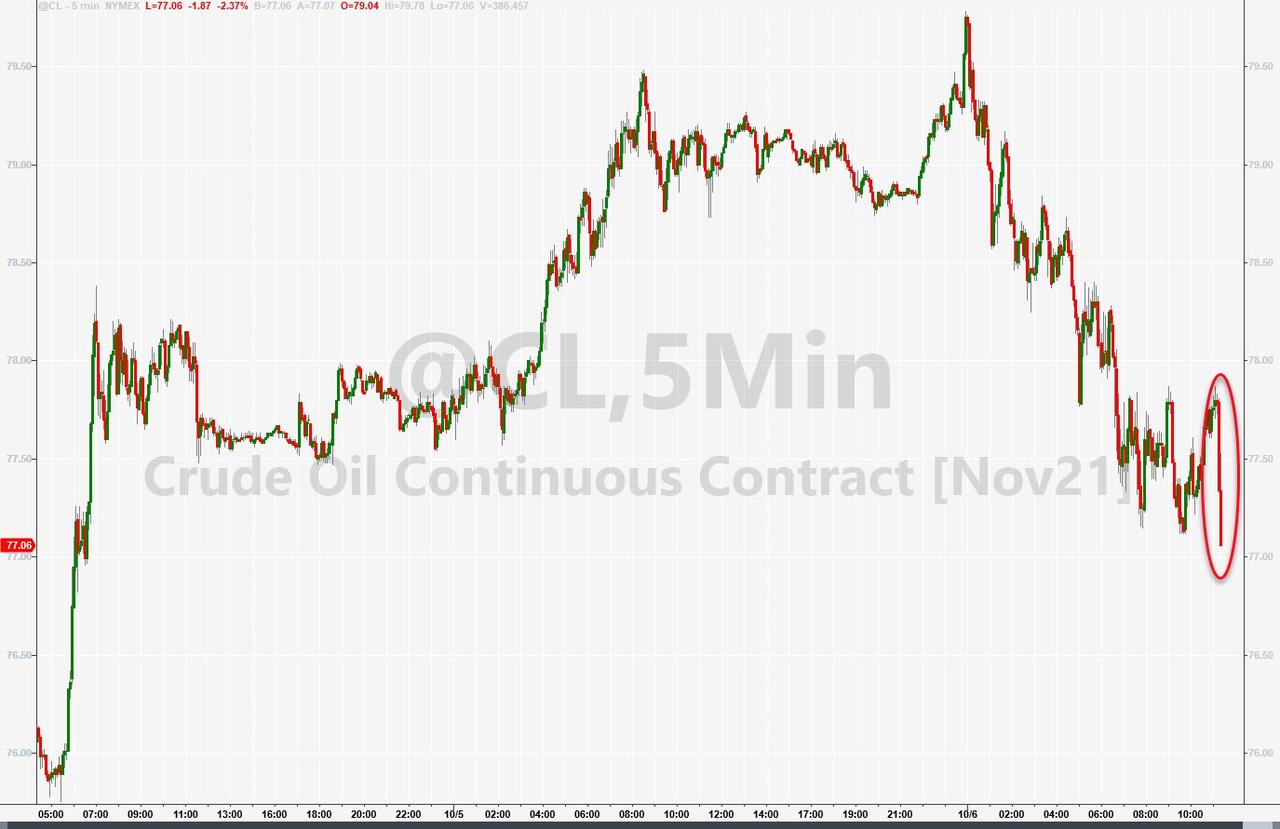
WTI Crude prices have tumbled from almost $79.50 overnight to barely above $77 as inventories were seen rising for the second week, Russian President Vladimir Puttin offered to placate Europe’s natural gas pain (removing a pillar of support for oil from gas-to-crude rotation), and now The FT reports that US energy secretary Jennifer Granholm has raised the prospect of releasing crude oil from the government’s strategic petroleum reserve, declaring that “all tools are on the table” as the Biden administration confronts a politically perilous surge in the price of gasoline.

“It’s a tool that’s under consideration,” Granholm said of a release of crude supplies from the national strategic petroleum reserve, which analysts say could calm oil markets and bring prices down.

“SPR [releases] came on the table a nanosecond after Jake Sullivan was rebuffed in Riyadh and the administration realised shale producers wouldn’t be able to increase production quickly enough,” said Bob McNally, head of Rapidan Energy Group and a former adviser to the George W Bush White House.

Granholm also did not rule out a ban on crude oil exports.

“That’s a tool that we have not used, but it is a tool as well,” she told the FT Energy Transition Strategies Summit on Wednesday.

WTI extended its losses on this latest news…

The last big release was in 2011, when the Obama administration worked with other International Energy Agency members to tap emergency stocks to bring down soaring prices. Congress has also authorised periodic sales to raise government revenue.

Tyler Durden
Wed, 10/06/2021 – 14:25

via ZeroHedge News https://ift.tt/3Ac8CbW Tyler Durden

Florida Gov. DeSantis Promises To Defend Parents At School Board Meetings Against DOJ

Florida Gov. DeSantis Promises To Defend Parents At School Board Meetings Against DOJ

Authored by Jack Phillips via The Epoch Times,

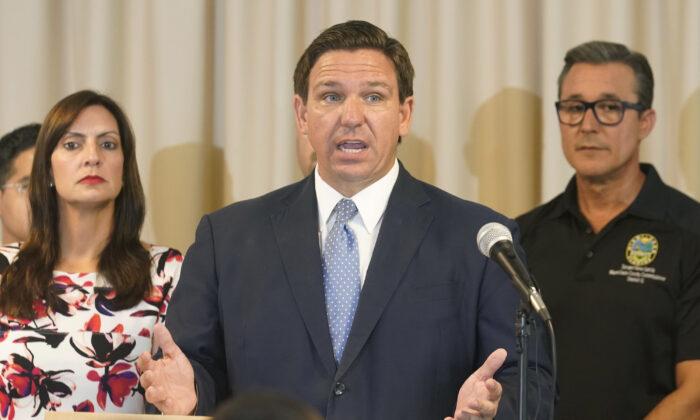
Following a Department of Justice announcement Monday that it would direct the FBI to mobilize against parents who allegedly threaten teachers and school board members, Florida Gov. Ron DeSantis promised that the state would defend parents amid GOP outcry against the move.

“Attorney General Garland is weaponizing the DOJ by using the FBI to pursue concerned parents and silence them through intimidation,” DeSantis wrote.

“Florida will defend the free speech rights of its citizens and will not allow federal agents to squelch dissent.”

The Justice Department stated that it would create a task force to see how the federal government can be used to prosecute any criminal conduct toward teachers or how to assist state and local authorities investigate such threats. It came after a national association of school boards asked the Biden administration to use “extraordinary measures” to prevent alleged threats against school board staff, accusing parents who oppose teaching critical race theory and mask mandates of lodging them.

DeSantis’s office on Tuesday released a statement saying Florida law already prohibits harassment of teachers, while adding that Florida law enforcement  is “perfectly capable of responding to crimes in Florida, and we have never heard the FBI suggest otherwise.”

“However, disagreement is not harassment. Protest is not terrorism, unless it involves rioting, looting, and assault, like some of the left-wing protests of summer 2020. Again, all of those actions are crimes in Florida and will be prosecuted, regardless of political context,” the statement added.

According to the Justice Department, it will create a task force to determine how to use federal resources to prosecute offending parents along with how to provide advice to states where no federal laws have been broken. Training will also be provided to school staff members on how to report threats from parents.

During school board meetings across the United States over the past several months, heated discussions have been held by parents, teachers, and school board staff on whether critical race theory or associated ideologies should be taught to children. The Department of Justice’s announcement did not elaborate on whether threats against teachers and staff are widespread.

This week, Republican lawmakers sharply criticized the Justice Department and Attorney General Merrick Garland’s directive, arguing the Biden administration is attempting to silence dissent.

“Your memorandum is a politically-motivated abuse of power and displays a lack of reasoned, sound judgment … confronting parents to oppose the views of the Biden administration and its socialist agenda,” wrote Rep. Ken Buck (R-Colo.) in a letter to the agency.

“Parents are speaking out against Critical Race Theory in schools. Now the Biden administration is cracking down on dissent,” Sen. Tom Cotton (R-Ark.) wrote on Twitter.

Tyler Durden
Wed, 10/06/2021 – 14:07

via ZeroHedge News https://ift.tt/3BwXDvn Tyler Durden

Goldman: It Is Now Too Late To Hike The Debt Limit “Before The Last Minute And Maybe Not Until After”

Goldman: It Is Now Too Late To Hike The Debt Limit “Before The Last Minute And Maybe Not Until After”

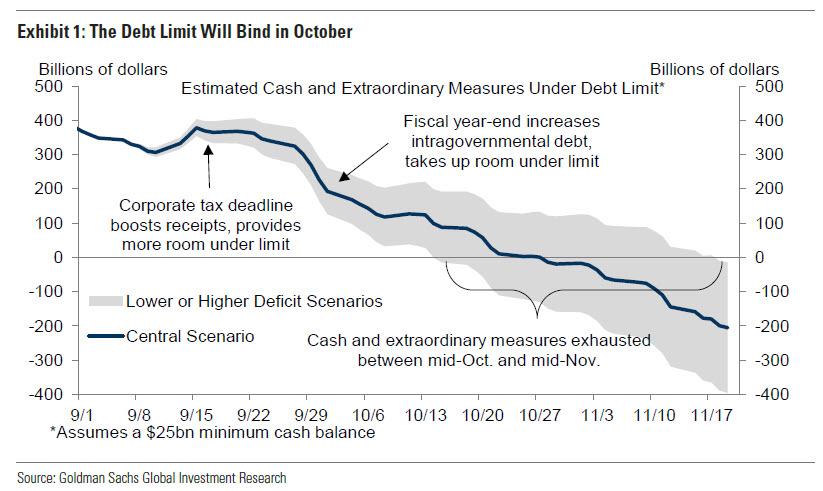
There is a reason why top Senate republican Mitch McConnell may be about to cave and offer democrats a short-term debt limit increase through November – aka lifting the limit until December – in order to give Dems enough time to begin a debt ceiling hike via a reconciliation process (which Dems won’t do and instead will punt on the Republicans again). That reason, as a just released note from Goldman calculates, is that “a debt limit hike now looks unlikely before the last minute… and maybe not until after” by which they refer to the “drop-dead date” which Janet Yellen recently said was October 18.

As Goldman’s political economist Alec Philips writes, “it looks unlikely that Congress will raise or suspend the debt limit” until just before the Oct. 18 deadline because “Neither side has a reason to compromise earlier than that and both appear to be waiting for the other party to change course.”

And while not Goldman’s base case yet, the bank also believes there is a real risk that Congress will miss the deadline. Here’s why:

If Democrats believe that Republicans will cooperate absent any other option, they might delay the other option—the reconciliation process—long enough to take that option off the table. Even at that late stage, Republicans might not cooperate if they still believe the reconciliation process is an option or doubt the credibility of the Treasury’s projected Oct. 18 deadline. In such a scenario, Congress could fail to raise the debt limit by the deadline even if neither side prefers that outcome.

Goldman then notes that the effect of missing the deadline would depend on how long the lapse lasts. On Oct. 18, the Treasury is likely—but not certain—to still have a small amount of cash on hand and might still be able to make scheduled payments even if Congress has not acted. Then, with each day that passes after the 18th, the probability that the Treasury exhausts all of its cash would increase. If that happens, the Treasury would likely delay payments to households, businesses, and state governments and pay those obligations in arrears, while continuing to pay debt obligations. That said, Goldman would expect a lapse in borrowing authority to be brief, “as the public and financial market response would likely force a quick political resolution.”

The good news is that even absent a short-term debt limit punt, Goldman does not believe that a lapse would affect payments related to Treasury securities. To wit, ahead of prior debt limit deadlines, the Treasury made plans to pay principal and interest (P&I) on Treasury securities while stopping other payments, and the same would occur if Congress misses the deadline. That said, as we have noted before repeatedly, there is already clear evidence demand for Treasury bills maturing just after the Oct. 18 deadline have cheapened relative to maturities farther from the deadline.

So if Democrats accept McConnell’s short-term extension proposal, all that will happen is the kink will move from October to November, something which we are seeing already, as the debt ceiling anxiety proxy is easing rapidly.

Tyler Durden
Wed, 10/06/2021 – 13:52

via ZeroHedge News https://ift.tt/3muLoZJ Tyler Durden

Cathie Wood Is Moving ARK Invest To Florida And Opening A Tech Company Incubator

Cathie Wood Is Moving ARK Invest To Florida And Opening A Tech Company Incubator

Cathie Wood is taking her show on the road. ARK Investment Management LLC announced in a Wednesday press release that it was going to be moving its headquarters to Florida effective November 1, 2021.

The company also said, after the move, it will be breaking ground on the “ARK Innovation Center”. The purpose of the facility is to “retain and attract top talent by supporting entrepreneurs and tech startups in St. Petersburg and the Tampa Bay region,” according to the release. 

“ARK believes that its relocation and the Center will advance its business as it scales and continues to redefine the asset management industry, and will increase collaboration between and among the communities focused on innovation at the local and national levels,” the press release read.

Cathie Wood commented: “We are thrilled to relocate our corporate headquarters to St. Petersburg, Florida, as we believe the Tampa Bay region’s talent, innovative spirit, and quality of life will accelerate our growth initiatives.”

“ARK is not a traditional Wall Street asset management firm, and we are looking forward to breaking the mold further by relocating to St. Petersburg, a city investing in technology, science, and innovation. Our relocation and the ARK Innovation Center will allow us to be more innovative and to impact the broader community while shining a spotlight on the technological advances and creativity permeating the Tampa Bay region,” she continued.

Jana Haines, ARK’s Chief Strategy Officer, added: “Tampa has been recognized as the top emerging technology city in the US and the broader area including St. Petersburg is among the top metro areas for STEM professionals. It offers a vast network of companies, universities, incubators, entrepreneurs, and many others dedicated to advancement.”

The press release said that the ARK Innovation Center would be open by 2023 and could generate revenue of $127 million by 2026:

The incubator, designated as ARK Innovation Center, is scheduled to open in July 2023 and will be located on 2.5 acres donated by the City of St. Petersburg at 4th Street and 11th Avenue South in the Innovation District. By 2026, the 45,000-square-foot building is expected to impact the county by $28 million thanks to the 1,265 direct and indirect jobs expected. Moreover, its clients and graduates are expected to generate $127 million in annual revenue.

J.P. DuBuque, President & CEO of the St. Petersburg Area Economic Development Corporation concluded: “ARK represents the community of innovators and disruptors thriving in St. Pete, particularly in the financial sector. We are incredibly proud that ARK has chosen not only to join us but to invest in the St. Pete community.”

Tyler Durden
Wed, 10/06/2021 – 13:41

via ZeroHedge News https://ift.tt/3mxkDno Tyler Durden

Rubino: This Gold Bull Market Has Years To Run

Rubino: This Gold Bull Market Has Years To Run

Authored by John Rubino via DollarCollapse.com,

The recent back-and-forth precious metals action has left a lot of people frustrated with both the metal and the “permabulls” in this space.

Fair enough.

Gold has almost doubled from its 2015 low, but it’s done so in a really boring way, which is the ultimate crime in the blow-off stage of a financial bubble when so many other things are going parabolic.

But history says that the real action is still to come. The following chart shows the past century’s gold bull markets, most of which* make the current bull market look like a virtual newborn.

*One gold bull market ended after matching today’s in both duration and appreciation. It ran from 1930 – the start of the Great Depression – to 1934 – the year in which FDR confiscated gold, made ownership of the metal illegal for individual Americans and then devalued the dollar versus gold. Unless all that happens again (possible but highly unlikely), that bull market isn’t a useful indicator.

Note that the 1970s appear as two bull markets separated by a correction in 1975. View that decade as a single bull market and you get something as long as – and much more lucrative than — the 2000-2012 bull market, with most of the gains coming towards the end of the run.

Is the 1970s gold market a good template for the the balance of the 2020s? Let’s consider the similarities:

  • A bungled exit from a pointless and costly war? Check: Vietnam then, Afghanistan now.

  • Rising inflation due to excessive debt and artificially easy money? Emphatic check. The current US CPI is showing a consistent 5%, while debt levels pretty much everywhere are off the charts.

  • Leadership that seems less competent and trustworthy every time they speak? Check: Jimmy Carter then, Biden/Harris now.

  • A rising power that threatens US military and financial hegemony – and by implication the dollar’s role as the world’s reserve currency? Double check: China and (again) Russia.

  • Energy crisis? Check: Natural gas and coal prices are soaring, stockpiles are at historically low levels, and winter is coming. Gas hoarding in the UK is likely to spread to Continental Europe and beyond. See here for more detail.

Toss in the pandemic that just won’t die, a labor shortage, supply chain disruptions, immigration chaos, and a weirdly-general societal shift away from discipline and rationality,  and you get an economy that’s locked into an easy-money, soaring leverage trajectory until no one in their right mind will want anything to do with traditional financial assets.

In this environment, the boring market action in gold – a form of money that has protected against financial and societal chaos for all of recorded history – looks like the calm before the storm.

Tyler Durden
Wed, 10/06/2021 – 13:20

via ZeroHedge News https://ift.tt/3FmZmpd Tyler Durden

Hackers “Own” Jeff Bezos By Stealing & Publishing Twitch Source Code In “Huge” Hack

Hackers “Own” Jeff Bezos By Stealing & Publishing Twitch Source Code In “Huge” Hack

These days, corporate hacks seem like a near-daily occurrence, with only the biggest and most damaging ones making headlines (whether it’s a ransomware attack or the good ol’ fashioned exploit) or attracting more than cursory attention from the press. But Wednesday’s hack of Twitch, the streaming service owned by Amazon, has come with a hilarious twist.

The hackers didn’t just break in, they stole a treasure trove of valuable source code, internal admin tools and files associated with the Vapor game store – ie it was a hack planned and executed not simply to profit, but to hurt Twitch and Amazon. Data on payments to popular streamers from 2019 and 2021 was also stolen and leaked so people could see how much they were paid.

It appears the leakers have taken precautions to avoid exposing personal data that could be damaging for Twitch users.

In a message posted to 4Chan, the purported attackers denounced Twitch and its community as a “disgusting toxic cesspool” and so “we have completely owned them…Jeff Bezos paid $970MM for this, we’re giving it away for free #dobettertwitch.”

Twitch only just confirmed the attack minutes ago via Tweet: “We can confirm a breach has taken place. Our teams are working with urgency to understand the extent of this. We will update the community as soon as additional information is available.”

Could this be the start of a new wave of anti-corporate “hacktivism”? Investors better hope not since the market already has enough to worry about.

Tyler Durden
Wed, 10/06/2021 – 13:00

via ZeroHedge News https://ift.tt/3DkZmUG Tyler Durden

Kolanovic Calls An End To The Covid Pandemic, Lays Out How To Trade The Energy Crisis

Kolanovic Calls An End To The Covid Pandemic, Lays Out How To Trade The Energy Crisis

JPMorgan’s Marko Kolanovic, who late last month was promoted for the second time this year most recently being named co-head of all global research at the largest US bank, has not only been one of the most bullish Wall Street voices, but one of the most vocal covid optimists, frequently predicting that the end of the delta wave is just a matter of time and that markets should largely ignore it, to wit:

… although to be fair, most if not all of these calls were self-serving and came in the context of his client recos to aggressively buy value stocks (while fading overvalued growth and tech stocks). That said, Kolanovic never actually called the end of the pandemic, but rather tentatively predicted its peak and decline.

That changed today when in his latest market note – in which he once again, surprise, urges clients to literally “buy the dip (ex high-multiple tech)”, the Croatian PhD has finally done it and has called for the official end of the pandemic, to wit:

Our core view remains that the COVID situation will continue improving driving a cyclical recovery. This will be the case for at least the next  3-4 months given COVID wave dynamics, but most likely also beyond that. We believe that this was the last significant wave, and an effective end to the pandemic – in the historical echo of the 1918/1919 pandemic (and a number of other pandemics in the last century) that also had ~4 waves and lasted about ~20 months. New COVID treatments are also supportive of this view.

And given the multi-decade lows in capex, inventories and what he calls “favorable conditions of consumer balance sheets”, Kolanovic believes the cyclical recovery “can run strongly for the next year or longer.”

Of course, markets have been bracing for the coming growth-to-value rotation, and as the JPM strategist notes this has manifested in a sharp spike in market volatility coupled with “a meaningful de-risking of systematic and discretionary managers. For instance, leverage in systematic strategies decreased from ~75th to ~45th percentile, and hedge fund betas declined to historical average levels.”

Always cheerful, Kolanovic – who in the past 5 years has not met a market he wouldn’t buy, unlike the skeptical Kolanovic of oil – believes “the recent pullback is an opportunity to buy the dip in cyclical assets – which would include all equities (EM and DM) apart from high-multiple growth sectors (e.g., Nasdaq 100).”

The reason for this is his view on intensifying energy issues, rising inflation and bond yields, “and still extreme overweights in growth and tech stocks, and underweights in value and cyclical stocks. Our highest conviction ideas remain energy (equities and commodity), materials, industrials and financials, and reopening, COVID-recovery, reflation and consumer themes.”

For what it’s worth, we completely agree with Kolanovic that while tech is massively overvalued and energy is the cheapest it has been on a relative basis perhaps ever, we are not as confident that the market will be quite so willing to rotate out of the five FAAMG stocks, which account for 25% of the S&P market cap, into the energy sector which in its entirety, accounts for just 4% of S&P market cap. Putting it mildly, such a rotation would leave countless casualties as there would be virtually no room to “rotate into.”

That challenging math however does not daunt the JPM quant, who believes that the current energy and supply chain issues “do not jeopardize, but in fact reinforce, our rotation thesis.” He explains why: 

The current energy issues caught the attention of global investors over the past weeks. While some clients are calling these developments collectively ‘Greenflation,’ indicating green policies are the only driver of the current woes, we maintain these effects are not driven by a single cause, but by a more complex interplay of green energy policies (impacting capital flows), issues related to the onset and recovery from the COVID pandemic (demand, labor and supply chain frictions), as well as several current geopolitical developments (OPEC+, Russia, Iran, etc.).

That said, while Kolanovic disagrees with a recent take from DB (laid out in “Will ESG Trigger Energy Hyperinflation“) and argues that the crisis is not caused by green policies alone (also disagreeing with Vladimir Putin who earlier today said Europe’s soaring prices on the shift to renewable energy sources in Europe), he admits that it also “appears farfetched to think that green policies don’t play a role in the current crisis, as recently suggested by the IEA (here).” The reason, he said, is simple and can be explained in one sentence: Given that a goal of the ESG/green initiative is to divert capital from fossil fuels development, affected companies will not have sufficient capital to provide needed supply, or will require significantly higher profits to clear the (higher) cost of capital hurdle.

Yet while he himself admits that historically centrally planned economic transitions – such as this one – have contributed to large crises (e.g., here and here), Kolanovic does not believe “the current energy issues will evolve to such catastrophic dimensions, primarily because of democratic election processes and pragmatism of political parties to adjust the course, and market-based incentives.” While we admire the naivete of this view – especially since the bulk of global energy production is in countries which the West is quick to point out are anything by democracies – we hope he is correct in expecting that “at some (higher) energy price, traditional energy capex in the US will increase, which will ease the current crisis.” Because if he is wrong, the coming crisis will be greater than anything seen in recent history.

Having laid out his bigger picture argument why he does not expect the energy crisis to lead to catastrophe, Kolanovic next drills – pardon the pun – into why he does not believe that “the current price of energy will have a significant negative impact on the economy.” He starts of by arguing that the market can easily digest $130 or even $150 oil, an assumption which we are confident many energy analysts will find quite confusing:

For instance, the economy and consumer were functioning just fine in the period over 2010-15, when oil averaged above $100. Adjusting for inflation, consumer balance sheets, total oil expenditures, wages and prices of other assets (housing, stocks, etc.), we think even with oil at $130 or $150 equity markets and the economy could function well (with some rebalancing and capital rotations).

In fact, all of the major asset classes (bonds, stocks, real estate, etc.) have increased ~50% or more, while oil has declined 25% over the last decade. Oil is by all cross-asset comparisons cheap today, and one could argue that OPEC (and US producers) have been subsidizing global consumption over the past decade (and last year during near-zero oil prices, subsidizing retail flows into speculative products such as crypto and NFTs).

Additionally, ever optimistic, the Croatian also thinks that markets can easily absorb higher rates, and he does not expect a broad market selloff unless yields were to rise above 250-300 bps (US 10y), which he doesn’t foresee in the near term. To this one can of course counter that with 10Ys at 1.50% the FAAMGs are already nearly down 10% from their highs so once can only imagine what will happen when rates rise another 150bps. That said, this particular #timestamp from Kolanovic will be revisited once the 10Y does hit 2.50% and when, if Kolanovic is right, the S&P will be trading higher from current levels.

But what about the consumer tax that are soaring energy prices? Here Kolanovic has some soothing words too, arguing that “consumer balance sheets are now in a strong position and some reallocation of expenditures towards energy would not set back the economy and equity markets.” Well, maybe not very strong position, because in the very next sentence he claims that “at the low end of the income range, potential strain from high gas prices could be an issue” but he believes this can “easily be addressed with a small fraction of current stimulus plans.”

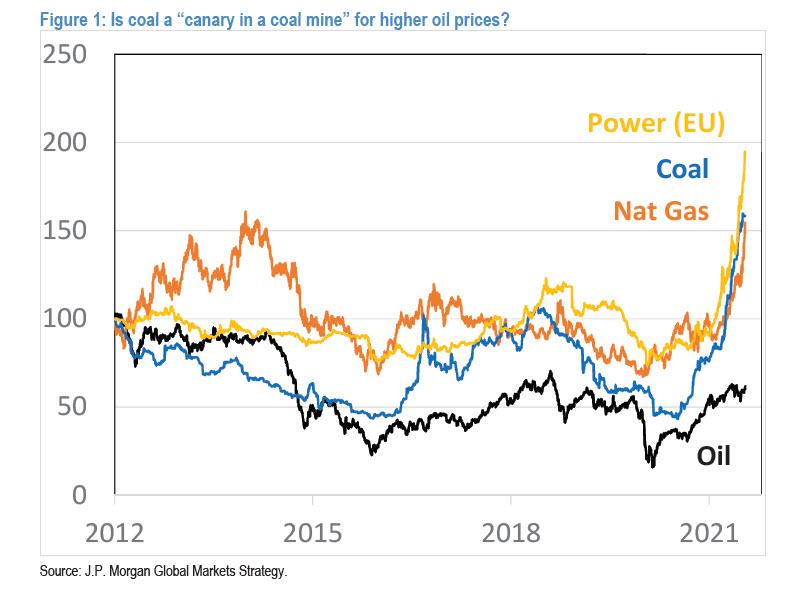
Finally, when looking at relative asset prices, Kolanovic claims that while oil is currently cheap relative to other assets “this is not the case with other forms of energy such as LNG, coal, natural gas, electricity, and uranium, which are all at or near all-time highs.” The JPM strategist believes that the evolution of coal prices might reflect supply, demand, cost of capital and energy transitioning issues for all fossil fuels, and as such, it would certainly be possible that oil prices will follow the same pattern (inflation adjusted for oil, that would be in a $150-200/bbl range).

And, in a faint glimpse of the old Kolanovic who looked at the future with great skepticism, the Croat then says that “the risk is that coal is a proverbial “canary in a coal mine” for the much more important commodity oil (figure below). Laws of physics (law of conservation of energy) would indicate that various forms of energy are interchangeable, as we are seeing currently with some oil for gas substitution, or firing up of coal plants above certain thresholds of electricity prices, private power generation, etc.”

Arguing that energy substitution is what really matters (even if once again energy analysts would have a field day with this “assumption”), and saying that “the linkage between various sources of energy has been true in financial markets as well, and historically energy assets have been correlated (averaging about 20-30% correlation of price returns)” the quant concludes that since oil is likely set to soar, “investors should consider hedging for higher oil prices, which can be expressed in asset class (long commodities, short bonds), sector (long energy), style (long value, short growth) or thematic form.”

His conclusion: “the most likely outcome of the current energy crisis is increased production at significantly higher energy prices, which would stabilize the global economy and energy infrastructure, but also temporarily slow down the energy transition.”

Tyler Durden
Wed, 10/06/2021 – 12:40

via ZeroHedge News https://ift.tt/3mw7vil Tyler Durden

The “Trillion Dollar Coin” Is Illegal

The “Trillion Dollar Coin” Is Illegal

Via PrestonByrne.com,

Much has been made lately of the possibility of minting a trillion dollar coin to avoid Congressional gridlock surrounding the increase of the debt ceiling.

To be blunt, this claim is horse puckey and pseudo-legal in nature.

Below I explain why…

The statute doesn’t authorize a trillion dollar coin

Congress grants authority to the Executive Branch all the time to do certain acts and promulgate certain regulations. It does this through Acts of Congress which delegate that authority to the Executive Branch.

Understanding what authority is granted, and its extent, requires us to read carefully the terms – the text – of the legal rules which govern the conduct of the Executive Branch. For example, in 2020-2021 the U.S. Centers for Disease Control and Prevention, or CDC, instituted an eviction moratorium which barred landlords of property subject to federally insured mortgages from evicting their tenants. It did so in reliance of a grant of authority from Congress.

As statutory authority for the moratorium, the CDC relied exclusively on Section 361 of the Public Health Service Act. See id. at 55,297. Enacted in 1944, this provision delegates to the Secretary of Health and Human Services the authority to “make and enforce such regulations as in his judgment are necessary to prevent the introduction, transmission, or spread of communicable diseases” across States or from foreign lands, 42 U.S.C. § 264(a), who in turn has delegated this power to the CDC, 42 C.F.R. § 70.2.

Section 361 reads in relevant part:

The Surgeon General, with the approval of the Secretary, is authorized to make and enforce such regulations as in his judgment are necessary to prevent the introduction, transmission, or spread of communicable diseases from foreign countries into the States or possessions, or from one State or possession into any other State or possession. For purposes of carrying out and enforcing such regulations, the Surgeon General may provide for such inspection, fumigation, disinfection, sanitation, pest extermination, destruction of animals or articles found to be so infected or contaminated as to be sources of dangerous infection to human beings, and other measures, as in his judgment may be necessary.

In a similar way, Congress also delegates authority to the Secretary of the Treasury to mint coins. The relevant provision for the “Mint the Coin” movement is sub-section (k) of 31 U.S. Code § 5112, which states in relevant part:

The Secretary may mint and issue platinum bullion coins and proof platinum coins in accordance with such specifications, designs, varieties, quantities, denominations, and inscriptions as the Secretary, in the Secretary’s discretion, may prescribe from time to time.

A number of adherents of an expansionary monetary ideology called “Modern Monetary Theory,” or “MMT,” and some of their friends in the media, including a pet legal academic of the movement who wrote a 75-page paper on the subject, appear to think that this statute authorizes the Treasury to mint a $1 trillion coin.

On a very cursory reading it certainly seems possible that this statute could authorize minting a $1 trillion coin, as long as the coin were a platinum proof coin. If this were the case, the Treasury could then sell to a prospective buyer and book the profits as general revenue, as indeed the Treasury does for all manner of proof coins and bullion that it issues and sells directly to the public on a regular basis.

Words have meaning, though, and I suspect the MMT crowd reading 5112(k) simply isn’t reading it carefully enough. This means that if someone “Minted the Coin” and that act were challenged, I don’t think a court would agree with them.

Let’s bounce back to Alabama Ass’n of Realtors (the CDC case) government claims of sweeping authority. In that case the CDC sought to argue that the language authorizing the Surgeon General to “make and enforce such regulations” as were necessary for the prevention of disease to authorize a nationwide eviction moratorium.

The District Court (with which the Supreme Court eventually agreed) found for the plaintiffs. Applying Chevron deference, the court first asked whether Congress had “spoken directly to the precise question at issue” – i.e., does the law in dispute do what the government says it does.

The Court found that it did not. The use of a list which governed the scope of the regulation the statute permitted – “inspection, fumigation, disinfection, destruction… and other measures” – limited the “other measures” that were allowable: such measures were “controlled and defined by reference to the enumerated categories before it,” an application of the so-called ejusdem generis canon of textual construction. The court therefore held that “[t]hese ‘other measures’ must therefore be similar in nature to those listed’”.

Put another way, the court looked to the actual text of the law and found that “[t]he national moratorium satsifies none of these textual limitations. Plainly, imposing a moratorium on evictions is different in nature” than inspections, fumigations, disinfections, etc.; and “[m]oreover, interpreting the term ‘articles’ to include eviction would stretch the term beyond its plain meaning.”

The second Chevron step is for the court to decide whether the agency’s interpretation of the statute is permissible. The CDC argued – as the “Mint the Coiners” do – that

“the grant of rulemaking authority…. is not limited in any way by the specific measures… Congress granted the Secretary the ‘broad authority to make and enforce’ any regulations that ‘in his judgment are necessary to prevent the spread of disease.’”

The court disagreed because, among other things,”[a]n overly expansive reading…that extends a nearly unlimited grant of legislative power to the Secretary would raise serious constitutional concerns,” and further that “courts ‘expect Congress to speak clearly if it wishes to assign to an agency decisions of vast ‘economic and political significance[.]”

Put another way, the doctrine that “Congress does not hide elephants in mouseholes.”

The Court concluded:

Accepting the Department’s expansive interpretation of the Act would mean that Congress delegated to the Secretary the authority to resolve not only this important question, but endless others that are also subject to “earnest and profound debate across the country.” Gonzales, 546 U.S. at 267 (internal quotation marks omitted). Under its reading, so long as the Secretary can make a determination that a given measure is “necessary” to combat the interstate or international spread of disease, there is no limit to the reach of his authority.

“Congress could not have intended to delegate” such extraordinary power “to an agency in so cryptic a fashion.” Brown & Williamson Tobacco Corp., 529 U.S. at 159. To be sure, COVID-19 is a novel disease that poses unique and substantial public health challenges, see Def.’s Cross-Mot. at 14, but the Court is “confident that the enacting Congress did not intend to grow such a large elephant in such a small mousehole.”

So as we we can see, even where the plain language of a law would appear to authorize the nearly unlimited exercise of power, the claim of unlimited power invites us to take – as the courts would take – a closer look.

This brings us to the question of what might happen if the Secretary of the Treasury decided to read Section 5112(k), the Platinum Coin rule, as granting a similarly broad authority to mint a $1 trillion coin, as the “Mint the Coin” crowd claims it does.

How that would end is anybody’s guess, but we can have some idea about how it would play out. First, a radical Treasury Secretary, likely with the support of a radical President, would decide that it’s no longer worth his or her time to deal with an uncooperative Congress on a debt ceiling increase. Then, the Secretary, listening to some MMT-schooled special advisers in the new administration, would mint the coin and dare someone with standing – whomever that might be – to sue.

Pleadings would follow, in which the government would get cute like the CDC did in Alabama Association of Realtors. In the meantime, the challenger would argue:

  1. 5112(k) is a law which enables the Mint to mint and sell two types, and two types only, of platinum curios: “platinum bullion” and “proof platinum” coins.

  2. Trillion dollar coiners’ legal argument is that they believe 5112(k) allows them to mint, and circulateproof coins to redeem U.S. outstanding debt.

  3. The statute does not define “proof platinum” so we have to go with the term’s plain and ordinary meaning. The dictionary definition of “proof coin” in Merriam-Webster and the OED – means a collectible, a decorative thing, means a “coin not intended for circulation but struck from a new, highly-polished die on a polished planchet and sometimes in a metal different from a coin of identical denomination struck for circulation.” In the OED it means “special coins struck from highly polished dies mainly for collectors“, with one definition dating to 1949 pointing out that “Proof coins were never struck for circulation… Proofs were first used as presentation pieces.”

  4. There is a definition of “proof coin” in 31 CFR § 92.3, but it isn’t expressed to govern the interpretation of Section 5112(k).

  5. Applying the plain and ordinary meaning of “proof coin” to the statute, 5112(k) does not authorize the issuance of proof coins for circulation, even if it such coins are made of 100% pure platinum (although if valued by weight they could be sold as “bullion” – more on that below). The use of the term “Proof Coin” requires for proof coins to be sold with the intent of being curios or collectibles, not circulating currency.

  6. “Circulation” means, in relation to currency, “the passing of something, such as money or news, from place to place or person to person.”

  7. The Trillion Dollar Coin is clearly made with the intent of being placed into circulation, even if that circulation is initially very limited (to the Fed). It, or its series, is also not made with the intent of being produced mainly for collectors, if we want to use the English dictionary instead of the American one. There is nothing preventing the Fed from selling it to someone else for $1 trillion, and so on, in the same manner as any other coinage. This is especially the case if the money bears the inscription “this money is legal tender for all debts public and private,” as some prominent MMT promoters claim it should. To describe the “Trillion Dollar Coin” as a proof coin, to borrow from Alabama Ass’n of Realtors, would be to “stretch the meaning” of “proof coin” beyond recognition.

  8. Using two of the most authoritative plain language definitions of “proof coin,” the Trillion Dollar Coin cannot be described as a “proof coin.” Therefore its production as a proof coin is not authorized by 5112(k).

  9. Additionally, even if the Trillion Dollar Coin could be described as a “proof coin” (and, to be clear, it cannot, at least if two of the leading English-language dictionaries are to be relied upon), the fact that Trillion Dollar Coiners seem to think that the power is infinite – quadrillion, quintillion, whatever-illion are all in play, they claim – is problematic. Congress does not hide elephants in mouseholes, much as was the case with the CDC and the Public Health Act. If we look at the fullness of 5112(k) (enacted in 1996) and go through the Chevron two-step, it’s clear that Congress was authorizing the Mint to produce collectibles, and not authorizing the Treasury Secretary to assume wholesale control of U.S. fiscal and monetary policy, or create unlimited money for the government’s use in such a way as to arrogate to itself the power to singlehandedly resolve “earnest and profound debate across the country” over the statutory debt limit.

A reader asks:

On the subject of bullion: as I mentioned above, 5112(k) authorizes the manufacture and sale of two types of collectible – “platinum bullion” and “platinum proof.” Because the statute does not give us a definition of “platinum bullion,” we have to take the term at its plain and ordinary meaning. As a result, the “platinum bullion” language in 5112(k) isn’t readily cooperative with MMT funny business, which is why the MMT crowd’s argument is that the trillion dollar coin they want to strike is to be a platinum proof.

There are alternative price-setting regulations for gold bullion. MMT people think that these other regulations permit platinum bullion to be given a face value higher than the price of the metal used in the coin.

They are wrong.

The issue is that the regulations governing the sale of gold bullion aren’t expressed to apply to platinum bullion under 5112(k). They do not provide a definition of “bullion” for the purposes of 5112(k). .Indeed, they don’t define “bullion” at all – they just regulate its manner of sale, if it’s gold.

We are not entitled to read these provisions as saying things that they do not say. Absent a statutory definition of “platinum bullion” we must fall back to plain language. Bullion’s dictionary definition is “[precious metals] in bulk before coining, or valued by weight [after coining].” If the Mint could rustle up $1 trillion in platinum 5112(k) authorizes it to issue a (very large) $1 trillion coin, or more likely lots of smaller-denomination platinum coins. If it’s not valued by weight, and not substantially made up of platinum, I submit that it cannot be platinum “bullion” and would not be authorized by the “platinum bullion” language in Section 5112(k).

Moving away from “platinum bullion,” and before wrapping up the discussion of “platinum proof”I note, before MMT fanbois chime in that Rohan Grey’s paper on this subject refers to a “circulation critique,” that this critique does not apply to this conclusion as his argument pertains to Section 5136 whereas my objection says that the Trillion Dollar Coiners are simply misreading Section 5112(k) without regard to any other statutory provision.

MMT proponents contend the platinum coin statute’s grant of authority is essentially unlimited:

This view is incorrect and, in any case, logically inconsistent. If we want to put 5112(k) in its wider cultural context, the so-called intentionalist approach, then we get to talk about what Congress meant when they drafted Section 5112(k) – and it’s clear Congress didn’t intend to grant the Treasury a power to mint a trillion-dollar-coin.

This is why folks like the MMTers point to, and rely upon, the plain language of the text, a literal reading which yields (in my view an absurd) result. That invites us, as it would invite a court going through the Chevron two-step, to ask whether the plain language grants the power claimed.

Lib law profs like Larry Tribe have cut corners on this analysis and reached the same conclusion as the MMT crowd:

Using the statute this way doesn’t entail exploiting a loophole; it entails just reading the plain language that Congress used. The statute clearly does authorize the issuance of trillion-dollar coins.

As we know, this view is wrong. The statute does not authorize the Treasury Secretary to have the Mint strike any or all coins. It authorizes the Treasury Secretary to strike bullion coins and proof coins, a necessarily narrower definition which, per the inclusio unius canon of statutory construction, necessarily excludes any coin which is not bullion or a proof coin from its scope.

Conclusion: the Trillion Dollar Coin, being neither “bullion” nor a “proof,” cannot be lawfully made

In order for a trillion dollar coin to be lawfully struck under the power granted in 5112(k), it must either be bullion (i.e., contain $1 trillion of platinum) or it must be a proof coin. MMT shitcoiners’ proposal requires a “proof coin” in order to work (and if they had $1 trillion in platinum to spare they would have long since sold it to pay for state expenditures).

But as we have seen, just as not all that glitters is gold, not every coin is a proof coin. MMT types are not free to supply “proof coin” with whatever meaning they want. That is the mistake the MMT crowd has made for seven years on the trot in (mis)reading 5112(k), and which they continue to make today.

Since 5112(k) doesn’t supply a definition of “proof coin,” we have to look to the plain and ordinary meaning of “proof coin” – as found in a dictionary – to provide that limiting definition, the thing that tells us what makes a proof coin different from any other coin used as money. The definition we find there – “never struck for circulation” and made for collectors in the OED, “not intended for circulation” in Merriam-Webster – tells us that Section 5112(k) authorizes the creation of a collectible which will not enter into circulation. This expressly contradicts the “Mint the Coin” plan, which requires, and therefore intends, circulation, and is not made to pass into the hands of collectors but is made as a fiscal policy trump card.

Long story short: a shiny object made with the intent of being a Trillion Dollar Coin is, definitionally, not a “proof coin.” If it’s not a proof coin (as it needs to be for the MMT crowd’s legal argument to work), 5112(k) doesn’t give the Treasury Secretary legal authority to mint it as a proof coin in platinum and sell it for $1, let alone $1 trillion.

The doctrine of absurdity

There is also a canon of statutory construction which in England we call the Golden Rule and in America they call the “Doctrine of Absurdity.” Generally stated, the Doctrine of Absurdity holds that when interpreting a statute, it is to be given its plain and ordinary meaning unless the meaning of the statute would be absurd.

The American formulation of that rule takes the following form:

The principle sought to be applied is that followed by this court in Holy Trinity Church v. United States, 143 U. S. 45712 S. Ct. 511, 36 L. Ed. 226; but a consideration of what is there said will disclose that the principle is to be applied to override the literal terms of a statute only under rare and exceptional circumstances. The illustrative cases cited in the opinion demonstrate that, to justify a departure from the letter of the law upon that ground, the absurdity must be so gross as to shock the general moral or common sense.

To that end, I asked the MintTheCoiners what limits, if any, they placed on the power of the Treasury Secretary here – could he or she mint a quadrillion dollar coin, quintillion dollar coin, sextillion dollar coin under 5112(k)?

Not realizing I was teeing their responses up for this blog post, they responded. Rohan Grey, a first year contracts lecturer at Willamette Law, said he thought they could:

The absurdity doctrine is generally disfavored by U.S. courts. It takes a fairly extreme example to trip it and the Supreme Court has only dealt with the matter a handful of times. Quite apart from the textual analysis we saw in the Alabama Ass’n of Realtors to one outrageous example of government overreach, which gives us some hints as to how a well-informed district judge might approach the MintTheCoiners’ textual arguments and claims of sweeping authority, I submit that claiming “proof coins” – keeping in mind this term means they are not for circulation – to justify the implementation of an MMT policy with seemingly no limitation, infinite money, which expressly places new money into circulation (a) fails for textual grounds, (b) shocks the conscience and (c) is, in every conceivable way, thus an absurd interpretation of a statute designed to authorize the manufacture and sale of numismatic curios.

At the end of the day, “MINT THE COIN!” strikes me as bad, pseudo-legal analysis of a law which very clearly does not authorize “minting the coin” – at least, if we don’t stretch the meaning of “proof coin” beyond recognition. Fortunately the matter also appears to be moot, as it seems Congress will be raising the debt limit and we can safely ignore “minting the coin” – at least for now. The danger behind this idea, however, is that one day we will be faced with an administration more stacked with Marxist radicals than the current one, who will have few qualms at sweeping Congress aside to carry out their own policy agendas.

The danger there is not loss in the courts, but rather what will happen between the time that the coin is minted and a final judgment is entered in a challenger’s favor. When trillions of dollars and the full faith and credit of the United States are on the line, a Mint-the-Coiner could simply mint $trillions to fund its operations or redeem Treasuries and then dare the courts to unwind the transaction – forcing a default – after the fact. Even if the Executive Branch should lose, it could put the courts in an impossible dilemma where restoring constitutional order would force a default.

That – the act of norm- and constitution-breaking unilateral executive action – must be forestalled as a matter of urgency. As soon as Republicans reclaim power they must introduce legislation to amend Section 5112(k) to ensure that no administration can misconstrue its meaning ever again.

[ZH: On a side note, Twitter CEO Jack Dorsey appeared to suggest that if the coin was minted, America could see Civil War…]

Tyler Durden
Wed, 10/06/2021 – 12:25

via ZeroHedge News https://ift.tt/3oE2BCA Tyler Durden

Manchin Digs In – Won’t Budge On $1.5 Trillion Top-Line, Says No To Filibuster Carve-Out For Debt Hike

Manchin Digs In – Won’t Budge On $1.5 Trillion Top-Line, Says No To Filibuster Carve-Out For Debt Hike

Sen. Joe Manchin (D-WV) said on Wednesday that his topline number on the $3.5 trillion reconciliation bill is still $1.5 trillion, dispelling rumors that he’d come up as much as $2.2 trillion.

He also reiterated his opposition to a legislative carve-out of the filibuster as a potential escape hatch from a fight over the national debt ceiling, according to The Hill.

“I’ve been very very clear where I stand on the filibuster. Nothing changes,” Manchin told reporters outside of his Senate office.

Manchin’s comments come as the idea of a “carve-out” from the legislative filibuster, which requires 60 votes for most legislation, has gained steam within the Senate Democratic caucus

Democrats discussed the idea, as well as other potential back-up plans, during a closed-door caucus lunch on Tuesday, with Sen. Dick Durbin (D-Ill.) confirming that talks were underway. 

But changing the legislative filibuster even just for a narrow carve-out on the debt ceiling was a heavy list for Senate Democrats given entrenched opposition to making changes to the 60-vote rule from Manchin and Sen. Kyrsten Sinema (D-Ariz.). -The Hill

In order to raise the debt ceiling without the filibuster carve-out, Democrats would need complete unity from their 50-member Senate caucus. 

“The filibuster has nothing to do with debt ceiling. Basically, we have other tools that we can use and if we have to use them we should use them,” Manchin said on Monday.

The West Virginia Senator suggested on Wednesday that Senate Majority Leader Chuck Schumer (D-NY) and Senate GOP Leader Mitch McConnell (R-KY) start negotiating.

“I truly implore both leaders … to engage, start working, work this out,” said Manchin, adding “We have a responsibility to be the adults… we should not have these artificial crises.”

“Please lead, lead, work together.”

Senate Democrats will hold an emergency caucus at 1pm this afternoon, according to Politico‘s Burgess Everett.

Tyler Durden
Wed, 10/06/2021 – 12:08

via ZeroHedge News https://ift.tt/3mrm3A1 Tyler Durden

Australians Being Mandated To Provide Police With Geo-Trackable Selfies To Prove They’re Quarantining

Australians Being Mandated To Provide Police With Geo-Trackable Selfies To Prove They’re Quarantining

Authored by Steve Watson via Summit News,

In a move that again highlights how far toward a complete tyranny Australia has become in the wake of COVID, citizens are being mandated to provide geo-trackable selfies to police to prove they are staying at home.

A report from 9 News in Australia details how people in Victoria are now required to respond to the authorities within 5 minutes of them randomly calling by sending a selfie of themselves at home. If they fail to respond, health goons are sent to their address to dish out punishments.

The reporter notes “Today the call has gone out to everyone in home quarantine in Victoria to take part in a pilot program. And what that means is they will receive random phone calls and they will have to answer within five minutes with a selfie sent to an app which will then geo-track where that person is and to make sure they are who they say they are as well.”

“If they don’t answer within the five minutes that’s when health ministers come knocking,” the reporter creepily adds.

Watch:

Reuters reported on the scheme earlier this month, noting that it is being trialled in “New South Wales (NSW) and Victoria, home to Sydney, Melbourne and more than half of Australia’s 25 million population.”

The technology involved uses facial recognition, but health authorities have refused to comment on the scheme.

Reuters notes that “Under the system being trialled, people respond to random check-in requests by taking a ‘selfie’ at their designated home quarantine address. If the software, which also collects location data, does not verify the image against a “facial signature”, police may follow up with a visit to the location to confirm the person’s whereabouts.”

It is something that was previously suggested for use in Britain, but was abandoned over fears of privacy invasion.

A literal government surveillance mandate.

Australia is gone.

*  *  *

Brand new merch now available! Get it at https://www.pjwshop.com/ 

In the age of mass Silicon Valley censorship It is crucial that we stay in touch. We need you to sign up for our free newsletter here. Support our sponsor – Turbo Force – a supercharged boost of clean energy without the comedown. Also, we urgently need your financial support here.

Tyler Durden
Wed, 10/06/2021 – 11:59

via ZeroHedge News https://ift.tt/2YtnLZD Tyler Durden