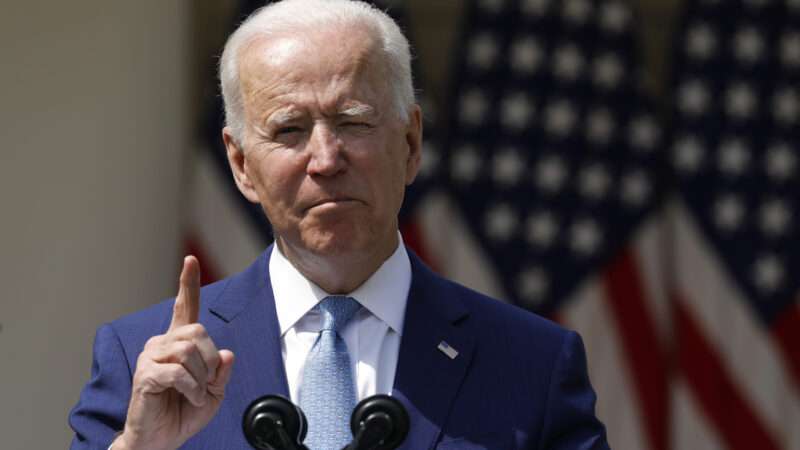
Joe Biden, Who Says He’s ‘Not a Fan of Court Packing,’ Just Created a Presidential Commission to Study Court Packing


polspphotos781507

The White House announced today that President Joe Biden will sign an executive order creating a new Presidential Commission on the Supreme Court of the United States. The group will be composed of legal activists and scholars who will “provide an analysis of the principal arguments in the contemporary public debate for and against Supreme Court reform,” according to a statement released by the White House. Among the items up for discussion by the commission are “the length of service and turnover of justices on the Court” and “the membership and size of the Court.”

The commission fulfills one of Biden’s campaign promises. “If elected,” Biden told 60 Minutes, “I’ll put together a national…bipartisan commission of scholars, constitutional scholars. Democrats, Republicans. Liberal, conservative. And I will ask them to, over 180 days, come back to me with recommendations as to how to reform the court system, because it’s getting out of whack.”

Despite many pleas from progressive activists—who would love to see Biden enlarge the Court and fill the new seats with Democratic appointees—Biden has so far refused to endorse any sort of court-packing scheme. “I’m not a fan of court packing,” Biden said on the campaign trail. “The last thing we need to do is turn the Supreme Court into just another political football, whoever’s got the most votes gets whatever they want,” he told 60 Minutes.

When President Franklin Roosevelt famously tried to pack the Supreme Court in 1937, his plan was defeated thanks in significant part to opposition from his fellow Democrats. As I recounted in my recent feature story, “Don’t Pack the Courts,” FDR’s “most effective adversaries turned out to be members of Roosevelt’s own party, such as the legendary progressive jurist Louis Brandeis, who deftly maneuvered behind the scenes to ensure the bill’s ultimate defeat. Like so many others at the time, Brandeis was frankly aghast at FDR’s blatant power grab.”

Let’s assume that Biden’s new presidential commission recommends a Roosevelt redux and endorses court packing 2.0. Will a modern-day Brandeis arise to oppose the plan from inside of the liberal coalition?

The late Ruth Bader Ginsburg might have been up for it. It “was a bad idea when President Franklin Roosevelt tried to pack the court,” Ginsburg told NPR in 2019, and it would be a bad idea now. “If anything would make the Court look partisan, it would be that—one side saying, ‘When we’re in power, we’re going to enlarge the number of judges, so we would have more people who would vote the way we want them to.'”

Justice Stephen Breyer similarly opposed court packing in a recent Harvard Law School speech, in which he urged proponents of such judicial tinkering to “think long and hard before embodying those changes in law.”

Will Biden pay heed to such voices? Will Biden himself play the Brandeis role and oppose rigging the judicial process for his own party’s benefit? It looks like we’re about to find out.

from Latest – Reason.com https://ift.tt/2PNYxkc
via IFTTT

Short Circuit: A Roundup of Recent Federal Court Decisions

Please enjoy the latest edition of Short Circuit, a weekly feature from the Institute for Justice.

Friends, Tuesday April 20 is the 150th anniversary of President Grant signing the Civil Rights Act of 1871 into law, giving the federal government powerful tools to fight the Ku Klux Klan—and giving civil rights plaintiffs a powerful tool, Section 1983, to hold state and local officials accountable for violating the Constitution. Please join us on Zoom from 12 – 2 pm ET for an event commemorating this momentous occasion and featuring scholars and litigators including Paul Finkelman, Fred Smith, Kelsi Brown Corkran, and Victor Fleitas. Register today!

  • “For the second time,” notes the D.C. Circuit, “we face the question of what to do about a Guantanamo military commission judge who, while presiding, seeks employment with an entity involved in prosecuting the detainee.” But because the government was willing to let any allegedly tainted orders be reconsidered de novo, the D.C. Circuit sees no need to weigh in; the detainee’s petition for a writ of mandamus is denied.
  • Despite the COVID-19 pandemic, the speaker of the New Hampshire House of Representatives refuses to allow members to participate in votes remotely (the previous Speaker died of COVID-19 one week after being selected at an in-person gathering). Seven House members with various medical conditions sue, alleging the policy violates the Americans with Disabilities Act. First Circuit: Quite possibly. The case is remanded for reconsideration of the plaintiffs’ motion for preliminary injunction.
  • Allegation: Suspected drug dealer flees across rooftops from Reading, Penn. police and is eventually cornered in an abandoned building. Unarmed and covered in his own blood, he dangles himself out a window. An officer punches him repeatedly in the head. He falls 10 feet and breaks his leg. Though he’s unconscious, another officer tases him. District court: Qualified immunity. Third Circuit: Not so. Remanded for trial.
  • Do you like puzzles? Then you’ll love the Fifth Circuit‘s 325-page set of en banc opinions on the lawfulness and constitutionality of the Indian Child Welfare Act, the law that regulates the placement and adoption of children born to American Indians. Some of the Act violates equal protection, some violates the anticommandeering doctrine, and some violates the Administrative Procedure Act. But, other parts do not. Want to know which parts do and don’t and why? You can only really figure that out by adding up the various votes and comparing numerous footnotes in the several opinions. However, the court helpfully includes a five-page per curiam cheat sheet to get you started.
  • Sole black member of a jury—in a case involving a Heritage Creek, Ky. police officer allegedly body-slamming a black man in because he was in the wrong place at the wrong time—reveals that the white jurors wrote off the plaintiff as a crack addict and referred to his lawyers as “the Cosby Show.” Sixth Circuit: Courts generally cannot consider evidence of jury deliberations, but the Supreme Court has made an exception for evidence of racial bias. Today, we hold that exception applies to civil as well as criminal trials.
  • South Dakota man spends 10 years in prison for vehicular homicide after he rolls his Corvette, killing the passenger. Whoops! Witnesses later confirm that he was the passenger and the dead woman was the driver. He’s released and sues, alleging that the reckless investigation by the trooper who found him violated his constitutional rights. Eighth Circuit: The trooper found the victim on the passenger side of the car and the plaintiff outside the car near the open driver-side door, and the witnesses didn’t come forward until years later. It’s hard luck, but it doesn’t shock the conscience.
  • Lee County, Iowa officer who is transporting a handcuffed and shackled but not seatbelted prisoner in his cruiser responds to bank robbery in progress. Prisoner: The officer drove through a rutted, unmaintained lot, tossing me around violently and causing injuries to my neck and back. Officer: I was only going 20 to 25 mph, though I did turn abruptly when the robber fired at the cruiser. District court: A jury should sort this out. Eighth Circuit: Reversed. The officer may have been negligent, but negligence isn’t enough to impose liability here.
  • Can a grocery store be held liable under the ADA because its website is not accessible to the visually impaired? Eleventh Circuit: Nope. A website is not itself a place of public accommodation under the ADA, and the website’s limited functionality does not prevent visually impaired customers from visiting the physical store. While the Ninth Circuit reached a contrary decision in a case involving a pizza chain, that case was distinct because customers could order pizza on the website. Dissent: Even if customers couldn’t buy anything on the website, they could use it to refill prescriptions and access coupons. As stores make increasing use of the internet, they need to make their websites accessible to the visually impaired.
  • Two Tallahassee police officers kill armed suspects in separate encounters. Can the city publicly identify the cops? Florida appellate court: No. The suspects threatened the cops’ lives, thus victimizing them, so the cops are entitled to Florida constitutional protections that allow crime victims to remain anonymous.
  • There’s a lot to untangle in this Kansas Supreme Court decision about statutory rape between two underage teens. But the takeaway is we can all rest assured that Clay County, Kan. officials are committed—really, really committed—to prosecuting a 14-year-old girl for having sex with a 14-year-old boy (who was older than her by several months).
  • And in en banc news, the Ninth Circuit has amended but will not reconsider its decision enjoining in all states along the southern border the Trump Administration’s rule requiring asylum seekers to first apply for, and be denied, asylum in a country they had to travel through to get to the southern border.

Elizabeth Brokamp is a licensed, certified, and very experienced counselor who has been providing therapy over the internet to clients from her home in the Virginia suburbs of Washington D.C. throughout the pandemic. One of her clients moved to New York, however, which bars out-of-state counselors from providing teletherapy. Though the state has temporarily waived its ban, it will soon become illegal for Elizabeth to continue. Interestingly, if she had no qualifications whatsoever, New York would allow her to work as an unlicensed “life coach.” But precisely because of her extensive training, her speech is verboten. That’s an irrational and unconstitutional restriction on Elizabeth’s First Amendment rights, so this week she joined with IJ to sue New York. Click here to read more. (Elizabeth is also challenging a similar restriction in D.C. that bars her from taking on new clients.)

from Latest – Reason.com https://ift.tt/3d3NfBi
via IFTTT

Electric Silverado Joins GM’s EV Lineup

Electric Silverado Joins GM’s EV Lineup

Submitted by Market Crumbs,

Just a few months after unveiling an all-electric version of its popular Hummer, General Motors announced this week that it will introduce an electric version of its Silverado pickup truck.

The Chevrolet Silverado electric full-size pickup will be built on GM”s Ultium Platform as GM estimates it will provide a range of more than 400 miles on a full charge. GM added the electric Silverado will be available in both retail and fleet versions but declined to say when production will begin or when it will go on sale.

“The vehicles coming from Factory ZERO will change the world, and how the world views electric vehicles,” GM President Mark Reuss said.

“The GMC HUMMER EV SUV joins its stablemate in the realm of true supertrucks, and Chevrolet will take everything Chevy’s loyal truck buyers love about Silverado — and more — and put it into an electric pickup that will delight retail and commercial customers alike.”

The electric Silverado will be built at GM’s new 4.5 million square foot Factory ZERO assembly plant in Detroit and Hamtramck, Michigan alongside the GMC HUMMER EV pickup and the Cruise Origin. GM has committed $2.2 billion to renovate and retool Factory ZERO, the largest for a manufacturing facility in its history.

An electric Silverado is just the latest move by GM to reach its goal of delivering more than 1 million electric vehicles globally by 2025. GM says vehicle development time has been reduced by almost 50% to 26 months thanks to its Ultium Platform, virtual development tools and technology.

Investors approve the moves by GM to embrace a future with electric vehicles as shares continue to make new all-time highs on an almost daily basis.

Tyler Durden
Fri, 04/09/2021 – 15:40

via ZeroHedge News https://ift.tt/3d3cmE9 Tyler Durden

BlackRock, State Street Exploring Takeover Of Credit Suisse Asset Management Arm

BlackRock, State Street Exploring Takeover Of Credit Suisse Asset Management Arm

Earlier, several financial media outlets reported that Credit Suisse was considering dramatically shrinking or selling off its prime brokerage unit, the hedge-fund-focused business that just lost $4.7 billion for the bank, obliterating 18 months of the bank’s average net profits.

But in the last few hours, the focus has shifted to the bank’s asset management unit, amid reports that several American firms might be interested in making a bid, even as the bank has yet to release the final tally of expected losses from the Greensill debacle.

With Credit Suisse stock trading at its lowest level in months after a 25% drop, some apparently see an opportunity for a deal. According to Reuters, a SPAC has partnered with BlackRock to hash out the possibility of making a bid to spin out Credit Suisse’s asset management business, where the busted Greensill-stocked trade finance funds were based.

And they’re not the only bidders. BlackRock rival State Street is also reportedly weighing a bid.

BlackRock and Jean-Pierre Mustier’s blank-check firm are among investors expressing interest in Credit Suisse’s asset management arm, three sources told Reuters, as the Swiss lender explores options for the unit after a run of costly scandals.

U.S. investment firm State Street Corp is also eyeing a rival bid for all or part of the Swiss bank’s fund management business, while European asset managers including Germany’s DWS are waiting in the wings, the sources said, speaking on condition of anonymity.

Former UniCredit boss Mustier’s blank-check firm Pegasus Europe, which focuses on financial services investments, is due to list in Amsterdam between the end of April and early May, two sources said.

A spokeswoman for Credit Suisse said the bank had no plans to sell all or any parts of its asset management business. BlackRock, State Street, DWS and Pegasus Europe all declined to comment.

The sources said Credit Suisse is in the early stages of a strategic review of its asset management arm and has yet to entertain in-depth discussions with interested parties.

The bank will need to wait for former Lloyds boss Antonio Horta-Osorio to take over as chairman in May before any decision on whether to sell or spin off the unit can be taken, the sources said, cautioning no deal was certain. Credit Suisse in March announced an overhaul of the asset management unit amid the fallout from the Greensill debacle, bringing in former UBS executive Ulrich Koerner to lead the unit and separating it from international wealth management.

As Bloomberg reported in a piece published Friday, Horta-Osorio has a few possible strategies that he can embrace as he leads the turnaround of the bank. They include: a housecleaning that shrinks the Credit Suisse balance sheet and reduces capital allocated to the investment bank, selling parts of the business to deepen its focus on wealth management and rebuild capital (though that would probably be better served by selling the prime brokerage business, not the asset management arm), acquiescing to an acquirer (Barclays? Deutsche Bank?). Or simply merging with UBS.

Tyler Durden
Fri, 04/09/2021 – 15:20

via ZeroHedge News https://ift.tt/3dNVGjf Tyler Durden

Peter Schiff: Inflation Is A Painful Tax

Peter Schiff: Inflation Is A Painful Tax

Via SchiffGold.com,

We’re told inflation isn’t a problem. But a quick trip out to the grocery store or to fill up your car with gas tells you otherwise. Prices are going up. Peter Schiff recently appeared on Tucker Carlson’s show to talk about inflation. He said the price of everything is going up and the value of everything is going down.

It’s clear that prices are rising. Peter said it’s going to get even worse.

You have to remember that inflation really is nothing more than a tax. Now, when the government spends money, they need to get money. The public has to pay for it. Normally, the government would raise taxes, and then the taxpayers send money to the government, the government spends it.  But we just passed a $1.9 trillion stimulus bill. Nobody’s taxes got raised. But we don’t get all this government for free.

So, how is the government paying for this massive stimulus spending?

The Federal Reserve prints the money and then the government spends it into circulation. But when that happens, the value of all the money that’s already out there goes down and now the price of everything that you want to buy goes up. And that added price is basically the inflation tax.

The Federal Reserve is printing money at an unprecedented rate. We’ve had 11 straight months of historically high money creation. The money supply expanded at a record rate yet again in February.

Tucker pointed out that this seems intentional – that the government is trying to pay for all of the spending  – making it less costly by devaluing the dollar. Peter agreed.

Well certainly, as you have inflation, you reduce the real value of the debt.”

But Peter said the government has no plan to pay off the debt. And the real problem is the amount of money they are going to have to spend just to finance all their current commitments.

This is a massive amount of money printing. It’s unprecedented inflation because it’s the money supply that is being inflated. And as a result, everything costs more, because we’re not producing more. It’s actually the opposite. Americans are at home. They’re not producing goods and services. Yet, we’re creating more money to buy the goods and services that fewer people are producing. More money, fewer goods. Prices are just going to keep going up and it’s not going to stop.”

Tucker pointed out that this looks pretty crazy from an outsider’s perspective. Peter said he doesn’t know how it looks to an outsider.

But I think to everybody that lives in the United States, it’s not going to look pretty. And the real problem is the Fed. The Fed pretends that it’s transitory. But when they have to admit that it’s not transitory the inflation rate will be far too high for the Fed to do anything about it. Because if the Fed actually raises rates to fight inflation, they’ll create a much bigger financial crisis than 2008 and the US government will be forced into insolvency.”

Tyler Durden
Fri, 04/09/2021 – 15:05

via ZeroHedge News https://ift.tt/3d3I0l6 Tyler Durden

Joe Biden, Who Says He’s ‘Not a Fan of Court Packing,’ Just Created a Presidential Commission to Study Court Packing


polspphotos781507

The White House announced today that President Joe Biden will sign an executive order creating a new Presidential Commission on the Supreme Court of the United States. The group will be composed of legal activists and scholars who will “provide an analysis of the principal arguments in the contemporary public debate for and against Supreme Court reform,” according to a statement released by the White House. Among the items up for discussion by the commission are “the length of service and turnover of justices on the Court” and “the membership and size of the Court.”

The commission fulfills one of Biden’s campaign promises. “If elected,” Biden told 60 Minutes, “I’ll put together a national…bipartisan commission of scholars, constitutional scholars. Democrats, Republicans. Liberal, conservative. And I will ask them to, over 180 days, come back to me with recommendations as to how to reform the court system, because it’s getting out of whack.”

Despite many pleas from progressive activists—who would love to see Biden enlarge the Court and fill the new seats with Democratic appointees—Biden has so far refused to endorse any sort of court-packing scheme. “I’m not a fan of court packing,” Biden said on the campaign trail. “The last thing we need to do is turn the Supreme Court into just another political football, whoever’s got the most votes gets whatever they want,” he told 60 Minutes.

When President Franklin Roosevelt famously tried to pack the Supreme Court in 1937, his plan was defeated thanks in significant part to opposition from his fellow Democrats. As I recounted in my recent feature story, “Don’t Pack the Courts,” FDR’s “most effective adversaries turned out to be members of Roosevelt’s own party, such as the legendary progressive jurist Louis Brandeis, who deftly maneuvered behind the scenes to ensure the bill’s ultimate defeat. Like so many others at the time, Brandeis was frankly aghast at FDR’s blatant power grab.”

Let’s assume that Biden’s new presidential commission recommends a Roosevelt redux and endorses court packing 2.0. Will a modern-day Brandeis arise to oppose the plan from inside of the liberal coalition?

The late Ruth Bader Ginsburg might have been up for it. It “was a bad idea when President Franklin Roosevelt tried to pack the court,” Ginsburg told NPR in 2019, and it would be a bad idea now. “If anything would make the Court look partisan, it would be that—one side saying, ‘When we’re in power, we’re going to enlarge the number of judges, so we would have more people who would vote the way we want them to.'”

Justice Stephen Breyer similarly opposed court packing in a recent Harvard Law School speech, in which he urged proponents of such judicial tinkering to “think long and hard before embodying those changes in law.”

Will Biden pay heed to such voices? Will Biden himself play the Brandeis role and oppose rigging the judicial process for his own party’s benefit? It looks like we’re about to find out.

from Latest – Reason.com https://ift.tt/2PNYxkc
via IFTTT

Biden’s $1.5 Trillion Budget Request Would Fund All Nails Needed for the Coffin of Fiscal Restraint


reason-helicopter

Despite the record amounts of money the federal government has spent over the last year responding to the pandemic—and the record deficits it’s racked up in the process—the Biden administration continues to ask for trillions more.

Today, the White House released its first budget request. It has asked Congress to approve a $1.52 trillion budget, including $769 billion in non-defense discretionary spending (a 16 percent increase over fiscal year 2021) and $753 billion in defense spending (a 1.7 percent increase).

That would represent an overall 8.4 percent increase in federal spending from last year, when excluding the recent $1.9 trillion pandemic relief bill that Biden signed in March, reports Bloomberg. Today’s budget request also comes in addition to the $2.3 trillion American Jobs Plan that Biden unveiled last week.

Taken together, this represents a massive fiscal expansion of the federal government and one that comes at a time of ballooning deficits.

The feds ran a budget deficit of $1.7 trillion in the first six months of fiscal year 2021 (which runs from October 2020 through September 2021), reported the Congressional Budget Office (CBO) yesterday.

That’s a $1 trillion increase from the same period last year and was driven almost entirely by additional pandemic spending on things like unemployment benefits, small business aid, and refundable tax credits, writes the CBO.

The budget deficit for the first six months of fiscal year 2019—which predates our pandemic spending splurge—was $693 billion.

Like his past spending proposals, Biden’s budget request includes huge funding boosts for federal agencies. The Associated Press reports he’s asking for a 41 percent boost in Education Department funding, and a 23 percent increase in spending on the Department of Health and Human Services. The government’s climate change efforts would get a $14 billion bump, while appropriations for the Department of Housing and Urban Development would jump 15 percent.

It’s hardly surprising that a Democratic administration would want to spend more money on health, education, and housing. The sheer size of Biden’s proposed budget, however, is galling.

The Wall Street Journal’s Greg Ip sees in the president’s budget requests a new left-wing “Bidenomics” that has no patience for traditional concerns about budget deficits, inflation, or fears that government spending will crowd out private investment.

“Bidenomics is more a political movement than a school of economic thought,” writes Ip, saying that Biden and the Democratic Party’s left-wing base see massive federal spending as a tool “to reshape the economy and society for years to come.”

“The problem with economic policies subordinated to political imperatives is that they have no limiting principle: if $3 trillion in stimulus is OK, why not $6 trillion? If a $15 minimum wage is harmless, why not $30?” he adds.

Or as Reason‘s Peter Suderman wrote just yesterday: “Biden seems to believe that bigger government is definitionally better government, almost independent of the policy specifics, so he’s pushing for bigger government just about any way he can.”

An $800 billion stimulus bill passed to combat the Great Recession sparked the Tea Party. Today, even the reaction to Biden’s $2 trillion American Jobs Plan is far more muted.  Sizable majorities of voters support individual spending items in it in recent polls.

White House budget requests are political documents, and this will kick off months of negotiations. The topline $1.5 trillion figure could shrink somewhat.

But these are still dark days for anyone worried about the effects of endlessly increasing deficits, or the distortionary effects of creeping federal interventions into every market and corner of American life.

from Latest – Reason.com https://ift.tt/39YtBET
via IFTTT

Tesla Solar Panel System “Explodes”: Customer Claims 

Tesla Solar Panel System “Explodes”: Customer Claims 

Tesla solar panels have become a nightmare for some businesses and homeowners over the years. Readers may recall one of the biggest Tesla solar roof panel scandals was in 2019 when Walmart sued Tesla over roof fires. 

There have been multiple reports Tesla didn’t properly maintain the panels in states from Maryland to Arizona. In one instance, Briana Greer, a homeowner in Colorado, had her roof catch on fire in 2019 after leasing SolarCity panels, now owned by Tesla. Greer is not the only one, and other customers with Tesla panels have caught fire too.

In the latest installment of Tesla solar systems catching on fire, the Twitter user “EcoSocYogi” claims her “Tesla inverter exploded.” 

“This is our Tesla inverter after it exploded. Apparently, we’re lucky your house didn’t burn down. The Tesla online forms are filled with people who solar systems do not work,” she tweeted. 

EcoSocYogi said, “Our system was installed in 2013 by SolarCity which is now Tesla. If they had been here six months ago when I made the original complaint, this wouldn’t have happened. Also, when you call, hold times are over an hour.”

She said the maintenance crew who showed up said the solar panels had “water damaged and were shorting out,” adding that “they had never seen anything like this as well. It all began with a very loud clicking sound.” 

The fire was contained in the metal inverter box. She was able to shut the system down before “it escaped the box.” 

Greer, whose Tesla solar panels caught fire a few years back, told Bussiness Insider that Tesla “purposely kept a lot of people in the dark.”

Like in EcoSocYogi’s case, could older Tesla/SolarCity solar systems be ticking timebomb fire hazards? 

Tyler Durden
Fri, 04/09/2021 – 14:50

via ZeroHedge News https://ift.tt/3wR5GkL Tyler Durden

Biden’s $1.5 Trillion Budget Request Would Fund All Nails Needed for the Coffin of Fiscal Restraint


reason-helicopter

Despite the record amounts of money the federal government has spent over the last year responding to the pandemic—and the record deficits it’s racked up in the process—the Biden administration continues to ask for trillions more.

Today, the White House released its first budget request. It has asked Congress to approve a $1.52 trillion budget, including $769 billion in non-defense discretionary spending (a 16 percent increase over fiscal year 2021) and $753 billion in defense spending (a 1.7 percent increase).

That would represent an overall 8.4 percent increase in federal spending from last year, when excluding the recent $1.9 trillion pandemic relief bill that Biden signed in March, reports Bloomberg. Today’s budget request also comes in addition to the $2.3 trillion American Jobs Plan that Biden unveiled last week.

Taken together, this represents a massive fiscal expansion of the federal government and one that comes at a time of ballooning deficits.

The feds ran a budget deficit of $1.7 trillion in the first six months of fiscal year 2021 (which runs from October 2020 through September 2021), reported the Congressional Budget Office (CBO) yesterday.

That’s a $1 trillion increase from the same period last year and was driven almost entirely by additional pandemic spending on things like unemployment benefits, small business aid, and refundable tax credits, writes the CBO.

The budget deficit for the first six months of fiscal year 2019—which predates our pandemic spending splurge—was $693 billion.

Like his past spending proposals, Biden’s budget request includes huge funding boosts for federal agencies. The Associated Press reports he’s asking for a 41 percent boost in Education Department funding, and a 23 percent increase in spending on the Department of Health and Human Services. The government’s climate change efforts would get a $14 billion bump, while appropriations for the Department of Housing and Urban Development would jump 15 percent.

It’s hardly surprising that a Democratic administration would want to spend more money on health, education, and housing. The sheer size of Biden’s proposed budget, however, is galling.

The Wall Street Journal’s Greg Ip sees in the president’s budget requests a new left-wing “Bidenomics” that has no patience for traditional concerns about budget deficits, inflation, or fears that government spending will crowd out private investment.

“Bidenomics is more a political movement than a school of economic thought,” writes Ip, saying that Biden and the Democratic Party’s left-wing base see massive federal spending as a tool “to reshape the economy and society for years to come.”

“The problem with economic policies subordinated to political imperatives is that they have no limiting principle: if $3 trillion in stimulus is OK, why not $6 trillion? If a $15 minimum wage is harmless, why not $30?” he adds.

Or as Reason‘s Peter Suderman wrote just yesterday: “Biden seems to believe that bigger government is definitionally better government, almost independent of the policy specifics, so he’s pushing for bigger government just about any way he can.”

An $800 billion stimulus bill passed to combat the Great Recession sparked the Tea Party. Today, even the reaction to Biden’s $2 trillion American Jobs Plan is far more muted.  Sizable majorities of voters support individual spending items in it in recent polls.

White House budget requests are political documents, and this will kick off months of negotiations. The topline $1.5 trillion figure could shrink somewhat.

But these are still dark days for anyone worried about the effects of endlessly increasing deficits, or the distortionary effects of creeping federal interventions into every market and corner of American life.

from Latest – Reason.com https://ift.tt/39YtBET
via IFTTT

Why Are Initial Claims So High – Explaining “The Jobless Claims Puzzle”

Why Are Initial Claims So High – Explaining “The Jobless Claims Puzzle”

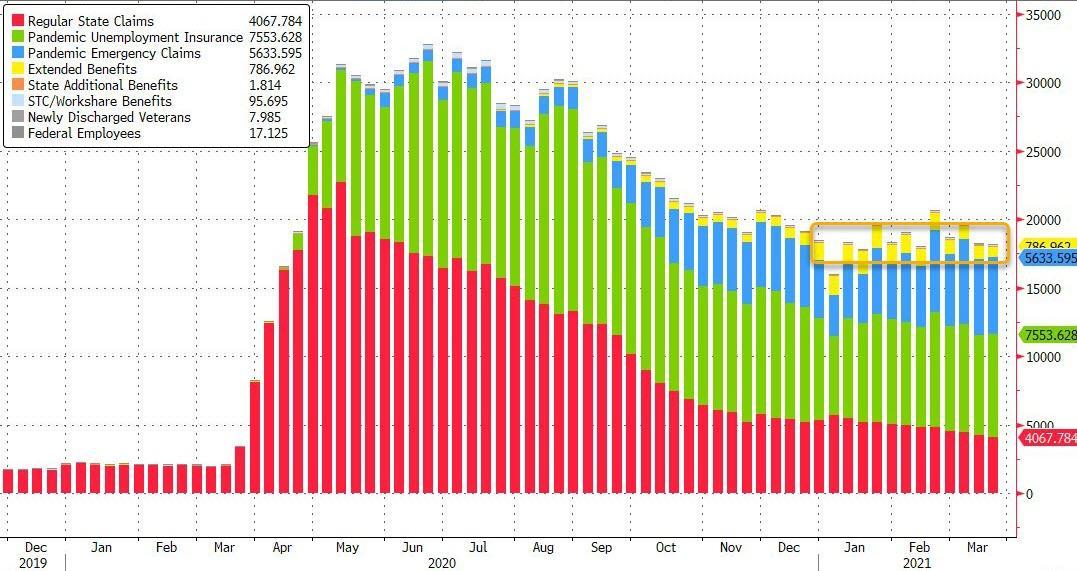
There has been an odd divergence in the US labor market: while both BLS nonfarm payroll surveys (Household and Establishment) telegraph an increasingly stronger jobs market, a signal confirmed by the latest near-record print in job openings, the labor department’s initial claims data has been stubbornly sticky to the upside, indicating at least 18 million people receive some sort of benefit, far above the official number of unemployed people according to the BLS…

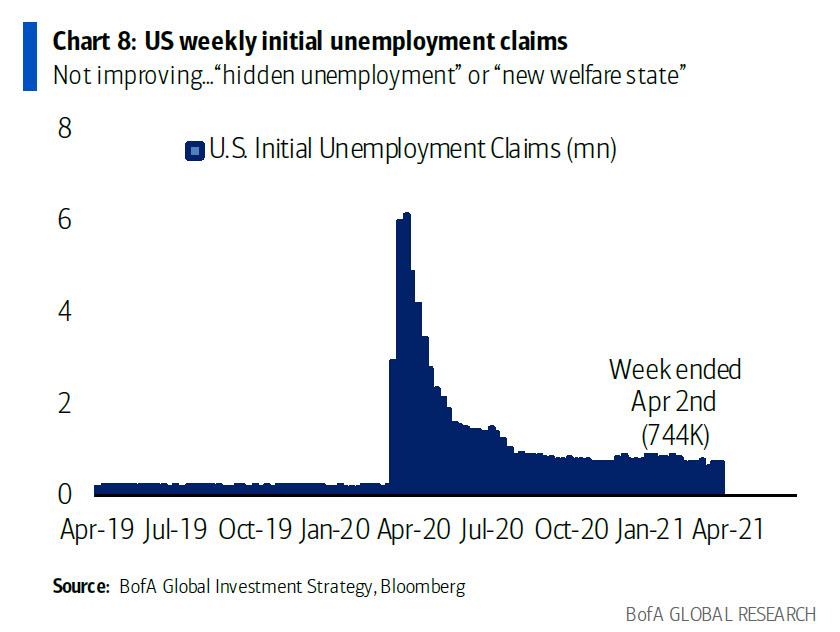
… and with the weekly initial claims now roughly 3-4x higher than their pre-covid levels, there are those such as BofA’s Michael Hartnett, who conclude that the US may have spawned a “new welfare state” hidden in the outlier number of new job claims every week.

So is this bizarrely high number of weekly claims the back door through which socialism entered the US?

Addressing this question, JPMorgan’s Michael Feroli writes today that “one of the puzzles of US labor market data is the difference in messages being sent by the level of initial claims for unemployment insurance and almost every other employment indicator.”

For example, in the latest weekly figures 744,000 filers claimed jobless benefits, higher than at any point prior to the pandemic, including the Great Recession and the early 1980s recession. This is occurring even as the unemployment rate is down to 6.0%, job growth is booming, and the JOLTS measure of layoffs is at the low end of the historical range.

One clue to resolving this puzzle according to Feroli “is to stress the ‘claim’ in jobless claims. When someone files for benefits they are claiming they are eligible for unemployment insurance. It’s the state labor agencies, however, who actually determine whether the claimants truly are eligible.”

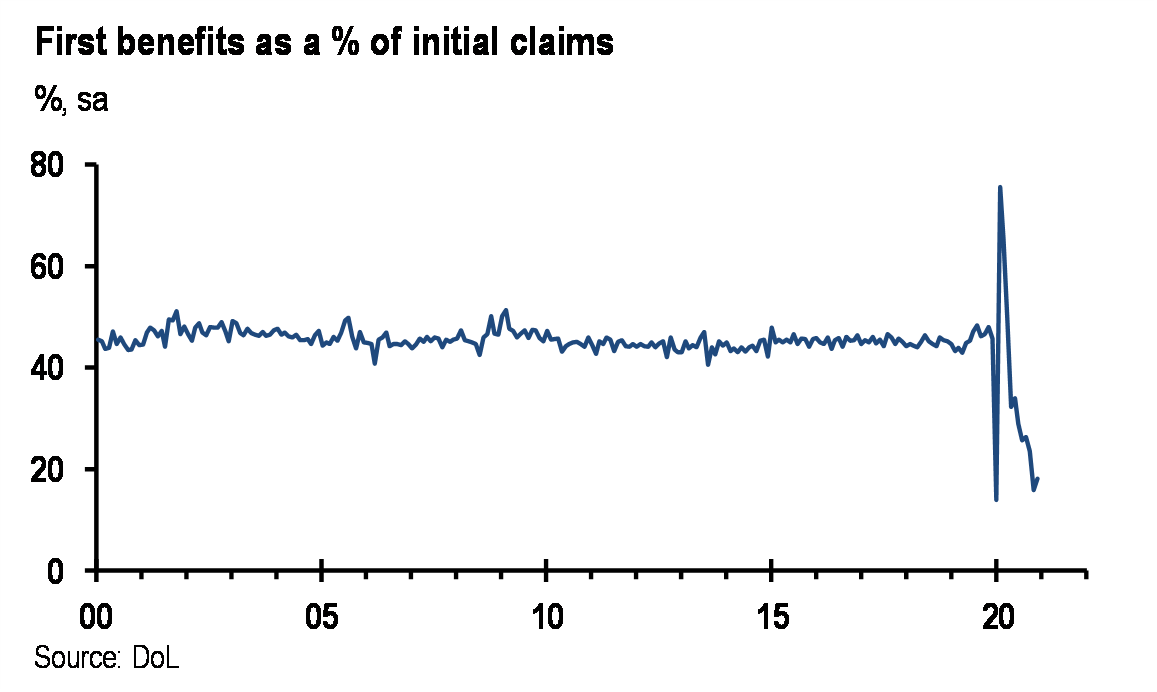
In addition to publishing initial claims for unemployment insurance, the Department of Labor also publishes the number of first payments, which is the number of workers who have filed for benefits and were actually determined to be eligible to receive benefits. These data are reported monthly and with a longer lag than initial claims.

Well, the number of first benefits paid in February was reported today, and as one may expect, it was quite surprising: while historically, about 45% of initial claims resulted in a first payment of benefits…

over the last few months, fewer than 25% of initial claims generated a first payment of benefits.

Why is this so? One reason according to JPMorgan is that the $300 weekly bonus payments are encouraging more people to give filing a shot—the payoff from a successful claim is significantly greater than before the pandemic. This is an extension of the same phenomenon we discussed yesterday in “How Trillions In Stimulus Sparked A Historic Job Market Crisis“, when we noted that in an economy where 100 million people are outside the labor force, “there are absolutely no job seekers.”

In any event, the JPM economist writes that had the number of claimants been consistent with the historical relation with first payments, then the recent jobless claims figure would have been 330,000. This, to Feroli, seems a little more reasonable: the last time weekly claims were at least this high was in 2014, when the unemployment rate was 6.2%.

That said, as the economist concludes, the new configuration of the level of initial claims relative to other labor market indicators may be with us for a while because “the weekly $300 benefits continue through early September, which could continue to attract a larger than usual number of filers.” In short, expect a far higher number of initial claimants… even if the number of claim recipients is far lower.

Tyler Durden
Fri, 04/09/2021 – 14:36

via ZeroHedge News https://ift.tt/3d0wpTP Tyler Durden