Rand Paul, Ron Wyden Want To End Endless National Emergencies

polspphotos769179

Have you heard about the newest national emergency?

No, not the COVID-19 pandemic. The most recent national emergency was declared just two weeks ago—when President Joe Biden granted himself emergency powers to freeze the property and assets of individuals and businesses connected to Myanmar’s military, following an attempted coup in the southeast Asian country.

It didn’t make national news. But why would it? It’s just one of 34 currently active national emergencies—each coming with its own special powers that the president can use until he decides to stop. The longest-running was invoked by President Jimmy Carter in response to the Iran hostage crisis (which ended in 1981, though the “emergency” never did). Other emergencies authorized by Presidents Bill Clinton, George W. Bush, Barack Obama, and Donald Trump are still humming along too, many with no obvious end in sight.

Congress can respond to presidential emergency declarations by disapproving of them after the fact, which it occasionally does. For example, Trump’s declaration of a national emergency along America’s southern border as a way to redirect funds to the building of a border wall was blocked by Congress in 2019.

But doing so requires a supermajority of both chambers and, generally, Congress can’t be persuaded to get off its collective duff. That’s why Clinton’s 1997 emergency trade embargo against Sudan—a country that obviously represents a serious threat to U.S. national security even 24 years later, natch—is still active. Obama’s emergency sanctions targeting Moammar Gadhafi are too, even though he’s been dead since 2011.

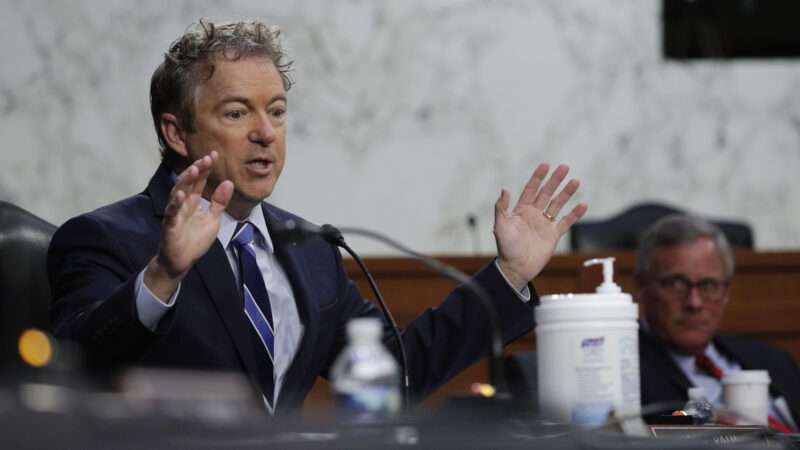
Congressional inaction and executive power-grabbing are nothing new, of course, but Sens. Rand Paul (R–Ky.) and Ron Wyden (D–Ore.) are once again teaming up to try to force that to change. Under a bill the two senators reintroduced on Friday, all presidential emergency declarations would expire after 72 hours unless Congress votes to allow them to continue.

The Reforming Emergency Powers to Uphold the Balances and Limitations Inherent in the Constitution (REPUBLIC) Act effectively flips Congress’ role from one of a passive bystander to an active participant. Paul and Wyden say that in cases of true national emergencies there should be no problem convening a session of Congress within three days to approve a presidential declaration, and the consideration of a national emergency would get immediate priority.

“Congress cannot allow any White House to declare phony emergencies just to get around the legislative process envisioned by the Constitution,” Wyden said in a statement. The proposal would “reassert Congress’ role as a coequal branch of government, while still allowing a president to address real emergencies,” he said.

The bill would automatically sunset national emergencies after 90 days unless Congress voted again to renew the emergency declaration. The bill would also repeal Section 706 of the Communications Act of 1934—a law written long before cell phones or the internet, but one with language so broad that some legal experts worry it could be effectively used as a “kill switch” for the internet.

Unfortunately, the bill is undermined by the fact that Paul and Wyden propose to exempt some presidential powers, such as those granted by the International Emergency Economic Powers Act (IEEPA), which allows presidents to impose sanctions on foreign officials and businesses deemed a threat to American national security. The powers granted by the IEEPA form the basis of many of the 34 ongoing national emergencies, including the most recent declaration issued by Biden.

Still, the Paul/Wyden bill should be part of a broader debate over the balance of power between Congress and the White House—a debate that is long overdue.

As Reason‘s Peter Suderman highlighted earlier this week, the federal government has been operating in a nonstop crisis mode—sometimes in response to officially declared national emergencies and other times due to its own incompetence—for more than two decades. “These emergencies have become excuses for permanent political power grabs, for restrictions on individual liberties large and small, for mass bureaucratization and mass expansion of government spending, trillions of dollars’ worth of non-solutions to deep-rooted problems,” Suderman wrote. “With every crisis, government grows. And now the crisis is government itself.”

Undoing that permanent state of emergency should be a top priority for anyone concerned about the centralization of power and the executive branch’s unilateral decision-making on everything from who gets bombed to who gets bailed out. Setting some basic limits on how long presidential national emergency declarations can last should be relatively low-hanging fruit.

from Latest – Reason.com https://ift.tt/3sv6wAv
via IFTTT
Any Suggestions for Automatically Feeding Our Posts to MeWe?

We’d love to have our blog automatically feed to a MeWe page, as we do on Facebook, Twitter, and Parler; but MeWe doesn’t seem to offer such a feature, the way dlvr.it and similar services do it for Facebook and Twitter, and the way Parler does it automatically for us. And while we theoretically could just hand-post each new post to MeWe, practically that wouldn’t be sustainable.

Can anyone suggest any product or code that can be used or adapted to do that? Thanks!

from Latest – Reason.com https://ift.tt/3q7gjvb
via IFTTT

Washington S. Ct.: Strict Liability Drug Possession Ban Unconstitutional

From the majority opinion in State v. Blake, by Justice Sheryl Gordon McCloud:

Washington’s strict liability drug possession statute, makes possession of a controlled substance a felony punishable by up to five years in prison, plus a hefty fine; leads to deprivation of numerous other rights and opportunities; and does all this without proof that the defendant even knew they possessed the substance.

This case presents an issue of first impression for this court: Does this strict liability drug possession statute with these substantial penalties for such innocent, passive conduct exceed the legislature’s police power? The due process clauses of the state and federal constitutions, along with controlling decisions of this court and the United States Supreme Court, compel us to conclude that the answer is yes—this exceeds the State’s police power….

In 2016, police executed a search warrant in Spokane, Washington, seeking evidence of stolen vehicles. They arrested three people on the property, including Shannon Blake. At the jail, a corrections officer discovered a small baggy containing methamphetamine in the coin pocket of Blake’s jeans. The State charged Blake with possession of a controlled substance in violation of RCW 69.50.4013.

At trial, Blake relied on the judicially created affirmative defense of “unwitting possession.” She testified that a friend had bought the jeans secondhand and given them to Blake two days before Blake’s arrest. Blake said she had never used methamphetamine and did not know the jeans had drugs in the pocket. She acknowledged that the drugs had been “on [her]” on the day of her arrest. Blake’s boyfriend also testified that Blake did not use drugs and that she had received the jeans from a friend….

The “constitutional protection[s] afforded certain personal liberties” implicated by RCW 69.50.4013 are (1) the principle that ” ‘[t]he existence of a mens rea is the rule of, rather than the exception to, the principles of Anglo-American criminal jurisprudence'” and (2) the rule that the government cannot criminalize “essentially innocent” conduct.

With regard to the first constitutional limit, the principle that mens rea is generally a prerequisite to criminalization in “Anglo-American jurisprudence,” it is certainly true that this general rule has exceptions. In Washington, for example, the legislature can still create strict liability crimes in certain circumstances: “our legislature has the plenary power to criminalize conduct regardless of whether the actor intended wrongdoing.” In particular, the legislature may create “strict liability offenses to protect the public from the harms that have come with modern life by putting the burden of care on those in the best position to avoid those harms.”

But the second constitutional limit, the rule against criminalizing “essentially innocent” conduct, does not have such exceptions, and it applies with special force to passive conduct—or nonconduct—that is unaccompanied by intent, knowledge, or mens rea.

The United States Supreme Court explained this over 60 years ago in Lambert v. California (1957). In Lambert, Los Angeles had criminalized “remain[ing] in Los Angeles for a period of more than five days without registering” with the city. [This was limited to defendants who had past felony convictions. -EV] A defendant charged with violating this ordinance was “given no opportunity to comply with the law and avoid its penalty, even though her default [failure to register] was entirely innocent.” The United States Supreme Court held that this exercise of the police power to criminalize entirely passive, innocent nonconduct deprived defendant Virginia Lambert of her liberty without due process of law.

The United States Supreme Court applied the same reasoning to a similar statute 15 years later. In Papachristou v. City of Jacksonville (1972), that Court considered the constitutionality of a Florida ordinance that criminalized, among other things, “nightwalking.” The Florida Supreme Court had upheld the ordinance after construing it “not to make criminal one night’s wandering, only the ‘habitual’ wanderer or, as the ordinance describe[d] it, ‘common night walkers.'” But the United States Supreme Court reversed. It explained that walking, strolling, and wandering—even at night—are “historically part of the amenities of life as we have known them.” It continued that criminalizing such historically innocent conduct was impermissible for many reasons, including the fact that it made “criminal activities which by modern standards are normally innocent” and did so without proof of any “intent to commit an unlawful act.” It concluded that criminalizing passive nonconduct while eliminating the requirement of a guilty mind violated due process clause protections, “cannot be squared with our constitutional standards[,] and is plainly unconstitutional.” Lambert‘s and Papachristou‘s holdings rested on the due process clause of the Fourteenth Amendment.

Our state constitution’s due process clause provides even greater protection of individual rights in certain circumstances. Thus, this court’s precedent also enforces the constitutional due process limit on the reach of the State’s police power (though often without specifying the specific constitutional source of that limit)…. [W]e have analyzed whether “the area of regulation [was] within the government’s scope of authority and [whether] the particular ordinance [was] a reasonable regulatory measure in support of the area of concern.” Applying that test, we have held that criminalization of passive nonconduct without mens rea “makes no distinction between conduct calculated to harm and that which is essentially innocent” and therefore exceeds the State’s police power.

The strict liability drug possession statute challenged in this case is similar to the strict liability curfew ordinance challenged in Pullman. In Pullman, the defendant challenged a Seattle ordinance that prohibited “accompanying a child during curfew hours.” By the language of the ordinance, “any minor under the age of 18 could be arrested for standing or playing on the sidewalk in front of his home at 10:01 p.m. on a warm summer evening.” Justice Utter, writing for the majority, recognized that the government has an “independent interest in the well-being of its youth” and hence has authority to “enact laws to assist those whose primary responsibility is for the well-being of minors.”

But the challenged law made “no distinction between conduct calculated to harm and that which is essentially innocent,” and it bore “an insufficient relationship to the objective of safeguarding minors.” We therefore concluded that the law was “an unreasonable exercise of the police power.” We explained that the record before the court was “absolutely devoid of any evidence showing ‘bad conduct’…. [T]he mere fact that the defendant was in the presence of two minors during curfew hours resulted in this prosecution.”

Pullman stands for the rule that the state legislature’s exercise of its otherwise plenary police power to criminalize entirely passive and innocent nonconduct with no mens rea or guilty mind violates the due process clause of the state and federal constitutions….

[T]he legislature criminalized exactly that sort of passive and innocent nonconduct in this case…. Because unknowing possession is just as innocent and passive as staying out late with a juvenile or remaining in a city without registering, we hold that this felony drug possession statute is just as unconstitutional as were the laws in Lambert, Papachristou, and Pullman.

To be sure, active trafficking in drugs, unlike standing outside at 10:01 p.m., is not innocent conduct. States have criminalized knowing drug possession nationwide, and there is plenty of reason to know that illegal drugs are highly regulated. The legislature surely has constitutional authority to regulate drugs through criminal and civil statutes.

But the possession statute at issue here does far more than regulate drugs. It is unique in the nation in criminalizing entirely innocent, unknowing possession. The statute would criminalize, to list a few examples:

“a letter carrier who delivers a package containing unprescribed Adderall; a roommate who is unaware that the person who shares his apartment has hidden illegal drugs in the common areas of the home; a mother who carries a prescription pill bottle in her purse, unaware that the pills have been substituted for illegally obtained drugs by her teenage daughter, who placed them in the bottle to avoid detection.” “A person might pick up the wrong bag at the airport, the wrong jacket at the concert, or even the wrong briefcase at the courthouse. Or a child might carry an adult’s backpack, not knowing that it contains the adult’s illegal drugs.” …

This court [has] recognized the harshness of its [earlier statutory holding] holding that RCW 69.50.4013 permissibly criminalized innocent, passive, unknowing possession. It addressed that harsh result with what it admitted was an “anomalous” device: the court created a brand new affirmative defense out of whole cloth. Cleppe decided that an “unwitting possession” affirmative defense, that the defendant had the burden to prove, would “ameliorate[]” the harshness of its strict liability decision….  [But while a] judicially created affirmative defense may “ameliorate the harshness” of criminalizing innocent nonconduct, but it cannot save an unconstitutional statute….

We do nothing here today to disturb the legislature’s power to enact strict liability crimes…. The key distinction between this simple possession statute and other, valid, strict liability crimes is that the former statute penalizes passive and innocent nonconduct (without mens rea) while the latter statutes do not.

For example, to prove that a defendant practiced law unlawfully, the State must show that the defendant actually “practice[d] law, or [held] himself or herself out as entitled to practice law.” That conduct is, well, conduct. To be sure, Yishmael held that the defendant need not know that his or her conduct constituted the “practice of law.” But we continued that the State must still prove the activity of practicing law, and that, of course, requires the State to show intentional activity (not passivity). As we explained, “Yishmael did not dispute that he gave his clients advice about homesteading, adverse possession, and talking with the police, and that he offered assistance in completing documents to be filed with the county recorder’s office.” Not surprisingly, Yishmael did not claim that he had not intended any of those actions.

Similarly, to convict a defendant of rape of a child, the State must prove that the defendant “ha[d] sexual intercourse with another” who is under a particular age, depending on the degree of the crime. Sexual intercourse is conduct, not passivity. The crime is “strict liability” in the sense that the State need prove only “‘the doing of the acts constituting the offense'”; the State need not prove that the defendant knew the victim’s age, which is what makes the acts constituting the offense criminal. But the State must certainly show the activity of sexual intercourse, not just innocent passivity.

The drug possession statute is different. It does not require the State to prove any intent or even any action. And in this case, the State did not prove that Blake did anything except wear jeans that had pockets. Valid strict liability crimes require that the defendant actually perform some conduct. Blake did not. Under the due process clauses of the state and federal constitutions, the legislature may not criminalize such nonconduct….

Justice Charles Johnson dissented (for three Justices), concluding that “The legislative power to enact strict liability crimes remains consistent and undiminished …. Our continued recognition of this legislative power applies with special force in this case given the length of time that the crime of possession of a controlled substance has been upheld as a strict liability crime. The constitutional analysis in the majority’s decision is not convincing enough to outweigh those considerations.”

Justice Debra L. Stephens concurred in part and dissenting in part, concluding that the statute should be interpreted to avoid strict liability.


from Latest – Reason.com https://ift.tt/3aY9RlN
via IFTTT

FDA Panel Unanimously Endorses J&J Covid Vaccine

FDA Panel Unanimously Endorses J&J Covid Vaccine

While it was so widely expected the announcement was merely a formality, just after 5pm on Friday the FDA Advisory Panel voted unanimously (22-0) to endorse the (one-shot, no mRNA) J&J vaccine, saying the benefits outweigh the risks, and recommended the agency grant emergency authorization, moving the nation’s third vaccine one step closer to getting into Americans’ arms.

The vaccine was 66% effective in protecting any cases of moderate to severe illness. It was 85% effective against severe cases of COVID-19 and completely prevented hospitalizations and death, four weeks after inoculation.

The FDA could now give the green light to the single-dose vaccine as early as Saturday, and it probably will.

Vaccinations will then begin as soon as a Centers for Disease Control and Prevention (CDC) panel recommends the vaccine and the CDC accepts that recommendation. The CDC panel is scheduled to meet Sunday.

“We are at the precipice of having another vaccine in our toolbox,” CDC Director Rochelle Walensky said Friday. “Having an additional safe and effective vaccine will help protect more people faster.”

The Johnson & Johnson (J&J) vaccine is different from the other two already on the market and could be a potential game changer. It is administered in a single dose, and does not need to be frozen when shipped and stored. It is also not based on the highly controversial mRNA technology used by Pfizer and Moderna. Unlike those two, the JNJ vaccine is what’s called a viral vector vaccine.

To create this vaccine, the Johnson & Johnson team took a harmless adenovirus – the viral vector – and replaced a small piece of its genetic instructions with coronavirus genes for the SARS-CoV-2 spike protein.

After this modified adenovirus is injected into someone’s arm, it enters the person’s cells. The cells then read the genetic instructions needed to make the spike protein and the vaccinated cells make and present the spike protein on their own surface. The person’s immune system then notices these foreign proteins and makes antibodies against them that will protect the person if they are ever exposed to SARS-CoV-2 in the future.

The adenovirus vector vaccine is safe because the adenovirus can’t replicate in human cells or cause disease, and the SARS-CoV-2 spike protein can’t cause COVID–19 without the rest of the coronavirus.

“We need vaccines that are effective and well-tolerated. And importantly, ones that are simple to deploy,” said Gregory Poland, director of the Mayo Clinic’s vaccine research group, who spoke to the panel as part of J&J’s presentation.

The endorsement from the FDA panel of experts comes as politically motivated federal officials are again scrambling to boost the panic meter by warning about the impact of recent highly contagious variants of the coronavirus, urging people not to grow complacent despite plunging cases and hospitalizations. The rise of variants makes vaccination more important than ever, CDC officials said.

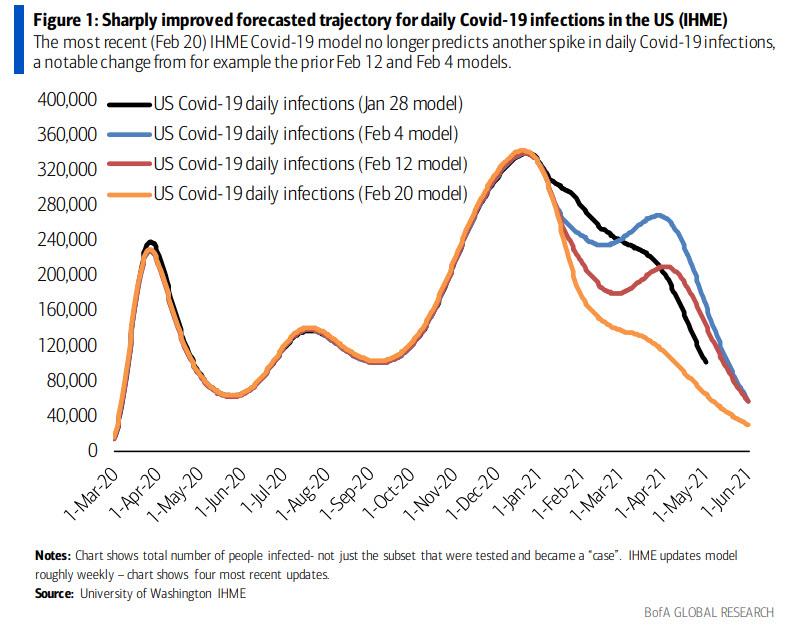
CDC epidemiologist Adam MacNeil told the FDA panel said he expects the B.1.1.7 variant, first found in the United Kingdom, has likely spread throughout the entire U.S., and could become the dominant virus in mid-to-late March. However, inadequate genetic sequencing means we may never get the true picture. Furthermore, recent computer models have predicted that not even covid variants will prevent the US from basically being covid free by June.

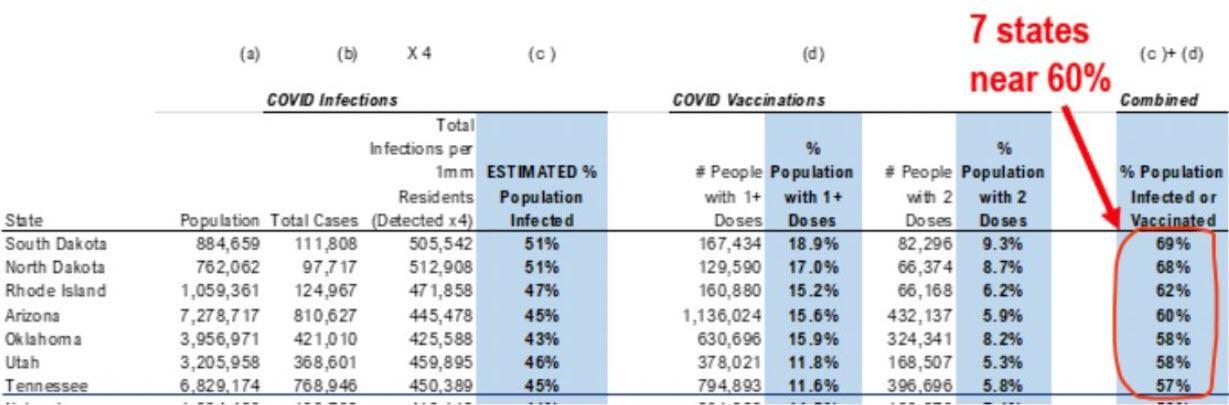
While the pace of vaccinations has been steadily increasing, MacNeil said the U.S. is still “nowhere close” to herd immunity, which also is a politically-motivated falsity because as we showed earlier, at least 7 states are now on the verge of herd immunity. He emphasized the effectiveness of current strategies including masking and physical distancing.

Continuing with the political narrative, to date supply has been the primary constraint to the ramping up of the U.S. vaccination effort. A vaccine by U.S. pharmaceutical giant Pfizer and its German partner BioNTech, and another by Moderna were both authorized in December, but Pfizer has only shipped approximately 40 million doses, while Moderna has shipped about 45 million doses.

Johnson & Johnson’s vaccine will only be available at a relative trickle at first. The company will only have about 4 million doses available to ship immediately upon authorization, but that number will increase to 20 million by the end of next month.

J&J has a deal with the U.S. government to supply 100 million doses of its vaccine by the end of June, and White House COVID-19 coordinator Jeff Zients said this week the federal government will do “everything we can” with the company to ramp up production.

The company asked the FDA to authorize the use of the vaccine in people aged 18 and older, but there were some concerns over the lack of data on recipients older than 75. There were also concerns over the effectiveness in people over the age of 60 with certain pre-existing conditions, like obesity and diabetes.

The J&J vaccine hasn’t been tested yet in children and teens under the age of 18, so it was not authorized for their use. A trial to study the safety and efficacy of the company’s vaccine in teens aged 17 and younger will begin late next month or early April.

Finally, while the two coronavirus vaccines already on the market may appear to be more effective than Johnson & Johnson’s, experts say it is difficult to compare them head-to-head because of different clinical trial designs and different endpoints. Furthermore, the fact that the two previous vaccines are mRNA based – a rather novel and untested technology – may have sparked skepticism among many Americans.

“I really think we need to be careful not to read into the data, to look across studies when they are so different, and instead look at each vaccine individually,” CDC’s Nancy Messioner said Friday during an interview with the Journal of the American Medical Association.

Tyler Durden
Fri, 02/26/2021 – 17:22

via ZeroHedge News https://ift.tt/3aXDP9g Tyler Durden

“A New World Altogether” – Global Airlines Set To “Go Live In March” With COVID ‘Passports’ 

“A New World Altogether” – Global Airlines Set To “Go Live In March” With COVID ‘Passports’ 

Imagine a world where the ability to travel on a commercial airliner depends on passing a COVID-19 test or taking a vaccine. If a traveler tests positive or did not receive or refused to take the vaccine, they would be locked out of air travel. 

This dystopic future could be the ‘new normal‘ in a matter of weeks. All along, maybe the “conspiracy theorists” who warned of an overreaching system of control by the government were right. 

During a Wednesday press conference, the International Air Transport Association (IATA) said they would roll out a new travel app (called Travel Pass) to manage COVID-19 tests and vaccine certifications. IATA is the premier global trade organization for airlines, with 290 members. 

Since the early days of the pandemic (read: here & here & here), we’ve discussed “COVID passports,” “immunity passports,” or at least mentioned those who don’t get tested for the virus or vaccinated could face travel restrictions. 

From conspiracy theory to conspiracy fact, this appears to be the case as IATA’s new app will be rolled out in March.

Already, Singapore Airlines and twenty other airlines are testing the Travel App. In recent weeks, more airlines, such as American Airlines have expanded the use of immunity passports for international travel. 

“The key issue is one of confidence. Passengers need to be confident that the testing they’ve taken is accurate and will allow them to enter the country,” said Vinoop Goel, IATA’s regional director of airports and external relations.

“And then governments need to have the confidence that the tests that the passengers claim to have is one which is accurate and meets their own conditions,” Goel said. 

“We are currently working with a number of airlines worldwide and learning from these pilots. And the plan is to go live in March,” he said.

“So basically, we expect to have a fully functional working system over the next few weeks,” he added.

The development of the app suggests airlines and governments have worked together to come up with a global solution to restart the crippled airline industry. Despite the imminent release of the app, IATA expects summer travel to be slow

So the question we ask readers is if COVID passports could actually backfire on the airline industry? After all, who wants private corporations and governments holding your private health data?

A corporation or government holding private health data could be a deterrence for some travels. Monitoring people’s health erodes privacy, and electronic documentation leaves the data susceptible to hackers. 

A shortage of vaccines and or younger generations who are expected to get vaccinated later this year could result in unfair access to air travel. COVID passports appear to be a new form of discrimination. 

It comes as no surprise as billionaire and top vaccine pusher Bill Gates, for the last ten months, has been one of the most prominent figures discussing health passports.

After airlines, there is no telling what governments will do with these new health passports – they could be quickly extended to entering grocery stores, attending concerts and sports games, riding public transportation, and or even collecting unemployment. 

Already in Europe, Spain, Estonia, Iceland, Denmark, Sweden, Poland, and Belgium have indicated immunity passports will be used for cross-border activity.  

Former Prime Minister and globalist Tony Blair recently said the “world is moving in this direction,” adding that he couldn’t see another way of this,” while referring to immunity passports. 

Blair has previously said that vaccine passports are inevitable and that “It’s going to be a new world altogether.”

Tyler Durden
Fri, 02/26/2021 – 17:20

via ZeroHedge News https://ift.tt/2O0qjZE Tyler Durden

Federal Judge Rules Nationwide Eviction Ban Is Unconstitutional

Federal Judge Rules Nationwide Eviction Ban Is Unconstitutional

Authored by Janita Kan via The Epoch Times (emphasis ours),

A  judge in Texas on Thursday ruled that the federal government does not have the authority to issue a nationwide eviction moratorium.

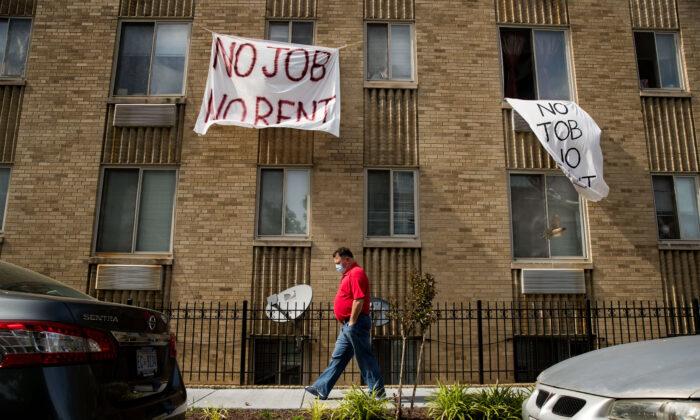
Signs that read “No Job No Rent” hang from the windows of an apartment building in Washington on May 20, 2020. (Andrew Harnik/AP Photo)

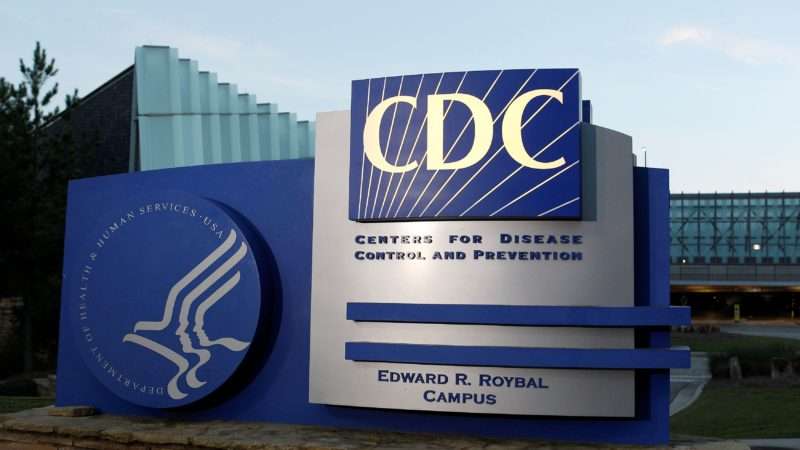
U.S. District Judge John Barker, a Trump appointee, ruled in favor of a group of property managers and landlords who challenged a Centers for Disease Control and Prevention (CDC) order that prevented them from temporarily evicting tenants for non-payment of rent during the CCP (Chinese Communist Party) virus pandemic.

The CDC order in question was initially issued in September 2020 and was originally set to expire on Dec. 31, 2020. It was extended to Jan. 31 and then again until the end of March. The order aimed to mitigate the spread of the pandemic by reducing congregation in shared living settings or in unsheltered homeless areas, and support state and local responses to the disease.

The order made it a crime for a landlord or property owner to evict a “covered person” from a residence, subject to several exceptions. Tenants who are covered by the order include those who have used their best efforts to obtain government assistance for rent or housing; or whose income falls below a certain income threshold.

A person who violated the order could face up to one year of imprisonment, to be followed by up to one year of supervised release, and a fine of up to $250,000.

The order only pauses evictions but does not relieve tenants from rent or housing payments.

Barker said eviction moratoriums are usually enacted by states and that the lawsuit does not question the states’ authority to do so. But plaintiffs in the case are asking the court to determine whether the U.S. Constitution allows the federal government to order or legislate a nationwide moratorium on evicting specified tenants.

“After analyzing the relevant precedents, the court concludes that the federal government’s Article I power to regulate interstate commerce and enact laws necessary and proper to that end does not include the power to impose the challenged eviction moratorium,” Barker wrote in his 21-page ruling (pdf).

The Southeastern Legal Foundation (SLF) and Texas Public Policy Foundation jointly represented the plaintiffs in the case. The groups welcomed the judge’s decision.

The court’s order today holding the CDC’s interference with private property rights under the veil of COVID-19 serves as notice to the Biden administration that the Constitution limits government power,” SLF General Counsel Kimberly Hermann said in a statement. The moratorium was first issued by the CDC under the Trump administration, and extended by Congress and then the CDC under Biden.

“The federal courts will continue to be a primary bulwark against unconstitutional overreach by federal and state governments. As our record shows, we have fought and won cases just like this for decades, and the current administration has shown no restraint. We are preparing cases across the constitutional spectrum to defend against unrestrained government action.”

The lawsuit was filed against the United States, the CDC, the Department of Health and Human Services (HHS), and three HHS officials responsible for the order.

The Justice Department did not immediately respond to The Epoch Times’ request for comment.

Follow Janita on Twitter: @janitakan

Tyler Durden
Fri, 02/26/2021 – 17:00

via ZeroHedge News https://ift.tt/3su71L8 Tyler Durden

Robinhood Is In Talks With FINRA To Settle March 2020 Probe Into Options And Outages

Robinhood Is In Talks With FINRA To Settle March 2020 Probe Into Options And Outages

Robinhood is reportedly in talks with Financial Industry Regulatory Authority to settle a March 2020 investigation that has been ongoing into the company. The probe is regarding app outages and option trading, Bloomberg reported on Friday.

At the center of the investigation was how Robinhood displays cash balances and buying power to its customers and the process that it undertakes to vet and approve traders for options trading. 

Robinhood noted the talks in a filing made on Friday, stating: “We have accrued in our statement of financial condition for the year ended December 31, 2020 of $26.6 million representing the bottom of the range of our probable losses. We cannot predict, however, whether these discussions will result in a resolution of these matters.”

The same filings show that the company had $154.2 million in net capital, Bloomberg reported.

And while fending off FINRA with one hand, Robinhood was also fighting a war of words against Charlie Munger with the other. We reported this morning that in an exclusive interview with the Wall Street Journal, the 97 year old Vice Chairman of Berkshire Hathaway sounded off about the “wild speculation” created by the budding brokerage.

“I hate this luring of people into engaging in speculative orgies. [Robinhood] may call it investing, but that’s all bullshit,” Munger said on Thursday. 

“It’s really just wild speculation, like casino gambling or racetrack betting. There’s a long history of destructive capitalism, these trading orgies whooped up by the people who profit from them.”

His comments on Thursday came after statements he made on Wednesday at the annual meeting of Daily Journal Corp., when he said “it’s really stupid to have a culture which encourages as much gambling in stocks.”

He said at the meeting: “You should try and make your money in this world by selling other people things that are good for them.”

And with one FINRA investigation off the plate, hopefully financial regulators will have plenty of time to look into Vlad Tenev’s non-liquidity-related liquidity issues that emerged weeks ago as a result of the chaotic trading in GameStop. 

After weeks of doubling down on his early insistence that Robinhood wasn’t suffering from a “liquidity issue”, Tenev finally explained days ago to Barstool Sports’ Dave Portnoy that “the ‘L’ word is a big thing in financial services: “A ‘liquidity issue’ means you can’t meet your deposit requirements, you can’t meet your margin requirements and are basically dead,” he said.

Tyler Durden
Fri, 02/26/2021 – 16:40

via ZeroHedge News https://ift.tt/3stymgw Tyler Durden

Any Suggestions for Automatically Feeding Our Posts to MeWe?

We’d love to have our blog automatically feed to a MeWe page, as we do on Facebook, Twitter, and Parler; but MeWe doesn’t seem to offer such a feature, the way dlvr.it and similar services do it for Facebook and Twitter, and the way Parler does it automatically for us. And while we theoretically could just hand-post each new post to MeWe, practically that wouldn’t be sustainable.

Can anyone suggest any product or code that can be used or adapted to do that? Thanks!

from Latest – Reason.com https://ift.tt/3q7gjvb
via IFTTT

Washington S. Ct.: Strict Liability Drug Possession Ban Unconstitutional

From the majority opinion in State v. Blake, by Justice Sheryl Gordon McCloud:

Washington’s strict liability drug possession statute, makes possession of a controlled substance a felony punishable by up to five years in prison, plus a hefty fine; leads to deprivation of numerous other rights and opportunities; and does all this without proof that the defendant even knew they possessed the substance.

This case presents an issue of first impression for this court: Does this strict liability drug possession statute with these substantial penalties for such innocent, passive conduct exceed the legislature’s police power? The due process clauses of the state and federal constitutions, along with controlling decisions of this court and the United States Supreme Court, compel us to conclude that the answer is yes—this exceeds the State’s police power….

In 2016, police executed a search warrant in Spokane, Washington, seeking evidence of stolen vehicles. They arrested three people on the property, including Shannon Blake. At the jail, a corrections officer discovered a small baggy containing methamphetamine in the coin pocket of Blake’s jeans. The State charged Blake with possession of a controlled substance in violation of RCW 69.50.4013.

At trial, Blake relied on the judicially created affirmative defense of “unwitting possession.” She testified that a friend had bought the jeans secondhand and given them to Blake two days before Blake’s arrest. Blake said she had never used methamphetamine and did not know the jeans had drugs in the pocket. She acknowledged that the drugs had been “on [her]” on the day of her arrest. Blake’s boyfriend also testified that Blake did not use drugs and that she had received the jeans from a friend….

The “constitutional protection[s] afforded certain personal liberties” implicated by RCW 69.50.4013 are (1) the principle that ” ‘[t]he existence of a mens rea is the rule of, rather than the exception to, the principles of Anglo-American criminal jurisprudence'” and (2) the rule that the government cannot criminalize “essentially innocent” conduct.

With regard to the first constitutional limit, the principle that mens rea is generally a prerequisite to criminalization in “Anglo-American jurisprudence,” it is certainly true that this general rule has exceptions. In Washington, for example, the legislature can still create strict liability crimes in certain circumstances: “our legislature has the plenary power to criminalize conduct regardless of whether the actor intended wrongdoing.” In particular, the legislature may create “strict liability offenses to protect the public from the harms that have come with modern life by putting the burden of care on those in the best position to avoid those harms.”

But the second constitutional limit, the rule against criminalizing “essentially innocent” conduct, does not have such exceptions, and it applies with special force to passive conduct—or nonconduct—that is unaccompanied by intent, knowledge, or mens rea.

The United States Supreme Court explained this over 60 years ago in Lambert v. California (1957). In Lambert, Los Angeles had criminalized “remain[ing] in Los Angeles for a period of more than five days without registering” with the city. [This was limited to defendants who had past felony convictions. -EV] A defendant charged with violating this ordinance was “given no opportunity to comply with the law and avoid its penalty, even though her default [failure to register] was entirely innocent.” The United States Supreme Court held that this exercise of the police power to criminalize entirely passive, innocent nonconduct deprived defendant Virginia Lambert of her liberty without due process of law.

The United States Supreme Court applied the same reasoning to a similar statute 15 years later. In Papachristou v. City of Jacksonville (1972), that Court considered the constitutionality of a Florida ordinance that criminalized, among other things, “nightwalking.” The Florida Supreme Court had upheld the ordinance after construing it “not to make criminal one night’s wandering, only the ‘habitual’ wanderer or, as the ordinance describe[d] it, ‘common night walkers.'” But the United States Supreme Court reversed. It explained that walking, strolling, and wandering—even at night—are “historically part of the amenities of life as we have known them.” It continued that criminalizing such historically innocent conduct was impermissible for many reasons, including the fact that it made “criminal activities which by modern standards are normally innocent” and did so without proof of any “intent to commit an unlawful act.” It concluded that criminalizing passive nonconduct while eliminating the requirement of a guilty mind violated due process clause protections, “cannot be squared with our constitutional standards[,] and is plainly unconstitutional.” Lambert‘s and Papachristou‘s holdings rested on the due process clause of the Fourteenth Amendment.

Our state constitution’s due process clause provides even greater protection of individual rights in certain circumstances. Thus, this court’s precedent also enforces the constitutional due process limit on the reach of the State’s police power (though often without specifying the specific constitutional source of that limit)…. [W]e have analyzed whether “the area of regulation [was] within the government’s scope of authority and [whether] the particular ordinance [was] a reasonable regulatory measure in support of the area of concern.” Applying that test, we have held that criminalization of passive nonconduct without mens rea “makes no distinction between conduct calculated to harm and that which is essentially innocent” and therefore exceeds the State’s police power.

The strict liability drug possession statute challenged in this case is similar to the strict liability curfew ordinance challenged in Pullman. In Pullman, the defendant challenged a Seattle ordinance that prohibited “accompanying a child during curfew hours.” By the language of the ordinance, “any minor under the age of 18 could be arrested for standing or playing on the sidewalk in front of his home at 10:01 p.m. on a warm summer evening.” Justice Utter, writing for the majority, recognized that the government has an “independent interest in the well-being of its youth” and hence has authority to “enact laws to assist those whose primary responsibility is for the well-being of minors.”

But the challenged law made “no distinction between conduct calculated to harm and that which is essentially innocent,” and it bore “an insufficient relationship to the objective of safeguarding minors.” We therefore concluded that the law was “an unreasonable exercise of the police power.” We explained that the record before the court was “absolutely devoid of any evidence showing ‘bad conduct’…. [T]he mere fact that the defendant was in the presence of two minors during curfew hours resulted in this prosecution.”

Pullman stands for the rule that the state legislature’s exercise of its otherwise plenary police power to criminalize entirely passive and innocent nonconduct with no mens rea or guilty mind violates the due process clause of the state and federal constitutions….

[T]he legislature criminalized exactly that sort of passive and innocent nonconduct in this case…. Because unknowing possession is just as innocent and passive as staying out late with a juvenile or remaining in a city without registering, we hold that this felony drug possession statute is just as unconstitutional as were the laws in Lambert, Papachristou, and Pullman.

To be sure, active trafficking in drugs, unlike standing outside at 10:01 p.m., is not innocent conduct. States have criminalized knowing drug possession nationwide, and there is plenty of reason to know that illegal drugs are highly regulated. The legislature surely has constitutional authority to regulate drugs through criminal and civil statutes.

But the possession statute at issue here does far more than regulate drugs. It is unique in the nation in criminalizing entirely innocent, unknowing possession. The statute would criminalize, to list a few examples:

“a letter carrier who delivers a package containing unprescribed Adderall; a roommate who is unaware that the person who shares his apartment has hidden illegal drugs in the common areas of the home; a mother who carries a prescription pill bottle in her purse, unaware that the pills have been substituted for illegally obtained drugs by her teenage daughter, who placed them in the bottle to avoid detection.” “A person might pick up the wrong bag at the airport, the wrong jacket at the concert, or even the wrong briefcase at the courthouse. Or a child might carry an adult’s backpack, not knowing that it contains the adult’s illegal drugs.” …

This court [has] recognized the harshness of its [earlier statutory holding] holding that RCW 69.50.4013 permissibly criminalized innocent, passive, unknowing possession. It addressed that harsh result with what it admitted was an “anomalous” device: the court created a brand new affirmative defense out of whole cloth. Cleppe decided that an “unwitting possession” affirmative defense, that the defendant had the burden to prove, would “ameliorate[]” the harshness of its strict liability decision….  [But while a] judicially created affirmative defense may “ameliorate the harshness” of criminalizing innocent nonconduct, but it cannot save an unconstitutional statute….

We do nothing here today to disturb the legislature’s power to enact strict liability crimes…. The key distinction between this simple possession statute and other, valid, strict liability crimes is that the former statute penalizes passive and innocent nonconduct (without mens rea) while the latter statutes do not.

For example, to prove that a defendant practiced law unlawfully, the State must show that the defendant actually “practice[d] law, or [held] himself or herself out as entitled to practice law.” That conduct is, well, conduct. To be sure, Yishmael held that the defendant need not know that his or her conduct constituted the “practice of law.” But we continued that the State must still prove the activity of practicing law, and that, of course, requires the State to show intentional activity (not passivity). As we explained, “Yishmael did not dispute that he gave his clients advice about homesteading, adverse possession, and talking with the police, and that he offered assistance in completing documents to be filed with the county recorder’s office.” Not surprisingly, Yishmael did not claim that he had not intended any of those actions.

Similarly, to convict a defendant of rape of a child, the State must prove that the defendant “ha[d] sexual intercourse with another” who is under a particular age, depending on the degree of the crime. Sexual intercourse is conduct, not passivity. The crime is “strict liability” in the sense that the State need prove only “‘the doing of the acts constituting the offense'”; the State need not prove that the defendant knew the victim’s age, which is what makes the acts constituting the offense criminal. But the State must certainly show the activity of sexual intercourse, not just innocent passivity.

The drug possession statute is different. It does not require the State to prove any intent or even any action. And in this case, the State did not prove that Blake did anything except wear jeans that had pockets. Valid strict liability crimes require that the defendant actually perform some conduct. Blake did not. Under the due process clauses of the state and federal constitutions, the legislature may not criminalize such nonconduct….

Justice Charles Johnson dissented (for three Justices), concluding that “The legislative power to enact strict liability crimes remains consistent and undiminished …. Our continued recognition of this legislative power applies with special force in this case given the length of time that the crime of possession of a controlled substance has been upheld as a strict liability crime. The constitutional analysis in the majority’s decision is not convincing enough to outweigh those considerations.”

Justice Debra L. Stephens concurred in part and dissenting in part, concluding that the statute should be interpreted to avoid strict liability.


from Latest – Reason.com https://ift.tt/3aY9RlN
via IFTTT

Federal Court Strikes Down CDC’s Controversial Eviction Ban as Unconstitutional

reason-cdc

In a surprise decision Thursday, a federal court has struck down the Centers for Disease Control and Prevention’s (CDC) controversial ban on evictions as unconstitutional.

The federal government’s power to regulate interstate commerce “does not include the power to impose the challenged eviction moratorium,” wrote Judge J. Campbell Barker for the U.S. District Court for the Eastern District of Texas in his opinion yesterday. “Although the COVID-19 pandemic persists, so does the Constitution.”

This ruling comes in response to a lawsuit brought by the Texas Public Policy Foundation (TPPF) and the Southeastern Legal Foundation on behalf of several Texas landlords who’ve been prevented from evicting non-paying tenants because of the CDC’s order.

“My clients have continued to have the cost of their property, their property taxes, their mortgages, their costs of maintaining and upkeep,” says Robert Henneke, general counsel for the TPPF. “At the same time, in the last five months, they’ve been prohibited by the federal government from collecting rent. That’s caused them injury they can start recovering from here beginning today.”

Housing advocates, who’ve long supported a nationwide eviction moratorium, are less pleased.

“This court decision must not stand, the federal government must vigorously defend, extend, strengthen and enforce the CDC order,” said Diane Yentel, president and CEO of the National Low Income Housing Coalition. “Evictions risk lives, drive families deeper into poverty, and strain our already overstretched public health systems.”

The CDC first issued its eviction ban back in September 2020. The order forbade rental property owners from evicting tenants for non-payment of rent so long as they filed a hardship declaration saying that they’d made efforts to obtain government assistance and that their eviction would result in them moving into a more crowded living situation.

Landlords who violated the eviction ban could face hundreds of thousands of dollars in fines, and even jail time.

The moratorium was originally supposed to expire on December 31. Congress extended it through the end of January when it passed its $900 billion relief package that month. President Joe Biden extended it once again through the end of March.

From the beginning, the federal government’s eviction ban has been legally controversial.

The CDC has justified it by pointing to the Public Health Services Act, which says federal health officials have the power to take measures “reasonably necessary” to prevent the interstate spread of communicable disease. The law goes on to list “inspection, fumigation, disinfection, [and] sanitation” as examples of measures public health authorities can take.

The agency has argued that an eviction ban is a “reasonably necessary” means of fighting the pandemic, given that evicted tenants might spread COVID-19 to their next living situations.

Critics of the CDC’s eviction ban argued this interpretation of the law would give the agency unilateral authority to issue near-limitless restrictions in the name of preventing the spread of COVID-19.

“This broad interpretation of the regulation would give the executive the power to restrict almost any type of activity. Pretty much any economic transaction or movement of people and goods could potentially spread disease in some way,” wrote George Mason University law professor Ilya Somin in September.

Multiple lawsuits have been filed against the CDC’s moratorium, arguing it’s a clear example of executive overreach, and that Congress never gave the agency the power to impose a nationwide eviction ban.

Barker’s decision on Thursday goes further than that by saying that even if Congress wanted to impose an eviction ban, it couldn’t. Its powers to regulate interstate commerce can’t extend to intrastate evictions, which aren’t economic activity, he ruled.

“Here, the regulated activity is not the production or use of a commodity that is traded in an interstate market. Rather, the challenged order regulates property rights in buildings—specifically, whether an owner may regain possession of property from an inhabitant,” wrote Barker.

Thus, if Congress doesn’t have the power to ban evictions, then it follows that it can’t delegate that power to the CDC or any other agency. Barker’s ruling doesn’t touch eviction moratoria adopted by state or local governments.

The decision is a huge blow to supporters of the CDC’s eviction ban, but its practical implications are a bit unclear.

Henneke says that the moratorium is gone, telling Reason, “This is a declaration that the order is unconstitutional followed by a final judgment to that effect from the federal court so our position is that the CDC order as a matter of law does not exist.”

Yentel counters that because Barker didn’t issue an injunction against the CDC’s eviction ban, the protections of the moratorium remain in place.

“The Court did not issue an injunction, but the government previously said that it would follow a declaration. By my read, the order is no longer in effect,” says Josh Blackman, a professor of constitutional law at the South Texas College of Law in Houston and Volokh Conspiracy contributor, in an email. “What complicates the issues is that disputes would not arise between the federal government and landlords. Rather, tenants would seek to challenge an eviction by relying on the federal order.”

“The situation is messy,” he concludes.

The government is likely to appeal the decision too, meaning the case will go to the U.S. Court of Appeals for the 5th Circuit.

from Latest – Reason.com https://ift.tt/3uEfbSU
via IFTTT