David Portnoy Says Bitcoin Is Going To “12000000000”

David Portnoy Says Bitcoin Is Going To “12000000000”

Tyler Durden

Thu, 08/13/2020 – 15:45

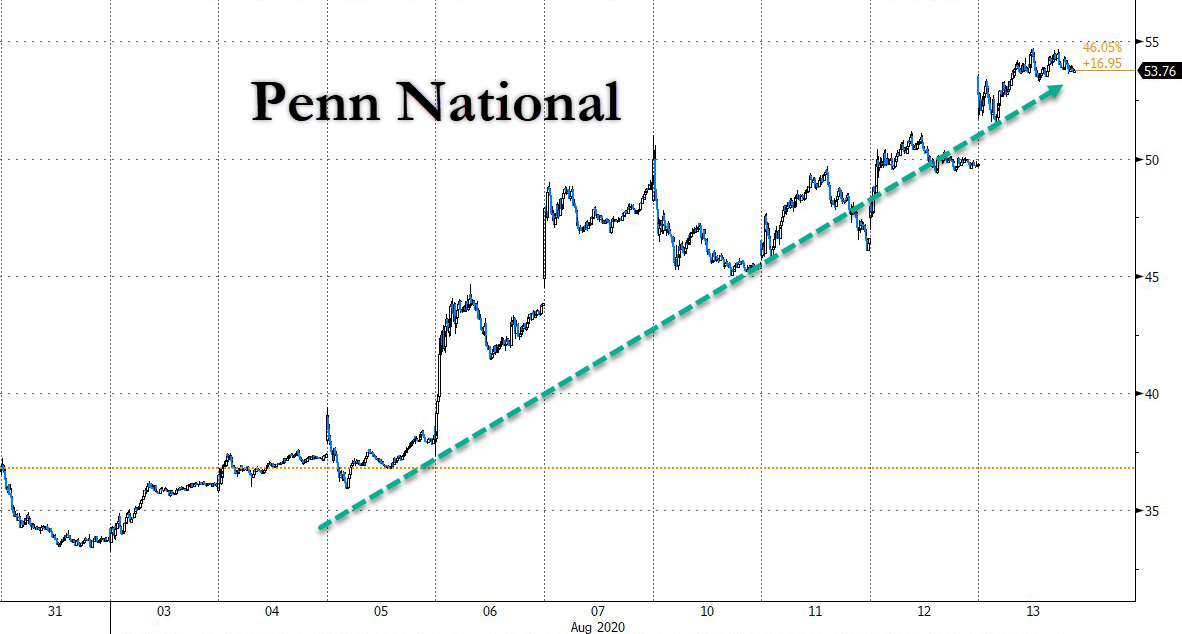
David Portnoy has been having a good Thursday. Earlier, Goldman Sachs’ research department initiated Penn National – Portnoy’s stake in the company from the Barstool deal comprises the bulk of his wealth – with a price target of $60 a share, 20% higher than the price at Wednesday night’s close. As a result, the stock soared.

Apparently, Portnoy is trying to parlay this latest success into riding bitcoin “to da moon”, as they say. In a series of tweets, he proclaimed that the pioneering digital currency is going to “12,000,000,000”.

Does this mean Portnoy is once again essentially frontrunning his arm of “DDTG” loyalists”? It’s possible.

Perhaps Bitcoin’s performance in recent weeks has  Portnoy convinced that traders who have argued for bitcoin as a more appealing alternative to gold – despite its many, many flaws (to be fair, we’re not saying the pet rock is perfect) – might be on the right track.

Of course, on a more fundamental level, buying bitcoin requires making a bet that the systems underlying bitcoin  – namely, the internet, and the bitcoin network – won’t ever be compromised. To be sure, it’s fair to argue that the “digital gold” that’s growing in popularity thanks to ETFs like GLD carries similar risks.

via ZeroHedge News https://ift.tt/30VjXyJ Tyler Durden

You Don’t Have to Vote for Your Party’s Crappy Ticket

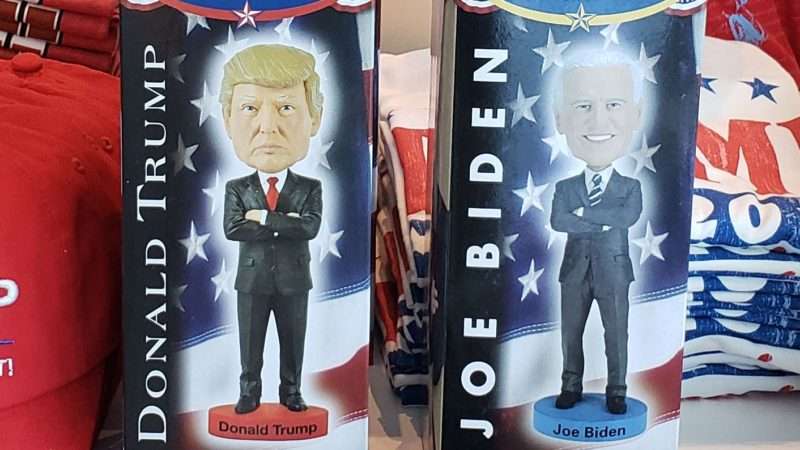
TrumpBiden

You don’t have to strain your imagination to come up with reasons why some (though definitely not most!) Democrats might be less than enthused by vice presidential nominee Sen. Kamala Harris (D–Calif.) or by ol’ whatshisface at the top of the ticket. In a year where criminal justice reform is at or near the front of many progressive agendas, the Dems are pairing California’s self-styled former “top cop” with a guy who once bragged that “every major crime bill since 1976 that’s come out of this Congress, every minor crime bill, has had the name of the Democratic senator from the State of Delaware: Joe Biden.”

And yet, like so many Republican voters who claim to be appalled by the behavior of President Donald Trump, these Democrats will, if they vote, overwhelmingly hold their noses and support a home team that has yet again put forth a less-than-ideal ticket. This despite the fact that so many voters live in states where the 2020 outcome is a foregone conclusion.

How dare anyone make such a confident claim after the projections-shattering debacle of 2016? Here’s how:

In each of the past seven presidential elections, Democratic nominees have won by double-digit margins in California, New York, Illinois, Massachusetts, Maryland, Vermont, the District of Columbia, and Rhode Island. The closest Donald Trump came in any of them last time around was within 16 percentage points in Rhode Island. If you change the margin-of-victory parameters from 10 percentage points to eight, you can also include Hawaii (which was +32 for Hillary Clinton in 2016) and Biden’s home state of Delaware (+11).

That’s a combined 90 million people, 142 electoral college votes, and zero chance of Trump winning, barring belated arrival of the Sweet Meteor O’Death.

Some Democratic residents of these states (and also some non-Democrats who despise Trump and Trumpism) will want to run up the score against the incumbent. But for the subset who don’t, and are disgruntled about their own side’s offering, yet anxious about even the remote possibility of losing, I’m here to tell you that FiveThirtyEight‘s projection model puts Trump’s chances of winning in each of these states at less than 1 percent.

What about red states in tough Republican year? FiveThirtyEight gives Biden the less-than-1-percent-chance treatment in four: Oklahoma, West Virginia, Idaho, and Wyoming. Trump won each of these states by at least 32 percentage points in 2016. That’s another eight million people and 19 electoral votes off the table.

Other states that hold the distinction of A) voting Republican in every presidential election since Reason was founded 52 years ago, B) going GOP by at least nine percentage points every contest this century, and C) preferring Trump last time by 15+ percentage points, include: Utah, Kansas, Nebraska, South Dakota, North Dakota, and Alaska. The Klondike State is notoriously unpredictable and is showing some support for Biden, but FiveThirtyEight gives the other five a chance of between just 2 percent and 8 percent of going rogue. That’s another 10 million people and 25 electoral votes.

Why point out that so much of the electoral map remains stubbornly non-competitive? Partly, it is true, to stick up for that much-reviled cohort I happen belong to: self-described independents, who remain the largest bloc on the political spectrum. And yes, I prefer more political competition to the two major parties, because they don’t come close to representing my political views, and also I am a bit weird.

But the main motivation here is to encourage my depressed partisan friends to use political literacy and what tiny leverage they have to produce more gratifying results.

Behavior that gets rewarded gets repeated. If you reward your party for nominating people you don’t like, chances are very likely that will happen again, sooner rather than later. There is a contradiction in complaining that two-party choices seem to get worse every four years while still voting reliably for one of those choices.

So: Dissatisfied Bernie-bro environmentalist types in California and New York—kick the tires on Green Party nominee Howie “I invented the Green New Deal” Hawkins! Utah Mormons sickened by Trump’s boorishness: Libertarian Jo Jorgensen is a nice lady!

Just because you despise a major-party presidential nominee—trust me, I know the feeling—that doesn’t mean your choice is limited to supporting his or her major-party opponent. Using your vote strategically in states where the outcome is certain gives you at least the remote possibility of positively influencing your own team’s future behavior.

And who knows—if you stop despising your own nominees, maybe one day I will too.

from Latest – Reason.com https://ift.tt/3408ujg
via IFTTT
You Don’t Have to Vote for Your Party’s Crappy Ticket

TrumpBiden

You don’t have to strain your imagination to come up with reasons why some (though definitely not most!) Democrats might be less than enthused by vice presidential nominee Sen. Kamala Harris (D–Calif.) or by ol’ whatshisface at the top of the ticket. In a year where criminal justice reform is at or near the front of many progressive agendas, the Dems are pairing California’s self-styled former “top cop” with a guy who once bragged that “every major crime bill since 1976 that’s come out of this Congress, every minor crime bill, has had the name of the Democratic senator from the State of Delaware: Joe Biden.”

And yet, like so many Republican voters who claim to be appalled by the behavior of President Donald Trump, these Democrats will, if they vote, overwhelmingly hold their noses and support a home team that has yet again put forth a less-than-ideal ticket. This despite the fact that so many voters live in states where the 2020 outcome is a foregone conclusion.

How dare anyone make such a confident claim after the projections-shattering debacle of 2016? Here’s how:

In each of the past seven presidential elections, Democratic nominees have won by double-digit margins in California, New York, Illinois, Massachusetts, Maryland, Vermont, the District of Columbia, and Rhode Island. The closest Donald Trump came in any of them last time around was within 16 percentage points in Rhode Island. If you change the margin-of-victory parameters from 10 percentage points to eight, you can also include Hawaii (which was +32 for Hillary Clinton in 2016) and Biden’s home state of Delaware (+11).

That’s a combined 90 million people, 142 electoral college votes, and zero chance of Trump winning, barring belated arrival of the Sweet Meteor O’Death.

Some Democratic residents of these states (and also some non-Democrats who despise Trump and Trumpism) will want to run up the score against the incumbent. But for the subset who don’t, and are disgruntled about their own side’s offering, yet anxious about even the remote possibility of losing, I’m here to tell you that FiveThirtyEight‘s projection model puts Trump’s chances of winning in each of these states at less than 1 percent.

What about red states in tough Republican year? FiveThirtyEight gives Biden the less-than-1-percent-chance treatment in four: Oklahoma, West Virginia, Idaho, and Wyoming. Trump won each of these states by at least 32 percentage points in 2016. That’s another eight million people and 19 electoral votes off the table.

Other states that hold the distinction of A) voting Republican in every presidential election since Reason was founded 52 years ago, B) going GOP by at least nine percentage points every contest this century, and C) preferring Trump last time by 15+ percentage points, include: Utah, Kansas, Nebraska, South Dakota, North Dakota, and Alaska. The Klondike State is notoriously unpredictable and is showing some support for Biden, but FiveThirtyEight gives the other five a chance of between just 2 percent and 8 percent of going rogue. That’s another 10 million people and 25 electoral votes.

Why point out that so much of the electoral map remains stubbornly non-competitive? Partly, it is true, to stick up for that much-reviled cohort I happen belong to: self-described independents, who remain the largest bloc on the political spectrum. And yes, I prefer more political competition to the two major parties, because they don’t come close to representing my political views, and also I am a bit weird.

But the main motivation here is to encourage my depressed partisan friends to use political literacy and what tiny leverage they have to produce more gratifying results.

Behavior that gets rewarded gets repeated. If you reward your party for nominating people you don’t like, chances are very likely that will happen again, sooner rather than later. There is a contradiction in complaining that two-party choices seem to get worse every four years while still voting reliably for one of those choices.

So: Dissatisfied Bernie-bro environmentalist types in California and New York—kick the tires on Green Party nominee Howie “I invented the Green New Deal” Hawkins! Utah Mormons sickened by Trump’s boorishness: Libertarian Jo Jorgensen is a nice lady!

Just because you despise a major-party presidential nominee—trust me, I know the feeling—that doesn’t mean your choice is limited to supporting his or her major-party opponent. Using your vote strategically in states where the outcome is certain gives you at least the remote possibility of positively influencing your own team’s future behavior.

And who knows—if you stop despising your own nominees, maybe one day I will too.

from Latest – Reason.com https://ift.tt/3408ujg
via IFTTT

Gold Prices Show There’s A “Big Short” Going On In Official Currencies

Gold Prices Show There’s A “Big Short” Going On In Official Currencies

Tyler Durden

Thu, 08/13/2020 – 15:31

Authored by Thorstein Polleit vioa The Mises Institute,

On August 4, 2020, the price of gold surpassed $2,000 per ounce.

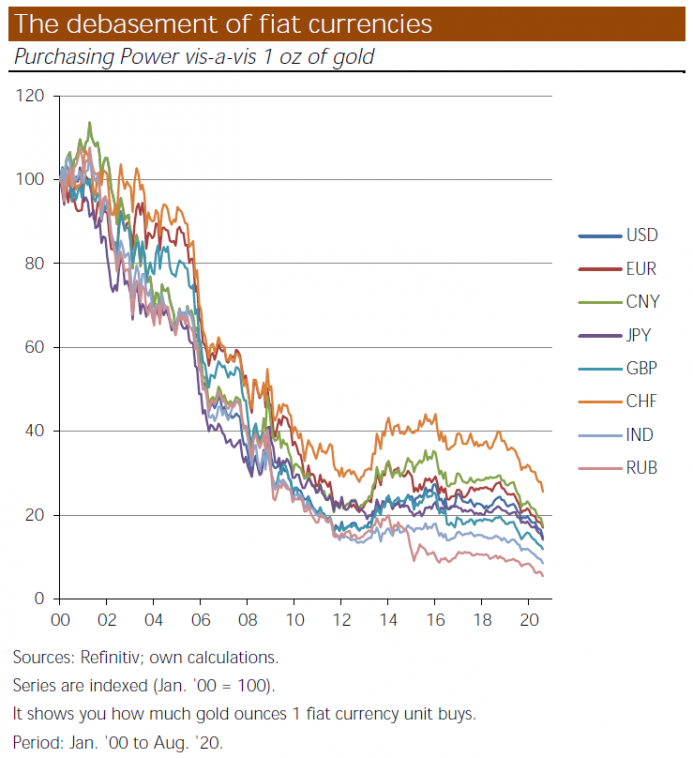
While one may say that the price of gold is on the rise, it would actually be more meaningful to say that the purchasing power of the world’s fiat currencies vis-à-vis gold is on the decline…

…because this is what a rising price for gold and silver in, say, US dollars, euros, Chinese renminbi, Japanese yen, or Swiss francs really stands for: The higher the price of this precious metal, the lower the exchange value of official currencies.

Gold isn’t just a good like any other.

It is special: it is the “ultimate means of payment,” the “base money of civilization.”

 Monetary history bears this out: whenever people were free to choose their money, they went for gold. Indeed, gold has all the physical properties that make for sound money: gold is scarce, homogenous, easily transportable, divisible, mintable, durable, and, last but not least, has a relatively high value per unit of weight. Even though officially demonetized in the early 1970s, people haven’t stop appreciating gold’s “moneyish” qualities.

However, it is not only the rising gold price that indicates that the purchasing power of fiat currencies is on the decline. Basically, all other goods prices go up as well, most notably asset prices—the prices of stocks, bonds, housing, and real estate. This means that you can buy fewer and fewer stocks, bonds, and houses with a given official currency unit. From this perspective, you can rightfully conclude that a broad-based debasement is going on as far as the world’s major official fiat currencies are concerned.

Of course, this is not what most people would wish for, as they prefer to hold a kind of money that doesn’t go down in value, money that actually preserves or even increases its purchasing power over time. Actually no one who is in his right mind would wish to hold inflationary money. Unfortunately, however, central banks have been debasing their official fiat currencies over the last decades. To make things even worse, the monetary debasement is gathering speed due to the consequences of the politically dictated lockdown crisis.

Central banks around the world print up ever greater amounts of fiat currencies to make up for lost income and profits. It is against this background that the rise of goods prices in terms of official currencies can be interpreted in a meaningful way: the rise in the quantity of money will, as an economic law, cause the exchange value of the money unit to go down—either in absolute terms or in relative terms (that is by keeping money prices at a higher level when compared to a situation in which the quantity of money has not been increased).

In view of central banks‘ expansion of the quantity of fiat currency, people increasingly seek to hold assets, such as, say, stocks, housing, real estate, and commodities, that are considered to be “inflation protected.” As they exchange fiat currencies for other goods, the money prices of these goods are bid up, and higher money prices are equivalent to a decline in the purchasing power of fiat currencies. Of course, financial market traders will be among the first to react and benefit, while those less informed will get the shaft.

In a world in which central banks not only ramp up the quantity of fiat currency but also push market interest rates to zero, people get hit particularly hard. Saving in traditional instruments (bank deposits, money market funds, etc.) is made impossible. The artificially lowered interest rates also contribute to asset price inflation: the prices of stocks and real estate are driven upward. Those holding fiat currencies suffer losses as far as their purchasing power is concerned, while people who hold assets that gain in price are on the receiving end.

Unfortunately, an end to central banks’ inflationary policies is not in sight. There is the widespread and deeply entrenched belief among people that an increase in the quantity of fiat currency would make the economy richer, and that it would help overcome financial and economic crises. This is, however, a serious mistake, for all an increase in the stock of money does is make some richer at the expense of many others. And an inflation policy can cover up economic and financial problems only for so long.

Ludwig von Mises wrote:

The collapse of an inflation policy carried to its extreme—as in the United States in 1781 and in France in 1796—does not destroy the monetary system, but only the credit money or fiat money of the State that has overestimated the effectiveness of its own policy. The collapse emancipates commerce from etatism and establishes metallic money again.1

Mises’s words should help us to better understand why the appreciation of gold (and lately also silver) vis-à-vis the fiat currency universe has been underway for quite some time now.

via ZeroHedge News https://ift.tt/31O9dRX Tyler Durden

Chinese City Finds Traces Of COVID-19 On Chicken-Wing Packaging

Chinese City Finds Traces Of COVID-19 On Chicken-Wing Packaging

Tyler Durden

Thu, 08/13/2020 – 15:12

China is once again implying that “imported” COVID-19 cases may have been caused by imported foodstuffs. First it was shrimp and salmon from Norway and Ecuador, now it’s frozen chicken wings from Brazil.

Reuters reported that authorities in Shenzen found traces of the virus on the packaging of the chicken wings imported from Brazil, a country with one of the worst outbreaks in the world. One day later, a similar discovery was made in Xian City, though this time on packages of frozen shrimp from Ecuador.

Shenzhen’s health authorities did thorough testing and tracing, and eventually said they found no new cases connected to the packaging.

Reports of contaminated food have led supermarkets and markets across the country to ditch fresh salmon and shrimp, destroying millions of dollars of product. However, we’ve started to wonder whether the tests used by the Chinese authorities might be set off by something else in the packaging.

The Brazilian embassy in Beijing did not immediately respond to a request for comment.

“It is hard to say at which stage the frozen chicken got infected,” said a China-based official at a Brazilian meat exporter.

The Shenzhen Epidemic Prevention and Control Headquarters said the public needed to take precautions to reduce infection risks. Meanwhile, the WHO said Thursday that there are no confirmed examples of the virus being “food borne”.

via ZeroHedge News https://ift.tt/2E0lQ46 Tyler Durden

Chicago Rioters Attacked Charity Building With Sick Children Inside

Chicago Rioters Attacked Charity Building With Sick Children Inside

Tyler Durden

Thu, 08/13/2020 – 14:51

Authored by Paul Joseph Watson via Summit News,

Amidst looting of stores in downtown Chicago on Sunday night, it has now emerged that rioters also attacked a charity building with sick children inside.

The Streeterville neighborhood of Chicago’s Near North Side is home to the Ronald McDonald House, which provides care and support for sick children and their families while they are receiving treatment at nearby Lurie Children’s Hospital.

That building became the target of rioters in the early hours of Monday morning as more than 30 families sleeping inside huddled together in fear.

“The charity said more than 30 families and their sick children were sleeping inside when the looters, who had taken over downtown, ransacking stores and vandalizing properties, started attacking the building,” reports the Washington Times.

The building was placed on lockdown after rioters began smashing front windows and a door had to be boarded up.

Thankfully, no one was injured.

According to Lisa Mitchell of Ronald McDonald House Charities, staff were “frightened” and families were put under “additional stress and worry” over fears that they wouldn’t be able to get to the hospital if necessary.

“No one was injured, at least not physically,” writes Dave Blount. “Fortunately, none of the mostly peaceful protesters thought to set the building on fire, as they did recently after blocking exits from the East Precinct in Portland.”

“Anyone who aids and abets rioting shares responsibility for the results, whatever those results may turn out to be. That applies to the Democratic Party, the mainstream media, pro sports, and the rest of the riot-rewarding, pro-BLM liberal establishment.

*  *  *

My voice is being silenced by free speech-hating Silicon Valley behemoths who want me disappeared forever. It is CRUCIAL that you support me. Please sign up for the free newsletter here. Donate to me on SubscribeStar here. Support my sponsor – Turbo Force – a supercharged boost of clean energy without the comedown.

via ZeroHedge News https://ift.tt/2DGfQ0N Tyler Durden

America’s Biggest Companies Fear Trump’s WeChat Ban Will Cut Them Off From World’s Largest Market

America’s Biggest Companies Fear Trump’s WeChat Ban Will Cut Them Off From World’s Largest Market

Tyler Durden

Thu, 08/13/2020 – 14:30

Talks between TikTok-owner ByteDance and Microsoft are up in the air, but while seemingly every incremental development about the negotiations becomes front page news in the business press, the business community might actually be more worried about the fate of WeChat, and what the administration’s executive order might mean for members’ bottom line.

Because whether Trump likes it or not, China is the world’s biggest market (by population) and second-biggest economy after the US (Chinese economists argue that it’s already larger than the economy of the US). And WeChat is critical medium through which Chinese consumers perform a multitude of tasks, from paying their bills, to ordering takeout, to shopping online – and so much more.

According to a WSJ report, more than a dozen major US multinational companies raised concerns with the administration during a call with White House officials on Tuesday to discuss the scope and impact of Trump’s executive order, which won’t take effect until Sept. 15.

Apple, Ford Motor, Walmart and Walt Disney were among those participating in the call, along with P&G, Intel, MetLife, Goldman Sachs, Morgan Stanley, United Parcel Service, Merck and Cargill.

To put it succinctly, these companies are afraid that the administration’s action could inadvertently force them off the WeChat platform in China, which would put practically every American company that does substantial business in China at an even bigger disadvantage to domestic companies.

Even so, US companies are concerned the administration’s action could effectively cut them off from access to the lucrative China market, for example by ending their ability to accept payments or advertise on WeChat. As one of WSJ’s ‘expert’ sources said, many Americans simply don’t understand how dominant WeChat is in the Chinese market.

“For those who don’t live in China, they don’t understand how vast the implications are if American companies aren’t allowed to use it,” said Craig Allen, president of the U.S.-China Business Council. “They are going to be held at a severe disadvantage to every competitor,” he added.

Even beyond WeChat, its owner Tencent is even more dominant: Disney and the other entertainment focused companies are concerned that Tencent could retaliate by cutting them off from its domestic platforms. The NBA is worried about a streaming deal with Tencent, and a spokesman Mike Bass said the league is “awaiting further clarity on the executive order.”

Chinese officials are also eager to talk and figure out what, exactly, is going on, which is perhaps why they’re reportedly pushing to modify the six-month “review” of the Phase 1 trade deal and instead discuss the administration’s actions when the two delegations hold a virtual check in next week.

With the election coming up in a few months, we would be shocked if the Trump Administration actually followed through with any plan that would effectively exclude American companies from the Chinese market. While there isn’t much that can shake markets out of their centrally-planned trajectory, such a steep drop in Apple’s smartphone sales just might do it. Remember what happened last time Apple’s China business hit a speed bump?

via ZeroHedge News https://ift.tt/2Fq10fr Tyler Durden

Welcome Back To (Virtual) Campus, and Follow Along My Classes This Semesters on YouTube

Our semester at the South Texas College of Law Houston begins on Monday. As usual, I will live-stream all of my classes. (The camera will be on me, so fortunately, you will not see the Zoom grid). I welcome everyone to stream along. I teach Mondays and Wednesday. Property II will meet from 9:00-10:15 CT, and Constitutional Law will meet from 10:30-12:10 CT. You can subscribe to my channel here.

In the meantime, you can watch the “mock” 1L Orientation Class I gave today. I hope my advice specific for this semester is helpful for others.

from Latest – Reason.com https://ift.tt/30UGWtI
via IFTTT

Welcome Back To (Virtual) Campus, and Follow Along My Classes This Semesters on YouTube

Our semester at the South Texas College of Law Houston begins on Monday. As usual, I will live-stream all of my classes. (The camera will be on me, so fortunately, you will not see the Zoom grid). I welcome everyone to stream along. I teach Mondays and Wednesday. Property II will meet from 9:00-10:15 CT, and Constitutional Law will meet from 10:30-12:10 CT. You can subscribe to my channel here.

In the meantime, you can watch the “mock” 1L Orientation Class I gave today. I hope my advice specific for this semester is helpful for others.

from Latest – Reason.com https://ift.tt/30UGWtI
via IFTTT

Most Americans Don’t Trust Cops Much, a New Gallup Poll Reveals

Indianapolis-cops-beating-protester-cropped

Most Americans do not trust cops much, according to new poll results that put public confidence in the police at a record low level. From 2019 to 2020, Gallup reports, “confidence in the police fell five points to 48%, marking the first time in the 27-year trend that this reading is below the majority level.”

Since Gallup began asking the question in 1993, the share of American adults who said they had “a great deal” or “a lot” of confidence in the police has ranged from 52 percent to 64 percent. In the latest poll, which was conducted in late June and early July, that number fell to 48 percent. Meanwhile, 33 percent of respondents said they had “some” confidence in the police, while 17 percent said “very little” and 2 percent said “none.”

The decline in confidence, which follows nationwide protests triggered by George Floyd’s death at the hands of Minneapolis police on May 25, is especially striking when compared to the trends for other institutions. From 2019 to 2020, confidence in the medical system and the public schools rose by 15 and 12 points, respectively. Confidence in small businesses and organized religion also rose substantially (by seven and six points, respectively), and even Congress rated slightly better this year than last (rising from 11 percent to 13 percent confidence).

As in prior years, there are stark partisan and racial gaps in attitudes toward the police. “Confidence in the police rose seven points among Republicans to 82% and dropped six points among Democrats to 28%,” Gallup notes. And while 56 percent of white adults had “a great deal” or “a lot” of confidence in police, only 19 percent of black adults did.

The latter result may seem surprising in light of another Gallup finding: More than four-fifths of black respondents said they did not want police to spend less time in their neighborhoods. Sixty-one percent said the current police presence should be maintained, while 20 percent said it should be increased. As my colleague Nick Gillespie suggests, those findings cast doubt on the popularity of calls to “defund” or abolish police departments. But there is nothing inconsistent in wanting police to do their jobs without abusing the citizens they are supposed to serve.

Among adults generally, confidence in the police stood at 52 percent in 1993 and peaked at 64 percent in 2004. There is little reason to think police abuse has gotten worse since then, but publicity about it certainly has increased. The ubiquity of cameras in the pockets of cellphone owners, on storefronts, on the dashboards of squad cars, and on the bodies of police officers has a lot to do with that. The public understanding of controversial police encounters, which once depended on conflicting accounts from cops and people who claimed to have been victimized by them (sometimes coupled with possibly unreliable bystander testimony), is nowadays routinely informed by compelling video footage.

Floyd’s death never would have gotten the attention it did without cellphone video that clearly showed Derek Chauvin kneeling on the neck of a handcuffed, prone arrestee whose resistance at the time was limited to complaining that he could not breathe and begging for his life. And in the aftermath of that horrifying incident, when police officers across the country seemed intent on validating public suspicion by using excessive force against peaceful demonstrators protesting such abuse, video evidence was again crucial in documenting their misconduct.

This week, for example, two Indianapolis officers were charged with assaulting two women at a protest on May 31. A protester alleged that the officers, Jonathan Horlock and Nathaniel Schauwecker, attacked her with batons and pepper balls without provocation. Her companion, a photographer, said one of the officers shoved her to the pavement when she objected to the protester’s treatment. While the officers claimed they used appropriate force while arresting the women for violating a local curfew, video of the incident told a different story. Now Horlock and Schauwecker both face battery charges, while Horlock is also charged with perjury and obstruction of justice because he lied about the encounter, falsely claiming that the protester had hit a police sergeant in the chest.

The response from the local police union was notably muted. “We look forward to a full, fair and public airing of all of the facts and circumstances surrounding the events in question,” the Indianapolis Fraternal Order of Police said yesterday. “While officers prefer to avoid any use of force, we fully recognize the requirement to safely and swiftly effectuate the lawful arrest of individuals when called upon to do so, especially during tense and rapidly evolving events. Therefore, we welcome a robust review of these allegations and have confidence in the process.”

The restrained tone of that statement contrasts sharply with the strident, diehard defenses that we frequently hear from police unions. That reflex, which elevates the personal interests of particular cops about the broader interests of the profession, is one of the things that will have to change if police want to rehabilitate their reputation and restore public confidence in their work.

from Latest – Reason.com https://ift.tt/30R1WBw
via IFTTT