L.A.’s Plan To Solve Its Homeless Problem Is a Mess

More than 2,500 homeless individuals sleep on the streets of the 53-square-block Skid Row area in downtown Los Angeles.

“Skid row is the worst man-made disaster in the United States. There’s human waste on the sidewalks. There’s all kinds of disease,” says Rev. Andy Bales, CEO of Skid Row’s Union Rescue Mission, the nation’s largest private homeless shelter.

While California’s homelessness crisis extends far beyond L.A., the city’s predicament is notable for its sheer scale. It has the highest unsheltered homeless population in the country, and more than 1,000 homeless people died on the streets of Los Angeles County last year, according to government figures. The problem is so bad that in 2016, 76 percent of L.A. voters approved a bond referendum to spend more than $1.2 billion in public funds on 10,000 new apartment units for the homeless.

The plan called for completing construction within a decade, but just 1 percent of those apartments will be ready for occupancy by the end of 2019. Now, homeless advocates like Bales are concerned that the city is wasting money on the most expensive possible solution—one that might not work as advertised even if it weren’t behind schedule and likely to bust its own budget.

The city’s approach to homelessness, known as “housing first,” was adopted by municipalities nationwide after Utah reportedly reduced chronic homelessness by 91 percent by giving away permanent apartments with no strings attached. But state auditors later attributed those findings to a data collection error. Utahans don’t actually know what effect various programs have had on the state’s homeless population, which, in any case, is estimated to be two-thirds the size of just Skid Row’s.

What’s more, building housing for the homeless is considerably more costly and complex in Los Angeles than in Salt Lake City, thanks to local and statewide zoning and environmental regulations that allow labor unions, homeowners, and other parties to bring housing development to a standstill. Advocates are now watching in frustration as such roadblocks drive up the cost of the city’s housing first efforts, while cheaper, faster solutions congeal on the back burner.

L.A. initially estimated the permanent units would have a median cost of $350,000 apiece—not cheap to begin with. Three years later, the estimated cost has increased to more than $500,000 per unit, with some units approaching $700,000. (The median price of a condo in Los Angeles was $581,000 as of this writing.)

“We cannot spend $600,000 per person per unit and ever get it done,” says Bales. “We’ve got to think innovatively or we’re going to have a bigger disaster on our hands.”

Union Rescue Mission just opened what’s called a Sprung structure—a relatively inexpensive but sturdy and weather-resistant tent with 120 beds. Bales wants the city to invest more in Sprung structures and other cheap, easily constructed solutions like mobile homes, container homes, or even 3D-printed houses (see page 5). Under increasing pressure in recent months, the city has erected a few of its own Sprung structures to address the crisis, but Bales believes it’s still not nearly enough.

“It’s ridiculous,” he says. “I mean, who would want to leave 44,000 people on the streets to die while you stick with your very expensive plan to help a few?”

For a video version of this story, visit reason.com.

from Latest – Reason.com https://ift.tt/2UD25G8
via IFTTT

‘Diamond Princess’ Reports 66 New Coronavirus Infections, Bringing Total Onboard To 136

‘Diamond Princess’ Reports 66 New Coronavirus Infections, Bringing Total Onboard To 136

The nightmare cruise from hell just got even worse for the thousands of passengers still aboard.

The Diamond Princess, the cruise ship that has been quarantined off the coast of Yokohama, Japan for roughly a week now, saw the total number of confirmed nCoV infections climb to 136 on Monday, cementing its position as the host of the largest outbreak outside China.

Japanese health authorities have been extremely careful in dealing with the ship, which has become a massive albatross for the government of PM Shinzo Abe. While Hong Kong let a cruise ship sail yesterday following a 4-day quarantine (the ship was reportedly found to be free of viral infections), the ‘Diamond Princess’, and the 2,500+ remaining passengers and crew, will be stuck in place until mid-February. The NYT chronicled the growing sense of unease and paranoia aboard the ship, which we cited yesterday.

The ship’s captain Stefano Ravera announced Monday that 66 new cases of the virus had been confirmed, bringing the infection total of passengers and crew to 136, roughly equal to all the other cases in Asia outside China. Media reports have claimed more than 2,500 passengers and crew remain aboard the ship.

According to CNBC, the nationalities of the newly infected are Japanese (45), American (11), Australian (four), Filipino (three), Canadian (one), English (one) and Ukrainian (one). Notably, all of these infections occurred person to person, since they were all spread from ‘patient zero’ to others aboard the ship.

Princess Cruises, the Carnival Japan unit that owns the ship, told NBC News that it was continuing to follow guidance from Japan’s health ministry regarding plans for providing medical care and passengers ultimately disembarking. Meanwhile, one passenger told the NYT yesterday that those aboard the ship are being left in the dark, and have resorted to tracking the comings and goings of ambulances to try to keep abreast of what’s going on. Many suspect the virus has been spread through the ship’s ventilation system.

The ship was quarantined for two weeks after a passenger who disembarked in Hong Kong on Jan. 25 tested positive for the virus six days after leaving. After initially finding no cases aboard the ship, the cruise line copped to the first ten cases, prompting more intense scrutiny by the Japanese government. Princess Cruises said it didn’t expect new cases to be confirmed after the beginning of the quarantine, though that has clearly happened.

So far, it doesn’t look like the virus has made the jump from the ship to the surrounding area. If that happens, expect Japanese authorities to resort to the same types of draconian quarantine measures that have been imposed in China.


Tyler Durden

Mon, 02/10/2020 – 06:07

via ZeroHedge News https://ift.tt/2Sf5eKL Tyler Durden

L.A.’s Plan To Solve Its Homeless Problem Is a Mess

More than 2,500 homeless individuals sleep on the streets of the 53-square-block Skid Row area in downtown Los Angeles.

“Skid row is the worst man-made disaster in the United States. There’s human waste on the sidewalks. There’s all kinds of disease,” says Rev. Andy Bales, CEO of Skid Row’s Union Rescue Mission, the nation’s largest private homeless shelter.

While California’s homelessness crisis extends far beyond L.A., the city’s predicament is notable for its sheer scale. It has the highest unsheltered homeless population in the country, and more than 1,000 homeless people died on the streets of Los Angeles County last year, according to government figures. The problem is so bad that in 2016, 76 percent of L.A. voters approved a bond referendum to spend more than $1.2 billion in public funds on 10,000 new apartment units for the homeless.

The plan called for completing construction within a decade, but just 1 percent of those apartments will be ready for occupancy by the end of 2019. Now, homeless advocates like Bales are concerned that the city is wasting money on the most expensive possible solution—one that might not work as advertised even if it weren’t behind schedule and likely to bust its own budget.

The city’s approach to homelessness, known as “housing first,” was adopted by municipalities nationwide after Utah reportedly reduced chronic homelessness by 91 percent by giving away permanent apartments with no strings attached. But state auditors later attributed those findings to a data collection error. Utahans don’t actually know what effect various programs have had on the state’s homeless population, which, in any case, is estimated to be two-thirds the size of just Skid Row’s.

What’s more, building housing for the homeless is considerably more costly and complex in Los Angeles than in Salt Lake City, thanks to local and statewide zoning and environmental regulations that allow labor unions, homeowners, and other parties to bring housing development to a standstill. Advocates are now watching in frustration as such roadblocks drive up the cost of the city’s housing first efforts, while cheaper, faster solutions congeal on the back burner.

L.A. initially estimated the permanent units would have a median cost of $350,000 apiece—not cheap to begin with. Three years later, the estimated cost has increased to more than $500,000 per unit, with some units approaching $700,000. (The median price of a condo in Los Angeles was $581,000 as of this writing.)

“We cannot spend $600,000 per person per unit and ever get it done,” says Bales. “We’ve got to think innovatively or we’re going to have a bigger disaster on our hands.”

Union Rescue Mission just opened what’s called a Sprung structure—a relatively inexpensive but sturdy and weather-resistant tent with 120 beds. Bales wants the city to invest more in Sprung structures and other cheap, easily constructed solutions like mobile homes, container homes, or even 3D-printed houses (see page 5). Under increasing pressure in recent months, the city has erected a few of its own Sprung structures to address the crisis, but Bales believes it’s still not nearly enough.

“It’s ridiculous,” he says. “I mean, who would want to leave 44,000 people on the streets to die while you stick with your very expensive plan to help a few?”

For a video version of this story, visit reason.com.

from Latest – Reason.com https://ift.tt/2UD25G8
via IFTTT
Half Of Amsterdam Women Are Intimidated On The Street, Says Mayor

Half Of Amsterdam Women Are Intimidated On The Street, Says Mayor

Via FreeWestMedia.com,

The Amsterdam city leadership is greatly concerned about the safety of girls and women in Amsterdam. But the mayor does not want the real perpetrators to be blamed.

According to Mayor Femke Halsema, girls and young women are being confronted with sexual intimidation or violence in increasing numbers. Therefore, she is announcing measures, Dutch daily De Telegraaf reported.

Research shows that 51 percent of women in Amsterdam have been confronted with street intimidation. For the ages 15 to 34, the percentage is 81 percent. Many reports come especially from the region around the Central Station, by the red-light district, around the Leidseplein, Bijlmer, Jan Evertsenstraat and the Mercatorplein. Also online there has been a large increase in sexual harassment and violence. These areas happen to be populated by immigrants.

Halsema claims that for a smaller group of girls and women the situation in Amsterdam is “really alarming and almost hopeless due to a negative spiral of abuse and violence, sometimes extended over several generations”. The most unsafe place for women is at home; many perpetrators are ex-partners or family members. In Amsterdam, for example, the number of registered violent incidents went up by 7 percent: from 6 183 in 2017 to 6 608 in 2018.

The figures have been a reason for Halsema to launch a campaign, the focus of which is victims of sexual intimidation and violence, on the street or online. One of the aims is to create a greater readiness to report such incidents, so that the police and the Public Prosecution Service can conduct investigations. A personal approach is also being launched for girls who have repeatedly been victims of sexual violence.

Halsema is also entering into talks with the hotel-restaurant and night club industry because personnel are likely to see the practices of pinching, intimidation and abuse. “Most do not count this as one of their responsibilities.”

For victims, safe places to live have become the most sought after, even outside the city. Social workers are also encouraged to work differently.

“Social workers and parents often have little control, and there also seems to be a professional inability whereby the problems are not recognized or cases where people do not communicate properly,” says the mayor.

In addition, the existing area ban that the mayor proposed on notorious nuisance offenders will also be put in place for people who annoyingly hang around near a shelter for vulnerable girls, or who are demonstrably sexually intrusive on the street.

The causes of sexual intimidation and violence, just like the situations in which the victims find themselves, are diverse, writes Halsema. Along with classical patterns of power inequality, based on tradition or physical strength, in Amsterdam, “reactionary ideas about the equality of men and women have reappeared”.

She refers to a study in which it is alleged that rising religious fundamentalists as well as “secular extreme-right movements” encourage and justify hate toward women.

“Under the mask of a restoration of traditional role patterns, whereby women are subordinate to the demands and wishes of men, a woman’s ‘no’ is openly doubted or ignored. With the presence of religious fundamentalism in our local society, there is even talk of the re-entry of age-old and forbidden phenomena such as forced marriages and female circumcision.

Femke Halsema represents the party GroenLinks, which has never questioned immigration as the only possible reason for the surge of crimes targeting women and girls. Instead, she is trying to blame men in general and in particular conservative men. The irony was not lost on Geert Wilders, who tweeted in response: “How did that happen?” with a picture of Muslim men verbally harassing a Dutch girl.

Halsema writes that almost all woman in Amsterdam have felt unsafe, either in public spaces or in the private domain.

“The same goes for LGBHQ people. Walking hand in hand can be risky. Being alone can put your safety and physical integrity at risk. Not only on the street, but also behind closed doors, in houses, hotels and schools, the security and freedom of a portion of Amsterdamers cannot always be guaranteed. This is not only sad, it is also unacceptable.”

Amsterdam earlier introduced a ban on street intimidation, but it is not enforced in the capital city because the court in the Hague earlier ruled that the similar Rotterdam provision is not legally valid. According to the judges, such a ban can only be introduced by the Second and First Chambers of Parliament.


Tyler Durden

Mon, 02/10/2020 – 05:00

via ZeroHedge News https://ift.tt/38hrzgm Tyler Durden

Brickbat: It Does a Body Good

The Virginia House Agriculture, Chesapeake and Natural Resources committee has approved a bill that would define milk as being “obtained by the complete milking of a healthy hooved animal.” It would bar plant-based milk products from being marketed as milk. The bill now goes to the full House for a vote.

from Latest – Reason.com https://ift.tt/37dErmf
via IFTTT

Gen Z Is Lonely

Gen Z Is Lonely

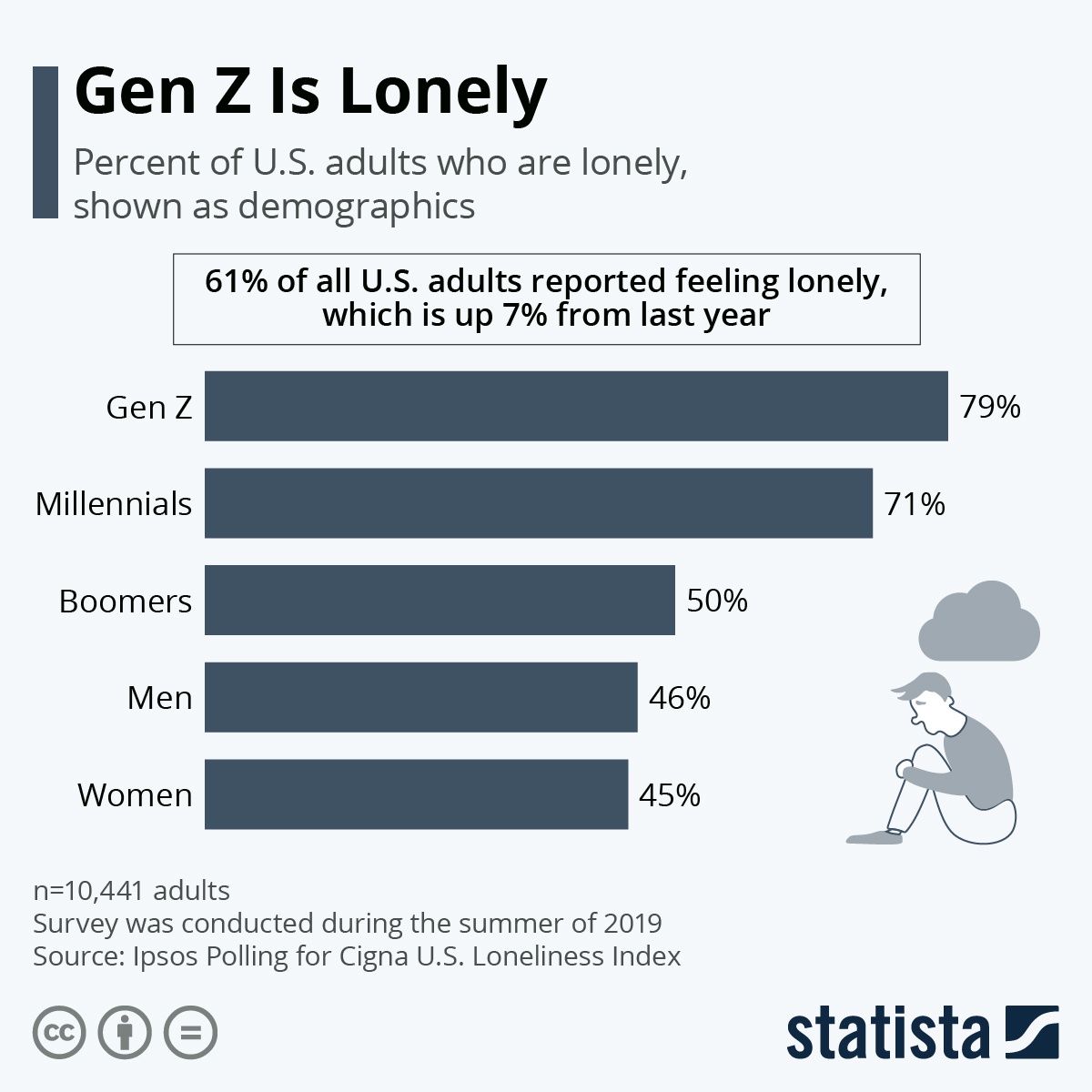
Gen Z feels like the most isolated generation, according to a survey conducted by insurance provider Cinga. For the past two years they have measured loneliness through the U.S. Loneliness Index. In 2019, the insurance company polled more than 10,000 U.S. adults over the summer.

79 percent of Gen Z, or adults in the 18 to 22 age group, said they felt alone, and as Statista’s Maria Vultaggio notes, Millennials aren’t too far behind them, with 71 percent saying they’re lonely. At 50 percent, Boomers felt the least alone. At 46 percent versus 45, men felt a little more cut off than women.

Infographic: Gen Z Is Lonely | Statista

You will find more infographics at Statista

The new information suggests overall that Americans might be getting lonelier. There was a 7 percent rise: 54 percent said they were lonely in 2018 and 61 percent—or three in five people—said they felt isolated in 2019.

Social media could be to blame, and it makes sense since Gen Z is most connected to online networking.

“We had a hypothesis that society—the U.S. specifically—was dealing with an elevated level of loneliness, disconnection,” Cigna CEO David Cordani told CNBC in a January report.

“We can start to see those disconnections manifest themselves in other health issues showing up for individuals … whether you think about it through the lens of depression, stress … or more heavy, complex behavioral issues.”


Tyler Durden

Mon, 02/10/2020 – 04:15

via ZeroHedge News https://ift.tt/31DmmNi Tyler Durden

Brickbat: It Does a Body Good

The Virginia House Agriculture, Chesapeake and Natural Resources committee has approved a bill that would define milk as being “obtained by the complete milking of a healthy hooved animal.” It would bar plant-based milk products from being marketed as milk. The bill now goes to the full House for a vote.

from Latest – Reason.com https://ift.tt/37dErmf
via IFTTT

The Race For Arctic Oil Is Heating Up

The Race For Arctic Oil Is Heating Up

Authored by Tsvetana Paraskova via OilPrice.com,

Despite climate concerns and environmentalist backlash against exploration for oil and gas in pristine sensitive regions of the Arctic, companies continue to explore for hydrocarbon resources in the Arctic Circle, in Russia and Norway in particular

The largest Russian energy companies are looking to explore more Arctic oil and gas resources on and offshore Russia, while Norwegian and other Western oil firms are digging exploration wells in Norway’s Barents Sea.

Those companies lead the development efforts to tap more Arctic oil and gas resources as legacy oil and gas fields both offshore Norway and onshore Russia mature.  

Russia’s biggest energy firms Gazprom, Rosneft, Novatek, and Lukoil, and Norway’s oil and gas giant Equinor, as well as Aker BP and ConocoPhillips, are the top oil and gas producers in the Artic region, data and analytics company GlobalData said in a new report. Gazprom is the undisputed leader in Arctic oil and gas production, followed, at a long distance, by two other Russian firms, Rosneft and Novatek, GlobalData’s estimates show.

Russian firms are ramping up exploration in Russia’s Arctic, while Equinor and other Western companies drill exploration wells in Norway’s Barents Sea, hoping for a significant discovery that could add to the Johan Castberg oilfield—a massive discovery which was made in 2011, but which hasn’t been replicated in the Barents Sea so far.  

Yet, both Russia and Norway face specific challenges in getting the most out of their respective Arctic oil and gas resources.

In Russia, the government has made Arctic oil and gas development a key priority and offers tax breaks for firms exploring in the area.

Energy giants Gazprom and Rosneft dominate the exploration and development efforts in Russia’s Arctic. Offshore, Gazprom’s Prirazlomnoye field is currently the only producing Russian oil and gas project on the Arctic Shelf.

But even with tax breaks, Russia may find it hard to develop its offshore Arctic resources, due to the U.S. sanctions banning collaboration on Russian deepwater, Arctic offshore, or shale projects with Gazprom, Gazprom Neft, Lukoil, Surgutneftegas, and Rosneft. These are the largest energy firms in Russia and they don’t have access to capital at western banks to develop such projects. In the wake of the sanctions, many Western oil firms withdrew from joint ventures with Russian companies, which are now left without partnerships in technology needed to explore, drill, and potentially produce and process hard-to-extract oil and gas resources. 

Although Russian firms downplay the effects of the U.S. sanctions on their development plans, and although domestic companies are focused on developing in-house technology solutions to replace foreign-sourced tech, analysts believe that 100-percent local content technology in challenging projects would likely take years to implement.

Financing for large onshore projects in the Arctic is not easy either. Rosneft, which wants to develop the Vostok Oil project, to “implement a complex development program for a new oil and gas province in the north of the Krasnoyarsk Territory,” is looking east to gather funding for the US$157 billion project—to Japan, India, and China.

Russia’s largest private natural gas producer, Novatek, is one of the success stories of Arctic resource development. Novatek—which already exports liquefied natural gas (LNG) from the Yamal LNG plant—gave last year the go-ahead to its second LNG project, Arctic LNG 2 on the Gydan Peninsula. Novatek’s partners in the ventures are France’s Total with a minority stake as well as Chinese and Japanese companies.

Last year, Russian officials said that the Arctic area could become the key driver of Russia’s natural gas production in less than two decades, as it has the potential to produce 90 percent of all the gas produced in Russia by 2035.

Norway’s Arctic areas open to exploration are parts of the Barents Sea, where companies are struggling to finally make a large-size discovery after Johan Castberg. Norwegian authorities say that the Barents Sea holds 64 percent of the yet to be discovered resources on the Norwegian Continental Shelf, while the North Sea and the Norwegian Sea each are estimated to hold 18 percent of the undiscovered resources. 

Last year, just five wells were drilled in the Barents Sea, fewer than in 2018. In 2019, a total of 17 new discoveries were made offshore Norway, of which only one was in the Barents Sea.

Norway’s Equinor says that it continues to explore in the Barents Sea because more oil will be needed in the world just to maintain supplies.

“Discoveries in the Barents Sea can lead to significant economic development, nationally and locally. Based on our understanding of the geology, we hope to find high quality light oil that’s in demand—and better for the climate. The wells we drill in the Barents Sea are cheaper than many others, thanks to the geology and shallower waters,” says the Norwegian giant.

In 2020, Equinor will focus on exploration in the western part of the Barents Sea, Tim Dodson, Executive Vice President, Exploration at Equinor, told Reuters in November.

Norway and Russia are leading Arctic oil and gas development, but they both face challenges in making the Arctic the next oil hotspot.  


Tyler Durden

Mon, 02/10/2020 – 03:30

via ZeroHedge News https://ift.tt/37jOaYo Tyler Durden

Iran Fails For Fourth Time In A Row To Put A Satellite Into Orbit

Iran Fails For Fourth Time In A Row To Put A Satellite Into Orbit

Iran’s attempt to jump start and advance its space program has suffered yet another hit, after on Sunday state television confirmed the latest attempt of an Iranian rocket to put a satellite into orbit has failed

The launch operation at Imam Khomeini Spaceport, about 145 miles southeast Tehran, initially succeeded but then ultimately failed due to the Simorgh or “Phoenix” rocket’s low speed, resulting in the Zafar 1 communications satellite not reaching orbit, according to the AP

A prior satellite launch by Iran a year ago that also ended in failure, via Fars/AP.

“Stage-1 and stage-2 motors of the carrier functioned properly and the satellite was successfully detached from its carrier, but at the end of its path it did not reach the required speed for being put in the orbit,” Defense Ministry space program spokesman Ahmad Hosseini said on state TV.

Sunday’s failure now makes four recent space launch operations in a row ending in failure, after the attempted launches of the Payam and Doosti satellites failed last year, as well as a launchpad explosion in August.

This has raised suspicions and accusations by Iran’s leaders that Israel or the United States could be behind sabotaging the program

Last September, Washington imposed sanctions on Iran’s space agency, its space research center, as well as astronautics research institute — given all of these are seen as assisting development of technology related to Iran’s ballistic missiles capability. 

The Trump administration has consistently charged that Iran’s space program is geared toward advancing its banned ICBMs.

Over the past decade Iran has successfully put several short-lived satellites into orbit, but has been unable to advance beyond this. 

Despite yet another embarrassing setback for the program, Iran’s Defense Ministry still praised Sunday’s launch as “remarkable” given the progress up to the point of failing to get the satellite into orbit. 


Tyler Durden

Mon, 02/10/2020 – 02:45

Tags

via ZeroHedge News https://ift.tt/2tIcXr5 Tyler Durden

Dissatisfaction With Democracy Reaches All-Time High

Dissatisfaction With Democracy Reaches All-Time High

Authored by Michela Palese via TruePublica.org,

A new report by the recently established Centre for the Future of Democracy at the University of Cambridge has found that dissatisfaction with democracy has reached an all-time global high. Westminster-style democracies (the UK, Australia, Canada, New Zealand and the US) typically fare particularly badly in terms of democratic faith, with the proportion of citizens dissatisfied with the performance of their democracy doubling since the 1990s. In the UK, this proportion increased by around a fifth since then.

The global financial and economic crisis and growing within-country regional inequality are of course important factors behind decreasing satisfaction with democracy. But the Centre’s report also suggests that ‘satisfaction with democracy is lower in majoritarian “winner-takes-all” systems than in consensus-based, proportionally representative democracies’. The antagonistic and adversarial mentality inherent in the outdated First Past the Post voting system found in majoritarian, Westminster-style democracies contributes to polarisation and tribalism, making citizens less willing to compromise and to accept the mandate of rival political parties or viewpoints. By contrast, New Zealand is the only Westminster-style democracy to have avoided the trend of ever-increasing public discontent, likely as a result of having introduced a fairer voting system in the 1990s.

These findings highlight the perilous state of our democracy, with ever-deepening citizen dissatisfaction and disengagement

These findings highlight the perilous state of our democracy, with ever-deepening citizen dissatisfaction and disengagement, but sadly they do not come as a surprise. Edelman’s annual trust barometer found that trust in institutions is the lowest it’s ever been in the UK – we’re penultimate in their league table of trust, just one spot ahead of Russia. Similarly, a BMG poll for the ERS in December 2019 found that 85 per cent of people thought democracy could be improved ‘quite a lot’ or ‘a great deal’, with 80 per cent of people feeling they have ‘not very much’ or ‘no influence’ over decision-making. Just 16 per cent of the public believe politics is working well in the UK – and only two per cent feel they have a significant influence over decision-making.

Indeed, why shouldn’t they? The 2019 general election saw the views of almost 14.5 million voters (45.3% of all electors) go unrepresented, while unelected legislators continue to be appointed to the House of Lords, without a mandate from, and no accountability to, citizens.

Our broken Westminster system – with its power-hoarding tendencies, over-centralisation and short-term policy-making – combined with decades of institutional failure and lack of reform, are at the root of most of this dissatisfaction and lack of trust.

To quote Edelman’s own findings: ‘How did the birthplace of parliamentary democracy, the “mother of parliaments,” and a respected voice of sense on the world stage find itself in such an unaccustomed place?’ Our broken Westminster system – with its power-hoarding tendencies, over-centralisation and short-term policy-making – combined with decades of institutional failure and lack of reform, are at the root of most of this dissatisfaction and lack of trust.

We need to renew our democracy wholesale before it’s too late – shifting away from the centralised ‘Westminster model’ of governance, towards a consensus model which would include a move towards proportional elections for both chambers; decentralising power and sharing it across our nations and regions; and ensuring that citizens are engaged and empowered with a genuine voice over their democracy.

Westminster needs an ambitious, democratic overhaul to bring it into the 21st century. Only by switching to a fair, proportional voting system for Westminster and replacing the House of Lords with a PR-elected second chamber representing all parts of the UK, we can bring power closer to voters, while putting into practice the fundamental values of cooperation and equality – all of which are fundamental to ensuring that citizens once again are satisfied with democracy and trust their institutions.

To revitalise our democracy, the Electoral Reform Society is calling for:

  • Proportional representation: The UK remains the only country in Europe to use First Past the Post. To end the disaster of winner-takes-all voting, the ERS advocates the use of the Single Transferable Vote (STV), which maintains both proportionality and a constituency link.

  • House of Lords reform: The ERS proposes a second chamber elected on a territorial basis to serve as a forum in which the four nations (including English regions, depending on how they choose to be represented at the national level) can work together in the 21st century, and scrutinise and revise the work of the government and the House of Commons.

  • A national Constitutional Convention led by citizensA Convention should consider constitutional issues (including devolution), building upon the work of local citizens’ assemblies and other deliberative democratic processes to give people a say on how they are represented.

  • Local Citizens’ Assemblies: We need to bring politics closer to people and foster bottom-up citizen involvement at the local level to ensure trust in our democracy. Citizens’ assemblies should be used at the local level in a systematic and embedded manner to deal with complex and contested issues.


Tyler Durden

Mon, 02/10/2020 – 02:00

via ZeroHedge News https://ift.tt/3bpWUPW Tyler Durden