Some students at Harvard University still have it out for The Harvard Crimson. On Friday, a group of 50 activists gathered at the newspaper’s headquarters to protest its coverage of pro-immigration rallies, which the activists have deemed insufficiently sympathetic.
Notably, the Friday protest was organized by “current and former Crimson editors,” according to The Harvard Crimson, which has thus far refused to give in to the most serious demand—that reporters cease requesting comment from U.S. Immigration and Customs Enforcement. As The Crimson‘s top editor, Kristine Guillaume, has correctly and repeatedly explained, it is standard practice for journalists to seek comment from named subjects in articles.
Nevertheless, some of The Crimson‘s own staff members and alumni evidently think the paper should stop practicing objective journalism, and instead become some kind of mouthpiece for the activist left. Spearheading this effort is Danu Mudannayake, a design editor, who noted in a Medium post that protesters entered The Crimson building with signs that read “Undocumented Lives > ‘Objective Journalism.'”
She also claimed that 33 current and active staff members of The Crimson signed an internal petition she circulated. The petition calls for “a formal apology, a review of the request for comment policy, and an open forum for students to share their concerns.”
Mudannayake did not immediately respond to a request for comment.
Harvard’s student government has voiced support for the protest, and the College Democrats have signed the activists’ anti-Crimson petition.
I have been told that adult journalists are not supposed to criticize college-aged journalists, even when they really, really deserve it. Nevertheless, I would submit that ongoing activist efforts (internally and externally) to compel the student paper of the country’s most elite university to forfeit its objectivity merit some amount of concern from professional journalists. After all, some of these activists may soon be joining our ranks.
from Latest – Reason.com https://ift.tt/2O0yQJy
via IFTTT
Some students at Harvard University still have it out for The Harvard Crimson. On Friday, a group of 50 activists gathered at the newspaper’s headquarters to protest its coverage of pro-immigration rallies, which the activists have deemed insufficiently sympathetic.
Notably, the Friday protest was organized by “current and former Crimson editors,” according to The Harvard Crimson, which has thus far refused to give in to the most serious demand—that reporters cease requesting comment from U.S. Immigration and Customs Enforcement. As The Crimson‘s top editor, Kristine Guillaume, has correctly and repeatedly explained, it is standard practice for journalists to seek comment from named subjects in articles.
Nevertheless, some of The Crimson‘s own staff members and alumni evidently think the paper should stop practicing objective journalism, and instead become some kind of mouthpiece for the activist left. Spearheading this effort is Danu Mudannayake, a design editor, who noted in a Medium post that protesters entered The Crimson building with signs that read “Undocumented Lives > ‘Objective Journalism.'”
She also claimed that 33 current and active staff members of The Crimson signed an internal petition she circulated. The petition calls for “a formal apology, a review of the request for comment policy, and an open forum for students to share their concerns.”
Mudannayake did not immediately respond to a request for comment.
Harvard’s student government has voiced support for the protest, and the College Democrats have signed the activists’ anti-Crimson petition.
I have been told that adult journalists are not supposed to criticize college-aged journalists, even when they really, really deserve it. Nevertheless, I would submit that ongoing activist efforts (internally and externally) to compel the student paper of the country’s most elite university to forfeit its objectivity merit some amount of concern from professional journalists. After all, some of these activists may soon be joining our ranks.
from Latest – Reason.com https://ift.tt/2O0yQJy
via IFTTT
Retail Rout Dings Dow, Bond Yields Tumble To 2-Week Lows
Summing up this morning’s impeachment hearings…
Big gains for China overnight with hyper-beta ChiNext soaring…
Source: Bloomberg
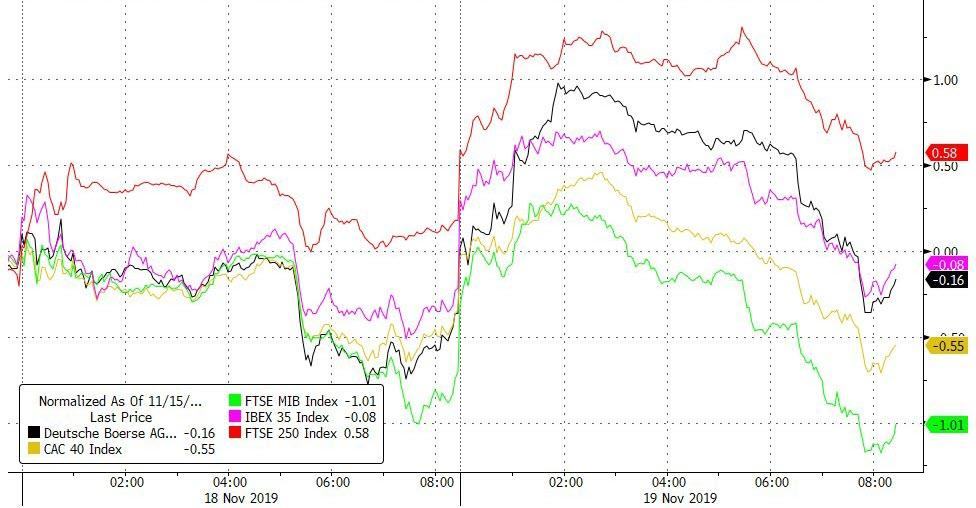
European markets rolled over hard today…
Source: Bloomberg
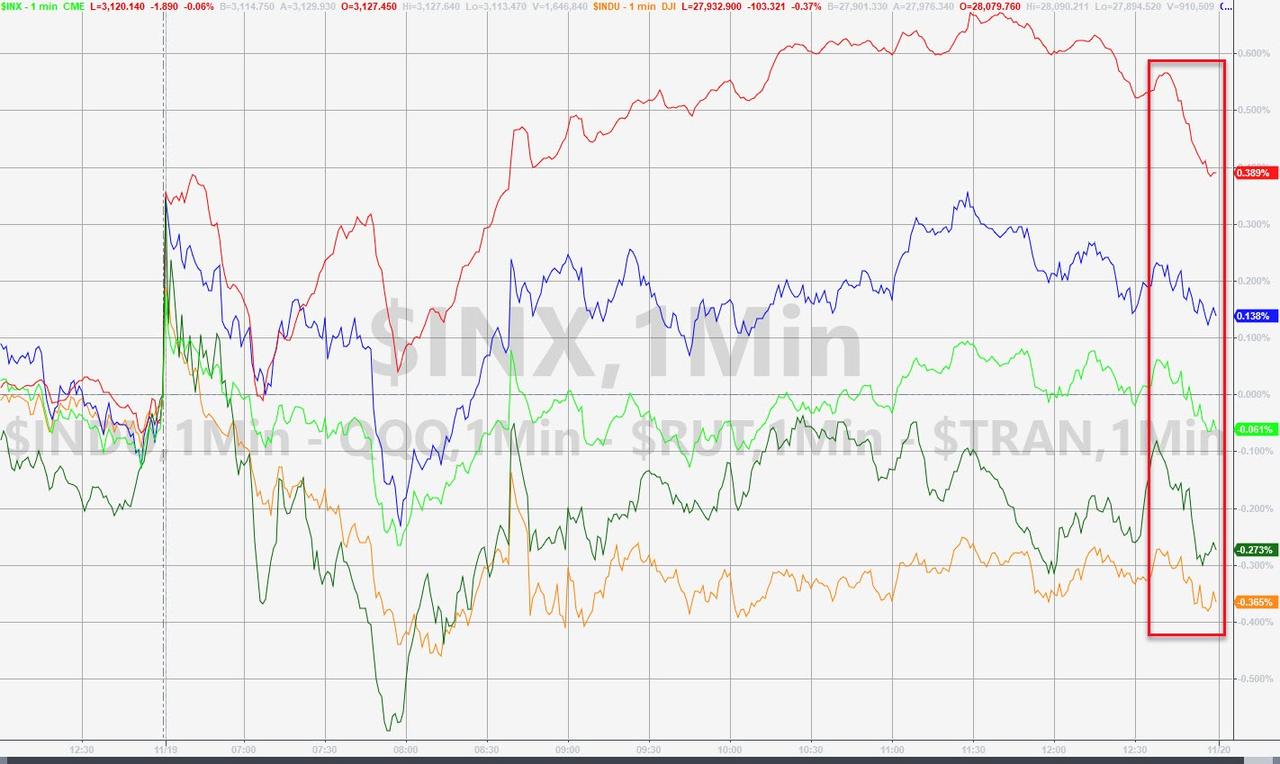
US Small Caps outperformed on the day, Dow Industrials and Transports lagged (markets ended on the weak side)…
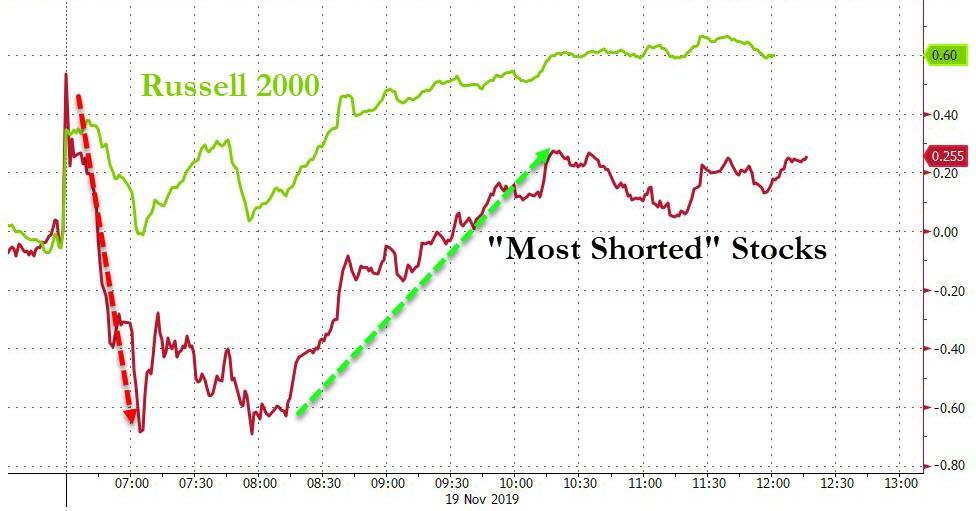
Small Caps were driven by a post-EU-Close short-squeeze…
Source: Bloomberg
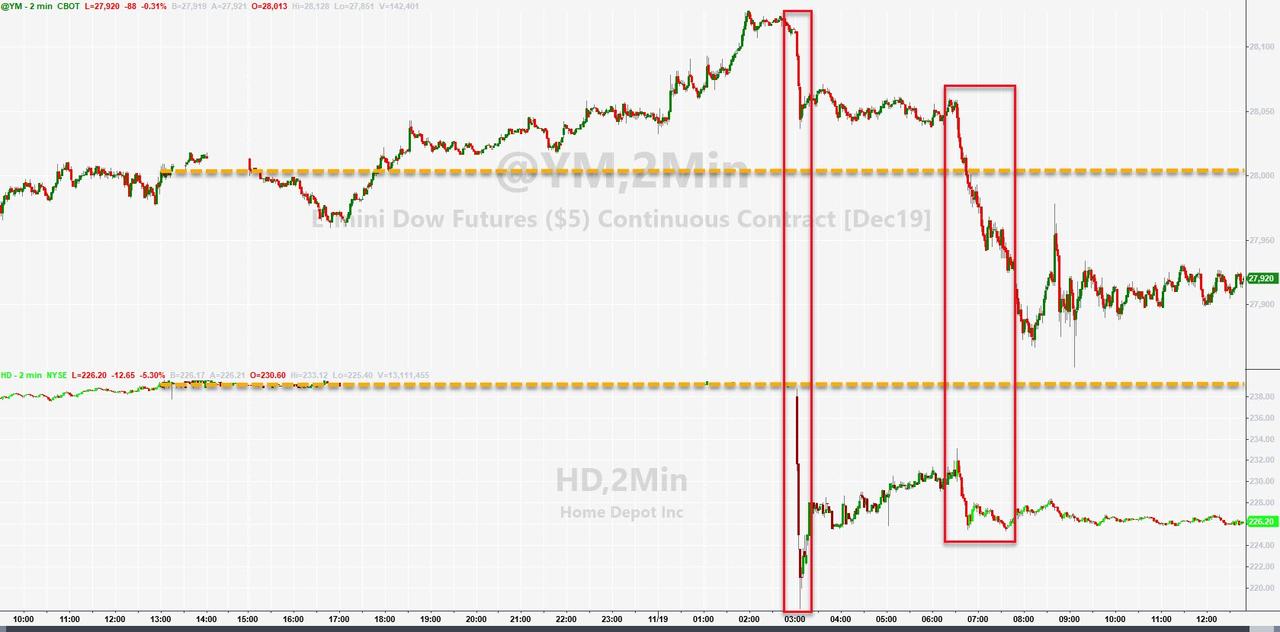
The Dow suffered its first drop in 3 days, and closed below 28k, thanks to ugly earnings from Home Depot…
Source: Bloomberg
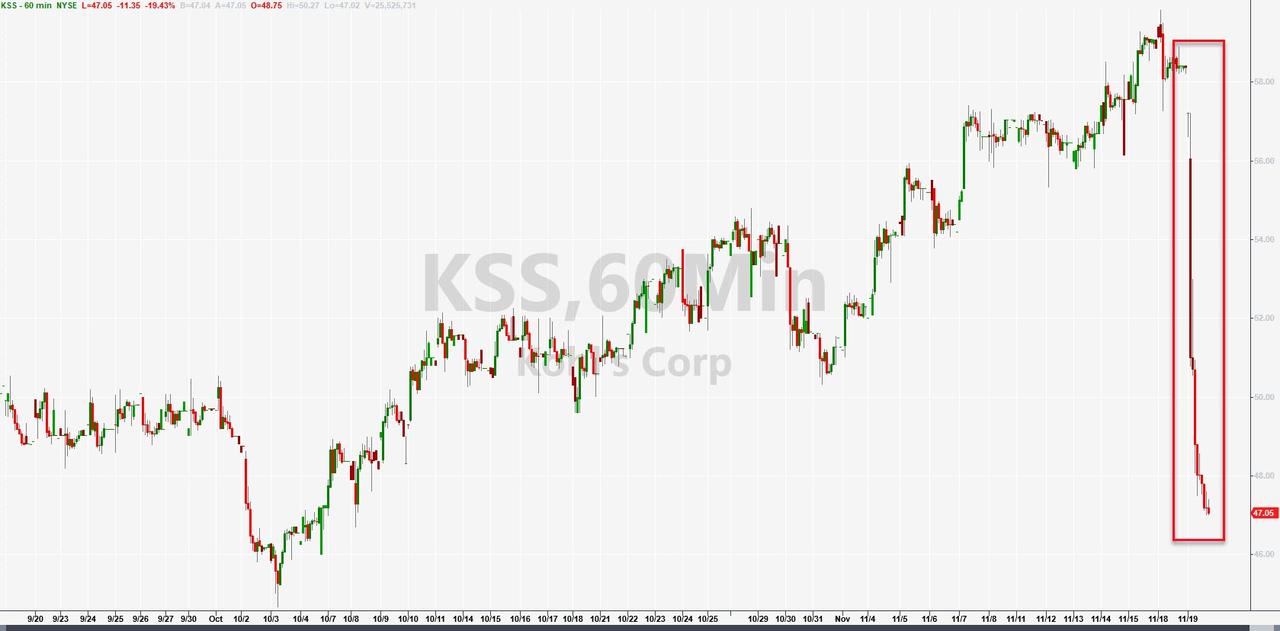
Kohls was clubbed like a baby seal…
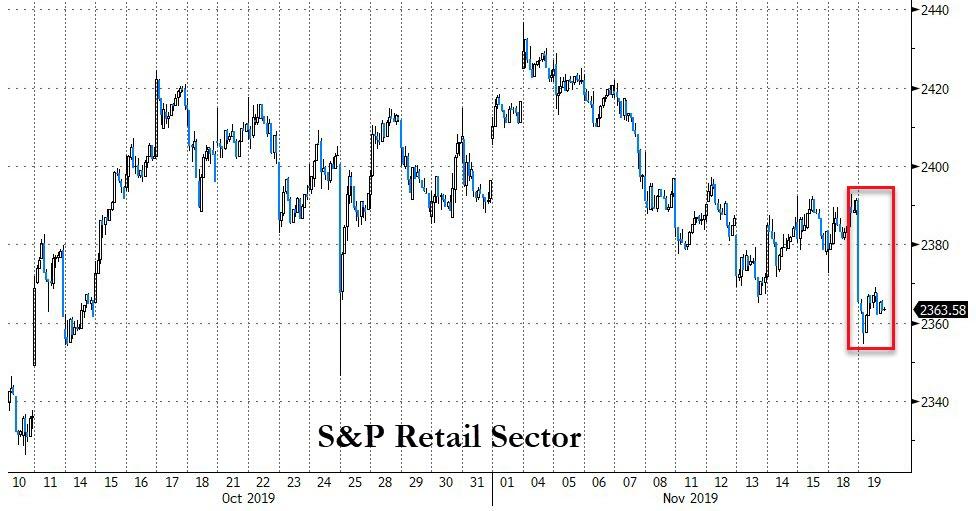
Kohls and Home Depot sent the S&P Retail sector reeling to one-month lows…
Source: Bloomberg
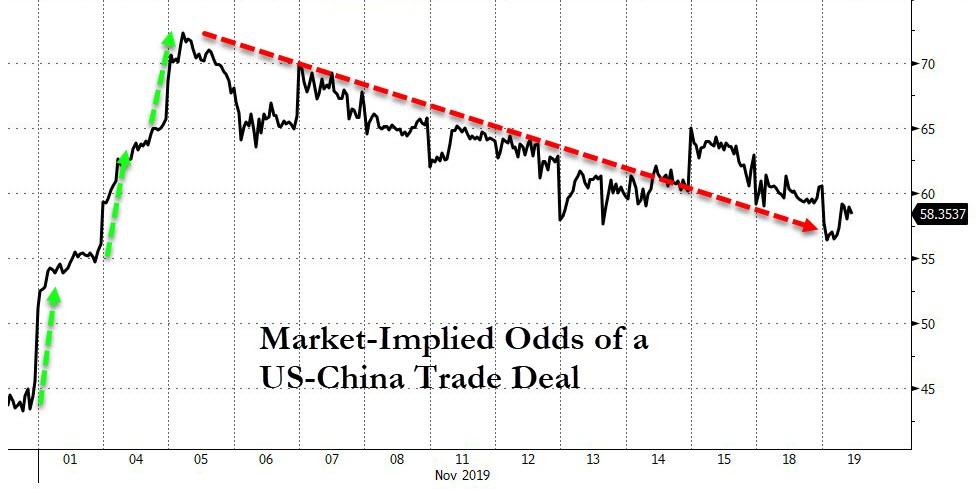
The odds of a US-China trade deal continue to slide…
Source: Bloomberg
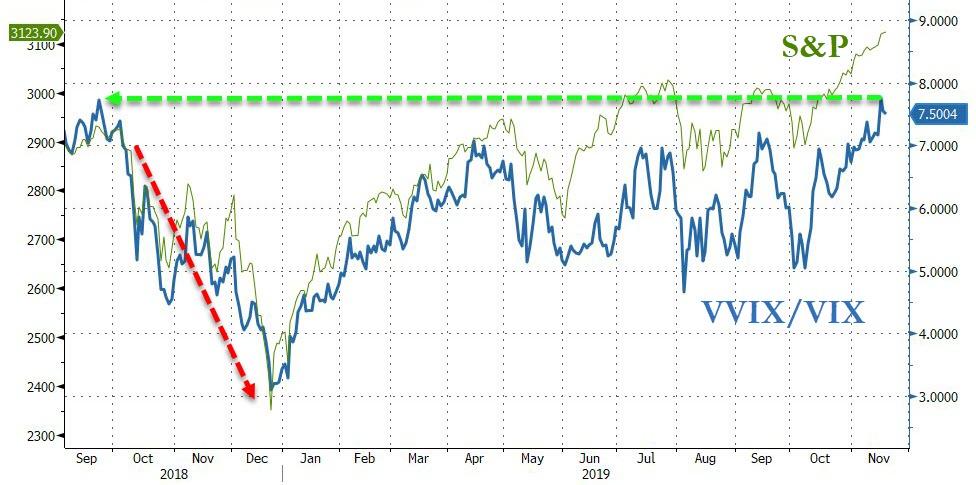
VVIX , which measures volatility of volatility, reached the highest level versus the VIX since August 2018.
Source: Bloomberg
Bloomberg notes that that has happened as “demand for VIX options (particularly calls) has picked up,” Credit Suisse Group AG derivatives strategist Mandy Xu wrote in a note Monday.
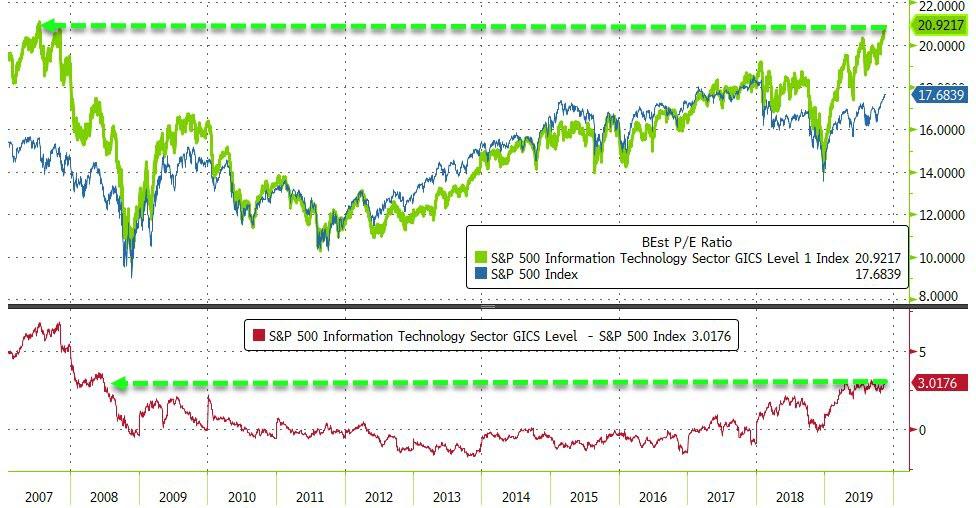
And before we move to bond-land, tech valuations are – as The Fed might say – “elevated”…
Source: Bloomberg
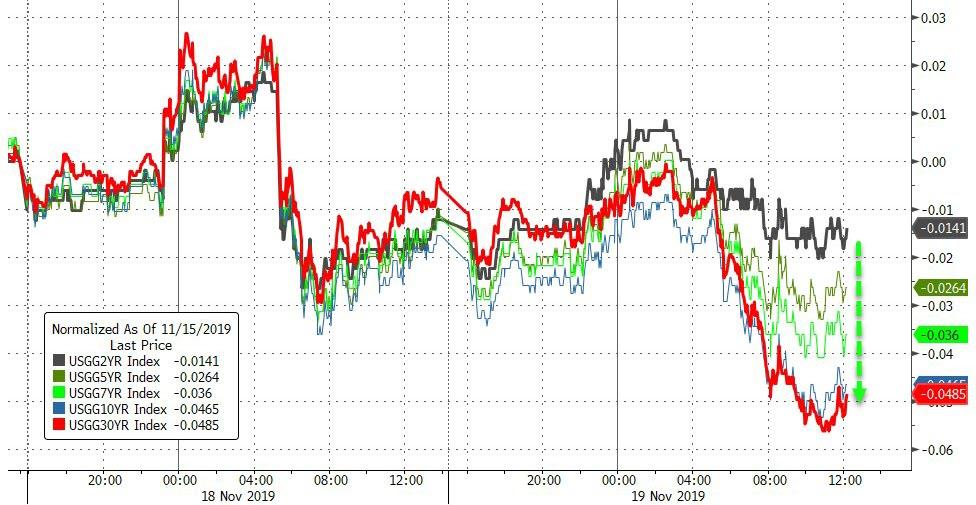
Treasury yields were all lower on the day led by the long-end…
Source: Bloomberg
With 10Y closing back below 1.80% for the first time since Nov 4th…
Source: Bloomberg
As the yield curve flattening is re-accelerating…
Source: Bloomberg
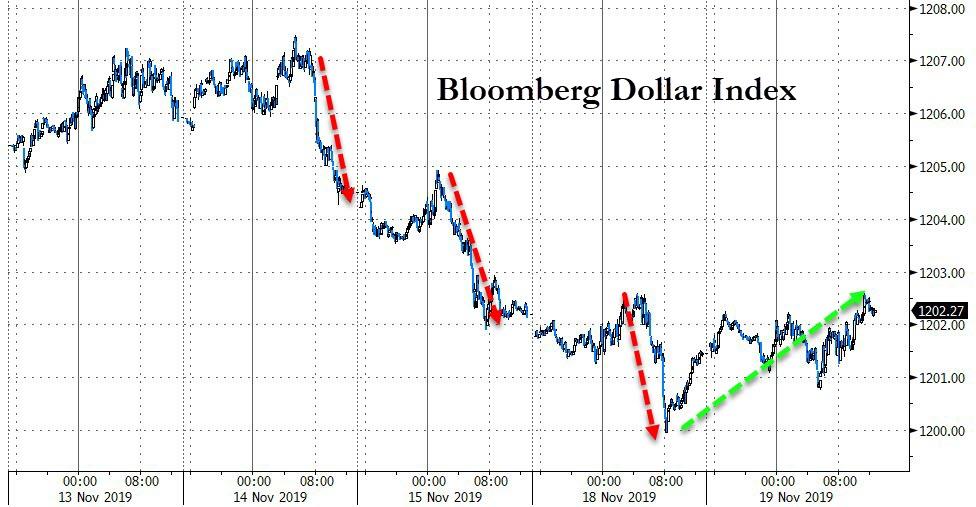
The Dollar managed gains for the first time in 4 days…
Source: Bloomberg
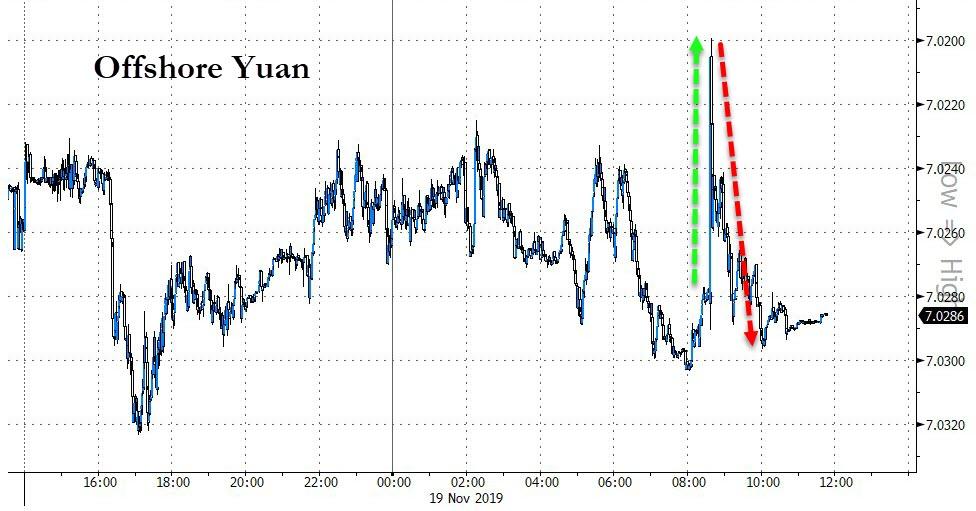
Offshore Yuan gives a perfect example of the fading power of trade deal-related headlines as it spiked on a random headline then tumbled back…
Source: Bloomberg
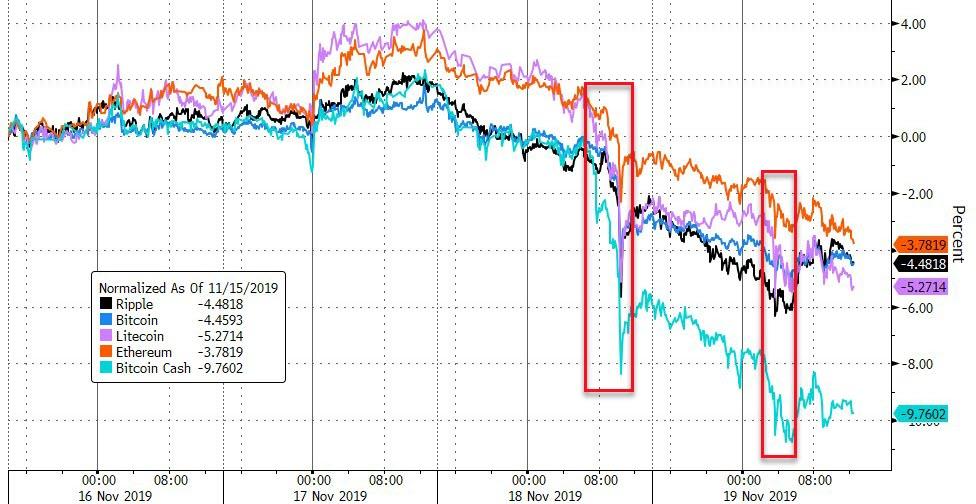
Cryptos continued to slide today…
Source: Bloomberg
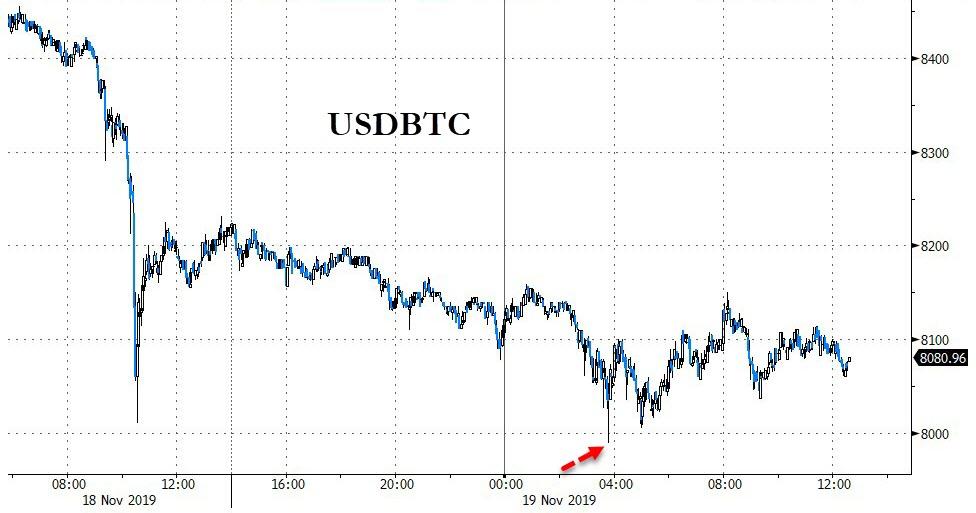
Bitcoin briefly fell below $8,000 intraday…
Source: Bloomberg
Oil tumbled most in seven weeks as US-China trade talks stall and PMs gained modestly…
Source: Bloomberg
WTI finally broke out (down) of its re4cent range…
Silver rallied back above $17…
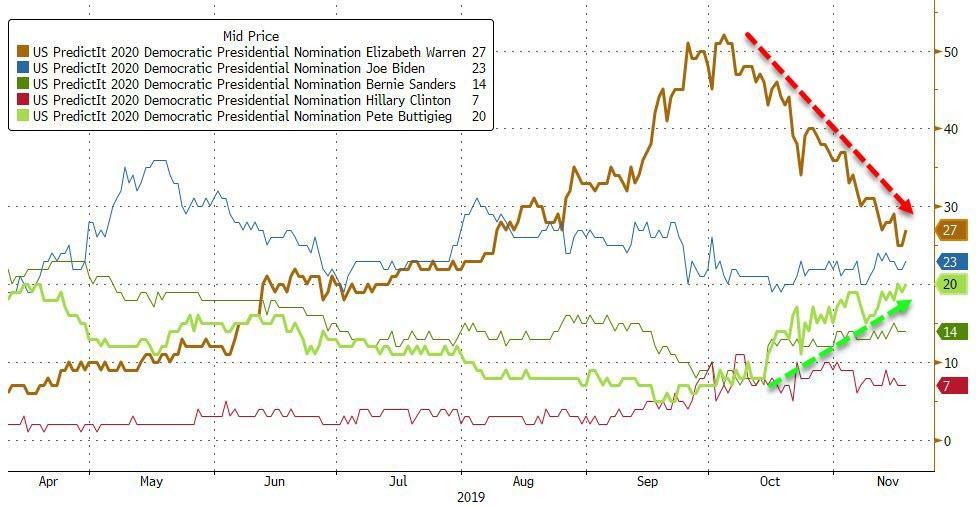
And finally, Warren continues to collapse in the odds as Buttigieg surges…
Source: Bloomberg
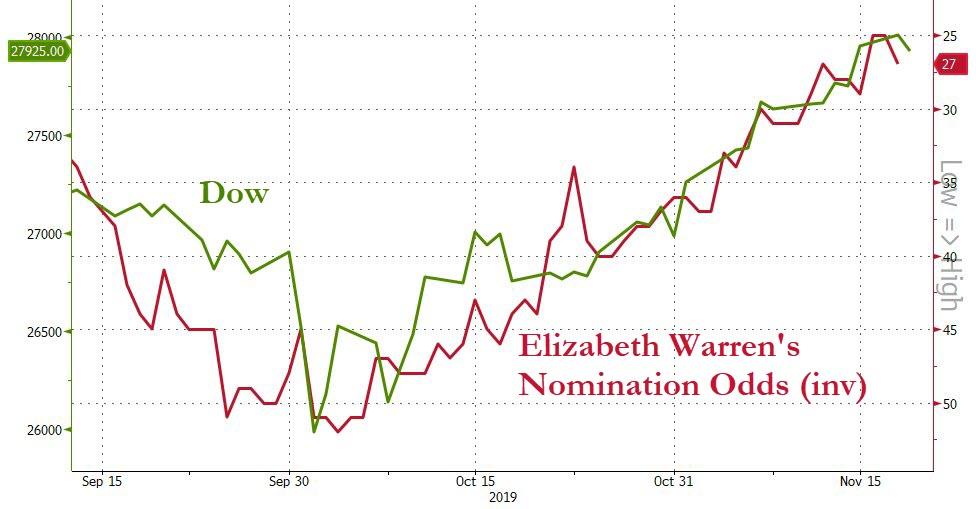
Does make u wonder?
Source: Bloomberg
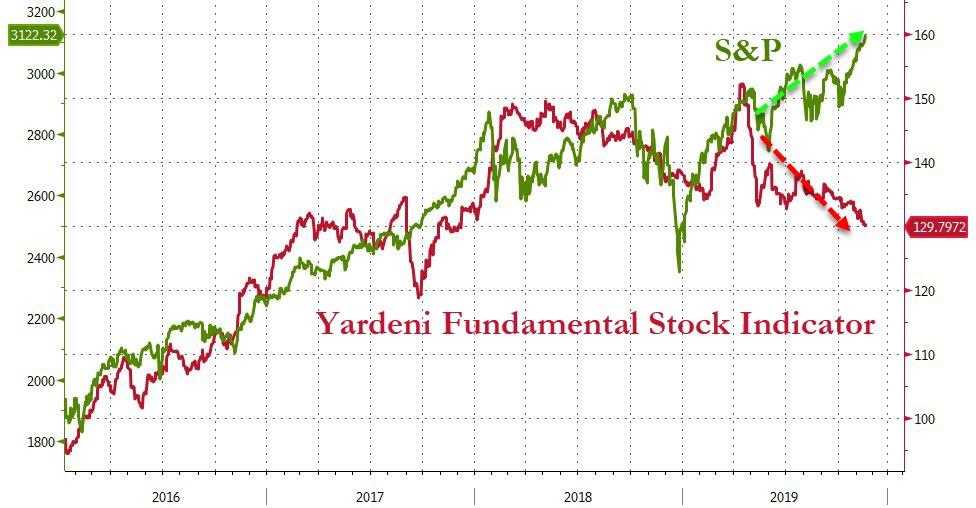
But it sure isn’t fun-durr-mentals keeping this dream alive…
As Democrats continue to poll test what exactly will be included in the inevitable articles of impeachment and Republicans continue to hunt for a shiny object that might distract voter attention from the president’s actions, I revisit a very basic question relating to the impeachment power—Are “high crimes and misdemeanors” limited to violations of the federal criminal code? Since Trump’s inauguration, Alan Dershowitz has been pushing the claim that the House cannot launch a valid impeachment without evidence of an actual felony, and that’s another thing about which he is wrong when it comes to impeachments. Trump supporters are now embracing a new chant of “where’s the crime?” It seems like a good time to reemphasize that it is possible to commit an impeachable offense without engaging in conduct that might get you prosecuted in an ordinary court of law.
The whole piece is over at Lawfare. Check it out. Here’s a taste:
Despite what Trump’s supporters say, however, the president can commit an impeachable high crime without violating the federal criminal law. To conclude otherwise would be to ignore the original meaning, purpose and history of the impeachment power; to subvert the constitutional design of a system of checks and balances; and to leave the nation unnecessarily vulnerable to abusive government officials.
. . . .
A president who egregiously misuses the powers of his office or engages in conduct grossly incompatible with the dignity of his office has forfeited the right to continue to occupy his office and is subject to the constitutional judgment of the Senate acting as a court of impeachment. The House and the Senate might conclude that accusations of misconduct are ungrounded or that the remedy of removal is unwarranted, but the misconduct that they might assess need not involve violations of the criminal law.
from Latest – Reason.com https://ift.tt/2CUV3CC
via IFTTT
Mike Novogratz Launches New Funds To Bring Bitcoin To America’s Top 1%
Mike Novogratz is still saddled with hundreds of millions of dollars in paper losses on his crypto portfolio, but he hasn’t given up on the space yet. The former Goldman executive’s Galaxy Digital Holding is launching two new funds, both aimed at accredited investors with little experience in crypto (something to help justify the higher fees), according to Bloomberg.
The billionaire investor is reportedly planning to target “the wealth of America” – that is the ‘mass affluent’ of Americans who have between $2 million and $25 million in assets (and the firms that represent them) who would like to diversify their portfolios, and those with even more wealth to invest. The vast majority of Americans between the ages of 50 and 80 stayed on the sidelines during the crypto bull run, Novogratz claims. And it’s time somebody showed them a way in.
According to BBG, Novogratz isn’t wrong. Bitcoin investors have always skewed younger and more tech savvy. Galaxy is hoping to convince everyone else that bitcoin is a worthwhile long-term hold, at a price point that’s lower than the Grayscale Bitcoin Trust, pretty much the only tried-and-tested fund that offers exposure to bitcoin at a markup.
Galaxy is trying to design a fund that can “plug into existing infrastructure,” which we imagine means fit nicely into the sales pipeline controlled by financial advisors and the big wirehouses.
Here’s what Galaxy’s head of asset management told BBG.
“The existing landscape for accessing Bitcoin is incomplete,” Steve Kurz, head of asset management at Galaxy Digital, said in a phone interview. “We are trying to offer secure service providers, low fees, simple access to Bitcoin. We wanted to create something that could plug into the existing infrastructure.”
Still, the stakes for the Galaxy Bitcoin Fund are pretty high. Galaxy’s bitcoin fund requires a $25,000 minimum investment and funds can only be withdrawn quarterly. The other fund, the Galaxy Institutional Bitcoin Fund has weekly withdrawal periods and a higher initial buy-in. The funds are being seeded with Galaxy’s money (whatever’s left of it) and some of Galaxy’s initial investors participated as well.
Novogratz believes that more traditional financial services firms will offer bitcoin services in the next 12 months, and hopes he’s getting a head start.
With gold prices on the upswing, Novo hopes his new bitcoin funds might benefit from the flight-to-safety momentum that’s emerged as of late.
“You are seeing Bitcoin way outperform other coins right now, and I think that will continue until these coins start to get used for things,” Novogratz said. “You also get more credentialed people – there are probably 20 billionaires I could name that made their money outside of crypto and are in crypto now. Every speculative asset needs people to tell the story, and people are buying the story.”
Novo has been foretelling the mainstream wealth advisors’ eventual embrace of bitcoin for years now. And now he’s putting his money where his mouth is. But if he can’t win over the big institutional clients – endowments & etc. – this could be another major money loser for Novo.
As Democrats continue to poll test what exactly will be included in the inevitable articles of impeachment and Republicans continue to hunt for a shiny object that might distract voter attention from the president’s actions, I revisit a very basic question relating to the impeachment power—Are “high crimes and misdemeanors” limited to violations of the federal criminal code? Since Trump’s inauguration, Alan Dershowitz has been pushing the claim that the House cannot launch a valid impeachment without evidence of an actual felony, and that’s another thing about which he is wrong when it comes to impeachments. Trump supporters are now embracing a new chant of “where’s the crime?” It seems like a good time to reemphasize that it is possible to commit an impeachable offense without engaging in conduct that might get you prosecuted in an ordinary court of law.
The whole piece is over at Lawfare. Check it out. Here’s a taste:
Despite what Trump’s supporters say, however, the president can commit an impeachable high crime without violating the federal criminal law. To conclude otherwise would be to ignore the original meaning, purpose and history of the impeachment power; to subvert the constitutional design of a system of checks and balances; and to leave the nation unnecessarily vulnerable to abusive government officials.
. . . .
A president who egregiously misuses the powers of his office or engages in conduct grossly incompatible with the dignity of his office has forfeited the right to continue to occupy his office and is subject to the constitutional judgment of the Senate acting as a court of impeachment. The House and the Senate might conclude that accusations of misconduct are ungrounded or that the remedy of removal is unwarranted, but the misconduct that they might assess need not involve violations of the criminal law.
from Latest – Reason.com https://ift.tt/2CUV3CC
via IFTTT
Democratic presidential candidate and New Jersey Sen. Cory Booker dusted off his charter school credentials to show his support for school choice in an op-ed at The New York Times.
Of course, he has to first frame it as an attack on the Republican Party, because he’s running for office, but nevertheless, Booker on Monday called for the Democrats to be more friendly to letting parents decide how their children would best be educated:
It is largely up to Democrats—especially those of us in this presidential primary race—to have a better discussion about practical K-12 solutions to ensure that every child in our country can go to a great public school. That discussion needs to include high-achieving public charter schools when local communities call for them.
Many public charter schools have proved to be an effective, targeted tool to give children with few other options a chance to succeed.
For-profit charter school schemes and the anti-public education agenda of President Trump and Education Secretary Betsy DeVos are hurting teachers, students and their families. Of course, we must fight back against these misguided and harmful forces. But we shouldn’t let the worst actors distort this crucial debate, as they have in recent years.
Yes, he’s still very much, like the other Democrats, attempting to make for-profit charter schools into some sort of educational whipping boy. It is true that some for-profit charters have been run as scams, but unlike public schools, parents can respond by yanking their kids out and local governments can even shut them down entirely. You won’t see that happen with bad public schools.
The big point here, noted in the subhead of Booker’s op-ed, is that the senator is calling out powerful interests within the Democratic Party itself who are trying to snatch school choice away from lower income parents. It’s not DeVos who is stopping low-income city kids from attending the schools they want. As Booker writes:
As Democrats, we can’t continue to fall into the trap of dismissing good ideas because they don’t fit into neat ideological boxes or don’t personally affect some of the louder, more privileged voices in the party. These are not abstract issues for many low-to-middle-income families, and we should have a stronger sense of urgency, and a more courageous empathy, about their plight.
Especially at this moment of crisis for our country, we must be the party of real solutions, not one that threatens schools that work for millions of families who previously lacked good educational options.
It’s somewhat disappointing that Booker doesn’t actually name names here. The “louder, more privileged voices in the party” are entrenched public education interests and unions who want to control where the money goes. When students go to charter schools, even public ones, the money that would go to establishment schools follows them. The fight against charter schools has never truly been about children’s educations at all. It’s about who gets to control the massive amounts of money that gets spent on education—the parents or the education unions. Booker is making it clear that parents are specifically not the “more privileged” voices in the party.
Booker could have been more courageous. His failure to actually call anybody in particular out shows just how much power the public education establishment has over the Democratic Party. Candidates like Sen. Elizabeth Warren (D–Mass.) know this and directly pander to the education unions by promising crackdowns on charter schools, even against the desires of parents to send their kids there.
from Latest – Reason.com https://ift.tt/37lfAy9
via IFTTT
At first blush, US stocks, gold and crude oil may seem like 3 very different markets:
Equity prices essentially measure optimism related to human ingenuity (corporate profits) balanced with fears of equally human frailty (central bank management of long run inflation expectations).
Gold, by virtue of its 5,000-year track record, prices the desire of market participants to hold physical assets that are no other participant’s financial liability.
Crude oil prices reflect something akin to the global economy’s blood pressure reading. New technology has shifted this calculus over the last decade, but the world still uses 81 million barrels/day. Demand still matters to that market even if potential supply is higher than prior periods.
Against those differences these 3 assets share one common bond: they are priced in dollars. With rare exception you need greenbacks to buy all of them. On top of that, their units (S&P 500, troy ounce, 42 gallon barrel) do not change.
This combination of differences and commonalities makes a stock/gold/oil relative price analysis a useful exercise. We use World Bank data for each from 1970 – present (email us for the spreadsheet), which has longer run information than just WTI prices, for example. Here is what the latest data shows:
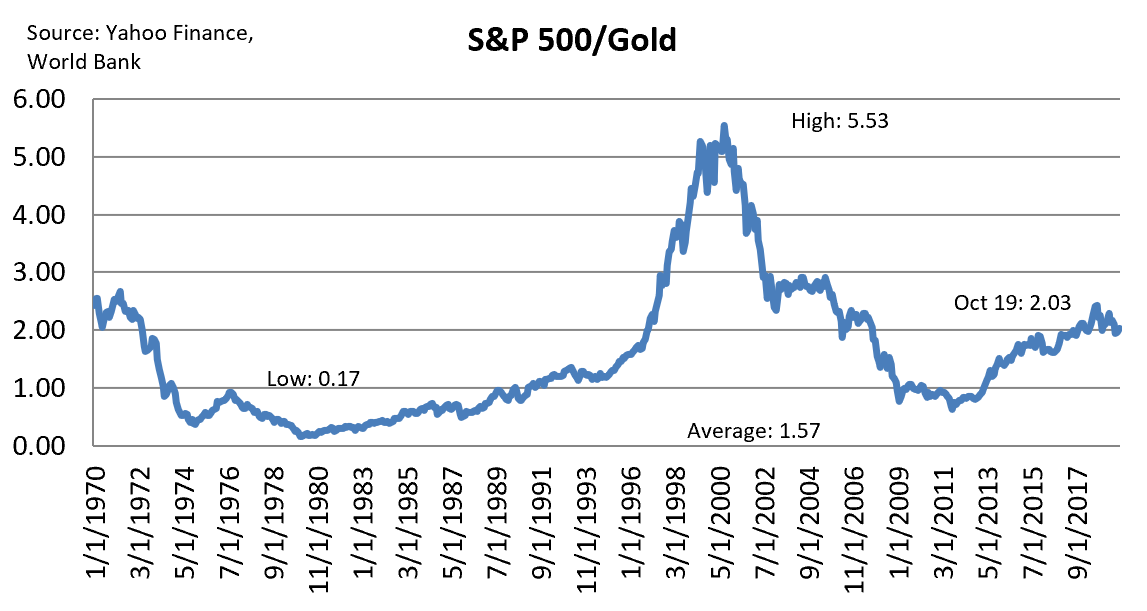
#1: The S&P 500 currently trades spot-on its long run average ratio to gold:
The S&P 500 trades for 3119; gold is $1,471/oz. The ratio: 2.12.
Over the last 30 years the average S&P/gold ratio has been 2.07.
The chart below (1970 – present) shows how the S&P/gold ratio has done an excellent job of spotting when equity market optimism was either too high (1998/1999 at +4x) or too low (2008 – 2012, when the S&P 500 and an ounce of gold went for about the same amount).
Upshot: by this measure the optimism imbedded in US equity prices is at equilibrium with the caution priced into gold markets.
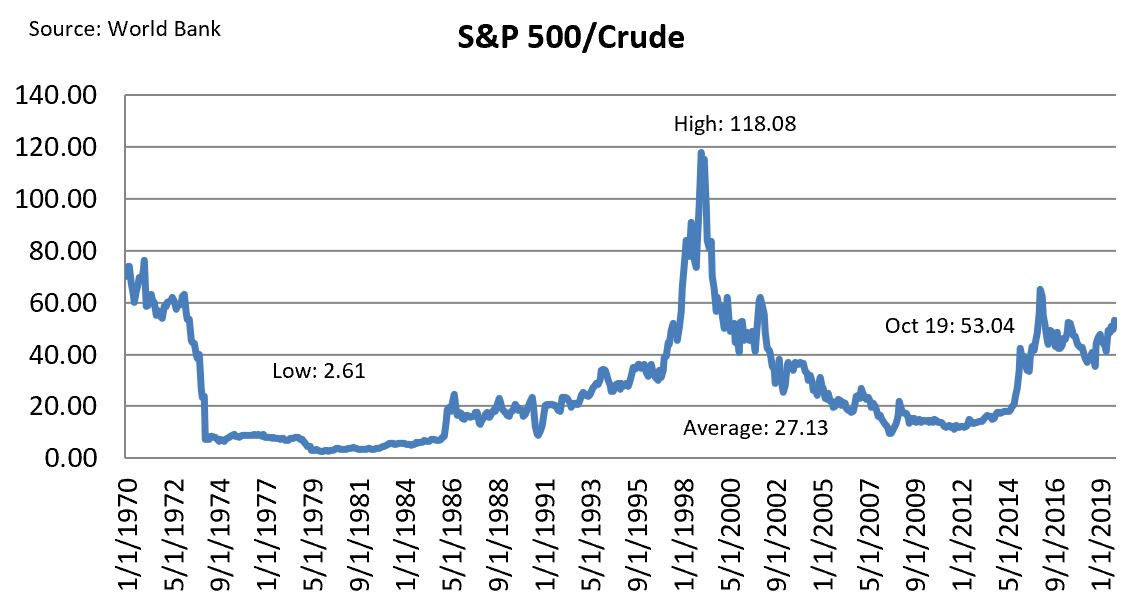
#2: The S&P 500 does, however, trade rich to oil prices:
The World Bank data uses a blend of WTI, Brent and Dubai prices. The average of those today is $59/barrel.
That makes the S&P/oil price ratio 52.8.
This is well above the 30-year average of 32.8, in fact fully one standard deviation (18.9) over the long-run mean.
The chart below (1970-present) highlights that US stocks have been well above their long run average ratio to oil since 2015, when crude prices collapsed. They are not anywhere near the late 1990s (ratios +80x), however, which saw peak levels of equity market enthusiasm coupled with trough levels of global economic optimism due to the 1998 Asia Crisis.
Upshot: that the S&P/crude ratio has run consistently at 40-60x since 2015 points to a systemic belief that equity valuations benefit from disruptive technology (Big Tech valuations/price gains) but oil prices suffer from the same phenomenon (American energy independence from new extraction methods).
#3: The gold/crude oil ratio is noisy through time, but at current levels the yellow metal looks expensive:
The ratio here based on the prices noted above is 24.9x.
The 30-year average is 16.8x, with a standard deviation of 5.8. That puts the current ratio almost 2 standard deviations away from the mean (28.4).
The chart below (1970-present) shows you have to go back to the 1980s/1990s to find a period where the gold/crude ratio runs reliably above 20x. When it happens, however, it can be just as sticky as the 10-20x band we’ve seen more recently.
Upshot: oil comes up “cheapest” against both gold and stocks, but as with the prior point there’s good reason for that. In this case, no one has figured out how to frack gold deposits just yet.
* * *
Summing up: using these simple ratios we find that global capital markets are pretty well balanced between fear (gold prices) and greed (stock prices) but oil is clearly the odd man out. If your inner contrarian says that’s an opportunity, we would advise caution just now. Prior history says it can remain cheap relative to stocks and gold, even without the overhang of technological disruption.
Democratic presidential candidate and New Jersey Sen. Cory Booker dusted off his charter school credentials to show his support for school choice in an op-ed at The New York Times.
Of course, he has to first frame it as an attack on the Republican Party, because he’s running for office, but nevertheless, Booker on Monday called for the Democrats to be more friendly to letting parents decide how their children would best be educated:
It is largely up to Democrats—especially those of us in this presidential primary race—to have a better discussion about practical K-12 solutions to ensure that every child in our country can go to a great public school. That discussion needs to include high-achieving public charter schools when local communities call for them.
Many public charter schools have proved to be an effective, targeted tool to give children with few other options a chance to succeed.
For-profit charter school schemes and the anti-public education agenda of President Trump and Education Secretary Betsy DeVos are hurting teachers, students and their families. Of course, we must fight back against these misguided and harmful forces. But we shouldn’t let the worst actors distort this crucial debate, as they have in recent years.
Yes, he’s still very much, like the other Democrats, attempting to make for-profit charter schools into some sort of educational whipping boy. It is true that some for-profit charters have been run as scams, but unlike public schools, parents can respond by yanking their kids out and local governments can even shut them down entirely. You won’t see that happen with bad public schools.
The big point here, noted in the subhead of Booker’s op-ed, is that the senator is calling out powerful interests within the Democratic Party itself who are trying to snatch school choice away from lower income parents. It’s not DeVos who is stopping low-income city kids from attending the schools they want. As Booker writes:
As Democrats, we can’t continue to fall into the trap of dismissing good ideas because they don’t fit into neat ideological boxes or don’t personally affect some of the louder, more privileged voices in the party. These are not abstract issues for many low-to-middle-income families, and we should have a stronger sense of urgency, and a more courageous empathy, about their plight.
Especially at this moment of crisis for our country, we must be the party of real solutions, not one that threatens schools that work for millions of families who previously lacked good educational options.
It’s somewhat disappointing that Booker doesn’t actually name names here. The “louder, more privileged voices in the party” are entrenched public education interests and unions who want to control where the money goes. When students go to charter schools, even public ones, the money that would go to establishment schools follows them. The fight against charter schools has never truly been about children’s educations at all. It’s about who gets to control the massive amounts of money that gets spent on education—the parents or the education unions. Booker is making it clear that parents are specifically not the “more privileged” voices in the party.
Booker could have been more courageous. His failure to actually call anybody in particular out shows just how much power the public education establishment has over the Democratic Party. Candidates like Sen. Elizabeth Warren (D–Mass.) know this and directly pander to the education unions by promising crackdowns on charter schools, even against the desires of parents to send their kids there.
from Latest – Reason.com https://ift.tt/37lfAy9
via IFTTT
ISIS Secrets Spilled In Rare On-Camera Interviews: “We Just Walked Into Syria”
Over the years of the war in Syria, an overwhelming amount of evidence has amassed documenting that the so-called ‘Islamic State’ caliphate was established after tens of thousands of ISIS and other foreign fighters were allowed to pour across Turkey’s southern border into Syria.
That NATO’s second largest military with the help of its allies such as the US, Britain, France, and Gulf countries like Saudi Arabia and Qatar facilitated what the State Department in 2014 described asthe largest mass movement of jihadist terrorists in modern history should be a scandal of monumental importance, yet the mainstream media predictably ignored it and “moved on”.
And now more bombshell proof of state sponsorship behind the prior rapid rise of ISIS: below are details exposed during unprecedented on-camera interviews of imprisoned ISIS members in Syria spilling all. They confess openly that Turkish military and intelligence simply let them “just walk into Syria”.
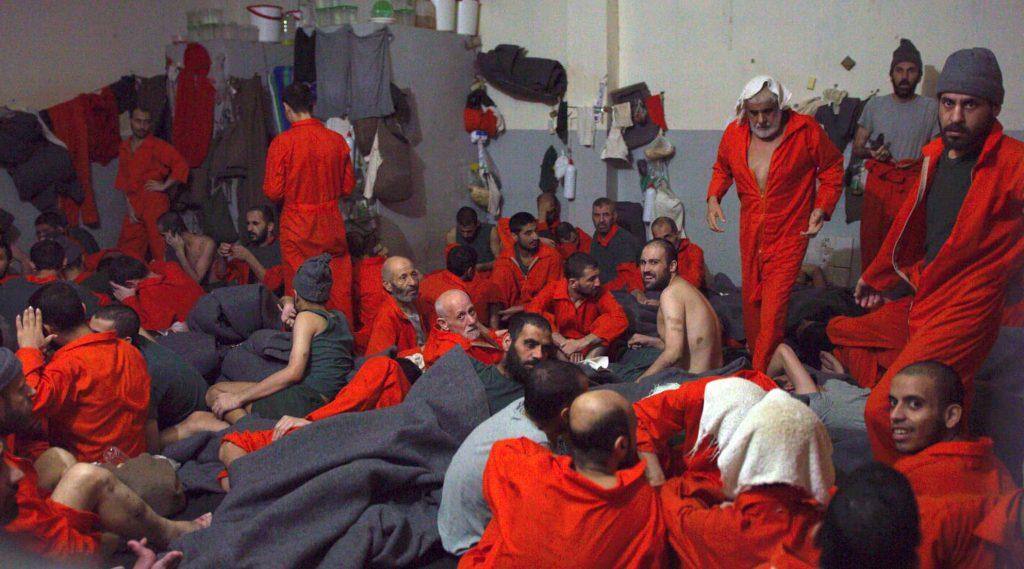
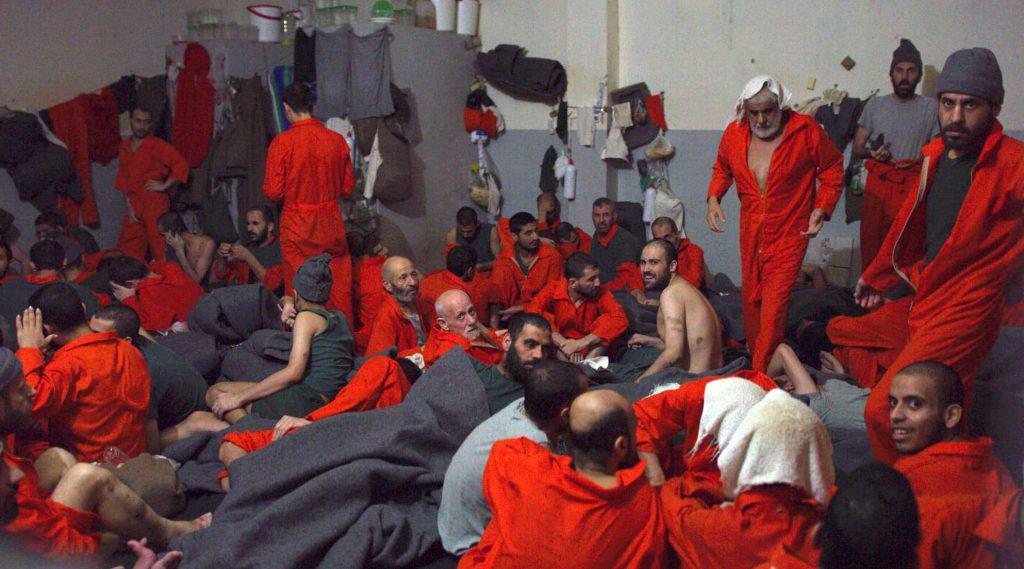
Award-winning journalist Lindsey Snell, who’s been widely published in outlets ranging from MSNBC to ABC to Foreign Policy and others, gained unprecedented access to ISIS prisoners at a facility administered by the Kurdish-led SDF in Hasakah province in northeast Syria:
Abdullah granted us access to a prison in Hasakah that holds around 5,000 ISIS members from 28 different countries. We were able to spend five hours there, touring the various sections and interviewing ISIS militants. Abdullah’s first request to us was that we refrain from telling the prisoners that Abu Bakr al-Baghdadi, ISIS’ leader, had recently been killed in Idlib. “They don’t know. And no good will come from them knowing,” he said.
Those interviewed confessed that their arrival in Syria years prior without doubt had the cooperation of Turkish authorities. Watch the interviews and video report here:
“Turkey let all of these jihadis cross its border into Syria, and now, Turkey is giving [ISIS] the chance to start again.” Read @lindseysnell’s report from an ISIS prison and the al-Hol camp in Northeast Syria: https://t.co/U855qlqXTcpic.twitter.com/RBGJwlxayW
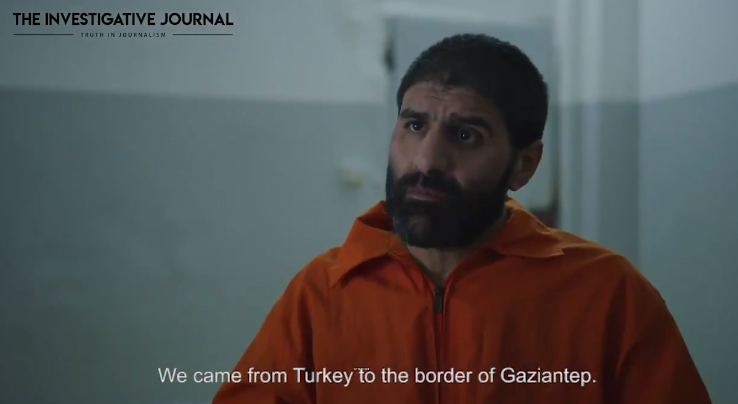
One captured militant, a Turkish ISIS member identified as Murat Kaymak expressed his initial shock at how easy it was to just walk across the border at the city of Gaziantep.
“I thought it was a joke,” he said. “How can such a large portion of the Turkish border be open? With no police or military? We just walked into Syria.”
As journalist Lindsey Snell describes in her report for The Investigative Journal, over a dozen among those interviewed confessed the same thing:
Over the last few months, we have interviewed more than a dozen ISIS members and ISIS wives in Northeastern Syria. Nearly all of them, including those who are not Turkish nationals, said they want to leave Syria and go to Turkey. Most don’t believe they will face any legal consequences for joining ISIS in Turkey. All of them said that when they crossed the border illegally from Turkey to Syria, no Turkish police or military attempted to stop them.
Another named Faisal Demir explained that even the network of ISIS ‘safe-houses’ on the Turkish side of the border was likely run by Turkish intelligence.
“There were people from so many different countries in this house. Men and families,” he said. “Turkish Intelligence is strong. ISIS rented that house, and I am sure Turkey knew ISIS rented that house.”
“They knew the foreigners staying in the house were in Turkey to cross to Syria and join ISIS. They knew, I am sure,” he admitted. And in separate testimony included in the report:
“Turkey let all of these jihadis cross their border into Syria,” Abdullah said, shaking his head. “And now, Turkey is giving them the chance to start again..”
The other common theme to the interviews is that the ISIS militants believe that if they can make it out of Syria, Turkey will let them go free once on the other side.
When asked if he wanted to return to Turkey, he grinned and said he did. He said he heard about other Turkish ISIS members returning to Turkey, being detained and investigated for a period of weeks, and then simply released. He believes that, although he stayed with ISIS for more than four years, his case would be the same in the eyes of the Turkish government.
“They all want to go to Turkey,” one Kurdish YPJ (Women’s Protection Units) prison guard additionally explained as part of the report. “ISIS started because of Turkey. ISIS is still active in Turkey. And the women here tell us they all want to go and will try to cross at Tel Abyad when they escape.”
And further, according to the report: “A Chechen woman who had been married to an ISIS fighter and living in Syria since 2013 said that she had no desire to return to Chechnya, and that Turkey seemed like a good option for her and her young daughter. She didn’t think she’d be arrested there, because she didn’t believe she’d done anything wrong.”
It must be remembered and bears repeating that Turkey is NATO’s second largest military, and throughout the early years of the war US intelligence worked closely with the Turks in pursuit of regime change in Syria.
Thus the “jihadi highway” across the Turkish border, at least in the early years before and during the rise of the Islamic State, appeared willful, intentional policy.