Democrats Shift From Demonizing Cannabis to Demonizing Nicotine

This week the House Judiciary Committee is expected to approve the MORE Act, which would repeal the federal ban on marijuana. Meanwhile, the House Energy and Commerce Committee yesterday approved a new federal ban on flavored e-cigarettes, which would make the vast majority of nicotine vaping products illegal. Also this week, the American Medical Association (AMA), which has questioned marijuana’s classification as a Schedule I drug, approved a resolution calling for a complete ban on “all e-cigarette and vaping products.”

The fact that Democratic legislators and AMA leaders who think the war on weed should be ended or scaled back are prepared to launch a new war on nicotine products is puzzling on its face, since they recognize the problems created by drug prohibition in one context while ignoring them in another. But the illogic of these contradictory impulses looks even worse when you notice that both the AMA and the members of Congress who want to ban flavored e-cigarettes are citing the recent outbreak of lung injuries tied to marijuana products as a justification for banning nicotine products.

Rep. Frank Pallone (D–N.J.), who chairs the House Energy and Commerce Committee and sponsored the ban on flavored nicotine e-liquids, mentioned “over 2,100 cases of lung injuries and 42 deaths related to vaping illnesses.” The AMA likewise invoked “the recent lung illness outbreak linked to more than 2,000 illnesses and over 40 deaths across the country and a spike in youth e-cigarette use.”

According to data from the U.S. Centers for Disease Control and Prevention, those cases overwhelmingly, and perhaps entirely, involve vaping of cannabis extracts, typically purchased on the black market. So far there is no evidence that legal nicotine e-cigarettes—the products that Pallone and the AMA want to severely restrict or ban—have caused any of these injuries or deaths. Since such products have been used by millions of Americans for years without causing such acute respiratory reactions, the likelihood that they are even partly responsible for the outbreak is approximately zero.

To be clear, the fact that cannabis products figure prominently in vaping-related lung injuries is not an argument for marijuana prohibition. Although a few lung disease cases have been linked to products purchased from state-licensed marijuana retailers, the main problem is a black market in which consumers do not know the provenance and composition of the products they are consuming. In a legal market, it is much easier to guard against potential hazards. Marijuana regulators in Colorado and Washington, for example, have banned the use of vitamin E acetate, a cutting and thickening agent implicated in the lung injuries, and state-licensed laboratories in states where marijuana is legal can test products for that ingredient and other potentially harmful additives or contaminants.

In other words, it is not at all inconsistent to call for legalization of marijuana in the face of health problems that seem to be caused by THC vapes containing ingredients that consumers do not anticipate. But it is exceedingly odd to cite those health problems while targeting an entirely different category of products. Worse, to the extent that bootleg nicotine e-liquids have played a role in the recent lung injuries, banning legal e-cigarettes will only exacerbate that problem.

Consider how The New York Times ties itself into knots while attempting to explain this utterly irrational political response. In an editorial last week, the Times recognized that the issue of “surging e-cigarette use among teenagers” is “distinct” from the issue of “a lung-injury outbreak that has sickened more than 2,000 people and killed at least 40.” Because “black market products are a leading suspect in the lung-injury outbreak,” it noted, “product bans are more likely to exacerbate this crisis than to mitigate it.” But in a news story published yesterday, Times reporter Karen Zraick weirdly conflated the two issues that the paper’s editorial board understands are unrelated:

[Juul] has come under intense scrutiny amid an outbreak of lung injuries and deaths linked to vaping. The Centers for Disease Control and Prevention and state agencies have reported 2,172 lung injury cases and 43 deaths linked to vaping. More than 120 of the injured patients were under 18.

A majority of those cases involve people who said they had vaped THC, which Juul does not sell. But the illnesses highlighted how widespread vaping has become among American teenagers.

The Times editorial also pointed out that a ban on flavored e-liquids is likely to drive some of the millions of Americans who have switched from smoking to vaping back to their former habits, which were indisputably much more dangerous. That point seems entirely lost on the AMA.

“In calling for an e-cigarette ban, the AMA is also calling for hundreds of thousands of ex-smokers to return to smoking,” writes Michael Siegel, a public health professor at Boston University, since that is the effect that such a policy would have on a large proportion of the 2.5 million ex-smokers who currently rely upon e-cigarettes to stay off of the real ones. In addition, the AMA is calling for the creation of a new, dangerous black market for e-cigarettes and e-liquids because the overwhelming majority of those vapers who do not return to cigarette smoking will turn instead to the black market in an act of desperation to avoid having to go back to smoking.”

While the AMA says “we must keep nicotine products out of the hands of young people,” Siegel notes, the policy it recommends would favor conventional cigarettes, a far more hazardous source of nicotine. “There is absolutely no way in which the AMA can justify calling for a ban on e-cigarettes while allowing real tobacco cigarettes to stay on the market.” Siegel calls the organization’s proposed ban on vaping products “the most dangerous health-related policy proposal from a medical or health organization that I have seen in my career.”

The answer is surely not a blanket ban on all nicotine products, which would only add a new front to the disastrous war on drugs, compounding all the familiar problems caused by prohibition. But the shift from demonizing cannabis to demonizing e-cigarettes is not a good sign for anyone who hoped that recognizing the folly of marijuana prohibition would lead to a broader understanding of the costs inflicted by attempts to forcibly prevent people from consuming psychoactive substances.

from Latest – Reason.com https://ift.tt/2O5LTJW
via IFTTT
New Gun Control Bill Encourages Financial Institutions to Report ‘Suspicious’ Firearm Transactions

A new gun control bill calls for banks and credit card companies to track and provide transaction data to the feds on some firearm purchases as a way of tracking people who the government suspects might be planning mass shootings.

Rep. Jennifer Wexton’s (D–Va.) “Gun Violence Prevention Through Financial Intelligence Act” would require the Financial Crimes Enforcement Network (FinCEN) to “request information from financial institutions for the purpose of developing an advisory about the identification and reporting of suspicious activity.” The bill’s aim is to identify a consistent purchasing pattern among people who buy firearms and firearm accessories in order to conduct “lone wolf acts of terror” and expose how the firearms market in the United States is exploited by would-be mass shooters.

“Banks, credit card companies, and retailers have unique insight into the behavior and purchasing patterns that can help identify and prevent mass shootings,” Wexton explained in a statement. “The red flags are there—someone just needs to be paying attention.”

The New York Times reports that Wexton’s bill was inspired in part by Times columnist Andrew Ross Sorkin’s 2018 investigation on several mass shootings that have happened since the Virginia Tech shooting in 2007. Sorkin’s work revealed that in at least eight of the 13 mass shootings that killed 10 or more people within that time span, the perpetrators used credit cards to finance their killing sprees. James Holmes, who killed 12 people at a movie theater in Aurora, Colorado, used a credit card to purchase more than $11,000 worth of guns, grenades, and other military gear prior to his rampage. Omar Mateen, the Pulse nightclub shooter in Orlando, Florida, ran up $26,532 in charges across six credit card accounts in the 12 days leading up to his attack.

Wexton’s bill assumes it’s possible to tell who is a threat based on tracking credit card activity. Unfortunately, government’s past attempts to identify “red flags” by analyzing transaction data has resulted in, as Reason‘s Elizabeth Nolan Brown puts it, banks “cast[ing] as wide a net as possible,” when deciding what activity gets reported. Banks fear the consequences of being accused of not doing enough to comply with reporting laws and requests. Brown notes that banks’ attempts to monitor customers’ transaction data in order to identify human traffickers for the government have resulted in the creation of an extremely broad definition of what constitutes suspicious activity, including things like running up large grocery bills and renting DVDs in bulk.

Almost half of gun owners report owning at least four guns, which makes it relatively easy to see how any gun owner could come under suspicion should the government deputize financial institutions to monitor “suspicious” gun transaction patterns. There is no way to determine whether or not someone is spending a lot of money on guns to commit a crime or just because they like them since the transactions are identical on paper. Spending a lot at a gun store might be less unusual than Wexton seems to think.

Wexton also acknowledges that “historically, retail-level purchase information…has been hard to obtain” and that the effectiveness of the advisory would be largely dependent upon the willingness of merchants to share information on “specific firearms products and accessories.”

Representatives from both Visa and Mastercard did not respond to Reason‘s request for comment on Wexton’s current bill. But both companies have expressed reservations in the past about, as Visa spokesperson Amanda Pires told the Times last year, “setting restrictions on the sale of lawful goods or services.”

Pires also noted that “asking Visa or other payment networks to arbitrate what legal goods can be purchased sets a dangerous precedent.”

from Latest – Reason.com https://ift.tt/2Oy99Pt
via IFTTT

FBI Wants To Speak With Trump-Ukraine CIA Whistleblower

FBI Wants To Speak With Trump-Ukraine CIA Whistleblower

The FBI has reached out to an attorney for the Trump-Ukraine whistleblower reported to be CIA analyst Eric Ciaramella, who filed a complaint over President Trump’s July 25 phone call with his Ukrainian counterpart, Volodomyr Zelensky, according to Yahoo! News

The move came after a vigorous internal debate at the agency over how to proceed with an investigation of allegations contained in the complaint, according to sources familiar with the matter.

According to the report, an FBI agent from the Washington field office reached out to whistleblower attorney Mark Zaid (The
Coup has started‘ guy who loves going to Disneyland alone), who declined comment for the article.

An interview with the whistleblower has yet to be scheduled.

The request from the FBI comes at a sensitive moment when Republicans on the House Intelligence Committee are making repeated efforts to “out” the whistleblower in order to suggest he may have had political motivations hostile to the president when he filed his Aug. 12 complaint with the intelligence community’s inspector general. 

It also comes after multiple threats have been made against the whistleblower and his lawyers — some of which have been separately passed along by the lawyers to other officials at the FBI. But the agent who sought to question the whistleblower made no reference to the threats as the purpose of the interview, according to sources familiar with the discussions. –Yahoo! News

Yahoo suggests that an FBI interview will “introduce a new wild card into the debate over whether to impeach the president over his Ukraine dealings.”


Tyler Durden

Wed, 11/20/2019 – 12:24

via ZeroHedge News https://ift.tt/2qmYpf4 Tyler Durden

New Gun Control Bill Encourages Financial Institutions to Report ‘Suspicious’ Firearm Transactions

A new gun control bill calls for banks and credit card companies to track and provide transaction data to the feds on some firearm purchases as a way of tracking people who the government suspects might be planning mass shootings.

Rep. Jennifer Wexton’s (D–Va.) “Gun Violence Prevention Through Financial Intelligence Act” would require the Financial Crimes Enforcement Network (FinCEN) to “request information from financial institutions for the purpose of developing an advisory about the identification and reporting of suspicious activity.” The bill’s aim is to identify a consistent purchasing pattern among people who buy firearms and firearm accessories in order to conduct “lone wolf acts of terror” and expose how the firearms market in the United States is exploited by would-be mass shooters.

“Banks, credit card companies, and retailers have unique insight into the behavior and purchasing patterns that can help identify and prevent mass shootings,” Wexton explained in a statement. “The red flags are there—someone just needs to be paying attention.”

The New York Times reports that Wexton’s bill was inspired in part by Times columnist Andrew Ross Sorkin’s 2018 investigation on several mass shootings that have happened since the Virginia Tech shooting in 2007. Sorkin’s work revealed that in at least eight of the 13 mass shootings that killed 10 or more people within that time span, the perpetrators used credit cards to finance their killing sprees. James Holmes, who killed 12 people at a movie theater in Aurora, Colorado, used a credit card to purchase more than $11,000 worth of guns, grenades, and other military gear prior to his rampage. Omar Mateen, the Pulse nightclub shooter in Orlando, Florida, ran up $26,532 in charges across six credit card accounts in the 12 days leading up to his attack.

Wexton’s bill assumes it’s possible to tell who is a threat based on tracking credit card activity. Unfortunately, government’s past attempts to identify “red flags” by analyzing transaction data has resulted in, as Reason‘s Elizabeth Nolan Brown puts it, banks “cast[ing] as wide a net as possible,” when deciding what activity gets reported. Banks fear the consequences of being accused of not doing enough to comply with reporting laws and requests. Brown notes that banks’ attempts to monitor customers’ transaction data in order to identify human traffickers for the government have resulted in the creation of an extremely broad definition of what constitutes suspicious activity, including things like running up large grocery bills and renting DVDs in bulk.

Almost half of gun owners report owning at least four guns, which makes it relatively easy to see how any gun owner could come under suspicion should the government deputize financial institutions to monitor “suspicious” gun transaction patterns. There is no way to determine whether or not someone is spending a lot of money on guns to commit a crime or just because they like them since the transactions are identical on paper. Spending a lot at a gun store might be less unusual than Wexton seems to think.

Wexton also acknowledges that “historically, retail-level purchase information…has been hard to obtain” and that the effectiveness of the advisory would be largely dependent upon the willingness of merchants to share information on “specific firearms products and accessories.”

Representatives from both Visa and Mastercard did not respond to Reason‘s request for comment on Wexton’s current bill. But both companies have expressed reservations in the past about, as Visa spokesperson Amanda Pires told the Times last year, “setting restrictions on the sale of lawful goods or services.”

Pires also noted that “asking Visa or other payment networks to arbitrate what legal goods can be purchased sets a dangerous precedent.”

from Latest – Reason.com https://ift.tt/2Oy99Pt
via IFTTT

Ukrainian Indictment Claims $7.4 Billion Obama-Linked Laundering, Puts Biden Group Take At $16.5 Million

Ukrainian Indictment Claims $7.4 Billion Obama-Linked Laundering, Puts Biden Group Take At $16.5 Million

An indictment drawn up by Ukraine’s Office of the Prosecutor General against Burisma owner Nikolai Zlochevsky claims that Hunter Biden and his partners received $16.5 million for their ‘services’ – according to Ukrainian MP Alexander Dubinsky of the ruling Servant of the People Party.

Dubinsky made the claim in a Wednesday press conference, citing materials from an investigation into Zlochevsky and Burisma.

“Zlochevsky was charged with this new accusation by the Office of the Prosecutor General but the press ignored it,” said the MP. “It was issued on November 14.”

The son of Vice-President Joe Biden was receiving payment for his services, with money raised through criminal means and money laundering,” he then said, adding “Biden received money that did not come from the company’s successful operation but rather from money stolen from citizens.”

According to Dubinsky, Hunter Biden’s income from Burisma is a “link that reveals how money is siphoned [from Ukraine],” and how Biden is just one link in the chain of Zlochevsky’s money laundering operation which included politicians from the previous Yanukovich administration who continued their schemes under his successor, President Pyotr Poroshenko.

“We will reveal the information about the financial pyramid scheme that was created in Ukraine and developed by everyone beginning with Yanukovich and later by Poroshenko. This system is still working under the guidance of the current managerial board of the National Bank, ensuring that money flows in the interest of people who stole millions of dollars, took it offshore and bought Ukrainian public bonds turning them into the Ukrainian sovereign debt,” said Dubinsky, adding that “in both cases of Yanukovich and Poroshenko, Ms. Gontareva and companies she controls were investing the stolen funds.”

Franklin Templeton named

According to Interfax-Ukraine, MP Andriy Derkach announced at the same press conference that deputies have received new materials from investigative journalists alleging that the ‘family’ of ex-President Yanukovych funneled $7.4 billion through American investment firm Franklin Templeton Investments, which they claim have connections to the US Democratic party.

“Last week, November 14, the Prosecutor General’s Office (PGO), unnoticed by the media, announced a new suspicion to the notorious owner of Burisma, ex-Ecology Minister Zlochevsky. According to the suspicion, the Yanukovych family is suspected, in particular, with legalizing (laundering) of criminally obtained income through Franklin Templeton Investments, an investment fund carrying out purchases of external government loan bonds totaling $7.4 billion,” said Derkach, adding that the money was criminally obtained and invested in the purchase of Ukrainian debt in 2013 – 2014.

The son of Templeton’s founder, John Templeton Jr., was one of President Obama’s major campaign donors. Another fund-related character is Thomas Donilon. Managing Director of BlackRock Investment Institute, shareholder Franklin Templeton Investments, which has the largest share in the fund. It is noteworthy that he previously was Obama’s national security advisor,” Derkach added.

Derkach then demanded “President Zelensky must pick up the phone, dial Trump, ask for help and cooperation in the fight against corruption and fly to Washington. The issue of combating international corruption in Ukraine with the participation of citizens, businessmen and U.S. officials should become a key during the meeting of the two presidents.”


Tyler Durden

Wed, 11/20/2019 – 12:14

via ZeroHedge News https://ift.tt/2D1FJ7d Tyler Durden

Devin Nunes Exposes The Democrats’ 10 Most “Outlandish” Trump Conspiracy Theories

Devin Nunes Exposes The Democrats’ 10 Most “Outlandish” Trump Conspiracy Theories

“In their mania to attack the president, no conspiracy theory is too outlandish for the Democrats.”

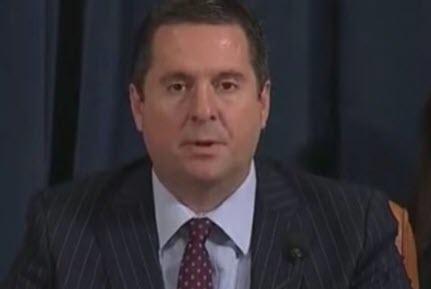
Those were the ‘fighting’ words of a clearly frustrated Rep. Devin Nunes as he addressed the American public ahead of today’s latest round of farcical impeachment circus shenanigans.

With Democrats yawningly repeating endless hearsay and opinion as ‘fact’, Nunes – in a few brief minutes – exposed the whole house of cards by laying out succinctly the ‘facts’ of what Democrats have tried to pull in the last three years:

“Time and again, they floated the possibility of some far-fetched malfeasance by Trump, declared the dire need to investigate it, and then suddenly dropped the issue and moved on to their next asinine theory”

Nunes’ “Top 10” list of “asinine” Democrat attacks on Trump are as follows…

  1. Trump is a long-time Russian agent, as described in the Steele dossier.

  2. The Russians gave Trump advance access to emails stolen from the DNC and the Hillary Clinton campaign.

  3. The Trump campaign based some of its activities on these stolen documents.

  4. Trump received nefarious materials from the Russians through a Trump Campaign aide.

  5. Trump laundered Russian money through real estate deals.

  6. Trump was blackmailed by Russia through his financial exposure with Deutsche Bank.

  7. Trump had a diabolical plan to build a Trump Tower in Moscow.

  8. Trump changed the Republican National Committee platform to hurt Ukraine and benefit Russia.

  9. The Russians laundered money through the NRA for the Trump campaign.

  10. Trump’s son in law lied about his Russian contacts while obtaining his security clearance

“It’s a long list of false charges, all false, and I can go on and on and on,” Nunes concluded.

But, as Schiff would have you believe, this time is different – “we gotcha”.


Tyler Durden

Wed, 11/20/2019 – 12:03

Tags

via ZeroHedge News https://ift.tt/2qmrffC Tyler Durden

Editor Of China’s Global Times Taunts US Farmers: “Wait For A Trade Deal Before Getting Bigger Tractors”

Editor Of China’s Global Times Taunts US Farmers: “Wait For A Trade Deal Before Getting Bigger Tractors”

China’s most influential twitter troll is on a rampage today.

Following his earlier threat that “China wants a deal but is prepared for the worst-case scenario, a prolonged trade war”, uttered shortly after the Senate vote to support Hong Kong protesters and Trump’s warning that the US could raise tariffs further if there is no deal (something we hinted at yesterday)…

… the editor in chief is out with a new taunt, this time addressing US farmers with a “friendly reminder” not to “rush to buy more land or get bigger tractors. Wait until a China-US trade deal is truly signed and still valid six months after. It’s safer by then.”

His advice is probably wise, especially since it was China and not the US that reneged on a trade deal when it was almost completed back in May, and it will be China again that refuses to comply with any trade deal that forces it to reverse on its entire economic model predicated on “borrowing” and reverse-engineering US technology, especially if there is some credible enforcement component attached to the deal.

On the other hand, Hu’s tweets also betray China’s growing nervousness.

While Beijing may have thought it had full control over the future of trade war and the “Phase 1” deal all wrapped up back at the start of October, when it also assumed that the upcoming Trump impeachment process would give it all the leverage it needed to pass through a photo-op of a “deal” with no enforcement provisions (while also buying Trump’s welcome silence over the ongoing Hong Kong protests) recent developments have once again sent the shaky equilibrium into a tailspin, especially now that Beijing is contemplating how to respond to the Senate’s unanimous passage of a bill that sides with Hong Kong protesters.

Indeed, as Bloomberg notes this morning, President Xi Jinping’s government has a problem: “Any strong measures against the U.S. also risk backfiring on China. That’s particularly dangerous as he struggles to contain escalating violence in Hong Kong and negotiates a trade pact with the U.S. all while the economy grows at its slowest pace in decades.”

“It’s worth noting that the U.S. can do more damage to China than China can do to the U.S.,” said Shi Yinhong, an adviser to China’s cabinet and professor of international relations at Renmin University in Beijing.

The bill also threatens to derail the talks on the infamous “phase one” trade deal that are entering their final stages. Stocks in Europe and Asia fell along with American equity-index futures on Wednesday on concerns it could lead to further delays.

It was optimism that trade war with China would be resolved some time in December that has helped stocks hit an all time high in recent weeks; now whether that optimism persists will depend entirely on what China’s retaliation will be.

“The imminent retaliation from China would be on the on-going trade talks,” said Huiyao Wang, another adviser to China’s cabinet and founder of the Center for China and Globalization in Beijing. “The Hong Kong bill will do tremendous damage to the prospect of a trade deal and stall the negotiation process as China’s side won’t engage positively with U.S. counterparts.”

To be sure, the Senate vote also presents a dilemma for Trump. A major reason he wants a deal now is so China can buy large amounts of agricultural products from swing states he needs to win re-election next year. If that doesn’t happen, his own political future is in doubt.

Hence, Hu Xijin’s taunt to US farmers.

Trump’s position is even trickier because Congress would easily be able to override any veto. If he signs the bill, he could torpedo the trade talks, while refusing to sign it would give his political opponents a chance to attack him for being weak on China.

Meanwhile, even though Xi Jinping doesn’t have to worry about that type of electoral pressure – as he recently crowned himself ruler for life – he also wants to stop the bleeding and avoid more tariff increases, including one still due to take place in December. And Xi may be under pressure within the Communist Party: A rare leak to the New York Times this week of internal documents showing human-rights abuses in Xinjiang signaled some dissent in China’s opaque political system.

Beijing has other options too: beyond merely delaying trade talks, it could hit out at U.S. companies (most notably Apple), halt cooperation on enforcing sanctions related to North Korea and Iran, recall the Chinese ambassador to the U.S. or downgrade diplomatic relations. It could also further tighten rare earth metal exports.

Yet the most likely outcome is that for all its huffing and puffing, China will do, well, nothing.

After all, when it comes to Hong Kong, Trump already has enormous leverage, and as Bloomberg notes, under the Hong Kong Policy Act of 1992, the U.S. president can issue an order removing the special trading status that underpins its economy, potentially with devastating consequences.

And since Beijing realizes will only do that if extremely provoked, it is likely to limit itself to “very high-sounding, rhetorical responses” rather than concrete actions hitting American economic interests, according to Willy Lam, an adjunct professor at the Chinese University of Hong Kong’s Centre for China Studies, who has authored numerous books on Chinese politics.

“The Chinese will, of course, cry foul, but the real reaction may not be that severe,” Lam said. “They will watch the situation and make a judgment later.”

As for Hu Xijin’s tweet urging farmer to wait 6 months, we wonder just what the price of pork in China will be in six months. A simple extrapolation of the chart below showing the hyperinflation in Chinese pork prices…

… suggests that Beijing will soon come begging for US pork exports as the alternative is a very angry – and hungry – Chinese population, which as events in 2011 showed, usually has catastrophic consequences for the ruling regime. 


Tyler Durden

Wed, 11/20/2019 – 11:43

Tags

via ZeroHedge News https://ift.tt/2XyYd8l Tyler Durden

‘We Followed the President’s Orders’: Gordon Sondland Says There Was a Quid Pro Quo

Gordon Sondland, the U.S. ambassador to the European Union, told the House Intelligence Committee on Wednesday that there was an explicit and well-understood quid pro quo between the U.S. and Ukraine: If the latter country wanted a White House meeting with President Donald Trump, then Ukrainian President Volodymyr Zelenskiy needed to publicly announce politically-charged investigations into Burisma Holdings, where former Vice President Joe Biden’s son Hunter sat on the board, and into a conspiracy theory that Ukraine interfered in the 2016 U.S. presidential election to benefit Democratic candidate Hillary Clinton.

“I followed the directions of the president,” Sondland testified, telling congressional investigators that those in Trump’s circle—including Secretary of State Mike Pompeo, acting Chief of Staff Mick Mulvaney, and former special envoy Kurt Volker—were all fully aware of the condition.

Sondland repeatedly expressed resentment toward Rudy Giuliani, Trump’s personal lawyer, and his active role in the interactions with Ukraine. “We did not want to work” with him, he said. “Simply put, we played the hand we were dealt.” Had he known about Giuliani’s “associations with people now under criminal indictment,” then Sondland would not have agreed to the working relationship, he testified.

And it was Giuliani, he said, who pushed the investigations forward at Trump’s behest.

“Mr. Giuliani demanded that Ukraine make a public statement announcing investigations of the 2016 election, DNC server, and Burisma,” Sondland said. “Mr. Giuliani was expressing the desires of the president of the United States, and we knew these investigations were important to the president.”

The Trump administration also froze $400 million in security assistance to the country, which Sondland later came to believe was tied to the investigations, although he testified that he was never expressly confirmed to him. He lacked a “credible explanation” that said otherwise, though, and subsequently became “absolutely convinced” that the security assistance hinged on a public statement from Ukraine committing to pursuing the investigations.

On September 1, Sondland would go on to tell Andriy Yermak, a top adviser to Zelenskiy, that the aid was contingent on a public announcement pertaining to the political probes.

But the E.U. ambassador refuted a key part of several previous witness testimonies regarding a July 10 call between U.S. and Ukrainian officials, during which time Sondland mentioned the investigations. Lt. Col. Alexander Vindman, a top White House adviser on Ukraine, and Volker both said Sondland was reprimanded for the remarks, whereas Sondland says that he received no such protestations.

Varnishing a series of WhatsApp and email exchanges prior to the notorious July 25 call between Zelenskiy and Trump, Sondland sought to show that the effort was not hidden behind closed doors.

“I talked to the Zelenskiy just now…He is prepared to receive Potus’ call. Will assure him that he intends to run a transparent investigation and that he will ‘turn over every stone.'” Sondland wrote in a July 19 email to Pompeo, Mulvaney, Energy Secretary Rick Perry, Executive Secretary of the Department of State Lisa Kenna, as well as other support staff.

“Everyone was in the loop,” Sondland testified on Wednesday. “It was no secret.”

Pertaining to the July 25 call, the ambassador said that he was never provided with a readout that included Trump’s references to the Bidens.

In that same vein, Daniel Goldman, the Democrats’ lawyer, pressed Sondland on whether or not he was aware that an investigation into Burisma was directly connected to an investigation of Trump’s political rival.

“Today I know exactly what it means,” Sondland said. “I didn’t know it at the time.”

from Latest – Reason.com https://ift.tt/2D3I812
via IFTTT

‘We Followed the President’s Orders’: Gordon Sondland Says There Was a Quid Pro Quo

Gordon Sondland, the U.S. ambassador to the European Union, told the House Intelligence Committee on Wednesday that there was an explicit and well-understood quid pro quo between the U.S. and Ukraine: If the latter country wanted a White House meeting with President Donald Trump, then Ukrainian President Volodymyr Zelenskiy needed to publicly announce politically-charged investigations into Burisma Holdings, where former Vice President Joe Biden’s son Hunter sat on the board, and into a conspiracy theory that Ukraine interfered in the 2016 U.S. presidential election to benefit Democratic candidate Hillary Clinton.

“I followed the directions of the president,” Sondland testified, telling congressional investigators that those in Trump’s circle—including Secretary of State Mike Pompeo, acting Chief of Staff Mick Mulvaney, and former special envoy Kurt Volker—were all fully aware of the condition.

Sondland repeatedly expressed resentment toward Rudy Giuliani, Trump’s personal lawyer, and his active role in the interactions with Ukraine. “We did not want to work” with him, he said. “Simply put, we played the hand we were dealt.” Had he known about Giuliani’s “associations with people now under criminal indictment,” then Sondland would not have agreed to the working relationship, he testified.

And it was Giuliani, he said, who pushed the investigations forward at Trump’s behest.

“Mr. Giuliani demanded that Ukraine make a public statement announcing investigations of the 2016 election, DNC server, and Burisma,” Sondland said. “Mr. Giuliani was expressing the desires of the president of the United States, and we knew these investigations were important to the president.”

The Trump administration also froze $400 million in security assistance to the country, which Sondland later came to believe was tied to the investigations, although he testified that he was never expressly confirmed to him. He lacked a “credible explanation” that said otherwise, though, and subsequently became “absolutely convinced” that the security assistance hinged on a public statement from Ukraine committing to pursuing the investigations.

On September 1, Sondland would go on to tell Andriy Yermak, a top adviser to Zelenskiy, that the aid was contingent on a public announcement pertaining to the political probes.

But the E.U. ambassador refuted a key part of several previous witness testimonies regarding a July 10 call between U.S. and Ukrainian officials, during which time Sondland mentioned the investigations. Lt. Col. Alexander Vindman, a top White House adviser on Ukraine, and Volker both said Sondland was reprimanded for the remarks, whereas Sondland says that he received no such protestations.

Varnishing a series of WhatsApp and email exchanges prior to the notorious July 25 call between Zelenskiy and Trump, Sondland sought to show that the effort was not hidden behind closed doors.

“I talked to the Zelenskiy just now…He is prepared to receive Potus’ call. Will assure him that he intends to run a transparent investigation and that he will ‘turn over every stone.'” Sondland wrote in a July 19 email to Pompeo, Mulvaney, Energy Secretary Rick Perry, Executive Secretary of the Department of State Lisa Kenna, as well as other support staff.

“Everyone was in the loop,” Sondland testified on Wednesday. “It was no secret.”

Pertaining to the July 25 call, the ambassador said that he was never provided with a readout that included Trump’s references to the Bidens.

In that same vein, Daniel Goldman, the Democrats’ lawyer, pressed Sondland on whether or not he was aware that an investigation into Burisma was directly connected to an investigation of Trump’s political rival.

“Today I know exactly what it means,” Sondland said. “I didn’t know it at the time.”

from Latest – Reason.com https://ift.tt/2D3I812
via IFTTT

Campus ‘Inclusivity’ Training: “If You’re Breathing, You’re Biased”

Campus ‘Inclusivity’ Training: “If You’re Breathing, You’re Biased”

Authored by Daniel Payne via The College Fix,

Diversity training at a prominent Christian university seems to suggest that merely being alive is enough to qualify one as biased

Baylor University’s Equity Office recently offered a training session called “If You’re Breathing, You’re Biased.” The event, which was held last Wednesday, was styled as an “introductory workshop to Building an Inclusive Community.”

“You probably don’t even know you have biases. The problem is that biases are unconscious,” the event listing reads:

As a result, you may be unaware of some of the reasons underlying your actions and reactions. According to Howard J. Ross, author of “Everyday Bias,” bias is “far from simply being malicious prejudgments of others and situations.” It influences the core of decision making abilities in how we interact within our very own communities.

The workshop promised to “take a look at defining bias, identifying personal and potential biases, and consider the effects of biases in the workplace as well as within the Baylor community.”

Earlier in the semester, reporting on another offering of the same workshop, the Baylor Lariat cited several approving responses from the student body.

“I tend to think that a lot of people here are not as open to other ideas and thinking in different ways as people might be on other campuses,” one student said, with another adding:

“I feel like we’re a very set-in-our-ways university; we all could benefit from opening our minds to different groups of people.”


Tyler Durden

Wed, 11/20/2019 – 11:25

Tags

via ZeroHedge News https://ift.tt/2KU33Z5 Tyler Durden