Offenders in California Get Saddled with Thousands of Dollars in Court Fees. This Bill Would Stop That.

Criminal convictions can come with significant fines and fees—and not just the kind where you’re “paying for your crime.” Criminal defendants get overloaded with administrative court fees, thanks to the government’s desire to fund a massive criminal justice system without forcing all the costs onto taxpayers. In California counties, this can add up to thousands of dollars. And when you throw those costs at low-income people, they often find themselves unable to pay that money.

This creates two big problems. First, it makes it harder for poor people to get back in the clear, to clean up their act (assuming they’ve been convicted of an actual crime that harms other people, as opposed to some vice nonsense), and to live stable lives. Second, because they’re poor, they cannot actually pay these fees, and so the expected revenue doesn’t actually show up in budgets. So they don’t even end up sparing the taxpayers these costs.

State Sen. Holly Mitchell (D–Los Angeles) wants to change that. You may recall Mitchell from her legislation scaling back civil asset forfeiture abuse. Now she’s introduced SB-144, which aims to roll back the court-fee burden. The bill would delete most court administrative fees and forgive a lot of the existing debts.

Mitchell explained the problems of California’s administrative fees in a recent op-ed:

Despite its progressive reputation, California imposes financial burdens and barriers—including administrative fees, surcharges, and penalty assessments—on people who have gone through the legal system and are striving to move forward with their lives. These additional impositions are extraordinarily burdensome and undermine the economic security of low-income families and families of color who simply cannot afford to pay them.

In Los Angeles County, for example, someone with a three-year term of probation accumulates over $5,500 in probation administrative fees alone—fees that drive people into debt and push families deeper into poverty.

These fees are often collected through wage garnishments or interceptions of tax refunds, and this naturally drives many people into work paid under the table.

Many of these counties do not, in fact, cover the costs of their justice systems through these administrative fees. A report from the Office of the Treasurer and Tax Collector for the City and County of San Francisco found that the collection rate on these fees is absolutely abysmal. In the San Francisco area, they collected a mere 17 percent of the administrative fees imposed on offenders. San Francisco has failed to collect more than $12 million out of $15.8 million in probation fees imposed over six years.

San Francisco’s “Clean Slate” program is supposed to help people expunge their criminal records, but it requires that they pay off most of these fees. The aforementioned report from the Office of the Treasurer and Tax Collector reprints a bill received by somebody who wanted to participate in the Clean Slate program, showing more than $5,000 due from 24 separate fines and fees. Those fees aren’t intended to be an additional form of punishment, any more than bail is, but it certainly works out that way for people who don’t have much disposable income.

These extensive, burdensome costs also animate some of the new activism to try to scale back the duration that people spend on probation on the first place. It’s costly, and long probations aren’t really making communities safer.

Mitchell’s bill deletes dozens of administrative fees, including those costly probation supervision demands, as well as any demands that defendants pay for pretrial supervision costs. That’s a big worry with the bail reform movement: that courts might replace money bail demands with orders that defendants pay for their own pretrial monitoring. You can read through the list of all the deleted fees in the Senate analysis documents (a $15 charge for a written promise to appear at court…really?).

The bill has the backing of dozens of civil rights and criminal justice reform organizations, including the American Civil Liberties Unions. It’s opposed by county government organizations and state sheriff’s and probation officer groups.

Interestingly, the opposition hasn’t framed its concerns by attempting to argue that these reforms will lead to more crime. They don’t think eliminating these fees inherently creates a danger, and they acknowledges that these fees and fines cause serious problems for offenders’ re-entry. Their concern is that ending these fees will cause all sorts of downstream funding problems and could lead to the elimination of various services and programs.

Much like civil asset forfeiture revenue, these types of fees have been used to help make up funding gaps. Some were specifically put in place to fund reform programs.

This doesn’t make Mitchell’s bill misguided. But there’s going to have to be a significant realignment of how various criminal justice programs are going to be funded if SB-144 becomes law. Then again, given how many cities collect such a small percentage of what they’re legally owed, they’ve arguably had to adjust expectations anyway.

The bill is currently in the State Senate’s Appropriations Committee, where it looks like it’s about to pass. Read it for yourself here.

from Latest – Reason.com http://bit.ly/2wfB5PA
via IFTTT
New York Legislators Approve Double Jeopardy for Trump Cronies to Protect ‘the Rule of Law’

Yesterday the New York State Assembly approved a bill that carves out an exception to the state’s ban on dual prosecutions for people associated with the president who benefit from an act of clemency after being prosecuted for a federal crime. Senate Bill 4572, which the state Senate already has passed and Gov. Mario Cuomo supports, does not mention Donald Trump by name, but it is aimed at making sure that his cronies can still be prosecuted under state law if he pardons them or commutes their sentences.

The high-minded rationale for S.B. 4572 is that a president should not be able to suppress damaging information that might emerge from state prosecution of former underlings by pardoning them for federal offenses that are also criminal under New York law. “Either in the past or in a continuing manner, the president has talked about using the pardon power in a corrupt way to undermine the rule of law,” said the bill’s Senate sponsor, Todd Kaminsky, a Democrat who represents part of Long Island. “I think New York doesn’t have to sit by and let the capricious use of the pardon power tie its hands.”

The low-minded rationale for Kaminsky’s bill is that Democrats who detest Trump want to take advantage of any weapon they can find to hurt him and people associated with him, especially since impeachment seems to be off the table. But in their eagerness to attack their political opponents, the Democrats who control New York’s legislature are compromising an important principle of justice.

The U.S. Supreme Court has long held that people can be prosecuted for the same conduct under both federal and state law, notwithstanding the constitutional ban on double jeopardy, because an act criminalized by “separate sovereigns” constitutes two distinct offenses. In a case the Court is considering right now, a man convicted of illegal gun possession under both state and federal law is asking the justices to revisit that dubious doctrine, which allows double punishment for the same crime and new prosecutions of defendants who have been acquitted. But 20 states, including New York, already have laws aimed at preventing such outcomes.

New York’s law says “a person may not be twice prosecuted for the same offense” and “a person may not be separately prosecuted for two offenses based upon the same act or criminal transaction.” There are exceptions to that rule, but none of them covers self-protecting pardons by Donald Trump. Hence the perceived need for S.B. 4572, which applies to former executive branch officials who served in positions requiring Senate confirmation, former members of the president’s executive staff, and former employees of his campaign, transition team, businesses, or nonprofit organizations who benefit from his clemency after they are prosecuted for federal offenses.

In case those broad categories don’t do the trick, the new exception also encompasses anyone who “bears accessory liability” for crimes committed by people associated with the president. There are also catchall categories for acts of clemency that help the president avoid “potential prosecution or conviction,” that are related to crimes that benefited him, or that provide relief for a person who has information “material to the determination of any criminal or civil investigation, enforcement action or prosecution” involving the president.

If the goal of the law were limited to the one described by Kaminsky, you might think those last three categories would suffice. Why throw everyone connected to Trump under the bus if state prosecutions are allowed in cases where it can be shown that a pardon or commutation helped him avoid civil or criminal liability? The breadth of the new exception makes sense if it is a cudgel to beat Trump allies, less so if it is all about preventing him from “using the pardon power in a corrupt way to undermine the rule of law.”

Consider former Trump campaign chairman Paul Manafort, who was sentenced to nearly eight years in federal prison for crimes unrelated to his work on the campaign. Manafort might or might not know things that would support civil or criminal action against the president. But under this bill, New York could prosecute him again for the same conduct (bank fraud, say) even without making that showing (since he is a former campaign official) if Trump decides to pardon him or commute his sentence. It would not matter if Trump’s sole motivation was sympathy for someone he sincerely thought got a raw deal. New York prosecutors could still try to send Manafort back to prison.

The same would be true of many other people in Trump’s orbit—including former secretaries, second cousins, and low-level campaign employees—who are convicted of federal offenses, even if the crime seems minor and the punishment disproportionate. Trump could still use his clemency power to help such a person, but that would not stop New York prosecutors from trying him again for the same conduct, assuming they can find a state law that applies.

If, say, Trump commuted the mandatory minimum sentence of a drug offender who once worked for one of his businesses, she would still be subject to state prosecution for the same crime. Meanwhile, a similarly situated defendant who committed the same offense but never made the mistake of working for Trump would not have to worry about a second prosecution. Call that distinction whatever you like, but it surely does not seem like upholding the rule of law.


from Latest – Reason.com http://bit.ly/2X3yyUo
via IFTTT

Market Shrugs Off Fed Hawkish Tone (For Now) – Goes Nowhere

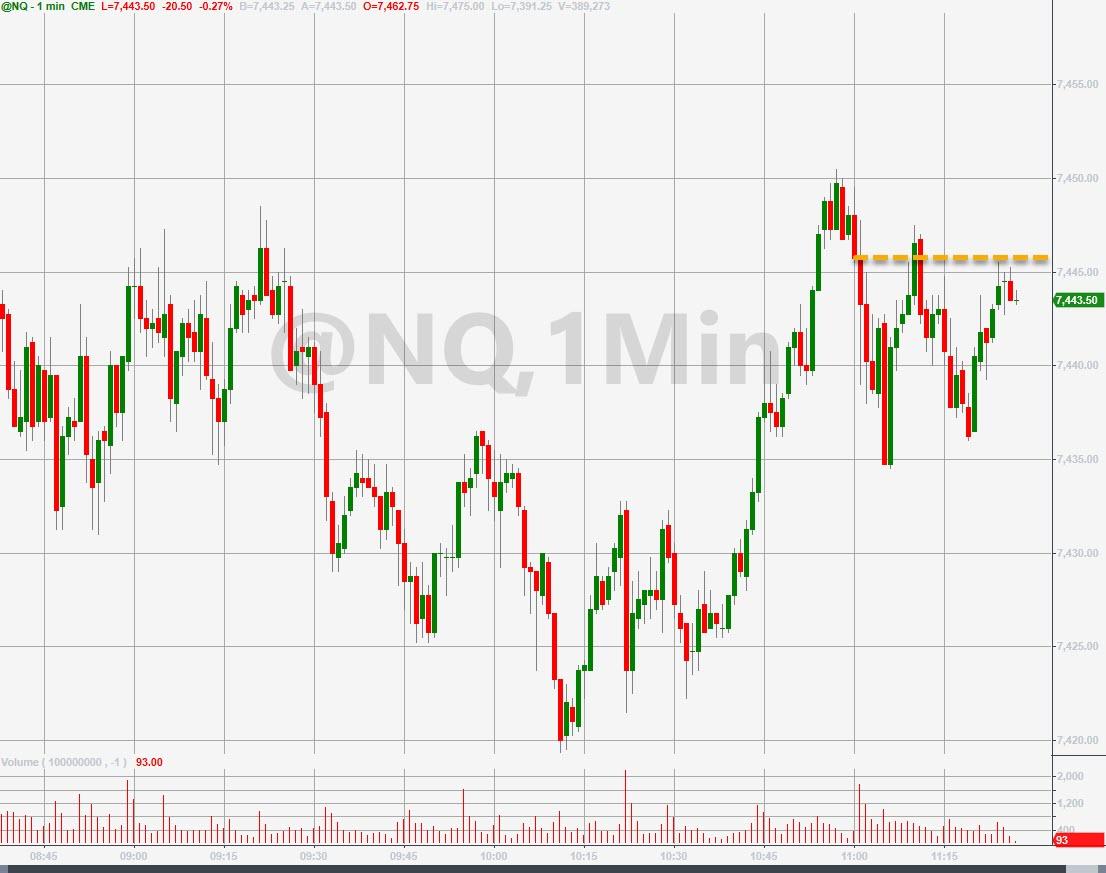
It appears The Fed has mastered the art (for now) of creating a document with no algo-triggering headlines as despite a definite hawkish tone – transitory inflation and asset valuation warnings – stocks and bonds are unmoved and the dollar is very marginally higher.

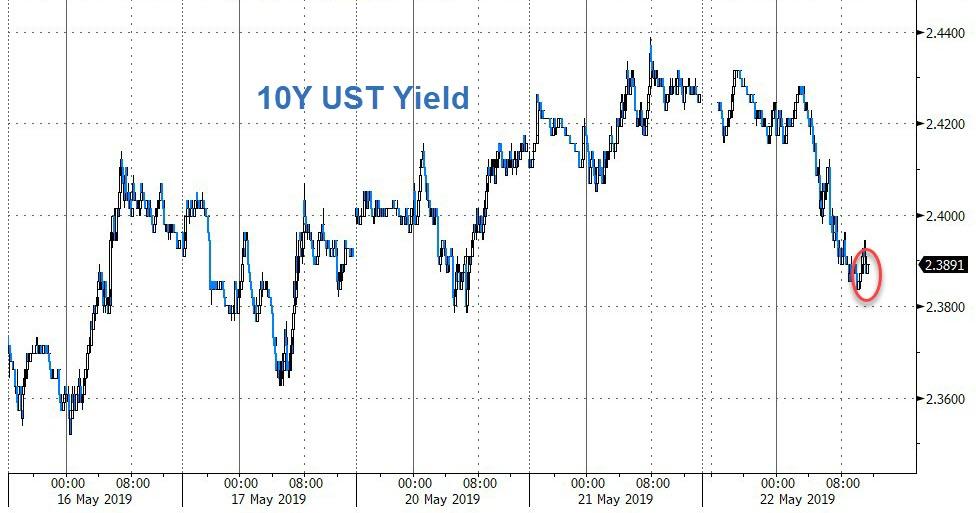
Bond yields are unch…

Eurodollar futures show no immediate shift in rate expectations on the back of the Fed minutes, despite the “transitory” inflation language and the lack of any mention of rate cuts would seem to be a little more hawkish than the market’s positioning.

Stocks are down very modestly…

But the dollar was the only asset that really moved (and even that was minimal)…

But, of course, it’s early yet.

via ZeroHedge News http://bit.ly/2QhVoFg Tyler Durden

New York Legislators Approve Double Jeopardy for Trump Cronies to Protect ‘the Rule of Law’

Yesterday the New York State Assembly approved a bill that carves out an exception to the state’s ban on dual prosecutions for people associated with the president who benefit from an act of clemency after being prosecuted for a federal crime. Senate Bill 4572, which the state Senate already has passed and Gov. Mario Cuomo supports, does not mention Donald Trump by name, but it is aimed at making sure that his cronies can still be prosecuted under state law if he pardons them or commutes their sentences.

The high-minded rationale for S.B. 4572 is that a president should not be able to suppress damaging information that might emerge from state prosecution of former underlings by pardoning them for federal offenses that are also criminal under New York law. “Either in the past or in a continuing manner, the president has talked about using the pardon power in a corrupt way to undermine the rule of law,” said the bill’s Senate sponsor, Todd Kaminsky, a Democrat who represents part of Long Island. “I think New York doesn’t have to sit by and let the capricious use of the pardon power tie its hands.”

The low-minded rationale for Kaminsky’s bill is that Democrats who detest Trump want to take advantage of any weapon they can find to hurt him and people associated with him, especially since impeachment seems to be off the table. But in their eagerness to attack their political opponents, the Democrats who control New York’s legislature are compromising an important principle of justice.

The U.S. Supreme Court has long held that people can be prosecuted for the same conduct under both federal and state law, notwithstanding the constitutional ban on double jeopardy, because an act criminalized by “separate sovereigns” constitutes two distinct offenses. In a case the Court is considering right now, a man convicted of illegal gun possession under both state and federal law is asking the justices to revisit that dubious doctrine, which allows double punishment for the same crime and new prosecutions of defendants who have been acquitted. But 20 states, including New York, already have laws aimed at preventing such outcomes.

New York’s law says “a person may not be separately prosecuted for two offenses based upon the same act or criminal transaction.” There are exceptions to that rule, but none of them covers self-protecting pardons by Donald Trump. Hence the perceived need for S.B. 4572, which applies to former executive branch officials who served in positions requiring Senate confirmation, former members of the president’s executive staff, and former employees of his campaign, transition team, businesses, or nonprofit organizations who benefit from his clemency after they are prosecuted for federal offenses.

In case those broad categories don’t do the trick, the new exception also encompasses anyone who “bears accessory liability” for crimes committed by people associated with the president. There are also catchall categories for acts of clemency that help the president avoid “potential prosecution or conviction,” that are related to crimes that benefited him, or that provide relief for a person who has information “material to the determination of any criminal or civil investigation, enforcement action or prosecution” involving the president.

If the goal of the law were limited to the one described by Kaminsky, you might think those last three categories would suffice. Why throw everyone connected to Trump under the bus if state prosecutions are allowed in cases where it can be shown that a pardon or commutation helped him avoid civil or criminal liability? The breadth of the new exception makes sense if it is a cudgel to beat Trump allies, less so if it is all about preventing him from “using the pardon power in a corrupt way to undermine the rule of law.”

Consider former Trump campaign chairman Paul Manafort, who was sentenced to nearly eight years in federal prison for crimes unrelated to his work on the campaign. Manafort might or might not know things that would support civil or criminal action against the president. But under this bill, New York could prosecute him again for the same conduct (bank fraud, say) even without making that showing (since he is a former campaign official) if Trump decides to pardon him or commute his sentence. It would not matter if Trump’s sole motivation was sympathy for someone he sincerely thought got a raw deal. New York prosecutors could still try to send Manafort back to prison.

The same would be true of many other people in Trump’s orbit—including former secretaries, second cousins, and low-level campaign employees—who are convicted of federal offenses, even if the crime seems minor and the punishment disproportionate. Trump could still use his clemency power to help such a person, but that would not stop New York prosecutors from trying him again for the same conduct, assuming they can find a state law that applies.

If, say, Trump commuted the mandatory minimum sentence of a drug offender who once worked for one of his businesses, she would still be subject to state prosecution for the same crime. Meanwhile, a similarly situated defendant who committed the same offense but never made the mistake of working for Trump would not have to worry about a second prosecution. Call that distinction whatever you like, but it surely does not seem like upholding the rule of law.


from Latest – Reason.com http://bit.ly/2X3yyUo
via IFTTT

This Environmentalist Says Only Nuclear Power Can Save Us Now

Calling climate change an existential threat to humanity, congressional Democrats have proposed a policy package called the Green New Deal. It would mandate that 100 percent of U.S. energy production come from “clean, renewable and zero-emission energy sources” like wind and solar by the year 2050.

But some environmentalists say Green New Dealers are neglecting one obvious source of abundant clean energy already available: nuclear power, which the Green New Deal FAQ wants to phase out along with such fossil fuels as oil, gas, and coal.

“It’s when the conservationists became environmentalists that everything went bad,” says Michael Shellenberger, founder and president of Environmental Progress, a pro-nuclear research and advocacy nonprofit based in Berkeley, California. “It stopped being about the environment. It became about controlling society.”

Shellenberger started his career in energy advocating for more government subsidies to wind and solar. He pushed for a new Apollo Project of $300 billion in federal research and development funding to make renewable energy sources cheaper than coal within a decade.

From 2009 to 2015, the Obama administration took up that call and put billions of dollars into renewable energy subsidies. That, Shellenberger says, opened his eyes to the fact that no amount of government funding can overcome the inherent drawbacks of renewables.

When California invested heavily in wind and solar, Shellenberger says it led to energy price increases at a rate about six times faster than the national average, despite the falling cost of solar panels.

Shellenberger says that the allure of nuclear power is its “energy density”—he estimates that the energy consumption of the average human being from birth to death can be provided by a single 12-ounce soda can’s worth of uranium. He believes a nuclear renaissance could unlock a world of clean energy abundance, an idea he explores further in a document he co-authored, titled “An Ecomodernist Manifesto.”

He contrasts his pro-growth, urbanist “ecomodernism” with the Malthusian, neo-primitivist “dark green” environmentalism that he thinks motivates many proponents of the Green New Deal.

“If you want to save the natural environment, you just use nuclear. You grow more food on less land, and people live in cities. It’s not rocket science,” says Shellenberger. “The idea that people need to stay poor…that’s just a reactionary social philosophy that they then dress up as a kind of environmentalism.”

Watch the above video to learn more about the history of nuclear energy and to hear more from Shellenberger about his case for nuclear power, as well as his response to concerns about radiation, nuclear weapons, and nuclear’s economic viability. The video also features solar energy advocate Ed Smeloff, who served on the Sacramento Municipal Utilities District board during the shutdown of California’s Rancho Seco nuclear plant. Smeloff argues that nuclear power simply can’t compete in the marketplace.

Produced by Zach Weissmueller. Camera by Alexis Garcia and Weissmueller.

This video falls under a Creative Commons Attribution-NonCommercial-ShareAlike License.

“Granular Orchestra” by VP Productions is licensed under a Standard License through Artisound.io.

“Intro” by Herr Doktor is licensed under an Attribution-NonCommercial-ShareAlike License.

“Revenge” by Herr Doktor is licensed under an Attribution-NonCommercial-ShareAlike International License.

“Neon Riding” by Herr Doktor is licensed under an Attribution-NonCommercial-ShareAlike License.

“The Night Heat” by Herr Doktor is licensed under an Attribution-NonCommercial-ShareAlike License.

“Inner City Lights” by Herr Doktor is licensed under an Attribution-NonCommercial-ShareAlike International License.

“Ana” by Herr Doktor is licensed under an Attribution-NonCommercial-ShareAlike License.

“Moon” by Herr Doktor is licensed under an Attribution-NonCommercial-ShareAlike License.

German environmentalists photo credit: Stefan Boness/Ipon/SIPA/Newscom

Alexandria Ocasio-Cortez photo credit: Alex Edelman/Zuma Press/Newscom

Elon Musk photo credit: Yang Lei Xinhua News Agency/Newscom

Michael Shellenberger photo credit: James Arthur Photography/James Arthur/Newscom ID 113779354 © Vaclav Volrab | Dreamstime.com

Smokestacks photo credit: Shaun Van Steyn Stock Connection Worldwide/Newscom


from Latest – Reason.com http://bit.ly/2JyeXbE
via IFTTT

This Environmentalist Says Only Nuclear Power Can Save Us Now

Calling climate change an existential threat to humanity, congressional Democrats have proposed a policy package called the Green New Deal. It would mandate that 100 percent of U.S. energy production come from “clean, renewable and zero-emission energy sources” like wind and solar by the year 2050.

But some environmentalists say Green New Dealers are neglecting one obvious source of abundant clean energy already available: nuclear power, which the Green New Deal FAQ wants to phase out along with such fossil fuels as oil, gas, and coal.

“It’s when the conservationists became environmentalists that everything went bad,” says Michael Shellenberger, founder and president of Environmental Progress, a pro-nuclear research and advocacy nonprofit based in Berkeley, California. “It stopped being about the environment. It became about controlling society.”

Shellenberger started his career in energy advocating for more government subsidies to wind and solar. He pushed for a new Apollo Project of $300 billion in federal research and development funding to make renewable energy sources cheaper than coal within a decade.

From 2009 to 2015, the Obama administration took up that call and put billions of dollars into renewable energy subsidies. That, Shellenberger says, opened his eyes to the fact that no amount of government funding can overcome the inherent drawbacks of renewables.

When California invested heavily in wind and solar, Shellenberger says it led to energy price increases at a rate about six times faster than the national average, despite the falling cost of solar panels.

Shellenberger says that the allure of nuclear power is its “energy density”—he estimates that the energy consumption of the average human being from birth to death can be provided by a single 12-ounce soda can’s worth of uranium. He believes a nuclear renaissance could unlock a world of clean energy abundance, an idea he explores further in a document he co-authored, titled “An Ecomodernist Manifesto.”

He contrasts his pro-growth, urbanist “ecomodernism” with the Malthusian, neo-primitivist “dark green” environmentalism that he thinks motivates many proponents of the Green New Deal.

“If you want to save the natural environment, you just use nuclear. You grow more food on less land, and people live in cities. It’s not rocket science,” says Shellenberger. “The idea that people need to stay poor…that’s just a reactionary social philosophy that they then dress up as a kind of environmentalism.”

Watch the above video to learn more about the history of nuclear energy and to hear more from Shellenberger about his case for nuclear power, as well as his response to concerns about radiation, nuclear weapons, and nuclear’s economic viability. The video also features solar energy advocate Ed Smeloff, who served on the Sacramento Municipal Utilities District board during the shutdown of California’s Rancho Seco nuclear plant. Smeloff argues that nuclear power simply can’t compete in the marketplace.

Produced by Zach Weissmueller. Camera by Alexis Garcia and Weissmueller.

This video falls under a Creative Commons Attribution-NonCommercial-ShareAlike License.

“Granular Orchestra” by VP Productions is licensed under a Standard License through Artisound.io.

“Intro” by Herr Doktor is licensed under an Attribution-NonCommercial-ShareAlike License.

“Revenge” by Herr Doktor is licensed under an Attribution-NonCommercial-ShareAlike International License.

“Neon Riding” by Herr Doktor is licensed under an Attribution-NonCommercial-ShareAlike License.

“The Night Heat” by Herr Doktor is licensed under an Attribution-NonCommercial-ShareAlike License.

“Inner City Lights” by Herr Doktor is licensed under an Attribution-NonCommercial-ShareAlike International License.

“Ana” by Herr Doktor is licensed under an Attribution-NonCommercial-ShareAlike License.

“Moon” by Herr Doktor is licensed under an Attribution-NonCommercial-ShareAlike License.

German environmentalists photo credit: Stefan Boness/Ipon/SIPA/Newscom

Alexandria Ocasio-Cortez photo credit: Alex Edelman/Zuma Press/Newscom

Elon Musk photo credit: Yang Lei Xinhua News Agency/Newscom

Michael Shellenberger photo credit: James Arthur Photography/James Arthur/Newscom ID 113779354 © Vaclav Volrab | Dreamstime.com

Smokestacks photo credit: Shaun Van Steyn Stock Connection Worldwide/Newscom


from Latest – Reason.com http://bit.ly/2JyeXbE
via IFTTT

FOMC Minutes Confirm Hawkish “Transitory” Inflation Outlook, Remains “Patient For Some Time”

Will the Minutes attempt to walk back Powell’s ‘hawkish’ transitory/transient inflation comments, will they mention frothy prices in financial markets, or will an insurance rate-cut be discussed against trade-war threats?

The answer is mixed:

Hawkish

*MANY FED OFFICIALS SAW INFLATION DIP AS LIKELY ‘TRANSITORY

Dovish

*FED OFFICIALS SAW PATIENT APPROACH APPROPRIATE FOR ‘SOME TIME

Bloomberg lays out the key takeaways from FOMC minutes:

  • Fed doubles down on its wait-and-see strategy, as FOMC members felt their patient approach on interest-rate adjustments “would likely remain appropriate for some time” even if global economic and financial conditions continued to improve.

  • Backing up Powell’s comments at the press conference, minutes say “many participants” viewed recent dip in inflation as “likely to be transitory”; minutes contain multiple references to support for patience strategy.

  • A “few” officials said that policy firming would be needed if economy evolved as they expected and inflation pressures built up, while “several” saw a risk that inflation expectations could become anchored below 2%; minutes don’t contain explicit reference to support for possible rate cut.

  • The FOMC held a discussion on the future maturity composition of the central bank’s bond portfolio without making a decision. Staff presented two scenarios: a portfolio similar to maturity of outstanding Treasuries, and a portfolio with bond maturities of three years or less. The minutes show extensive debate on the pros and cons of each approach, particularly on how much capacity they would provide to provide economic stimulus through a maturity extension program.

  • There was little discussion about the U.S.-China trade war, a sign that the worsening of tensions since the meeting probably came as a surprise.

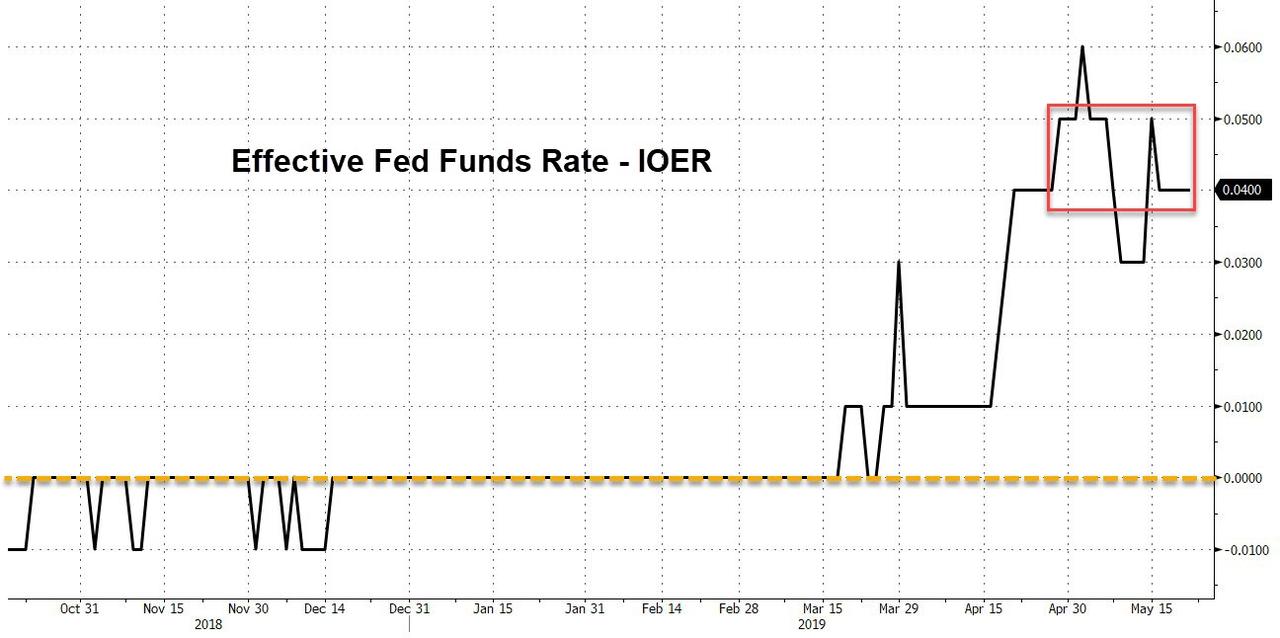
  • On the decision to lower interest on excess reserves rate by 5 basis points, the minutes say Fed staff noted that the effective fed funds rate rose to 5 bps above IOER after the federal income tax deadline on April 15; while a similar dynamic occurred in prior years, the magnitude of the change was larger this year.

*  *  *

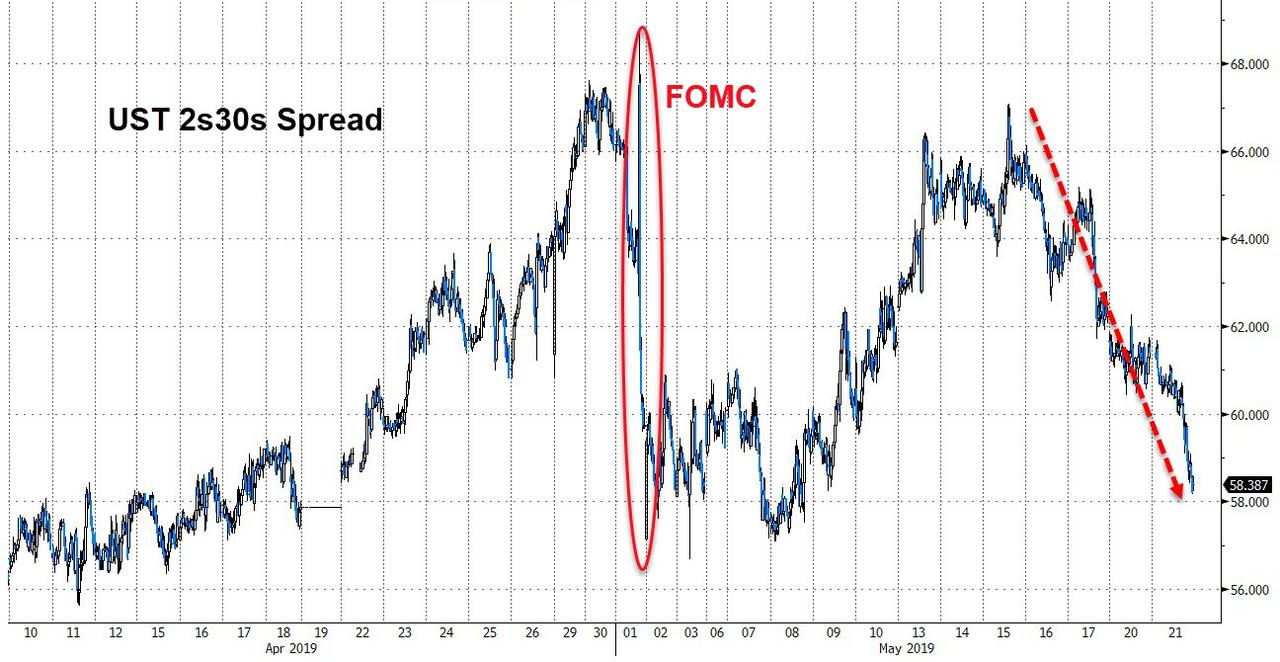
Since the FOMC Meeting on May 1st, the yield curve has had a wild ride but overall has collapsed…hardly a signal that Fed policy is approved by the market.

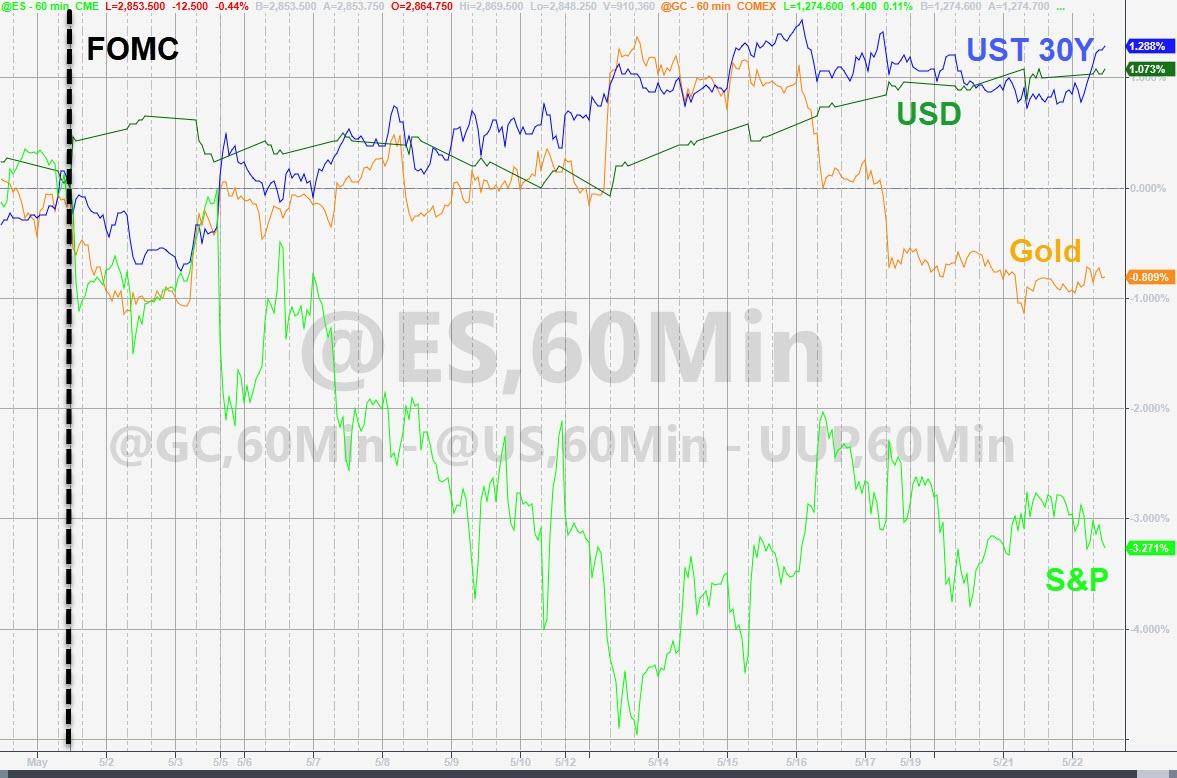
Stocks and Gold have been the worst hit with bonds and the dollar rallying since Powell’s transitory press conference…

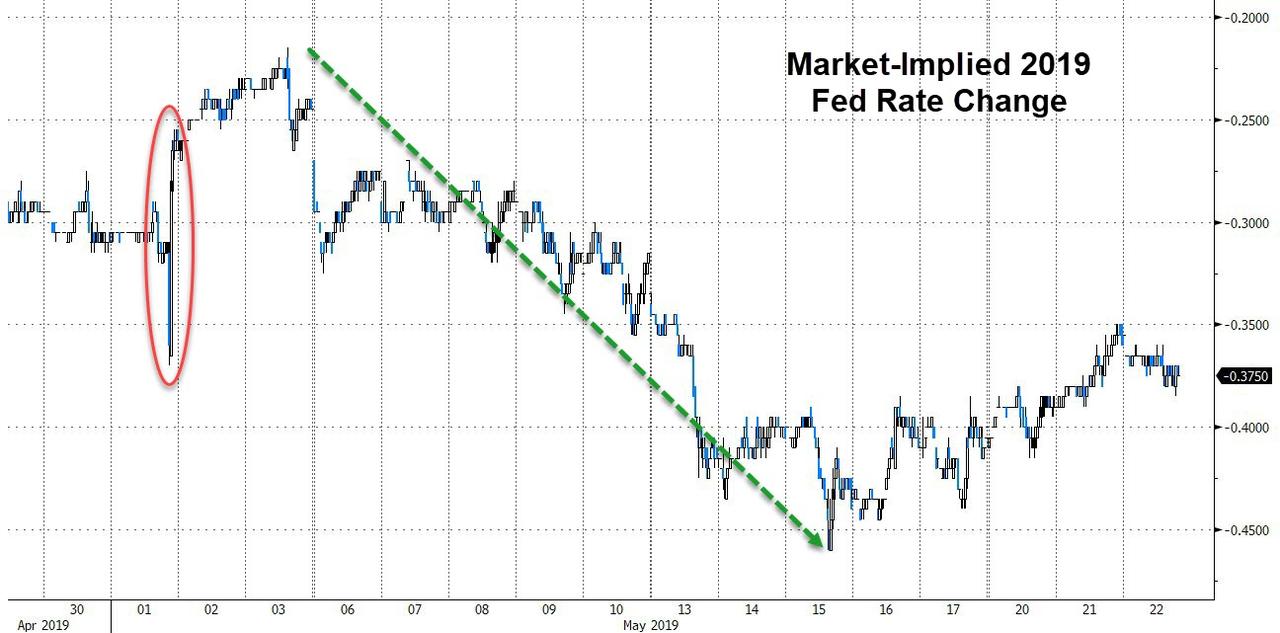
But while the price action looks (and Powell sounds) hawkish, the market-implied Fed rate-change expectations have plunged dovishly since the FOMC meeting…

And, perhaps most notably, despite The Fed’s actions on IOER, the short-term liquidity market remains broken

*  *  *

Full Minutes below:


via ZeroHedge News http://bit.ly/2M3ySRS Tyler Durden

Why Was Mueller Investigation Needed If Witnesses Are Asked To Testify Again?

Authored by Jennie Taer via SaraCarter.com,

On May 17, 2017 Robert Mueller was appointed as Special Counsel to investigate alleged coordination efforts between the Russian government and Donald Trump’s 2016 campaign. On March 22, 2019 he delivered his report final report to Attorney General William Barr.

Over the course of his probe, Mueller brought 199 charges against 34 people and three companies, including six of Trump’s former advisers and associates.

How much did the Mueller Investigation cost?

During these 22 months of investigation, Mueller’s team have filed 3 expense reports, with a fourth one coming soon. The first three reports totaled approximately $6.8 million, $10 million and $8.5 million, respectively. So the last one, if comparable to the others, would make the final dollar amount of Mueller’s probe between $32 million and $35 million.

Despite Mueller’s extensive investigation and its conclusions, democrats in Congress are pursuing multiple investigations on the same subjects previously investigated by the Special Counsel.

Rep. Mark Meadows questioned “what on earth was the point of a taxpayer funded special counsel if we’re going to demand every witness testify again – after the case is already closed?

And President Trump agrees…Everybody, including me, thought that when the 40 Million Dollar Mueller Report was released with No Collusion and No Obstruction (of a crime caused by others), that was the end. But no, the Democrats want to keep it going in an effort to help them in 2020. Bad for the Country!

via ZeroHedge News http://bit.ly/2HL4kPK Tyler Durden

What To Look For In Today’s “Potentially Relevant” FOMC Minutes

The FOMC’s April/May meeting saw the Fed firmly in neutral with recent Fedspeak suggesting that the Fed remains in “patient, or “wait and see mode,” assessing how trade wars will impact growth and inflation. Traders will be particularly attentive to any guidance on the ‘transitory’ nature of inflation, uncertainties around trade, and ‘insurance’ rate cuts.

Courtesy of RanSquawk, here is a recap of what happened during the last FOMC meeting, and what to expect today:

Meeting Recap

At its April/May meeting, the FOMC unanimously decided to hold the FFR target between 2.25-2.50%, as expected, though cut the IOER by 5bps to 2.35%. The statement saw the Fed acknowledge a “solid” rate of growth (upgrading its view), while pointing out that both overall and core inflation has eased (downgrading its view to ‘below 2%’, while also dropping its reference to low rates being a function of low energy prices). The Fed noted that job gains have been solid, though growth of household spending and business fixed investment has slowed. Fed Chair Powell attempted to navigate a neutral line in his press conference, reiterating the messages of the statement, while emphasising the appropriateness of the Fed’s policy stance, and the familiar message of neutral, seasoned with patience. The chair added that while business fixed investment and household spending had slowed, he sees it rebounding. Risks have moderated since the beginning of Q1, (data from China and Europe, disorderly Brexit pushed back, progress on trade talks with China, where the gains would be seen over time). Powell said the Fed was strongly committed to a symmetric inflation target; core inflation fall was unexpected, but likely transitory (this affirmation would prove to be the turning point during the presser, from a markets perspective). Powell said the policy stance is currently appropriate and does not see the case to shift rates in either direction (on a few occasions reiterating that the current policy stance was appropriate); he said the IOER was a technical adjustment that does not represent any shift in the Fed’s policy stance; the FFR remains the central bank’s primary policy tool; he also said that the Fed could look at the possibility of a repo facility at upcoming meetings. Fed Chair Powell was pressed on conditions that the Fed would need to see before considering cutting rates, though he seemed reticent to be drawn in, instead reiterating the Fed’s policy targets. Asset prices were elevated, but not extremely so, though has some concern about corporate leverage; overall though, he does not see evidence of overheating. The FOMC had a discussion on the composition of the balance sheet; a decision will need to be taken at future meetings, and any changes will be telegraphed well in advance, Powell said.

Watch For: Trade Uncertainty

  • Fed Chair Powell, Fed Vice Chair Clarida and FOMC Vice Chair Williams all gave remarks this week ahead of the FOMC minutes release, but there was very little to take away, and the Trinity focusing more on the fundamentals of monetary policy itself, avoiding any detail on US trade policy. Analysts note that without the details of Chinese countermeasures, and details of any exemptions, it is difficult to outline exact economic implications. Until then, uncertainties are likely to persist through to the G20 meeting in June, and the Fed may choose to refrain from committing in either direction until the uncertainty has lifted, delivering upbeat remarks on the progress of the US economy instead.

Watch For: Insurance Rate Cuts

  • When journalists were attempting to cajole Powell into an answer on rate cuts, the Fed chair strongly emphasized the Fed’s neutral position, arguing that he did not see the case to move rates either way. Analysts expect, therefore, that the minutes will show a broad consensus for that neutral stance and a high threshold for possible insurance rate cuts. Indeed, the Fedspeak in the run-up to the release of the minutes has tended to be neutral, signalling that there is support for this view. CS thinks a significant downgrade of the economic data would likely be needed in conjunction with rising financial stress before the Fed entertained lower rates. On the IOER, the minutes will likely reiterate that the move was technical in nature.

Watch Fore: Transitory Inflation

  • Powell downplayed the significance of cooling inflation, suggesting that it was a result of transitory factors, and the minutes will provide insight on how confident the FOMC is in this view. Credit Suisse has argued that Powell’s categorisation of inflation as transitory might be an effort by policymakers to push back against speculation of an insurance rate cut. The ‘transitory’ argument has been pushed forward in remarks by other Fed policymakers since the May meeting too, again signalling that the majority of officials on the Committee tend to agree with Powell. Naturally, there are elements that do not agree – the Fed’ Bullard (voter) recently made the case that if inflation remains at 1.6% he would be more aggressively in favor for lowering rates, signalling that there may be more voices calling for lower rates than higher.

Additionally, here is the take from Nomura’s Charlie McElligott who warns that today’s Minutes have “potential for actual relevance” for the following reasons:

  • Potential for further clarity on Powell’s recent characterization of inflation weakness as “transitory”
  • There too is potential for an update on Fed balance-sheet normalization—recall, QT is “still a thing” currently (keeping USD “bid” with b/s runoff, policy rates at 11y highs and increased Treasury issuance acting to restrict USD liquidity), but shifts to QE-Lite in Oct; thus we could hear more about the Fed’s vision for the composition of the balance-sheet and the concept of something where purchases look “reverse operation twist”-like by being concentrated into T-Bills in order to shorten WAM and steepen curve
  • Finally, we should be on the lookout for any further developments on a standing repo facility as a long-term solution to ease the current / recurring funding squeeze dynamic—as this mechanism would allow for USTs to be “fungible” into Reserves if required “on demand,” helping in periods of “tighter” funding rates

via ZeroHedge News http://bit.ly/2VHxPGP Tyler Durden

Beto O’Rourke Wants To Legalize Weed and Expunge Records, Too

Rep. Beto O’Rourke (D–Texas) is making it clear that his anti-prohibitionist view is about more than simply ending the war on weed.

On Tuesday evening, the Democratic presidential contender answered questions about his presidential platform during a CNN town hall. When asked if he would decriminalize drug use, O’Rourke took his call to end the war on drugs one step further.

“Let’s end the war on drugs … let’s end the prohibition on marijuana, and expunge the arrest records of everyone arrested on possession of a substance that is legal in most of this country,” he said.

His website similarly states that expungement is needed in addition to ending prohibition. Though the website itself lacks a specific plan for pushing this kind of reform, it is still significant to see this position from a major presidential candidate.

Legalization was long thought to be the proper solution to combat disproportionate sentencing and the rapid growth of the prison population. However, several of the states that legalized recreational weed earlier than others are now revisiting state law to pass clemency measures for those still facing consequences from outdated drug laws. States that are just now choosing to repeal prohibition nationwide have already carved out methods to clear old drug convictions in their new legislation.

The crowded primary has attracted anti-prohibitionists and drug warriors alike. One of the most prominent and persistent reformers among these candidates is Sen. Cory Booker (D–N.J.), who has long supported criminal justice reform during his time in the Senate, even reaching across the aisle on occasion. Most recently, Booker reintroduced his Marijuana Justice Act, which includes a (legally questionable) provision for expungements.

In March, he slammed jokes from a few of his challengers who spoke of casual drug use “almost as if it’s funny.” He argued that jokes from these politicians discount the realities that many Americans face as they continue to be arrested for the same crimes.

According to recent polls, an increasing number of Americans support legalization. It’s possible that all 50 states could see legalization and a better criminal justice system in this lifetime, whether those decisions are state-based or come from the federal government.

from Latest – Reason.com http://bit.ly/2WmtYDz
via IFTTT