Real Estate Investors Are Buying A Record Share Of US Homes, Sending Prices Soaring

Real Estate Investors Are Buying A Record Share Of US Homes, Sending Prices Soaring

Earlier this week, we reported that Blackrock, America’s largest commercial and residential landlord, just got even bigger with the purchase of 12,000 apartments in the sunbelt (among other assets) when it acquired Preferred Apartment Communities for $5.8 billion. But Blackrock has not been alone in quietly swooping up US residential real estate.

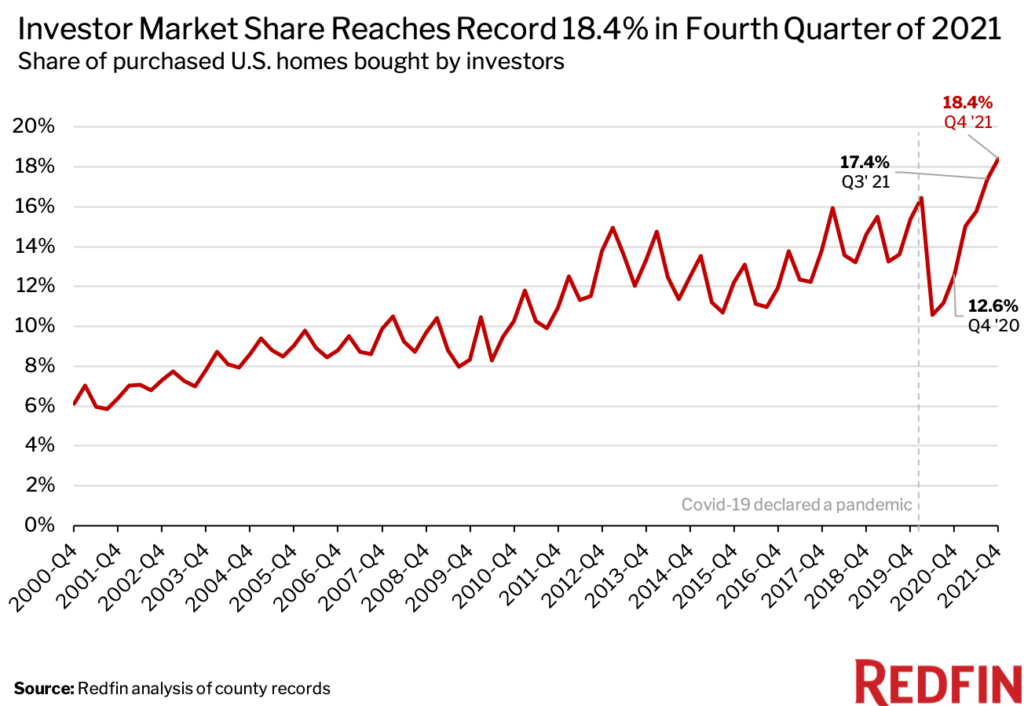
According to the latest data from real-estate consultancy Redfin, real estate investors – i.e., those who purchase real estate not with the intention of living in it but in expectations of reselling and/or renting it out – bought a record 18.4% of the homes that were sold in the U.S. during the fourth quarter of 2021, up from 12.6% a year earlier and a revised rate of 17.4% in the third quarter.
Investors bought 80,293 homes in the fourth quarter, up 43.9% from a year earlier (although investor market share hit a record in the fourth quarter, the number of homes bought by investors declined by 8000, or 9.1%, from the third-quarter peak; but it’s up significantly from pre-pandemic levels). The housing-supply crunch constrained home sales for all homebuyers, including investors. The drop from the third quarter is also due partly to seasonality, as real estate activity tends to slow at the end of the year. In 2019, for example, the number of homes investors purchased dropped 4% from the third to fourth quarters. 
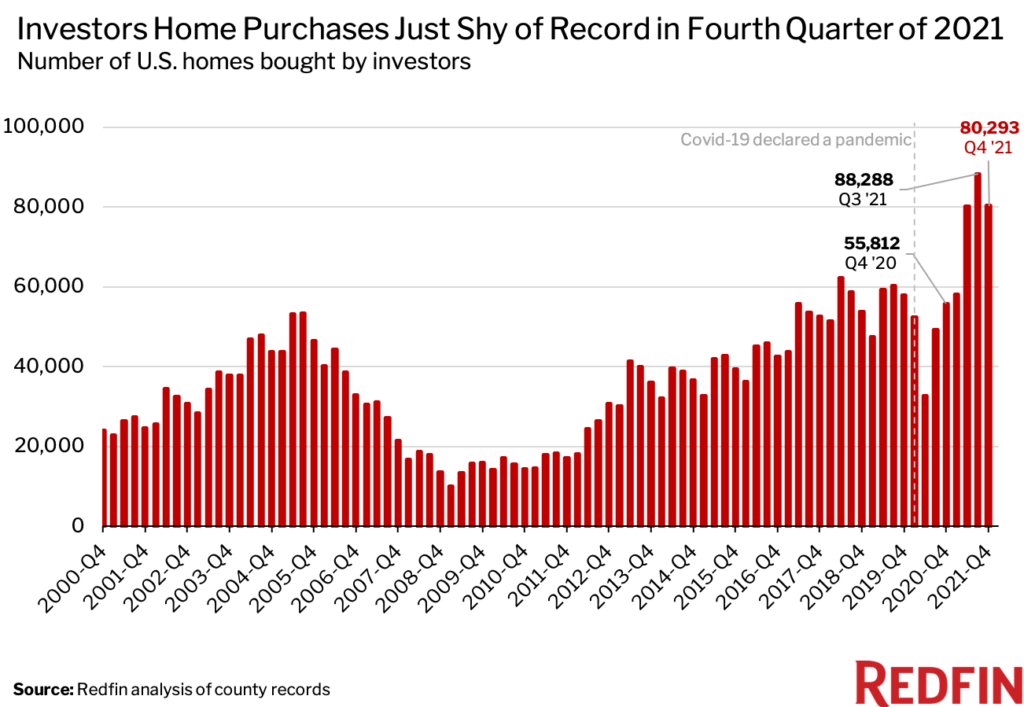
The number of homes bought by investors jumped throughout 2021 as home prices rose rapidly–they were up 15% year over year in December–alongside a shortage of homes for sale. Investors are taking advantage of intense demand for rentals and increasing prices, with the average monthly rental payment for a new lease up 14% in December.  

Just over three-quarters (75.3%) of investor home purchases were paid for with all cash in the fourth quarter. 

Here is a summary of Redfin’s findings:

  • Investors bought 18.4% of the U.S. homes that were purchased in the fourth quarter, a record high.
  • Investor demand is stronger than ever as home prices increase, allowing investors to charge higher rents and sell flipped homes for higher prices.
  • Real estate investors bought roughly 80,000 U.S. homes worth a total of $50 billion in the fourth quarter, up significantly from a year earlier.
  • Mid-priced homes are becoming more popular with investors, making up 32% of investor purchases in the fourth quarter, a record high. Low-priced homes are still most popular with investors, making up 37% of purchases.
  • Investors had the highest market shares in Atlanta, Charlotte and Jacksonville.

“While record-high home prices are problematic for individual homebuyers, they’re one reason why investor demand is stronger than ever,” said Redfin economist Sheharyar Bokhari. “Investors are chasing rising prices because rental payments are also skyrocketing, incentivizing investors who plan to rent out the homes they buy. The supply shortage is also an advantage for landlords, as many people who can’t find a home to buy are forced to rent instead. Plus, investors who ‘flip’ homes see potential to turn a big profit as home prices soar.”

“Investors buying up a record share of for-sale homes is one factor making this market difficult for regular homebuyers,” Bokhari continued. “It’s tough to compete with all-cash offers, and rising mortgage rates have a smaller impact on investors because they often don’t use mortgages at all. If home-price growth slows in the coming year, investor demand may cool down because rental price growth will slow, too.”

In dollar terms, investors bought $49.9 billion worth of homes in the fourth quarter, up from $35 billion a year earlier. The typical home investors purchased sold for $432,971, up nearly 10% from a year earlier. The price increase comes amid surging prices in the overall housing market.

Mid-priced homes are gaining popularity with investors, representing 32.3% of their purchases in the fourth quarter, a record high (essentially tied with 32.4% in the third quarter) and up from 24.1% a year earlier. 

Low-priced homes are still more popular than more expensive options for investors, but not by much. Low-priced homes made up 37% of investor purchases in the fourth quarter, a record low and down from 44.5% a year earlier. 

Meanwhile, high-priced homes represented 30.7% of investor purchases, up slightly from 30% in the third quarter but down slightly from 31.4% a year earlier. 
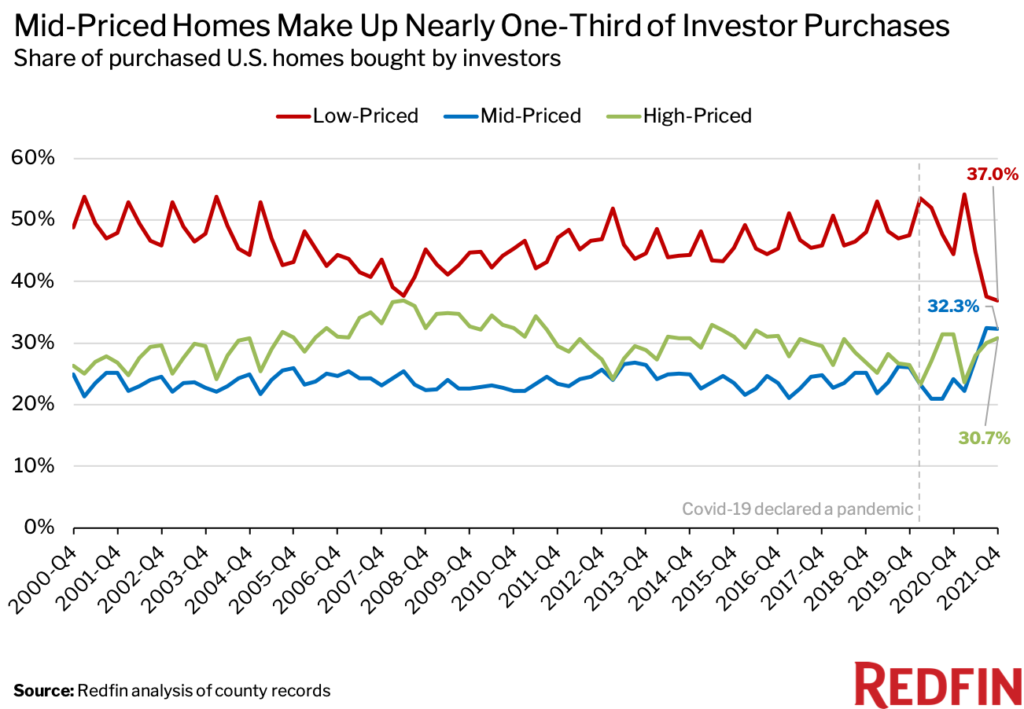
“Lower price points are still popular with investors, and I don’t expect that to change. One of their main goals is still to buy low and sell high,” Bokhari said. “But investors are also increasingly interested in higher-priced properties, partly because there’s a lack of low-priced inventory and partly because they’re betting on rising demand for high-end rentals.”

Single-family homes made up about three-quarters (74.8%) of investor purchases in the fourth quarter. That’s near the highest level on record, essentially tied with the third quarter (75%), and up from 72.2% a year before.

Condos and coops made up 15.4% of investor purchases, down from 17.8% a year earlier and 16.1% in the third quarter. Townhouses represented 6% of investor purchases, up from 5.3% a year earlier, and multifamily properties made up 3.8%, down from 4.7% a year earlier.
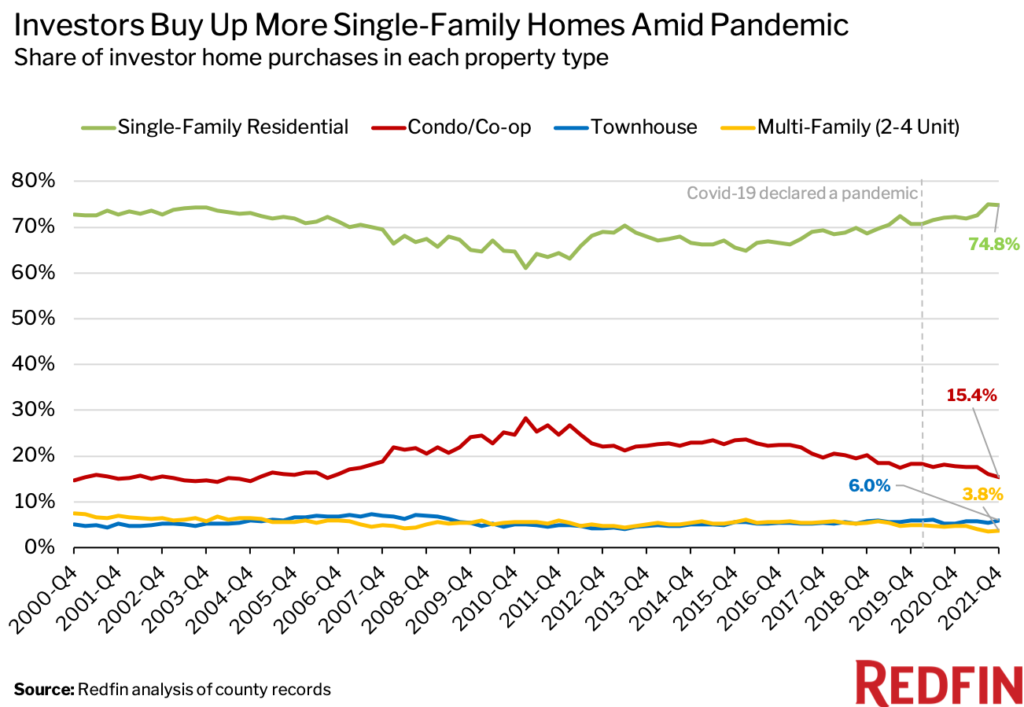
Single-family homes surged in popularity at the beginning of the pandemic, with many homebuyers searching for space for remote work and online schooling. Investors are likely buying up single-family homes because they still make attractive rentals for those reasons.

Investors had the biggest market share in relatively affordable Sun Belt metros. In Atlanta, 32.7% of homes that sold in the fourth quarter were bought by investors, the biggest share of the 40 U.S. metros in this analysis, and in Charlotte it was 32.1%. They’re followed by Jacksonville, FL (29.8%), Las Vegas (29.2%) and Phoenix (28.4%). 

The top three metros for investors—Atlanta, Charlotte and Jacksonville—all had median home-sale prices under the national median of $383,000 in December, making them attractive to investors. 

Home prices have risen significantly over the last year in Las Vegas and Phoenix, up 24.8% year over year to $399,400 and up 28% to $435,200, respectively. They’re also two of the most popular migration destinations in the U.S., attracting tens of thousands of new residents in 2021. Atlanta and Charlotte are also among the most popular destinations for Americans moving from one metro area to another, making all four of those areas good bets for investors hoping to rent out properties. 

Investor purchases more than doubled from last year in Jacksonville, with a 157% year-over-year increase, the biggest jump of the metros in this analysis. It’s followed by Las Vegas (105.5% year-over-year increase), Charlotte (92.8%), Baltimore (83%), and Atlanta (74.4%). Investor purchases increased from the year before in all but four of the metros in this analysis (Seattle, Nassau County, NY, Newark, NJ and Warren, MI). 

Just over 6% of Providence, RI homes that sold in the third quarter were bought by investors, the smallest share of the metros in this analysis. It’s followed by Washington, D.C. (7.8%), Warren, MI (8.2%), Virginia Beach (8.6%) and Montgomery County, PA (8.6%).

Tyler Durden
Fri, 02/18/2022 – 20:40

via ZeroHedge News https://ift.tt/W8t2hov Tyler Durden

No Sealing of Police Body-Cam Video in Lawsuit Over Confrontation With Police,

From Tuesday’s decision by Judge Anthony Ishii in Wallace v. City of Fresno (E.D. Cal.):

Defendants argue that the Court should seal a police body-cam video that depicts the confrontation between [Fresno Police Department] officers and [minor plaintiff] Wallace. Defendants state that some of the individuals depicted in the video are minors who have privacy rights. Public disclosure of the video could have an adverse impact on the minor’s reputation and standing in the community. To avoid the danger and harm that could come from release, sealing the video is appropriate….

There is a strong presumption of access to judicial records, including attachments/filings relating to summary judgment.

An exhibit or other judicial record may be ordered sealed if “compelling reasons” to seal outweigh the general history of access and the public policies favoring disclosure…. “‘[C]ompelling reasons’ sufficient to outweigh the public’s interest in disclosure exist when court records might become a vehicle for improper purposes, such as the use of records to gratify private spite, promote public scandal, circulate libelous statements, or release trade secrets.” However, the “mere fact that the production of records may lead to a litigant’s embarrassment, incrimination, or exposure to further litigation will not, without more, compel the court to seal its records.” …

[T]he Court agrees with Wallace that sealing the body-cam video is unwarranted…. Wallace is aware of only one minor (who is his friend) who is depicted in the body-cam video. Wallace represents that the minor is seen for three seconds and is only seen exiting the apartment and walking into a public space. This is an extremely short period of time.

Moreover, the depiction of the minor is by itself immaterial and there is nothing inherently embarrassing about walking out of an apartment. Additionally, Wallace has represented that the video has been reported and circulated in the public domain for over two years. The Court agrees with Wallace that any possible embarrassment, as unlikely as that may be, has already occurred. {If the parties believe that it is appropriate, the Court would likely be amenable to a stipulation to file the video with the minor’s face blurred out.}

Defendants have not submitted any contrary information that indicates that Wallace’s representations are inaccurate. Therefore, the Court must conclude that Defendants have not articulated sufficiently compelling reasons that would justify the sealing of the body-cam video exhibit. If Defendants wish to rely on the body-cam video, the video must be submitted or filed in an unsealed manner and consistent with the Local Rules….

The post No Sealing of Police Body-Cam Video in Lawsuit Over Confrontation With Police, appeared first on Reason.com.

from Latest https://ift.tt/kzXOfPg
via IFTTT

The Fed Is Mistaken: It’s The Removal Of Inflation That Is Destabilizing, Not ‘Late’ Policy Moves

The Fed Is Mistaken: It’s The Removal Of Inflation That Is Destabilizing, Not ‘Late’ Policy Moves

By Joseph Carson, former chief economist at Alliance Bernstein

The Fed is mistaken. The removal of inflation has the most significant destabilizing effect on the economy, not the abrupt change in monetary policy that comes late to dampen or reverse the price cycle and imbalances. Inflation cycles create liquidity, income, and wealth, and its reversal triggers a sharp loss in all of them.

Over the past 50 years, inflation cycles have been broad and narrow, rotating from general consumer and producer inflation to financial and tangible assets. Each has unique features, but each has a common lousy outcome (recession).

The challenge for the Fed nowadays is that inflation is everywhere and in everything (“The Everything Inflation Cycle” Blog of November 26, 2021). Several years ago, I developed a proprietary broad price index consisting of consumer and producer prices and real estate and equity prices. Based on data through January 2022, the broad price index shows a record double-digit increase over the past year, consisting of CPI and PPI gains equal to that of the 1970s and asset inflation that is roughly equal to the dot.com and housing bubbles combined.

In a recent interview Ms. Mary Daly, President of the San Francisco Federal Reserve Bank, stated, “history tells us with Fed policy, that abrupt and aggressive action can actually have a destabilizing effect on the very growth and price stability we’re trying to achieve.” That is true if the Fed waits until actual inflation worsens before taking countermeasures. The Fed is still easing policy.

The question now does the Fed engineer a Greenspan-type soft landing (1995) or a Volcker hard-landing? Odds favor a Volcker ending.

Look at the evidence.

  • The 1970s: Supply shocks triggered a sharp rise in consumer and producer prices that fed into wages and expectations. Consumer price inflation averaged nearly 7% per year during the decade, the highest of any decade in the postwar period. Still, policymakers feared the negative trade-off between fighting inflation and increasing joblessness, so policy remained loose. It took a dramatic rise in official rates to kill the cycle, led by Fed Chair Volcker. The result was three years of recession from 1980-to 82.

  • The 1980s: A sharp rise in cyclical inflation surfaced in the late 1980s following the sharp depreciation of the US dollar and the abrupt easing of monetary policy after the stock market crash of 1987. Consumer price inflation jumped to 6% by the late 1980s. Policymakers lifted official rates to near 10% to break the price cycle. An economic recession and a banking crisis (linked to the collapse in commercial real estate) occurred in the early 1990s.

  • The 1990s: Against a backdrop of modest consumer price inflation, a surge in asset prices occurred from the mid-1990s to 2000. During that period, the S&P 500 rose roughly 25% per year for five consecutive years, while the Nasdaq posted annual gains of nearly 60%. The surge in equities prices lifted share prices far beyond the company’s earnings, creating a unbalance or a bubble. Equity prices fell hard once the Fed reversed its easy money policy. A mild recession occurred in 2001, and equity markets corrected for the next three years.

  • The 2000s: As the Fed maintained an easy money policy to cushion the economy from the plunge in equity prices, a new inflation cycle started in real estate. According to the S&P/Cass Shiller National House Price Index, housing inflation ran roughly 10% per year from 2001 to 2006, or four to five times the rise in general inflation. The housing bubble ended when once monetary policy and credit conditions tightened. The collapse in house prices triggered the most severe economic and financial downturn in the post-war period.

  • 2021 and ?. The current inflation cycle is unlike anything seen before. The 1970s and 1980s inflation cycles centered on consumer and producer prices, while assets prices (equities and real estate) powered the 1990s and 2000s inflation cycles. Today’s inflation cycle has all of the above. And based on the broad price index, the current inflation cycle is as big as the 1970s and the dot.com and the housing bubble combined. (Note: CPI less shelter has risen 9.1%in the last year, the biggest increase since 1981. Including a market-price shelter, the component lifts CPI to double-digits. The old producer prices for finished goods are up 12.5, while core intermediate and crude prices have increased by 23% and 13.5%, respectively. The CPI and PPI account for 85% of the broad price index,)

Policymakers have misread the full scope of the inflation cycle and need to play catch-up. Monetary policy is a blunt instrument, and so trying to attack one or two segments of the inflation cycle will hit them all, but not equally.

History says the odds of achieving a soft landing in the economy is low. Mr. Greenspan successfully landed the economy in 1995, but he raised official rates 300 basis points over twelve months and raised the real federal funds rate from zero to 3%. The current generation of policymakers needs to do as much or more soon or risk doing much more later. Even if policymakers act soon and big, the scale and breadth of the inflation cycle still favor a Volcker-type ending.

One key takeaway from all this is that the analytical framework used to assess the appropriate monetary policy stance has been too narrow and inflexible. A broad price index would be a helpful addition to the Fed’s toolbox as it helps distinguish between relative and absolute price movements and provide a signaling effect of significant and persistent increases.

Tyler Durden
Fri, 02/18/2022 – 20:20

via ZeroHedge News https://ift.tt/CdVOJb9 Tyler Durden

No Sealing of Police Body-Cam Video in Lawsuit Over Confrontation With Police,

From Tuesday’s decision by Judge Anthony Ishii in Wallace v. City of Fresno (E.D. Cal.):

Defendants argue that the Court should seal a police body-cam video that depicts the confrontation between [Fresno Police Department] officers and [minor plaintiff] Wallace. Defendants state that some of the individuals depicted in the video are minors who have privacy rights. Public disclosure of the video could have an adverse impact on the minor’s reputation and standing in the community. To avoid the danger and harm that could come from release, sealing the video is appropriate….

There is a strong presumption of access to judicial records, including attachments/filings relating to summary judgment.

An exhibit or other judicial record may be ordered sealed if “compelling reasons” to seal outweigh the general history of access and the public policies favoring disclosure…. “‘[C]ompelling reasons’ sufficient to outweigh the public’s interest in disclosure exist when court records might become a vehicle for improper purposes, such as the use of records to gratify private spite, promote public scandal, circulate libelous statements, or release trade secrets.” However, the “mere fact that the production of records may lead to a litigant’s embarrassment, incrimination, or exposure to further litigation will not, without more, compel the court to seal its records.” …

[T]he Court agrees with Wallace that sealing the body-cam video is unwarranted…. Wallace is aware of only one minor (who is his friend) who is depicted in the body-cam video. Wallace represents that the minor is seen for three seconds and is only seen exiting the apartment and walking into a public space. This is an extremely short period of time.

Moreover, the depiction of the minor is by itself immaterial and there is nothing inherently embarrassing about walking out of an apartment. Additionally, Wallace has represented that the video has been reported and circulated in the public domain for over two years. The Court agrees with Wallace that any possible embarrassment, as unlikely as that may be, has already occurred. {If the parties believe that it is appropriate, the Court would likely be amenable to a stipulation to file the video with the minor’s face blurred out.}

Defendants have not submitted any contrary information that indicates that Wallace’s representations are inaccurate. Therefore, the Court must conclude that Defendants have not articulated sufficiently compelling reasons that would justify the sealing of the body-cam video exhibit. If Defendants wish to rely on the body-cam video, the video must be submitted or filed in an unsealed manner and consistent with the Local Rules….

The post No Sealing of Police Body-Cam Video in Lawsuit Over Confrontation With Police, appeared first on Reason.com.

from Latest https://ift.tt/kzXOfPg
via IFTTT

The Future Of Global Coal Production (2021-2024F)

The Future Of Global Coal Production (2021-2024F)

Coal is the world’s most affordable energy fuel, and as such, the world’s biggest commodity market for electricity generation.

Unfortunately, as Visual Capitalist’s Niccolo Conte notes, that low-cost energy comes at a high cost for the environment, with coal being the largest source of energy-related CO2 emissions.

Despite its large footprint, coal was in high demand in 2021. As economies reopened following the start of the COVID-19 pandemic, countries struggled to meet resurgent energy needs. As a readily available low-cost energy source, coal filled the supply gap, with global coal consumption increasing by 450 million tonnes or around +6% in 2021.

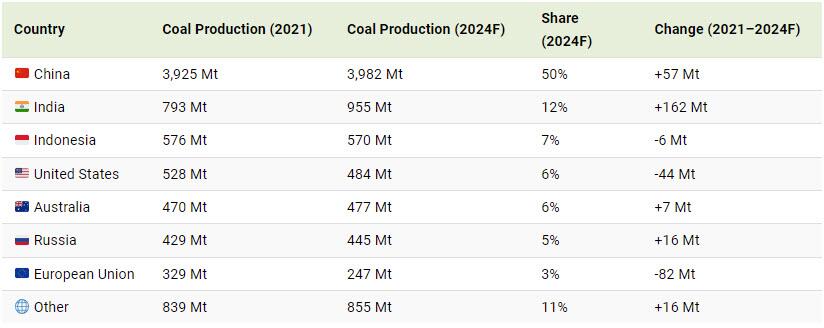
This graphic looks at the IEA’s coal production forecasts for 2024, and the specific countries projected to reduce or increase their production over the next few years.

Which Countries Are Increasing (or Reducing) Coal Production?

Global coal production was a topic of scrutiny at the COP26 conference held in November of 2021, where 40 countries pledged to stop issuing permits and direct government support for new coal-fired power plants.

However, many of the top coal-producing countries did not commit to the pledge. China, the U.S., India, Russia, and Australia abstained, and of those five, only the U.S. is forecasted to reduce coal production in the next two years.

Source: IEA

With 15 EU countries signing the pledge, the European Union is forecasted to see the greatest drop in coal production at 82 million tonnes, along with the greatest forecasted reduction in coal consumption (101 million tonnes, a 23% reduction).

Reducing Coal-Fired Power Generation in the U.S.

The U.S. and Indonesia are the other two major producers forecasted to reduce their reliance on coal. The U.S. is projected to cut coal production by 7.5% or 44 million tonnes, while Indonesia’s reduction is forecasted at 6 million tonnes, or just a 1% cut of its 2021 production.

Despite not joining the COP26 pledge, the U.S. is still noticeably pursuing short and long-term initiatives to reduce coal-fired power generation.

In fact, 85% of U.S. electric generating capacity retirements in 2022 are forecast to be coal-fired generators, and there are further plans to retire 28% (59 GW) of currently operational coal-fired capacity by 2035.

Coal Makes Energy Ends Meet in China and India

Modern consumption and production are instead focused in Asia.

China and India produce almost 60% of the world’s coal, and are expected to increase their production by more than 200 million tonnes per year, collectively. All this coal goes towards meeting the insatiable energy demands of both nations.

While China has pledged to start cutting down coal consumption in 2026, the country also announced the construction of 43 new coal-fired power plants to meet energy demand until then. Part of the additional production is driven by a need to reduce the country’s dependence on coal imports, which are expected to drop by 51 million tonnes or 16% from 2021–2024.

By 2024, China’s coal consumption is forecasted to rise by 3.3% and India’s by 12.2%, which would make the two countries responsible for two-thirds of the world’s coal consumption.

Tyler Durden
Fri, 02/18/2022 – 20:00

via ZeroHedge News https://ift.tt/5jElzWV Tyler Durden

Bitcoin’s Political Breakthrough Raises Questions About Its Regulatory Future

Bitcoin’s Political Breakthrough Raises Questions About Its Regulatory Future

By Mike Hobart of Bitcoin Magazine

Is it actually possible for individual U.S. states to establish bitcoin as legal tender currency?

Arizona State Senator Wndry Rogers seems to think so, based on the submission (SB 1341) she crafted and introduced late last month, aiming to establish bitcoin as legal tender in the State of Arizona. Meanwhile Texas Governor Candidate Don Huffines has promised to recognize bitcoin as legal tender if elected.

But while there is growing interest in state leaders adoption bitcoin in this way, there might be some obstacles. Namely, the first clause in article one in section 10 of the U.S. Constitution:

“No State shall enter into any Treaty, Alliance, or Confederation; grant Letters of Marque and Reprisal; coin Money; emit Bills of Credit; make any Thing but gold and silver Coin a Tender in Payment of Debts; pass any Bill of Attainder, ex post facto Law, or Law impairing the Obligation of Contracts, or grant any Title of Nobility.”

As of right now, it seems that individual states do not have the capability, nor the power, to establish a newly acceptable form of legal tender within the Union of the U.S. So, that’s a bit of a buzzkill. But it’s clear that we are making significant progress in the mainstream acceptance of Bitcoin, sparking interest by American politicians and legislators and spreading like wildfire.

“The key piece here is not whether it will pass or what impact it will have in Arizona,” explained Dennis Porter, a podcaster focused on the intersection of Bitcoin and politics. “The true impact of this bill is the fire that it has ignited. Other states and legislators are now looking at this as a potential option for their state as a way to protect themselves from a runaway federal government.”

Game Theory Playing Out

It also means that Bitcoiners as individuals need to become careful, and much more critical of what our politicians claim and promise. The game theory that we have been discussing within our circles for years is playing out, almost precisely as was expected: politicians and other public figures are realizing the power behind garnering support from the Bitcoin community. Not just because of the excitement around price action, but also due to the sheer numbers of the voter base within the borders of the United States. This voter base reaches across all party lines, anyone is capable of garnering support, from all angles.

“States need to begin adopting Bitcoin today so they can begin the process of protecting themselves from the federal government unplugging them from the overly-powerful national financial system,” Porter said. “It’s a win-win plan for any state to adopt Bitcoin. It gives them more autonomy over their future.”

Changing Perception In D.C.

Another recent development at the intersection of Bitcoin and politics can be found in a bill introduced to the U.S. Congress by Representatives Suzan DelBene of Washington and David Schweikert of Arizona on February 3, 2022.

This particular bill is aimed at introducing a “workable structure for taxing purchases made with virtual currency,” such as bitcoin. One of the greatest hindrances to bitcoin adoption by the general public is its infeasibility as a currency for routine purchases, as it is more closely treated as a stock or other long-term investment from a tax perspective in the U.S.

DelBene and Schweikert aimed to alleviate this bottleneck by providing an exemption from taxes in the use of bitcoin as a currency where capital gains amounted to less than $200.

“It’s a great way to normalize the whole ‘track your buys under $600 thing,’” said Ant, the pseudonymous author of Bitcoin blockchain data dashboard Timechain Stats. “Accounting is a nightmare, and hardly anyone knows their cost basis.”

However, as national politicians attempt to normalize and increasingly regulate the use of bitcoin, even if that regulation is meant to increase adoption, they will inevitably challenge the project’s status as something parallel to and outside of the national system.

“Most important: Bills like this will end up doxxing a lot of bitcoiners, both directly and indirectly,” Ant warned.

While a bill like DelBene and Schweikert’s may be viewed as a boon to some individuals who take portions of their salary in bitcoin, it also provides a stepping stone for potential abuse of financial surveillance powers, not just immediately, but into the future as well. Which is a very important worry amongst many in the Bitcoin space.

Bitcoiners should be cautious around how quickly we are seeing these social and powerful figures flock to this revolutionary asset. It would behoove all of us to take pause, catch our breath and reflect before two potential scenarios play out:

One, we rush to regulate an asset that is wildly misunderstood and provide roadblocks to those we aim to protect. And two, we rush to support and uplift politicians who hoist the Bitcoin standard in the desire to reach regulation of the asset before the regulatory windfalls are well gauged or we have established understanding, so as to avoid inviting weakness within the system itself.

Our world moves fast, but we don’t have to break things. When it comes to state adoption, being a slow mover can be a blessing, not a curse.

Tyler Durden
Fri, 02/18/2022 – 19:40

via ZeroHedge News https://ift.tt/14gWI8q Tyler Durden

Ontario Government Employee Fired Over $100 Contribution To Freedom Convoy

Ontario Government Employee Fired Over $100 Contribution To Freedom Convoy

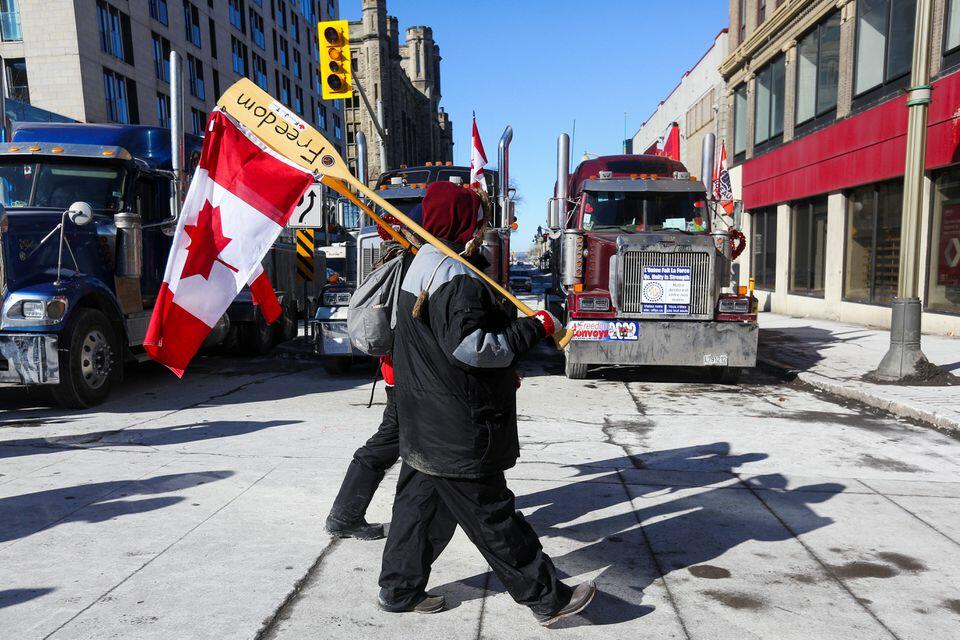
The communications director for the Ontario ministry responsible for enforcing the law was fired this week after her $100 donation to the Freedom Conovoy was revealed in the hack of donors to a GiveSendGo campaign, according to CTV News.

Marion Isabeau-Ringuette was one of several government staffers whose donations drew the eye of Sauron after the list of some 100,000 donors was leaked.

For the communications director to be financially supporting an unlawful, illegal occupation is definitely concerning,” said NDP MPP Catherine Fife. “Who was donating, why were they donating, and did this contribute to the non-action that happened on the ground in Ottawa?”

According to Ontario Premier Doug Ford spokeswoman Ivana Yelich, “Ms. Isabeau-Ringuette no longer works for the Ontario government.”

Isabeau-Ringuette worked as a political staffer as recently as Sunday for Ontario’s Solicitor-General, the position that oversees police and other law enforcement in Ontario.

The $100 donation was listed as anonymous on GiveSendGo, but in a pair of leaked documents totalling nearly 100,000 donations, one line reads “M.R.” with an email address that contains Isabeau-Ringuette’s name. -CTV

Another employee under scrutiny works for the federal correctional service, while a pollster with ties to the governing Progressive Conservative party was also accused in an NDP news release of donating to the protesters, who oppose government vaccine mandates and other restrictions.

According to Toronto lawyer Nainesh Kotak, even small donors to the fund – should the continue donating – run the risk of frozen bank accounts since the government invoked the Emergencies Act.

“Under this enactment I would suggest the government could freeze bank accounts if they chose to do so,” he said, adding “That’s concerning. The targets should be the bigger players.”

George Washington University postdoc fellow Yunkang Yan says conservative US politicians are using the Freedom Convoy to energize their base.

““A lot of influential right-wing media have been promoting narratives about that for a long time. They have very big audiences. People from all walks of life on the political right might be a viewer of their content on a regular basis,” which includes those on both sides of the border. “That might be why they are really sucked into this.”

Tyler Durden
Fri, 02/18/2022 – 19:20

via ZeroHedge News https://ift.tt/TWmlUE3 Tyler Durden

Pseudonymity Allowed in Challenge to Denial of Religious Exemption to Vaccine Requirement

From Judge Steve Merryday’s order today in Navy Seal 1 v. Austin (M.D. Fla.):

Although acknowledging the “presumption that parties’ identities are public information,” the plaintiffs claim that a privacy interest under governing authority overcomes the presumption. The plaintiffs assert that the privacy of their medical and health information and the privacy of their religious beliefs and practice, as well as the prospect of “stigma, ostracization, retaliation, and other harms,” including threats of violence, require the use of a pseudonym.

The plaintiffs correctly observe that “religion is perhaps the quintessentially private matter.” Prosecution of this action compels the plaintiffs to disclose sincere religious beliefs and to disclose the deeply personal experiences that form the foundation of those beliefs. For example, Lieutenant Colonel 2 opposes any vaccine associated with aborted fetal cell lines because she received an abortion after suffering a rape and later—through her religious devotion—believes herself forgiven, according to her beliefs, for the sin of abortion. Although the defendants argue that the plaintiffs’ vaccination status “is not a matter of utmost intimacy,” this action encompasses substantially more intimate detail than whether a person chose to accept a vaccine.

Further, the plaintiffs point to an array of recent and current actions similar to, or nearly the same as, this action that permit pseudonyms for the same reasons that plaintiffs advance. See, e.g., Does 1–6 v. Mills (D. Me. 2021); Air Force Officer v. Austin (M.D. Ga. 2022). Mills recognizes the “reasonable fear of harm that outweighs the public’s interest” in disclosure because of the “substantial public controversy currently surrounding public and private mandates requiring individuals to be vaccinated for the COVID-19 coronavirus or to provide proof of vaccination status.” Mills (granting leave to proceed pseudonymously to healthcare workers objecting to a COVID-19 vaccination requirement). As in Mills, the plaintiffs in this action challenge the government on the controversial issue of a COVID-19 vaccination requirement. The statements and incidents cited by the plaintiffs adequately demonstrate, and everyday experience in recent weeks and months confirms, an acrid public atmosphere of contention about masks, vaccines, mandates, and the like.

Beyond the plaintiffs’ interests in maintaining privacy and safety, the record shows that little harm results from the plaintiffs remaining innominate. The public’s interest in this action is satisfied by the facts patent in the record—the branches of the armed forces involved; the rank, duty, service record, and the like of the litigants; the nature of the claims and defenses; and the orders of the court. The names add nothing substantial, but enable those who—through “social media,” as well as more immediate mechanisms—intimidate, harass, and defame.

The law is actually quite unsettled as to whether pseudonymity is generally allowed in order to protect information about people’s religious beliefs or even about their having had abortions; for more, see pp. 52-53 (abortion) and 59-61 (religious beliefs) of my forthcoming The Law of Pseudonymous Litigation.

The post Pseudonymity Allowed in Challenge to Denial of Religious Exemption to Vaccine Requirement appeared first on Reason.com.

from Latest https://ift.tt/Luht8jY
via IFTTT

Colas: No Arbitrage In New York City

Colas: No Arbitrage In New York City

By Nick Colas of DataTrek Research

This week’s Story Time is about New York City 2 years on from the onset of the pandemic. The first confirmed case was on March 1st, 2020, which means 24 months ago – perhaps to the day – is when the virus first started to circulate here. I (Nick) live in midtown Manhattan and did not spend a night out of the city until Thanksgiving 2021. Being a native New Yorker and aside from college and grad school never living anywhere else as an adult, I thought it was important to stay and support the city that has given me, well, everything.

My long history in this town has taught me one thing: there is no arbitrage in New York. Every form of capital (intellectual, physical, financial, whatever) is properly priced at any given moment. And, like the efficient market theory for stocks, even if there are mispricings there is no way to systematically find them. A few examples of what I mean by “no arbs in Gotham”:

  • If an apartment for sale is priced cheap to the comps, it is always because there is a problem with the location.
  • If you see a 20-something in a Ferrari, it’s most likely because they’ve made a killing in virtual currencies or at a hedge fund. Maybe they were lucky, and maybe they are brilliant. No way to tell, but you do know it’s new money. Old money keeps their nice cars in Palm Beach.
  • If a gaggle of attractive, lively young women ask you to go to a club with them, it’s not because they think you are handsome. It’s because you are driving a bright yellow Porsche 911 (true story, if a short and rather dull one because I waved my wedding band and drove on).

This “no arbitrage in NYC” rule makes the city an ideal vantage point from which to consider the current state of a post-pandemic world. New York marks everything to market, efficiently and quickly. Again, this doesn’t mean all “prices” (what’s visible today) are right over the long term. It just means they reflect today’s realities accurately.

Five vignettes that show what this “no-arb” market is saying just now:

#1: My friend “J”, 28 years old, is an up-and-coming recruiter specializing in management consulting. Hiring in this area has been white hot for over a year. Any consultant with a decent resume and 3-5 years of name-brand experience is in huge demand and routinely offered $300 – $500,000 to switch jobs. One of “J’s” clients, a well-known firm, recently offered him $4 million to work exclusively with them for the next year. He turned it down. “It’s nowhere near enough to make up for all the business I would lose”, he told me.

#2: I recently had a conversation with someone best described as an archetypal “tech bro” in his early 30s. He runs an online business that helps independent contractors handle billing and other paperwork. This “bro” just leased some lovely new office space for $10,000/month in downtown Manhattan, just for show. His VCs wanted to see some office space, and a few large operational partners did as well. “I don’t know…” he told me, “none of my guys want to work in an office… but whatever. I’m going to Dubai for a break next week … I can afford the rent. It’s fine.”

#3: “M”, a senior banker in leveraged finance working at a very large non-US financial institution, has repeatedly told me of his plan to leave the city once his kids are in college. “No one in my office cares where I live. My market works like a light switch – it’s either on or off. When it’s on, I’m on the road and visiting clients. When it’s off, there’s nothing to do in the office anyway.”

#4: “P”, my favorite waiter at my favorite French restaurant, got omicron while working the Christmas Eve 2021 dinner shift. “I was wearing 2 masks, but the place was packed and I knew I was going to get it. Sure enough, I did. I was sick for a week. My son got it too – he was fine in a day.” He went on to say, “We’re sold out every night, often lunch as well. Good spenders, too… This summer will be crazy if the tourists start coming back.”

#5: Mixing in a little data with these anecdotes, here are the latest MTA mass transit ridership numbers (workweek averages though this past Tuesday):

  • Average subway ridership: 55.5 percent of the pre-pandemic (2019) comparable week
  • Average bus ridership: 62.0 pct of comparable 2019 week
  • Long Island Railroad: 48.8 pct of comparable 2019 week
  • Metro-North Railroad: 43.8 pct of comparable 2019 week
  • Bridges and tunnels into/out of 5 boroughs: 99.5 pct of comparable 2019 week

The bottom line to those numbers is that, two years after the start of the pandemic’s spread, mass transit usage is still only about half of 2019 levels and when people do come into the city it’s more often in their cars. New York may never be a driving city like Los Angeles, but it is closer to that reality than any point in my +50 years living here.

Taken as a whole, these anecdotes tell a story of dramatic societal change powered by two drivers. The first is an overheated US economy, which is always on maximum display in New York when we hit such points in a cycle. The second, which is unique to right now, is that the last 2 years of hybrid/at home work have fundamentally changed how people think about employment. Simply put, they want more freedom and choice about where they live, how they live, and in many cases what they do.

Perhaps I’ve seen too many cycles and have become jaded as a result, but I can’t help but wonder if the next recession will push things back closer to pre-pandemic norms of work. Living in Montana but keeping your job and pay structure as a NYC investment banker only works if every other banker who could replace you also wants the same flexibility and, crucially, that your employer needs someone to execute deals. When deal flow dries up and companies cut back, the NYC job market becomes like a game of musical chairs just after the music stops. The same, I think, is true for many jobs here. And there is no “arb” to keep the current high-flying, work from anywhere ethos in place once the national economy slows.

I’ll close with one last story, courtesy of a friend who has made a very good living working at high-end Manhattan watch boutiques since the 1990s. “Nick …”, he once told me in his lilting Russian accent, “I want to be like a clam. Clams don’t swim around looking for food. They park themselves in the current and pump away. The food comes to them.” That’s what New York and cities in general do – sit in one place and wait for sustenance. Perhaps the current shifts for a while, but as long as it returns the city continues to survive and prosper.

Tyler Durden
Fri, 02/18/2022 – 19:00

via ZeroHedge News https://ift.tt/571FuJ0 Tyler Durden

Pseudonymity Allowed in Challenge to Denial of Religious Exemption to Vaccine Requirement

From Judge Steve Merryday’s order today in Navy Seal 1 v. Austin (M.D. Fla.):

Although acknowledging the “presumption that parties’ identities are public information,” the plaintiffs claim that a privacy interest under governing authority overcomes the presumption. The plaintiffs assert that the privacy of their medical and health information and the privacy of their religious beliefs and practice, as well as the prospect of “stigma, ostracization, retaliation, and other harms,” including threats of violence, require the use of a pseudonym.

The plaintiffs correctly observe that “religion is perhaps the quintessentially private matter.” Prosecution of this action compels the plaintiffs to disclose sincere religious beliefs and to disclose the deeply personal experiences that form the foundation of those beliefs. For example, Lieutenant Colonel 2 opposes any vaccine associated with aborted fetal cell lines because she received an abortion after suffering a rape and later—through her religious devotion—believes herself forgiven, according to her beliefs, for the sin of abortion. Although the defendants argue that the plaintiffs’ vaccination status “is not a matter of utmost intimacy,” this action encompasses substantially more intimate detail than whether a person chose to accept a vaccine.

Further, the plaintiffs point to an array of recent and current actions similar to, or nearly the same as, this action that permit pseudonyms for the same reasons that plaintiffs advance. See, e.g., Does 1–6 v. Mills (D. Me. 2021); Air Force Officer v. Austin (M.D. Ga. 2022). Mills recognizes the “reasonable fear of harm that outweighs the public’s interest” in disclosure because of the “substantial public controversy currently surrounding public and private mandates requiring individuals to be vaccinated for the COVID-19 coronavirus or to provide proof of vaccination status.” Mills (granting leave to proceed pseudonymously to healthcare workers objecting to a COVID-19 vaccination requirement). As in Mills, the plaintiffs in this action challenge the government on the controversial issue of a COVID-19 vaccination requirement. The statements and incidents cited by the plaintiffs adequately demonstrate, and everyday experience in recent weeks and months confirms, an acrid public atmosphere of contention about masks, vaccines, mandates, and the like.

Beyond the plaintiffs’ interests in maintaining privacy and safety, the record shows that little harm results from the plaintiffs remaining innominate. The public’s interest in this action is satisfied by the facts patent in the record—the branches of the armed forces involved; the rank, duty, service record, and the like of the litigants; the nature of the claims and defenses; and the orders of the court. The names add nothing substantial, but enable those who—through “social media,” as well as more immediate mechanisms—intimidate, harass, and defame.

The law is actually quite unsettled as to whether pseudonymity is generally allowed in order to protect information about people’s religious beliefs or even about their having had abortions; for more, see pp. 52-53 (abortion) and 59-61 (religious beliefs) of my forthcoming The Law of Pseudonymous Litigation.

The post Pseudonymity Allowed in Challenge to Denial of Religious Exemption to Vaccine Requirement appeared first on Reason.com.

from Latest https://ift.tt/Luht8jY
via IFTTT