Daisy Luther: 10 Kinds Of Americans Who Are Ruining Our Country

Authored by Daisy Luther via The Organic Prepper blog,

Have you noticed the instant judgment world we’re living in? Are you perhaps a part of it? We are a nation of caricatures, where one opinion leads others to see an exaggerated personality, the qualities of which are desirable or deplorable. (Keep your MAGA hat on – not in that Hillary Clinton way – in the Merriam Webster deserving of strong condemnation way.)

We’ve become so staunchly fixed in our opinions that there’s simply no room for those who have other opinions. We instantly decide based on one snippet of an opinion that a person is “good” or “bad.”  America is incredibly polarized on such a wide variety of topics and people respond in extremes. And you better hope you have a good guardian angel if someone takes a video of you at an angle that tells something other than the real story – you’ll face the wrath of the entire internet all at once.

There are all sorts of people weakening America, but no one can agree on the worst culprits.  And that in itself is a problem – there’s a total lack of acceptance for the opinions and beliefs of others. Somehow, this country that used to value rugged individualism has turned into something entirely different. Everyone is seen as a caricature as opposed to an actual person with a variety of diverse opinions.

Here are 10 examples of the people who get blamed for everything that is wrong with America.

(And yes. I know you’re offended.)

Are you a Christian? You know the right way to live. You know that you have to work to eat. You know where you’re going after this life is done.  But according to some, you’re too Christian and you’re pushing your religion on them. Your beliefs are offensive to many people and the fact that you teach your children your religion is practically criminal. In a country born on the freedom of religion, your belief system now marks you as backward, uncaring, and downright ignorant of science.

Are you not a Christian?  You think those churchy people are silly with varying degrees of scorn. You know that science is the answer and that facts are all that matters. You know where you’re going after this life too. You told your kids to bury your remains and plant a tree on them so you can at least be of some use as a rotting corpse. Well, this non-Christianity means that you are, on principle, a bad person even if you haven’t done anything wrong. If heaven forbid, you are an atheist or an agnostic person, then you are just waiting for the opportunity to rape and murder because you don’t have Jesus in your life. How can you even know right from wrong if you never go to church?

Disclaimer: Please note that certain alternative religious beliefs are somewhat acceptable, while some religious beliefs paint the faithful as either terrorists or exotic, downtrodden people in need of the condescending support of those who picture themselves as apostles of equality. And some of the less well-known beliefs? Well, they worship the devil, plain and simple. You’ll know them when you see them.

Are you a Republican? You’re too conservative, you hate poor people, and you want to control women’s bodies. You really hate people of color, particularly those who are poor or getting an abortion. You think the lack of religion (your religion) is the problem with this country and you want to go back to old school values and make sure no one ever gets welfare. All those babies you insist should be born are just going to need to get jobs. Your favorite things are wars on foreign soil, vehicles that are adamantly environmentally unfriendly, and the 4th of July.

Are you a Democrat? You are too liberal, you’re part of the lunatic fringe, and you are killing America. You are probably a blue-haired lesbian or an effeminate, albeit beautifully dressed, gay man, you want to invite criminals into our country and give them the right to vote, and you have been a part of numerous abortions. You believe rich white men are the problem with this country and you wish bad things on anyone who disagrees. You enjoy protests, poetry readings, and taking away guns from law-abiding citizens.

Are you politically neither a Republican or Democrat? Making your own decisions that don’t go down a party line is confusing. What kind of heathen thinks drugs should be legalized and the government needs to stay out of people’s bedrooms while at the same time fully supporting the right to bear arms? Don’t these people understand that taxation is the price we pay for a civilized society and ROADS, for the love of gravy? You just can’t make up your mind and the fact that you opt out of political stuff means you hate America. You love gay weddings, gun shows, and long walks in Somalia.

Are you just quietly minding your own business? What the heck is wrong with you? Don’t you carethat there are babies being aborted, women being forced to bear unwanted children conceived of rape or incest, bakers are refusing to/being forced to make gay wedding cakes, school shooters are everywhere because we haven’t melted down all the guns in America, teachers don’t carry guns, some city ripped out a person’s front yard vegetable garden, Kroger got rid of their organic food aisle because they want to poison us all with glyphosate and it’s part of the eugenics scheme, and American Idol was canceled because everyone can’t get a trophy? Your peaceful hobbies can wait. Knock it off with the Tai Chi and go raise Cain about something. Show us you care.

Do you only eat healthy food? Perhaps you look down on people who are overweight and simultaneously blame the entire obesity epidemic on Monsanto and the USDA food pyramid, which you feel should be inverted. Going out for a celebratory dinner is a nightmare for you as you pick at your plate with a lightly filtered sneer on your face while all the stupid people you’re with just dive right in. You scorn people who eat processed food and you believe those chronically ill people wouldn’t be so sick if they’d just eat clean, get off their scooters, and go for a walk, for crying out loud.

Are you vegan/paleo/keto? You are a thousand times healthier than all those stupid omnivores. Your WOE (way of eating) is everyone else’s woe (great sorrow or distress.) You are better and healthier than you’ve ever been before in your entire life, you have the key to health and longevity, and you make sure everyone knows it. Daily and at full volume. Heaven help us if you also do cross-fit.

Do you relish the Standard American Diet and processed food? Your pantry is full of Pop-Tarts, Doritos, and ramen noodles. You love nothing better than a belly-busting meal at Golden Corral where you can get 8 kinds of meat, “salads” swimming in mayonnaise, and some fried veggies on the side (dipped in ranch, duh.) You’ve eaten this way your whole life and so did your family and they all lived to be 90. When it’s your time, it’s your time, and you’ll go down with a plate of bacon, buttered toast, and a glass of whiskey in front of you. You were a quarterback in high school and although you’ve never run anywhere since then, you’re certain you could go full Rambo in a split second if the North Koreans started parachuting from the sky ala Red Dawn.

How did we become a nation of caricatures?

I bet everyone reading this saw people they knew in the descriptions above. Heck, you might have even seen yourself. But you also knew there was more to you than that judgmental little paragraph of description.

So maybe there’s more to those other people, too, huh?

Moderation is a lost art for many. We’ve become so wrapped up in these generalized identities that a lot of folks don’t have one of their own. People have become caricatures, with exaggerated qualities and staunch platforms of belief. At least that’s how we’re seen. But aren’t we more than that?

Maybe we could even take a step back, stop categorizing people, and look for some common ground.

Maybe that’s how the United States becomes united again.

via ZeroHedge News http://bit.ly/2XvnXlf Tyler Durden

Get Ready, Amazon Delivery Drones Coming ‘Within Months’ 

Amazon announced this week that they will begin delivering packages to customers using drones within months, according to the Financial Times 

Unveiled at a presentation during the robotics and space conference in Las Vegas (Re:Mars), Amazon’s electric delivery drone has a range of 15 miles and can deliver packages weighing up to five pounds to customers in under 30 minutes – which accounts for 75-90% of Amazon’s consumer deliveries, according to Jeff Wilke, head of Amazon’s consumer business.

“You’re going to see this new drone delivering packages to customers in months,” said Wilke, without elaborating. 

“With the help of our world-class fulfillment and delivery network, we expect to scale Prime Air both quickly and efficiently, delivering packages via drone to customers within months,: Wilke said in a blog post that accompanied the conference announcement. 

Drones will join an expanding fleet of Amazon’s delivery formats as the company takes greater control over its sprawling logistics network and looks to get items to customers more quickly and cheaply. In recent years it has invested in freight trailers, cargo planes and delivery vans, built out an extensive network of delivery hubs, and begun to experiment with autonomous vehicles for deliveries.

Earlier this year Amazon pledged to spend $800m in the second quarter cutting shipping times to one day for members of its Prime subscription programme in the US. –Financial Times

Amazon’s drone delivery program has been public knowledge since 2013, while the company tested its first delivery in a rural corner of England in December, 2016. It took 13 minutes from order to delivery, and had a similar 5 lb maximum constraint – which was quoted as constituting 87% of items sold. 

The company’s new hexagonal drone takes off vertically but can fly like an airplane, which Business Insider likened to a Lockheed Martin F-35 Lightning II fighter jet. 

The drone can detect obstacles such as wires, chimneys and paragliders in real time – and can avoid them “using machine learning and advanced artificial intelligence,” according to Business Insider. 

In March, UPS said that it had beaten Amazon to the first revenue-generating drone delivery in the US. UPS is using Matternet’s M2 quadcopter, which is designed to carry payloads up to 5 lbs. over a distance of approximately 12 to 13 miles (weather dependent).

In April, meanwhile, the FAA approved Google parent Alphabet’s ‘Wing’ subsidiary to operate as an airline, allowing it to move forward with drone delivery experiments.

Expect the constant sound of drones buzzing around our formerly quiet skies. Maybe you can have some earplugs delivered in 30 minutes or less? 

via ZeroHedge News http://bit.ly/2WfRs9m Tyler Durden

Saudi Arabia Secretly Purchased Ballistic Missile Tech From China: Report

Via Middle East Eye,

Saudi Arabia has “significantly” expanded its ballistic missile program through recent purchases from China, CNN reported on Wednesday.

The purchases expanded both its missile infrastructure and technology, the news agency said, citing three unidentified sources with direct knowledge of the matter.

Key Congressional Democrats discovered the weapons expansion program outside of “regular US government channels”, CNN reported.

The legislators told the news agency they concluded the Trump administration had knowledge of the weapons deal and deliberately left Congress out of a series of meetings where they would have been briefed on the purchases.  

While Saudi Arabia is the US’s top arms buyer, it is barred from purchasing ballistic missiles from Washington under a 1987 regulation that prevents the sale of rockets capable of carrying weapons of mass destruction.

The purchases are particularly worrying to a Congress that has been attempting to limit Saudi Arabia’s weapons capabilities for months, amid growing concerns over the devastating Saudi-led war in Yemen.

On Wednesday, key US senators from both major parties introduced 22 separate resolutions in an attempt to block arms sales to Saudi Arabia and the United Arab Emirates.

The resolutions aim to stop the $8bn sale of weapons to Saudi Arabia, pushed through by the Trump administration without congressional oversight late last month.

The sale was pushed through by US Secretary of State Mike Pompeo, who declared a state of emergency on 24 May, citing tensions with Iran as a means to strip Congress of its authority to halt the sales.

Since the murder of journalist Jamal Khashoggi at the hands of Saudi government agents last year, Congress has passed a series of measures to denounce Crown Prince Mohammed bin Salman in defiance of US President Donald Trump.

Congress also passed a resolution that aimed to end Washington’s support for Saudi-led coalition forces in Yemen, but Trump vetoed that measure.

In March, the Stockholm International Peace Research Institute (SIPRI) released a report that showed an 87 percent increase in arms flows to the Middle East over the past five years.

The defence think-tank’s annual survey showed that Saudi Arabia became the world’s top arms importer between 2014-18, with an increase of 192 percent over the preceding five years.

via ZeroHedge News http://bit.ly/2Wuo2JG Tyler Durden

CPR Dummy With Breasts Aims To Overcome Fondling Fears

Women are 27% less likely than men to receive CPR if they suffer from a medical emergency, which some researchers have suggested is due to reluctance to grab a random woman’s breasts.

In a move aimed at encouraging more people to perform CPR on the fairer sex (and those who identify as such), New York ad agencyt JOAN Creative and the United State of Women have teamed up to introduce the “Womanikin” – a pair of breasts that can be attached to traditionally flat-chested CPR dummies. 

And while this does nothing to stop well-meaning passers-by from getting sued into oblivion for fondling a victim (Good Samaritan law notwithstanding), JOAN co-founder and chief creative director Jamie Robinson tells CNN that it’s a “step in the right direction.” 

Robinson’s team wanted to create a product that is easy to replicate so instructors and schools can adopt it in CPR training classes, she said. Anyone can download the Womanikin builder’s toolkit from the open-sourced website and construct their own following the instructions. –CNN


A post shared by The United State of Women (@usowomen) on


“Witnessing a CPR class using the Womanikin, we also noticed the attachment offered a natural conversation starter to discuss this issue,” said Robinson. “It’s out of the ordinary, so people talk about it. Creating awareness so people act when they have to is our primary goal.”

JOAN Creative has a goal of spreading the Womanikin across the country by the end of 2020 according to Robinson. 

From Womanikin’s website

“When performing chest compressions, locate the end of the person’s breastbone where their ribs come together. Place the heel of one hand 2 inches from the breastbone, closest to the person’s face. Place the free hand on top of the other, interlocking your fingers. Yes, this will mean you are touching her breast. Don’t worry. You might save her life.” 

via ZeroHedge News http://bit.ly/2wEpIkj Tyler Durden

New “Call Of Duty” Video Game Encourages Support For The White Helmets

Authored by Caitlin Johnstone via Medium.com,

The official trailer for the latest Call of Duty was released a few days ago, and it features the Syria narrative management operation known as the White Helmets depicted in heroic roles. Characters wearing the organization’s signature headgear are seen clearing rubble in part of the trailer for Call of Duty: Modern Warfare.

To give you an idea how popular the CoD franchise is, as of this writing the official Youtube version of the trailer has 27 million views.

To be clear, the characters in the game are most certainly intended to resemble the White Helmets of Syria, and their presence there is most certainly intended to increase support for and interest in that group. How do I know? Its game writer has explicitly said so.

“Kurosaki says he wants ‘Call of Duty’ to be spoken of as on par with the best war films, and he hopes ‘Modern Warfare’ will inspire fans to check out the harrowing and eye-opening documentaries ‘The White Helmets’ or ‘Last Man in Aleppo,” the LA Times reports.

The White Helmets are what legendary journalist John Pilger describes as “a complete propaganda construct”, an operation designed by former British army officer and private military contractor James Le Mesurier to manipulate the narrative about what’s going on in Syria. This excellent half-hour mini-documentary by James Corbett clearly outlines the way the operation is used to create footage implicating the Assad government in the slaughter of civilians via chemical weapons attacks and other camera-friendly war crimes, the mountain of evidence of their ties to literal terrorist organizations in Syria, and the western funding and media manipulations that have been pouring into elevating the outfit.

It’s a brilliant invention, really. Have a purportedly neutral group filming on the ground in “rebel”-held areas (where the White Helmets exclusively operate), and you can ensure an endless supply of footage which can be used to paint a longtime western target for regime change as a barbarian who needs to be ousted. And indeed, the extremist jihadist factions which overran Syria with the backing of the US and its allies nearly succeeded in toppling Assad prior to Russia’s intervention, and we may be certain that the agenda to control who rules over the geostrategically crucial region remains as intact as ever.

The pro-White Helmets propaganda is not Call of Duty’s first foray into US military narrative management. As noted by journalist Max Blumenthal in April, an earlier CoD game depicted the assassination of the leader of Venezuela and, bizarrely, attacking Venezuela’s hydroelectric dam and energy grid with the goal of causing power outages like the ones the nation has been struggling with. Citing public information, Blumenthal documents how such games have been “developed with substantial input from America’s military intelligence apparatus”, as well as the CoD designer’s involvement with the Pentagon and the NATO narrative management firm the Atlantic Council.

People playing these games, mostly impressionable young men, are manipulated into desiring to accomplish the goals that are laid out for them in order to win, all of which involve killing and many of which happen to align with preexisting US military agendas. They are desensitized to mass military violence, trained to support and identify with US military campaigns, and taught that being a member of the military might just be a fun and noble way to spend one’s future.

Propaganda in video games doesn’t get the kind of pushback you see against propaganda in news media and movies, largely because the content in the games is generally only viewed individually by those who are engrossed in playing them. It’s this whole closed-off world that is manipulating minds with very little scrutiny compared to other forms of media, which is troubling, because the video game industry is so vast that for many years its earnings have eclipsed those of the movie and music industries combined.

This needs more attention. The sane, healthy response to learning that one’s government and its allies were arming and training terrorist groups in Syria would have been screaming, earth-shaking rage for months, accompanied by a demand for an unequivocal apology, immediate repair of all damage done, and war crimes tribunals for everyone who was involved. Instead, the news passed by with barely a whisper, and now when you see Syria mentioned it’s generally to condemn its president for fighting back against that unforgivably depraved act of regime change interventionism. This has been happening because people have been propagandized. Nothing will change until we find a way to help human minds unplug from the narrative control matrix and awaken to what’s really going on.

*  *  *

The best way to get around the internet censors and make sure you see the stuff I publish is to subscribe to the mailing list for my website, which will get you an email notification for everything I publish. My work is entirely reader-supported, so if you enjoyed this piece please consider sharing it around, liking me onFacebook, following my antics on Twitter, throwing some money into my hat on Patreon or Paypalpurchasing some of my sweet merchandise, buying my new book Rogue Nation: Psychonautical Adventures With Caitlin Johnstone, or my previous book Woke: A Field Guide for Utopia Preppers. For more info on who I am, where I stand, and what I’m trying to do with this platform, click here. Everyone has my unconditional permission to republish or use any part of this work (or anything else I’ve written) in any way they like free of charge.

Bitcoin donations:1Ac7PCQXoQoLA9Sh8fhAgiU3PHA2EX5Zm2

via ZeroHedge News http://bit.ly/2KFLzAn Tyler Durden

“Elon Musk Is A Charlatan”: Fund Manager Slams Tesla On CNBC, Says Company Will Have To Restructure

Fund manager William B. Smith of Blaine Capital appeared on CNBC to offer up his thoughts on one of the street’s most talked about names: Tesla.

Blaine, based in Stamford, CT, is short the name and when prompted by the hosts on CNBC to explain his reasoning why it’s his “favorite short”, Smith didn’t mince words.  “We’ve been short Tesla since the low 300’s. We believe the company is going to have to restructure,” he says. “We believe the company is going to be zeroed out, it’s going to be worthless as far as the equity is concerned.”

They have very poor management. Elon Musk is not a genius, he’s not a visionary. He’s a charlatan, he’s a carnival barker. He can not replace any of the massive amounts of management that are leaving the company,” Smith continues.

Smith discussed the company’s recent capital raise: “They have a toxic balance sheet and while they were able to pull of a recent secondary, that secondary was done at $242 and the shares are right now $179.”

He then turns his attention to the Model 3: “If you look at the product that Tesla is actually making now, this Model 3, it is absolute garbage. This is not the ‘S’ and it’s not the ‘X’.  That’s the old Tesla. This new Tesla is being thrown together by hand in a tent. You can’t go through a car wash. These things are blowing up all the time. The batteries are incinerating. It is not a quality product.”

Finally, he turns his ire to the company’s financials: “They have never made a profit in 16 years,” Smith concludes. 

Blaine Capital, on its website, calls itself “an event driven Investment Manager that analyzes and invests in the public equity and debt securities of companies that trade at steep discounts to Private Market Value (PMV) and Sum-of-Parts (SOP) valuations.”

via ZeroHedge News http://bit.ly/2WkqOMo Tyler Durden

Leaked FDA Study: Toxic “Forever Chemicals” Contaminate Many Foods

Authored by Dagny Taggart via The Organic Prepper blog,

The Food and Drug Administration (FDA) has quietly revealed some troubling information about a class of toxic chemicals that the agency found in significant levels in our food supply.

At a recent scientific conference, the FDA shared the findings of its first broad testing of food for a worrisome class of nonstick, stain-resistant industrial compounds called per- and polyfluoroalykyl substances, or PFAS.

The FDA has not made its findings public yet, but agency researchers discussed the results at a conference held by the Society of Environmental Toxicology and Chemistry last week in Finland. The Environmental Defense Fund and the Environmental Working Group obtained the FDA presentation and provided it to The Associated Press.

Substantial levels of PFAS were found in grocery store meats and seafood and in off-the-shelf chocolate cake:

The levels in nearly half of the meat and fish tested were two or more times over the only currently existing federal advisory level for any kind of the widely used manmade compounds, which are called per- and polyfluoroalykyl substances, or PFAS.

The level in the chocolate cake was higher: more than 250 times the only federal guidelines, which are for some PFAS in drinking water. (source)

PFAS are found everywhere and are nearly impossible to fully avoid.

Per- and polyfluoroalkyl substances (PFAS) are a group of man-made chemicals that includes PFOA, PFOS, GenX, and many other chemicals. PFAS have been manufactured and used in a wide variety of industries around the world, including in the United States since the 1940s. PFOA and PFOS have been the most extensively produced and studied of these chemicals.

As of 2015, neither PFOA or PFOS chemicals are manufactured or used in the U.S., due to health and environmental concerns, according to the rules of the EPA’s stewardship program for the substances, signed in 2006. But both chemicals persist in the environment because they don’t degrade.

PFOA has been detected in the blood of more than 98% of the population in the United States, according to the National Center for Biotechnology Information.

According to the Agency for Toxic Substances and Disease Registry (ATSDR), you can be exposed to PFAS by:

  • Drinking contaminated municipal water or private well water
  • Eating fish caught from water contaminated by PFAS (PFOS, in particular)
  • Accidentally swallowing contaminated soil or dust
  • Eating food that was packaged in material that contains PFAS
  • Using some consumer products such as non-stick cookware, stain-resistant carpeting, and water repellant clothing.

ATSDR also reports that “research has suggested that exposure to PFOA and PFOS from today’s consumer products is usually low, especially when compared to exposures to contaminated drinking water.”

Some products that may contain PFAS include:

  • Some grease-resistant paper, fast food containers/wrappers, microwave popcorn bags, pizza boxes, and candy wrappers
  • Nonstick cookware
  • Stain-resistant coatings used on carpets, upholstery, and other fabrics
  • Water resistant clothing
  • Cleaning products
  • Personal care products (shampoo, dental floss) and cosmetics (nail polish, eye makeup)
  • Paints, varnishes, and sealants

Are the pots and pans you are using to cook made of materials that could make you or your family sick? Check these guides for more on what to avoid and what to use: The Healthy Cookware Shopping Guide (and the toxic things to avoid) and The Healthy Baker’s Shopping Guide to Non-Toxic Ovenware.

Our food and water supplies are contaminated with PFAS.

Diet is thought to be a major source of PFAS exposure for Americans, as explained by the Environmental Working Group:

Studies show that chemicals, including PFAS, can migrate into food from food packaging and food contact substances. PFAS are commonly used in food packaging. Between 2002 and 2016, theFDA approved 19 PFAS for use in food packaging and nearly half of the fast food wrappers collected in 2014 and 2015 had detectable PFAS. But FDA did not test the food for any of the PFAS the agencies allows to be used today.

PFAS can also migrate into fruits, vegetables and grains that are irrigated with PFAS-contaminated water or grown in soils that are contaminted with PFAS.

The use of PFAS-contaminated sewage sludge, concentrated waste from residential and industrial sources, as a fertilizer on farm fields is another way PFAS chemicals find their way into crops grown for food and animal feed. Almost half of the seven million tons of sewage sludge generated in the U.S. every year are applied to land, including on farm fields. Though numerous PFAS chemicals were found in municipal sewage sludge sampled across the country, no federal regulations are in place to require testing for PFAS or prohibiting land applications of sewage sludge that contains PFAS. (source)

To see if the water in your area is known to be contaminated with PFAS, check this interactive map: PFAS Contamination In the U.S.

These chemicals can be devastating to health.

There is evidence that exposure to PFAS can lead to serious adverse human health effects, including cancer, reproductive harm, developmental harm, high cholesterol, damage to the immune system, hormone disruption, weight gain in children and dieting adults, and liver and kidney damage. The presence of PFOA in the blood has been associated with increased cholesterol and uric acid levels, which can lead to kidney stones and gout.

The Environmental Working Group provides more information on PFAS and the FDA study’s findings:

The FDA tested for the presence of 16 PFAS chemicals in foods sampled across eight mid-Atlantic states, including North Carolina, West Virginia, Delaware and Kentucky. The FDA detected PFOS in approximately half of the meat and seafood products; PFPeA in chocolate milk and high levels in chocolate cake with icing; PFBA in pineapple; and PFHxS in sweet potato.

In a related study, the FDA detected the PFAS chemical GenX and highly elevated levels of numerous other PFAS in samples of leafy greens grown within 10 miles of a PFAS production facility. (source)

Some PFAS chemicals are no longer manufactured in the U.S. due to health concerns, but they still turned up at levels ranging from 134 parts per trillion to 865 parts per trillion in tilapia, chicken, turkey, beef, cod, salmon, shrimp, lamb, catfish, and hot dogs. Chocolate cake tested at 17,640 parts per trillion of a kind of PFAS called PFPeA. If you are wondering why the chocolate cake that was testing contained such high levels, here’s a possible explanation from the Environmental Defense Fund:

Chocolate cake with icing is a mixture of many ingredients – outside of flour and oil, no ingredient dominates. So, if the PFPeA comes from only one of ingredient, the levels would have to be extremely high.  For that reason, we think it is much more likely that the chemical got into the cake from grease-proofed paper used by the bakery.

From our review of more than 20 notifications submitted by PFAS-manufacturers to FDA describing the use of their PFAS-variant to greaseproof paper, it would not be surprising to find these levels in food. So we think these levels are likely from contact with paper treated with PFPeA.

The disturbing part is that none of the 14 different PFASs currently allowed by FDA to greaseproof paper products are PFPeA. They do not appear to be made from the chemical or expected to break down into it either. Therefore, if the use was intentional rather than simply environmental contamination, then the PFAS manufacturer and company making the treated paper must have self-certified it as GRAS. This is a loophole in the 1958 law establishing the food additive regulatory program that FDA has allowed industry to exploit. EDF and other public health advocates think that this practice violates the Federal Food Drug and Cosmetic Act and are in the middle of a legal challenge to the agency’s rule. The lawsuit was filed two years ago. In April 2018, we asked the court to declare a summary judgment in our favor. (source)

The FDA also found levels of PFAS over 1,000 parts per trillion in leafy green vegetables grown within 10 miles (16 kilometers) of an unspecified eastern U.S. PFAS plant and sold at a farmer’s market, the AP reports. The FDA also previewed test levels for a previously reported instance of PFAS contamination of the food supply in the feed and milk at a dairy near an Air Force base in New Mexico. The FDA called the milk contamination a health concern.

via ZeroHedge News http://bit.ly/2Xw4Fwe Tyler Durden

Microsoft Deletes Facial Recognition Database Used By China’s Surveillance State

In the latest move by a US company to deprive Chinese authorities access to tools that are integral to he creation of the government’s vast security apparatus.

According to the FT, the database, known as MS Celeb, was first published in 2016.  At the time, it was described by the company as the largest publicly available facial recognition data set in the world, containing more than 10 million images of nearly 100,000 individuals.

Microsoft

Those whose images were included in the database did not give their permission for the images to be used. Instead, their images were scraped off the web and off search engines.

Two other data sets have also been taken down since the FT exposed how they were being used by the Chinese. They include: the Duke MTMC surveillance data set built by Duke University researchers and a Stanford University data set called Brainwash.

Going by professional citations, Microsoft’s MS Celeb has been used by a handful of corporations, including Sensetime and Megvii, two suppliers of the growing state security apparatus in China’s Northwestern Xinjiang province.

Microsoft’s MS Celeb data set has been used by several commercial organisations, according to citations in AI papers, including IBM, Panasonic, Alibaba, Nvidia, Hitachi, Sensetime and Megvii. Both Sensetime and Megvii are Chinese suppliers of equipment to officials in Xinjiang, where minorities of mostly Uighurs and other Muslims are being tracked and held in internment camps.

Despite its name, “MS Celeb” includes thousands of photos of non-celebrities. For example, journalists Kim Zetter, Adrian Chen and Shoshana Zuboff, the author of Surveillance Capitalism, and Julie Brill, the former FTC commissioner responsible for protecting consumer privacy, were all included in the database. Many were unaware that they were included.

“I am in no sense a public person, there is no way in which I’ve ceded my right to privacy,” said Adam Greenfield, a technology writer and urbanist who was included in the data set.”

“It’s indicative of Microsoft’s inability to hold their own researchers to integrity and probity that this was not torpedoed before it left the building,” he said. “To me, it is indicative of a profound misunderstanding of what privacy is.”

Microsoft said it wasn’t aware of any violations of Europe’s sweeping data privacy law – the GDPR – related to the database. But others argued that since it was no longer being used for strictly research purposes, there ould be violations.


via ZeroHedge News http://bit.ly/2KzXsaL Tyler Durden

What A Technology ‘Cold War’ Could Look Like

Authored by Fan Yu via The Epoch Times,

During the Cold War, around half of the world ran on the technologies, machinery, and political ideologies developed by the Soviet Union. The other half – the free world – adopted those of the United States and its allies.

As trade war tensions between the United States and China escalate, could we be on the cusp of a new version of the cold war, one which is driven by technology and finance?

Since U.S. President Donald Trump has deemed Chinese telecommunications giant Huawei Technologies as a national security threat and barred it from purchasing key U.S. equipment, Beijing has engaged in an escalating tit-for-tat that could have lasting ramifications on the technology industry going forward.

And Huawei may just be the beginning. Several other Chinese companies are being considered to join the blacklist with Huawei.

If a technology cold war does come to pass, it would significantly alter the existing technology landscape, dismantle global supply chains, and cleave off the global trade network that has underpinned China’s rise as a global economic power.

Decoupling of the Global Supply Chain

Global consumers are used to seeing this familiar description donning Apple products’ packaging for years: “Designed by Apple in California. Assembled in China.”

That’s the model followed by most technology companies during the past few decades. American companies develop new technologies and products in the United States, which are assembled by comparatively cheap labor in China, and then shipped for sale globally.

Going forward, purchase orders would likely need to be rerouted.

A wide-ranging ban similar to the one imposed on Huawei and its affiliates would effectively bar other foreign companies whose products contain at least 25 percent U.S.-sourced technology from supplying the Chinese.

What does this mean in practice?

More companies may begin to adopt localized R&D and manufacturing practices. Instead of Chinese factories supplying the world when labor costs were low, localized operations to directly supply the China market may be set up.

Around 33.2 percent of American companies operating in China are delaying or cancelling investments in China altogether, according to the most recent American Chamber of Commerce in China survey released on May 22. If the tariffs are more permanent in nature, U.S. companies will likely move production outside of China, which is increasingly seen as a prudent choice given rising political instability within China and growing labor costs.

Another 35.5 percent of respondents are adopting an “In China, for China” approach to mitigate the impact of tariffs, according to the AmCham survey. That refers to manufacturing products to be sold in China, within China. That strategy may be broadened in a full-on technology cold war, as research and innovation may also need to be localized and companies may need to erect internal information barriers.

Losers, Big and Small

Chinese companies will be the main losers—there are no existing domestic replacements for many U.S.-sourced components.

For example, Huawei’s chip-making arm HiSilicon currently derives its Kirin chip architecture on license from UK-based semiconductor firm ARM Holdings. But in May, ARM notified Huawei that it would stop licensing its chip designs to HiSilicon due to having certain U.S.-sourced origins.

Huawei also lost access to Google’s Android software platform, which is the main operating system running on all Huawei smartphones. As of the end of May, the U.S. Commerce Department gave Huawei a temporary, 90-day license to provide security patches to existing phones.

In addition, Huawei has been suspended from the Wi-Fi Alliance, an industry standard-setting body for technology protocols.

These events don’t just hobble Huawei—they effectively ground its ambitions to a halt. Without access to these technologies, there’s simply no way for Huawei to reach its goal of overtaking Samsung as the world’s No. 1 smartphone supplier. And on the networking front, Japan’s SoftBank became the latest potential customer to reject Huawei for 5G networking equipment, announcing on May 31 that it would be turning to European telecom giants Nokia and Ericsson instead.

Should similar bans extend to other Chinese companies—many of which have far smaller operational support and balance sheets than Huawei—many of them could cease operations altogether.

via ZeroHedge News http://bit.ly/31dOrKu Tyler Durden

How The Fed’s New Monetary Policy Will Crush America’s Poorest

As part of the Fed’s broad review its monetary policy framework, strategy, tools, and communication practices that the US central bank is undertaking this year, one of the most controversial aspects under consideration is the implementation of “symmetric” inflation targeting, i.e., allowing the economy to run hot without hiking rates in hopes of stimulating growth, well, that’s the stated purpose. The real purpose is the Fed’s burning desire to inflate away the record US debt however that has so far proven virtually impossible as the current stock of debt makes any rate hikes impossible. There is another problem: as BofA writes in an analysis published today, as inflation accelerates, it is the lowest income cohort, i.e. America’s poorest, that experiences higher inflation than the highest income group. In other words, the Fed is explicitly creating even more inequality.

Unfortunately, this – as BofA’s strategists find – “is one of the unintended costs of allowing inflation to run above target.” But, as she concludes, impairing America’s poor even further, “is unlikely to deter the Fed.”

First, the background details:

Official inflation has persisted below the 2% target this cycle, coinciding with a drift lower in inflation expectations. Throughout this year, Fed officials have mused about “makeup strategies,” allowing inflation to overshoot the target to compensate for past undershooting. At the Fed’s June policy framework conference in Chicago, Fed Chair Powell noted that the models suggest this strategy would be effective, but in reality there are major credibility questions as it requires buy-in from households and businesses. In order to become credible, a make-up strategy would need to be communicated in advance of a downturn, and be followed by years of consistent policy. To BofA, Powell’s comments spray cold water all over a strict inflation averaging regime.

However, an even more important dynamic that the Fed should consider when pushing inflation above target-inflation: gains are felt unevenly by income cohort. Empirical observations find that when inflation picks up, the lowest income cohort generally experiences higher inflation than the highest income group, because they spend more income share on rent, food at home, and other inflationary items. This can be shown by comparing the inflation rate of the bottom 20% and the top 20% income distribution, reweighted by their spending shares. As shown below, inflation runs above for lower income households given their spending composition.

There is a persistently positive headline and core-excludes food and energy-inflation gap between the bottom 20% of the income distribution and the top 20%. Since 1999, the consumer in the bottom quintile has experienced 10% more cumulative headline inflation (0.39% on average) than the consumer in the top quintile income group. They have also experienced 15% more core inflation (0.47% on average), and the core inflation gap has been more stable compared with the headline inflation gap. The headline inflation gap is highly correlated with headline inflation-the correlation is around 0.8 based on the data from 1999-2017-suggesting that inflation gap is likely to widen when headline inflation picks up. As one can imagine, the inflation gap originates in spending differences in both core items and non-core items (i.e. food and energy) for people at top and bottom of income spectrum.

To understand these gaps, BofA compares the shopping carts of these two groups (Chart 2). The largest difference within core lies in shelter. The lowest income consumer is much more likely to be a renter than a homeowner, while the opposite is true for the highest income consumer. Thus, rent of primary residence has a much larger share in the former’s spending basket, while owners’ equivalent rent (OER) is bigger in the latter. Rent of primary residence inflation is persistently higher than OER inflation (Chart 3), thus a higher weight in the former at the expense of latter would bias up aggregate inflation. Also, taking into account the share differences of rent of primary residence (+12.8%), OER (-9.8%), and lodging away from home (-1.5%) indicates that shelter share broadly is a larger share of spending at the low-end (net share difference around 1.5%, Chart 2 again). This provides additional upside bias given that shelter inflation generally runs hotter than broader core inflation, and is therefore a “high inflation” category (Chart 3).

While shelter, or rather rent, is the most important spending category, there are also other categories that contribute to the core inflation gap between the top and bottom income brackets, if on a smaller magnitude. The lowest income consumers tend to spend more on medical care services and less on things like motor vehicles, household equipment, recreation, and other vehicle spending. Like shelter, medical care inflation typically runs hotter than broader core inflation, averaging 3.8% since 1999 versus 2% for core CPI (Chart 4).

With the exception of other vehicle spending, the other major core categories where the lowest income consumer spent less than the highest income consumer generally experienced more subdued inflation relative to core. Thus, the bottom bracket loses out relative to the top bracket by allocating more of their spending to a high inflation category and less of their spending to lower inflation categories.

Breaking down the core inflation gap, shelter and medical care explained 91% of the inflation gap on average from 1999-2017 (Chart 5). That said, since the financial crisis the contribution from healthcare has declined while shelter has picked up and now explains most of the inflation gap. The rent is, indeed, too damn high… and it is hurting the poor first and foremost.

The remaining 9% of the inflation gap was explained by categories where the lowest income bracket spent less and other categories with minor shopping cart differences from the top income bracket. The dominance of shelter explains why the core inflation gap tends to widen during periods of high inflation, as shelter is the largest cyclical component of inflation. This creates a problem for the Fed trying to overshoot inflation. In their ideal scenario, above-target inflation will be underpinned by core cyclical inflation, which is largely comprised of shelter.

Looking at the broader, headline inflation, food and energy spending differences further widen the cyclical inflation gap between income groups for headline inflation. As shown in Chart 2, the lowest income consumers tend to eat at home, whereas the highest income consumers often eat outside. Food at home inflation is more volatile than food away from home inflation, and as both move with the cycle the former will reach lower troughs and higher peaks which contributes to the cyclical nature of the inflation gap (Chart 6). Energy is also a cyclical category and lower income consumers tend to spend a greater share of their budget on utilities (Chart 7). As such, higher food and energy costs also contribute to greater cyclicality in the headline inflation gap.

So are the poor always doomed to get the short end of the stick from the Fed? Well… yes, especially since as BofA ominously warns, “inequality is not the first-order consideration for Fed policy.

And her an amusing aside from BofA which asks rhetorically, it “the fact that higher inflation hurts the lowest income workers disproportionally might lead people to question if monetary policy contributes to greater inequality.” Well, of course – in fact, former Fed Chair Bernanke pointed out in 2015 that that was one of the major critiques of quantitative easing. Two effects are often mentioned.

  • The “income composition channel”: People in lower income buckets primarily rely on wages for income, while people in higher income buckets will also be compensated with corporate equities. If expansionary monetary policies boost corporate profits more than they do wages, those with claims to ownership of firms will tend to benefit disproportionately, worsening income inequality.
  • The “portfolio channel“: Low-income workers tend to hold relatively more currency than high-income workers. Therefore, higher inflation would hurt the purchasing power of low-income consumers more than high-income, increasing consumption inequality

In short, not only is the Fed screwing the poor… it is doubly screwing the poor!

What is the Fed’s defense to this argument that it has been the primary driver behind wealth and income inequality? As BofA tactfully puts it, “monetary policy is a blunt instrument and the Fed’s goal is to focus on the macro, not the micro.”

In other words, in the grand scheme of things the Fed’s job is to focus on those pathways that make the rich richer, even if in the process the poor become even poorer, and the US middle class erodes.

Or, as BofA puts, “the goal of price stability and full employment is to ensure that the business cycle evolves as smoothly as possible. If successful, this will underpin economic prosperity for the broad population, particularly for the lower income cohorts which tends to be most affected by business cycle fluctuations. Carpenter and Rogers (2004)corroborate this view and find that during a downturn and early stages of the recovery, elevated unemployment tends to disproportionately impact low income groups.”

This justification that “the poor will be worse off thanks to the Fed’s policy, but will be even more worse off without it”, continues:

Even for people who keep their jobs during recessions, wage growth generally worsens the most for low skilled workers. Using the Atlanta Fed’s wage tracker, we can calculate the difference in median wage growth between the bottom 25% of wage earners and the top 25% of wage earners, which we call the wage gap. We find that the wage gap is highly cyclical and tends to lag the output gap (Chart 9). Thus, bottom wage earners benefit more from a strong economy and this serves to offset the wider inflation gap discussed earlier. It is worth noting that the wage gap turned positive in 2014 and is now at the highest level since 1999.

Bottom line, the Fed’s apologists will say, “by stabilizing the business cycle and thereby promoting job and wage growth, the Fed produces a positive outcome for the lowest income cohort.”

Yes… but there is major collateral damage which is also cumulative. The most powerful counterpoint by far, is that most (poor) people refuse to accept such a unfalsifiable statement – that life would be even worse if they stood up to the actor who is making lives bad – and the outcome are soaring populist movements, events such as Brexit and “Trump”, and central banks that are increasingly the target of popular and populist ire. In fact, such grassroot anger at inflationary Fed policies taken to an extreme, as under the proposed policy frameworks of far-left Democrats such as AOC and Elizabeth Warren both of which are promoting MMT, or “helicopter money”, would eventually result in the disintegration of the central bank model as once the government is allowed to print its own money, as MMT suggests, that’s when the central bank becomes obsolete.

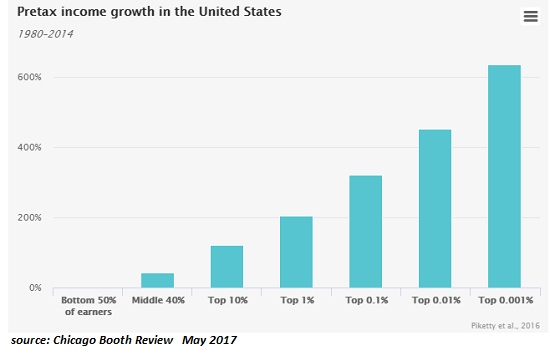
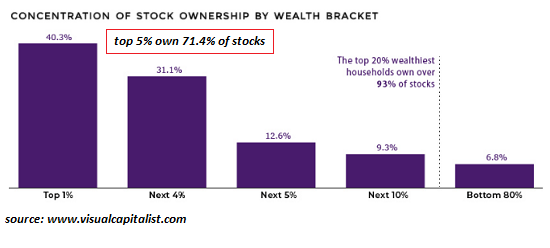
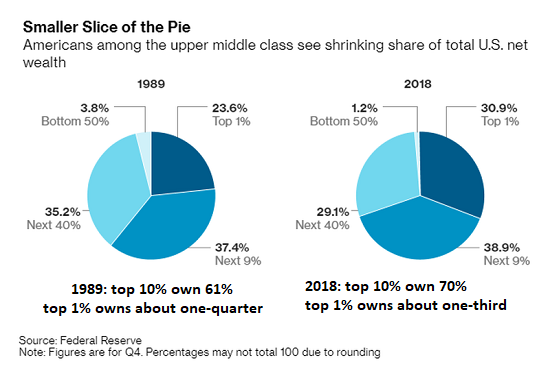
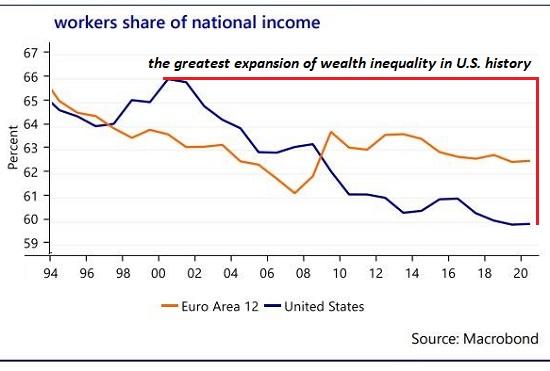
Incidentally, for those curious just what event catalyzed the unprecedented divergence between America’s haves and have nots, we provided the answer over 4 years ago: the dramatic ascent of the “Top 1%” of earners at the expense of the “Bottom 90%” started in the early 1970s… when Nixon ended the gold standard. It is this monetary framework, more than anything, that the current iteration of the Fed will do everything in its power to protect.

Should it be successful, one thing is certain: the implementation of more “bubble” policies that create even greater social inequality, one which – as the French discovered in the late 18th century – inevitably culminates in revolution.

Which is, no matter how one gets there, the end of the Fed couldn’t come fast enough.

via ZeroHedge News http://bit.ly/2Xuv2mg Tyler Durden