Iran: Nuclear Talks To Resume “Very Soon”; Confirms Surprise Dialogue With Saudis On Yemen War

Iran: Nuclear Talks To Resume “Very Soon”; Confirms Surprise Dialogue With Saudis On Yemen War

Despite fierce denunciations of the “US hegemon” for its using sanctions as a “new means of war” by Iranian President Ebrahim Raisi in his first international address before the UN General Assembly earlier in the week, Iran on Friday said it will return to Vienna nuclear negotiations “very soon” – but without giving a date.

This after repeat warnings from the Biden administration that its patience will only last so long, while blaming the Iranians for stalling in the wake of Raisi’s election. New Iranian Foreign Minister Hossein Amirabdollahian told a press briefing on Friday that “The Islamic Republic of Iran will return to the table of negotiations. We are reviewing the Vienna negotiations files currently and, very soon, Iran’s negotiations with the ‘four plus one’ countries will recommence.”

Via Shutterstock

Biden in his own speech before the UNGA said that he’s offering a full return to the deal “if Iran does the same”

Interestingly, and despite Raisi reported to be stacking his foreign ministry with ‘hardliners’ (in comparison to the Rouhani administration and former FM Javad Zarif), there were sideline conversations between the Iranians and Saudis at the UN meeting this week.

The dialogue appeared centered on Yemen, where Iran-backed Houthis are fighting the technologically superior Saudi military alliance:

Speaking on the sidelines of the U.N. General Assembly, the foreign minister also described conversations between Iranian and Saudi officials as “constructive” and he said Tehran had put forward dynamic proposals towards achieving peace in Yemen.

Meanwhile, Raisi’s newly appointed negotiating team is expected to hold a firmer line compared to the prior “moderates” under former president Rouhani:

A seasoned Iranian diplomat, who was a member of Iran’s nuclear negotiations team in the 2010s under President Mahmoud Ahmadinejad, says new appointments at the Foreign Ministry signal a tougher negotiating posture in nuclear talks.

Washington has in a slow, piecemeal way already relaxed some Trump-era sanctions on Iran, but it’s been Tehran’s consistent position that a restored JCPOA deal is not possible unless an immediate full rollback is in effect. 

Tyler Durden
Fri, 09/24/2021 – 17:40

via ZeroHedge News https://ift.tt/3i7n3YJ Tyler Durden

An Inmate Allegedly ‘Leaking Blood All Over’ Was Denied Medical Treatment for Hours. The Prison Guard Gets Qualified Immunity


matthew-ansley-ihl2Q5F-VYA-unsplash

A prison guard who opted not to ensure prompt medical care for an inmate with a broken hand and a partially severed tendon is entitled to qualified immunity and thus cannot be sued over the incident, a federal court ruled last week.

The doctrine of qualified immunity requires that, in order to hold certain government actors accountable in civil court, plaintiffs must furnish a prior court ruling where the exact misbehavior they’re alleging has already been explicitly ruled unconstitutional. If they’re not able to do so, state officials—from cops to prison guards to college administrators—are sometimes able to violate your constitutional rights without any recourse.

It’s a standard that requires a devotion to myopic detail. Here, there were a few factors distinguishing the allegations from prior court decisions, including the location of the injury and the amount of blood shed.

In October 2014, Charles Wade, then an inmate at United States Penitentiary in Atlanta, Georgia, injured his hand and was escorted on a 10-minute walk from the kitchen to a holding cell by Captain Gordon Lewis. Wade says that over the course of that walk, he was “leaking blood all over” and left “a path of blood,” but that his requests to go to the infirmary were ignored. He would stay in the holding cell for several hours before receiving any attention from a prison nurse. His injuries eventually worsened: Though he put in a request for help after his hand began to swell, staff did not tend to him until a day later when he flagged an officer and told a nurse his pain was registering as a ten out of ten. He ultimately required hospital treatment outside the prison.

In awarding Lewis qualified immunity, the 11th Circuit made a few distinctions from previous case law. “In [a prior ruling], the plaintiff suffered an injury to his head,” wrote Judge Elizabeth L. Branch, “whereas here, Wade suffered an injury to his hand.” She also noted that “the quantity of blood is different,” because the defendant in a previous case had “blood soaked [on] his clothing [and] pooled on the floor.” Also different is the location of the plaintiff: Wade was in a holding cell, sitting three feet from the infirmary, whereas the plaintiff in the preexisting precedent was in a hospital.

“On the one hand, this seems to be a pretty garden-variety application of qualified immunity,” says Clark Neily, vice president for legal studies at the Cato Institute. “On the other hand, it underscores one of the most pernicious aspects of the qualified immunity defense, which is to take cases where reasonable people may plausibly disagree about the culpability of the government defendant and ensure that those disagreements are resolved not by ordinary citizens sitting as a jury—the way the Constitution, the Founders, and centuries of Anglo-American common law provide—but instead by a bunch of government employees who are disproportionately drawn from the ranks of prosecutors and other courtroom advocates for government.”

But whether or not Lewis violated Wade’s rights is still a matter of debate, and it will unfortunately remain that way, as the 11th Circuit chose not to make a ruling on it for subsequent defendants. We’re told that victims of government abuse need to find the perfect court decision to hold the state accountable, yet the federal courts often decline to set those very precedents.

It’s “entirely possible” that damages weren’t appropriate, adds Neily. The story isn’t exactly sympathetic: Wade says he sustained the injuries from cutting open a can of vegetables; others contend it was because he had punched another inmate in the face moments prior. But should such a determination be up to a jury? “The Founders were committed to the proposition that disputes between citizens and government—whether civil or criminal—should generally be resolved by ordinary citizens, not government mandarins,” says Neily. “Qualified immunity represents a repudiation of that ancient wisdom and a blatant act of judicial policy making.”

There are several instances of rogue prison guards receiving qualified immunity. There was the group of correctional officers who received the protection after locking a naked inmate in two cells over the span of several days: one with “massive amounts” of human feces covering the walls, and the other with sewage bubbling up from a clogged floor drain. In another case, a guard pepper-sprayed an prisoner, admittedly for no reason at all.

The Supreme Court, which legislated qualified immunity into existence, has been hesitant to fundamentally reconsider the doctrine as a whole. But in two highly unusual moves, it overturned both of the above cases within the last several months, allowing the victims to plead their cases where the Founders intended: in front of a jury.

from Latest – Reason.com https://ift.tt/3lYonhG
via IFTTT

Chris Cuomo’s Former Boss Says CNN Host Harassed Her; He Says He Apologized

Chris Cuomo’s Former Boss Says CNN Host Harassed Her; He Says He Apologized

Authore dby Zachary Stieber via The Epoch Times,

A woman who was Chris Cuomo’s boss at ABC News says he harassed her after a party in 2005.

Cuomo, now a host at CNN, has acknowledged an incident took place.

Shelley Ross, who was Cuomo’s boss while they were both at ABC, said in an op-ed that Cuomo greeted her at the party in a violative manner, gripping her buttocks.

“I can do this now that you’re no longer my boss,” Cuomo was quoted as saying.

Ross said he could not and moved so he could see her husband was near her and had witnessed what happened.

Cuomo soon emailed Ross to say he was “ashamed” and that somebody had been arrested for “a (kind of) similar act,” according to a copy of the message Ross kept.

“And as a husband i can empathize with not liking to see my wife patted as such,” Cuomo apparently added before apologizing to both Ross and her partner.

Ross said she’s coming forward about what took place over a decade ago because of Chris Cuomo’s support for his brother, now-former New York Gov. Andrew Cuomo.

Gov. Cuomo resigned after investigators tapped by New York Attorney General Letitia James, another Democrat, said they substantiated sexual misconduct claims against him.

Chris Cuomo advised his brother during the scandal, breaking traditional journalism rules.

“I have no grudge against Mr. Cuomo; I’m not looking for him to lose his job. Rather, this is an opportunity for him and his employer to show what accountability can look like in the MeToo era,” Ross wrote.

CNN did not respond to a request for comment.

Cuomo told the New York Times: “As Shelley acknowledges, our interaction was not sexual in nature. It happened 16 years ago in a public setting when she was a top executive at ABC. I apologized to her then, and I meant it.”

Tyler Durden
Fri, 09/24/2021 – 17:20

via ZeroHedge News https://ift.tt/3kFzBrQ Tyler Durden

An Inmate Allegedly ‘Leaking Blood All Over’ Was Denied Medical Treatment for Hours. The Prison Guard Gets Qualified Immunity


matthew-ansley-ihl2Q5F-VYA-unsplash

A prison guard who opted not to ensure prompt medical care for an inmate with a broken hand and a partially severed tendon is entitled to qualified immunity and thus cannot be sued over the incident, a federal court ruled last week.

The doctrine of qualified immunity requires that, in order to hold certain government actors accountable in civil court, plaintiffs must furnish a prior court ruling where the exact misbehavior they’re alleging has already been explicitly ruled unconstitutional. If they’re not able to do so, state officials—from cops to prison guards to college administrators—are sometimes able to violate your constitutional rights without any recourse.

It’s a standard that requires a devotion to myopic detail. Here, there were a few factors distinguishing the allegations from prior court decisions, including the location of the injury and the amount of blood shed.

In October 2014, Charles Wade, then an inmate at United States Penitentiary in Atlanta, Georgia, injured his hand and was escorted on a 10-minute walk from the kitchen to a holding cell by Captain Gordon Lewis. Wade says that over the course of that walk, he was “leaking blood all over” and left “a path of blood,” but that his requests to go to the infirmary were ignored. He would stay in the holding cell for several hours before receiving any attention from a prison nurse. His injuries eventually worsened: Though he put in a request for help after his hand began to swell, staff did not tend to him until a day later when he flagged an officer and told a nurse his pain was registering as a ten out of ten. He ultimately required hospital treatment outside the prison.

In awarding Lewis qualified immunity, the 11th Circuit made a few distinctions from prior precedents. “In [a prior ruling], the plaintiff suffered an injury to his head,” wrote Judge Elizabeth L. Branch, “whereas here, Wade suffered an injury to his hand.” She also noted that “the quantity of blood is different,” because in a previous case, the defendant had “blood soaked [on] his clothing [and] pooled on the floor.” Also different is the location of the plaintiff: Wade was in a holding cell, sitting three feet from the infirmary, whereas the plaintiff in the preexisting precedent was in a hospital.

“On the one hand, this seems to be a pretty garden-variety application of qualified immunity,” says Clark Neily, vice president for legal studies at the Cato Institute. “On the other hand, it underscores one of the most pernicious aspects of the qualified immunity defense, which is to take cases where reasonable people may plausibly disagree about the culpability of the government defendant and ensure that those disagreements are resolved not by ordinary citizens sitting as a jury—the way the Constitution, the Founders, and centuries of Anglo-American common law provide—but instead by a bunch of government employees who are disproportionately drawn from the ranks of prosecutors and other courtroom advocates for government.”

But whether or not Lewis violated Wade’s rights is still a matter of debate, and it will unfortunately remain that way, as the 11th Circuit chose not to make a ruling on it for subsequent defendants. We’re told that victims of government abuse need to find the perfect court decision to hold the state accountable, yet the federal courts often decline to set those very precedents.

It’s “entirely possible” that damages weren’t appropriate, adds Neily. The story isn’t exactly sympathetic: Wade says he sustained the injuries from cutting open a can of vegetables; others contend it was because he had punched another inmate in the face moments prior. The  But should such a determination be up to a jury? “The Founders were committed to the proposition that disputes between citizens and government—whether civil or criminal—should generally be resolved by ordinary citizens, not government mandarins,” says Neily. “Qualified immunity represents a repudiation of that ancient wisdom and a blatant act of judicial policy making.”

There are several instances of rogue prison guards receiving qualified immunity in less sympathetic circumstances. There was the group of correctional officers who received the protection after locking a naked inmate in two cells over the span of several days: one with “massive amounts” of human feces covering the walls, and the other with sewage bubbling up from a clogged floor drain. In another case, a guard pepper-sprayed an prisoner, admittedly for no reason at all.

The Supreme Court, which legislated qualified immunity into existence, has been hesitant to fundamentally reconsider the doctrine as a whole. But in two highly unusual moves, it overturned both of the above cases within the last several months, allowing the victims to plead their cases where the Founders intended: in front of a jury.

from Latest – Reason.com https://ift.tt/3lYonhG
via IFTTT

First Weekly Outflow From Stocks In 2021

First Weekly Outflow From Stocks In 2021

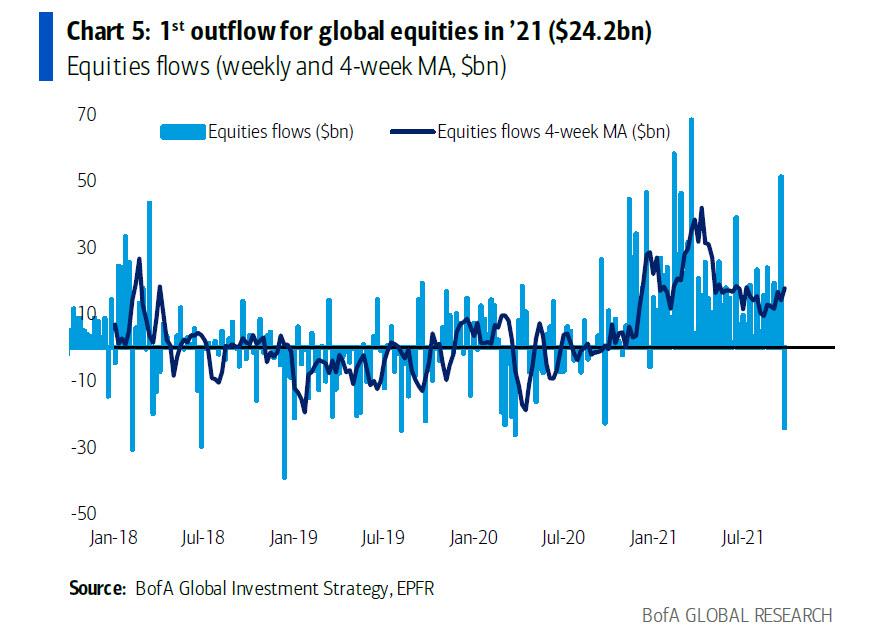
After a tremendous stretch of non-stop weekly inflows into mutual funds and related investment products since before the start of 2021, the latest week showed net selling of equities for the first time this year.

According to EPFR, net flows into global equity funds turned negative in the week ending September 22 to the tune of -$28.6BN vs +$45BN last week (which was one of the top 3 largest inflows on record), alongside the sizable drawdown in markets in the start of the week (if not the end). This was the biggest outflow from US stocks since Feb 2018. Offsetting the equity outflow was a massive $39.6BN going into cash (the largest since May’21), a modest $10.0BN into bonds (the smallest in 9 weeks), and a small $84MM into gold.

A more detailed breakdown of the equity flows by geographic segment:

  • US: largest outflow since Feb’18 ($28.6bn)
  • Japan: largest inflow in 8 weeks ($0.5bn)
  • Europe: largest outflow since Dec’20 ($1.8bn)
  • EM: inflows past 7 weeks ($2.6bn)

By style, the outflows were focused on US small cap ($2.9bn), US value ($3.3bn), US growth ($9.8bn), US large cap ($14.2bn).

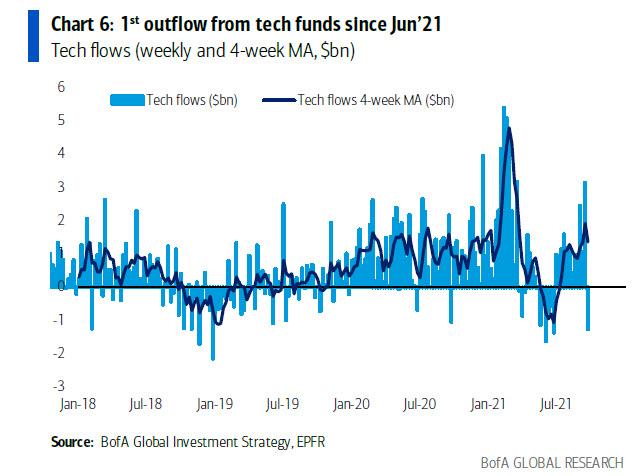
By sector, the selling was pervasive with ever sector seeing outflows: energy ($0.2bn), real estate ($0.2bn); outflows materials ($12mn), coms svs ($0.1bn), utils ($0.2bn), hcare ($0.1bn), financials ($0.5bn), consumer ($1.0bn), tech ($1.2bn).

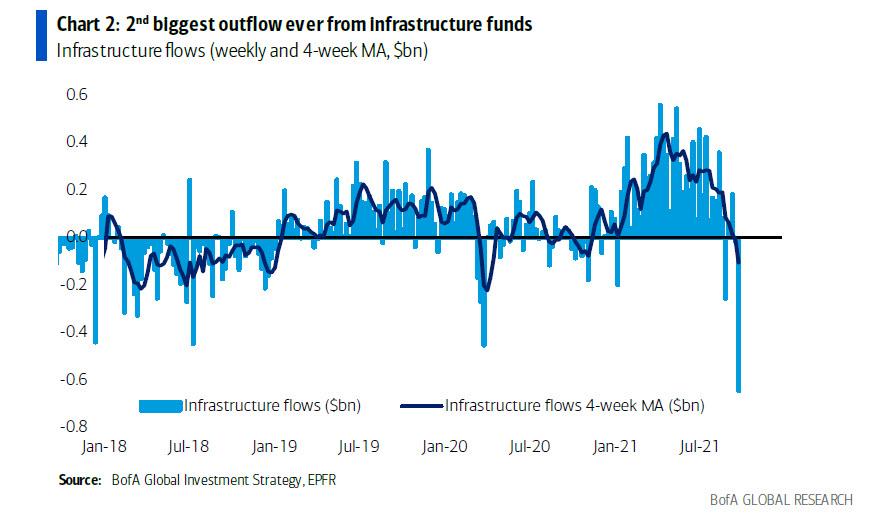
A key driver for the outflow according to BofA is pessimism over passage of $1tn BIB (Bipartisan Infrastructure Bill) scheduled Sep 27th & $3.5tn BBB (Build Back Better) Reconciliation which caused 2nd biggest outflow ever from infrastructure funds and largest consumer funds outflow YTD.

As Bank of America notes, we also had the first outflow from tech funds – the perennial market generals – since June.

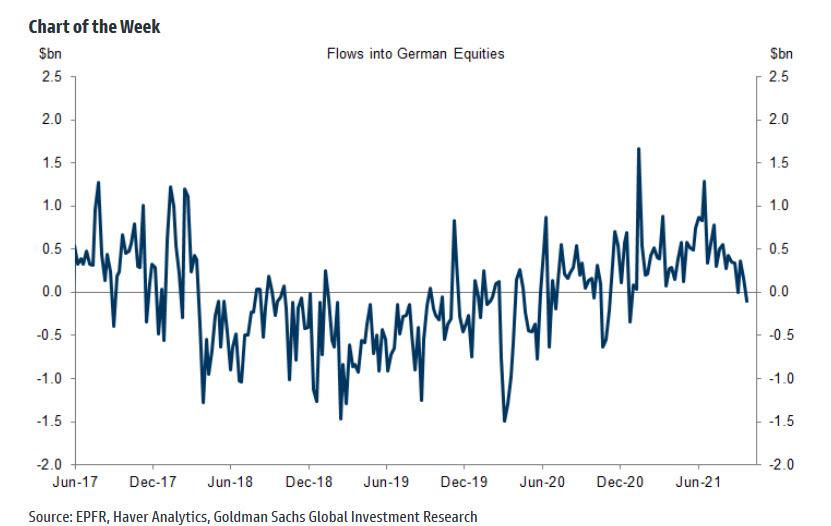
The net selling was concentrated in the US market, although investors also net sold Western European shares. While Europe saw a total of $1.8BN in outflows, Goldman shows that demand for German equities has cooled ahead of this weekend’s federal elections as shown in the bank’s chart below.

Modest net selling of global EM benchmark products was more than offset by net inflows into country-specific products, including China-dedicated funds. By sector the largest net outflows (scaled by AUM) were from industrials.

Flows into fixed income products also cooled slightly (though remained positive), while FX flows favored CNY.

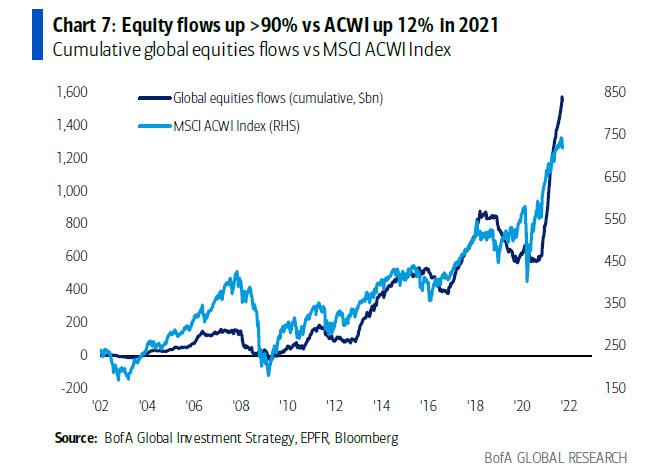
The question, as BofA’s CIO Michael Hartnett suggests, is whether this is the end of the torrent of institutional and retail buying observed YTD. It matters because as the Bank of America strategist notes, global equity flows & global equity prices have been 93% correlated since ‘02, with both at all-time highs although in ‘21 equity inflows are much higher (>90%) than price (12%).

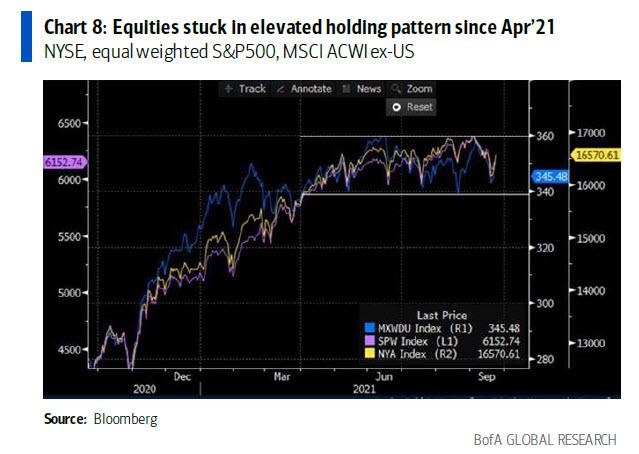
The BofA strategist also notes that despite the massive inflows in 2021, broad global indices such as NYSE (US stocks, ADRs, bond ETFs), S&P500 equal weighted, and ACWI ex-US have been stuck in elevated holding patterns for the past 6 months.

Finally, while the Monday meltdown may explain the outflow, how does one explain the latest week meltup? Well, as Hartnett explains, confirming the “bubble zeitgeist”, majority of traders are “full-invested bears” but the anecdotal ratio of clients in “melt-up” vs “melt-down” camps currently 8:2, hence bullish price reaction to China/Fed/fiscal events this week, i.e., a vast majority are BTFDers.

According to the BofA CIO, history says the best way to hedge “bubble” is via “long leadership, long distressed” barbell, i.e. long leadership of bull (today = IG, tech, biotech…) & long distressed, cyclical plays (today = EM, energy, small cap) as investors chase laggards (the only market that outperformed Nasdaq in ’99 TMT bubble was Russia).

Tyler Durden
Fri, 09/24/2021 – 17:00

via ZeroHedge News https://ift.tt/3zG1owG Tyler Durden

Biden Can’t Fix High Beef Prices With $500 Million


thumb (5)

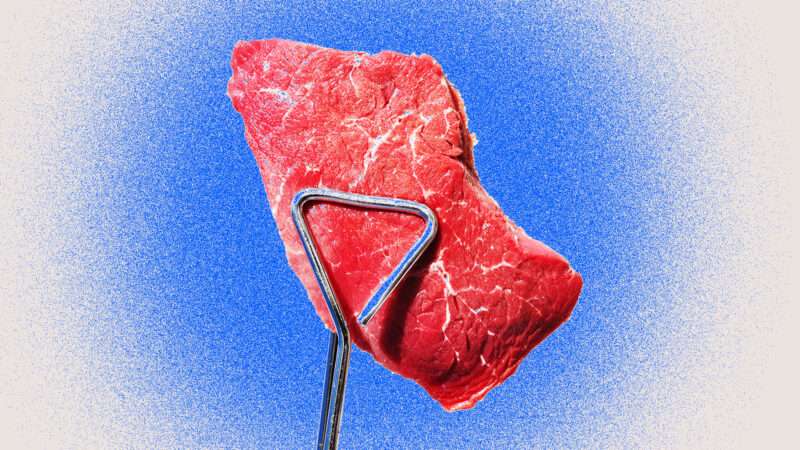
The rising price of beef offers a meaty lesson on the limits of the government’s ability to combat inflation by throwing more money at the problem.

Even in an environment where almost everything is getting more expensive, the price of a pound of beef can make your eyes water. The Bureau of Labor Statistics says beef prices are up 12 percent since last September—beef steaks, specifically, are up by 16 percent over the same period. That’s considerably more than the increases for food products (3.7 percent) and all products (5.3 percent) over the past 12 months.

The Biden administration, perhaps worried about the political toll that rising food prices could extract in next year’s midterms, announced plans earlier this month to offer up to $500 million in loan guarantees to beef producers. That’s on top of $500 million approved as part of the $1.9 trillion American Rescue Plan that was supposed to “expand processing capacity and increase competition in meat and poultry” industries, according to the U.S. Department of Agriculture.

The second prong of the White House’s plans seems to involve shaming meat-processing companies. “Just four large conglomerates control the majority of the market for each of these three products (beef, pork, and poultry), and the data show that these companies have been raising prices while generating record profits during the pandemic,” Brian Deese, director of the White House’s National Economic Council, said during a press briefing last Friday, the Detroit Free Press reports.

Taken together, the White House’s approach to high meat prices can be summarized as an argument for greater government subsidies based on the idea that stimulating more competition in the meat-packing industry will expand supply and reduce bottlenecks.

But, as David Frum details in The Atlantic today, there are some good reasons to be skeptical of this argument. For starters, it takes about $200 million (and several months, if not longer) to build a single new meat-processing plant. That means the Biden administration’s new loan programs will not purchase much additional capacity, and whatever gains are made will not happen immediately. Even if the plan is successful, smaller producers will likely need ongoing support beyond the initial loans—if there was a market for more, smaller meat processors, the private sector would be investing in them already.

“There’s a real risk,” writes Frum, “that the initial commitment of $500 million in aid and loan guarantees to small packers will expand into continuing intervention in the marketplace to keep smaller competitors in business in the face of the higher efficiency and lower prices of the big packers.”

Of course, because this is Frum, he handles the shortcomings of President Joe Biden’s plan with kid gloves, even while admitting that White House officials had no answers for his pretty basic questions about how all this will actually, you know, work. Still, he writes, “the architects of the Biden plan are uneasily aware that it rests on a lot of hopes, guesses, and optimistic assumptions.”

Let’s just call this what it is: a good way to waste $500 million without making any impact on the price of beef.

In some ways, Biden’s approach here mirrors his recent big announcement about using the Defense Production Act to get more rapid, at-home COVID tests available to the public. Thanks to an inept Food and Drug Administration (FDA) that’s still refusing to approve rapid COVID tests that are readily available in Europe and elsewhere, America has a relatively small supply of these tests—and, naturally, that means the tests are relatively more expensive here. That’s a problem because the main benefit of rapid, at-home COVID testing is that you can take a test whenever you want, but that’s a lot harder to do when the tests are $20 each—and harder still when you can’t find any.

Biden’s solution is to use the hammer of government power to force companies to make more tests. That might sound workable in theory, but in practice, even the White House admits that it will be able to squeeze out only another 280 million tests. That’s enough for every adult in America to take…one test.

But 280 million sounds like a big number. So does $500 million. Indeed, they are big numbers. But in the context of a national economy like America’s, they are actually quite small. So small as to be insignificant, really.

It’s not impossible to imagine a more expensive government response to rising beef prices, of course. The Biden administration could ask Congress to approve $20 billion to subsidize farmers who raise cows, build more meat-processing plants, and send every American family a weekly coupon to reduce the cost of steaks and burgers at the local supermarket. (At the very least, this would allow those of us in the news business to write fun headlines about how the beef czar was grilled during a congressional hearing.)

That would be a response that might move the needle, though it would be awful on so, so many levels. The never-ending interventions that Frum describes would be only a part of it. It probably wouldn’t take long for the beef industry to become a sacred cow for Congress in the same way that corn-growers already are.

And even if the government did all that, it still wouldn’t do anything to address the actual root causes of the current beef price problem: a massive drought in the Western U.S. that has caused beef herds to shrink and the average cow to be 15 pounds less meaty when it is slaughtered. It would not fix the ongoing pandemic-related staffing issues at meat-packing plants, which are operating less efficiently even when fully staffed because they have to take necessary precautions to limit outbreaks that could cause even bigger disruptions.

The lesson here is one about the inability of the government to direct the economy on a large scale. Using the Defense Production Act isn’t the best way to get more rapid COVID tests into American homes, sweeping aside FDA red tape is. The test makers will do the rest. Offering $500 million in loan guarantees to anyone who wants to build a new meat-processing plant isn’t going to address the supply chain problems at the existing plants or end the Western drought.

Higher prices, while politically difficult for the Biden administration, will send signals up the supply chain that result in more workers being hired and more cows being raised. Beyond that, it’s just a matter of waiting—because any government intervention will be either insignificant or ineffective.

And maybe we’ll have to eat more pork for a while.

from Latest – Reason.com https://ift.tt/3zFZUm6
via IFTTT

Biden Can’t Fix High Beef Prices With $500 Million


thumb (5)

The rising price of beef offers a meaty lesson on the limits of the government’s ability to combat inflation by throwing more money at the problem.

Even in an environment where almost everything is getting more expensive, the price of a pound of beef can make your eyes water. The Bureau of Labor Statistics says beef prices are up 12 percent since last September—beef steaks, specifically, are up by 16 percent over the same period. That’s considerably more than the increases for food products (3.7 percent) and all products (5.3 percent) over the past 12 months.

The Biden administration, perhaps worried about the political toll that rising food prices could extract in next year’s midterms, announced plans earlier this month to offer up to $500 million in loan guarantees to beef producers. That’s on top of $500 million approved as part of the $1.9 trillion American Rescue Plan that was supposed to “expand processing capacity and increase competition in meat and poultry” industries, according to the U.S. Department of Agriculture.

The second prong of the White House’s plans seems to involve shaming meat-processing companies. “Just four large conglomerates control the majority of the market for each of these three products (beef, pork, and poultry), and the data show that these companies have been raising prices while generating record profits during the pandemic,” Brian Deese, director of the White House’s National Economic Council, said during a press briefing last Friday, the Detroit Free Press reports.

Taken together, the White House’s approach to high meat prices can be summarized as an argument for greater government subsidies based on the idea that stimulating more competition in the meat-packing industry will expand supply and reduce bottlenecks.

But, as David Frum details in The Atlantic today, there are some good reasons to be skeptical of this argument. For starters, it takes about $200 million (and several months, if not longer) to build a single new meat-processing plant. That means the Biden administration’s new loan programs will not purchase much additional capacity, and whatever gains are made will not happen immediately. Even if the plan is successful, smaller producers will likely need ongoing support beyond the initial loans—if there was a market for more, smaller meat processors, the private sector would be investing in them already.

“There’s a real risk,” writes Frum, “that the initial commitment of $500 million in aid and loan guarantees to small packers will expand into continuing intervention in the marketplace to keep smaller competitors in business in the face of the higher efficiency and lower prices of the big packers.”

Of course, because this is Frum, he handles the shortcomings of President Joe Biden’s plan with kid gloves, even while admitting that White House officials had no answers for his pretty basic questions about how all this will actually, you know, work. Still, he writes, “the architects of the Biden plan are uneasily aware that it rests on a lot of hopes, guesses, and optimistic assumptions.”

Let’s just call this what it is: a good way to waste $500 million without making any impact on the price of beef.

In some ways, Biden’s approach here mirrors his recent big announcement about using the Defense Production Act to get more rapid, at-home COVID tests available to the public. Thanks to an inept Food and Drug Administration (FDA) that’s still refusing to approve rapid COVID tests that are readily available in Europe and elsewhere, America has a relatively small supply of these tests—and, naturally, that means the tests are relatively more expensive here. That’s a problem because the main benefit of rapid, at-home COVID testing is that you can take a test whenever you want, but that’s a lot harder to do when the tests are $20 each—and harder still when you can’t find any.

Biden’s solution is to use the hammer of government power to force companies to make more tests. That might sound workable in theory, but in practice, even the White House admits that it will be able to squeeze out only another 280 million tests. That’s enough for every adult in America to take…one test.

But 280 million sounds like a big number. So does $500 million. Indeed, they are big numbers. But in the context of a national economy like America’s, they are actually quite small. So small as to be insignificant, really.

It’s not impossible to imagine a more expensive government response to rising beef prices, of course. The Biden administration could ask Congress to approve $20 billion to subsidize farmers who raise cows, build more meat-processing plants, and send every American family a weekly coupon to reduce the cost of steaks and burgers at the local supermarket. (At the very least, this would allow those of us in the news business to write fun headlines about how the beef czar was grilled during a congressional hearing.)

That would be a response that might move the needle, though it would be awful on so, so many levels. The never-ending interventions that Frum describes would be only a part of it. It probably wouldn’t take long for the beef industry to become a sacred cow for Congress in the same way that corn-growers already are.

And even if the government did all that, it still wouldn’t do anything to address the actual root causes of the current beef price problem: a massive drought in the Western U.S. that has caused beef herds to shrink and the average cow to be 15 pounds less meaty when it is slaughtered. It would not fix the ongoing pandemic-related staffing issues at meat-packing plants, which are operating less efficiently even when fully staffed because they have to take necessary precautions to limit outbreaks that could cause even bigger disruptions.

The lesson here is one about the inability of the government to direct the economy on a large scale. Using the Defense Production Act isn’t the best way to get more rapid COVID tests into American homes, sweeping aside FDA red tape is. The test makers will do the rest. Offering $500 million in loan guarantees to anyone who wants to build a new meat-processing plant isn’t going to address the supply chain problems at the existing plants or end the Western drought.

Higher prices, while politically difficult for the Biden administration, will send signals up the supply chain that result in more workers being hired and more cows being raised. Beyond that, it’s just a matter of waiting—because any government intervention will be either insignificant or ineffective.

And maybe we’ll have to eat more pork for a while.

from Latest – Reason.com https://ift.tt/3zFZUm6
via IFTTT

A New Lawsuit Says Wilmington Is Running an Unconstitutional Towing and Impound Racket


ameera shaheed

A new lawsuit accuses the city government of Wilmington, Delaware, of running an unconstitutional towing and impound program that strips owners of their vehicles over petty ticket debts. 

The Institute for Justice (IJ), a libertarian-leaning public interest law firm, filed the lawsuit Wednesday on behalf of two Wilmington residents who say their vehicles were towed over improperly issued tickets and then scrapped after they couldn’t afford to pay off the accumulating fines and storage fees within 30 days.

The suit alleges that Wilmington allows two private towing companies it contracts with to wrongfully take and sell residents’ cars without providing proper pre- or post-seizure hearings, violating owners’ Fourth Amendment and due process rights. And because the value of the cars often far exceeds the owners’ debts, IJ argues the practice also violates the Eighth Amendment’s protections against excessive fees and fines.

“When they took my vehicle, it hindered me from being able to get around. I have a bad back. I can’t do a lot of walking,” Ameera Shaheed, one of the plaintiffs in the suit, said in a press release. “I needed that vehicle. It was my pride and joy.”

According to the suit, Shaheed’s car was ticketed six times while it was parked in a legal space outside of her home. While Shaheed was appealing the tickets, her car was towed and impounded. Because Shaheed, a grandmother of three who lives on a fixed income, could not afford to pay the $320 that the towing company was demanding for the release of her car, it remained impounded for more than 30 days, after which it was sold for scrap.

Although Shaheed’s car was worth more than $4,000, none of the proceeds from the sale were credited toward Shaheed’s debt. In fact, IJ says her debts have risen to $580.

According to the lawsuit, Wilmington does not pay the two towing companies that it contracts with for impound services and “scofflaw enforcement.” Rather, the companies keep the proceeds of any sales of any vehicles that are forfeited. The two towing companies sold, scrapped, kept, or otherwise disposed of at least 987 out of the 2,551 cars it towed in 2020, IJ says.

Civil liberties groups argue that abusive impound programs strip petty offenders and low-income residents of their transportation, often making it even harder for them to hold down a job and pay off their debts.

“The Constitution requires that any penalty imposed by the government be proportional to the crime. The loss of one’s car for ticket debt is unconstitutional,” IJ attorney Will Aronin said in a press release. “People depend on their cars to work, to visit family, and for all parts of their lives. Nobody should lose their car just because they can’t afford to pay a parking ticket.”

Reason reported in 2018 on Chicago’s uniquely punitive impound program, which soaked owners in thousands of dollars in fines and fees for a litany of low-level offenses and held their cars indefinitely until the fines were paid or they relinquished their cars. There were few to no accommodations for low-income defendants. Even in cases where owners beat criminal charges or were innocent, they were still forced to go through the city’s quasi-judicial administrative hearings court, where low standards of evidence and few procedural protections almost always ensured that defendants ended up in debt and bereft of their cars.

IJ also filed a civil rights lawsuit against Chicago in 2019, alleging that the city’s impound scheme violates the Illinois and U.S. Constitution’s protections against excessive fines and unreasonable seizures, as well as due process protections.

That lawsuit is ongoing, but Chicago passed some reforms to its impound program in 2020, following more investigative reporting by WBEZ and ProPublica Illinois. WBEZ reported that Chicago seized 250,000 cars since 2010, imposing $600 million in debt on owners. The news outlet also discovered that motorists’ debts were sometimes inflated due to a combination of computer and data-entry errors.

Some federal courts have struck down similar impound schemes on constitutional grounds. For example, in 2017 the 9th Circuit Court of Appeals ruled that Los Angeles’ automatic 30-day impound law amounted to an unconstitutional seizure under the Fourth Amendment.

However, earlier this month The Orange County Register reported that, despite the 9th Circuit’s ruling, law enforcement agencies across California continue to use 30-day impounds for unlicensed drivers.

A spokesperson for the city of Wilmington said the city is reviewing the lawsuit but declined to comment further.

from Latest – Reason.com https://ift.tt/3o6S9DE
via IFTTT

Why The West Can’t Ban Bitcoin The Way China Did

Why The West Can’t Ban Bitcoin The Way China Did

Authored by Mark Jeftovic via BombThrower.com,

Only a complete “dictatorship of the proletariat” can kill Bitcoin

Evergrande is being called China’s “Lehman moment” and overnight the PBC closed the loop on their clampdown on crypto with a total ban on virtual currency transactions.

For those paying attention, however, China isn’t just moving against crypto, they’ve been bringing their entire technology sector to heel. They also stated that it is time to redistribute wealth from the top tier of the nations wealth holders to the rest of the peasant class.

This isn’t a return to their Communist roots as much as it is a move of self-preservation against rising internal powers. In the words of my friend Charles Hugh Smith via some correspondence we’ve been having this week “Xi has set out to crush the Network State”.

I said in my earlier Network State Primer about the coming tension between Nation States and Network States: the former will go down swinging.

The power structures of the nation states won’t go gently into the dustbin of history. They will go down swinging, over a transitional era that may span decades or longer, similar to the centuries long tensions between monarchs and the Papacy that shaped the transition from the Middle Ages into the Renaissance.

China has decided to make their last stand of the Nation State, now. Here at this moment in time. They will not bail out Evergrande, they will allow their side of the Everything Bubble to pop, and they will use the economic crash to make a final sweep of consolidation of their power. They will make sure their Big Tech knows who is in charge and that it is not them.

Over here in the West, recent regulatory jabs at crypto seem almost enfeebled by comparison. The SEC forcing Coinbase to cancel a program they hadn’t launched yet (so it makes no difference to their bottom line), while bickering with the CFTA over who gets to regulate crypto.

The subtext to all this is we shall now see, and be forced to choose, a path forward in the digital networked age:

Behind door #1 we keep the nation state format of centralized, top down control and escalating interference into both the economic and private lives of its subjects.

Behind door #2 is the coming tension between nation states, network states and crypto-claves that I outlined previously.

Neither path will produce a serene and stable gilded age. They will both be chaotic and volatile, Fourth Turning style transitions. The former in the course of implementing then maintaining a totalitarian dictatorship by force. The latter in the interplay and jockeying between three disparate organizational dynamics, each with it’s own centre of gravity (power), source of wealth and interdependencies with the others.

China may be able to make option #1 work there, at least for awhile, but would a China style technocratic dictatorship actually fly and sustain in the West?

At first glance one may think so. The zeitgeist today seems to be one clamouring for authoritarianism and collectivism. But upon deeper examination this may only be the vocal minority of academia, media pundits and Social Justice Inc. The majority of the population may just be keeping silent out of pragmatism and sheer exhaustion from the never-ending elitist sanctimony and cultural Marxism.

But the pushback against COVID authoritarianism, now made acute by forced vaccinations and the ongoing threats of never-ending lockdowns may finally be getting hints of non-compliance through to policy-makers in the West. Australia has officially abandoned their Zero Covid policy and vaccine passport mandates are incurring revolts and in some places are abandoned.

What would it take for Western governments to ban crypto, reign in ascendant tech platforms and more permanently abrogate all property rights?

Western governments would have to go “Full China”

My worry under lockdowns was that Western governments pined for China-style autocracy. And let’s call it for what it is: for a couple years since all this started, they certainly tried it. To varying degrees they continue to cling to the hope that they can remain relevant in a 21st century world using technocratic methods developed out of 20th century industrialism. Most policy makers are still trapped in a mindset learned from an era of assembly lines and cubicles. They think the only difference is it’s now digitized.

But the more I started thinking about this the more I realized how unlikely this is in the realms of erstwhile liberal democracies.

For one thing, decentralized crypto currencies have already changed the game  in the West in a way where there is no going back. It is estimated that by 2024, there will one billion Bitcoin HODLers, and that makes them a real constituancy.

Another reason is that we are at least nominally democracies, with elections. That means our societal fabric has a particular architecture very different from China’s. While elections have become largely ceremonial ratifications of homogenous policy tracks, contested between insular factions within political monocultures, they at least show the overlords where the boundaries of their powers are.

Take for example the recent Canadian election, where Justin Trudeau’s gambit to secure a majority failed and he’s stuck with another minority government. The rising right-wing PPC party won no seats, and yet, secured 5% of the popular vote, up from 1.62% in 2019, the year that party formed. They blew out the Green Party at 2.6% and who has been around for 35 years. Their performance caused much pearl clutching from the MSM and there will be more going forward, especially should the incumbent government continue with its post-national, woke, collectivist aspirations.

The Chinese peoples have never been free. There’s never been a liberty inspired revolution there, only a cultural (Marxist) one. People in China have no constitutionally guaranteed rights, they aren’t even citizens. They’re subjects. They will take it, at least for now, because they’ve always taken it. As Charles put it in his emails to me, their history is replete with

“one bloody purge after another, of someone consolidating power and then unleashing a Cultural Revolution to eliminate rivals, etc. If crashing China’s bubble is the nuclear option, Xi is quite confident he can push the pain level to 11 and most will accept it, those who don’t will enjoy treatment as an honorary Uyghur.”

That’s not the case here in the West where there have been at least two revolutions fuelled directly out of an impulse for liberty: The French and the American. Even though the former went off the rails a lot quicker than the latter did, it still happened and it is a stark reminder of where things go when wealth inequality gets so out of whack and the elites become so detached from reality (Charles thinks this is where things are headed in the US, he may not be wrong).

For cryptos to be hit with a China-style ban, in their entirety here in the West, governments would have to go Full China, complete with total control over every aspect of every citizen’s life (China just set limits on how much time you’re allowed to spend on Tik Tok, they have social credit systems which meter your alcohol consumption, the list goes on and is getting longer).

How long would that last here in the West? Either the citizenry would move straight into the final hyper-normalization phase seen in the Soviet Union before it collapsed (paraphrasing: “They pretend to govern us and we pretend to obey”), or, the pitchforks and torches come out almost immediately. Countries break up. Secessionists abound. At least a few people face some Mussolini moments if not full on Storming of the Bastille and a French Revolution style purging of perceived elites. It would get ugly.

I’m not saying this is what would happen if Western governments banned crypto, I’m saying it could happen in response to the kind of dictatorship that would have to be imposed in order to ban crypto.

That also doesn’t mean that cryptos can’t go “risk off” (to use Charles’ description) for awhile, even in lieu of a ban. Especially if China allows the economic chips to fall as they may and that ripples across the global economy (perhaps China is unleashing yet another global contagion…. on purpose).

The way I see it, the tension in liberal democracies between nation states and network states will be played out through their respective monetary systems.

  • The nation state’s fiat money will be digitized into CBDCs, which will be specifically constructed to preclude wealth formation or savings and almost certainly be the rails of Westernized social credit systems,
  • The network state stable coins (like Facebook’s Diem), which may endeavour to extend the lifespan of fiat currencies and fuse with CBDCs
  • And crypto currencies founded on hard money principles that catalyzed the entire decentralized revolution. These will exist out of default because in the absence of total dictatorship and owing to the demands of optionality, capital pools will have to go here (among other places) out of self-preservation.

*  *  *

I cover this dynamic extensively in The Crypto Capitalist Letter, a long with a tactical focus on publicly traded crypto stocks. Get the overall investment / macro thesis free when you subscribe to the Bombthrower mailing list, or try the premium service for a month with our fully refundable trial offer.

Tyler Durden
Fri, 09/24/2021 – 16:40

via ZeroHedge News https://ift.tt/39AudQp Tyler Durden

A New Lawsuit Says Wilmington Is Running an Unconstitutional Towing and Impound Racket


ameera shaheed

A new lawsuit accuses the city government of Wilmington, Delaware, of running an unconstitutional towing and impound program that strips owners of their vehicles over petty ticket debts. 

The Institute for Justice (IJ), a libertarian-leaning public interest law firm, filed the lawsuit Wednesday on behalf of two Wilmington residents who say their vehicles were towed over improperly issued tickets and then scrapped after they couldn’t afford to pay off the accumulating fines and storage fees within 30 days.

The suit alleges that Wilmington allows two private towing companies it contracts with to wrongfully take and sell residents’ cars without providing proper pre- or post-seizure hearings, violating owners’ Fourth Amendment and due process rights. And because the value of the cars often far exceeds the owners’ debts, IJ argues the practice also violates the Eighth Amendment’s protections against excessive fees and fines.

“When they took my vehicle, it hindered me from being able to get around. I have a bad back. I can’t do a lot of walking,” Ameera Shaheed, one of the plaintiffs in the suit, said in a press release. “I needed that vehicle. It was my pride and joy.”

According to the suit, Shaheed’s car was ticketed six times while it was parked in a legal space outside of her home. While Shaheed was appealing the tickets, her car was towed and impounded. Because Shaheed, a grandmother of three who lives on a fixed income, could not afford to pay the $320 that the towing company was demanding for the release of her car, it remained impounded for more than 30 days, after which it was sold for scrap.

Although Shaheed’s car was worth more than $4,000, none of the proceeds from the sale were credited toward Shaheed’s debt. In fact, IJ says her debts have risen to $580.

According to the lawsuit, Wilmington does not pay the two towing companies that it contracts with for impound services and “scofflaw enforcement.” Rather, the companies keep the proceeds of any sales of any vehicles that are forfeited. The two towing companies sold, scrapped, kept, or otherwise disposed of at least 987 out of the 2,551 cars it towed in 2020, IJ says.

Civil liberties groups argue that abusive impound programs strip petty offenders and low-income residents of their transportation, often making it even harder for them to hold down a job and pay off their debts.

“The Constitution requires that any penalty imposed by the government be proportional to the crime. The loss of one’s car for ticket debt is unconstitutional,” IJ attorney Will Aronin said in a press release. “People depend on their cars to work, to visit family, and for all parts of their lives. Nobody should lose their car just because they can’t afford to pay a parking ticket.”

Reason reported in 2018 on Chicago’s uniquely punitive impound program, which soaked owners in thousands of dollars in fines and fees for a litany of low-level offenses and held their cars indefinitely until the fines were paid or they relinquished their cars. There were few to no accommodations for low-income defendants. Even in cases where owners beat criminal charges or were innocent, they were still forced to go through the city’s quasi-judicial administrative hearings court, where low standards of evidence and few procedural protections almost always ensured that defendants ended up in debt and bereft of their cars.

IJ also filed a civil rights lawsuit against Chicago in 2019, alleging that the city’s impound scheme violates the Illinois and U.S. Constitution’s protections against excessive fines and unreasonable seizures, as well as due process protections.

That lawsuit is ongoing, but Chicago passed some reforms to its impound program in 2020, following more investigative reporting by WBEZ and ProPublica Illinois. WBEZ reported that Chicago seized 250,000 cars since 2010, imposing $600 million in debt on owners. The news outlet also discovered that motorists’ debts were sometimes inflated due to a combination of computer and data-entry errors.

Some federal courts have struck down similar impound schemes on constitutional grounds. For example, in 2017 the 9th Circuit Court of Appeals ruled that Los Angeles’ automatic 30-day impound law amounted to an unconstitutional seizure under the Fourth Amendment.

However, earlier this month The Orange County Register reported that, despite the 9th Circuit’s ruling, law enforcement agencies across California continue to use 30-day impounds for unlicensed drivers.

A spokesperson for the city of Wilmington said the city is reviewing the lawsuit but declined to comment further.

from Latest – Reason.com https://ift.tt/3o6S9DE
via IFTTT