Sorority Apologizes For Congratulating Amy Coney Barrett

Sorority Apologizes For Congratulating Amy Coney Barrett

Tyler Durden

Tue, 10/27/2020 – 12:25

Authored by Ben Zeisloft via Campus Reform,

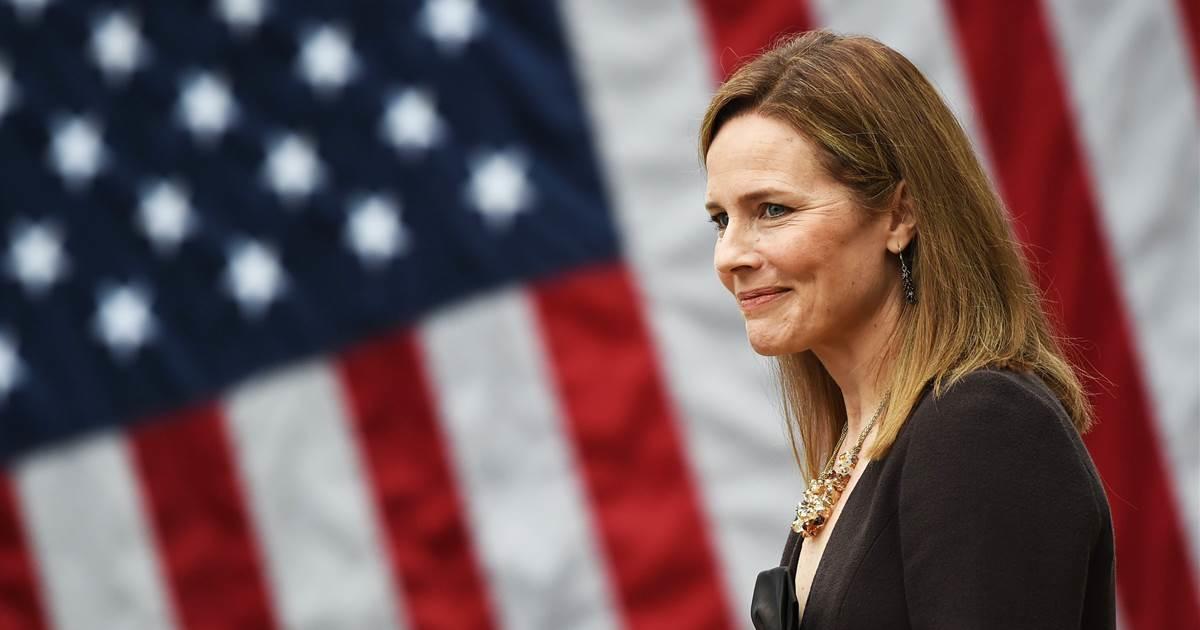
The Kappa Delta sorority deleted and apologized for a congratulatory message for Amy Coney Barrett, who was a member of the sorority during her time at Rhodes College.

The sorority tweeted an image of a statement, saying “KD alumna Amy Coney Barrett was nominated to serve on the Supreme Court. While we do not take a stand on political appointments, we recognize Judge Coney Barrett’s significant accomplishment. We acknowledge our members have a variety of views and a right to their own beliefs.”

The next day, the sorority deleted the tweet and posted an apology statement.

The organization stated that it was “deeply sorry” for the “hurtful” original statement.

“Our approach was disappointing and hurtful to many,” said the new statement.

“We did not intend to enter a political debate, take a stand on the Supreme Court nomination, cause division among our sisters, or alienate any of our members.”

The sorority also recalled its new “intentional journey” to focus on diversity, equity, and inclusion. 

“Thank you for holding us accountable,” it concluded.

However, many on Twitter expressed disappointment in the apology.

“Don’t let the internet bully you,” said one user.

“It’s an amazing accomplishment that one of our sisters was nominated to the highest court in the land! Regardless of politics or not. Also, judges judge based off the constitution and law, not opinions and politics.”

What’s disappointing is that you let yourself be bullied and showed that ‘once a KD always a KD’ isn’t true. Amy Coney Barrett, regardless of her political affiliation, is a Kappa Delta sister. She deserves acknowledgement for her achievement from her sorority. Disgraceful,” said another.

Alumni also launched a petition titled “Kappa Deltas Against Judge Amy Coney Barrett,” which alleges that Barrett “does not intend to defend the rights of marginalized peoples,” including “BIPOC and LGBQT+ communities.”

The petition has garnered more than 11,500 signatures.

Eli Dueker, a Kappa Delta alum, professor at Bard College, and self-professed transgender man, wrote an op-ed denouncing Barrett’s potential influence on the Supreme Court. Dueker recalled Barrett as “a dedicated new sister, whip-smart, and incredibly kind,” but expressed concern that “access to healthcare and abortion” for “women, men, non-binary people — whether queer, trans, or straight” would be threatened if Barrett is confirmed.

“I reject the idea of a Judge Coney Barrett, whose views undermine the health and safety of others, having a lifetime sway on the Supreme Court stage,” said Dueker.

Bard College promoted Dueker’s letter on its official website. 

Campus Reform reached out to Kappa Delta for comment and will update this article accordingly.

via ZeroHedge News https://ift.tt/3jwyeIk Tyler Durden

11 Trillion Reasons To Fear Joe Biden’s Presidency

joebiden10-27

By my calculation, there are at the very least 11 trillion reasons to worry about Democratic presidential contender Joe Biden. He’s the odds-on favorite to beat incumbent Donald Trump on November 3. Not only is the former vice president likely to win, but FiveThirtyEight predicts Democrats have a 74-in-100 chance of taking the Senate while holding the House of Representatives, meaning that he will have a great opportunity to deliver on all of his campaign promises, which add up to a mind-blowing total of $11 trillion in new federal spending over the coming decade. His “platform is more liberal than that of every past Democratic nominee,” writes The Washington Post.

That’s bad news not just for the economy but for a wide range of libertarian concerns about things such as individual autonomy, free speech, school choice, and gun rights. In last week’s debate with Trump, Biden warned that we are entering a “dark winter.” He was talking about rising COVID-19 cases, but his own platform is likely to keep us at home, out of work, and in a bad place for a long time to come.

Biden’s expansive vision is about more than vastly increasing spending, but let’s start there because the numbers are simply staggering. He’s proposing $11 trillion in brand new spending over the next decade, according to the Manhattan Institute’s Brian Riedl. Big-ticket new items include $1.4 trillion to expand Obamacare; $2 trillion on his version of a Green New Deal; jacking Social Security and Supplemental Security Income by $1 trillion; and goosing spending on preschool, K-12, and higher education by $1.5 trillion. Biden has also signed on to a $3.3 trillion stimulus spending plan pushed by House and Senate Democrats.

All of this new spending would be layered on top of an existing annual federal budget that has swelled to nearly $7 trillion in fiscal year 2020, from a record-high yet relatively cheap $4.4 trillion in 2019. To pay for this new largess, Biden has laid out $3.6 trillion in tax hikes over the coming decade, resulting in what Riedl says is “the largest permanent tax increase since World War II.” Much of the new revenue would come from boosting corporate income taxes back to what they were before Republicans lowered them during Trump’s first year in office. Yet despite all the hikes, Biden would still manage to increase the national debt (and thus depress long-term economic growth) by about $5.6 trillion between 2021 and 2030, according to the Committee for a Responsible Federal Budget.

Despite Biden’s claims that no one in a household making under $400,000 a year would pay one red cent more in taxes, it’s inevitable that everyone will feel the pinch. First, notes Richard Rubin in The Wall Street Journal, Biden is calling for a reinstatement of the Affordable Care Act’s individual mandate. Second,

the corporate tax increases would indirectly affect households at all income levels. That’s because the burden of that tax is borne mostly by shareholders and, over the long run, by workers. So anyone owning stocks could be affected and eventually, companies may raise wages less than they otherwise would.

Worse still, the new levies, along with a bevy of new regulations on energy, health care, and more that Biden has promised, will almost certainly stall the economy big time. Analysts at the Hoover Institution calculate, according to Reason‘s Billy Binion, “that over the next decade, these changes would prompt the economy to shed 4.9 million jobs and the gross domestic product to drop $2.6 trillion.” And in the year 2030, “U.S. consumption would be down $1.5 trillion and median-income households would make $6,500 less.”

Using the Hoover study as a guide, the economic conservatives at The Wall Street Journal‘s opinion page take pains to note that Biden’s plan won’t tank the economy overnight. Rather, they rightly fear his “proposals will have a long-term corrosive impact by raising the cost of capital, reducing the incentive to work and invest, and reducing productivity across the economy.” They illustrate how that works:

To take only one example, the electrification of most passenger cars would increase the per capita demand for electric power by 25% even as more than 70% of baseline electric power from fossil fuels would go offline. Bridging this supply-demand gulf would require enormous subsidies and far more investment and labor to achieve the same energy output. Mr. Biden’s energy plans would cut total factor productivity by 1%-2% across the entire economy.

Perhaps even scarier than Biden’s explicit plans to tax, spend, and regulate what already exists are the seemingly infinite promises he has made to push new government controls onto virtually all aspects of our lives. He wants to repeal Section 230, the law that protects online platforms from legal liability for speech generated by users, and wants to “take a really hard look” at breaking up tech companies, especially Facebook. He’s called for an end to federal funding for charter schools and the reinstatement of ineffective assault-weapons bans and countless other gun-control measures.

Pick any page of his campaign website’s extensive “vision” section and you’ll find endless proposals to tinker with everyday life and employment. He pledges to “aggressively pursue employers who violate labor laws, participate in wage theft, or cheat on their taxes by intentionally misclassifying employees as independent contractors” and also to “establish an Environmental and Climate Justice Division within the U.S. Department of Justice.” What sort of bureaucracy do those sorts of things require? The same sorts of questions are raised by his on-again, off-again endorsement of a federal mask mandate. On many, perhaps most, issues, Joe Biden’s America will be one in which political and economic power is unified under Washington’s control. 

He will be all things to all people and it’s hard to know where any single agenda ends and another begins. Hence, in a section devoted to “Joe’s Agenda for Students,” he promises to require “aggressive methane pollution limits for oil and gas operations” while also making “four-year public colleges and universities tuition-free for all students whose family incomes are below $125,000.”

As Reason‘s publisher Mike Alissi noted in Reason‘s recent roundup of how the staff is voting:

These ideas aren’t just rhetoric from a blowhard. Depending on what happens in the Senate, they’re likely to become law, undermining economic growth and moving us backward on First and Second Amendment protections, school choice, property rights, consumer freedom, campus due process, worker freedom, energy choices, and so much more.

Joe Biden has been in national politics for some 47 years, almost 10 years more than most of us are old. Because of various scandals (he dropped out of the 1988 presidential race after it came out that he’d plagiarized details of his own biography from a British politician!) and gaffes (in 2008, he asked a wheelchair-bound supporter to “stand up…and let ’em see you“), he was a late-night punchline for much of his half-century in the public eye.

But he is a battle-hardened politician whose time has finally come and who has a very good chance of being the next president of the United States. He will also likely have Democratic majorities in both houses of Congress that are even more expansionist than he is. His season in the sun—coming decades after he first tossed his hat into the presidential ring—may well usher in a dark winter that will persist long after next year’s first crocuses bloom.

from Latest – Reason.com https://ift.tt/2Ts8mm3
via IFTTT
NHTSA Is Supposedly Watching Tesla’s Full Self-Driving Beta Very Closely

NHTSA Is Supposedly Watching Tesla’s Full Self-Driving Beta Very Closely

Tyler Durden

Tue, 10/27/2020 – 12:15

Today in news we find to be highly unlikely, federal regulators at the NHTSA are supposedly watching Tesla’s roll out of its “Full Self Driving” beta closely, according to The Verge

Though, we’re not sure this means anything at all, since this is the regulatory agency that has sat idly by and watched one Tesla on Autopilot after another wreak havoc on city streets and highways, sometimes resulting in fatal consequences. 

Regardless, the NHTSA has commented that it would “monitor the new technology closely and will not hesitate to take action to protect the public against unreasonable risks to safety.”

The agency also seemed to take the wind out of the sails of the name “Full Self Driving”, stating: “As we have stated consistently, no vehicle available for purchase today is capable of driving itself. The most advanced vehicle technologies available for purchase today provide driver assistance and require a fully attentive human driver at all times performing the driving task and monitoring the surrounding environment. Abusing these technologies is, at a minimum, distracted driving. Every State in the Nation holds the driver responsible for the safe operation of the vehicle.”

Yet despite the obvious differences the NHTSA has with Tesla – and the very stark exception it takes with the product’s name – it simply allows it to run amok on U.S. streets, potentially putting other drivers (who did not sign up for Tesla’s beta test) at risk.

Recall, on Monday of this week we shared videos of the “Full Self Driving” beta being put to work on the open roads. 

One video shows a driver saying “this is kind of challenging” approaching an intersection with construction. His Tesla display seems to show the vehicle unsure of whether it is turning left or right, before the car makes an awkward left turn, which the driver appears to have to assist with.

A second video shows a Tesla “really hitting the accelerator” then braking quickly seconds later, as the driver narrates.

“It makes you feel a little queasy,” the driver says. 

Then, the car appears to far overshoot a left turn while a surprised and scared driver yells: “Holy shit!”. After the driver rights the vehicle’s turn, he exclaims: “Good lord almighty.” 

In a third video, a Tesla is seen clearly confused about what lane it should be in after driving through an intersection. The car bucks back and forth between the lane it is currently in and the lane to the left of it. 

Finally, there’s this video of a Tesla stopping in the middle of an intersection in the midst of making a left hand turn. After the car behind it honks, it completes the turn while crossing over a solid white line. 

Recall, a couple of weeks ago we noted that FSD is supposed to allow Tesla vehicles to react to stop signs, stop lights and freeway exits. Days prior to that we noted that after Tesla released its much awaited beta that it had also warned drivers that the software “may do the wrong thing at the worst time.”

And as far as the NHTSA stepping in and doing something even-handed and in the best interest of the public? We’ll believe it when we finally see it.

via ZeroHedge News https://ift.tt/2Tuaji2 Tyler Durden

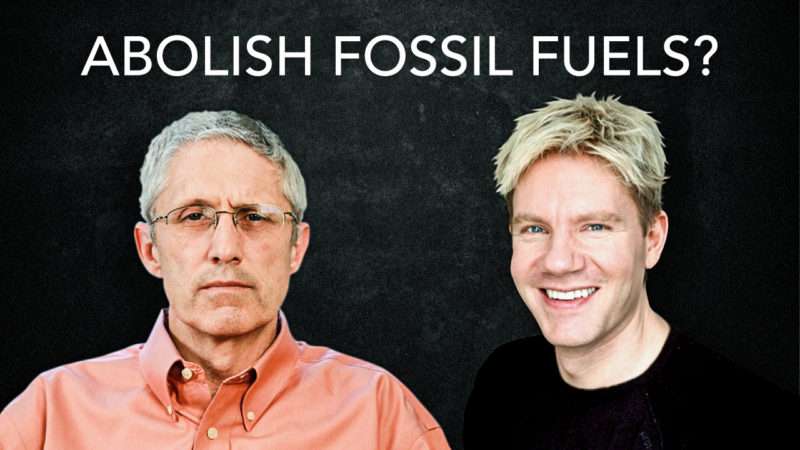
Should We Abolish Fossil Fuels to Stop Global Warming? A Soho Forum Debate

8090559_thumbnail copy

To combat climate change, the world’s nations must make it their highest priority to completely replace the burning of fossil fuels within the next 20 years.

If governments don’t completely eliminate fossil fuels by 2040, society is doomed, says Jeff Nesbit, author of This Is the Way the World Ends.

That kind of apocalyptic rhetoric “costs us trillions, hurts the poor, and fails to fix the planet,” says Bjorn Lomborg, the author of False Alarm.

Are fossil fuels an imminent threat to human life, or are attempts to eliminate them more destructive? That was the subject of an Oxford-style online Soho Forum debate hosted on Sunday, October 18, 2020.

Arguing in favor of the complete elimination of fossil fuels over 20 years was Nesbit, who is the executive director of Climate Nexus. He went up against Lomborg, who is the president of the Copenhagen Consensus Center. The debate was moderated by Soho Forum director Gene Epstein.

Narrated by Nick Gillespie, edited by Ian Keyser, intro by John Osterhoudt

Music: “Under Cover” by Wayne Jones

Photos: Gina M Randazzo/ZUMA Press/Newscom; SEBASTIAN SILVA/EFE/Newscom; imageBROKER/Jim West/Newscom; Stefan Boness/Ipon/SIPA/Newscom.

from Latest – Reason.com https://ift.tt/2Jdek8H
via IFTTT

Stocks Can No Longer Pretend 2020 Will Be A One-Off

Stocks Can No Longer Pretend 2020 Will Be A One-Off

Tyler Durden

Tue, 10/27/2020 – 11:55

By Bloomberg macro strategist and former Lehman trader, Mark Cudmore

Monday’s global equity losses were a preview of the coming months rather than just a case of pre-election jitters. Investors are finally realizing that the coronavirus is a 2021 story too.

After the initial weeks of fear, it was easy for many wealthy people to dismiss the pandemic as an overblown threat. There have been fewer than two Covid-19 fatalities for every 10,000 people on the planet, meaning it’s unlikely any random individual knows someone personally who has died from the disease. The majority of those who contract the virus experience relatively mild symptoms or even none at all.

On top of that, the financial elite saw their savings and investments bolstered by extraordinary stimulus packages and were most likely to be be able to easily transition to a remote-working lifestyle, supported by their employer.

And then there’s been the constant promises of a vaccine being ready by year end. All this combined to mean that unless they experienced the trauma of personal loss, the most accessible narrative was that the pandemic was a one-off shock to earnings that would soon be recovered as life normalized again.

But the world isn’t going to “normalize” any time soon. Quite the opposite. As of Sunday, the seven-day average daily case count was 432,475 — up from 356,343 a week earlier. At current trends, daily case counts will be regularly above half a million from later this week (we know that the highest counts usually come Wednesday to Friday). The running mortality rate for those global cases is 2.68%. That rate should continue to drop as testing improves but late November is still on track to see daily fatalities above 10,000 on a too-frequent basis.

This is completely separate from the potentially much larger problem of overloaded hospital systems and the dire related consequences of society forgoing other treatments and check-ups. These factors will combine to severely alter consumer behavior well into 2021, whether mandated by government restrictions or not.

There will be winners and losers from the rotation to a new type of economy but the transition will overall result in a massive real net cost on society and for many individuals. Many established businesses will go bankrupt and millions of jobs will be lost, destroying the consumer base.

But there’s a bigger problem for optimistically priced stocks. Everyone has been hyping up the arrival of the vaccine on the assumption that it will be a game-changer. But vaccinating a sufficiently large part of the global population to resume “normal” activities will be a long, drawn-out process – spanning many months or even years – rather than an event. Especially as many people appear reluctant to be early in the vaccine queue.

The K-shaped recovery has helped the fortunate remain relatively insulated from the pandemic but the financial bubble is set to burst. And none of this even hinges on the complacent pricing around the U.S. election risks.

via ZeroHedge News https://ift.tt/3owHujj Tyler Durden

Record Flows Pour Into “Woke” ESG Funds That Invest In Names Like Exxon, Google, Chevron, And Nike

Record Flows Pour Into “Woke” ESG Funds That Invest In Names Like Exxon, Google, Chevron, And Nike

Tyler Durden

Tue, 10/27/2020 – 11:40

We have been taking exception with the environmental, social and governance (ESG) con for the better part of the last few months, inconveniently pointing out that the funds that make “woke” investors feel warm and fuzzy on the inside are turning around and pouring their money into the very same corporate giants many investors likely think they are avoiding by investing in ESG funds.

But, since regulators haven’t weighed in on use of the term “ESG”, the con continues to roll on.

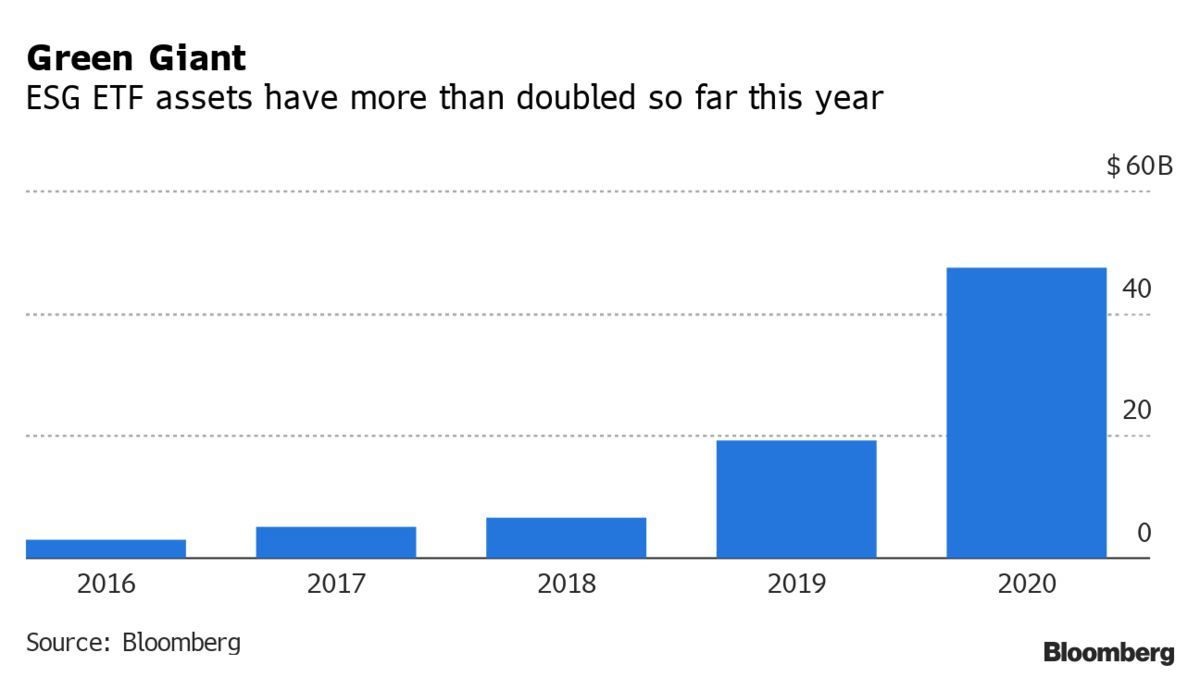
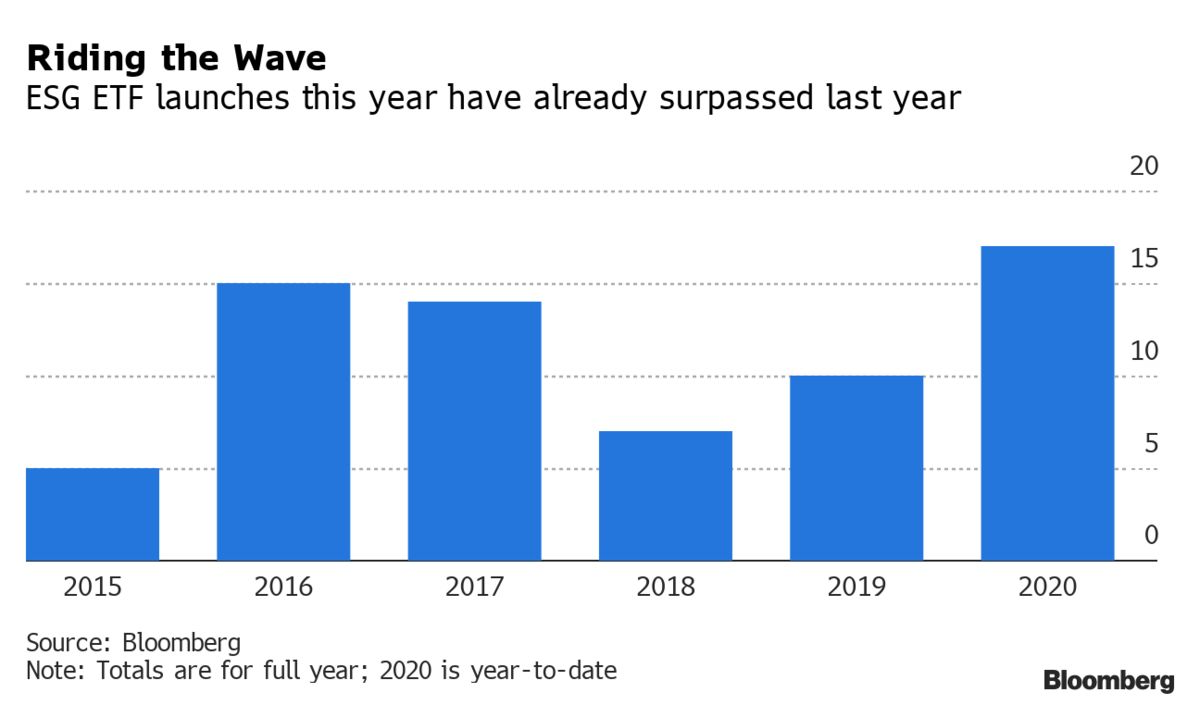
Inflows to ESG funds have skyrocketed to $22 billion in 2020 so far, which is about 3x the total inflows in 2019, according to Bloomberg. This is despite the fact that funds like BlackRock Inc.’s iShares ESG Aware MSCI USA ETF (ESGU) include names like Exxon and Chevron. In fact, its largest holdings are big tech companies under investigation for antitrust violations, Bloomberg notes. 

Eric Balchunas, ETF analyst for Bloomberg Intelligence, said: “If you go in there thinking that you want to ‘woke’ up your portfolio, and you see those companies, you’re going to be like, ‘What? That’s not what I signed up for.’”

The ESGU, ESGE and ESGD make up $13.4 billion of those $22 billion. MSCI helps set inclusion and exclusion rules for the ETFs. The ESGU apparently tries to rule out “civilian firearms, controversial weapons, tobacco, thermal coal and oil sands” while Vanguard’s ESGV steers clear of “adult entertainment, alcohol, tobacco, weapons, fossil fuels, gambling and nuclear power”.

But the “social responsibility score” of other names included in many funds – even names like Amazon, who has been accused of poor work environment – can be easily challenged.  

Ben Johnson, Morningstar’s global director of ETF research, said: “The preponderance of assets in ESG funds are in ESG light funds. The level of spiciness, if you will, goes from mild to medium to hot — in terms of where the assets are right now, it’s all in pico de gallo.”

And until the SEC decides to weigh in with criteria on what constitutes an ESG fund, there is going to continue to be subjective differences in how ESG rating companies rate funds. One analyst for Bloomberg, who is developing an ESG rating service, said: “The question on everybody’s mind now revolves around green washing.”

Dylan Tanner, executive director of InfluenceMap, said: “Some of the data providers who rate companies on ESG tend to firstly rely on a company’s own disclosures and sustainability reports too much. How meaningful those numbers are, when you’re blending climate with labor, should be questioned.”


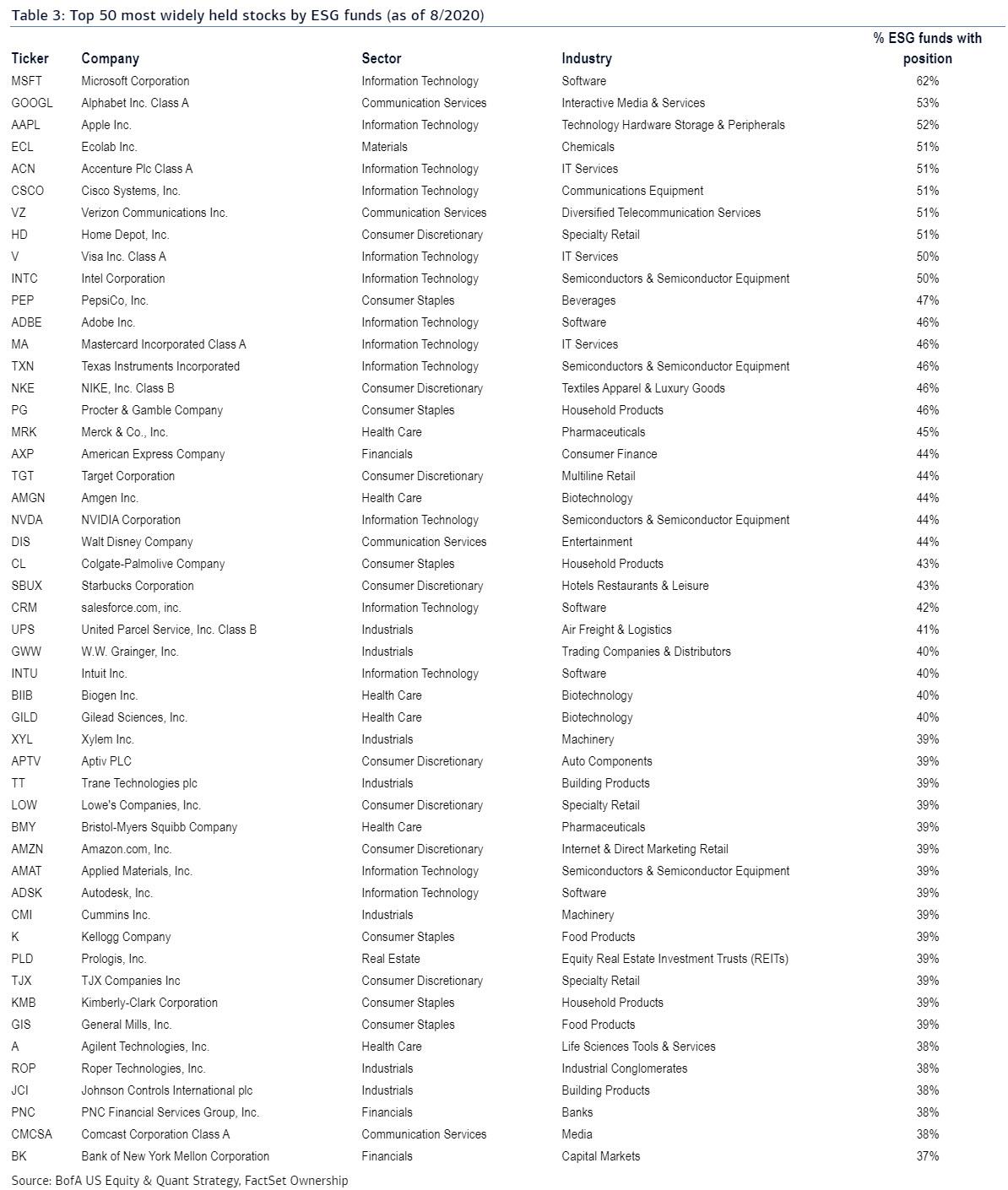
We documented back in September what some of the most popular ESG fund holdings were. The list included many of the same massive corporations one would find in the SPY or QQQ funds: Microsoft, Apple, Google, Cisco, Verizon, Nike, Pepsi and many other massive corporate conglomerates associated with all types of “socially responsible” behavior, including overseeing sweat shops and employing underpaid Foxconn workers who routinely hurl themselves off of the top of skyscrapers due to their work environment. 

As we noted then, the ESG term is just a brilliant hook with which to attract the world’s most gullible, bleeding-heart liberals and frankly everybody else into believing they are fixing the world by investing when instead they are just making Jeff Bezos richer beyond his wildest dreams. 

Here is Bank of America’s summary of the 50 most popular ESG funds. Try not to laugh:

As confirmation here are the Top 10 Holdings of the purest ESG ETF available: the FlexShares ESGG fund. Below we present, without further commentary, its Top 10 holdings:

As we said in September:

Two centuries ago, PT Barnum said “there’s a sucker born every minute.”

Little did he know how appropriate that phrase would be more than a hundred years later to describe investors in the virtue-signaling craze that has taken over markets today.

via ZeroHedge News https://ift.tt/2G1xcpQ Tyler Durden

To Ban Evictions During COVID-19, the CDC Demands Huge Expansion of Executive Power

reason-cdc

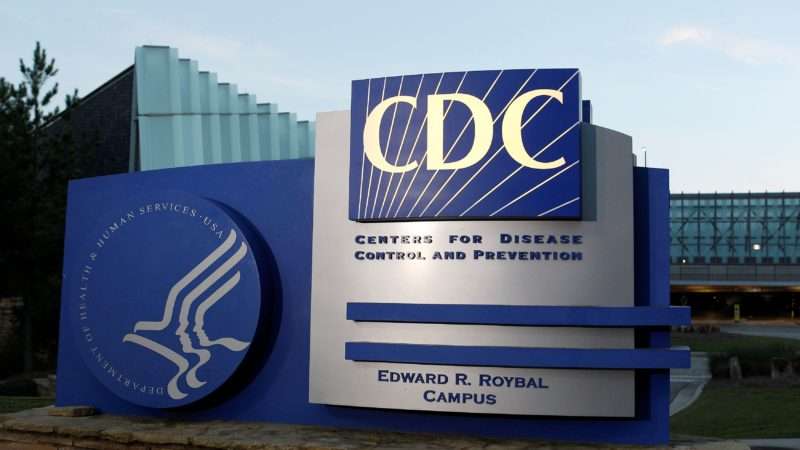
Lawsuits continue to mount against the Trump administration’s September-issued eviction moratorium, which bans landlords from removing tenants for non-payment of rent through the end of the year, and threatens hefty fines and even jail time for property owners who violate it.

The statutes and regulations that the administration and the Centers for Disease Control and Prevention (CDC) are leaning on to justify their moratorium come nowhere close to authorizing a nationwide emergency ban on evictions, say a growing number of plaintiffs. Allowing the order to stand would give the federal bureaucracy near-limitless authority to issue regulations and mandates in the name of public health, they argue.

“I’m not being hyperbolic when I say that if [the CDC’s] interpretation is accepted, it means the CDC can issue any of the same orders at all that any of the governors across the country have done,” says Luke Wake, an attorney with the Pacific Legal Foundation (PLF). “Business closures, micromanaging the economy, what we can do in our private circles. That would all be under their purview.”

On Friday, the PLF filed a lawsuit in the U.S. District Court for the Northern District of Ohio on behalf of several Ohio property management companies and the National Association of Home Builders, all of whom say the CDC’s eviction moratorium is preventing them from removing non-paying tenants.

In their complaint, these plaintiffs argue that the CDC’s eviction moratorium—which went into effect within days of the text being released, without any opportunity for affected parties to provide feedback—violates the federal Administrative Procedure Act’s notice and comment requirements.

They also argue that the federal law the CDC’s order rests on does not give the executive branch carte blanche to issue an eviction moratorium.

That law, the Public Health Services Act, gives federal public health officials the authority to make regulations “reasonably necessary” to prevent the interstate spread of communicable disease, including “inspection, fumigation, disinfection, sanitation, pest extermination, and destruction of animals or articles believed to be sources of infection.”

The CDC, in the text of its emergency order, lists a number of explanations for why a moratorium is “reasonably necessary” to prevent the spread of COVID-19.

Absent its eviction ban, up to 40 million renters would be at risk of eviction, the order reads, citing an upper-end estimate put out by the Colorado-based COVID-19 Eviction Defense Project. People being evicted are likely to move in with family, friends, or into crowded group settings like homeless shelters, it continues, raising the chances of coronavirus transmission.

Evictions also pose a particular risk of interstate transmission, the CDC argues in the text of its order, because some 15 percent of moves pre-pandemic were between states.

That’s a tortured interpretation of the Public Health Services Act and related regulations, counters Wake, saying that measures that could count as “reasonably necessary” under the law are limited by the explicit powers the law gives public health authorities.

“When Congress gives a list of things that says an agency can do XYZ and then has some catchall language we need to interpret that catchall language consistent with the XYZ,” he says. That means that the CDC is limited to issuing regulations related to inspection, fumigation, disinfection, and other things spelled out in the Public Health Services Act itself.

The Trump administration has pushed back on that interpretation of the law. Instead, it has argued in legal filings in a separate but related lawsuit challenging its eviction moratorium that the intent of the Public Health Services Act was to give public health officials “maximum flexibility” to combat disease.

Because the law provides the government with the authority to intrude on private property and even detain individuals, an eviction moratorium that limits private property owners’ rights to remove non-paying tenants is clearly justified, it argues in a brief filed in early October.

That’s an incredibly sweeping claim of power that should concern anyone who thinks there should be some outer bound on the government’s coercive authority to respond to the pandemic.

Regrettably, much of the media attention that the CDC’s eviction moratorium has attracted has instead focused on whether local and state courts are doing enough to enforce the likely illegal order.

PLF’s lawsuit is asking the court for a preliminary injunction against the CDC’s eviction moratorium, and ultimately for the order to be declared unlawful and/or unconstitutional. That’d be good news for those who think the powers of the Trump administration—and subsequent administrations—ought to be limited, even during a pandemic.

from Latest – Reason.com https://ift.tt/3kCcxbc
via IFTTT

Peter Schiff: Sooner Or Later Every Bubble Finds Its Pin

Peter Schiff: Sooner Or Later Every Bubble Finds Its Pin

Tyler Durden

Tue, 10/27/2020 – 11:20

Via SchiffGold.com,

Stocks sold off Monday as markets fretted over the lack of progress on stimulus and a rise in COVID-19 cases. In his podcast, Peter talked about the sell-off and the political dynamics driving the markets right now. He also drove down to a question nobody seems to want to grapple with: why are the markets and the economy so dependent on and desperate for stimulus?

The Dow was down 650 points on Monday. A 300 point rally off the interday low kept the carnage from being even worse. The Nasdaq fell 189 points and the S&P 500 lost 1.86%. It was the worst day on Wall Street since mid-September. Two factors drove stocks lower – the lack of progress on a stimulus deal and a surge in COVID-19 cases.

The selloff could have been worse if it wasn’t for a big move out of recovery stocks into the “stay-at-home” stocks benefiting from the pandemic. But Peter wondered how long these stay-at-home stocks can continue to buoy the market given they are already significantly overvalued.

And of course, if all of the people who are staying at home and shopping never go back to work and never actually have a job, and the only money they have to spend is the money the Fed creates out of thin air, eventually the dollar is going to collapse and their real purchasing power is going to go down along with it. And a lot of these stocks are going to crash because they’re not going to have any real revenue because their customers are going to be broke and they’re not going to be able to sell these higher-cost products because inflation will drive up the cost of producing all these products that their consumers really can’t afford to buy.”

Nervousness about the election may have also played in the stock selloff. The markets are concerned about their worst-case scenario – gridlock – coming to pass. This would occur if Biden won the White House but the GOP retains control of the Senate. Polling shows some of the Senate races tightening up. Peter has said this would likely be the best outcome for the overall economy, as it would probably mean less stimulus, less borrowing and less money printing. But stimulus is exactly what the markets want, regardless of the effect on the dollar and the actual economy.

If we end up with divided government, with Republicans holding the Senate, I think Republicans in the Senate will actually put more pressure on President Biden than they would have on a President Trump. They’re more likely to cooperate with Trump to give him the spending he wants. But they are more likely, for their own political reasons, for their own base so they don’t get primaried and lose, they will finally find some religion and they will push back against Biden stimulus.”

As a result, Wall Street doesn’t like the possibility of the Republicans maintaining control of the Senate.

Peter said he’s not buying any of this “nonsense.” He thinks the markets are just trying to convince everybody that a Biden win is good for the economy despite the likelihood of higher taxes. We’ll offset the negatives of higher taxes with the positives of more stimulus, so the thinking goes.

But remember, more stimulus comes with bigger government. Bigger government is not a recipe for economic success and it’s not a recipe for stock market success.”

Peter said if Biden does win, he thinks any Biden-related market rally will be short-lived, just like the sell-off after Trump won was short-lived.

When investors have a chance to really think about what a Biden win means, just like when they actually had a chance to think about what a Trump win was supposed to mean – the Trump win was lower taxes and less regulations. That is good for the market. A Biden win means higher taxes and more regulation. That’s bad for the market.

Peter said we got a small taste Monday of the downside that’s coming in the US stock market.

Nevertheless, the focus has been almost exclusively on stimulus. The conventional wisdom holds that people and businesses need help and it’s time to stop playing politics and provide the help that’s necessary. But the question nobody asks is why are people in such dire straits to begin with?

Most people will point to the pandemic. But as Peter pointed out, we’ve dealt with other big shocks to the economy without a bunch of government stimulus. Just consider World War II. How did people manage? Because they were prepared. They had savings. The economy wasn’t completely levered up on debt going into the crisis.

The fact that we weren’t prepared at all, that’s the problem no one wants to talk about. Why is it that Americans are loaded up with debt and living paycheck to paycheck? Why is the same thing true for so many businesses? Why are the credit losses now going to be horrific? … Because the Federal Reserve kept interest rates so low for so long that people and companies were able to borrow far more money than they ever would have been able to borrow during a normal lending environment. So, it’s because of the Federal Reserve that the society, the country, is so levered up. That’s why we’re so vulnerable. That’s why everybody needs so much help. Because the government crippled everybody with its monetary policies, and also the fiscal policies, and so now, of course, we can’t walk, so we need more government crutches so we can limp around without realizing that all that is doing is exacerbating the problems that already exist. I mean, we’ve got to fess up to reality and stop trying to sober up by drinking more alcohol. But it is a very sobering understanding to have to do that – for reality to be dealt with and stop pretending there’s a government cure for what ails us.

We’re sick because we overdosed on government cures. So, nobody has these conversations. Yeah, people need money. Companies need money. And so we have to stop playing politics and give them the money. Playing politics is giving them the money.

The reason everybody needs the money is because we played politics in the past by making them so dependent on that money, by trying to delay and mitigate every single recession – now we’re in a depression. Had we allowed market forces to operate, we would have had a much healthier economy going into COVID-19 instead of a bubble. And the problem with bubbles is sooner or later, they always find a pin.

via ZeroHedge News https://ift.tt/3kDwle8 Tyler Durden

Map Shows Arctic Blast Sweeping Across The US 

Map Shows Arctic Blast Sweeping Across The US 

Tyler Durden

Tue, 10/27/2020 – 11:05

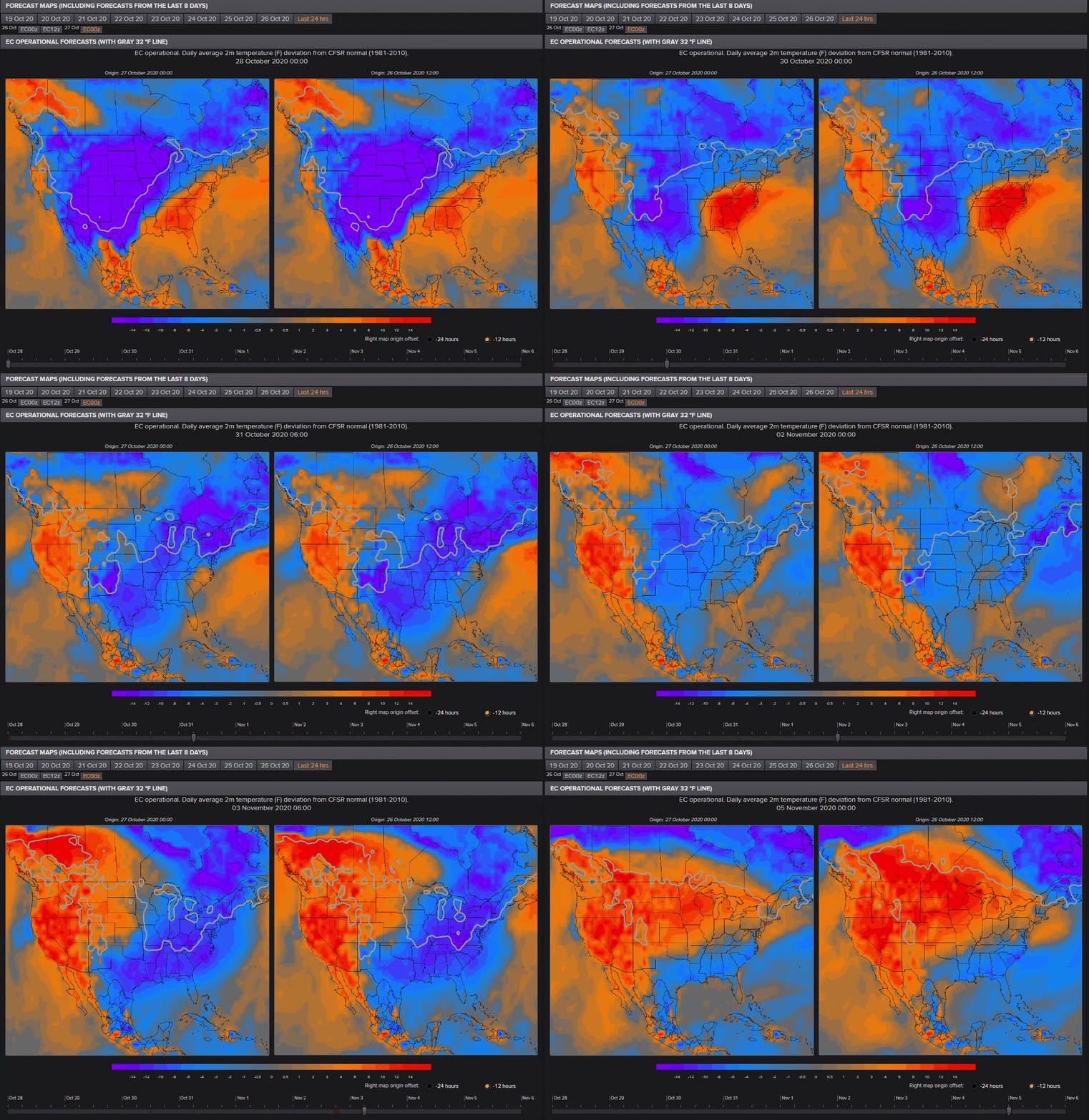
Widespread coolness is expected for more than half the country this week as a late-October Arctic blast makes temperatures feel like winter for millions of Americans across the Plains. 

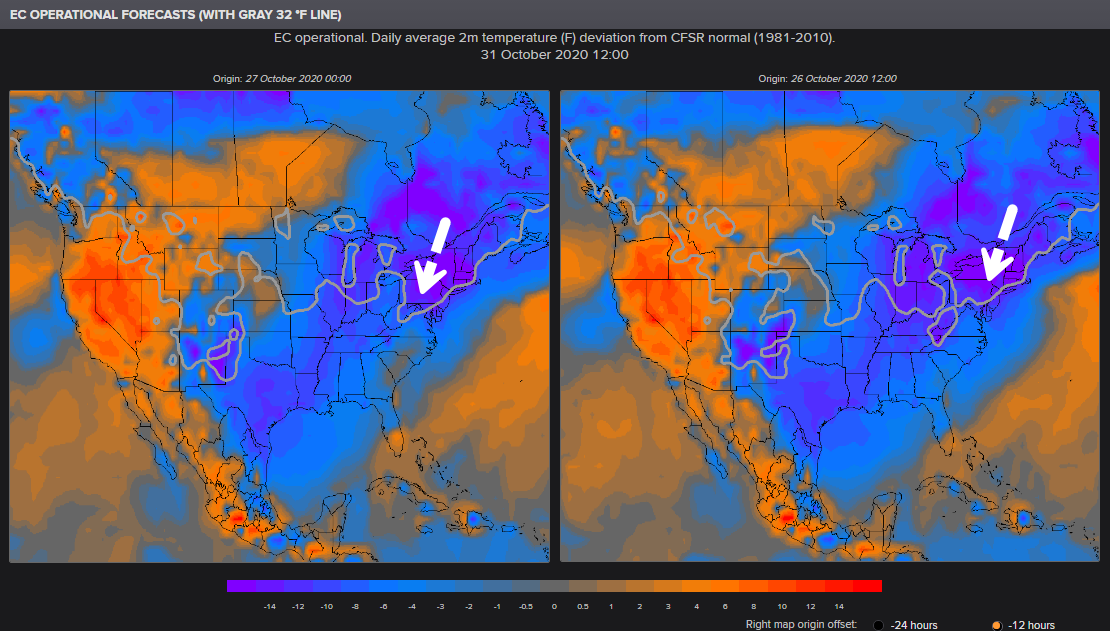
The EC Operational Forecast (With Gray 32 Degree Fahrenheit Line) shows extreme temperature deviations could be more than 15 degrees below-average for much of the Plains this week. The Gray 32 Degree Fahrenheit Line dove into Northern Mexico on Monday and will stay there through Friday. 

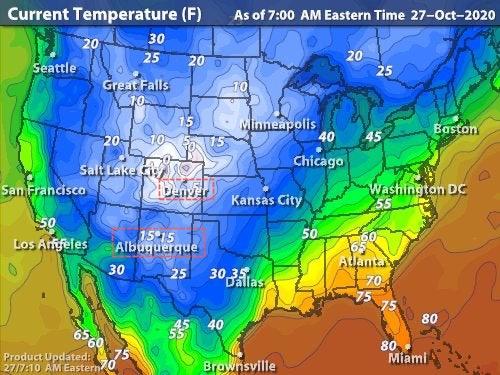
The Arctic blast is the first season, with temperatures dipping to single digits in Denver on Tuesday morning. Albuquerque, New Mexico, recorded 15 degrees as the bitterly cold air pours in from the Arctic.  

US Temperature Map Tuesday 0700 ET 

Colder weather will expand to the Northeast Wednesday, with the Gray 32 Degree Fahrenheit Line moving below the Mason–Dixon line by Saturday morning. Here’s the EC Operational Forecast (With Gray 32 Degree Fahrenheit Line) for Saturday morning: 

“The 6 to 10-day temperature outlook keeps temperatures below average in parts of the Northeast and the South, then above-average temperatures return for most of the country in the 8 to 14-day outlook as we head into the first two weeks of November,” said NewsNation Chief Meteorologist Albert Ramon

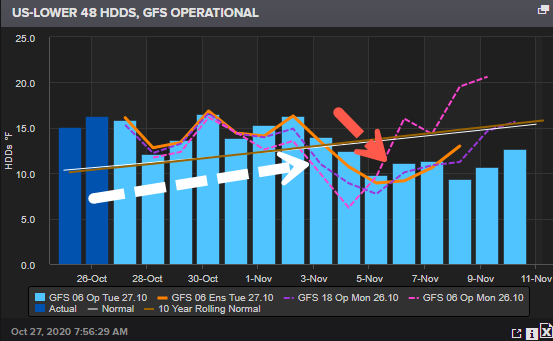
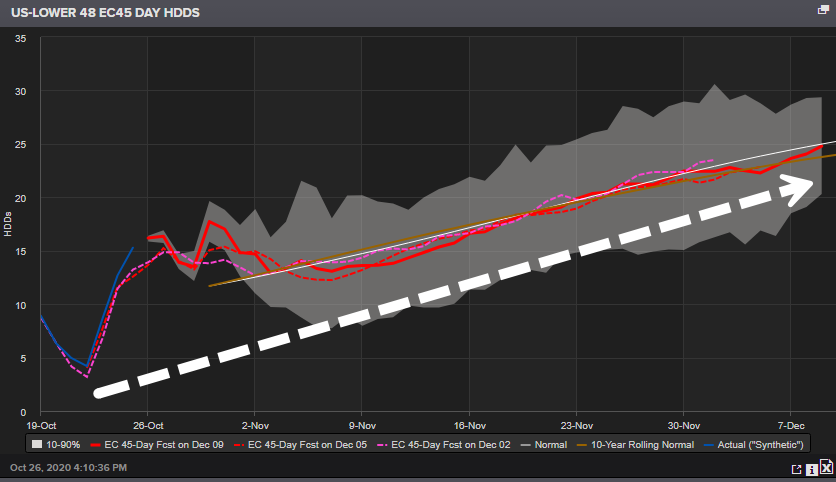
For much of the country, US-Lower 48 Heating Degree Days for the next 15 days show Americans will likely turn up their thermostats as temperatures dip from now through Nov. 2, but as Ramon explained above, warmer weather could be ahead of the first half of next month. 

US-Lower 48 Heating Degree Days for the next 45 days more or less shows Old Man Winter is arriving. 

Natgas hit two-year highs on Monday on the prospects of colder weather.  

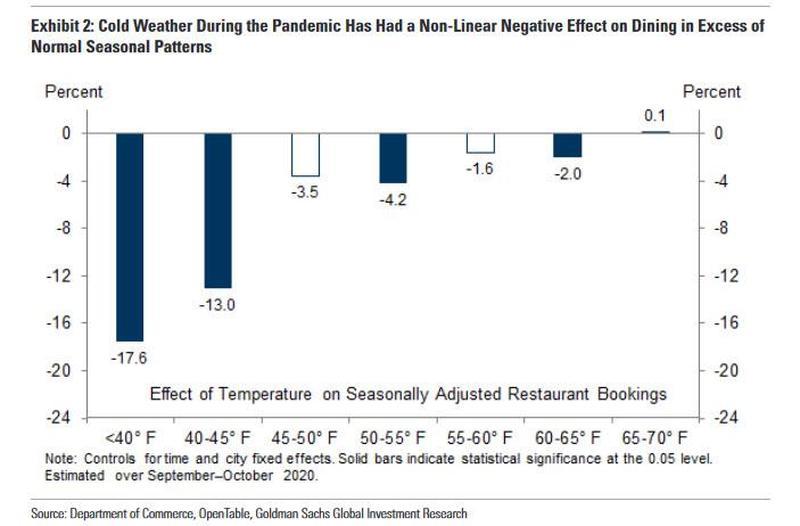
Goldman recently forecasted dropping temperatures will dramatically slow down consumer activity. 

Colder weather and surging COVID-19 cases could be a double whammy that plunges the US economy into a double-dip recession

via ZeroHedge News https://ift.tt/34CrTqF Tyler Durden

To Ban Evictions During COVID-19, the CDC Demands Huge Expansion of Executive Power

reason-cdc

Lawsuits continue to mount against the Trump administration’s September-issued eviction moratorium, which bans landlords from removing tenants for non-payment of rent through the end of the year, and threatens hefty fines and even jail time for property owners who violate it.

The statutes and regulations that the administration and the Centers for Disease Control and Prevention (CDC) are leaning on to justify their moratorium come nowhere close to authorizing a nationwide emergency ban on evictions, say a growing number of plaintiffs. Allowing the order to stand would give the federal bureaucracy near-limitless authority to issue regulations and mandates in the name of public health, they argue.

“I’m not being hyperbolic when I say that if [the CDC’s] interpretation is accepted, it means the CDC can issue any of the same orders at all that any of the governors across the country have done,” says Luke Wake, an attorney with the Pacific Legal Foundation (PLF). “Business closures, micromanaging the economy, what we can do in our private circles. That would all be under their purview.”

On Friday, the PLF filed a lawsuit in the U.S. District Court for the Northern District of Ohio on behalf of several Ohio property management companies and the National Association of Home Builders, all of whom say the CDC’s eviction moratorium is preventing them from removing non-paying tenants.

In their complaint, these plaintiffs argue that the CDC’s eviction moratorium—which went into effect within days of the text being released, without any opportunity for affected parties to provide feedback—violates the federal Administrative Procedure Act’s notice and comment requirements.

They also argue that the federal law the CDC’s order rests on does not give the executive branch carte blanche to issue an eviction moratorium.

That law, the Public Health Services Act, gives federal public health officials the authority to make regulations “reasonably necessary” to prevent the interstate spread of communicable disease, including “inspection, fumigation, disinfection, sanitation, pest extermination, and destruction of animals or articles believed to be sources of infection.”

The CDC, in the text of its emergency order, lists a number of explanations for why a moratorium is “reasonably necessary” to prevent the spread of COVID-19.

Absent its eviction ban, up to 40 million renters would be at risk of eviction, the order reads, citing an upper-end estimate put out by the Colorado-based COVID-19 Eviction Defense Project. People being evicted are likely to move in with family, friends, or into crowded group settings like homeless shelters, it continues, raising the chances of coronavirus transmission.

Evictions also pose a particular risk of interstate transmission, the CDC argues in the text of its order, because some 15 percent of moves pre-pandemic were between states.

That’s a tortured interpretation of the Public Health Services Act and related regulations, counters Wake, saying that measures that could count as “reasonably necessary” under the law are limited by the explicit powers the law gives public health authorities.

“When Congress gives a list of things that says an agency can do XYZ and then has some catchall language we need to interpret that catchall language consistent with the XYZ,” he says. That means that the CDC is limited to issuing regulations related to inspection, fumigation, disinfection, and other things spelled out in the Public Health Services Act itself.

The Trump administration has pushed back on that interpretation of the law. Instead, it has argued in legal filings in a separate but related lawsuit challenging its eviction moratorium that the intent of the Public Health Services Act was to give public health officials “maximum flexibility” to combat disease.

Because the law provides the government with the authority to intrude on private property and even detain individuals, an eviction moratorium that limits private property owners’ rights to remove non-paying tenants is clearly justified, it argues in a brief filed in early October.

That’s an incredibly sweeping claim of power that should concern anyone who thinks there should be some outer bound on the government’s coercive authority to respond to the pandemic.

Regrettably, much of the media attention that the CDC’s eviction moratorium has attracted has instead focused on whether local and state courts are doing enough to enforce the likely illegal order.

PLF’s lawsuit is asking the court for a preliminary injunction against the CDC’s eviction moratorium, and ultimately for the order to be declared unlawful and/or unconstitutional. That’d be good news for those who think the powers of the Trump administration—and subsequent administrations—ought to be limited, even during a pandemic.

from Latest – Reason.com https://ift.tt/3kCcxbc
via IFTTT