China Is Stealing Border Land From Tiny Nepal To Build Military Bases Tyler Durden
Mon, 11/02/2020 – 21:00
China is again being accused of a blatant landgrab along the disputed Himalayan high altitude border region not far from where Chinese and Indian Army troops previously clashed.
This time it’s the country of Nepal that has accused China of stealing over 150 hectares sovereign of its territory, or about 1.5 square kilometers. Leaders of the tiny country wedged between the major regional powers of India and China made the explosive charge to the Daily Telegraphearly this week.
“Why should China come over into Nepal, when China is already sixty times the size of our small country?” a lawmaker in the Nepali Congress Party, Jeevan Bahadur Shahi, said. However, it’s believed that thus far neither Kathmandu nor Beijing has officially acknowledged it because it would harm trade ties – a much more worrisome prospect for the Nepal side.
The entire country of Nepal is mountainous with extreme altitudes. Image source: Shutterstock.com
Nepalese politicians have recently accused top officials have seeking to hide the scandal for fear of the economic repercussions.
But perhaps most alarming is what the cross-border territory is to be used for by the PLA, as the Telegraph explains:
China allegedly began seizing Nepalese land in five frontier districts in May, sending members of its People’s Liberation Army (PLA) across undefended areas of the border.
In the north-western district of Humla, PLA troops crossed the border into the Limi Valley and Hilsa, moving stone pillars which had previously demarcated the boundary further into Nepalese territory before constructing alleged military bases. The Daily Telegraph has seen images of the bases.
Border identifiers were also allegedly moved by the Chinese in the district of Gorkha as well, while additional annexations Rasuwa, Sindhupalchowk and Sankuwasabha were also said to have taken place according to the report.
PLA Military camps and bases have also featured into the much larger dispute along the Line of Actual Control (LAC) which separates Indian-controlled territory from Chinese-controlled territory, especially in the Ladakh region, which witnessed hand-to-hand combat last summer resulting in at least 20 Indian troop deaths. India had accused PLA forces of setting up fortifications inside its administered territory.
But in the case of Nepal, China may think it can get away with more while hoping the ruling Nepal Communist Party (NCP) will look the other way, given the two governments consider themselves ideological allies.
via ZeroHedge News https://ift.tt/3mKSpUF Tyler Durden
A Yale psychiatrist with a history of anti-Trump rhetoric tried to seriously argue on Twitter that Donald Trump is worse than Adolf Hitler, before deleting her tweet.
Bandy Xenobia Lee bills herself as an “Expert on global violence prevention,” yet she appears to seriously think that Trump poses a bigger threat than one of the worst dictators in human history.
“Donald Trump is not an Adolf Hitler,” Lee tweeted.
“At least Hitler improved the daily life of his followers, had discipline, and required more of himself to gain the respect of his followers. Even with the same pathology, there are varying degrees of competence.”
Desperately backpedaling, Lee was forced to delete the tweet and issue a mealy-mouthed apology.
Okay, I have taken it down, since it has upset so many people and was not provoking thought but the opposite. Of note, my statement was about how little Donald Trump believes he needs to do to retain his followership, NOT to minimize Adolf Hitler’s atrocities.
And then doubled-down on her remarkable hyperbole…
If we cannot look at parallels in history and learn from them, we are truly poised to repeat it. I say so in heartbreak for the 11+ million lives lost, not in their minimization (currently, we are looking at 7 billion at risk, without exaggeration if we soberly thought of it).
Lee’s outburst is ironic given that she has repeatedly asserted that Trump is mentally unstable yet is clearly suffering from Trump Derangement Syndrome herself.
Respondents weighed in with their views on Lee’s bizarre tweet.
“The doctor has the worst case of TDS I’ve ever seen. Sick stuff,” said one.
“You’d think that the [checks notes] President of the World Mental Health Coalition wouldn’t be fucking insane. And yet here we are,” remarked another.
“Intellectuals nowadays. Gotta love ’em,” added another.
In the age of mass Silicon Valley censorship It is crucial that we stay in touch. I need you to sign up for my free newsletter here. Also, I urgently need your financial support here.
via ZeroHedge News https://ift.tt/34NAE10 Tyler Durden
Your Last Minute Election Night Preview: Here’s All You Need To Know Tyler Durden
Mon, 11/02/2020 – 20:28
Yesterday we published a lengthy election cheat sheet looking at what happens on and after November 3.
Due to popular demand, and since there have been some notable changes in the past 24 hours, we update this preview as well as present some new data that will be relevant to keep track of tomorrow’s events.
But first, here is how to follow the news on Election Day.
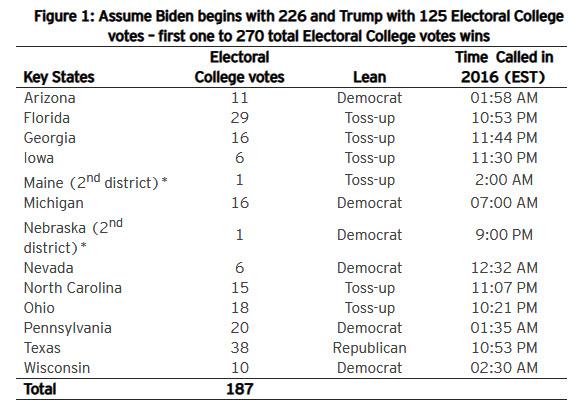
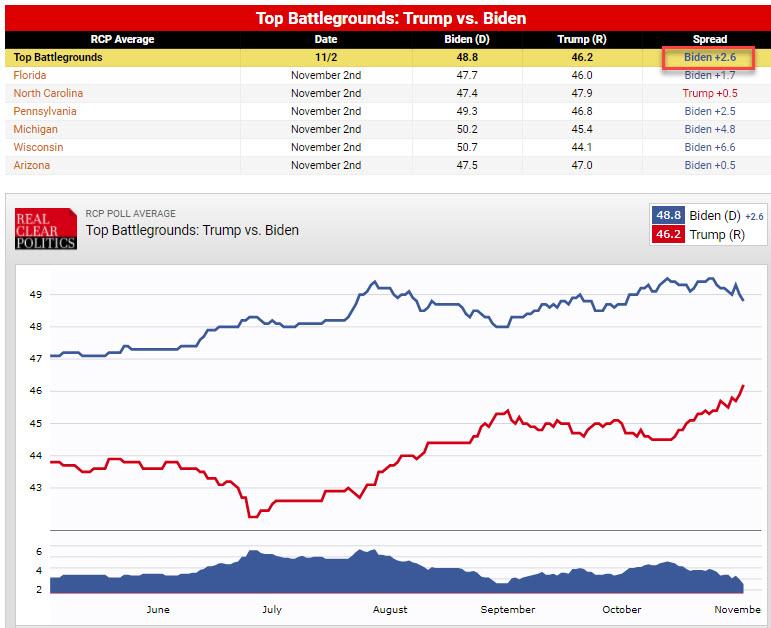
The table below shows the states that are considered toss-ups or have a slight lean according to forecasters (“likely” and “safe” states are likely to go as expected, which gives Biden 226 Electoral College votes and Trump 125 Electoral College votes). As different states below are awarded to each candidate, add the Electoral College votes to their total. The first candidate to 270 Electoral College votes wins the Presidency. Times which these states were called on election night in 2016 are also included, though these times can and will likely vary this year.
Florida and Pennsylvania are perhaps the two most important states to watch as no Republican has won the Presidency without winning Florida since 1924 and it is a must-win for Trump – without it the path for him to reach 270 Electoral College votes diminishes significantly. Meanwhile, as we reported last night, Pennsylvania is considered by FiveThirtyEight to be the most likely “tipping point” in the election and should Biden lose it, he will become the underdog. It is another state which Trump likely needs, but is also critical for Biden. If Biden wins Florida or Pennsylvania, he is very likely to win the election and if he wins both it is almost certain he gains the 270 Electoral College votes.
Additionally, Iowa, Ohio and North Carolina are states Trump won in 2016 and he needs to retain some combination of them – though not necessarily all of them – to win. If he loses all three, it is likely Trump has lost.
Here are a few tips from Bank of America:
Be wary of exit polls: The track record of exit polls is tenuous at best. In 2004, exit polls showed John Kerry winning the popular vote by 51% to 48% only to ultimately lose by the same margin. Similarly, there were major flaws in the 2016 exit polls which substantially underestimated the number of white working-class voters while overestimating the number of college-educated white voters, leading to bias results favoring Hilary Clinton. Pollsters claim they have fixed the issues ailing Election Day polls but the better mouse trap is yet unproven. Moreover, there has been unprecedented surge in early voting (both in person and mail-in) with over 70mn votes cast nationwide to-date and there is a major skew in voter day preference by party. Admittedly, pollster are aware of this issue and will enhance their methodology by polling at large and early voting centers but nevertheless this creates greater uncertainty in their estimates.
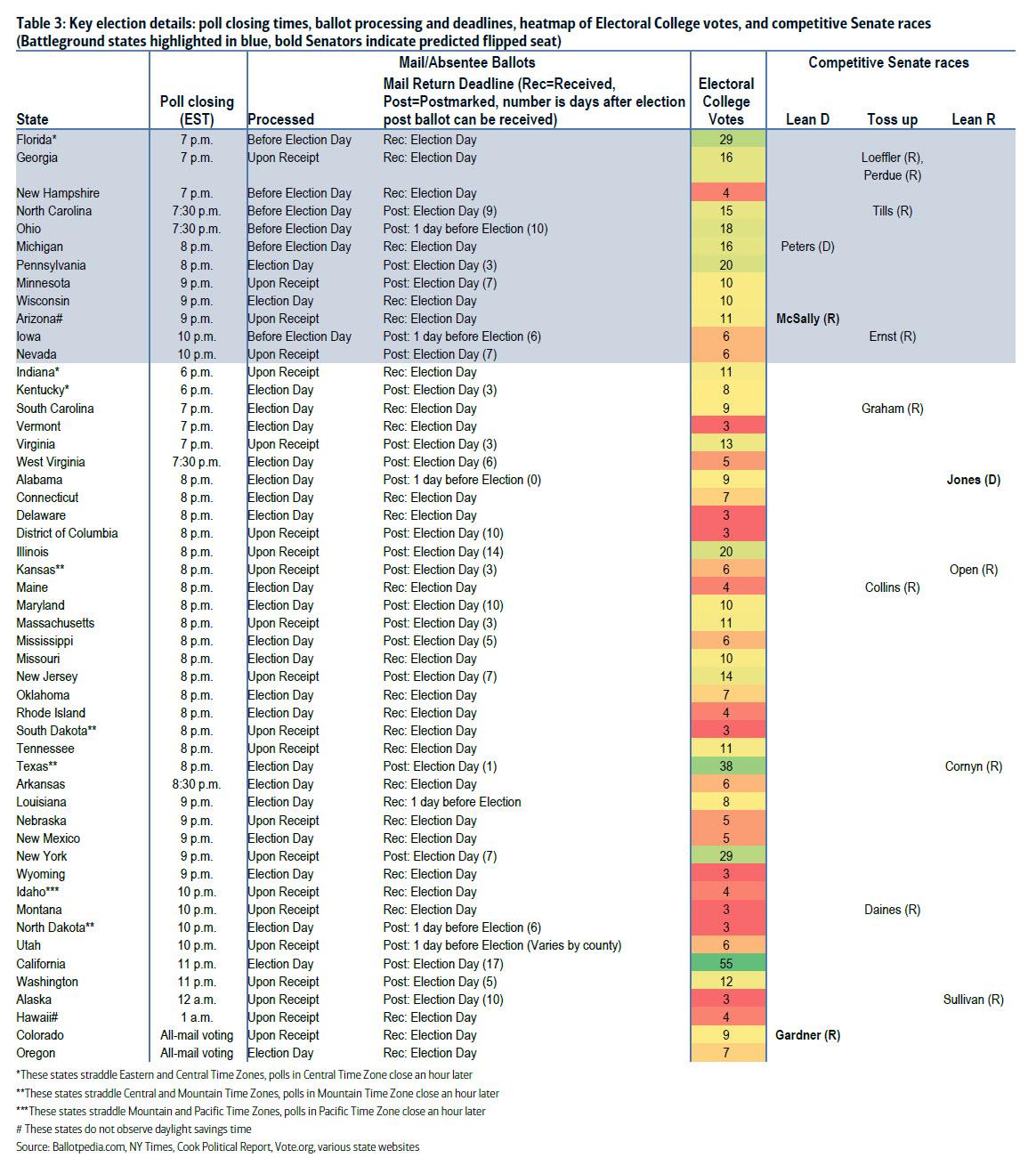
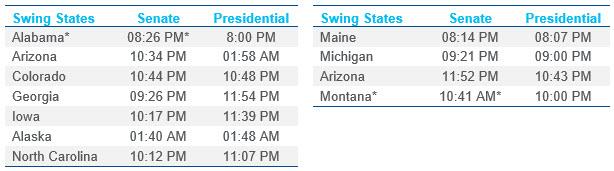
Brace for head fakes: Results from battleground states should begin to trickle in just after polls close within each state (Table 3). First battleground states to report will be Florida, Georgia and New Hampshire where polls close at 7pm EDT (polls in Florida’s panhandle will close at 8 pm), followed by North Carolina, Ohio and Michigan, Pennsylvania, Minnesota, and Wisconsin. Type of ballots reported first will vary across states. For example, according to reporting done by the Upshot blog of the New York Times, battleground states such as Florida, North Carolina, Ohio, Arizona, and Iowa will report early in-person and processed mail-in votes first. Meanwhile, Georgia, Michigan, Pennsylvania, Minnesota, Wisconsin, and Nevada will not follow any specific order. Getting a clear sense of who is winning will be difficult given the large number of early voting by mail and absentee ballots and different rules around processing ballots, which we discuss below.
Key demographics: In 2016, President Trump was able to tip the election by winning the older and suburban vote. A post-mortem of the 2016 election by the Pew research center showed that Trump won the age groups 50-64 and 65+ by a margin of 6 and 9 points, respectively and edged out the suburban vote by 2 points. During the 2020 election cycle, polls have shown President Trump consistently running below his 2016 election numbers in these key demographic groups. In this context, keep an eye on results coming out of suburban areas such as Maricopa County in Arizona and Peach County in Georgia and older leaning regions such as Sumter County and Pinellas County in Florida. Results in these regions could prove to be a canary in the coalmine.
Below we present a BofA cheat sheet summarizing the key election details including poll closing times, ballot processing and deadlines, heatmap of Electoral College votes, and competitive Senate races (Battleground states highlighted in blue, bold Senators indicate predicted flipped seat).
As Reuters expands, here is what to expect in some of the most bitterly contested states :
Blue Mirage
Florida and North Carolina allow election officials to begin processing mail-in ballots weeks before Election Day, and the results of those counts are expected to be released as soon as polls close on Nov. 3. If both states follow that schedule, it is likely that Biden will appear to be ahead initially, as the latest Reuters/Ipsos opinion poll shows that people who already have voted in Florida and North Carolina support the Democratic challenger by a more than 2-to-1 margin over the president. In both states, a majority of people who plan to vote in person on Election Day support Trump. A blue mirage is not expected to last long in either state. Experts say they expect Florida and North Carolina to finish counting most of their mail-in and in-person ballots before the end of the night.
Texas, Iowa and Ohio – which Trump won easily in 2016 but polls show could be competitive this year – also allow early processing of mail ballots, so could show a similar blue mirag. All three states are expected to finish counting most ballots on Nov. 3.
Red Mirage
In Pennsylvania, Michigan and Wisconsin, mail-in ballots cannot be counted until Election Day. While Michigan did recently pass a law that allows many cities to start processing mail-in ballots, such as opening ballot envelopes, the day before the election, they cannot begin to count votes. Because mail-in ballots typically take longer to count than ballots cast in person, the initial results could skew Republican. Then, some experts say, expect a “blue shift” as election officials wade through the piles of mail-in ballots. Pennsylvania and Wisconsin may be slowed by their lack of experience with high volumes of mail-in ballots. About one in 20 votes in the two states were cast by mail in the 2018 congressional election, compared to a quarter of Michigan’s votes and about a third of Florida’s.
Pennsylvania’s vote counting could go on for days. Democrats in the state recently won a victory in the U.S. Supreme Court to allow officials to accept mail-in ballots up to three days after the election as long as they are postmarked by Nov. 3. “Something I’m prepared for on election night is for Pennsylvania to look more Republican than it may actually be, whoever ends up winning the state,” said Kyle Kondik, a political analyst at the University of Virginia’s Center for Politics. Ballots in Wisconsin and Michigan must arrive by Election Day, although litigation is under way over whether the states should count ballots that arrive late if postmarked by Nov. 3.
When could the Presidential election be called?
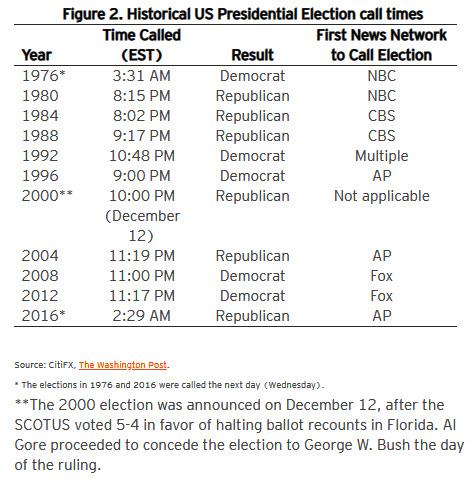
Traditionally, most Presidential elections are called by midnight of Election Day (see chart below) but there are few exceptions including the 2000 contested Bush-Gore election and the 2016 Trump-Clinton election. These are also the only two elections in over 130 years in which the Electoral College winner was not the winner of the national popular vote (that is the loser in both those elections received more national votes than the winner).
As a reminder, the 2000 election came down to Florida’s 25 Electoral College votes as the deciding factor (and Bush only won the state by 537 votes). The 2016 election came down to Michigan, Wisconsin and Pennsylvania which Trump won by around 77,000 votes (0.05% of all votes cast in 2016).
The obvious message here is that the timing of the results is conditional on how close the election is. Given current election forecasts, polls including in swing states, it is possible that the election results could therefore be known before midnight IF Biden in actuality is going to win by a significant margin. Even if Biden wins, a smaller margin of victory could see delayed results.
One other item to note is that there could be greater care in calling the winner by the major news networks. Traditionally, AP gives the official “call” though other news networks compete to be the first. However, given the polarized climate and concerns around contested elections, networks could be especially cautious before proclamations.
Closing Gap
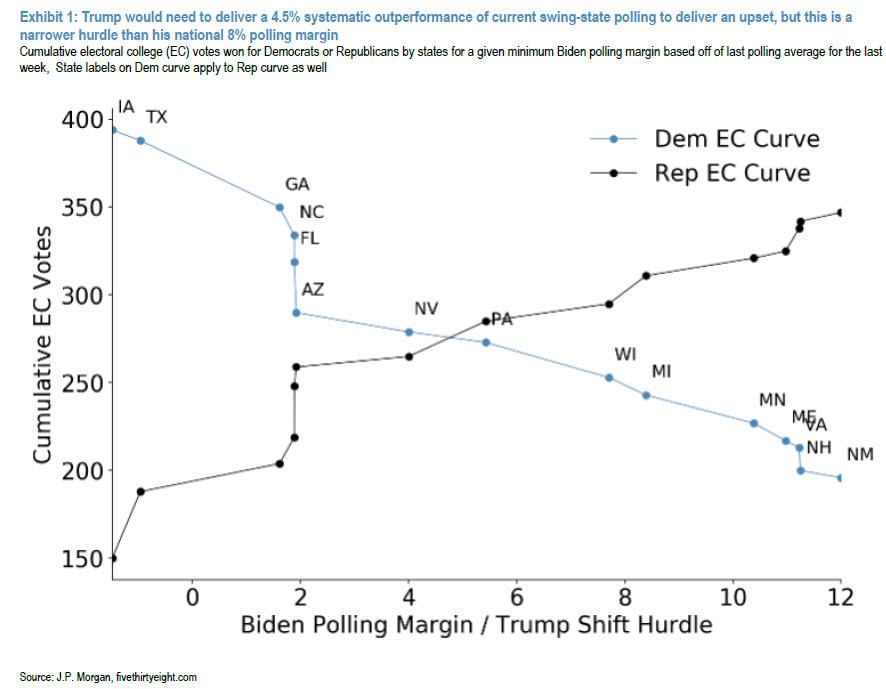
One key development of note in the past 24 hours has been the continued shift in Trump’s favor in a number of swing state polls, which has narrowed the polling margin error difference separating a decisive early Biden victory and a potentially delayed slog towards certainty. This can be seen in a number of states that have more closely clustered around the 1.6-1.9% polling margin in favor of Biden (GA, NC, FL, AZ), which together count for 71 Electoral College Votes (26% of those needed to win).
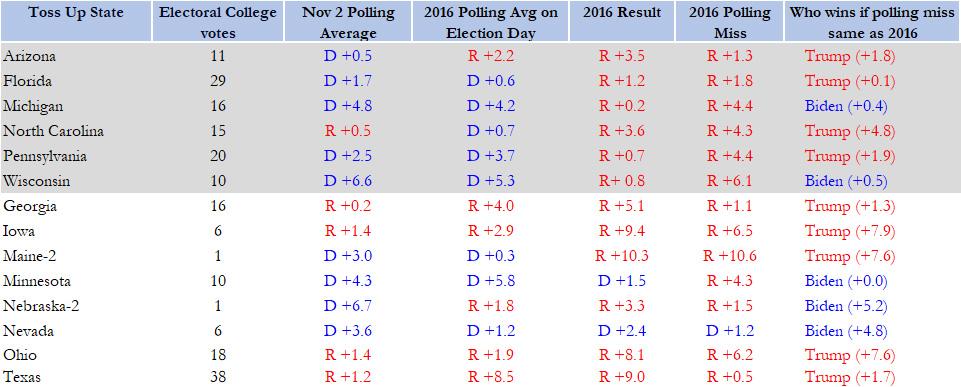
This matters because if we re-run the analysis we conducted over the weekend where we assume the same polling errors in 2020 as in 2016, Trump will win comfortably with 279 votes, and take Florida, Pennsylvania, Arizona and North Carolina.
As the following chart from JPMorgan shows, this is indicated by the unusual steepness of the Electoral College curve just before the 2% margin. The exhibits presents cumulative electoral college votes according to polling margin – to give an idea of which states are important to watch to determine which final outcome is most likely. Put in plain English, a systematic polling error of less than 1.6% should give high certainty of a decisive Biden victory assumed tomorrow evening. A systematic polling error of greater than 1.9%, however, will likely push the tipping point states towards those known to likely have delayed results (PA, WI, MI).
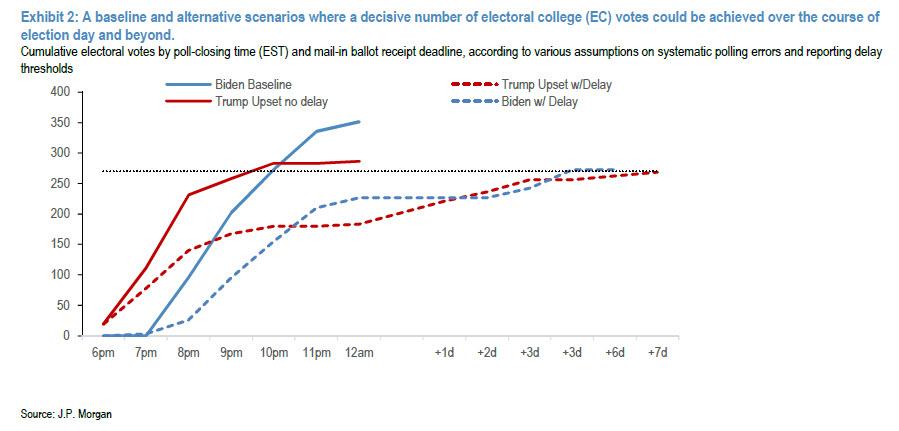
The next chart shows a baseline and alternative scenarios where a decisive number of electoral college votes could be achieved over the course of election day and beyond. This chart shows cumulative electoral college votes according to likely result release time according to various representative scenarios, to provide a template to track how the actual observed outcomes unfolding election night and beyond is tracking to either the baseline, or to alternative wildcards outcomes.
Here are some observations on the chart above from JPMorgan:
The ‘Baseline’: Early confirmation of Biden/Blue Wave sweep (TX goes to Biden at ~9-10 pm EST). Each of TX, GA, OH, FL and IA are close contests after strong Republican outturns in 2016. Newswires called TX first in 2016, followed by OH. If the same holds true in 2020, Biden victories in TX or OH would suggest no systematic polling error in favor of Trump (and the potential for the opposite). It would set a decisive path to deliver the majority 270 EC votes by around 10-11pm (after the 9pm EST closing polls report), and towards as many as 417 Electoral College votes. Earlier in the evening (with the 7pm poll closures) a definitive Biden victory in Florida and Georgia would also go a long way to signaling a highly probable Biden victory. Importantly, if Biden wins in all the states where he has a polling margin lead (including Florida), he will be able to be confirmed without relying on states where there could be potential reporting delays because of mail-in ballot counting, with the decisive EC votes coming in after CA and WA report. Finally, Biden could win even with a polling margin error of up to ~4% in favor of Trump, but this would likely involve a delay.
Wildcards: On the other hand, Trump has a path to win or at least contest the election process (Trump wins Florida at ~11pm EST, PA/WI/MI results are delayed). Trump realistically needs Florida to remain competitive on election night. If he wins Florida and upsets in a number of smaller states (e.g. NC, GA and AZ, implying a systematic polling error at least 2% in Trump’s favor), then this would elevate the importance of PA, WI and MI to cross the 270 electoral vote threshold. These three states have all seen massive surges in requests for mail-in ballots, and largely do not pre-process the votes; this creates risk of reporting delays. Delayed results in these states keep a contested election a possibility, and could delay the final official outcome for several days while late absentee votes are counted in PA. Importantly, a Trump upset requires a greater than 4.5% systematic polling error in his favor and will almost necessarily involve states where there would likely be delayed reporting. Without any delays, this upset win could be confirmed as soon as the 10pm closing polls report.
Biden/gridlock likely (Republicans defend almost all Lean-R incumbent Senate seats pushing to a Jan 5 Georgia Runoff). If Biden wins, Democrats need to net +3 seats to have the bare minimum for a Blue Wave sweep that includes a win in the Senate. Per Cook, they look poised to net +2, with seven toss-up seats to be decided. A Biden victory in NC or IA could potentially carry the Senate seat as well, giving Democrats net +3 or +4. So the signal for the Senate may be clear before midnight (it was called at 1:24am EST in 2016). But if the Republicans mount a strong defensive performance, it may come down to seats in Georgia – at least one of which is likely to be decided in a run-off format on 5 Jan 2021. Thus in a tail-risk scenario, there is scope for the Senate not to be decided until January, which would pose significant discomfort for market participants given the potential legislative agenda at stake.
According to JPM, markets should focus on and potentially reprice specifically around outcomes in Texas and Florida. A Texas Biden win should trigger a fuller pricing in of the Blue Wave scenario and a closing of wildcard hedges, as it will also likely rule out a delayed or contested scenario. A Florida win by Trump should trigger a pricing of greater risk premium against the baseline low-drama Blue Wave scenario. Together with news of too-close-to-call outcomes in PA, WI, MI and NC will trigger hedging against a delayed outcome and more significant chance of a Trump upset.
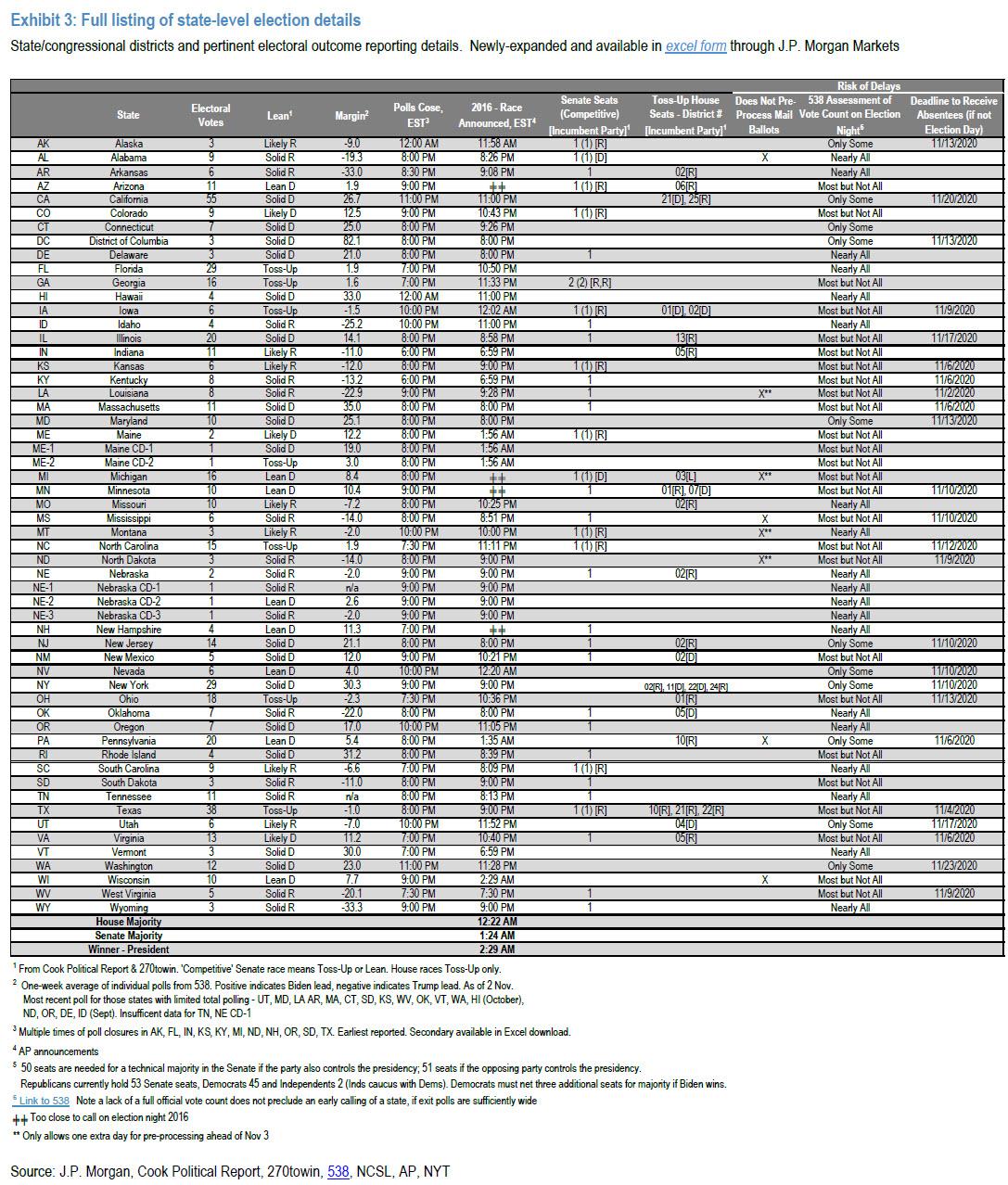
The chart below presents a full listing of state-level election details, together with the risk of delays and the deadline to receive absentee ballots when it’s not election day.
Risks of delays and lead changes
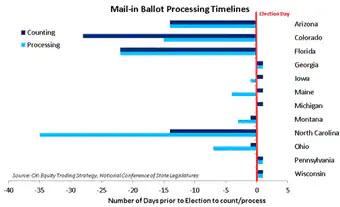
Concerns around delays due to greater voting by mail may be overblown in some states, and understated in others. Over 93 million Americans have already voted, including 59 million by mail and 34 million in-person. For reference just 25% of the 2016 votes were by mail, although a big reason for the mail votes is due to the covid pandemic. Most of the swing states are able to process and even count votes ahead of Election Day, which should reduce or eliminate delays. Therefore we would not expect any significant delays in Arizona, Florida, Georgia, Iowa or Ohio, thought marginal delays (hours not days) could be seen in Michigan and Wisconsin.
The biggest potential for delays come from Pennsylvania and North Carolina as under current law both states will allow ballots to arrive up to three days after Election Day so long as they are sent by November 3. These are the two most important swing states after Florida, therefore a tight race in these states could lead to delayed results through Friday, November 6. Both states could see potential cases in the Supreme Court that could alter these rules: Pennsylvania could see its deadline forced back to Election Day and North Carolina could see its deadline extended from three days to nine days. These states need not see such long delays, though, if there is a big lead by one candidate; rather this how long the delays could be under a worst-case scenario. Officials in North Carolina expect over 98% of ballots will be reported on election night which suggests we may still see early results there.
How are the mail in ballots being counted?
According to BofA, states could have a challenging time working through such a large number of mail-in ballots. The rules also vary by state in terms of when the ballot can be sent and counted. The most common state deadline is on Election Day when the polls close (see Table 3 above).
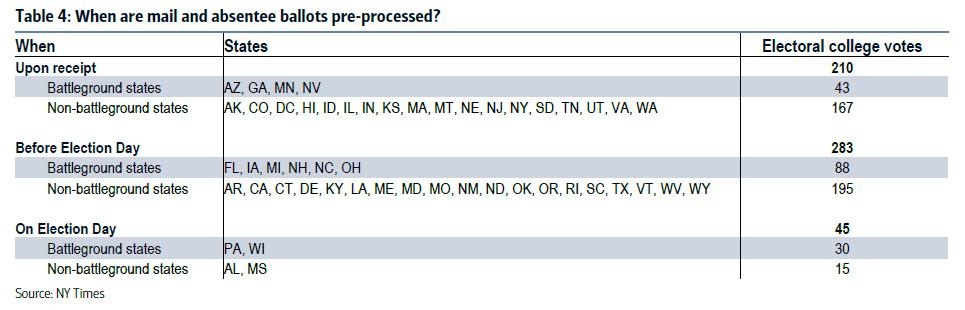
However, some states will accept a mailed ballot if it is received after Election Day as long as it is postmarked prior. The rules differ in terms of when the ballots can be counted. Some states do not allow mail-in ballots to be opened before Election Day which could mean counting delays. This includes a few of the critical swing states – such as PA and WI. Moreover, mail-in ballots may be contested for signatures that don’t match voter registration cards.
Expect to wait for Arizona
On election night in 2018, Arizona Republican Martha McSally appeared to be on the road to victory in the state’s U.S. Senate race, telling her supporters she was going “to bed with a lead of over 14,000 votes.” Six days later, McSally conceded the race to Democrat Kyrsten Sinema as election officials tallied hundreds of thousands of mail-in ballots, including many from the Democratic-leaning metropolitan areas of Phoenix and Tucson that were handed in at voting centers on Election Day.
Arizona officials said they hope it will take less time to count ballots this year as Maricopa County, which includes Phoenix, has upgraded its equipment and added an extra week to handle early mail-in ballots. But if the race is close, it could still take days to fully count the votes. That would be “an indication of things going the way they’re supposed to,” said C. Murphy Hebert, a spokeswoman for the Arizona Secretary of State. “The process is complex, and we would just invite folks to be patient.”
Lead changes throughout the night
One potential consequence of the significant early voting and different counting procedures is for lead changes throughout the evening. In states with delayed processing/counting (e.g., Michigan, Wisconsin, Pennsylvania), in-person Election Day voting could be counted and reported sooner than mail-in voting which could appear to give Trump an early lead that later diminishes. Conversely, states reporting already-counted mail-in votes early could appear to give Biden a lead initially that then reduces as in-person Election Day votes are tallied (e.g., Florida, North Carolina). This is why Twitter today said it will flag tweets from certain accounts, including those of presidential candidates, who claim a U.S. election victory before it’s called by two of seven media outlets (indicatively, Twitter cited the following news outlets as acceptable race callers: The Associated Press, ABC News, CBS News, CNN, FOX News, DecisionDeskHQ and NBC News).
Contested election risk
Close races in key states could lead to delays because it can trigger recounts, in some cases automatically, especially in Ohio, Pennsylvania and Florida if the margin is less than 0.5%. Initial machine recounts can be done in days while manual recounts if needed can take longer. Even if results are not within the margin to trigger automatic recounts, candidates are still able to petition for recounts in close elections.
Recounts – an infrequent if normal part of elections – come with added risk this year as markets have becoming increasingly concerned with the potential for a contested election. A contested election is conditional on close/unclear results. Clear, lopsided results on election night could still lead to challenges but they are unlikely to be material or alter outcomes. However, a scenario wherein: (1) the Electoral College 270 vote threshold is a function of one or two states, and (2) where initial results in those deciding states are close enough to require recounts could lead to a significantly higher probability of a contested election, as was the case in the 2000 Bush versus Gore election.
Therefore, if the overall outcome is not known by the morning following the election as we are waiting on recounts or delayed results, the markets could quickly price in a higher probability of a contested election and we could see the USD higher and equities and yields lower on risk-off sentiment until there is greater clarity.
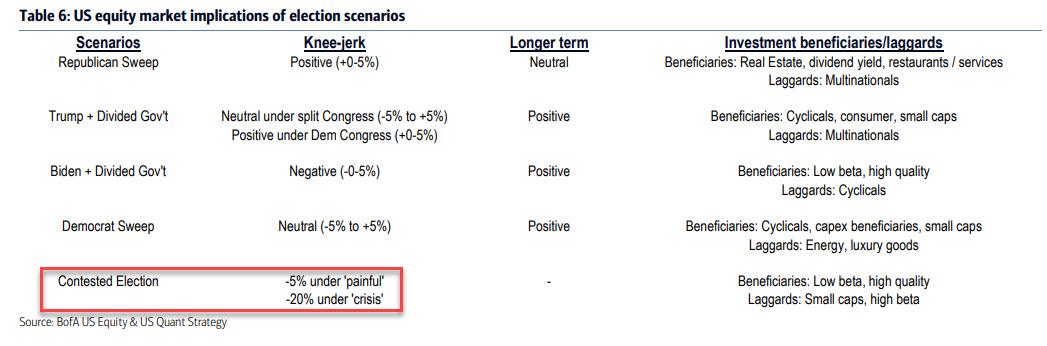
A recent note from Bank of America attempted to quantify the impact of a contested election on markets: in it BofA’s Michelle Meyer and Savita Subramanian said that stocks could slide as much as 20% if there’s a contested election. This means that as soon as Wednesday once it emerges if the election will not have a clear winner, we could see a bear market. Whether that happens or note will depend on the reason and duration of the delay. There are three scenarios:
Benign: Results are delayed due to counting backlogs given the large number of absentee and mail-in ballots but a result is expected within days.
Painful: If the count is close, it could result in a dispute about ballot validity and lead to a recount at the state level. C
Crisis: Either side refuses to accept the results, leading to a legislative battle and a high degree of government dysfunction
“A landslide victory for either Trump or Biden and rapid election conclusion would likely be welcomed by markets while a severely contested election could see risk-off and drive 10-year rates materially lower”…
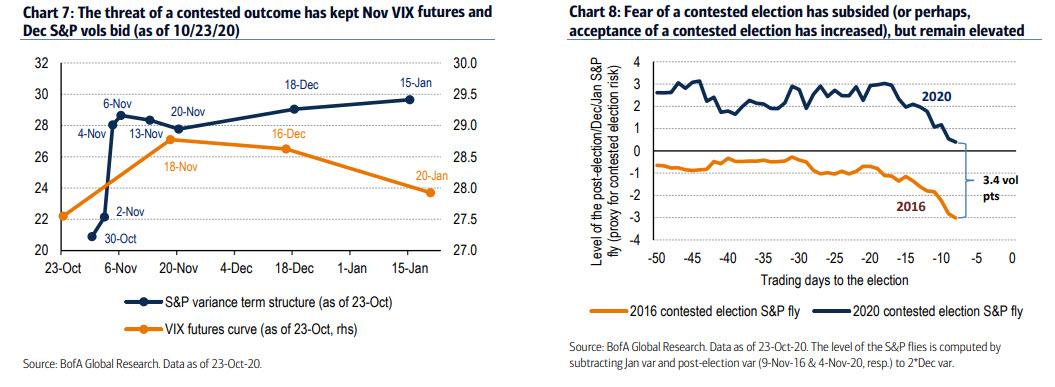
… and even though probability of a contested election has subsided (or perhaps, acceptance of a contested election has increased) VIX futures still remain elevated, clearly discounting risks of a contested election.
The flipside, of course, is that “if markets sell off violently and the economic data deteriorate, we could see Washington facilitate the passage of stimulus even in a highly contentious environment.“
The battle for the Senate
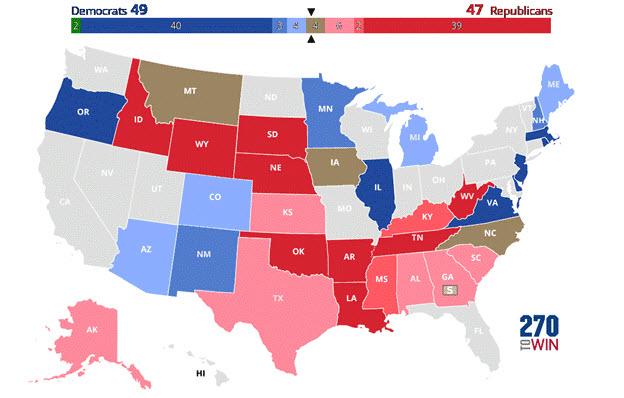
An unspoken truth is that while the presidential race is important, it will have little to no impact on markets. It will however, matter, in conjunction with the outcome of Congressional votes. As such the outcome of the Senate race matters more markets. Currently, Republicans hold 53 of the 100 seats, with 34 seats up for re-election this year. Recall that in the event of a 50-50 split, the Vice President acts as a tiebreaking vote. Currently forecasters expect Democrats to lose a seat in Alabama and gain seats in Arizona, Colorado and Maine for a net gain of 2 seats (from 47 to 49 of 100). This leaves four toss-up Senate seats to watch: Georgia, Iowa, Montana and North Carolina. Democrats would need to win one of these four and the Presidency or two of these outright to ensure control of the Senate. The Georgia Senate seat requires 50% of votes; however, there are multiple candidates running which likely means a run-off election on January 5 will be needed to determine the winner of that seat. Though unlikely, this can create a scenario where the Senate majority is not known until then.
According to the Iowa Electronic Markets, the probability of the Democrats taking over the Senate and maintaining the House (Democratic Sweep) is the mostly likely outcome with a 57.5% probability, although online prediction market PredictIt begs to differ, and according to the latest data, odds of a Blue Sweep have tumbled to just 50%, the lowest in weeks and leaving open the possibility of years of Congressional gridlock.
As noted above, the Senate and Presidential election results need not be called at the same time, and historically this has been the case for many of the key states we are watching. In 2016 Senate results were typically called earlier than Presidential results, and the same political party won both elections in all swing states. In 2012, though, the Senate results were usually slightly delayed compared to the Presidential election; however, here again there was consistency across parties with three of the four swing states seeing the same political party win both contests.
The story for stimulus
The first order impact of the election will be on the trajectory for additional stimulus. Here are our expectations:
Biden win + Democratic Congress (‘Blue wave’): $2.0 – 2.5tr in stimulus, including additional funds for the COVID health response. Passed right after inauguration.
Biden win + divided Congress: $500bn – 1tr in stimulus. Passed after inauguration but with some delay. There is also some chance of continued gridlock in this scenario.
Trump win + divided Congress (‘Status quo’): $1.5 – 2.0tr in stimulus. Passed in the lame duck session because neither side gains an advantage by waiting for a new government to form.
Needless to say, a clear victory could accelerate stimulus negotiations. This is particularly the case if it returns the status quo so neither side has a reason to delay. The two sides are not that far apart — both agree on additional unemployment insurance (around 100% replacement income which is about $300-400 additional/week) and aid for small businesses. They disagree over state & local aid and liability protections for businesses but these appear surmountable hurdles. It is even possible that stimulus is passed in the lame duck session with a status quo result.
The worst case scenario, and one which could lead to a 20% drop in markets according to BofA, a scenario of a Biden victory with a Republican Senate could make it harder to get any package through, creating a risk of sustained gridlock. By contrast, a “Blue Wave” would make a stimulus package very likely by February, one that is likely in excess of $2tr. Under any election result, there will be much more clarity on the path for fiscal stimulus with a fading of the uncertainty shock.
In the event of a contested election that looks like either scenario 2 or 3, the political environment creates a challenge for additional stimulus. Markets will likely become discouraged about the prospects for compromise. However, there is a threshold. If markets sell off violently and the economic data deteriorate, we could see Washington facilitate the passage of stimulus even in a highly contentious environment.
To summarize, BofA believes that an election result of status quo could lead to an earlier passage of stimulus (in lame duck), a “Blue Wave” makes a stimulus package very likely but only after inauguration and a highly contested election would likely create an impediment to stimulus but if the markets and economy deteriorate, an emergency stimulus could be triggered. A clear victory would be a net positive for the economy as it reduces some of the negative risk from higher uncertainty. A Blue Wave likely means greater stimulus which thereby provides the greatest near-term boost to the economy.
The Fed wild card
If there is not a result and financial conditions tighten due to a contested election, BofA believes the Fed’s credit facilities will once again be needed. The Fed could consider easing terms to facilitate the flow of credit. The Fed could also ramp up the QE program, buying Treasuries and MBS at a faster rate, as well as corporate credit as needed, particularly if it sees concerns over market liquidity. Ultimately the focus could be on credit (MBS and corporate credit) versus USTs in a risk-off scenario. Or as BofA recaps, “the Fed has tools and will use them.”
via ZeroHedge News https://ift.tt/323BjcH Tyler Durden
My colleagues at Rolling Stone recentlyendorsed Joe Biden for president:
Biden’s lived experience and expansive empathy make him not just a good, but an outstanding candidate… This is a fight between light and darkness…
Joe Biden is a corpse with hair plugs whose idea of “empathy” is to jam fingers in the sternums of people who ask the wrong questions, or call them “fat” or “full of shit,” or dare them to “try me” — and that’s if he remembers what state he’s in. Is he a better human than Donald Trump? Probably, but his mental decline has hit Lloyd Bridges-in-Hot-Shots! levels and he shares troubling characteristics with the president, beginning with a pathological struggle with truth.
Biden spent much of 2020 lying about everything from his Iraq War vote to his educational history to a fantasy about being arrested in South Africa with Nelson Mandela. The same press that killed him for this behavior in the past let it all slide this time. Same with the growing ledger of handsy-uncle incidents that had adolescent girls and campaigning politicians alike wondering why a Vice President needs to smell their hair or plant lingering kisses on their heads while cameras flash.
Biden’s entire argument for the presidency, and it’s a powerful one, is his opponent. This week’s election is not a choice between “light or darkness,” but “pretty much anything or Donald Trump,” and only in that context is this disintegrating, bilious iteration of Scranton Joe even distantly credible as a choice for the world’s most powerful office.
Donald Trump is going to be a difficult case for future historians because he’s simultaneously the biggest liar and the most lied-about politician in American history. The standard propaganda lines about Trump are all incorrect. The usual technique involves sticking his name in headlines next to absurd disqualifying descriptors: “fascist,” “traitor,” “dictator,” and so on.
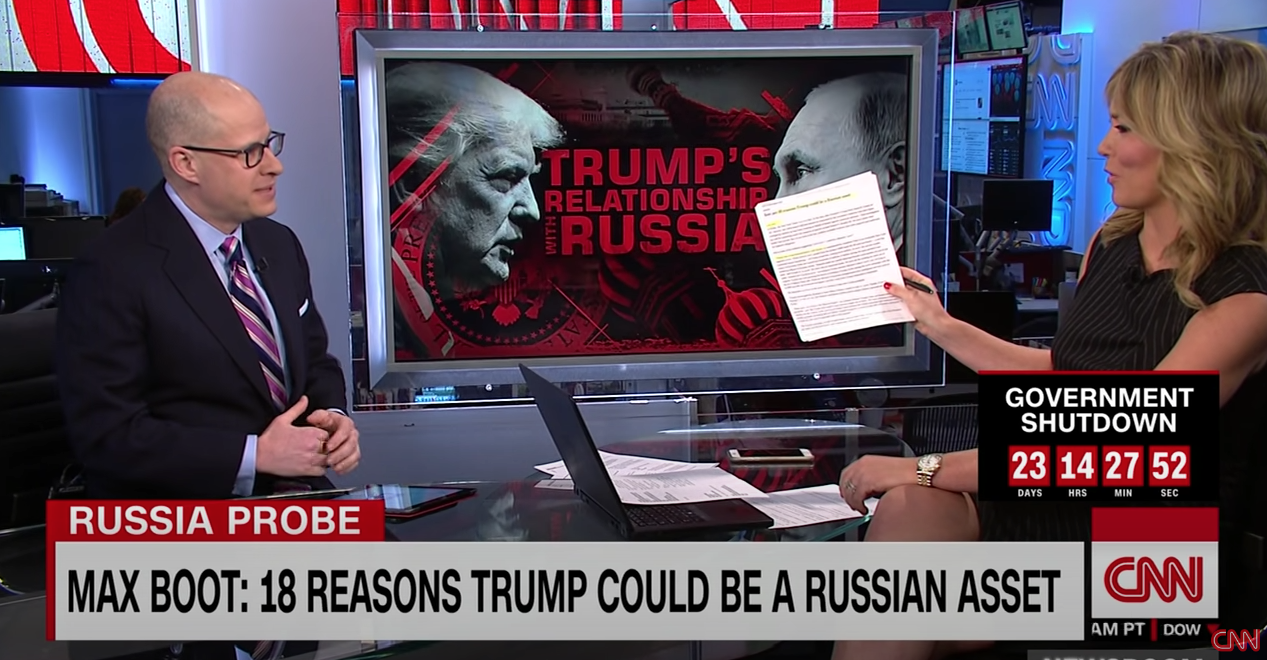
“18 Ways Trump Might Be a Russian Asset” is a typical example of what passed for commentary at outlets like the Washington Post in the Trump years. Such hot takes were a sure way to get TV invites:
Trump may have played cartoon Mussolini on the stump and reached for Hitlerian cliches in his campaign videos, but the dirty secret of the last four years — hidden from the broad mass of voters by both conservative and mainstream media — was that the president’s much ballyhooed strongman leanings were a fraud. Trump the Terrible was great TV, but away from cameras he was a fake despot who proved repeatedly that he didn’t know the first thing about how to exercise presidential power, even in his own defense.
Taibbi subscribers can read the rest of the report here…
via ZeroHedge News https://ift.tt/2HYSAx1 Tyler Durden
@Clerk: DeRay McKesson, Black Lives Matter leader, filed petition for writ of cert. Divided CA5 panel held he negligently staged a protest, in which an officer was injured. The First Amendment did not provide a dissent. J. Willett dissented.
–6/17/20–
@BigRed: Did you really intend to write such a broad opinion in Bostock?
@RobeNotCapes: Intent is irrelevant Clarence. All that matters are the specific words I deliberately chose to express my personal beliefs.
@PhilliesFan: I can think of some four-letter words right now….
@TheChief: Just wait till my DACA opinion tomorrow. I have been committed to this position for months. No flip-flopping from me.
@BeachWeek: We know, John. You haven’t changed your mind. Happy Blue June everyone.
@Clerk: Briefing is completed in McKesson v. Doe. Case will be distributed for long conference on September 29.
[Private Group Chat: Ruth’s Troops]
@RBG: What do you all think about the BLM case? If we push for cert, will Neal join us?
@TheRealChief: Absolutely, Ruth. And we may get the Chief as well.
@MyBelovedWorld: I don’t know, Elena. He may not be down for BLM. Race matters, after all.
@BreyerPager: I think this case is important enough to take. Let’s see what happens.We have four.
[/end Private Group Chat: Ruth’s Troops]
—
9/18/20
[Private Group Chat: Elena’s Angels]
@BreyerPager: Now we have three votes.
@TheRealChief: I got this, Steve.
[/End Group Chat]
—
9/29/20
@TheChief: Happy long conference everyone. Welcome back.
…
@TheChief: Now we turn to 19-1108, McKesson v. Doe. Any interest?
@TheRealChief: We have three votes to grant. Anyone want to give a courtesy fourth? Neal?
@RobesNotCapes: Nope, I’ll pass. Still stinging from Bostock.
@TheRealChief: Anyone? No? Come on, Don Willett dissented. Remember how funny his Twitter was?
@TheChief: I muted him a long time ago. Elena, would you like to prepare a dissent from denial of certiorari?
@TheRealChief: Hold on. I thought of a novel way to punt on a controversial issue: Let’s certify the case to the Louisiana Supreme Court!
@BigRed: Has the Supreme Court ever issued a certification order before certiorari was granted?
@TheRealChief: Well, I found one case from 1963. We certified a question to the Supreme Court of Florida from the shadow docket.
@BigRed: Is that it? That precedent is not really helpful.
@TheRealChief: Well, I have another idea. In a 1974 case, after argument, we remanded a case to the old Fifth Circuit to “reconsider whether the controlling issue of Florida law should be certified to the Florida Supreme Court.” Let’s do that again!
@TheChief: Now I am intrigued. What would that order look like?
@TheRealChief: Just spitballing here. How about, “We therefore grant the petition for writ of certiorari, vacate the judgment of the United States Court of Appeals for the Fifth Circuit, and remand the case to that court for further proceedings consistent with this opinion.”
@BigRed: So we strongly suggest the Fifth Circuit certify, without actually telling the panel to certify?
@TheChief: It’s perfect. I join.
@RobesNotCapes: Works for me. Certification is very federalist-y.
@BigRed: I dissent. This remand is a waste of time. Let’s deny cert on this case already.
–11/2/20–
@Clerk: Order issued in McKesson v. Doe.
@MyBelovedWorld: Excellent punt, Elena. This case will come back to us in about 2 years after Court expansion.
@BreyerPager: I won’t be here for it. I will be announcing my retirement as soon as Biden is sworn in. Polls looking good! Now because of the rigors of Article III standing, Texas may finally turn blue.
@TheChief: WTF!?
@BeachWeek: Oh come on.
@RobesNotCapes: Tell us what you really think.
@BigRed: Was that message meant for all of us?
@MyBelovedWorld: I’m sorry, chief, did it again. Those messages were supposed to be for our private group chat. Sorry everyone.
@TheChief: You have a private group chat?! Article III says there is “one Supreme Court.” One. That means “one group chat.” You aren’t allowed to have private group chats. That basically violates Article III.
@TheRealChief: It’s not so bad. It’s like having panels on the Supreme Court. You know, maybe we should look into cases where only a panel of us decides a case. Think of how much easier things would be if there were more than nine of us to spread the work around.
@TheChief: You know, I really don’t appreciate this incessant court-packing chatter.
@GoIrish: Everyone ready for the election tomorrow!
@TheChief: This chat is closed.
—
from Latest – Reason.com https://ift.tt/2GpYDKk
via IFTTT
There’s no telling where the destruction wrought by a President Joe Biden would end. Not even our most prized obelisks would be safe.
On Monday afternoon, President Donald Trump’s campaign tweeted out a screenshot of an imagined future CNN report from the “D.C. Autonomous Zone” where the demolition of the Washington Monument is well underway. “This would be Joe Biden’s America,” the caption reads.
— Trump War Room—Text TRUMP to 88022 (@TrumpWarRoom) November 2, 2020
The tweet is perhaps meant as a bit of tongue-in-cheek hyperbole. (By the Trump campaign’s standards, it’s even relatively charitable to CNN in depicting the network neutrally covering urban unrest.)
It’s nevertheless in keeping with the dark closing message of Trump’s campaign: A Democrat-controlled White House will use the immense power of the Oval Office to remake America.
“The Biden lockdown will mean no school, no graduation, no Thanksgiving, no Easter, and no Christmas, no Fourth of July and no future for America’s youth,” warned Trump at a campaign rally in Fayetteville, North Carolina, Monday, conjuring up the risk that a Biden administration would do its best to shut down most social and economic life to fight coronavirus.
It’s not the first time that Trump has claimed Biden would prosecute the War on Christmas with a renewed vigor. It’s also not the only thing that would be in President Biden’s sights.
“Him and his group,” Trump warned Monday in North Carolina, will “destroy the suburbs, dissolve your borders, terminate religious liberty, outlaw private health insurance…shred your Second Amendment, confiscate your guns and indoctrinate your children with anti-American lies.”
His Twitter feed over the last few days has rung similar alarm bells about gun rights, the Supreme Court, and school choice.
Biden will terminate school choice, eliminate charter schools, defund religious schools, ban prayer in public schools, indoctrinate your children with Anti-American lies, and force you to subsidize extreme late-term abortion. We believe that every child is a Sacred Gift from God!
Some of these criticisms are more on point than others. But Trump’s warnings about Biden represent the president’s choice to end his campaign with a strongman’s song that dabbles in the language of liberty while still managing to be overwhelmingly hostile to the idea of individuals leading their own lives. Trump’s pitch isn’t ultimately about freedom, it’s about control.
“America will never be a socialist nation,” Trump said in North Carolina Monday, which is always good to hear. But every warning about high taxes and the end of Christmas is pared with a warning that Democrats will make it too easy to trade with other countries or for people to move to this one. Even as the president was praising school choice at his rally and on his Twitter account, he was signing executive orders setting up a federal commission to encourage “patriotic education” in public schools.
The destructive potential of a Biden administration doesn’t necessarily mean the federal government is too powerful as is, Trump argues. Rather, it means we need to keep electing to right people to wield that power correctly.
“This election comes down to a simple choice: do you want to be ruled by the arrogant, corrupt, ruthless, and selfless [sic] political class, or do you want to governed by the American people themselves?” said the president in his speech Monday.
The choice of being governed a little less is apparently not on the ballot.
from Latest – Reason.com https://ift.tt/3mNASLH
via IFTTT
@Clerk: DeRay McKesson, Black Lives Matter leader, filed petition for writ of cert. Divided CA5 panel held he negligently staged a protest, in which an officer was injured. The First Amendment did not provide a dissent. J. Willett dissented.
–6/17/20–
@BigRed: Did you really intend to write such a broad opinion in Bostock?
@RobeNotCapes: Intent is irrelevant Clarence. All that matters are the specific words I deliberately chose to express my personal beliefs.
@PhilliesFan: I can think of some four-letter words right now….
@TheChief: Just wait till my DACA opinion tomorrow. I have been committed to this position for months. No flip-flopping from me.
@BeachWeek: We know, John. You haven’t changed your mind. Happy Blue June everyone.
@Clerk: Briefing is completed in McKesson v. Doe. Case will be distributed for long conference on September 29.
[Private Group Chat: Ruth’s Troops]
@RBG: What do you all think about the BLM case? If we push for cert, will Neal join us?
@TheRealChief: Absolutely, Ruth. And we may get the Chief as well.
@MyBelovedWorld: I don’t know, Elena. He may not be down for BLM. Race matters, after all.
@BreyerPager: I think this case is important enough to take. Let’s see what happens.We have four.
[/end Private Group Chat: Ruth’s Troops]
—
9/18/20
[Private Group Chat: Elena’s Angels]
@BreyerPager: Now we have three votes.
@TheRealChief: I got this, Steve.
[/End Group Chat]
—
9/29/20
@TheChief: Happy long conference everyone. Welcome back.
…
@TheChief: Now we turn to 19-1108, McKesson v. Doe. Any interest?
@TheRealChief: We have three votes to grant. Anyone want to give a courtesy fourth? Neal?
@RobesNotCapes: Nope, I’ll pass. Still stinging from Bostock.
@TheRealChief: Anyone? No? Come on, Don Willett dissented. Remember how funny his Twitter was?
@TheChief: I muted him a long time ago. Elena, would you like to prepare a dissent from denial of certiorari?
@TheRealChief: Hold on. I thought of a novel way to punt on a controversial issue: Let’s certify the case to the Louisiana Supreme Court!
@BigRed: Has the Supreme Court ever issued a certification order before certiorari was granted?
@TheRealChief: Well, I found one case from 1963. We certified a question to the Supreme Court of Florida from the shadow docket.
@BigRed: Is that it? That precedent is not really helpful.
@TheRealChief: Well, I have another idea. In a 1974 case, after argument, we remanded a case to the old Fifth Circuit to “reconsider whether the controlling issue of Florida law should be certified to the Florida Supreme Court.” Let’s do that again!
@TheChief: Now I am intrigued. What would that order look like?
@TheRealChief: Just spitballing here. How about, “We therefore grant the petition for writ of certiorari, vacate the judgment of the United States Court of Appeals for the Fifth Circuit, and remand the case to that court for further proceedings consistent with this opinion.”
@BigRed: So we strongly suggest the Fifth Circuit certify, without actually telling the panel to certify?
@TheChief: It’s perfect. I join.
@RobesNotCapes: Works for me. Certification is very federalist-y.
@BigRed: I dissent. This remand is a waste of time. Let’s deny cert on this case already.
–11/2/20–
@Clerk: Order issued in McKesson v. Doe.
@MyBelovedWorld: Excellent punt, Elena. This case will come back to us in about 2 years after Court expansion.
@BreyerPager: I won’t be here for it. I will be announcing my retirement as soon as Biden is sworn in. Polls looking good! Now because of the rigors of Article III standing, Texas may finally turn blue.
@TheChief: WTF!?
@BeachWeek: Oh come on.
@RobesNotCapes: Tell us what you really think.
@BigRed: Was that message meant for all of us?
@MyBelovedWorld: I’m sorry, chief, did it again. Those messages were supposed to be for our private group chat. Sorry everyone.
@TheChief: You have a private group chat?! Article III says there is “one Supreme Court.” One. That means “one group chat.” You aren’t allowed to have private group chats. That basically violates Article III.
@TheRealChief: It’s not so bad. It’s like having panels on the Supreme Court. You know, maybe we should look into cases where only a panel of us decides a case. Think of how much easier things would be if there were more than nine of us to spread the work around.
@TheChief: You know, I really don’t appreciate this incessant court-packing chatter.
@GoIrish: Everyone ready for the election tomorrow!
@TheChief: This chat is closed.
—
from Latest – Reason.com https://ift.tt/2GpYDKk
via IFTTT
There’s no telling where the destruction wrought by a President Joe Biden would end. Not even our most prized obelisks would be safe.
On Monday afternoon, President Donald Trump’s campaign tweeted out a screenshot of an imagined future CNN report from the “D.C. Autonomous Zone” where the demolition of the Washington Monument is well underway. “This would be Joe Biden’s America,” the caption reads.
— Trump War Room—Text TRUMP to 88022 (@TrumpWarRoom) November 2, 2020
The tweet is perhaps meant as a bit of tongue-in-cheek hyperbole. (By the Trump campaign’s standards, it’s even relatively charitable to CNN in depicting the network neutrally covering urban unrest.)
It’s nevertheless in keeping with the dark closing message of Trump’s campaign: A Democrat-controlled White House will use the immense power of the Oval Office to remake America.
“The Biden lockdown will mean no school, no graduation, no Thanksgiving, no Easter, and no Christmas, no Fourth of July and no future for America’s youth,” warned Trump at a campaign rally in Fayetteville, North Carolina, Monday, conjuring up the risk that a Biden administration would do its best to shut down most social and economic life to fight coronavirus.
It’s not the first time that Trump has claimed Biden would prosecute the War on Christmas with a renewed vigor. It’s also not the only thing that would be in President Biden’s sights.
“Him and his group,” Trump warned Monday in North Carolina, will “destroy the suburbs, dissolve your borders, terminate religious liberty, outlaw private health insurance…shred your Second Amendment, confiscate your guns and indoctrinate your children with anti-American lies.”
His Twitter feed over the last few days has rung similar alarm bells about gun rights, the Supreme Court, and school choice.
Biden will terminate school choice, eliminate charter schools, defund religious schools, ban prayer in public schools, indoctrinate your children with Anti-American lies, and force you to subsidize extreme late-term abortion. We believe that every child is a Sacred Gift from God!
Some of these criticisms are more on point than others. But Trump’s warnings about Biden represent the president’s choice to end his campaign with a strongman’s song that dabbles in the language of liberty while still managing to be overwhelmingly hostile to the idea of individuals leading their own lives. Trump’s pitch isn’t ultimately about freedom, it’s about control.
“America will never be a socialist nation,” Trump said in North Carolina Monday, which is always good to hear. But every warning about high taxes and the end of Christmas is pared with a warning that Democrats will make it too easy to trade with other countries or for people to move to this one. Even as the president was praising school choice at his rally and on his Twitter account, he was signing executive orders setting up a federal commission to encourage “patriotic education” in public schools.
The destructive potential of a Biden administration doesn’t necessarily mean the federal government is too powerful as is, Trump argues. Rather, it means we need to keep electing to right people to wield that power correctly.
“This election comes down to a simple choice: do you want to be ruled by the arrogant, corrupt, ruthless, and selfless [sic] political class, or do you want to governed by the American people themselves?” said the president in his speech Monday.
The choice of being governed a little less is apparently not on the ballot.
from Latest – Reason.com https://ift.tt/3mNASLH
via IFTTT
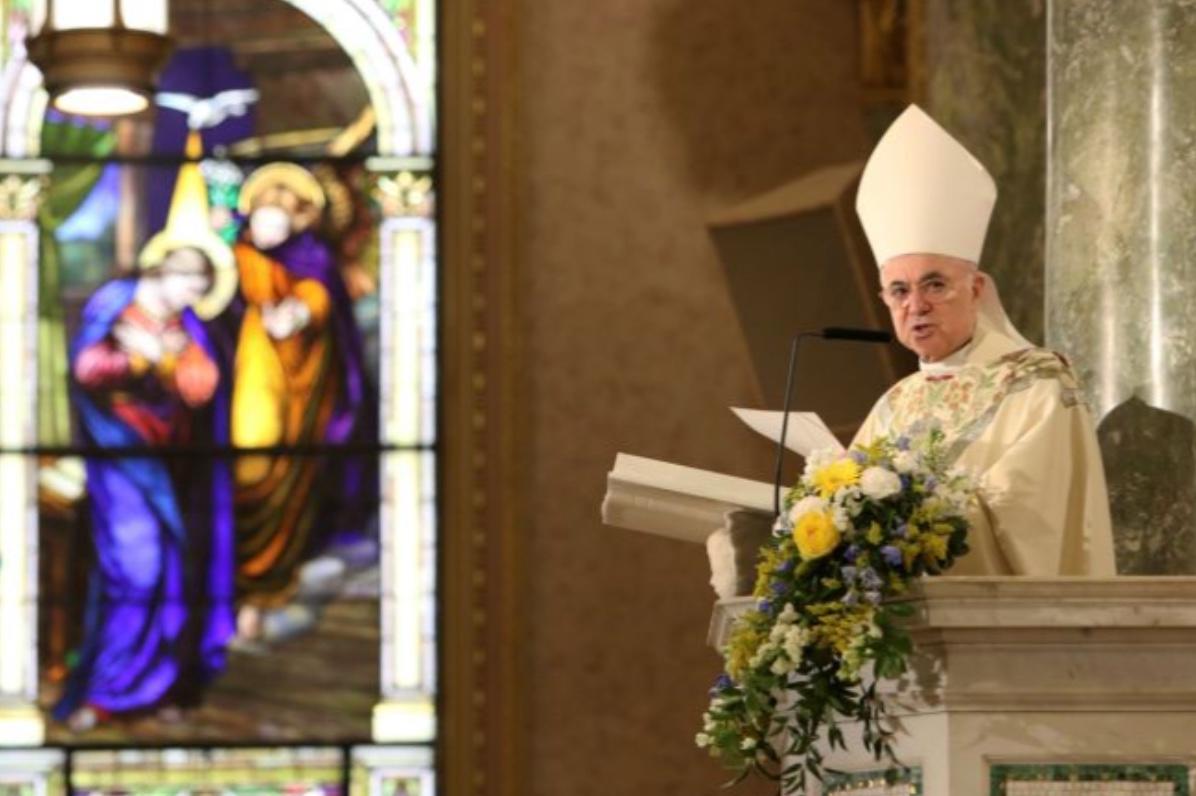
“A Global Conspiracy Against God” – Archbishop Says Trump Is Only One To Save Humanity From ‘The Great Reset’ Tyler Durden
Mon, 11/02/2020 – 19:40
The Italian archbishop best known for confronting Pope Francis over the Vatican’s willful blindness to priests who abuse boys has written a letter in which he lashes out at the “global elite”, prompting some to accuse him of sympathizing with the “QAnon” movement of conspiracy theorists.
The letter, penned by Archibishop Carlo Maria Vigano, formerly the Vatican’s ambassador to the US, attacks a shadowy “global elite”, that is plotting a “Great Reset” intended to undermine “God and humanity”.
This same group, the archbishop argued, is also responsible for the lockdowns that have restricted movement and freedom around the globe, eliciting protests in many European capitals.
“The fate of the whole world is being threatened by a global conspiracy against God and humanity,” Viganò wrote in the letter, which comes just days before the US election, which the archbishop wrote was of “epochal importance.”
“No one, up until last February,” Viganò writes, “would ever have thought that, in all of our cities, citizens would be arrested simply for wanting to walk down the street, to breathe, to want to keep their business open, to want to go to church on Sunday. Yet now it is happening all over the world, even in picture-postcard Italy that many Americans consider to be a small enchanted country, with its ancient monuments, its churches, its charming cities, its characteristic villages.” Viganò adds: “And while the politicians are barricaded inside their palaces promulgating decrees like Persian satraps, businesses are failing, shops are closing, and people are prevented from living, traveling, working, and praying.”
Working to protect the world from this group of elites seeking to recast society in a secular, totalitarian model, Viganò portrays President Trump as “the final garrison against the world dictatorship”. Viganò cast Trump’s opponent, Vice President Joe Biden, as “a person who is manipulated by the deep state.”
Analysts who monitor “QAnon” conspiracy theories and their spread online warned the mainstream press that the letter had been widely discussed on various QAnon message boards, and had been disseminated in languages including Portuguese, Spanish, French, German and Italian, according to Yahoo News.
Over the summer, Trump tweeted an earlier letter penned by the archbishop, and encouraged his supporters to read it.
So honored by Archbishop Viganò’s incredible letter to me. I hope everyone, religious or not, reads it! https://t.co/fVhkCz89g5
In the past, Viagnò has accused Pope Francis of sweeping the child abuse crisis under the rug, and moving to protect homosexual priests, part of a “homosexual current” flowing through the Vatican.
Read the full letter below:
* * *
DONALD J. TRUMP
Sunday, October 25, 2020
Solemnity of Christ the King
Mr. President,
Allow me to address you at this hour in which the fate of the whole world is being threatened by a global conspiracy against God and humanity. I write to you as an Archbishop, as a Successor of the Apostles, as the former Apostolic Nuncio to the United States of America. I am writing to you in the midst of the silence of both civil and religious authorities. May you accept these words of mine as the “voice of one crying out in the desert” (Jn 1:23).
As I said when I wrote my letter to you in June, this historical moment sees the forces of Evil aligned in a battle without quarter against the forces of Good; forces of Evil that appear powerful and organized as they oppose the children of Light, who are disoriented and disorganized, abandoned by their temporal and spiritual leaders.
Daily we sense the attacks multiplying of those who want to destroy the very basis of society: the natural family, respect for human life, love of country, freedom of education and business. We see heads of nations and religious leaders pandering to this suicide of Western culture and its Christian soul, while the fundamental rights of citizens and believers are denied in the name of a health emergency that is revealing itself more and more fully as instrumental to the establishment of an inhuman faceless tyranny.
A global plan called the Great Reset is underway. Its architect is a global élite that wants to subdue all of humanity, imposing coercive measures with which to drastically limit individual freedoms and those of entire populations. In several nations this plan has already been approved and financed; in others it is still in an early stage. Behind the world leaders who are the accomplices and executors of this infernal project, there are unscrupulous characters who finance the World Economic Forum and Event 201, promoting their agenda.
The purpose of the Great Reset is the imposition of a health dictatorship aiming at the imposition of liberticidal measures, hidden behind tempting promises of ensuring a universal income and cancelling individual debt. The price of these concessions from the International Monetary Fund will be the renunciation of private property and adherence to a program of vaccination against Covid-19 and Covid-21 promoted by Bill Gates with the collaboration of the main pharmaceutical groups. Beyond the enormous economic interests that motivate the promoters of the Great Reset, the imposition of the vaccination will be accompanied by the requirement of a health passport and a digital ID, with the consequent contact tracing of the population of the entire world. Those who do not accept these measures will be confined in detention camps or placed under house arrest, and all their assets will be confiscated.
Mr. President, I imagine that you are already aware that in some countries the Great Reset will be activated between the end of this year and the first trimester of 2021. For this purpose, further lockdowns are planned, which will be officially justified by a supposed second and third wave of the pandemic. You are well aware of the means that have been deployed to sow panic and legitimize draconian limitations on individual liberties, artfully provoking a world-wide economic crisis. In the intentions of its architects, this crisis will serve to make the recourse of nations to the Great Reset irreversible, thereby giving the final blow to a world whose existence and very memory they want to completely cancel. But this world, Mr. President, includes people, affections, institutions, faith, culture, traditions, and ideals: people and values that do not act like automatons, who do not obey like machines, because they are endowed with a soul and a heart, because they are tied together by a spiritual bond that draws its strength from above, from that God that our adversaries want to challenge, just as Lucifer did at the beginning of time with his “non serviam.”
Many people – as we well know – are annoyed by this reference to the clash between Good and Evil and the use of “apocalyptic” overtones, which according to them exasperates spirits and sharpens divisions. It is not surprising that the enemy is angered at being discovered just when he believes he has reached the citadel he seeks to conquer undisturbed. What is surprising, however, is that there is no one to sound the alarm. The reaction of the deep state to those who denounce its plan is broken and incoherent, but understandable. Just when the complicity of the mainstream media had succeeded in making the transition to the New World Order almost painless and unnoticed, all sorts of deceptions, scandals and crimes are coming to light.
Until a few months ago, it was easy to smear as “conspiracy theorists” those who denounced these terrible plans, which we now see being carried out down to the smallest detail. No one, up until last February, would ever have thought that, in all of our cities, citizens would be arrested simply for wanting to walk down the street, to breathe, to want to keep their business open, to want to go to church on Sunday. Yet now it is happening all over the world, even in picture-postcard Italy that many Americans consider to be a small enchanted country, with its ancient monuments, its churches, its charming cities, its characteristic villages. And while the politicians are barricaded inside their palaces promulgating decrees like Persian satraps, businesses are failing, shops are closing, and people are prevented from living, traveling, working, and praying. The disastrous psychological consequences of this operation are already being seen, beginning with the suicides of desperate entrepreneurs and of our children, segregated from friends and classmates, told to follow their classes while sitting at home alone in front of a computer.
In Sacred Scripture, Saint Paul speaks to us of “the one who opposes” the manifestation of the mystery of iniquity, the kathèkon (2 Thess 2:6-7). In the religious sphere, this obstacle to evil is the Church, and in particular the papacy; in the political sphere, it is those who impede the establishment of the New World Order.
As is now clear, the one who occupies the Chair of Peter has betrayed his role from the very beginning in order to defend and promote the globalist ideology, supporting the agenda of the deep church, who chose him from its ranks.
Mr. President, you have clearly stated that you want to defend the nation – One Nation under God, fundamental liberties, and non-negotiable values that are denied and fought against today. It is you, dear President, who are “the one who opposes” the deep state, the final assault of the children of darkness.
For this reason, it is necessary that all people of good will be persuaded of the epochal importance of the imminent election: not so much for the sake of this or that political program, but because of the general inspiration of your action that best embodies – in this particular historical context – that world, our world, which they want to cancel by means of the lockdown. Your adversary is also our adversary: it is the Enemy of the human race, He who is “a murderer from the beginning” (Jn 8:44).
Around you are gathered with faith and courage those who consider you the final garrison against the world dictatorship. The alternative is to vote for a person who is manipulated by the deep state, gravely compromised by scandals and corruption, who will do to the United States what Jorge Mario Bergoglio is doing to the Church, Prime Minister Conte to Italy, President Macron to France, Prime Minster Sanchez to Spain, and so on. The blackmailable nature of Joe Biden – just like that of the prelates of the Vatican’s “magic circle” – will expose him to be used unscrupulously, allowing illegitimate powers to interfere in both domestic politics as well as international balances. It is obvious that those who manipulate him already have someone worse than him ready, with whom they will replace him as soon as the opportunity arises.
And yet, in the midst of this bleak picture, this apparently unstoppable advance of the “Invisible Enemy,” an element of hope emerges. The adversary does not know how to love, and it does not understand that it is not enough to assure a universal income or to cancel mortgages in order to subjugate the masses and convince them to be branded like cattle. This people, which for too long has endured the abuses of a hateful and tyrannical power, is rediscovering that it has a soul; it is understanding that it is not willing to exchange its freedom for the homogenization and cancellation of its identity; it is beginning to understand the value of familial and social ties, of the bonds of faith and culture that unite honest people. This Great Reset is destined to fail because those who planned it do not understand that there are still people ready to take to the streets to defend their rights, to protect their loved ones, to give a future to their children and grandchildren. The leveling inhumanity of the globalist project will shatter miserably in the face of the firm and courageous opposition of the children of Light. The enemy has Satan on its side, He who only knows how to hate. But on our side, we have the Lord Almighty, the God of armies arrayed for battle, and the Most Holy Virgin, who will crush the head of the ancient Serpent. “If God is for us, who can be against us?” (Rom 8:31).
Mr. President, you are well aware that, in this crucial hour, the United States of America is considered the defending wall against which the war declared by the advocates of globalism has been unleashed. Place your trust in the Lord, strengthened by the words of the Apostle Paul: “I can do all things in Him who strengthens me” (Phil 4:13). To be an instrument of Divine Providence is a great responsibility, for which you will certainly receive all the graces of state that you need, since they are being fervently implored for you by the many people who support you with their prayers.
With this heavenly hope and the assurance of my prayer for you, for the First Lady, and for your collaborators, with all my heart I send you my blessing.
God bless the United States of America!
+ Carlo Maria Viganò
Tit. Archbishop of Ulpiana
Former Apostolic Nuncio to the United States of America
via ZeroHedge News https://ift.tt/2HV20JJ Tyler Durden
Coronavirus is back with a vengeance. After dwindling over the summer, new cases are rising in many countries and reached a record high this week in America. France and Germany are reinstating lockdowns. But however strong the case may have been for the extreme measures of the spring, when the world was flying blind in the face of this nasty virus, lockdowns are neither workable nor desirable in America at this stage.
Does that mean we should throw caution to the wind and return to business as usual, as President Donald Trump seems to be suggesting? Not really. Our best bet at this stage is encouraging millions and millions of adaptations at the individual level that will let life resume, albeit not in a “normal” way. This approach is best visualized by precisely the thing President Donald Trump panned in the second debate: “plexiglass cubes” in restaurants. “Are you going to sit there in a cubicle wrapped around in plastic?” he chided. Yes.
Should Trump get re-elected, we should do our best to ignore him. If Joe Biden wins on Tuesday, he should wholeheartedly back such adaptive responses, staking out a middle ground between doing nothing and putting everyone under lock and key.
If there is any epidemiological rationale for President Trump’s “don’t let this dominate your life” and go-about-business-as-usual approach, it is that social distancing measures diminish exposure to the virus and therefore come in the way of achieving population-wide herd immunity—a critical mass of people developing resistance and forming a firewall against disease spread.
But this rationale is flawed. No one really knows what percentage of the population would have to become infected to get to herd immunity. Reaching that point might involve an unacceptably high death and sickness rate. It’s not even clear herd immunity can be achieved without a vaccine.
Sweden is the closest real-life example of this approach. That Nordic country went maverick and rejected radical shutdowns. It opted only to ban large gatherings while closing universities and high schools. It also urged people to work from home to the extent possible. Otherwise bars, restaurants, primary schools, and retail shops stayed open.
Supporters of the model claim that this allowed Sweden to avoid economic devastation while maintaining a death toll in the European middle—between the U.K.’s high and Denmark’s low. But that’s misleading, because Sweden’s 576.25 deaths per million fatality rate is much closer to England’s 682 deaths per million (almost on par with America’s 690 per million) than Denmark’s 122.88—even though Sweden’s population density is only 1/6th that of Denmark’s. (Norway, whose population density is similar to Sweden’s, has an even lower 52.36 per million death rate.)
Although Sweden’s infection and death rate has now tapered off and is in line with the rest of Europe’s, that doesn’t mean it got things right. Its frontloading of deaths would make sense if it meant saving more lives later. But given that at this stage a vaccine within a year seems likely and therapeutics keep improving, such a strategy, as George Mason University’s Tyler Cowen points out, “is akin to charging the hill and taking casualties two days before the end of World War I.”
The failure of Sweden’s herd immunity strategy doesn’t mean that France and Germany’s new lockdowns are a rational approach either. France has imposed a national shelter-in-place order requiring people to stay at home. Germany has shut down not just theaters and bars but also all hotels.
Prior to this pandemic, lockdowns had never been deployed, not even during the Spanish flu. They were no part of the Centers for Disease Control and Prevention’s pandemic response planning—no doubt because planners intuitively understood that such drastic steps would impose massive economic and health costs of their own. And they have.
Indeed, unemployment in America rose higher in three months of COVID-19 than two years of the Great Recession, with 14 million Americans losing their jobs. Meanwhile, whatever the flaws of the Great Barrington Declaration, a controversial statement signed by 9,000 epidemiologists, economists, and other experts opposing lockdowns, it is dead right that such policies will result in lower childhood vaccination rates, worsening cardiovascular disease outcomes, fewer cancer screenings, and deteriorating mental health —all of which will result in more deaths and worse health outcomes that public health stats won’t capture for a year. Inadequate tuberculosis treatment alone could cause an estimated 400,000 deaths worldwide.
The lockdowns may have made sense in the spring, when we had very little idea what we were up against and every interaction seemed fraught. But now it is possible to separate relatively dangerous from relatively innocuous activities—and avoid the former until entrepreneurs can come up with innovative business models that make it possible to engage in them safely, precisely the kind of adaptation that hunker-down orders thwart.
To be sure, there might be no business model that could rescue some industries. Contrast, for example, movie theaters with restaurants.
At this stage, the government couldn’t pay people to go to the movies (and shouldn’t try), because everyone knows that huddling with strangers in a dark, enclosed space for two hours is asking for trouble. Regal Theaters has permanently closed its doors, and AMC, the country’s biggest theater chain, is on the verge of following suit.
But the restaurant industry found a way to hang on. Many eateries shifted their operations outdoors or switched to takeout and implemented other safe practices. They mandated masks and switched to disposable or scannable menus to minimize contact. Some even check patrons’ temperatures before allowing them in. The industry still experienced a 27 percent loss of business, but the real challenge will be in winter when outside dining becomes difficult in much of northern U.S. Restaurants then will have to scramble and experiment with all kinds of new strategies, including plexiglass cubicles, to remain in business.
Political leaders who pan such innovations are just as unhelpful as government lockdowns. There is enough public awareness to make a more laissez-faire approach to coronavirus workable, provided that the powers-that-be don’t actively lead people astray—by encouraging them to attend super-spreading events, for example, or ditching masks.
To get through the pandemic, America needs to encourage personal responsibility and private initiative. Top-down diktats are suboptimal. Silly leaders are even worse.