Despite COVID-19 Lockdowns, Licensed Marijuana Sales Continue in the Vast Majority of States With Legal Pot

Measured by marijuana sales, 4/20 came early this year as cannabis consumers scrambled to stock up, apparently worried that COVID-19 lockdowns might cut off their legal supply. After local governments in the San Francisco Bay Area imposed stay-at-home orders in March, The New York Times reports, sales of edibles “surged to levels typically only seen around April 20, or ‘4/20,’ the annual, if unofficial, marijuana appreciation holiday.”

That initial panic, which the chief executive of a medical dispensary in Pennsylvania likened to “hoarding toilet paper,” seems to have subsided now that the legal status of marijuana sales under state and local lockdowns has been clarified. The vast majority of states where cannabis is legal have deemed marijuana merchants “essential,” meaning they are exempt from business closure orders, although new restrictions may apply.

According to a tally by Marijuana Business Daily, medical dispensaries are exempt from business closure orders in 28 of the 33 states that allow patients to use cannabis for symptom relief. Of the 10 states that have legalized recreational sales, eight are allowing them to continue. Licensed recreational stores have not opened yet in Maine, although it has been four years since voters approved them. Only Massachusetts has closed recreational outlets while allowing medical sales to continue.

Here is a summary of the rules for marijuana merchants in states that have legalized recreational sales:

Alaska

Recreational and medical marijuana retailers remain open, subject to social distancing rules. The cannabis industry is urging the state to legalize curbside pickup.

California

The Bureau of Cannabis Control notes that Gov. Gavin Newsom’s March 19 business closure order “identifies certain services as essential, including food, prescriptions, and healthcare.” And “because cannabis is an essential medicine for many residents, licensees may continue to operate at this time so long as their operations comply with local rules and regulations.”

Colorado

Gov. Jared Polis is temporarily allowing online sales of marijuana, which means “both Medical and Retail Marijuana Stores may accept and complete online and telephone sales transactions.” Colorado’s Marijuana Enforcement Division is allowing curbside pickup, as long as it is consistent with local regulations and the transactions occur on private property, as well as sales from drive-through or walk-up windows.

Illinois

Gov. J.B. Pritzker’s March 21 business closure order classifies “licensed medical and adult use cannabis dispensaries” as essential. Like other exempt retailers, they have to follow social distancing rules.

Maine

Although a 2016 ballot initiative legalized recreational use, licensed sales to recreational consumers have not begun yet. Dispensaries serving state-approved patients have been classified as essential “medical facilities.” Various precautions apply to in-store sales.

Massachusetts

Gov. Charlie Baker is allowing sales to registered patients but has ordered recreational stores to close. “Licensed medical marijuana retailers” are exempt from Baker’s March 23 business closure order because they provide essential “health care services.” Recreational retailers did not make the cut, although liquor stores did, under the heading of “food and agriculture.”

Michigan

Gov. Gretchen Whitmer, who has banned sales of vegetable seeds, paint, and other products she deems nonessential, is nevertheless allowing medical and recreational marijuana sales to continue. Michigan’s Marijuana Regulatory Agency is temporarily allowing home delivery and “encourages” consumers to use that option “when applicable.” Regulators are also temporarily allowing curbside pickup.

Nevada

The Department of Taxation says “licensed cannabis stores and medical dispensaries will remain open but must adhere to strict social distancing protocol during this time.” That means “licensees must not allow individuals to congregate in stores or outside while waiting”; “patient consultations should be limited to phone or video only”; and “consumers are strongly encouraged to utilize delivery services when applicable, or complete orders online or over the phone.”

Oregon

The Liquor Control Commission, which also regulates marijuana sales, is temporarily allowing curbside delivery of cannabis products. In-store sales are also permitted. The commission has increased the daily limit from eight to 24 ounces for medical marijuana buyers.

Washington

The Liquor and Cannabis Board says “cannabis producers, processors, retailers and approved labs are considered essential and not required to close due to the coronavirus restrictions.” To facilitate social distancing, the board is allowing recreational consumers as well as patients to use curbside pickup. General retailing restrictions, such as keeping customers at least 6 feet apart, apply to in-store sales.

The Times says the exemptions for marijuana merchants constitute “official recognition that for some Americans, cannabis is as necessary as milk and bread.” Except in Massachusetts, where it is not even as necessary as booze.

from Latest – Reason.com https://ift.tt/2XNo8LT
via IFTTT
Biden… The Placeholder?

Biden… The Placeholder?

Authored by James Howard Kunstler via Kunstler.com,

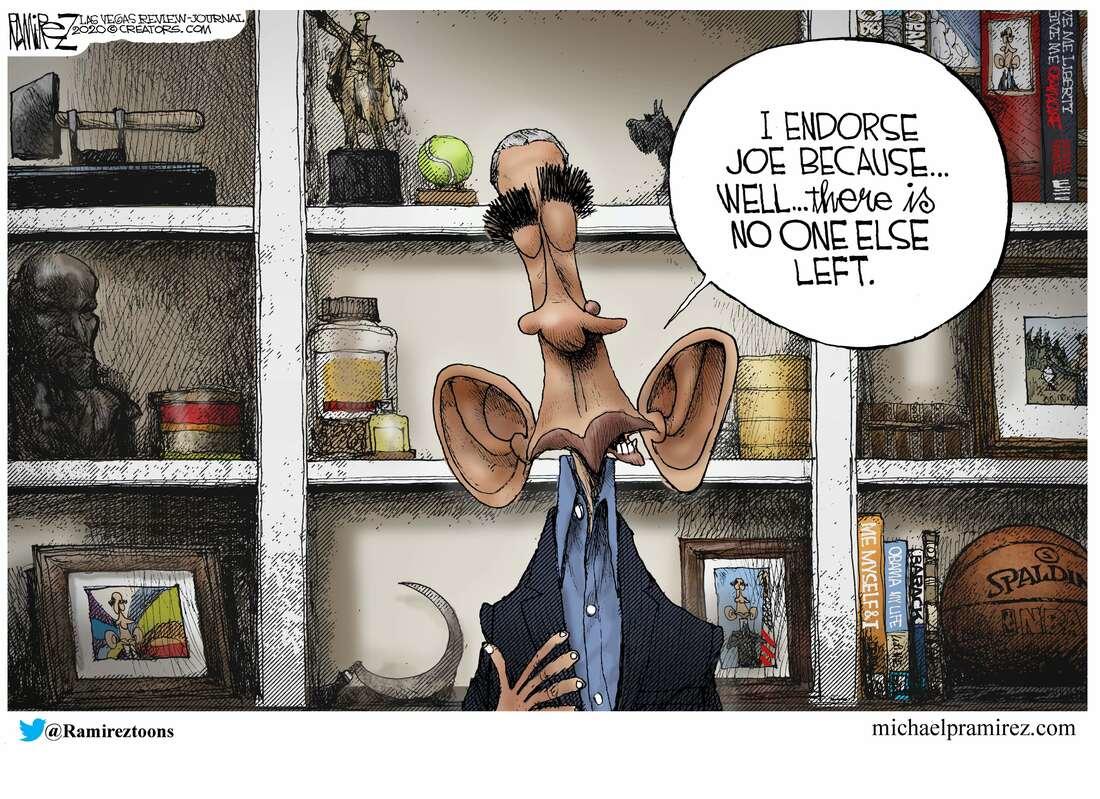
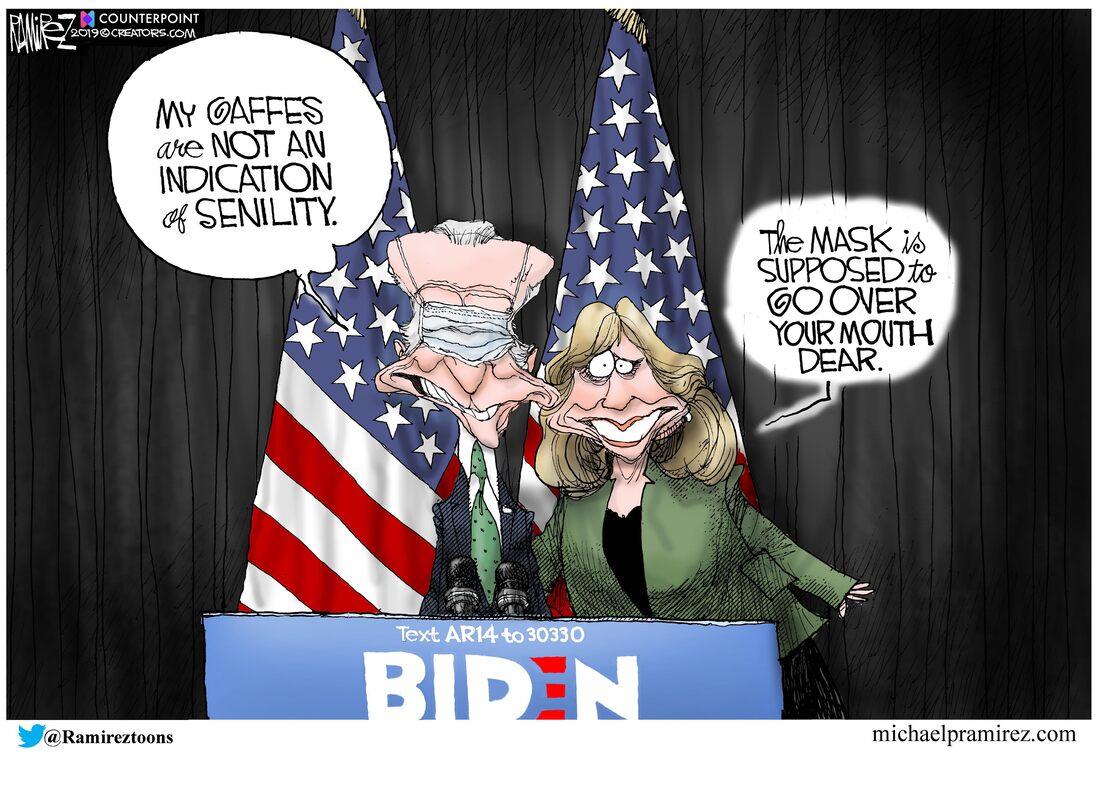
These are strange days, indeed. But in what alternative universe can anyone imagine Joe Biden actually making it through a presidential election campaign? The party he supposedly leads stuffed him into a broom closet last week after he gibbered through a session with CNN’s leading light Anderson Cooper. They can’t just hide the poor fellow there until November 3.

Asked about reopening everyday life in America, Mr. Biden said, “You know, there’s a… uh, during World War II, uh… you know, where Roosevelt came up with… a thing, uh, that, uh… you know, was totally different than a… than the… the, it’s called… he called it the… you know, the World War II… he had the war… the War Production Board….”

Everybody knows he’s dimmer than a night-lite, and everybody’s pretending it’s okay. There’s no analog in history for any faction putting up such an empty vessel for high office. Granted, the Democratic Party has trafficked in unreality for years, from Crossfire Hurricane through UkraineGate ­ — with side-trips like trannies in women’s sports — but those capers were just old-fashioned scams. Joe Biden for President is Emperor’s-New-Clothes caliber deceit, requiring a rank-and-file so marinated in falsehood they couldn’t tell you the difference between a red light and a green light.

So, you have to ask: what is their game? In the weeks that led up to the blossoming of Covid 19, the game was apparently to bump off Bernie Sanders to satisfy the party’s corporate sponsors, who were not so eager to back someone that promised to confiscate their wealth. Ironically, Covid 19 only fortified Bernie’s case that the nation’s obscenely crooked health care system demands drastic reform. Now, you could easily construct a scenario in which ol’ Bernie would have glided to victory in November on the basis of that, combined with unemployment figures that make the Great Depression look like a job fair.

Picking Joe Biden as the instrument to block Bernie seemed especially dumb just weeks after the Democrat’s impeachment gambit blew up in their faces by shining a fiercely revealing light on Joe and Hunter’s adventures in international grift. One can easily discern Mr. Biden’s motive for remaining in the race after that because sheltering in candidacy seemed to inoculate him from any criminal investigation. But, did the whole party want to go all-in on that?

Maybe so, because the doings in Ukraine circa 2014 included a large cast of characters in Barack Obama’s state department ­– not least, Secretary of State John Kerry ­– plus the entire George Soros network of international backstage finaglers, with tendrils to Jeffrey Epstein’s nefarious operations ­– in short, a can of worms so slithery and disgusting they make the Democratic Party look like a primordial sink of species dumped into Mother Nature’s discontinued merchandise bin. Note: none of that has been adjudicated yet and don’t assume they’ll get off scot-free.

Then there is the sexual molestation charge against Mr. Biden by ex-staffer Tara Reade, who claims the then-Senator violated her manually in 1993. The New York Times editors sang la-la-la-la-la-la-kittens-and-puppies for two weeks before they even acknowledged the accusation, only to dismiss it because, well, it was like… you know, where Roosevelt came up with… a thing, uh, that, uh… you know, was totally different than a….

There really are only two plausible game plans for the Dems with Joe Biden.

One is that he’s a mere placeholder until the convention – assuming it can even be held — where party bigwigs are forced to un-do their Biden blunder by some legerdemain of rules-fudging, and cram in a last-minute replacement. The putative savior would be none other than She-Whose-Turn-Was-Thwarted in 2016, on the grounds that she at least knows how to run for president, even if she isn’t very good at it. They might as well hand every delegate a dixie-cup of cyanide-enhanced kool-aid as they cast that fateful vote.

The other pretty obvious scheme, seemingly underway now, is to fix up Mr. Biden with a running-mate who can take over his duties twenty-three minutes after the inauguration ceremony. Stacey Abrams, the self-proclaimed “real governor of Georgia” who, in fact, lost that election but has made out nicely hustling her delusions, is campaigning arduously for the VP appointment. Wouldn’t that make a heck of an appealing ticket?

Apparently, that’s one more memo the Democratic Party did not get: America no longer has time for identity politics. There are more important things to attend to, like whether large numbers of people go to bed hungry, get cast out of their homes, live or die. Things like that. For the moment, the USA doesn’t have an economy. Nor does much of the rest of the world. Believe me, that’s a problem. And unlike Mr. Biden’s dementia, there’s no pretense about not noticing it.


Tyler Durden

Mon, 04/20/2020 – 14:47

via ZeroHedge News https://ift.tt/34SNWaI Tyler Durden

Supreme Court Agrees to Decide, What is Hacking?

I blogged last week about the Supreme Court’s pending cert petition in Van Buren v. United States, on the meaning of unauthorized access to a computer, and why I expected the Supreme Court to take the case.  I’m pleased to that that the Supreme Court has agreed to hear the case.

The fundamental question in the case is what Congress did when it criminalized unauthorized access to a computer.  In particular, what makes an access to a computer unauthorized?   Do the terms of service control?   Does there need to be some sort of technical restriction on access that is breached?

To put the question in colloquial terms, the question is, what is the crime of hacking?**

Given the Supreme Court’s recent trend toward favoring the narrow interpretation of vague criminal statutes, I would guess that the Court likely will rule in the defendant’s favor.  But every case is different, so we’ll have to wait and see.  As always, stay tuned.

_____________

** I realize that there are many in the technical community who insist that the correct word for unlawful unauthorized access to a computer is “cracking,” not “hacking,” and that most people use the term “hacking” incorrectly.  But most people follow colloquial usage, pretty much by definition, so I think it’s fair to put the question that way.


from Latest – Reason.com https://ift.tt/3apc5qw
via IFTTT

Despite COVID-19 Lockdowns, Licensed Marijuana Sales Continue in the Vast Majority of States With Legal Pot

Measured by marijuana sales, 4/20 came early this year as cannabis consumers scrambled to stock up, apparently worried that COVID-19 lockdowns might cut off their legal supply. After local governments in the San Francisco Bay Area imposed stay-at-home orders in March, The New York Times reports, sales of edibles “surged to levels typically only seen around April 20, or ‘4/20,’ the annual, if unofficial, marijuana appreciation holiday.”

That initial panic, which the chief executive of a medical dispensary in Pennsylvania likened to “hoarding toilet paper,” seems to have subsided now that the legal status of marijuana sales under state and local lockdowns has been clarified. The vast majority of states where cannabis is legal have deemed marijuana merchants “essential,” meaning they are exempt from business closure orders, although new restrictions may apply.

According to a tally by Marijuana Business Daily, medical dispensaries are exempt from business closure orders in 28 of the 33 states that allow patients to use cannabis for symptom relief. Of the 10 states that have legalized recreational sales, eight are allowing them to continue. Licensed recreational stores have not opened yet in Maine, although it has been four years since voters approved them. Only Massachusetts has closed recreational outlets while allowing medical sales to continue.

Here is a summary of the rules for marijuana merchants in states that have legalized recreational sales:

Alaska

Recreational and medical marijuana retailers remain open, subject to social distancing rules. The cannabis industry is urging the state to legalize curbside pickup.

California

The Bureau of Cannabis Control notes that Gov. Gavin Newsom’s March 19 business closure order “identifies certain services as essential, including food, prescriptions, and healthcare.” And “because cannabis is an essential medicine for many residents, licensees may continue to operate at this time so long as their operations comply with local rules and regulations.”

Colorado

Gov. Jared Polis is temporarily allowing online sales of marijuana, which means “both Medical and Retail Marijuana Stores may accept and complete online and telephone sales transactions.” Colorado’s Marijuana Enforcement Division is allowing curbside pickup, as long as it is consistent with local regulations and the transactions occur on private property, as well as sales from drive-through or walk-up windows.

Illinois

Gov. J.B. Pritzker’s March 21 business closure order classifies “licensed medical and adult use cannabis dispensaries” as essential. Like other exempt retailers, they have to follow social distancing rules.

Maine

Although a 2016 ballot initiative legalized recreational use, licensed sales to recreational consumers have not begun yet. Dispensaries serving state-approved patients have been classified as essential “medical facilities.” Various precautions apply to in-store sales.

Massachusetts

Gov. Charlie Baker is allowing sales to registered patients but has ordered recreational stores to close. “Licensed medical marijuana retailers” are exempt from Baker’s March 23 business closure order because they provide essential “health care services.” Recreational retailers did not make the cut, although liquor stores did, under the heading of “food and agriculture.”

Michigan

Gov. Gretchen Whitmer, who has banned sales of vegetable seeds, paint, and other products she deems nonessential, is nevertheless allowing medical and recreational marijuana sales to continue. Michigan’s Marijuana Regulatory Agency is temporarily allowing home delivery and “encourages” consumers to use that option “when applicable.” Regulators are also temporarily allowing curbside pickup.

Nevada

The Department of Taxation says “licensed cannabis stores and medical dispensaries will remain open but must adhere to strict social distancing protocol during this time.” That means “licensees must not allow individuals to congregate in stores or outside while waiting”; “patient consultations should be limited to phone or video only”; and “consumers are strongly encouraged to utilize delivery services when applicable, or complete orders online or over the phone.”

Oregon

The Liquor Control Commission, which also regulates marijuana sales, is temporarily allowing curbside delivery of cannabis products. In-store sales are also permitted. The commission has increased the daily limit from eight to 24 ounces for medical marijuana buyers.

Washington

The Liquor and Cannabis Board says “cannabis producers, processors, retailers and approved labs are considered essential and not required to close due to the coronavirus restrictions.” To facilitate social distancing, the board is allowing recreational consumers as well as patients to use curbside pickup. General retailing restrictions, such as keeping customers at least 6 feet apart, apply to in-store sales.

The Times says the exemptions for marijuana merchants constitute “official recognition that for some Americans, cannabis is as necessary as milk and bread.” Except in Massachusetts, where it is not even as necessary as booze.

from Latest – Reason.com https://ift.tt/2XNo8LT
via IFTTT
Something Impossible Just Happened: A CLO Just Failed Its AAA Overcollateralization Test

Something Impossible Just Happened: A CLO Just Failed Its AAA Overcollateralization Test

Over the weekend, we reported that in its quest to bailout the richest Americans and the country’s financial system, the Fed unleashed an unprecedented array of actions meant to backstop capital markets, going so far as buying investment grade, high yield bonds and even AAA-rated CLO bonds.

However, as we warned, it won’t be enough, for two reasons: first, recall that the expanded Term Asset-Backed Securities Loan Facility (TALF) announced by the Fed last Thursday only buys AAA-rated bonds of CLOs, which after the coming tsunami of CLO downgrades is complete, will not only collapse in nominal size but will mean that any further attempts to stabilize the CLO space will require yet another Fed backstop of even riskier – i.e., rated AA and lower – structured products.

The second reason – one which Bloomberg called a “bigger and more ominous force at work that has investors bracing for the kind of pain they’ve never experienced in the decades that the [CLO] market has existed” – is that late on Friday, in the most draconian and widespread ratings action since the financial crisis, Moody’s warned it may cut the ratings on $22 billion of U.S. collateralized loan obligations – a fifth of all such bonds it grades – as a result of the collapse in cash flows due to the Covid-19 pandemic.

The ratings agency took action on 859 bonds from 358 CLOs that package leveraged loans into securities of varying degrees of risk and return. The step – which according to Bloomberg affects about 19% of Moody’s-rated CLOs that purchase broadly syndicated loans – comes as the underlying debt gets downgraded at a record pace.

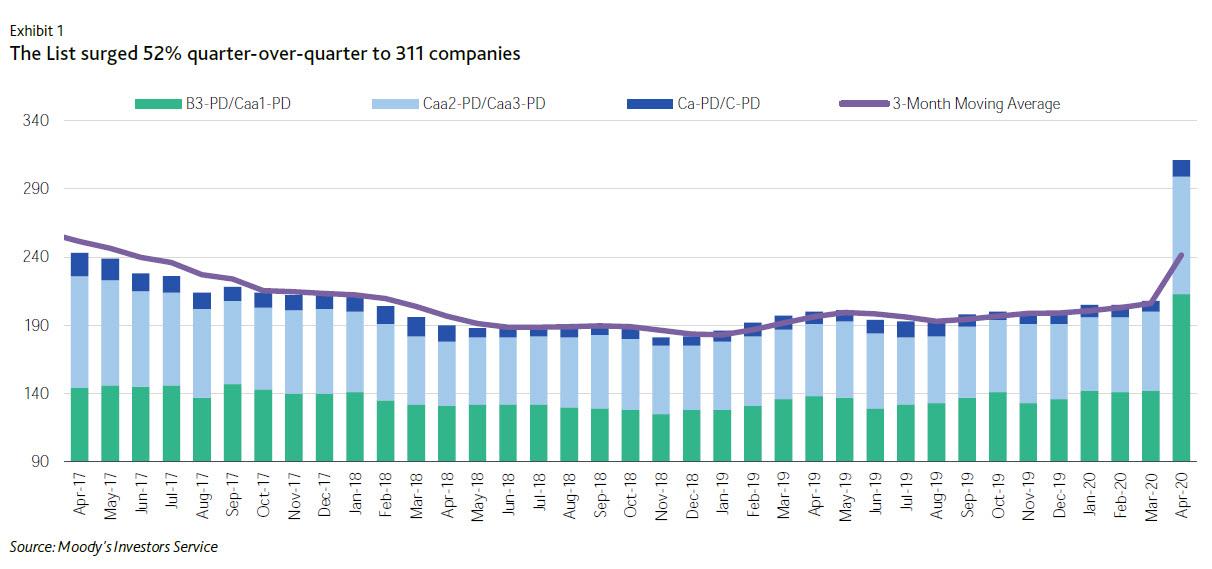
The action followed a report by Moodys earlier in the week in which it reported that its “B3 Negative and lower list” soared to its highest tally ever — 311 companies. That tops a former peak of 291 companies, reached during the credit crisis of 2009 and the commodity-related downturn in April 2016. At 20.7% of the total rated spec-grade population, the list also shot up above its long-term average of 14.8%, and closing in on its all-time high of 26.1%. This spike is the result of the confluence of a coronavirus outbreak, plunging oil prices, and mounting recessionary conditions, which created severe and extensive credit shocks across many sectors, regions and markets, the effects of which are unprecedented.

And with the underlying bonds set to suffer an unprecedented collapse in solvency, it is only a matter of time before the products where they are packaged are also hammered. Products such as CLOs.

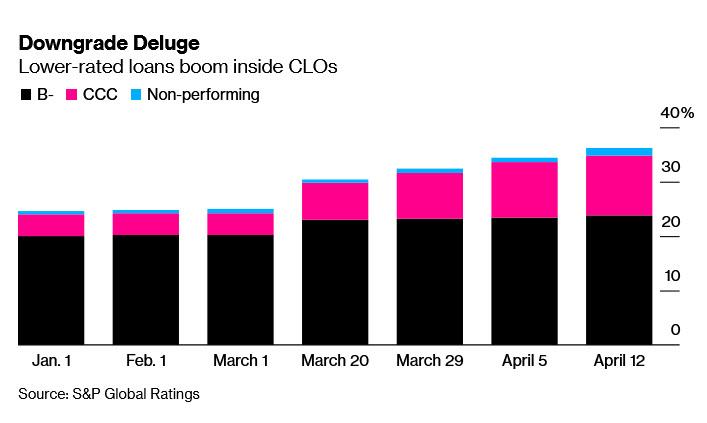
Today, picking up on this growing risk of widespread impairments across the CLO deal stack, Bloomberg echoes what we said, namely that credit ratings on risky corporate loans that were stuffed into the CLOs “are being downgraded at a pace so frenetic that it threatens to overwhelm safeguards that were put in place to ensure the securities’ financial strength.”

And “if that happens” Bloomberg continues, “the firms that manage the CLOs will be forced to dump under-performing debt at fire-sale prices or suspend the cash payments they hand over to their investors.”

It just happened.

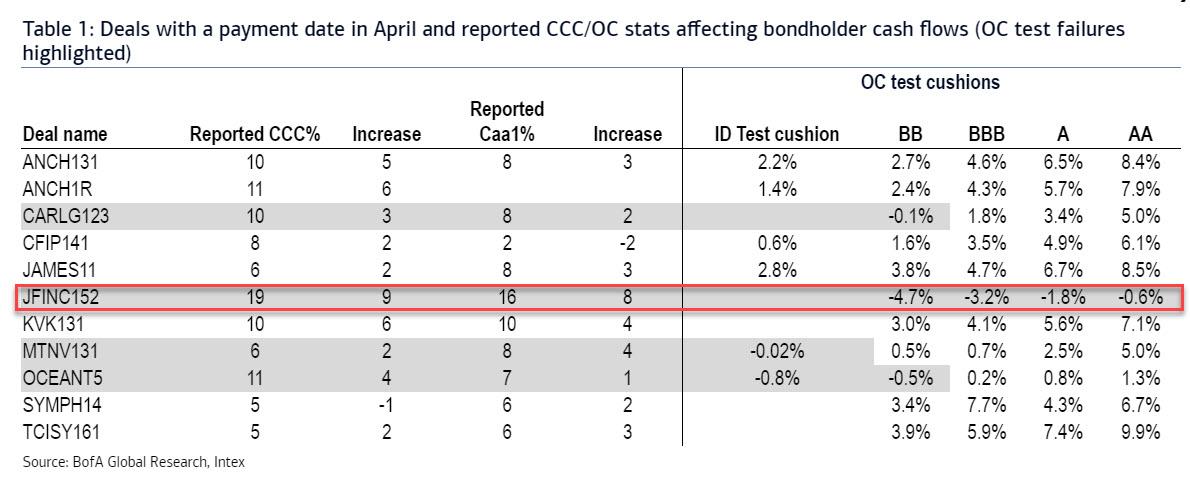
In yet another case of something that was previously deemed impossible becoming reality thanks to the Coronavirus depressionlike oil trading at a negative $14 per barrel – Bank of America’s Chris Flanagan writes that with some deals already reporting late March/early April data, we find that some deals are failing, not just the junior overcollateralization (OC) test but in one case, even the AAA/AA OC test!

According to Flanagan, this will be the likely be the first “CLO 2.0” deal failing the senior most OC test; as a reminder, not even during the financial crisis were the supersafe AAA tranches impaired. This time it took just a few weeks for the cash flow collapse to impair the very top of the stack!

The CLO deal in question is JFINC152, where downgrades have sent the reported CCC percentage to 19%, up 9%, and the result is that every single test cushion is now showing impaired results, from BB (-4.7%) all the way to AA (-0.6%).

Those seeking the reason for this unprecedented development will find it in the dramatic deterioration of CLO credit ratings: for the deals that failed any one of the tests, the increase in CCC is almost 2x over the past month, BofA notes adding that the lack of reinvestment flexibility for some of the transactions as the deals were post the RP period implied managers could not take advantage of the volatile loan market condition in March.

Looking at the past month, since March, S&P and Fitch have placed around 100 tranches on negative watch. The vast majority of these deals were initially rated BB/B and there are 8 IG-rated tranches (mostly BBB). BBB bonds continue to face a high risk of downgrade in the near term considering the increasing CCC share and the recent uptick in defaults. According to an analysis by S&P, should CCC’s increase to 18%, defaults to 5% and OC declines of 2pts, around 46% of BBB bonds could be downgraded to Non-IG.

This has important ramifications for both bondholders and investors as many deal documents initiate a restricted trading condition if any IG-rated bond is downgraded. This will further limit manager’s ability to trade in/out of loans.

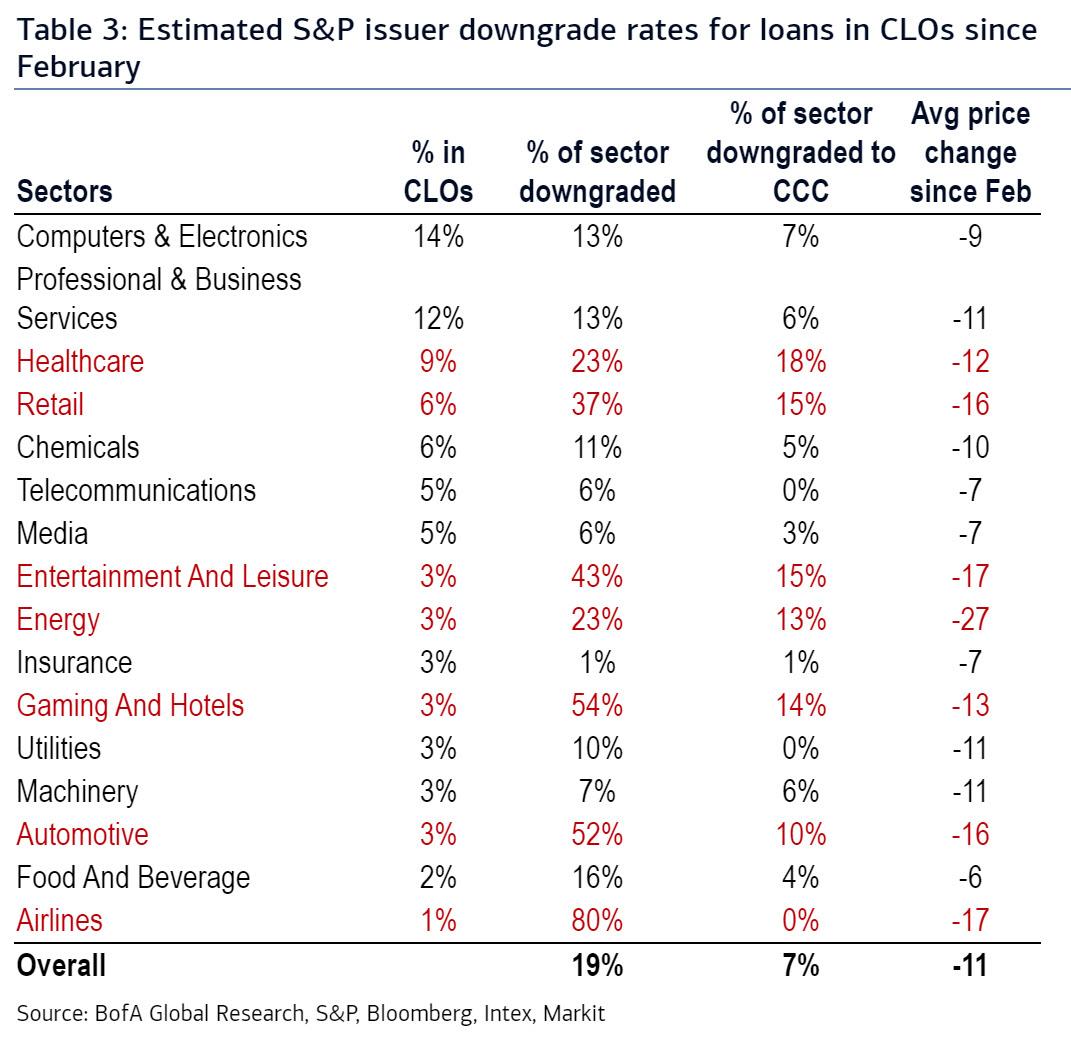
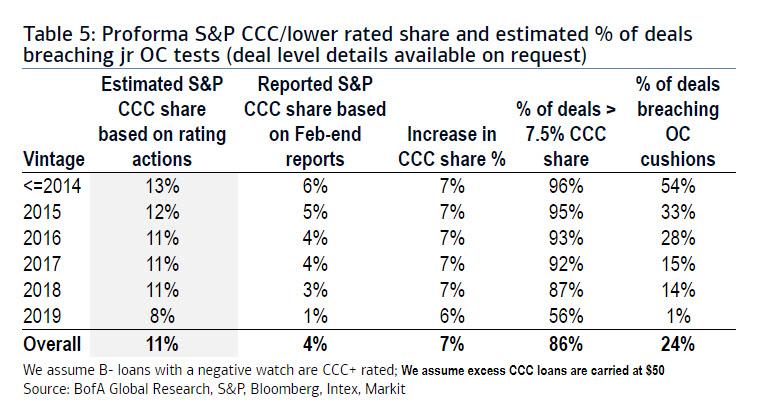
Additionally, the surging share of CCC downgrades has caused many deals to have lower OC ratios as a result of CCC excess and/or par burn as managers traded out of lower priced/lower rated loans. BofA currently estimates that around 17-19% (and counting) of loans in CLOs have been downgraded by both Moody’s and S&P since February, and many more downgrades are coming. Currently, the share of CCC+/lower rated issuers is estimated to be 10.5% and the share of Caa1/lower rated loans is estimated to be around 8.5% across CLO portfolios (assuming loans with a negative watch have been downgraded by a notch lower).

BofA also highlights the average price across each rating cohort currently (after adjusting for downgrades). There has been an increased dispersion between high/low quality names with B+/BB issuers trading around $90 and CCC issuers, around $60. As a result, to swap from a CCC name into a B or higher rated asset still implies taking a $25 hit to par.

Next, looking at updated CCC concentrations, BofA estimates that as many as 20-30% of deals are now potentially breaching their OC tests (assuming a $40-50 price for excess CCC assets and based off March portfolios). In some cases, the BB bonds may PIK as well. With April determination dates beginning and around the corner, managers have very less room/time to trade out of loans and cure these breaches.

Looking ahead, BofA thinks further OC breaches are likely to occur as more deals that make their payment in April report. With the estimated CCC share reaching 10.5%, roughly 20-30% of deals could breach their junior OC tests, and increasingly more deals will likely impair the AAA tranche as well – that’s where Japanese pensioners’ money is currently allocated an outcome that until just a few weeks ago was inconceivable.

* * *

With the safest tranches facing impairments, the riskiest – or equity – tranches are set for a historic wipeout. According to Bloomberg, analysts expect as many as one in three CLOs may soon have to limit payouts to holders of the equity portion. 

The loan downgrades have come so fast that Stephen Ketchum of Sound Point Capital Management compared it to a spill “at the Daytona 500, where the cars are crashing into each other.” It’s a lot different, he said, than the 2008 financial crisis, which “was a slow-moving train wreck.”

Another major difference between the financial crisis and now is that back in 2008, the CLO market emerged largely unscathed – especially the AAA tranches – an outcome which we now know will not happen. Corporate loans were far enough removed from the epicenter of the 2008 crisis – a housing bubble – to avoid much of the collateral damage and, besides, the CLO market back then was a fraction of its size today.

Ironically, the strong track record, the lack of major CLO impairments, along with the fact that the securities provided juicy returns in an era of near-zero global rates; fueled a boom in demand over the past decade. The same boom will now lead to hundreds of billions in losses.

Worse, it means that a key pillar of the credit market will be crushed for years: CLOs have been the biggest buyers in the $1.2 trillion leveraged loan market, helping fuel a surge in debt-fueled buyouts and other transactions.

In sympathy with the broader market, prices on CLOs have recovered some in recent days with AAA securities recouping most of their declines since the selloff began largely thanks to the Fed’s promise to backstop the supersafe tranche. However, as cash flows plunge and as a flood of downgrades hit the underlying loans which then leads to even more AAA tests being missed, the entire CLO space is in for a very violent repricing and unless the Fed is prepared to backstop the entire $1.2 trillion market, the consequences – for both the loan and broader bond market – will be catastrophic, while the Fed ends up holding paper that in a few months will be insolvent, at which point the Congressional hearings why Powell bought worthless securities with freshly printed dollars will be the hottest thing on TV.


Tyler Durden

Mon, 04/20/2020 – 14:21

via ZeroHedge News https://ift.tt/2VoJ4r2 Tyler Durden

Exactly How Many Deaths Are Needed To Justify Giving Government’s Control Of Everything?

Exactly How Many Deaths Are Needed To Justify Giving Government’s Control Of Everything?

Authored by Jim Fedako via The Mises Institute,

The CDC estimates that 61,000 Americans died from the flu during the 2017–18 flu season (with a range of 46,000 to 95,000 deaths). Few of us even remember that event. Stores stayed open, folks met and worked, and everyone lived as normal.

Taking sixty-one thousand deaths as our baseline, how deadly does a virus have to be to justify the destruction of our livelihoods and economy in general?

Half as deadly? No that wouldn’t make sense. But neither would “as deadly,” either.

Would twice as deadly cross the panic threshold? But that would be just twice something we didn’t notice while it was happening. So maybe even double is not enough.

No one is ever safe, ever. But we all lived lives in a world of uncertainty. That is, until many panicked and allowed governments to drive us into our own caves, so to speak.

But who incited panic? Media and social media initially sounded the alarm, sparking fear. However, it was government that provided justification for that fear, wrapping dour pronouncements in a veneer of supposed science and truth. Soon the panic threshold was breached. While the various media live off provocative headlines, government lives off fear.

So we end up with this strange symbiotic relationship: with the aid of a friendly media, government justifies the fears it propagandizes; constituents panic and turn to both government for help and the media for information. Certainly, it has to be this way. Why? Because government rules through the consent of the governed.

As Mises noted:

Only a group that can count on the consent of the governed can establish a lasting regime. Whoever wants to see the world governed according to his own ideas must strive for domination over men’s minds. It is impossible, in the long run, to subject men against their will to a regime that they reject.

So, a government looking to extend its powers, to assume additional rights from its citizens, will need to manufacture consent, else rebellion with ensue. And there is no better opportunity to manufacture consent than during an existential crisis, whether it’s enemies massed at the gate or ones concealed within.

Obviously, if those enemies do not exist, they have to be invented. As Schumpeter stated:

There was no corner of the known world where some interest was not alleged to be in danger or under actual attack. If the interests were not Roman, they were those of Rome’s allies; and if Rome had no allies, then allies would be invented. When it was utterly impossible to contrive such an interest—why, then it was the national honor that had been insulted. The fight was always invested with an aura of legality. Rome was always being attacked by evil-minded neighbors, always fighting for a breathing space. The whole world was pervaded by a host of enemies, and it was manifestly Rome’s duty to guard against their indubitably aggressive designs. They were enemies who only waited to fall on the Roman people.

Not too long ago, the devised enemy was ISIL—haunting the Levant in Toyota trucks. We were told daily that ISIL was readying a strike against the US some fifty-five hundred miles away. Plausible? Hardly. However, the propaganda machine was able to create some angst, for some time, anyway.

Today the enemy is through the gate unseen, infiltrating bodies and minds. COVID-19 is a government’s dream. Folks who just yesterday, or so it seems, said certain acts of government, such as closing churches, would ignite rebellion, gladly consent to authoritarian edicts. But why?

There is the manufactured fear, the product of the propaganda machine—the good doctors making dire predictions about likely death counts, surrounded by somber officials, all standing near a dais backed by the richly colored, acronymed logo of some official sounding agency. Great video, great propaganda.

But there is more. Government is blaming the virus, not itself. That serves several purposes. It allows government to employ a misdirect, pilfering the public purse and annulling rights while the masses concern themselves with social distancing.

It also provides personal cover to minor agents of the bureaucracy, who do not have to spend sleepless nights fretting about their role in the destruction of our economy.

Hannah Arendt wrote about the Eichmann trial and tried to answer the conscience question:

The trick used by Himmler…was very simple and probably very effective; it consisted in turning these instincts around, as it were, in directing them toward the self. So that instead of saying: What horrible things I did to people!, the murderers would be able to say: What horrible things I had to watch in the pursuance of my duties, how heavily the task weighed upon my shoulders! (Hannah Arendt, Eichmann in Jerusalem)

So you hear statements that twist reality in this manner: “The virus will let us know when we can reopen the country.” As if the virus is dictating policy.

We are told that government officials are only reacting as the virus commands. And the enforcement agents spreading tickets and handcuffs are simply shouldering the horrible tasks that must be pursued.

Is this how we, the people, choose to live? In a world where government foments fear for its own purposes and then stands back, blaming its actions on an enemy of its own creation?

Once more, how deadly does a virus have to be to justify the destruction of our livelihoods and economy in general? Twice the usual? Three times? I can’t decide the issue for all. I simply ask you to consider first what we are allowing (crashed economy, record unemployment growth, exploding government debt, unconstitutional government edicts, well, you get the picture).

And I ask you to consider who, or what entities, are benefiting. It is true that some cui bono (to whom it is a benefit) arguments are fallacious, but not all. However, consider this: besides a shift of rights and power from the people to the state, there is that matter of trillions moving from our wallets to those of the friends and families of the politically connected.

As I wrote above, no one is ever safe, ever. But until a month ago, we all accepted a world of uncertainty and didn’t panic. What was true then is true today—to be free is not to be safe. However, to live free is to live. Period.


Tyler Durden

Mon, 04/20/2020 – 14:06

via ZeroHedge News https://ift.tt/2wYOsru Tyler Durden

Facebook Removes Coronavirus Misinformation but Will Only Ban Lockdown Protests If They Violate Social Distancing

Facebook will remove coronavirus-related misinformation that directly threatens imminent harm, CEO Mark Zuckerberg told ABC News. But contrary to several media reports, Facebook is not taking action against all lockdown protests that are being organized on the site.

“Unless government prohibits the event during this time, we allow it to be organized on Facebook,” a company spokesperson tells Reason. “For this same reason, events that defy government’s guidance on social distancing aren’t allowed on Facebook.”

This is slightly but critically different from what was reported by The Hill, which made it sound like Zuckerberg had endorsed some kind of blanket ban on anti-lockdown activism:

Facebook CEO Mark Zuckerberg on Monday told ABC’s George Stephanopoulos that protests against stay-at-home orders organized through his social media site qualify as “harmful misinformation” and are taken down.

Zuckerberg’s answer to Stephanopoulos—who had asked about protests that explicitly violate social distancing—was actually more complicated than that. Here was the exact exchange:

Stephanopoulos: How do you deal with the fact that Facebook is now being used to organize a lot of these protests that defy social distancing and defy social distancing guidelines in states? If someone is trying to organize something like that, does that qualify as harmful misinformation because it defies social distancing?

Zuckerberg: This is an important question. If someone is spreading something that is misinformation—certainly, someone saying that social distancing is not effective to help limit the spread of coronavirus—we do classify that as harmful misinformation and we take that down. At the same time, it’s important for people to debate policies, basically give their opinions on different things, so there’s a line on this. But more than normal political discourse, I think, a lot of the things people are saying that is false around a health emergency can be classified as harmful misinformation that has a risk of leading to physical danger, and we will take that down.

At the behest of state governments, Facebook has indeed taken action against some anti-quarantine protests being organized on the site. But that’s because those events were being organized in direct violation of state social distancing dictates, Facebook saysIt matters what each state’s guidance has been, and it matters whether the event in question is urging participants to take appropriate precautions.

That’s markedly different from the idea that all opposition to the lockdowns is being treated as harmful misinformation.

In terms of content, Zuckerberg said that only posts advocating imminently harmful actions would be taken down. He cited a theoretical post recommending bleach as a miracle cure for COVID-19 as an example.

“That’s not allowed on our service at all,” said Zuckerberg. “There have been thousands and thousands of pieces of content like that we have to take down.”

Again, the panic-stricken reporting about the Big Tech censorship would have people believe that Facebook is removing all content about the coronavirus that doesn’t toe some government-approved line. But while there are bound to be times when Facebook makes a bad moderation call, on paper, its policy is reasonable.

from Latest – Reason.com https://ift.tt/34PQzKA
via IFTTT

Facebook Removes Coronavirus Misinformation but Will Only Ban Lockdown Protests If They Violate Social Distancing

Facebook will remove coronavirus-related misinformation that directly threatens imminent harm, CEO Mark Zuckerberg told ABC News. But contrary to several media reports, Facebook is not taking action against all lockdown protests that are being organized on the site.

“Unless government prohibits the event during this time, we allow it to be organized on Facebook,” a company spokesperson tells Reason. “For this same reason, events that defy government’s guidance on social distancing aren’t allowed on Facebook.”

This is slightly but critically different from what was reported by The Hill, which made it sound like Zuckerberg had endorsed some kind of blanket ban on anti-lockdown activism:

Facebook CEO Mark Zuckerberg on Monday told ABC’s George Stephanopoulos that protests against stay-at-home orders organized through his social media site qualify as “harmful misinformation” and are taken down.

Zuckerberg’s answer to Stephanopoulos—who had asked about protests that explicitly violate social distancing—was actually more complicated than that. Here was the exact exchange:

Stephanopoulos: How do you deal with the fact that Facebook is now being used to organize a lot of these protests that defy social distancing and defy social distancing guidelines in states? If someone is trying to organize something like that, does that qualify as harmful misinformation because it defies social distancing?

Zuckerberg: This is an important question. If someone is spreading something that is misinformation—certainly, someone saying that social distancing is not effective to help limit the spread of coronavirus—we do classify that as harmful misinformation and we take that down. At the same time, it’s important for people to debate policies, basically give their opinions on different things, so there’s a line on this. But more than normal political discourse, I think, a lot of the things people are saying that is false around a health emergency can be classified as harmful misinformation that has a risk of leading to physical danger, and we will take that down.

At the behest of state governments, Facebook has indeed taken action against some anti-quarantine protests being organized on the site. But that’s because those events were being organized in direct violation of state social distancing dictates, Facebook saysIt matters what each state’s guidance has been, and it matters whether the event in question is urging participants to take appropriate precautions.

That’s markedly different from the idea that all opposition to the lockdowns is being treated as harmful misinformation.

In terms of content, Zuckerberg said that only posts advocating imminently harmful actions would be taken down. He cited a theoretical post recommending bleach as a miracle cure for COVID-19 as an example.

“That’s not allowed on our service at all,” said Zuckerberg. “There have been thousands and thousands of pieces of content like that we have to take down.”

Again, the panic-stricken reporting about the Big Tech censorship would have people believe that Facebook is removing all content about the coronavirus that doesn’t toe some government-approved line. But while there are bound to be times when Facebook makes a bad moderation call, on paper, its policy is reasonable.

from Latest – Reason.com https://ift.tt/34PQzKA
via IFTTT

Facebook Bans Civil Disobedience, Removes Posts Organizing Anti-Lockdown Protests

Facebook Bans Civil Disobedience, Removes Posts Organizing Anti-Lockdown Protests

Facebook has removed several pages promoting protests against state quarantine orders designed to slow the spread of coronavirus.

The social media giant acknowledged removing the posts promoting protests in California, New Jersey and Nebraska which violated measures taken by governors to slow the spread of COVID-19.

Facebook has been the main main hub for the coordination and promotion of these events, bringing together anti-government and conspiracy-minded fringe activists, including militia groups, religious fundamentalists and anti-vaccination proponents, with the common cause of ending state and federal efforts to restrict freedom of movement to halt the coronavirus’ spread. –NBC News

“Unless government prohibits the event during this time, we allow it to be organized on Facebook,” said Facebook. “For this same reason, events that defy government’s guidance on social distancing aren’t allowed on Facebook,” said Facebook spokesman Andy Stone in a statement to the Washington Post.

We do classify that as harmful misinformation and we take that down,” said Facebook CEO Mark Zuckerberg on Monday during an appearance on ABC, adding “At the same time, it’s important that people can debate policies so there’s a line on this, you know, more than normal political discourse. I think a lot of the stuff that people are saying that is false around a health emergency like this can be classified as harmful misinformation.”

The move by Facebook comes after dozens of protests were held in various states in recent weeks – with smaller gatherings marked by “dozens or hundreds of protesters” gathering in front of state capitols and governors’ mansions while waving American flags and signs suggesting that the lockdown has infringed on their rights, according to NBC News.

State governments have asked people not to attend the protests, as the groups have assembled without adhering to social distancing guidelines, and could risk infecting more people and lengthening the state shutdown measures.

President Donald Trump has encouraged social distancing but also offered support to the protests. Last week he tweeted “LIBERATE MINNESOTA!” as far-right gun groups led a protest in front of the governor’s mansion. –NBC News

President Trump defended the protesters on Sunday – saying “They’ve got cabin fever,” while adding “I’ve never seen so many American flags. These people love our country. They want to get back to work.”

Facebook, meanwhile, says it’s trying to get information from New York, Pennsylvania, Ohio and Wisconsin about whether protests break social distancing measures enacted by the states – however an official with Pennsylvania’s Department of General Services told FOX Business that they haven’t heard from the Silicon Valley company, reports National Review.

Ohio Governor Mike Dewine’s office said that the state is unlikely to interfere with the protests, saying “The Governor values the First Amendment and asks that protesters practice social distancing by standing at least 6 feet apart.”

Last week, Twitter enacted similar measures against InfoWars host Owen Shroyer, who was using the platform and its livestreaming subsidiary Periscope to promote a Saturday rally in Austin, TX against the state’s stay-at-home measures.


Tyler Durden

Mon, 04/20/2020 – 13:45

via ZeroHedge News https://ift.tt/3anvckU Tyler Durden

Making Sense of the Votes in the Ramos v. Louisiana Majority (Updated)

Today the Supreme Court decided Ramos v. Louisiana. (Eugene and Jon blogged about it earlier). The votes are very, very complicated:

GORSUCH, J., announced the judgment of the Court, and delivered the opinion of the Court with respect to Parts I, II–A, III, and IV–B–1, in which GINSBURG, BREYER, SOTOMAYOR, and KAVANAUGH, JJ., joined, an opinion with respect to Parts II–B, IV–B–2, and V, in which GINSBURG, BREYER, and SOTOMAYOR, JJ., joined, and an opinion with respect to Part IV–A, in which GINSBURG and BREYER, JJ., joined. SOTOMAYOR, J., filed an opinion concurring as to all but Part IV–A. KAVANAUGH, J., filed an opinion concurring in part. THOMAS, J., filed an opinion concurring in the judgment. ALITO, J., filed a dissenting opinion, in which ROBERTS, C. J., joined, and in which KAGAN, J., joined as to all but Part III–D.

Justice Kavanaugh offered this explanation of the breakdown:

As noted above, I join the introduction and Parts I, II–A, III, and IV–B–1 of JUSTICE GORSUCH‘s opinion for the Court. The remainder of JUSTICE GORSUCH‘s opinion does not command a majority. That point isimportant with respect to Part IV–A, which only three Justices have joined. It appears that six Justices of the Court treat the result in Apodaca as a precedent and therefore do not subscribe to the analysis in PartIV–A of JUSTICE GORSUCH‘s opinion.

This graph (as best as I can tell) charts the votes in the majority.

Votes in Ramos v. Louisiana Majority

I will update the post as I make my way through the 87-page opinion.

Update: The remainder of this post explains the complicated breakdown of the Ramos majority.

Part II-B

Justices Gorsuch, Ginsburg, Breyer, and Sotomayor joined Part II-B . This brief section (pp. 9-11 of the slip opinion) tries to make sense of Apodaca v. Oregon:

So what could we possibly describe as the “holding” of Apodaca?

Really, no one has found a way to make sense of it. In later cases, this Court has labeled Apodaca an “exception,” “unusual,” and in any event “not an endorsement” of JusticePowell’s view of incorporation.34 At the same time, we have continued to recognize the historical need for unanimity.35 We’ve been studiously ambiguous, even inconsistent, about what Apodaca might mean.

Justice Kavanaugh did not join Part II-B.

Part IV-A

Justices Gorsuch, Ginsburg, and Breyer joined Part IV-A (pp. 16-20 of the slip opinion). This section responds to Justice Alito’s dissent. It begins:

If Louisiana’s path to an affirmance is a difficult one, the dissent’s is trickier still. The dissent doesn’t dispute that the Sixth Amendment protects the right to a unanimous jury verdict, or that the Fourteenth Amendment extends this right to state-court trials. But, it insists, we must affirm Mr. Ramos’s conviction anyway. Why? Because the doctrine of stare decisis supposedly commands it. There are two independent reasons why that answer falls short.

Justices Sotomayor and Kavanaugh did not join Part IV-A, for different reasons.


Part IV-B-2

Justices Gorsuch, Ginsburg, Breyer, and Sotomayor joined Part IV-B-2 and Part IV. Justice Kavanaugh did not join Part IV-B-2 and Part IV.


from Latest – Reason.com https://ift.tt/3buNbYg
via IFTTT