Iran Nuclear Talks To Resume Thursday As US Complains Tehran ‘Demanding More, Concedes Less’

Iran Nuclear Talks To Resume Thursday As US Complains Tehran ‘Demanding More, Concedes Less’

The result of last week’s resumption of nuclear talks in Vienna between Iran and signatories to the original Joint Comprehensive Plan of Action deal is being described in Western sources as Tehran demanding more from the US while willing to concede less

“More than five months after multilateral nuclear talks with Iran were paused before the country’s presidential elections in June, a new negotiating team arrived in Vienna in late November with additional demands and fewer concessions than its predecessors,” NATO’s Atlantic Council lamented in an op-ed.

Over the weekend Biden administration officials questioned the Iranian side’s “seriousness” – suggesting they came to the table unwilling to compromise from the start while demanding the US drop all Trump era sanctions. But on Tuesday Iranian official media announced that Vienna talks will resume Thursday.
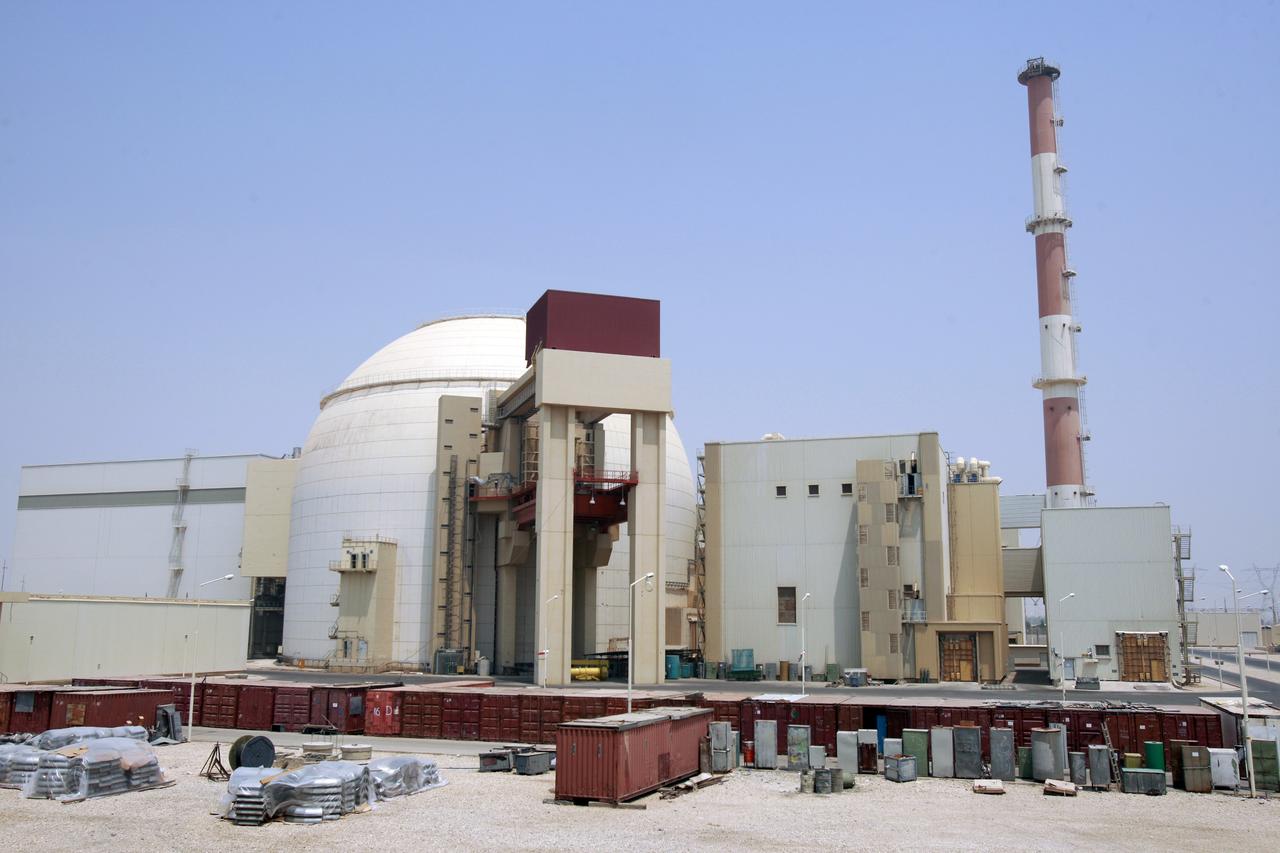
Bushehr main nuclear reactor, via Reuters

“The date for the resumption of the P4 + 1 talks in Vienna has been finalized,” Iran’s Tasnim news agency has reported. “Iran, P4 + 1 resume talks in Vienna on Thursday.”

But despite Iran’s willingness to continue the dialogue toward restoration of a deal, White House officials are casting severe doubts on the possibility that something firm can be reached:

A US official said Saturday that Iran had backed away from all its previous compromises on reviving the 2015 nuclear deal and that the US would not allow Iran to “slow walk” the international negotiations while at the same time ramping up its atomic activities.

The warning came a day after Washington hit out at Iran, saying talks with world powers on a return to the 2015 nuclear accord had stalled because Tehran “does not seem to be serious.”

A senior administration official was cited further as saying: “We can’t accept a situation in which Iran accelerates its nuclear program and slow walks its nuclear diplomacy,” according to an AFP and Times of Israel report.

Meanwhile, Israel is currently trying to persuade the Biden White House to initiate limited military strikes on Iranian assets in the Middle East region. In fresh statements Tuesday, Prime Minister Naftali Bennett said his military is fighting “bad forces” in the region “day and night”. Israeli media details:

Hours after Syrian media accused Israel of striking the port city of Latakia, Prime Minister Naftali Bennett said on Tuesday that the military was constantly fighting “bad forces” in the Middle East.

“We’re pushing back on the bad forces of this region day and night,” he said in English alongside Greek Prime Minister Kyriakos Mitsotakis and Cypriot President Nicos Anastasiades. “We won’t stop for one second. This happens almost daily.”

“In the face of destructive forces we will continue to act, we will be persistent, and we will not tire,” Bennett pledged.

The referenced strike was an Israeli air assault on Latakia port in Syria. It happened overnight in the early Tuesday hours, with suggestions that Israel was targeting Iranian weapons shipments, though precisely what was in the shipping containers that were hit and engulfed in flames remains unknown and unconfirmed. 

Tyler Durden
Wed, 12/08/2021 – 05:45

via ZeroHedge News https://ift.tt/3091Rf8 Tyler Durden

Printing And Borrowing Always Ends Badly

Printing And Borrowing Always Ends Badly

Authored by Daniel Lacalle,

As more countries copy the Federal Reserve’s monetary policy without the global demand of the US dollar, financing trade and fiscal deficits printing a weakening currency, nations become more dependent on the US dollar.

Neither domestic nor international citizens demand local currency, and governments continue to build large fiscal and trade imbalances believing the magic money tree will solve everything. However, as confidence in their domestic currency collapses, global US dollar-denominated debt soars because very few investors want local currency risk and central banks need to build US dollar reserves to cushion the monetary debasement blow.

Implementing aggressive so-called expansionary policies almost always backfires because the impact on growth of large spending plans is minimal, and the destruction of purchasing power of the currency rises.

Governments always want to believe that they will be able to disguise their imbalances with monetary debasement, but the effect is the opposite.

It is, therefore, no surprise that most global currencies have depreciated against the US dollar even in a year of high Federal reserve injections and commodity price rises. When a commodity exporting country sees its currency collapse despite rising exports, you know that -again- the myth of modern monetary theory has evaporated.

As the domestic economy and currency in countries like Brazil, Argentina or Turkey get worse, governments turn the blame to the International Monetary Fund.

The relationship of countries with the International Monetary Fund (IMF) always makes the headlines when governments have already spent the money they borrowed and do not want to return it. Interestingly, few seem to criticize the IMF when it rescues governments from their fiscal imbalances, and harsh comments only surface when the money must be paid back.

The first thing that citizens should understand is that the best relationship that a government should have with the IMF is the same that we have with borrowing. Use it the least possible.

Citizens must understand that the objective of the IMF is not to solve the structural problems of an economy, but to provide liquidity and help governments to maintain their credit position.

If a government squanders the money it has raised and destroys its confidence, that is not the IMF’s fault. Moreover, if that government continues to increase imbalances as if funds were free and irrelevant, neither the IMF nor any other global credit entity is going to rescue it.

The IMF’s problem is not that it is too demanding with governments or that it suffocates economies, but that it is extremely benign with profligate governments and that it never stops states that solve everything by raising taxes and sinking taxpayers’ disposable income. If the IMF is to blame for something it is for being often too kind on extractive and confiscatory government policies.

In the last thirty years, the world has experienced more than 100 financial crises. Coincidentally, these periods of bubble expansion and subsequent crisis are driven by misnamed “expansive” government plans, by central banks increasing money supply without control and governments tend to present themselves as the solution to problems created by their own policies.

The IMF rarely tells governments what to do. At best, it suggests and tends to be extremely accommodative to tax hikes. For the IMF, government is the pillar of credit credibility, and public spending is rarely questioned. While the IMF does acknowledge the rising burden on taxpayers and the impact of increasing the tax wedge on growth and employment, it rarely penalizes governments that overspend and overtax. The usually excellent IMF papers and empirical analyses are almost unanimous in showing the negative impact on growth and jobs of tax hikes and the poor, if not negative, fiscal multipliers of government spending, but the organization itself seems so scared of being called a defender of austerity that it has stopped recommending fiscal prudency.

The problem with recommending spending and borrowing in periods of low rates and excess liquidity is that, when everything explodes, governments complain of alleged “austerity” requests. When the IMF suggests to moderate spending, states rebel, even if they have squandered previous support.

The International Monetary Fund usually responds to all crises as follows:

– Accepting the measures of governments from a constructive, diplomatic and benign perspective.

– Recommending liberalization measures and budgetary moderation plans that either are never carried out at all, or have been aimed, as in Argentina or the European crisis, at supporting hypertrophied state structures at all costs. Almost all the “austerity measures” implemented in the past thirty years have relied heavily on tax increases, and not on reducing current spending, which further weakens economies.

International organizations rarely curb the governments’ desire for intervention and on many occasions encourage it.

It is true that the International Monetary Fund may be wrong in its predictions, but it is one of the most accurate international bodies and, when it is wrong, it is usually out of optimism, accepting the expectations of the government in office as valid.

The relationship that governments should have with the IMF is the same that you have with your lawyer or your lending bank. Try to use them as little as possible.

Argentina and other emerging economies’ problems have not been created by the IMF. If the IMF can be accused of anything it is of having been optimistic with the governments’ promises.

The lesson of this crisis is that, if governments want to avoid negative consequences in the future, they should ignore the siren calls that tell them to increase imbalances to “grow”. History has proven that spending and borrowing today always leads to a crisis tomorrow. Two plus two does not equal twenty-two. The less they copy the Fed or ask for IMF support, the better.

Tyler Durden
Wed, 12/08/2021 – 05:00

via ZeroHedge News https://ift.tt/31J9464 Tyler Durden

Brickbat: Hard Lessons


letter_1161x653

Katrina Phelan, a teacher at Abraham Lincoln High School in Iowa, has been charged with three felony counts of terroristic threats. Police say Phelan wrote several anonymous notes threatening gun violence at the school. At least one of the notes purported to be from a bullied student. Police say all of the notes were found in Phelan’s classroom or by Phelan in other parts of the school.

The post Brickbat: Hard Lessons appeared first on Reason.com.

from Latest – Reason.com https://ift.tt/3rIgAcl
via IFTTT

Suspected Member Of Jamal Khashoggi Hit Squad Arrested In France

Suspected Member Of Jamal Khashoggi Hit Squad Arrested In France

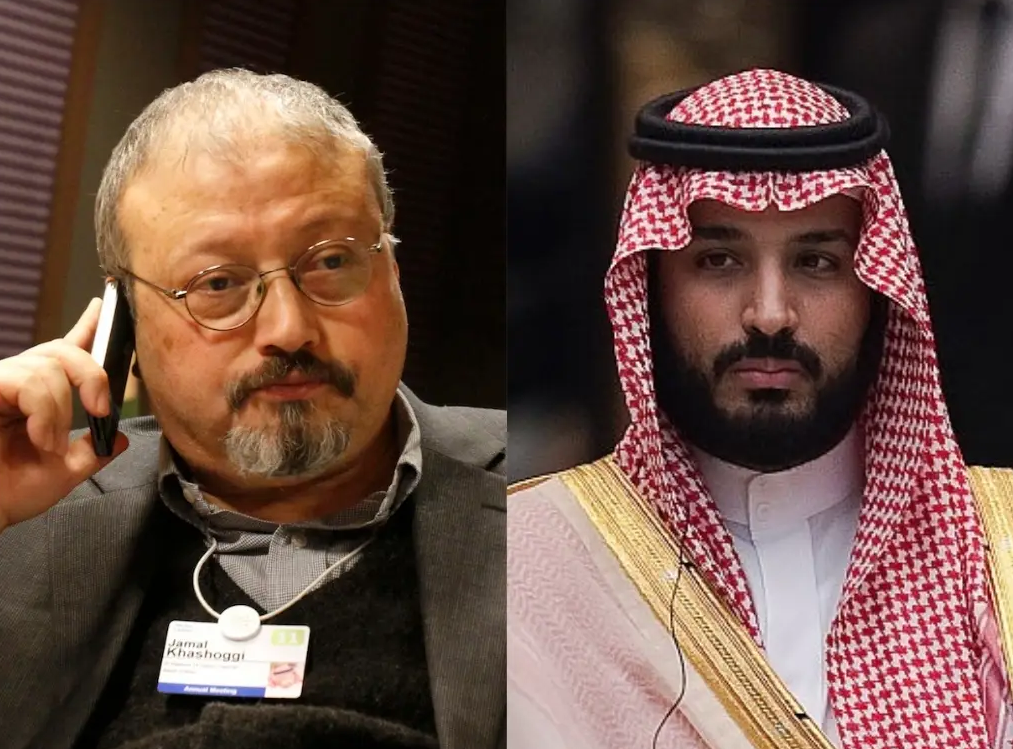
Perhaps Saudi crown prince Mohammed bin Salman should be worried the next time he visits Paris… More than three years after the grisly slaying of journalist Jamal Khashoggi at the Saudi Istanbul consulate, a key suspect in the murder has been arrested in France

He’s one of 26 Saudis believed part of the hit team still being sought by Turkish and international authorities for the 2018 killing and dismemberment of Khashoggi, who was a columnist for the Washington Post. “Khalid Alotaibi, 33, was detained by border police on the basis of an arrest warrant issued by Turkey just before taking a flight to Riyadh from Charles de Gaulle Airport, judicial and airport sources said,” France24 reports. “His name appeared in a Washington Post investigation on the alleged hit squad, based on passport copies and travel details.”

Previously Saudi Arabia itself had tried a number of the accused, with some receiving death sentences – later overturned on appeal – however, many critics blasted the proceedings as a sham trial meant for external public consumption, while separate investigations by the United Nations and CIA pointed to the order to assassinate Khashoggi being issued at the highest levels of the kingdom: namely crown prince MbS himself. 

Currently at least eight convicted Saudis are imprisoned in the kingdom. Starting in 2020, a Turkish court tried at least 20 suspects in absentia. Tuesday’s arrest marks the first such detention of a murder suspect in the killing abroad. 

The Saudi Foreign Ministry was quick to demand the Saudi national’s release, however, calling it a case of “mistaken identity”. The Saudis issued a statement:

“Regarding the arrest of a Saudi citizen on the grounds of being a suspect in the murder of the late citizen Jamal Khashoggi, the Embassy of the Kingdom of Saudi Arabia to the Republic of France would like to clarify that what was reported in the media is incorrect, and that the person who was arrested has nothing to do with the case in quesiton,” it said.

“Therefore, the Kingdom’s embassy expects his immediate release.”

So far the French appear to be confident they have their man, pending continuing investigation, based on a warrant issued by Turkey. The explosive headline could prove deeply awkward for French President Emmanuel Macron, who has essentially “moved on” like many other world leaders, having already literally embraced MbS and welcomed him “back into the fold” of respected world leaders – as Sky News reports:

The arrest came just days after French President Emmanuel Macron held face-to-face talks in Saudi Arabia with de facto ruler Crown Prince Mohammed bin Salman, becoming the first major Western leader to visit the kingdom since Mr Khashoggi’s murder.

Previously the CIA concluded with “high confidence” that the crown prince and kingdom’s de facto ruler ordered the killing. 

Source: Middle East Eye

Image via MEI: Khaled Aedh al-Otaibi, whose 2018 passport is shown here, is a former member of the royal guard who was present in the Saudi consulate in Istanbul on the day of Khashoggi’s murder.

“The CIA has concluded that Saudi Crown Prince Mohammed bin Salman ordered the assassination of journalist Jamal Khashoggi in Istanbul last month, contradicting the Saudi government’s claims that he was not involved in the killing, according to people familiar with the matter,” The Washington Post based on US intelligence’s initial investigation.

Tyler Durden
Wed, 12/08/2021 – 04:15

via ZeroHedge News https://ift.tt/3lKDzQh Tyler Durden

Brickbat: Hard Lessons


letter_1161x653

Katrina Phelan, a teacher at Abraham Lincoln High School in Iowa, has been charged with three felony counts of terroristic threats. Police say Phelan wrote several anonymous notes threatening gun violence at the school. At least one of the notes purported to be from a bullied student. Police say all of the notes were found in Phelan’s classroom or by Phelan in other parts of the school.

The post Brickbat: Hard Lessons appeared first on Reason.com.

from Latest – Reason.com https://ift.tt/3rIgAcl
via IFTTT

Intellectual Diversity and the Problem of Speaking Up

There have been a lot of debates here at the blog, and elsewhere, about the value of intellectual diversity in academia.  The case for intellectual diversity is usually expressed in terms of the value of having different ideas. No one ideological perspective has a monopoly on the truth, the argument runs.  You can get to better ideas, in general, by drawing insights from a range of different inputs.  To borrow a metaphor, the marketplace of ideas produces better products when there’s competition.

There’s a lot to that, I think. But I’ve come to think that an under-appreciated benefit of intellectual diversity in academia is not so much the range of ideas felt as it is the range of ideas actually voiced.  In my experience, at least, intellectual diversity makes it more likely that people will speak up.  This is perhaps an under-appreciated corollary to the general case for having a broad range of inputs.  To get those benefits, people need to be willing to say what they think.  And my sense is that people are more willing to say what they think when they aren’t necessarily sharing the priors of the speaker, or at least believe some others in the audience aren’t.

The dynamic within a  particular faculty or discussion group might run something like this.  Imagine there’s a faculty workshop, and a professor presents an academic argument that supports a high-profile political or ideological cause.  Imagine, further, that pretty much everyone in the audience strongly supports that cause.  At the same time, many in the audience conclude that the professor’s specific argument has a lot of problems.  It’s in support of a wonderful cause, they’re all thinking.  But it has a lot of problems.

When the audience questions the speaker about the argument, social dynamics may encourage the audience to be self-conscious about how or whether to respond.  Dynamics vary group to group, of course.  But my sense is that, often enough, those who share an ideological view are more reluctant to voice objections to arguments offered in support of that view.

Part of the problem is what you might call the suspicion of hidden sympathies. Direct questioning of the argument may create the impression the questioner is secretly sympathetic to the other side of the political cause.  You see this all the time in public discussions of hot-button topics.  When an objection is made, the specific question about whether the objection has merit often brings up additional questions about why that person asked the question, what’s their agenda, and the like.  If the cause is one you hold dear, and that the group sees as important to its collective identity, you may not want to risk being seen as having uncertain commitment to it.

In that setting, potential questioners may decide to keep objections to themselves. You can’t have your motives questioned if you stay silent, after all.  Or if they decide to speak, they may do so obliquely, downplaying objections so that they become easier to dismiss or ignore. Either way, the questioner ends up trying to balance the group’s interest in the exchange of ideas with the questioner’s self-interest in in-group identification. To varying degrees, the former suffers to protect the latter.

Intellectual diversity can help this situation, I think, because outsiders are less likely to worry about these in-group dynamics.  Not sharing the views of the rest of the group, they are likely to be less worried about suspicion of hidden sympathies.  And I think this extends to those in the group who share the majority view but who know there are dissenters from it.  The more they believe that their colleagues are coming from different perspectives, the less self-conscious they are likely to be about whether their question might be misunderstood.

The usual caveats apply, of course.  Group dynamics can vary.  And there are limits to what kinds of intellectual diversity are useful, with judgments always needing to be made about what views are off-the-wall and useless versus on-the-wall and useful.  But I think this dynamic occurs often enough, and in settings where the dissenting voice is on-the-wall, that it ends up as an important purpose intellectual diversity tends to serve.

The post Intellectual Diversity and the Problem of Speaking Up appeared first on Reason.com.

from Latest – Reason.com https://ift.tt/3lKktcY
via IFTTT

Intellectual Diversity and the Problem of Speaking Up

There have been a lot of debates here at the blog, and elsewhere, about the value of intellectual diversity in academia.  The case for intellectual diversity is usually expressed in terms of the value of having different ideas. No one ideological perspective has a monopoly on the truth, the argument runs.  You can get to better ideas, in general, by drawing insights from a range of different inputs.  To borrow a metaphor, the marketplace of ideas produces better products when there’s competition.

There’s a lot to that, I think. But I’ve come to think that an under-appreciated benefit of intellectual diversity in academia is not so much the range of ideas felt as it is the range of ideas actually voiced.  In my experience, at least, intellectual diversity makes it more likely that people will speak up.  This is perhaps an under-appreciated corollary to the general case for having a broad range of inputs.  To get those benefits, people need to be willing to say what they think.  And my sense is that people are more willing to say what they think when they aren’t necessarily sharing the priors of the speaker, or at least believe some others in the audience aren’t.

The dynamic within a  particular faculty or discussion group might run something like this.  Imagine there’s a faculty workshop, and a professor presents an academic argument that supports a high-profile political or ideological cause.  Imagine, further, that pretty much everyone in the audience strongly supports that cause.  At the same time, many in the audience conclude that the professor’s specific argument has a lot of problems.  It’s in support of a wonderful cause, they’re all thinking.  But it has a lot of problems.

When the audience questions the speaker about the argument, social dynamics may encourage the audience to be self-conscious about how or whether to respond.  Dynamics vary group to group, of course.  But my sense is that, often enough, those who share an ideological view are more reluctant to voice objections to arguments offered in support of that view.

Part of the problem is what you might call the suspicion of hidden sympathies. Direct questioning of the argument may create the impression the questioner is secretly sympathetic to the other side of the political cause.  You see this all the time in public discussions of hot-button topics.  When an objection is made, the specific question about whether the objection has merit often brings up additional questions about why that person asked the question, what’s their agenda, and the like.  If the cause is one you hold dear, and that the group sees as important to its collective identity, you may not want to risk being seen as having uncertain commitment to it.

In that setting, potential questioners may decide to keep objections to themselves. You can’t have your motives questioned if you stay silent, after all.  Or if they decide to speak, they may do so obliquely, downplaying objections so that they become easier to dismiss or ignore. Either way, the questioner ends up trying to balance the group’s interest in the exchange of ideas with the questioner’s self-interest in in-group identification. To varying degrees, the former suffers to protect the latter.

Intellectual diversity can help this situation, I think, because outsiders are less likely to worry about these in-group dynamics.  Not sharing the views of the rest of the group, they are likely to be less worried about suspicion of hidden sympathies.  And I think this extends to those in the group who share the majority view but who know there are dissenters from it.  The more they believe that their colleagues are coming from different perspectives, the less self-conscious they are likely to be about whether their question might be misunderstood.

The usual caveats apply, of course.  Group dynamics can vary.  And there are limits to what kinds of intellectual diversity are useful, with judgments always needing to be made about what views are off-the-wall and useless versus on-the-wall and useful.  But I think this dynamic occurs often enough, and in settings where the dissenting voice is on-the-wall, that it ends up as an important purpose intellectual diversity tends to serve.

The post Intellectual Diversity and the Problem of Speaking Up appeared first on Reason.com.

from Latest – Reason.com https://ift.tt/3lKktcY
via IFTTT

Spain’s Fake November “Employment Boom”

Spain’s Fake November “Employment Boom”

Authored by Daniel Lacalle,

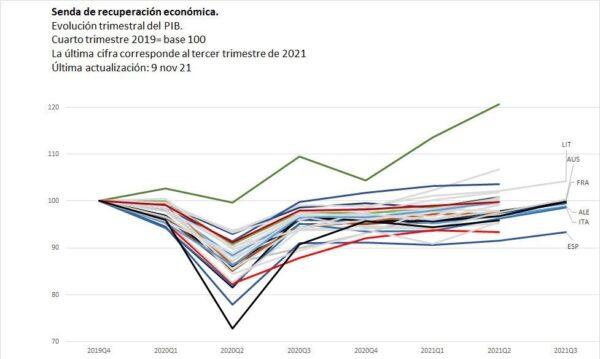
The Spanish government and its supporters question the GDP figures, which show a very poor recovery, lagging behind the OECD and European Union, stating that employment is recovering stronger therefore the GDP figure must be wrong.

Employment is bouncing at a 4% pace after a massive slump in 2020, consistent with a poor 4.5% GDP recovery after a 10.8% collapse in 2020. However, working hours have fallen, most of the jobs recovery comes from the public sector and there are 259,000 furloughed jobs (ERTE, 125,000 and 134,000 self-employed without activity) counted in the employment figure.

The November figures are not “record” nor “extraordinary” as the government trumpets.

Between November 2019 and November 2021, the Government has increased enrollment in the public sector by 211,800 people. In that same period, affiliation to the private sector has fallen by 68,133 people, according to data from the Ministry of Labor.

In November, there are almost 70,000 fewer affiliated people in the private sector than two years ago, and there are 125,000 workers in furloughed jobs (ERTE) and 134,000 self-employed in cessation of activity.

Furthermore, the last day of November 110,000 jobs were destroyed, equivalent to the entire average increase in social security affiliation of the month, all accroding to Ministry of Labor data.

The Government boasts of an ’employment record’ where 60% is public employment and furloughed jobs without activity (which count as “employed” in Social Security affiliation figures), while 3.2 million people remain unemployed.

Another very worrying factor, which the INE has reflected in its GDP analysis: hours worked in the third quarter fell 10% compared to the previous quarter and 2.6% compared to the third quarter of 2019.

Of the more than two million contracts signed in November, only 14% of the total are permanent, while 86% are temporary.

Of the new effective affiliated to the Social Security, excluding ERTE and cessation of activity, 78% are from the public sector between February 2020 and November 2021. Between November 2019 and 2021, it is 100%, since net private jobs have been destroyed.

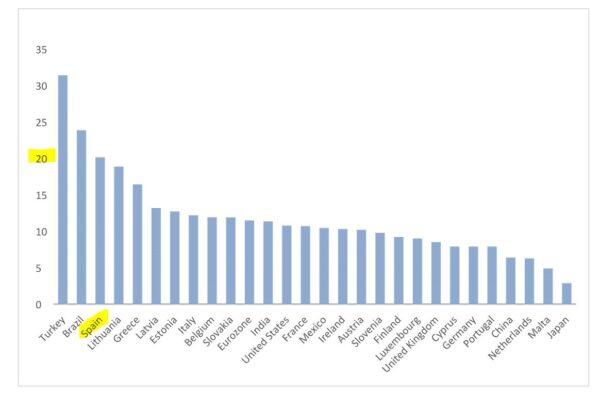
There is nothing to celebrate in a country that, among the large economies, is only behind Turkey and Brazil in the Okun Misery Index, with 20.17%. And with the highest unemployment rate in the European Union. High unemployment and high inflation.

This is serious because Spain’s public accounts are devastated. A government with the largest structural deficit in the European Union and a debt of more than 120% of GDP cannot disguise the employment figures by hiring in the public sector.

The euphoria is worrying when the very document of the Ministry of Labor reflects that the number of jobseekers is much higher: In November there are 4,992,251 jobseekers of which only 1,285,559 are considered “employed.” A figure of 294,422 appears as “with limited availability” and 229,583 as “unemployed jobseekers-TEASS”.

In other words, among those without employment who indicate in their application special working conditions (only at home, telework, abroad, etc.) and unemployed job seekers (DENOS) there is a group of more than 523,000 unemployed people who do not appear in the official unemployment data.

No country with 14.5% unemployment and hundreds of thousands of jobless counted as employed should promote as a ‘record’ or ‘spectacular’ such a poor bounce in employment doped by massive public hiring. Greece did the same and we all know how that ended.

Tyler Durden
Wed, 12/08/2021 – 03:30

via ZeroHedge News https://ift.tt/3oz490v Tyler Durden

Largest Icelandic Utility Cuts Power To Crypto-Miners Amid Grid Crunch

Largest Icelandic Utility Cuts Power To Crypto-Miners Amid Grid Crunch

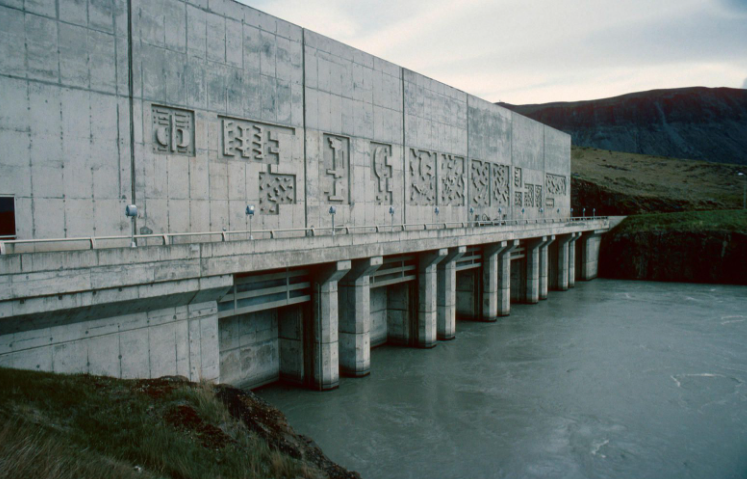
This week, a power crisis has developed in Iceland, forcing the island’s largest utility company, Landsvirkjun, to reduce electricity to energy-intensive industries, such as data centers and metal smelters, including the denial of new power contracts to crypto miners.  

“The reduction does not only apply to fishmeal factories but also to those large users who have curtailable short-term contracts, such as data centers and smelters. Landsvirkjun has also rejected all requests from new customers for energy purchases due to electronic currency mining,” according to Iceland Monitor

All power on the island is generated through renewable sources, with 73% of electricity provided by hydropower plants and 26.8% from geothermal energy, accounting for over 99% of total electricity consumption. The source of the power crisis is low hydro reservoir levels. Another issue is an offline power station and a delay in obtaining additional power sources from a third party. 

Iceland’s problems appear to be very similar to what happened in Europe when wind generation collapsed, forcing the UK and other surrounding countries to transition to natural gas generation to make up for lost power, forcing fossil fuel prices higher on tight supplies. A similar instance occurred in China when Beijing forced utilities to limit power to energy-intensive industries. 

In the last several years, Iceland has been considered Bitcoin’s green energy haven because of cheap power from hydro and geothermal energy sources; but, interestingly (and certainly not in keeping with the globalist climate change narratives), an ecologist in El Salvador said geothermal still costs more than oil, according to Decrypt

As for Iceland, the local newspaper said the power crunch could be resolved by the end of the week. This is another example of how green energy power sources are unreliable and disruptive to the economy if electricity generation lapses. 

Tyler Durden
Wed, 12/08/2021 – 02:45

via ZeroHedge News https://ift.tt/3lMvYR3 Tyler Durden

Poland vs. EU: A Battle Of Political Sovereignty

Poland vs. EU: A Battle Of Political Sovereignty

Authored by José Niño via The Libertarian Institute & Mises.org,

Across the pond, Poland and the European Union find themselves deadlocked over a question about judicial primacy. In early October, Poland’s Constitutional Tribunal sparked controversy when it ruled that EU law does not supersede national legislation.

At stake in the EU-Poland legal dispute, was Poland’s decision in 2018 to rein in its judiciary and establish a disciplinary chamber to remove judges. Before these reforms were undertaken, the Polish judiciary was largely viewed as corrupt and inefficient, possessing vestigial features of the previous Communist order, when Poland was a member of the Warsaw Pact. What initially started out as a mundane domestic reform soon transformed into an international controversy.

AFP via Getty Images

The European Court of Justice (ECJ) took exception to Poland’s reforms and ruled that EU law takes precedence over Polish law. The ECJ’s ruling did not deter Poland, though. Back in March, Polish prime minister Mateusz Morawiecki brought the case before the Polish Constitutional Tribunal, subsequently leading to the Polish tribunal’s controversial ruling in October. Following the October ruling, the EU commission had choice words for Poland’s superior court and reaffirmed its EU-law-über-alles stance.

Possessed by a universalist spirit, the EU ramped up the pressure on Poland by slapping it with a daily fine of €1 million euros (slightly over $1.1 million) until the Law and Justice (PiS, Prawo i Sprawiedliwość) government modifies its judicial legislation to align with EU standards.

The Poles remain intransigent. They know what is at stake. Having gone through a series of partitions in the late eighteenth century in addition to being placed under the Soviet Union’s thumb via the Warsaw Pact in the twentieth century, Poles’ skepticism toward supranational entities and hostile external actors is justified. The former Soviet satellite will not compromise on its sovereignty both as a matter of principle and national identity.

The current tension between Poland and the European Union offers a glimpse of the new kinds of struggles nation-states are confronting in contemporary times. The erosion of national sovereignty is becoming the norm throughout the West as governments grow and political planners find every way possible to build superstates. The EU represents the most significant trial run of such a utopian project. Despite its failed attempts to create a United States of Europe so far, Eurocrats remain committed to their fantastical vision.

The biggest obstacles central planners in Brussels face are the former Soviet satellite states, which have grown skeptical of the EU’s pie-in-the-sky project for the Old Continent. As the largest member of the Visegrad Group, Poland has established itself as an opposing pole to Brussels-style globalism.

Poland’s judiciary reforms are part of a broader set of populist measures that span restricting the resettlement of Middle Eastern migrants within Europe to standing up for traditional cultural norms that have irked the bien-pensants all the way from DC to Brussels. For its defiance of conventional Western political norms, Poland has earned the illiberal democracy label, accompanying its fellow Visegrad Group member Hungary in receiving this dubious distinction.

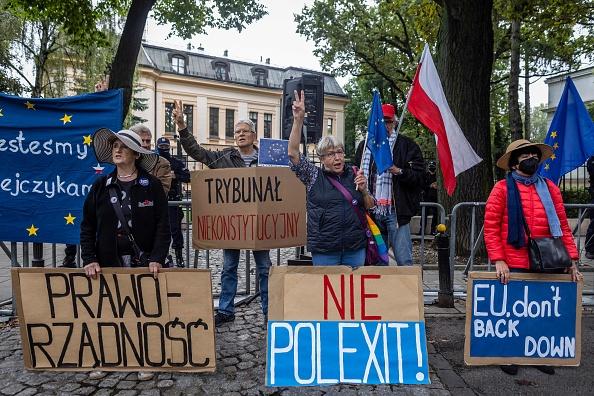
The curious thing about Poland’s fracas with the EU is that Poland doesn’t want to leave the EU, at least not for now. According to various Polish polling firms’ findings, support for leaving the EU has never exceeded 20 percent. Since joining the EU in 2004, Poles have generally held the supranational union in high esteem. Further, Poland heavily relies on intra-EU trade for its exports. Trade with EU members accounts for 80 percent of Polish total exports. Even Prime Minister Morawiecki reiterated that a “Polexit” is not in the cards at the moment.

However, political intentions can change. Eurocrats fail to recognize that the EU’s initial popularity was predicated on reasonable benefits such as free trade between member states, liberalized travel within the EU, and greater diplomatic integration to prevent the kinds of fratricidal wars that devastated the Old Continent during the first half of the twentieth century. The 2016 Brexit vote showed the world that the EU’s power is not yet monolithic and that with the right amount of political will, EU member states can go their separate ways.

The more the EU micromanages Polish internal affairs and punishes Poland for the simple act of exercising sovereignty, the more likely it is to entertain the idea of exiting the EU altogether—a potentially devastating blow to the Eurocrats’ quixotic political project.

Tyler Durden
Wed, 12/08/2021 – 02:00

via ZeroHedge News https://ift.tt/3y985Z4 Tyler Durden