Arbery Trial Judge Delivers Massive Blow To The Defense On Eve Of Closing Statements

Arbery Trial Judge Delivers Massive Blow To The Defense On Eve Of Closing Statements

Authored by Jonathan Turley,

In the Georgia trial over the killing of Ahmaud Arbery, Judge Timothy Walmsley delivered a haymaker to the defense on the very eve of closing statements. 

The court ruled that Georgia’s prior citizen’s arrest law is only applicable if a person sees a felony committed and acts without delay.

The ruling could be “outcome determinative” in the case by stripping away the core defense that these men were chasing a person suspected of a series of crimes over the last year.

Travis McMichael, his father, Greg McMichael, and William “Roddie” Bryan are likely to make this ruling the heart of any appeal if they are convicted.

The judge ruled Friday afternoon that the prior citizen’s arrest law requires that the arrest would have to occur right after any felony crime was committed. Bob Rubin, attorney for Travis McMichael, objected that “if you are going to instruct the jury as you say, you are directing a verdict for the state.”

Judge Walmsley simply responded “I understand the significance of this charge.”

The new law in Georgia removes the right of bystanders or witnesses generally to detain people. Deadly force is not authorized to detain someone unless it is used in the act of self-protection, protecting a home, or preventing a forcible felony. The new law does allow business employees to detain people suspected of theft, including restaurant employees who detain people who try to leave without paying for their meals. Licensed security guards and private detectives are also allowed to detain people.

Georgia, however, still retains its “stand your ground” law, which does not require retreat before someone defends themselves.

Here is the prior law:

O.C.G.A. 17-4-60 (2010)
17-4-60. Grounds for arrest

A private person may arrest an offender if the offense is committed in his presence or within his immediate knowledge. If the offense is a felony and the offender is escaping or attempting to escape, a private person may arrest him upon reasonable and probable grounds of suspicion.

Walmsley’s interpretation is that even if the offense is committed in a person’s presence or within his immediate knowledge, they must act contemporaneously with that observation.  The active language of the second line would seem to support that meaning of an immediate response to the observed crime.

The defense could appeal this ruling and will likely do so with any conviction. One can read the first line to mean that the qualification elements refer to personal observation or knowledge. The second line could then mean that the person, upon confrontation or identification, is attempting to escape.  Moreover, if it is not “committed in his presence,” it is a bit unclear what “within his immediate knowledge” means. It clearly cannot mean the same thing as “committed in his presence.” Thus, it suggests that someone has been informed of the status of the suspect as an offender. Of course, that could still mean, as Judge Walmsley suggests, that the knowledge was “immediate” to the crime like assisting an actual witness to the crime.

The history of this provision is highly controversial. Indeed, the problem is that the court must rely on past courts interpreting a law with a horrific legacy not just during the Civil War but later during the Civil Rights movement.

The law was created in 1863 and was designed to allow whites to capture fleeing slaves.  The defense could argue that such a purpose contradicts Walmsley’s immediacy element since fleeing slaves could be captured days or weeks after escape. However, the appellate court could rule that the escape was, at that time, considered a crime in progress and thus remained an immediate or ongoing crime.  The appellate court will have to weigh past cases on how the law was interpreted.

Whatever happens on appeal, the ruling cut the legs away from the defense. This is a common risk in criminal cases where you build a defense based on an interpretation that the court later rejects on the eve of closing arguments. In my view, courts should avoid this problem by ruling on such threshold legal issues before the trial.

As I have noted throughout the trial, both the prosecution and defense counsel were strong in the case. The defense counsel did an effective job in having McMichael go through his training in the Coast Guard. At points he sounded like an expert witness on law enforcement and the use of force. The prosecution did an excellent job in showing that there was no evidence that Arbery had actually stolen anything and how McMichael continued to pursue him as Arbery tried to avoid the trucks.

Defense counsel took a considerable risk in putting Travis McMichael on the stand. As a defense attorney, I see the justification for the risk. Indeed, this ruling increases the need for such a Hail Mary play.

The thrust of such testimony is not acquittal, which always seemed unlikely. The videotape in the case is too chilling to expect an acquittal. The scene of these men chasing Arbery in their trucks was incredibly upsetting for many of us who watched the videotape. It was equally unnerving to see a law designed to chase down slaves used as a defense. 

The testimony of McMichael was more likely part of a strategy for a hung jury — trying to create just enough of a connection with the defendant or reasonable doubt to sway a couple of jurors. Hearing from the defendant can create that type of connection.  While McMichael made admissions like the fact that Arbery did not threaten him before they struggled for the gun, that fact was already obvious from the videotape and the testimony of witnesses. The defense was trying to rebut the image of the videotape showing McMichael shooting Arbery and then walking away. That is not likely to sway an entire jury as opposed to a couple members. However, you need only one holdout for a hung jury.

Tyler Durden
Mon, 11/22/2021 – 06:30

via ZeroHedge News https://ift.tt/3FAnfJc Tyler Durden

Lost in Transition


decker

Reason‘s December special issue marks the 30th anniversary of the collapse of the Soviet Union. This story is part of our exploration of the global legacy of that evil empire, and our effort to be certain that the dire consequences of communism are not forgotten.

The Soviet Union has been gone for 30 years now, having passed away without ceremony as the red flag was lowered from the Kremlin on December 25, 1991. It was created by a small but disciplined and fanatical sect who saw their chance and made their move in October 1917, when Russia was broken and starving from World War I and nominally governed by a wobbly coalition after the overthrow of the tsar eight months earlier.

“Power was lying in the streets, and we picked it up,” said Vladimir Ilyich Lenin, the revolutionary leader and founder of the Soviet state.

After promising “bread and peace,” Lenin launched one of the most repressive political and economic systems ever devised. Over a century later, its shadow still looms over Eurasia. For societies held in its grip, reform has proved risky and complex. In Russia, efforts to unravel Lenin’s handiwork are incomplete and have partly backfired, helping spur the creation of a new kind of authoritarian structure.

Lenin and his successor, Josef Stalin, conducted a strange and vicious experiment on the populations of Russia and an expanding realm of captive nations. Claiming that private enterprise inevitably leads to exploitation of workers, they sought to eradicate it, using all the violence and terror they could muster. Factories were nationalized. Farmland was confiscated. Livestock and seed were seized.

As his comrades routed the resistance, Lenin vowed that “we will make our hearts cruel, hard, and immovable, so that no mercy will enter them, and so that they will not quiver at the sight of a sea of enemy blood. We will let loose the floodgates of that sea.”

And so they did. Historians and statisticians debate the final tally of the dead from the terror campaigns, show trials, summary executions, induced famines, and concentration camps. But they are certainly responsible for one of history’s most lethal chapters of mass murder. Stalin biographer Simon Sebag Montefiore attributes about 20 million killings to the Stalin era alone. Yale historian Timothy Snyder estimated 6 million deliberate killings for Stalin, 9 million if other foreseeable deaths are included. Robert Conquest of Stanford put the total deaths for Lenin and Stalin at no less than 15 million.

The Soviet regime was built by men like Vasily Blokhin, awarded the Order of the Red Banner for his “skill and organization in the effective carrying out of special tasks,” most notably, delivering a bullet point-blank to the back of the head for 7,000 prisoners in just 28 days. Blokhin worked in a brown leather butcher’s apron. It helped with the mess.

The mass violence and terror served to build a new society, in which all significant assets were in the hands of the state and virtually all economic activity was supposed to be controlled by central command. All production, farming, and distribution for the largest country in the world, spanning 11 time zones, were directed from an office complex in Moscow, housing an economic planning super-agency called Gosplan.

Colossal waste and misallocations caused periodic famines and constant shortages. Even in the best of times, ordinary people waited in lines stretching around city blocks to buy necessities and bartered with family and friends to get by. Meanwhile, the communist elite were served by well-supplied shops with display windows discreetly covered in long gray curtains and with admission by invitation only.

Some of the greatest cruelties came after Soviet leaders discovered how much buried treasure there was in the country they ruled. The richest prizes of minerals and fossil fuels were locked tightly in the permafrost of the Arctic Far North and the Siberian taiga. To break through the frozen ground and extract this treasure with ordinary wage labor would have required massive investment upfront in heavy machinery, transportation, housing, and facilities, as well as high wages to attract workers to endure the hardships and risks of life in places not fit for human habitation.

The Soviet leadership found a cheaper way. They developed a network of “corrective labor camps,” which provided forced labor to build railways, dig canals, construct factories, and work in mining, processing, and shipment of ores and fossil fuels, as well as in logging and other industries requiring heavy and dangerous labor, particularly in remote areas with the most brutal climate. According to historian Anne Applebaum, writing in the June 15, 2000, New York Review of Books, high-level planning discussions among Soviet leaders in 1929 about expansion of the camp system focused on “how many prisoners would be needed to extract the resources of the ‘underpopulated areas,’ a euphemism for the barely habitable far north.”

The network of camps that was created came to be known as the gulag, an acronym of the Russian words for “main administration of corrective labor camps.”  Some of the prisoners sent to corrective labor camps were common criminals, but the majority were people convicted of “political” or (even more commonly) “economic” crimes, which came to be very broadly defined. It is likely that these crimes became so broadly defined and enforced in part to assure an adequate supply of labor for the gulag.

As Applebaum recounts, getting caught twice for being 10 minutes late for factory work could be considered “desertion” and garner a 5-year sentence. According to Alexander Solzhenitsyn, an audience at a political conference vigorously applauded the name of Stalin for 10 minutes, with everyone afraid to be the first to stop because secret policemen were there; a local factory director who was finally the first to stop clapping was arrested and sentenced to 10 years. After 1929, being identified as a kulak—a peasant farmer who had prospered enough to own land and several head of cattle or horses—was enough to be condemned as a class enemy and dispatched with a bullet or sent to the gulag.

A sentence to the gulag carried a high risk of death, especially for the old and weak. Among the worst was the Butugy-chag Corrective Labor Camp in the Kolyma mountains of northwestern Siberia. Prisoners there mined uranium without protective equipment. Life expectancy was reportedly measured in months.

Can a people escape a history like this and make a normal life? Now that a full generation has passed since the collapse of the Soviet system, a preliminary assessment can be made. At least for Russia—just one of the 15 countries formed from the vast territory of the Soviet Union—it does not look promising.

But perhaps it could all have been different. In the effort to build a prosperous economy and free society from the husk of the Soviet system in the 1990s and afterward, serious mistakes were made, and some seriously misguided ideas prevailed. While the Russian people are responsible for their own fate, it must be said that some of the mistakes and bad ideas came from the United States.

Buried Treasure in the Frozen Ground

To understand what happened after the Soviet collapse, it helps to track the development of one enterprise, now called Norilsk Nickel, a mining operation named after the city where it was founded. Located deep inside the Arctic Circle, Norilsk is today the northernmost city in the world with more than 100,000 in population. With savage windstorms and temperatures averaging negative 23 degrees Fahrenheit in January, Norilsk appears unfit for human life and work.

But as Stanford historian Simon Ertz relates in the 2003 book The Economics of Forced Labor: The Soviet Gulag, in the early 1930s, the young Soviet regime discovered signs of untold wealth in the barren area that would become Norilsk. A geological survey team identified vast deposits of nickel as well as copper, cobalt, and platinum. Nickel was the most valuable prize for its use in making stainless steel for military production. Estimates of the size of nickel deposits there were regularly raised as new measures were taken, and by 1939 the regime concluded that perhaps more than a quarter of the world’s recoverable deposits of nickel were in the area. Large deposits of coal were also conveniently nearby to provide power for smelting and transportation.

But how to recover all of this bounty? Development of the complex was initially under the jurisdiction of the Ministry of Heavy Industry, but little progress was made in building infrastructure. In 1935, responsibility was transferred to the People’s Commissariat for Internal Affairs—the notorious predecessor of the KGB—which was responsible for administering the gulag. The site was renamed the Norilsk Corrective Labor Camp (abbreviated Norillag in Russian). The first contingent of more than a thousand prisoners arrived almost immediately.

Prisoners who had to break through the permafrost worked with only pickaxes and wheelbarrows. Most did not have boots. A 1936 report from Norillag unearthed by Ertz—sent to Moscow to explain the slow progress to an impatient Stalinist administration—vividly describes the conditions. Prisoners “work under permafrost conditions, under the most severe snowstorms, which dissipated their energy and mental state. Only a person who had experienced it himself knows what it means to preserve the necessary vitality and working energy after months of constant winds with a force from 18 up to 37 meters per second that blow continuous clouds of snow, so that visibility is about 2 meters. Stray workers were lost due to loss of orientation. They had to work in temperatures reaching 53 degrees below zero [Celsius].”

According to Ertz, the timing of this report—at the outset of Stalin’s Great Purges—proved unfortunate for the general manager of Norillag. In that mass political repression from 1936 to 1938, in which about a million Communist Party functionaries, military officers, managers, and others were killed, the Norillag manager too was arrested, tried, and sentenced to death for dereliction. Although his sentence was later commuted to incarceration, he died a prisoner.

In the mid-1950s, after the death of Stalin, the gulag system was mostly dismantled. While political repression continued, and dissenters remained vulnerable to arrest and imprisonment, the system of slave labor organized through the gulag was no longer a cornerstone of the Soviet economy.

With these changes, the mines and supporting enterprises of Norilsk ceased being operated as a penal camp. But many of the “free laborers” who lived and worked there after the Stalin era were former prisoners with nowhere to go, no means to leave, or no permission to relocate under the Soviet internal passport and migration system. So they remained, many for the rest of their lives, stranded in one of the coldest and most polluted places on Earth.

Meanwhile, the Soviet system as a whole, after impressive economic growth rates in the 1950s and 1960s under Nikita Khrushchev, slid into a period of gray stagnation under Leonid Brezhnev and his successors.

After the reformer Mikhail Gorbachev became general secretary of the Communist Party in 1985, there was some loosening of the command economy, with cooperatives allowed to operate businesses with more independence, and with more flexibility for managers of enterprises.

At Norilsk, operations were restructured and combined with other nickel mining ventures in the far northwest of the country to become, by 1989, the Soviet enterprise known as Norilsk Nickel. Norilsk Nickel, built at such enormous cost in human suffering, would be at the center of struggles for power and wealth in Russia over the next decade. Its fate illustrates what has become of Russia, and why.

Freedom and Chaos

The period from 1989 to 1991 saw one of the largest and most peaceful geopolitical transformations in world history. First the Soviet satellite states in Eastern Europe seized by Stalin in World War II broke away. Unlike in 1956 and 1968, when Hungary and Czechoslovakia tried to set their own courses, the Soviet Union did not send tanks and troops to quell the freedom movements.

Then, starting with the declaration of independence by the Baltic Soviet Republic of Lithuania in March 1990, the Soviet Union itself broke apart, with final dissolution happening at the end of 1991. The 15 former Soviet republics, with their state-controlled economies commanded and coordinated from Moscow, became independent countries.

There was a chance for freedom. But there was also an immediate need to continue feeding populations that had just seen the only system they ever knew dissolve into nothing. All that was solid melted into the air.

The 1990s in Russia and throughout most of the former Soviet Union were a time of dizzying change, new freedoms, disorder, banditry, and widespread hunger. In June 1991, Boris Yeltsin became the first democratically elected president of the Russian Republic. He would become the leader of an independent Russian Federation after the Soviet Union collapsed later that year. Soviet strictures on private property ownership and business operations were reformed, new enterprises flourished, and media and entertainment, already increasingly free under Gorbachev, were unleashed. Many of the young and entrepreneurial seized new opportunities. Foreign investment and Western advisers flowed in.

But the cradle-to-grave employment and benefits provided by the Soviet command economy also disappeared. The elderly and children were particularly vulnerable, as Soviet support systems collapsed and pensions and savings evaporated.

As price controls were lifted and the money supply increased, inflation exploded. In 1992, Russian inflation was about 2,000 percent, with another 1,000 percent inflation the following year. Life savings disappeared almost overnight. In major cities, the elderly could be seen selling their books, clothes, and furniture on the street to buy food or rummaging through garbage.

According to World Bank figures, the mortality rate from 1990 to 2000 jumped from 11.2 per 1,000 people to 17.1. Life expectancy for Russian men plummeted from about 65 in the late Soviet period (1987) to 55.5 in 1994, with a less dramatic drop for women. Much of the increased mortality was attributed to alcoholism, suicide, and other causes associated with destitution and despair.

Russians also started having far fewer babies. Between 1989 and 1999, fertility in Russia declined from 2.01 to 1.16 births per woman, an historically unprecedented drop signaling demographic collapse. And large numbers of children were abandoned, some left at woefully undersupplied orphanages and others ending up on the street. By the end of the decade, based on estimates from the Russian government and the United Nations, there were about 3 million homeless Russian children.

These plummeting social indicators were all tied to the disastrous performance of the Russian economy, a chaotic mix of large enterprises still under state control, a central government heavily in debt and in arrears for pensions and wages, liberalized consumer prices, and burgeoning new private enterprises (some legal and some not).

Some prospered, none more than the “New Russians,” a rising class of businesspeople who built new enterprises and amassed quick fortunes, sometimes using criminal methods to take advantage of the tumult and lawlessness of the time. The most successful of the New Russians grew into the oligarch class of the superrich who dominate Russian business and politics to this day. But much of the population was left bewildered, sidelined, and underfed.

The ‘Crown Jewels’

The fall in living standards and increasing misery for much of the Russian population in the early and mid 1990s led to bitterness. Nostalgia grew for the old Soviet system, which had provided meager but reasonably reliable sustenance in its last decades, particularly among older Russians who were unable to adapt and fend for themselves.

After the 1995 parliamentary elections, the reconstituted Communist Party led by Gennady Zyuganov and allied parties controlled almost half of the seats in the Russian parliament, or Duma. Meanwhile, President Yeltsin’s approval in opinion polls fell as low as 6 percent. The Communist Party had a serious chance to retake control of Russia in the 1996 presidential elections. That prospect alarmed both the Yeltsin government in Moscow and its supporters in Washington. Both concluded that dramatic action should be taken to stave off a Communist political victory and prevent a return to Soviet-style state ownership and central command.

Although the Yeltsin government had experimented with privatization measures, the “crown jewels” of the former Soviet economy—in sectors such as oil and gas, mining, and steel production—remained under state control. Many large enterprises were controlled by so-called “red directors,” holdovers from the old system who sympathized with the Communist Party, resisted modernization, and were often accused of feather-bedding and corruption.

A young banker and rising oligarch, 34-year old Vladimir Potanin, had a bold idea that he sold as a way in one fell swoop to fund the cash-strapped Russian government, support the reelection of Boris Yeltsin, defeat the Communists, eject the red directors, establish private ownership and modern management in the crown jewels, and thus take Russia on an irreversible path to capitalism.

Under the scheme, called “loans for shares,” the Russian government would borrow large sums of money from banks to help pay its arrears on wages and pensions and would post shares in the crown jewels as collateral. The lending banks were given the temporary right to manage and profit from the industrial assets posted as collateral. Presumably, the lenders would restructure and modernize management (eliminating the red directors along the way) to maximize their profits. And if the government did not repay the loans, the industrial assets would be sold at auction. The lending banks themselves would serve as auctioneers.

But—and this was crucial—the auctions of shares would not occur until after the 1996 presidential elections. And as everyone knew, if the Communist Party won, the auctions would never happen. The Communist Party would never allow the crown jewels to be released from state ownership.

As a mechanism to assure reelection of the deeply unpopular Boris Yeltsin and defeat of a resurgent communist movement, the plan succeeded masterfully. The oligarchs who lent to the government and wanted permanent ownership of the enterprises they took as collateral had a powerful incentive to fund and promote Yeltsin’s candidacy. Indeed, much of the mass media in Russia at the time was owned by these same oligarchs, so they used their TV and print media to promote Yeltsin and vilify his Communist opponents in saturation coverage, often by tying the Communists to the gulag and other aspects of their brutal past. In the end, although there were accusations of election fraud, Yeltsin beat Zyuganov handily, 54–41.

But as a method of privatization and transition to an efficient and fair market economy, the loans-for-shares scheme was a world-historic disaster. Predictably, the government did not repay the loans. The scheme left the banks free to manipulate the ensuing auction process, and they took full advantage.

For example, Vladimir Potanin, who devised the loans-for-shares scheme and participated by lending to the government through his bank, ultimately sold the enterprise shares posted as collateral through an “auction” to his own bank. The name of the enterprise that Potanin’s bank acquired? Norilsk Nickel.

Potanin’s bank took control of Norilsk Nickel for $171 million, half of what a rival Russian bidder was willing to offer. Foreigners were excluded entirely from the process, which assured that a price below market would prevail even if the bidding had not been rigged. Although conditions have obviously changed, the company Potanin secured for $171 million now has a market capitalization of about $50 billion.

The other oil-and-gas and metals enterprises privatized through the loans-for-shares program were similarly “auctioned” for small fractions of their value in rigged transactions, to the benefit of oligarchs who, like Potanin, had cultivated connections with the Yeltsin administration. Although the sales process was anything but transparent, the fraud was open and notorious.

The Russian loans-for-shares scandal is now largely forgotten in the United States. But in Russia, it is well-remembered and often associated with economic advisers from Harvard University who were funded by the U.S. Agency for International Development (USAID) and close to the Yeltsin government. While they disavow the corrupt execution, these American advisers encouraged at least some aspects of the scheme, while allegedly also in some instances enriching themselves.

As David McClintick wrote in the January 13, 2006, edition of Institutional Investor, “while still holding oil shares, [Harvard economist Andrei] Shleifer wrote a memorandum to Russian officials advocating the inclusion of oil stocks in a program to distribute Russia’s energy assets to rich entrepreneurs in exchange for loans to the government.” Former Moscow Mayor Yuri Luzhkov and current Russian President Vladimir Putin have both reminded Russian audiences of the perceived American role in the despised loans-for-shares scheme.

In the end, there is no dispute that the crown jewels of the Soviet economy were essentially stolen. In a touch of bitter irony, some Russians referred to these events as “primitive accumulation,” Karl Marx’s term for the processes that enabled land and other productive assets in late feudal England to be concentrated in the hands of a few while others were dispossessed.

Little wonder that polling by Pew Research Center found that support among Russians for a free market economy fell from 54 percent in 1991, the year of the Soviet collapse, to 42 percent in 2011. Similarly, Gallup found that in 2007 only 35 percent of Russians thought “creation of a free market economy that is largely free from state control” was “right” for the country’s future, with 41 percent saying it was “wrong.”

Predictably, the drop in support for economic freedom has been accompanied by increasing support for political authoritarianism. According to Pew, support for “democracy” instead of a “strong leader” among Russians declined from 51 percent in 1991 to 32 percent in 2011.

A majority of the Russian people were eager for free markets and democracy in 1991. That support was lost in the ensuing decade of disorder, hunger, and colossal theft, perhaps forever.

Vulgar Coase-ism

Did privatization have to be dirty? Russia in the 1990s was tumultuous, violent, and highly corrupt. It was (and still is) a land without rule of law. It would likely have been impossible to design a process for selling off valuable industrial assets using the institutions in place at the time to assure fairness and transparency.

Another approach might have been to postpone privatization of the crown jewels, foster growth of the small-business sector through low taxes and light regulation, and wait until the rising class of self-made small business owners were able to force creation of honest institutions to support their sector, including reliable courts.

In an influential 1990 book, The Road to a Free Economy, Hungarian economist János Kornai had warned against “the offensive and irresponsible liquidation of state ownership,” noting that “there are a number of institutions that can evolve soundly only as the result of an organic historical development.” Perhaps if Kornai had been heeded, privatization of the crown jewels could have been accomplished later, without gargantuan theft.

But surprisingly, an idea in wide currency at the time held that the gargantuan thefts through privatization just didn’t matter. The theory, which purported to derive from the ideas of the late British economist Ronald Coase, went something like this: Anyone who comes to own an enterprise will want to extract the maximum value from it. If the owner knows how to operate the enterprise most efficiently to maximize profit, he will keep it. If he doesn’t, he will have every incentive to sell the enterprise to someone who does know how to maximize profit, because that buyer will pay premium dollar for the opportunity.

Thus, no matter how dirty the process necessary for getting productive assets away from the state, it should be done immediately. All that matters is that the assets get into the hands of someone who can resell them for profit. Economic incentives will naturally move the assets from one owner to another until they land in the hands of someone with the skills to use them for greatest profit, thus extracting maximum value for himself and also for society.

Potanin was still offering the Coasean defense in a 2018 interview with the Financial Times. He conceded that the loans-for-shares deals were unfair and had made him “incredibly rich” (with a net worth at the time of the interview of about $16 billion) but argued that the “choice was not between being fair and open or creating oligarchs. It was whether to leave these companies in the hands of [former Soviet] red directors and forget efficiency forever, or sell them in any way possible.”

It should be noted that Coase, who was alive and working at the time of the loans-for-shares scheme, is not known to have ever endorsed this alleged corollary of his famous theorem, which posits that parties with conflicting property rights should be able to come to efficient arrangements through bargaining. Indeed, he was always careful to emphasize the severe limiting conditions of his theorem, including perfect information between the parties, competitive markets, zero transaction costs, and a costless court system.

Such nuances were lost on proponents of fast and dirty privatization in Russia. Skeptics, including the Hungarian economist Kornai, dubbed their thinking “vulgar Coase-ism.”

Robber Barons for Rule of Law

A similarly optimistic notion in the mid 1990s held that getting productive assets into private hands, however accomplished, would create demand for rule of law and would ultimately lead to the rise of clean courts, better government, and a more limited state. The idea was that putting Soviet assets into private hands would help trigger a process replicating the rise of the bourgeoisie in Western countries, but in compressed time.

Private owners would want a reliable system of property rights and courts for adjudicating them to protect what they had acquired. And as the wealthiest members of society, they would have the power to assure that appropriate institutions were built. All of society would then benefit from the just and efficient institutions they pushed to create.

As Maria Popova of McGill University drily observed in the Spring 2017 issue of Daedalus, “the robber-barons for rule of law transformation has been expected for two decades; but we have yet to see any indications that it will happen.”

Apparently, the proponents of fast and dirty privatization were missing something. In fact, they misunderstood the nature of private property, rule of law, and the state.

To be stable, property rights require public legitimacy, institutional backing, and incentives for elites to support and uphold them. The loans-for-shares scheme assured that Russia would have none of these. “When you buy state assets in such a dubious backroom deal and at such a steep discount to market, chances are your property rights will never be truly secure,” the late American journalist Paul Klebnikov wrote in the November 17, 2003, Wall Street Journal. “You will always be regarded by the population as a crook and by the government as more of a custodian of state assets than an owner.”

Further, oligarchs who acquire industrial assets through dirty privatization will likely have a vested interest in preventing development of the rule of law or limits on the role of the state. Oligarchs invest resources to foster a comparative advantage in activities such as bribing judges and currying favor with parliamentarians and officials, and also sometimes build their own private means of enforcing contract and property claims through hired agents of force.

Why would oligarchs push to reform the lawless system they have mastered, at substantial cost? Well-defined property rights and a fair and neutral system for adjudication would deprive them of the benefits they can accrue from their position of advantage. The situation is wasteful and curbs broader economic development, but according to University of Chicago economist Konstantin Sonin, “if the rich [in Russia] have enough political power to choose the level of public property rights protection, the economy may be locked in a stable long-run equilibrium with weak public protection of property rights.”

Klebnikov was right that oligarchs who acquire assets in dirty privatizations will always be regarded “by the government as more of a custodian of state assets than an owner.” After assuming the Russian presidency in 2000, Putin moved aggressively to reassert the state’s prerogative over the crown jewels of the Russian economy in the extractive industries, regardless of who formally owned them after the 1990s privatizations.

As described by energy industry experts Andrei Belyi and Samuel Greene in their 2012 paper, “Russia: A Complex Transition,” Putin arrived at a settlement with the oligarchs resting on “two interlocking rules.” First, private ownership of major Russian enterprises does not confer permanent enforceable rights; rather, “all resources within the economy belong to the system as a whole” and “can be redistributed by the state in order to maintain balance in the system.” Second, bases of power independent from the state will not be tolerated; “no player may seek to mobilize resources from outside the system (whether political or economic) to gain leverage or comparative advantage.”

Fealty is expected: “Those who play by the rules know that they may be deprived of their assets, but maintain a high degree of certainty that they will be rewarded for their loyalty with other assets in return.” But if any resist? They are “removed from the game permanently,” according to Belyi and Greene.

As examples of the fate of resisters, they cite the fallen oligarchs Vladimir Gusinsky, Boris Berezovsky, and Mikhail Khodorkovsky, who were famously forced into exile (or in the case of Khodorkovsky, into a modern-day penal labor camp) after crossing Putin. As additional assurance against challenges to his power, Putin also took most of the major mass media companies under state control.

To be fair, Putin restored a measure of stability to the country and oversaw some improvements in living standards for much of the population, particularly in the early years of his presidency. Teachers’ salaries that had gone six months in arrears under Yeltsin were paid on time. The real value of pensions increased. And maternity and child benefits were enhanced, in part to stem the demographic collapse.

Those efforts have been at least partly successful. The number of births per woman rose from about 1.2 in 2000 to about 1.78 in 2015. Life expectancy for men has risen back to about late Soviet levels, and life expectancy for women appears to be higher than in late Soviet times. Some of these improvements may be attributed to the steep rise in global oil prices that began early in Putin’s rule, which fattened state coffers and funded higher wages in the oil-dependent Russian economy. But progress on social indicators seems to have been mostly maintained even as oil prices have fallen and international economic sanctions have been imposed on Russia since 2014.

But that stability and relative prosperity have come at a cost. According to a 2021 country report from the think tank Freedom House, “Power in Russia’s authoritarian political system is concentrated in the hands of President Vladimir Putin. With loyalist security forces, a subservient judiciary, a controlled media environment, and a legislature consisting of a ruling party and pliable opposition factions, the Kremlin is able to manipulate elections and suppress genuine dissent. Rampant corruption facilitates shifting links among bureaucrats and organized crime groups.”

The current corporate ownership arrangements in Russia, in addition to being politically authoritarian, seriously retard the country’s economic growth. “Owners” who can be expropriated at any time have an incentive to extract as much short-term profit as possible and not to invest in innovation and long-term growth. They will tend to pursue unproductive activities that prevent expropriation, such as bribing officials and judges and cultivating relationships with superiors in the hierarchy.

“In the real world, bad initial owners loot enterprises…and corrupt the government while they’re at it,” noted Bernard Black, Reinier Kraakman, and Anna Tarassova in a July 2000 article in the Stanford Law Review. “Call it the triumph of [Friedrich] Hayek over Coase—of Hayekian respect for endogenously developed traditions over the abstract promise of the Coase-influenced mass privatization schemes.” Or we might call it the vindication of János Kornai and his warning of the need for “organic historical development of institutions” over the advice of the Harvard economists funded by USAID. Either way, fast and dirty privatization did not lead Russia to democracy and free enterprise.

Doing Business Under Putin

Despite skewed incentives, some Russian business leaders do aspire to transform their enterprises into efficient and well-managed world-beating competitors. An interesting and perhaps surprising example appears to be Vladimir Potanin, instigator of the loans-for-shares scheme and part owner of the highly profitable former slave-labor enterprise Norilsk Nickel.

Starting in 2001, Potanin and his then-partner Mikhail Prokhorov (future owner of the Brooklyn Nets) began a business restructuring with the goal of competing with global mining giants such as Rio Tinto, BHP Billiton, and Anglo American. As recounted in the journal Resources Policy by David Humphreys, a British mining industry expert and former chief economist for Norilsk Nickel, the company sought to raise its governance, transparency, management quality, and internal processes to “win the respect and trust of international investors” and “compete on the world stage.” Over time, its investments in modernization rose to $1 billion a year. The company also brought in new talent with world-class expertise, including Humphreys and Leonid Rozhetskin, a Russian-American financier and graduate of Harvard Law School.

For a while, Potanin and Prokhorov succeeded. They managed to diversify by acquiring Montana palladium producer Stillwater Mining, then additional assets in the U.S., Finland, Australia, South Africa, and Botswana. By 2008—which Humphreys views as “the high-water mark” of Norilsk Nickel’s transformation—the company achieved a market capitalization of $60 billion, ranking as the sixth-largest mining company in the world by that measure.

But like every major Russian company, Norilsk Nickel had to pay tribute to survive. In August 2008, the company hired Vladimir Strzhalkovsky as its chief executive. A longtime associate of Putin who served with him in the KGB, Strzhalkovsky had no background in mining; his prior business experience was in promotion of tourism. When he left the CEO position in late 2012, Norilsk Nickel paid him a $100 million severance package, the largest in Russian history.

The same year that Strzhalkovsky was hired, the oligarch Oleg Deripaska acquired a major stake in Norilsk Nickel through his aluminum company Rusal, triggering a feud over control between Deripaska and Potanin that continues to this day.

Putin, the ever-present arbiter in the background, has occasionally intervened. When Potanin and Deripaska were battling over the size of the company’s dividends in 2010, Putin paid a visit to the company’s Arctic headquarters and mentioned that it had paid “unusually high” dividends the previous year, thus signaling that Potanin’s push to lower dividends should prevail. Such is corporate governance in the Russian Federation.

As long as Putin stays healthy, the current system is probably stable. The rules of the game have been established. Occasional transgressors are dealt with severely and publicly as deterrence.

These arrangements certainly depress productivity. Feeding a population of 145 million, the Russian economy is today the 11th largest in the world, smaller than Canada’s, which has only about 38 million people. And in GDP per capita, Russia has fallen far behind its fellow former Soviet republics in the Baltic region, with output per person about half of Estonia’s and about 40 percent less than Lithuania’s and Latvia’s. Not coincidentally, the Baltic countries all rank in the top 30 in the world in the Heritage Foundation’s 2021 Index of Economic Freedom (with Estonia at No. 8), while Russia ranks 92nd. But other former Soviet republics, including Ukraine and Moldova, lag well behind Russia in output per person, aggravated by Putin’s intrusions and aggression.

Putin’s economic governance is at least better than Soviet central planning. The key to the system, though, is an established and accepted central arbiter. Putin, now 69 years old, appears to have done nothing either to cultivate a successor or to build rules of succession into the game he created. Russians are left with a stagnant society and the fear that the ruinous instability of the 1990s could return.

Could it all have been different? Many believe that Russia is driving in the well-worn grooves of its history and that the only alternative to chaos and hunger for Russia is the grip of a strongman at the wheel. It is indeed eerie how much Putin has emulated the tsars, controlling the distribution of wealth and power among the modern aristocracy to assure that his absolute rule can never be challenged.

But those who think this was inevitable seem to have forgotten the spirit of 1991. There was so much hope. And there was good reason for it. At the time of the Soviet collapse, Russia had arguably the best-educated population in the world. It had unquestionably the world’s largest science and technology community, with more engineers than any other nation and a tradition of excellence that put the first man in orbit and built the Mir space station. It had the world’s richest literary heritage. It had produced moral leaders of astonishing strength and courage who stood up to the Soviet regime, including Solzhenitsyn, Andrei Sakharov, and Yelena Bonner. And it had vast wealth in natural resources to fund a better future, in some instances developed at appalling human cost by people like the prisoners at Norillag.

A young foreigner who had the good fortune to spend evenings drinking and talking with Russian friends in a cramped Moscow kitchen during the late Soviet period could feel that a great destiny would unfold for Russia as soon as communism was discarded. These people were ready, and they deserved it.

But the decade that followed was a tragedy and a farce. It became so because of the choices made by powerful people, from American advisers with misplaced priorities to a disengaged and dissolute leader in Boris Yeltsin—notorious for showing up drunk at summits—to predatory oligarchs pulling off the greatest heist in history. From the high hopes of 1991, the disasters that followed nearly broke Russia and made Russians aim low, with many willing to forfeit their freedom for stability and sustenance. Promises of bread and peace won again.

Could it have been different? We can never know. But the people who might have given Russia a chance let everyone down.

The post Lost in Transition appeared first on Reason.com.

from Latest – Reason.com https://ift.tt/3x7M4cw
via IFTTT

The Sick Man of Central Asia


tajikistan

Reason‘s December special issue marks the 30th anniversary of the collapse of the Soviet Union. This story is part of our exploration of the global legacy of that evil empire, and our effort to be certain that the dire consequences of communism are not forgotten.

Of all the countries to emerge from the dissolution of the Soviet Union, Tajikistan has arguably fared the worst. It ranks 149th out of 180 countries in Transparency International’s Corruption Perception Index, worse than every other former Soviet republic except Turkmenistan. It has the highest poverty rate of the former Soviet republics; a full 27 percent of its gross domestic product (GDP) is the result of remittances sent home by Tajik migrants working mostly in Russia; and its GDP per capita for 2021 ($810) ranks 179th out of the 195 countries for which the International Monetary Fund has data.

Why is Tajikistan so poor? It is landlocked, which means importing and exporting are more expensive and the country is more vulnerable to supply chain disruptions. And the violent civil war that followed the USSR’s fall, which pitted the incumbent Soviet power holders and their militias against a coalition of liberal reformers, anti-Soviet Islamists, and ethnic minorities, killed tens of thousands of people and displaced over 1 million Tajiks.

But geography and past conflict only explain so much. Tajikistan is rich with largely untapped mineral resources, and its mountain ranges are ideal for the kind of ecotourism that has made Nepal one of the fastest-growing economies in the world.

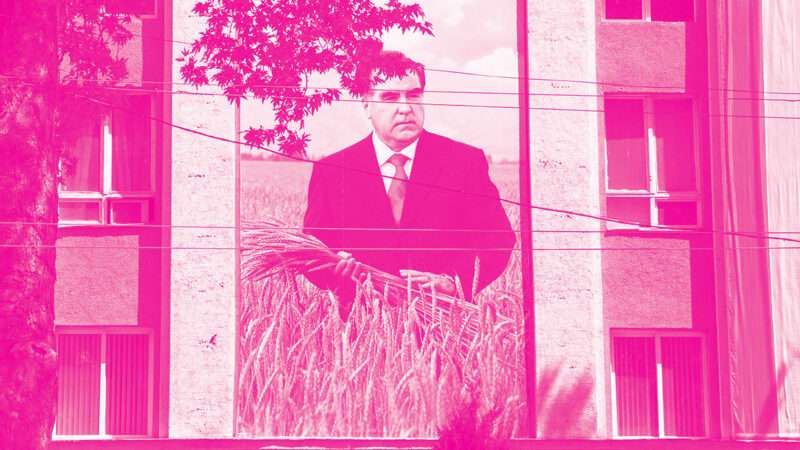
Tajikistan is the sick man of Central Asia because it is ruled by a despot who has enriched himself and his relatives at the expense of millions of his malnourished countrymen. Emomali Rahmon has been Tajikistan’s official president since 1994 and “Leader of the Nation”—a lifetime appointment that provides him with immunity from prosecution—since 2015. In all but name, he is a king.

Like most despots, Rahmon has an ironclad grip on every aspect of his country, from media to business to the practice of religion. Many of his relatives hold key positions of power, with his son Rustam serving as the mayor of the capital city, Dushanbe, and one of his sons-in-law holding a key position at the National Bank of Tajikistan.

Rahmon’s rule has been predictably poor not just for the rights of Tajiks but also for the country’s economy. The Economist found that a state-owned aluminum refining operation overseen by the Rahmon family has been routing hundreds of millions of dollars annually to a shell company in the British Virgin Islands.

While Tajikistan has welcomed foreign investment with open arms and nominally generous terms, it has found few takers. According to a 2020 U.S. State Department Investment Climate Statement, “bureaucratic and financial hurdles, widespread corruption, a largely dysfunctional banking sector, non-transparent tax system, and countless business inspections greatly hinder investors.”

The post The Sick Man of Central Asia appeared first on Reason.com.

from Latest – Reason.com https://ift.tt/2ZahPVI
via IFTTT

Lost in Transition


decker

Reason‘s December special issue marks the 30th anniversary of the collapse of the Soviet Union. This story is part of our exploration of the global legacy of that evil empire, and our effort to be certain that the dire consequences of communism are not forgotten.

The Soviet Union has been gone for 30 years now, having passed away without ceremony as the red flag was lowered from the Kremlin on December 25, 1991. It was created by a small but disciplined and fanatical sect who saw their chance and made their move in October 1917, when Russia was broken and starving from World War I and nominally governed by a wobbly coalition after the overthrow of the tsar eight months earlier.

“Power was lying in the streets, and we picked it up,” said Vladimir Ilyich Lenin, the revolutionary leader and founder of the Soviet state.

After promising “bread and peace,” Lenin launched one of the most repressive political and economic systems ever devised. Over a century later, its shadow still looms over Eurasia. For societies held in its grip, reform has proved risky and complex. In Russia, efforts to unravel Lenin’s handiwork are incomplete and have partly backfired, helping spur the creation of a new kind of authoritarian structure.

Lenin and his successor, Josef Stalin, conducted a strange and vicious experiment on the populations of Russia and an expanding realm of captive nations. Claiming that private enterprise inevitably leads to exploitation of workers, they sought to eradicate it, using all the violence and terror they could muster. Factories were nationalized. Farmland was confiscated. Livestock and seed were seized.

As his comrades routed the resistance, Lenin vowed that “we will make our hearts cruel, hard, and immovable, so that no mercy will enter them, and so that they will not quiver at the sight of a sea of enemy blood. We will let loose the floodgates of that sea.”

And so they did. Historians and statisticians debate the final tally of the dead from the terror campaigns, show trials, summary executions, induced famines, and concentration camps. But they are certainly responsible for one of history’s most lethal chapters of mass murder. Stalin biographer Simon Sebag Montefiore attributes about 20 million killings to the Stalin era alone. Yale historian Timothy Snyder estimated 6 million deliberate killings for Stalin, 9 million if other foreseeable deaths are included. Robert Conquest of Stanford put the total deaths for Lenin and Stalin at no less than 15 million.

The Soviet regime was built by men like Vasily Blokhin, awarded the Order of the Red Banner for his “skill and organization in the effective carrying out of special tasks,” most notably, delivering a bullet point-blank to the back of the head for 7,000 prisoners in just 28 days. Blokhin worked in a brown leather butcher’s apron. It helped with the mess.

The mass violence and terror served to build a new society, in which all significant assets were in the hands of the state and virtually all economic activity was supposed to be controlled by central command. All production, farming, and distribution for the largest country in the world, spanning 11 time zones, were directed from an office complex in Moscow, housing an economic planning super-agency called Gosplan.

Colossal waste and misallocations caused periodic famines and constant shortages. Even in the best of times, ordinary people waited in lines stretching around city blocks to buy necessities and bartered with family and friends to get by. Meanwhile, the communist elite were served by well-supplied shops with display windows discreetly covered in long gray curtains and with admission by invitation only.

Some of the greatest cruelties came after Soviet leaders discovered how much buried treasure there was in the country they ruled. The richest prizes of minerals and fossil fuels were locked tightly in the permafrost of the Arctic Far North and the Siberian taiga. To break through the frozen ground and extract this treasure with ordinary wage labor would have required massive investment upfront in heavy machinery, transportation, housing, and facilities, as well as high wages to attract workers to endure the hardships and risks of life in places not fit for human habitation.

The Soviet leadership found a cheaper way. They developed a network of “corrective labor camps,” which provided forced labor to build railways, dig canals, construct factories, and work in mining, processing, and shipment of ores and fossil fuels, as well as in logging and other industries requiring heavy and dangerous labor, particularly in remote areas with the most brutal climate. According to historian Anne Applebaum, writing in the June 15, 2000, New York Review of Books, high-level planning discussions among Soviet leaders in 1929 about expansion of the camp system focused on “how many prisoners would be needed to extract the resources of the ‘underpopulated areas,’ a euphemism for the barely habitable far north.”

The network of camps that was created came to be known as the gulag, an acronym of the Russian words for “main administration of corrective labor camps.”  Some of the prisoners sent to corrective labor camps were common criminals, but the majority were people convicted of “political” or (even more commonly) “economic” crimes, which came to be very broadly defined. It is likely that these crimes became so broadly defined and enforced in part to assure an adequate supply of labor for the gulag.

As Applebaum recounts, getting caught twice for being 10 minutes late for factory work could be considered “desertion” and garner a 5-year sentence. According to Alexander Solzhenitsyn, an audience at a political conference vigorously applauded the name of Stalin for 10 minutes, with everyone afraid to be the first to stop because secret policemen were there; a local factory director who was finally the first to stop clapping was arrested and sentenced to 10 years. After 1929, being identified as a kulak—a peasant farmer who had prospered enough to own land and several head of cattle or horses—was enough to be condemned as a class enemy and dispatched with a bullet or sent to the gulag.

A sentence to the gulag carried a high risk of death, especially for the old and weak. Among the worst was the Butugy-chag Corrective Labor Camp in the Kolyma mountains of northwestern Siberia. Prisoners there mined uranium without protective equipment. Life expectancy was reportedly measured in months.

Can a people escape a history like this and make a normal life? Now that a full generation has passed since the collapse of the Soviet system, a preliminary assessment can be made. At least for Russia—just one of the 15 countries formed from the vast territory of the Soviet Union—it does not look promising.

But perhaps it could all have been different. In the effort to build a prosperous economy and free society from the husk of the Soviet system in the 1990s and afterward, serious mistakes were made, and some seriously misguided ideas prevailed. While the Russian people are responsible for their own fate, it must be said that some of the mistakes and bad ideas came from the United States.

Buried Treasure in the Frozen Ground

To understand what happened after the Soviet collapse, it helps to track the development of one enterprise, now called Norilsk Nickel, a mining operation named after the city where it was founded. Located deep inside the Arctic Circle, Norilsk is today the northernmost city in the world with more than 100,000 in population. With savage windstorms and temperatures averaging negative 23 degrees Fahrenheit in January, Norilsk appears unfit for human life and work.

But as Stanford historian Simon Ertz relates in the 2003 book The Economics of Forced Labor: The Soviet Gulag, in the early 1930s, the young Soviet regime discovered signs of untold wealth in the barren area that would become Norilsk. A geological survey team identified vast deposits of nickel as well as copper, cobalt, and platinum. Nickel was the most valuable prize for its use in making stainless steel for military production. Estimates of the size of nickel deposits there were regularly raised as new measures were taken, and by 1939 the regime concluded that perhaps more than a quarter of the world’s recoverable deposits of nickel were in the area. Large deposits of coal were also conveniently nearby to provide power for smelting and transportation.

But how to recover all of this bounty? Development of the complex was initially under the jurisdiction of the Ministry of Heavy Industry, but little progress was made in building infrastructure. In 1935, responsibility was transferred to the People’s Commissariat for Internal Affairs—the notorious predecessor of the KGB—which was responsible for administering the gulag. The site was renamed the Norilsk Corrective Labor Camp (abbreviated Norillag in Russian). The first contingent of more than a thousand prisoners arrived almost immediately.

Prisoners who had to break through the permafrost worked with only pickaxes and wheelbarrows. Most did not have boots. A 1936 report from Norillag unearthed by Ertz—sent to Moscow to explain the slow progress to an impatient Stalinist administration—vividly describes the conditions. Prisoners “work under permafrost conditions, under the most severe snowstorms, which dissipated their energy and mental state. Only a person who had experienced it himself knows what it means to preserve the necessary vitality and working energy after months of constant winds with a force from 18 up to 37 meters per second that blow continuous clouds of snow, so that visibility is about 2 meters. Stray workers were lost due to loss of orientation. They had to work in temperatures reaching 53 degrees below zero [Celsius].”

According to Ertz, the timing of this report—at the outset of Stalin’s Great Purges—proved unfortunate for the general manager of Norillag. In that mass political repression from 1936 to 1938, in which about a million Communist Party functionaries, military officers, managers, and others were killed, the Norillag manager too was arrested, tried, and sentenced to death for dereliction. Although his sentence was later commuted to incarceration, he died a prisoner.

In the mid-1950s, after the death of Stalin, the gulag system was mostly dismantled. While political repression continued, and dissenters remained vulnerable to arrest and imprisonment, the system of slave labor organized through the gulag was no longer a cornerstone of the Soviet economy.

With these changes, the mines and supporting enterprises of Norilsk ceased being operated as a penal camp. But many of the “free laborers” who lived and worked there after the Stalin era were former prisoners with nowhere to go, no means to leave, or no permission to relocate under the Soviet internal passport and migration system. So they remained, many for the rest of their lives, stranded in one of the coldest and most polluted places on Earth.

Meanwhile, the Soviet system as a whole, after impressive economic growth rates in the 1950s and 1960s under Nikita Khrushchev, slid into a period of gray stagnation under Leonid Brezhnev and his successors.

After the reformer Mikhail Gorbachev became general secretary of the Communist Party in 1985, there was some loosening of the command economy, with cooperatives allowed to operate businesses with more independence, and with more flexibility for managers of enterprises.

At Norilsk, operations were restructured and combined with other nickel mining ventures in the far northwest of the country to become, by 1989, the Soviet enterprise known as Norilsk Nickel. Norilsk Nickel, built at such enormous cost in human suffering, would be at the center of struggles for power and wealth in Russia over the next decade. Its fate illustrates what has become of Russia, and why.

Freedom and Chaos

The period from 1989 to 1991 saw one of the largest and most peaceful geopolitical transformations in world history. First the Soviet satellite states in Eastern Europe seized by Stalin in World War II broke away. Unlike in 1956 and 1968, when Hungary and Czechoslovakia tried to set their own courses, the Soviet Union did not send tanks and troops to quell the freedom movements.

Then, starting with the declaration of independence by the Baltic Soviet Republic of Lithuania in March 1990, the Soviet Union itself broke apart, with final dissolution happening at the end of 1991. The 15 former Soviet republics, with their state-controlled economies commanded and coordinated from Moscow, became independent countries.

There was a chance for freedom. But there was also an immediate need to continue feeding populations that had just seen the only system they ever knew dissolve into nothing. All that was solid melted into the air.

The 1990s in Russia and throughout most of the former Soviet Union were a time of dizzying change, new freedoms, disorder, banditry, and widespread hunger. In June 1991, Boris Yeltsin became the first democratically elected president of the Russian Republic. He would become the leader of an independent Russian Federation after the Soviet Union collapsed later that year. Soviet strictures on private property ownership and business operations were reformed, new enterprises flourished, and media and entertainment, already increasingly free under Gorbachev, were unleashed. Many of the young and entrepreneurial seized new opportunities. Foreign investment and Western advisers flowed in.

But the cradle-to-grave employment and benefits provided by the Soviet command economy also disappeared. The elderly and children were particularly vulnerable, as Soviet support systems collapsed and pensions and savings evaporated.

As price controls were lifted and the money supply increased, inflation exploded. In 1992, Russian inflation was about 2,000 percent, with another 1,000 percent inflation the following year. Life savings disappeared almost overnight. In major cities, the elderly could be seen selling their books, clothes, and furniture on the street to buy food or rummaging through garbage.

According to World Bank figures, the mortality rate from 1990 to 2000 jumped from 11.2 per 1,000 people to 17.1. Life expectancy for Russian men plummeted from about 65 in the late Soviet period (1987) to 55.5 in 1994, with a less dramatic drop for women. Much of the increased mortality was attributed to alcoholism, suicide, and other causes associated with destitution and despair.

Russians also started having far fewer babies. Between 1989 and 1999, fertility in Russia declined from 2.01 to 1.16 births per woman, an historically unprecedented drop signaling demographic collapse. And large numbers of children were abandoned, some left at woefully undersupplied orphanages and others ending up on the street. By the end of the decade, based on estimates from the Russian government and the United Nations, there were about 3 million homeless Russian children.

These plummeting social indicators were all tied to the disastrous performance of the Russian economy, a chaotic mix of large enterprises still under state control, a central government heavily in debt and in arrears for pensions and wages, liberalized consumer prices, and burgeoning new private enterprises (some legal and some not).

Some prospered, none more than the “New Russians,” a rising class of businesspeople who built new enterprises and amassed quick fortunes, sometimes using criminal methods to take advantage of the tumult and lawlessness of the time. The most successful of the New Russians grew into the oligarch class of the superrich who dominate Russian business and politics to this day. But much of the population was left bewildered, sidelined, and underfed.

The ‘Crown Jewels’

The fall in living standards and increasing misery for much of the Russian population in the early and mid 1990s led to bitterness. Nostalgia grew for the old Soviet system, which had provided meager but reasonably reliable sustenance in its last decades, particularly among older Russians who were unable to adapt and fend for themselves.

After the 1995 parliamentary elections, the reconstituted Communist Party led by Gennady Zyuganov and allied parties controlled almost half of the seats in the Russian parliament, or Duma. Meanwhile, President Yeltsin’s approval in opinion polls fell as low as 6 percent. The Communist Party had a serious chance to retake control of Russia in the 1996 presidential elections. That prospect alarmed both the Yeltsin government in Moscow and its supporters in Washington. Both concluded that dramatic action should be taken to stave off a Communist political victory and prevent a return to Soviet-style state ownership and central command.

Although the Yeltsin government had experimented with privatization measures, the “crown jewels” of the former Soviet economy—in sectors such as oil and gas, mining, and steel production—remained under state control. Many large enterprises were controlled by so-called “red directors,” holdovers from the old system who sympathized with the Communist Party, resisted modernization, and were often accused of feather-bedding and corruption.

A young banker and rising oligarch, 34-year old Vladimir Potanin, had a bold idea that he sold as a way in one fell swoop to fund the cash-strapped Russian government, support the reelection of Boris Yeltsin, defeat the Communists, eject the red directors, establish private ownership and modern management in the crown jewels, and thus take Russia on an irreversible path to capitalism.

Under the scheme, called “loans for shares,” the Russian government would borrow large sums of money from banks to help pay its arrears on wages and pensions and would post shares in the crown jewels as collateral. The lending banks were given the temporary right to manage and profit from the industrial assets posted as collateral. Presumably, the lenders would restructure and modernize management (eliminating the red directors along the way) to maximize their profits. And if the government did not repay the loans, the industrial assets would be sold at auction. The lending banks themselves would serve as auctioneers.

But—and this was crucial—the auctions of shares would not occur until after the 1996 presidential elections. And as everyone knew, if the Communist Party won, the auctions would never happen. The Communist Party would never allow the crown jewels to be released from state ownership.

As a mechanism to assure reelection of the deeply unpopular Boris Yeltsin and defeat of a resurgent communist movement, the plan succeeded masterfully. The oligarchs who lent to the government and wanted permanent ownership of the enterprises they took as collateral had a powerful incentive to fund and promote Yeltsin’s candidacy. Indeed, much of the mass media in Russia at the time was owned by these same oligarchs, so they used their TV and print media to promote Yeltsin and vilify his Communist opponents in saturation coverage, often by tying the Communists to the gulag and other aspects of their brutal past. In the end, although there were accusations of election fraud, Yeltsin beat Zyuganov handily, 54–41.

But as a method of privatization and transition to an efficient and fair market economy, the loans-for-shares scheme was a world-historic disaster. Predictably, the government did not repay the loans. The scheme left the banks free to manipulate the ensuing auction process, and they took full advantage.

For example, Vladimir Potanin, who devised the loans-for-shares scheme and participated by lending to the government through his bank, ultimately sold the enterprise shares posted as collateral through an “auction” to his own bank. The name of the enterprise that Potanin’s bank acquired? Norilsk Nickel.

Potanin’s bank took control of Norilsk Nickel for $171 million, half of what a rival Russian bidder was willing to offer. Foreigners were excluded entirely from the process, which assured that a price below market would prevail even if the bidding had not been rigged. Although conditions have obviously changed, the company Potanin secured for $171 million now has a market capitalization of about $50 billion.

The other oil-and-gas and metals enterprises privatized through the loans-for-shares program were similarly “auctioned” for small fractions of their value in rigged transactions, to the benefit of oligarchs who, like Potanin, had cultivated connections with the Yeltsin administration. Although the sales process was anything but transparent, the fraud was open and notorious.

The Russian loans-for-shares scandal is now largely forgotten in the United States. But in Russia, it is well-remembered and often associated with economic advisers from Harvard University who were funded by the U.S. Agency for International Development (USAID) and close to the Yeltsin government. While they disavow the corrupt execution, these American advisers encouraged at least some aspects of the scheme, while allegedly also in some instances enriching themselves.

As David McClintick wrote in the January 13, 2006, edition of Institutional Investor, “while still holding oil shares, [Harvard economist Andrei] Shleifer wrote a memorandum to Russian officials advocating the inclusion of oil stocks in a program to distribute Russia’s energy assets to rich entrepreneurs in exchange for loans to the government.” Former Moscow Mayor Yuri Luzhkov and current Russian President Vladimir Putin have both reminded Russian audiences of the perceived American role in the despised loans-for-shares scheme.

In the end, there is no dispute that the crown jewels of the Soviet economy were essentially stolen. In a touch of bitter irony, some Russians referred to these events as “primitive accumulation,” Karl Marx’s term for the processes that enabled land and other productive assets in late feudal England to be concentrated in the hands of a few while others were dispossessed.

Little wonder that polling by Pew Research Center found that support among Russians for a free market economy fell from 54 percent in 1991, the year of the Soviet collapse, to 42 percent in 2011. Similarly, Gallup found that in 2007 only 35 percent of Russians thought “creation of a free market economy that is largely free from state control” was “right” for the country’s future, with 41 percent saying it was “wrong.”

Predictably, the drop in support for economic freedom has been accompanied by increasing support for political authoritarianism. According to Pew, support for “democracy” instead of a “strong leader” among Russians declined from 51 percent in 1991 to 32 percent in 2011.

A majority of the Russian people were eager for free markets and democracy in 1991. That support was lost in the ensuing decade of disorder, hunger, and colossal theft, perhaps forever.

Vulgar Coase-ism

Did privatization have to be dirty? Russia in the 1990s was tumultuous, violent, and highly corrupt. It was (and still is) a land without rule of law. It would likely have been impossible to design a process for selling off valuable industrial assets using the institutions in place at the time to assure fairness and transparency.

Another approach might have been to postpone privatization of the crown jewels, foster growth of the small-business sector through low taxes and light regulation, and wait until the rising class of self-made small business owners were able to force creation of honest institutions to support their sector, including reliable courts.

In an influential 1990 book, The Road to a Free Economy, Hungarian economist János Kornai had warned against “the offensive and irresponsible liquidation of state ownership,” noting that “there are a number of institutions that can evolve soundly only as the result of an organic historical development.” Perhaps if Kornai had been heeded, privatization of the crown jewels could have been accomplished later, without gargantuan theft.

But surprisingly, an idea in wide currency at the time held that the gargantuan thefts through privatization just didn’t matter. The theory, which purported to derive from the ideas of the late British economist Ronald Coase, went something like this: Anyone who comes to own an enterprise will want to extract the maximum value from it. If the owner knows how to operate the enterprise most efficiently to maximize profit, he will keep it. If he doesn’t, he will have every incentive to sell the enterprise to someone who does know how to maximize profit, because that buyer will pay premium dollar for the opportunity.

Thus, no matter how dirty the process necessary for getting productive assets away from the state, it should be done immediately. All that matters is that the assets get into the hands of someone who can resell them for profit. Economic incentives will naturally move the assets from one owner to another until they land in the hands of someone with the skills to use them for greatest profit, thus extracting maximum value for himself and also for society.

Potanin was still offering the Coasean defense in a 2018 interview with the Financial Times. He conceded that the loans-for-shares deals were unfair and had made him “incredibly rich” (with a net worth at the time of the interview of about $16 billion) but argued that the “choice was not between being fair and open or creating oligarchs. It was whether to leave these companies in the hands of [former Soviet] red directors and forget efficiency forever, or sell them in any way possible.”

It should be noted that Coase, who was alive and working at the time of the loans-for-shares scheme, is not known to have ever endorsed this alleged corollary of his famous theorem, which posits that parties with conflicting property rights should be able to come to efficient arrangements through bargaining. Indeed, he was always careful to emphasize the severe limiting conditions of his theorem, including perfect information between the parties, competitive markets, zero transaction costs, and a costless court system.

Such nuances were lost on proponents of fast and dirty privatization in Russia. Skeptics, including the Hungarian economist Kornai, dubbed their thinking “vulgar Coase-ism.”

Robber Barons for Rule of Law

A similarly optimistic notion in the mid 1990s held that getting productive assets into private hands, however accomplished, would create demand for rule of law and would ultimately lead to the rise of clean courts, better government, and a more limited state. The idea was that putting Soviet assets into private hands would help trigger a process replicating the rise of the bourgeoisie in Western countries, but in compressed time.

Private owners would want a reliable system of property rights and courts for adjudicating them to protect what they had acquired. And as the wealthiest members of society, they would have the power to assure that appropriate institutions were built. All of society would then benefit from the just and efficient institutions they pushed to create.

As Maria Popova of McGill University drily observed in the Spring 2017 issue of Daedalus, “the robber-barons for rule of law transformation has been expected for two decades; but we have yet to see any indications that it will happen.”

Apparently, the proponents of fast and dirty privatization were missing something. In fact, they misunderstood the nature of private property, rule of law, and the state.

To be stable, property rights require public legitimacy, institutional backing, and incentives for elites to support and uphold them. The loans-for-shares scheme assured that Russia would have none of these. “When you buy state assets in such a dubious backroom deal and at such a steep discount to market, chances are your property rights will never be truly secure,” the late American journalist Paul Klebnikov wrote in the November 17, 2003, Wall Street Journal. “You will always be regarded by the population as a crook and by the government as more of a custodian of state assets than an owner.”

Further, oligarchs who acquire industrial assets through dirty privatization will likely have a vested interest in preventing development of the rule of law or limits on the role of the state. Oligarchs invest resources to foster a comparative advantage in activities such as bribing judges and currying favor with parliamentarians and officials, and also sometimes build their own private means of enforcing contract and property claims through hired agents of force.

Why would oligarchs push to reform the lawless system they have mastered, at substantial cost? Well-defined property rights and a fair and neutral system for adjudication would deprive them of the benefits they can accrue from their position of advantage. The situation is wasteful and curbs broader economic development, but according to University of Chicago economist Konstantin Sonin, “if the rich [in Russia] have enough political power to choose the level of public property rights protection, the economy may be locked in a stable long-run equilibrium with weak public protection of property rights.”

Klebnikov was right that oligarchs who acquire assets in dirty privatizations will always be regarded “by the government as more of a custodian of state assets than an owner.” After assuming the Russian presidency in 2000, Putin moved aggressively to reassert the state’s prerogative over the crown jewels of the Russian economy in the extractive industries, regardless of who formally owned them after the 1990s privatizations.

As described by energy industry experts Andrei Belyi and Samuel Greene in their 2012 paper, “Russia: A Complex Transition,” Putin arrived at a settlement with the oligarchs resting on “two interlocking rules.” First, private ownership of major Russian enterprises does not confer permanent enforceable rights; rather, “all resources within the economy belong to the system as a whole” and “can be redistributed by the state in order to maintain balance in the system.” Second, bases of power independent from the state will not be tolerated; “no player may seek to mobilize resources from outside the system (whether political or economic) to gain leverage or comparative advantage.”

Fealty is expected: “Those who play by the rules know that they may be deprived of their assets, but maintain a high degree of certainty that they will be rewarded for their loyalty with other assets in return.” But if any resist? They are “removed from the game permanently,” according to Belyi and Greene.

As examples of the fate of resisters, they cite the fallen oligarchs Vladimir Gusinsky, Boris Berezovsky, and Mikhail Khodorkovsky, who were famously forced into exile (or in the case of Khodorkovsky, into a modern-day penal labor camp) after crossing Putin. As additional assurance against challenges to his power, Putin also took most of the major mass media companies under state control.

To be fair, Putin restored a measure of stability to the country and oversaw some improvements in living standards for much of the population, particularly in the early years of his presidency. Teachers’ salaries that had gone six months in arrears under Yeltsin were paid on time. The real value of pensions increased. And maternity and child benefits were enhanced, in part to stem the demographic collapse.

Those efforts have been at least partly successful. The number of births per woman rose from about 1.2 in 2000 to about 1.78 in 2015. Life expectancy for men has risen back to about late Soviet levels, and life expectancy for women appears to be higher than in late Soviet times. Some of these improvements may be attributed to the steep rise in global oil prices that began early in Putin’s rule, which fattened state coffers and funded higher wages in the oil-dependent Russian economy. But progress on social indicators seems to have been mostly maintained even as oil prices have fallen and international economic sanctions have been imposed on Russia since 2014.

But that stability and relative prosperity have come at a cost. According to a 2021 country report from the think tank Freedom House, “Power in Russia’s authoritarian political system is concentrated in the hands of President Vladimir Putin. With loyalist security forces, a subservient judiciary, a controlled media environment, and a legislature consisting of a ruling party and pliable opposition factions, the Kremlin is able to manipulate elections and suppress genuine dissent. Rampant corruption facilitates shifting links among bureaucrats and organized crime groups.”

The current corporate ownership arrangements in Russia, in addition to being politically authoritarian, seriously retard the country’s economic growth. “Owners” who can be expropriated at any time have an incentive to extract as much short-term profit as possible and not to invest in innovation and long-term growth. They will tend to pursue unproductive activities that prevent expropriation, such as bribing officials and judges and cultivating relationships with superiors in the hierarchy.

“In the real world, bad initial owners loot enterprises…and corrupt the government while they’re at it,” noted Bernard Black, Reinier Kraakman, and Anna Tarassova in a July 2000 article in the Stanford Law Review. “Call it the triumph of [Friedrich] Hayek over Coase—of Hayekian respect for endogenously developed traditions over the abstract promise of the Coase-influenced mass privatization schemes.” Or we might call it the vindication of János Kornai and his warning of the need for “organic historical development of institutions” over the advice of the Harvard economists funded by USAID. Either way, fast and dirty privatization did not lead Russia to democracy and free enterprise.

Doing Business Under Putin

Despite skewed incentives, some Russian business leaders do aspire to transform their enterprises into efficient and well-managed world-beating competitors. An interesting and perhaps surprising example appears to be Vladimir Potanin, instigator of the loans-for-shares scheme and part owner of the highly profitable former slave-labor enterprise Norilsk Nickel.

Starting in 2001, Potanin and his then-partner Mikhail Prokhorov (future owner of the Brooklyn Nets) began a business restructuring with the goal of competing with global mining giants such as Rio Tinto, BHP Billiton, and Anglo American. As recounted in the journal Resources Policy by David Humphreys, a British mining industry expert and former chief economist for Norilsk Nickel, the company sought to raise its governance, transparency, management quality, and internal processes to “win the respect and trust of international investors” and “compete on the world stage.” Over time, its investments in modernization rose to $1 billion a year. The company also brought in new talent with world-class expertise, including Humphreys and Leonid Rozhetskin, a Russian-American financier and graduate of Harvard Law School.

For a while, Potanin and Prokhorov succeeded. They managed to diversify by acquiring Montana palladium producer Stillwater Mining, then additional assets in the U.S., Finland, Australia, South Africa, and Botswana. By 2008—which Humphreys views as “the high-water mark” of Norilsk Nickel’s transformation—the company achieved a market capitalization of $60 billion, ranking as the sixth-largest mining company in the world by that measure.

But like every major Russian company, Norilsk Nickel had to pay tribute to survive. In August 2008, the company hired Vladimir Strzhalkovsky as its chief executive. A longtime associate of Putin who served with him in the KGB, Strzhalkovsky had no background in mining; his prior business experience was in promotion of tourism. When he left the CEO position in late 2012, Norilsk Nickel paid him a $100 million severance package, the largest in Russian history.

The same year that Strzhalkovsky was hired, the oligarch Oleg Deripaska acquired a major stake in Norilsk Nickel through his aluminum company Rusal, triggering a feud over control between Deripaska and Potanin that continues to this day.

Putin, the ever-present arbiter in the background, has occasionally intervened. When Potanin and Deripaska were battling over the size of the company’s dividends in 2010, Putin paid a visit to the company’s Arctic headquarters and mentioned that it had paid “unusually high” dividends the previous year, thus signaling that Potanin’s push to lower dividends should prevail. Such is corporate governance in the Russian Federation.

As long as Putin stays healthy, the current system is probably stable. The rules of the game have been established. Occasional transgressors are dealt with severely and publicly as deterrence.

These arrangements certainly depress productivity. Feeding a population of 145 million, the Russian economy is today the 11th largest in the world, smaller than Canada’s, which has only about 38 million people. And in GDP per capita, Russia has fallen far behind its fellow former Soviet republics in the Baltic region, with output per person about half of Estonia’s and about 40 percent less than Lithuania’s and Latvia’s. Not coincidentally, the Baltic countries all rank in the top 30 in the world in the Heritage Foundation’s 2021 Index of Economic Freedom (with Estonia at No. 8), while Russia ranks 92nd. But other former Soviet republics, including Ukraine and Moldova, lag well behind Russia in output per person, aggravated by Putin’s intrusions and aggression.

Putin’s economic governance is at least better than Soviet central planning. The key to the system, though, is an established and accepted central arbiter. Putin, now 69 years old, appears to have done nothing either to cultivate a successor or to build rules of succession into the game he created. Russians are left with a stagnant society and the fear that the ruinous instability of the 1990s could return.

Could it all have been different? Many believe that Russia is driving in the well-worn grooves of its history and that the only alternative to chaos and hunger for Russia is the grip of a strongman at the wheel. It is indeed eerie how much Putin has emulated the tsars, controlling the distribution of wealth and power among the modern aristocracy to assure that his absolute rule can never be challenged.

But those who think this was inevitable seem to have forgotten the spirit of 1991. There was so much hope. And there was good reason for it. At the time of the Soviet collapse, Russia had arguably the best-educated population in the world. It had unquestionably the world’s largest science and technology community, with more engineers than any other nation and a tradition of excellence that put the first man in orbit and built the Mir space station. It had the world’s richest literary heritage. It had produced moral leaders of astonishing strength and courage who stood up to the Soviet regime, including Solzhenitsyn, Andrei Sakharov, and Yelena Bonner. And it had vast wealth in natural resources to fund a better future, in some instances developed at appalling human cost by people like the prisoners at Norillag.

A young foreigner who had the good fortune to spend evenings drinking and talking with Russian friends in a cramped Moscow kitchen during the late Soviet period could feel that a great destiny would unfold for Russia as soon as communism was discarded. These people were ready, and they deserved it.

But the decade that followed was a tragedy and a farce. It became so because of the choices made by powerful people, from American advisers with misplaced priorities to a disengaged and dissolute leader in Boris Yeltsin—notorious for showing up drunk at summits—to predatory oligarchs pulling off the greatest heist in history. From the high hopes of 1991, the disasters that followed nearly broke Russia and made Russians aim low, with many willing to forfeit their freedom for stability and sustenance. Promises of bread and peace won again.

Could it have been different? We can never know. But the people who might have given Russia a chance let everyone down.

The post Lost in Transition appeared first on Reason.com.

from Latest – Reason.com https://ift.tt/3x7M4cw
via IFTTT
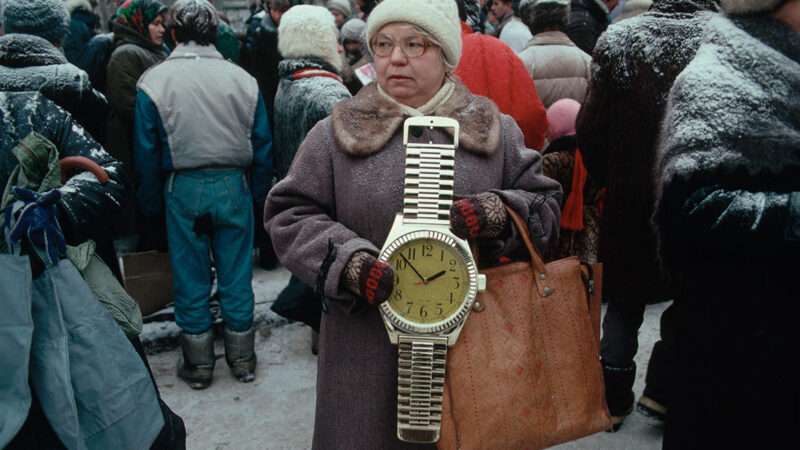
The Sick Man of Central Asia


tajikistan

Reason‘s December special issue marks the 30th anniversary of the collapse of the Soviet Union. This story is part of our exploration of the global legacy of that evil empire, and our effort to be certain that the dire consequences of communism are not forgotten.

Of all the countries to emerge from the dissolution of the Soviet Union, Tajikistan has arguably fared the worst. It ranks 149th out of 180 countries in Transparency International’s Corruption Perception Index, worse than every other former Soviet republic except Turkmenistan. It has the highest poverty rate of the former Soviet republics; a full 27 percent of its gross domestic product (GDP) is the result of remittances sent home by Tajik migrants working mostly in Russia; and its GDP per capita for 2021 ($810) ranks 179th out of the 195 countries for which the International Monetary Fund has data.

Why is Tajikistan so poor? It is landlocked, which means importing and exporting are more expensive and the country is more vulnerable to supply chain disruptions. And the violent civil war that followed the USSR’s fall, which pitted the incumbent Soviet power holders and their militias against a coalition of liberal reformers, anti-Soviet Islamists, and ethnic minorities, killed tens of thousands of people and displaced over 1 million Tajiks.

But geography and past conflict only explain so much. Tajikistan is rich with largely untapped mineral resources, and its mountain ranges are ideal for the kind of ecotourism that has made Nepal one of the fastest-growing economies in the world.

Tajikistan is the sick man of Central Asia because it is ruled by a despot who has enriched himself and his relatives at the expense of millions of his malnourished countrymen. Emomali Rahmon has been Tajikistan’s official president since 1994 and “Leader of the Nation”—a lifetime appointment that provides him with immunity from prosecution—since 2015. In all but name, he is a king.

Like most despots, Rahmon has an ironclad grip on every aspect of his country, from media to business to the practice of religion. Many of his relatives hold key positions of power, with his son Rustam serving as the mayor of the capital city, Dushanbe, and one of his sons-in-law holding a key position at the National Bank of Tajikistan.

Rahmon’s rule has been predictably poor not just for the rights of Tajiks but also for the country’s economy. The Economist found that a state-owned aluminum refining operation overseen by the Rahmon family has been routing hundreds of millions of dollars annually to a shell company in the British Virgin Islands.

While Tajikistan has welcomed foreign investment with open arms and nominally generous terms, it has found few takers. According to a 2020 U.S. State Department Investment Climate Statement, “bureaucratic and financial hurdles, widespread corruption, a largely dysfunctional banking sector, non-transparent tax system, and countless business inspections greatly hinder investors.”

The post The Sick Man of Central Asia appeared first on Reason.com.

from Latest – Reason.com https://ift.tt/2ZahPVI
via IFTTT

St. Louis Fed Has Some Advice For Your Thanksgiving Dinner: Eat Plants, Not Poultry

St. Louis Fed Has Some Advice For Your Thanksgiving Dinner: Eat Plants, Not Poultry

The Federal Reserve Bank of St. Louis posted some climate-crisis-approved nutrition advice on its blog on Saturday ahead of Thanksgiving.

“A Thanksgiving dinner serving of poultry costs $1.42. A soybean-based dinner serving with the same amount of calories costs 66 cents and provides almost twice as much protein,” the St. Louis Fed’s Twitter account said. 

The tweet was widely unpopular given that it was “ratioed,” meaning there were a more significant number of replies or comments than likes.

The tweet was poorly timed. It comes as some of the highest consumer price readings in decades have been reported. Soaring inflation has wiped out real wage gains this year as consumer sentiment collapses. But that doesn’t stop the Fed’s social media team propaganda arm from telling people they should consume a cheaper plant-based diet than more expensive turkey and all the servings.  

Is this The Fed’s solution to the death knell of its “transitory” inflation narrative (and negative real wages)?

Someone should tell the Fed that the rise in poultry and soybean costs since Thanksgiving in 2019 (before the pandemic and before their insane money-printing) are relatively the same. 

Instead of curtailing persistently high inflation, the Fed is up to its old tricks, doing what it knows best: soothing nerves of consumers who are about to pay the most ever for Thanksgiving this year because of soaring food inflation. 

In another way, the Fed is “literally telling us have fun eating poorly,” one Twitter user said

Crypto entrepreneur Anthony Pompliano responded to the tweet by saying, “I don’t think anyone is looking for nutrition advice from a central bank. It would be easier for you all to curtail the persistently high inflation that you created, rather than take on a national nutrition campaign.” 

Pompliano is right. Americans don’t need a woke Fed telling them about nutrition. But maybe there’s an underline agenda the monetary wonks are secretly pushing… 

Remember that “Davos Man,” or the elites of the world, have been pushing a plant/insect-based diet during the ‘Great COVID Reset.’ The EU has approved the sale of worms as food to be consumed by humans. They’re also pushing to put weeds and sewage on people’s menus. 

A drastic reduction in living standards for the plebs is here as plants and bugs will be for the working poor and turkey and fine wine for the elites in their ivory towers. If you don’t believe us, the world’s largest insect protein factory farm is being built in central Illinois. 

And it could be worse. At least leaders in the Western world aren’t pushing the consumption of black swans amid a crippling food shortage in North Korea. 

We can’t wait for the Fed’s nutrition advice ahead of Christmas. Who is ready for cricket pie?

Tyler Durden
Mon, 11/22/2021 – 05:45

via ZeroHedge News https://ift.tt/30LacWK Tyler Durden

What Drives The Price Of Gold? Part 1

What Drives The Price Of Gold? Part 1

By Jan Nieuwenhuijs of The Gold Observer

In general, the gold price in U.S. dollars is set by long-term inflation expectations and interest rates in the United States. The price of gold in  other currencies depends on the exchange rate between a particular currency and the dollar.

In a previous series of articles we discussed how the international gold market functions, and how the price of gold is set by institutional supply and demand. In this series, we will examine what economic variables change supply and demand of gold, and thus the gold price. To save your precious time I will start this article with a summary and add a historical background, to subsequently expand on the details in forthcoming articles.

In my opinion it is important to understand the current framework, if only to question its longevity. Since 2006 the price of gold in U.S. dollars is inversely correlated to (expected) real interest rates derived from the 10-year U.S. Treasury Inflation Protected Security (TIPS), as you can see in the chart below. This correlation is what I refer to as the current framework.

Note, in the chart above the axis of the TIPS rate is inverted, because when the TIPS rate falls, the gold price rises, and vice versa*. The reasoning is that when the real interest rate on government bonds falls, it becomes more attractive to own gold, because gold is the only international reserve asset without counterparty risk. When the real interest rate rises, it becomes less attractive to own gold, because gold doesn’t yield (if not lent out).

The 10-year TIPS bond is a U.S. government bond that compensates the owner for consumer price inflation (CPI). If, for example, the TIPS rate is 2% and annual inflation 3%, the owner of the bond receives 5% interest (2% + 3%). Because a correction is added when interest and the principal are paid, the market sets the TIPS yield lower than the yield on regular U.S. government bonds (nominal Treasuries). Basically, the market keeps buying TIPS bonds, driving down its yield, until the market is indifferent between holding TIPS bonds or nominal Treasuries, based on what they expect average inflation to be over the next 10 years.

The difference between the 10-year TIPS rate and 10-year nominal Treasury rate is thus what the market expects average inflation to be in the next 10 years. This market-based inflation expectation is also called the breakeven rate.

In conclusion:

TIPS rate = Treasury rate – breakeven rate

Or, in other words:

Expected real interest rate = Treasury rate – inflation expectations

For those interested, after 2008 the 10-year breakeven rate became more tightly correlated to the price of oil. As energy is the lifeblood of the economy, a rise in energy prices will be translated in higher prices of consumer goods.

For those that like to access an interactive chart that includes the gold price and the 10 -year TIPS rate please click here. Click here if you want to access an interactive chart that includes the 10-year breakeven rate, 10-year TIPS rate, and 10-year nominal Treasury rate.

A Historic Perspective on Gold as a Store of Value

Gold has been an inflation hedge for thousands of years. Though gold is not a perfect constant, as such an asset doesn’t exist in economics.

People in the East are still accustomed to giving their peers gold at childbirth and marriage. This old tradition makes sure communities survive all monetary regimes by using gold as a store of value and share the metal when people reproduce. They had learned early on that government issued money eventually loses its purchasing power. For wealth to be passed on from one generation to the next a store of value is needed that is immutable and can’t printed: gold. 

In developed economies people have lost their affinity with gold to a degree, because financialization started earlier in West, offering higher returns. Although Western central banks are holding on to their vast monetary gold reserves. Ironically, they are fully aware of their shortcomings and hold gold as their preferred back up currency.

The chart below shows the depreciation of three fiat currencies against gold since 1900 without interest rates being calculated. After all, many people don’t have fiat savings that yield. 

During the last form of a gold standard (Bretton Woods) the U.S. dollar was pegged to gold at a price of $35 per troy ounce, and all other major currencies were pegged to the dollar. Technically, Bretton Woods ended in 1968 when the United States allowed the gold price to float in the free market, after they had printed too many dollars and the gold peg was untenable. From that moment on the gold price started rising. Once again it was clear that no currency issued by a government can compete with gold.  

Remarkably, the gold price would rise before consumer prices went up. If the market expected inflation to soar, investors would take shelter in gold and the gold price reacted accordingly. Gold became a proxy for inflation expectations. If the price of gold went up, consumer prices would follow within two years.

Chair of the Federal Reserve Alan Greenspan stated in 1994:

I think that what the price of gold reflects is a basic view of the desire to hold real hard assets versus currencies. … [Gold] is a store of value measure which has shown a fairly consistent lead on inflation expectations and has been over the years a reasonably good indicator, among others, of what inflation expectations are doing.

Greenspan even based his monetary policy partially on the price of gold.

The connection between inflation expectations and the gold price is still relevant as we saw in the introduction about TIPS bonds.

After double digit inflation numbers and deeply negative real rates in the 1970s, investors were lured out of gold by high positive real rates in the 1980s. Because prior to 1997 there were no TIPS bonds, real interest rates could only be calculated as the nominal interest rate minus the prevailing CPI print. Academics call this the ex-post real interest rate, while they call the TIPS rate the ex-ante real interest rate.

In the chart below you can see 10-year (ex-post) real rate, calculated as the 10-year nominal Treasury rate minus CPI in the United States from 1968 through 2021.

Obviously, (ex-post) real rates are very important to the gold price. In the 1970s gold skyrocketed when real rates for two times in a row hit -5%. Can it happen again if inflation proves not be transitory and real rates stay negative?

To find answers we will do a deep dive into TIPS bonds in part 2.

If you enjoyed reading this article please consider to support The Gold Observer and subscribe to the newsletter.

*Note, in this article I have addressed correlations without prove of causality.

Tyler Durden
Mon, 11/22/2021 – 05:00

via ZeroHedge News https://ift.tt/3xeGiWr Tyler Durden

Brickbat: How Shocking


taser_1161x653

An Oklahoma jury has found former Wilson police officers Brandon Dingman and Joshua Taylor guilty of second-degree murder and assault and battery with a dangerous weapon. Jared Lakey died after the two shocked him a total of 53 times with their Tasers. The two said Lakey, who was suspected of disorderly conduct, refused to comply with their commands. Bodycam footage showed that Lakey did not act aggressively towards the two.

The post Brickbat: How Shocking appeared first on Reason.com.

from Latest – Reason.com https://ift.tt/3kT2Yqr
via IFTTT

EU Abruptly Shelved Plan For Upgraded Taiwan Trade Ties Amid China Pressure

EU Abruptly Shelved Plan For Upgraded Taiwan Trade Ties Amid China Pressure

America’s increasingly tough line on Taiwan and willingness to transfer weapons while continuing to send high-level officials, including Congressional junkets to Taipei, appears to be causing strain for the European Union’s typically independent trade policy. 

In perhaps the most serious sign yet that Europe is struggling on which direction it should lean on the Taiwan issue, it was reported Friday that the EU postponed at the last minute implementation of what’s being called a “confidential plan” for a major upgrade in trade ties with Taiwan

Via Nikkei 

In was first revealed in detail by the South China Morning Post, which wrote that “On Friday, Brussels was preparing to announce a new strategic format for liaising with Taiwan on trade and economic issues, involving more regular meetings, collaboration on specific sectors such as semiconductors, and more visits by senior officials, according to multiple sources briefed on the plans but not authorised to discuss them publicly.”

Crucially, it’s being widely perceived that China brought immense pressure to bear on Brussels, given that a mere days prior to the “eleventh-hour” decision, China’s ambassador to the EU, Zhang Ming, blasted efforts to that would continue steering the EU into Washington’s corner, seen as stoking pro-independence forces on the island. 

Ming issued a statement on the unbending nature of Beijing’s refusal to compromise, saying, “any attempt to develop official relations with Taiwan authorities is not acceptable because it’s a violation of the basic norms of the international relationship”.

“The Taiwan question is China’s internal affairs,” he told a virtual European Policy Centre conference. “It is a highly sensitive issue, but some people in Europe seem to underestimate the Chinese people’s aspiration for the complete reunification of our country. Let me stress that China’s position on the Taiwan question is firm and clear. Such a position remains unchanged and will never be changed.”

The proposed upgraded trade deal would have been seen as largely symbolic, particularly if it should stop short of delivering a bilateral investment trade pact. Still, it would have been a huge diplomatic win for Taipei and thumb in the eye to China – something which EU officials perhaps in the end saw as unnecessary at this point, given trade already flows freely between the EU and Taiwan – all without violating the ‘One China’ status quo policy.

Last month, the EU Competition Commissioner Margrethe Vestager laid out that “The European Union has an interest in enhancing relations and cooperation with Taiwan, within the framework of its one-China policy.”

More recently this past week, a statement from the EU’s trade commission suggested the plans would still be on the table: “We are looking into possible options to boost our engagement with Taiwan, which remains an important and like-minded trade partner. This is a work in progress,” a spokeswoman said.

Tyler Durden
Mon, 11/22/2021 – 04:15

via ZeroHedge News https://ift.tt/3kXpFK8 Tyler Durden

Brickbat: How Shocking


taser_1161x653

An Oklahoma jury has found former Wilson police officers Brandon Dingman and Joshua Taylor guilty of second-degree murder and assault and battery with a dangerous weapon. Jared Lakey died after the two shocked him a total of 53 times with their Tasers. The two said Lakey, who was suspected of disorderly conduct, refused to comply with their commands. Bodycam footage showed that Lakey did not act aggressively towards the two.

The post Brickbat: How Shocking appeared first on Reason.com.

from Latest – Reason.com https://ift.tt/3kT2Yqr
via IFTTT