Trump Imposes Massively Harmful and Illegal Section 301 Tariffs

NA

Today, the Trump Administration announced massive new tariffs, supposedly authorized by Section 301 of the Trade Act of 1974:

The Trump administration on Thursday finalized new double-digit tariffs on dozens of U.S. trading partners as it seeks to reconstitute sweeping duties struck down by the Supreme Court in February.

The new duties, which range from 10 to 12.5 percent, follow a five-month investigation into trading partners’ efforts to root out products made with forced labor from their supply chains and are set to take effect just as a temporary global 10 percent tariff expires.

Starting Friday, 17 trading partners — including Canada, the European Union, Indonesia, the United Kingdom and Mexico — will face a 10 percent duty, along with another 10 countries that agreed to address forced labor through signed trade agreements with the U.S.

Another 43 other countries, including Japan, China, South Korea and Australia, will face a 12.5 percent tariff rate….

The Section 301 tariffs may be meant to replace temporary Section 122 tariffs, which expire today, and which were rightly invalidated by the US Court of International Trade in May (though appellate litigation continues, and Trump may yet hope to use Section 122 again). The new tariffs will predictably raise prices for consumers, reduce economic growth, inflict grave harm on the US economy, and further poison our relationships with allies and trading partners.

As I have previously explained, the planned Section 301 tariffs are illegal for some of the same reasons as the IEEPA tariffs invalidated by the Supreme Court in February, in a case I helped litigate. Georgetown University scholar Peter Harrell outlined some additional reasons why the Section 301 tariffs are illegal, in a guest post here at this site. Unlike IEEPA, Section 301 does authorize some tariffs. But it does not permit a massive power grab like this.

In a Dispatch article published today, my Cato Institute colleague Scott Lincicome – an expert on trade policy – explains in detail why the forced labor “investigations” supposedly justifying the Section 301 tariffs are a sham, and a pretext for a massive presidential power grab. As he notes, the conclusion of the “investigations” was clearly predetermined in advance, the tariffs imposed have no real connection to any genuine forced labor issues, and many of the countries subject to the massive new tariffs actually have tighter restrictions on goods produced by forced labor than the US itself does. He concludes that, if courts uphold these tariffs, the president would have the kind of unlimited tariff authority the Supreme Court denied him in the IEEPA case:

The forced labor action is a clear abuse of the law and a serious departure from past U.S. government practice—even under President Trump. By no reasonable measure can it be considered anything other than a ham-fisted way to reinstall Trump’s tariff wall and protect it from another IEEPA-like defeat in federal court. In the latter case, the administration might be successful: Section 301 is more legally durable than the untested IEEPA and, while the forced labor action is obviously flimsy, a court might simply be unwilling to question the president’s determinations and actions. We shall see.

If the courts do rubber-stamp these tariffs, their problems will likely extend well beyond just this sham case. Section 301 could become a way for USTR to tariff any country, at any rate, and for any reason and duration, as long as it checks the law’s minor procedural boxes. The actual merits of the case, the quality of the agency’s findings, or its efforts to consider public input won’t really matter. Just say a country doesn’t adequately do something you say is harmful and then apply blanket tariffs after meaningless hearings and comments. Voila.

This is precisely the open-ended tariff power grab the courts checked with their IEEPA rulings, just with a little more procedural window-dressing. In such a case, Section 301 would be a broad tariff generator instead of the targeted tool Congress thought it designed, and it’ll surely be used by Trump or any future president who wants to tariff trading partners over carbon emissions, labor standards, AI regulation, or anything else. Republicans cheering the forced labor tariffs today should consider how they’ll feel when a Democrat holds the tariff pen.

As explained in my and Peter Harrell’s earlier posts on the Section 301 tariffs, Trump’s policy violates the requirements of Section 301 itself, and also runs afoul of the major questions doctrine, which requires Congress to “speak clearly” when authorizing the executive to make “decisions of vast economic and political significance.” At the very least, Section 301 does not clearly authorize the president to start a massive trade war against almost all our major trading partners on the basis of a sham investigation and dubious pretexts.

If, somehow, Section 301 does authorize this action, it would violate the constitutional nondelegation doctrine, which limits delegation of legislative power to the executive. Tariffs are a specifically enumerated congressional power. While the Supreme Court’s nondelegation precedent is far from completely clear, last year’s decision in FCC v. Consumers’ Research held that delegations of the power to impose taxes and other financial levies must have a clear “floor” and “ceiling” and that “[t]he guidance needed is greater when an agency action will affect the entire national economy than when it addresses a narrow, technical issue” [quotation omitted]. There is no meaningful floor or ceiling under the administration’s approach to Section 301. And the power claimed is clearly one that massively affects the “entire national economy.”

In the IEEPA case, the Supreme Court emphasized that “the president does not have the power to “impose tariffs on imports from any country, of any product, at any rate, for any amount of time.” Chief Justice Roberts went on to note that, while some statutes do grant the president tariff authority (among which he specifically cited Section 301), “[w]hen Congress has delegated its tariff powers, it has done so… subject to strict limits.”

Trump’s power grab today respects no such limits. I hope and expect it will be challenged in court. And when that happens, courts should strike it down, just like they did with the IEEPA  and Section 122 tariffs.


The post Trump Imposes Massively Harmful and Illegal Section 301 Tariffs appeared first on Reason.com.

from Latest – Reason.com https://ift.tt/X8Heusd
via IFTTT
Justice Kagan Rejects Charge that Supreme Court Is “Rubber Stamp” for Trump Administration

Some legal and political commentators claim that the Supreme Court has bent over backwards to appease or affirm the Trump Administration. In recent remarks before the Ninth Circuit Judicial Conference, as reported by Politico, Justice Elena Kagan rejected this common narrative.

From Politico:

“I don’t see this as a court that is just like, ‘We’re just going to rubber stamp what the current administration does.’ You know, quite the opposite,” Kagan said to a judicial conference here Thursday. “I think that that is a bad rap.” . . .

Kagan, a liberal justice and Obama appointee, said the 6-3 decision scuttling Trump’s tariffs was extraordinary.

“Tariffs is probably the key policy issue for this president. I mean, something he campaigned on, he ran on, he cared an enormous amount about,” she said. “I don’t think that there are all that many decisions in the recent times, where a court strikes down such an important policy to a a sitting president.”

That the Court is conservative–and reaches conservative decisions–is not evidence that it is under President Trump’s sway.

“You just have to deal with the fact that there’s a conservative court doing things that conservative jurists have long thought it appropriate to do, and I can really dislike that. But it has nothing to do, I think, with becoming the arm of this current administration,” she said.

Kagan also said that the justices were unaffected by President Trump’s decision to attend oral argument in the birthright citizenship case, another case of extreme importance to Trump in which the Court rejected his position, and even dissenting justices raised questions about the breadth of the Trump Administration’s position.

“It was sort of like….from the court’s point of view, a non-event,” Kagan said in her first public remarks on the unusual spectacle. “Honestly, the vibes in the courtroom were the vibes in the courtroom on any other day.” . . .

Kagan also noted that Trump left about halfway through the two-hour session. “It was a long argument. You really did kind of think he probably had other things to do,” she said.

“So, I don’t know. I think he probably won’t come back,” she added, prompting laughter from the audience.

The post Justice Kagan Rejects Charge that Supreme Court Is "Rubber Stamp" for Trump Administration appeared first on Reason.com.

from Latest – Reason.com https://ift.tt/OtgAoE5
via IFTTT

“There Is an Error in the Supreme Court’s Analysis in Loper Bright.”

In Loper Bright Enterprises v. Raimando, the Supreme Court overturned Chevron U.S.A. v. NRDC‘s holding that federal courts should defer to reasonable agency interpretations of ambiguous statutory provisions. In Loper Bright, the Court concluded that Chevron deference was incompatible with the Administrative Procedure Act. As Chief Jsutice Roberts explained, Section 706 of the APA  provides “‘the reviewing court’—not the agency whose action it reviews—is to ‘decide all relevant questions of law’ and ‘interpret . . . statutory provisions.'”

The Chevron opinion made no effort to reconcile its holding with the language of the APA. Indeed, the Chevron decision did not mention the APA at all. But perhaps there was a good reason for that.

In a footnote to his dissent in Hospital Menonita de Guayama v. NLRB–a case in which the D.C. Circuit was instructed by the Supreme Court to reconsider its prior decision deferring to an agency interpretation under Chevron–Judge Ray Randolph addresses this “error” in Loper Bright.

There is an error in the Supreme Court’s analysis in Loper Bright. Much of the Court’s reasoning (and a part of Justice Gorsuch’s concurrence) is devoted to criticizing the Chevron opinion for ignoring section 706 of the Administrative Procedure Act, 5 U.S.C. § 706. See, e.g., 603 U.S. at 397-400, 411-12; id. at 428 (Gorsuch, J., concurring). The Court’s critique is unfounded. It is unfounded because section 706 of the APA did not apply to judicial review of the EPA rule at issue in Chevron. Section 706 did not apply because Chevron was not an APA review case. The Clean Air Act superseded the APA: “The provisions of section 553 through 557 and section 706 of Title 5 [the APA] shall not, except as expressly provided in this subsection, apply to actions to which this subsection applies.” 42 U.S.C. § 7607(d)(1). The problem the Court identified in Loper Bright was not with Chevron itself, but with courts, including the Supreme Court, indiscriminately adopting the Chevron formula in later cases in which section 706 of the APA did apply.

The post "There Is an Error in the Supreme Court's Analysis in <i>Loper Bright</i>." appeared first on Reason.com.

from Latest – Reason.com https://ift.tt/KhuHAop
via IFTTT

Trump Imposes Massively Harmful and Illegal Section 301 Tariffs

NA

Today, the Trump Administration announced massive new tariffs, supposedly authorized by Section 301 of the Trade Act of 1974:

The Trump administration on Thursday finalized new double-digit tariffs on dozens of U.S. trading partners as it seeks to reconstitute sweeping duties struck down by the Supreme Court in February.

The new duties, which range from 10 to 12.5 percent, follow a five-month investigation into trading partners’ efforts to root out products made with forced labor from their supply chains and are set to take effect just as a temporary global 10 percent tariff expires.

Starting Friday, 17 trading partners — including Canada, the European Union, Indonesia, the United Kingdom and Mexico — will face a 10 percent duty, along with another 10 countries that agreed to address forced labor through signed trade agreements with the U.S.

Another 43 other countries, including Japan, China, South Korea and Australia, will face a 12.5 percent tariff rate….

The Section 301 tariffs may be meant to replace temporary Section 122 tariffs, which expire today, and which were rightly invalidated by the US Court of International Trade in May (though appellate litigation continues, and Trump may yet hope to use Section 122 again). The new tariffs will predictably raise prices for consumers, reduce economic growth, inflict grave harm on the US economy, and further poison our relationships with allies and trading partners.

As I have previously explained, the planned Section 301 tariffs are illegal for some of the same reasons as the IEEPA tariffs invalidated by the Supreme Court in February, in a case I helped litigate. Georgetown University scholar Peter Harrell outlined some additional reasons why the Section 301 tariffs are illegal, in a guest post here at this site.

In a Dispatch article published today, my Cato Institute colleague Scott Lincicome – an expert on trade policy – explains in detail why the forced labor “investigations” supposedly justifying the Section 301 tariffs are a sham, and a pretext for a massive presidential power grab. As he notes, the conclusion of the “investigations” was clearly predetermined in advance, the tariffs imposed have no real connection to any genuine forced labor issues, and many of the countries subject to the massive new tariffs actually have tighter restrictions on goods produced by forced labor than the US itself does. He concludes that, if courts uphold these tariffs, the president would have the kind of unlimited tariff authority the Supreme Court denied him in the IEEPA case:

The forced labor action is a clear abuse of the law and a serious departure from past U.S. government practice—even under President Trump. By no reasonable measure can it be considered anything other than a ham-fisted way to reinstall Trump’s tariff wall and protect it from another IEEPA-like defeat in federal court. In the latter case, the administration might be successful: Section 301 is more legally durable than the untested IEEPA and, while the forced labor action is obviously flimsy, a court might simply be unwilling to question the president’s determinations and actions. We shall see.

If the courts do rubber-stamp these tariffs, their problems will likely extend well beyond just this sham case. Section 301 could become a way for USTR to tariff any country, at any rate, and for any reason and duration, as long as it checks the law’s minor procedural boxes. The actual merits of the case, the quality of the agency’s findings, or its efforts to consider public input won’t really matter. Just say a country doesn’t adequately do something you say is harmful and then apply blanket tariffs after meaningless hearings and comments. Voila.

This is precisely the open-ended tariff power grab the courts checked with their IEEPA rulings, just with a little more procedural window-dressing. In such a case, Section 301 would be a broad tariff generator instead of the targeted tool Congress thought it designed, and it’ll surely be used by Trump or any future president who wants to tariff trading partners over carbon emissions, labor standards, AI regulation, or anything else. Republicans cheering the forced labor tariffs today should consider how they’ll feel when a Democrat holds the tariff pen.

As explained in my and Peter Harrell’s earlier posts on the Section 301 tariffs, Trump’s policy violates the requirements of Section 301 itself, and also runs afoul of the major questions doctrine, which requires Congress to “speak clearly” when authorizing the executive to make “decisions of vast economic and political significance.” At the very least, Section 301 does not clearly authorize the president to start a massive trade war against almost all our major trading partners on the basis of a sham investigation and dubious pretexts.

If, somehow, Section 301 does authorize this action, it would violate the constitutional nondelegation doctrine, which limits delegation of legislative power to the executive. Tariffs are a specifically enumerated congressional power. While the Supreme Court’s nondelegation precedent is far from completely clear, last year’s decision in FCC v. Consumers’ Research held that delegations of the power to impose taxes and other financial levies must have a clear “floor” and “ceiling” and that “[t]he guidance needed is greater when an agency action will affect the entire national economy than when it addresses a narrow, technical issue” [quotation omitted]. There is no meaningful floor or ceiling under the administration’s approach to Section 301. And the power claimed is clearly one that massively affects the “entire national economy.”

In the IEEPA case, the Supreme Court emphasized that “the president does not have the power to “impose tariffs on imports from any country, of any product, at any rate, for any amount of time.” Chief Justice Roberts went on to note that, while some statutes do grant the president tariff authority (among which he specifically cited Section 301), “[w]hen Congress has delegated its tariff powers, it has done so… subject to strict limits.”

Trump’s power grab today respects no such limits. I hope and expect it will be challenged in court. And when that happens, courts should strike it down, just like they did with the IEEPA  and Section 122 tariffs.


The post Trump Imposes Massively Harmful and Illegal Section 301 Tariffs appeared first on Reason.com.

from Latest – Reason.com https://ift.tt/X8Heusd
via IFTTT
Justice Kagan Rejects Charge that Supreme Court Is “Rubber Stamp” for Trump Administration

Some legal and political commentators claim that the Supreme Court has bent over backwards to appease or affirm the Trump Administration. In recent remarks before the Ninth Circuit Judicial Conference, as reported by Politico, Justice Elena Kagan rejected this common narrative.

From Politico:

“I don’t see this as a court that is just like, ‘We’re just going to rubber stamp what the current administration does.’ You know, quite the opposite,” Kagan said to a judicial conference here Thursday. “I think that that is a bad rap.” . . .

Kagan, a liberal justice and Obama appointee, said the 6-3 decision scuttling Trump’s tariffs was extraordinary.

“Tariffs is probably the key policy issue for this president. I mean, something he campaigned on, he ran on, he cared an enormous amount about,” she said. “I don’t think that there are all that many decisions in the recent times, where a court strikes down such an important policy to a a sitting president.”

That the Court is conservative–and reaches conservative decisions–is not evidence that it is under President Trump’s sway.

“You just have to deal with the fact that there’s a conservative court doing things that conservative jurists have long thought it appropriate to do, and I can really dislike that. But it has nothing to do, I think, with becoming the arm of this current administration,” she said.

Kagan also said that the justices were unaffected by President Trump’s decision to attend oral argument in the birthright citizenship case, another case of extreme importance to Trump in which the Court rejected his position, and even dissenting justices raised questions about the breadth of the Trump Administration’s position.

“It was sort of like….from the court’s point of view, a non-event,” Kagan said in her first public remarks on the unusual spectacle. “Honestly, the vibes in the courtroom were the vibes in the courtroom on any other day.” . . .

Kagan also noted that Trump left about halfway through the two-hour session. “It was a long argument. You really did kind of think he probably had other things to do,” she said.

“So, I don’t know. I think he probably won’t come back,” she added, prompting laughter from the audience.

The post Justice Kagan Rejects Charge that Supreme Court Is "Rubber Stamp" for Trump Administration appeared first on Reason.com.

from Latest – Reason.com https://ift.tt/OtgAoE5
via IFTTT

“There Is an Error in the Supreme Court’s Analysis in Loper Bright.”

In Loper Bright Enterprises v. Raimando, the Supreme Court overturned Chevron U.S.A. v. NRDC‘s holding that federal courts should defer to reasonable agency interpretations of ambiguous statutory provisions. In Loper Bright, the Court concluded that Chevron deference was incompatible with the Administrative Procedure Act. As Chief Jsutice Roberts explained, Section 706 of the APA  provides “‘the reviewing court’—not the agency whose action it reviews—is to ‘decide all relevant questions of law’ and ‘interpret . . . statutory provisions.'”

The Chevron opinion made no effort to reconcile its holding with the language of the APA. Indeed, the Chevron decision did not mention the APA at all. But perhaps there was a good reason for that.

In a footnote to his dissent in Hospital Menonita de Guayama v. NLRB–a case in which the D.C. Circuit was instructed by the Supreme Court to reconsider its prior decision deferring to an agency interpretation under Chevron–Judge Ray Randolph addresses this “error” in Loper Bright.

There is an error in the Supreme Court’s analysis in Loper Bright. Much of the Court’s reasoning (and a part of Justice Gorsuch’s concurrence) is devoted to criticizing the Chevron opinion for ignoring section 706 of the Administrative Procedure Act, 5 U.S.C. § 706. See, e.g., 603 U.S. at 397-400, 411-12; id. at 428 (Gorsuch, J., concurring). The Court’s critique is unfounded. It is unfounded because section 706 of the APA did not apply to judicial review of the EPA rule at issue in Chevron. Section 706 did not apply because Chevron was not an APA review case. The Clean Air Act superseded the APA: “The provisions of section 553 through 557 and section 706 of Title 5 [the APA] shall not, except as expressly provided in this subsection, apply to actions to which this subsection applies.” 42 U.S.C. § 7607(d)(1). The problem the Court identified in Loper Bright was not with Chevron itself, but with courts, including the Supreme Court, indiscriminately adopting the Chevron formula in later cases in which section 706 of the APA did apply.

The post "There Is an Error in the Supreme Court's Analysis in <i>Loper Bright</i>." appeared first on Reason.com.

from Latest – Reason.com https://ift.tt/KhuHAop
via IFTTT

E.U. Fines Google $1 Billion and Orders It To Give Competitors Equal Treatment


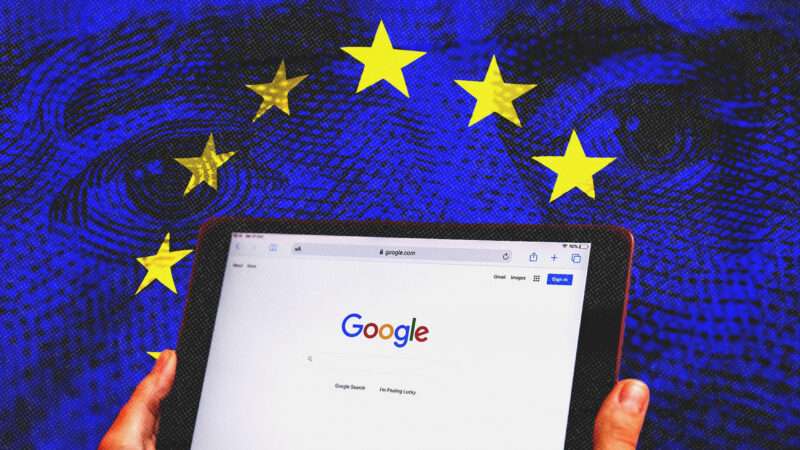
A smartphone showing the Google homepage, with the European Union flag in the background | Illustration: Motion5, SteveAllenPhoto999, Africaimages/Envato

The European Commission has hit Google with two fines totaling $1 billion for breaking digital antitrust regulations. What egregious sin did the tech giant commit to warrant such hefty fees? Setting up the Google search engine and Google Play Store to encourage consumers to purchase Google’s services, which the European Commission says violates the Digital Markets Act (DMA).

The Commission alleges that Google unfairly promoted its own shopping, hotel, transport, and sports services in search results while limiting other app developers’ ability to advertise and complete purchases outside Google Play. Google now must take steps to “treat third-party services that feature on Google’s search results in a fair and non-discriminatory manner” and allow app developers to distribute their apps via the Google Play Store “both technically and contractually, to freely communicate, promote offers and conclude contracts with users not only within but also outside the Google Play app store.”

“Google has fallen short of effective compliance with the Digital Markets Act, and today we have taken decisive yet balanced enforcement action sanctioning these breaches,” Teresa Ribera, executive vice president for Clean, Just and Competitive Transition, said in the European Commission’s press release.

The DMA, which became applicable in May 2023, intends to “make the markets in the digital sector fairer and more contestable.” It tries to do so by requiring “large digital platforms providing so called core platform services, such as online search engines, app stores, messenger services,” to comply with a comprehensive list of regulations. These include forcing these firms to allow users to access the data they generate and prohibiting them from favoring their own product (which Google was fined for). The DMA was written with 19 companies in mind, of which 16 are American.

“The best products should succeed because they’re better, not because they’re owned by the company running the search engine,” Ribera added. “And European consumers have a right to be told by app developers where to sign up to the best offers, even when the app store owner does not get a cut. This is the promise of the DMA, protecting fairness, choice and innovation in digital markets for the benefit of all European citizens.”

This is the latest fine in the European Union’s decades-long clampdown on American Big Tech. Last year, the E.U. fined Apple 500 million euros (about $569 million today) and Meta 200 million euros (about $227 million today) under the same antitrust law. Google has borne the brunt of DMA enforcement, having recently lost an appeal over a record $4.5 billion antitrust fine for allegedly thwarting competition through Android’s dominance. The latest penalties bring the value of European Commission fines against Google to almost $12 billion over nearly two decades, according to Reuters.

While the fines are bad news for Google, they are also bad news for consumers worldwide, who may soon feel the effects of tariffs imposed by the United States.

President Donald Trump has previously threatened tariffs and other retaliatory measures in response to European regulations and fines, especially for those that his administration considers discriminatory toward American companies. A 2025 White House memorandum states that if a foreign government “imposes a fine, penalty, tax, or other burden” that is “discriminatory” or “disproportionate,” the Trump administration “will act, imposing tariffs and taking such other responsive actions necessary to mitigate the harm to the United States and to repair any resulting imbalance.”

The imposition of retaliatory tariffs would hurt American consumers too, and would do little to dissuade the regulatory zealots in Brussels from going after American tech companies for operating their companies as they see fit.

The question of why the European Commission consistently punishes tech companies speaks to the nature of Europe’s adversarial attitude toward Big Tech. “Whether offline or online, fear, and greed, lead big and powerful companies to want more power,” Margrethe Vestager, then the European Commission’s competition chief, declared in 2024. She accused large digital platforms of becoming “the player and the referee” and turning the online economy into “the realm of the big few.”

This tech-hostile attitude was seen in the most recent round of fines against Google. It is no wonder that successful and innovative tech companies choose not to base themselves in Europe.

The post E.U. Fines Google $1 Billion and Orders It To Give Competitors Equal Treatment appeared first on Reason.com.

from Latest – Reason.com https://ift.tt/ahOwC9r
via IFTTT

E.U. Fines Google $1 Billion and Orders It To Give Competitors Equal Treatment


A smartphone showing the Google homepage, with the European Union flag in the background | Illustration: Motion5, SteveAllenPhoto999, Africaimages/Envato

The European Commission has hit Google with two fines totaling $1 billion for breaking digital antitrust regulations. What egregious sin did the tech giant commit to warrant such hefty fees? Setting up the Google search engine and Google Play Store to encourage consumers to purchase Google’s services, which the European Commission says violates the Digital Markets Act (DMA).

The Commission alleges that Google unfairly promoted its own shopping, hotel, transport, and sports services in search results while limiting other app developers’ ability to advertise and complete purchases outside Google Play. Google now must take steps to “treat third-party services that feature on Google’s search results in a fair and non-discriminatory manner” and allow app developers to distribute their apps via the Google Play Store “both technically and contractually, to freely communicate, promote offers and conclude contracts with users not only within but also outside the Google Play app store.”

“Google has fallen short of effective compliance with the Digital Markets Act, and today we have taken decisive yet balanced enforcement action sanctioning these breaches,” Teresa Ribera, executive vice president for Clean, Just and Competitive Transition, said in the European Commission’s press release.

The DMA, which became applicable in May 2023, intends to “make the markets in the digital sector fairer and more contestable.” It tries to do so by requiring “large digital platforms providing so called core platform services, such as online search engines, app stores, messenger services,” to comply with a comprehensive list of regulations. These include forcing these firms to allow users to access the data they generate and prohibiting them from favoring their own product (which Google was fined for). The DMA was written with 19 companies in mind, of which 16 are American.

“The best products should succeed because they’re better, not because they’re owned by the company running the search engine,” Ribera added. “And European consumers have a right to be told by app developers where to sign up to the best offers, even when the app store owner does not get a cut. This is the promise of the DMA, protecting fairness, choice and innovation in digital markets for the benefit of all European citizens.”

This is the latest fine in the European Union’s decades-long clampdown on American Big Tech. Last year, the E.U. fined Apple 500 million euros (about $569 million today) and Meta 200 million euros (about $227 million today) under the same antitrust law. Google has borne the brunt of DMA enforcement, having recently lost an appeal over a record $4.5 billion antitrust fine for allegedly thwarting competition through Android’s dominance. The latest penalties bring the value of European Commission fines against Google to almost $12 billion over nearly two decades, according to Reuters.

While the fines are bad news for Google, they are also bad news for consumers worldwide, who may soon feel the effects of tariffs imposed by the United States.

President Donald Trump has previously threatened tariffs and other retaliatory measures in response to European regulations and fines, especially for those that his administration considers discriminatory toward American companies. A 2025 White House memorandum states that if a foreign government “imposes a fine, penalty, tax, or other burden” that is “discriminatory” or “disproportionate,” the Trump administration “will act, imposing tariffs and taking such other responsive actions necessary to mitigate the harm to the United States and to repair any resulting imbalance.”

The imposition of retaliatory tariffs would hurt American consumers too, and would do little to dissuade the regulatory zealots in Brussels from going after American tech companies for operating their companies as they see fit.

The question of why the European Commission consistently punishes tech companies speaks to the nature of Europe’s adversarial attitude toward Big Tech. “Whether offline or online, fear, and greed, lead big and powerful companies to want more power,” Margrethe Vestager, then the European Commission’s competition chief, declared in 2024. She accused large digital platforms of becoming “the player and the referee” and turning the online economy into “the realm of the big few.”

This tech-hostile attitude was seen in the most recent round of fines against Google. It is no wonder that successful and innovative tech companies choose not to base themselves in Europe.

The post E.U. Fines Google $1 Billion and Orders It To Give Competitors Equal Treatment appeared first on Reason.com.

from Latest – Reason.com https://ift.tt/ahOwC9r
via IFTTT

The Trump Coin Case Ends, but Legal Questions Remain


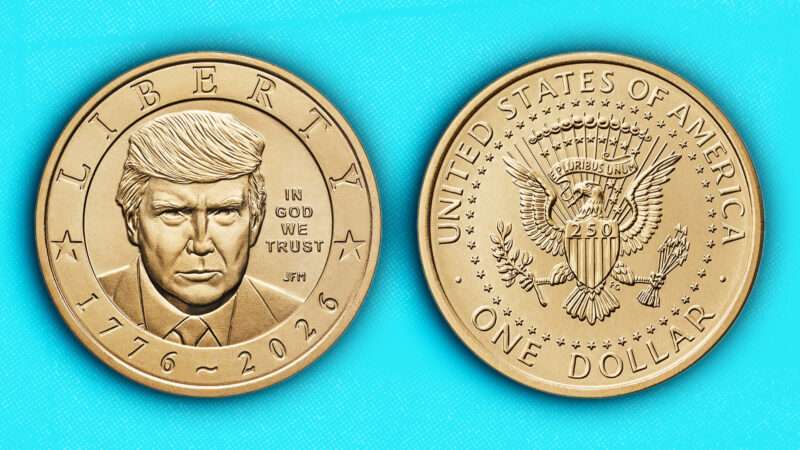
The Trump coin | Department of Treasury/@SecScottBessent/X

Less than a week after United States Treasury Secretary Scott Bessent announced the final design of the new $1 coin featuring the face of President Donald Trump, a federal lawsuit in Oregon challenging the coin’s production has been voluntarily dismissed. The controversial coin is scheduled for release this fall. 

Plans for the gold-plated coin include the presidential seal and “250” etched on one side, plus a portrait of Trump with the words “liberty” and “in God we trust” on the other. The coin, which is being minted to commemorate the nation’s 250th anniversary, is meant to “honor the enduring legacy of liberty and a lasting symbol of patriotism,” and “celebrate the strength of American values,” Bessent posted on social media.

However, critics argue the addition of Trump’s face not only breaks with long-standing norms against enshrining living persons on legal tender, but also violates federal law. 

Legislation passed by Congress in 1866 “expressly and unambiguously forbids” the production of a coin featuring “the image of a face of a living man” and is meant to prevent “officials from using currency as an instrument of political self-promotion,” according to court documents filed in federal court by James Rickher, a retired lawyer in Portland, Oregon. Known as the Thayer Amendment, the law was passed in reaction to former Treasury Department official Spencer Clark placing himself on banknotes intended to honor William Clark, of the famous Lewis and Clark exploration duo. 

Today, the statute grants the secretary of the Treasury the authority to “engrave and print United States currency” and states “only the portrait of a deceased individual may appear on United States currency and bonds.” However, proponents of the Trump coin argue the Thayer Amendment is limited to paper currency and instead point to a separate statute that governs the minting of coins and has no blanket prohibition on including the portrait of a living person. 

But the Circulating Collectible Coin Redesign Act of 2020 (CCCRA), which authorized the redesign of dollar coins “with designs emblematic of the United States semiquincentennial” to be produced only in the year 2026, does limit the design. The statute reads, in part, “no head and shoulders portrait or bust of any person, living or dead, and no portrait of a living person may be included in the design on the reverse of” the commemorative dollar coin. 

In response, the Treasury Department argued in court filings the correct interpretation of the statute only “limit[s] the prohibition [of a portrait of a living person] specifically to the reverse” or tails side of the coin. And since “the proposed design places President Trump’s portrait on the [head’s] side and an eagle on the reverse side,” there is no legal complication. And besides, the government’s lawyer argued, elsewhere in the statute the secretary is granted broad discretion over the designs of gold bullion and proof coins—coins that are still considered legal tender and official U.S. currency. 

Despite these many questions of statutory interpretation, Rickher filed to voluntarily dismiss the lawsuit on July 20 after being denied a preliminary injunction against the production of the coin in late June. The denial, written by U.S. District Judge Karin Immergut, was due to Rickher’s lack of standing and inability to prove he would suffer a concrete or particularized harm should the coin be produced and distributed. Thus, Immergut did not rule on the merits of the case. 

Indeed, it could be that no one will have standing to challenge the coin in court until after the coin is produced and distributed. One scenario in which someone might prove injury and therefore have standing to sue, Richard Painter, former chief White House ethics lawyer for President George W. Bush, told NPR, is if a vendor or customer refused to accept the coin as legal tender. 

But even if the Trump administration were to win in court, however, this kind of leader worship and idolatry is deeply antithetical to American values. And whether such a coin is accepted or rejected is ultimately up to the American people today. After all, although former President Calvin Coolidge was able to move forward with his controversial and heavily criticized coin depicting him alongside former President George Washington on the half-dollar in celebration of America’s 150th anniversary, the decision was largely regarded as a flop and resulted in 859,408 of the 1 million coins minted being returned and melted.

The post The Trump Coin Case Ends, but Legal Questions Remain appeared first on Reason.com.

from Latest – Reason.com https://ift.tt/0KMZioC
via IFTTT

Lots of Trump’s Tariffs Expire on Friday. It’s Thursday Afternoon, and No One Knows What Will Replace Them.


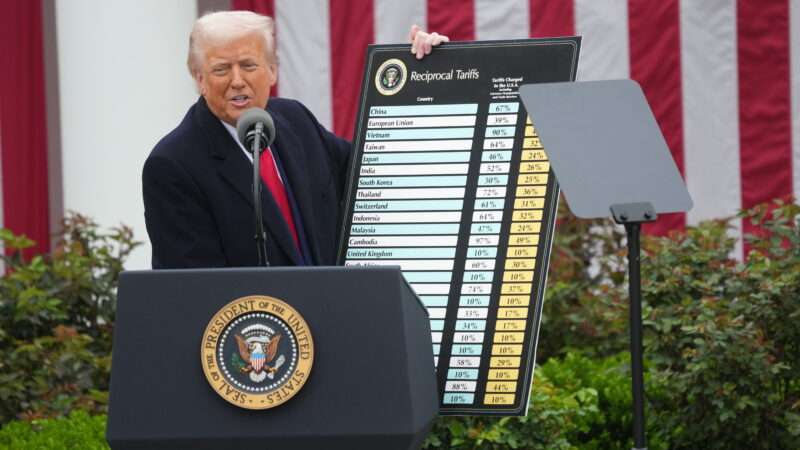
Donald Trump holding a board of tariffs on 'Liberation Day' | Chris Kleponis - CNP/Polaris/Newscom

Consider one of the biggest challenges facing American businesses in the midst of President Donald Trump’s global trade war: As of Thursday afternoon, no one knew what tariffs would be charged on which imports entering the country as soon as Friday morning.

Trump is no stranger to improvisational, make-it-up-as-you-go policy, but even by his standards, this is pretty ridiculous.

To understand the wild uncertainty facing American businesses this week, you have to back up a few months. In February, the Supreme Court struck down many of the tariffs Trump had imposed last year when it ruled that the International Emergency Economic Powers Act (IEEPA) did not grant presidents the power to impose tariffs. Trump responded by implementing a 10 percent “global tariff” via a different legal mechanism: Section 122 of the Trade Act of 1974.

But that law only allows for temporary tariffs that last a maximum of 150 days, unless Congress votes to extend them, which it has not. As a result, the tariffs Trump imposed in February will expire at midnight tonight.

The Trump administration had 150 days to provide some clarity and stability to American businesses that buy and sell things overseas. It did not do that.

“You’ll have to stay tuned, and you’re gonna be busy over the next few days,” U.S. Trade Rep. Jamieson Greer told The Wall Street Journal earlier this week when asked about the upcoming tariff deadline.

That’s, uh, not very helpful. The U.S. economy is not a reality show. The Trump administration should stop acting like it is.

On Thursday, White House press secretary Karoline Leavitt said an announcement about tariff rates would be coming later in the day. As of 4 p.m., however, no such announcement has been made. (It’s possible the White House is deliberately waiting until after the stock market closes, given how the market has reacted to previous tariff hikes.)

“How in the world does someone decide whether to expand their factory when they wake up in the morning and have no idea what the tariff on the materials they need will be?” Bryan Riley, director of the Free Trade Initiative at the National Taxpayers Union Foundation, asked rhetorically in an email to Reason. “Or how many acres of crops to plant? Or how many workers to hire? Or how many Christmas toys to order?”

All good questions. Thursday did not get the same level of national media attention as Trump’s so-called “Liberation Day” tariff announcements of April 2025. For good reason, the White House decided to avoid turning this latest bit of major tariff news into a spectacle.

But what happened on Thursday is in many ways even less defensible than what happened on Liberation Day. Trump’s trade policies are more unpopular and less successful than ever, but he seems determined to continue jerking American businesses around, with little warning and no regard for the uncertainty it is creating.

The chaos and uncertainty created by these new, last-minute tariff announcements ought to underscore the importance of having Congress, rather than one (highly mercurial) president, set American trade policy.

Studies show that the heightened level of uncertainty caused by Trump’s handling of the tariffs has harmed the economy. That is, of course, on top of the direct cost of the tariffs themselves, which have been a massive tax increase on Americans. Various estimates show that the Section 122 tariffs cost American businesses between $25 billion and $30 billion during the 150 days that they were in place.

No wonder the trade war and tariffs are unpopular—and getting more unpopular as time passes.

The post Lots of Trump's Tariffs Expire on Friday. It's Thursday Afternoon, and No One Knows What Will Replace Them. appeared first on Reason.com.

from Latest – Reason.com https://ift.tt/r39RIAP
via IFTTT