Jewish Teacher Sued Portland Public Schools + Union for Discrimination Over Colleagues’ Anti-Israel Speech

From yesterday’s Report and Recommendation by Magistrate Judge Jeff Armistead in Doe v. Portland Ass’n of Teachers, Doe’s allegations:

Doe was born in Israel and takes his Jewish religious faith and ethnic heritage seriously. For Doe, the State of Israel is essential and integral to his devout religious faith. Although Doe immigrated to the United States, he maintains close ties to Israel and his family there. In the 2023-24 school year, Doe worked for PPS [Portland Public Schools] as a high school math teacher.

When he started working for PPS, he chose not to become a dues-paying member of PAT [Portland Association of Teachers], exercising his First Amendment right not to support union political speech and public sector collective bargaining. Nevertheless, because Doe is a PPS teacher, PAT is his exclusive representative by way of Oregon’s Public Employee Collective Bargaining Act (PECBA) and the collective bargaining agreement (CBA) PAT has with PPS….

Curricula. Doe alleges that PAT collaborates with Oregon Educators for Palestine (OEP) in its publications, including by co-publishing a guide called “Teach Palestine!” The guide references resources for teaching about Palestine, “encourages teachers to use their classroom to teach anti-Isreal views[,] and includes detailed curricula recommendations for pre-K through high school.” Among the recommended resources in the “Teach Palestine!” guide is “Teaching While Muslim,” which includes the statement “75 years ago, a lot of decision makers around the world decided to take away Palestinian land to make a country called Israel. Israel would be a country where rules were mostly fair for Jewish people with White skin” and encouragement to make signs that include the slogan “Free Palestine.”

The “Teach Palestine!” resource guide also includes “Let’s Go to Palestine.” That lesson—directed at elementary school—includes the statement “Palestine is currently under a brutal occupation by Israel. We pray for a truly free Palestine so that the Palestinians can prosper and we can all visit freely.” Also recommended in the guide is “Handala’s Return,” which includes the statement: “A group of bullies called Zionists wanted our land so they stole it by force and hurt many people.” The “Know Your Rights!” guide, also co-published by PAT and OEP, includes references to CBA provisions that protect teachers in teaching what are, according to Doe, anti-Israel views.

Displays. Doe alleges that, with PAT’s encouragement, teachers at Doe’s school wore clothing that included pro-Palestine messages, such as “Free Palestine,” and “From the River to the Sea.” School administration also allowed posting of Palestinian flags, print-out maps of Palestine that eliminate Israel, and other symbols and slogans throughout the school. The displayed flags and other symbols were in common spaces such as hallways, the library, as well as shared classrooms. In Doe’s view, the “placement was intentional so as to appear to be an expression of the community and school rather than any individual.”

Prayer. A teacher “led an on-campus morning meeting that he designated as a ‘prayer circle’ to support Palestine.”

Organizing and Political Activities. PAT collaborates with OEP in its publications, including by co-publishing the “Know Your Rights!” guide—a document “developed in response to the censorship, discrimination, and harassment” that PPS staff experienced when teaching or supporting pro-Palestine views. PAT’s social media accounts follow OEP, which organizes events and speech activities in support of Palestine and against Israel and which is visible to the public as well as members of PAT. OEP used social media to promote May 15 as “Nakba Day,” for instance. It stated, “This Nakba Day, we call on educators across Oregon to wear your kufiya [sic], pins, and “From the River to the Sea, Palestine Will Be Free” shirt to school or work!” On its own social media channels, PAT announced a “students for peace” walkout on March 15, 2024, with a rally at PAT headquarters that included anti-Israel expression.

Doe also alleges that PAT endorses candidates who are vocally anti-Israel and pro-Palestine, including then-candidates Raschelle Chase-Miller and Jorge Sanchez Bautista, both of whom have used social media to promote anti-Israel messages. On May 28, 2024, PAT held informational sessions for teachers to “[l]earn about your rights to teach and advocate for Palestine within Portland Public Schools” at PAT Hall.

PAT Member Conduct. PAT members and representatives allegedly “took coordinated, politically charged actions” while knowing or disregarding the effect they would have on Doe, including posting on social media that staff should wear pro-Palestinian clothing and should post pro-Palestinian messages through the school. In March 2024, Doe “was physically intimidated by a colleague who physically blocked him from entering the copy room to use the copy machine.” The colleague was “vocal about her anti-Israel views.” Doe also alleges that other PAT members spread rumors about Doe and falsely blamed and accused him of various things….

Doe also takes issue with PPS, alleging that it discriminated against him and violated his First Amendment rights. Against PPS, Doe alleges the following:

  • “[t]he school’s policy is that every poster or expressive item displayed in the school’s common areas, such as a hallway, has to receive approval from administration. Thus, any display in these areas was with the explicit or implicit permission of the school administration.”
  • “School administration allowed posting of Palestinian flags, print-out maps of Palestine that eliminate Israel, and other symbols and slogans throughout the school.”
  • “The displayed flags and other symbols were in common spaces such as hallways, the library, as well as shared classrooms. The placement was intentional so as to appear to be an expression of the community and school rather than any individual staff person.”
  • Although Doe brought his concerns to PPS, his school’s administration refused to remove pro-Palestine symbols.
  • “When he asked school administrators if he could display a flag of Israel or symbols supporting Israel’s right to exist, school administrators denied Plaintiff’s request telling him that an Israeli flag or related symbols would be too disruptive.”
  • “Because it only allowed pro-Palestinian flags, symbols, and messages, the school failed to maintain any kind of viewpoint neutrality on this issue.”

Doe asserts that PPS created a hostile work environment in its religious discrimination, primarily by making Doe’s school “a forum for one-sided, anti-Israel rhetoric.” As a result of that hostile work environment, Doe experienced a “severe recurrence” of his post-traumatic stress disorder (PTSD) which forced him to take a leave of absence and undergo medical treatment during the summer of 2024.

Doe alleges that PPS’s discriminatory conduct continues because it has failed to resolve or respond to his complaints, failed to take measures to curb the hostile work environment, and subjected him to an investigation based on false accusations. Although PPS transferred Doe to another school for the 2024-25 school year, Doe asserts that he continues to face hostility because of PPS’s failure “hold individuals to account,” which means that he cannot attend district-wide events because he might encounter those colleagues there.

Doe also contends that PPS’s discrimination is ongoing because, as a result of PPS’s “refusal to clarify the record,” he continues to be “blamed for incidents that did not occur.” For instance, in May 2025, Doe had to correct one of his new colleagues when they asked him “whether it was true that he was suspended for removing Palestinian flags from all the classrooms.” …

The report recommended rejecting Doe’s claims “that PAT’s exclusive representation violated his First Amendment right to free association by forcing him to associate with expression with which he disagrees, and which betrays his deeply held religious and moral beliefs”:

The collective bargaining system [upheld in Minn. State Bd. for Comm. Colleges v. Knight (1984)] is no different than PECBA in any way that matters to Doe’s constitutional challenges. Doe, who is not a member of PAT and does not have to pay PAT membership dues, has not had his associational rights impaired. And Knight extends, as this court sees it, to First Amendment rights generally. Knight (“The state has in no way restrained appellees’ freedom to speak on any education-related issue or their freedom to associate or not to associate with whom they please, including the exclusive representative. Nor has the state attempted to suppress any ideas.”). That Doe specifically challenges his right to freely exercise his religion is of no moment in this context. Like the freedom to associate and freedom to speak, rights that are unburdened by exclusive representation, so too is Doe’s freedom to practice his religion—PAT’s exclusive representation in no way “forces” Doe to “tacitly approve” PAT’s beliefs.

The report also recommended rejecting Doe’s claim that PPS unconstitutionally discriminated against his viewpoint:

Does allege in Claim 3 that PPS allows expression of pro-Palestine, anti-Israel views but disallowed his request to promote pro-Israel views, and that by doing so (the One View Conduct), PPS applied its rules on speech and expressive activity in a viewpoint-based manner….

“When government speaks, it is not barred by the Free Speech Clause from determining the content of what it says.” In Downs v. Los Angeles Unified Sch. Dist. (9th Cir. 2000), the Ninth Circuit held that materials posted on school bulletin boards constituted government speech because only school employees could access the bulletin boards, the bulletin boards were the property of the school, and the school principal oversaw (and thus implicitly approved) the posted materials. That implicit approval was equivalent to the school itself speaking, and when the school principal removed a competing bulletin board put up by a teacher with opposing views, that “explicit rejection” was equivalent to the school “choosing not to speak.”

Doe alleges that it is PPS’s policy “that every poster or expressive item displayed in the school’s common areas, such as a hallway, has to receive approval from administration” and thus any displays in the school’s common areas required PPS’s “explicit or implicit permission.” Given that Doe alleges that the One View Conduct is approved by PPS, the viewpoint challenged by Doe is attributable to PPS….

The report likewise recommended rejecting Doe’s claim that PPS’s actions unconstitutionally established religion:

[T]he Curricula and Display allegations are not a violation of the Establishment Clause because they can be regarded as geopolitical or political expressions that happen to align or harmonize with religious beliefs. That is, a policy or conduct does not violate the Establishment Clause “merely because it ‘happens to coincide or harmonize with the tenets of some or all religions.'” … Even for the resource guide “Teaching While Muslim,” which Doe alleges is sectarian, he fails to allege specifically what content in the guide advanced the Muslim faith rather than a political viewpoint that can be shared by Muslims and non-Muslims alike.

As for the Prayer allegation, its critical deficiency is that it fails to satisfy Iqbal pleading standards. The allegation merely states that a “teacher led an on-campus morning meeting that he designated as a ‘prayer-circle’ to support Palestine.” That cursory allegation omits any facts that would allow the court to conclude whether the “meeting” or “prayer-circle” was an instance of the unnamed teacher crossing the line from “protected private expression” to “impermissible government coercion.” Put differently, prayer is not categorically prohibited in schools because the Supreme Court has “long recognized … that secondary school students are mature enough to understand that a school does not endorse, let alone coerce them to participate in, speech that it merely permits on a nondiscriminatory basis.”

The report recommended rejecting Doe’s hostile work environment harassment claim against PPS, partly because of the statute of limitations, but partly for broader reasons:

Doe fails to plausibly allege that PPS’s conduct was “sufficiently severe or pervasive to alter the conditions of the plaintiff’s employment and create an abusive work environment.” … Although the court does not doubt Doe’s subjective perception that his workplace was hostile and conflicted with his religious beliefs and identity, the occurrences alleged by him do not rise to the baseline of pervasiveness and severity that the Ninth Circuit has set….

First, PPS’s alleged conduct is part of a contentious geopolitical debate in which it is not settled whether the views Doe takes issue with are antisemitic or, rather, protests against the actions of the Israeli government toward Palestinians. To adopt Doe’s argument that the environment at his school was objectively offensive enough to alter his work conditions is to conflate Doe’s subjective belief with the requirement that the work environment was objectively hostile…..

Second, Doe does not allege, or plausibly allege, that the conduct he finds offensive was directed at him. Significant [in past precedents] was that much of the alleged conduct was not directed at the plaintiffs…. Offensive comments purposely directed at an employee are by degrees more severe than comments overheard first-hand or second-hand, or in this case expressions concerning a geopolitical dispute….

And the report recommended rejecting Doe’s discrimination claim against PAT, again largely for statute of limitations reasons, but also because of this:

[Doe] asserts that, in the spring of 2025, PAT publicly endorsed two school board candidates, on social media and through a meet-and-greet, who are “vocally anti-Israel and pro-Palestine.” PAT responds that imposing civil liability for a public endorsement would violate its First Amendment rights. The court agrees. See Rodriguez v. Maricopa Cnty. Cmty. Coll. Dist. (9th Cir. 2010) (“Harassment law generally targets conduct, and it sweeps in speech as harassment only when consistent with the First Amendment.”).

The endorsement and social media posts were not directed at Doe, nor does Doe allege that he was required to attend the meet-and-greet. In other words, PAT’s endorsement sought to “disseminate a message to the general public,” rather than “intrude upon the targeted [listener] … in an especially offensive way.” See also Rodriguez (holding that “a college professor’s expression on a matter of public concern, directed to the college community” could not “constitute unlawful harassment” where its “offensive quality was based entirely on [its] meaning, and not on any conduct or implicitly threat of conduct that [it] contained”)…. Doe cannot rely on PAT’s endorsements to allege an ongoing hostile work environment and timely Title VII violation.

I hope to put up a post soon on the Magistrate Judge’s decision to allow Doe to proceed under a pseudonym.

Misha Isaak, Megan S. Bradford, and Dominik K. Mackinnon (Stoel Rives LLP) represent PPS and related defendants. Scott A. Kronland and Matthew J. Murray (Altshuler Berzon LLP) and Karen O’Kasey (Hart Wagner LLP) represent PAT.

The post Jewish Teacher Sued Portland Public Schools + Union for Discrimination Over Colleagues' Anti-Israel Speech appeared first on Reason.com.

from Latest – Reason.com https://ift.tt/7TW8Pzk
via IFTTT
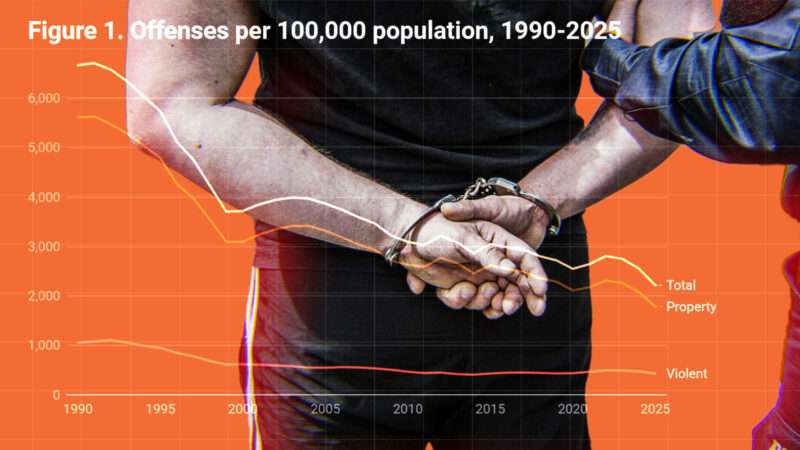
California’s Prison Reform Experiment Worked. The State’s Crime Rate Has Fallen by 27% in 15 Years.


A man in handcuffs, with a downward trending chart in the background | imageBROKER/Piotr Dziurman/Newscom/cjcj.org

For those of us who are more interested in policy than politics, it’s frustrating to try a rational discussion about any issue once it’s caught up in a partisan maelstrom. Few matters are more given to hysteria than crime, for the obvious reason that everyone (except criminals) is against it—and politicians are incentivized to use crime-related policy to score political points.

We have to await the passage of time to analyze which anti-crime policies worked, which created unintended consequences, and which made little difference. I’m long past expecting politicians to learn about past policy, but it’s worth trying. So I cheer the Legislative Analyst’s Office, which last month released a report evaluating the results of a brouhaha that most of us have forgotten: prison realignment. The short take: the doomsayers were wrong.

Fifteen years ago, California prisons were filled to 180% of their design capacity—the result of 1990s tough-on-crime initiatives that boosted sentences and created larger populations. A 2009 federal court decision agreed that overcrowding undermined inmates’ right to receive “adequate” healthcare, but the court stayed the full implementation of California’s proposed fixes while the case made its way to the U.S. Supreme Court.

In May 2011, the high court agreed with the lower court: “[W]ithout a reduction in overcrowding, there will be no efficacious remedy for the unconstitutional care of the sick and mentally ill,” as a 2011 LAO report noted. Democratic Gov. Jerry Brown’s solution was Assembly Bill 109, which “shifted to counties the responsibility for monitoring, tracking and incarcerating lower-level offenders previously bound for state prison,” per the Stanford Criminal Justice Center.

This was a bipartisan problem. Problems arose during the Republican Schwarzenegger administration, but came to a head under Brown. Although the ruling was backed by the court’s liberals, one conservative provided the deciding vote. Regardless of the court’s ideology—and whether it was right in its determination—its decision required California to reduce its prison population. State leaders, regardless of their philosophy, had no choice but to act.

Many anti-realignment arguments centered on the capability of locals to handle the influx of prisoners, which was a legitimate concern. Some progressives were angry that the law mainly moved prisoners around rather than reduced their sentences, which was tone deaf. But Republicans opposed the bill and then started ramping up emotional tactics, arguing that realignment would lead to carnage—even though Brown’s solution upheld sound conservative principles regarding local control.

Shortly after realignment began, Assembly Republicans “began an online video campaign to get Californians outraged over Brown’s prisoner shift program,” reported ABC 7 in Sacramento. The ad featured “scary-looking thugs and ominous music.” Two years later, Republicans pushed to unravel realignment and go on a prison-building spree.

GOP fear-mongering became so obnoxious that two conservative former Assembly members, Pat Nolan (R–Glendale) and Chuck DeVore (R–Irvine), published a 2013 column in the Los Angeles Times complaining that, “Some Republicans…are trying to score short-term political points by employing old scare tactics about the state’s prison ‘realignment’ plan. Realignment gives local jails the responsibility—and funding—to oversee low-level inmates, while violent and career offenders remain the responsibility of costlier state prisons. This is a common-sense division of responsibility.”

Years later, after crime spiked during the pandemic, conservatives were still pointing their fingers at realignment, although they fell silent after crime rates dropped again. So what exactly are the results of this policy—one that seems rather modest in hindsight, but was depicted as a radical gutting of the criminal-justice system at the time? Drum roll, please.

Per the LAO, the effort “contributed to a modest increase in property crime and had no effect on violent crime.” Realignment enabled California to meet its court obligations: “Without it, the state would have had to pay for significantly more prison capacity and/or allow the federal courts to release tens of thousands of people from prison.” Although the reform altered some sentences for lower-level offenders, it could have been worse had courts been granted release power. Meanwhile, “sentences for violent crimes were largely unaffected.”

The law did increase pressure on county jails, but subsequent initiatives “mitigated the population pressures created by realignment.” Realignment also created better fiscal management: “[C]ounties now bear a greater share of the costs of felony sentences. As a result, county decisions about sentencing now incorporate the costs of incarceration for many felony sentences—thereby better aligning counties’ costs with their decision-making authority.”

What about overall crime in California? Rates are 27 percent lower now than they were in 2011, which was not only the beginning of realignment—but the beginning of a series of criminal-justice reforms mostly passed by voter initiative. Did I mention that California has been shuttering prisons rather than embarking on costly prison-building efforts? Too bad we had to wait 15 years to confirm that all the alarmism was political nonsense.

This column was first published in The Orange County Register.

The post California's Prison Reform Experiment Worked. The State's Crime Rate Has Fallen by 27% in 15 Years. appeared first on Reason.com.

from Latest – Reason.com https://ift.tt/rxFz8J6
via IFTTT

Jewish Teacher Sued Portland Public Schools + Union for Discrimination Over Colleagues’ Anti-Israel Speech

From yesterday’s Report and Recommendation by Magistrate Judge Jeff Armistead in Doe v. Portland Ass’n of Teachers, Doe’s allegations:

Doe was born in Israel and takes his Jewish religious faith and ethnic heritage seriously. For Doe, the State of Israel is essential and integral to his devout religious faith. Although Doe immigrated to the United States, he maintains close ties to Israel and his family there. In the 2023-24 school year, Doe worked for PPS [Portland Public Schools] as a high school math teacher.

When he started working for PPS, he chose not to become a dues-paying member of PAT [Portland Association of Teachers], exercising his First Amendment right not to support union political speech and public sector collective bargaining. Nevertheless, because Doe is a PPS teacher, PAT is his exclusive representative by way of Oregon’s Public Employee Collective Bargaining Act (PECBA) and the collective bargaining agreement (CBA) PAT has with PPS….

Curricula. Doe alleges that PAT collaborates with Oregon Educators for Palestine (OEP) in its publications, including by co-publishing a guide called “Teach Palestine!” The guide references resources for teaching about Palestine, “encourages teachers to use their classroom to teach anti-Isreal views[,] and includes detailed curricula recommendations for pre-K through high school.” Among the recommended resources in the “Teach Palestine!” guide is “Teaching While Muslim,” which includes the statement “75 years ago, a lot of decision makers around the world decided to take away Palestinian land to make a country called Israel. Israel would be a country where rules were mostly fair for Jewish people with White skin” and encouragement to make signs that include the slogan “Free Palestine.”

The “Teach Palestine!” resource guide also includes “Let’s Go to Palestine.” That lesson—directed at elementary school—includes the statement “Palestine is currently under a brutal occupation by Israel. We pray for a truly free Palestine so that the Palestinians can prosper and we can all visit freely.” Also recommended in the guide is “Handala’s Return,” which includes the statement: “A group of bullies called Zionists wanted our land so they stole it by force and hurt many people.” The “Know Your Rights!” guide, also co-published by PAT and OEP, includes references to CBA provisions that protect teachers in teaching what are, according to Doe, anti-Israel views.

Displays. Doe alleges that, with PAT’s encouragement, teachers at Doe’s school wore clothing that included pro-Palestine messages, such as “Free Palestine,” and “From the River to the Sea.” School administration also allowed posting of Palestinian flags, print-out maps of Palestine that eliminate Israel, and other symbols and slogans throughout the school. The displayed flags and other symbols were in common spaces such as hallways, the library, as well as shared classrooms. In Doe’s view, the “placement was intentional so as to appear to be an expression of the community and school rather than any individual.”

Prayer. A teacher “led an on-campus morning meeting that he designated as a ‘prayer circle’ to support Palestine.”

Organizing and Political Activities. PAT collaborates with OEP in its publications, including by co-publishing the “Know Your Rights!” guide—a document “developed in response to the censorship, discrimination, and harassment” that PPS staff experienced when teaching or supporting pro-Palestine views. PAT’s social media accounts follow OEP, which organizes events and speech activities in support of Palestine and against Israel and which is visible to the public as well as members of PAT. OEP used social media to promote May 15 as “Nakba Day,” for instance. It stated, “This Nakba Day, we call on educators across Oregon to wear your kufiya [sic], pins, and “From the River to the Sea, Palestine Will Be Free” shirt to school or work!” On its own social media channels, PAT announced a “students for peace” walkout on March 15, 2024, with a rally at PAT headquarters that included anti-Israel expression.

Doe also alleges that PAT endorses candidates who are vocally anti-Israel and pro-Palestine, including then-candidates Raschelle Chase-Miller and Jorge Sanchez Bautista, both of whom have used social media to promote anti-Israel messages. On May 28, 2024, PAT held informational sessions for teachers to “[l]earn about your rights to teach and advocate for Palestine within Portland Public Schools” at PAT Hall.

PAT Member Conduct. PAT members and representatives allegedly “took coordinated, politically charged actions” while knowing or disregarding the effect they would have on Doe, including posting on social media that staff should wear pro-Palestinian clothing and should post pro-Palestinian messages through the school. In March 2024, Doe “was physically intimidated by a colleague who physically blocked him from entering the copy room to use the copy machine.” The colleague was “vocal about her anti-Israel views.” Doe also alleges that other PAT members spread rumors about Doe and falsely blamed and accused him of various things….

Doe also takes issue with PPS, alleging that it discriminated against him and violated his First Amendment rights. Against PPS, Doe alleges the following:

  • “[t]he school’s policy is that every poster or expressive item displayed in the school’s common areas, such as a hallway, has to receive approval from administration. Thus, any display in these areas was with the explicit or implicit permission of the school administration.”
  • “School administration allowed posting of Palestinian flags, print-out maps of Palestine that eliminate Israel, and other symbols and slogans throughout the school.”
  • “The displayed flags and other symbols were in common spaces such as hallways, the library, as well as shared classrooms. The placement was intentional so as to appear to be an expression of the community and school rather than any individual staff person.”
  • Although Doe brought his concerns to PPS, his school’s administration refused to remove pro-Palestine symbols.
  • “When he asked school administrators if he could display a flag of Israel or symbols supporting Israel’s right to exist, school administrators denied Plaintiff’s request telling him that an Israeli flag or related symbols would be too disruptive.”
  • “Because it only allowed pro-Palestinian flags, symbols, and messages, the school failed to maintain any kind of viewpoint neutrality on this issue.”

Doe asserts that PPS created a hostile work environment in its religious discrimination, primarily by making Doe’s school “a forum for one-sided, anti-Israel rhetoric.” As a result of that hostile work environment, Doe experienced a “severe recurrence” of his post-traumatic stress disorder (PTSD) which forced him to take a leave of absence and undergo medical treatment during the summer of 2024.

Doe alleges that PPS’s discriminatory conduct continues because it has failed to resolve or respond to his complaints, failed to take measures to curb the hostile work environment, and subjected him to an investigation based on false accusations. Although PPS transferred Doe to another school for the 2024-25 school year, Doe asserts that he continues to face hostility because of PPS’s failure “hold individuals to account,” which means that he cannot attend district-wide events because he might encounter those colleagues there.

Doe also contends that PPS’s discrimination is ongoing because, as a result of PPS’s “refusal to clarify the record,” he continues to be “blamed for incidents that did not occur.” For instance, in May 2025, Doe had to correct one of his new colleagues when they asked him “whether it was true that he was suspended for removing Palestinian flags from all the classrooms.” …

The report recommended rejecting Doe’s claims “that PAT’s exclusive representation violated his First Amendment right to free association by forcing him to associate with expression with which he disagrees, and which betrays his deeply held religious and moral beliefs”:

The collective bargaining system [upheld in Minn. State Bd. for Comm. Colleges v. Knight (1984)] is no different than PECBA in any way that matters to Doe’s constitutional challenges. Doe, who is not a member of PAT and does not have to pay PAT membership dues, has not had his associational rights impaired. And Knight extends, as this court sees it, to First Amendment rights generally. Knight (“The state has in no way restrained appellees’ freedom to speak on any education-related issue or their freedom to associate or not to associate with whom they please, including the exclusive representative. Nor has the state attempted to suppress any ideas.”). That Doe specifically challenges his right to freely exercise his religion is of no moment in this context. Like the freedom to associate and freedom to speak, rights that are unburdened by exclusive representation, so too is Doe’s freedom to practice his religion—PAT’s exclusive representation in no way “forces” Doe to “tacitly approve” PAT’s beliefs.

The report also recommended rejecting Doe’s claim that PPS unconstitutionally discriminated against his viewpoint:

Does allege in Claim 3 that PPS allows expression of pro-Palestine, anti-Israel views but disallowed his request to promote pro-Israel views, and that by doing so (the One View Conduct), PPS applied its rules on speech and expressive activity in a viewpoint-based manner….

“When government speaks, it is not barred by the Free Speech Clause from determining the content of what it says.” In Downs v. Los Angeles Unified Sch. Dist. (9th Cir. 2000), the Ninth Circuit held that materials posted on school bulletin boards constituted government speech because only school employees could access the bulletin boards, the bulletin boards were the property of the school, and the school principal oversaw (and thus implicitly approved) the posted materials. That implicit approval was equivalent to the school itself speaking, and when the school principal removed a competing bulletin board put up by a teacher with opposing views, that “explicit rejection” was equivalent to the school “choosing not to speak.”

Doe alleges that it is PPS’s policy “that every poster or expressive item displayed in the school’s common areas, such as a hallway, has to receive approval from administration” and thus any displays in the school’s common areas required PPS’s “explicit or implicit permission.” Given that Doe alleges that the One View Conduct is approved by PPS, the viewpoint challenged by Doe is attributable to PPS….

The report likewise recommended rejecting Doe’s claim that PPS’s actions unconstitutionally established religion:

[T]he Curricula and Display allegations are not a violation of the Establishment Clause because they can be regarded as geopolitical or political expressions that happen to align or harmonize with religious beliefs. That is, a policy or conduct does not violate the Establishment Clause “merely because it ‘happens to coincide or harmonize with the tenets of some or all religions.'” … Even for the resource guide “Teaching While Muslim,” which Doe alleges is sectarian, he fails to allege specifically what content in the guide advanced the Muslim faith rather than a political viewpoint that can be shared by Muslims and non-Muslims alike.

As for the Prayer allegation, its critical deficiency is that it fails to satisfy Iqbal pleading standards. The allegation merely states that a “teacher led an on-campus morning meeting that he designated as a ‘prayer-circle’ to support Palestine.” That cursory allegation omits any facts that would allow the court to conclude whether the “meeting” or “prayer-circle” was an instance of the unnamed teacher crossing the line from “protected private expression” to “impermissible government coercion.” Put differently, prayer is not categorically prohibited in schools because the Supreme Court has “long recognized … that secondary school students are mature enough to understand that a school does not endorse, let alone coerce them to participate in, speech that it merely permits on a nondiscriminatory basis.”

The report recommended rejecting Doe’s hostile work environment harassment claim against PPS, partly because of the statute of limitations, but partly for broader reasons:

Doe fails to plausibly allege that PPS’s conduct was “sufficiently severe or pervasive to alter the conditions of the plaintiff’s employment and create an abusive work environment.” … Although the court does not doubt Doe’s subjective perception that his workplace was hostile and conflicted with his religious beliefs and identity, the occurrences alleged by him do not rise to the baseline of pervasiveness and severity that the Ninth Circuit has set….

First, PPS’s alleged conduct is part of a contentious geopolitical debate in which it is not settled whether the views Doe takes issue with are antisemitic or, rather, protests against the actions of the Israeli government toward Palestinians. To adopt Doe’s argument that the environment at his school was objectively offensive enough to alter his work conditions is to conflate Doe’s subjective belief with the requirement that the work environment was objectively hostile…..

Second, Doe does not allege, or plausibly allege, that the conduct he finds offensive was directed at him. Significant [in past precedents] was that much of the alleged conduct was not directed at the plaintiffs…. Offensive comments purposely directed at an employee are by degrees more severe than comments overheard first-hand or second-hand, or in this case expressions concerning a geopolitical dispute….

And the report recommended rejecting Doe’s discrimination claim against PAT, again largely for statute of limitations reasons, but also because of this:

[Doe] asserts that, in the spring of 2025, PAT publicly endorsed two school board candidates, on social media and through a meet-and-greet, who are “vocally anti-Israel and pro-Palestine.” PAT responds that imposing civil liability for a public endorsement would violate its First Amendment rights. The court agrees. See Rodriguez v. Maricopa Cnty. Cmty. Coll. Dist. (9th Cir. 2010) (“Harassment law generally targets conduct, and it sweeps in speech as harassment only when consistent with the First Amendment.”).

The endorsement and social media posts were not directed at Doe, nor does Doe allege that he was required to attend the meet-and-greet. In other words, PAT’s endorsement sought to “disseminate a message to the general public,” rather than “intrude upon the targeted [listener] … in an especially offensive way.” See also Rodriguez (holding that “a college professor’s expression on a matter of public concern, directed to the college community” could not “constitute unlawful harassment” where its “offensive quality was based entirely on [its] meaning, and not on any conduct or implicitly threat of conduct that [it] contained”)…. Doe cannot rely on PAT’s endorsements to allege an ongoing hostile work environment and timely Title VII violation.

I hope to put up a post soon on the Magistrate Judge’s decision to allow Doe to proceed under a pseudonym.

Misha Isaak, Megan S. Bradford, and Dominik K. Mackinnon (Stoel Rives LLP) represent PPS and related defendants. Scott A. Kronland and Matthew J. Murray (Altshuler Berzon LLP) and Karen O’Kasey (Hart Wagner LLP) represent PAT.

The post Jewish Teacher Sued Portland Public Schools + Union for Discrimination Over Colleagues' Anti-Israel Speech appeared first on Reason.com.

from Latest – Reason.com https://ift.tt/7TW8Pzk
via IFTTT
California’s Prison Reform Experiment Worked. The State’s Crime Rate Has Fallen by 27% in 15 Years.


A man in handcuffs, with a downward trending chart in the background | imageBROKER/Piotr Dziurman/Newscom/cjcj.org

For those of us who are more interested in policy than politics, it’s frustrating to try a rational discussion about any issue once it’s caught up in a partisan maelstrom. Few matters are more given to hysteria than crime, for the obvious reason that everyone (except criminals) is against it—and politicians are incentivized to use crime-related policy to score political points.

We have to await the passage of time to analyze which anti-crime policies worked, which created unintended consequences, and which made little difference. I’m long past expecting politicians to learn about past policy, but it’s worth trying. So I cheer the Legislative Analyst’s Office, which last month released a report evaluating the results of a brouhaha that most of us have forgotten: prison realignment. The short take: the doomsayers were wrong.

Fifteen years ago, California prisons were filled to 180% of their design capacity—the result of 1990s tough-on-crime initiatives that boosted sentences and created larger populations. A 2009 federal court decision agreed that overcrowding undermined inmates’ right to receive “adequate” healthcare, but the court stayed the full implementation of California’s proposed fixes while the case made its way to the U.S. Supreme Court.

In May 2011, the high court agreed with the lower court: “[W]ithout a reduction in overcrowding, there will be no efficacious remedy for the unconstitutional care of the sick and mentally ill,” as a 2011 LAO report noted. Democratic Gov. Jerry Brown’s solution was Assembly Bill 109, which “shifted to counties the responsibility for monitoring, tracking and incarcerating lower-level offenders previously bound for state prison,” per the Stanford Criminal Justice Center.

This was a bipartisan problem. Problems arose during the Republican Schwarzenegger administration, but came to a head under Brown. Although the ruling was backed by the court’s liberals, one conservative provided the deciding vote. Regardless of the court’s ideology—and whether it was right in its determination—its decision required California to reduce its prison population. State leaders, regardless of their philosophy, had no choice but to act.

Many anti-realignment arguments centered on the capability of locals to handle the influx of prisoners, which was a legitimate concern. Some progressives were angry that the law mainly moved prisoners around rather than reduced their sentences, which was tone deaf. But Republicans opposed the bill and then started ramping up emotional tactics, arguing that realignment would lead to carnage—even though Brown’s solution upheld sound conservative principles regarding local control.

Shortly after realignment began, Assembly Republicans “began an online video campaign to get Californians outraged over Brown’s prisoner shift program,” reported ABC 7 in Sacramento. The ad featured “scary-looking thugs and ominous music.” Two years later, Republicans pushed to unravel realignment and go on a prison-building spree.

GOP fear-mongering became so obnoxious that two conservative former Assembly members, Pat Nolan (R–Glendale) and Chuck DeVore (R–Irvine), published a 2013 column in the Los Angeles Times complaining that, “Some Republicans…are trying to score short-term political points by employing old scare tactics about the state’s prison ‘realignment’ plan. Realignment gives local jails the responsibility—and funding—to oversee low-level inmates, while violent and career offenders remain the responsibility of costlier state prisons. This is a common-sense division of responsibility.”

Years later, after crime spiked during the pandemic, conservatives were still pointing their fingers at realignment, although they fell silent after crime rates dropped again. So what exactly are the results of this policy—one that seems rather modest in hindsight, but was depicted as a radical gutting of the criminal-justice system at the time? Drum roll, please.

Per the LAO, the effort “contributed to a modest increase in property crime and had no effect on violent crime.” Realignment enabled California to meet its court obligations: “Without it, the state would have had to pay for significantly more prison capacity and/or allow the federal courts to release tens of thousands of people from prison.” Although the reform altered some sentences for lower-level offenders, it could have been worse had courts been granted release power. Meanwhile, “sentences for violent crimes were largely unaffected.”

The law did increase pressure on county jails, but subsequent initiatives “mitigated the population pressures created by realignment.” Realignment also created better fiscal management: “[C]ounties now bear a greater share of the costs of felony sentences. As a result, county decisions about sentencing now incorporate the costs of incarceration for many felony sentences—thereby better aligning counties’ costs with their decision-making authority.”

What about overall crime in California? Rates are 27 percent lower now than they were in 2011, which was not only the beginning of realignment—but the beginning of a series of criminal-justice reforms mostly passed by voter initiative. Did I mention that California has been shuttering prisons rather than embarking on costly prison-building efforts? Too bad we had to wait 15 years to confirm that all the alarmism was political nonsense.

This column was first published in The Orange County Register.

The post California's Prison Reform Experiment Worked. The State's Crime Rate Has Fallen by 27% in 15 Years. appeared first on Reason.com.

from Latest – Reason.com https://ift.tt/rxFz8J6
via IFTTT

Review: The D.C. Museum Where Everything Is for Sale


ministhemuseumonO | The Mansion on O Street; ajay_suresh/Wikimedia

If you need a break from the “free” (taxpayer-funded), “patriotic” (statist) museums dotting Washington, D.C., check out The Mansion on O Street.

Located in a series of converted row houses in the Dupont Circle neighborhood, the museum is, in both form and function, a glowing tribute to messy consumerist spontaneity. Inside the museum, you’ll find not neat, curated exhibits, but a long series of rooms connected via “secret” doors. Each contains an assemblage of “artifacts” ranging from 1980s TV Guides to a cognac made during Louis XIII’s reign.

Should you find something you like during your visit, you’re welcome to purchase it: Literally everything in the museum is for sale. Unlike in the stodgy Smithsonians, where food and drink can be consumed only in a centralized café, visitors are free to roam the Mansion with an adult beverage in hand.

You might personally find the Mansion a little too wacky. If so, you’re free not to spend any money there. One can’t say the same for D.C.’s better-known museums, which are supported by all taxpayers, whether they visit or not.

The post Review: The D.C. Museum Where Everything Is for Sale appeared first on Reason.com.

from Latest – Reason.com https://ift.tt/Woj9yAx
via IFTTT

Review: The D.C. Museum Where Everything Is for Sale


ministhemuseumonO | The Mansion on O Street; ajay_suresh/Wikimedia

If you need a break from the “free” (taxpayer-funded), “patriotic” (statist) museums dotting Washington, D.C., check out The Mansion on O Street.

Located in a series of converted row houses in the Dupont Circle neighborhood, the museum is, in both form and function, a glowing tribute to messy consumerist spontaneity. Inside the museum, you’ll find not neat, curated exhibits, but a long series of rooms connected via “secret” doors. Each contains an assemblage of “artifacts” ranging from 1980s TV Guides to a cognac made during Louis XIII’s reign.

Should you find something you like during your visit, you’re welcome to purchase it: Literally everything in the museum is for sale. Unlike in the stodgy Smithsonians, where food and drink can be consumed only in a centralized café, visitors are free to roam the Mansion with an adult beverage in hand.

You might personally find the Mansion a little too wacky. If so, you’re free not to spend any money there. One can’t say the same for D.C.’s better-known museums, which are supported by all taxpayers, whether they visit or not.

The post Review: The D.C. Museum Where Everything Is for Sale appeared first on Reason.com.

from Latest – Reason.com https://ift.tt/Woj9yAx
via IFTTT

Brickbat: Deadly Hurry


Zachary Krug in court, wearing a prison uniform and a neck brace | Hillsborough State Attorney's Office

Former Florida police officer Zachary Krug has been charged after investigators say he drove 104 mph in a 50 mph zone and crashed into an SUV, killing a 6-year-old girl. Prosecutors say Krug was late for work with the Temple Terrace Police. He activated the emergency lights on his unmarked car to get through a red light, then accelerated to more than twice the speed limit before crashing into an SUV containing Samantha Sakowski and her three children. Sakowski received broken ribs and two black eyes, one child sustained a concussion, and another had a broken spine and pelvis and needed to be placed into a medically induced coma. Six-year-old Leila died from her injuries. His attorney claimed Krug was following a speeding driver, but the county prosecutor says there was no such driver. Krug was fired and now faces charges of vehicular homicide and reckless driving.

The post Brickbat: Deadly Hurry appeared first on Reason.com.

from Latest – Reason.com https://ift.tt/g1umkSQ
via IFTTT