The Correspondents’ Dinner Shooting Is No Excuse for More Security Theater


Heavily armed police officers enter the 2026 White House Correspondents' Association dinner in Washington, D.C. | AARON SCHWARTZ/UPI/Newscom

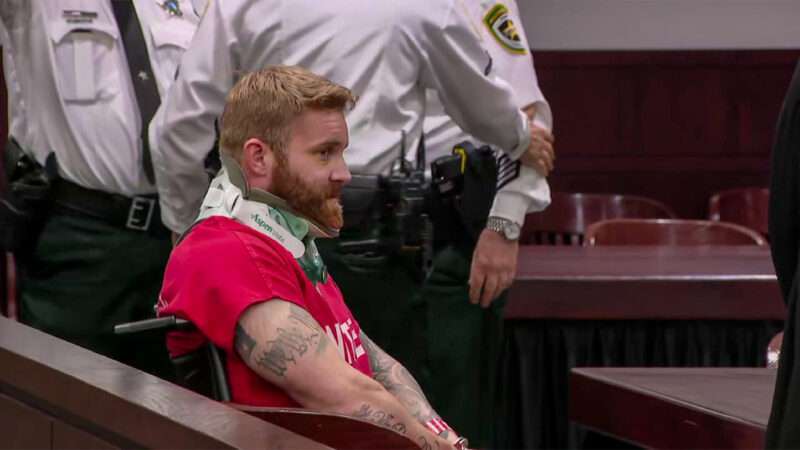
Secret Service agents reportedly subdued a gunman Saturday at the Washington Hilton hotel, during the annual White House Correspondents’ Association dinner.

A man charged a security checkpoint armed with multiple weapons, and he was taken down by some very brave members of Secret Service,” President Donald Trump said while posting security camera footage to social media.

Officials later identified the assailant as Cole Tomas Allen, a 31-year-old California man, and said he was armed with a shotgun, handgun, and knives. Allen reportedly exchanged gunfire with Secret Service, and one agent was hit, though further details are still unknown.

Allen reportedly told law enforcement he was targeting “Trump administration officials,” not Trump himself. But in a digressive manifesto purportedly sent to family members, and published by the New York Post, Allen criticized a number of Trump policies and seemingly deemed the president “a pedophile, rapist, and traitor.”

Some, on both the left and the right, see Allen’s near-miss as a failure that requires more extensive security measures in the future. That’s a mistake, and we should always proceed with caution before subjecting ourselves to more extensive scrutiny.

Trump said the event underscores the need to build a giant ballroom at the White House, in place of the East Wing he recently demolished, where such events could be safely held in the future. “We need the ballroom,” he said in an address later that night. “Today, we need levels of security that probably nobody’s ever seen before.” Many on the right immediately took the same position.

Earlier this month, in response to a civil lawsuit, a federal judge halted construction on the ballroom. On Sunday, Acting U.S. Attorney General Todd Blanche posted a letter on X asking the plaintiffs to “voluntarily dismiss” their “frivolous lawsuit today in light of last night’s assassination attempt on President Trump.”

But as Reason‘s Eric Boehm notes, “the White House Correspondents’ Association is a private entity, and the president is a guest at their dinner. Assuming that the dinner would take place at the White House, if it had a ballroom, seems erroneous.”

This doesn’t mean the Washington Hilton is the most secure possible venue. It has, after all, already been the site of a previous presidential assassination attempt. The New York Times noted in 1999 that the Hilton was simply “the only hotel with a banquet room large enough to hold the 2,700 guests.” MS NOW’s Carol Leonnig writes that the hotel “boasts one of the largest ballrooms in the city but is a functioning hotel that is difficult to secure.”

The Wall Street Journal reported Sunday on the “simple security flaws” that allowed a gunman to get near a sitting president who, less than two years ago, survived an assassination attempt at a campaign rally in Butler, Pennsylvania.

Allen, Saturday’s assailant, even wondered in a postscript to his manifesto, “what the hell is the Secret Service doing?…I walk in with multiple weapons and not a single person there considers the possibility that I could be a threat. The security at the event is all outside, focused on protestors and current arrivals, because apparently no one thought about what happens if someone checks in the day before.”

Within hours of Saturday’s events, The Daily Beast executive editor Hugh Dougherty published an article about his experience, when he discovered the shooter was booked in the hotel room next to his own.

“It does not take a security expert to unravel the layers of failure that happened at a Washington, D.C. hotel on Saturday night,” Dougherty wrote. “How on earth could someone with a disassembled long gun check into a room at a hotel where the president was going to speak?”

Dougherty complains that security was simply too lax, that when he and a colleague checked into the hotel on separate days, security didn’t check their luggage or usher them through a metal detector.

But these complaints ignore the fact that the Secret Service actually performed its task reasonably well. Unlike the fiasco in Pennsylvania in 2024, when a single shooter with a long gun shimmied up the side of an unsecured building within range of a major presidential candidate, agents at the Hilton successfully prevented Allen from entering the ballroom.

“Guests were able to access the Hilton’s lobby and lower levels without going through security scans, and only passed through magnetometers before they entered the ballroom where the dinner was held,” marveled The Wall Street Journal. But that checkpoint is where Allen, likely aware he couldn’t get through with his weapons, apparently tried to simply sprint past the agents, who successfully subdued him before he reached the event.

“It’s not—and shouldn’t be—the job of the Secret Service to secure the whole building. There was a threat to the president and it was stopped well before it could pose a threat to the president,” Garrett Graff wrote on Substack. “So far as we know right now, this seems like the system basically working as designed amid the always necessary trade-offs of security in a free society.”

Indeed, Dougherty—and, ironically, Allen—would apparently prefer the Secret Service either lock down the entire 1,100-room hotel, or subject every single guest to an invasive search of their luggage and effects, any time the president briefly appears at a private event.

Such an expansion of public security calls back to post-9/11 security theater. Desperate to prevent a repeat of that day’s terror attacks, officials dedicated trillions of dollars to tasks like shoring up airport security, taking over a job previously done by the private sector. Years later, the agents of the federal Transportation Security Agency (TSA) not only do no better than private screeners, but they do considerably worse, failing to catch weapons in 90 percent of tests.

The post The Correspondents' Dinner Shooting Is No Excuse for More Security Theater appeared first on Reason.com.

from Latest – Reason.com https://ift.tt/TklOUZM
via IFTTT

Judge Reaffirms: EEOC May Subpoena Penn’s Records as to “Jewish-Related Organizations” (and Others) in Investigation of Anti-Semitic Harassment at Penn

From today’s decision by Judge Gerald Pappert (E.D. Pa.) in EEOC v. Trustees of Univ. of Pa.:

In the wake of Hamas’s October 2023 terrorist attack on Israel, the University of Pennsylvania’s then-President Elizabeth Magill and others affiliated with the school stated publicly numerous times that Jewish faculty, employees and others at Penn had been subject to vile acts of antisemitism and harassment on campus…. Prompted by these statements, … [t]he EEOC … issued an administrative subpoena, with which Penn refused to comply, seeking contact information for Penn employees who may have been victims of, or witnesses to, such harassment…. The Court granted the EEOC’s application [for] {judicial enforcement of the subpoena}, requiring Penn to comply with most of the subpoena by May 1.

Penn, and later the intervenors, moved to stay the Court’s order pending appeal…. Penn does not have a strong chance of prevailing on appeal but makes, narrowly, a showing of irreparable harm. Staying the Court’s order will not substantially injure the EEOC and a stay will allow the Third Circuit Court of Appeals to address in an orderly manner a matter of great public interest….

A request for a stay pending appeal prompts four questions: (1) whether the applicant has made a strong showing it is likely to succeed on the merits; (2) whether the applicant will be irreparably injured absent a stay; (3) whether a stay will substantially injure the other party in the litigation; and (4) whether the public interest favors a stay….

Penn does not have a strong chance of success on the merits, and its motion further exposes its vulnerabilities on appeal. The charge of discrimination is valid, the EEOC’s subpoena seeks information relevant to the charge and the subpoena does not unduly burden Penn. The subpoena also does not violate substantive due process or the First Amendment. The Court explained its reasoning in its memorandum opinion [see this post], and Penn either ignores that reasoning, mischaracterizes it, or objects to it on superficial and conclusory grounds….

Penn … contends the EEOC’s subpoena is “so novel” it cannot be enforced. Penn stresses “the EEOC has cited no authority in which a court enforced a subpoena conscripting an employer to identify employees of a specific religion.”  But the EEOC requested this information to further a charge of discrimination based on religion because in 2023 President Magill made numerous public statements over a one-month period describing the pernicious acts of antisemitism Jewish individuals, including faculty and other employees, experienced on Penn’s campus.  While the EEOC’s investigation of a major university for alleged systemic religious discrimination may be comparatively unique, the purpose of its subpoena is not. The subpoena seeks contact information for employees affiliated with the Penn Jewish community because, in the EEOC’s view and to tailor its requests as narrowly as possible, those employees are more likely to possess information relevant to whether Penn subjected Jewish employees to a hostile work environment based on religion.

Most importantly, Penn has no support for its proposition that a court may quash an administrative subpoena because it contains a “novel” request. Penn wants the Court to sanction a newfangled principle—that an EEOC subpoena is invalid if it does not “resembl[e]” other judicially enforced EEOC subpoenas. At bottom, Penn appears to believe that a different set of legal standards should govern the enforceability of EEOC subpoenas in discrimination cases involving religion generally, and antisemitism specifically. But Penn neither articulates what those standards are, nor cites any precedent pursuant to which courts can fabricate them.

Penn wants to dictate the terms of the EEOC’s investigation, continuing to argue it can contact its employees on the EEOC’s behalf. But that gives an employer subject to a federal investigation an unacceptable role in, or authority over, how that investigation is conducted….

[Penn] contends the charge of discrimination fails to state a method of discrimination because it is “blank” and “merely asserts a legal conclusion.” But again, the charge fairly alleges Penn failed to provide Jewish faculty, staff and other employees a work environment free from religious harassment in the form of antisemitic slurs, messages and threats of violence, pointing Penn to specific acts of antisemitic harassment employees may have experienced on campus.  That suffices to allege a method of discrimination ….

Penn mischaracterizes the Court’s opinion as concluding that a commissioner can state a valid method of discrimination by merely alleging an employer has violated Title VII. As Penn knows, that is not what the Court held, and Penn fails to advance a single critique of its actual reasoning. Requiring a commissioner to allege more than what Commissioner Lucas alleged here would “oblige the Commissioner to substantiate [her] allegations before the EEOC initiates an investigation, the purpose of which is to determine whether there is reason to believe those allegations are true.”

At oral argument, Penn said the charge could have alleged Penn required employees “on their way to work to run a[n] [antisemitic] gauntlet.” The charge pretty much says just that. Based on President Magill’s statements describing specific acts of antisemitic harassment Jewish faculty and employees experienced on campus, the charge alleges Penn permitted Jewish faculty, staff and other employees to endure religious harassment in the form of antisemitic slurs, messages and threats of violence.

Penn also argues the subpoena violates its employees’ right to informational privacy. Specifically, it contends the Court did not “squarely” address whether mere affiliation with a Jewish-related organization on campus falls within the ambit of materials protected by substantive due process. But as the Court explained, Penn offered nothing to support this argument.

Information is private if it is generally unavailable and a person treats it as confidential. Penn presented no facts that could show its employees’ affiliation with Jewish-related organizations is generally unavailable and that the employees keep this information confidential. Nor did Penn contend that affiliation with a Jewish-related organization on campus is inherently private information, such as a person’s medical records. Adjudication of substantive due process rights relies on facts and legal arguments, not conclusory and generalized assertions of privacy.

More importantly, the Court’s substantive-due-process holding did not turn on whether the affected employees have a privacy interest in the information sought by the subpoena. The Court assumed the EEOC’s subpoena sought private information and then balanced the EEOC’s interest in collecting it against the employees’ interest in keeping it from the EEOC….

As the Court explained, the EEOC has a substantial interest in investigating a valid charge of discrimination.  It has a reasonable need for the information at issue because it seeks to contact Penn employees likely to possess evidence relevant to whether Penn subjected Jewish employees to a hostile work environment based on religion.  Nothing suggests EEOC personnel will use the information to harm the affected employees.  And Title VII protects against unauthorized disclosure of the information….

Another reason Penn is unlikely to win on its informational privacy claim is that such claims rarely, if ever, succeed. Each time it has spoken on the subject of informational privacy, the Supreme Court has permitted disclosure upon balancing the interests at stake. See Whalen v. Roe (1977) (upholding a state system that records personal information of patients who obtain prescription drugs); Nixon v. Adm’r of Gen. Servs. (1977) (requiring President Nixon to disclose information); NASA v. Nelson (2011) (requiring federal contract employees to disclose information to the government). And the Third Circuit Court of Appeals has taken a similar approach.

Finally, Penn argues the subpoena infringes the affected employees’ right to associate with Jewish-related organizations on campus. The Court viewed the subpoena through the lens of exacting scrutiny, as Penn wanted it to do. Under that standard, there must be a substantial relation between the subpoena and an important governmental interest, and the governmental interest must reflect the seriousness of the actual burden imposed on the affected employees. The subpoena must also be narrowly tailored.

As the Court explained, the EEOC has an important interest in investigating a valid charge of discrimination.  Next, there is no dramatic mismatch between that interest and the subpoena the EEOC issued.  The subpoena seeks contact information for employees in Jewish-related organizations because they are reasonably likely to have information relevant to the charge.  And the EEOC’s interest in enforcement of the subpoena reflects the actual burden imposed on the affected employees.  The subpoena does not require Penn to disclose an employee’s specific affiliation with a particular organization.  Nor does it require Penn to publicize any information.  And the record contains no evidence showing enforcement of the subpoena would actually chill the affected employees’ ability to associate with Jewish-related organizations on campus.

Finally, the subpoena is narrowly tailored. Narrow tailoring requires the EEOC to demonstrate its need for the information in light of less intrusive alternatives.  But an alternative must be adequate.  And an alternative may be inadequate if it is ineffective.  The claimant “bears the burden to provide, in the record, evidence of … feasible alternatives” and the “government can then rebut by demonstrating that [the] alternative measures … would fail to achieve its interests.”

Penn did not point to any alternative, arguing only “the EEOC’s sweeping inquiry into all employee associations with Jewish-related organizations is not ‘narrowly tailored to the’ agency’s asserted interest in hearing about employee experiences with antisemitism.” The intervenors pointed to two alternatives, arguing Penn could inform its employees of the EEOC’s investigation and the EEOC could invite Penn employees to contact it through a hotline.

The Court addressed both of the intervenors’ alternatives in its opinion, finding them inadequate.  The first proposal forces the EEOC to speak through Penn, which discourages employees to report discrimination.  And both proposals prohibit the EEOC from contacting potential victims or witnesses of harassment directly to inform them of their rights and learn if they have evidence of discrimination.

Since the Court’s ruling, Penn has come up with its own alternative. It now argues a third-party vendor may inform its employees of the EEOC’s investigation. But this suffers from the same flaws as the intervenors’ alternatives.  It strips the EEOC of its ability to contact possible victims or witnesses of antisemitic harassment, inform them of their rights, learn if they have evidence of discrimination, and attempt to persuade them to come forward if they do.

Penn also suggests the EEOC can contact every one of its over twenty thousand employees, but as Penn already knows, this too is inadequate. The EEOC has limited resources, so forcing it to contact twenty thousand individuals would significantly undermine its ability to conduct an effective investigation, not to mention that if it tried to do so, Penn would complain that the investigation was overly broad.

Moreover, narrow tailoring in this context requires only a “reasonable fit” between the EEOC’s goal and the means chosen to accomplish that goal. Bd. of Trs. v. Fox (1989). If the EEOC’s subpoena is “in proportion to the interest served,” the Court must “leave it to [EEOC] decisionmakers to judge what [requests] [] may be best employed.”

There is a clear fit between the EEOC’s subpoena and its interest. The subpoena seeks contact information for Penn employees aligned with the Penn Jewish community because they are reasonably likely to possess information relevant to whether Penn subjected Jewish employees to a hostile work environment based on religion.

But despite that, the court stayed its decision, because “[t]he irreparable-harm factor in this high-profile administrative subpoena enforcement action tilts in Penn’s favor, albeit barely,” and because of the public interest “in the orderly resolution of this case through the ordinary appellate process”:

Penn asserts a successful appeal would not prevent or fully rectify its disclosure of the affected employees’ information to the EEOC. The EEOC responds that if respondents prevail on appeal, the Third Circuit Court of Appeals can order the EEOC to destroy the information Penn turned over. But that would not prevent or fully rectify the initial disclosure of the information to the EEOC….

The post Judge Reaffirms: EEOC May Subpoena Penn's Records as to "Jewish-Related Organizations" (and Others) in Investigation of Anti-Semitic Harassment at Penn appeared first on Reason.com.

from Latest – Reason.com https://ift.tt/DB2GHwJ
via IFTTT

By Dropping Her Criminal Probe of Jerome Powell, Jeanine Pirro Confirms Its Political Motivation


Federal Reserve Chairman Jerome Powell | Sha Hanting/China News Service/VCG/Newscom

“This investigation continues,” Jeanine Pirro, the U.S. attorney for the District of Columbia, declared last Wednesday, referring to the criminal probe of Federal Reserve Chairman Jerome Powell that she launched in November. “I am going forward. We are appealing the decision of Judge Boasberg.”

Pirro was referring to a March 11 ruling in which James Boasberg, chief judge of the U.S. District Court for the District of Columbia, quashed two grand jury subpoenas seeking information about the over-budget renovation of the central bank’s Washington, D.C., headquarters and Powell’s allegedly dishonest testimony about that project during a Senate Banking Committee hearing on June 25. But on Friday, two days after saying she was determined to continue her probe of Powell, Pirro announced that she was dropping it.

It is not hard to see why. Boasberg concluded that the investigation was a transparent attempt to intimidate Powell, whom President Donald Trump has long criticized for failing to deliver the interest-rate cuts he wanted. Sen. Thom Tillis (R–N.C.), a member of the Senate Banking Committee, agreed with that assessment. Tillis had vowed to block confirmation of Trump’s nominee to replace Powell as Fed chairman, Kevin Warsh, until the Justice Department “drops their bogus investigation into Chairman Powell,” which he said “threatens the independence of the Fed.”

Pirro’s investigation of Powell was another example of Trump’s efforts to punish his enemies by weaponizing the criminal justice system. That pattern includes Pirro’s attempt to prosecute members of Congress for constitutionally protected speech and the dismissed indictments against former FBI Director James Comey and New York Attorney General Letitia James. The aborted case against Powell is especially striking because even Republicans who are critical of his performance as Fed chairman agreed there was no evidence that he had broken the law.

The central allegation against Powell was that he lied when he told the Senate Banking Committee that the Fed headquarters renovation did not include luxurious features that had been described in press reports. In a June 24 letter to Powell, several members of the committee asked him about amenities such as “rooftop garden terraces, ornate water features, new elevators that drop board members off directly in their VIP dining suite, use of white marble, rooftop Italian beehives, and a private art collection in the basement.” During his testimony the next day, Powell tried to set the record straight.

“There’s no VIP dining room,” Powell said. “There’s no new marble. We took down the old marble and are putting it back up. We will have to use new marble where some of the old marble broke, but there are no special elevators. They are old elevators that have been there. There are no new water features. There are no beehives, and there are no roof terrace gardens. All of the sort of inflammatory things that the media carried are either not in the current plan or are simply inaccurate.”

That testimony, Powell’s foes argued, contradicted plans that had been approved by the National Capital Planning Commission in 2021. But Powell said any perceived discrepancies were based either on mischaracterizations or on elements that had been abandoned since 2021.

The “garden terrace” mentioned in the 2021 plans, Powell said in a July 17 letter to Office of Management and Budget Director Russell Vought, referred to “the ground-level front lawn of the 1951 Constitution Avenue building,” which “serves as the roof of the parking structure beneath.” Such “green roofs,” he explained, “are commonly used to help with stormwater management and to increase building efficiency and roof longevity.”

Powell reiterated that “there are no VIP dining rooms being constructed as part of the project.” Rather, he said, “the Eccles Building has historic multi-use rooms on the 4th Floor that are used as conference rooms and for mealtime meetings,” and those preexisting rooms “are being renovated and preserved.”

Powell also reiterated that “there are no special, private, or VIP elevators being constructed as part of the project.” Rather, he said, “the original elevators of the Eccles Building are being rehabilitated, including an elevator that services historic conference rooms.” He added that “a short (eighteen-inch) extension of rehabilitated elevator will make the space more accessible for people with disabilities.”

Although the initial design “included new water features for the 1951 Constitution
Avenue building,” Powell wrote, “they have been eliminated.” Instead, “fountains that were original to the Eccles building are being restored.”

What about the marble? “The Eccles and 1951 Constitution Avenue Buildings were originally built with marble in the facades and stonework,” Powell told Vought. “The project has salvaged the original exterior marble to be reinstalled and will use new domestic marble sourced from Georgia in places where the original was damaged or where needed to keep with historic preservation guidelines and to address concerns raised by external review agencies.”

Whatever you make of those explanations, Powell’s testimony certainly does not seem like a violation of 18 USC 1001, which prohibits “knowingly and willfully” making “any materially false, fictitious, or fraudulent statement or representation” during congressional testimony. As Tillis noted on the Senate floor in February, he did not think Powell had deliberately misled the Senate Banking Committee, and neither did most of the other Republicans on the panel.

“I found him to be inept at doing his job, but ineptness or being incompetent is not a
criminal act,” Sen. Tim Scott (R–S.C.), the committee’s chairman, said in February. “I do not believe that he committed a crime during the hearing.”

Sen. Dave McCormick (R–Pa.) concurred. “I believe strongly in an independent Federal Reserve,” he said in January. “I also agree with President Trump that Chairman Powell has been slow to cut interest rates. I think the Federal Reserve renovation may well have wasted taxpayer dollars, but the proper place to fix this is through congressional oversight. I do not think Chairman Powell is guilty of criminal activity.”

Sen. Kevin Cramer (R–N.D.) took a similar view, criticizing the project’s cost overruns but adding: “I do not believe, however, he is a criminal. I ⁠hope this criminal investigation can be put to rest quickly along with the remainder of Jerome Powell’s term. We need to restore confidence in the Fed.” Sen. Mike Crapo (R–Idaho) likewise said he wanted “this resolved as quickly as possible,” adding that it is important for the central bank to remain “free of political influence.”

Sen. John Kennedy (R–La.) also was skeptical of Pirro’s investigation. “We need this like we need a hole in the head,” he said in January. “I know Chairman Powell very well. I will be stunned—I will be shocked if he has done anything wrong.” Sen. Cynthia Lummis (R–Wyo.), a prominent Powell critic, likewise “said [that] the Justice Department’s use of a criminal statute looked like a ‘heavy lift’ and that she did not see any criminal intent,” Reuters reported around the same time.

“We don’t think a crime was committed,” Tillis said after citing those comments, and “we are the majority of the Republicans on the Banking Committee.” That assessment, he said, “sends a very clear message” to Pirro: “Why don’t you come talk to people who were at the alleged scene of the crime? We said we do not believe there was any criminal intent.”

Pirro’s retreat confirms that she has no evidence to the contrary. Even when Boasberg invited her to substantiate her suspicions with ex parte evidence that only he would see, she had nothing to offer. “I will not hesitate to restart a criminal investigation ​should the facts warrant doing so,” Pirro said on Friday, implicitly conceding that “the facts” did not justify the probe she had promised to continue just two days earlier.

“The investigation still continues,” Pirro lamely insisted. “It’s just under a different authority.”

Pirro was referring to an investigation of the renovation project by the Federal Reserve’s inspector general, which Powell himself requested. Although she implied that the inspector general’s review is pretty much the same as her criminal investigation, that is obviously not true. While the inspector general’s report may identify failures that unnecessarily boosted the project’s cost, that is a far cry from alleging criminal conduct.

When Boasberg quashed Pirro’s subpoenas, he noted that Trump or his underlings had made “at least 100 statements” criticizing Powell’s performance and “pressuring
him to lower interest rates.” In a characteristic Truth Social post, Trump described Powell as “TOO ANGRY, TOO STUPID, & TOO POLITICAL” to “have the job of Fed Chair,” saying “he is costing our Country TRILLIONS OF DOLLARS.” Powell is “a TOTAL LOSER,” he said, “and our Country is paying the price!” If Powell did not fall in line, Trump said, “I may have to force something.”

In that context, Boasberg concluded, Pirro’s investigation looked like an attempt to criminalize a policy disagreement. “There is abundant evidence that the subpoenas’ dominant (if not sole) purpose is to harass and pressure Powell either to yield to the President or to resign and make way for a Fed Chair who will,” he wrote. “The Government has offered no evidence whatsoever that Powell committed any crime other than displeasing the President.”

Even as he condemned Boasberg’s ruling, Trump confirmed the judge’s conclusion that the Powell investigation was politically motivated. Trump emphasized Powell’s “horrible performance” in setting interest rates, a policy critique that has nothing to do with the legal merits of pursuing a criminal case against him.

Although Trump frequently complains about Democratic “weaponization” of the legal system, Tillis warned, he is engaged in similar abuses. Whether it happens under a Democratic administration or a Republican administration, “vindictive prosecution is wrong, period,” Tillis said. “At some point, one of the two parties has to stand on principle and end this cycle, or it gets worse.”

The post By Dropping Her Criminal Probe of Jerome Powell, Jeanine Pirro Confirms Its Political Motivation appeared first on Reason.com.

from Latest – Reason.com https://ift.tt/lGwdMsU
via IFTTT

The Correspondents’ Dinner Shooting Is No Excuse for More Security Theater


Heavily armed police officers enter the 2026 White House Correspondents' Association dinner in Washington, D.C. | AARON SCHWARTZ/UPI/Newscom

Secret Service agents reportedly subdued a gunman Saturday at the Washington Hilton hotel, during the annual White House Correspondents’ Association dinner.

A man charged a security checkpoint armed with multiple weapons, and he was taken down by some very brave members of Secret Service,” President Donald Trump said while posting security camera footage to social media.

Officials later identified the assailant as Cole Tomas Allen, a 31-year-old California man, and said he was armed with a shotgun, handgun, and knives. Allen reportedly exchanged gunfire with Secret Service, and one agent was hit, though further details are still unknown.

Allen reportedly told law enforcement he was targeting “Trump administration officials,” not Trump himself. But in a digressive manifesto purportedly sent to family members, and published by the New York Post, Allen criticized a number of Trump policies and seemingly deemed the president “a pedophile, rapist, and traitor.”

Some, on both the left and the right, see Allen’s near-miss as a failure that requires more extensive security measures in the future. That’s a mistake, and we should always proceed with caution before subjecting ourselves to more extensive scrutiny.

Trump said the event underscores the need to build a giant ballroom at the White House, in place of the East Wing he recently demolished, where such events could be safely held in the future. “We need the ballroom,” he said in an address later that night. “Today, we need levels of security that probably nobody’s ever seen before.” Many on the right immediately took the same position.

Earlier this month, in response to a civil lawsuit, a federal judge halted construction on the ballroom. On Sunday, Acting U.S. Attorney General Todd Blanche posted a letter on X asking the plaintiffs to “voluntarily dismiss” their “frivolous lawsuit today in light of last night’s assassination attempt on President Trump.”

But as Reason‘s Eric Boehm notes, “the White House Correspondents’ Association is a private entity, and the president is a guest at their dinner. Assuming that the dinner would take place at the White House, if it had a ballroom, seems erroneous.”

This doesn’t mean the Washington Hilton is the most secure possible venue. It has, after all, already been the site of a previous presidential assassination attempt. The New York Times noted in 1999 that the Hilton was simply “the only hotel with a banquet room large enough to hold the 2,700 guests.” MS NOW’s Carol Leonnig writes that the hotel “boasts one of the largest ballrooms in the city but is a functioning hotel that is difficult to secure.”

The Wall Street Journal reported Sunday on the “simple security flaws” that allowed a gunman to get near a sitting president who, less than two years ago, survived an assassination attempt at a campaign rally in Butler, Pennsylvania.

Allen, Saturday’s assailant, even wondered in a postscript to his manifesto, “what the hell is the Secret Service doing?…I walk in with multiple weapons and not a single person there considers the possibility that I could be a threat. The security at the event is all outside, focused on protestors and current arrivals, because apparently no one thought about what happens if someone checks in the day before.”

Within hours of Saturday’s events, The Daily Beast executive editor Hugh Dougherty published an article about his experience, when he discovered the shooter was booked in the hotel room next to his own.

“It does not take a security expert to unravel the layers of failure that happened at a Washington, D.C. hotel on Saturday night,” Dougherty wrote. “How on earth could someone with a disassembled long gun check into a room at a hotel where the president was going to speak?”

Dougherty complains that security was simply too lax, that when he and a colleague checked into the hotel on separate days, security didn’t check their luggage or usher them through a metal detector.

But these complaints ignore the fact that the Secret Service actually performed its task reasonably well. Unlike the fiasco in Pennsylvania in 2024, when a single shooter with a long gun shimmied up the side of an unsecured building within range of a major presidential candidate, agents at the Hilton successfully prevented Allen from entering the ballroom.

“Guests were able to access the Hilton’s lobby and lower levels without going through security scans, and only passed through magnetometers before they entered the ballroom where the dinner was held,” marveled The Wall Street Journal. But that checkpoint is where Allen, likely aware he couldn’t get through with his weapons, apparently tried to simply sprint past the agents, who successfully subdued him before he reached the event.

“It’s not—and shouldn’t be—the job of the Secret Service to secure the whole building. There was a threat to the president and it was stopped well before it could pose a threat to the president,” Garrett Graff wrote on Substack. “So far as we know right now, this seems like the system basically working as designed amid the always necessary trade-offs of security in a free society.”

Indeed, Dougherty—and, ironically, Allen—would apparently prefer the Secret Service either lock down the entire 1,100-room hotel, or subject every single guest to an invasive search of their luggage and effects, any time the president briefly appears at a private event.

Such an expansion of public security calls back to post-9/11 security theater. Desperate to prevent a repeat of that day’s terror attacks, officials dedicated trillions of dollars to tasks like shoring up airport security, taking over a job previously done by the private sector. Years later, the agents of the federal Transportation Security Agency (TSA) not only do no better than private screeners, but they do considerably worse, failing to catch weapons in 90 percent of tests.

The post The Correspondents' Dinner Shooting Is No Excuse for More Security Theater appeared first on Reason.com.

from Latest – Reason.com https://ift.tt/TklOUZM
via IFTTT

A Few Thoughts on the Chatrie Oral Argument

The Supreme Court held oral argument this morning in Chatrie v. United States, the geofence warrant case.  I live-tweeted the two-hour argument over at both X and Bluesky, and click the links there to see the play-by-play.  For those wanting the big picture, here are my initial thoughts right after the argument:

(1) The most important takeaway is that the Justices seem likely to reject the broader arguments Chatrie made that geofence warrants are categorically unconstitutional or cannot be drafted in ways that could identify suspects. They seem likely to rule that geofence warrants can be drafted constitutionally, rejecting the 5th Circuit’s view in Smith.  I suspect they will likely hold that geofence warrants have to be limited in time and space, and leave the details to lower courts. There were some Justices who wanted to address the multi-step process of Google’s warrant procedure and say new warrants were needed for those steps—that was the view, if I recall correctly, suggested by Justices Sotomayor and Jackson. But I don’t know if the majority will get that far.

(2) I don’t know if the Court will rule on whether there was a search. I would guess that they assume a search and say the warrant was constitutional, so they don’t have to decide the search question. There was a lot of discussion of whether location history records were kept in a virtual private locker, and I heard the government conceding that this was a viable theory of protection for cloud-stored *content* records, like calendar entries and photos stored in the cloud, that the user directly controls. But I don’t know if the Court will weigh in on that or just assume a search and focus on the constitutionality of the warrant.

(3) I was somewhat surprised by the government not pushing back more late in the argument, especially in response to arguments that its search arguments are maximalist, or that there were practical problems with getting warrants, or that warrants might be needed if the revealed location was a home.  Late in the argument, the government seemed in a conciliatory mindset, perhaps sensing a victory on the warrant issue that it didn’t want to place at risk. But Smith v. Maryland expressly holds that voluntary disclosure from the home that reveals presence in the home is still not a search. And more broadly, there’s no practical problem with getting warrants for Location History because the technology doesn’t exist anymore, and probable cause was not challenged back when there was.  In any event, what matters going forward is all the other online records that exist online: IP logins, etc. (See my book for some of the other kinds of records that are important in investigations.) Those are records that lower courts have held don’t require warrants, and it would be a massive shift in practice if the Court ruled on the search issue in ways that implicated those different records. I was surprised the government didn’t flag that; that’s what matters practically speaking. Anyway, maybe that counsels in favor of just assuming a search here, or maybe the Court will get into that. Stay tuned.

(4) There was some discussion of a bunch of the side issues: Do Terms of Service matter? Does privacy legislation matter? Can we recognize a mosaic theory? These are each massive questions on which lower courts are split. Although I think there are correct answers to each of the three questions— Full disclosure, I have articles on each of these topics arguing that the answers are, respectively, no, no, and no—I am not sure that the Court will get into them.

(5) Justice Alito expressed some frustration that the Court had granted cert to render what amounted to an advisory opinion, both because the good faith exception obviously applies and because Google no longer stores these records. Justice Alito suggested that he might rule for the government on the good faith exception even though the Court denied cert on that question presented. He also hinted that perhaps it was the minimum of four Justices among his colleagues who voted to grant in the case. Justice Sotomayor weighed in that guidance in this area was important. So presumably Justice Sotomayor voted to grant cert in the case, and Justice Alito did not.

(6) There was some discussion of the Stored Communications Act and how it applies.  It wasn’t a particularly strong discussion, I thought; it’s a complicated question, and this was no context in which to delve into the glorious statutory details.  I don’t think the statute is relevant to the Fourth Amendment issue, for all the reasons I explained here. But if the Court does weigh in on the SCA, it might surprisingly lead to an important SCA precedent, albeit on a question not really briefed.

As always, stay tuned.

The post A Few Thoughts on the <i>Chatrie</i> Oral Argument appeared first on Reason.com.

from Latest – Reason.com https://ift.tt/8YGBNKu
via IFTTT

Juge Reaffirms: EEOC May Subpoena Penn’s Records as to “Jewish-Related Organizations” (and Others) in Investigation of Anti-Semitic Harassment at Penn

From today’s decision by Judge Gerald Pappert (E.D. Pa.) in EEOC v. Trustees of Univ. of Pa.:

In the wake of Hamas’s October 2023 terrorist attack on Israel, the University of Pennsylvania’s then-President Elizabeth Magill and others affiliated with the school stated publicly numerous times that Jewish faculty, employees and others at Penn had been subject to vile acts of antisemitism and harassment on campus…. Prompted by these statements, … [t]he EEOC … issued an administrative subpoena, with which Penn refused to comply, seeking contact information for Penn employees who may have been victims of, or witnesses to, such harassment…. The Court granted the EEOC’s application [for] {judicial enforcement of the subpoena}, requiring Penn to comply with most of the subpoena by May 1.

Penn, and later the intervenors, moved to stay the Court’s order pending appeal…. Penn does not have a strong chance of prevailing on appeal but makes, narrowly, a showing of irreparable harm. Staying the Court’s order will not substantially injure the EEOC and a stay will allow the Third Circuit Court of Appeals to address in an orderly manner a matter of great public interest….

A request for a stay pending appeal prompts four questions: (1) whether the applicant has made a strong showing it is likely to succeed on the merits; (2) whether the applicant will be irreparably injured absent a stay; (3) whether a stay will substantially injure the other party in the litigation; and (4) whether the public interest favors a stay….

Penn does not have a strong chance of success on the merits, and its motion further exposes its vulnerabilities on appeal. The charge of discrimination is valid, the EEOC’s subpoena seeks information relevant to the charge and the subpoena does not unduly burden Penn. The subpoena also does not violate substantive due process or the First Amendment. The Court explained its reasoning in its memorandum opinion [see this post], and Penn either ignores that reasoning, mischaracterizes it, or objects to it on superficial and conclusory grounds….

Penn … contends the EEOC’s subpoena is “so novel” it cannot be enforced. Penn stresses “the EEOC has cited no authority in which a court enforced a subpoena conscripting an employer to identify employees of a specific religion.”  But the EEOC requested this information to further a charge of discrimination based on religion because in 2023 President Magill made numerous public statements over a one-month period describing the pernicious acts of antisemitism Jewish individuals, including faculty and other employees, experienced on Penn’s campus.  While the EEOC’s investigation of a major university for alleged systemic religious discrimination may be comparatively unique, the purpose of its subpoena is not. The subpoena seeks contact information for employees affiliated with the Penn Jewish community because, in the EEOC’s view and to tailor its requests as narrowly as possible, those employees are more likely to possess information relevant to whether Penn subjected Jewish employees to a hostile work environment based on religion.

Most importantly, Penn has no support for its proposition that a court may quash an administrative subpoena because it contains a “novel” request. Penn wants the Court to sanction a newfangled principle—that an EEOC subpoena is invalid if it does not “resembl[e]” other judicially enforced EEOC subpoenas. At bottom, Penn appears to believe that a different set of legal standards should govern the enforceability of EEOC subpoenas in discrimination cases involving religion generally, and antisemitism specifically. But Penn neither articulates what those standards are, nor cites any precedent pursuant to which courts can fabricate them.

Penn wants to dictate the terms of the EEOC’s investigation, continuing to argue it can contact its employees on the EEOC’s behalf. But that gives an employer subject to a federal investigation an unacceptable role in, or authority over, how that investigation is conducted….

[Penn] contends the charge of discrimination fails to state a method of discrimination because it is “blank” and “merely asserts a legal conclusion.” But again, the charge fairly alleges Penn failed to provide Jewish faculty, staff and other employees a work environment free from religious harassment in the form of antisemitic slurs, messages and threats of violence, pointing Penn to specific acts of antisemitic harassment employees may have experienced on campus.  That suffices to allege a method of discrimination ….

Penn mischaracterizes the Court’s opinion as concluding that a commissioner can state a valid method of discrimination by merely alleging an employer has violated Title VII. As Penn knows, that is not what the Court held, and Penn fails to advance a single critique of its actual reasoning. Requiring a commissioner to allege more than what Commissioner Lucas alleged here would “oblige the Commissioner to substantiate [her] allegations before the EEOC initiates an investigation, the purpose of which is to determine whether there is reason to believe those allegations are true.”

At oral argument, Penn said the charge could have alleged Penn required employees “on their way to work to run a[n] [antisemitic] gauntlet.” The charge pretty much says just that. Based on President Magill’s statements describing specific acts of antisemitic harassment Jewish faculty and employees experienced on campus, the charge alleges Penn permitted Jewish faculty, staff and other employees to endure religious harassment in the form of antisemitic slurs, messages and threats of violence.

Penn also argues the subpoena violates its employees’ right to informational privacy. Specifically, it contends the Court did not “squarely” address whether mere affiliation with a Jewish-related organization on campus falls within the ambit of materials protected by substantive due process. But as the Court explained, Penn offered nothing to support this argument.

Information is private if it is generally unavailable and a person treats it as confidential. Penn presented no facts that could show its employees’ affiliation with Jewish-related organizations is generally unavailable and that the employees keep this information confidential. Nor did Penn contend that affiliation with a Jewish-related organization on campus is inherently private information, such as a person’s medical records. Adjudication of substantive due process rights relies on facts and legal arguments, not conclusory and generalized assertions of privacy.

More importantly, the Court’s substantive-due-process holding did not turn on whether the affected employees have a privacy interest in the information sought by the subpoena. The Court assumed the EEOC’s subpoena sought private information and then balanced the EEOC’s interest in collecting it against the employees’ interest in keeping it from the EEOC….

As the Court explained, the EEOC has a substantial interest in investigating a valid charge of discrimination.  It has a reasonable need for the information at issue because it seeks to contact Penn employees likely to possess evidence relevant to whether Penn subjected Jewish employees to a hostile work environment based on religion.  Nothing suggests EEOC personnel will use the information to harm the affected employees.  And Title VII protects against unauthorized disclosure of the information….

Another reason Penn is unlikely to win on its informational privacy claim is that such claims rarely, if ever, succeed. Each time it has spoken on the subject of informational privacy, the Supreme Court has permitted disclosure upon balancing the interests at stake. See Whalen v. Roe (1977) (upholding a state system that records personal information of patients who obtain prescription drugs); Nixon v. Adm’r of Gen. Servs. (1977) (requiring President Nixon to disclose information); NASA v. Nelson (2011) (requiring federal contract employees to disclose information to the government). And the Third Circuit Court of Appeals has taken a similar approach.

Finally, Penn argues the subpoena infringes the affected employees’ right to associate with Jewish-related organizations on campus. The Court viewed the subpoena through the lens of exacting scrutiny, as Penn wanted it to do. Under that standard, there must be a substantial relation between the subpoena and an important governmental interest, and the governmental interest must reflect the seriousness of the actual burden imposed on the affected employees. The subpoena must also be narrowly tailored.

As the Court explained, the EEOC has an important interest in investigating a valid charge of discrimination.  Next, there is no dramatic mismatch between that interest and the subpoena the EEOC issued.  The subpoena seeks contact information for employees in Jewish-related organizations because they are reasonably likely to have information relevant to the charge.  And the EEOC’s interest in enforcement of the subpoena reflects the actual burden imposed on the affected employees.  The subpoena does not require Penn to disclose an employee’s specific affiliation with a particular organization.  Nor does it require Penn to publicize any information.  And the record contains no evidence showing enforcement of the subpoena would actually chill the affected employees’ ability to associate with Jewish-related organizations on campus.

Finally, the subpoena is narrowly tailored. Narrow tailoring requires the EEOC to demonstrate its need for the information in light of less intrusive alternatives.  But an alternative must be adequate.  And an alternative may be inadequate if it is ineffective.  The claimant “bears the burden to provide, in the record, evidence of … feasible alternatives” and the “government can then rebut by demonstrating that [the] alternative measures … would fail to achieve its interests.”

Penn did not point to any alternative, arguing only “the EEOC’s sweeping inquiry into all employee associations with Jewish-related organizations is not ‘narrowly tailored to the’ agency’s asserted interest in hearing about employee experiences with antisemitism.” The intervenors pointed to two alternatives, arguing Penn could inform its employees of the EEOC’s investigation and the EEOC could invite Penn employees to contact it through a hotline.

The Court addressed both of the intervenors’ alternatives in its opinion, finding them inadequate.  The first proposal forces the EEOC to speak through Penn, which discourages employees to report discrimination.  And both proposals prohibit the EEOC from contacting potential victims or witnesses of harassment directly to inform them of their rights and learn if they have evidence of discrimination.

Since the Court’s ruling, Penn has come up with its own alternative. It now argues a third-party vendor may inform its employees of the EEOC’s investigation. But this suffers from the same flaws as the intervenors’ alternatives.  It strips the EEOC of its ability to contact possible victims or witnesses of antisemitic harassment, inform them of their rights, learn if they have evidence of discrimination, and attempt to persuade them to come forward if they do.

Penn also suggests the EEOC can contact every one of its over twenty thousand employees, but as Penn already knows, this too is inadequate. The EEOC has limited resources, so forcing it to contact twenty thousand individuals would significantly undermine its ability to conduct an effective investigation, not to mention that if it tried to do so, Penn would complain that the investigation was overly broad.

Moreover, narrow tailoring in this context requires only a “reasonable fit” between the EEOC’s goal and the means chosen to accomplish that goal. Bd. of Trs. v. Fox (1989). If the EEOC’s subpoena is “in proportion to the interest served,” the Court must “leave it to [EEOC] decisionmakers to judge what [requests] [] may be best employed.”

There is a clear fit between the EEOC’s subpoena and its interest. The subpoena seeks contact information for Penn employees aligned with the Penn Jewish community because they are reasonably likely to possess information relevant to whether Penn subjected Jewish employees to a hostile work environment based on religion.

But despite that, the court stayed its decision, because “[t]he irreparable-harm factor in this high-profile administrative subpoena enforcement action tilts in Penn’s favor, albeit barely,” and because of the public interest “in the orderly resolution of this case through the ordinary appellate process”:

Penn asserts a successful appeal would not prevent or fully rectify its disclosure of the affected employees’ information to the EEOC. The EEOC responds that if respondents prevail on appeal, the Third Circuit Court of Appeals can order the EEOC to destroy the information Penn turned over. But that would not prevent or fully rectify the initial disclosure of the information to the EEOC….

The post Juge Reaffirms: EEOC May Subpoena Penn's Records as to "Jewish-Related Organizations" (and Others) in Investigation of Anti-Semitic Harassment at Penn appeared first on Reason.com.

from Latest – Reason.com https://ift.tt/DB2GHwJ
via IFTTT

A Few Thoughts on the Chatrie Oral Argument

The Supreme Court held oral argument this morning in Chatrie v. United States, the geofence warrant cases.  I live-tweeted the two-hour argument over at both X and Bluesky, and click the links there to see the play-by-play.  For those wanting the big picture, here are my initial thoughts right after the argument:

(1) The most important takeaway is that the Justices seem likely to reject the broader arguments Chatrie made that geofence warrants are categorically unconstitutional or cannot be drafted in ways that could identify suspects. They seem likely to rule that geofence warrants can be drafted constitutionally, rejecting the 5th Circuit’s view in Smith.  I suspect they will likely hold that geofence warrants have to be limited in time and space, and leave the details to lower courts. There were some Justices who wanted to address the multi-step process of Google’s warrant procedure and say new warrants were needed for those steps—that was the view, if I recall correctly, suggested by Justices Sotomayor and Jackson. But I don’t know if the majority will get that far.

(2) I don’t know if the Court will rule on whether there was a search. I would guess that they assume a search and say the warrant was constitutional, so they don’t have to decide the search question. There was a lot of discussion of whether location history records were kept in a virtual private locker, and I heard the government conceding that this was a viable theory of protection for cloud-stored *content* records, like calendar entries and photos stored in the cloud, that the user directly controls. But I don’t know if the Court will weigh in on that just assume a search and focus on the constitutionality of the warrant.

(3) I was somewhat surprised by the government not pushing back more late in the argument, especially in response to arguments that its search arguments are maximalist, or that there were practical problems with getting warrants, or that warrants might be needed if the revealed location was a home.  Late in the argument, the government seemed in a conciliatory mindset, perhaps sensing a victory on the warrant issue that it didn’t want to place at risk. But Smith v. Maryland expressly holds that voluntary disclosure from the home that reveals presence in the home is still not a search. And more broadly, there’s no practical problem with getting warrants for Location History because the technology doesn’t exist anymore, and probable cause was not challenged back when there was.  In any event, what matters going forward is all the other online records that exist online: IP logins, etc. (See my book for some of the other kinds of records that are important in investigations.) Those are records that lower courts have held don’t require warrants, and it would be a massive shift in practice if the Court ruled on the search issue in ways that implicated those different records. I was surprised the government didn’t flag that; that’s what matters practically speaking. Anyway, maybe that counsels in favor of just assuming a search here, or maybe the Court will get into that. Stay tuned.

(4) There was some discussion of a bunch of the side issues: Do Terms of Service matter? Does privacy legislation matter? Can we recognize a mosaic theory? These are each massive questions on which lower courts are split. Although I think there are correct answers to each of the three questions— Full disclosure, I have articles on each of these topics arguing that the answers are, respectively, no, no, and no—I am not sure that the Court will get into them.

(5) Justice Alito expressed some frustration that the Court had granted cert to render what amounted to an advisory opinion, both because the good faith exception obviously applies and because Google no longer stores these records. Justice Alito suggested that he might rule for the government on the good faith exception even though the Court denied cert on that question presented. He also hinted that perhaps it was the minimum of four Justices among his colleagues who voted to grant in the case. Justice Sotomayor weighed in that guidance in this area was important. So presumably Justice Sotomayor voted to grant cert in the case, and Justice Alito did not.

(6) There was some discussion of the Stored Communications Act and how it applies.  It wasn’t a particularly strong discussion, I thought; it’s a complicated question, and this was no context in which to delve into the glorious statutory details.  I don’t think the statute is relevant to the Fourth Amendment issue, for all the reasons I explained here. But if the Court does weigh in on the SCA, it might surprisingly lead to an important SCA precedent, albeit on a question not really briefed.

As always, stay tuned.

The post A Few Thoughts on the <i>Chatrie</i> Oral Argument appeared first on Reason.com.

from Latest – Reason.com https://ift.tt/8YGBNKu
via IFTTT

Republicans Fumble Away Fiscal Conservatism in Stadium Subsidy Projects


Cleveland Browns playing in a stadium | Frank Jansky/Icon Sportswire DCT/Frank Jansky/Icon Sportswire/Newscom

Republican politicians love to talk a good fiscal conservatism game, but they’ve been quick to throw out their penny-pinching playbooks when pro sports team owners come calling. 

In states like Indiana, Kansas, and Ohio, elected officials are offering increasingly massive public subsidies for new stadium projects, using a variety of convoluted mechanisms to hide the ultimate cost to taxpayers and communities.

We can start with the story of the Chicago Bears’ replacement stadium in either Illinois or Indiana. The drama here features the deeply unusual casting of Illinois Democratic Gov. J.B. Pritzker as the nominal voice of fiscal sanity and taxpayer protection. 

“I’m very interested to see how the people of Indiana and the voters of Indiana feel about the massive increases in taxes that are being proposed, about paying for a stadium in Indiana for the Chicago Bears,” he told reporters after the Indiana House of Representatives voted 95–4 in February to provide up to $1 billion in subsidies for a Bears stadium through a new public funding mechanism. (Pritzker, however, has offered undefined amounts of state funding for “infrastructure” around a new Bears stadium in Chicago or suburban Arlington Heights, and Democratic leaders in the Illinois Legislature are trying to find ways to give the team a break on local property taxes.)

Indiana’s plan includes a variety of new and redirected taxes to amass that billion dollars, including a new 1 percent food and beverage tax in Lake and Porter counties. This could be an annual $18 million tax hike, according to the state Legislative Services Agency. Making every meal across 917 square miles of northwest Indiana cost 1 percent more so that an NFL team can have a new stadium isn’t the kind of Hoosier fiscal conservatism associated with proudly tight-fisted former governors like Mitch Daniels and Mike Pence.

The Indiana plan also doubles Lake County’s hotel tax rate from 5 percent to 10 percent and assesses a 12 percent tax on any tickets—excluding season tickets—sold for events at the stadium. On top of that, it creates two new governmental authorities with the power to capture state sales and use taxes, income taxes, and property taxes in a stadium district within the city of Hammond, Indiana, on the Chicago border.

In Kansas, a similar drama is playing out with the Kansas City Chiefs’ new stadium project. Unlike Pritzker, Democratic Gov. Laura Kelly has teamed up with the Republican-dominated Kansas Legislature on a bipartisan spending binge that will throw $1.8 billion at the Kansas City Chiefs to load up their U-Hauls and drive 20 miles west over the Missouri-Kansas state line to a new stadium near Kansas Speedway in Wyandotte County.

Kelly and her allies in the Legislature tried to claim they were being fiscally responsible while committing Kansas’ taxpayers to funding 60 percent of a $3 billion stadium and practice facility/team headquarters project, saying there would be “no new state taxes and no impact on the state budget.”

The issue, however, is what happens to existing taxes, and what impact that will have on future state and municipal budgets. The state will be issuing bonds to fund the stadium project, then diverting most future sales tax revenue growth in “neighboring communities”—a disingenuous way to describe a bond district covering as much as 290 square miles of eastern Kansas—toward repaying that debt. 

This means, for example, that if business picks up over the next few decades at the Tractor Supply Company store in the South Olathe Business Park, 25 miles away by car (or tractor) from the proposed stadium site, the resulting increase in sales tax revenues will be considered to be “generated by this project” and subject to capture by the stadium bond district.

In fact, large portions of the proposed Sales Tax and Revenue (STAR) Bond District are closer to the Chiefs’ current stadium in Missouri than they are to the new Kansas stadium site. But under the logic of Kansas politicians, those communities will somehow economically benefit from being further away from an NFL stadium than they are today.

The municipal governments were pressured to get involved, and in Olathe, the city agreed to divert 1.5 percent of its municipal sales tax and 78 percent of its hotel tax revenues to the project. Wyandotte County (which includes Kansas City, Kansas) is committing most of its hotel sales tax revenues, all county sales tax revenues not already earmarked for other purposes and 61 percent of its municipal sales tax revenues inside the stadium district. The county estimates this could total $450 million in lost tax revenues over the 30-year life of the bond.

The Kansas Department of Commerce’s preliminary map for the sprawling STAR Bond district in which future growth in sales tax revenues would be captured to repay stadium bonds. The urban area at the northeast edge of the district is Kansas City.

The “no new taxes” claim also glosses over the way the plan diverts revenues that currently pay for other government operations. In addition to sales tax capture in the bond district, the state is also devoting existing lottery and sports betting tax collections, along with potentially other revenue streams, to fund the project.

While Indiana’s and Kansas’ stadium subsidy plans are terrible and convoluted, the most egregious proposal is Ohio’s plan to simply take private citizens’ money and give it to sports team owners: no taxes, no fees, just a simple governmental seizure of private property. Because they can.

Driven by the Cleveland Browns’ desire to build a new stadium in the Cleveland suburb of Brook Park, the state’s leaders looked around for a funding source for the proposed $600 million subsidy and settled on the state’s unclaimed funds accounts, which hold an estimated $4.8 billion of private citizens’ dormant bank accounts, uncashed checks, stocks and bonds, utility deposits, unclaimed wages, and other assets.

Notably, this is money that does not belong to the state of Ohio. It belongs to someone else, even if the rightful owner doesn’t know it exists. But that didn’t matter to the state legislature, which last June set a 10-year deadline on Ohioans’ ability to claim those funds.

Ohio’s elected officials decided that this pot of free money was the perfect source of funding for a new “Ohio Cultural and Sports Facility Performance Grant Fund,” which would have the power to pay for as much as 25 percent of the cost of new stadiums. 

This isn’t the first time that Ohio has come up with a strange financing mechanism for corporate welfare programs. The state uniquely funds its JobsOhio economic development agency with the profits of the state’s liquor distribution monopoly, which the agency’s website disingenuously describes as “an independent private source.”

Former Ohio Attorney General Marc Dann and former state Rep. Jeffrey Crossman filed suits in both federal and state courts on behalf of two plaintiffs who have assets in the state’s Unclaimed Funds Trust Fund. They were successful in getting a temporary restraining order and follow-up preliminary injunction halting the state’s plans, after a magistrate judge in Franklin County ruled that the plaintiffs were likely to prevail on their claims under the Ohio Constitution’s Takings and Due Process Clauses. Magistrate Judge Jennifer D. Hunt rejected the state’s claim that it could sidestep the Ohio constitution’s Takings Clause by legislatively declaring the funds to be “abandoned,” or that taking private property to subsidize a stadium district was in a “public purpose.”

Hunt was correct that Ohio’s stadium subsidy plans were not in the public interest, as the real-world economic evidence is clear that pro sports stadiums are not fiscally responsible government investments.

To be fair to Ohio Republican Gov. Mike DeWine and his colleagues in Indiana and Kansas, they are far from alone in throwing out fiscal conservatism in favor of corporate welfare for sports team owners. In recent years, governors and other elected officials in supposedly “red” states like Florida, Georgia, Oklahoma, Tennessee, Texas, and even penny-pinching Utah have cut massive stadium deals as part of the current generational wave of stadium projects spreading out across the country. 

Not to be outdone, Democratic governors who talk a good game about corporate power and standing up for the little guy have been perfectly happy to fund billionaires’ stadiums in states like Maryland, Nevada, New York, North Carolina, Oregon, and Wisconsin, as well as in Washington, D.C.

There are, of course, at least a few elected officials who aren’t on board with the stadium subsidy game. On April 15, Hillsborough County, Florida, commissioner Joshua Wostal posted a message on social media regarding efforts by the Tampa Bay Rays to get public financing for a new stadium. “At this point I have to rescind all of the positive things I’ve said about the new Rays ownership,” Wostal wrote. “They have outright lied not only to my face but also the public at multiple meetings. This is them now asking literally for your property taxes.”

“May God have mercy on the soul of anyone that supports this.”

The post Republicans Fumble Away Fiscal Conservatism in Stadium Subsidy Projects appeared first on Reason.com.

from Latest – Reason.com https://ift.tt/Xh8T3Mk
via IFTTT

SCOTUS Summarily Reverses Three-Judge Panel In Mandatory Jurisdiction Case Based On Earlier Shadow Docket Ruling In Same Case

Today, the Supreme Court issued a very unusual order in a very unusual case.

In late November, a three-judge panel found that Texas’s redistricting plan was motivated by race. Judge Jeffrey Brown, a Trump appointee in Galveston, joined (and likely wrote) the majority opinion. Judge Jerry Smith, a Reagan appointee in Houston, wrote a blistering dissent. It began:

“Fasten your seatbelts. It’s going to be a bumpy night!”

Indeed, this night would be very bumpy.

Texas Solicitor General Will Peterson sought an emergency stay of the preliminary injunction with the Supreme Court.

On December 4, the Supreme Court granted an emergency stay by a 6-3 vote. There were two paragraphs of substantive analysis. The second paragraph focused on the timing, as the District Court issued its order after voting had already begun. The first paragraph offered two reasons why “Texas is likely to succeed on the merits of its claim that the District Court committed at least two serious errors.” First, “the District Court failed to honor the presumption of legislative good faith by construing ambiguous direct and circumstantial evidence against the legislature.” And second, “the District Court failed to draw a dispositive or near-dispositive adverse inference against respondents even though they did not produce a viable alternative map that met the State’s avowedly partisan goals.” The Supreme Court distilled Judge Smith’s detailed dissent to a few words.

This stay order allowed the maps to go into effect for the 2026 midterm elections. But it did not end the case. Texas still had to challenge the preliminary injunction in the normal course.

On January 13, the Texas Solicitor General filed what is known as a jurisdictional statement. Unlike a usual discretionary case, which involves a petition for a writ of certiorari, Congress designated appeals from three-judge panels in redistricting cases as “mandatory” jurisdiction. The Appellants (not Petitioners) asked the Supreme Court to note “probable jurisdiction” in the case. The Appellees asked the Supreme Court instead to affirm.

Texas did not ask the Supreme Court to summarily reverse the case. Instead, the state wanted the Court to hear oral argument to clarify the Alexander issue:

Plaintiffs alternatively ask this Court to vacate the preliminary injunction (presumably without opinion), remand, and delay review until an appeal following final judgment. See, e.g., Brooks Mot. 37; Gonzales Mot. 35. Although the district court’s errors are straightforward and may well warrant summary reversal, this Court should provide guidance for the district court in this case and future cases. The standard for issuance of a preliminary injunction in redistricting litigation is an important issue, and as this case illustrates, the erroneous grant of a preliminary injunction can create electoral chaos and require expedited action. To avoid such disruption in future cases, this Court should squarely hold that Alexander’s alternative-map requirement and the presumption of legislative good faith apply with equal force at the preliminary injunction stage. And unless they are corrected by this Court, the additional errors discussed above may well recur at trial, leading to reversal and a waste of both judicial and party resources.

But the Supreme Court took a difference path. Today the Court issued an order in Abbott v. League of United Latin American Citizens (25-845):

For the reasons set forth in Abbott v. League of United Latin American Citizens, 607 U. S. ___ (2025) [25A608], we reverse the District Court’s judgment. Justice Sotomayor, Justice Kagan, and Justice Jackson dissent from the Court’s summary reversal.

Do you follow? The Supreme Court reversed the District Court’s preliminary injunction in light of the emergency docket order staying the District Court’s preliminary injunction. It is a bit recursive, but it makes sense. Again, Lulac is a mandatory jurisdiction case, not a discretionary certiorari case. I presume that the decision to summarily reverse required a threshold finding of probable jurisdiction, but the Court does not say so expressly.

I can’t recall any instance where the Court summarily reversed in a mandatory jurisdiction case. It is common enough for summary affirmances. Bluman v. FEC (2012) was one such recent case. In my article on bilateral judicial reform, I proposed that all mandatory cases should be submitted for oral argument. At the time, I was responding to the Court issuing a summary affirmance in a mandatory jurisdiction case. The thought never crossed my mind that the Court would summarily reverse in a mandatory jurisdiction case. And I could have never fathomed the Court would summarily reverse in a mandatory jurisdiction case based on an emergency docket order. Yet, here we are.

Lulac was distributed for the conference on April 24, and decided on April 27. This does not seem to have been a hard one for the Court. They didn’t want to decide the tough merits issue so just got rid of it. Justices Sotomayor, Kagan, and Jackson didn’t even bother writing a dissent.

Just last week, the Supreme Court GVR’d a case based on an unargued per curiam decision. Now, the Supreme Court is summarily reversing a district court’s preliminary injunction based on an emergency docket ruling that stayed the district court’s preliminary injunction. It would have been impossible for the district court to have even considered that ruling when issuing the PI, as it did not exist yet.

Usually, a summary reversal is reserved for the rare cases where the lower court clearly violated a precedent and there is no purpose to hold more proceedings. But here, the district court is summarily reversed for not anticipating what the Supreme Court would later do to reverse that same district court. This is not like Judge Murphy and his colleagues who are reversed twice in the same case, consecutively. Here, Judge Brown was reversed twice, having only issued one opinion.

Going forward, this case is not yet over. There was only a preliminary injunction issued. In theory at least, the case can go through discovery, summary judgment, and perhaps trial. But what’s the point? The Supreme Court has spoken twice. Does anyone think the outcome would be any different after discovery? Moreover, by the time this case actually gets to a final judgment, 2030 will be around the corner, and there will be new maps. The courts need to get out of the business of reviewing legislative maps. Let Texas be Texas and let Virginia be Virginia. The chips will fall where they may.

What comes on Wednesday? Maybe the Court was clearing the brush in advance of Callais.

The post SCOTUS Summarily Reverses Three-Judge Panel In Mandatory Jurisdiction Case Based On Earlier Shadow Docket Ruling In Same Case appeared first on Reason.com.

from Latest – Reason.com https://ift.tt/kh0VJ3a
via IFTTT

Republicans Fumble Away Fiscal Conservatism in Stadium Subsidy Projects


Cleveland Browns playing in a stadium | Frank Jansky/Icon Sportswire DCT/Frank Jansky/Icon Sportswire/Newscom

Republican politicians love to talk a good fiscal conservatism game, but they’ve been quick to throw out their penny-pinching playbooks when pro sports team owners come calling. 

In states like Indiana, Kansas, and Ohio, elected officials are offering increasingly massive public subsidies for new stadium projects, using a variety of convoluted mechanisms to hide the ultimate cost to taxpayers and communities.

We can start with the story of the Chicago Bears’ replacement stadium in either Illinois or Indiana. The drama here features the deeply unusual casting of Illinois Democratic Gov. J.B. Pritzker as the nominal voice of fiscal sanity and taxpayer protection. 

“I’m very interested to see how the people of Indiana and the voters of Indiana feel about the massive increases in taxes that are being proposed, about paying for a stadium in Indiana for the Chicago Bears,” he told reporters after the Indiana House of Representatives voted 95–4 in February to provide up to $1 billion in subsidies for a Bears stadium through a new public funding mechanism. (Pritzker, however, has offered undefined amounts of state funding for “infrastructure” around a new Bears stadium in Chicago or suburban Arlington Heights, and Democratic leaders in the Illinois Legislature are trying to find ways to give the team a break on local property taxes.)

Indiana’s plan includes a variety of new and redirected taxes to amass that billion dollars, including a new 1 percent food and beverage tax in Lake and Porter counties. This could be an annual $18 million tax hike, according to the state Legislative Services Agency. Making every meal across 917 square miles of northwest Indiana cost 1 percent more so that an NFL team can have a new stadium isn’t the kind of Hoosier fiscal conservatism associated with proudly tight-fisted former governors like Mitch Daniels and Mike Pence.

The Indiana plan also doubles Lake County’s hotel tax rate from 5 percent to 10 percent and assesses a 12 percent tax on any tickets—excluding season tickets—sold for events at the stadium. On top of that, it creates two new governmental authorities with the power to capture state sales and use taxes, income taxes, and property taxes in a stadium district within the city of Hammond, Indiana, on the Chicago border.

In Kansas, a similar drama is playing out with the Kansas City Chiefs’ new stadium project. Unlike Pritzker, Democratic Gov. Laura Kelly has teamed up with the Republican-dominated Kansas Legislature on a bipartisan spending binge that will throw $1.8 billion at the Kansas City Chiefs to load up their U-Hauls and drive 20 miles west over the Missouri-Kansas state line to a new stadium near Kansas Speedway in Wyandotte County.

Kelly and her allies in the Legislature tried to claim they were being fiscally responsible while committing Kansas’ taxpayers to funding 60 percent of a $3 billion stadium and practice facility/team headquarters project, saying there would be “no new state taxes and no impact on the state budget.”

The issue, however, is what happens to existing taxes, and what impact that will have on future state and municipal budgets. The state will be issuing bonds to fund the stadium project, then diverting most future sales tax revenue growth in “neighboring communities”—a disingenuous way to describe a bond district covering as much as 290 square miles of eastern Kansas—toward repaying that debt. 

This means, for example, that if business picks up over the next few decades at the Tractor Supply Company store in the South Olathe Business Park, 25 miles away by car (or tractor) from the proposed stadium site, the resulting increase in sales tax revenues will be considered to be “generated by this project” and subject to capture by the stadium bond district.

In fact, large portions of the proposed Sales Tax and Revenue (STAR) Bond District are closer to the Chiefs’ current stadium in Missouri than they are to the new Kansas stadium site. But under the logic of Kansas politicians, those communities will somehow economically benefit from being further away from an NFL stadium than they are today.

The municipal governments were pressured to get involved, and in Olathe, the city agreed to divert 1.5 percent of its municipal sales tax and 78 percent of its hotel tax revenues to the project. Wyandotte County (which includes Kansas City, Kansas) is committing most of its hotel sales tax revenues, all county sales tax revenues not already earmarked for other purposes and 61 percent of its municipal sales tax revenues inside the stadium district. The county estimates this could total $450 million in lost tax revenues over the 30-year life of the bond.

The Kansas Department of Commerce’s preliminary map for the sprawling STAR Bond district in which future growth in sales tax revenues would be captured to repay stadium bonds. The urban area at the northeast edge of the district is Kansas City.

The “no new taxes” claim also glosses over the way the plan diverts revenues that currently pay for other government operations. In addition to sales tax capture in the bond district, the state is also devoting existing lottery and sports betting tax collections, along with potentially other revenue streams, to fund the project.

While Indiana’s and Kansas’ stadium subsidy plans are terrible and convoluted, the most egregious proposal is Ohio’s plan to simply take private citizens’ money and give it to sports team owners: no taxes, no fees, just a simple governmental seizure of private property. Because they can.

Driven by the Cleveland Browns’ desire to build a new stadium in the Cleveland suburb of Brook Park, the state’s leaders looked around for a funding source for the proposed $600 million subsidy and settled on the state’s unclaimed funds accounts, which hold an estimated $4.8 billion of private citizens’ dormant bank accounts, uncashed checks, stocks and bonds, utility deposits, unclaimed wages, and other assets.

Notably, this is money that does not belong to the state of Ohio. It belongs to someone else, even if the rightful owner doesn’t know it exists. But that didn’t matter to the state legislature, which last June set a 10-year deadline on Ohioans’ ability to claim those funds.

Ohio’s elected officials decided that this pot of free money was the perfect source of funding for a new “Ohio Cultural and Sports Facility Performance Grant Fund,” which would have the power to pay for as much as 25 percent of the cost of new stadiums. 

This isn’t the first time that Ohio has come up with a strange financing mechanism for corporate welfare programs. The state uniquely funds its JobsOhio economic development agency with the profits of the state’s liquor distribution monopoly, which the agency’s website disingenuously describes as “an independent private source.”

Former Ohio Attorney General Marc Dann and former state Rep. Jeffrey Crossman filed suits in both federal and state courts on behalf of two plaintiffs who have assets in the state’s Unclaimed Funds Trust Fund. They were successful in getting a temporary restraining order and follow-up preliminary injunction halting the state’s plans, after a magistrate judge in Franklin County ruled that the plaintiffs were likely to prevail on their claims under the Ohio Constitution’s Takings and Due Process Clauses. Magistrate Judge Jennifer D. Hunt rejected the state’s claim that it could sidestep the Ohio constitution’s Takings Clause by legislatively declaring the funds to be “abandoned,” or that taking private property to subsidize a stadium district was in a “public purpose.”

Hunt was correct that Ohio’s stadium subsidy plans were not in the public interest, as the real-world economic evidence is clear that pro sports stadiums are not fiscally responsible government investments.

To be fair to Ohio Republican Gov. Mike DeWine and his colleagues in Indiana and Kansas, they are far from alone in throwing out fiscal conservatism in favor of corporate welfare for sports team owners. In recent years, governors and other elected officials in supposedly “red” states like Florida, Georgia, Oklahoma, Tennessee, Texas, and even penny-pinching Utah have cut massive stadium deals as part of the current generational wave of stadium projects spreading out across the country. 

Not to be outdone, Democratic governors who talk a good game about corporate power and standing up for the little guy have been perfectly happy to fund billionaires’ stadiums in states like Maryland, Nevada, New York, North Carolina, Oregon, and Wisconsin, as well as in Washington, D.C.

There are, of course, at least a few elected officials who aren’t on board with the stadium subsidy game. On April 15, Hillsborough County, Florida, commissioner Joshua Wostal posted a message on social media regarding efforts by the Tampa Bay Rays to get public financing for a new stadium. “At this point I have to rescind all of the positive things I’ve said about the new Rays ownership,” Wostal wrote. “They have outright lied not only to my face but also the public at multiple meetings. This is them now asking literally for your property taxes.”

“May God have mercy on the soul of anyone that supports this.”

The post Republicans Fumble Away Fiscal Conservatism in Stadium Subsidy Projects appeared first on Reason.com.

from Latest – Reason.com https://ift.tt/Xh8T3Mk
via IFTTT