Byron York Dismantles Inspector General’s ‘Confusing, Ass-Covering Mess’ To Explain Whistleblower Form

Byron York Dismantles Inspector General’s ‘Confusing, Ass-Covering Mess’ To Explain Whistleblower Form

After The Federalist’s Sean Davis dropped a bombshell last Friday that the intelligence community “secretly eliminated a requirement that whistleblowers provide direct, first-hand knowledge of alleged wrongdoings,” lawyers from the Office of the Inspector General of the Intelligence Community (ICIG) cobbled together a confusing response over the weekend to justify why a CIA ‘whistleblower’ was allowed to submit second-hand information to complain about Trump’s communications with Ukrainian President Volodomyr Zelensky, concerning former VP Joe Biden’s corruption scandal. 

So confusing, in fact, that the Washington Examiner‘s chief White House correspondent Byron York broke down the ICIG’s response in spectacular fashion via Twitter. 

The rest (emphasis ours): 

  • ICIG says Trump-Russia whistleblower complaint was ‘processed and reviewed…in accordance with the law.’ Fine. Issue addressed in ICIG explanation is what policy on first- versus second-hand information was at the time.
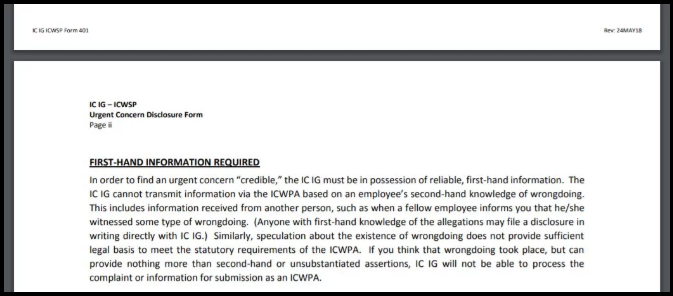
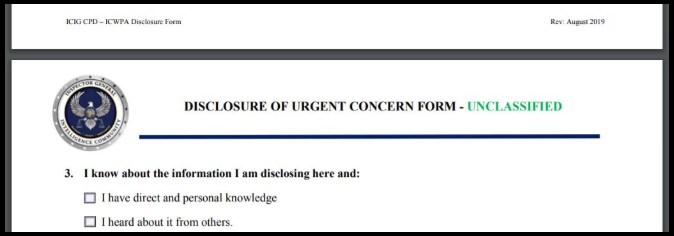
  • ICIG says it gave whistleblower a procedures form saying in order to find urgent concern ‘credible,’ complainant must have ‘reliable, first-hand information.’ Without that, ICIG ‘will not be able to process the complaint.’
  • But ICIG then notes ‘there is no [first-hand information] requirement set forth in the statute.’ Further: ‘In fact, by law the complainant…need not possess first-hand information’ in order to file complaint.
  • That means ICIG procedures form, the one handed to whistleblower, was wrong on question of first- versus second-hand information.
  • What gives? ICIG says procedures form was in effect since 5/24/18, before ICIG Atkinson took office 5/29/18. Translation: Don’t look at me — it was before my time!
  • ICIG also notes whistleblower claimed he had both second-hand *and* first-hand information. So ICIG did *not* find that whistleblower could ‘provide nothing more than second-hand or unsubstantiated assertions.’
  • Not clear what first-hand information in whistleblower complaint is. Key accusations concerning Trump-Zelensky call and alleged WH coverup afterward are entirely second-hand.
  • So what about procedures form? ICIG says new person was hired to run Center for Protected Disclosures, was working on updating forms. Then Trump-Ukraine brouhaha erupted, and ICIG saw something was amiss…
  • ICIG says amid controversy, he ‘understood that certain language in those forms…could be read–incorrectly–as suggesting that whistleblowers must possess first-hand information.‘ Of course, that’s exactly what the form said.

***

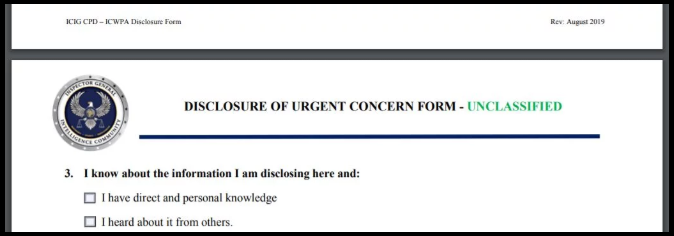
Old form: 

Via The Federalist

New form:

Via The Federalist

***

  • So ICIG’s office developed new forms. ‘Consistent with the law, the new forms do not require whistleblowers to possess first-hand information,’ ICIG says. And that looked like after-the-fact justification of whistleblower handling.
  • In summary, ICIG seems be saying: Whistleblower was given form with incorrect information. Not my fault! Then, after Trump-Ukraine exploded, we changed form to match law. Yes, looked fishy, but all OK.


Tyler Durden

Tue, 10/01/2019 – 15:20

via ZeroHedge News https://ift.tt/2oiX7jw Tyler Durden

The US Dollar Beast

The US Dollar Beast

Authored by Thorstein Polleit via The Mises Institute,

John Maynard Keynes (1883–1946) explains very well how to predict the winner of a beauty contest successfully. You must, he noted, think along the following lines:

“(…) each competitor has to pick, not those faces which he himself finds prettiest, but those which he thinks likeliest to catch the fancy of the other competitors (…). It is not a case of choosing those which, to the best of use of one’s judgment, are really the prettiest, nor even those which average opinion genuinely thinks the prettiest. We have to reach the third degree where we devote our intelligences to anticipating what average opinion expects the average opinion to be.

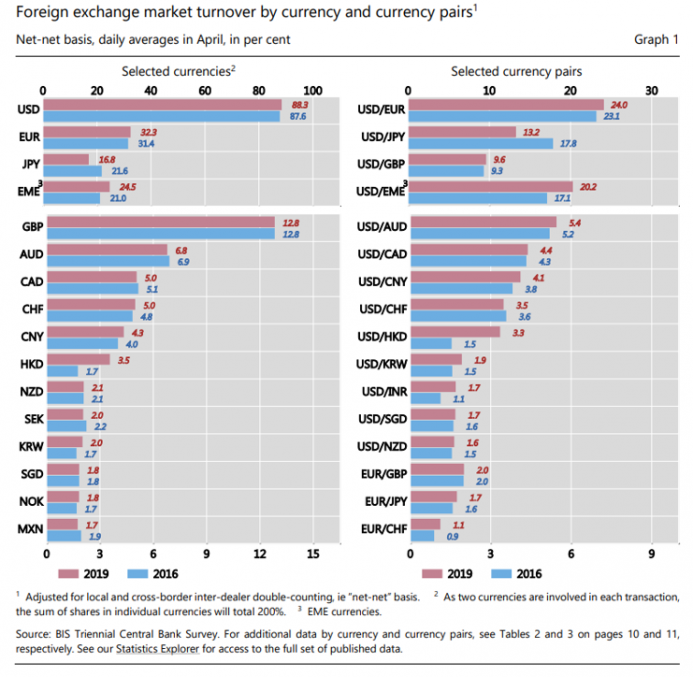
This is a perspective that those may wish to take into consideration who think the US dollar is about to collapse, would be the ugliest of all currencies. Latest data from the Bank of International Settlement (BIS) speaks a rather different language. In its 2019 Triennial Survey, the BIS informs us that daily trading in foreign exchange markets had reached 6.6 trillion US dollar per day in April 2019 – compared to 5.1 trillion US dollar three years earlier – and that the US dollar remained the single-most important currency in the FX markets, being on one side of 88% of all the trades. For comparison: the euro was on one side of 32% of all trades, the Japanese yen of 17%, and the Chinese renminbi of just 4.3%.

And if anything, the importance of the US dollar in foreign exchange markets has gone up in recent years, not down. So why is the US dollar so increasingly popular? Well, the Greenback is the currency of the world’s largest economy and unsurpassed military superpower – the United States of America. US financial markets are by far the largest, most transparent, and most liquid in the world. Like it or not: the US dollar is the preferred currency for conducting international trade and financial transactions. Among its paper money peers, there is not one candidate in sight who might challenge the US dollar’s status.

By no means less important is the fact that the US dollar serves as the ‘underlying’ of many other paper currencies: the US dollar typically represents the biggest chunk of ‘assets’ which central banks around the world keep for backing their own currencies – in most cases, foreign central banks hold US dollar-denominated US government bonds, short-term debt papers, and bank deposits. In other words: Monetary authorities around the world keep standing with the US dollar. Their currencies’ fate is tightly and inextricably linked to the Greenback.

Should something terrible happen to the US currency, it is quite likely that many other currencies would get hit even harder. This is because financial markets, especially the international banking business, have become “dollarized”: banks around the world have a structural demand for US dollar as a funding source; they depend on the availability of US dollar, they need access to US dollar loan markets. As the financial and economic crisis in 2008/2009 has made all too clear, tensions in the US dollar credit markets had hit foreign banks at least as hard, or even harder, than US banks.

For if and when investors start losing their faith in the US dollar, their trust in other currencies, which depend on the Greenback, will dwindle even stronger. In a similar vein, any financial market ‘stress’ makes investors taking refuge in the US dollar, as the US dollar is widely considered as the truly ‘safe haven’ currency: in times of crisis, the US dollar is basically always in high demand relative to other currencies. Against this backdrop, it is fair to say that from the viewpoint of the majority of market agents, the US dollar can be considered as the world’s number one currency.

What a privilege for the US! America issues a currency which is accepted and is in high demand around the world. In this way the Americans can borrow easily from the savings of the rest of the world: They can consume and invest well beyond their own resources. Or, to take a different perspective: people around the world are more than happy to send their savings to the US rather than invest them in their home countries. This is undoubtedly one of the reasons why the US ‘enjoys’ a negative trade balance – meaning that the US imports more goods and services than it exports; in other words: capital imports into the US exceed capital exports out of the US.

This situation is unlikely to change anytime soon. The monetary system of the world is, no doubt about that, in pretty bad shape. After many decades of relentless credit expansion under the central bank regime, most economies suffer from over-indebtedness. As a result, central banks have started to bring down market interest rates, trying to fend off a crisis that could bring down the credit pyramid. To do so, they engage in debasing the currencies – for the policy of propping up the unbacked paper money goes hand in hand with expanding the quantity of money. And as the money stock rises, the prices of goods and services increase, and the purchasing power of money declines.

Should the US embark upon a policy of heavily debasing the US dollar – as a reaction to, say, an economic or credit crisis –, it is likely that other currency areas would be inflated even stronger. It is realistic to assume that the world’s economy and international monetary system have become more than ever dependent on the US dollar – as suggested by, for instance, the BIS’ latest data. An increasingly inflationary US dollar monetary policy would most likely be imitated by other central banks – as they are provided with a superb chance to debase their currencies to reduce the real value of outstanding debt in their countries while blaming the US for the unpleasant surge in price inflation.

To be sure: people around the globe are demanding US dollar not because they consider it the best currency they could think of. For them, it is the best currency they are allowed to choose from. New ideas such as, for instance, Facebook’s Libra, even if it should gain traction among a great many people around the globe, do not suggest that the US dollar’s super-status will be replaced: for the Libra is supposed to effectively represent nothing more than a basket of unbacked paper currencies, among them the US dollar. Of course, one could think of an emerging cryptocurrency posing a challenge to the current dominance of unbacked paper currencies including the Greenback.

However, any such change would take time, and, perhaps even more important, it would require a profound change in people’s minds. In fact, to dethrone the US dollar, people would have to determinedly call for a truly free market in money, that is calling for an end of governments’ money production monopolies altogether. In the absence of such a movement, the odds are that the world’s dependence on the Greenback will not decline but presumably grow even further in the years to come. No doubt, the US dollar has become a huge and terrifying beast – a beast, however, that for its holder may eventually turn out to be of lesser evil when compared to the other unbacked paper currency beasts around the world.

This appears to be a reasonably good judgment if we follow Keynes’ recommended technique for anticipating the winner of a beauty contest. To be sure: the US dollar won’t be a reliable currency either, its purchasing power will undoubtedly be debased by the Fed’s monetary policy.

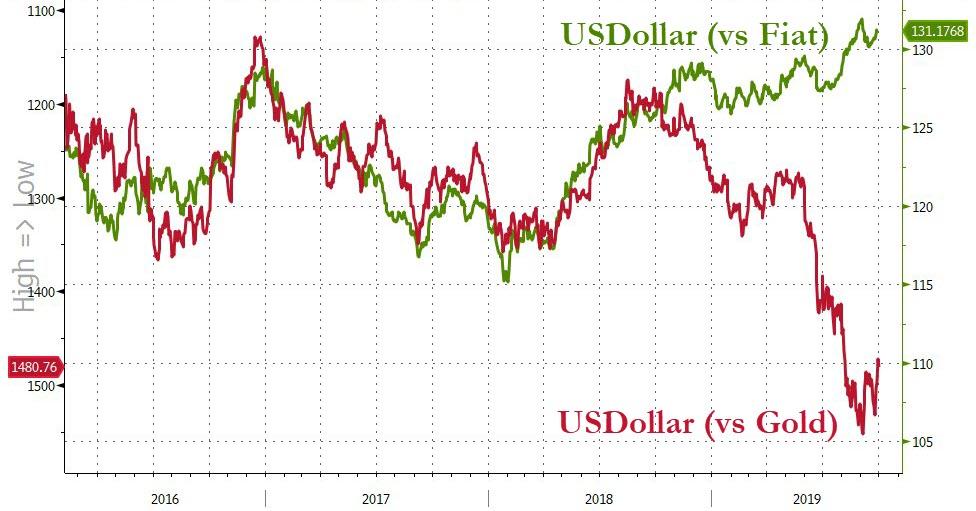
If you are looking for reliable money, there is pretty much only one candidate – and that is gold. Ludwig von Mises put this insight succinctly:

“The gold standard is certainly not a perfect or ideal standard. There is no such thing as perfection in human things. But nobody is in a position to tell us how something more satisfactory could be put in place of the gold standard.”

The truth of this timeless wisdom deserves to be repeated again and again.


Tyler Durden

Tue, 10/01/2019 – 15:05

via ZeroHedge News https://ift.tt/2nyfOjm Tyler Durden

North Korea And US To Resume Nuclear Talks Saturday

North Korea And US To Resume Nuclear Talks Saturday

North Korea and the U.S. will resume working-level talks on Oct. 5, North Korea’s state news agency KCNA reported Tuesday, reviving the possibility that denuclearization talks have restarted after a failed February summit between both countries in Vietnam, reported The Wall Street Journal.

KCNA said both countries would have a preliminary meeting on Friday, followed by working-level talks on Saturday, citing a statement from Vice Foreign Minister Choe Son Hui.

“The delegates of the DPRK side are ready to enter into the DPRK-U.S. working-level negotiations,” Choe said in the statement.

“It is my expectation that the working-level negotiations would accelerate the positive development of the DPRK-U.S. relations.”

Choe’s statement made no mention of an exact location or time for the planned weekend talks.

Denuclearization discussions between President Trump and Kim Jong-un, Supreme Leader of North Korea, failed to materialize any progress at a summit in Vietnam in February. Trump met with Kim in June at the demilitarized zone between the two Koreas; the meet and greet didn’t immediately revive talks between both countries until now.

For the last several months, North Korea conducted a series of short-range ballistic missile tests, while furiously commenting about U.S. and South Korean war drills.

North Korean Ambassador Kim Song told the U.N. General Assembly on Monday that it was up to the Trump administration whether negotiations “will become a window of opportunity or an occasion that will hasten the crisis.”

“The situation on the Korean Peninsula has not come out of the vicious cycle of increased tension, which is entirely attributable to the political and military provocations perpetrated by the U.S.,” the North Korean ambassador said.

Former U.S. National Security Adviser John Bolton warned Monday that North Korea had no plans of denuclearizing.

“We welcome the agreement between North Korea and the United States to proceed with working-level negotiations on Oct. 5.” South Korea’s presidential Blue House said in a statement.

“Through this working-level negotiation, we hope that substantial progress will be made at an early date to achieve complete denuclearization and permanent peace on the Korean Peninsula.”

With talks set between North Korea and the U.S. on Saturday, Washington should show more flexibility towards North Korea, offering a step-by-step process, in which economic sanctions are lifted in return for incremental steps toward denuclearization.


Tyler Durden

Tue, 10/01/2019 – 14:45

Tags

via ZeroHedge News https://ift.tt/2ny71On Tyler Durden

Pat Buchanan: “This What The Deep State Does To Outsiders”

Pat Buchanan: “This What The Deep State Does To Outsiders”

Authored by Patrick Buchanan via Buchanan.org,

“This is a very sad time for our country. There is no joy in this,” said Nancy Pelosi Saturday.

“We must be somber. We must be prayerful. … I’m heartbroken about it.”

Thus did the speaker profess her anguish — just four days after announcing that her Democratic House would conduct an impeachment inquiry of President Donald Trump.

But is this how it really went down? Is this how Pelosi came to authorize an impeachment inquiry before she read the transcript of the conversation between Trump and Ukrainian President Volodymyr Zelensky?

Another explanation, based on the actual events, suggests itself.

By late September, Pelosi was under constant fire from the House “resistance” that wanted Trump impeached and whose numbers were slowly growing. What was the speaker to do?

The judiciary committee is the body historically authorized by a vote of the full House to conduct impeachment inquiries. But to Pelosi this was looking like a loser, a dead end, a formula for failure followed by a backlash against House Democrats and her own removal as speaker in January 2021, if not before.

How so? Her judiciary committee chairman, Jerrold Nadler, in his investigation of Trump, had presided over a debacle of a hearing where Trump ally Corey Lewandowski mocked the members. House Budget Committee Chair John Yarmuth called the hearing a “fiasco.”

Thus, when news broke of a July 25 conversation between Trump and the president of Ukraine, during which Trump allegedly urged Zelensky “eight times” to investigate Joe Biden and son Hunter Biden’s connections to corrupt oligarchs, Pelosi seized upon it to solve all her problems.

To satisfy the red-hots in her Democratic caucus, she announced an impeachment inquiry on her own. To spare her moderates the pain of having to vote for or against an inquiry, she skipped the floor vote.

To ensure the investigation was done swiftly, she took the franchise from Nadler and his judiciary committee and handed it to Adam Schiff and the intelligence committee. Now she is urging a narrowing of the articles of impeachment to just one — Trump’s request of Ukraine’s president to look into the Bidens.

Pelosi’s hope: Have one House vote on a single article of impeachment by year end; then send it on to the Senate for trial and be done with it.

This is Nancy Pelosi’s fast track to impeachment of Trump and ruination of his presidency. But, to be sure, she is “heartbroken” about all this.

For three years, the media-deep state axis has sought to overturn the election of 2016 and bring down Trump, starting with Russia-gate. Now it appears to have tailored and weaponized the impeachment process.

That is what this is all about. It always is. Then-editor Ben Bradlee of The Washington Post, when it looked like the Iran-Contra matter might break Ronald Reagan’s presidency, after his 49-state landslide, chortled, “We haven’t had this much fun since Watergate.”

This is what the deep state does to outsiders Middle America sends to Washington to challenge or dispossess it.

How should the Republican Party and Trump’s base respond?

Recognize reality. Whether or not Trump was ill-advised to suggest to the president of Ukraine that passing on the fruits of the investigation of Joe and Hunter Biden, the end game is bringing down Trump, democracy’s equivalent of regicide.

While the “whistleblower,” whose memo is the basis of these impeachment hearings, is well on his way to Beltway beatification, no campaign to depose the president can be allowed to cloak itself in anonymity indefinitely, for one man’s whistleblower is another man’s seditionist.

Whom did the whistleblower collaborate with to produce his memo? What is his background? What are his biases? The people have a right to know. And democracy dies in darkness, does it not?

Not until 30 years after Watergate did we learn the “whistleblower” known as “Deep Throat” was a corrupt FBI veteran agent who leaked grand jury secrets to The Washington Post to discredit acting Director Pat Gray and thereby become FBI director himself.

His identity was sheltered for three decades. For whose benefit?

Republicans should not allow Democrats to fast-track this process but should give their troops time to recognize the stakes involved, organize a defense and repel this latest establishment attempt to overthrow a president elected to come to the capital to corral that establishment.

Force all the Democratic candidates for president to take a stand on removing Trump for high crimes — over a nebulous phone call to Kiev.

And the U.S. Senate should refuse to take up and should return to the House any bill of impeachment done in a short-circuited and savagely partisan manner, as this one is being done. There should be no rush to judgment.

If the election of 2020 is going to be about President Trump, tell the nation that the people will decide his political fate in November 2020, and that of Joe Biden if Democrats believe he is as pure as the driven snow and choose to nominate him.


Tyler Durden

Tue, 10/01/2019 – 14:25

Tags

via ZeroHedge News https://ift.tt/2oi8R5Q Tyler Durden

D.C. Circuit Upholds FCC Decision to Rescind “Net Neutrality” (But Rejects FCC Attempt to Preempt Conflicting State Law)

Today, a partially divided three-judge panel on the U.S. Court of Appeals for the D.C. Circuit largely rejected challenges to the Federal Communications Commission’s 2018 decision to repeal its 2015 “net neutrality” decision (aka the “Open Internet Order”). In a per curiam opinion on behalf of Judges Millett and Wilkins, and Senior Judge Williams, the court concluded that given the broad degree of deference afforded to federal agencies, the FCC’s interpretation of its own statutory authority could withstand legal challenge and that the agency was entitled change course.

The FCC did not win across the board, however. The court rejected a key part of the FCC’s order that would have preempted conflicting state and local regulations. As a consequence, individual states may attempt to adopt “net neutrality” rules of their own. In addition, the court remanded a few issues to the FCC for greater examination and explanation, but otherwise left the new order intact.

The per curiam opinion in Mozilla v. FCC begins:

In 2018, the Federal Communications Commission adopted an order classifying broadband Internet access service as an information service under Title I of the Communications Act of 1934, as amended by the Telecommunications Act of 1996, Pub. L. 104–104, 110 Stat 56 (“the Act”). See In re Restoring Internet Freedom, 33 FCC Rcd. 311 (2018) (“2018 Order“). In so doing, the agency pursued a market-based, “light-touch” policy for governing the Internet and departed from its 2015 order that had imposed utility-style regulation under Title II of the Act.

Petitioners––an array of Internet companies, non-profits, state and local governments, and other entities––bring a host of challenges to the 2018 Order. We find their objections unconvincing for the most part, though we vacate one portion of the 2018 Order and remand for further proceedings on three discrete points. . . .

The 2018 Order accomplishes a number of objectives. First, and most importantly, it classifies broadband Internet as an “information service,” see 2018 Order ¶¶ 26–64, and mobile broadband as a “private mobile service,” see id. ¶¶ 65–85. Second, relying on Section 257 of the Act (located in Title II but written so as to apply to Titles I through VI), the Commission adopts transparency rules intended to ensure that consumers have adequate data about Internet Service Providers’ network practices. See id. ¶¶ 209–38. Third, the Commission undertakes a cost-benefit analysis, concluding that the benefits of a market-based, “light-touch” regime for Internet governance outweigh those of common carrier regulation under Title II, see id. ¶¶ 304–323, resting heavily on the combination of the transparency requirements imposed by the Commission under Section 257 with enforcement of existing antitrust and consumer protection laws, see id. ¶¶ 140– 154. The Commission likewise finds that the burdens of the Title II Order’s conduct rules exceed their benefits. See id. ¶¶ 246–266.

We uphold the 2018 Order, with two exceptions. First, the Court concludes that the Commission has not shown legal authority to issue its Preemption Directive, which would have barred states from imposing any rule or requirement that the Commission “repealed or decided to refrain from imposing” in the Order or that is “more stringent” than the Order. 2018 Order ¶ 195. The Court accordingly vacates that portion of the Order. Second, we remand the Order to the agency on three discrete issues: (1) The Order failed to examine the implications of its decisions for public safety; (2) the Order does not sufficiently explain what reclassification will mean for regulation of pole attachments; and (3) the agency did not adequately address Petitioners’ concerns about the effects of broadband reclassification on the Lifeline Program.

Both Judges Millett and Wilkins wrote separate concurring opinions stressing that they were obligated to uphold the FCC’s judgement under the Supreme Court’s Brand X decision, but neither seemed particularly happy about it.

Senior Judge Williams dissented in part. His separate opinion begins:

And be these juggling fiends no more believed,
That palter with us in a double sense;
That keep the word of promise to our ear,
And break it to our hope.

So says Macbeth, finding that the witches’ assurances were sheer artifice and that his life is collapsing around him. The enactors of the 2018 Order, though surely no Macbeths, might nonetheless feel a certain kinship, being told that they acted lawfully in rejecting the heavy hand of Title II for the Internet, but that each of the 50 states is free to impose just that. (Many have already enacted such legislation. See, e.g., Cal. S. Comm. on Judiciary, SB 822 Analysis 1 (2018) (explaining that California has expressly “codif[ied] portions of the recentlyrescinded . . . rules”).) If Internet communications were tidily divided into federal markets and readily severable state markets, this might be no problem. But no modern user of the Internet can believe for a second in such tidy isolation; indeed, the Commission here made an uncontested finding that it would be “impossible” to maintain the regime it had adopted under Title I in the face of inconsistent state regulation. On my colleagues’ view, state policy trumps federal; or, more precisely, the most draconian state policy trumps all else. “The Commission may lawfully decide to free the Internet from Title II,” we say, “It just can’t give its decision any effect in the real world.”

His opinion concludes:

My colleagues and I agree that the 1996 Act affords the Commission authority to apply Title II to broadband, or not. Despite the ample and uncontested findings of the Commission that the absence of preemption will gut the Order by leaving all broadband subject to state regulation in which the most intrusive will prevail, . . . and despite Supreme Court authority inferring preemptive power to protect an agency’s regulatory choices, they vacate the preemption directive. Thus, the Commission can choose to apply Title I and not Title II—but if it does, its choice will be meaningless. I respectfully dissent.

All together, the opinions are nearly 200 pages.

As preemption is an issue that divides the current Supreme Court in some unusual ways, it will be interesting to see whether a petition for ceriorari on the preemption question is forthcoming, and whether the Supreme Court believes this question is worthy of review.

from Latest – Reason.com https://ift.tt/2mKCufY
via IFTTT

D.C. Circuit Upholds FCC Decision to Rescind “Net Neutrality” (But Rejects FCC Attempt to Preempt Conflicting State Law)

Today, a partially divided three-judge panel on the U.S. Court of Appeals for the D.C. Circuit largely rejected challenges to the Federal Communications Commission’s 2018 decision to repeal its 2015 “net neutrality” decision (aka the “Open Internet Order”). In a per curiam opinion on behalf of Judges Millett and Wilkins, and Senior Judge Williams, the court concluded that given the broad degree of deference afforded to federal agencies, the FCC’s interpretation of its own statutory authority could withstand legal challenge and that the agency was entitled change course.

The FCC did not win across the board, however. The court rejected a key part of the FCC’s order that would have preempted conflicting state and local regulations. As a consequence, individual states may attempt to adopt “net neutrality” rules of their own. In addition, the court remanded a few issues to the FCC for greater examination and explanation, but otherwise left the new order intact.

The per curiam opinion in Mozilla v. FCC begins:

In 2018, the Federal Communications Commission adopted an order classifying broadband Internet access service as an information service under Title I of the Communications Act of 1934, as amended by the Telecommunications Act of 1996, Pub. L. 104–104, 110 Stat 56 (“the Act”). See In re Restoring Internet Freedom, 33 FCC Rcd. 311 (2018) (“2018 Order“). In so doing, the agency pursued a market-based, “light-touch” policy for governing the Internet and departed from its 2015 order that had imposed utility-style regulation under Title II of the Act.

Petitioners––an array of Internet companies, non-profits, state and local governments, and other entities––bring a host of challenges to the 2018 Order. We find their objections unconvincing for the most part, though we vacate one portion of the 2018 Order and remand for further proceedings on three discrete points. . . .

The 2018 Order accomplishes a number of objectives. First, and most importantly, it classifies broadband Internet as an “information service,” see 2018 Order ¶¶ 26–64, and mobile broadband as a “private mobile service,” see id. ¶¶ 65–85. Second, relying on Section 257 of the Act (located in Title II but written so as to apply to Titles I through VI), the Commission adopts transparency rules intended to ensure that consumers have adequate data about Internet Service Providers’ network practices. See id. ¶¶ 209–38. Third, the Commission undertakes a cost-benefit analysis, concluding that the benefits of a market-based, “light-touch” regime for Internet governance outweigh those of common carrier regulation under Title II, see id. ¶¶ 304–323, resting heavily on the combination of the transparency requirements imposed by the Commission under Section 257 with enforcement of existing antitrust and consumer protection laws, see id. ¶¶ 140– 154. The Commission likewise finds that the burdens of the Title II Order’s conduct rules exceed their benefits. See id. ¶¶ 246–266.

We uphold the 2018 Order, with two exceptions. First, the Court concludes that the Commission has not shown legal authority to issue its Preemption Directive, which would have barred states from imposing any rule or requirement that the Commission “repealed or decided to refrain from imposing” in the Order or that is “more stringent” than the Order. 2018 Order ¶ 195. The Court accordingly vacates that portion of the Order. Second, we remand the Order to the agency on three discrete issues: (1) The Order failed to examine the implications of its decisions for public safety; (2) the Order does not sufficiently explain what reclassification will mean for regulation of pole attachments; and (3) the agency did not adequately address Petitioners’ concerns about the effects of broadband reclassification on the Lifeline Program.

Both Judges Millett and Wilkins wrote separate concurring opinions stressing that they were obligated to uphold the FCC’s judgement under the Supreme Court’s Brand X decision, but neither seemed particularly happy about it.

Senior Judge Williams dissented in part. His separate opinion begins:

And be these juggling fiends no more believed,
That palter with us in a double sense;
That keep the word of promise to our ear,
And break it to our hope.

So says Macbeth, finding that the witches’ assurances were sheer artifice and that his life is collapsing around him. The enactors of the 2018 Order, though surely no Macbeths, might nonetheless feel a certain kinship, being told that they acted lawfully in rejecting the heavy hand of Title II for the Internet, but that each of the 50 states is free to impose just that. (Many have already enacted such legislation. See, e.g., Cal. S. Comm. on Judiciary, SB 822 Analysis 1 (2018) (explaining that California has expressly “codif[ied] portions of the recentlyrescinded . . . rules”).) If Internet communications were tidily divided into federal markets and readily severable state markets, this might be no problem. But no modern user of the Internet can believe for a second in such tidy isolation; indeed, the Commission here made an uncontested finding that it would be “impossible” to maintain the regime it had adopted under Title I in the face of inconsistent state regulation. On my colleagues’ view, state policy trumps federal; or, more precisely, the most draconian state policy trumps all else. “The Commission may lawfully decide to free the Internet from Title II,” we say, “It just can’t give its decision any effect in the real world.”

His opinion concludes:

My colleagues and I agree that the 1996 Act affords the Commission authority to apply Title II to broadband, or not. Despite the ample and uncontested findings of the Commission that the absence of preemption will gut the Order by leaving all broadband subject to state regulation in which the most intrusive will prevail, . . . and despite Supreme Court authority inferring preemptive power to protect an agency’s regulatory choices, they vacate the preemption directive. Thus, the Commission can choose to apply Title I and not Title II—but if it does, its choice will be meaningless. I respectfully dissent.

All together, the opinions are nearly 200 pages.

As preemption is an issue that divides the current Supreme Court in some unusual ways, it will be interesting to see whether a petition for ceriorari on the preemption question is forthcoming, and whether the Supreme Court believes this question is worthy of review.

from Latest – Reason.com https://ift.tt/2mKCufY
via IFTTT

The Latest Fight Over Eating Meat Ignores These 4 Essential Nutrition Truths

Nutrition researchers and doctors are at each other’s throats once again, this time over a recommendation published in the Annals of Internal Medicine that “adults continue to eat their current levels of red and processed meat unless they felt inclined to change them themselves.” 

This advice runs contrary to the consensus formed by most American medical organizations and the U.S. government, which says the optimal diet is one low in all kinds of meat and processed foods and higher in most kinds of vegetables, fruits, and grains. 

It’s yet another example of the ways that years of bad government diet recommendations, media myths, and disagreement between competing factions in the world of diet and nutrition science have combined to make for an incredibly confusing environment for people who want to eat better, tastier, healthier diets.

The panel of experts that made the red meat recommendation labeled its conclusions as a “weak recommendation” with “low-certainty evidence.” You can read the entire package from the American College of Physicians, which publishes the Annals, or just this summary: “We found low- to very low-certainty evidence that diets lower in unprocessed red meat may have little or no effect on the risk for major cardiometabolic outcomes and cancer mortality and incidence.”

This conclusion has sparked a fight between two groups that might best be described as “meat agnostics,” who believe that moderate meat consumption is not as risky as recently claimed, and “less meaters,” who argue that meat consumption does not occur in a vacuum, and—in the industrialized context—is generally bad. If you buy raw animal proteins, cook them yourself, and eat them with mostly greens, rainbow vegetables, and legumes, you probably agree with the new recommendation. If you eat most of your meat out of a can, wrapper, or bucket, you are why people are mad at the new recommendation.  

My own takeaway, as someone who overhauled his diet and successfully lost a lot of weight and brought his blood pressure down to optimal levels, is that this fight does a disservice to people who want to be healthy, or healthier, and feel confused by the daily onslaught of conflicting nutrition research. 

If you are in the latter camp, allow me to share with you my own recommendations for meat, plants, and all things food.  

Most diet advocates are uncompromising zealots. The best diet is the one that works for you.

I have a good friend who lost 100 pounds eating vegan. I lost 90 pounds eating pork chops for breakfast and meat at every meal, lots of vegetables, but almost no grains, pasta, rice, or fruit. Both of us have sustained our weight loss for many years by continuing to eat our respective diets, and both of us have optimal blood pressure, blood glucose levels, and cholesterol panels. Whose advice should you follow? 

The better question is, whose advice do you want to follow? Liking the idea of a diet is a good indicator that you’ll at least be able to start it. The next best question is, are you getting the results you wanted, whether it be improved biomarkers, better body composition, or weight loss? The third question is, can you eat this way 90 percent of the time for a long time? 

These are the questions that should inform your quest for the optimal diet. People succeed in improving their physical and mental health, testable biomarkers, and body composition using all kinds of different nutrition plans. I prefer something close to the keto diet, which can be adapted for omnivores, vegetarians, and vegans, but if you dig into the research conducted by the National Weight Control Registry, which surveys Americans who have lost weight and sustained that weight loss, you’ll find the keys to success are exercise, intentional and disciplined food choices, and keeping a close eye on their weight. In other words, what food types you eat matters less than how much you eat, how much you exercise, and how disciplined you are about eating and exercising. 

Processed foods are not inherently bad, but they do present a tradeoff.  

The rise of “processed” food that tastes good is both a massive human accomplishment and a double-edged sword. Processed foods, which are basically any food item that has been rendered nonperishable or includes multiple ingredients at the time of purchase, have made life easier by speeding up and simplifying food preparation. “Fortified” processed foods, meanwhile, have made it possible for the poorest people in the developed world to both consume adequate calories each day and get many of the micronutrients previously found only in a balanced diet of perishable meats, fruits, and vegetables.  

However, the proliferation of affordable, nonperishable food has played a major role in the rise of obesity and obesity-related diseases; more so, probably, than any other labor-saving technological development of the last century.

This does not mean processed food is bad, or that it should be banned or taxed out of reach, only that consuming processed foods is a tradeoff. These foods often taste fantastic, yet excessive consumption of processed foods can easily erase whatever benefits they provide through micronutrient fortification and time saved.

Expert consensus is hard to come by and overrated.

That the panelists published by the Annals are now under attack by their peers in medicine is just the latest example of the war over nutrition advice. Many academic nutrition researchers believe their work can save entire populations and are frustrated that they have to compete in a marketplace of ideas that does not elevate their findings over those of their peers, the advice of lay diet experts, and the marketing done by food companies. That the federal government has done such a hamfisted job of recommending the “right” advice and is slow to correct recommendations when consensus changes, is all the more infuriating. 

What’s more, popular media reporting on nutrition is often sloppy, sensationalized, and self-contradicting. Just look at the way the Annals recommendation was covered by The Washington Post: The researchers used the terms “weak recommendation” and “low-certainty” while the Post headlined its piece: “A study says full speed ahead on processed and red meat consumption. Nutrition scientists say not so fast.” The study did not say “full speed ahead” and its critics did not say “not so fast.” Debates in nutrition science are covered this way every single day in America’s most respected media outlets. 

The noise around nutrition science should not distract us from the fact that Type 2 diabetes, cardiovascular disease, and other ailments with a lifestyle correlation are, in fact, a major health care expenditure in the U.S. and around the world; and that many humans in the industrialized world who should eat better both can afford to and would likely succeed with the right combination of external motivation and education. 

This is why nutrition researchers are constantly at each other’s throats. Each faction wants to have the final say, and for their peers and government to rally behind them. But it is futile to expect a single global nutrition paradigm to exist across varying economies, climates, and cultures, especially in the age of democratized media. 

You’re going to die regardless of what or how much you eat, but, on average, junk habits will kill you faster and decrease your quality of life. 

While there is no actual consensus on the optimal ratio of the three macronutrients (fat, carbohydrates, proteins), or on how much (if any) animal protein a person should consume each day, there is an actual, honest-to-God consensus against smoking cigarettes, drinking excessive alcohol, not sleeping enough, and consuming a diet made up mostly of processed foods. If you are the kind of person who desires certainty, nutritionists of every persuasion are certain about the above, if nothing else. 

And if you are the kind of person who feels liberated by the possibility that any number of nutritional paradigms can restore your health and improve your quality of life, there is no better time to be alive than today and no better marketplace of ideas than the one we have now. 

from Latest – Reason.com https://ift.tt/2nlHmsh
via IFTTT

The Latest Fight Over Eating Meat Ignores These 4 Essential Nutrition Truths

Nutrition researchers and doctors are at each other’s throats once again, this time over a recommendation published in the Annals of Internal Medicine that “adults continue to eat their current levels of red and processed meat unless they felt inclined to change them themselves.” 

This advice runs contrary to the consensus formed by most American medical organizations and the U.S. government, which says the optimal diet is one low in all kinds of meat and processed foods and higher in most kinds of vegetables, fruits, and grains. 

It’s yet another example of the ways that years of bad government diet recommendations, media myths, and disagreement between competing factions in the world of diet and nutrition science have combined to make for an incredibly confusing environment for people who want to eat better, tastier, healthier diets.

The panel of experts that made the red meat recommendation labeled its conclusions as a “weak recommendation” with “low-certainty evidence.” You can read the entire package from the American College of Physicians, which publishes the Annals, or just this summary: “We found low- to very low-certainty evidence that diets lower in unprocessed red meat may have little or no effect on the risk for major cardiometabolic outcomes and cancer mortality and incidence.”

This conclusion has sparked a fight between two groups that might best be described as “meat agnostics,” who believe that moderate meat consumption is not as risky as recently claimed, and “less meaters,” who argue that meat consumption does not occur in a vacuum, and—in the industrialized context—is generally bad. If you buy raw animal proteins, cook them yourself, and eat them with mostly greens, rainbow vegetables, and legumes, you probably agree with the new recommendation. If you eat most of your meat out of a can, wrapper, or bucket, you are why people are mad at the new recommendation.  

My own takeaway, as someone who overhauled his diet and successfully lost a lot of weight and brought his blood pressure down to optimal levels, is that this fight does a disservice to people who want to be healthy, or healthier, and feel confused by the daily onslaught of conflicting nutrition research. 

If you are in the latter camp, allow me to share with you my own recommendations for meat, plants, and all things food.  

Most diet advocates are uncompromising zealots. The best diet is the one that works for you.

I have a good friend who lost 100 pounds eating vegan. I lost 90 pounds eating pork chops for breakfast and meat at every meal, lots of vegetables, but almost no grains, pasta, rice, or fruit. Both of us have sustained our weight loss for many years by continuing to eat our respective diets, and both of us have optimal blood pressure, blood glucose levels, and cholesterol panels. Whose advice should you follow? 

The better question is, whose advice do you want to follow? Liking the idea of a diet is a good indicator that you’ll at least be able to start it. The next best question is, are you getting the results you wanted, whether it be improved biomarkers, better body composition, or weight loss? The third question is, can you eat this way 90 percent of the time for a long time? 

These are the questions that should inform your quest for the optimal diet. People succeed in improving their physical and mental health, testable biomarkers, and body composition using all kinds of different nutrition plans. I prefer something close to the keto diet, which can be adapted for omnivores, vegetarians, and vegans, but if you dig into the research conducted by the National Weight Control Registry, which surveys Americans who have lost weight and sustained that weight loss, you’ll find the keys to success are exercise, intentional and disciplined food choices, and keeping a close eye on their weight. In other words, what food types you eat matters less than how much you eat, how much you exercise, and how disciplined you are about eating and exercising. 

Processed foods are not inherently bad, but they do present a tradeoff.  

The rise of “processed” food that tastes good is both a massive human accomplishment and a double-edged sword. Processed foods, which are basically any food item that has been rendered nonperishable or includes multiple ingredients at the time of purchase, have made life easier by speeding up and simplifying food preparation. “Fortified” processed foods, meanwhile, have made it possible for the poorest people in the developed world to both consume adequate calories each day and get many of the micronutrients previously found only in a balanced diet of perishable meats, fruits, and vegetables.  

However, the proliferation of affordable, nonperishable food has played a major role in the rise of obesity and obesity-related diseases; more so, probably, than any other labor-saving technological development of the last century.

This does not mean processed food is bad, or that it should be banned or taxed out of reach, only that consuming processed foods is a tradeoff. These foods often taste fantastic, yet excessive consumption of processed foods can easily erase whatever benefits they provide through micronutrient fortification and time saved.

Expert consensus is hard to come by and overrated.

That the panelists published by the Annals are now under attack by their peers in medicine is just the latest example of the war over nutrition advice. Many academic nutrition researchers believe their work can save entire populations and are frustrated that they have to compete in a marketplace of ideas that does not elevate their findings over those of their peers, the advice of lay diet experts, and the marketing done by food companies. That the federal government has done such a hamfisted job of recommending the “right” advice and is slow to correct recommendations when consensus changes, is all the more infuriating. 

What’s more, popular media reporting on nutrition is often sloppy, sensationalized, and self-contradicting. Just look at the way the Annals recommendation was covered by The Washington Post: The researchers used the terms “weak recommendation” and “low-certainty” while the Post headlined its piece: “A study says full speed ahead on processed and red meat consumption. Nutrition scientists say not so fast.” The study did not say “full speed ahead” and its critics did not say “not so fast.” Debates in nutrition science are covered this way every single day in America’s most respected media outlets. 

The noise around nutrition science should not distract us from the fact that Type 2 diabetes, cardiovascular disease, and other ailments with a lifestyle correlation are, in fact, a major health care expenditure in the U.S. and around the world; and that many humans in the industrialized world who should eat better both can afford to and would likely succeed with the right combination of external motivation and education. 

This is why nutrition researchers are constantly at each other’s throats. Each faction wants to have the final say, and for their peers and government to rally behind them. But it is futile to expect a single global nutrition paradigm to exist across varying economies, climates, and cultures, especially in the age of democratized media. 

You’re going to die regardless of what or how much you eat, but, on average, junk habits will kill you faster and decrease your quality of life. 

While there is no actual consensus on the optimal ratio of the three macronutrients (fat, carbohydrates, proteins), or on how much (if any) animal protein a person should consume each day, there is an actual, honest-to-God consensus against smoking cigarettes, drinking excessive alcohol, not sleeping enough, and consuming a diet made up mostly of processed foods. If you are the kind of person who desires certainty, nutritionists of every persuasion are certain about the above, if nothing else. 

And if you are the kind of person who feels liberated by the possibility that any number of nutritional paradigms can restore your health and improve your quality of life, there is no better time to be alive than today and no better marketplace of ideas than the one we have now. 

from Latest – Reason.com https://ift.tt/2nlHmsh
via IFTTT
“It’s Time To Start Hedging Election Risk”: This Is How One Bank Is Doing It

“It’s Time To Start Hedging Election Risk”: This Is How One Bank Is Doing It

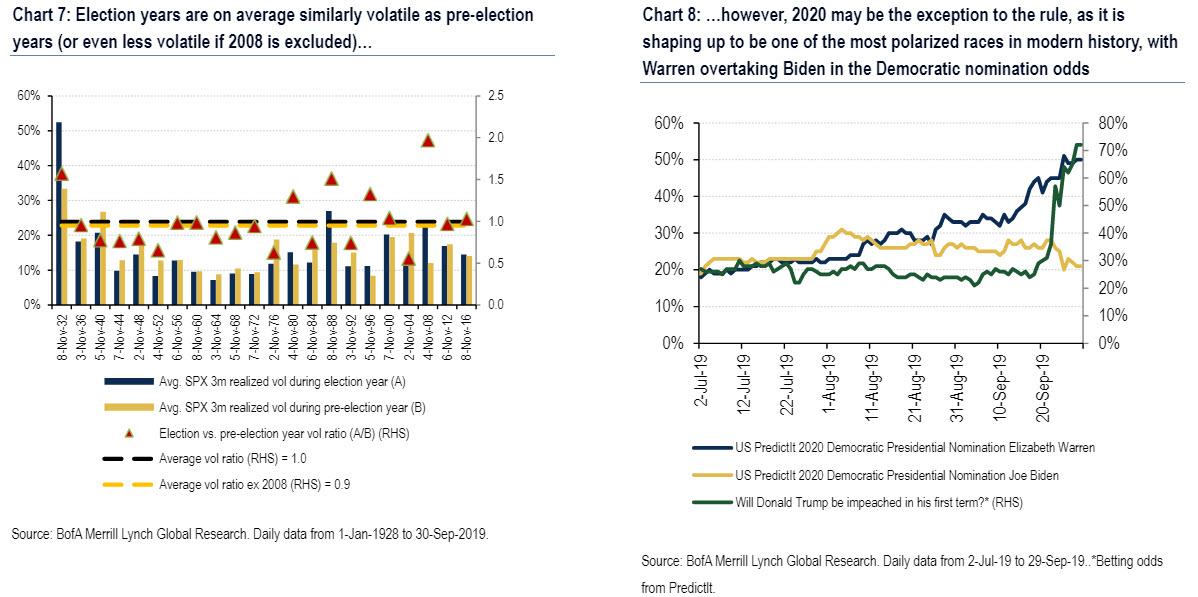
According to BofA’s derivatives strategists, if 90 years of history of US elections is to be believed, there is scant evidence that 2020 should be more volatile than 2019, as the S&P tends to be similarly volatile in election years as in the year prior. In fact, excluding 2008 when the spike in volatility had little to do with the election cycle, volatility tends to be slightly lower during election years.  And yet, in light of last week’s political developments, 2020 could well be an exception to the rule.

As shown in the right-hand chart above, the recent increase in President Trump’s impeachment odds coincided with the simultaneous rise and fall of Senator Warren and former Vice President Biden in the market-implied probabilities for the 2020 Democratic Presidential nomination. With Biden widely regarded as a more moderate liberal/market-friendly candidate than Warren, his potential exclusion from the Presidential race could make 2020 one of the most polarized election years in modern history should Warren and Trump emerge as the two front-runners, according to BofA.

As such, the bank warns that “investors can’t ignore election risk any longer.”

While the investment implications of such a polarized scenario are manifold, the most straightforward of which is higher volatility, the uniqueness of this scenario also implies there is not a readily available trading playbook investors can rely upon. Below, BofA explore some of its preferred investment ideas to trade 2020 election risk.

But first things first: How much election-related risk is priced in?

Before jumping to the bank’s election trading playbook, it is key to first understand how much election risk is already priced into markets. Anecdotally, the bank’s strategists note that they are starting to see interest from clients in hedging both the election and its run-up, with a particular focus on the early rounds of the Democratic Party’s primaries.

Iowa and New Hampshire will be the first states to vote, on February 3rd and 11th, followed by Nevada (22-Feb), South Carolina (29-Feb), and finally Super Tuesday (3-Mar, when 14 states will cast their ballots). Historically strong predictors of the eventual outcome, these early caucuses and primaries may cause the strongest market reaction if there remains significant uncertainty about who will win the Democratic nomination. Hence, any evidence of equity protection buying will be most clearly observed in Feb-Mar (S&P) option expiries. Purely from a political perspective, the risks to potentially higher vol could include the resurgence of a more moderate candidate like Biden or dominant polling numbers by Trump against the leading Democratic candidates.

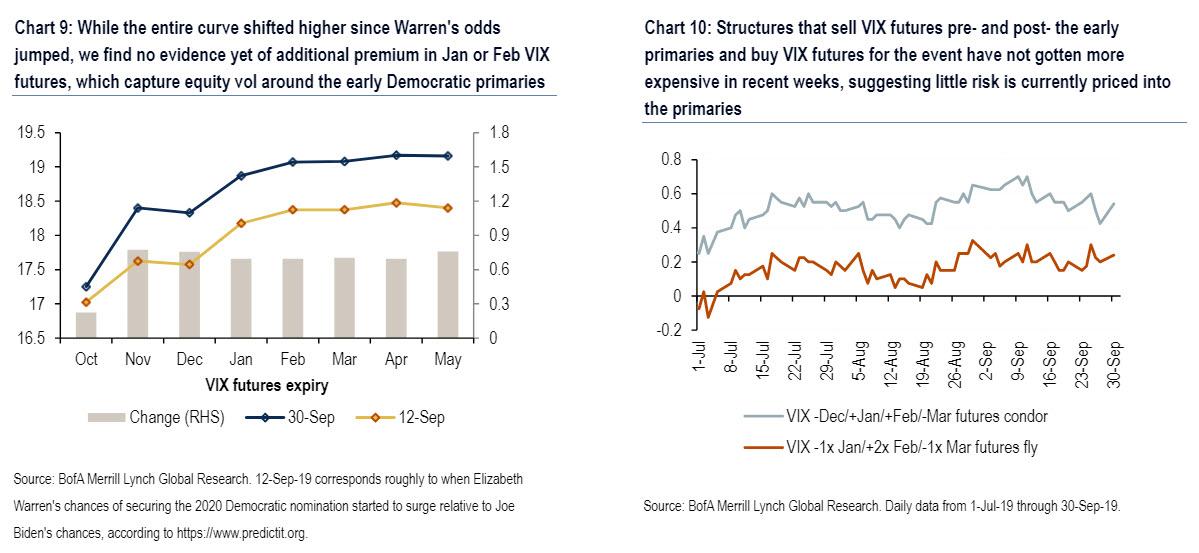
The logical first place to check for election-related risks is the VIX futures market. To match the timing of Warren’s recent move higher in the polls (chart below, left), BofA compared the level and shape of the VIX futures curve on 12-Sep and 30-Sep. While the entire curve shifted higher in these last 2.5 weeks, there is so far no evidence of additional premium in Jan or Feb futures (which capture S&P implied vol in Feb & Mar, peak primaries season – chart below, left). The chart below, right confirms this numerically: the cost of a “futures condor” which sells the Dec-19 and Mar-20 futures and buys Jan-20 and Feb-20 has not increased with Warren’s odds. Selling the Jan-20 and Mar-20 futures to buy 2x Feb-20 futures has not gotten more expensive either.

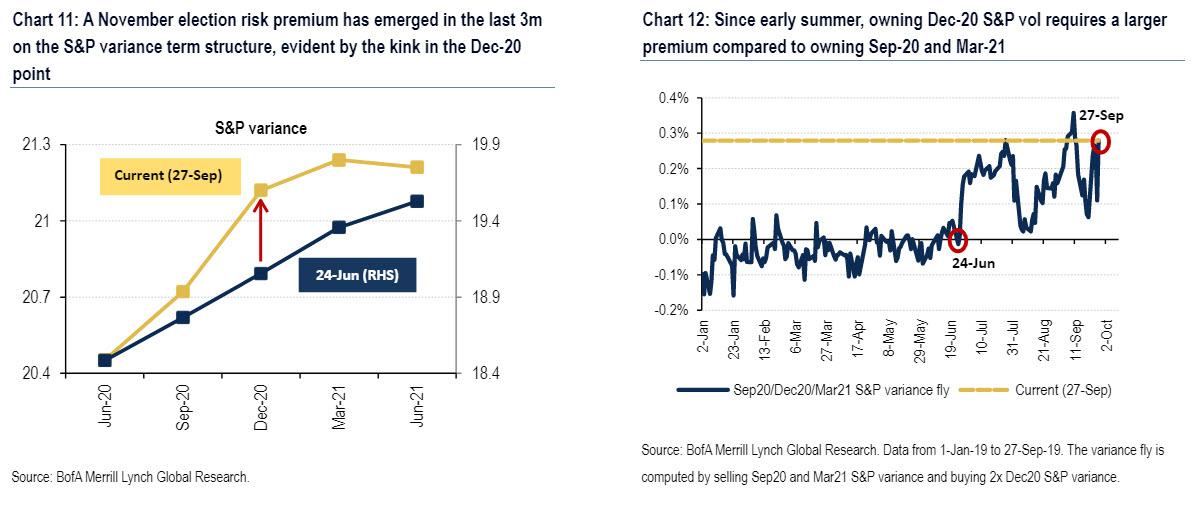
Yet if equity markets are not yet concerned about the Democratic primaries, is this also true of the actual election? As BofA responds, unlike VIX futures (which are only listed through Jun-20 today), “S&P-based measures of equity vol allow us to look beyond the primaries to the election on November 3rd. We find that an election risk premium has emerged in the last 3 months, evident by the kink in the Dec-20 point on the S&P variance swap term structure (chart below, left).” The chart on the right plots the hypothetical cost of selling Sep-20 and Mar-21 vs. buying 2x Dec-20 S&P variance to help extract an election premium. While the size of the dislocation varies over time, we appear to have entered a new regime in which owning Dec-20 S&P vol requires a larger premium compared to owning Sep-20 and Mar-21.

Hedging Liz

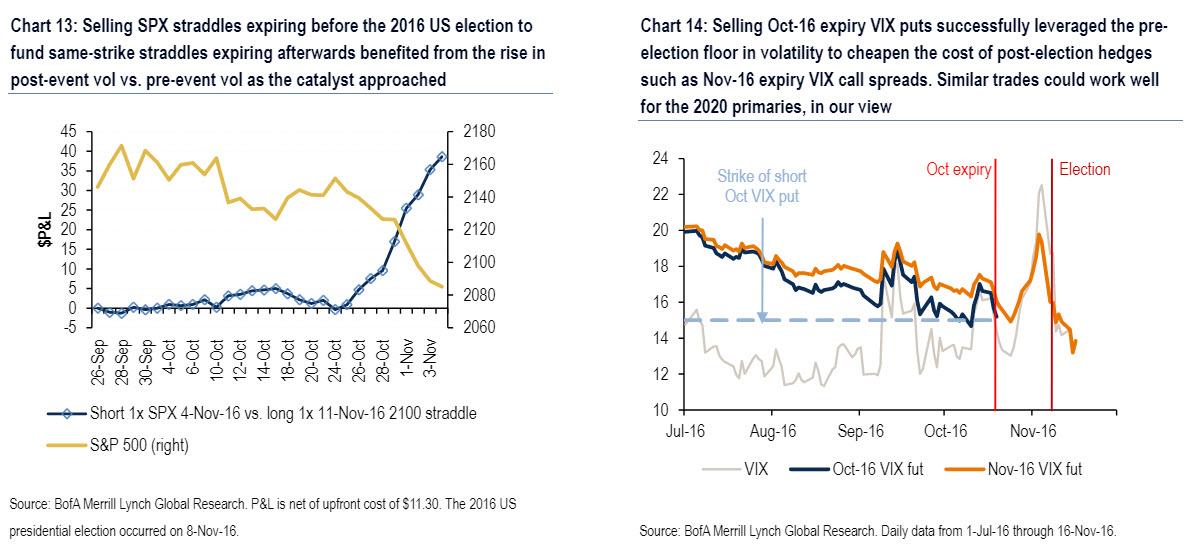
Getting to the big point, should S&P 500 options markets grow more concerned about the implications of a strong Elizabeth Warren showing in the Feb/Mar-20 caucuses and primaries, strategies that sell SPX straddles expiring before the “catalyst” to fund same-strike straddles expiring afterwards stand to profit. This was the case heading into Brexit, the 2016 US presidential election, and the 2017 French elections, when such long-short straddle pairs benefited from an expansion in “event risk premium”. For example, the first chart below shows the hypothetical P&L of a short SPX 4-Nov-16 2100 straddle vs. a long SPX 11-Nov-16 2100 straddle (the US election was on 8-Nov), which achieved a gross payout ratio of ~4.5-to-1. BofA would look to deploy similar strategies once S&P weekly options spanning the caucuses/primaries become listed. Owning the VIX futures fly/condor shown in the next chart below is an alternative way to benefit from a potential rise in primaries event risk premium with limited risk, though likely with less asymmetry as the VIX futures curve tends to dislocate less than the term structure of S&P weekly options in our experience.

Focus on the casualties

According to BofA, financials and health care companies will likely be the biggest “president Warren” casualties. While Warren is broadly regarded as being a less market friendly candidate than President Trump has been, Financials and Health Care are perceived to be the two sectors that stand to lose the most if Warren were to be elected, at least based on her track record and rhetoric. In particular, Financials are likely to weaken on the risk of an increase in regulation (“The real cause of the crash was not some inevitable cycle; this crash was the direct consequence of years of deliberate deregulation…”, Apr 2014 – Elizabeth Warren). Arguably, Financials would also be hurt by falling yields if markets were spooked and a textbook flight-to-safety type of sell-off played out.

The Health Care sector is also at risk given Warren’s push for Medicare-for-All (“I spent a big chunk of my life studying why families go broke. One of the number-one reasons is the cost of health care, medical bills. [..] Medicare for all solves that problem”, Jun 2019 – Elizabeth Warren).

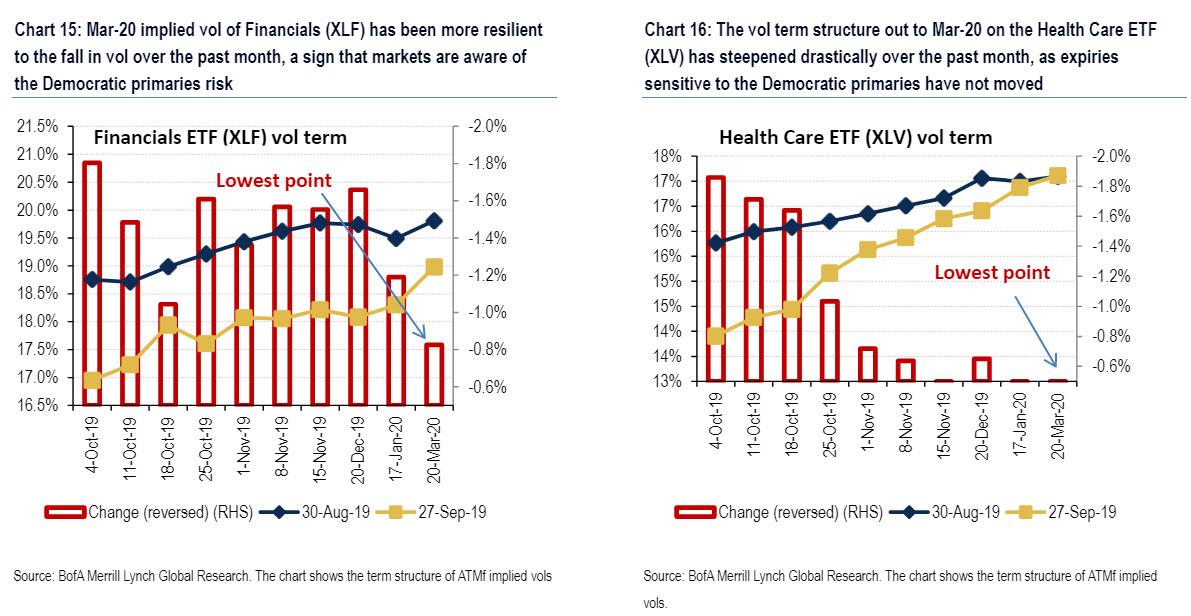
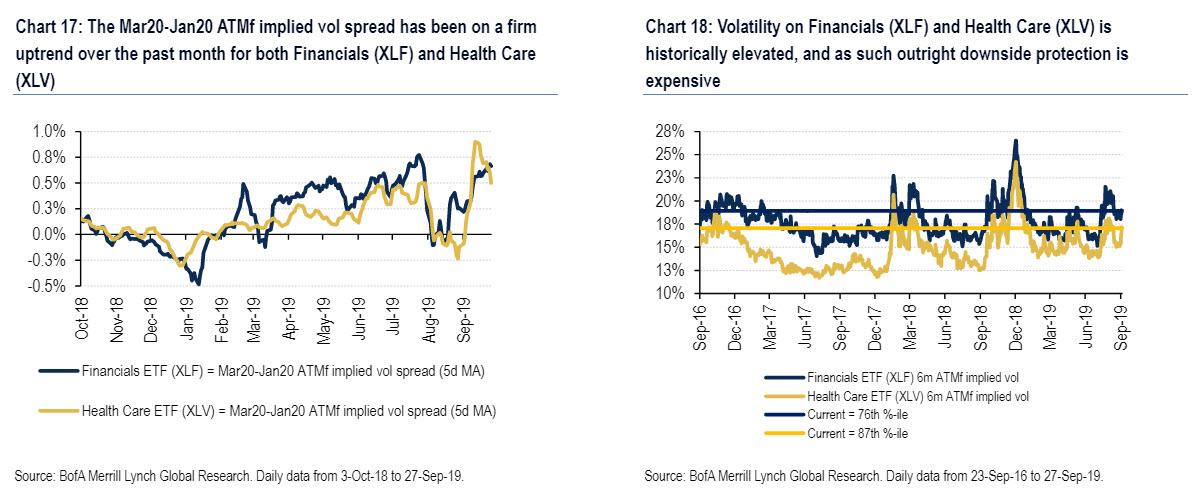
In terms of what is priced-in for the Democratic primaries, it is clear at the sector level that Health Care and Financials are alert to the risks, with for instance Mar-20 expiry vol showing little-to-no change since August month-end vs. a general decrease in all other expiries’ vols (see below charts). Indeed, the Mar-20 minus Jan-20 ATMf implied vol spread has been on a firm uptrend over the past month for both Financials (XLF) and Health Care (XLV).

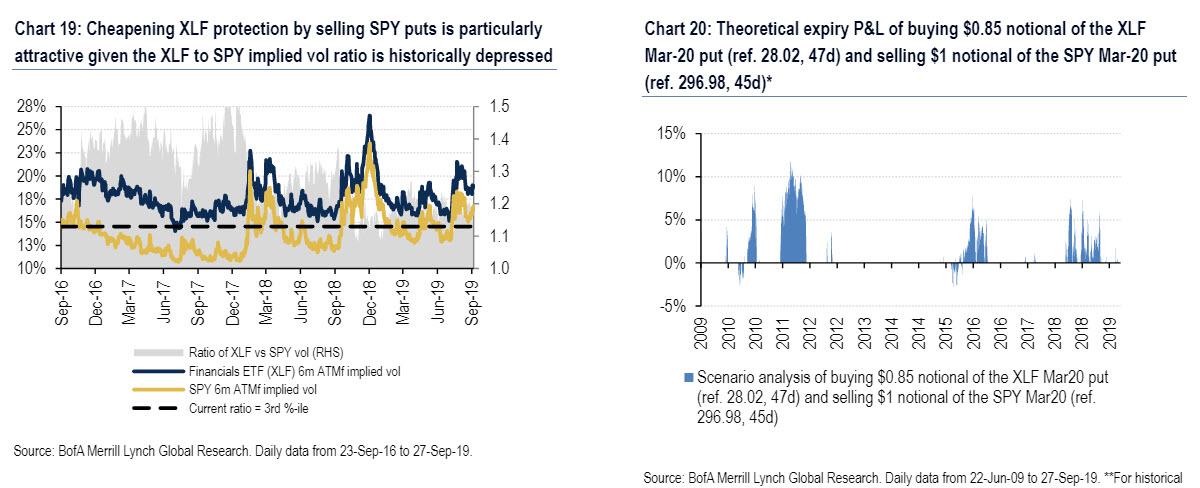
That said, since the volatility of both sectors is historically elevated, rather than recommending buying outright puts, BofA prefers financing downside protection by selling SPY puts. Here, relative value opportunities are particularly attractive between XLF and SPY, given the implied vol spread is depressed both historically and vs. trailing realized vol (the 3m realized vol ratio of XLF vs. SPY is 1.22 vs. the 6m ATM implied vol ratio of 1.13).

As an example, buying $0.85 notional of the XLF Mar-20 put (ref. 28.02, 47d) and selling $1 notional of the SPY Mar-20 put (ref. 296.98, 45d) is roughly zero cost upfront. The theoretical expiry P&L shows a highly asymmetric and favorable historical risk reward profile. For instance, the P&L was positive one-quarter of the time since Jun 09, and negative only 3% of the time. In addition, positive returns were on average 4.1%, 3.6x as large as negative returns. Importantly, the max gain of 11.9% was 4x as large as the max loss (-2.9%). Finally, while the P&L suffered some losses at the start of the 2011 and 2015 sell-offs, the trade ultimately delivered positive returns that outstripped the initial losses.


Tyler Durden

Tue, 10/01/2019 – 14:05

via ZeroHedge News https://ift.tt/2nlDnfj Tyler Durden

On Coins And Canals

On Coins And Canals

Authored Omid Malekan via Medium.com,

A lot has changed since I first started writing that stablecions would become a big deal and disrupt the booming payments and FinTech industries. On the crypto side, blockbuster projects like JPM Coin, the Utility Settlement Coin and Libra were announced. Dai proved resilient despite an ugly collateral winter and public coins like Tether grew even larger. Regulators and central bankers went from not knowing to what they are to obsessing over them.


And yet, on the FinTech side, nothing has changed. Judging by the capital markets, investors now believe in siloed payment providers who own proprietary pipes more than ever. Visa has overtaken J.P. Morgan to become the world’s biggest financial company. PayPal’s stock is 20% higher from when I first wrote about its inevitable demise. Stripe’s valuation has jumped by 50% in less than a year.

Ironically, the ascent of the (soon to be) old guard happened despite all three companies giving stablecoins the ultimate stamp of approval by joining the Libra Association. Here is David Marcus going on about how Libra will change the world by drastically expanding access and lowering fees, and there are three of the world’s biggest payment companies — with business models based on limited access and higher fees — nodding along.

Say what?

I like history, and analogies, and find an appropriate one in the transportation industry of the early 19th century. Moving money is a lot like moving goods. If either money or a physical item needs to get from point A to point B, and you happen to control the only route, then you get to charge a toll. If an unrelated secular trend leads to a lot more goods or payments needing to traverse that route, then you make a lot of money.

Today, the good is electronic payments, and the routes are cards rails and e-money schemes. As commerce grows increasingly digital, global and platform based, the few available pipes to send payments grow increasingly profitable. In the 1800s the good was industrial and agricultural supply, and the routes were rivers and lakes. As the world grew increasingly industrial and trade-oriented, the few available routes out of North America grew increasingly important. Contemporary companies like Stripe and PayPal are changing the payment landscape by building important bridges between legacy payment pathways. Back then, the same thing was accomplished by building canals.

If you aren’t familiar with the canal boom of the first industrial revolution you are missing out. So much of the map, economic layout, population distribution and culture of America can be attributed to a single piece of infrastructure: the Erie Canal. It connected two major shipping corridors in the form of the Great Lakes and the Atlantic Ocean via the Hudson River and literally redrew the map of North America. The Midwestern farm belt, Northeastern Industrial Belt and New York City all ascended because of it. And of course, it was highly profitable. So much so that its tolls paid for the massive cost of construction within 3 years, a repayment time unheard of in the modern era.

Canals are slow, expensive to build and difficult to maintain. But because they were the only game in town in the early industrial era, they were economically important. There was a time when the fastest way to ship goods across Pennsylvania was up to the Great Lakes and down through New York City. The success of the Erie as an economic gateway inspired many other canals to be built at great expense. They all did great, and made a ton of money, until the railroads did them in.

I like this analogy because it shows how in the absence of a proper network that connects two points directly, even the most cumbersome, indirect and expensive transportation options could do extremely well. That’s the FinTech payment boom of 2019 for you. What makes companies like Stripe so successful is that they can abstract away all of the inefficiencies and messy underbelly of the siloed payment industry and give merchants and users a payment experience that looks seamless. This is a valuable contribution today, but not nearly as good as a grid that allows instant point to point transfers of money. That’s the stablecoin vision of tomorrow.

We can stretch this analogy as far as we like. Just as the biggest payment providers of today have joined Libra because they believe it only accentuates their business model, canal operators initially embraced railroads as a means of bringing more goods to their shores. Both stablecoins and railroads are in some ways limited in capacity compared to the infrastructure they hope to replace, but the efficiencies of shipping (or paying) point to point are worth the trade-off.

Some canals survived deep into the railroad boom and were even expanded as a result, which means some of today’s payment gateways, particularly the wholesale ones that move huge sums of money, will be with us well into the stablecoin boom, and possibly benefit from it.

We are already seeing this with Libra. In order for the overall mission to be successfully, the project is going to need a lot of help from the legacy financial system, including certain payment gateways.

I expect the endgame for most of today’s payment players to be the same as those of 18th century canals, now more than ever. A network, be it a physical one for moving goods or a digital one for moving value, wants to be built. The efficiencies and growth economics are too tempting to ignore. The more money the Visas, PayPals and Stripes of the world make operating their canals, the more everyone else will be willing to invest in a network that replaces them — despite challenges like this.

Libra is just the beginning. Whether it succeeds, or even launches, is a moot point. The idea of a decentralized payment network that only charges minimal fees to provide security (as opposed to seeking rent to reward shareholders) has now been validated, and there’s no turning back. If the statement “your profit margins are my opportunity” is to be believed, then there is no greater opportunity in all financial services than a secure global blockchain-based payment network.


Tyler Durden

Tue, 10/01/2019 – 13:45

via ZeroHedge News https://ift.tt/2ob8NVD Tyler Durden