U.S. Life Expectancy Increases for the First Time in Four Years

Average life expectancy in America ascended to 78.9 years in 2014, and then it started declining. By 2017, it had fallen to 78.6 years. But now there’s good news: According to the National Center for Health Statistics (NCHS), this downward trend has stopped. In 2018—the latest year for which we have the data—the average life expectancy of Americans ticked back up to 78.7.

In 2017, the Princeton economists Anne Case and Angus Deaton reported that the falling U.S. life expectancy was largely driven by the rising death rate among poor middle-aged whites. They attributed rising mid-life mortality among poor whites to “deaths of despair“—drug overdoses, alcoholic liver disease, and suicides. They also noted that the mortality gap between whites with a college degree and those without was widening.

A 2019 paper in the Journal of the American Medical Association bolstered the deaths-of-despair hypothesis, noting that “the largest relative increases in midlife mortality occurred among adults with less education and in rural areas or other settings with evidence of economic distress or diminished social capital.”

Interestingly, the new NCHS report notes that the death rates “for age groups 35–44 and 55–64 did not change significantly between 2017 and 2018.”

The two chief reasons for the uptick in life expectancy, according to the NCHS, are the first fall in drug overdose deaths since 1990 and the continuing decline in cancer deaths. Another possible factor: The U.S. population-employment ratio has been increasing, which suggests that as more Americans have success in labor markets they may be less despairing about their life prospects.

from Latest – Reason.com https://ift.tt/2Ua7jck
via IFTTT

Controversy Erupts After Chief Justice Roberts Shuts Down Rand Paul ‘Whistleblower’ Question

Controversy Erupts After Chief Justice Roberts Shuts Down Rand Paul ‘Whistleblower’ Question

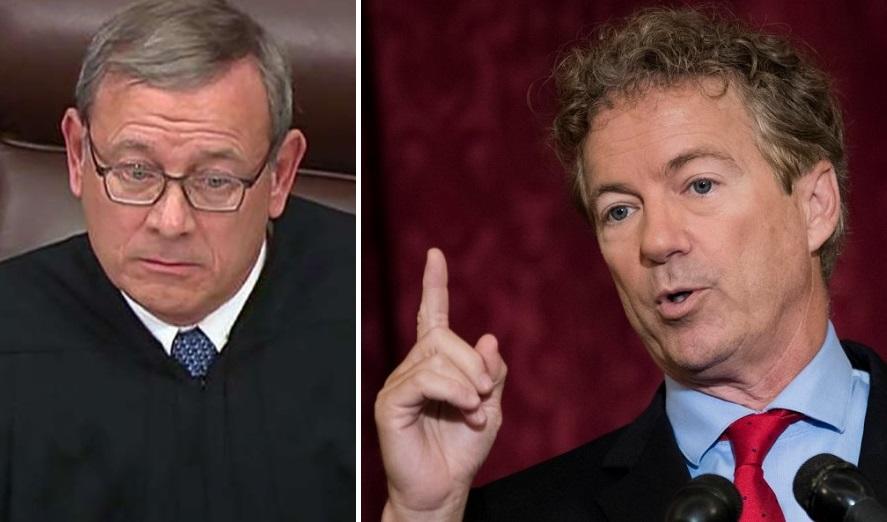
Sen. Rand Paul (R-KY) was spitting mad Wednesday night after Chief Justice John Roberts blocked his question concerning the CIA whistleblower at the heart of the impeachment of President Trump.

According to both Politico and The Hill, Roberts told Senators that he wouldn’t read Paul’s question, or any other question which would require him to publicly say the whistleblower’s name or otherwise reveal his identity – which has been widely reported as CIA analyst Eric Ciaramella, who worked for the National Security Council under the Obama and Trump administrations – and who consulted with Rep. Adam Schiff’s (D-CA) staff prior to filing the complaint.

A frustrated Paul was overheard expressing his frustration on the Senate floor during a break in Wednesday’s proceedings – telling a Republican staffer “If I have to fight for recognition, I will.

Roberts signaled to GOP senators on Tuesday that he wouldn’t allow the whistleblower’s name to be mentioned during the question-and-answer session that started the next day, the sources. Roberts was allowed to screen senators’ questions before they were submitted for reading on the Senate floor, the sources noted.

Senate Majority Leader Mitch McConnell (R-Ky.) and other top Republicans are also discouraging disclosure of the whistleblower’s identity as well. Paul has submitted at least one question with the name of a person believed to be the whistleblower, although it was rejected. Sen. Mike Lee (R-Utah) composed and asked a question regarding the whistleblower earlier Wednesday that tiptoed around identifying the source who essentially sparked the House impeachment drive. –Politico

“We’ve got members who, as you have already determined I think, have an interest in questions related to the whistleblower,” said Senate Majority Whip John Thune (R-SD), adding “But I suspect that won’t happen. I don’t think that happens. And I guess I would hope it doesn’t.”

That said, Paul says he’s not giving up – telling reporters “It’s still an ongoing process, it may happen tomorrow.”

Does Ciaramella deserve ‘anonymity’?

Of note, Roberts did not offer any legal argument for hiding the whistleblower’s identity – which leads to an interesting argument  from Constitutional law expert and impeachment witness Johnathan Turley concerning whistleblower anonymity.

Via Jonathan Turley  (emphasis ours)

Federal law does not guarantee anonymity of such whistleblowers in Congressonly protection from retaliation. Conversely, the presiding officer rarely stands in the path of senators seeking clarification or information from the legal teams. Paul could name the whistleblower on the floor without violation federal law. Moreover, the Justice Department offered a compelling analysis that the whistleblower complaint was not in fact covered by the intelligence law (the reason for the delay in reporting the matter to Congress). The Justice Department’s Office of Legal Counsel found that the complaint did not meet the legal definition of “urgent” because it treated the call between Trump and a head of state was if the president were an employee of the intelligence community. The OLC found that the call “does not relate to ‘the funding administration, or operation of an intelligence activity’ under the authority of the Director of National Intelligence . . . As a result, the statute does not require the Director to transmit the complaint to the congressional intelligence committees.The Council of the Inspectors General on Integrity and EfficiencyCouncil strongly disagree with that reading.

Regardless of the merits of this dispute, Roberts felt that his position allows him to curtail such questions and answers as a matter of general decorum and conduct. It is certainly true that all judges are given some leeway in maintaining basic rules concerning the conduct and comments of participants in such “courts.”

This could lead to a confrontation over the right of senators to seek answers to lawful questions and the authority of the presiding office to maintain basic rules of fairness and decorum. It is not clear what the basis of the Chief Justice’s ruling would be in barring references to the name of the whistleblower if his status as a whistleblower is contested and federal law does not protect his name. Yet, there are many things that are not prohibited by law but still proscribed by courts. This issue however goes to the fact-finding interests of a senator who must cast a vote on impeachment. Unless Majority Leader Mitch McConnell can defuse the situation, this afternoon could force Roberts into a formal decision with considerable importance for this and future trials.


Tyler Durden

Thu, 01/30/2020 – 11:25

Tags

via ZeroHedge News https://ift.tt/3aUnPD5 Tyler Durden

Senator Calls For Immediate Shut Down Of All Flights From China To US

Senator Calls For Immediate Shut Down Of All Flights From China To US

Authored by Paul Joseph Watson via Summit News,

Senator Tom Cotton is calling for an immediate shut down of all flights from China to the U.S., warning that Beijing is lying about the full extent of the coronavirus outbreak.

The death toll from the virus, which has now reached every region in mainland China, has risen to 170 with 7,711 confirmed cases of people being infected.

Republican Senator Tom Cotton is urgently calling for stronger action to prevent the virus spreading in the United States.

“Russia has closed its ENTIRE 2,600-mile border with China. Time to shut down travel between China and US,” Cotton tweeted.

“Israel shuts down commercial flights with China. Time to shut down flights between US and China,” he tweeted separately.

Cotton also warned that the number of coronavirus cases was probably far higher than Chinese authorities are admitting to.

The Senator is also calling on the World Health Organization to reverse its decision to not the coronavirus a global health emergency immediately.

Yesterday, the CDC announced that 195 American citizens who returned from the epicenter of the virus outbreak in Wuhan were not under quarantine and would be allowed to leave March Air Reserve Base in California.

*  *  *

My voice is being silenced by free speech-hating Silicon Valley behemoths who want me disappeared forever. It is CRUCIAL that you support me. Please sign up for the free newsletter here. Donate to me on SubscribeStar here. Support my sponsor – Turbo Force – a supercharged boost of clean energy without the comedown.


Tyler Durden

Thu, 01/30/2020 – 11:05

via ZeroHedge News https://ift.tt/2S0Y0su Tyler Durden

U.S. Life Expectancy Increases for the First Time in Four Years

Average life expectancy in America ascended to 78.9 years in 2014, and then it started declining. By 2017, it had fallen to 78.6 years. But now there’s good news: According to the National Center for Health Statistics (NCHS), this downward trend has stopped. In 2018—the latest year for which we have the data—the average life expectancy of Americans ticked back up to 78.7.

In 2017, the Princeton economists Anne Case and Angus Deaton reported that the falling U.S. life expectancy was largely driven by the rising death rate among poor middle-aged whites. They attributed rising mid-life mortality among poor whites to “deaths of despair“—drug overdoses, alcoholic liver disease, and suicides. They also noted that the mortality gap between whites with a college degree and those without was widening.

A 2019 paper in the Journal of the American Medical Association bolstered the deaths-of-despair hypothesis, noting that “the largest relative increases in midlife mortality occurred among adults with less education and in rural areas or other settings with evidence of economic distress or diminished social capital.”

Interestingly, the new NCHS report notes that the death rates “for age groups 35–44 and 55–64 did not change significantly between 2017 and 2018.”

The two chief reasons for the uptick in life expectancy, according to the NCHS, are the first fall in drug overdose deaths since 1990 and the continuing decline in cancer deaths. Another possible factor: The U.S. population-employment ratio has been increasing, which suggests that as more Americans have success in labor markets they may be less despairing about their life prospects.

from Latest – Reason.com https://ift.tt/2Ua7jck
via IFTTT

Some Thoughts on the Espinoza Argument

I’d like to thank Eugene for inviting me to join the VC, and to my fellow bloggers for having me. I’m really looking forward to posting here!

For my first contribution, I thought I’d post a brief comment about Espinoza v. Montana Dep’t of Revenue, the Blaine Amendment case that the Court currently has under consideration. The Court heard oral argument in the case last week. It’s always tricky predicting the outcome of a case based on oral argument. But it seems pretty clear, at least to me, the the Court will ultimately rule in favor of the petitioners.

Followers of this blog know the facts of the case. (Ilya recently posted about the case here.) Briefly, Espinoza concerns the constitutionality of a Montana school-choice program that allows parents to direct state-funded scholarships to religiously affiliated schools. The Montana Supreme Court ruled that the program violated the state constitution’s “Blaine Amendment,” which prohibits the appropriation of public money for “sectarian” institutions, including private, religiously affiliated schools. Petitioners argue that excluding them from otherwise available scholarship funds, simply because they planned to use the funds at a religiously affiliated school, violates the federal Free Exercise Clause.

Based on the Justices’ interventions, the Court seems likely to rule that, in these circumstances, barring parents from using public funds to pay tuition at religiously affiliated schools is unconstitutional. The Court’s cases point to that outcome. Zelman holds that the Establishment Clause isn’t violated when public money reaches religiously affiliated schools “wholly as a result” of parents’ “genuine and independent choice.” Trinity Lutheran Church holds that a state cannot deny a school access to public financial assistance simply because the school has a religious character. When you put these two cases together, it seems to me, the petitioners prevail.

That’s not to say their victory will be sweeping. For one thing, the Court seems likely to limit its holding to the facts of this case and avoid a ruling on the constitutionality of Blaine Amendments more generally. At least that’s what the Justices’ interventions suggest. Moreover, the four progressive Justices signaled their strong disagreement with the petitioners’ Free Exercise argument.

Interestingly, two of the progressive Justices, Kagan and Breyer, who joined the Court in Trinity Lutheran Church, indicated that they see this case as quite different. Trinity Lutheran Church involved state funds specifically for playground refurbishment–a use unrelated to the religious character of the school in question. Espinoza, by contrast, involves unrestricted funds that a school presumably could direct towards religious education. There is a case that suggests a state may refuse to allow its tax money to be spent for those purposes. But that case, Locke v. Davey, involved tax money for clergy training, not for general education at an accredited, religiously affiliated school–a distinction that will probably persuade the Court’s conservatives that Locke doesn’t apply here.

In short, oral argument suggests another of those familiar, narrow, 5 to 4, Religion Clause decisions. If that’s the case, Espinoza will be an important victory for school choice advocates–though perhaps not as sweeping as they might have hoped. Stay tuned.

from Latest – Reason.com https://ift.tt/2vCCUsZ
via IFTTT

Biased Textbooks Are Just Part of the Public School Curriculum Wars

When you put political officials in charge of education, you get politicized education. That point was made recently in an investigation conducted by New York Times correspondent Dana Goldstein into the ideological customization of textbooks for the numerous public schools of California and Texas. Her article is eye-opening, but it’s only the most recent evidence that the line between education and indoctrination is often blurry when government institutions present the world to the children under their controlwith conflict as an inevitable result.

“The books have the same publisher. They credit the same authors. But they are customized for students in different states, and their contents sometimes diverge in ways that reflect the nation’s deepest partisan divides,” Goldstein writes.

Side-by-side comparison of the eight textbooks Goldstein examines, all published since 2016, reveal very different takes on hot-button issues including immigration, race relations, sexuality, self-defense rights, and economics.

Interpretations of the Civil War and its aftermath remain divisive:

Southern whites resisted Reconstruction, according to a McGraw-Hill textbook, because they ‘did not want African-Americans to have more rights.’ But the Texas edition offers an additional reason: Reforms cost money, and that meant higher taxes.

Whole paragraphs on redlining and restrictive deeds appear only in the California editions of textbooks, partly as a result of different state standards.

Presentations of free markets and private enterprise are also different in textbooks crafted for different states:

Texas policymakers feel strongly about giving students a positive view of the American economy; since 1995, state law has required that high school economics courses offer an ’emphasis on the free enterprise system and its benefits.’ That emphasis seems to have made its way into the history curriculum as well.

California’s curriculum materials, by contrast, sometimes read like a brief from a Bernie Sanders rally. ‘The yawning gap between the haves and have-nots and what is to be done about it is one of the great questions of this time,’ says the state’s 2016 social studies framework.

California and Texas get customized and very differently spun versions of the same publications because they are large markets with centralized state panels that approve textbook acquisitions. As you would expect, the California panel leans left and the Texas panel leans right.

Given how eye-opening the Times investigation is, it’s ironic that a project by the same newspaper now features in debates over politicized education.

“The 1619 Project—The New York Times Magazine‘s much vaunted series of essays about the introduction of African slavery to the Americas—will now be taught in K-12 schools around the country,” Reason‘s Robby Soave noted just days ago. “Many historians, though, have questioned The 1619 Project’s accuracy. Five of them penned a letter to The New York Times expressing dismay ‘at some of the factual errors in the project and the closed process behind it.'”

Billed as corrective to the long-time glossing-over in American classrooms of the legacy of slavery, The 1619 project tacks far in the other direction, portraying the United States as irreparably stained by racism and the practice of human bondage, and free market economics as rooted in plantation slavery.

“Mandating the use of The 1619 Project in K-12 curricula is at best premature until these issues are resolved and the Times makes a good faith effort to answer its critics,” economic historian Phil Magness told Soave.

The curriculum debates of the moment are only the latest manifestation of years-long disagreements over how the world should be presented to students in the public schools.

“The Texas State Board of Education adopted a social studies and history curriculum Friday that amends or waters down the teaching of the civil rights movement, religious freedoms, America’s relationship with the U.N. and hundreds of other items,” CBS reported in 2010.

Tucson, Arizona public schools sparred with critics for years over a controversial ethnic studies program in a battle that presaged a similar debate in California.

Michigan officials divided over partisan lines when it came to issues including the question of whether students should be taught the U.S. is a “democracy” or a “republic.”

And, famously, battles between classroom advocates of creationism and those of evolutionary theory dragged on for decades, starting at least as long ago as the 1925 Scopes Trial. Lost in most reports about that courtroom drama is that the textbook at issue contained not just now-widely accepted ideas about the natural emergence of humanity, but also some truly awful eugenics nonsense presented as fact.

It’s true that people can differ over interpretations of the world around us without the intervention of government officials—and can do a bad job of it entirely free of bureaucratic directives. Howard Zinn’s A People’s History of the United States is the go-to alternative to history textbooks for lefties. But it’s widely criticized by mainstream educators as at least as spun as—and often less accurate than—many of the works it seeks to counter. And private schools can teach nonsense as readily as public schools; if you want your kids to learn creationism today, plenty of fundamentalist institutions are available to do the job.

But Zinn’s estate offers his take on the world primarily to private buyers who want an alternative to official texts. And church-run schools aren’t subsidized by advocates of evolutionary theory—they charge willing parents the price of admission.

By contrast, government officials with control over public schools and the textbooks they use impose their specific visions of “truth” from the top down on the willing and unwilling alike. Their intent is to ensure that approved takes are fed to all of those young voters of the future. That’s a guaranteed recipe for conflict over what’s taught. Such disputes are so common, in fact, that the Cato Institute tracks them in their multitude on its Public Schooling Battle Map.

If you’re looking for a complete fix for biased lessons, it probably doesn’t exist. School choice is no guarantee that children will learn only accurate information, let alone that they’ll be taught to critically analyze their lessons and accept no source as the final word. No approach is going to reach that high a standard.

But when families choose education options that suit them, and avoid those that don’t, there’s much less reason to fight over what’s taught in the classroom. There’s even a better chance for diverse opinions to flourish and be debated in settings where the stakes are lower.

Don’t worry, we’ll still find plenty of other reasons to argue.

from Latest – Reason.com https://ift.tt/38OYKaM
via IFTTT

Some Thoughts on the Espinoza Argument

I’d like to thank Eugene for inviting me to join the VC, and to my fellow bloggers for having me. I’m really looking forward to posting here!

For my first contribution, I thought I’d post a brief comment about Espinoza v. Montana Dep’t of Revenue, the Blaine Amendment case that the Court currently has under consideration. The Court heard oral argument in the case last week. It’s always tricky predicting the outcome of a case based on oral argument. But it seems pretty clear, at least to me, the the Court will ultimately rule in favor of the petitioners.

Followers of this blog know the facts of the case. (Ilya recently posted about the case here.) Briefly, Espinoza concerns the constitutionality of a Montana school-choice program that allows parents to direct state-funded scholarships to religiously affiliated schools. The Montana Supreme Court ruled that the program violated the state constitution’s “Blaine Amendment,” which prohibits the appropriation of public money for “sectarian” institutions, including private, religiously affiliated schools. Petitioners argue that excluding them from otherwise available scholarship funds, simply because they planned to use the funds at a religiously affiliated school, violates the federal Free Exercise Clause.

Based on the Justices’ interventions, the Court seems likely to rule that, in these circumstances, barring parents from using public funds to pay tuition at religiously affiliated schools is unconstitutional. The Court’s cases point to that outcome. Zelman holds that the Establishment Clause isn’t violated when public money reaches religiously affiliated schools “wholly as a result” of parents’ “genuine and independent choice.” Trinity Lutheran Church holds that a state cannot deny a school access to public financial assistance simply because the school has a religious character. When you put these two cases together, it seems to me, the petitioners prevail.

That’s not to say their victory will be sweeping. For one thing, the Court seems likely to limit its holding to the facts of this case and avoid a ruling on the constitutionality of Blaine Amendments more generally. At least that’s what the Justices’ interventions suggest. Moreover, the four progressive Justices signaled their strong disagreement with the petitioners’ Free Exercise argument.

Interestingly, two of the progressive Justices, Kagan and Breyer, who joined the Court in Trinity Lutheran Church, indicated that they see this case as quite different. Trinity Lutheran Church involved state funds specifically for playground refurbishment–a use unrelated to the religious character of the school in question. Espinoza, by contrast, involves unrestricted funds that a school presumably could direct towards religious education. There is a case that suggests a state may refuse to allow its tax money to be spent for those purposes. But that case, Locke v. Davey, involved tax money for clergy training, not for general education at an accredited, religiously affiliated school–a distinction that will probably persuade the Court’s conservatives that Locke doesn’t apply here.

In short, oral argument suggests another of those familiar, narrow, 5 to 4, Religion Clause decisions. If that’s the case, Espinoza will be an important victory for school choice advocates–though perhaps not as sweeping as they might have hoped. Stay tuned.

from Latest – Reason.com https://ift.tt/2vCCUsZ
via IFTTT

Biased Textbooks Are Just Part of the Public School Curriculum Wars

When you put political officials in charge of education, you get politicized education. That point was made recently in an investigation conducted by New York Times correspondent Dana Goldstein into the ideological customization of textbooks for the numerous public schools of California and Texas. Her article is eye-opening, but it’s only the most recent evidence that the line between education and indoctrination is often blurry when government institutions present the world to the children under their controlwith conflict as an inevitable result.

“The books have the same publisher. They credit the same authors. But they are customized for students in different states, and their contents sometimes diverge in ways that reflect the nation’s deepest partisan divides,” Goldstein writes.

Side-by-side comparison of the eight textbooks Goldstein examines, all published since 2016, reveal very different takes on hot-button issues including immigration, race relations, sexuality, self-defense rights, and economics.

Interpretations of the Civil War and its aftermath remain divisive:

Southern whites resisted Reconstruction, according to a McGraw-Hill textbook, because they ‘did not want African-Americans to have more rights.’ But the Texas edition offers an additional reason: Reforms cost money, and that meant higher taxes.

Whole paragraphs on redlining and restrictive deeds appear only in the California editions of textbooks, partly as a result of different state standards.

Presentations of free markets and private enterprise are also different in textbooks crafted for different states:

Texas policymakers feel strongly about giving students a positive view of the American economy; since 1995, state law has required that high school economics courses offer an ’emphasis on the free enterprise system and its benefits.’ That emphasis seems to have made its way into the history curriculum as well.

California’s curriculum materials, by contrast, sometimes read like a brief from a Bernie Sanders rally. ‘The yawning gap between the haves and have-nots and what is to be done about it is one of the great questions of this time,’ says the state’s 2016 social studies framework.

California and Texas get customized and very differently spun versions of the same publications because they are large markets with centralized state panels that approve textbook acquisitions. As you would expect, the California panel leans left and the Texas panel leans right.

Given how eye-opening the Times investigation is, it’s ironic that a project by the same newspaper now features in debates over politicized education.

“The 1619 Project—The New York Times Magazine‘s much vaunted series of essays about the introduction of African slavery to the Americas—will now be taught in K-12 schools around the country,” Reason‘s Robby Soave noted just days ago. “Many historians, though, have questioned The 1619 Project’s accuracy. Five of them penned a letter to The New York Times expressing dismay ‘at some of the factual errors in the project and the closed process behind it.'”

Billed as corrective to the long-time glossing-over in American classrooms of the legacy of slavery, The 1619 project tacks far in the other direction, portraying the United States as irreparably stained by racism and the practice of human bondage, and free market economics as rooted in plantation slavery.

“Mandating the use of The 1619 Project in K-12 curricula is at best premature until these issues are resolved and the Times makes a good faith effort to answer its critics,” economic historian Phil Magness told Soave.

The curriculum debates of the moment are only the latest manifestation of years-long disagreements over how the world should be presented to students in the public schools.

“The Texas State Board of Education adopted a social studies and history curriculum Friday that amends or waters down the teaching of the civil rights movement, religious freedoms, America’s relationship with the U.N. and hundreds of other items,” CBS reported in 2010.

Tucson, Arizona public schools sparred with critics for years over a controversial ethnic studies program in a battle that presaged a similar debate in California.

Michigan officials divided over partisan lines when it came to issues including the question of whether students should be taught the U.S. is a “democracy” or a “republic.”

And, famously, battles between classroom advocates of creationism and those of evolutionary theory dragged on for decades, starting at least as long ago as the 1925 Scopes Trial. Lost in most reports about that courtroom drama is that the textbook at issue contained not just now-widely accepted ideas about the natural emergence of humanity, but also some truly awful eugenics nonsense presented as fact.

It’s true that people can differ over interpretations of the world around us without the intervention of government officials—and can do a bad job of it entirely free of bureaucratic directives. Howard Zinn’s A People’s History of the United States is the go-to alternative to history textbooks for lefties. But it’s widely criticized by mainstream educators as at least as spun as—and often less accurate than—many of the works it seeks to counter. And private schools can teach nonsense as readily as public schools; if you want your kids to learn creationism today, plenty of fundamentalist institutions are available to do the job.

But Zinn’s estate offers his take on the world primarily to private buyers who want an alternative to official texts. And church-run schools aren’t subsidized by advocates of evolutionary theory—they charge willing parents the price of admission.

By contrast, government officials with control over public schools and the textbooks they use impose their specific visions of “truth” from the top down on the willing and unwilling alike. Their intent is to ensure that approved takes are fed to all of those young voters of the future. That’s a guaranteed recipe for conflict over what’s taught. Such disputes are so common, in fact, that the Cato Institute tracks them in their multitude on its Public Schooling Battle Map.

If you’re looking for a complete fix for biased lessons, it probably doesn’t exist. School choice is no guarantee that children will learn only accurate information, let alone that they’ll be taught to critically analyze their lessons and accept no source as the final word. No approach is going to reach that high a standard.

But when families choose education options that suit them, and avoid those that don’t, there’s much less reason to fight over what’s taught in the classroom. There’s even a better chance for diverse opinions to flourish and be debated in settings where the stakes are lower.

Don’t worry, we’ll still find plenty of other reasons to argue.

from Latest – Reason.com https://ift.tt/38OYKaM
via IFTTT
Dow ‘Dead-Cat-Bounce’ Dies As “Not Contained” Virus Fears Spread

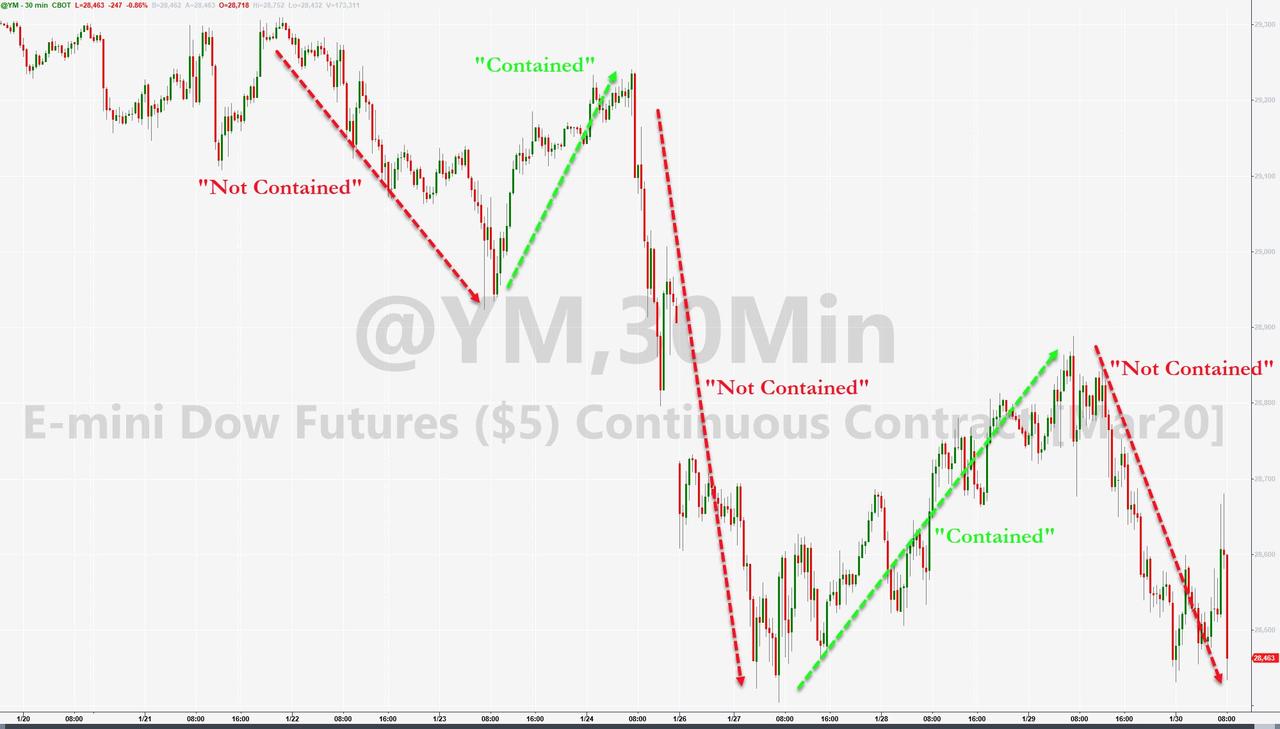
Dow ‘Dead-Cat-Bounce’ Dies As “Not Contained” Virus Fears Spread

The Dow is down 200 points this morning, erasing all the mid-week gains… didn’t we learn the l;esson last week?

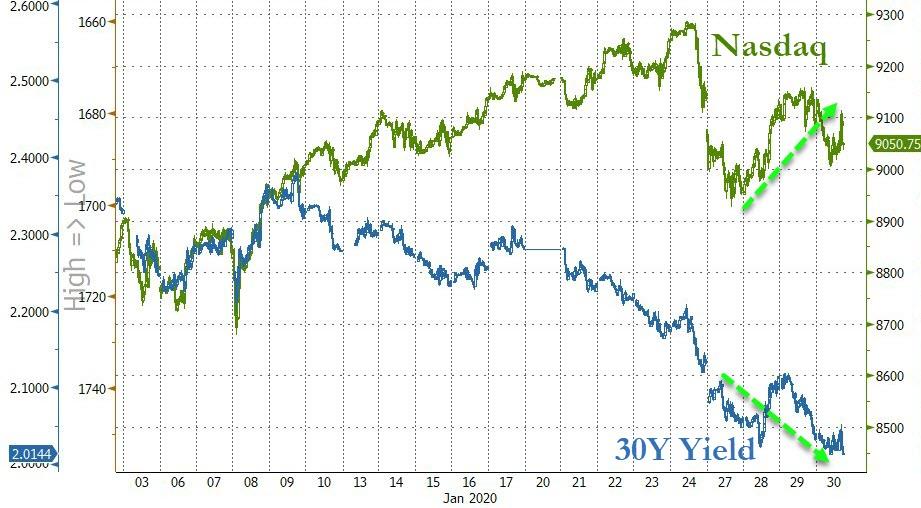
30Y Yields are trading barely above a 1 handle…

Source: Bloomberg

So once again, bonds were right all along?


Tyler Durden

Thu, 01/30/2020 – 11:02

via ZeroHedge News https://ift.tt/2S36eQQ Tyler Durden

One Week After Saying “Cash Is Trash”, Dalio Says It’s Time To Diversify Into Cash

One Week After Saying “Cash Is Trash”, Dalio Says It’s Time To Diversify Into Cash

Ray Dalio has done it again.

Back during the 2018 Davos boondoggle, the Bridgewater founder mocked the “stupidity of holding cash”, and predicted that “if you’re holding cash, you’re going to feel pretty stupid.” One week later, the market suffered a 10% correction, and on Dec 31 of that year, cash would end up being the best-performing asset of the year.

Fast forward to Davos 2020, when speaking to CNBC last week, the billionaire investor doubled down saying “Cash is trash,” and adding “Get out of cash. There’s still a lot of money in cash.”

Just a few days later, the market suffered its biggest drop in months as traders finally realized that the Chinese global coronavirus pandemic is, as the name implies, a global viral pandemic, one which could have a devastating toll not only in terms of human capital but also crippling the Chinese, and thus global economy, and as a result a global liquidation wave reallocation capital out of risk assets and into gold, bonds and, yes, cash.

In other words, maybe cash isn’t trash after all, because as Bloomberg reports, when evaluating market impact of the coronavirus outbreak, Dalio – who admits he knows nothing about pandemics – wrote in his daily note on clients that it is time to play safe and hedge his bets.

“When you don’t know, the best investment strategy is to be smartly diversified across geographic locations, across asset classes, and across currencies,” he wrote, stopping just shy of endorsing trash, pardon cash.

The global coronavirus pandemic has triggered what Dalio describes as “flight-to-quality market action,” with equities selling off globally, while bonds, gold and – yes – cash have rallied.

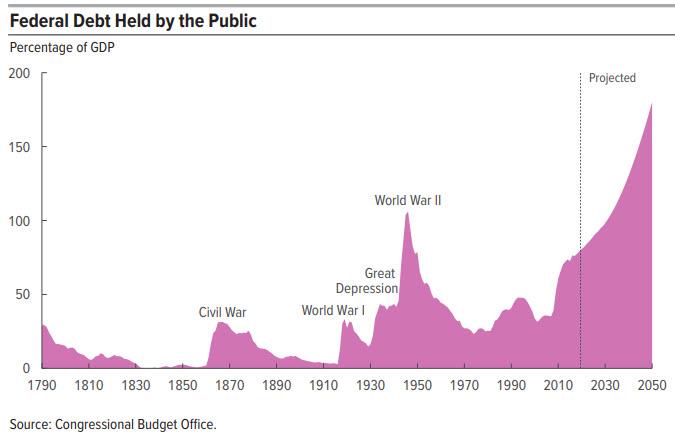
Forever dazzling with his mastery of the obvious, Dalio – who once upon a time endorsed the hilarious concept known a “beautiful deleveraging”, which a few years later led the CBO to predict the following not so beautiful trajectory for US debt/GDP…

… then notes that “being able to understand how investors are reacting will be key.” Which, for those wondering, is not somehow more profound than it sounds.

“We want to pay attention to what’s actually happening, what people believe is happening that is reflected in pricing (relative to what’s likely), and what indicators that will indicate the reversal”, he said, staking yet another claim on the “less than profound statement” scale.

In a note documenting major pandemics dating back a century, Dalio said that no one has any clue on where and to what extent the coronavirus will spread and how will it impact economies and markets. He went on to discuss the economic impact of the Spanish flu that rocked the world in the early 19th century and killed more people than World War I.

In short, Dalio has no idea what happens next and so cash may not be trash after all.


Tyler Durden

Thu, 01/30/2020 – 10:45

via ZeroHedge News https://ift.tt/2u4qGsn Tyler Durden